Category Archives: Uncategorized

Abraham, Ephesians 2, and the Unique Jewish Mission, Part 2

For He Himself is our peace, who made both groups into one and broke down the barrier of the dividing wall, by abolishing in His flesh the enmity, which is the Law of commandments contained in ordinances, so that in Himself He might make the two into one new man, thus establishing peace, and might reconcile them both in one body to God through the cross, by it having put to death the enmity.

Ephesians 2:14-16 (NASB)

This text indicates that the two identified in Ephesians 2:11 as Gentiles and Jews, have become one in Christ. Jesus broke down the barrier dividing the two in order to create “one new man” in which there is peace and reconciliation. “One new man” is a metaphor for the church but, in spite of its apparent simplicity, two diametrically opposing views of its nature appear in the literature. Each of these views is underpinned by antithetical perspectives on Israel in the present era inaugurated by the Christ-event.

-David B. Woods
“One New Man, Part 1 of 2” p.51
from Issue 119/Spring 2015 of Messiah Journal

Continued from Part 1.

The above-quoted scripture is the foundation for both Woods’ commentary in the current issue of Messiah Journal and Derek Leman’s commentary on his blog. Leman addresses “the wall” and what it might actually be from a Judaically-oriented interpretive perspective, and Woods takes on who this “one new man” might be.

Woods quoted Martyn Lloyd-Jones (“God’s Way of Reconciliation” [vol. 2. of “An Exposition on Ephesians”; Edinburgh, Scotland: Baker Book House, 1972], 275) to exemplify the currently held viewpoint of the “one new man” within Evangelical Christianity:

The Jew has been done away with as such, even as the Gentile has been done away with, in Christ…nothing that belonged to the old state is of any value or has any relevance in the new state.

-ibid, p.52

If you’re familiar with my views on supersessionism, otherwise known as replacement theology or fulfillment theology, then you know from my perspective, those are “fighting words.

Conversely, Woods quoted the Union of Messianic Jewish Congregations (UMJC) (“Introducing Messianic Judaism and the UMJC” [Albuquerque, NM: Union of Messianic Jewish Congregations, 2010], 24) to illustrate the “flip side” of the coin:

One new man does not mean that the distinction and mutuality between Jews and Gentiles are obliterated. Instead, it means that Jews as Jews and Gentiles as Gentiles, with their differences and distinctions, live in unity and mutual blessing in Yeshua…they do not become a new generic, uniform humanity.

-ibid
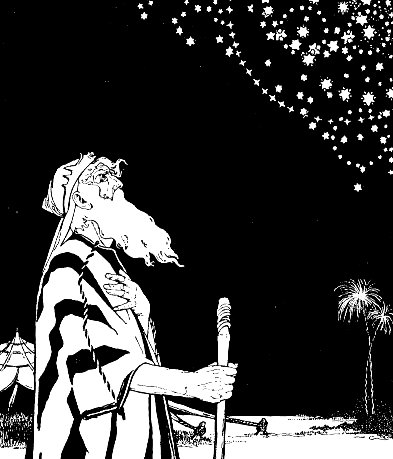
AbrahamThis harkens back to certain passages of Carl Kinbar’s article from the same issue of Messiah Journal: “The Promises to Abraham, Isaac, and Jacob, Part 1” which I mentioned in my previous blog post. God endowed the Jews, through the patriarchs, with certain blessings and responsibilities, and one of those responsibilities is, through Abraham, being a blessing to the Gentiles. This operates through the faithfulness of Messiah and Gentile faith in the God of Israel through Messiah Yeshua, and it only works if Israel, that is, the Jewish people, remain distinct from the Gentile disciples in the Ekklesia of Messiah.

Distinction theory is my term for the theological framework which understands Jewish and Gentile believers in Jesus as distinct in certain significant theological senses, including identity and function (role, service) in the economy of God’s kingdom. That is, a biblical differentiation exists between Israel and the nations within the church similar to that which existed before Christ. This distinction results in a twofold structure within the church that I label “intra-ecclesial Jew-Gentile distinction.” In this framework, the “one new man” or “humanity” as I shall explain, comprises Jews and Gentiles who together are devoted to Jesus.

-ibid, p.53

I know that statement won’t sit well with some people reading this, namely more traditional, mainstream Christians, and certainly many Hebrew Roots proponents. Woods intends on showing from his analysis of scripture, how his view is more Biblically sustainable than those views that insist on the obliteration of Jewish uniqueness of identity and corporate covenant responsibility, either by, in essence, “Gentile-izing” them (and recall that Kinbar says you can’t “unJew” a Jew) or erasing Jewish distinction by assigning Jewish roles and responsibilities to both Jews and Gentiles equally.

To do this, Woods proposes to take the phrase “one new man” and analyze the Greek (and Hebrew) one word at a time. Unfortunately, by the time he ended part 1 of his article, he had addressed only the first word.

His explanation is complex, but in short:

Hena assuredly means one, but Jewish and Christian scholars alike are aware that the word is laden with theological import. God, says Deuteronomy 6:4, is one (…echad–or heis in the Septuagint, where heis and hena are inflections of the same word).

-ibid, p.54

Relative to the Shema and “the LORD is One”, it is just as accurate to translate echad as “unique” or “alone”. Applied to the “one” in “one new man,” this changes the meaning somewhat, from a single fused entity, to a grouping that has the potential to contain other groupings. Certainly “alone” could be compared to “called out”.

Also echad might not imply so much that God is “one and indivisible,” but…

…rather that God alone is to be worshiped to the exclusion of all other gods.

-ibid

Woods also considers basar echad or “one flesh” (Genesis 2:4) and states:

The marriage relationship is dependent on the distinction between husband and wife; thus “unity implies distinctiveness and yet is complementary.”

-ibid
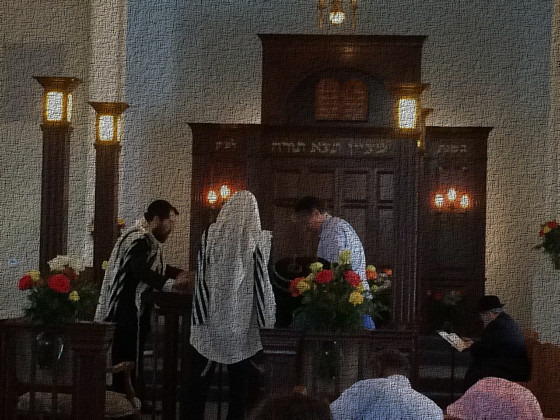
beth immanuel
Beth Immanuel Sabbath Fellowship

Looking back upon the “one new man” as the Messiah’s Ekklesia, we can see that it’s possible to have a group of called out ones that are echad and yet not only can contain sub-groups that are distinct, but that the Ekklesia’s very existence is dependent upon the Jewish and Gentile sub-groups within the larger “one” group remaining distinct and also complementary.

Woods cites Ephesians 2:11-22 in that it notes:

…that the principle distinction between members of the body is their status in Israel: They are either members of Israel (Jews), or they are drawn from among the nations (Gentiles/non-Jews) into fellowship with Israel–yet without becoming Jews.

-ibid, p.55 (emph. mine)

I might change that last part to say that we Gentiles in the Ekklesia are drawn “into fellowship with Israel without becoming Israel.” We have fellowship with Israel without replacing or usurping Israel’s unique covenant relationship with and responsibility to God.

Woods continues building his case for several more pages, but I believe I’ve presented sufficient examples to illustrate where he’s going. However, he won’t begin discussing his understanding of the word “new” until the next issue of Messiah Journal which will be published this coming summer.

Turning now to Derek Leman’s blog post on the Dividing Wall:

I attended a paper in 2013 on the meaning of the dividing wall passage of Ephesians 2. A year and a half later, the interpretation put forward by Jesper Svartvik still looks good to me. I include here a postlude concerning the meaning of “abolishing the law of commandments in decrees.”

So based on Leman’s presentation of the conclusions of Svartvik’s 2013 paper, how are we to understand the “dividing wall” that Yeshua was to have “broken down in his own flesh?”

From Leman’s perspective (taking from Svartvik), the Christian misunderstanding of this “wall” is based on the Christian misunderstanding of the Temple’s sacrificial system:

First, Svartvik said we need to keep in mind a Jewish understanding of sacrifice and the Temple worship, as opposed to same later Christian re-interpretations. Sacrifice at the Temple was about staying in the covenant and not getting in. People were not trying to “get saved” or “be born again” in offering a lamb. They already were in and sacrifices were part of keeping right relation with God.

Second, sacrifice in the Bible is about nearness, the spatial metaphor of “drawing near” to God. The verb most used for offering a sacrifice means literally “bring near.” (As a Hebrew Bible devotee, I can tell you, this is not only true, it is one of the most profound things I wish people knew about the sacrifices and it is one of the major issues I discuss in my book, Yeshua Our Atonement). We might notice that in Ephesians 2 the same nearness issue is being discussed: those who were far off are now brought near.

The Jewish people were near to God and the Gentiles were far off. So how could those who were far off be brought near to those who were already near (the Jews)? How was the enmity between Jews and Gentiles to be resolved? By doing away with Jewish obligation to Torah? By mandating that Jewish obligation to Torah also be assigned equally to the Gentile?

As we see from Woods, forming an “echad” Ekklesia of Jews and Gentiles doesn’t require that both groups be eliminated to form a new, homogenous entity with no distinctiveness contained within it.

As I quoted Leman in my previous blog post, the dividing wall can be understood differently than the four prevailing theories, the “soreg” or literal fence forming the “Court of the Gentiles” in the Temple, the Talmudic “fence” around the Torah commandments, a theological dividing wall between heaven and earth, or, most commonly, the Torah itself. The dividing wall can be understood as a metaphor for the “mistrust and enmity between Jews and Gentiles in the Greco-Roman world in which the apostles founded a movement of faith.”

intermarriageLet’s go back to Woods’ comparison of “one” as the “echad” of a marriage. A man and a woman meet and fall in love. They desire to marry, but there are “issues” that stand between them that must be resolved before they can enter into a life-long commitment to one another. You might say that they have to overcome any “mistrust and enmity” between them before they can be joined as “one flesh” and become something new, not two individuals, male and female, living apart, but “one flesh”, male and female, living in a single family and yet requiring they maintain their distinctiveness.

You can go to Leman’s blog to read the entire text of his essay as well as view the ongoing discussion, but hopefully, I’ve adequately summarized his main point regarding the nature of the “dividing wall” that was torn down through the Messiah. The dividing wall is just a metaphor for the mistrust and enmity that previously existed between Jew and Gentile. In Messiah, those barriers are gone and Jewish and Gentile disciples of the Master can co-exist within the Ekklesia while remaining Jewish and Gentile. This is the same thing as a man and woman getting married and remaining male and female within the family.

Now before someone asks, Leman ends his blog post…

By the way, I should say the theory I just put out there concerning the meaning of “law of commandments in decrees” could never be fully verified as it is an example of trying to fill in a gap left by the writer. We can only guess what fills in the gap. The guess that “law of commandments in decrees” means the whole Torah has huge problems, not least of which is that is a strange way of describing Torah as a whole.

My take away from reviewing Kinbar’s, Woods’ and Leman’s work is that the concept of two unique and complementary groups, one made up of Jews and the other of Gentiles, operating within a single Ekklesia, and indeed, providing mutual blessings to one another, is certainly supportable from a Biblical viewpoint that is Israel-focused and Judaically-oriented, and may well represent the Apostle Paul’s original viewpoint.

Adopting that viewpoint requires divorcing ourselves from the more traditional Christian exegetical perspective on Paul in particular and the Bible in general, so that we may attempt to recapture the actual context and meaning of Paul and the other Bible writers, who were attempting to communicate how God’s vast, sweeping redemptive plan for Israel and the nations was to unfold, first through the Torah, then the Prophets, and finally the revelation of Messiah.

Reviews, by their nature, can only capture a snapshot of the works being reviewed. Again, I encourage you to go to Leman’s blog, and to read the articles written by Kinbar and Woods in the current issue of Messiah Journal to get the full message of what they are presenting. While not everyone who reads my blog may agree with what they have to say, you will see that there are compelling counterarguments to the traditions that have been handed down in the Church for so many centuries. I believe those counter-perspectives must be considered and ultimately accepted by believers in order for Jews and Gentiles in the Body of Messiah to apprehend the true meaning of “one new man.”
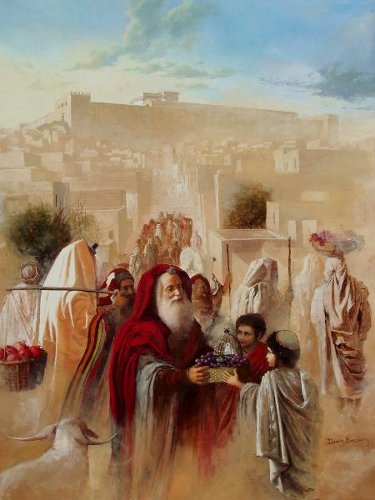
JerusalemIn Part 1, I said that in order to understand the role and purpose of the Messianic Gentile, we needed to understand the role of the Messianic Jew in the Ekklesia. So what did we Gentiles learn about ourselves? Hopefully, I illustrated that our role is to be joined with Israel, not to become or replace Israel. And as I’ve stated before, our purpose in the Ekklesia, in response to being blessed by the Jewish people and the promises God made to Abraham, is to support and encourage Jewish Torah observance and covenant obedience, for without an Israel oriented toward God, there is no redemption for the world.

Abraham, Ephesians 2, and the Unique Jewish Mission, Part 1

I am writing this article to a specific segment of this generation of Jews: those who follow Messiah Yeshua, whether we are in Messianic congregations, synagogues, churches, groups of various kinds that meet in homes, or not actively part of a group. I call us all “Messianic Jews,” but the name is not important; what counts is our connection with Messiah.

We are members of both the body of Messiah and what Michael Wyschogrod calls “the body of Israel.” It is essential that we fulfill our calling and destiny in both communities.

To be frank, many Messianic Jews, myself included, have avoided speaking openly and in depth about the meaning and significance of Jewish existence because we do not want to inadvertently offend others. For now I want to say that the “tasks begun by the patriarchs” that are now entrusted to this generation of Jews have positive and profound implications for the nations. Therefore, if you are not Jewish, I invite you to pull up a chair and listen in. You are welcome here.

-Carl Kinbar
“The Promises to Abraham, Isaac, and Jacob, Part 1 of 3” p.34
from Issue 119/Spring 2015 of Messiah Journal

At two separate seminars I attended in 2009, two speakers presented a different interpretation of Ephesians 2:15; they both claimed that the unity of the “one new man” does not imply, let alone require, a flattening of its Jewish and Gentile members into homogeneity. Instead, the unity spoken of in Ephesians 2:14-16 strengthens the case that Jewish identity of Jews who believe in Jesus is fundamental.

-David B. Woods
“One New Man, Part 1 of 2” p.52
from Issue 119/Spring 2015 of Messiah Journal

Regarding the fourth and most common Christian interpretation, Svartvik said something profound: how would that view fit with “peace to those near” in Ephesians 2? In other words, Yeshua came to bring peace to those near (Jewish people) and far (Gentiles). If he came to nullify God’s covenant with Israel, how is this peace with Israel?

Thus, Svartvik offers a fifth and new suggestion: the dividing wall is not physical or tangible, but is exactly what the text says it is, the mistrust and enmity between Jews and Gentiles in the Greco-Roman world in which the apostles founded a movement of faith.

He offers a comparison with another first century text in which a wall is used as a metaphor for something abstract. In 2 Baruch 54:3-5 the image of a wall refers to a block in understanding or perception: “You pull down the enclosure for those who have no experience and enlighten the darkness.”

-Derek Leman
“The Dividing Wall in Ephesians 2”
Published April 9, 2015 at the
Messianic Jewish Musings blog

You may notice that the common thread running through all three of the above-quoted paragraphs (besides Messianic Judaism in general) is the special status and mission of the Jewish people, particularly those who are disciples of Messiah Yeshua, as distinct and separate from the body of believing Gentiles, whether they are affiliated with Christianity, Hebrew/Jewish Roots, or the Messianic Jewish movement.

Derek Leman
Derek Leman

Each article provides an excellent springboard by which to launch ourselves into further investigation of the relationship between Jews and Gentiles who are attached to Yeshua, and to define the unique roles and purposes of each population as we exist within the Ekklesia of Messiah.

When I first started reading Kinbar’s article and saw that he had specifically written it to a Jewish audience, I felt as if I’d opened and was reading someone else’s letter, at least until he invited non-Jews to “pull up a chair” and become part of the audience. For it is in the definition of the special tasks that the current generation of Jews, both in Messiah and otherwise, have inherited from the patriarchs, that we find a contrasting role for “Messianic Gentiles”.

Both Woods and Leman tackle this topic through the lens of Ephesians 2, with Woods addressing the so-called “One New Man” (Ephesians 2:15) made out of two peoples, Jews and Gentiles, and Leman focusing on the breaking down of the “barrier of the dividing wall” (Ephesians 2:14 NASB) that previously separated those two groups but, “by the blood of Christ” (v.13) have been made one.

They both, as you might imagine, disagree with the traditional Christian interpretation of what “one new man” is supposed to mean, or what the result of tearing down the “dividing wall” was supposed to bring about. Christianity believes that annihilating that wall and creating one new man eliminated distinctions between Jews and Gentiles by obliterating Jewish and Gentile identity. The “one new man” was “neither Jew nor Greek” (Galatians 3:28) but an entirely new creation in Jesus Christ.

Except that’s not how these gentlemen interpret these scriptures.

I should also say it is a shame that Paul’s letters can only be read in their Jewish context via a “radical” and “new” perspective. That is, of course, how they should have been read all along. But a few issues have understandably blocked Christian readers from seeing the Jewishness of Pauline letters and Ephesians in particular. To make a complex issue simple let me just list a few things. Paul’s letters do not address Jewish believers and their concerns, but rather his burgeoning Gentile mission of the earliest Yeshua-movement. Paul does not give us a theology of Jewish identity in relation to Messiah Yeshua because that identity was already well-known and assumed in the background. Jewish identity in Messiah remained rooted in the covenants with Abraham and at Sinai and through David, but the coming of Yeshua marked a new stage in God’s revealing his plan to Israel. It was only later, when the church interpreted Paul as saying there was a break away from Sinai and God’s covenant with Israel, that Jews must now become Christians, that the idea occurred that it would become “radical” and “new” to read Paul as a Jewish writer who had not abandoned his prior beliefs and practices.

-Leman (emph. mine)

Carl Kinbar
Rabbi Carl Kinbar

It is difficult to distill an analysis of all three articles into a blog post or two, so I’ll just hit the highlights, so to speak. Also, since both Kinbar and Woods are writing multi-part missives, and the latter submissions are not yet publicly available, the picture you are going to receive here will be, by necessity, incomplete. I encourage you to read Leman’s blog post and acquire copies of Messiah Journal, issue 119 and the subsequent two issues, to read their complete messages.

In order to “flesh out” the role of the “Messianic Gentile” related to Messianic Judaism and the Jewish people (in and out of the movement), it is necessary to understand to some degree, the role and mission of Jewish people as a covenant people within Judaism and as devoted disciples to Messiah.

Our loyalty to Messiah must be so powerfully integrated into our lives that we are simply unable to conceive of life without him. He must be part and parcel of our lives.

At the same time, being Jewish is a fact of our existence: whether we were born Jewish or converted, it is not even possible to “un-Jew” ourselves. To minimize, ignore, or deny this fact is to minimize, ignore, or deny the meaning and significance of our existence. That said, the fullness of our Jewish identity needs to be internalized just as our loyalty to Yeshua does. Our identity as Jews must be part and parcel of our lives.

Our identity as Jews and our loyalty to Messiah must be internalized and brought into harmony.

-Kinbar, p.35

That harmony is not easy to achieve, and I know of at least three Jewish people, one of whom I am very close to, who fully integrated and internalized their Jewish identities by way of entirely dispensing with their devotion to Yeshua.

What Kinbar said reminds me of an article Stuart Dauermann wrote for issue 114 of Messiah Journal called “The Jewish People are Us – Not Them,” which I reviewed nearly eighteen months ago.

In their separate articles, both Kinbar and Dauermann emphasize the vital importance in Messianic Jewish loyalty and affiliation to the Jewish people and national Israel, but while Kinbar makes his points very well regarding Jewish covenant responsibilities to the Torah mitzvot, to their fellow Jews, and to Hashem, what does this say about we Gentiles?

It all seems to come down to Abraham:

Shaul of Tarsus explains how we receive the blessings in Romans 4, where he writes that when Abraham believed God’s promise that he would have a son, God counted his faith as righteousness. Since this took place before Abraham was circumcised, the blessing is not reserved for the circumcised — that is, for Jews. It is available to anyone who follows in Abraham’s footsteps by relying on God, “who raised Yeshua our Lord form the dead, he who was delivered up for our trespasses and was raised for our justification.” Thus, God’s promise statement that he has made Abraham “the father to many nations” is being fulfilled in the body of Messiah…

-ibid, p.40

Kinbar made what I thought was a very interesting point on the same page:

This changed dramatically when Abraham’s name became more broadly known through the distribution of the Apostolic Writings among the nations of the world. In my opinion, it is not an accident that Abraham’s name appears proportionately more often in the Apostolic Writings than in the Tanach.

And again he says:

Were it not for the Apostolic Writings and the body of Messiah, “the families of the earth” would not have known that they may be blessed in Abraham.

But blessed with what? The evidence is in scripture itself as previously quoted above:

“who raised Yeshua our Lord form the dead, he who was delivered up for our trespasses and was raised for our justification.”

MessiahOur faith and the faithfulness of Messiah results in we Gentiles receiving the promise of the resurrection, the forgiveness of sins, and justification before the Almighty. But remember, these promises are universal because they were given to Abraham before the circumcision. There are responsibilities incumbent only upon the Jewish people based on what was promised to Abraham after circumcision and subsequently promised to Isaac and Jacob:

Everyone who is devoted to Messiah should fear God, but Jews and Jewish communities are uniquely entrusted with the tasks begun by the fathers so that we can confirm the promises that God made to them. Engaging in these tasks is part and parcel of the meaning of Jewish existence: to be a source of blessing to the rest of humanity.

-ibid, p.49

So how are we to understand Woods, Leman, and Ephesians 2 in terms of what I’ve written above? For the sake of keeping this “morning meditation” reasonably short and thus of readable length, I’ll save the answer to that question for Part 2.

Review of Loving God When You Don’t Love the Church: The Conclusion

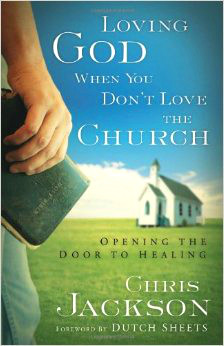
This should be quite a bit shorter than the previous seven reviews I wrote about Pastor Chris Jackson’s book Loving God When You Don’t Love the Church.

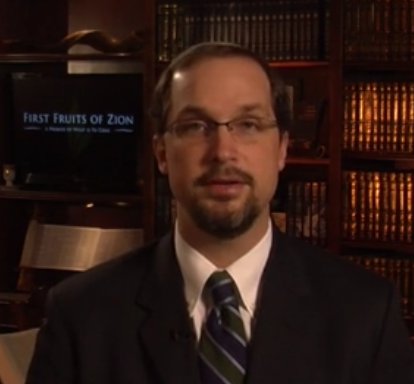
chris jackson
Pastor Chris Jackson

The first part of his book seems to be Pastor Jackson’s acknowledgement of how the Church can be a hurtful place, how Pastors, lay staff, and regular members can be heavy-handed instead of open-hearted, and why thousands upon thousands of people have legitimate reasons for walking away from their local churches if not their faith in Jesus.

Jackson was reasonably transparent in describing how he’s been hurt in church and how he has sometimes caused hurt.

Then he attempted to lure his disenfranchised readers back into church using a number of incentives. One was his belief in a third Great Awakening, a national or even world-wide revival of the Church in response to the moral nosedive of current western progressive culture.

He also described how desperately God loves each and every individual Christian as if each person were His favorite son or daughter. He emphasized how each person was born into this day and age to fulfill a unique role in God’s plan of redemption.

But we can only fulfill that role if we are not only part of the universal Church, but fellowship at a local church. Yes, church can be a pretty uncomfortable place and people can be mean or just plain thoughtless. If one church doesn’t work, go to another. He makes it sound pretty simple.

I read a number of the reviews of this book at Amazon.com. Those who didn’t like the book or who were lukewarm to its message said that it didn’t speak to the specific reasons they left, and I have to join this group.

I left church, not because anyone was mean to me, but simply because my theological and doctrinal viewpoints were so different. Hashkafah is a Hebrew word without an exact English equivalent, but basically it’s one’s worldview, specifically regarding your ideology and the reasons behind your ideology. My “Hashkafah” was inconsistent with that of my local church and after two years, the two viewpoints weren’t even beginning to mesh.

I had spent most of that time meeting regularly with the Head Pastor. We developed a friendship, or so I thought, and we each shared our own personal understanding of the Bible, Jesus, and how God’s redemptive plan was supposed to work. As it turned out, he was trying to convince me to change my mind and adopt his viewpoint and I was doing the same thing.

When he preached from the pulpit against my specific viewpoint, I knew I was being asked to change or leave.

Parting was on good terms, but I haven’t heard from anyone at that church since the day I left. At first, I thought Pastor might keep in touch, but he never called or emailed.

Pastor Jackson encouraged people to make amends and either return to the churches they left or find another church to join. The one thing absent from his book is exactly how to do that. He didn’t develop a “re-entry” plan. He just pumped up his audience with how important they were to God and God’s plan, how important the Church is in the next great revival, and how, to be a part of it all, his readers needed to go back to church.

Glasses on Open BibleBut like I said, he didn’t describe that process. It didn’t help that I disagreed with some of his key interpretations of the Bible and the full purpose of how God plans to redeem the world. In fact, at many points in his book, he reminded me of why I left church in the first place, not because the people were unkind, actually, most of them were very compassionate, but because I was totally alienated among them, a “stranger in a strange land,” if you will. I could only attempt to force a square peg into a population of round holes so long.

I downloaded and read Pastor Jackson’s book, not because I was really looking for a way back in, but because a friend of mine expressed his concern that I was without regular fellowship, as if being alone in my faith opened me up to some sort of “spiritual predator.” I re-examined my original decision using Jackson’s book as a lens. In the end, the view showed me what I’d seen in my local church before.

The Church contains a large number of kind, good-hearted, gentle people who desire to serve Jesus and to preach the gospel message as they’ve been taught. But a church is as much a culture as it is anything else, and I learned (or re-learned) from Pastor Jackson’s book that “church” is not my culture.

I’m sure his book serves his target audience well. It just didn’t serve me, at least not in the way he probably intended.

Review of Loving God When You Don’t Love the Church, Part Seven (The Final Review)

When He made the world, He made two ways to repair each thing: With harshness or with compassion. With a slap or with a caress. With darkness or with light.

“And G‑d looked at the light and saw that it was good.” Darkness and harsh words may be necessary. But He never called them good.

Even if you could correct another person with harsh words, the One Above receives no pleasure from it. When He sees his creatures heal one another with caring and with kindness, that is when He shines His smile upon us.

—cited from Kedushas Levi on Shabbos Vayechi, 5751
-Rabbi Tzvi Freeman
Based on the Letters and Talks of the Rebbe, Rabbi M.M. Schneerson
Chabad.org

Continued from Part Six of this review.

Since the overall theme of Pastor Chris Jackson’s book (not to mention one of Boaz Michael’s books) is healing, I thought the above-quoted statement of Rabbi Freeman’s was an appropriate way to start out this final review.

Beginning with Chapter 18: The 21st Century Christian, Pastor Jackson writes:

Do what the occasion requires! This statement comes from the Bible, from the passage when the prophet Samuel gave this command to the newly anointed King Saul (see 1 Samuel 10:7).

The occasion of the 21st century requires a specific response. It requires a specific breed of Christians. The day and age in which we live requires a specific type of church.

The good news is that God has known all along what the specific challenges of each era would be, and He has strategically placed believers in those eras to respond to them.

Jackson also briefly cited Esther 4:14 and other sources, all to say that each of us, you and me, were born and live in this time for a very specific purpose.

That purpose, Jackson says, is to summon revival, which he discussed in a previous chapter. Quoting Romans 8:19-22, Jackson says creation is longing and groaning as if in childbirth.

Of course he means all this starts with the American church and ripples outward, which is Biblically unsustainable. However, it’s his “hook” to engage his reader, to engage us (or them). What he misses (and how would he ever see it?) is that our purpose as believing Gentiles is to encourage Jewish return to Torah observance, to making Aliyah, all in preparation for the return of Messiah and the rise of Israel to the head of the nations.

We can’t simply coexist with the ideologies of our day. We can’t peacefully allow our nation to be overrun and destroyed by demonic strategies.

See what I mean? Oh, I’m not saying that we shouldn’t pray for our country. We are encouraged to do so in the Bible. But America is not the center of all things. We haven’t replaced Israel. New York, Los Angeles, or Seattle haven’t replaced Jerusalem as the city where the Almighty has placed His Name.

But then Jackson asks an interesting question:

What are some of the specific messages that you were meant to carry?

The response I have in my notes is You have no idea.
The other question, which comes at the end of this chapter is:

Do you believe that God has strategically placed you in this hour of church history?

church-and-crossI don’t know that I’m even part of “church history” or “the Church,” at least as Jackson defines those terms. We search all our lives in an attempt to find purpose and meaning in the world and in God’s plan of redemption. Who is to say for what reason you or I exist at this moment in time?

Moving on to Chapter 19: The 21st Century Church, Jackson continues:

I would like to include a chapter here that slightly detours from specifically discussing you and me as individual believers and instead focuses briefly on the bigger picture of the Church. As we move past the hurts we received in church and resolve to take our place again in God’s plan for His Body, it’s important to recognize what that plan is so we can identify what our role in it might be.

Staying with his focus on the American church, Jackson believes that Christianity has a highly critical role in the history of America right now. Quoting Pastor Jack Hayford of The Church On The Way in Van Nuys, California, Jackson writes:

I perceive “an hour” has arrived. It is an hour of citywide impacting that is beginning to occur in New Testament ways, because New Testament vitality and spiritual penetration is taking place.

I have no idea what that’s supposed to mean, even in the larger context of the original quote. Sometimes, Christian Pastors word things rather oddly, at least from my point of view.

Somehow to Jackson, it means “The church is not irrelevant!” I suppose a lot of atheists would disagree with him, especially given certain events that have saturated mainstream media lately.

In order to describe the church the 21st century needs, he goes through a list of churches we read about in the Apostolic Scriptures, such as those congregations as Ephesus, Colossae, Thessalonica, and Antioch. He also mentioned “other New Testament churches, like the one at Jerusalem.” Really, I was astonished (and so would be James and the Council of Apostles and Elders) that he conceives of the faithful first century Jewish disciples in the Holy City as “a church.” Many of the original communities Paul established in the galut were more synagogues, particularly the ekklesia in Antioch, but modern Christians can’t help revising history to make them “churches.”

I was just as surprised that he cited Numbers 23 and Balaam’s words “How shall I curse whom God has not cursed,” applying them to the Church when clearly Balaam was describing Israel. Has Jackson replaced Israel with the Church? It would seem so.

I know he’s trying to build up his Christian readers and building up the Christian Church in order to convince his audience that it is an institution of destiny and that to be part of that destiny, they must return to their congregations, but in order to do so, he has to bend the meaning of scripture beyond any reasonable bounds.

Throughout the rest of the chapter, Jackson reinvents the “Church” at Antioch to look more like a 21st century Evangelical church. This serves his own perspective and probably the majority of his readers, but I don’t think it serves the Bible or God’s true intent in his redemptive plan for Israel and then the world.

Moving on to Chapter 20: The Life of a Puzzle Piece, we read:

Did you know that you and I are living inside a puzzle box?

jigsaw puzzle boxYes, I’ve always suspected as much. Actually, Jackson means a jigsaw puzzle box, with each of us representing one of the pieces. We all have to fit together (he cites 1 Corinthians 1:10 here) in order to see the big picture.

Jackson relates what he calls “The Parable of the Puzzle Piece” to get his point across. From the point of view of the individual puzzle piece, we can’t see the big picture. The puzzle is actually the body of Christ or the unified Christian Church. If we aren’t part of the entire puzzle, then life has no meaning and makes no sense.

Well, that’s not entirely true, since plenty of atheists find meaning, purpose, and direction in life, and there are Christians who aren’t actively part of a local church that have other means of fellowship, and of course, as Jackson says, rely on their relationship with Jesus to help make sense of their lives.

However, returning to the puzzle piece metaphor, he states that although an individual piece can’t see the big picture, it is absolutely essential in order to complete the big picture. If you’ve ever assembled a jigsaw puzzle only to discover that one or more pieces are missing, it can really be annoying.

This is Jackson’s way of saying that each and every individual Christian is important and matters to God. Just like he said earlier that each Christian should be considered God’s favorite.

But each piece only contains a fraction of the whole and will never “fulfill its destiny” if it isn’t correctly put together with the rest of the pieces.

It’s pretty obvious where Jackson is going with all this, but at one point he adds:

Sometimes it takes several attempts for the piece to find its fit.

In other words, if your first church experience doesn’t work out, try, try again. Cute.

Oh, and a puzzle piece usually fits only in one single spot. Trying to fit a puzzle piece in a gap where it doesn’t fit won’t work out well and the piece will end of being mangled if forced.

Be patient, he says. Your place might not become available until other puzzle pieces are put together.

Although he doesn’t quote 1 Corinthians 12, he does say “Don’t get jealous of any other pieces–we’re all equally important.” Equally important but not identical. Each piece is uniquely shaped and will only fit in one location within the puzzle. This might be a message describing the differing roles of Jews and Gentiles in the Messianic movement.

One of his end of chapter questions is:

Do you know that you are crucial for God’s big picture plan?

Even accepting this, as Jackson said before, the individual puzzle piece can’t see the big picture and therefore is unlikely to know where it fits or what it contributes.

Chapter 21: Old People starts out:

Recently, a number of young adults in our church hosted a very special banquet to honor the senior citizens in our congregation. We wanted to treat them to a night of honor and esteem that would send a clear message that we loved and needed them in our church.

This reminded me of the following commandment from the Torah:

‘You shall rise up before the grayheaded and honor the aged, and you shall revere your God; I am the Lord.’

Leviticus 19:32 (NASB)

older jewish man prayingBut Jackson was simply leveraging the concept of “the wisdom of the aged” to what he imagines an older might say to a younger one. Advice like “I’m not better than you” and “It’s all about relationship” (his favorite theme). The advice is largely just restating points he made earlier in his book about being transparent, Christianity’s evangelical mission, and “God will come through.”

Chapter 22: The Abundant Life begins:

I think the book of Ecclesiastes is probably one of the most overlooked and underrated books of the Bible…

Well, in the traditional church, that’s probably true.

On the other hand, Jackson also says:

…and then moving on to something easier, like the book of Psalms or the gospel of John…

The Gospel of John may seem deceptively easy, but being that it’s the most mystic of the four gospels, I’d have to say that anyone thinking it’s “easy” hasn’t read it in sufficient depth.

Going back to Ecclesiastes, Jackson attempts to distill some Christian principles from Solomon’s wisdom such as “The perspective that this life is only a pilgrimage–a journey toward eternity” and “Enjoyment of life’s simple pleasures.”

The bottom line of this next-to-the-last-chapter of Jackson’s book is in one of his end of chapter questions:

Do you ever consider the fact that this life here on earth is merely the dress rehearsal for your eternal life in heaven with Jesus? How does this change your attitude and perspective?

I assume this is meant to put a life in church community into some sort of positive context with the realization that our earthly life is a test. How we perform on the test determines how or if we share a life “in heaven with Jesus.”

I tend to prefer a more Jewish interpretation of being alive, that what we do is important, not primarily because we will merit a place in the world to come, but because what we do summons or inhibits the return of Messiah. Tikkun Olam (Repairing the World) matters because the world matters to God. In fact, it’s to our world that Messiah will return, and it is here, not in Heaven, where we will reside in the Messianic Kingdom.

Last chapter, Chapter 23: Sleeping With Bathsheba…Again.

So, now what? We’ve looked at the good, the bad, and the ugly of church life, and we’ve recognized that, for all of its very human shortcomings, the Church is still the Bride and the Body of Christ. He is still committed as ever to building it into a force that will overthrow hell in every region of society.

Jackson might almost be writing in a foreign language as far as I’m concerned. No, I understand what he’s saying, but it’s just such a different point of view on the purpose and glory of Messiah from the one I hold.

Jackson goes on to say that “we are the Church” and as such, we can’t remove ourselves from church, anymore than we could remove our heart or our lungs and remain alive. In this case, he means spiritual life, of course.

I’m like you-I’m finished with religion that helps only the ultra-disciplined but offers no life for hurting, desperate people.

I know he’s speaking to his target audience, but this is just another slam against ancient and modern Judaism…”religion but no life”. Jackson believes, based on the current “cultural maelstrom,” that we’re “entering the age of the Church,” that the Church is God’s instrument to bring a fallen world back from the brink of disaster. that there will be a great revival in this country (U.S.A), and that we all can be a part of it if we’re a part of the Church (meaning a part of a local church).

leaving churchJackson actually brings up a point (you probably know what it is based on the chapter’s title) that I sometimes think about. After David’s sin with Bathsheba, David remains married to her and indeed, she becomes the mother of Solomon, the heir to the Davidic throne and ancestor of Messiah.

If those events were to happen today, let’s say with a President instead of a King, most of us would be appalled and call for this President’s immediate impeachment and imprisonment.

But in this case, Jackson is talking about second chances:

Perhaps there’s a Bathsheba waiting for you. Perhaps there are relationships in your church that ended in pain, and you’ve vowed never to return to them.

In other words, reconsider your decision.

And that’s it. The end of the book. Since this is a pretty long blog post, I’ll save my final conclusions for another time.

Review of Loving God When You Don’t Love the Church, Part Six

Do you think of yourself as a leader?

-Pastor Chris Jackson
from Chapter 13: A Leader Who Lost His Cutting Edge
Loving God When You Don’t Love the Church: Opening the Door to Healing

Continued from Part Five of my review series.

I need to find a way to accelerate this review process or it’ll take as many blog posts to finish as Jackson’s book has chapters. Okay, here goes.

According to Pastor Jackson, we are all leaders in the sense that anyone with the indwelling of the Holy Spirit will “rise to the top,” so to speak. That said, rising to the top in our homes, our jobs, and our relationships, as he says, is easier said than done. It’s possible for anyone to lose their “spiritual edge,” as Jackson puts it, including Pastors.

The cure for “spiritual dullness” (and I can relate) is to remember that “the Christian journey is not a sprint, it’s a marathon.” True enough. Any of us can temporarily pull ourselves up by our bootstraps, but for the long haul, we need the faithfulness of God to see us through.

Like most Christians, Jackson says we need to believe in God, but he also says we must experience Him. This goes back to advice I’ve been given in the past about not focusing so much on Judaism or Christianity, but pursuing the presence of God. Jews do that through prayer and the mitzvot and there are Christian equivalents, though Christianity considers itself more of a “relationship” than a “doing” religion.

Jackson asks a telling question:

When was the last time you took the day off of work just to be with Jesus?

If this Pastor had a Jewish appreciation of the Shabbat, he wouldn’t have to ask that question, at least not in that way. He might ask instead, “When was the last time you truly observed Shabbos?” With Easter behind us and now in the midst of the Week of Unleavened Bread, special days of Holiness should be on everyone’s mind, and hopefully, in everyone’s experience.

End of Chapter questions included “Have you lost the edge in any area of your life” and “Are you convinced that you can get it back?”

Good questions.

Moving on to Chapter 14: Mimicking God, Jackson spoke of a small-group meeting he had recently attended where the meeting began:

He opened his Bible to Ephesians 5:1 and read, “Be imitators of God.” After that, he closed his Bible, looked everyone in the room in the eye and said three words: “Now…let’s wrestle.”

Jackson continued, “Some truths must be wrestled with.” I agree, and in fact, I believe that many more truths must be wrestled with than most religious people are willing to engage, particularly in the Church.

While Jackson describes Ephesians 5:1 as a “wrestling verse,” he states that wrestling ends in verse 2: “and walk in love.”

The word “walk” is a great word with a profound meaning. In the Bible it means ” to regulate one’s lifestyle.”

WalkingAgain, Judaism anticipated his response with the concept and application of halachah. Jackson’s “halachah,” if you will, is summarized with the word love. That’s true as far as it goes, but it’s out of this love for God and our neighbor (see Matthew 22:36-40) that we must respond behaviorally. Walking in love isn’t metaphorical, feel-good language, it’s a call to action.

I’m convinced that the primary search of mankind is not for doctrine, religious truth or strategies for successful living; it is for love. It is for acceptance. It is for belonging…

Then why are these things so difficult to find in religious community?

When people in the world see Christians who bear one another’s burdens, who are quick to forgive, who fail to judge and criticize, who are quick to repent and ask forgiveness and who reach out with accepting arms of love, they will feel like they’ve come home. They will realize that they have truly encountered Jesus in our churches.

While I can see his point that living out the teachings of the Master is the best way to communicate the truth of his faithfulness, Jackson seems to have moved from attempting to heal the wounded Christian who is estranged from the Church, to matters of what Christians call “The Great Commission” (Matthew 28:18-20). What’s the connection?

Or is Jackson speaking to the person who not only left the church but left the faith?

The Lord not only wants to heal you from your hurtful experiences in church, but He wants to make you one of his saints.

I’m never really sure what being a “saint” means in this context. Is it equivalent to the Jewish concept of a tzadik, a holy, righteous person who is close to God?

From here, Jackson encourages his readers to consider how children relate to God with that innocent faith that never questions anything. We should be more transparent than performance-oriented, don’t worry so much about “coloring inside the lines” (rules), and instead, becoming “prayer warriors”. We should also consider ourselves God’s “favorite,” as if the world were created only for our sakes individually (and that last part is actually a very Jewish concept).

The chapter seemed to focus on how much God loves each of us as a way of healing our hurts and getting us to reunite with church. By realizing that we are loved by God, we should reflect that love, both to people outside the Church and to other Christians.

Jackson continues with this theme in Chapter 15: Becoming Someone’s Angel. I’ve sometimes said that we should be the answer to someone’s prayer. Instead of waiting for God to intervene supernaturally in some situation, if we see a need and we have the ability to fill it, we should fill it. I think Jackson would agree with this.

Jackson seems filled with his own boundless enthusiasm for the work of the Church, so much so that he said:

I believe the United States is due for a third Great Awakening and that the other nations of the earth can also be transformed by a visitation from Him.

Church splitI believe no such thing, and in fact, based on the ethical and moral nosedive that many churches and all of secular western culture is in right now, I believe that in the end, except for a small remnant, the nations in general and most churches in particular, will turn against Jewish people, Judaism, and national Israel. The churches may call that “a Great Awakening” but based on how I read the Bible, it will actually be rebellion against God.

Like many American Christians, Jackson sees America as the central nation in God’s field of vision. But the Bible says that the centrality of Israel is the lynchpin in God’s redemptive plan for the rest of the world. If Jackson doesn’t see this as well, he’s in for a big surprise when the Messiah returns.

Jackson does rightly say that “most answered prayers come in the form of other people,” but he misses the big, big picture.

He did go on to say something to which I can relate:

One Sunday morning I was so discouraged that I didn’t think I could cut it as a pastor. I didn’t even want to be in church.

I used to have quite a number of Sunday mornings in church where I felt exactly like that, not that I had to worry about being a Pastor, of course. My answer was to stop going to church. My Sundays seem more productive and liberating now.

Jackson then told a story that I think illustrates some of my points well. He mentioned how he had visited a church friend, and older woman who was laid up with an injury, to pray with her. As they were praying, he heard a noise from the bathroom and discovered another woman cleaning the toilet. As it turns out, this other church friend had been coming over pretty much every day cooking and cleaning, as well as praying with the injured woman and keeping her company.

I suddenly felt a little sheepish and realized that this young lady’s cooking, cleaning and other practical help was far more a demonstration of the heart of God than any quick prayer.

I completely agree. I think it’s examples like this young woman, this living, breathing answer to prayer, that trump all of the “religious arguments” we have in the blogosphere, from the pulpit, or anywhere else. Churches and synagogues that preach this sort of message and follow it up with continued action are better than all of the theological and doctrinal pontifications we stack up against each other.

Then in Chapter 16: Ten Times Better, Jackson says:

One of the most significant problems with Christians–with me–is that we so frequently surrender the image of God in us. Rather than living in our glory as the Creator’s image-bearers, we live from our lover, natural selves.

And living like that, Jackson wonders if non-believers ask:

Is that what it means to be a Christian?

alone at churchI’m sure many people who surf into our blogs and read the comments sections ask that same question about Christians, Messianics, and Hebrew Roots people as well.

Jackson makes another good point:

…a major reason that people are leaving the Church today by the thousands is that there is frequently no real discernible difference between Christians and the world.

So many churches, in an attempt to “fit in” with the current culture, “adjust” their Biblical morals and ethics to fit the larger, politically correct and progressive mindset of the world around us. How can the Church be imitators of God if it’s too busy taking its cues from CNN and MSNBC?

For the Church as well as the individual believer, how we live out our faith is a matter of choice. Who are we trying to please, people or God?

None of this is why I left church, but I can agree with a lot of what Jackson is saying. True, he’s speaking from his own Hashkafah, but it’s not as if I can’t relate at all with his worldview, at least the broad strokes of it.

It goes back to what I said before. Don’t seek Judaism and don’t seek Christianity, but seek an experience with God. I might add, then walk on the path He sets before you, even if it leads to some pretty uncomfortable places.

I still don’t think that means back into church, or at least not the church I left. My problem is that I can only see a few steps ahead at a time, so beyond that, I proceed forward trusting that God won’t lead me over a cliff.

Moving on to Chapter 17: Christianity Doesn’t Make Sense Without It, Jackson says:

The Christian religion is a lifelong quest to know our loving Creator and become more and more like Him.

In that, it is indistinguishable from my understanding of Judaism, although exactly how that task is accomplished can look quite a bit different between the two religions. For instance, Jackson asked:

How can I know God more? How can I be more like Him? How can I prosper financially and thus bless my family?

That last question seems distinctly Christian. In Pirkei Avot 4:1, we learn:

Who is rich? He who is satisfied with his lot

That doesn’t preclude ambition and achievement, only that we need not constantly feel that we must have more just because somebody else has or become some television commercial says so. I sincerely hope Pastor Jackson doesn’t subscribe to any form of Prosperity Theology, which seems like a total scam.

Jackson wants to “experience the abundant life” he says Jesus promised him? Really? Does that really mean financial abundance? Is that what the Master meant in John 10:10?

Gateway to EdenJackson goes on to compare Genesis 1:1 with John 1:1 and says “John 1:1 details the real beginning of the story.”

I’m sure from his point of view, that probably seems true, but most Christians read the Bible from the Gospels or from Paul backward rather than from Genesis forward. That unfortunately leads to the false conclusion that “the Church” is the center of God’s plan rather than Israel. And focusing on John 1:1, Jackson says:

If any project, process or expedition gets too far away from its original design, it is destined to fail.

Unfortunately, from my perspective, that describes the Christian Church and the divergent path it has taken across history since the days when the Apostle Paul was sent to be an emissary of the Messiah to the Gentiles.

Jackson goes on to state how Matthew 28:19 “set the course of the Church throughout the ages” based on good, solid principles.”

He compares this with:

Jesus said of the Pharisees that they searched the Scriptures in pursuit of life, but they couldn’t find it. They could not find true life because their religion had become divorced from mission.

In other words, he presents a traditionally Christian discounting of the Pharisees and by extension, all of post-Biblical Judaism. From Jackson’s point of view, 100% of the Church’s mission is evangelizing:

On days when I share my faith with an unsaved person, I’m on top of the world.

And…

I exist to manifest the glory of God.

What about the young woman who was manifesting the glory of God by cooking for a disabled woman and cleaning her toilet?

…and I think I blessed the people who were in attendance. Of course, they were just like me…

I think this is the book’s central message about community, whether Jackson intended it to be or not. Particularly in the church, but most likely in any other human community, we thrive if we are in a group made up of people just like us.

But I’m not just like them.

Life makes no sense…until we return to the sanctuary of God. Christianity makes no sense…until we return to the place of mission.

Up to JerusalemAssuming Jackson isn’t being metaphorical, it seems he’s replaced the Holy Temple in Jerusalem with the Great Commission. This isn’t far-fetched from the Church’s point of view if he believes that the body of Christ is the Temple and that we are all stones that together make up the Temple. He won’t be able to see that we can metaphorically and spiritually be a “temple” and yet there can also be a Heavenly Temple as well as a future Temple on Earth in the coming Messianic Age.

These chapters continue to convince me that, as I said above, I’m not like them.

And further, as I quoted Boaz Michael saying in my previous blog post:

Most religious arguments involve bitter clashes over “what we believe” (theology) and “what we do” (praxis). If we do not share the same hashkafah informing our theology and praxis, this type of debate will be pointless and irresolvable.

And…

For example, many Christians operate under the hashkafah which assumes that the authority of the New Testament has replaced the authority of the Old Testament. This paradigm holds it as self-evident that any conditions established in the Old Testament remain operative only if restated in the New Testament. So long as that paradigm remains firmly in place, there is no point in arguing…

I made it through five chapters today. Only six more to go.

I’ll continue my review in a bit.

Of Dissonance and Hashkafah

Hashkafah is a great Hebrew word without an exact English equivalent. Your hashkafah is your worldview. The term is often used when referring to one’s personal worldview as regards to religion and halachah (Jewish law). It’s the lens through which you view things. It’s how you understand a system. It’s your paradigm of thought. It dictates the way you think about things, and therefore impacts the conclusions you will reach. It’s your ideology and the reason behind your ideology.

-Boaz Michael
“Hashkafah,” p.7
from the Director’s Letter for Issue 119/Spring 2015 of
Messiah Journal

I learned something new today. I learned that my blog is all about discussing my hashkafah, “the lens through which I view things” including my “paradigm of thought” and my “ideology and the reason behind my ideology.”

I’ve said this before but it bears repeating. I’m not writing because I think I’m smarter than other people and that I am delivering my learned pronouncements from some virtual ivory tower. I’m writing to explain what I’ve been learning and how it affects the development of my hashkafah.

Actually, Boaz said so much more in his letter that I found quite useful, which is why I’m sharing this with you. Here’s another useful idea:

A person’s hashkafah (worldview or paradigm) is like the DNA that determines both appearances and actions as a fully formed body. If one’s outward appearance is inconsistent with his hashkafah, it will lead to cognitive dissonance and a crisis of faith.

-ibid (emph. mine)

And that’s what I’ve been experiencing, both in my previous attempt to integrate into a local church and, ironically enough, in my encounters with Messianic Judaism.

For instance, for Shauvot 2012, I attended First Fruits of Zion’s Shavuot Conference at Beth Immanuel Sabbath Fellowship in Wisconsin and I had a blast. I made connections with new people and deepened relationships with old friends.

But the following year, I had started going to church and as a result, I was encountering some of that “cognitive dissonance” Boaz talks about. At the Shavuot conference in 2013, I was confused and conflicted as to who I was and what I was supposed to be doing. I eventually settled in, but not before behaving in such a way that damaged a number of friendships.

The dissonance worked both ways, and not only made it unlikely for me to be invited to attend future Messianic conferences, but ultimately ended up with me leaving church as well.

How do you resolve the dissonance between being attracted to a Messianic Jewish study and practice paradigm and yet not being Jewish?

jackson's bookThis is the reason I’ve been reviewing Pastor Chris Jackson’s book Loving God When You Don’t Love the Church: Opening the Door to Healing. I’m using my review series as the lens through which to look at whether there’s any likelihood of me returning to fellowship or if I should even try. Since Boaz’s letter speaks to what’s going on behind that concern, I consider examining it here part of that investigation.

Here’s what’s at the core of not only my difficulties with the church but with just about every single religious argument we have in the blogosphere:

Most religious arguments involve bitter clashes over “what we believe” (theology) and “what we do” (praxis). If we do not share the same hashkafah informing our theology and praxis, this type of debate will be pointless and irresolvable.

-ibid

That, in a nutshell, describes the vast majority of the religious arguments that happen in the comments sections of my blog and many other religious blogs, especially in the Messianic Jewish and Hebrew Roots spaces.

Although I doubt Boaz intended to, he described exactly what happened between me and the head Pastor of the church I used to attend:

For example, many Christians operate under the hashkafah which assumes that the authority of the New Testament has replaced the authority of the Old Testament. This paradigm holds it as self-evident that any conditions established in the Old Testament remain operative only if restated in the New Testament. So long as that paradigm remains firmly in place, there is no point in arguing…

-ibid, p.8

It took two years to get to this point, but Pastor and I finally arrived on the shores of “there is no point in arguing.”

Boaz, spent much of his letter describing his perspective on the hashkafah of various related movements such as Christianity, One Law, Missionary and Post-Missionary Messianic Judaism, and then what he calls Messianic Judaism for the Nations, which is First Fruits of Zion’s (FFOZ) perspective.

I won’t go into all of that here (I may in a future blog post), but for the sake of matters of dissonance and fellowship (or lack thereof), I’ll focus on the portions of Boaz’s letter I consider relevant. He restated the hashkafah of Messianic Judaism from his previous letter in issue 117 thus:

The practice of Judaism coupled with the realization that Yeshua of Nazareth is the Messiah, the New Testament is true, and the kingdom is at hand.

Boaz Michael
Boaz Michael

My immediate question was how that’s supposed to work for someone who isn’t Jewish. Boaz answers that question subsequently, but does Boaz’s answer work for me? We’ll see by the by.

I do want to mention something regarding Boaz’s hashkafah for Post-Missionary Messianic Judaism since Derek Leman said something similar recently.

Post-Missionary Messianic Judaism is interested in practicing Judaism and maintaining Jewish identity, because Torah is seen as covenantally binding on all Jews. It has an interest in restoring the faith and practice of first-century believers for Messianic Jews, but not for Gentiles. Under this vision for Messianic Judaism, Gentile believers belong in Gentile Christianity identifying as Christians and Messianic Jews belong in Messianic synagogues identifying as Jews.

-ibid, p.10 (emph. mine)

It’s important to remember that Boaz distinguishes his personal (and FFOZ’s official) hashkafah from this Post-Missionary description, but it’s equally important to realize that there is significant overlap. So what does this mean for the so-called “Messianic Gentile?” What is FFOZ’s hashkafah for Messianic Judaism for the Nations?

The practice of Messianic Judaism by both Messianic Jews and Messianic Gentiles for the sake of continuity with the New Testament and the coming kingdom.

He further defines this view of Messianic Judaism as “the Judaism of the Messianic Era.” As far as that goes, I agree with him, and I’ve said more than once that when Messiah returns, as such, there will be no such entity as “the Church.” There will only be Messianic Judaism as it applies to Jews and to the people of the nations.

Relative to the rest of the Judaism in our world, Boaz states:

Our hashkafah acknowledges Jewish authority. We do not believe the New Testament stripped the Jewish people of the biblical and God-given authority to transmit, interpret, and apply the Torah. Although the rest of the Jewish world may be enemies regarding the gospel, they are nonetheless beloved for the sake of the fathers (Romans 11:28).

morning prayerIn other words, God did not abandon the Jewish people or Judaism nearly two-thousand years ago all for sake of the Gentile Christian Church. He didn’t change horses in mid-stream, and He didn’t jump from Plan A to Plan B in Acts 2 or anywhere else in the Bible, or for that matter, in post-Biblical times. God is with the disciples of Yeshua (Jesus) and God is also with His people Israel, the Jewish people, all of them, for the sake of His promises in the Torah and the Prophets as well as the aforementioned Romans 11:28.

As far as Messianic Jews and Messianic Gentiles, Boaz says:

Our hashkafah distinguishes between Jews and Gentiles and their respective obligations to the Torah. Since we accept the authority of the apostles, who also made that distinction clear, we maintain distinction. We advocate the integrity of Jewish identity as defined by Jewish tradition, with all its associated prerogatives, privileges, responsibilities, and obligations. We advocate the integrity of Messianic Gentile identity with its own prerogatives, privileges, responsibilities, and obligations as defined by the New Testament. Although Messianic Jews and Messianic Gentiles are two distinct groups, they share one religion.

While I wholeheartedly agree with all of that, I still asked myself where the Gentile praxis is defined specifically. It seems to vary from one Messianic group to the next, and my personal response was to give up all (or almost all) practice that could even tangentially be considered Jewish (I will still occasionally use a siddur).

I’m writing this on Saturday afternoon (I’m not much of a Sabbath-keeper anymore). Last night, my family and I had a very pleasant, low-key, and quite yummy Passover seder. I’m still getting full noshing on left-over matzah ball soup, and matzah and hummus.

This morning, my wife (who is Jewish) went to shul at the local Chabad, and I believe she’ll be attending the second seder night there as well (which means she won’t be home until very late). One of the obligations I believe we “Messianic Gentiles” have is encouraging and supporting Jewish Torah observance. To that end, I’m delighted she can partake of Jewish community as a Jew. I wish the same for all Jews, Messianic or otherwise.

Now if only someone would write and publish the definitive guide to Messianic Gentile praxis within the context of “Messianic Judaism for the Nations.”

I would encourage you to see our various works in our Mayim Chayim series: Mezuzah, Tzitzit, Tefillin, etc.

-ibid, p.12

Tent of DavidApparently there is a praxis for Messianic Gentiles, and after a few minutes and a quick Google search, I remembered that in past years, FFOZ had published a series of small booklets about different aspects of Jewish practice as applied to non-Jews. Toby Janicki wrote about Gentiles and Tefillin in this 2007 blog post. However, a quick search of the FFOZ online store front didn’t yield any positive results, so I can’t point you to where to purchase them. I remember possessing at least some of these booklets in the past, but either I loaned them to interested parties who never returned them, or they didn’t survive one of my wife’s “reducing clutter” projects.

Now as I said, so far, I agree with Boaz on most or all of the points he makes in his letter. But in terms of my own situation and especially the last two-and-a-half years of my personal history, here’s the kicker:

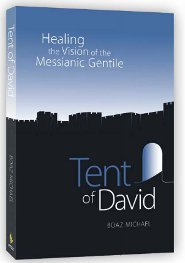
I should point out that I do not believe that Gentile believers need to leave their churches and join a Messianic synagogue or Sabbatarian group in order to be part of Messianic Judaism. As I advocate in my book Tent of David, I feel the best place for most Messianic Gentiles, at this point in history, is to remain in their respective churches, supporting the local church’s efforts for the kingdom and becoming an ambassador within that church for this message of restoration. Yes, it may be lonely, one may face theological opposition in the form of subtle anti-Semitism and not-so-subtle replacement theology, but disciples of the suffering servant should expect to suffer a little bit. If we greet only those who greet us and love only those who love us, what reward will we get?

-ibid

Now let’s compare that paragraph to two of Boaz’s previous statements:

Most religious arguments involve bitter clashes over “what we believe” (theology) and “what we do” (praxis). If we do not share the same hashkafah informing our theology and praxis, this type of debate will be pointless and irresolvable.

And…

For example, many Christians operate under the hashkafah which assumes that the authority of the New Testament has replaced the authority of the Old Testament. This paradigm holds it as self-evident that any conditions established in the Old Testament remain operative only if restated in the New Testament. So long as that paradigm remains firmly in place, there is no point in arguing…

I think Boaz’s suggestion works with some Messianic Gentiles in some churches under certain circumstances. I don’t believe it can be universally applied to all Messianic Gentiles in all churches under all circumstances. Of course, that’s not what I think Boaz is suggesting, but still, we must acknowledge that in terms of the “Tent of David” ideal, one size does not fit all.

Don’t worry. It’s not like I’m pounding on the doors of some Messianic Jewish community demanding to be let in. Far from it. As I’ve said many times before, my current family situation would prohibit such a thing, even if the perfect Messianic shul was just down the street from my house.

As far as church goes, I went in with the idea of being an ambassador and left to avoid being a nudnik (pest), at least any more than I’d already become.

To be fair, Boaz also said:

At the same time, I believe that the Messianic synagogue should function as a daughter of the holy Temple: “A house of prayer for all nations.” What would it look like if Messianic Judaism was to open its doors to the many Gentiles who come flocking to Messianic Judaism seeking leadership, direction, and spiritual guidance? What if Messianic Jews took up our role as the head, and not the tail, and we began to lead and shepherd our Master’s flocks? What might that look like?

alone-desertGiven the goal of maintaining Jewish identity and distinctiveness, all of that is easier said than done. Boaz says “Messianic Judaism is the Judaism of the Messianic Era–practiced today.” Well, sort of. There’s still so much we don’t know about exactly how Messiah will consider Jewish vs. Gentile devotees. It would be nice to believe there’s a way to smooth out all of the rough edges between Jews and Gentiles sharing Jewish community in Messiah, but I can only have faith that this is something Messiah will accomplish when he returns.

What’s the bottom line for me? Like my reviews of Pastor Jackson’s book, while I can see what both of these authors mean, and I can see it working for others, I don’t see a personal application. I’ve said before that I was willing simply to surrender the idea that I must be in community at all. I have limited social needs, so it’s pretty easy for me to be self-contained and to progress forward as an individual. Relative to my faith, it’s what I do at home anyway. It was only the concerns of a friend that had me return to this topic and take another look.

I’ve finished reading Pastor Jackson’s book and I’ll continue my reviews soon.

Final Note: I realize that every time I mention Boaz Michael and First Fruits of Zion, those people who have “issues” with him and his organization tend to make a number of rather “uncomplimentary” remarks in the comments section of my blog. I insist that you stick to the actual issues I’m discussing, that is the hashkafah of Messianic Judaism for the nations as contrasted with Post-Missionary Messianic Judaism and with Christianity as applied to my personal situation. If you can’t comment within the bounds of decorum and avoid committing lashon hara, then consider not commenting at all. Thank you.