Category Archives: Uncategorized

Sermon Review of the Holy Epistle to the Hebrews: A Sabbath Rest Remains

The Sabbath represents the Messianic Era and the menuchah of the world to come. In Hebrews 3:7-4:11, the holy epistle to the Hebrews compares this present world to the work week of preparation, and he warns us to prepare ourselves now for the kingdom and the world to come. This important message demonstrates that Hebrews 4 should not be used to justify a spiritual interpretation of the Sabbath that makes actual Sabbath observance obsolete.

-D. Thomas Lancaster
Sermon Eleven: A Sabbath Rest Remains
Originally presented on March 16, 2013
from the Holy Epistle to the Hebrews sermon series

Lancaster spent about the first half of his sermon reviewing the previous sermon. Remember we were left with a cliffhanger? What is God’s rest? Is it…

  1. The Sabbath?
  2. The Land of Israel?
  3. The Messianic Kingdom/The World to Come?

We are told a number of stories in today’s sermon, most from the Talmud, such as one found in Tractate Sanhedrin 98a, of Rabbi Joshua ben Levi who, while meditating near the tomb of Rabbi Shimon Bar Yohai, met the Prophet Elijah.

Rabbi ben Levi asked Elijah, “When will the Messiah come?” asked Joshua. “Ask him,” replied the Prophet. “The Messiah is at the gates of Rome, sitting among the poor, the sick and wretched. Like them, he changes the bindings of his wounds, but does so one wound at the time, in order to be ready at a moment’s notice.”

The Rabbi traveled to Rome, found the Messiah, and greeted him with ”Peace upon you, my Master and Teacher, to which the Messiah replied, ”Peace upon you, son of Levi.” When the Rabbi asked Messiah when he would come, Messiah replied, ”Today!”

But by the time Rabbi ben Levi returned to Elijah, the Messiah had not come. Messiah had lied…or did he?

Elijah explained “This is what he said to thee, To-day, if ye will hear his voice”, a reference to Psalms 95:7, making his coming conditional with the condition not fulfilled.

You should remember Psalm 95 from last week’s review, since it figured heavily in laying the foundation for our “mystery” of what is meant by “God’s rest” or for that matter, the mystery of “What is today?”

Before continuing, as Lancaster said, Hebrews 3 and 4 are frequently used by many Christian Pastors to prove that a literal Saturday Shabbat has been done away with and that it has been spiritually “converted” into Christ. Our Sabbath rest is Jesus Christ. Problem is, this letter was written by a Jewish writer to a Jewish audience who were still keeping the Sabbath. While Gentiles may not have been placed under that aspect of Torah obedience, these Jews were still Jews and were still performing all of the mitzvot including observing Shabbos.

But these guys were tired. They’d been waiting for the return of the Messiah for thirty years and their faith and patience were wearing thin. They either had been barred from the Temple because of their Messianic faith or were about to be. As we learned last week, the writer of Hebrews was adjuring them to keep their faith in Messiah or risk the fate of that faithless generation in the desert who disobeyed God and did not enter the Land of Canaan to take it as their possession. They did not enter God’s Sabbath rest.

But again, what is God’s rest?

Therefore, while the promise of entering his rest is still open, let us take care that none of you should seem to have failed to reach it.

Hebrews 4:1 (NRSV)

Apparently it was something that the readers of Hebrews could still attain since ”his rest is still open.” If Lancaster is right, then it can’t be the literal Saturday Sabbath, because they were already keeping that. It couldn’t be literally the Land of Israel, because they were already there.

…again he sets a certain day—“today”—saying through David much later, in the words already quoted, “Today, if you hear his voice, do not harden your hearts.”

Hebrews 4:7 (NRSV)

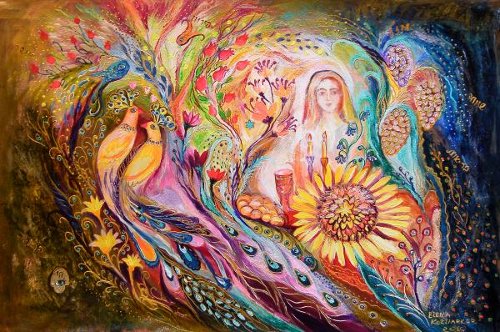
shabbat-queen-elena-kotliarkerLancaster went through a rather lengthy explanation of what “today” means, which includes literally this very day, that is, right now. But from our perspective, it’s always “right now” or “today.” Part of what the Hebrews writer is saying, according to Lancaster, is that as long as you are still alive, “hear (heed) his voice, do not harden your hearts, ” but repent and return to God.

But “today” is also idiomatic language for the Shabbat. I just got done saying this wasn’t about a literal Shabbat on Saturday, but what were the Hebrews risking by a lack of faith? And why did Lancaster tell the story of Rabbi Joshua ben Levi, Elijah, and Messiah?

The object of the Midrashic story from Talmud was to say Messiah would come today if Israel would repent. The Jewish readers of the Hebrews letter will enter God’s rest if they repent. If the coming of Messiah is linked here to God’s rest, then what is to be entered is the Messianic Kingdom.

The Sages liken the Shabbat to the Kingdom of Heaven and the World to Come. It’s as if the days of the week and Shabbat represent the different ages of creation with the seventh day, the end of time, being a grand, millennial Shabbat, an age of great rest, and our weekly Sabbaths are merely a periodic reminder, down payment, or foretaste of that ultimate rest in Moshiach.

This seems to resolve Lancaster’s mystery or cliffhanger, but in fact, he states that it was a trick question. Since the Messianic Age is future oriented, then Hebrews 3 and 4 are not only a rendition of history but prophetic. It may surprise you to realize that all of the prophesies in the Bible have to do with Israel and Jerusalem and for all prophesies to be fulfilled, there must be an Israel and Jerusalem. No Israel, no fulfillment of prophesy.

So a literal Sabbath, a literal Land of Israel, and the Messianic Age to Come all figure into God’s rest and the object of Lancaster’s sermon for the past couple of weeks.

He says some interesting things about work and rest:

Let us therefore make every effort to enter that rest, so that no one may fall through such disobedience as theirs.

Hebrews 4:11 (NRSV)

one-of-ten-virgins-oilWhy do we work to enter God’s rest? I thought we were saved by grace. Lancaster says we must do all that is necessary to get ready for the Messiah’s return, even though it will never be enough. It’s like if you keep a traditional Shabbat. On Friday you work and work and work to get ready, but even if you don’t get everything done in time, Shabbat comes and then you stop, you are quiet, there is peace, and there is rest…

…whether you’re ready or not.

Jesus said “It is finished” on the cross (John 19:30) and in the past, I’ve said that it can’t mean literally all of Messiah’s work is finished. If it did, then he wouldn’t have to return. But in another sense, besides Messiah’s suffering, something else was finished, which was the inauguration of the Messianic Age. It started with the death and resurrection, so that part’s finished, but everything will not be completed until all of Israel (according to Lancaster) repents:

“Jerusalem, Jerusalem, the city that kills the prophets and stones those who are sent to it! How often have I desired to gather your children together as a hen gathers her brood under her wings, and you were not willing! See, your house is left to you, desolate. For I tell you, you will not see me again until you say, ‘Blessed is the one who comes in the name of the Lord.’”

Matthew 23:37-39 (NRSV)

I should say that Rabbinic opinions differ on this point, with some saying that Messiah will come when all Israel repents, and others saying that Messiah will come when Israel is wholly corrupt and about to fall. Lancaster apparently is taking the former view.

So does “get ready” and “strive” and “work” mean “shore up your faith?” I can see why Lancaster says we’ll never be ready because no one’s faith will ever be perfect. Of course, we have the Parable of the Ten Virgins (Matthew 25:1-13) that says there are things to be done, preparations to make, to be ready for the coming of the bridegroom (Messiah), with the oil in their lamps representing perhaps our faith and devotion to God.

And yet without God’s grace, nothing we do could ever be enough all by itself to merit the Messianic Age and a life in the world to come, which is part of what Joshua ben Levi wanted to know from Messiah. But being faithful and obedient, by grace, we shall enter God’s rest if we persevere to the end (see 2 Timothy 4:7).

What Did I Learn?

I think I’ve been learning this lesson for a while now. I wrote a little bit about it nearly two years ago, and it also seems associated with something I wrote more recently.

Beyond that, someone commented about one of my blog posts on Facebook not too long ago. I’ll withhold his name unless he allows me to use it, but here’s what he said:

A.) There’s 6,000 years of linear-time human history since Adam & Chava ‘stepped out of Gan Edan into the physical world of existence.’

B.) For the sake of Israel, G-d will deduct ‘time served in the captivity of Egypt’ from the 6000 years. Consensus opinion is 210 years.

C,) Mashiach comes and ushers in a 1,000 year earthly kingdom with Israel as head of the nations

D.) At the end of this 1000 year “shabbat hagadol” the earth is ‘recreated’ and existence as we know it ends and begins in a new reality – THIS is the time of the New Covenant, as outlined in the Tenakh, the writings of the sages and the final chapters of the book of Revelation.

E.) The New Covenant existence is one of no more ‘evil,’ no more ‘free will,’ no more ‘choice,’ no more ‘sin,’ no more consequence of sin, i.e., death, suffering, sadness, etc.

Of course, the eye-catcher in all that is the 210 year idea and how it relates to the Jewish calendar. We are presently in 5774 which would mean another 226 years maximum to go (Messiah can come any time in a 40-year window before this but no later.) Now, deducting the 210 years for ‘time served in Egypt’ we have a year that corresponds to 2030 on our western calendars. This is not some modern nonsense to sell books. It is primarily from the Zohar first published in the 13th century. Rabbi Pinchas Winston has some interesting stuff on this.

This will all make more sense if you listen to Lancaster’s forty minute sermon on A Sabbath Rest Remains, since I hardly have related everything he taught. This is just a review. Also remember that taking midrash and mysticism too much to heart is a lot like playing with matches. It’s dangerous and you could get burned. Just saying.

practicing_faithAs I conclude this eleventh sermon in a series that is still ongoing over a year after it started, I find I could easily get lost. There is so much detail involved, so many sources and references, both inside and outside of the Bible, to consult and connect, that it’s hard for my mind to apprehend and hold in focus everything all at once.

OK, I admit it. I can’t keep everything Lancaster’s taught so far in my head in “active memory,” so to speak, all at the same time.

So, like most people, I have to reduce a lot of talking and studying into a small, manageable point. Faith is an active and even physical process. It may start with intellectual ascent of the existence of God and a spiritual awareness of the presence of the Creator, but that means nothing unless it also encompasses a lived obedience to God.

For the generation who died in the desert (except for a very few such as Joshua and Caleb), even the physical awareness of the Divine Presence with them for over forty years on a daily basis was not enough for them to merit entry into the Land of Israel or into the Messianic Kingdom. They failed to obey. They failed to fulfill the promise of God to Abraham, Isaac, and Jacob by entering the Land, going to war, and taking possession of Israel.

For the readers of the letter of Hebrews, like the generation in the desert standing on the eastern bank of the Jordan, they too stand on the threshold, risking everything, risking the fate of the faithless generation of Israelites, should they also test God as did that generation of their Fathers. Intellectual knowledge and spiritual awareness are not enough. Lived, active obedience to God in the continuation of their faith in Messiah as the future King who is coming but who already rules is an absolute requirement.

The readers of the letter had waited thirty years and their faith was wavering. We’ve waited almost two-thousand years. What about us?

For more about a traditional Jewish perspective on Messiah, the world today, and the world to come, see Moshiach and the World Today.

Should We Get Rid of Paul?

From Miletus he sent a message to Ephesus, asking the elders of the church to meet him. When they came to him, he said to them:

“You yourselves know how I lived among you the entire time from the first day that I set foot in Asia, serving the Lord with all humility and with tears, enduring the trials that came to me through the plots of the Jews. I did not shrink from doing anything helpful, proclaiming the message to you and teaching you publicly and from house to house, as I testified to both Jews and Greeks about repentance toward God and faith toward our Lord Jesus. And now, as a captive to the Spirit, I am on my way to Jerusalem, not knowing what will happen to me there, except that the Holy Spirit testifies to me in every city that imprisonment and persecutions are waiting for me. But I do not count my life of any value to myself, if only I may finish my course and the ministry that I received from the Lord Jesus, to testify to the good news of God’s grace.

Acts 20:17-24 (NRSV)

Pastor Randy’s sermon today (it’s Sunday afternoon as I write this) had some very nice things to say about Paul. This isn’t surprising, since we’ve been studying Paul’s life and activities as an Apostle to the Gentiles and as a role model for Christians, and especially for missionaries, in the Church today.

But Paul has been on my mind lately. This is sort of a “part 2” to my previous blog post Questioning Paul. While Paul’s teachings as we have them in Luke’s Book of Acts and in many of the Epistles are well accepted by the Church, since after all, these sources are part of our Biblical canon, not everyone sees Paul as a beneficial influence. In fact, he’s a big problem to almost everyone else outside of the normative Church who cares about his impact on Christianity, Judaism, and the world beyond.

As you recall from prior blog posts, I’d been having an email conversation with a Jewish friend of mine about Paul and how my friend believes the Epistles show Paul to be an arrogant, anti-Law Apostle, possibly a convert to Judaism, and certainly a traitor to the Jewish people, to the Torah, and to the Temple.

I posted this link to my review of the second lecture in D. T. Lancaster’s five-part series What About The New Covenant into a closed group on Google+. I got another perspective on Paul from a person who replied with the following comments (edited for context):

OK, please post supporting OT scripture or where Yeshua said this was so, not Paul’s rabbinical commentary of OT scripture. Let’s stick to the source.

I look at the writings of Paul as for (sic) what they are, they ARE commentary on what is already written. If they add to or remove from what is written in the Tanach, then they are false. They HAVE to agree, plain and simple.

In other words, Paul’s letters (and probably the Book of Acts as well as epistles written by other apostles) are mere commentary and not on the same level as the Torah, Prophets, Writings (Tanakh or Old Testament), and Gospels. We are free to disregard Paul whenever we perceive that Paul is in contradiction with the Tanakh or the teachings of Jesus in the four Gospel accounts.

So let’s review the three positions we have on Paul so far:

  • Christians accept Luke’s Book of Acts and the Epistles of Paul as Biblical canon and writings inspired by the Holy Spirit, just like the other books in the Bible.
  • Generally, Jewish people do not accept any of the writings in the part of the Christian Bible from Matthew through Revelation, and my friend suggests that I consider the Epistles more “authentic” because they are Paul’s own words and reveal him to be anti-Judaism, anti-Jewish people, and anti-Torah, thus in conflict with the Tanakh.
  • At least one representative of the Hebrew Roots “One Law” movement, accepts Paul’s letters as an authentic part of the Bible, but only at the level of Torah commentary, much like how Christians consider portions of Talmud, thus whenever Paul seems to contradict the Torah, Prophets, and Writings, the Tanakh must be right and Paul must be wrong.

hebrews_letterI haven’t spoken of this on my blog, though I have in more private conversations, but I remember, I think it was back in 2005, when a fellow named Monte Judah, who is the head of an organization called Lion and Lamb Ministries, publicly came out and said that the Book of Hebrews should not be part of Biblical canon. His article is rather lengthy, so I won’t attempt to analyze it or quote from it here, but the problem he produced then in the Hebrew Roots and Messianic Jewish worlds is the problem I seem to be experiencing: can we “adjust” Biblical canon to eliminate or minimize portions of scripture we find are a “problem?”

Of course, from my Jewish friend’s perspective (as a non-believer), there’s no issue since nothing in the New Testament is considered the Bible, thus Paul should be a “non-event.” Paul, or at least how he’s been traditionally interpreted, is only an issue to the degree that his writings have been used by the Church for nearly two-thousand years, to at best marginalize the Jewish people, and at worst to exterminate them.

This isn’t the Paul that I know, who would take any risk and suffer anything for the sake of his Jewish brothers and sisters:

I am speaking the truth in Christ—I am not lying; my conscience confirms it by the Holy Spirit—I have great sorrow and unceasing anguish in my heart. For I could wish that I myself were accursed and cut off from Christ for the sake of my own people, my kindred according to the flesh. They are Israelites, and to them belong the adoption, the glory, the covenants, the giving of the law, the worship, and the promises; to them belong the patriarchs, and from them, according to the flesh, comes the Messiah, who is over all, God blessed forever. Amen.

Romans 9:1-5 (NRSV)

But even here, the letter picking up at verse 6 seems to see Paul damning those he just praised. Paul appears to be a maddening contradiction, at once praising the Jewish people and denigrating them; at once saying how lovely the Torah is and also how it is the way of death. They can’t both be right. Either Paul was hopelessly double-minded or we’re missing something.

Mauck
John Mauck

Men like John Mauck, Mark Nanos, and Scot McKnight have been trying to interpret Paul in a way that actually makes sense and doesn’t violate God’s intent toward the Jewish people or break God’s prior covenants with them as we see in the Tanakh, but it’s an uphill battle. Both Christianity and Judaism see Paul in fundamentally the same way, a man who walked away from Judaism and, based on the teachings of Jesus, created a brand-new faith for non-Jewish people that Jews could only join by abandoning their Jewish birthright.

For at least a few in the Hebrew Roots movement, the answer to Paul is to downgrade him from scripture writer to Bible commentator whereby he “merely” is interpreting older scripture without adding to canon as such. Again, I can only assume that the other epistles and Luke’s Acts are also relegated to the status of commentary (which doesn’t make them scripture at all) and only the Gospels (and John’s Revelation?) are the real, authentic Word of God we find post-Tanakh.

Paul is a lightning rod of controversy because of the apparent contradictions in his writings and the “weirdness” of having letters included as part of our Bible. On the other hand, Revelation 2 and 3 record Messiah’s personal correspondence to seven diaspora churches, so Jesus himself creates a wrinkle in the fabric of what we consider scriptural writings.

How are we to evaluate canon? Who is qualified, competent, and has the authority (which presumably would have to come from God) to change the Bible we have today? Who has the right to subtract entire books from the Bible or even a paragraph, a sentence, a word, or a letter?

Certainly not me.

You must neither add anything to what I command you nor take away anything from it, but keep the commandments of the Lord your God with which I am charging you.

Deuteronomy 4:2 (NRSV)

But even if we or an angel from heaven should proclaim to you a gospel contrary to what we proclaimed to you, let that one be accursed! As we have said before, so now I repeat, if anyone proclaims to you a gospel contrary to what you received, let that one be accursed!

Galatians 1:8-9 (NRSV)

I warn everyone who hears the words of the prophecy of this book: if anyone adds to them, God will add to that person the plagues described in this book; if anyone takes away from the words of the book of this prophecy, God will take away that person’s share in the tree of life and in the holy city, which are described in this book.

Revelation 22:18-19 (NRSV)

Admittedly, I’m taking these verses out of context and I can’t say that they present a blanket statement that covers the entire Bible from Genesis through Revelation (though they do seem to cover the Torah, the Gospel as presented in the context of Paul’s Galatians letter, and Revelation), but they do indicate that it is a dangerous thing to play fast and loose with the contents of the Bible. I mean, we already play around a lot with the context of the Bible, with how we choose to interpret it, with how we decide what it means, but once we think we’re all big and bad enough to decide as individuals or groups, that we can put this part in the Bible and take another part out, we might as well resolve to meet our demise in the manner of Nadab and Abihu.

nadab-abihu-fireOne does not treat a consuming fire lightly.

My answer is that we have no sound basis for changing the contents of the Bible, which for better or worse, has been part of our religious canon for almost twenty centuries as far as the Apostolic Writings go, and the rest of the Bible, a good deal longer.

The Bible is what it is. We either learn to live with it and try to learn from it, or we admit defeat by either blindly trusting what leaders and experts tell us it means, or give up our faith altogether, or as much of it as is based on the Bible. If we love the Tanakh but don’t trust the Apostolic Writings, we Gentiles, by definition, must abandon Jesus and convert to Judaism (or alternately become Noahides). This could include even those who feel comfortable readjusting the level of Paul’s importance and authority as a Bible author, for once you start questioning Paul, how much “Christianity” do you have left?

As a disciple of my Master, the only reasonable choice I have is to believe that all of the Bible, from Genesis to Revelation, tells a single story about God and Israel and what that story means about the people of the nations. I have to believe, even though there seems to be different messages from and about Paul in Acts and in the Epistles, that there is an internally consistent Paul who believed one thing, was on a single mission, and who was always faithful to God, the Master, the Torah, the Temple, and the Jewish people.

Three days later he called together the local leaders of the Jews. When they had assembled, he said to them, “Brothers, though I had done nothing against our people or the customs of our ancestors, yet I was arrested in Jerusalem and handed over to the Romans. When they had examined me, the Romans wanted to release me, because there was no reason for the death penalty in my case. But when the Jews objected, I was compelled to appeal to the emperor—even though I had no charge to bring against my nation. For this reason therefore I have asked to see you and speak with you, since it is for the sake of the hope of Israel that I am bound with this chain.”

Acts 28:17-20 (NRSV)

This is only one time when Paul defends himself against the false charges of teaching Jews against following the Torah of Moses (see Acts 21:21-24, 24:10-21, 25:10, and 26:22-23 for other portions of Paul’s testimony). If Paul is telling the truth, and I believe he must be (for why would he suffer such terrible persecution including beatings, stonings, and other hardships just to lie in order to get out of punishment now) then we must be reading wrong those portions of his letters that seem to indicate that Paul had a low (or no) view of the Torah.

I know I’m probably pinning a lot of my hopes for understanding the Apostle to the Gentiles on the scholars of the New Perspective on Paul, but I really don’t think there’s another reasonable option. Given everything I’ve said up to this point, the only answer to this conundrum is that our interpretation of Paul, the Church’s traditional, historical interpretation of Paul, is faulty, due either to an early second and third century misunderstanding, or to a deliberate “massaging” of the text in an attempt to make Paul fit an anti-Jewish paradigm.

Tinkering with Biblical canon in any way isn’t an option and frankly, I think you’d have to be pretty “nervy” to even suggest it. The Bible is what it is. Now, the challenge is to discover the identity of the real, consistent, sane, Pharisee and observant Jew who we call the Apostle Paul.

Review of “What About the New Covenant,” Part 2

Session Two: The Breit Chadashah

D. Thomas Lancaster started this second lecture in the series by taking me more than a few years back into my own history in the Hebrew Roots movement. He said that when he first became involved in Messianic Judaism, even though most people in his group didn’t know Hebrew, there were a few “Hebrewisms” that everyone was expected to observe.

Never say “Jesus”. Always say “Yeshua”. Say “Messiah” instead of “Christ”. Say “Torah” instead of “Law”. Really remember to say “Rav Shaul” rather than “Paul.” Also, say “Breit Chadashah” instead of “New Testament.”

Although some of my readers are scrupulous to use these “Hebrewisms” when emailing me or commenting, even though they may not be well-versed in Hebrew (though a few are quite proficient), some of them probably feel they have to follow this sort of “Messianic Political Correctness speak” in order to be acceptable or perhaps they feel they’re correcting past wrongs and, after all, Messianic Gentiles and Hebrew Roots Christians don’t want to sound too “church-y”.

But there’s a fundamental misunderstanding that most people in the Church and many in the Hebrew Roots and Messianic movements have, that the “New Testament,” that is the books in our Bibles that start with Matthew and end with Revelation, is the same thing as the “New Covenant.”

It’s not.

But to understand that point, we have to understand what the Old Covenant is and that the Old Covenant is not the same as the Torah or what Christians call “the Law.”

I covered some of this territory in last week’s review but Lancaster adds more detail in today’s sermon.

Now therefore, if you obey my voice and keep my covenant, you shall be my treasured possession out of all the peoples. Indeed, the whole earth is mine, but you shall be for me a priestly kingdom and a holy nation. These are the words that you shall speak to the Israelites.”

So Moses came, summoned the elders of the people, and set before them all these words that the Lord had commanded him. The people all answered as one: “Everything that the Lord has spoken we will do.” Moses reported the words of the people to the Lord.

Exodus 19:5-8 (NRSV)

This is the Old Covenant in a nutshell. It’s an agreement and a rather simple one at that. God says, if you, Israel, obey me, then I, God, will make you a ”priestly kingdom and a holy nation.” More simply put, God agrees that if Israel obeys Him ”Then I will take you for My people, and I will be your God.” (Exodus 6:7)

Once the people agreed to the Covenant, then Moses initiated it.

Moses came and told the people all the words of the Lord and all the ordinances; and all the people answered with one voice, and said, “All the words that the Lord has spoken we will do.” And Moses wrote down all the words of the Lord. He rose early in the morning, and built an altar at the foot of the mountain, and set up twelve pillars, corresponding to the twelve tribes of Israel. He sent young men of the people of Israel, who offered burnt offerings and sacrificed oxen as offerings of well-being to the Lord. Moses took half of the blood and put it in basins, and half of the blood he dashed against the altar. Then he took the book of the covenant, and read it in the hearing of the people; and they said, “All that the Lord has spoken we will do, and we will be obedient.” Moses took the blood and dashed it on the people, and said, “See the blood of the covenant that the Lord has made with you in accordance with all these words.”

Exodus 24:3-8 (NRSV)

Moses at NeboThis formally sealed the Covenant relationship between Israel and God. If you look at verses 9 through 11, you’ll see representatives of Israel having a meal in the presence of God since, in last week’s lecture, Lancaster said it was traditional behavior among two human parties, such as a great King and a vassal nation, to share a meal after a treaty had been settled.

The actual Covenant was the agreement between God and Israel, and Israel, for their part, were responsible to obey God in order to hold up their end of the bargain. But how? That’s where the Torah comes in. It defines the specific conditions and stipulations that Israel must obey.

However, there’s a problem. Israel’s obedience was rather poor. In fact, the first time they disobeyed was very soon after their initial agreement by building the Golden Calf (see Exodus 32). After that, the Covenant had to be renewed and it was renewed many times. But Israel, sadly, fell into a pattern of disobedience and sin. As part of the Covenant conditions, if the people obeyed, then God would be their God and they would be His people, but when they disobeyed, He ceased to be their God and they ceased to be His people. Then God sent an army and great destruction usually happened, sometimes with the people going into exile. Once they cried out to God and repented, God would send a rescuer, defeat Israel’s enemies, and restore the people to their Land.

And this happened over and over again. The Book of Judges is a good chronicle of this but the pattern is recorded in much of the Tanakh (Old Testament).

I mentioned that a lot of New Covenant language is found in Jeremiah 31 and Lancaster said that we need to understand the context of Jeremiah to get this.

In Jeremiah 3:1-5 we see Israel depicted as an unfaithful wife, and in spite of many calls to repentance, such as in verses 6 though 25, Israel remains uncaring and God sends the armies of Babylon to destroy Jerusalem.

But amid this tragic tale, Jeremiah introduces hope in the form of a future redemption, but one like Israel had never seen before.

The days are surely coming, says the Lord, when I will make a new covenant with the house of Israel and the house of Judah. It will not be like the covenant that I made with their ancestors when I took them by the hand to bring them out of the land of Egypt—a covenant that they broke, though I was their husband, says the Lord. But this is the covenant that I will make with the house of Israel after those days, says the Lord: I will put my law within them, and I will write it on their hearts; and I will be their God, and they shall be my people. No longer shall they teach one another, or say to each other, “Know the Lord,” for they shall all know me, from the least of them to the greatest, says the Lord; for I will forgive their iniquity, and remember their sin no more.

Jeremiah 31:31-34 (NRSV)

Now remember, the conditions of the Covenant are not the Covenant itself. The conditions of the Old Covenant are the Torah, but Jeremiah isn’t saying that the conditions are what’s new, it’s the Covenant that’s new.

Sofer-Sefer-TorahWhat’s so new in the New Covenant?

In the Old Covenant, God spoke the words of the Covenant to Moses who spoke them to Israel. Israel agreed and everything was written down on scrolls or tablets and the people were to refer to those conditions to, first understand what they had agreed to, and then to actually do what they’d agreed to do by performing the mitzvot.

In the New Covenant, instead of doing all that, God writes the conditions of the Covenant on the hearts and puts them in the minds of the people of Israel and then it becomes second nature for them to obey. The Torah conditions are internalized rather than being externally referenced.

The Old Covenant was written on scrolls and the New Covenant will be, or is in the process of being, written on human hearts and human natures.

But the conditions are the same.

I know what you’re thinking. You’re thinking if Gentiles are also benefiting to the New Covenant through faith in Jesus (Yeshua), then are those same conditions being written on our hearts as well?

Yes and no.

In the Torah is there a condition for Gentiles to circumcise their males on the eighth day of life? No, that requirement is only for the physical descendants of Abraham, Isaac, and Jacob. Gentiles are exempt. I’ve said before that the Acts 15 decision formally spelled out the conditions that Gentiles are responsible for carrying out, and it’s only through the blessings of one part of the Abrahamic covenant that the nations are attached to the New Covenant at all. Jews already knew the conditions that applied to them because they were the same ones established by the Sinai (Old) Covenant and they never changed.

But what about this?

But Jesus has now obtained a more excellent ministry, and to that degree he is the mediator of a better covenant, which has been enacted through better promises. For if that first covenant had been faultless, there would have been no need to look for a second one.

God finds fault with them when he says: “The days are surely coming, says the Lord, when I will establish a new covenant with the house of Israel and with the house of Judah…

Hebrews 8:6-8 (NRSV)

Torah at SinaiIt’s scriptures such as this that Christians use to prove that the Old Covenant was replaced by the New, but look at what the writer of Hebrews is actually saying. As he is about to quote from Jeremiah 31, he says, ”God finds fault with them (emph. mine)…” He doesn’t say God found fault with it, that is, the Old Covenant, but with them, with Israel, with the people, because they didn’t obey the conditions of the Covenant because of sin.

The solution wasn’t to change the Covenant but instead, to change the people, so it would be possible to fulfill the conditions of the Old Covenant originally spelled out at Sinai. The New Covenant (and not renewed) is a new method of delivery and institution so Israel will be obedient by design.

So how did we get into the mess we’re in as Christians today? How did this get screwed up?

According to Lancaster, the Church Fathers in the second and third centuries CE knew that they didn’t have to keep the conditions of the Old Covenant as did the Jews but they didn’t know why. The Apostles taught that Gentiles had a different (and somewhat overlapping) set of conditions but once the last of the Apostles died, the Gentiles made a few assumptions (or perhaps a few deliberate errors to serve a specific purpose, but that’s my opinion). Lancaster said these Gentile Christians assumed that everyone, Jew and Gentile in Jesus, kept the Gentile standards of obedience, and the Gentile Christians actually criticized (and later persecuted) Jews for not abandoning the “Old Covenant” conditions.

The other shocker for some Christians is that we aren’t really living in New Covenant times right now. Sure, the death and resurrection of Jesus started a process by which the New Covenant era began to arrive but it’s not fully with us yet. Otherwise, we wouldn’t sin. Otherwise the conditions of the New Covenant would be written on our hearts rather than in the Bible and we would all just naturally obey God.

Sadly, I must confess that I do not naturally obey God. I have to struggle with obedience. Chances are, you do, too. It will only be when the New Covenant Era fully arrives that we really will be “new creatures” and “new creations”. We aren’t there yet. We’re a work in progress.

That doesn’t stop you and me from repenting now. Why wait? Messiah is coming.

If my reviews are piquing your interest, you can find the complete, five-disc set of Lancaster’s New Covenant lectures at First Fruits of Zion. I’ll review the third lecture next week.

For more on this topic and how historical and modern Christianity has misunderstood the New Covenant, see my blog post The Two-Thousand Year Old Christian Mistake.

Subbotniks, Proselytes, and Messianic Gentiles

I was reminded of this once again when I recently came across some articles on the Russian Subbotniks. The Subbotniks were a break-off group from the Russian Orthodox Church. They observed a seventh day and also faithfully observed the laws of Torah. When researching their account, I was not only intrigued by its many similarities to the situation of increasing numbers of Gentiles disciples of the Master returning to the practice of Torah, but I was also struck by some dangerous pitfalls revealed by their story. If we are not careful, we might fall into the same traps. In that regard, the tale of the Subbotniks is as inspiring as it is cautionary.

-Toby Janicki
“The Subbotniks,” pg 49
Messiah Journal Spring 2014 (115) issue

In 1451, Pope Nicholas V issued a decree forbidding all social contact between Christians and Jews. The Church sought to stop Christian converts to Judaism; throughout Europe, those who did so were liable to the death penalty.

This Day in Jewish History
For 24 Adar 5774 – March 26, 2014

To be honest, I’ve been avoiding reading Toby’s article because the title just didn’t “resonate” with me, but now I’m glad I did. Lately, I’ve been writing about the nature of Messianic Judaism for Jewish people and just how Jewish should Jews in Messianic Judaism be. However, as I’m always reminded, there’s the other side of the coin; Gentiles who remain devoted disciples of Jesus as the Jewish Messiah and yet who are also attracted to the practice and/or perspective of Judaism on their (our) faith.

But I included the quote about Pope Nicholas V for a reason. When I first read it a day or so ago, I found myself wondering why this Pope found it necessary to forbid contact between Christians and Jews and why there was such a “problem” with Christians converting to Judaism in 15th century Europe? How many Christians were converting anyway, and why? What was the allure?

I suppose the story of the 18th century Subbotniks might contain part of the answer. It seems that periodically in the history of the Church, some sub-group of Gentile believers breaks off from their local, normative expression of Christianity and either converts to Judaism or, without abandoning their faith in Jesus, begins to take on more “Jewish” practices and perspectives.

Luther’s open letter of 1538 condemning Sabbatarian tendencies among Christians in Silesia and Moravia after 1527 is a key work marking the transition toward the anti-Judaic attitudes of the late Luther. Marked by a new severity toward the Jews on Luther’s part, the letter had its origin in Luther’s response to a new Sabbatarianism arising among radical Protestants, which Luther saw as a victory for Jewish legalism over sound evangelical teachings.

-Dr. Lowell H. Zuck
“Luther’s Writing Against Emerging Sabbatarianism”
ConcordiaTheology.org

Apparently, the Reformation didn’t end of the problem of Christian Sabbatarians anymore than Pope Nicholas did.

Martin Luther
Martin Luther

I’ve often thought that the authors of the Reformation didn’t take things far enough. Sure, they stood up against the errors and abuses of the Roman Catholic church as it existed in the 16th century, but they didn’t change as much as you might imagine. They still kept the Sunday worship day and continued to adhere to and enforce theologies and doctrines that were anti-Semitic and anti-Judaism, even accusing “the Jews” of attempting to mislead Christians (probably relative to the Shabbat):

I had made up my mind to write no more either about the Jews or against them. But since I learned that these miserable and accursed people do not cease to lure to themselves even us, that is, the Christians, I have published this little book, so that I might be found among those who opposed such poisonous activities of the Jews who warned the Christians to be on their guard against them. I would not have believed that a Christian could be duped by the Jews into taking their exile and wretchedness upon himself. However, the devil is the god of the world, and wherever God’s word is absent he has an easy task, not only with the weak but also with the strong. May God help us. Amen.

-quoted from “The Jews & Their Lies” (1543) by
JewishVirtualLibrary.org

I’ve been accused in the past of bashing Luther a little too hard, so I’ll try to be a little less aggressive here, but the history of Christians being attracted to aspects of Judaism doesn’t seem to be an isolated one.

Why? What’s the attraction?

Initially, these former members of the Christian Church continued to view both the Old and New Testaments as divinely inspired, but they believed that nothing in the New Testament abolished the commandments of the Torah, including the laws of kashrut (dietary laws). While still considering themselves disciples of the Master, the Subbotniks wrestled with the traditional Orthodox Church’s teaching on the Trinity, and they developed some of their own thoughts regarding Christology and Yeshua’s role as a prophet and miracle worker. They also squarely rejected icons and frescoes of the Orthodox Church as idolatrous.

-Janicki, pg 50

shabbos1My guess is when my traditionally Christian readers hit the word “Trinity” in the quote above, you may have decided that the Subbotniks were heretics and wrote them off, but hang in there. Also, for the Protestants out there, you may be thinking that the Subbotnik reaction to the “icons and frescoes” of the Orthodox Church may have been appropriate, but they certainly wouldn’t have that sort of issue with Protestant Christianity today. They certainly wouldn’t have left a (for example) Baptist church to take up Sabbath-keeping, would they?

Having spent some number of years in the Hebrew Roots movement (which meant I also exited traditional Church worship and thought), I’ve interacted with many, many people who “left the Church”. They (we) have a lot of reasons for doing so. For me, it was that the Christian Pastors and church members (Sunday School teachers, rank-and-file in the pews) weren’t able to answer all of my questions about the Bible and why Christians do and teach certain things (a Sunday Sabbath, replacement theology). But some people felt much, much worse about Christianity than I ever imagined.

Some people were actually angry at their former churches and their former Pastors. Some people felt lied to. They had discovered, through various processes, that the New Covenant didn’t say what many churches teach, it isn’t a recipe for replacing Israel with the Church in God’s covenant promises, and it isn’t the “swan song” for the Jewish people and Judaism. Many of these people, and some expressions of Hebrew Roots, attempted to follow a path similar to those of the Subbotniks, remaining believers in Jesus (or Yeshua, if you will), but adopting many of the practices of modern Judaism to varying degrees of observance. The logic is that if the fundamental theology and doctrines of Christianity are wrong because they are anti-Jewish, anti-Israel, and misrepresent the “Jewishness” of the foundations of “Christian” faith, the true answer to how we Gentiles are to be devoted disciples of Jesus can only be found by seriously revisiting the first century Judaism of “the Way” and building a worship practice and teaching from there. That point of view also accuses the Reformation of not going far enough or perhaps not going far enough back in time as I previously mentioned.

Toby Janicki
Toby Janicki

As I quoted Toby saying, the example of the Subbotniks and of all the various non-Jewish groups across history who have devoted themselves to Jesus by devoting themselves to Jewish study and practice is inspiring for modern-day Messianic Gentiles like me, but he also said their story is a cautionary tale.

Toby relates that the Subbotniks were persecuted by the Orthodox Church and the government, but it’s fairly unlikely Messianic Gentiles in the western nations would face the same treatment today. The separation of church and state means the U.S. government has no vested interest in enforcing a state religion as such, and how exactly is a Catholic or Evangelical (or any other kind of) church going to persecute us? No, we won’t be persecuted. Some Christians and some Churches are actually curious about Messianics. Up to a certain point, they find it interesting or even a little fascinating to be just a little more “Jewish” as Gentile Christians and to even “allow” a certain level of Jewish practice among Jewish believers.

But when they finally grasp just how people like me think Jewish believers should be completely Jewish, these Christians back off while rapidly raising their “you’re under the Law” shields. Even Christians like me, who don’t have a significant “Jewish” practice but who utilize a Messianic Jewish informational and educational platform in interpreting the Bible, are at best thought of as intelligent but mistaken and at worst as a member of a cult or even a heretic (what do you mean “the Law” wasn’t nailed to the cross with Jesus?).

But Toby’s right. Messianic Gentiles walk a fine line, at least potentially. We must never mistake Jewish perspective or Jewish practice as the object of our faith. The true focus must be Messiah as the “doorway” by which we may approach the Throne of God.

At the same time, the story of the Subbotniks cautions us about potential pitfalls. What began as a life-giving revelation ended in causing the people to deny Yeshua as Messiah — the very one who had brought them to the truth. This story is not just an interesting footnote for the history of religion. Both Jews and Gentiles in the Messianic Jewish movement face the same issues today that the Subbotniks did.

-Janicki, pg 57

I don’t have any numbers to draw from, but anecdotal information suggests more than a few Gentiles in the Hebrew Roots and Messianic Jewish movements have “swung to the other side,” so to speak, and converted to (usually Orthodox) Judaism. One of the best arguments “the Church” has to dissuade Gentiles from becoming involved in Jewish practices and studies is the danger of apostasy and conversion. This is as big a problem now as it was five-hundred years ago. The understanding that the Church labors under a set of misunderstandings, some of which go back to the very foundations of (Gentile) Christianity, creates the false impression that Christianity is bad and Judaism is good.

jewish-traditionI’m not denigrating Judaism, but I am saying that, for my part, it is a lens through which I gain a clearer (in my opinion) focus on what the Bible is actually trying to say, and a better view of the original intent of the Bible writers including the ever controversial Apostle Paul. One of the reasons I limit my “Jewish” practice is to avoid falling into the trap that captured the Subbotniks and that pulls many believers out of Yeshua-faith and into conversion to normative Judaism every year (I should say though, that it’s not my only reason).

In my opinion, Messianic Gentiles will continue to struggle with our own “identity” issues, regardless of whether we find ourselves in a Messianic Jewish synagogue or a traditional church. I’ve participated in adding some resources to a website called MessianicGentiles.com, created by Rabbi David Rudolph, in order to assist in building a positive identity for people like me. While I believe that it is vital for Jews in Messianic Judaism to have authentic Jewish community in the movement so as to not be cut off from larger Jewry, just like Messianic Jews, Messianic Gentiles must never forget that the central focus of our faith is not our practice but the Messiah.

If Judaism were the focus, then Jews in Messianic Judaism could find community in any synagogue of any of the other branches of Judaism. And if Judaism were the focus for Gentiles, then our answer would be to convert to some branch of normative Judaism and that would be that.

But then we end up denying the Master, Yeshua…Jesus. Having come this far under difficult circumstances, being dismissed by other Christians, trying to help our families understand why we do what we do, being accused of being “wannabe Jews,” are we to fail now in our faith and apostatize by becoming Jewish proselytes and casting Messiah aside like an old love affair?

Kareth and Messianic Judaism

At the core of the pluralism issue is the debate over whether there’s “More than one way to be a good Jew.” Indeed, there have always been divergent streams of observance – like Chassidic, Sefardic vs. Ashkenazic, and even the Talmudic arguments between the Talmudic academies of Shammai and Hillel.

And yet, historic precedents show that there are limits to pluralism, beyond which a group is schismatic to the point where it is no longer considered Jewish. For example, everyone considers Jews for Jesus as outside of the legitimate Jewish sphere. The disagreement, then, lies in defining exactly what are the acceptable limits of divergence.

-from “Ask the Rabbi”
Aish.com

I’m continuing my email conversation with my Jewish friend as I described in yesterday’s meditation, and this “Ask the Rabbi” column seemed to fit right in. As you just read, there are a whole bunch of divergent streams of Judaism, but how far can you diverge and still be Jewish? According to the Aish Rabbi, being “Jews for Jesus” is going too far.

I should say at this point that “Jews for Jesus” is how most Jews see Messianic Judaism, thus Messianic Judaism isn’t viewed as a “Judaism” at all. One problem is, as a private communication revealed to me just recently, even many staunch Jewish disciples of Messiah aren’t all that observant. For instance, one Messianic Jewish conference (I’m deliberately concealing identifying information for obvious reasons) was scheduled during a major Jewish fast day. At another conference, the conference leaders ate the local hotel (non-Kosher) fare, and the very few Jewish attendees who kept kosher were forced to have catered kosher meals brought in or to drive some distance to a kosher eating establishment. And driving on Shabbat for the Jewish conference organizers and attendees wasn’t considered a big deal at all.

Why do I say all this?

Historically, any Jewish group which denied the basic principles of Jewish tradition – Torah and mitzvah-observance – ultimately ceased to be part of the Jewish people. The Sadducees and the Karites, for instance, refused to accept certain parts of the Oral Law, and soon after broke away completely as part of the Jewish People. The Hellenists, secularists during the Second Temple period, also soon became regarded as no longer “Jewish.” Eventually, these groups vanished completely.

-the Aish Rabbi

One of the big issues that may inhibit halachically, culturally, and religiously observant Jews from recognizing Messianic Judaism as a Judaism is, based on the quote above, the lack of consistent Jewish observance in Messianic Judaism. Except for in a few small corners of the movement (at least from an Orthodox Jewish perspective), Messianic Judaism presents the appearance of being not a Judaism (there are many other issues, such as the deification of Jesus and the supposed worship of a man, but I’m choosing to focus on the matter of community and observance right now).

tallit-prayerIt’s a terrible thing for a Jew to be cut off from his or her people.

For those of you who don’t know, the concept of Kareth or “cutting off” is a consequence of a Jew committing certain offenses, such as having a forbidden sexual relationship or worshiping a deity other than Hashem (known as Avodah Zarah). Messianic author and teacher Derek Leman even wrote an article on the topic a few years back.

Should a Jew in Messianic Judaism feel cut off from larger Judaism? Is that a consequence of being a Messianic Jew? Not according to Rabbi Stuart Dauermann in his article “The Jewish People are Us – Not Them,” which he wrote for the Fall 2013 issue of Messiah Journal (and which I reviewed), however, R. Dauermann admits that this has been a consequence of Messianic Judaism historically due to its associations with Evangelical Christianity. Evangelicals believe that once a Jew becomes a disciple of Messiah through the Messianic movement (or by converting to Christianity), they have more in common with Gentile Christians than non-Messianic Jews.

That’s a terrible burden to lay on any Jew’s shoulders.

But does it really have to be that way? Has it always been that way?

Early Christians were the original “Jews for Jesus.” They accepted the Divine revelation of the Torah, but not the eternal, binding nature of the commandments. Initially, these Jews were reliable in their kashrut, and counted in a minyan. But the turning point came when Paul, realizing that Jews wouldn’t accept the concept of a dead Messiah, opened up membership to non-Jews. At that point, these “Jews” experienced a total severing of Jewish identity.

Now that’s a glaring assumption by the Aish Rabbi. Let’s look at that again:

But the turning point came when Paul, realizing that Jews wouldn’t accept the concept of a dead Messiah, opened up membership to non-Jews. At that point, these “Jews” experienced a total severing of Jewish identity.

Ending MacArthur seriesEvangelical Christianity believes that Paul broke with Jewish identity shortly after he encountered Jesus on the road to Damascus (see Acts 9) and that the extinguishment of Jewish identity in Messiah was by design. The Aish Rabbi says Paul may not have originally intended to break with Judaism and tradition, but when he couldn’t convince other Jews to “worship a dead Messiah,” Paul switched the object of his proselytizing from Jewish to Gentile populations and cut loose anything Jewish from devotion to Jesus.

No wonder so many Jewish people really hate Paul.

As Paul and Barnabas were going out, the people urged them to speak about these things again the next sabbath. When the meeting of the synagogue broke up, many Jews and devout converts to Judaism followed Paul and Barnabas, who spoke to them and urged them to continue in the grace of God.

Acts 13:42-43 (NRSV)

I invite you to read the larger context which is captured in Acts 13:13-52, but basically, after Paul’s discourse in the synagogue at Pisidian Antioch, on how Jesus was indeed the Messiah, his Jewish audience was extremely eager for him to return next Shabbat to say more. Apparently the issue of a “dead Messiah” wasn’t a problem. The problem was this:

The next sabbath almost the whole city gathered to hear the word of the Lord. But when the Jews saw the crowds, they were filled with jealousy; and blaspheming, they contradicted what was spoken by Paul.

Acts 13:44-45 (NRSV)

A certain number of God-fearing Gentiles generally attended this synagogue on a regular basis, so the huge crowds of non-Jews who showed up for the subsequent Shabbat to hear Paul must have been the result of word getting out and large crowds of idol-worshiping pagan Gentiles entering the Jewish community space.

The Jewish PaulSo like I said, the “dead Messiah,” at least in this case, didn’t seem to be the problem, nor, as we know from many of Paul’s other letters as well as the record in Luke’s Acts, did Paul totally abandon his people or Jewish practice in order to invent a new, Law-free, religion exclusively for the Gentiles. As the Aish Rabbi himself stated, the early Jewish disciples ”accepted the Divine revelation of the Torah” and ”these Jews were reliable in their kashrut, and counted in a minyan.” I do not believe that ”these Jews” denied ”the eternal, binding nature of the commandments” nor that Paul taught Jews to neglect the Torah.

Paul said in his defense, “I have in no way committed an offense against the law of the Jews, or against the temple, or against the emperor.”

Acts 25:8 (NRSV)

Paul continued to deny that he had committed any offense against the Torah or against Roman law for the rest of his life and unless we want to believe he was just lying to try to save his skin (didn’t do him very much good if that was his ploy), then we have to consider that the Aish Rabbi, representing the general Jewish view of Paul, and Evangelical Christianity, are both wrong about the Apostle to the Gentiles.

So we have some history that tells us the very first Jews who belonged to the Messianic stream of Judaism called “the Way” continued to be observant Jews and continued to be considered Jewish by the other branches of Judaism in the late Second Temple period.

But why can’t we have that now? Why can’t Messianic Jews be considered Jewish, even within Messianic Judaism? Why should a Jew in Messianic Judaism be considered cut off from his or her people in larger Judaism?

The Aish Rabbi ends his article this way:

I can’t predict what will happen to the various streams within Judaism today, but I do believe that the best bet for a strong Jewish future is to remain loyal to our faith and traditions.

I promise that the Rabbi was not considering Messianic Judaism in this opinion but I believe we should. What that means, is the Jewish people in Messianic Judaism, in order to ensure a strong Jewish future, must too remain loyal to Jewish faith and traditions. That’s why I wrote the blog post The Necessity of Messianic Jewish Community. That’s exactly why Messianic Jewish community is necessary, important, vital, critical.

There’s a lot more I could say about this, but for the sake of length, I’ll back off for now. It will probably be fuel for another blog post fairly soon. I don’t see this issue going away.

synagogue_arkI know it’s odd for me, a non-Jewish person studying within the context of Messianic Judaism, to be so passionate about Jewish identity for Jews in Messiah. I suppose it all comes back to my own (Jewish) family who aren’t Messianic but who I believe really need to be even better at connecting with Jewish community. There’s a huge danger as each generation passes, of Jewish people simply fading away, not assimilating into Christianity necessarily, but just drifting into secular oblivion.

Within Messianic Judaism, many of the leading Jewish teachers and promoters are themselves intermarried, and if the mothers of their children aren’t Jewish, then neither are their offspring.  If, as I stated above, there is a “crisis” of minimal or inconsistent observance of the mitzvot which further weakens the Jewish nature of Messianic Judaism and thus any connection with larger Jewry, will Jews be found within Messianic Judaism in twenty or thirty years?

Sermon Review of the Holy Epistle to the Hebrews: Enter My Rest

Three possible interpretations of Psalm 95:11 prepare us for understanding the discussion in Hebrews 3:7ff regarding the generation in the wilderness that did not enter into God’s rest. An important preface to the Sabbath discussion of Hebrews 4.

-D. Thomas Lancaster
Sermon Ten: Enter My Rest
Originally presented on March 9, 2013
from the Holy Epistle to the Hebrews sermon series

This lesson covers all of Hebrews 3 and most of Hebrews 4, but it all hinges on an understanding of Psalm 95:

O come, let us sing to the Lord;
let us make a joyful noise to the rock of our salvation!
Let us come into his presence with thanksgiving;
let us make a joyful noise to him with songs of praise!
For the Lord is a great God,
and a great King above all gods.
In his hand are the depths of the earth;
the heights of the mountains are his also.
The sea is his, for he made it,
and the dry land, which his hands have formed.
O come, let us worship and bow down,
let us kneel before the Lord, our Maker!
For he is our God,
and we are the people of his pasture,
and the sheep of his hand.
O that today you would listen to his voice!
Do not harden your hearts, as at Meribah,
as on the day at Massah in the wilderness,
when your ancestors tested me,
and put me to the proof, though they had seen my work.
For forty years I loathed that generation
and said, “They are a people whose hearts go astray,
and they do not regard my ways.”
Therefore in my anger I swore,
“They shall not enter my rest.”

Psalm 95 (NRSV)

There are three possible ways of looking at this Psalm that affect today’s study. But before getting into that, we need to ask, what is “God’s rest?”

Lancaster took his audience through a quick Hebrew language lesson. The word “Shabbat” is based on the Hebrew verb “Shavat” which means “to rest.” But that’s not the word used in Psalm 95:11. Lancaster says it’s the Hebrew word “Minuchah” (noun) which is also based on a Hebrew verb for “to rest.” Lancaster cited another reference to the Shabbat in verse 7: “O that today you would listen to his voice.” In this context, “today” is a Hebrew idiom for Shabbat . Also, to “listen,” or more accurately rendered “to hear,” is idiomatic for “hear and obey,” and is better rendered in English as “to heed.”

So it sounds like those who did not “heed” (hear and obey) God’s voice will not enter His rest, which we could interpret as Shabbat. But who are we talking about?

How long shall this wicked congregation complain against me? I have heard the complaints of the Israelites, which they complain against me. Say to them, “As I live,” says the Lord, “I will do to you the very things I heard you say: your dead bodies shall fall in this very wilderness; and of all your number, included in the census, from twenty years old and upward, who have complained against me, not one of you shall come into the land in which I swore to settle you, except Caleb son of Jephunneh and Joshua son of Nun. But your little ones, who you said would become booty, I will bring in, and they shall know the land that you have despised. But as for you, your dead bodies shall fall in this wilderness. And your children shall be shepherds in the wilderness for forty years, and shall suffer for your faithlessness, until the last of your dead bodies lies in the wilderness. According to the number of the days in which you spied out the land, forty days, for every day a year, you shall bear your iniquity, forty years, and you shall know my displeasure.” I the Lord have spoken; surely I will do thus to all this wicked congregation gathered together against me: in this wilderness they shall come to a full end, and there they shall die.

Numbers 14:27-35 (NRSV)

Mount SinaiBecause of the faithlessness of the Israelites, because they failed to hear and obey God and fulfill the promises made to Abraham, Isaac, and Jacob to enter and take the Land (all except Joshua and Caleb who desired to do so), they shall not enter God’s rest. This generation of Israelites, the ones directly redeemed from slavery in Egypt, would die in the desert and not enter.

Not enter what?

The first interpretation says they would not enter the Shabbat, but that’s ridiculous because they kept the Shabbat for the entire forty years they lived in the desert.

The second interpretation seems to make more sense. They did not enter the Land of Israel. Is that correct, though? I suppose it is literally, but could something else be going on?

Lancaster relates that according to Rabbi Akiva inTractate Sanhedrin, the generation in the wilderness would not enter the age to come. Now this gets a little confusing as sometimes this means the Messianic Age and on other occasions, it means everlasting life or eternity. Is Akiva saying the generation in the desert, to put it in Christian terms, are “damned?” Rabbi Yochanan disagrees and says that they will enter the world to come, that is, eternity, and offers accompanying proof texts.

Let’s get back to the word “Minuchah”. What does it mean? What can it mean? It can mean “rest” or “resting place”. After the Torah service, when the Torah scroll is returned to the ark, the ark is referred to as God’s resting place. One interpretation of Isaiah 66 is that God’s resting place can be the Temple or even Israel in the Messianic Kingdom.

So we have three possibilities. God’s rest or resting place is:

  1. Shabbat
  2. Israel
  3. The Messianic Kingdom

To find the correct interpretation for our study of Hebrews, we have to ask the Apostles or at least the writer of the epistle to the Hebrews. Starting in Hebrews 3:7, it says “according to the Holy Spirit,” implying that David, who wrote Psalm 95, was inspired by the Spirit. Verses 7 thought 11 quotes Psalm 95. Then, the letter writer states:

Take care, brothers and sisters, that none of you may have an evil, unbelieving heart that turns away from the living God. But exhort one another every day, as long as it is called “today,” so that none of you may be hardened by the deceitfulness of sin. For we have become partners of Christ, if only we hold our first confidence firm to the end.

Hebrews 3:12-14 (NRSV)

The writer of Hebrews is comparing the situation of his audience, who are suffering from a profound crisis of faith at losing access to the Temple (or at least potentially so) to the generation in the wilderness who lost faith and failed to obey God. Whatever fate the generation in the wilderness suffered for faithlessness, if the readers of Hebrews also loses faith and becomes disobedient, that consequence will be theirs, too.

soul_cries_outSo what would they lose? Shabbat observance? Unlikely. The Land of Israel? They, according to Lancaster, were living in Israel and since Lancaster dates the letter at about 63 CE, before the destruction of the Temple and the great exile, he doesn’t believe the writer or readers of Hebrews suspected any of that was coming. Entry into the Messianic Era seems to be the correct interpretation and what Lancaster is saying is that, just as the generation in the desert lost their place in the coming age of Messiah (which doesn’t mean they lost eternal life in the age to come, necessarily) for their faithlessness, if the readers of Hebrews continue on their path of faithlessness, they too will lose their place in the Age and Kingdom of Messiah when he returns.

So the letter functions both as an encouragement and a cautionary tale.

Therefore, while the promise of entering his rest is still open, let us take care that none of you should seem to have failed to reach it.

Hebrews 4:1 (NRSV)

There’s still time. This could go either way. If the readers of the letter choose to emulate the faith of Joshua and Caleb, who did merit to enter Israel and also a place in the Messianic Kingdom, then they too will share in that promise. However, if they should be like the faithless generation who died in the desert and lost entry into the Messianic Age, this too will be their consequence.

Oh, in verse 2, when the text says, “good news came to us just as to them,” that doesn’t mean Moses preached the Gospel of Jesus to the ancient Israelites, but rather the “good news” for the ancient Israelites is that the promise made to Abraham, Isaac, and Jacob was at hand, the promise of taking the Land for their own possession. Just “go get it.” The good news for the readers of Hebrews and for the rest of us is much more than personal salvation and eternal life, it is to enter the Messianic Kingdom by the merit of the Master, Yeshua.

Lancaster throws a monkey wrench into his well-oiled machine when verses 4 and 5 mention the “seventh day” again. So does this mean we are talking about Shabbat after all and not the Messianic Kingdom? Verses 7 and 8 also mention “today,” which as was mentioned above, is idiomatic for Shabbat.

However there is this:

For if Joshua had given them rest, God would not speak later about another day. So then, a sabbath rest still remains for the people of God

Hebrews 4:8-9 (NRSV)

So entering Israel isn’t “the rest” and losing Israel though exile isn’t losing the rest. What is that rest, then? Lancaster ends today’s sermon with that question. Come back next week when we all hope he can pull an answer out of this “cliffhanger.”

What Did I Learn?

Let’s revisit a few verses:

For we who have believed enter that rest, just as God has said,

“As in my anger I swore,
‘They shall not enter my rest,’”
though his works were finished at the foundation of the world.

Hebrews 4:3-4 (NRSV)

minyanA Kingdom that was already established since the foundation of the world and is not here yet should remind you of Lancaster’s sermon on Partisans which I reviewed a couple of weeks ago. It also reminded me of Brad Young’s book The Jewish Foundation to the Lord’s Prayer which I reviewed last week. The Kingdom of God or the Messianic Kingdom, according to Young, is something each of us, as believers, makes up, as if we are individual bricks being used to construct that Kingdom. All together, we are the Kingdom, and every time someone comes to faith, they are added to the overall structure. But to lose faith and abandon the Master is to remove ourselves from the structure and we lose being part of the Kingdom. I think that could be what the writer of the epistle to the Hebrews is saying. Perhaps this is also what the generation in the desert lost through faithlessness.

One of the greatest continual debates in Christianity is whether or not a believer can lose salvation. Rabbi Akiva said that the faithless Israelites did lose their place in the world to come (eternity) but Rabbi Yochanan disagreed. Perhaps they did lose their participation in the Kingdom of Heaven, but this is different from eternity. A great mystery how this would work, I must admit. And here we are sitting on the edge of Lancaster’s cliff, hanging around, so to speak.

May next week bring and answer and more illumination in this fresh perspective on Hebrews.

Oh, I just want to remind you to actually listen to the forty minute sermon (the link is at the top). I didn’t write down everything Lancaster taught.