Noah: Reminder of the Rainbow

rainbow-israelThe story of one righteous man in an evil generation. The Almighty commands Noah to build the ark on a hill far from the water. He built it over a period of 120 years. People deride Noah and ask him, “Why are you building a boat on a hill?” Noah explains that there will be a flood if people do not correct their ways (according to the comedian Bill Cosby, Noah would ask “How long can you tread water?”). We see from this the patience of the Almighty for people to correct their ways and the genius of arousing people’s curiosity so that they will ask a question and, hopefully, hear the answer.

The generation does not do Teshuva, returning from their evil ways, and God brings a flood for 40 days. ah leave the ark 365 days later when the earth has once again become habitable. The Almighty makes a covenant and makes the rainbow the sign of the covenant that He will never destroy all of life again by water (hence, James Baldwin’s book, The Fire Next Time). When one sees a rainbow it is an omen to do Teshuva — to recognize the mistakes you are making in life, regret them, correct them/make restitution, and ask for forgiveness from anyone you have wronged as well as from the Almighty.

-Rabbi Kalman Packouz
Torah Portion of the Week
Noah, Genesis 6:9-11:32
Aish.com

The rainbow is a sign to do teshuvah. I’d never heard of that before or, if I had, it leaked out of my memory somewhere along the way.

The Jewish world has just completed the period of the High Holidays including Yom Kippur, the Day of Atonement, the most Holy and solemn day on the Jewish religious calendar, a day when every observant Jew seeks to repent and to beg God’s forgiveness and the forgiveness of others. The rest of the world, including most Christians, don’t have much regard for Jewish holidays, but for Christians, you’d think we might take a cue from the rainbow.

Of course, since we have the blood of Jesus covering our sins and we’ve been washed white as snow, most Christians don’t give a great deal of thought to ongoing repentance, forgiveness, and atonement. More’s the pity.

But this is about me, not you. No, I’m not writing this as an exercise in narcissism, but rather as my effort to continue to turn toward God and to seek His face.

The heart of those that seek God shall rejoice. Seek God and His might, constantly seek His countenance

–Psalms 105:3-4

As I write this, I didn’t sleep well last night. I thought about seeking God, about recounting His wonders, about remembering His marvels and judgments, but my mind was too clouded and distracted. Reading the Bible while fighting fatigue was unproductive. All I could do was to try to cling to God and pray that He would grant me at least a little bit of rest.

I’ve resolved to meditate on and even to memorize His Word (some of it, anyway) as a way to keep Him and His teachings close to my heart. Last night wasn’t a good time to do that and it reminded me of just how far a journey I must yet travel.
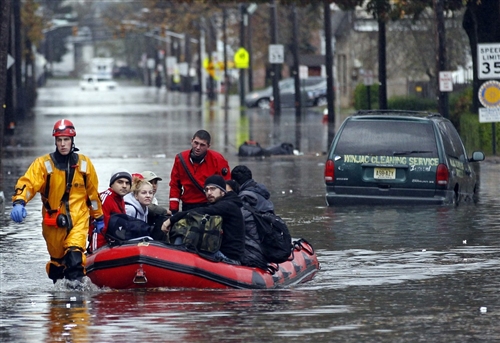
sandy-little-ferry-flooding-hmed-4a_photoblog500If I had known last night what I know this morning, I might have meditated on a rainbow.

Rabbi Yirmiyahu Ullman says that the rainbow is both a curse and a blessing. It’s a curse because it is a reminder that the world deserves to be destroyed for its sins, but that God has promised by covenant not to do so by flooding. Such a grim reminder of destruction that, in slightly smaller ways, we still suffer from today. But then, what else can we say about the rainbow? Rabbi Ullman states this:

The generation of the flood indulged in this worldliness to the point of perversion. Their wanton obsession with variety and variation resulted in their abusing the full gamut of their G-d given powers for the purpose of impurity. The flood purged the world of this impurity and the rainbow was given as a sign and reminder of what results from inundating the world with indulgence. However, the same rainbow simultaneously reminds us to repent from the relentless pursuit of multiplicity drawing us away from G-d. It urges us to direct the full spectrum of our powers and interests over the rainbow to the One on High.

In this way the rainbow is at once both curse and blessing; transgression and repentance; seductively appealing and pristinely beautiful. It depends on what you’re looking for in life. And perhaps that’s why, although it’s forbidden to indulge in the rainbow’s beauty, one may gaze at it – for the purpose of doing teshuva and directing one’s pluralities to G-d — in order to make the blessing.

I think the rainbow is visually appealing so that it will draw our gaze and having done that, remind us that we must continually seek to repent, to do teshuvah, to be reminded that we have a purpose in this world that goes beyond pursuing our individual desires.

I’ll never look at a rainbow the same way again.

One of the fundamental differences in Jewish Law and Noahide Law is that, Jews do not actively pursue Jewish converts, among non-Jewish nations.

The B’nai Noah are already under the Seven Laws, and have been permanently warned concerning their observance, so it is not a matter of trying to “convert” someone, from one religion to another; for the Noahide Code is not a “religion;” and all organized “religions,” are prohibited for the Noahide.

For the Noahide, it is a matter of Teshuva (return to G-d), not proselytization. Similarly a Jew who grew up atheist or agnostic, or who had strayed from the Torah and converted to an idolatrous religion; when he realizes his mistake and returns to Judaism, he does not “convert” back to Judaism; it is a matter of Teshuva, or returning.

It is the same for a Noahide. Others proselytize, Noahides return.

-Shlomo
“The Noahide Teshuva”
Gateway to Heaven

I include this quote because it suggests a very interesting idea. Jewish people are born into a covenant relationship with God whether they want to be or not. When a Jew leads a wholly secular life and later wants to return to God, as “Shlomo” says, that person doesn’t have to “convert” to Judaism, since they’re already Jewish and in relation to God. However, they do have to return to God, to do teshuvah, to repair the damage done in that relationship (I’ll argue that a Messianic Jewish person has not converted to Christianity but rather, made an even more complete return to God by becoming a disciple of Moshiach).

Blessed by GodMost Jewish people don’t recognize the Christian connection to God or that we are the beneficiaries of the blessings of the covenant God made with Abraham. However, they are quite willing to say, as “Shlomo” did above, that all non-Jews already have a covenant relationship with God through Noah. So, from that perspective, a Gentile does not have to “convert” to Judaism or anything else. The Gentile, like the Jew, is born already having a covenant relationship with God and on that basis, must return to God.

And in you all the families of the earth will be blessed.

–Genesis 12:3 (NASB)

Now the promises were spoken to Abraham and to his seed. He does not say, “And to seeds,” as referring to many, but rather to one, “And to your seed,” that is, Christ.

–Galatians 3:16 (NASB)

Christianity is something else. No one is born a Christian. Even if you are born to parents who are believers, you are not automatically a believer. Each person negotiates their own relationship with God. On the other hand, the covenant God made with Abraham is very old and spans across human history just waiting for any and all of us to grasp it and experience the blessings of the seed, of Messiah. In that sense, are we converting to Christianity or returning to something God intended for us all along?

The Lord is not slow about His promise, as some count slowness, but is patient toward you, not wishing for any to perish but for all to come to repentance.

–2 Peter 3:9 (NASB)

Not that all of us will, of course. But we each have a responsibility to turn…to return to Him. It is not a casual act and it’s not something you do once and then it’s done forever. I neglect my relationship with God at my own peril. God created each of us in His own image, and endowed us with free will and a desire to seek Him. Many of us twist or distort those gifts and either go our own merry way in chasing our pleasures, or in seeking “something” we can’t define, become lost in the maze of religions and philosophies, imagining we are wise by worshiping what isn’t alive or even real.

Another Shabbos approaches. Another opportunity to welcome the Lord of the Sabbath (Matthew 12:1-8) beckons. Will the glow of the candles symbolize the warmth of God in my home and my heart? Will I fill in the “missing rainbow colors” in that glow and see the reminder to repent and return?

“A different world cannot be built by indifferent people.”

-Peter Marshall

Good Shabbos.

Crossing the Ford of the Jabbok

PrayingHear my prayer, O Lord, Give ear to my supplications! Answer me in Your faithfulness, in Your righteousness! And do not enter into judgment with Your servant, For in Your sight no man living is righteous. For the enemy has persecuted my soul; He has crushed my life to the ground; He has made me dwell in dark places, like those who have long been dead. Therefore my spirit is overwhelmed within me; My heart is appalled within me. I remember the days of old; I meditate on all Your doings; I muse on the work of Your hands. I stretch out my hands to You; My soul longs for You, as a parched land. Selah.

–Psalm 143:1-6 (NASB)

Part of the Returning to the Tent of David series

This is the “flip side” to this morning’s meditation, The Christianization of Acts 15. Every couple of weeks or so, I have coffee and conversation with a friend who is smarter and wiser than I am. Certainly, his spirit is far closer to God than mine. I often tell him of my thoughts and feelings and he is direct and forthright in his response.

This is a continuation of my Returning to the Tent of David series since it has a direct connection to my reacquaintance with the church and how I have been conducting myself within its walls.

Apparently, I haven’t been doing so well.

I spend a fair amount of time expressing my point of view on this blog. I guess that’s OK since, after all, it is my blog, my platform for talking about my experiences as they occur. But I also air out my opinions of and frustrations with the church and its members on occasion. I commented to my friend that I felt my Sunday school teacher is rather dogmatic in how he presents his lessons. And the instant the words left my lips, I knew what he was going to say.

So am I, just with a different point of view.

I’ve been spending a lot of time presenting and expressing my opinions. But what about God? That is, who is expending the effort here and whose purpose is being served, mine or God’s? In my friend’s view, it’s the former, totally.

No, he isn’t being too hard on me and in fact, I have every reason to believe he speaks not only with an honest heart, but from the heart of God. I’ve been studying and using what I’ve learned as a sword or a club to “go after” those with whom I disagree, and without the slightest concern about God’s desires. I guess I assumed that if I was doing this, it must be what God wants, but that was arrogant presumption on my part. I never even considered the possibility that I wasn’t in the right spiritual frame from which to conduct such activities.

No, it doesn’t mean I’m going to stop going to church, attending Sunday school, or meeting with my Pastor (unless none of them will have me anymore). It does mean I need to take a step backward and start “preparing” for these actions in a different way.

Yes, studying the Bible is good. Studying intelligent and informative commentaries is good. But is it the mind and will of God that makes change, not the efforts of mere men.

There’s little doubt that my Pastor and I, in meeting together, are each trying to help the other change in a particular direction. Of course, I learn a great deal from these conversations, but I’m also hoping to impart something as well. But so far, I’m the only one doing the imparting. Has God been in my voice? Am I even aware of His presence in the Pastor’s office? For that matter, am I aware of God’s presence in the chapel during services or in the classroom during Sunday school?

Man aloneThe vast majority of the time, I must say “no.”

My friend keeps suggesting I “meditate” on the Bible, but the word “meditate” seems indistinct to me. He says it’s matter of considering a portion of scripture and mulling it over. What does it mean? What does it mean to me? What can it tell me about God and about myself? What scripture should I choose?

I meditate on all Your doings;
I muse on the work of Your hands.

I read books, including the Bible, as fast as I can, as if I’m in some sort of race to cover the maximum amount of territory in the least amount of time. I’m only mortal and my span on this sphere is exceptionally limited. God is infinite and forever. He can afford to take His time. After all, it is His time; He made it. Time exists only within His will and should He desire, time would cease to exist and scurry back to the nothingness from whence it came.

“In that day I will raise up the fallen booth of David,
And wall up its breaches;
I will also raise up its ruins
And rebuild it as in the days of old;
That they may possess the remnant of Edom
And all the nations who are called by My name,”
Declares the Lord who does this.

–Amos 9:11-12 (NASB)

I keep coming back to these verses because they define my purpose within a “Hebraic” and “Messianic” context. I say “my purpose” but it’s really the purpose of any non-Jewish disciple of Messiah, “the nations who are called by My Name,” says the Lord. It’s the “job description” for Gentile disciples of the Jewish Messiah who perceive that they are operating within a Jewish religious and spiritual context and not necessarily inside of “goyishe Christianity.”

I’m not trying to be insulting, but consider who our King is and from where he will reign. Can there be any doubt that Moshiach our King is and will be King of Israel, King of the Jews, and only out of all that is he King of the World?

But I’m getting ahead of myself again. Humility is something I didn’t think far from my grasp, but a guess I am farther from its sheltering arms than I imagined. This isn’t my battle. I didn’t come here to fight. I came here to serve God. What an interesting thought, since it never occurred to me to say it that way before. I always thought, harkening back to Boaz’s book, that I returned to the church to help breach the gap between the traditional fundamental and evangelical perspective on Jesus, the Bible, and everything and how it all should be seen within the Jewish context, using Jewish terms, Hebrew language, and especially removing the paint from “Joseph’s” alien face (Genesis 45:4) to reveal the son of Jacob or more to the point, the son of David…the Jewish son and firstborn of Israel. The son of God.

man-without-a-coatIf this is how you want me to serve you God, then I have to admit I haven’t been doing such a good job. If this isn’t what you’ve wanted me to do, then I’ve been doing an even worse job than I thought.

How can I promote any form of healing at all by “banging heads” with other people or by beating my head against a wall? When Jacob wrestled the Divine, in midrash, it is said that Jacob wrestled with his doubts, or his evil inclination, or his own dark angel. He had to conquer something in himself before he could take the next steps back into the Land his descendants would one day inherit, the Land of Promise. Is that my mission as well, to conquer something within myself?

That I should slow down, take time with scripture, mull and turn over the Word in my mind and heart, meditate on His wisdom day and night is all worthy and right, and I’ve been in too much of a hurry to actually do it. Where will my spirit and the Spirit of God find a common meeting ground? Jacob arose at night, crossed the ford of the Jabbok and was left alone. There he encountered God. Jacob wrestled for the rest of the night and when the sun began to dawn, the battle was still raging. Jacob’s “companion,” seeing he had not prevailed, injured Jacob, permanently disabling him (see Genesis 32:22-32). But Jacob also received a blessing, a new name, and a mission to form a dynasty; to  ultimately become the father of a mighty nation that belongs only to God.

I seriously doubt my destiny is such a great thing in God’s eyes or in man’s. And yet there must be some reason for my existence, else God would have long since extinguished me, like I might blow out a candle. Not that I’m such a great light or even a small one. Who can glory in their own light when confronted with the blazing inferno of an Everlasting God? Only a fool. I pray that I am no fool, though I know I’ve been foolish.

God will judge us not according to how much we endured, but how much we could love.

-Richard Wurmbrand

Whatever God wants me to do could easily fail if it was all up to me. Having launched myself in a particular direction for nearly a year, I haven’t looked back and I haven’t checked the map. I just figured if I went in a nice, straight line, I’d end up where I’m supposed to be. But there are no nice straight lines in my terrain, only back alleys, narrow corridors, dark tunnels, and labyrinthine passages. Getting lost if I am the only navigator is a foregone conclusion.

…but whatever your original intentions, you have become truly lost.

-Ducard (played by Liam Neeson)
Batman Begins (2005)

extinguished_candleIs that me? Maybe. Or maybe it’s what I’m on my way to becoming. But according to my friend, it’s not too late. I can slow down the horse, so to speak, take stock of my surroundings, renew my connection to God, through the Bible, through meditation on His Word, through prayer, through sincere repentance. Like a watchman on the walls of the city at night, I rely on the Presence of God as I await the dawn, considering His mighty deeds, recalling Days of Old, meditating upon Him in my heart.

My voice rises to God, and I will cry aloud;
My voice rises to God, and He will hear me.
In the day of my trouble I sought the Lord;
In the night my hand was stretched out without weariness;
My soul refused to be comforted.
When I remember God, then I am disturbed;
When I sigh, then my spirit grows faint. Selah.
You have held my eyelids open;
I am so troubled that I cannot speak.
I have considered the days of old,
The years of long ago.
I will remember my song in the night;
I will meditate with my heart,
And my spirit ponders…

–Psalm 77:1-6 (NASB)

And my spirit ponders…as I cross the ford of the Jabbok and am left alone in the dark…waiting.

The Christianization of Acts 15

phariseesSome men came down from Judea and began teaching the brethren, “Unless you are circumcised according to the custom of Moses, you cannot be saved.”

–Acts 15:1 (NASB)

In Acts 15:1-2 and 15:24, Now with what Satanically-inspired and dogmatic false teaching did these “certain men from Judaea” try to infect the church at Antioch, and why according to Galatians 2:4-5? (emph. mine)

-From the notes for Sunday School class on Acts 15:1-21
For September 29, 2013

Part of the Return to the Tent of David Series

This past Sunday, Pastor’s sermon was on Acts 15:1-21. I knew from our conversations that I was going to disagree on some of his points, and I knew by “doing my homework” for Sunday school class, that I was going to disagree with my teacher.

I’m making this part of my Returning to the Tent of David series, since it chronicles how I’m doing in my church after nearly a year. I can’t say that in last week’s Sunday school experience, I covered myself in glory.

I know my teacher tends to be rather dogmatic and inflexible on his points, but I felt he was so far off base with his “Satanically-inspired” comment directed to “the men from Judea” we find in Acts 15:1, that I had to speak up. I’ve expressed opinions that conflicted with his in the past, but usually they’re easily set aside, however there was real tension in the air as we had our exchange of words this time. I promised that this issue would be the only one I’d argue with him about and kept silent for the rest of class. Boy, was that a challenge.

There was another fellow there who is older, both chronologically and as a believer, and wiser, who also took our teacher to task about certain of his assumptions. Because this gentleman has been a long-time church member and is well-respected, I think he was tolerated more easily than I am.

Which brings me to a point that I struggled with when I first returned to church. Just how long would it be before I’m accepted within the ranks of the church as a “regular?” The answer may be “never.” Yes, most Wednesday evenings find me in Pastor’s office for a one-on-one discussion on the book of Galatians and the interface between fundamental Christianity and my understanding of Messianic Judaism, but that doesn’t necessarily add to my “cred” with the congregation as a whole.

Every time I open my mouth, I risk alienating someone. I know my teacher struggled with my idea that the “men from Judea” not only weren’t “Satanically-inspired” but had a legitimate theological concern, but who knows how many other people in that class were equally put out by my comments? No one else said a word.

There is such a misconceptualization about what happened in Acts 15 and the relationship between Torah (law) and saving grace that it’s hard to get enough information expressed to correct the errors. The basic argument is that you are only saved by grace and not through obedience to the Torah, which is true, but since the Law doesn’t save, the assumption is that it is of no use at all and thus is bad, wrong, awful, and aren’t we glad James and the boys made the decision to get rid of it once and for all. Most Christians can’t see that for a Jewish believer, yes faith saves, but this doesn’t annul the Sinai covenant and the command to live a certain lifestyle in obedience to God.

My frustration in this situation was compounded by the Bible Study Fellowship (BSF) model of teaching being used by my instructor. It emphasizes getting the maximum amount of class notes presented with a minimum of questions and interactions between teacher and student. Sure, teacher asks if we have any questions, but the class has about sixty seconds to respond before being shut down and the next point in the notes being addressed. Any serious attempt at debate over a questionable item in the teaching gets almost no “air time.”

ancient_beit_dinNot only did I press my point that the men from Judea had good reason to make the statements they did (yes, they were wrong, but it was going to be an uphill battle to convince most first century Jewish authorities that Gentiles didn’t have to be circumcised and convert to Judaism in order to have a saving relationship with God), but that the “private meeting” (Acts 15:6-11) involving the apostles and elders was actually a judicial body attempting to make a legal decision (akin to the function of a Beit Din) about how to admit Gentiles into a wholly Jewish religious stream as equal members and not require conversion.

How do you see Peter’s wisdom as he waited God’s timing before speaking?

-Class notes referring to Acts 15:7-11

If this was a legal proceeding, which makes a lot of sense to me, then Peter’s wisdom and God’s timing had less influence than the idea of a series of witnesses each giving testimony one at a time. It just happened to be Peter’s turn to testify. If there was any cross talk or overlapping discussions, they were probably analogous to how spectators in a modern courtroom can sometimes get out of hand and start talking. At that point, the Judge has to regain order.

I won’t quote from all of the notes for this class but they are a testimony to the “Christianization” of the Bible and in this particular case, Acts 15. This is not unlike what I previously said about the Rabbinization of Abraham, where the Jewish sages anachronistically apply Rabbinic concepts to the lives of Abraham and the other patriarchs. It’s also akin to what my teacher was speaking against, the “Judaizing” of the Gentile believers.

In each episode of FFOZ TV: A Promise of What is to Come, First Fruits of Zion teacher Toby Janicki strongly emphasizes the absolute necessity of reading the Jewish Biblical texts from the Jewish perspective of the original writers and audience. While Christians may not realize it on the surface, the New Testament texts are Jewish. Reading them through “Christian-colored lens” will produce a false effect, and lead to lots of misunderstanding.

But some of the sect of the Pharisees who had believed stood up, saying, “It is necessary to circumcise them and to direct them to observe the Law of Moses.”

–Acts 15:5 (NASB)

In his sermon, Pastor said that the Pharisees were the “fundamentalists” of their day and he further said that if we lived in those days (and were Jewish), we, that is, the people in his church, would be Pharisees. He said that Jesus had issues with those Pharisees who started making up their own extra-Biblical rules, but Pastor praised the Pharisees as the movement in first century Judaism that supported using the Bible (Torah) as the guide to righteous living.

My Sunday school teacher uses the works of Pastor and theologian John MacArthur as the main source material for his classes. I praise MacArthur for his efforts to direct Christians back to reading the Bible, but in many other ways, he drives me nuts. According to my teacher, he said the “men from Judea” we find in Acts 15:1 and the believing Pharisees we see in Acts 15:5 are two separate groups with two separate perspectives and agendas.

I, on the other hand, believe they may have been the same or similar enough to have identical concerns and the legitimate question of what to do with the Gentiles pouring into the Jewish religious movement of “the Way.”

bang-head-hereAfter almost a year of being back in church, last Sunday’s “Tent of David” experience for me was one of almost beating my head against a brick wall. It’s frustrating to see things so clearly from a particular perspective, and yet to be shut down so abruptly and completely by an alternate perspective that is greatly divorced from the ancient Jewish context of the ancient Jewish text.

I may be in a position to be making my voice heard, and I may even be gingerly choosing my moments and words in expressing my opinion, but will that ever result in people hearing and actually considering that opinion, or am I always going to on the outs with my “fellow Christians?”

Now, having said all that, there is a flip side to the coin, which I’ll present in an extra meditation later today.

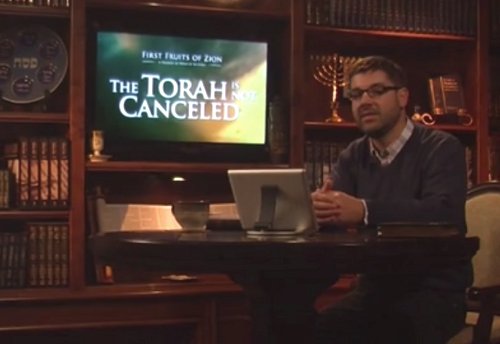
FFOZ TV Review: The Torah Is Not Canceled

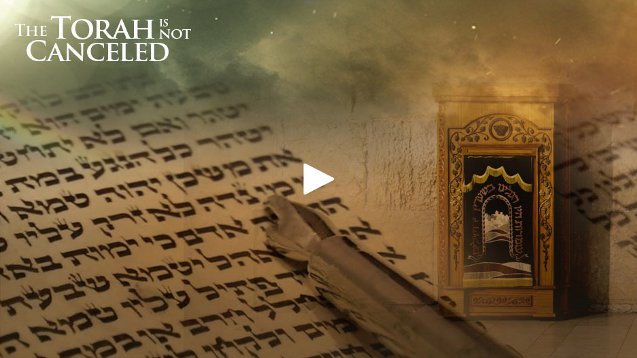
ffoz_tv13_mainEpisode 13: It is commonly taught that Jesus came to cancel the law but Jesus tells his disciples “I did not come to abolish the law.” Episode thirteen will revolutionize the viewer’s understanding of the law by learning that the law was given for Godly instruction. They will discover that not only has the law of God not been done away with but the prophets tell us that it will be observed even in the Messianic Era. It will also be taught that the law has different applications for different people, with some commandments only being applicable to Jewish people.

-from the Introduction to FFOZ TV: The Promise of What is to Come
Episode 13: The Torah Is Not Canceled

The Lesson: The Mystery of Jesus and the Torah

In this episode, First Fruits of Zion (FFOZ) teachers Toby Janicki and Aaron Eby take on one of the major misconceptions of Christian doctrine, that the death of Jesus canceled the Torah and invalidated the Law. Toby calls this “The Mystery of the Torah is not Canceled,” but I prefer the other expression he used: “The Mystery of Jesus and the Torah.”

The core to this episode is a scripture that practically everyone in the Hebrew Roots and Messianic Jewish movements is keenly aware of:

Do not imagine that I have come to violate the Torah or the words of the prophets. I have not come to violate but to fulfill. For, amen, I say to you, until heaven and earth pass away, not one yod or one thorn will pass away from the Torah until all has been established.

–Matthew 5:17-18 (DHE Gospels)

These verses are part of what is called the Sermon on the Mount, which is thought of in Christianity as the core of Jesus’s moral teachings.

Toby tells his audience that a closer analysis of Matthew 5:17 will help us get to our first clue in solving today’s mystery.

Do not think that I came to abolish the Law or the Prophets; I did not come to abolish but to fulfill.

–Matthew 5:17 (NASB)

According to Toby, Jesus had been criticized by the Jewish religious authorities, saying that he was not teaching and living by the Torah correctly. Jesus was taking this opportunity to explain his intent as a teacher. The phrase “I have come” has the sense in the Hebrew of purpose and intention. Toby tells us that in this section of his sermon, Jesus isn’t explaining his role as Messiah in relationship to the Torah, but his intention and purpose in teaching the Torah. He wants to clear up any misunderstanding about what he’s teaching, not explain how he is going to impact Torah obedience in Israel as the coming Messiah.

ffoz_tv13_tobyBut we have to have a proper understanding of the terms “abolish” and “fulfill” in order to understand Jesus’s words. While Christians have to take at face value the verse saying that Jesus didn’t come to “abolish” the Law, that is, to destroy, discard, overturn, or annul, they often interpret “fulfill” as abolish, since the net effect in Christian thinking is that Jesus “nailed the Law to the cross.”

But within a first century Jewish Rabbinic context, how are the words “abolish” and “fulfill” understood?

Rabbi Jonathan would say: Whoever fulfills the Torah in poverty, will ultimately fulfill it in wealth; and whoever abolishes the Torah in wealth, will ultimately abolish it in poverty. (emph. mine)

-Pirkei Avot 4:9

Pirkei Avot is also called Ethics of Our Fathers, and is a collection of ancient Rabbinic teachings compiled from 200 years before Jesus’s birth until 200 years after his resurrection.

Here we see how the early Sages defined the use of fulfill and abolish in relation to the Torah (the word “neglect” was in place of the word “abolish” in the quote of Pirkei Avot 4:9 I copied from a Chabad email newsletter). I bolded some of the words in the above quoted phrase so you could better see Toby’s point.

To “abolish” in this context, means to disobey Torah.
To “fulfill” in this context, means to obey Torah.

Jesus is saying that in his teaching and his life, he did not come, that is, it was not his intention and purpose as a teacher, to disobey the Torah, but rather, to obey the Torah. Let’s look at Matthew 5:17 again but in a modified form.

Do not think that I came to disobey the Law or the Prophets; I did not come to disobey but to obey. (emph. mine)

A rather startling change of meaning, don’t you think? Now we have the first clue we need to solve the mystery:

Clue 1: Jesus came to obey and teach the Law.

But exactly what is “the Law” and why does Christianity see it so negatively? To get the answer, the scene shifts to FFOZ teacher and translator Aaron Eby in Israel.

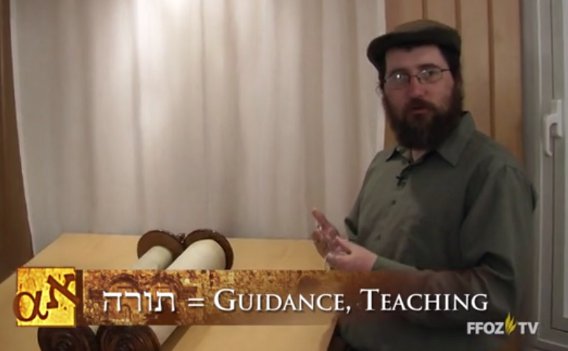
ffoz_tv13_aaronWhat is the Torah? Most often, we think of it as the first five books of the Bible: Genesis, Exodus, Leviticus, Numbers, and Deuteronomy. And while the Torah does contain many laws for Jews living in the Land of Israel and diaspora, as well as Jewish ethical and moral conduct, it also contains the story of Creation, the calling of Abraham, Isaac, and Jacob, and the astonishing redemption of the Israelites from slavery in Egypt.

Aaron teaches us that Torah means something like “guidance,” “teaching,” or “instruction.” The root word in Hebrew is an archery term implying something that is cast, thrown, or shot with aiming or guidance, like one might shoot an arrow at a target. In this sense the Torah can be any spiritual or Biblical teaching directing someone toward righteousness. To differentiate this broader meaning from the first five books of the Bible, we call those five books the Torah of Moses.

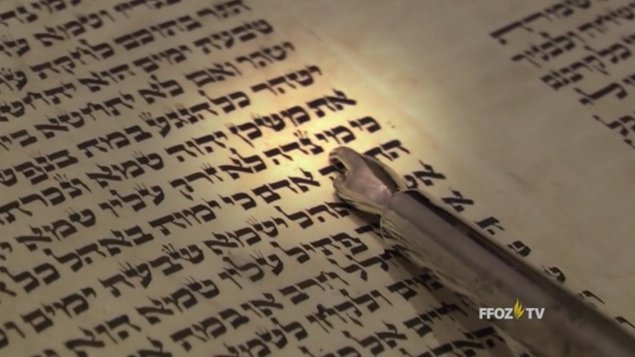
The main point of Aaron’s teaching is rather straightforward. Torah doesn’t mean “law,” it means teaching, instruction, and guidance, in a spiritual or moral sense. It doesn’t have to refer only to the “mechanics” of the legal parts of the Torah of Moses. He also explains what a “jot” and a “tittle” or “thorn” is which illuminates how Jesus used those terms in Matthew 5:18. Jesus was saying that he did not intend to abolish or disobey even the smallest detail of the Torah until heaven and earth passed away.

Returning to Toby, we have our second clue:

Clue 2: Torah is God’s Instruction.

Toby takes the lesson one step further and describes the future role and function of the Torah in the Messianic Era. To understand how this works, we must turn to Jeremiah 31:31-34

“Behold, days are coming,” declares the Lord, “when I will make a new covenant with the house of Israel and with the house of Judah, not like the covenant which I made with their fathers in the day I took them by the hand to bring them out of the land of Egypt, My covenant which they broke, although I was a husband to them,” declares the Lord. “But this is the covenant which I will make with the house of Israel after those days,” declares the Lord, “I will put My law within them and on their heart I will write it; and I will be their God, and they shall be My people. They will not teach again, each man his neighbor and each man his brother, saying, ‘Know the Lord,’ for they will all know Me, from the least of them to the greatest of them,” declares the Lord, “for I will forgive their iniquity, and their sin I will remember no more.”

Here, Toby interprets this scripture about the New Covenant in the same way I’ve been doing on this blog for quite some time. On the surface, the prophet is saying that there will be a new covenant and that it will be different from the old covenant, but what exactly will be different. Grace instead of Law? That’s not what scripture says. Let’s drill down into verse 33:

I will put My Torah within them and on their heart I will write it; and I will be their God, and they shall be My people. (emph. mine)

ffoz_tv13_torah_bethemmanuelI substituted the word “Torah” for “Law” since that’s how it’s rendered in the Hebrew. Remember, the New Covenant is made with Judah and Israel, not with the church or the nations. God still expects the Jewish people to obey the Torah, His guidance and instruction, but it will be written internally and will be part of the fiber of their being, rather than being written externally. My understanding is that it will be second nature for the Jewish people to live a lifestyle in obedience to God, rather than struggling between the good and evil inclinations.

We saw in the FFOZ TV show None Greater Than John that verse 34 refers to the state of the people of God during the Messianic Era. We will all know God, from the greatest to the least of us, as prophets, with an overabundance of the Spirit of God upon us.

This is the Messianic Era, when the Jewish exiles are returned to their Land, the Land of Israel, all of Israel’s enemies are finally defeated forever, and King Messiah establishes world peace. In those days, all Jews will obey Torah and even the Gentiles of the nations will go up to Jerusalem to learn:

And many peoples will come and say,
“Come, let us go up to the mountain of the Lord,
To the house of the God of Jacob;
That He may teach us concerning His ways
And that we may walk in His paths.”
For the law will go forth from Zion
And the word of the Lord from Jerusalem.

–Isaiah 2:3 (NASB)

Here we have the third and final clue:

Clue 3: The Torah will be obeyed in the Messianic Era

But this brings up the subject about the relationship of the Torah to the non-Jewish people. I thought that the topic would be ignored as in past episodes, but Toby briefly touches on it by saying that the Torah has different applications to Jewish and non-Jewish people. Most (non-Messianic) Jews would probably say the Torah has little to no application to the goyim at all, but Messianic Judaism sometimes has a unique perspective regarding non-Jews and particularly Christians.

At the end of the episode, FFOZ Founder and President Boaz Michael comes on camera and refers to the Torah as “God’s loving instruction.” He says that both Jews and Gentiles need to study the Torah and discover how it applies to our lives, also implying that there are different applications of the Torah to Jewish and non-Jewish people.

What Did I Learn?

ffoz_tv13_torah_lettersI gained a greater appreciation of the Rabbinic use of the terms “fulfill” and “abolish,” although I’d heard something similar in the past. I was also reminded of a discussion I had with my Pastor last week on this very topic: will there be distinctions between Jews and Gentiles in the Messianic Era and will there be any such thing as “Torah” in those days? He says “no” and I say “yes.” I don’t think the Torah ceases as we understand it today until “all is accomplished” (Matthew 5:18). The question is, when is everything that must be accomplished actually accomplished? If not even the smallest detail of the Torah pass away until heaven and earth pass away, then the only possible answer is that the Torah passes away only when there is a new heaven and earth.

Then I saw a new heaven and a new earth; for the first heaven and the first earth passed away, and there is no longer any sea. And I saw the holy city, new Jerusalem, coming down out of heaven from God, made ready as a bride adorned for her husband. And I heard a loud voice from the throne, saying, “Behold, the tabernacle of God is among men, and He will dwell among them, and they shall be His people, and God Himself will be among them…

–Revelation 21:1-3 (NASB)

When the Messianic Age is established, the Torah will still be in effect upon Israel, that is the Jewish people. There will be some applications for non-Jewish believers, but Toby was deliberately vague in this area. Only after everything has been accomplished, evil has finally been defeated, and a new heaven and earth have been established, that the Torah, as we understand it, will pass away.

But as I was watching this episode and reflecting on my conversation with Pastor last week, I was reminded of a question he asked me. There are several Jewish people who attend my church. None of them are “Messianic,” and would be better called “Hebrew Christians,” people of Jewish ethnic and family lineage but those who practice a traditional Christianity. In other words, they likely believe the law is abolished in the sense of being permanently destroyed.

Pastor asked me if I thought they are obligated to the Torah. My principles say “yes,” but I was suddenly confronted with the reality of my words. Could I go up to any of these individuals unbidden, and tell them to their face that they should be performing the mitzvot, not as a matter of salvation or justification, but out of covenant obedience? Probably not (not unless they asked, of course…). It would be like going up to a Jewish person driving to shul on Shabbos and telling them they shouldn’t drive but walk instead. Who am I, the religious police? On the other hand, if the Torah is incumbent upon all the Jewish people now and will be even into the Messianic Age…what are the consequences to a Jew for abandoning the Torah, even at the behest of the Christian church?

Whoever then annuls one of the least of these commandments, and teaches others to do the same, shall be called least in the kingdom of heaven; but whoever keeps and teaches them, he shall be called great in the kingdom of heaven.

–Matthew 5:19 (NASB)

prophetic_return1I believe that Jewish people are currently obligated to perform the mitzvot, but that doesn’t mean I must forcibly impose my beliefs upon them. Every person negotiates their own relationship with God. Every Jew must discover who they are as a Jew in relation to Hashem. I can only pray that all Jewish people everywhere return to the Torah and thus bring the Messiah that much closer to bringing his rule and reign fully into our world. For when he returns, as Toby and Aaron teach, the Torah will be established in Israel and will go forth into the nations from Zion.

When G‑d made the world He gave each creature, each nation and each individual a role and a meaning.
When each plays its part there is harmony.
When the lines become too blurred, there is acrimony.

-Rabbi Tzvi Freeman
“Distinctions”
Based on letters and talks of the Rebbe, Rabbi M. M. Schneerson
Chabad.org

I will review another episode next week.

Returning to the Tent of David: An Introduction

serpentThe serpent enticed Chavah by predicting beneficial outcomes. “Your eyes will be opened… The fruit will awaken a new desire and appreciation for the pleasures around you. It will be a source of intellectual benefit.”

Chavah longed for this new knowledge and exciting awakening, and she ate the forbidden fruit. She then used her persuasive powers to convince her husband to eat it as well.

Chavah’s downfall began when she expanded upon and distorted G-d’s command, which she did not personally hear.

-Chana Weisberg
“Woman and the Forbidden Fruit”
Chabad.org

Beginning the Returning to the Tent of David series

This depiction of Chavah (Eve) and her interaction with the serpent casts her in a more favorable light than we typically see her by in Christianity. Rather than being disobedient and rebellious, she is either a bold explorer of new knowledge, or an innocent dupe of the serpent who physically pushed her in to the tree of the knowledge of good and evil and after all, it’s not her fault because God did not tell Chavah directly not to touch the tree or to eat from it.

Chavah added the prohibition of touching the Tree of Knowledge. The serpent then forcibly pushed Chavah against the tree, and victoriously claimed, “See, just as death did not ensue from touching, so it will not follow from eating.”

In this way, the serpent introduced doubt into Chavah’s mind. It now became easier to dare Chavah to taste the forbidden fruit. He convinced her that G-d did not actually intend to kill her and Adam, but merely threatened them to intimidate them.

I know, I know. The Torah reading for Beresheet (Genesis) is behind us. Why do I continue to write about it now? Shouldn’t I be preparing my commentary on Noah? Be patient. There’s a reason.

That’s my ministry in a nutshell; it’s a not-so-interesting and rather Baptist-intensive story. I am eternally grateful for my family and for my Baptist heritage. God has used both to lead me to commit my life to Christ, to follow him with my life and to serve him through the church. However, the past eighteen months have opened up for me a more complete picture of who I am and where I came from. Through a series of circumstances, curiosity, and new friendships, I am being exposed to my Jewish roots. I have no doubt that all of these circumstances and friendships, and even my own curiosity that opened me up to the Jewish roots movement, are all God-ordained.

-Durwin Kicker
Senior Pastor at Marshfield First Baptist
From the Foreword (pg 10) of Boaz Michael’s book
Tent of David: Healing the Vision of the Messianic Gentile

tent-of-davidYou may think it’s terrifically unfair of me to compare Chavah’s situation to Pastor Kicker’s. I’m not really, but it occurs to me that, at least in midrash, we all have something in common with the wife of the first man. When exposed to be brand-new world with seemingly endless possibilities, we want to explore. However, like Chavah, we may also have reservations, since some of the things that we are tempted to explore may not be what God wants us to investigate, even when we get a “helpful” shove.

God has used Boaz Michael and the ministry of First Fruits of Zion to impact my life in a profound way in a very short amount of time. It is my great honor and privilege to call Boaz my friend. His passion and love for Messiah and his gentle spirit have struck a chord in our church family which has served to open many of our people to our Jewish roots, God’s everlasting covenants with his people, and our place as Gentiles in God’s family through our Jewish Messiah.

Boaz’s desire is that this kind of loving impact will be repeated over and over again in church after church. I join with Boaz in saying, the church needs you! The church is good, yet the church needs to change. Each individual who comes to know our Jewish Messiah in his Jewish context can play a part in lovingly and patiently helping brothers and sisters in Messiah come to know him in this way as well.

-Kicker, pg 12

I reviewed Boaz’s book about nine months ago in several blog posts, the two most notable being Return of the Christian and Returning to Faith. I had read an advanced copy of the book months previously, and it was instrumental in overcoming my inertia and inspiring my own return to a local church.

And now it’s been nearly a year later. The progression through the Jewish holiday season and the beginning of a new Torah cycle seem a very good time to review my own “Tent of David” experience and to see how things actually have ended up (not that anything has really ended yet).

Pastor Kicker seems enthusiastic about pursuing the vision of the “Messianic Gentile” in the church by way of his friendship with Boaz but of course, he’s been in the church for quite some time and as Pastor, he is a fully integrated unit within that cultural, social, and theological construct. In other words, he “fits.” Boaz’s book speaks of “Healing the Vision of the Messianic Gentile.” For me as a recent “returnee,” what has been healed, if anything?

My perception of Boaz’s book (I can’t speak directly to his intent, nor would I ever try…this is my own opinion) is that there are two kinds of healing going on, at least in theory.

There’s the healing of the “Messianic Gentile,” the Christian (non-Jewish disciple of Jesus Christ) who often has left the church because of some emotional or spiritual injury or hurt (real or perceived) caused somehow by the Christian church or some of its members. Many people in Hebrew or Jewish roots congregations believe they have sought refuge in a “safe place” outside of “the Church” and continue to view church and people who identify as Christians as adversaries. Finding a mechanism to have the Hebrew/Jewish roots Gentile return to church in a safe manner and to share who they are with their fellow Christians certainly opens the avenue for healing between the parties involved.

Then there’s the more historic healing between the traditional church of Jesus Christ and the historic and Biblical Jewish Jesus and the Jewish and Gentile body of Messiah. A great deal of damage has been done to Jewish and Christian hearts, and that has sustained the separate trajectories believing Gentiles and the Jewish community (including Messianic Jews) have been traveling for twenty centuries.

church-and-crossA non-Jewish believer possessing a Hebraic view and even a passion for the “Jewishness” of Jesus, and one willing to communicate that with his or her Christian counterparts in a church community could facilitate a great deal of healing, ultimately between Christianity and Judaism. Certainly, great strides have already been made in this area between some churches and various expressions of Messianic Judaism, although a lot of work still needs to be done.

But what about me and what I’m doing in the small church I attend? I’d like to completely re-read Boaz’s book before venturing to answer that question in full, but I did want to keep my promise and at least introduce the journey I’m taking in returning to the Tent of David and Boaz’s vision of the healing of Christian and Jewish communities. His book speaks on a larger scope by necessity, but nearly a year down the road,  how has Boaz’s vision worked “on the ground,” so to speak. I can only lend my own single, small voice and my individual experience. As this series progresses, I’ll share my insights with you. Perhaps you will return the favor.

Encounter with Now

Moses at SinaiNow Moses went up from the plains of Moab to Mount Nebo, to the top of Pisgah, which is opposite Jericho. And the Lord showed him all the land, Gilead as far as Dan, and all Naphtali and the land of Ephraim and Manasseh, and all the land of Judah as far as the western sea, and the Negev and the plain in the valley of Jericho, the city of palm trees, as far as Zoar. Then the Lord said to him, “This is the land which I swore to Abraham, Isaac, and Jacob, saying, ‘I will give it to your descendants’; I have let you see it with your eyes, but you shall not go over there.” So Moses the servant of the Lord died there in the land of Moab, according to the word of the Lord. And He buried him in the valley in the land of Moab, opposite Beth-peor; but no man knows his burial place to this day. Although Moses was one hundred and twenty years old when he died, his eye was not dim, nor his vigor abated. So the sons of Israel wept for Moses in the plains of Moab thirty days; then the days of weeping and mourning for Moses came to an end.

–Deuteronomy 34:1-8 (NASB)

The final verse of the final portion of the Torah refers to “the strong hand and all the great awe, which Moses performed before the eyes of all Israel.” According to the Talmud, the phrase “before the eyes of all Israel” alludes to the incident when Moses smashed the Tablets of the Covenant when he found the Jewish people worshiping the Golden Calf.

An odd conclusion for the Five Books of Moses! The whole Torah ends by recalling the destruction of the Ten Commandments by Moses! Another interesting point to consider is that after completing the reading of this portion in the Synagogue, we immediately begin reading from the first portion of the Torah (Gen. 1:1): “In the beginning, G-d created…”

The reason that the Torah ends as it does – by alluding to the breaking of the Tablets of the Covenant – is the same reason that we start over again once we’ve finished. Both ideas are rooted in the same principle; we never just finish up and move on. Just when we think we’ve reached the end – when we get to the very last line of the very last portion – we are reminded that the Tablets of the Covenant were once destroyed and had to be remade.

–Rabbi Ben A.
“Starting Over”
Chabad.org

In many ways, the start of a new Torah cycle is about starting over. But like the Children of Israel at the death of Moses and being poised to cross the Jordan with Joshua as their leader and prophet, it’s also a continuation and even a radical change…or it can be. It probably should be, otherwise, you’re just recycling the Torah and spiritual learning year by year and as a result, not actually learning anything new.

As the Children of Israel discovered when Moses died (and Aaron and Miriam and an entire generation of Israelites before him), change inevitably means loss, sorrow, and grief, even as change can mean growth, progression, and fulfillment.

broken-tabletsWe know that after Moses destroyed the first set of tablets as a result of the sin of the Golden Calf, at the command of God, he made a second set. But it was God who made the first set and it was God who wrote on it. The second set was created by Moses and Moses wrote on it at the command of God. God gave the Israelites a “second chance” but it wasn’t the same situation as the “first chance.” Even if God grants you “do-overs,” you lose something, even if you don’t lose it all.

Rabbi Ben A. is the most famous anonymous rabbi. Using his pen name, Ben A. draws from his personal experience in recovery to incorporate unique Chassidic philosophy into the practice of the 12 Steps. He tells us that our spiritual journey is never complete and we are always starting over, but not quite with fresh start. There is not perfect “reset” button for our lives.

As newcomers looking at the Steps for the first time, many of us wondered what we were supposed to do once they were completed. The answer is that our recovery is never finished; it continues by beginning again. We remember that the life we now have was once in a state of apparent destruction, just as the Tablets containing the Word of G-d had been smashed. In our despair, we agreed to let go, and let G-d give us a new life. We learned to trust G-d. We cleaned house; and we repaired our relationships with others.

We remember that it is He who takes away our pain and gives us joy. It is He who takes away our sickness and gives us health. It is He who instills renewed energy into our desolate lives…it reminds us how the spiritual lives we now have began out of darkness, chaos and void. It is now our job to once again transform our lives with light, order and fulfillment.

Spiritual growth is like a 12-step program? A Spiritual recovery program? It seemed a strange thought when I first encountered it, but actually, it makes perfect sense. Who are we without God but human beings on a path to destruction. We repent, but repentance, forgiveness, and atonement are not accomplished in a single act. It takes time, perhaps a great deal of time…perhaps all of our lives, over and over, year by year, like the Torah cycle.

It is now as it was now a moment before. It grew no older. It was not touched, not moved nor darkened by the events that flickered upon its stage. They have vanished; it has remained. It perpetually transcends.

And it is immanently here. Tangible, experienced, real and known. For what can be more known than the moment in which you stand right now?

Yet, what can be so utterly unknown?

-Rabbi Tzvi Freeman
“Now”
Chabad.org

Rolling the Torah ScrollLike the continual Torah reading cycle, we are constantly moving forward, continually experiencing and re-experiencing what we need and what God understands we need. But also, we only live inside of one instant in eternity at a time. It is always “Now.” We look to the future and remember the past, but it is always now. When you read Beresheet last Shabbos (if you follow the traditional Torah readings), it was “Now” and when you read Noah next Shabbos, it will also be “Now.”

It’s what we do inside of each instant of life that creates or inhibits the progression, the growth, the journey toward drawing closer to God. We may have done terrible damage to ourselves and to others in the past, but the past is just that. It’s gone, though the consequences can still be with us. It is now. It is always now. You are always in now. Living inside of now is like guiding a ship by working the tiller to move the rudder. Now you move it one way. Now you move it another. Now the tiller moves the rudder and now the ship moves in response. Moment by moment, every action you take in an endless progression of “now events” creates the sequence of our lives and results in consequences for us, for our loved ones, and in our relationship with God.

Rabbi Freeman concludes:

If you are here only now, what is the purpose?
And if all is transient, why be here now?

Grasp the now by both ends and every moment is divine,
every experience is precious.
For you have grasped G‑d Himself.

I will tell you a secret that can be told, and within it a secret that cannot be known: Take the Hebrew present tense of the verb to be, and prefix it with the letter yud to indicate a perpetual state of now-being—and you will have the name of G‑d.

G‑d is now.

Over two weeks ago, a friend of mine challenged me to experience God more fully. I felt backed into a corner knowing that I should want such an experience but dreading it as well. I didn’t want to change and I knew God would require it if I turned to Him. Now…yes, right now, God is also backing me into a corner. The choice of whether or not to turn to Him is still mine but God is limiting my options. The consequences for not accepting His challenge are becoming more dire, and I see that He has been allowing me enough rope and may yet let me swing if I continue in that direction.

ancient-sail-boatSo what do I do? I do what God wants, I do what God requires, not because I have no choice, but because God has made it abundantly plain what the result of my choices will be.

I know there is a future, a wonderful and terrible future. Where I’ll be standing when that future becomes “Now” depends on which direction I move the tiller, which direction I choose to turn the ship. The wood is in my hands, I can move right or left, the ship is traveling forward into the storm. Moving one way leads to disaster, with my ship and everyone on it being broken apart on jagged rocks, and moving the other way leads to safe haven. I may have seen this before but I chose to ignore it, believing I had time before I had to make the final decision. Now, what I once saw vaguely and disregarded has become a present reality viewed with absolute and crystal clarity.

Now I grasp the ship’s tiller, I apply pressure. I feel resistance. The tiller moves and with it, the rudder. Now the ship begins to change course and…

…and Moses dies. And the Children of Israel mourn. And the Ark goes ahead of the Assembly into the Jordan. And Joshua leads. And we read the last few lines in Deuteronomy. And we hastily re-roll the scroll. And we read, “When God began to create heaven and earth…”

O Hashem, You have scrutinized me and You know. You know my sitting down and my rising up; You understand my thought from afar. You encompass my path and my repose, You are familiar with all my ways. For the word is not yet on my tongue, behold, Hashem, You knew it all. Back and front You have restricted me, and You have laid Your hand upon me.

–Psalm 139:1-5 (Stone Edition Tanakh)

And now…

"When you awake in the morning, learn something to inspire you and mediate upon it, then plunge forward full of light with which to illuminate the darkness." -Rabbi Tzvi Freeman