Why We Need to Disagree (at least occasionally)

ben shapiro
Ben Shapiro – Found at DailyWire.com

I’ve been thinking a lot about disagreements recently. I’m no saint. I’ve participated in all kinds of arguments lately regarding folks I disagree with. I’ve disagreed with a Massachusetts elementary school librarian who took exception to the First Lady donating Dr. Seuss books to her school. I’ve disagreed with a former CBS Vice President who didn’t seem to mind that the victims of the Las Vegas mass shooting were (apparently) country and western fans and thus Republicans, and owners of firearms. I’ve disagreed with lots of people in the past and probably will continue to do so.

I don’t doubt there are a lot of folks who disagree with me about my stance on certain issues. It’s uncomfortable. I don’t particularly like it. But that doesn’t mean disagreement is a bad thing. Actually, the ability to express disagreement is a good thing. We need to keep doing it.

Why do I believe disagreement is good you ask?

Read the rest at Powered by Robots.

No, this isn’t really on a “religious” topic, but since people in the realm of theological blogging are often in disagreement, I thought this audience might be interested.

What If Parts Of The Bible Are Wrong?

Larry Hurtado
Larry Hurtado

I came across something interesting at Larry Hurtado’s blog the other day titled Paul and 1 Corinthians 14:34-35. I had just finished reading 1 Corinthians as part of my annual “read the Bible cover-to-cover in one year” effort (through admittedly, this is the first year I’ve made the attempt in quite a long time).

Hurtado was discussing Philip B. Payne’s recent article Vaticanus Distigme-obelos Symbols Marking Added Text, Including 1 Corinthians 14.34–5. Referencing the paper, Hurtado states in part:

The…story focuses on the view espoused in Payne’s article that vv. 34-35 are an interpolation inserted into some copies of 1 Corinthians, probably originating as some reader’s marginal note, and then incorporated into the copy-stream at some early point. But, actually, for a number of years now an increasing number of scholars have reached this basic conclusion. Indeed, in his article Payne points to the numerous scholars who agree that vv. 34-35 are not an original part of Paul’s letter. For example, note Gordon D. Fee’s judgment in his commentary: “The First Epistle to the Corinthians,” New International Commentary on the New Testament (Grand Rapids: Eerdmans, 1987), 705-8.

Okay, so what does that mean? It means there are a number of scholars who have long believed verses 34-35 in 1 Corinthians 14 were not part of the original epistle and in fact were a reader’s note in the margin that was later erroneously incorporated into the formal text.

What are these verses?

The women are to keep silent in the churches; for they are not permitted to speak, but are to subject themselves, just as the Law also says. If they desire to learn anything, let them ask their own husbands at home; for it is improper for a woman to speak in church.

1 Corinthians 14:34-35 (NASB)

According to Hurtado, the general reason for scholarly agreement on this point is:

The verses seem to go against practically everything else in Paul’s uncontested letters pertaining to women’s involvement in the churches.

I bring this up for a couple of reasons.

The first is the general belief that the Bible in toto is the inspired, inerrant, and infallible word of God and is not to be questioned in even the slightest degree. Of course, this depends on the level of sophistication and education of the reader, but there are a lot of Christians who basically say God said it, I believe it, that settles it.

I work with a fellow who is very nice and friendly and he is a Christian who basically approaches the Bible this way. Occasionally, he tries to engage me in a little theological discussion and I tend to put him off. I know from painful experience that if I tell him what I believe and what I believe about what he believes, it will not end well.

Coffee and BibleThe second, building on my first, is that if we know or have good reason to believe there are “questionable” verses and phrases in the Bible, shouldn’t we make it our business to find out what they are so we don’t use them to commit an injustice?

There probably are churches (probably conservative and many of them rural) that do preach women being silent within their walls and that expect women who may have questions about what they hear from the pulpit or in Sunday School to wait until they get home to ask their husbands (who may or may not have a good understanding of what was said) what it all means.

Now I’ve never had that sort of experience in any church or congregation I’ve attended. Women did seem to be active, questioning members of those religious communities, so there obviously are churches that simply set aside those verses or at least believe Paul meant to address a local matter rather than pronouncing some sort of universal truth.

Even if a Pastor, who hopefully was educated at a formal accredited seminary, keeps up on the latest Biblical research, it’s not likely you’ll hear the findings of that research being preached from the pulpit (or on Christian radio), so the average Christian in the pew will be totally unaware of this information.

After all, it doesn’t have anything to do with a Christian’s salvation or going to Heaven when they die.

I know that sounds cynical, but it can be really frustrating when I hear some Pastor on Christian radio say that you can’t be a believer unless you go to church and are in fellowship, realizing that what they’re advocating (whether they intend to or not) is, for the most part, corporate ignorance.

That said, most or at least a lot of believers don’t want to know anything that makes them feel uncomfortable about the Bible or their faith. It’s one of the reasons Evangelicals are believed to be superstitious, unsophisticated, anti-science, Luddites. They seem to have missed what Paul said about the Bereans.

I’m no teacher or scholar, and I’m no smarter than the average bear, but at least I try to learn a little bit more about the Bible and other things today than I knew yesterday or last year.

Christians have historically bent, twisted, and mutilated the Bible for their own purposes, at least those Christians in charge of Bible translations and laying out what is “sound doctrine,” so I don’t have a problem investigating said-doctrine to see if they’re wrong about something.

My wife calls me a Christian (her being a Jew) and she tries not to say it as a pejorative (most of the time), but while that’s true in the broadest possible sense, I’m certainly atypical relative to the vast majority of churches in my local community as well as in the nation (and the world).

Consider this blog article to be a small cautionary tale. Before you use the Bible to beat someone up or to establish and inflate your own superiority as “saved,” you might want to check and see if the Bible says what your Pastor or Sunday School teacher tells you it says.

muzzle
Actress Alexis Bledel in the television show “The Handmaid’s Tale”.

In this one specific case, it is highly unlikely that the Apostle Paul was advocating for muzzling women in “church.”

I put the word “church” in quotes because every time it’s mentioned in the New Testament, the word isn’t really “church,” nor is it likely Paul meant the Greek word Ekklesia to mean “church” in the modern sense (for more on this rant, see Notes on the Church from an Insomniac and When is Church not Church?).

How I Won’t Be Observing Yom Kippur

One of my favorite stories is of the house painter who deeply regretted stealing from his clients by diluting the paint, but charging full price. He poured out his heart on Yom Kippur hoping for Divine direction. A booming voice comes down from Heaven and decrees — “Repaint, repaint … and thin no more!” Yom Kippur begins Friday evening, September 29th! (It is the ONLY fast day that is observed on a Shabbos.)

Yom Kippur, the Day of Atonement, is the anniversary of the day Moshe brought down from Mount Sinai the second set of Ten Commandments. This signified that the Almighty forgave the Jewish people for the transgression of the Golden Calf. For all times this day was decreed to be a day of forgiveness for our mistakes. However, this refers to transgressions against the Almighty. Transgressions against our fellow human being require us to correct our mistakes and seek forgiveness. If one took from another person, it is not enough to regret and ask the Almighty for forgiveness; first, one must return what was taken and ask for forgiveness from the person and then ask for forgiveness from the Almighty.

-Rabbi Kalman Packouz
Aish.com

In general, observant Noahides can (but are not required to) commemorate those Jewish festivals that in some way relate to Gentiles and the overall spiritual missions that G-d assigns for them. There are some of the Jewish festivals that Noahides have more of a connection to, and they can honor these as special days (for example, with prayers and selected Torah reading): for example, Rosh HaShanah (the annual Day of Judgment for all people), and Sukkot (the annual time of judgment for the rainfall that each nation will receive, which is also characterized by the themes of unity and joy).

But you should be aware that these days are not to be commemorated by Noahides in the same way that they are commanded to be fully observed by Jews. For instance, a Noahide should not refrain from normal activities on the Jewish holy days or Sabbath, and should not perform those Jewish commandments that are religious only, and have no practical benefit for Noahides (for example, waiving the four species of plants during the Festival of Sukkot, or fasting on Yom Kippur).

The Jewish festival days of Shemini Atzeret/Simchat Torah, Yom Kippur, Purim and Shavuot have little relevance to Noahides, other than as reminders of constantly-relevant general Torah principles.

Taken from “Noahide Holidays” at AskNoah.org

With regard to Yom Kippur, which relates to the relationship between the Jews and G-d, Gentiles should not be concerned that they are lacking in any way in their opportunity at any time for successful repentance. The fact that only Jews were given Yom Kippur, the day that Moses descended from Mount Sinai with the second set of Tablets of the Ten Commandments, should only be a positive influence, in that perhaps it may inspire a Gentile to do his or her own needed repentance on any day of the year.

Taken from “Asking G-d to forgive for breaking a Noahide Law: Does this relate to Yom Kippur?”
at AskNoah.org

As you can see I’ve been doing a little bit of reading, particularly with the High Holidays rapidly approaching. There’s no real template for how or if the “Judaically aware” Gentile disciple of Rav Yeshua should observe such events. Certainly we are not Jews and we are not Israel (yes, I’m going to be criticized for those statements I suppose), but it’s difficult to ignore such an august occasion, especially when one’s spouse is Jewish (though not particularly observant at present).

I borrowed some information from a Noahide site to gain some perspective, but I’m not convinced the Noahide makes a suitable model for people like me. They don’t take into account the blessings of the New Covenant being conferred upon us due to the merit and faithfulness of our Rav.

Yet what else is there?

I do take some comfort, especially at this time of my life, in the statement that Yom Kippur can be a reminder that I can sincerely repent before Hashem at any time at all (of course, Jewish people can too). I’m also glad the Orthodox Rabbis who administer AskNoah.org recognize that Rosh Hashanah and Sukkot have applications to both Israel and the nations, so in some manner or fashion, we can partake in those observances as well.

As with my last several blog posts here, I continue to state that what you get out of your relationship with the Almighty depends on what you’re looking for.

If you are an observant Jew, it seems that your praxis is well-defined, which is part of what “grinds the gears” of some “Messianic Gentiles,” since our model seems less distinct. Maybe that’s because it’s too easy to mistake form for substance.

I think some of Paul’s letters, particularly Romans, touched on how some Jews (perhaps converts to Judaism who had Yeshua-faith) mistook the mechanics of Torah observance for an actual relationship with Hashem. I’ve seen it in some Messianic and Hebrew Roots groups in the past.

It’s easy to get distracted by praxis unless you have the correct perspective.

If the High Holidays are to mean anything for the rest of us, I think it’s true that they can serve as a reminder that God is accessible to us too. He’s always intended that from the very beginning. We were never meant to be left out in the cold or to be considered “sloppy seconds”.

As time goes on and I attempt to do even such minor things as listen to Christian radio, I realize that I don’t have very much in common with the normative Christian church. However I’d be lying and a fool if I said that I had nothing in common at all.

The church is full of good people, faithful people, people who have repented and continue to sincerely repent and to walk before Hashem. They do much kindness, express compassion in word and deed, are at the forefront helping victims of Harvey and Irma, putting their time, money, and effort where others only put their mouths.

Whether you call yourself a Christian, Messianic, or anything else, that’s what really matters, how you live out your relationship with Hashem through your devotion to Rav Yeshua. That’s what we should take with us into the Holidays. That’s what we should always take with us everyday as we walk with God.

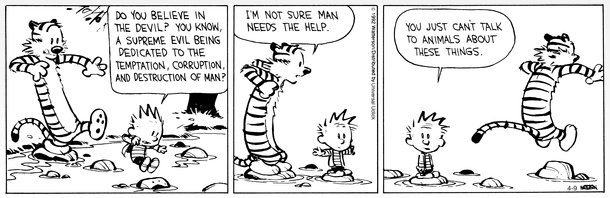
The Devil Made Me Do It Redux

Over three years ago, as part of my “church experience,” I wrote this blog post illustrating how many churches (including the one I was attending at the time) emphasize the influence of an external tormentor who causes them to sin over their own personal responsibility. I highlighted the fact, using multiple examples, that the Bible emphasizes that we are accountable to God for our actions and that blaming HaSatan (the Adversary) is no excuse.

I was reminded of this again while listening to Christian radio this week. All they talk about is Satan, Satan, Satan, and how if we’re not careful, we’ll fall into one of his traps.

But what about the traps we set for ourselves? I don’t think our external Adversary needs all that much help when after all, most people are their (our) own worst enemies. Just food for thought.

calvin-and-hobbes-devil
Calvin and Hobbes

Christianity Drives Me Crazy

I thought about just adding this to the comments on my last blog post, but it seems to deserve a missive of its own.

KBXL logoI admit it. I’ve been listening to Christian radio on the commute home from work again. Specifically, there’s a fifteen minute radio show called The Gospel Changes Everything hosted by Pastor Josh Bales of a local church called The Well.

This week, he’s presenting a sermon series called The Life of God In the Soul of Man based on John 17:17-19.

First of all, I’m always dubious of a Pastor giving a week long sermon series based on two verses out of the Bible. Secondly, he tends to be one of those Pastors who puts a lot of emotion and emphasis in his voice, which always makes me wonder if my emotions are what’s being appealed to the most.

I won’t go into everything he said, but he did define the essence of Christianity as “Christ being formed in me.” What does that even mean? He paraphrased Rav Yeshua (Jesus), refactoring verse 19 to say, “Form me in their souls, Father.”

What?

Did our Rav actually say that? Did he appeal to the God of Heaven asking that he, the individual Jesus, be “formed” in the souls of his disciples? Again, what does that even mean?

By the end of the fifteen minutes, Pastor Bales didn’t answer the question (actually, he lost me when he said verse 19 was Jesus addressing the “church”). Of course, he’s got Thursday and Friday to go, but I suspect he won’t ever answer that question, at least in a way that makes any sort of sense to me.

This is why I don’t go to a church…well, one of the numerous reasons anyway.

I’ve got enough of a headache just now and this just makes it worse.

I’ve been reading through Paul’s epistle to the Romans as part of my (ideally) daily Bible reading, using the NASB translation. Even though I like this version of the Bible better than most others, it still is horribly biased against the Torah, positioning Jewish devotion to the conditions of the covenants vs. grace.

I wish there were a Bible that really interpreted the apostolic scriptures in a manner more authentically honest to the real intent of the Apostles, particularly Paul since he is the number one club Christianity uses to beat up ancient and modern Judaism.

To be fair, I don’t doubt that Pastor Bales and most religious leaders like him really believe what they say and see their interpretation as totally benign and even beneficial, not only to Gentiles but to (converted) Jews.

I’ve had this conversation a nearly endless number of times with the head Pastor of a little Baptist church I attended for about two years. I finally decided to leave (Wow, has it been three years already?) when the Pastor specifically criticized my theology and doctrine from the pulpit. He didn’t mention my name of course, but I knew he was targeting me.

Again, I’m convinced it was not out of malice and that he was just trying to set me straight in the most convincing way possible since I wasn’t going along with the program in our private conversations.

But it also convinced me that I belong in a church about as much as a cat at a kangaroo convention. I just don’t fit in or, as they say on Sesame Street, “one of these things is not like the other.”

I was reading Psalm 93 from the Stone Edition Tanakh and it made a lot more sense to me:

Hashem has reigned, He has donned grandeur; Hashem has donned strength and girded Himself, even the world of men is firm, it shall not falter. Your throne is established from old; eternal are You. [Like] rivers they raised. Oh Hashem, [like] rivers they raised their voice; [like] rivers they shall raise their destructiveness. More than the roars of many waters, mightier than the waves of the sea, You are mighty on high, Hashem. Your testimonies about Your House, the Sacred Dwelling, are exceedingly trustworthy; O Hashem, may it be for lengthy days.

Since this is a Psalm about Messianic times and how God’s majesty and grandeur will be recognized by all the people of the world, I’m not hesitant to apply it even to me. God is mighty, He is eternal, His House is Sacred, and He is exceedingly trustworthy. This is so much more straightforward (at least to me) than the confusing pronouncements I keep listening to on Christian radio.

I have no idea what normative Christians hear when they listen to these programs. What do they get out of them? What do they understand? How do they apply phrases like “Christ formed in you” to their lives?

the gospel changes everythingI wanted to ask Pastor Bales something like, “Christ formed in me. That sounds great. I’d really like that. Now what?”

He said it wasn’t what you did that made you a Christian but having Christ formed in your was the essential core of Christianity.

I wonder how that works?

For me, how a relationship with God works starts with continual teshuvah (repentance). Continual turning to God and away from sin. Continual prayer. Continual reading of the Bible. It’s easy to forget that and to put our religious lives on automatic pilot, just cruising through day by day.

Auto-pilot doesn’t bring you closer to God. At best it establishes a steady distance and at worse, that distance steadily increases until God either tries to snap you out of it, or He lets you go do your own thing, waiting until you screw up your life so badly, you call out to Him or abandon Him completely (for He will never abandon you, Jew or Gentile alike).

In the end, I can look to whatever resources I consider trustworthy to increase my understanding, but it still comes down to who I am and what I decide to do about my connection with God. Rav Yeshua is my only conduit since without devotion to my Rav, I have no hope and no promise. It is clear that only through God’s grace and mercy that non-Jews, through the merit of our Rav, are able to partake in the covenant blessings since we are not named members of the New or any other Covenant God has ever made.

Come nearer, God. Help my lack of faith. Heal me and I will be healed, save me and I will be saved for you are my praise.

The Prayer of the Nations to Our Father

praying aloneAs just about anyone involved in some form of Judaism or in the Messianic/Hebrew Roots movements knows, the High Holy Days are coming up on us fast.

Of course this season may not have the same application upon Gentile believers as upon the Jewish people. “ProclaimLiberty,” who often comments here, said (I think) that perhaps Sukkot might be the better time for a Gentile to make teshuvah given our understanding of Zechariah 14:16-19.

I’ve also been giving some thought to prayer, particularly after reading Rabbi Kalman Packouz’s commentary on Ki Tavo. The vast majority of what he’s written could as easily apply to the Gentile as to the Jew apart from his recommending the Artscroll Siddur.

Many non-Jewish Messianics use such a siddur for prayer and I have myself in the past, but there are a lot of pitfalls to avoid, such as any section that refers to the person praying as “Israel” or otherwise  to being Jewish.

After all, we’re not Jewish.

As far as I know, there is no such thing as a Messianic Siddur just for Gentiles and there’s a simple reason for that. Most Gentile Messianics worship corporately with Jews, at least in some congregations. It would make spoken group prayer impossible to manage if the Jews were using a siddur worded very much differently from the Gentiles praying nearby.

However, even one Orthodox Rabbi advises that Gentiles can use an Orthodox Siddur as long as they avoid employing any of the language or prayers specifically set aside for Jews.

He also says that Gentiles are exempt from the obligations for prayer applied to a Jew. He states that we (or at least Noahides) aren’t obligated to specifically worded prayers or particular times of prayer. He suggests that maybe the Psalms (from a reliable Orthodox Jewish publishing company…probably as opposed to how he considers Christian Bibles) would make a good “book of prayer” for Noahides.

Something similar (I think) has been suggested by the Messianic Jewish community such as how Gentiles are allowed to pray at the specific times of prayer but are not actually obligated to do so. In other words, we can adopt the praxis but it’s not commanded of us.

That’s not to say we should not pray or that God doesn’t expect us to pray. In Rabbi Packouz’s commentary for Nitzavim-Vayelech, he states in part, citing The Book of Our Heritage, that:

In the Providence section we proclaim our understanding that: 1) the Creator has a one on one relationship with every human being 2) God cares about what we do with our lives and sees and remembers everything 3) there are Divine consequences for our actions.

To bring a tighter focus on the main point, he says “the Creator has a one on one relationship with every human being.” If that’s true, then the Almighty has made provision to interface with and connect to every individual human being, including you and me.

Sometimes in the Messianic world, we Gentiles get so hung up on Judaism that we forget we also have a specific invitation to pray to God as Gentiles.

On another blog where I write fiction, my latest chapter in a time travel series sends one of my protagonists back to the time of King Solomon and the dedication of the Temple. The most relent portion of that for “the rest of us,” is this:

“Also concerning the foreigner who is not of Your people Israel, when he comes from a far country for Your name’s sake (for they will hear of Your great name and Your mighty hand, and of Your outstretched arm); when he comes and prays toward this house, hear in heaven Your dwelling place, and do according to all for which the foreigner calls to You, in order that all the peoples of the earth may know Your name, to fear You, as do Your people Israel, and that they may know that this house which I have built is called by Your name.

1 Kings 8:41-43 (NASB)

It wasn’t since just the time of Rav Yeshua that Gentiles could communicate with God through prayer. It was an expectation from the very beginning. After all, who were Adam and Havah (Eve) and their children and their children’s children? Who were Noah and his family, and until being declared a “Hebrew,” who was Abraham?

I belong to a private Facebook group dedicated to “Unchurched Christians” or believers who have left the organized church but who continue to have a faith. The public website is Unchurching.com.

I’m not particularly involved in its content and joined mainly because I think it’s an interesting idea and also because not only am I unaffiliated with a congregation, I am likely to remain that way for the foreseeable future.

I was listening to Christian radio again on my commute home from work (I know…right?) and the Pastor was referring to a passage in John’s Gospel where Jesus was talking about the Church. The what? The sermon just reminded me of (in my opinion) what a massive disconnect mainstream Christianity has from what the Bible actually says since nothing called “church” existed in that place and time.

One of the Pastor’s points was that a Christian cannot subsist apart from the organized Church anymore than your hand could continue living if it were amputated from the rest of your body.

I don’t know about that. I have to believe continuing in relative isolation must be possible. After all, Richard Jacobson, who used to be a full-time Pastor in a church before quitting all of that and starting an online community for “Unchurched Christians” seems to believe otherwise, and more and more relationships are conducted online as we continue to rely on the internet for our extended social contacts.

Besides all that, God isn’t hiding. We don’t have to go to a church or synagogue to find Him. He’s there with us. If that weren’t true, He wouldn’t or couldn’t hear our prayers if we weren’t in a house of worship.

The one big flaw in my analysis, going back to Solomon, was his statement about a Gentile coming and praying toward the Temple, implying close proximity rather than merely facing in the direction of Jerusalem where ever you might be on Earth.

But I can’t help that and I do not intend to take Solomon quite so literally. Also, “church” isn’t the Temple, that is, the unique physical location where the glory of God appears physically.

God is accessible to us, Jew and Gentile alike. Yeah, I’ve said it before. We don’t belong formally to the Covenants, New or otherwise. We as non-Jews are wholly dependent on God’s mercy and grace, His desire and will that all human beings come to Him.

tears of repentanceBut that is His will, it’s what the Bible actually says, even though the vast majority of its content was written by and for the Jewish people.

While the High Holy Days may not have a direct application on the Gentile believer, Messianic or otherwise, it can serve us as a reminder that God also wants the people of the nations to make teshuvah and turn toward Him. What’s the harm if we actually accept His offer? In fact, what benefits might we discover the Almighty bestowing upon us if we do pray to our Father in Heaven?

"When you awake in the morning, learn something to inspire you and mediate upon it, then plunge forward full of light with which to illuminate the darkness." -Rabbi Tzvi Freeman