Flight of the Sparrow

Devastating News Today, darn it!

Heidi’s tumor markers not only went up but doubled. So this new chemotherapy failed completely, like the one they tried in December/January. We will hear what option(s) are left sometime tomorrow.

My own outpatient surgery is tomorrow morning at 8am, another unwelcome surprise.

We’re really grateful to all of you for your kindness and support.

My beloved wife has metastatic breast cancer (spread to lungs, bone, liver). I am a prostate cancer survivor and my bladder cancer is in remission. We are both treated at Seattle Cancer Care Alliance. But we love God, we love life’s adventures, we love our family & friends. And will do so until God takes us Home. We are followers of Christ.

-Joe Hendricks
Tuesday, April 2nd, 2012

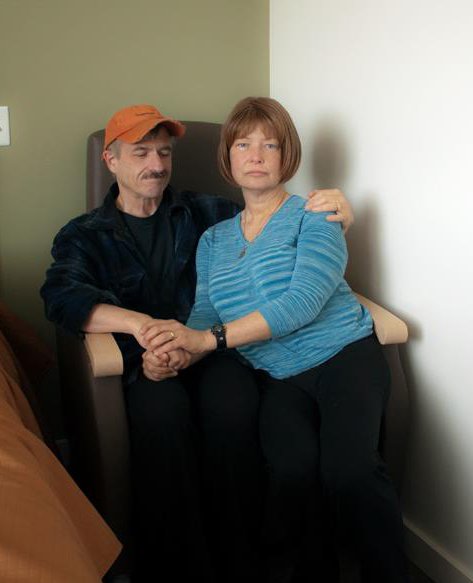
I’ve never met Joe and Heidi Hendricks face to face. I suppose I could, since we live only about a day’s drive away from each other. However, through the “magic” of Facebook, I have shared the last few years of their cancer battle together. The photo I’ve posted is number 56 in their scenes from our cancer battle.

The most startling thing for me about photo 56 is that Joe and Heidi aren’t smiling. No, I don’t expect them to smile after such terrible news, but if you go through their “photo album,” even in the most dire of circumstances, they’re always smiling and joking and pressing on through adversity. Humor is almost the last tool to fail when all other tools have long since burned out in the course of such a tremendous physical and emotional drain. I must admit, mine would have been shot through like swiss cheese in a hail storm long before this. But Joe particularly always makes me laugh.

But not today.

Besides their sense of humor, the thing I admire most about Joe and Heidi is their faith. A lot of Christians say they have faith and trust in God…that is, until something really bad happens. Then it all goes flying out the window and it’s “Why did you let this happen to me, God?” and “How could you be so cruel to me, God?” I’m sure I’d be among that group if I had to face the scenes from Joe and Heidi’s cancer battle first hand.

But no matter how grim it’s been for them, they’ve always grasped tightly onto the hand of God and never let go, just as love has bonded Joe and Heidi together and the never let go of each other.

I’m angry. No, not at God…well, not exactly. I don’t who or what I’m angry at. I think it’s that I feel really helpless and frustrated. Sounds strange, eh? There is horrible tragedy happening all over the world. Every day, someone suffers. Every day, someone dies. Every day, some act of injustice is committed, the helpless are victimized and have no defender, the innocent are made to pay for the crimes of the oppressor. It’s a broken world.

But in the face of all that, I’m angry at the news of Joe and Heidi’s cancer battle today. I know the world isn’t fair, but I’m still angry. It isn’t fair.

It’s like my feelings have mass and can be affected by gravity. It’s like the muscles that hold up my feelings are tired and my sadness is a lead weight, pulling my shoulders down and anchoring me to my seat. I feel as if I’m slowly being pulled to the floor. It’s as if my only light is losing its brightness, and I’m just getting more heavy and silent and it’s getting dark all around me.

The light of laughter is going out in the world.

And where is God?

How many people of faith have asked that question across the long stretch of centuries? How many Christians and Muslims and Jews and whoever else have asked God where He went off to when horrible news, disease, injury, and death stalked us one by one? Is this what ancient man felt like, cowering in some cave in the night, listening to the predators crying out at the moon and declaring to the grey, reflected light that they would find you and consume you?

Is that what it feels like knowing that there is a cancer inside of you and it’s taking over and it won’t be chased away?

I’ve heard the words “God is in control” said countless times in countless church services, but what do the words really mean? God is in control, but people still get sick. God is in control but people still get hurt. We’re alone, and we’re scared, and we need to be able to hang on when our strength, and our stamina, and finally our laughter is dried up like the last drop of water feeding the last wilted flower in the brilliant summer sun baking the vast and endless desert.

I realize that there are forces in the world and forces in our body that we can fight but we can’t always control. At some point, no matter how much you put into the struggle, you (I can only imagine, since I haven’t had to face this) have to let your shoulders relax, let the weight pull you down, look up, put your tiny hand in God’s immense grasp and say, “No matter what happens, please don’t go away.”

I hate crying.

God, don’t go away. Stay with Joe and Heidi, no matter what happens. We all want a miracle, but the greatest miracle is that You even care. If not even one tiny sparrow falls to the earth apart from the will of the Father, then You are mindful of Joe and Heidi, for they are worth much, much more than sparrows.

Stay with them God and, if it is Your will, don’t let them fall. Let them fly.

Easter, Passover, and Myriad Truths

When our universe as we know it first emerged, the soil of the earth was imbued with a wondrous power—the power to generate life.

Place a tiny seed in the ground and it converts the carbon of the air into a mighty redwood—a decomposing seed awakens the power of the infinite.

Yet another miracle, even more wondrous: A quiet act of kindness buried in humility ignites an explosion of G‑dly light.

Infinite power is hidden in the humblest of places.

-Rabbi Tzvi Freeman
“Seeding Miracles”
Based on letters and talks of the Rebbe
Rabbi M. M. Schneerson
Chabad.org

Depending on your religious orientation, we are entering a “season of miracles” in a few days. If you’re Christian, then you are certainly looking forward to Holy Week, culminating with the festivities of Easter and the celebration of the risen Christ this coming Sunday. If you’re Jewish, then you are busy preparing your home and your soul for the Passover season, which begins with Erev Shabbat this coming Friday evening.

Or you have another sort of religious tradition that has no holidays at this time of year, or a tradition that contains no wonders or miracles at all.

I haven’t celebrated Easter for many, many years but I usually look forward to Passover. My wife and I haven’t discussed plans for Pesach this  year, and there are years when we don’t have a personal Pesach seder in our home. Life gets hectic and my spouse isn’t always up to the challenge of preparing an elaborate meal along with the many other preparations and tasks she performs. I suggested yesterday morning, that my sons and I take a turn this year at preparing the Passover meal, but my daughter (who knows what it all entails) just rolled her eyes (mercifully, my wife wasn’t present when I “shot off my big mouth”).

I’ve been avoiding the obligatory Passover blog posts so far due to the uncertainty of the season and, like corporate fellowship, I may have to admit that there will be no personal Passover for me this year. I suppose because I’m not Jewish that it shouldn’t apply to me anyway, so in that, there is no loss if one less Christian isn’t available to attend a purely Jewish commemoration of freedom from slavery and bonding with God.

While, as Rabbi Freeman says, “infinite power is hidden in the humblest of places,” sometimes only humility is to be found in such places as well. There is a time to rise up, to attempt to exceed your limitations, and strive to touch the hem of the garment of God. There are other times that it’s best to step aside and make room for others to achieve that purpose by making yourself small and still. The latter is what’s best for me.

I used to think that so much time had passed since I initiated this “experiment” that my “alternate path” should be apparent to me by now. However, I realize that only an instant has elapsed and it is my place to sit in the shadows and wait. If there is a “miracle” for me, it will be the silence and the muted shades and the stillness of the abyss as I contemplate my existence and ponder on the wonder of God and His unique, radical Oneness.

And I contemplate my path and consider the fork in the road. I can hardly say that it’s either Judaism or Christianity that presents themselves before me, since my options are not two but rather nearly infinite. Within Christianity, there are a myriad of possibilities, both “formal” and idiosyncratic. Judaism, as an option, really doesn’t present itself to me for the simple reason that I am not Jewish. Yet some part of that voice speaks to me and incorporates itself in the other, more “appropriate” options that I still find available to me. Rabbi Freeman presents the transcendent path of truth as containing two paths, but indeed, it contains so much more.

If you find yourself affixed to a single path to truth—

the path of prayer and praise,

or the path of kindness and love,

or the path of wisdom and meditation,

or any other path of a singular mode

—you are on the wrong path.

Truth is not at the end of a path.

Truth transcends all paths.

Choose a path. But when you must, take the opposite path as well.

But if “truth transcends all paths,” then how do you tell truth from its opposite? If choosing truth means choosing opposite paths, when how can I make a choice? If I can’t make a choice, I can then walk no particular path in seeking God.

That leaves me with an impossible decision and no way to make that decision. How can I choose truth if truth is transcendent but I am only human?

If, for me, there is no Easter and there is no Passover, then my choice is to choose no option. That may be the only choice in relation to truth as well. Is it Jacob’s ladder of prayer that sits in front of me, shimmering faintly in the darkness and taunting me in the twilight, or is it the point at which a billion, billion paths converge all demanding I choose the truth and all demanding I choose all truths?

Hypothetical indecision must give way to practical living. I still must wake up each morning, must acknowledge God as the author of my life, such as it is, must get dressed, go to work, labor, go home, be a husband, and father, and grandfather, and walk all the different paths that my life requires, as my tiny march of days on this earth continues to elapse.

All of Judaism will be reading from the seder in a few days, and in a week, Christianity will turn to the end of the Gospels and the resurrection of Jesus. But I will wait and by the dim light of a candle or my soul (I can’t always tell which), I’ll thumb through the pages of Lamentations:

My transgressions were bound into a yoke;
by his hand they were fastened together;
they were set upon my neck;
he caused my strength to fail;
the Lord gave me into the hands
of those whom I cannot withstand.

Lamentations 1:14

An Unusual Introduction

Professor Didier Pollefeyt of The Catholic University of Leuven (the oldest continual Catholic University in the world) stated his view at the Cathedral Notre Dame on October 1996 as follows:

‘The way Jesus will come as the Christ and the Redeemer of the world will depend on the way Christians re-present Him in the present. When Christians are not able to bring His redemption to the world today, especially in relationship with the Jewish people, I’m afraid that at the end of times, they will not meet a triumphalising Messiah, but what I would like to call a `’weeping Messiah’, a Messiah weeping for the injuries and the unredeemedness Christians caused, especially to His own people. Then it could end with the fact that indeed not Christians, with their triumphalistic Messianic perceptions, but the Jews will be able to recognize as the first one’s the Messiah as the Savior of the World.’

At a pre Christmas service in 2001, Father Dr. Reimund Beiringer, also of the Catholic University of Leuven, began his sermon with the following opening remarks: ‘when Jesus comes back he will be circumcised, he will not be able to eat at my home because it is not kosher and will look at this church and ask the Rabbi where can he find a synagogue’. The above remarkable statements confirm that Jesus the Jew continues to accept the symbol of Jewishness – the circumcision – by eating kosher he continues to observe Jewish ritual law and by attending a synagogue he continues his Jewish persona. This embodies the total antithesis of Rejection theology. Father Reimund personally asked me to attend this church service and pointed me out as the person Jesus would ask for a synagogue and at whose home he could eat.

-Rabbi Moshe Reiss
from the Introduction to
Christianity: A Jewish Perspective

I don’t know where I got this link. I tend to collect them in my email account and “save them for later.” Most of the links and resources I save never get read or written about. I just don’t have the time. But for some reason, I went back and revisited this one and read through the Introduction. As far as I can tell, this book is only available online and has ten chapters, including the introduction, conclusions, and bibliography. The landing page for the book is at moshereiss.org.

I have no idea who Rabbi Moshe Reiss is and I can’t find anything reliable about him on the web, at least as the result of a quick Google search. For all I know, his opinions and experiences are “stuffed full of muffins,” to put it politely, but I got this link from somewhere, which means someone probably recommended it.

I must admit to being intrigued by an Orthodox Rabbi to who doesn’t dismiss Christianity out of hand and who is willing to engage it to the degree that he even writes a book about it.

OK, there is also Rabbi Shmuley Boteach and his book Kosher Jesus, which I reviewed reviewed last February, but that almost doesn’t count because Rabbi Boteach is always writing about controversy. He also didn’t really “engage” Christianity so much as he tried to explain it away.

I don’t think I expected an Orthodox Jew to write something like this:

As a graduate student at Oxford University in 1970 I decided to visit the Anglican Church on Christian Eve. I was amazed how the services seemed Jewish-like to me. I discovered a class on the Talmud at Oxford. I naively assumed that the teacher would be a Rabbi; in fact he was an Anglican Minister. Not only was I amazed – having grown up in a Jewish ghetto I assumed only Jews learnt the Talmud – I was also angry. Why was this Gentile cleric reading our books? In 1984, after visiting Auschwitz I entered an Orthodox Church in Bucharest and was once again I was struck by the resemblance to a service in a Jewish Synagogue. At the time my knowledge of Christianity was virtually nil. The following year I found an ex-Jesuit Priest from Yale University who agreed to teach me the Christian Bible.

Maybe the reason the only place I can find out anything about Rabbi Reiss is on his own rather cheesy looking, 1990-ish website, is because of how the larger Orthodox community has perceived statements such as the one I just quoted. What Jew would admit on the Internet that he asked an “ex-Jesuit Priest from Yale University’ to teach him the New Testament?

Frankly, I’m also amazed at the quote from Father Dr. Reimund Beiringer saying, “when Jesus comes back he will be circumcised, he will not be able to eat at my home because it is not kosher and will look at this church and ask the Rabbi where can he find a synagogue.” I think that definitely demands an official response of, “Wow!”

So, despite the fact that I can’t really discover anything about Rabbi Reiss, I am quite intrigued to find out what else he has to say about Christianity. I’m also very interested to see if he’s encountered any other Christians who believe the Messiah will return as a circumcised Jew who keeps kosher. Imagine listening to a conversation between two guys like Rabbi Reiss and Father Beiringer over coffee.

I suppose I should say at this point that the Rabbi does have an email address on his site, so I could just send him a message and ask him about himself. I think I’ll wait though. I’ll let his book speak for him right now. Later I may have more questions I’ll keep you posted.

In the meantime, if anyone out there has any insights or information about Rabbi Reiss, please let me know. Thanks.

Questions You Can Never Ask In Church

There is a Yiddish saying that is familiar to many: “One doesn’t die from asking a question.” This expression is a pithy way to explain to someone who has questions that having a question — or many — is no big deal.

As one gets older and wiser, he has a broader perspective and realizes that questions are a part of life and that we make choices despite questions all the time.

Daf Yomi Digest
Stories Off the Daf
“The Missing Husband”
Kereisos 11-1

I had coffee after work with a couple of guys yesterday. That’s actually kind of unusual for me since I don’t socialize very often, but this was a somewhat unusual situation. Those of you who have been following my blog for awhile know that one of my “issues” is my lack of fellowship with like-minded believers. You have probably read my discussion about why I don’t go to church. These two fellows are more or less in the same boat as I am. We are all believers, but through one process or another, we find ourselves without a congregation to which we can belong. Maybe we’re too independent or idiosyncratic or something.

So over coffee at Moxie Java, we discussed why we were meeting in the first place. We hadn’t brought our Bibles and we didn’t have a specific plan or agenda for our meeting. The most we had settled on before getting together yesterday was that we wanted to have a meeting and talk. But what about?

We came up with a number of reasons why we were more alike than unalike, and why we don’t seem to fit into a traditional church setting. One of the reasons was that we ask a lot of questions.

You might not think this is a big deal, but I know from my own experience that it’s not a good idea to ask a lot of questions in church, or at least, you shouldn’t ask questions that don’t have canned, pre-programmed, Christian answers. But we were discussing things like the Deity (or lack thereof) of Jesus and whether or not there really is a Trinity, and whether the third Temple would be a real, physical structure built by men (I think so, but someone else didn’t) or something more “spiritual.” These are questions that would probably raise a few eyebrows if you discussed them in adult Sunday school after services. They might even get you quickly escorted to the door by a couple of ushers with a strong “suggestion” never to return.

That’s the difference between how I see Christianity and Judaism. Christianity is about always having the right answers and only asking questions that map to those answers. Judaism is about always asking all kinds of questions and then struggling with the answers, maybe coming up with half a dozen possible responses, and then arguing all of them around back and forth. There’s no sin in wondering exactly what makes Jesus divine and what his relationship is with “God the Father,” but you might not get that feeling if you asked those kind of questions in a church.

But if you don’t ask questions, then you don’t learn. And if you don’t learn, then your relationship with God drops into a deadend rut and never goes anywhere for years and years.

The rebellious child who questions everything sits in a place beyond the one who has nothing to ask.

If the rebellious child questions, it is because it touches him, it says something to him. Perhaps it even bothers him.

But a perfectly capable human being who has no questions about Torah and G-d — he is stuck in his place. Perhaps he is a good religious Jew who does good deeds and never sins. But there is no sense of the spirit, of the meaning of life, of transcendence.

He is stuck in Egypt and knows of nothing higher.

—at the second Seder, 1965

Chronicled by Rabbi Tzvi Freeman
“Inquisitively Challenged”
Based on letters and talks of the Rebbe
Rabbi M. M. Schneerson
Chabad.org

I was discussing this matter with a Pastor on his blog the other day, and his response was that the issue wasn’t Christianity vs. Judaism, but west vs. east. He said that the eastern churches tended to very much encourage question asking and wrestling over difficult issues. The western church tends to be more “goal-oriented” and likes conclusions rather than conundrums. That may well be true. I don’t know. I do know that the traditional Yeshiva model of learning is to argue opposing positions and “posing problems that would cross a rabbi’s eyes.” (from the lyrics to If I Were a Rich Man)

broken-crossSo there we were, three guys sitting around drinking mediocre coffee and occasionally having our conversation being drowned out by the latte machine, asking questions, posing problems, and generally discussing matters that would “cross a Pastor’s eyes.”

But it felt good.

Part of getting close to God is meditating upon Him and His awesome, mighty works and wonders. Part of getting close to God is prayer. Part of getting close to God is reading the Bible and studying the Torah commentaries of the ancient Jewish sages.

And part of knowing God is getting together with a few other guys in a coffee shop in southwestern Idaho and talking about Him, asking all the questions we can’t ask other people, and hoping we get at a few answers, or better yet, a few more questions, that surprise and challenge us.

Because if we can’t find a way to get closer to Him, we’ll always be too far away.

Whom have I in heaven but you?
And there is nothing on earth that I desire besides you.
My flesh and my heart may fail,
but God is the strength of my heart and my portion forever.

For behold, those who are far from you shall perish;
you put an end to everyone who is unfaithful to you.
But for me it is good to be near God;
I have made the Lord God my refuge,
that I may tell of all your works. –Psalm 73:25-28 (ESV)

We’ll get together again next Thursday after work and see how it goes. Maybe, I’ll have a good question to ask. I hope no one comes up with just one answer.

Tzav: Burning in the Dark

The fire upon the altar shall be kept burning upon it, it shall never go out. Each morning, the kohen shall burn wood upon it.

Leviticus 6:5

Although a supernal fire from heaven always burned upon the altar, nevertheless, it was imperative that an additional fire be provided by man.

Talmud, Eruvin 63a

The Ramban states (Commentary on Vayikra 1:9.) that the offering of an animal upon the altar was able to achieve atonement for a sinner because the person realizes that everything transpiring with the animal should have been happening with him, were it not that G-d in His kindness permitted the substitution.

It is thus understandable that all aspects of an offering, including the burning of fat and limbs, find corollaries in terms of man’s spiritual service.

How does “burning the fat” apply to our spiritual lives?

Fat is indicative of pleasure. (See Gittin 56b.) The lesson here is: “All fat is to be offered to G-d” (Vayikra 3:16.) – all of a Jew’s pleasure and satisfaction should be offered to G-d.

Commentary on Torah Portion Tzav
from the The Chasidic Dimension series
Chabad.org

There’s a sort of “communication” that happens in substitutionary sacrifice. In saying that the body, the sinews, the flesh, and the fat of this animal is burning in your place because of your sins, God was showing the Jewish people the dire consequences of their sins. Extending that to we who are Christians, by showing us a picture of a Christ crucified and “abandoned” (Matthew 27:46) by God, He lets us see the ultimate consequences of our own sins. By continuing to show us that horrible image after we have come to faith and trust in God through the Messiah, we can see that any wrongdoing we commit as a “saved” person is throwing pain, suffering, blood, and death right back in the face of the Master.

If God so loved the world and the world continues to sin, what does His love mean to us anyway?

To be fair (if fairness comes into the equation), human beings are very frail and easily distracted. As I mentioned in yesterday’s morning meditation, we are all in search of a language and a method by which we can reconcile the spiritual and the “animal” within each of us. We strive to reach heaven while wallowing in the mud. “The spirit indeed is willing, but the flesh is weak.” (Matthew 26:41) We will never be “perfect people” this side of paradise and so our “fruits” will never be perfect either. I think it’s the struggle toward holiness that defines us just as much as the result.

…it is possible to explain the analogies of day and night on a deeper plane, enabling us to understand why offering the fats during the day is a positive mitzvah, while offering them at night serves merely to preclude sin.

In addition to the interpretation mentioned above, day and night can be seen as analogies for a person’s spiritual state. Day refers to a time when one feels the G-dly light in his soul. This applies not only when he is involved in the observance of Torah and mitzvos, G-d’s will and His wisdom, (Tanya , ch. 4.) but also when involved in material activities. Even in the worldly sphere, he serves G-d, following the dictum: (Mishlei 3:6.) “Know Him in all your ways.” To cite an example, when tzaddikim partake of food, their eating serves a higher purpose than humanity’s ordinary efforts at refinement; “A tzaddik eats for the satisfaction of his soul.” (Mishlei 13:25.)

Night, by contrast, refers to a condition in which a person does not feel G-dliness. Therefore his need to engage in material things generates a constant struggle to serve G-d rather than indulge his desires. Moreover, even when he is involved in studying Torah and observing its mitzvos, he must labor to remain properly motivated. For the law is enclothed in mortal intellect, and the mitzvos involve material entities and the potentials of our animal soul. And so it is necessary to strive that one study lishmah, only for the sake of the Torah. Similarly, our observance of the mitzvos must be for G-d’s sake, and not for our own.

-Rabbi Eli Touger
Lekutei Sichot: Tzav
“Day and Night in Our Divine Service”
Adapted from Sichos Yud-Tes Kislev, 5711
Chabad.org

I think a lot of folks qualify as “night people” by the above interpretation and, sad to say, that includes me. I admire people who can “Know Him in all your ways,” but that behavior eludes me. I think it requires that I somehow repair the disconnect between the spiritual and the secular within me. I say that with the awareness that to “repair” something means it must have worked properly at some point in the past. However, in my case, maybe I never made the connection in the first place. Maybe I have never “known Him in all my ways.”

In that case, are all of my efforts in attempting to “know Him,” while constantly walking into walls in the material world, in vain? Maybe I am the one who is burning on the fire and I just haven’t let myself smell the aroma of my own incineration yet. Maybe like Peter and the two sons of Zebedee at Gethsemane, I’m also asleep at the switch, present in the garden because of my spirit but completely unconscious because of my “flesh.” In “practicing stillness,” I have “stilled” myself into a spiritual nap, and in my nightmares, I can’t escape the maze of my so-called day-to-day existence.

On today’s daf we find that, for certain sacrifices, one who is poor can use a bird instead of an animal. The birds permitted for use are either a pigeon or a dove.

In Bava Kama, Rabbi Avahu learns a lesson from this. “One should be among those whom others pursue rather than among those who pursue others. We learn this from the birds used when bringing a sacrifice: pigeons or doves. There are no birds which are more pursued than these.”

Ramban, zt”l, explains why specifically these birds are used. “There are no birds more readily available than pigeons or doves. As our sages say regarding the animals used for sacrifices, he brings a sheep or a goat since no other animals are more readily available. This is so that a person should not have to hunt to bring a sacrifice. God wanted us to use big pigeons since they never take another mate. Similarly, Yisrael is God’s nation and will never leave Him for anything. Doves will take new mates however. That is why we find that only small yonim are qualified to be used as a sacrifice.

“Our sages tell us that if a person takes eggs or chicks out of the nest, most birds will never take them back. The yonah is an exception to this rule—it will never abandon its eggs or offspring. This symbolizes, that we will never leave God no matter what duress we may have to endure. As the Midrash writes, Jews would say, ‘Either let me live as a Jew, or crucify me!'”

Daf Yomi Digest
Stories Off the Daf
“The Doves”
Kereisos 10-1

According to the Daf, a Jew must be allowed to live as a Jew in every detail of day-to-day existence because it is that lifestyle that expresses his worship of and devotion to God. When the church has historically demanded (and forced) Jews to abandon their Judaism in order to “be saved” and to worship the Jewish Messiah (though the church did not depict him as such in that bygone era), they were asking the impossible. They were asking a Jew to abandon God for the sake of worshiping the Christian Jesus. As the Daf concludes, “As the Midrash writes, Jews would say, ‘Either let me live as a Jew, or crucify me!'”

It’s that level of devotion in the face of human tribulation that escapes me. The ability to rise above adversity, the arguments about religion, politics, and what it means to be good or bad, given the various biases in the world is (as I see it) impossible for me to achieve. Where is the “one small still voice” and the “peace beyond all understanding” in a world of controversy surrounding whether the Jewish murder victims in Toulouse are more or less worthy of compassion than shooting victim Trayvon Martin in Florida? Why does the world insist that I choose and why should I care what the world insists upon? Why can’t I see beyond the arguments of the moment and extend my perspective to the world as God sees it? Does God not care equally for all of the hurt, and the fearful, and the dying?

No man is an island entire of itself; every man
is a piece of the continent, a part of the main;
if a clod be washed away by the sea, Europe
is the less, as well as if a promontory were, as
well as a manor of thy friends or of thine
own were; any man’s death diminishes me,
because I am involved in mankind.
And therefore never send to know for whom
the bell tolls; it tolls for thee.

-John Donne
No Man Is An Island

This is a very old poem, and yet it presents the modern day humanity with a perfect image of how we should feel about one another. The Master said that the two greatest commandments (Matthew 22:36-40) were to love God and to love our neighbor, and he forever, inexorably linked the two mitzvot. If we love God, we must love each other, but that requires that we step outside of ourselves, our petty squabbles, our biases, our wants, our needs, and our humanity. To love God requires a mystical connection to the supernatural, ephemeral essence of God, the Ayn Sof, the Infinite, the Unique One. The Jewish Messiah provides the conduit we non-Jews require to make that happen, but it’s hardly automatic.

I sometimes wonder if these “day people” are truly real or even possible, and it’s only a matter of some people being better able to hide their “night” persona better than others? Yesterday, while sitting at the bottom of the abyss, I optimistically reached out for the first rung in my metaphorical “Jacob’s ladder” of prayer and dared to imagine I could climb up and achieve a “light at the end of the tunnel” experience with God.

Today, it seems like my reach has greatly exceeded my grasp and nothing but wishful thinking and presumptuous arrogance allowed me to imagine I could go that far. But restructuring probably isn’t an event that can be achieved in a moment of brilliance. It’s rather a process that occurs as slowly as the movement of the constellations against the velvet dark sky.

So here I am, a night person in the dark, sitting with my Bible and my humanity, wrestling with that other part of me created in God’s image. They don’t like talking to each other, and although perfectly aware of each other’s presence, they can barely see or even stand each other. So I try to light a candle to give off even a tiny modicum of light in the hopes that humanity and divinity can come to some sort of accord, but is that light the illumination of my inner holiness, or is it just my flesh burning on the pyre?

By our nature, we are aflame. We burn with anxiety, the angst of survival in a hostile world.

To channel this fire, there is meditation and prayer. With these, we fan a fire of love for that which transcends this world. One fire swallows another and we are set free.

Liberated from fear, we face the world no longer as slaves, but as masters.

-Rabbi Tzvi Freeman
“Fire Burning Fire”
Based on letters and talks of the Rebbe
Rabbi M. M. Schneerson
Chabad.org

Good Shabbos.



Restructuring

We’re talking about meditating – as per our last installment. About taking the reins of that gray matter and restructuring it for inspired living. Who’s going to take those reins? Who’s doing the restructuring? There must be some aspect of mind that transcends the gray meat and is able to look at it and say, “Naah—better off this way!” Otherwise, why would a brain care about restructuring itself – or even realize it requires restructuring?

We’ve known this for a long time. We’ve known that there is an aspect of the human being that comes wrapped with the meat and bones, while there’s another aspect that enters from beyond. That is why, writes the 14th-century commentator, Rabbeinu Bechayei, the book of Genesis tells the story of the creation of the first human being twice: once to describe the animal called homo sapiens, and then again to describe the injection of a G-dly soul into this creature — “And He blew into his nostrils the breath of life.”

So there are (at least) two persons in there: a basic human animal person, and a G-dly person. Two big roommates in a small human frame – with very different tastes in interior decorating. Which can get very ugly.

-Rabbi Tzvi Freeman
“Chabad Meditation”
Last entry in the Multimedia Guide to Jewish Prayer series
Chabad.org

In yesterday’s morning meditation, I presented the concept of Jewish, or more specifically, Chasidic meditation as a means of preparing for entry into prayer. The idea is that, before climbing the ladder of Jacob, so to speak, in order to enter into the presence of the King, you prepare your mind and spirit through meditating on God, His wonders, His works, His meaning. You immerse yourself in God as one steps into a pool and submerges into the depths of His mystery and His identity. Then you emerge and are ready to stand before the Throne.

However, this last entry into Rabbi Freeman’s series on Jewish prayer expands and transforms the meaning of meditation to include the internal restructuring of the person. This is actually my primary goal at the moment; a personal restructuring of my understanding of myself and life and how I can choose to interpret events differently than I have in the past. From the Chasidic point of view, the restructuring involves the transaction between the purely human “meat animal” of a person, and that part of us God breathed into our bodies.

Here’s the really exciting part for me.

So, to put this all together, we are describing meditation as a form of negotiations between a non-meat-related soul that is basically G-d breathing inside, principally concerned with going back to where it came from, and a human brain that comes wrapped in gray and white meat and is principally concerned with, well, meat kinds of things – eating, sleeping, procreating, collecting toys, and getting lots of people to say what a wonderful human being he is.

A daunting task. What can the G-dly soul possibly say that might impress this human person?

Well, first off, you need some background data on your particular human animal. What impresses it? What fascinates it? What’s its language?

This is just amazing. Not only does Rabbi Freeman speak of restructuring, which is foremost on my mind and the thrust of my current desires, but he introduces “language” or metaphor as the means by which we learn how to restructure. There’s a reason why Rabbi Freeman is one of my favorite storytellers, particularly in the area of spirituality, God, and wonder.

The Rabbi goes on to explain that one of his favorite “languages” is technology and programming, so he tends to allow this theme to act as the conduit for communications between his “Godly soul” and his “Animal soul.” We all use different languages for this purpose. In a comment on yesterday’s morning meditation, my friend Joe said:

Practicing when hiking in the mountains, breathing God in and out with each step opens up an awareness of every example of Creation’s beauty I pass on the trail, because I am not off thinking about the future.

I thought of that this morning as I was working out on the Elliptical machine at the gym. I’m trying to improve my cardiac recovery after an aerobic workout and, during the five-minute cooldown, as I was slowing my pace and had the machine set to a lesser intensity, I closed my eyes and spent some time breathing God in and out as I allowed my breathing to slow and deepen. I pondered the wonders of God in ways you might not imagine. I found my thoughts centering around Joe’s recent cancer surgery and how well it went and then around his wife Heidi, who continues to undergo aggressive chemotherapy. I found myself asking where is the miracle of God in Heidi’s suffering? The answer is the wonder of God she has in Joe. Whatever Heidi faces in her battle with cancer, she is not alone. She has God and she has a husband with a Godly soul.

I opened my eyes and my heart rate was lower than I had previously achieved at the end of a workout…not by much, but it was something.

That may not be particularly impressive, but there is something important in what we talk to ourselves about before we actually talk to God. Often, I enter into the presence of God like a raw nerve with this need and that, yelling and screaming about the injustices of the world, and the worry, and the anxiety, and the tragedy of the world, including my world. I’ve heard Pastors and motivational speakers talk about “giving it all to Jesus” and “taking charge of your thoughts” and “letting go of your worries,” but no one ever says how this is to be done. Or if they describe a method, it doesn’t seem to be one that I find particularly workable.

But then, we all respond differently to different languages. I don’t “understand” a lot of the languages being spoken in the religious and spiritual worlds and thus, they mean little or nothing to me. And then there’s the language that’s required to conduct the internal dialog between that which is animal and that which is spiritual within me.

Everyone else’s “good advice” doesn’t work if they’re talking in the wrong language and if the metaphors don’t make a connection (which is why motivational football or fishing stories fall flat with me). Restructuring requires that you have active control over selecting your own language and metaphors, even if they don’t mean anything to anyone else. Find your own storytellers who speak that language and let them speak to you. Take all that and let it be your own voice as you speak to yourself. Then you will have a voice in which you can better speak to God. Not a voice of panic and desperation, but one that, after still and quiet contemplation upon God’s wonders, can speak in small stillness, in praise, in glory, in humility, in a thousand colors and shades that describe who you are, who you are becoming, and who you are perfectly within Him.

There are better days and there are worse days. But on the better days, I can reach that place in the antechamber that exists between the world and God’s Throne and still myself. Then, in a supernatural moment of peace, I reach out for the first rung of the ladder which sits at the bottom of the abyss, and the surroundings begin to brighten. I take the first step in my climb, breathing in God and breathing Him out. The door to the Heavenly court begins to open, I find my mouth, and I must speak.

“Our Father Who is in Heaven…”

“Faith believes that which it is told, because it wants to believe.

Intellect believes that which it understands, because it wants to attain understanding.

Wisdom believes that which is true, because it is true.

It doesn’t have to fit that which faith wishes to believe. It doesn’t await the approval of intellect to say, “This can be understood.”

Wisdom is clear vision, the power to see “that which is” without attempting to fit it into any mold. Wisdom, therefore, is the only channel by which an Infinite G-d may enter.”

-Rabbi Tzvi Freeman
“Faith, Intellect, Wisdom”
Based on letters and talks of the Rebbe
Rabbi M. M. Schneerson
Chabad.org

This isn’t the end. It’s only the beginning.

“When you make a world tolerable for yourself, you make a world tolerable for others.”

-Anaïs Nin, French-Cuban author

"When you awake in the morning, learn something to inspire you and mediate upon it, then plunge forward full of light with which to illuminate the darkness." -Rabbi Tzvi Freeman