Va’eira: Peace in the Valley of Landru

When the Torah names a place, the name describes not only a geographic location, but also a state of mind, and a spiritual set of circumstances. In this context, Mitzrayim, the Hebrew name for Egypt, serves as a paradigm, teaching us what exile is, and demonstrating the essence of the spiritual challenge which our people have confronted throughout history.

Mitzrayim relates to the Hebrew word meitzarim, meaning “boundaries,” or “limitations.” Material existence confines and limits the expression of G-dliness in the world at large, and the expression of the G-dly spark within our souls. This is exile, an unnatural state. For the true reality that the world was created to be a dwelling for G-d, and that a person’s soul is an actual part of G-d is concealed. In such a setting, a person becomes absorbed in the daily routine of his life. Spiritual values if he considers them at all are interpreted according to his own world view.

Moreover, exile naturally perpetuates itself. Our Sages relate that not one slave could escape from Egypt. Similarly, any setting in which a person lives creates an inertia that resists change. To borrow an expression from our Sages: “A person in fetters cannot set himself free.” Since every person’s thought processes are today shaped by the environment of exile, many find it difficult to see beyond that setting.

-Rabbi Eli Touger
In the Garden of Torah
“Seeing and Believing”
Commentary on Torah Portion Va’eira
Adapted from
Likkutei Sichos, Vol. XVI, p. 52ff; Vol. XXXI, p. 25ff;
Sichos Shabbos Parshas Va’eira, 5743;
and Sichos Chof-Vav Nissan, 5751
Chabad.org

Have you ever wondered how Aaron, the brother of Moses, was able to escape the land of Egypt in order to join his brother in Midian (Exodus 4:14)? After all, Aaron was a slave. Certainly there were people watching him while he toiled under his harsh labors. Certainly there were guards at the border of Egypt to make sure slaves didn’t just wander out. Moses had a very difficult time escaping and was almost killed in the process. How did Aaron leave with such apparent ease?

I don’t know if the slavery of Israel in Egypt is the way Rabbi Touger explains. After all, we see in this week’s Torah Portion that Moses and Aaron tried time and again to get Pharaoh, king of Egypt to release Israel, and time and again, Pharaoh refused, even after temporarily agreeing in order to end each plague. If Israel had basically enslaved themselves through their own limited spiritual awareness, why couldn’t they free themselves by just getting up and walking out? It would have been pretty difficult for even the entire army of Egypt to stop two or three million people if they decided to do something in a united fashion.

OK, Rabbi Touger’s analysis is more midrash and metaphor than historical fact, but it does teach us something about the nature of exile, slavery, and human nature. Often, we can be “enslaved” to something that is extremely unpleasant and even damaging and we beg God to release us from our captivity. Yet all the while, it is within our power to release ourselves. All we have to do is become aware of our freedom of spirit, take off our chains, stand up, and walk out of the “land of Egypt.”

But is it that easy? Rabbi Touger doesn’t seem to think so.

And yet, although man may not be able to free himself, G-d refuses to allow exile to continue indefinitely. The first step of redemption is a direct revelation of G-dliness. Since the fundamental characteristic of exile is the concealment of G-d’s presence, the nullification of exile involves a clearer revelation of G-dliness. This will shake people out of their self-absorption and open them to spiritual awareness.

This is the message of “Parshas Va’eira”. “Va’eira” means “And I revealed Myself.” The root of Va’eira is the word “re’iyah”, meaning “sight.” Va’eira refers to something that can be seen directly. This theme is continued throughout the Torah reading, which describes seven of the ten plagues open miracles which had a twofold purpose, as the Torah states: “I will display My power,… I will bring forth My hosts from Egypt…. And Egypt will know that I am G-d.”

So, it’s not that easy but we do have a roadmap in the realization of a revealed God. We can’t free ourselves from our own exile in “the land of sin,” but fortunately, God is not willing to allow us to suffer indefinitely. He will intervene on our behalf, sometimes even when we don’t want Him to. We may want to stay in our sin, in our specific problems, in our booze, in our drugs, in our depression, in our anger and frustration, maybe because we’ve lost hope. It’s at those times when God will come in and shake up our “status quo” and we might not feel too comfortable about it. While the plagues were aimed at Pharaoh and the Egyptians, what were the Israelites feeling? While they didn’t suffer the consequences of the plagues, were they worried about what would happen to them next? We see in future parts of the Torah how the Israelites, when encountering challenges along the road to Israel, rebelled against God and even longed to return to Egypt, as if slavery were better than freedom.

The rabble with them began to crave other food, and again the Israelites started wailing and said, “If only we had meat to eat! We remember the fish we ate in Egypt at no cost—also the cucumbers, melons, leeks, onions and garlic. –Numbers 11:4-5

Was the food given to slaves really so superior to what they got from God, or were they really having a difficult time separating themselves from a lifetime of servitude and the “comfort” of having Egyptian masters? It’s hard to imagine, but sometimes people who have been in prison for many years, once released, will commit a crime, just to go back to the relative “security” of the penal system. A person who has turned to God and found freedom from sin and degradation may abandon a life of holiness and return to their former world, even though they know they’ll suffer pain, hardship, and even potentially death. It’s hard to give up what we are familiar with, even when what we have become accustomed to hurts and degrades us.

The story of the Exodus from Egypt isn’t just a story of a population of slaves being redeemed in order to serve God and inherit the Land of Promise. It’s the story of personal and corporate redemption from slavery to sin and exile of the spirit in a place not inhabited by God. God can do all of the “heavy lifting”, defeat the plans of our “slave masters” (who are often ourselves), and open the door to freedom, but we must be willing to remove our chains, stand up, and walk out of prison and into freedom. Then, we must be willing to tolerate the “insecurity” of being free and have the courage to explore a life that is new with the presence of God. Our enemy in this endeavor doesn’t have to be some external, supernatural force. Most of the time, it’s the person we see whenever we look in the mirror.

The potential spiritual growth of a man about to be married who wants to be uplifted is certainly significant. When he marries, all of his sins are forgiven. The Chasam Sofer, zt”l, writes that a groom is compared to the tzaddik of the generation throughout the entire week of sheva berachos. Who can tell to what heights he can reach if he puts in the spiritual work necessary during these special days?

The Lev Simcha, zt”l, gives us an idea of what the spiritual potential of a chosson is like. “Our sages say that a groom is compared to a king. In Sukkah 52 our sages say that the tzaddikim see their yetzer hara as a mountain. And in Arachin 6 we find that a king has the power to uproot mountains. If a chosson workshard enough on this, he can literally uproot his yetzer hara!”

Daf Yomi Digest
Stories Off the Daf
“Uprooting Mountains”
Arachin 6

He said to them, “Because of your little faith. For truly, I say to you, if you have faith like a grain of mustard seed, you will say to this mountain, ‘Move from here to there,’ and it will move, and nothing will be impossible for you.” –Matthew 17:20

God gives us the power to move mountains. These may not be the snow-capped mountains we see in winter, that we ski upon, or that possess trails into the pine covered wilderness. These may be the mountains of the evil we have nurtured within us and that weigh us down, preventing our spirit from taking flight as does the eagle.

You may still feel as if you’re in jail, trapped behind a locked cell door. But stand up and look around. You’ve been Sitting on the Keys.

Good Shabbos.
 

Mistreating People

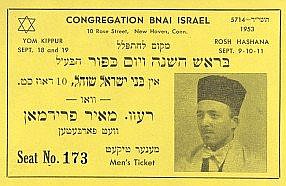
A few years ago, in a hilarious episode of “Curb Your Enthusiasm,” the comedian Larry David bought scalpers’ tickets to his congregation’s High Holy Day services, and was kicked out when his subterfuge was discovered. Nothing that dramatic happened to a friend of mine who wished to attend services last year, but he also had an unpleasant experience with a large congregation.

My friend, who moved to Westchester several years ago, is not a regular shul-goer, but had always gone to High Holy Day services in the city. In his first year in the suburbs, he called a large local Conservative congregation — his denominational preference — and was told that he could have tickets that year at a nominal fee, but if he wished to attend the following year he would have to join the congregation. He was out of the country the following year, so when he returned the year after that, he phoned to ask if he might pay a more substantial fee for his seats this time but not yet become a congregation member. He had not made up his mind about membership. The response he received was a snappish, “You cannot come here again without joining,” and a loud click of the receiver. One or two other large synagogues in his area also informed him in no uncertain terms that he had to be a member to get tickets.

-Francine Klagsbrun
Special to the Jewish Week
“Synagogues Should Be More Welcoming”
The Jewish Week

That sounds terrible. In fact, the whole process of buying tickets to the High Holy Days services probably seems strange and alien to most Christians. After all, it’s not like we have to buy tickets to get seats at Christmas or Easter services in a church (although I must admit, I haven’t commemorated either event or worshiped in a church setting for many years). And yet, the synagogue model raises funds in a very different manner than the church and purchasing an annual membership to a synagogue as well as buying tickets for special events like Passover or the High Holy Days is perfectly normal and reasonable.

But what about the situation described by Klagsbrun? Is this what God really intended? Is this how a synagogue welcomes a Jew into its midst for worship and to honor God? If the person in question had held a membership to the synagogue, it wouldn’t be a problem. But just as some Christians only attend church on Easter, some Jews only go to shul for the High Holidays. No one bars the door to the “annual Christian” but why should a “three day a year Jew” not be able to worship because of lack of “membership?”

Of course, there are always options.

Put off by those responses he called the local Chabad office, ordinarily a sect foreign to his liberal religious and social outlooks. The rabbi who answered the phone greeted him cordially and invited him to attend all the holiday services with no payment. When he did, he received a warm welcome from the rabbi and his assistant. And when he became ill and did not show up for Yom Kippur, the rabbi later called his home to inquire after him. Although my friend missed the more intellectual atmosphere of a Conservative synagogue, he enjoyed the enthusiasm and inclusiveness of the Chabad service. Needlessly to say, he sent an unsolicited check to Chabad after the holidays. It was the money he had offered to pay for tickets to the large suburban synagogue.

No, this isn’t my advertisement for the Chabad and that also was not Klagbrun’s intent when writing her article. For many Reform and Conservative Jews, entering the world of the Chabad is about as comfortable as a visit to the surface of the Moon without the benefit of a spacesuit. A large number of Jews consider the Chabad “cult-like, with its mysticism, messianism, and adulation of the Rebbe” (so if you as a Christian have issues with the Chabad, you’re not alone). But they are doing one thing right. They are welcoming the so-called “three days a year” Jew into their midst the way (forgive me if this next part offends you) that a church would welcome an errant Christian, seeker, or wandering atheist through their doors.

Klagsbrun suggests that it is time for “synagogues to rethink some of their policies, add flexibility, reach out to the unaffiliated, and then take more pride than ever in what a religious New Year really means.” I don’t often go out of my way to be critical of Judaism, but I am also aware that no people group and no religious faith is perfect or has the corner market on righteousness. To my way of thinking, the “welcomeness” of the church (whatever faults it may possess) is generally more aligned with the will and wisdom of God and the spirit of the Messiah than the examples of the synagogue Klagsbrun brings forth. And yet, even during some of Judaism’s darkest hours, God’s response to His “straying sheep” is not condemnation, but compassion.

By the time Moses returned to the scene, his people had hit an all-time low. They worshipped idols, spoke slanderously of each other, and had wandered very far from the path of their forefathers. Perhaps he should have told them off, saying, “Repent, sinners, lest you perish altogether!”

But he didn’t. Instead, he told them how G-d cared for them and felt their suffering, how He would bring about miracles, freedom and a wondrous future out of His love for them.

As for rebuke, Moses saved that for G-d. “Why have you mistreated your people?!” he demanded.

If you don’t like the other guy’s lifestyle, do him a favor, lend him a hand. Once you’ve brought a few miracles into his life, then you can urge him to chuck his bad habits.

-Rabbi Tzvi Freeman
“Rebuke”
Based on letters and talks of the Rebbe
Rabbi M. M. Schneerson
Chabad.org

I am sometimes treated to a view of our local Reform and Chabad synagogues, their members, and their Rabbis, as seen through my wife’s eyes and experiences. No one is perfect. Everyone has flaws. Some of the events that occur within the Chabad are less than attractive or appealing. And yet to read words of wisdom and beauty that are inspired by the Rebbe are a joy that reminds me of the grace of Jesus. As I mentioned in yesterday’s “morning meditation”, God is writing on all our hearts and there is something of the Divine in each of us. Rather than rebuking our neighbor for his shortcomings, we should show our love and grace, even as God has shown love, grace, and mercy to us.

“For God so loved the world, that he gave his only Son, that whoever believes in him should not perish but have eternal life. –John 3:16 (ESV)

Praying and the Pain of Thorns

Most of us expect prayer to inspire and comfort us. The grandeur of the synagogue, its architectural beauty and music, the peacefulness of the setting – all of these convey the sense that Jewish prayer is about feeling peace. We expect that participating in a service will touch us uniquely and deeply. So when we do not feel that peace, we feel let down.

But if Jewish life is about struggle, we should be suspicious of the assumption that prayer is entirely about peace or comfort. If prayer were designed only to provide comfort, would it contribute to our struggle? Probably not. If prayer were designed only to move and to touch us, if comfort and joy were its only goals, Jewish prayer would actually undermine the difficult effort involved in Jewish spirituality.

-Rabbi Daniel Gordis
“Prayer – Jewish Spirituality and the Struggle to Become” (pp 164-5)
God Was Not In The Fire

This is probably very mysterious to most Christians. Why shouldn’t prayer be about “comfort and joy” instead of struggle? Who wants to struggle with God and with themselves when they are hurt or sick or scared? We want peace when we’re in trouble and praying to God, and we want peace now!

And sometimes, God delivers.

And a lot of times, He doesn’t, at least in the immediate sense of providing instantaneous, overwhelming peace.

Not that I am speaking of being in need, for I have learned in whatever situation I am to be content. I know how to be brought low, and I know how to abound. In any and every circumstance, I have learned the secret of facing plenty and hunger, abundance and need. I can do all things through him who strengthens me. –Philippians 4:11-13 (ESV)

Does any of this mean that Paul never contended with God as Jacob contended with the angel (Genesis 32:22-32)? Here’s the answer.

So to keep me from becoming conceited because of the surpassing greatness of the revelations, a thorn was given me in the flesh, a messenger of Satan to harass me, to keep me from becoming conceited. Three times I pleaded with the Lord about this, that it should leave me. But he said to me, “My grace is sufficient for you, for my power is made perfect in weakness.” Therefore I will boast all the more gladly of my weaknesses, so that the power of Christ may rest upon me. For the sake of Christ, then, I am content with weaknesses, insults, hardships, persecutions, and calamities. For when I am weak, then I am strong. –2 Corinthians 12:7-10 (ESV)

Imagine the conversation (repeat three times):

Paul: Ouch, God! This hurts! Can you please take it away now?

God: No.

Paul: Why not? It’s not like I deserve this. Look at all the good I’ve done in the name of the Moshiach. Half the time, I can’t concentrate because of the pain. Think about how much better I could serve you if I didn’t have this distraction.

God: I’m thinking about how big an ego you’ve got and how much more you’d serve it if you didn’t have to put up with the messenger of Satan I’ve allowed to be jammed into your side.

Paul: That’s not fair.

God: Job said that same thing to me and you know how I answered him.

Paul: I guess I’m stuck for an answer, but it still hurts.

God: It’s not about living without the struggle, it’s about learning to live with it. If you can do that, your message to the disciples among the Goyim will be all the more powerful. You must remember my servant Jacob, as the Goyim will remember my servant Paul.

I have some friends in the Puget Sound area named Joe and Heidi. They’re about my age. They enjoy hiking and photography and they love God. They both have cancer and spend almost all of the time that they’re not climbing over mountains and valleys, in lengthy sessions of treatment and testing. The tumors never seem to abate and the news I hear is often more bad than good. Their faith is virtually without parallel, but at times, so is their suffering and sorrow. They ask for prayer frequently and I pray for them constantly. But what do I pray? What am I supposed to pray? Jesus, tell me how I’m supposed to pray!

The answer probably seems obvious to you. “Pray for their healing,” you say. “Pray that God will give them both a complete and perfect cure,” you say. “Pray that they experience total comfort and joy and peace.”

Is there something wrong with my prayers? I pray for all that, but it doesn’t happen. God is supposed to give us what we need and even what we want if we pray in the name of Jesus Christ, right? Why isn’t it working?

If you ask Me anything in My name, I will do it. John 14:14 (NASB)

In that day you will not question Me about anything. Truly, truly, I say to you, if you ask the Father for anything in My name, He will give it to you. –John 16:23 (NASB)

It’s not working out the way he promised. Instead of being given what I ask for in the name of Christ, I feel like I’ve wrestled with an angel all night long. It’s not easy, it’s exhausting. I’m worn out and no closer to experiencing “comfort and joy,” let alone “contentment,” than I was when I started praying. As far as I can tell, Joe and Heidi are no closer to be cured of cancer now than when I started praying, and it’s not only me. A lot of believers are praying for them all the time. God, where are You when we need You?

That is why Jewish prayer tries to evoke not only peace and comfort, but wrestling and angst as well. Despite our desire to feel beauty and the comfort that often accompanies it, it may be precisely when we feel somewhat disconcerted and not entirely at ease that Jewish prayer may be accomplishing its most central goal. Indeed, that ideal for prayer is communicated by the very word that Jews use for the act of praying.

The Hebrew term for the verb “to pray” is “le-hitpalel,” which means “to judge oneself,” or even “to struggle with oneself.”

-Gordis (pg 165)

Now that is what I experience when I pray!

Rabbi Gordis goes on to explain that prayer is not sending out “Santa’s wish list” up to God so that His miracles can be delivered to us in flashy wrapping paper and tied in a pretty ribbons. Jewish Prayer is not a “Catechism” of devotional statements about what we believe, but a struggle with God and with ourselves, with faith and trust hanging in the balance, along with human lives.

Adon Olam or “Master of the Universe” is a classic Jewish prayer that encapsulates faith, trust, and struggle. The beginning of this 11th century poem speaks of a Jew’s absolute trust in the God of his Fathers, but as Gordis teaches:

…suddenly, after line six, the tone changes. Beginning with the seventh line, the focus shifts. The poet moves away from broad theological claims about God’s grandeur, focusing instead on the speaker’s intimate feelings about God. No longer is God endless and majestic; now, the poet speaks of “my God…a Rock in my travail at the time of distress.” Gone are the claims that “even after all things have come to an end, God alone, awesome, will remain King”; in their stead we hear “to His hand I entrust my spirit, when I sleep and when I wake.” Just as the Mishnah we examined above abruptly switched its emphasis from keva to kavvanah from one line to the next, this text suddenly focuses not on what we believe about God, but on how we feel about God.

-Gordis (pg 173)

The struggle in our spiritual journey of discovery of both God and who we are in God, is contained, not only in Adon Olam, but in the contents of the siddur; in all Jewish prayer. Contrary to what most Christians believe, Jewish prayer contains both spontaneous and liturgical elements that create the structure in which a Jew prays, as well as allowing a Jew’s prayers to fly up free, returning to God as a spark returns to the flame. It also provides the arena in which we wrestle with God and our own spiritual struggle as we progress along the rough and rocky path that leads from earth into heaven.

How can there be misery and suffering in a world created by a perfect and loving God? That unanswered question has resulted in many falling away from the faith and many more never coming near a God they see as horrible and destructive. And yet, the current condition of our world is not God’s fault but man’s. God allowed us to play in our world as a child living in a tinderbox might play with matches. God could have protected us the way any responsible parent would have kept matches out of the reach of a four-year old, but we were meant to be the caretakers of this world, and as such, we were given autonomy over it (Genesis 1:28). We are responsible for our own messes and if the concept of Tikkun Olam has any meaning, we are responsible for preparing the world for the arrival of the Moshiach, who will help us repair the world we damaged so completely, including the world of our lives.

Yes, God answers prayer and sometimes people are miraculously healed, both for His glory and because of His kindness, but prayer isn’t like putting a coin in a vending machine, pressing a few buttons, and expecting a delicious soft drink to come popping out to quench our thirst. Each prayer is a fresh encounter with God where He challenges us to become a little more holy than we were before, often by facing those things about ourselves and our world that are most ugly and repellent. We meet both the best and the worst in ourselves, and in the midst of that battle, we encounter our desperation and our fears. We also encounter the miracle of meeting God on neutral ground, neither heaven or earth, and occasionally find the miracles of joy and comfort. We also encounter the thorn.

Prayer isn’t just a gift where we get what we want. It’s also a place where we share our joys and sorrows with God, and where we begin to realize that even if the conditions of our lives never really change, we come to know that God is always with us, no matter where we go, or what is happening to us.

If God entered the Egyptian exile with Jacob (Genesis 46:4) and even entered the death camps with six million Jews, He also goes into chemotherapy with those who have cancer, lives with the tumors, and climbs along the mountain trails, sharing our struggles, our tears, and even our joy.

The Finger of God is Writing

Once, Rav Elchonon Wasserman explained the greatness of those who learn Torah which touched upon a famous statement of Rava: “How foolish are those who stand for a sefer Torah but not for people great in Torah!”

Rav Elchonon related a story to illustrate the point: “Once, the Netziv of Volozhin, was carrying a sefer Torah to the bimah when he slammed into a bench and fell down, and the sefer fell with him. As the bnei yeshivah rushed to pick them up, the Netziv’s son-in-law, Rav Itzel Volozhiner, gave an astounding order, “First pick up the Rosh Yeshiva, then the sefer Torah!”

Rav Elchonon explained, “This is what Rava means in Makkos 22. It is only people’s foolishness that causes them to respect a sefer Torah more than a true Torah scholar. After all, why should one respect a sefer Torah inscribed on parchment more than a sefer Torah housed in living flesh and bone?”

The Divrei Shmuel explains this statement similarly, “Tzaddikim are themselves holy like a sefer Torah. A sefer Torah is merely the Torah written on parchment; how much more is it incumbent upon us to honor a sefer Torah inscribed on one’s heart! As the verse states: ‘Write them on the tablet of your heart.’”

`But Rav Reuven Margolios points out that this distinction does not apply to just any scholar. “The gemara uses the expression ‘gavra rabbah’—‘a great man’—rather than the more common ‘tzurba d’rabanan,’ which implies an ordinary scholar. This teaches that this halachah only applies if the scholar in question is one of the gedolei hador. It is only in such a case that it should be obvious to any thinking person that it is fitting to treat him with more honor than a sefer Torah. But if one is a regular talmid chacham, he is not to be more respected than a sefer Torah.”

Mishna Berura Yomi Digest
Stories to Share
“A Living Sefer Torah”
Simin 136, Seif 1

And the Word became flesh and dwelt among us, and we have seen his glory, glory as of the only Son from the Father, full of grace and truth.John 1:14 (ESV)

You shall therefore lay up these words of mine in your heart and in your soul…Deuteronomy 11:18 (ESV)

For when Gentiles, who do not have the law, by nature do what the law requires, they are a law to themselves, even though they do not have the law. They show that the work of the law is written on their hearts…Romans 2:14-15 (ESV)

Sorry for the lengthy list of quotes, but they were all necessary to create the foundation for today’s “morning meditation”. If you’ve been reading my blog lately, you know that I’ve written a four-part series on Exploring Messianic Divinity which investigates the idea that Jesus is God. As part of that investigation, I took a look at the various mystical and metaphorical writings that point to the Messiah as The Living Word of God. In my quote from the commentary on Simin 136, Seif 1, we see that such a concept is applied, not necessarily to the Messiah, but to a Torah scholar who is “gavra rabbah” or “a great man”. And yet, can we find any greater tzaddik in all the world than the Master and redeemer of our souls? Who else but the most exalted Messiah could redeem the world with his blood?

The murder of Rabbi Elazar Abuhatzeira, the “Baba Elazar,” on Thursday night saved the people of Israel from other tragedies, leading rabbis said Friday.

“Harsh punishments were decreed on the people of Israel, and he wanted to nullify them,” said the slain rabbi’s brother, Rabbi Baruch Abuhatzeira, also known as the Baba Baruch, speaking at Rabbi Abuhatzeira’s funeral.

by Maayana Miskin
“Rabbi Abuhatzeira Bore the Burden of Evil Decrees”
IsraelNationalNews.com

I’ve quoted this article before to establish that in traditional Judaism, it is conceivable that the death of a great tzaddik can atone for the sins of Israel. If the holiness of the tzaddik were great enough, could his death not atone for a world?

…so Christ also, having been offered once to bear the sins of many, will appear a second time for salvation without reference to sin, to those who eagerly await Him. –Hebrews 9:28

In Judaism, as we saw in my aforementioned quote, a scholar becomes great, very great, through intense Torah study such that he imbues his heart with the same holiness attributed to the Sefer Torah, because Torah is written on the tablet of his heart. We also see in Deuteronomy, that the Children of Israel have been commanded to write words of Torah on their hearts. From Paul, we see that though the Gentiles did not (and do not) have the commandments of Torah given to them (us) at Sinai, nevertheless, our actions show that the Torah is written on our hearts when we “do what the law requires”. In other words, when we do what our “living Sefer Torah” does, like any good disciples, we are imitating the works of our Master and living out his lessons. Having the Torah “written on our hearts” is like a spiritual overlay of righteousness upon the physical nature of our lives; a “Tree of Life” superimposed on a living tree with its grafted in branches.

I suppose we could be tempted to say that if the Law is written on the hearts of Gentiles who follow the teachings of Jesus, that we are obligated to “do what the law requires” in the same manner and fashion as the Jewish people, but that would be taking Paul out of context. We do see a bridge of sorts between Deuteronomy 11:18 and Romans 2:14-15 in terms of the law being upon our hearts, but does that really mean that any Gentile disciple of Jesus must respond to the mitzvot in precisely the same manner as the Jews who inherited Sinai?

I believe I’ve already answered that question, at least to my own satisfaction. The Word, but not the Jewish identity, is what is being actively written on our hearts. Jews and Christians are united under the Messianic covenant as “one new man” (Ephesians 2:15) in our ability to approach the Throne of God as adopted sons, with the Jews being adopted at Sinai and we Christians being adopted at the foot of the cross. However, while the “Covenant of the Cross” accepts the Jew as an extension of Sinai because of the promise of the Moshiach, it does not link the Gentile back to what was already given to Israel through the tablets of Moses. We non-Jews, like Abraham, access God by faith alone, through Jesus, without the requirement of Moses.

What then shall we say was gained by Abraham, our forefather according to the flesh? For if Abraham was justified by works, he has something to boast about, but not before God. For what does the Scripture say? “Abraham believed God, and it was counted to him as righteousness.” –Romans 4:1-3

One of the things (and I’ve mentioned this earlier) about being a disciple, is that we learn from our Master by imitating him. Traditionally, Jewish disciples studying under a great Rabbi and tzaddik, will imitate everything about him, including how he dresses, his vocal inflections, his physical mannerisms, even how he eats; every little detail. All this is in addition to memorizing his teachings, learning his teaching style, and living out his understanding of Torah. I’m not suggesting we try to imitate Jesus down to such a specific level, if for no other reason than most of that kind of information is unavailable.

However, I am suggesting we imitate him in the most important aspects of his life and learning.

But when the Pharisees heard that he had silenced the Sadducees, they gathered together. And one of them, a lawyer, asked him a question to test him. “Teacher, which is the great commandment in the Law?” And he said to him, “You shall love the Lord your God with all your heart and with all your soul and with all your mind. This is the great and first commandment. And a second is like it: You shall love your neighbor as yourself. On these two commandments depend all the Law and the Prophets.” –Matthew 22:34-40 (ESV)

I believe that it is this teaching more than any other, that is written on our hearts if we are his true disciples and followers of “the Way”. If the Torah were written perfectly on the heart of Jesus Christ, should we not imitate him and continually allow the “finger of God” (Exodus 31:18, Luke 11:20) to write the Word on our hearts? Is this not what it means to be Holy? But how is this done?

We never got used to Egypt. We never felt we belonged there. We never said, “They are the masters and we are the slaves and that’s the way it is.” So when Moses came and told us we were going to leave, we believed him.

Everyone has their Egypt. You’ve got to know who you are and what are your limitations. But heaven forbid to make peace with them. The soul within you knows no limits.

-Rabbi Tzvi Freeman
“No Limits”
Based on letters and talks of the Rebbe
Rabbi M. M. Schneerson
Chabad.org

The biblical slavery of Egypt represents bondage to your own self. Every day, every moment, must be an exodus from the self. If you’re not leaving Egypt, you’re already back there.

-Rabbi Tzvi Freeman
“Leaving Egypt”
Based on letters and talks of the Rebbe
Rabbi M. M. Schneerson
Chabad.org

I’ve heard it taught in certain circles, that Egypt represents the realm of sin. This isn’t traditionally taught in Judaism and we see from the Chassidic perspective, that whatever bondage Egypt represents spiritually and emotionally, is our bondage not to sin, but to our egos, and whatever suffering we may have brought upon ourselves. This can include our sins and shortcomings, but Egypt represents less of an external force for evil and more of our internal capacity for pain, suffering and harm. In order to imitate our Master, we must learn to erase whatever “script” that is currently scribbled within us and replace it with Words of true holiness.

These are Words that can only be written with the power of the “finger of God” and we cannot do it alone. We must open our hearts and be willing “tablets” so that the finger can write. Though the final Words of Torah (which means “teaching” as I’m using it here) will never be completely written before the Messiah returns to us, we can allow the ongoing transforming of our minds and our hearts and our spirits so that we become more and more like the one we follow. In this, we continue to travel the path and draw ever nearer to God who is our goal.

The finger continues to write. There’s still time. Open your hearts.

Waiting for Spring: Messianic Divinity Part 4

According to Torah sources, Moshiach undertakes the most intense suffering in the world on the condition that every Jew that has ever lived should have a portion in the ultimate redemption, including even aborted fetuses, the stillborn, and those souls that only arose in G-d’s thought, (Sicha of Chayei Sarah 5752-1991, Ch.1) The Sages state, (Ya/kut Shimoni, Psalms 2) “G-d divided the world’s suffering into three portions. One of those portions is the lot of King Moshiach. ‘He is wounded because of our sins… He suffers that we should merit peace.’ (Isaiah 53:5) When his time will come, G-d says, (Psalms 2:7) ‘Today I have given birth to him … It is his time and he will be healed.”’

from “Moshiach: The Greatest Challenge”
ChabadWorld.net

The prophet Zechariah describes Moshiach as “a pauper, riding on a donkey.” The simple meaning of the verse is that Moshiach — whom the Midrash describes as “greater than Abraham, higher than Moses, and loftier than the supernal angels” (Yalkut Shimoni after Isaiah 52:13) — is the epitome of self-effacement. Indeed, humility is the hallmark of the righteous: they recognize that their tremendous talents and achievements, and the power vested in them as leaders, are not theirs but their Creator’s. They live not to realize and fulfill themselves, but to serve the divine purpose of creation.

-Rabbi Yanki Tauber
“Moshiach’s Donkey”
Based on the teachings of the Lubavitcher Rebbe
Rabbi Menachem Mendel Schneerson
Chabad.org

This is the fourth (and probably final) article in my “Messianic Divinity series. To read this series from the beginning, go to part 1 Exploring Messianic Divinity, continue to part 2 The Living Word of God, and then part 3 The Mystic Mirror Darkly.

If you’re a Christian, the quotes I placed at the top of this blogpost probably sound a little familiar. You’ll probably have to “filter out” the parts that sound “too Jewish” for the Christian consciousness and theological palate, but I’m sure you’ll get the references most believers would associate with Jesus. I chose these sources because of how they seem to parallel what we believe in Christianity. Of course, this isn’t the intent of the writers, particularly the quote from ChabadWorld.net, which is specifically speaking of the Lubavitcher Rebbe as the Moshiach, who had to suffer and die only to be resurrected and live again. This is a point that hasn’t escaped the author of that article:

One thing is demonstrable; the Rebbe has not left us. He still guides us, obtains G-d’s favor and campaigns on our behalf. He’s still here, still alive, somehow. He is still the gener­ational leader and he’s still Moshiach. The redemption is still on, and the world is still moving towards its ultimate fulfillment. The mira­cles haven’t slackened one bit. In fact there are more miracles now. You can access the Rebbe, too. The main point is that we will soon see him again, here, soul in a body, and he will be recog­nized by all to be Moshiach and he will finish the job he started ­leading mankind into the true and complete redemption.

One may ask, “But how can this all be true? It sounds too fantas­tic. And besides, now this really sounds like another religion.”

That other religion being mentioned is unquestionably Christianity and the writer is correct. This all really does remind me of Jesus. I’m sorry if that offends anyone, but the parallels, though not intentional (by human beings, anyway), are just too close to ignore.

Rabbi Tauber writes something in his Moshiach’s Donkey story that also connects to how we think of Christ.

On a deeper level, Moshiach’s donkey represents the essence of the messianic process: a process that began with the beginning of time and which constitutes the very soul of history. In the beginning, the Torah tells us, when G-d created the heavens and the earth, when the universe was still empty, unformed, and shrouded in darkness, the spirit of G-d hovered above the emerging existence. Says the Midrash: “‘The spirit of G-d hovered’ — this is the spirit of Moshiach.” For Moshiach represents the divine spirit of creation — the vision of the perfected world that is G-d’s purpose in creating it and populating it with willful, thinking and achieving beings.

Let’s take a closer look at this reference, first from the Torah and then from a slightly more recent source.

When God began to create heaven and earth — the earth being unformed and void, with darkness over the surface of the deep and a wind from God sweeping over the water. –Genesis 1:1-2 (JPS Tanakh)

In the beginning was the Word, and the Word was with God, and the Word was God. He was in the beginning with God. All things were made through him, and without him was not any thing made that was made. –John 1:1-3

I should point out that the word translated as “wind” in Genesis 1:2 is the Hebrew word “ruach” which can be properly translated as either “wind” or “spirit”.

Why am I writing all this and why should you care? What does this have to do with the issue of the Messiah’s deity or lack thereof? To answer the second question first, not much. To answer the first question, because you want to know just as much as I do, who the Messiah really is (as much as we can understand, at least) so you can draw closer to God through him (John 14:6).

I’ve been bothered by the obvious disconnect between the Christian and Jewish views of the Messiah. Of course, it’s understandable why modern Judaism would want to create that disconnect, based on the rather bloody history of how Christians have harassed, tortured, and murdered Jews. It’s understandable why Christianity would also want to make that disconnect if you factor in the long history of supersessionism in the church (a theme of which I have a special interest). All of the Old Testament prophesies Christians say point to Jesus as the Messiah are interpreted to have other, non-Christian meanings by Judaism. Few Jews would want to even breathe a hint that their expectations of the Moshiach could have anything to do with oto ha’ish.

And yet there is a beauty and spiritual elegance in how Judaism renders the resurrection and the Moshiach that for me cannot fail to conjure up the perfect picture of Jesus Christ and his promises to a humanity desperately longing for hope and peace.

Resurrection involves both perfection in the state of man and a revelation of the Essence of G-d, an essence that transcends both the spiritual and the physical. In resurrection, there is a fusion of the Divine with the human through which is fulfilled the purpose of creation – to provide G-d with a dwelling in this lowly world.

How interesting. “…to provide G-d with a dwelling in this lowly world.” Isn’t that what we’ve been talking about for four blog articles now?

Rabbi Tauber uses the image of the Moshiach riding the donkey as a picture of how heaven and earth are joined together in the Messianic hope.

Conventional wisdom has it that the spiritual is greater than the physical, the ethereal more lofty than the material. Nevertheless, our sages have taught that G-d created the entirety of existence, including the most lofty spiritual worlds, because “He desired a dwelling in the lower world.” Our physical existence is the objective of everything He created, the environment within which His purpose in creation is to be realized.

So Moshiach, who represents the ultimate fulfillment of Torah, himself rides the donkey of the material. For he heralds a world in which the material is no longer the lower or secondary element, but an utterly refined resource, no less central and significant a force for good than the most spiritual creation.

Is the Messiah God? I can come to no absolute conclusions, especially since my “evidence” is based largely on mystical and metaphorical perceptions and interpretations. Any support for or against Jesus as God rests on foundations that are equally slippery to grasp and that transcend the logical, the rational, and the “real”, whatever “real” means. Whoever or whatever the Messiah is, he is no ordinary man. If man he is, then he has one foot on earth and another foot at the Heavenly Throne of God. He is the bridge between mankind and the Divine. Something of Him must have a Divine nature if he was the Word God used to speak the universe into being, if his spirit hovered over the antediluvian waters, and if the will and wisdom of God was “clothed” in flesh and “dwelt among us” in the person of Jesus.

The Death of the MasterDid the early Apostles worship Jesus as God or bow down to him as a serf bows to a (non-Deity) King? The Greek is not conclusive in my opinion but I’m hardly a linguistic expert. Judaism says that the Moshiach is a unique human being who will be raised very high and given great and extraordinary honor; that he is an elevated tzaddik whose death will atone for a nation and perhaps a world.

Whether we say “the Christ” or “Moshiach”, we’re all waiting for him. Some of us consider that he has been here once before (including the Lubavitchers who await the return of the Rebbe) while many others believe he has not yet come. Whoever he is, whatever he is, he is the promise and hope of Israel and the salvation and restoration of the earth.

Like a watchman on the walls of a besieged Jerusalem, we await the dawn. Like a frozen world isolated from life and light by the dark and endless winter, we long for spring.

All of us.

Cultivate the soul with hope; teach it to await the break of dawn with longing eyes.

Through its ordeals, the soul is softened to absorb the rains. Yet, nevertheless, Spring comes for those that long for it.

And so the sages say, “In the merit of hope, our parents were redeemed from Egypt.”

-Rabbi Tzvi Freeman’
“Longing for Spring”
Based on letters and talks of the Rebbe
Rabbi M. M. Schneerson
Chabad.org

The Prayer of Cornelius

At Caesarea there was a man named Cornelius, a centurion of what was known as the Italian Cohort, a devout man who feared God with all his household, gave alms generously to the people, and prayed continually to God. About the ninth hour of the day he saw clearly in a vision an angel of God come in and say to him, “Cornelius.”Acts 10:1-3

The shortest prayer service of the day takes place in the afternoon, or at least just before sunset, and is called Mincha.

-Rabbi Berel Wein
“Mincha: the afternoon prayer”
Aish.com

moshe.gorin: The KSA says the ikar time for mincha is mincha ketana (9 1/2) hours after sunrise but the Rebbe davened before then. If you’re davening alone, when is best?

Torah613: The Rebbe davvened earlier (probably) because he davvened with the Yeshiva’s minyan, which was daily at 3:15.

Straight halacha would imply that Mincha Ketanah is better, so if it isn’t a question of davvening betzibur, MK is better.

Disaclaimer: As in all halachik questions, a competent Rov should be consulted.

mosheh5769: Whether we pray alone (bediavad) or with a Minyan (betzibbur), the prefered time for Mincha is Mincha K’tanah. Some say that if you pray in Mincha Gedola, you are still Yatza, but Lechatkhila, it is proper to pray at the time of Mincha K’tanah.

I don’t know where and who, but I have no doubt Taryag will help, there is a Posek who ruled that it is better to pray Mincha K’tanah alone than to pray Mincha Gedola with a Minyan. Why, I don’t remember, and I don’t know if other Poskim poskened in the same way.

Anyway, the best time to pray is at the time of Mincha K’tanah and not earlier. But of course, if a Shul has the custom to pray earlier (like the Yeshiva’s Minyan as it has been explained by Taryag) and if there need you to complete the Minyan, even if it is not your custom, you should complete the Minyan and daven earlier.

-from the discussion thread “Best time for Mincha”
Archived thread at Chabadtalk.com

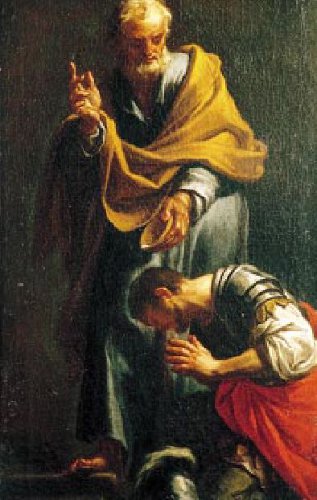
We don’t know much more about the late Second Temple figure Cornelius than what we read in the verses I quoted above. He was what we call a “God-fearer;” a Gentile, a Roman centurion who, by definition, would have been a pagan polytheist, and who, during his assignment in the land of the Hebrews, came to realize that the God of Abraham, Isaac, and Jacob, was and is the God; the One and Unique Creator of the universe.

Coming to that realization alone must have taken great courage and conviction. His actual response to his realization was certainly astounding, given who he must have been and where he had come from. We know he “gave alms generously to the people”, who we assume to be the Jews among whom he lived. The messengers sent to bring Peter to Cornelius after the Centurion’s vision referred to him as “an upright and God-fearing man, who is well spoken of by the whole Jewish nation” (Acts 10:22). And oh wow! Cornelius was so favored by God that this happened.

And Cornelius said, “Four days ago, about this hour, I was praying in my house at the ninth hour, and behold, a man stood before me in bright clothing and said, ‘Cornelius, your prayer has been heard and your alms have been remembered before God. Send therefore to Joppa and ask for Simon who is called Peter. He is lodging in the house of Simon, a tanner, by the sea.’ So I sent for you at once, and you have been kind enough to come. Now therefore we are all here in the presence of God to hear all that you have been commanded by the Lord.” –Acts 10:30-33

Incidentally, the ninth hour is at about 3 p.m. in the way we tell time today, about the time of the Mincha prayers. But why is that important? So who taught Cornelius to pray the Mincha prayers. Ok, there’s nothing to say that he was truly praying Mincha, but here’s why I think he was. Consider this.

The Roman Centurion Cornelius comes to faith in the One true God of the universe. Now what does he do? We know that he gives alms, probably to the poor among the Jews. Whatever else he did resulted in Cornelius being “well spoken of by the whole Jewish nation”, which is no small thing since he was also part of the Roman occupying army. As far as we are able to understand, that group of non-Jews who were called “God-fearers” worshiped on Shabbat among Jews in the synagogue. Where would he have learned the prayers and how to worship? What was the only available model Cornelius could have used to worship a God who was virtually unknown in the Greek and Roman world?

I’m not suggesting that Cornelius “lived as a Jew” in the sense of fully taking on Jewish customs including the various religious and identity markers. It is doubtful (but what do I know) that he would have shown up in the Court of the Gentiles at the Jerusalem Temple. After all, he had to consider appearances and what would the troops in the Italian Cohort have said if one of their Centurions was seen in such a public place among the Jews. On the other hand, his reputation preceded him among the Jewish people based on his being a devout and charitable man. Desiring to worship God above all other considerations, what would he have done? He would have consulted his Jewish mentors as to how to approach God. Prayer offered to the God of Israel is available to everyone, Jew and Gentile alike.

“Likewise, when a foreigner, who is not of your people Israel, comes from a far country for the sake of your great name and your mighty hand and your outstretched arm, when he comes and prays toward this house, hear from heaven your dwelling place and do according to all for which the foreigner calls to you, in order that all the peoples of the earth may know your name and fear you, as do your people Israel, and that they may know that this house that I have built is called by your name. –2 Chronicles 6:32-33

Even in the days of King Solomon, a non-Jew could come to Jerusalem, pray facing the Temple, and expect to be heard by God. Why couldn’t the Jews among whom Cornelius lived and worshiped have taught him the same thing?

How did Jews pray during the Second Temple period? I’m no expert, but assuming the Jews in the time of Cornelius and Peter had similar traditions about prayer to those of Jewish people today, they would have prayed as Jews pray now. They would have prayed the Shacharit (morning), Mincha (afternoon), and Maariv (evening) prayers. If Cornelius wanted to learn how to pray from the Jews, they would have taught him how to pray the way that they prayed, with perhaps only a few variations, because Cornelius was not Jewish. In those days, siddurim (prayer books) were not used and the prayers were generally memorized. That means, Cornelius would have had to say the prayers by memory, probably in Hebrew or Aramaic (given that the Centurion was posted to a foreign land, it’s not inconceivable that he was bi-lingual or multi-lingual). He also would have prayed at the times set by halacha for prayer which, in the afternoon, meant around 3 p.m. or the ninth hour.

Why am I writing this and why should you care? What does it matter to a Christian in the 21st century if a Roman centurion, who came to faith in Jesus almost 2,000 years ago, happened to worship and pray in a manner similar to the Jews? Have you ever wondered why Christians don’t pray in the same manner as the Jews today?

I’m not saying that we must pray morning, afternoon, and night (though it wouldn’t be a bad idea). I’m saying that there’s nothing stopping us from considering where we come from as a faith. However you pray and however you worship in your church, your way isn’t the only way. In fact, if you go back more than a few decades or a few centuries, the way you may consider “Christian” and “holy” probably wasn’t practiced, as least in a manner you’d recognize. Go back far enough, like 2,000 years, and the way a God-fearer and a Christian prayed and worshiped wouldn’t be much different than the way a Jew prayed and worshiped.

Imagine that.

We tend to take prayer and worship for granted because we can always pray and worship anytime we want. But in many ways, the church considers prayer and worship as optional or at least voluntary. We get to choose our own way and manner of doing things. However, for believers and God-fearers like Cornelius, that privlege and honor to worship the King may have come with a commandment attached, maybe at the level of rudimentary “halacha” for non-Jews who had faith.

Today’s amud discusses the halachah regarding hearing the Torah reading when one is in prison. Although today in many places things may be different, it used to be that most prisons would not allow a sefer Torah inside—even for an important person or a minyan of prisoners. When the Vilna Gaon spent about four weeks imprisoned it was impossible for him to fulfill the mitzvah of hearing the Torah reading. After he left prison he called a baal koreh to read for him all four parshios he had missed while in prison.

Although missing so many weeks is very unusual, many greats were meticulous to make up the reading that they had missed that day.

Mishna Berura Yomi Digest
Stories to Share
“The Prisoner’s Duty”
Siman 135, Seif 11-14

Our Gemara reviews a series of Mishnayos where the obligation to fulfill mitzvos is taught to be more inclusive than plainly stated. Regarding the mitzvah to read the Megillah on Purim, R’ Yehoshua b. Levi teaches that the expanded inference is meant to include women. Although this rabbinic mitzvah is one that is restricted to time, and women are generally exempt, here woman are obligated because “they were also included in the miracle.”

Rashi explains that women are obligated in the mitzvah to read the Megillah to the extent that a woman may read the Megillah for her husband or other men.

Daf Yomi Digest
Distinctive Insight
“Women’s obligation in reading and hearing the Megillah”
Arachin 3

The level of “commandedness” which defines Jewish tradition, worship, and prayer seems very “heavy-handed” to most Christians and the spectre of “man-made rulings” is generally disdained in the church (and among many Gentile believers to call themselves “Messianics”). And yet, how would an “upright and God-fearing man” like Cornelius have seen his responsibilities to God as taught to him by his Jewish mentors? Would the Jewish sense of halacha have meant to him what it meant to the Jews? We don’t know. But imagine if we, as Christians, could experience some of the sense of duty and obligation to God, to the prayers, to our way of worship, as Cornelius may have? How much more would God be a part of our lives today? How much more would God be our lives today?

ShemaOne of the functions of tradition and halacha in the life of a Jew is to make every act holy. You cannot eat without blessing God and considering the food on the plate sitting in front of you (or even without considering the plate). You cannot wake up in the morning without gratefully thanking God for returning your life to you. You cannot go to bed at night without asking God to send his angels to guard your soul as you sleep. You cannot progress through your day without ceasing your labors at specific hours in order to devote yourself to God in prayer. And for one day a week, you cannot do many things as you do them on the other days of the week, but instead, you cease labor entirely and dedicate the day to family, prayer, worship, and God.

I’m still not saying that as Christians we should live like Jews, but consider what we’re missing by not taking tradition more seriously. Tradition can be like a straight-jacket or a pair of wings. It can bind us inescapably to a collection of actions and rules that threaten to smother us, or it can send us free into flight away from a mundane world and into the presence of God with practically every move we make.

Maybe this is why the Jews considered the foreigner Cornelius an “upright and God-fearing man”. Maybe this is why God found that Cornelius merited a vision of an angel, and made him and his household a bridge between God-fearers and disciples of Christ.

While Peter was still saying these things, the Holy Spirit fell on all who heard the word. And the believers from among the circumcised who had come with Peter were amazed, because the gift of the Holy Spirit was poured out even on the Gentiles. For they were hearing them speaking in tongues and extolling God. Then Peter declared, “Can anyone withhold water for baptizing these people, who have received the Holy Spirit just as we have?” And he commanded them to be baptized in the name of Jesus Christ. –Acts 10:44-48

Amen.

"When you awake in the morning, learn something to inspire you and mediate upon it, then plunge forward full of light with which to illuminate the darkness." -Rabbi Tzvi Freeman