Injustice and the Promises

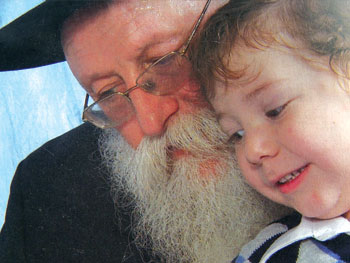
Three years ago, Baby Moshe, one of the unforgettable faces of the Mumbai attacks, escaped the carnage clinging to his nanny not knowing that his parents- Rabbi Gavriel Holtzberg and his pregnant wife Rivika – were killed. Now a four-year-old, Moshe knows they had fallen victim to terrorists. Orphaned by the terrorists, Moshe is now a carefree child, though he remembers his parents whenever he sees their photographs, saying good morning or goodnight to ‘eema’ (mother) and ‘abba’ (father) each day.

from the news story “Moshe still says goodnight to parents”
The Times of India

As Jacob flees from the promised land, he stops at Bethel where God gives him the dream of the ladder and confirms the covenant promises to him. Though the oracle at Bethel is essentially a repetition of the covenant promises bestowed upon Abraham and Isaac, there is an important variation on the wording in 28:14. The seed of Jacob will not only multiply to be as numerous and uncountable as the dust of the earth, it will also “spread abroad to the west, and to the east, and to the north, and to the south.” Not only will his seed inherit the land of Canaan, they will also be spread in every direction. This dispersion alludes again to the theme of exile. As Jacob descends into exile, he is warned that his seed will be spread in every direction as the result of such exile.

from “The Dispersion and Return”
Commentary on Torah Portion Vayetze
FFOZ.org

I don’t know what to write about but I do know that I’m angry. Three years ago this month, little Moshe Holtzberg lost his parents in the most horrible way possible. Now four years old, it’s doubtful he fully comprehends what has happened to him or why. But I know what has happened and I’m furious about it. As much as I’m supposed to forgive others for their “transgressions”, remembering the details of the attack that took Moshe’s parents away does not bring thoughts and feelings of forgiveness to me. I’m not alone.

Have you forgiven the terrorists? “No, of course not,” replies Moshe’s grandmother Yudith. His nanny says, “It makes me angry because they could have escaped but they did not do it and I could have done something, which in my cowardness I did not do.”

I have a grandson who’s not quite three years old. If my son and his wife had been killed by monsters and I was raising my grandson under those conditions, I would probably feel just like Moshe’s grandmother. I know that doesn’t say anything good about me, but I cannot get past this kind of murderous injustice.

Welcome to the history of the Jewish people.

I hope you all remember these events from CNN three years ago. I hope you were all shocked and appalled, just as I was, and angry that innocent blood could be shed in such a ghastly manner. Moshe’s parents weren’t just killed, they were tortured and mutilated by their attackers. Now with all that in mind, apply those same images to what has been happening to the Jewish people throughout history, not just the past 2,000 years of inquisitions, persecutions, and pogroms, but during every trial and exile that has befallen the Jewish people since the days of Jacob.

Although the Jewish people have a modern state of Israel, in many ways, they are still in exile. The very legitimacy of Israel is constantly being brought into question by nations from around the world including the U.S. and there is a continual struggle over what is “Israel” and what (if anything) is “Palestine”.

Faith and composure are very difficult for me when considering such manners (I’m making an understatement). And yet there are promises.

Remember, I am with you: I will protect you wherever you go and will bring you back to this land. I will not leave you until I have done what I have promised you.” –Genesis 28:15 (JPS Tanakh)

It is true that the plain meaning of the text suggests that God is speaking just to Jacob’s sojourn in Haran but, as the FFOZ commentary states, we can also apply this scripture both as prophesy and promise, that God will be with Jacob and his children in whatever exile they might find themselves and will remain with them until they return to their Land, to Israel.

This is not the only such promise to the Jewish people from God.

Do not be afraid, for I am with you;
I will bring your children from the east
and gather you from the west.
I will say to the north, ‘Give them up!’
and to the south, ‘Do not hold them back.’
Bring my sons from afar
and my daughters from the ends of the earth—
everyone who is called by my name,
whom I created for my glory,
whom I formed and made.” –Isaiah 43:5-7

And He will send forth His angels with a great trumpet and they will gather together His elect from the four winds, from one end of the sky to the other. –Matthew 24:31 (ESV)

The quote from the Book of Matthew is probably interpreted by Christianity as applying exclusively to the church, but put back into the larger panorama of the entire Bible and refactored into its original context (Matthew was writing to a primarily Jewish audience), we can see it has more specific implications.

I periodically rant on the topic of Christian supersessionism and how it has been used as a platform to justify crimes by the church against the Jewish people. I hope that recalling God’s promises to the Jews will serve as a reminder that they have been and always will be God’s chosen people. That God was gracious enough to give “his only Son, that whoever believes in him should not perish but have eternal life” (John 3:16), does not mean that we Christian Gentiles have “bumped” the Jews from their seats on the flight, so to speak, in order to make room for us (read Romans 11:17-20 again if you don’t believe me).

In our nice, peaceful, reasonably safe American homes, we like to think that the persecution and murder of Jews are a thing of the past and that an ugly chapter in the history of the church has now been closed, but if you are tempted to be comforted by those thoughts, remember four-year old Moshe Holtzberg as he kisses the photos of his parents every morning and night. True, this isn’t a crime that can be laid at the feet of the church, but it’s a delusion to believe that men and women of the past who also called themselves “Christian” didn’t perform the same, horrible terrorist acts and worse. How many Jewish children have we orphaned in the name of Christ?

George Santayana made the often misquoted comment, “Those who cannot remember the past are condemned to repeat it.” I could change that slightly to say, “Those who are not outraged by the atrocities of the past will continue to commit them in the present.” That includes committing atrocities by apathy, lack of concern, and the unwillingness to act.

We should mourn the loss of Rabbi Gavriel Holtzberg and his wife Rivika along with Moshe and his grandparents. It’s tragic that Christianity doesn’t understand the significance of yahrzeit for we should all kindle of the yahrzeit candle for Gavriel and Rivika Holtzberg in solemn memory. By inference, we can also mourn all the Jewish victims of terrorism who came before them, particularly those who were murdered by the church, for in remembering and grieving, we can assure the Jewish people and ourselves that we will never participate in such a nightmare again. We cry out against the injustice of the Nazi Holocaust and the murder of six million but we must never forget that countless Jews have their blood spilled across the pages of thousands of years of history.

Jews believe that tikkun olam, acts of repairing the world, will hasten the coming of the Messiah. However, even in Jewish tradition it is understood that anyone, Jew or Gentile, can perform tikkun olam. Gandhi was once supposed to have said, “Be the change you want to see in the world.” If the fact that Moshe Holtzberg will never again see his parents this side of Heaven makes you sad and angry, you can stand up and do something about it. You can make sure that through action or inaction, you are never a part of such an injustice. You don’t have to change the whole world. You only have to change yourself. Remember God’s promises to the Jewish people and to all people. If you are devoted to the God of Israel, perform one act of justice and mercy today. Perform another one tomorrow. Let your voice be heard. Light a candle in remembrance. Never let the light of mercy go dark in your heart.

The bridegroom is coming. The Prince is returning to his throne. Be ready every day and every night. Tremble at the thought that he will come and you will not be prepared.

Tremble, and sin not; reflect in your hearts while on your beds and be utterly silent. –Psalm 4:5

He who testifies to these things says, “Surely I am coming soon.” Amen. Come, Lord Jesus! –Revelation 22:20 (ESV)

Where Will We Find the Root of David?

lion-of-judahThere is another familiar case in which adjectives may cause more confusion than clarification: the misleading labels of “Orthodox”, “Conservative”, “Reform”, “Reconstructionist”, “Unaffiliated”, “Ashkenazic”, “Sephardic”, etc. It’s important to ask whether or not these words have anything to do with who we are in our kishkas (insides)! If we were able to perform a Litmus Test on our souls – or perhaps a “Litmus Configuration” on our souls, for “Midnight Run” fans who are more familiar with the Grodin/DeNiro technique for counterfeit money inspection – would we actually expect to find any trace of these labels? Do we really think that just as there are various blood types, a litmus test would reveal various “soul types”, such as AJ (Ashkenazic Jew), OJ (Orthodox Jew), UJ (Unaffiliated Jew), etc.? Do these labels somehow exist as “spiritual-chemical” elements on some kind of “Spiriodic Table”?

It’s crucial to keep in mind that the essential soul of a Jew has no such adjectives! A Jew is a Jew is a Jew. And the more we learn to focus on our shared essence, the more we can appreciate the splendor of our true unity! May G-d grant us the wisdom to continually discern the differences between external adjectives and essential nouns!

-Jon Erlbaum
“Birthright Battles & Material Worlds”
Insights from Torah Portion Toldos
Torah.org

It’s unfair to characterize a uniform Jewish view on just about any topic. As soon as you start talking about different periods [in history], it’s almost impossible to answer any question unless you specify what Jews, where and when. Essentially, uniformity of Jewish thought is impossible to find.

-Alan Cooper
Provost of the Jewish Theological Seminary in New York
as quoted by jweekly.com

Seems confusing, doesn’t it? We have Erlbaum saying that regardless of the various differences between Jews, in fact, a “Jew is a Jew is a Jew.” We also have Cooper saying that it’s “unfair to characterize a uniform Jewish view on just about any topic.” Which view of Jewish people is correct? Probably both. Is this a problem?

Nope. Well, maybe.

A large part of this blog is devoted to trying to gather some sort of understanding about the Jewish classic religious texts and, in my case, attempting to apply that knowledge and insight to the faith of one, lone Christian. Me. If anyone else finds something of value here, then I am honored to have recorded it. But given Erlbaum and Cooper, it seems as if my search for knowledge will not be an easy one. There is not one “Judaism” that exists immutable and unchangeable across time from Moses and Sinai to the twenty-first century that we can point to and say, “that’s what it means to be Jewish” or “that’s the sum of the Torah.” If that’s the case, then what am I looking for?

Hillel told a would-be convert this:

“A gentile once came to convert to Judaism, on the condition that he could learn the whole Torah while standing on one foot. He approached Shammai, who rejected him, so he went to Hillel, who taught him: “’That which you dislike don’t do to your fellow: That’s the basis of Torah. The rest is commentary; go learn!” –Shabbos 31

A generation later, quoting Deuteronomy 6:5 and Leviticus 19:18, Jesus said something similar:

“Teacher, which is the greatest commandment in the Law?”

Jesus replied: “‘Love the Lord your God with all your heart and with all your soul and with all your mind.’ This is the first and greatest commandment. And the second is like it: ‘Love your neighbor as yourself.’ All the Law and the Prophets hang on these two commandments.” –Matthew 22:36-40

This past week on my blog, I’ve been drawing a sharp contrast between religion and faith as well as between Judaism and Christianity. It seems as if these two poles at each end of the religious spectrum keep getting in each other’s way. It’s easy to see why most Jews don’t want to even touch the New Testament and why most Christians are relieved when their Pastors tell them that the Law is dead. It’s much less confusing to believe that one religion has nothing to do with the other and that Jews and Christians can remain self-contained within their own “silos” and not wonder or worry about what’s going on elsewhere.

Of course, to do this, Jews must come to the final conclusion that Jesus could never have been the person he claimed to be and that even if he was a good Jewish teacher, Paul twisted those teachings into a very Torah-bereft religion for the Gentiles. Christians, for their part, must believe that Jesus, born of a Jewish mother and of the line of David, did a very “unJewish” thing. They must believe that he lived a life in complete contradiction to everyone around him, somehow managing to gain a large following of Jewish disciples by preaching the Gospel of freedom from the Law and nailing the Torah to the cross. That last part is especially hard to believe. It would be like Joel Osteen visiting the biggest Orthodox synagogue in Houston, Texas during a Shabbat service and expecting to gain a large following of the Jews by taking their Torah scroll and lighting it on fire.

the-teacherYou can only believe all of that if you choose to remain in your silos, both in community and in mind, and refuse to consider the alternative. You also will be unable to explain men like Rabbi Isaac Lichtenstein, Chief Rabbi in the Northern District of Hungry, Rabbi Daniel Zion, Chief Rabbi of Bulgaria, Rabbi Israel Zolli, Chief Rabbi of Rome, and scores of other Jewish people (see Rabbi Joshua Brumbach’s Yinon blog for more information) who amazingly found the Jewish Messiah in the person of Jesus Christ, the man, prophet, and Messiah who neither denied the Torah nor abandoned his people, the Jews. They found that there is no inconsistency between being Jewish and discovering their Moshiach in the pages of the New Testament.

But these people are exceedingly rare among both Jews and Christians. 2,000 years of heinous persecution of the Jewish people by Christians explains why the vast majority of Jews are extremely hesitant (to put it mildly) to consider the validity of Christianity, but what makes Christians so adamant about rejecting the Judaism of Jesus?

To be perfectly blunt: I must say the Christians have robbed the Jews! And perhaps what is worse is that this thievery has been encouraged by theologians, pastors, and even Sunday School teachers, where small children are taught to sing the song, “Every promise in the book is mine, every chapter, every verse, every line.”

Every promise in Scripture in some way benefits Christians, but it is not all promised to Christians. Sometimes the thievery has been inadvertent and unintentional. It’s like thinking that the raincoat hanging in the office closet is yours for wearing home because of unexpected showers. Hopefully, you will discover the raincoat belongs to a fellow worker and you will restore it. It is not as if Christians do not have the greatest promise of God, which is 1 John 2:25: “And this is the promise that He hath promised us, even eternal life.”

-Moishe Rosen
as quoted from the Foreword of Pastor Barry E. Horner’s book
Future Israel: Why Christian Anti-Judaism Must Be Challenged

This isn’t happening in just the traditional church setting, either.

One of the consequences is that many Jews are starting to feel like the “other” in what we thought was a Jewish movement. IMO, limitations on Gentile involvement – some of which are legitimate, in my view – arise in large part from a sense of that a majority of our movement no longer feels that it is essential or even important for us to remain demographically Jewish. This isn’t just a feeling on my part: it comes from numerous conversations with Gentiles and Jews in our movement. I routinely ask, “Do you think we need a majority of Jews in the movement to legitimately call ourselves ‘Jewish’?” Apart from obnoxious Jews like myself (and a smaller number of Gentiles), the answer is almost universally “no.” The discomfort increases when the percentage is lowered: 40%? 25%? 10% – “Ten percent – a tithe. That sounds right!” How about less 5%?” It turns out that it’s very difficult for these otherwise reasonable folks to assign any bottom limit to the percentage of Jews necessary to call our movement, or a congregation, Jewish.

-Rabbi Carl Kinbar
Messianic Jewish Rabbinical Council
as quoted in the comments section of
Morning Meditations

Sometimes I say to myself as a kind of joke that, “if God hadn’t replaced the Jews with the Christians, then the Christians would have done it themselves.” It’s a personal “joke”, though a very sad one, because that’s exactly what Christianity did: decide to replace the Jews in the covenant promises of God, all of them, with Christians. Small wonder that Jews don’t want to anything to do with Christianity and that attempting to convert a Jew to become a Christian is considered deeply insulting by Jews. Christians believe that in order for a Jew to come to faith in the “Jewish” (I put the word in quotes because from the church’s point of view, the “Jewishness” of Jesus was undone on the cross) Messiah, he or she must completely deconstruct their own Jewish identity and remake themselves as a Christian goy. Yeah, like Jesus, Peter, and Paul did that to themselves, right?

Supersessionism isn’t just an artifact of the past but a lived reality of the present. Many churches still comfortably believe that Judaism is a “dead religion”, that Jesus did away with the law, that God changed His infinite mind about choosing Israel, played a game of bait and switch with the Israelites, ripped the covenant promises to Abraham, Isaac, and Jacob away from the Jews, and devoted His love, compassion, and mercy exclusively to Christianity.

Ironically, as Rabbi Kinbar points out, a form of supersessionism also seems to have invaded the one religious movement that exists to allow a Jew to live and worship as a Jew and yet be a disciple of Yeshua (Jesus) as Messiah and Savior. It’s like Gentile Christians just can’t stand the idea that “salvation is from the Jews” (John 4:22). We know from examples we read about in Acts 10 and Acts 15 that the Jewish disciples were responsible for carrying the Word of salvation to the Gentiles and administering how it was to be interpreted, but at the point where Gentiles began to outnumber Jews in the “Nazerene” faith, we also began to rewrite the rules and scriptural interpretations. We stacked the deck in our favor and loaded the dice so the Jews didn’t even have a chance. We invented a system whereby the Jews lost all control and involvement in their own Messiah and we would only let them back in if they agreed to stop being Jewish and to turn into us.

Fat chance. Why should they?

Tree of LifeWe’ve gotten it all backward. We’ve put the cart before the horse. We’ve elevated ourselves to place God never intended us to be. Romans 11:17-20 is Paul’s cautionary tale to the Gentiles about becoming arrogant with being grafted in at the expense of the natural branches. The Tanakh is replete with examples of God restoring those branches and when He does, what will become of us and our so-called “replacement” of the Jews? How will the grafted in answer for the insult to the natural branch of the vine?

More than anything, as frustrating and aggravating as it can be sometimes to struggle with the Jewish perspective on Torah and Talmud, we must look to ancient and modern Judaism if we ever expect to understand our Savior and our faith. We Gentile Christians embrace our comforting supersessionist “teddy bears” at great peril. I know Christianity is afraid of Christ’s Jewishness because we’re afraid of having to play “second fiddle” to the Jewish people and we hate the idea that not all of the promises belong to us. We hate the idea that our easy-going lives of faith and grace, with virtually no behavioral expectations of us by God, are somehow in contrast to the rich and beautiful morning prayers of Judaism, the holiness of the Shema, the Psalms of the Priests in the Temple, the night blessings at bedtime. It all seems so alien, so…Jewish.

But so is Jesus. Not “was”; “is”:

Then one of the elders said to me, “Do not weep! See, the Lion of the tribe of Judah, the Root of David, has triumphed. He is able to open the scroll and its seven seals.” –Revelation 5:5

“The Lion of the Tribe of Judah” and “the Root of David”. Verse 13 of the same chapter of Revelation says “To him who sits on the throne and to the Lamb be praise and honor and glory and power, for ever and ever!” Why do Gentile Christians have such a difficult time giving honor and glory to the Jewish “the Root of David”, or have I already answered that question?

Almost a month ago, I wrote another small article called In Search of the Jewish Voice of Jesus. If you’re a Christian who wants to find out about the Jesus no one talks about in church, you can discover him in that blog post.

Toldot: The Servant and the Coachman

studying-talmudIt was a hot July day during the summer of 1866. The children of Rabbi Shmuel of Lubavitch, five-year-old Sholom DovBer and his brother Zalman Aharon, had just come home from cheder and were playing in the garden which adjoined their home.

In the garden stood a trellis overgrown with vines and greenery which offered protection from the heat of the sun. It was set up as a study, with a place for books etc., and Rabbi Shmuel would sit there on the hot summer days.

The children were debating the difference between a Jew and a non-Jew. Zalman Aharon, the elder by a year and four months, argued that the Jews are a “wise and understanding people”who could, and do, study lots of Torah, both its ‘revealed part’ and its mystical secrets, and pray with devotion and ‘d’vaikus’, attachment to G-d.

Said the young Sholom DovBer: But this is true only of those Jews who learn and pray. What of Jews who are unable to study and who do not pray with d’vaikus? What is their specialness over a non-Jew?

Zalman Aharon did not know what to reply.

The children’s sister, Devorah Leah, ran to tell their father of their argument. Rabbi Shmuel called them to the trellis, and sent the young Sholom DovBer to summon Ben-Zion, a servant in the Rebbe’s home.

Ben-Zion was a simple Jew who read Hebrew with many mispronunciations and barely understood the easy words of the prayers. Every day he would recite the entire book of Psalms, pray with the congregation, and make sure to be present in the synagogue when Ein Yaakov was studied.

When the servant arrived, the Rebbe asked him: “Ben-Zion, did you eat?”

Ben-Zion: “Yes”.

The Rebbe: “Did you eat well?”

Ben-Zion: “What’s well? Thank G-d, I was sated.”

The Rebbe: “And why do you eat?”

Ben-Zion: “So that I may live”

The Rebbe: “But why live?”

Ben-Zion: “To be a Jew and do what G-d wants.” The servant sighed.

The Rebbe: “You may go. Send me Ivan the coachman.”

Ivan was a gentile who had grown up among Jews from early childhood and spoke a perfect Yiddish.

When the coachman arrived, the Rebbe asked him: “Did you eat today?”

“Yes”.

“Did you eat well?”

“Yes”

“And why do you eat?”

“So that I may live”

“But why live?”

“To take a swig of vodka and have a bite to eat,” replied the coachman.

“You may go,” said the Rebbe.

-Rabbi Yanki Tauber
“The Difference”
Commentary on Torah Portion Toldot
Chabad.org

Not a very flattering comparison between Jews and Gentiles, is it? Of course, the coachman, though he had “grown up among Jews from early childhood” obviously had not spent any time considering how the teachings of the Jewish people could apply to him. More’s the pity. He didn’t consider the example of Abraham and his household and how Abraham taught his non-Hebrew servants of the One God.

We know from last week’s Torah Portion that Abraham sent his most trusted servant to find a bride for Isaac from the land of Abraham’s father. We know that this non-Hebrew servant had learned the lessons of Abraham’s God well, as evidenced by his impassioned prayer.

And he said, “O Lord, God of my master Abraham, grant me good fortune this day, and deal graciously with my master Abraham: Here I stand by the spring as the daughters of the townsmen come out to draw water; let the maiden to whom I say, ‘Please, lower your jar that I may drink,’ and who replies, ‘Drink, and I will also water your camels’-let her be the one whom You have decreed for Your servant Isaac. Thereby shall I know that You have dealt graciously with my master.” –Genesis 24:12-14

The result of the servant’s life of faith depended on Abraham teaching him, and all of the non-Hebrew household, of the God who created us all in His image. Rabbi Eli Touger also speaks to this point in his Torah commentary for Toldot.

Our Sages relate (Shabbos 89b) that in the Era of the Redemption, Jews will praise Yitzchak, telling him: “You are our Patriarch.” For in that era, the inward thrust of Yitzchak will permeate all existence. “The occupation of the entire world will be solely to know G-d. The Jews will be great sages and will know the hidden matters, attaining an understanding of their Creator to the [full] extent of mortal expression.”(Rambam, Mishneh Torah, Hilchos Melachim 12:5).

Although all Jews will then live in Eretz Yisrael, they will as their ancestor Yitzchak did influence mankind as a whole, motivating all to seek G-dly knowledge. “And it shall come to pass in the end of days that the mountain of G-d’s house will be established on the top of the mountains…. and all the nations shall flow unto it. Many people shall say: ‘Come let us ascend the mountain of G-d… and He will teach us of His ways.’ ” (Isaiah 2:2-3) May this take place in the immediate future.

So what happened to Ivan the coachman? Did the Rebbe fail to teach him the same lessons or to live out the same holy life as an example to Ivan as he did to Ben-Zion? Is Rabbi Tauber simply telling us that Jews “naturally” seek the things of God while Gentiles only seek the temporal pleasures of the world? I can’t speak to Rabbi Tauber’s intent, but let’s compare Ivan to Eliezer (assuming Eliezer is “the servant” in the tale of Rivkah). What is the difference between these two men? They both spent many years in the household of a man of God. Did the Rebbe fail where Abraham succeeded or did Eliezer see and hear something in Abraham and in what he taught that Ivan chose to ignore in the Rebbe’s household?

Regardless of opportunity, the path of faith is walked by the individual. We are not old-fashioned wind up toy soldiers that are primed, set on the floor, pointed in a direction, and then set off to march. We make choices. We cannot blame others if our faith is weak or even if it’s non-existent. Ivan chose to consider the purpose of life as taking a “swig of vodka and having a bite to eat” while Eliezer chose to drink deep from the wells of salvation (John 4:13-14).

The path has been set before us. All we need to do is choose to face it, set our foot upon it, and take the first step…or to turn away and follow another trail through the wilderness. Our choice. But like the Samaritan woman at the well, we have already been talking to the one we seek.

“Woman,” Jesus replied, “believe me, a time is coming when you will worship the Father neither on this mountain nor in Jerusalem. You Samaritans worship what you do not know; we worship what we do know, for salvation is from the Jews. Yet a time is coming and has now come when the true worshipers will worship the Father in the Spirit and in truth, for they are the kind of worshipers the Father seeks. God is spirit, and his worshipers must worship in the Spirit and in truth.”

The woman said, “I know that Messiah” (called Christ) “is coming. When he comes, he will explain everything to us.”

Then Jesus declared, “I, the one speaking to you—I am he.” –John 4:21-26

Who are the sons of God? Israel is the obvious heir based on the promises of the Almighty to Abraham, Isaac, and Jacob, but then why were the Jewish people expected to teach the rest of the world about God? If we are not heirs, who are we and what do we matter except maybe as “slaves” or “dogs”? Paul offers us hope. Paul said that we can be grafted in (Romans 11) to “sonship” through faith such as what Abraham had (Romans 4). He also wrote something else encouraging.

So in Christ Jesus you are all children of God through faith, for all of you who were baptized into Christ have clothed yourselves with Christ. There is neither Jew nor Gentile, neither slave nor free, nor is there male and female, for you are all one in Christ Jesus. If you belong to Christ, then you are Abraham’s seed, and heirs according to the promise. –Galatians 3:26-28

The Jews are the sons of the Mosaic promise yet we Gentiles, through faith in the Messianic promises, will also be sitting with Abraham, Isaac, and Jacob at the feast in the Kingdom of Heaven (Matthew 8:11). God be willing and merciful to us all.

Venom

the_womans_serpentWhen people saw the snake, they understood that in order to elicit this transcendent divinity and be healed, they had to transform their own, inner “snake” – their evil inclination – into a force of good…The evil inclination impels us to sin for comfort, pleasure, or excitement. When we convince it that the truest comfort, pleasure, and excitement lie in holiness, it plunges headlong into fulfilling G-d’s purpose on earth, endowing our drive toward divinity with much greater power than it could have had otherwise. Thus, the initially evil inclination becomes the source of merit and goodness. The snake is transformed from the source of death to the agent of life.

From the teachings of the Lubavitcher Rebbe;
adapted by Rabbi Moshe Yaakov Wisnefsky
“Transforming the Primordial Snake”
[Based on Likutei Sichot vol. 13, pp. 75-77]
Kabbalah Online

It’s widely assumed that Jews do not believe in the doctrine of original sin. The notion that infants are born carrying the burden of Eve’s taking a bite of forbidden fruit is considered one of the main theological distinctions between Jews and Christians. But Alan Cooper, provost of the Jewish Theological Seminary in New York, says it’s not that simple.

-Rebecca Spence
“Bible scholar to put Jewish spin on original sin”
jweekly.com

On many occasions, my wife has told me that a major difference between Jewish and Christian beliefs is “original sin”. Last summer, I attempted to discuss the Jewish perspective on original sin in a three-part series on this blog, starting with Overcoming Evil. I found that the Jewish presentation of the first “sin” by human beings is remarkably different than that of the church.

The typical Christian perspective is that humankind inherited the initial rebellion of the first human beings, Adam and Eve. As a result, we are all born in a “fallen” state, with the primary desire to do evil. Judaism, by contrast, has a more complex set of beliefs based on the original “Tree of the Knowledge of Good and Evil” event. The upshot is that people have an equal capacity for good or evil and that we constantly make choices as to which “inclination” we lean toward. People are neither ultimately good or ultimately evil.

Frankly, even a casual review of human history seems to reveal the nature of the human race as rather dismal, but that’s just my point of view.

The brief interview with Alan Cooper at jweekly.com reveals that the difference in perspective on original sin between Christianity and Judaism may not be based solely on theological understanding.

When Jews nowadays ask themselves what are the basic ideological differences between Judaism and Christianity, one of the most prominent differences that many Jews will cite is the doctrine of original sin, which really gets down to basic anthropology. What is basic human nature according to Jewish teaching and according to Christian teaching, and what are the religious consequences of adopting one view or the other?

There’s two things to note here: the choice of how to view basic human nature, and the choice of theological interpretation of the first act of disobedience by people toward God. For the past 2,000 years, Christianity and Judaism have been defining and redefining their viewpoints in relation to each other and tending to present more what separates them as religions rather than what makes them alike. I spent some time talking about this concept of definition and “otherness” in yesterday’s morning meditation. Judaism seems to have a more “optimistic” perspective on human nature while Christianity comes off as decidedly more pessimistic. Yet, as the Cooper interview reveals, those differences may not be all that clear cut.

There are a couple places in the Talmud where it’s asked, “When did the pollution of the serpent cease?” The very phrase “pollution of the serpent” is surprising, and is probably reflective of what it would mean if Jews were to adopt a Christian premise of human nature.

the-joy-of-torahThe fact that even Cooper calls the phrase “pollution of the serpent” surprising seems to indicate that it’s not a concept that is commonly understood in today’s Judaism. Of course, Cooper also points out that it’s “unfair to characterize a uniform Jewish view on just about any topic. As soon as you start talking about different periods [in history], it’s almost impossible to answer any question unless you specify what Jews, where and when. Essentially, uniformity of Jewish thought is impossible to find.”

I’m sure Cooper didn’t intend to address the idea of “Messianic Judaism” or those Jews who claim a faith in Jesus as the Jewish Messiah within a wholly Jewish context, but his last comments in the interview are extremely relevant to that group.

Even if we agree with Christians that humankind was born in a state of grace, fell, and now requires divine salvation, where we find that salvation is very different. For Christians, it’s Christ, and for Jews, it’s Torah. The Christians tell the Jews that the law doesn’t save you, and the rabbis say that, in fact, the law is the only thing that can save you. The only antidote to the pollution of the serpent is Torah.

If I go over to the other side and accept Jesus and I’m saved, why would I keep putting on tefillin and observing Shabbat?

This continues to illustrate a major separation point between Christians and Jews and a continuing wedge between Jews who are Messianic and the rest of Jewry. Cooper says that he, and by inference any modern religious Jew, would no longer follow the Torah if they came to believe that they were saved by the grace of Jesus Christ. In contrast, many Jews who live as observant religious Jews and who are disciples of Jesus as Messiah, attempt to integrate the core tenants of Christianity while also accepting the Torah lifestyle, seeing grace and law as coexisting rather than mutually exclusive.

If we look at the doctrine of original sin as one that was created to define a difference between Christians and Jews, the question comes up as to whether “original sin” is even valid. It is scripturally based on Romans 5:12-21 and 1 Corinthians 15:22 and according to Wikipedia (quick and dirty research here), “began to be developed by the 2nd-century Bishop of Lyon Irenaeus in his controversy with the dualist Gnostics.”

Apparently, not all Christians accept the idea of original sin and some believe that there is “nothing inherently sinful about our emotions or bodily pleasures. Sin is a commitment to what pleases us without regard to God’s will.” This fits a little better with how Judaism sees original sin, but it also introduces the idea that both Christian and Jewish theology, and particularly the points where they differ, may be driven by the need for Christianity and Judaism to be different from each other, in order to establish their distinctiveness and their separate paths to salvation and to God.

A significant number of the Gentile Christians who align with the Messianic movement do so because they see the church as apostate and pagan and view Messianic Judaism as more “pure” and much more closely aligned with what Jesus originally taught and the worship practice of first century “Jewish Christianity”. In fact, we see that all of our modern religious interpretations have been somewhat muddied by twenty centuries of religious haggling and jockeying for position by Jews and Christians. Even the traditionally observant Jews in the Messianic movement aren’t so much returning to the past as attempting to forge a Jewish future as adherents to the Messiah, and in doing so, defy Cooper’s assertion that praying with tefillin and observing Shabbat are inconsistent with the behavior, teachings, and grace of Christ.

graceThe “antidote to the pollution of the serpent “ for a Messianic Jew or for any Jew is the Torah, but the Torah, however significant, is not meaningful when isolated from faith in God. That faith is exemplified in Abraham and the seed of Abraham, the Messiah, is the living Torah and the reversal of the poison that struck the heel of man in Genesis 3:15. For the non-Jew who does not have Torah, we can still be grafted into the “antidote” by adopting an Abrahamic faith in the Messiah of the Jews who allows us to be accepted by the same grace and to be nurtured by the same love of God (Galatians 3:28).

As fascinating as I find my studies into religion, it is not what I have learned that sustains my faith. It is God speaking to me in the lonely spaces and the empty regions of my soul, when people continually fail and the poison proceeds to work its way through my veins, that enables me to take another step forward, when everything else in the universe tells me to give up.

We Have Met the Others and They Are Us

broken-crossIn rabbinic literature, reference is made to non-Israelites (gentiles of various descriptions). These “external others” often appear in rabbinic literature as mirror opposites of Israelites, and so sharpen the rabbis’ definition of Israel. However, insofar as this literature explores and develops a definition of the rabbi as the ideal Jew, reference is made to non-rabbinic Jews (of various descriptions). These “internal others” often appear in rabbinic literature as mirror opposites of the rabbis and so sharpen the rabbis’ definition of their own class.

-Christine Hayes
“The ‘Other’ in Rabbinic Literature” (p. 243)
The Cambridge Companion to the Talmud and Rabbinic Literature
Edited by Charlotte E. Fonrobert and Martin S. Jaffee

For the past few mornings, I’ve been “assaulting” the concept of religion as opposed to faith, first with my blog post Longing for the Dawn and then with yesterday’s Red Stew in Context (the latter being a wee commentary on Torah Portion Toldot). Today, I’m returning to the challenge of a Christian attempting to gain insights into a faith in Jesus by studying the Jewish texts. More specifically, I’m drilling once again down into the well of Jewish/Gentile relations from (as accurately as I can depict) the Jewish point of view.

The view isn’t always encouraging.

I was fascinated as I read the Hayes article on the use of the “other” in rabbinic literature. This isn’t an unknown technique and individuals and groups have frequently defined themselves in comparison to some outside “other”. Sometimes these comparisons are benign and meant to illustrate how different cultures and ethnicities approach the same concepts but often the comparison game is used to elevate one group at the expense of the other. Jews, more than most other people groups, are acutely aware of how they have been negatively compared to the world around them, being blamed for virtually every evil that has encountered mankind. It’s small wonder that the Rabbis might use the same method to point the finger in the opposite direction.

But what is it that the Rabbis are saying?

In rabbinic halakhah, the gentile can be imagined as an ethnic other or as a religious other. As an ethnic other, the gentile is merely a non-Israelite or goy (member of a non-Israelite nation) to whom the laws of the Mosaic covenant do not apply. In tannatic law, the gentile is seen in contrast to the Israelite, as one who does not observe the dietary laws, is not obligated by the ritual purity system, does not contribute to the upkeep of the sanctuary, does not pay the half-shekel tax, and so on.

-Hayes, p. 245

Here, we see the Jew and Gentile compared to each other from a Jewish point of view and that comparison is devoid of any value judgments regarding either group. Jews carry certain duties and responsibilities that the Gentiles don’t. It’s quite simple, really. Hayes breaks the comparison down even further:

This depiction of the ethnic other – as outside and ignorant of the covenant – is not as straightforward as it might appear. According to the Pentateuch, some of the terms of Israels’ covenant apply even to non-Israelites who choose to take up residence among the nation of Israel as resident aliens (ger, pl. gerim). The pentateuchal model of peaceful coexistence, cooperation, and even limited integration of an ethnic other is realized in halakhot that exempt but do not forbid gentiles from observing certain laws.

It’s interesting that the comparison here relative to Gentiles being “outside and ignorant of the covenant” is based on ethnicity and not religion. That means the covenant of Moses was given to the Children of Israel which, in the context of the rabbinic texts, is an effect of ethnicity. Christians see their access to God through the covenant of Christ as an effect of religious identity and the Messianic covenant being “ethnicity-blind”. What happens if the rabbis look at Gentiles as religious “others”?

The gentile is also imagined as a religious other (‘oved’ ‘avodah zarah’) who worships a deity or deities other than Israel’s deity. The gentle as religious other falls under greater suspicion and is subject to more severe and at times hostile legislation than the gentile as ethnic other.

-Hayes, p. 246

Hayes is addressing the Gentile as a “generic idol worshiper” here and not specifically talking about Christians, so we could say that Jews believe the Gentile Christian do worship the same God as the Israelites, with only a disagreement as to the identity and status of Jesus Christ. But it’s not that easy.

Early Christianity was a dissident Jewish movement among other Jewish movements. Only in the late first century do Christian writings begin to affirm Christianity over and against Judaism, a trend that increased rapidly in the second century. As rabbinic Judaism took firmer shape and gentile Christianity set itself off from Jews, the group referred to by scholars as Jewish Christians emerged in the middle. The latter were followers of Jesus who, like Jesus and the apostles, kept the law of Moses. In early rabbinic literature, Jews partaking of a Christian heresy fell under the classification of min (plural minim), an umbrella term that included not only Jewish Christians but also a variety of Jewish sectarian groups, such as Sadducees, Boethusians, Zealots, and Samaritans (but not in an early period in Palestine, gentiles).

-Hayes, p. 258

Reading this, I wonder how those “Jewish Christians” of the early 21st century who call themselves “Messianic Jews” are viewed by the larger Jewish rabbinic community. We know historically that Sadducees, while not fitting into the first century Jewish mainstream, were nevertheless considered Jews, however Samaritans, though related, were not. This was even acknowledged in an encounter between a Samaritan and Jesus.

When a Samaritan woman came to draw water, Jesus said to her, “Will you give me a drink?” (His disciples had gone into the town to buy food.) The Samaritan woman said to him, “You are a Jew and I am a Samaritan woman. How can you ask me for a drink?” (For Jews do not associate with Samaritans.) –John 4:7-9

In the closing decades of the first century, “Jewish Christians” were not yet considered to have completely left Judaism, but they were not exactly welcome either. Hayes attributes this to the Gentile Christians and their efforts to separate themselves and their faith from Jewish origins and indeed, to elevate Christianity as the branch, above its Jewish root, giving birth to the ugly spectre of supersessionism.

But, as Hayes goes on to state, “Minim are almost universally depicted as possessing a knowledge of Scripture, but differing from the rabbis in their interpretation of Scripture (some even mocking or criticizing it).” The rabbis chose to include the Minim in with other “Christians and heretics,” all but rejecting them as Jews. As the schism increased, so did the “otherness” of both Jewish and Gentile Christians in relation to mainstream rabbinic Judaism.

Early Palestinian sources, in particular, urge rabbis and their families to avoid all contact with minim and Christians. The most vehement set of proscriptions against minim is found in T.Hullin 2:20-21. Many of these prohibitions stand in explicit contrast to similar laws concerning gentiles and are remarkable for their severity.

In other words, rabbinic proscriptions against contact with Jewish and Gentile Christians were even more stringent than those against contact with more “generic” idolators. And it wasn’t going to get any better as history progressed beyond the initial Rabbinic era of the 2nd to 4th centuries CE.

Compare all this to my previous blog post about how people self-identify with a specific religious context. In Judaism, there is largely a sense of being “born to it”. Though Jews can reject their religious heritage, it can be argued that the Torah will always be a part of the Jew, even when the Jew rejects religion for a purely ethnic lifestyle. For the religious Jew, the connection to God through Moses is an absolute and thus, so is the “rightness” of their faith and status. In comparison to that, the worshipers of oto ha’ish are at best misguided and at worse, the most repulsive of idolators, who claim to honor a first century Jewish itinerant teacher as both the Son of God and as God. Apparently, worshiping Apollo of Zeus would be an infinitely preferable choice for a Gentile as a religious orientation. The Christian wouldn’t be appropriating significant sections of the Jewish religious structure and scriptures for their (our) own purposes and contradicting and facing down the Jews at every turn.

My brief analysis of the Hayes essay is that, assuming we can project its conclusions into the present, both Gentile Christians and Messianic Jews of today have a very long road to walk in terms of establishing and maintaining a positive and normative relationship with traditional Judaism. Previously, I appeared to separate Messianic Judaism and Rabbinic Judaism, and largely the separation exists, but there are Messianics who were born and raised in Jewish homes and educated in Torah and Talmud in the traditional Jewish fashion who nonetheless, have come to faith in “oto ha’ish” and who do not see the dissonance between the Messianic and the Rabbinic. For these Jews, it will be the hardest to see and think and feel and be Jewish while at the same time experiencing the centuries-old separation between themselves and their Jewish brothers who continue to consider the Messianic Jews are minim.

For Gentiles like me, it affirms that my course of religious study, from a Jewish point of view, is problematic at best. There’s no prohibition against it per se (and certainly any book available for sale at Amazon.com is at my Gentile fingertips), but it is still rabbinically “uncomfortable” for more conservative Jews when they consider a Christian goy attempting to comprehend the mysteries of Talmud. Of course, there would be the comfort that I probably won’t really “get it” since, as I’ve stated before, I lack the required context and education to truly understand the rabbinic intent, but on the other hand, I could be accused (and perhaps rightly so) of misappropriating what is Jewish to feed what most Jews consider, my faith in a religion that historically has been very anti-Jewish.

back to backEven (Messianic Jew) Mark Kinzer in his book Post-Missionary Messianic Judaism strongly urged Christians who “dabble” (my word, not Kinzer’s) in the Messianic world to return to their (our) churches and to leave Messianic Judaism to Jews, so any Gentile Christian who may consider the Messianic movement to be a “meeting place” for integrating a faith in Jesus with the Torah of Moses (for the Gentile) is likely engaging in wishful thinking. That wishful thinking could even evolve into an odd form of supersessionism by the Gentile who, while not replacing Judaism with Christianity, quite innocently replaces Jewish covenant distinctiveness with the Jewish/Gentile Messianic “blend”. Hence Kinzer’s message of the church and the (Messianic) synagogue operating side-by-side in their individual silos rather than overlapping or being combined in a giant, religious mixing bowl.

One way to keep all of our traditions “safe” is to, as Kinzer suggests (echoing larger Judaism), all keep to our individual silos, being self-contained communities, and not allowing a mixing of identities. The traditional Jews and Christians already have gotten quite good at this, so they don’t contribute to the “problem”. Messianics, both Jews and Gentiles, by their very existence, tend to blur the lines, both within their silos and between silos. We each identify ourselves in relation to the “other” but Messianic Jews are attempting to cease being the “other” in relation to larger Judaism. I, for my part, understand that I will always be “other” in terms of the Jewish identity and rabbinic learning, and only want to read, learn, and understand what small parts I may take upon myself for the sake of my Master. Though in my heart and my experience, I also am “other” in relation to the church, it would be false for me to not claim Christianity as my identity since, it is only the church built by Christ that allows a Gentile access to God at all as a member of a covenant relationship.

If this “meditation” seems slightly disjointed and incomplete, that’s because it is. The “minim” are rising again after centuries of dormancy and attempting to show their more traditionally Jewish brothers that the life of a Messianic Jew follows an authentic Jewish tradition. Some Gentiles are coming along for the ride with precious few, like me, not claiming Messianic lineage in the Jewish tradition but trying to rediscover if there are crumbs from the Master’s table that we may eat. The man sitting at the far end of the banquet table, furthest from the bridegroom continues to wait. I am not worthy to have the Master come to my house. I am waiting for him to speak to me as his humble disciple, and because if he says a thing, it is so.

Christians are very comfortable with the Christian Jesus, but our master is the Jewish Messiah. Most Christians haven’t met him yet, but as in days of old, the “minim”, the Jewish disciples of the Master, are going to introduce us to him to us. We have been invited to the wedding feast and must hurry to put on our wedding clothes, buy oil for our lamps, and then wait for the doors of the banquet hall to open. There are many barriers between us and our Master. Those barriers are human beings. Those barriers are us.

Red Stew in Context

campfire-stewOnce when Jacob was cooking a stew, Esau came in from the open, famished. And Esau said to Jacob, “Give me some of that red stuff to gulp down, for I am famished”-which is why he was named Edom. Jacob said, “First sell me your birthright.” And Esau said, “I am at the point of death, so of what use is my birthright to me?” But Jacob said, “Swear to me first.” So he swore to him, and sold his birthright to Jacob. Jacob then gave Esau bread and lentil stew; he ate and drank, and he rose and went away. Thus did Esau spurn the birthright.Genesis 25:29-34 (JPS Tanakh)

Let there be no immoral or godless person like Esau, who sold his own birthright for a single meal. For you know that even afterwards, when he desired to inherit the blessing, he was rejected, for he found no place for repentance, though he sought for it with tears.Hebrews 12:16-17

We usually think of right and wrong as based on some set of formal or informal standards. For religious people, there tends to be a formal code against which actions are judged morally. It’s a little more fuzzy if you are a secular person, but that amorphous entity known as political correctness seems to be the final arbiter of proper actions (I tend to think of it as the doctrine of “Thou shalt not offend anybody”) in humanistic philosophy or atheism.

The example I’ve presented, from this week’s Torah Portion Toldot may seem to be difficult to understand in terms of how right and wrong are defined. Just what did Esau do that was so wrong? If it was his birthright, why shouldn’t he sell it for a bowl of red stew or anything else?

We don’t have a concept of the “rights of the first born” in modern, western society, so the question of Esau’s “sin” is mysterious to us. It cannot be understood outside of it’s literary and religious context and it is that context that provides the actions of Esau and Jacob with meaning. The First Fruits of Zion commentary on Toldot offers some illumination.

Whenever we allow our appetites to rule us, we are following in the footsteps of Esau. How often our desire for “red, red stuff” dictates our decisions! Opportunities to honor or despise our birthright pass before us on a daily basis. We are constantly placed in positions where we must decide between what we crave and what is right. A man who lets his appetites control him is a godless man. For many men, sexual temptation is the “red, red stuff” for which they are willing to compromise their birthright. For others it may be the desire for power or control. For others it may be desire for possessions. For still others, it may lie in the realm of physical addictions. All of these are signs of Esau. They are the “red, red stuff”.

Esau accepted Jacob’s offer. The Torah artfully describes Esau’s cavalier exit with a succinct series of one-word verbs: “He ate, he drank, he rose, he left and he despised his birthright.”

In some ways, the exchange between Esau and Jacob becomes a metaphor for how people confuse their priorities and their values, choosing something quick and satisfying at the expense of what is precious and enduring. The transaction becomes a lesson and a cautionary tale for people of faith to stay the course and to cling to our principles rather than giving in to momentary stressors, challenges, and temptations.

Now let’s take one giant step backward.

Right and wrong are defined within a contextual framework. Without such a framework, morals, ethics, and values either do not exist or become highly subjective (something is good because it is good for me or I like it, regardless of its impact on you). As I previously mentioned, religion isn’t the only framework that defines right and wrong. The secular world has a set of standards and morals that guide people in “right living”, but those standards often contradict what religious people think of as proper behavior. To be fair, between different religions and even within different sects of the same religion, the standards for right and wrong vary…sometimes by quite a bit.

vandalism-in-JerusalemThe recent Sydney Morning Herald news story When women and girls are the enemy illustrates how members of the Ultra-Orthodox Jewish community are seemingly “at war” with women, or at least with their appearance in photos and advertisements, which they believe is immodest and sexually “tempting”. But from an outsider’s viewpoint, it’s one thing to object to an image on moral grounds and something else entirely to commit acts of vandalism to enforce those morals. This example is uncomfortably close to a proposal in Saudi Arabia that may require women, who are normally completely covered from head to toe except for their eyes (and they have to see somehow), to cover even their eyes if these women have tempting eyes.

I suppose the philosophy behind both sets of behaviors is that these Jewish and Muslim men are incredibly concerned that they’ll be inspired to some sort of sexual attraction by women and are making the women (or the photo ads of women) responsible for the men’s feelings. I’m sure I’ll receive some sort of rebuttal about what I just said and I admit that I lack the context by which to completely understand what these Jewish and Muslim men are thinking and feeling, but like I said, right and wrong are defined contextually. For instance, seeing a little, red-headed girl as the official icon for the Wendy’s Hamburger restaurant chain is no big deal to me, but it might seem offensive to a conservative Jewish or Muslim man.

OK, to be fair, just about every guy has to deal with the struggle of objectifying women in terms of appearance, and if you are a Christian and seriously consider what Jesus taught in Matthew 5:28, then this really is a problem that men must address. In Christianity and in most forms of Judaism however, the responsibility is given to the men and not to the women since it is our eyes, and our brain, and our emotions that are at the root of obedience or disobedience, not the fact that women exist physically and visually.

I mentioned taking one giant step backward before. Let’s take another one.

Is God an Objective being? That is, does God exist independently of whatever religion and creed we happen to follow? Most of us should say “yes”. God doesn’t need us to be a Lutheran or a Catholic or a Reform Jew or an Orthodox Jew simply to exist as God. Moses said:

Before the mountains were born
or you brought forth the whole world,
from everlasting to everlasting you are God. –Psalm 90:2

And David said:

The LORD sits enthroned over the flood;
the LORD is enthroned as King forever. –Psalm 29:10

If God existed before Creation and He will continue after all things have passed away, then God’s standard of morality, correctness, and justice are certainly independent of our religious orientation or lack thereof. Sure, it’s probably not as simple as that, but I have to start somewhere. The Talmud considers morality to be somewhat mutable and changeable with the needs of each generation, but there is a limit beyond which Jewish people (and Christians and Muslims) say, “this is always wrong.” God must have that limit too, only in His case, His is the ultimate limit. God is His own context. He is, in reality (however you want to define that term), is the final arbiter of right and wrong.

God didn’t really invent “religion”. A religious framework is the interface by which people define and live out the actions they believe to be the will of God. However, religion is a man-made construct designed to interpret the Divine and as something man-made, it is not perfect…probably far from perfect, as a method of interpretation and definition.

How do people choose a religion, assuming they are religious? If you are born into a religious Jewish or Christian family, there is a possibility you will continue the religion of your parents because it is what you have learned and it is a continuation of your family and culture. But that’s not an absolute assurance. Some Jews have chosen to convert to other religions, to reject the religious aspect of their Judaism, or in extreme cases, to reject being Jewish in any lived manner. Someone born into a Christian home isn’t guaranteed to grow up a Christian and many kids leave the church the minute they are old enough to effectively tell their parents, “No.”

Why do secular people choose one religion or another? I don’t want to take up time and space by describing my own experience of becoming a believer in detail, but let’s just say a series of very unlikely events occurred that resulted in me accepting Jesus as Lord and Savior and starting to attend a specific church in my community. My Jewish wife introduced me to the local Messianic Jewish (One Law) congregation and I shifted my religious orientation. Within the past year, I’ve shifted again based on my assessment of the validity of the One Law proposition, while my wife, over the past several years, transitioned into a more traditional (non-Messianic) Jewish faith.

But is my religious orientation (admittedly in a state of flux at the moment) any more or less valid than any other Christian in or out of any other church (or synagogue) or any religious Jew or any Muslim or any other spiritual or faith group?

Tough question.

My personal opinion about why we have so many different religious and spiritual traditions in the world is that we, as human beings, are wired by God to seek Him. On the other hand, as human beings, we want what we want and we want it our way. If how we perceive God’s requirements in one system doesn’t meet our personal requirements for a faith community (whatever those requirements may be), then we go shopping for another faith community until we find one that fits the bill.

I know, that’s kind of cynical, but that’s what we do as human beings. We simply tell ourselves that the religious tradition we have selected is the “true” religion and all of the others are wannabes and posers.

interfaithBut how do you know you are right in your choice? How can you be so sure? Remember, your entire understanding of what is right and what is wrong is based on the religious, spiritual, or moral context you have selected for yourself (and even secular humanism and atheism is a “moral context”). How you think of others and how you treat them is based on that context. How you think of yourself and your place in the universe is based on that context. You chose it. You live with it. If you don’t like it, you can change it. Many people have.

It’s a tough question. What makes you right and everyone else wrong? Or, turning the question around, what makes me right and everyone else wrong? How can I be so sure? What if I made a mistake. If God exists, if God cares for human beings, if God has an objective set of moral standards He wants people to understand and live by, how can we know them and how can we be sure; how can I be sure, that the values I’m living by right now are the ones He has for me?

Or for you?

If Rabbi Freeman is right, that set of standards and context is extremely important.

There is no such thing as a mitzvah done alone.

In a mitzvah, space, time and consciousness converge. You nod your consent, and a flood of generations flows through you to do the rest.

Together with you, every soul of our people, wherever they may be, are swept along in the current.

That works for Rabbi Freeman within his conceptual framework but what about the rest of us? In Judaism, the metaphor can be extended to include performing every mitzvah as a partner with God. Is God waiting to perform the mitzvot with us? Are we are living a life of enduring substance or just noshing on a pot of yummy red stew?

"When you awake in the morning, learn something to inspire you and mediate upon it, then plunge forward full of light with which to illuminate the darkness." -Rabbi Tzvi Freeman