
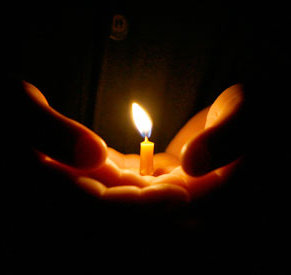
 Some think life is all about doing good and keeping away from evil. To them, struggle has no purpose of its own — to have struggled is to have failed. Success, they imagine, is a sweet candy with no trace of bitterness.
They are wrong, very wrong. Struggle is an opportunity to reach the ultimate, when darkness itself becomes light. In the midst of struggle, an inner light is awakened. Light profound enough to overwhelm the darkness, encasing it and winning it over. But if darkness never fights back, how will it ever be conquered?
-Rabbi Tzvi Freeman
“Perpetual Struggle”
Based on letters and talks of the Rebbe
Rabbi M. M. Schneerson
Chabad.org
I watched an interview quite sometime ago with Oprah and actor Will Smith. He shared his insight about dealing with negative people. He asks this profoundly important question to himself on a frequent basis: “Is there someone in your life who is not contributing to your life and not helping you move forward?” If your answer to this question is a resounding: Yes! Then: “Why do you insist on allowing them to remain in your life?” A big A-ha moment for me! There must be some payoff for you if you continue allowing these negative influences in your life. When you know better you do better. If you want to change your life you have to also change the folks you chose to surround yourself with.
-Debra Moser
“What Are Your Personal Boundaries?”
MorningCoach.com
Oddly enough, I do read the occasional “inspirational” blog, though I don’t put a lot of stock in them. I find the advice they offer is often superficial and overly optimistic. Of course, the writers of such blogs have to keep the content short in order to hold the attention of their readers. Most people won’t read web content beyond a certain length, so if you want to get your point across, you have to make it short and sweet.
I can live with the short part, though it comes with liabilities, but sometimes such blogs are just a little too “sweet” for a middle-age “curmudgeon” like me.
I suppose that’s one of the reasons why I like reading the Bible (I know this will probably sound irreverent). It doesn’t soften the blow and it doesn’t pull any punches. In fact, I’ve heard some people say they aren’t religious just because some of the “advice” offered in the Bible is too harsh (see 2 Thessalonians 3:10 for example). On the other hand, there are times when the ancient sages and today’s “life-coaches” seem to be saying the same thing.
Nitai the Arbelite would say: Distance yourself from a bad neighbor, and do not cleave to a wicked person. -Ethics of our Fathers, 1:7
Debra Moser said something quite similar and, unlike Nitai the Arbelite, provides methods for “weeding out the negative nellies in her life”. Actually, that’s not fair. The commentary for Pirkei Avot 1:7 is just as illuminating as Moser and probably more so.
On the surface, Nitai the Arbelite appears to be conveying a simple, if redundant, message: Stay away from bad people. In truth, however, a much deeper lesson is implicit in his words. In fact, a close examination of his phraseology yields an altogether different sentiment.
What is the difference between a “bad neighbor” and a “wicked person”? And why must one go so far as to “distance oneself” from the former, while, concerning the latter it is enough to avoid “cleaving” to him?
A “bad neighbor” means just that: not a bad person, but one whose proximity to yourself is detrimental to you. It may be that he is a righteous person, and that his path in life is, for him, most suitable and desirable; but if for you it is wrong and destructive, keep your distance.
On the other hand, a “wicked person” is not necessarily a bad neighbor if he is not in the position to influence you. From him you need not, and must not, distance yourself: on the contrary, befriend him, draw him close and help him improve himself, all the while taking care not to cleave to him and emulate his ways.
In other words: The evil in another is never cause for your rejection of him—only your susceptibility to what is evil for you. On the contrary, the “wickedness” of your fellow it is all the more a reason to become involved with him, and prevail upon him to cleave to the positive in yourself.
I am always amazed at how the sages provide teachings so like the Master.
While Jesus was having dinner at Levi’s house, many tax collectors and sinners were eating with him and his disciples, for there were many who followed him. When the teachers of the law who were Pharisees saw him eating with the sinners and tax collectors, they asked his disciples: “Why does he eat with tax collectors and sinners?”
On hearing this, Jesus said to them, “It is not the healthy who need a doctor, but the sick. I have not come to call the righteous, but sinners.” –Mark 2:15-17
By comparison, Moser’s advice is something of a mixed bag. Of course, her goal isn’t to help her audience help others, it’s to help her audience enhance their own lives.
When you value and love yourself those loving and thoughtful people will come into your life. They are a direct reflection of how you see yourself. Be your own person and don’t allow others to define you. These positive people have your interests at heart and celebrate you with the world. There is no animosity and jealousy; just love and acceptance for the unique person you are. The people in my personal and professional life add to my life and that is a wonderful feeling.
 That’s a little too “warm and fuzzy” for me. But while there’s nothing wrong with that advice as far as it goes, the goal starts and stops with the individual: you. It has little to do with anyone else unless those other people in your world are only there to support and augment your “personal and professional life”. This is Madison Avenue marketing meets personal life development meets New Age “all-about-me-ism”. It’s certainly not the message the Master or Nitai the Arbelite are sending. Pirkei Avot advices that we distance ourselves from a bad neighbor, not because they’re a bad person, but because they can be a bad influence on us (and Debra Moser would agree with this part). However, we are not to avoid a “wicked person” because, as long as we don’t cleave to them and adopt their ways, we may become a positive influence on them, turning them away from sin.
As the Master taught, it “is not the healthy who need a doctor, but the sick.” Part of tikkun olam, repairing the world, isn’t keeping all of the “health” to yourself like some self-esteem King Midas, but giving it back to others and to “love your neighbor as yourself” (Lev. 19:18; Mark 12:31).
To be fair, Moser did very briefly touch upon the matter of influencing others, but immediately returned to her primary subject.
You do make a positive difference in someone’s life. Believe in yourself. When you’re not in a good mood STOP and get back to your positive mindset and look with gratitude around you and see what an incredible life you have. Living with gratitude and coming from a loving heart space attracts loving positive people into your life.
Again, to be fair, I expect that if I could give Debra Moser an opportunity for rebuttal, she could expand upon her viewpoint and I suspect provide added dimension to what she writes, including how to be a better support and influence on others who need the help.
One of the 613 commandments in Judaism is to “rebuke the sinner”, based on Leviticus 19:17. The deeper meaning of the commandment has little to do with chiding someone for their faults but instead, it’s more like saving someone’s life. If you see someone in moral and spiritual trouble, and if you have the opportunity and ability to help, you are obligated to help. A Jew must become involved rather than let a fellow Jew fall into or remain within their sins. If they fail to do so, the penalty their fellow will suffer for his sins will also fall upon the person who didn’t help.
Jesus seems to be communicating the same thing to his audience in both Mark 2 and Mark 12 (as well as in other scriptures). Of course there is always a danger involved. Like a lifeguard swimming against hazardous ocean currents to save a drowning person, there’s always the risk that you’ll be pulled under yourself, but its a risk you’ve accepted. A lifeguard accepts the risk by virtue of accepting the position of being a lifeguard. As disciples of Christ, we accept the risk by virtue of virtue; by the fact that we accepted the man with the cross and the God of Heaven.
It’s not easy. That’s what most advice blogs leave out of their content. It’s not a walk in the park. Like any discipline, it takes time and practice. You’ll make mistakes. Sometimes you’ll get hurt. With perseverance, you’ll get better at it. You’ll probably never be perfect. There will be days when you are magnificent and other days when you’ll want to stay in bed and hide. There are even days when you will feel like it’s not worth it and want to give up. But even when we don’t like hearing it, we were created for a very simple reason, to help God help the world. Rabbi Freeman interprets the Rebbe’s teaching on this topic thus:
For all that is, physical or spiritual or Divine, was only created to be part of the repair of this world of action. And once that repair is done, all that will be true are those things that made it happen.
In every thought, look for the power to change the world.
It’s the struggle that creates the light that holds back the dark abyss. Without our struggle, we are only silhouettes fading into the night.
We were so close there was no room
We bled inside each others wounds
We all had caught the same disease
and we all sang the songs of peace
Some came to sing, some came to pray
Some came to keep the dark away
So raise the candles high
’cause if you don’t we could stay
black against the sky
Oh oh raise them higher again
and if you do we could stay dry against the rain-Melanie Safka
Candles in the Rain (1970)
If life is a strugle, it doesn’t mean that you’ve failed. You only drown when you stop struggling against the waves.








 Morning Meditations