Tag Archives: Bible

Why I Can Eat a Cheeseburger and Not Feel Guilty

A friend of mine mentioned to me via Facebook, that the so-called Dr. Laura letter is making the rounds on the Internet by way of email again. For those of you lucky enough to have escaped this collection of errors up until now, this letter was supposedly sent to Dr. Laura Schlessinger, probably sometimes around the year 2000, in response to “anti-gay” comments she made on her radio show. According to snopes.com, which uses their report on the letter to take various shots ar “Dr. Laura” but not to correct the letter’s obvious fallacies, the letter refuted the general argument of “homosexuality is wrong because the Bible says so” by illustrating how “ridiculous” other so-called “eternal truths” of the Bible cannot possibly apply in this day and age. The idea here is that, if many of the commandments given to the Israelites at Sinai are unobservable today, why shouldn’t that include any prohibitions regarding homosexual behavior?

Since Snopes created their web page in such a way to not allow copy and paste, I’m taking the letter from another source:

Dear Dr. Laura:

Thank you for doing so much to educate people regarding God’s Law. I have learned a great deal from your show, and try to share that knowledge with as many people as I can. When someone tries to defend the homosexual lifestyle, for example, I simply remind them that Leviticus 18:22 clearly states it to be an abomination. End of debate.

I do need some advice from you, however, regarding some other elements of God’s Law and how to follow them.

1. When I burn a bull on the altar as a sacrifice, I know it creates a pleasing odor for the Lord – Lev.1:9. The problem is my neighbors. They claim the odor is not pleasing to them. Should I smite them?

2. I would like to sell my daughter into slavery, as sanctioned in Exodus 21:7. In this day and age, what do you think would be a fair price for her?

3. I know that I am allowed no contact with a woman while she is in her period of menstrual uncleanliness – Lev.15: 19-24. The problem is how do I tell? I have tried asking, but most women take offense.

4. Lev.25:44 states that I may indeed possess slaves, both male and female, provided they are purchased from neighboring nations. A friend of mine claims that this applies to Mexicans, but not Canadians. Can you clarify? Why can’t I own Canadians?

5. I have a neighbor who insists on working on the Sabbath. Exodus 35:2. The passage clearly states he should be put to death. Am I morally obligated to kill him myself?

6. A friend of mine feels that even though eating shellfish is an abomination – Lev.11:10, it is a lesser abomination than homosexuality. I don’t agree. Can you settle this? Are there ‘degrees’ of abomination?

7. Lev.21:20 states that I may not approach the altar of God if I have a defect in my sight. I have to admit that I wear reading glasses. Does my vision have to be 20/20, or is there some wiggle room here?

8. Most of my male friends get their hair trimmed, including the hair around their temples, even though this is expressly forbidden by Lev.19:27. How should they die?

9. I know from Lev.11:6-8 that touching the skin of a dead pig makes me unclean, but may I still play football if I wear gloves?

10. My uncle has a farm. He violates Lev.19:19 by planting two different crops in the same field, as does his wife by wearing garments made of two different kinds of thread (cotton/polyester blend). He also tends to curse and blaspheme a lot. Is it really necessary that we go to all the trouble of getting the whole town together to stone them? – Lev.24:10-16. Couldn’t we just burn them to death at a private family affair like we do with people who sleep with their in-laws? (Lev.20:14)

I know you have studied these things extensively and thus enjoy considerable expertise in such matters, so I am confident you can help. Thank you again for reminding us that God’s word is eternal and unchanging.

How do I know that the writer of this letter believes they are more clever than they actually are? First some general info.

And God spoke all these words:

“I am the LORD your God, who brought you out of Egypt, out of the land of slavery. –Exodus 20:1-2 (NIV)

Who is God talking to? Moses? No, He’s talking to the Children of Israel, the descendants of Abraham, Isaac, and Jacob who were enslaved in the land of Egypt for centuries and who Moses, at the direction of God, freed from servitude with the intent on fulfilling God’s promises to the Israelites.

He also said to him, “I am the LORD, who brought you out of Ur of the Chaldeans to give you this land to take possession of it.” –Genesis 15:7

That’s the core scripture but for the full context, including that it is all of Abraham’s descendants through Isaac and Jacob who will inherit, you probably want to read all of chapter 15. You’ll also want to see Genesis 26:1-6 for God’s confirmation that Isaac’s descendants will inherit the Land, and Genesis 35:11-13 for God’s confirmation that it is Jacob’s descendants who will inherit Israel. This leaves out inheritance by Ishmael’s descendants (Isaac’s brother) and Esau’s descendants (Jacob’s brother).

Now you might be asking “what land” did God promise Abraham and his descendants?

Then Moses climbed Mount Nebo from the plains of Moab to the top of Pisgah, across from Jericho. There the LORD showed him the whole land—from Gilead to Dan, all of Naphtali, the territory of Ephraim and Manasseh, all the land of Judah as far as the Mediterranean Sea, the Negev and the whole region from the Valley of Jericho, the City of Palms, as far as Zoar. Then the LORD said to him, “This is the land I promised on oath to Abraham, Isaac and Jacob when I said, ‘I will give it to your descendants.’ I have let you see it with your eyes, but you will not cross over into it.” –Deuteronomy 34:1-4

This is only one of the places in Torah where the borders of ancient Israel are defined (they aren’t always defined in exactly the same way, however).

So we’ve established that God promised Israel specifically to the descendants of Abraham, Isaac, and Jacob, and that at Mount Sinai, God, through Moses the Prophet, gave the specifications of the Torah to those very descendants, the Children of Israel. But what does all this have to do with the Dr. Laura letter? Plenty. I have to “set the stage” so to speak, in order to explain why the points brought up in this letter are utter foolishness, written by someone who has absolutely no idea about how to study the Bible (actually, the letter writer may be deceptively clever, but I’ll get to that).

All of the points in the Bible are specifically drawn from the Torah which in this case means, the Pentateuch or the first five books of the Bible. They’re also called the Books of Moses because supposedly God “dictated” their contents to Moses for him to record in a series of scrolls. The validity of this being literally true is hotly contested in religious and scholarly circles, but regardless of how you weigh in on this issue, the Torah is considered the foundation for Jewish (and arguably Christian) religion and theology.

I want to say at this point, that no modern religious Jew would rely on just the Torah, the Prophets, and the Writings (otherwise known in Judaism as the “Tanakh”, which Christians call “the Old Testament”) as the sole arbiter of their religion. For an observant Jew, it would be impossible to understand what the Bible is saying without close and careful study of the Mishnah, Gemara, and the Talmud. These learned rulings and opinions are the interpreters of the meaning of the various portions of Torah and define how a religious Jew is to respond to its commandments in what has become known as the 613 mitzvot. I’m not scholar enough to present my counter argument from this perspective, but I can tell you that in Judaism, the full response to the fallacy of the Dr. Laura letter could not be given apart from a Talmudic understanding. That said, I believe I can effectively refute the points of the letter without resorting to Talmud.

(For those of you who are clueless about the Talmud but want to understand a little more about it, an excellent and easily read beginner’s guide is The Complete Idiot’s Guide to the Talmud by Rabbi Aaron Parry.)

To cut to the chase, so to speak, I propose that the reason the Dr. Laura letter is a waste of everyone’s time as far as a serious criticism against God’s commands in the Torah is that the writer of the letter completely failed to take it in its context (I realize that the writer’s main purpose was not to defame the Bible in general, but that’s the letter’s secondary effect). The vast majority of Torah commandments are meant to only be enacted in the ancient Nation of Israel! Is that enough emphasis for you? In other words, the Torah comprised the full body of civil and criminal laws as well as ethical and moral guides for all of the Israelite citizens in the Land. It’s like the U.S. Constitution, except that covers not only the legal basis of national sovereignty, rights, and freedoms, but all aspects of religious and social living. For Israel, there was no “separation of church and state” and originally, until Saul was anointed as King by the Prophet Samuel (1 Samuel 10), God was King of Israel in the world’s first and only functioning Theocracy.

Where do we find this? I don’t want this blog to be a thousand pages long. Here are a few examples:

“Honor your father and your mother, so that you may live long in the land the LORD your God is giving you. –Exodus 20:12

Worship the LORD your God, and his blessing will be on your food and water. I will take away sickness from among you, and none will miscarry or be barren in your land. I will give you a full life span. –Exodus 23:25-26

I will send the hornet ahead of you to drive the Hivites, Canaanites and Hittites out of your way. But I will not drive them out in a single year, because the land would become desolate and the wild animals too numerous for you. Little by little I will drive them out before you, until you have increased enough to take possession of the land. –Exodus 23:28-30

“I will establish your borders from the Red Sea to the Mediterranean Sea, and from the desert to the Euphrates River. I will give into your hands the people who live in the land, and you will drive them out before you. Do not make a covenant with them or with their gods. Do not let them live in your land or they will cause you to sin against me, because the worship of their gods will certainly be a snare to you.” Exodus 23:31-33

In these few examples, we see obedience to God’s Torah being applied to the Children of Israel taking possession of and living in the area then known as Canaan and subsequently as Israel and Judea centuries hence. A full inventory of each of the connections between Torah obedience and the context of Israel are beyond the scope of his blog post, but I think you get the idea. The Torah commandments, including those referenced in the Dr. Laura letter, were only meant to be enacted within the national borders of ancient Israel and not outside of those borders nor even in the modern age (HINT: This is the letter writer’s real point).

Now let’s take each point one at a time.

1. When I burn a bull on the altar as a sacrifice, I know it creates a pleasing odor for the Lord – Lev.1:9. The problem is my neighbors. They claim the odor is not pleasing to them. Should I smite them?

The Stone Edition Chumash commentary for Leviticus 1 outlines the specific conditions for the various offerings that were first enacted in the Mishkan (Tabernacle) in the desert, and later in both Solomon’s Temple and Herod’s Temple in Jerusalem. In general, these offerings could only be made where “God had placed His Name”.

You must not worship the LORD your God in their way. But you are to seek the place the LORD your God will choose from among all your tribes to put his Name there for his dwelling. To that place you must go; there bring your burnt offerings and sacrifices, your tithes and special gifts, what you have vowed to give and your freewill offerings, and the firstborn of your herds and flocks. There, in the presence of the LORD your God, you and your families shall eat and shall rejoice in everything you have put your hand to, because the LORD your God has blessed you. –Deuteronomy 12:4-7

Here we see that burnt offerings, and any of the other offerings, could not be sacrificed just any old place, not even within the borders of Israel. They had to be offered in either the Tabernacle (prior to the Israelites taking the Land) or in the Temple in Jerusalem. The fellow who wants to have a barbecue in his backyard might cook up a mean steak, but it has no relationship to Leviticus 1:9. Dr. Laura letter fail. Next.

2. I would like to sell my daughter into slavery, as sanctioned in Exodus 21:7. In this day and age, what do you think would be a fair price for her?

According to the Chumash commentary for Exodus 21, this set of laws deals primarily with civil and tort law within the nation of Israel. Right here, we see that our fellow in point 2 who wants to sell his daughter is out-of-bounds, because he doesn’t live 3500 years ago in ancient Israel. Also, slavery in ancient Israel is not the entity we understand it to be in a larger context. Israel had no welfare system or other means to take care of the poor, so people could sell themselves into indentured servitude as a means of satisfying their debts or to avoid starvation. The Chumash specifically states regarding Exodus 21:7-11:

Until a girl reaches puberty, the Torah gives her father the right to “sell” her as a bondswoman, but, as the passage itself and the teachings of the Sages makes clear, this right is given him for her benefit. He is permitted to “sell” her because the sale is expected to result in her marriage to either her master or his son. In fact, if neither of the two marries her, the Torah regards it as a betrayal of the girl.

If the marriage contract is not fulfilled, then the girl goes free upon reaching puberty, at the end of six years, or upon the advent of the Jubilee year. This is a commandment that cannot be understood by the plain text alone and that must be interpreted through additional sources (in this case, the relevant sections of Talmud are Kiddushin 18b and Kiddushin 41a). When the writer of the Dr. Laura letter asks, in “this day and age, what do you think would be a fair price for her?” he immediately disqualifies himself from being able to sell his daughter, for such a thing isn’t possible in this day and age outside the confines of ancient Israel and without a proper court system established by God (Numbers 11:16-30).

It should be noted that the Chumash commentary says a father should not enact this particular right but sometimes may to ensure a proper “match” for his daughter. This form of “slavery” amounts to an arranged marriage, and such arrangements are known across history and in many cultures up until modern times (hasn’t anyone ever seen Fiddler on the Roof?). They may not be politically correct in our day and age, but they’re not effectively slavery and in any event, this particular form of slavery cannot be enacted and enforced in even modern Israel, let alone anywhere else in the world.

Sorry. Dr Laura Letter fail #2.

3. I know that I am allowed no contact with a woman while she is in her period of menstrual uncleanliness – Lev.15: 19-24. The problem is how do I tell? I have tried asking, but most women take offense.

Oh brother. This one seems amazingly ridiculous to me, but let’s have a look at the source text. In fact, let’s see what happened when a man in ancient Israel did come in contact with a woman’s “impurity”.

“‘When she is cleansed from her discharge, she must count off seven days, and after that she will be ceremonially clean. On the eighth day she must take two doves or two young pigeons and bring them to the priest at the entrance to the tent of meeting. The priest is to sacrifice one for a sin offering and the other for a burnt offering. In this way he will make atonement for her before the LORD for the uncleanness of her discharge. –Leviticus 15:28-30

This sort of contact was only a problem if the man intended to offer a sacrifice or otherwise enter into the Temple. He was considered ritualistically unclean and unable to perform various religious rites. As far as his day-to-day life, it had no impact. Obviously, if the writer of the Dr. Laura letter is living in modern times and thus (even if he’s a Jew, and if he is, he should know better than to engage in such a foolish letter) sitting on the same sofa where a menstruant woman recently sat has absolutely no effect on his life. In modern times, the only issue a Jewish man would have with a menstruating woman would have to do with the niddah or law of separation. This forbids a husband from having sexual relations with his wife during her period. This is observed primarily within the Orthodox Jewish community and may not even be observed by Reform or non-religious Jews. This restriction is not binding on Christians or anyone else in any way, so Dr. Laura letter fail for point #3.

4. Lev.25:44 states that I may indeed possess slaves, both male and female, provided they are purchased from neighboring nations. A friend of mine claims that this applies to Mexicans, but not Canadians. Can you clarify? Why can’t I own Canadians?

The Chumash commentary for Leviticus 25:44-46 states:

Having said that an owner’s rights over his Jewish slaves are severely limited, the Torah states that one may purchase slaves from among the surrounding nations. Such slaves become the property of their owners.

Again, context, context, context. We are talking about ancient Israel and the surrounding nations. In the ancient near-east, slavery was common and legal. We’ve already seen an example of how “slavery” was more a matter of indentured servitude when one Jew owned another, but when an Israelite bought a slave from a neighboring country, they indeed were a slave. They had certain rights, but not nearly the rights of a born Jew. Having said all that, nothing in the context of this passage gives our (supposedly American) writer the legal leverage to buy a Canadian. In this case, the various laws of the U.S. and Canada apply and if said-writer ever seeks to buy another human being, he’ll end up doing a long stretch in prison. Letter fail for point #4.

5. I have a neighbor who insists on working on the Sabbath. Exodus 35:2. The passage clearly states he should be put to death. Am I morally obligated to kill him myself?

According to the Chumash commentary for this verse, violation of the Shabbat was the equivalent of idol worship, which also carried the death sentence. However, it’s not a matter of a mob grabbing the offender and doing away with him as many people seem to imagine. The offender had to be observed violating the Shabbat by at least two reliable witnesses (Deuteronomy 19:15). The case was adjudicated in front of a court system and once the witnesses testified, the court considered the matter and issued a verdict. If the verdict was guilty, then the primary witnesses were obligated to “cast the first stones” (Deuteronomy 17:7).

Barbaric? Sure sounds that way. Stoning was a horrible way to die. Notice though that (again) this particular law only applied to Jews (non-Jews were and are not obligated to observe the Shabbat) in ancient Israel. Even modern Israel as a nation, does not have a unified law obligating all of its citizens to observe the Shabbat, though some sects within religious Judaism are lobbying for this. Our supposedly American letter writer has no legal right to enforce an ancient penalty out of its context, even if his “Shabbat breaking neighbor” happens to be Jewish. Dr. Laura letter Fail #5.

6. A friend of mine feels that even though eating shellfish is an abomination – Lev.11:10, it is a lesser abomination than homosexuality. I don’t agree. Can you settle this? Are there ‘degrees’ of abomination?

This is the real reason the Dr. Laura letter writer submitted his wee missive; to illustrate that homosexuality cannot be considered an “abomination” by God according to the Bible unless all of the other Torah commandments remained equally valid. So who shouldn’t eat shellfish? The Leviticus 11 kosher laws are specific to the Children of Israel. This set of laws is a tad different, because it applies to Jews regardless of where they live and regardless of when in history they live. Modern observant Jews keep kosher within both the confines of Leviticus 11 and the specific rulings of the Talmudic sages. This additionally specifies how meat animals are to be slaughtered in a kosher manner. Observant Jews can’t just buy a pound of ground round from Albertsons to satisfy their dietary requirements. There are also rulings that require that the kitchen used to prepare food must be kosher (kashering a kitchen is a rather involved process), and meat and dairy products cannot be served and eaten together.

These restrictions are observed mainly in the Orthodox Jewish community and varying degrees of kosher are kept by Conservative and Reform Jews. Most secular Jews do not keep any form of kosher, just as Christians do not and certainly no other people group (actually, Muslims have their own kosher laws which closely mirror the Jewish dietary restrictions). For the rest of us, it’s OK to eat a cheeseburger and not feel guilty. Bon appetit.

I don’t know how to compare the “degree of abomination” of eating a pork chop to performing a homosexual act relative to the Torah, so I have no response for this. Orthodox Jews still declare homosexual acts as immoral but Reform Jews are fully accepting of gays including the ordination of gay Rabbis and having gay members of the synagogue board and their various committees.

Greenberg_steve_rabbiThe attitude of Orthodox Judaism toward homosexuality may be changing, although rather slowly. About six weeks ago, I wrote a blog post called At the Intersection of Intolerance and humanity in response to what I understand is the first ever wedding of two gay Orthodox Jewish men by a gay Orthodox Rabbi. The story and the blog comments in response are very illuminating and I encourage you to have a look. As far as the letter writer’s query, it isn’t stated in such a way that a response is possible. I’m sure a Talmud scholar could render an answer as a matter of degree of offense, since both the kosher laws and restrictions against homosexual behavior remain observed in Orthodox Judaism, but I lack the qualifications to render an opinion. As far as my analysis is concerned, we’ll call it a draw on point #6.

7. Lev.21:20 states that I may not approach the altar of God if I have a defect in my sight. I have to admit that I wear reading glasses. Does my vision have to be 20/20, or is there some wiggle room here?

The Chumash commentary for this section of Torah states in part, “This verse forbids the blemished Kohen to perform the service…”. OK, the blemished Kohen. Kohenim (plural for Kohen) are a subset of the tribe of Levi and direct descendants of Aaron (the brother of Moses). By definition, they’re Jewish, so unless our letter writer is Jewish, a Levite, and a Kohen, he doesn’t have anything to worry about. Also, no Temple exists, thus no altar exists. This question is a red herring (they all are). No sale. Dr Laura letter fail on point #7.

8. Most of my male friends get their hair trimmed, including the hair around their temples, even though this is expressly forbidden by Lev.19:27. How should they die?

I’m getting a little tired of writing long responses to silly questions. Remember the part in my response to #5 about the death sentence, court, judges, Israel, context, context, context? Apply that. Only the ultra-Orthodox and Chabad communities observe these restrictions in the modern age. If they violate them and try to remain within their communities, it’s up to the local Beit Din or rabbinic court to adjudicate the matter and their authority is only over their communities. The rest of us are free to have whatever haircut we choose. Dr. Laura letter fail on point #8.

9. I know from Lev.11:6-8 that touching the skin of a dead pig makes me unclean, but may I still play football if I wear gloves?

“You shall not touch their carcass.” Here’s the Chumash commentary on this verse.

This prohibition applies only during the festival visits to the Temple, when everyone must be pure. At such times, no one may touch a contaminated carcass, because everyone is commanded to remain uncontaminated during the festival visits to the Temple.

While Jews around the world continue to celebrate festivals such as Passover, Shavuot, and Sukkot, because there is no Temple or priesthood, it’s impossible to celebrate in accordance to the descriptions we find in the Torah. Even if our letter writing friend were Jewish, unless he was planning on using his time machine to celebrate Sukkot in the days of Herod, he has no problem. Certainly as an American non-Jew, he can play football anytime he wants. Dr. Laura letter fail on point #9.

10. My uncle has a farm. He violates Lev.19:19 by planting two different crops in the same field, as does his wife by wearing garments made of two different kinds of thread (cotton/polyester blend). He also tends to curse and blaspheme a lot. Is it really necessary that we go to all the trouble of getting the whole town together to stone them? – Lev.24:10-16. Couldn’t we just burn them to death at a private family affair like we do with people who sleep with their in-laws? (Lev.20:14)

Is his uncle Jewish? If so, does his uncle live in the land of Israel around 1000 B.C. or so? No? Then this, like the other points in this letter, is a “non-event”. Fail #10.

That’s 9 for 10 fails with a draw for point #6 and that’s only because of the way the question is worded and the failure of a consensus in even the Orthodox community.

Now here’s the real point. I realize that the letter writer is not really being so foolish as to think you can take bits and pieces of the Bible out of context and try to apply them to a modern, non-Jewish world. His (or her) real point was to attempt to illustrate that the Bible cannot be viewed as an absolute and timeless source of truth, since some any of its conditions have indeed changed across time, if for no other reason than the Temple in Jerusalem no longer exists (but reading the book of Ezekiel, we can expect a third Temple to be built at some future time). Thus the Torah prohibitions against homosexual behavior should not apply outside of the Torah context as well. I get that. Of course, since particularly Orthodox Jews do keep the kosher laws (and most religious Jews of the different sects do so to varying degrees), it’s up to each Jewish community to determine their tolerance level for homosexuals in their midst. I also realize that the letter (supposedly) was aimed at Dr. Laura in response to her comments against gays based on the Bible. If we keep the letter in that context, then the ten points I’ve just belabored have nothing to do with the rest of us.
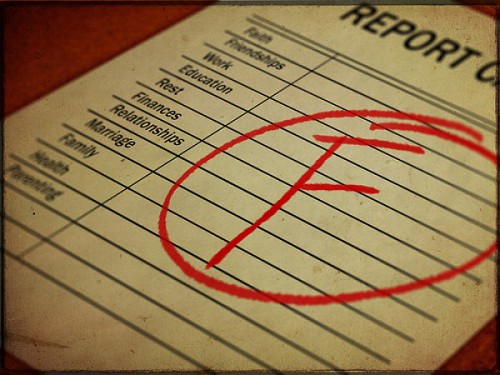
However, if we were to believe that the letter writer were also attempting to discredit the Bible (and the Christians and Jews who consider it holy) because it commands behaviors that don’t apply in the modern world, then he (or she) has failed miserably. As I previously said, I can’t say the letter is a 100% failure only because of the ambiguity of how point #6 is worded, though there is probably an answer out there somewhere. Still, the letter is a 90% failure and even if I give it 10% credit for point #6, that’s still an “F” in any teacher’s gradebook.

I know this is a very long write-up and it could have been much, much longer if I had gone into exquisite detail, but frankly, I think I’ve proved my point. All that stuff in the Bible doesn’t apply to you if you don’t want it to apply to you. Any part of the New Testament only starts applying once you decide you want to be a Christian (God will sort it all out at the final judgment, so if you’re not worried, neither is God). If you’re not Jewish and don’t live in ancient Israel, you don’t have to give the Dr. Laura letter a second thought. If you’re Jewish and religious, any questions you may have about the proper level of your observance need to be directed to your Rabbi.

As a parting note, I apologize for all of the typos you’ve found in my rather long “meditation”. I haven’t had the time to properly edit it but will do so in the hours and days ahead (so if the wording changes here and there, no worries). If you have a comment or rebuttal (please be nice), feel free to chime in. To my friend Leo, I hope this fits the bill.

Uncertain Traveler

walkingThe Torah is a code which assumes a community tradition to fill in its gaps. That is, the Torah does not spell out how to carry out many of its commands. The details of procedure are often left to the people. And the intention of Torah is clearly not to arrive at a situation like that in the book of Judges, where “every man did what was right in his own eyes.”

In matters of legal judgment, the Torah’s gaps were to be filled in by judges and by a sort of high court (Deut 17:8-13) and the people are not to turn to the right or to the left from the rulings of Israel’s judges. In matters of worship procedure and liturgy, the Levitical priests are the ones who determine the practice of the community.

-Derek Leman
“Torah Fundamental #2”
Messianic Jewish Musings

The Toras HaNefesh learns an important message about when to temper one’s avodah from a statement on today’s daf. “When a person ascends in understanding, he should also develop greater empathy for the pain of others. This is even true regarding fulfilling a mitzvah. If one is overzealous in fulfilling mitzvos, he can sometimes insult another Jew undeservedly. Usually this kind of person has forgotten his friend’s feelings and doesn’t even realize that he has sinned. He might have insulted another Jew, or he might have treated his fellow with less than the honor that he deserves, or he might have forgotten to consider the ramifications of his actions on his friend’s livelihood.

Daf Yomi Digest
Stories Off the Daf
“Send Her Away – No Matter What”
Chullin 141

For yesterday’s morning meditation, I wrote something that is a reversal from my usual theme and asked if a Christian should limit his or her Jewish learning. I know I typically advocate for Christians pursuing the traditional Jewish texts in order to discover the “Jewishness of Jesus”, but obviously this has pitfalls. For one thing, it may not be easy or even possible to really deconstruct Mishnah, Talmud, and Gemara back to that very special first century Rabbi in order to learn what he was teaching within its intended context. I must admit that much of the material I study seems to resemble what Jesus has taught to his disciples, but I know I have probably been deceiving myself. I hope I wasn’t deceiving you.

Wait. Let me explain.

I’m not “throwing the baby out with the bathwater” and I still think there is value in a Christian studying Judaism. I’m still here and I’m still studying, so it’s still important to me. But maybe I’ve been generalizing information beyond reasonable bounds. I quoted that small piece from from the “story off the daf” to illustrate that this information was written by and for Jews. Sure, some of what is presented in Jewish literature can be applied to a larger, non-Jewish audience but a lot of it can’t. Here’s another example:

In any case, since virtually all Jews with an interest in proper practice – lay preachers, priests, pietists, scribes – will have appealed to the Torah for support, the scriptural origins of mishnaic law will tell us nothing about the social group or groups from which the Mishnah derives. Nor can such derivation tell us whether a given law is a pre-mishnaic tradition or a mishnaic creation, since Jews read Scripture both before and after 70 C.E. If a mishnaic law can be shown to derive from a specific mode of reading Scripture, and if that mode of reading can be shown to derive from a specific group or a specific period, then of course the origins of that law would be established. But, as far as I know, convincing examples of this have yet to be adduced.

-Shaye J.D. Cohen
“The Judaean Legal Tradition and the Halakhah of the Mishnah”
Published in The Cambridge Companion to the Talmud and Rabbinic Literature
Edited by Charlotte E. Fonrobert and Martin S. Jaffee

Also, as Derek Leman says on the blog post I previously quoted:

The problem with Torah Fundamental #2 is that modern readers of the Bible tend to prefer the “every man does what is right in his own mind” ethic of our time. Tradition is a bad word. Authority in the hands of a group of people, such as the rabbis, is deemed oppressive and false. The Bible means what it means to me and no one should dictate procedure or tradition. How does Israel’s tradition work and how can those who want to know Torah respect the tradition?

Here is a problem that occurs often in our time: a person discovers Torah coming from a free church tradition and becomes “Hebraic” or “Messianic” and they read Torah as a free thinker descended from the Enlightenment. The people who fall into this trap generally don’t realize that they are reading Torah in a modernist mode. They think they are being true to the Bible.

Even if we look at the same texts as Jewish people, we don’t always see the same things. In fact, to the degree that Gentile Christians lack a Jewish conceptual framework, we are guaranteed not to see the same things. When a Jewish teacher tries to explain this to us, we are likely to reject his comments out of hand, because they go against how our Gentile perceptions construct God, Jesus, and the Bible. I try very hard to avoid falling into this trap and in my own limited way, I think I am successful. But not entirely.

at-the-edgeI struggle with how far I can take my present course and whether or not I’ll go sailing off the edge of the world and into the infinite abyss (I’m being overly dramatic) in my zeal, but the other option is to censor myself and limit what I read and study. I don’t like that idea, either. What I require ideally is the context I lack because I was not born Jewish, not raised in a Jewish home, and not educated as a Jew. No, I don’t regret who I am, how I was raised, and what I have learned in my life as it has been, but my “identity” automatically restricts my abilities and perceptions in terms of studying Judaism.

Some Christians have overcome this barrier, but only after many years of study, usually in a Jewish context such as classes offered at a synagogue, Jewish Community Center, or similar environment. For reasons too lengthy to explain, those options are not currently available to me. Still, I cannot simply let this go. I just have to try to be more careful.

Of course, I’m still going to make mistakes, I just hate making them.

I found something interesting at Chabad.org yesterday.

Wisdom lives in the future, and from there it speaks to us. There is no such thing as wisdom of the past.

Wisdom preceded the world and wisdom is its destiny. With each passing moment, wisdom becomes younger, as we come closer to the time when it is born and breathes the air of day.

Our ancient mothers and fathers, the sages, all those from whom we learn wisdom—they are not guardians of the past. They are messengers of the future.

The truth can never be old-fashioned. It was never in fashion to begin with.

-Rabbi Tzvi Freeman
“Youthful Wisdom”
Based on letters and talks of the Rebbe
Rabbi M. M. Schneerson

I’m used to thinking of wisdom as being locked up in the works of the past and the minds and hearts of people long gone from this world. When I think of “wisdom” as a goal, it never occurred to me to consider wisdom as something we are longing for in the same way we are longing for the Messiah. I know that the path toward wisdom, like living a life, cannot be experienced without making mistakes. Making a mistake is sometimes more helpful in learning something revolutionary than making 1,000 correct decisions. It’s also more painful.

no-danger-of-fallingThe conclusion I’m approaching is that limiting my access to Jewish educational materials isn’t going to help me, but attempting not to stretch them too far outside of their original form and substance might. That still goes against my nature, because stretching or bending information and concepts more often leads to revolutionary or evolutionary learning than playing it safe.

As you can see, I’m still arguing with myself about what I should do and where I should go from here. I just gave a piece of advice to another Christian blogger not to make a change just to reduce anxiety or just for the sake of changing something. In that same vein, I don’t think I’ll change to much around here in the near future. I’ll try to be more careful in how I apply what I’m learning, but to tell you the truth, I learn more when someone comes in here and explains what I said wrong and why it was wrong, than when people come around and say that I got it right (not that I mind complements).

I don’t think I’m really in danger of falling off the edge of the world (and based on the lack of comments in that blog post to date, other people don’t think so, either). However, I do need to verify that my footing is a little more sure sometimes. Perhaps someday, wisdom will lend me her wings so I can fly across the edge and discover the other side.

Why do I do this? Why am I on this rather problematic path? I feel driven by something I can’t explain and I feel that it’s important to try to understand certain things. I believe this trail, for me, is the right one, even though I walk it very imperfectly. I stumble, stagger, and fall like a drunken student on the floor of my school house that keeps tilting and twisting under me. But I’m waiting for something. I’m waiting for someone. Is wisdom coming from the future, tracing a backward path toward humanity like the coming of Messiah?

The great song traveler passed through here
And he opened my eyes to the view
And I was among those who called him a prophet
And I asked him what was true
Until the distance had shown how the road remains alone
Now I’m looking in my life for a truth that is my own

Well I looked into the sky for my anthem
And the words and the music came through
But words and music will never touch the beauty that I’ve seen
Looking into you

And that’s true

-Jackson Browne
“Looking Into You” (1972)

Sailing Toward the World’s Edge

worlds-edgeSometimes the sages tell us, “This wisdom is out of bounds. This contains truth for which you are not yet ready.”

If the soul is intact, it will thirst all the more to attain that wisdom. In truth, that is the inner reason we are told such things.

-Rabbi Tzvi Freeman
“Forbidden Water”
Based on letters and talks of the Rebbe
Rabbi M. M. Schneerson
Chabad.org

When someone asked the Korban Nesanel, zt”l, whether he should make a brochah when doing shiluach hakein, he replied that he should not. “The reason why is obvious: maybe the egg or eggs are inedible. As we find in Chullin 140 there is no mitzvah to do shiluach hakein on such an egg. It follows that we cannot make a brochah on this mitzvah.”

Daf Yomi Digest
Stories off the Daf
“Blessing the Mitzvah”
Chullin 140

Generally in this blog, but especially in the last two blog posts, I’ve been trying to filter Jewish Rabbinic learning through a Gentile Christian understanding. Most of the time, I believe that Christians must struggle with Judaism in some manner or fashion in order to gain a better insight into our faith and our Savior. I believe there is a dimension to be explored that, if we dare enter, will provide a form of illumination into who we are as disciples of the Master that otherwise would completely escape us.

Of course there is the other side of the coin. As Rabbi Freeman suggests, perhaps there is a “wisdom…out of bounds” for us, a boundary that we should not cross, a road that we should not travel, even though it cruelly beckons us.

I don’t know.

Part of my frustration is that I lack the essential educational and cultural foundation to truly do justice to the path I’ve selected. As has become abundantly clear, there is so much I do not know, not only at the level of education, but of experience and identity. Although I seriously doubt I see the world the way most other Christians see it, I also am incapable of seeing the world the way most Jews see it. I deliberately inserted a small paragraph from the Daf on Chullin 140 to illustrate this point.

But if the story of religious Judaism as transmitted in the Bible cannot be comprehended by Gentile Christians, then what the heck are we doing here and why are we reading it? Most churches and Christianity as a whole have refactored the Bible to make it transmit a wholly non-Jewish message and that message, for the most part, is extremely comfortable to most Gentile believers. It speaks our language which is certainly not Hebrew or Aramaic and it offers us a picture we can conveniently wrap our brains and feelings around with little or no effort.

Once you start deconstructing the story of the Bible back to its original language, context, and people, that message becomes increasingly alien to us. We blink our eyes a few times and discover once familiar terrain has become unrecognizable, incomprehensible, and even frightening. A 21st century Gentile Christian suddenly caught on the other side of the Bible, hundreds or thousands of years in the past, among a foreign people, trying to cope with strange customs, and a virtually encrypted language is totally removed from understanding the people of the Bible and hasn’t the vaguest idea how to approach God. Even the safe and loving Jesus Christ becomes Yeshua ben Yosef, whose face, voice, and demeanor are completely at odds with our “meek and mild” Savior. Just how strange would he appear to us and, to the degree that he rarely spoke with non-Jews, if we could understand him, what would he say to us, if anything at all?

So what are we doing here, why do we read the Bible, and especially, why do we attempt to understand where it came from and who the people inhabiting its pages really were as flesh and blood human beings? Should we attempt to know them? Can we really know them?

Isaac then brought her into the tent of his mother Sarah, and he took Rebekah as his wife. Isaac loved her, and thus found comfort after his mother’s death. –Genesis 24:67 (JPS Tanakh)

Isaac took his bride into his mother’s tent. All this time Sarah’s tent had been empty and forlorn, symbolizing the absence of the eishet chayil (virtuous wife). The Torah portion began the story of Rebekah by telling us of the death of Sarah. Since his mother’s death, Isaac had been in mourning. He keenly felt her absence. Isaac taking his bride into Sarah’s tent symbolizes Rebekah stepping into Sarah’s role as matriarch over the house of Abraham. In the language of the rabbis, Rebekah became the house of Isaac.

“Love and Marriage”
Commentary on Parasha Chayei Sarah
FFOZ.org

here-there-be-dragonsThis is where a Christian can intersect with the ancient Jewish universe, understand what is going on, and learn what it is for a person to interact with God. Who couldn’t understand grief at the loss of a mother, loneliness, and the need to be comforted? How many of us who depend on God have come to realize that we also need to hold onto a living, breathing human being when we are troubled or in distress? In this, is it so hard to understand Isaac and what he was going through at that moment?

But there is that rather mysterious and puzzling question about “whether a person should make a brochah when doing shiluach hakein.” Attempting to force some of the very human lessons of the Bible into a framework made up of Mishnah, Talmud, and Gemara may be a case, at least for me, of my reach exceeding my grasp. I may long to understand the “Jewish condition” and believe that it can be applied to the much larger context of human beings and our desire to encounter God, but longing for a thing does not make it occur nor does that longing even make it possible.

I’ve mentioned this before, but my wife has told me on several occasions that there is a perspective and thought process shared by people who were born and raised in a Jewish cultural, religious, and ethnic context that is fundamentally different from how people operate who come from other contexts. In that sense, it’s amazing any Jew and Christian can talk to each other at all, even though we may have the English language in common. I suppose I’m overstating my point, but with good reason. While I still think that shared knowledge is good and that there is a wisdom Christians can glean from Jewish education on some level, I’m starting to wonder where the limit of that journey lies. In ancient times, people believed that there was an edge to the world and mariners who sailed too far away from safe and familiar shores risked being lost forever as they fell endlessly down into the mists of the unknown. While we now know this “danger” is completely untrue, in a past centuries gone, those otherwise brave and daring men would experience fear and horror while contemplating that part of the map that declared, “Here there be dragons!”

I’m sure there are Jewish people in the world who, from their perspective, rightfully desire to limit Gentile access to Jewish learning. Should a Ger Toshav study the laws pertaining to the Kohen Gadol? Is it proper for a Christian who worships oto ha’ish as God and man to sit in at a “Talmud 101” class taught by a Rabbi at the local Chabad? From my point of view, if there is a line I should not cross or a barrier I should respect and not transverse, I don’t know where it is. In the violent mists and roar of the waters pouring over the vastness of the world’s edge, I cannot see it or hear it. One can only find “world’s end” by sailing across it and then, when it’s finally too late, declaring, “I’ve gone too far.”

Or we can simply turn our tiny wooden vessel around and head for safe harbor.

I’m not inclined to do that right now, but the day may come when I will have to revisit that option. Until then, I’m letting the wind take me to places not on my map and trying to draw a chart of currents, islands, and shoals I don’t always recognize. Even imagining they seem familiar, I am sometimes told by those who live there that I have my map upside down and my picture is askew.

Each pull at the oars takes me someplace I’ve never been before and each gust of wind pushes me into mysterious territory. What will I find and will I even understand what I’m looking at when I arrive? I don’t know, yet I’m driven to continue the journey, dangerous though it may be, until I either finally understand this strange book I hold in my hands or admit that it was written by and for men who are from a different world and always will be. Then I’ll either return to more familiar environs, where ever they may be found, or let myself sail over the edge of the world and discover if I will fly or drown.

The Conundrum Religion

conundrumNo matter how much you distrust your own sincerity or question your motives, there is no trace of doubt that at your core lives a G-dly soul, pure and sincere.

You provide the actions and the deed—just do what is good.

She needs no more than a pinhole through which to break out and fill those deeds with divine power.

-Rabbi Tzvi Freeman
“The Promise Inside”
Based on letters and talks of the Rebbe
Rabbi M. M. Schneerson
Chabad.org

Would that it was so simple. I guess it should be that simple to serve God. Really, I outlined the basic core of it a few days ago in my blog post Being Heaven on Earth. More than anything, if we want to serve God, we have a duty to serve other people in whatever way we can, great or small. It’s a very simple concept. No wonder people get it messed up all of the time.

I sometimes contribute to the confusion. In yesterday’s morning meditation I introduced a discussion of the relationship between the laws of Noah as chronicled in Genesis 9 and how they interact with the Mosaic and Messianic covenants (Sinai and the Cross respectively). While, as my friend Derek Leman pointed out to me, the concept of being a Noahide is post-New Testament, I still think the “theme” of a non-Jew, non-Israelite, non-Hebrew being able to have a covenant relationship with God in the post-diluvian world says much about God’s compassion for humanity.

Of course, I could be wrong.

Then again, there are still those in the Christian/Messianic world who insist that Christians are grafted into Israel to the degree that they become Israel. That is, they become Jewish in all but name only and are obligated to perform the identical 613 commandments as the Jewish people. This very much takes a long stick and stirs up the muddy, murky waters of “Judeo-Christian” (I use the term in quotes because it doesn’t exist in reality) religion.

It all seems so much easier when you look at it as just dedicating your life to performing 1000 mitzvot or feeding and caring for (video) people who can’t do these things for themselves.

We make religion out to be quite a mess when it doesn’t have to be.

I recently read a review of Talya Fishman’s book Becoming the People of the Talmud: Oral Torah as Written Tradition in Medieval Jewish Cultures which describes how the Talmud became a completely integrated element in the religious life of every observant Jew. It seems that integration wasn’t as seamless as I originally thought, nor is its acceptance completely uniform across all different populations of Jews (not to mention what non-Jews think of the Talmud). However, if you look at Judaism from a fundamentally Jewish perspective, you can’t really have Jewish religion without the Talmud.

But it contains all of these mind-bending puzzles, conundrums, and debates!

Christianity doesn’t have anything to compare to the Talmud so it would seem that Christianity, if you want a “simple” religion, would be the way to go, but that’s somewhat deceptive. At least in the west, Christianity is a religion of individuals. I’m oversimplifying here to make a point, but it’s as if becoming a Christian and developing your faith is as easy as declaring Christ as Lord and Savior, praying to God to give you discernment through the Holy Spirit, and then reading the NIV Bible while “allowing the Spirit” to tell you what it all means.

I was puzzling through something about the Seven Noahide Laws when I realized that Judaism conceptualizes these requirements for non-Jews in exactly the same way as it views the Torah for Jews. The view is that the requirements are imposed on a people rather than on individuals. To be sure, a Jew responds individually to commandments such as praying with tefillin and a tallit (although praying with a minyan requires 10 Jews), giving to charity, visiting the sick, and so forth, but it is obedience to the mitzvot that identifies the individual as belonging the the Jewish people (there’s debate here since there are a lot of secular Jews who feel no attachment to the Torah, but I digress).

Gentiles in the western nations don’t identify in the same way in terms of religion. We see religion as a personal responsibility only and we just happen to be loosely associated with a church where we agree on the theology being taught. This doesn’t make sense when a Jew looks at a Gentile. Here’s an example.

One of the Noahide commandments requires establishing courts of law. An individual doesn’t do this. I can’t personally obey this commandment. Only cities, counties, states, and nations establish courts. Political entities establish courts, not individual human beings. That means being a “righteous Gentile” to some degree, requires that you belong to a nation that establishes courts. That’s the personal part of the decision, but you still have to belong to “a people” or “nation” that obeys this directive to be said to have obeyed it yourself.

But it seems so involved and so much of the governmental establishment of justice is out of our control. This may be a fallacy in the Jewish application of the Noahide concept on Gentiles. We are not a people of God the way the Jews are a people of God. The Israelites (and an assorted group of non-Israelite freed slaves) stood at Sinai “as a single man” and accepted the Law of God He had designed and established for them. While the cross of Christ stands for anyone who accepts Jesus as Lord and Savior, there is no ” nation of Christians”. Thus, in respect to the concept of “peoplehood”, Jews and Christians are fundamentally different “things”.

studying-talmudI’m getting a headache.

What was I saying again? Oh yeah. Why is worshiping God so complicated. Why are there so many disagreements? What is the problem?

Theologians and philosophers have been debating those questions since man’s first awareness of God but the easiest answer I can come up with is that people are gumming up the works. Sure, God is hard to understand, the Bible isn’t exactly like a first grade reading text, and the Talmud doesn’t add up as easily as “two plus two”, at least not to me.

While I enjoy a good challenge and I delight in digging “deeper into the text” so to speak, it is too easy to lose myself in the complexities of religion while forgetting why I am here in the first place. It should be as simple as Adam and Eve standing in the Garden.

Anxieties, worries, feelings of inadequacy and failure — all these smother and cripple the soul from doing its job. You need to find the appropriate time to deal with them. But don’t carry them around the whole day.

During the day, you are Adam or Eve before they tasted the fruit of good and evil.

-Rabbi Tzvi Freeman
“Out From Under the Blanket”
Based on letters and talks of the Rebbe
Rabbi M. M. Schneerson
Chabad.org

We may argue and fuss with each other until the coming of the Moshiach and we may never see eye to eye on many issues but at the end of the day, if you managed to feed one hungry person, visit one sick person in the hospital, or even smile at a stranger you pass on the sidewalk, you’ve made the world a better place. God said it all here:

And what does the LORD require of you But to do justice, to love kindness, And to walk humbly with your God? –Micah 6:8

“The rest is just commentary, go and study.” -Hillel

The Gift of the Postdiluvian King

This week’s reading tells the story of Noah, the father of all humanity. We learn that G-d spoke to him and his children, directing them to follow seven laws for just and moral lives. Most religions say that they offer an exclusive path, but our Talmud teaches that “the righteous of all nations have a share in the World to Come.” Maimonides says that this applies to anyone who accepts upon him or herself to observe the Seven Commandments given to Noah.

-Rabbi Yaakov Menken
Director, Project Genesis – Torah.org

“But flesh, when its soul is with its blood, you shall not eat it… He who spills the blood of man, by man shall his blood be spilled, for in the Image of G-d did He create man.”Genesis 8:4,6

Where was God when the descendants of Noah needed salvation? Christians believe we are saved through the blood of Jesus Christ and Jews believe they merit a place in the world to come by obeying the 613 mitzvot (OK, it’s more complicated than that, but that’s “salvation” in a nutshell). But what about the time before the birth of Christ and before Moses at Sinai? We know that people were aware of God. Certainly Noah was a “righteous man; he was blameless in his age” and he “walked with God” (Genesis 6:9) and certainly God spoke to Abraham when He said, “Go forth from your native land and from your father’s house to the land that I will show you” (Genesis 12:1), but what allowed a person to have a relationship with God, particularly in Postdiluvial times?

We see hints that the people in those days were aware of “Torah” requirements. Even Noah was commanded of “every clean animal you shall take seven pairs, males and their mates, and of every animal that is not clean, two, a male and its mate”, telling us that well before Sinai, clean and unclean animals were an understood concept. We don’t see God going through an extensive set of explanations telling Noah the difference between these two general types of creatures, so he must have already known about this. We even know that when Abel offered his sacrifice to God (Genesis 4:3-4), it was a clean animal appropriate for sacrifice.

The commentaries in the Stone Edition of the Chumash make significant reference to the kosher vs. non-kosher animals such as in this example:

Genesis 6:19 “Two of each.” As the following verse explains, these animals were to be one male and one female, so that the species could be replenished after the Flood. In the case of the kosher species that could be used for offerings, Noah was later commanded to bring seven pairs (7:2), so that he could bring offerings of gratitude and commitment after returning to dry land.

The Chumash commentary for Genesis 8:20-21 even refers the reader to Leviticus for details on the sacrificial offerings, their names, and terminology, again suggesting that Noah would have had to possess some of this information in order to give a proper sacrifice to God after the Flood. Yet man, at that time, was not to divide animals into kosher and non-kosher for eating, as illustrated in Genesis 9:3:

Every creature that lives shall be yours to eat; as with the green grasses, I give you all these.

We see that certain parts of the “Torah knowledge” available to both the antediluvian and postdiluvian peoples was later applied specifically to the Children of Israel as part of the Torah, but what about the rest of humanity? Ten generations followed Noah before the birth of Abram (Abraham). The Bible glosses over the details of the lives of these people, but we presume at least some of them continued their worship of and devotion to Hashem. Also, during the lives of Abraham, Isaac, and Jacob, there were members of their households who were not Hebrews yet who learned of the God of Noah and turned their hearts to Him. What about the Egyptian members of Joseph’s house when he was a viceroy of Pharaoh, King of Egypt (see Torah Portions Miketz and Vayiggash)? Perhaps Joseph taught some of them about the God of his father Jacob. Most assuredly, he taught his Egyptian wife and sons.

Unlike most other religions, Judaism does not declare that they are the only path to righteousness, well not exactly anyway. Rabbi Yaakov Menken has this to say.

Unlike the other religions of the world, Judaism does not believe that everyone must become a Jew in order to approach G-d or earn a place in the World to Come. When King Solomon built the Holy Temple in Jerusalem, he asked of G-d that He hear the prayers of all who pray towards that Temple: “Also a gentile who is not of your people Israel, but will come from a distant land for Your Name’s sake… and will come and pray toward this Temple, may You hear in Heaven Your dwelling-place, and do according to all that gentile calls out to You…” [I Kings 8:41-43]

MosesIt is the subject of much debate as to whether or not there were “Noahides” or Ger Toshav among the Hebrew people between the days of Noah and Moses, but it is more than possible that they existed. Abraham sent his most trusted (non-Hebrew) servant to find a wife for his son Isaac (Genesis 24:1-9) and Rabbinic commentary identifies this man as a Noahide. If this servant had not been righteous before God, how could he have risen to such a high position in Abraham’s household and why would Abraham have trusted him to find a suitable wife for Isaac? We even see the Bible’s first recorded personal prayer uttered by this man.

He made the camels kneel down by the well outside the city, at evening time, the time when women come out to draw water. And he said, “O Lord, God of my master Abraham, grant me good fortune this day, and deal graciously with my master Abraham: Here I stand by the spring as the daughters of the townsmen come out to draw water; let the maiden to whom I say, ‘Please, lower your jar that I may drink,’ and who replies, ‘Drink, and I will also water your camels’-let her be the one whom You have decreed for Your servant Isaac. Thereby shall I know that You have dealt graciously with my master.” –Genesis 24:11-14

From a Christian point of view, there are apparent “gaps” in God’s plan of salvation for mankind. Discussions of hypothetical situations occasionally occur in Bible studies, such as what would have happened to a person before the birth of Christ who otherwise was “good” but had no way to confess Jesus as Lord and Savior? Perhaps God answered that question when He spoke to Moses in Genesis 9:1-17, which is the basis for today’s Noahide Laws.

I recently investigated the concept of the Ger Toshav as a possible “interface” between Christians and Jews but only hit a brick wall. Observant Jews do not consider Christians to be “righteous Gentiles” if, for no other reason, than they believe we worship a man as a God and indeed, worship three Gods rather than the One. However, the Ger Toshav may have enjoyed a life of righteousness that included a relationship with the God of Adam and Noah, perhaps into the time of Jesus, Peter, and Paul.

The centurion replied, “Lord, I do not deserve to have you come under my roof. But just say the word, and my servant will be healed. For I myself am a man under authority, with soldiers under me. I tell this one, ‘Go,’ and he goes; and that one, ‘Come,’ and he comes. I say to my servant, ‘Do this,’ and he does it.”

When Jesus heard this, he was amazed and said to those following him, “Truly I tell you, I have not found anyone in Israel with such great faith. I say to you that many will come from the east and the west, and will take their places at the feast with Abraham, Isaac and Jacob in the kingdom of heaven. –Matthew 8:8-11

At Caesarea there was a man named Cornelius, a centurion in what was known as the Italian Regiment. He and all his family were devout and God-fearing; he gave generously to those in need and prayed to God regularly. –Acts 10:1-2

As soon as it was night, the believers sent Paul and Silas away to Berea. On arriving there, they went to the Jewish synagogue. Now the Berean Jews were of more noble character than those in Thessalonica, for they received the message with great eagerness and examined the Scriptures every day to see if what Paul said was true. As a result, many of them believed, as did also a number of prominent Greek women and many Greek men. –Acts 17:10-12

The covenant of Christ allows we who are not Jewish to enter into a deep and abiding relationship with the God of all Creation that, in its holiness, is on par with the people of the Mosaic covenant (Galatians 3:26-29) so we non-Jews can go beyond the boundaries of the Noahide. Yet, the Acts 15 letter issued by the Jerusalem council, in some ways, mirrors the laws of Noah. Becoming disciples of the Master does not remove the obligation of a Christian to shun worship of idols, murder, theft, blasphemy, and sexual immorality. The Noahide prohibition to not eat the limb of a living animal may seem strange, but we also would find such as act abhorrent. Creating a court system is an act of establishing justice and as Christians, being just and merciful should not seem odd.

Shofar as sunriseIf the Messianic covenant has not removed or replaced the Noahide covenant but instead, has enhanced it and greatly expanded our access to God, how can we say that the covenant of the Messiah has replaced the Mosaic covenant for the Jews? The Noahide covenant paints a rainbow-colored portrait of God’s love of and provision for all of humanity from the days of the Flood up until the current age. He never abandoned the vast throng of mankind from Noah to Jesus but gave them a gift of Himself, even into the times of Abraham, Moses, and David. For the past 2,000 years, we have had Jesus to turn to for an even greater relationship with God.

But as I just said, if we can learn one lesson for the Gentiles in the story of Noah, including that there is no conflict between Noahide and Messianic covenants, then perhaps we can also learn that no conflict exists between the Mosaic laws and the teachings of the Messiah. Moses and Jesus are not enemies and in fact, for a Jew, what they illuminate goes hand in hand, just as the teachings of Noah and Jesus do for the Gentile.

Island Under Heaven

Under heavenThere is no security this side of the grave.Harlan Ellison

Very little is needed to make a happy life; it is all within yourself, in your way of thinking.Marcus Aurelius

Joy is an overflowing, an explosion. Something enters a person’s life for which he could never be prepared and his previously tidy self erupts in song, dance and joy. Approach the Divine with a calculated mind and there is no window for joy. Embrace the infinite beyond mind and let joy surprise you.

-Rabbi Tzvi Freeman
“Explosive Joy”
Meditations on Happiness
Based on letters and talks of the Rebbe
Rabbi M. M. Schneerson
Chabad.org

I know in one sense, God does not require us to live happy or satisfied lives and certainly, many of His servants, the Prophets and the Apostles, did not live happy lives. In fact, most of them died under less than optimal circumstances. Nevertheless, Paul did say:

I know what it is to be in need, and I know what it is to have plenty. I have learned the secret of being content in any and every situation, whether well fed or hungry, whether living in plenty or in want. I can do all this through him who gives me strength. –Philippians 4:12-13

This tells me that our circumstances don’t have to dictate our perception of life or of ourselves as long as we rely on God as the source of our strength. Of course, in verse 14, Paul went on to say, “Yet it was good of you to share in my troubles”, so for Paul, having a community to share his experiences with was not out of the question.

I’ve been considering matters of community and connection along with learning and growing closer to God. For some time, I have desired to study and worship with my wife and, since she’s Jewish and doing so is not an option in a Christian format, I have sought to meet her where she is and to honor God in a synagogue setting. Also, and this should be obvious to anyone who has been following my blog posts, I find Jewish theology, philosophy, and mysticism fascinating and indeed, a window into the soul of the Messiah, so deepening my understanding within a Jewish context is also something I desire.

But there’s a difference between wanting and having and there’s a difference between ideals and human beings. While I find a great deal of meaning in many of the writings produced by Rabbi Tzvi Freeman and the Chabad as well as religious Judaism in general, I am also aware that there are real people with real lives behind what I read and study. No religion or group of religious people is perfect and if we are human, we are flawed. Those flaws can get in the way of reaching community, fellowship, and purpose and sometimes desiring community with people can be confused with desiring union with God.

In yesterday’s blog, I discussed the roadblocks preventing me from achieving my stated goals, but maybe I’m confusing the ideal of what I want with the reality what I’m encountering. I may also be confusing how God sees and judges me with how human beings see and judge me. I am aware that many of the traditional values held by Christianity are incompatible with Judaism, especially based on how both religions have evolved over the past 2,000 years or so. Yesterday, I quoted a Jewish person who brought this to light, at least on the Christian side of the equation.

“Christianity has to realize its error in deviating from what the original sect taught and practices before that connection can be made, before that door can be entered through. Only then will hope be found.” –said by S

Night trainI think part of what I’ve been looking for is both the Biblical and Rabbinic ideal in how God is understood and taught, but what I have been encountering is the problematic relationship between Christians and Jews in the real world. It’s also easy to get caught up in the idea that feeling like I’m being pushed aside or pushed away means that I’m not good enough for that group. At least that’s how I see it sometimes.

Given all this, some Christians reading this might wonder why, besides the fact that I am married to a Jew, I pursue the Jews as the keepers of the Bible and the gateway to its understanding?  Why won’t I abandon this particular path and pursue a more normative Christian journey? Rabbi Abraham Joshua Heschel in his book God in Search of Man quotes A. Jeremias, Juedische Froemmigkeit, p. 57 with the answer:

Christian..Gellert, when asked by Frederick the Great: “Herr Professor, give me a proof of the Bible, but briefly, for I have little time,” answered: “Majesty, the Jews.” (Heschel p. 246)

Heschel (p. 255) also quotes from Seder Eliahu Rabba, IX, ed. M. Friedman, Wein, 1902, p. 48 when he declares that the revelation of the Bible is not for the Jew alone.

There is a grain of the prophet in the recesses of every human existence. “I call heaven and earth for witnesses that every man, whether gentile or Jew, whether man or woman, whether man-servant or maidservant, according to the measure of his good deeds, the spirit of holiness rests upon him.”

How like the words of Paul in Galatians 3:28. Heschel further demonstrates why I look east to Jerusalem with my questions about God and punctuates my dilemma in wondering how I will ever get an answer.

Never before and never since has such a claim been expressed. And who will doubt that the claim proved to be true? Has not the word spoken to the people of Israel, penetrated to all corners of the world and been accepted as the message of God in a thousand languages? (p. 243)

Our problem, then, is how to share the certainty of Israel that the Bible contains that which God wants us to know and to hearken to; how to attain a collective sense for the presence of God in the Biblical words. In this problem lies the dilemma of our fate, and in the answer lies the dawn or the doom. (p. 246)

I know ideally (there’s that word again) that I should seek to please God and not people (Acts 5:29; Galatians 1:10), but as Paul pointed out in Philippians 4:14, it would be good to share myself with others. However, reality, whether “dawn” or “doom”, is what it is and given my particular theological preferences and the nature of a perfect world vs. a real one, I may have to accept that although drawn to the gates of Judaism, I am not always welcome in Jewish communities because of my faith. In that I must also realize I am still “good enough” as the person I am, even though I must stand apart from those people and from my goal. That part about being “good enough” is hard for me to understand though, in light of the value of continual self-improvement and especially knowing that no one is righteous (Ecclesiastes 7:20; Romans 3:10).

RainIt’s rather premature to declare my experiment a failure, but I may end up having to accept truncated results. While human beings have limits and construct barriers, God does not inhibit us from approaching Him with an open and contrite heart. Even in Judaism, it is acknowledged that God has not rejected the Gentiles (although how they believe God sees Christians is another story) and of course, the very heart of Christianity opens the door for the nations to have access to God, specifically through the person of Jesus Christ.

In the end, community or isolation, acceptance or non-acceptance, I can still pray, I can still read, I can still study, and I can still write and share who I am and what I am learning during these “morning meditations”. If anyone deems them of value, I am certainly grateful, but more than people, I must share who I am with God, not that He doesn’t know me already, but because part of a relationship is to share yourself with the other. Being a writer, this is how I best share and communicate what I experience when I immerse myself into the pools of God’s perfect wisdom. Again, Heschel has something to say on this point.

The Bible is holiness in words. (p. 244)

If God is alive, then the Bible is His voice. (p. 245)

Almost 400 years ago, John Donne wrote that “no man is an island”. I suppose in general, that’s true. At other times though, I can see myself as a single, tiny bit of flotsam floating on an infinite sea waiting for God to toss me a line and bring me to His shores. A better metaphor, given the approach of Sukkot, is to say that I’m that imperfect and incomplete booth or tent, empty of guests and exposed to the harsh elements, who also is sheltered by the roof of Heaven.

A voice says, “Cry out.”
And I said, “What shall I cry?”
“All people are like grass,
and all their faithfulness is like the flowers of the field.
The grass withers and the flowers fall,
because the breath of the LORD blows on them.
Surely the people are grass.
The grass withers and the flowers fall,
but the word of our God endures forever.” –Isaiah 40:6-8