Tag Archives: Bible

Does the Church Interpret the Bible Based on Traditions?

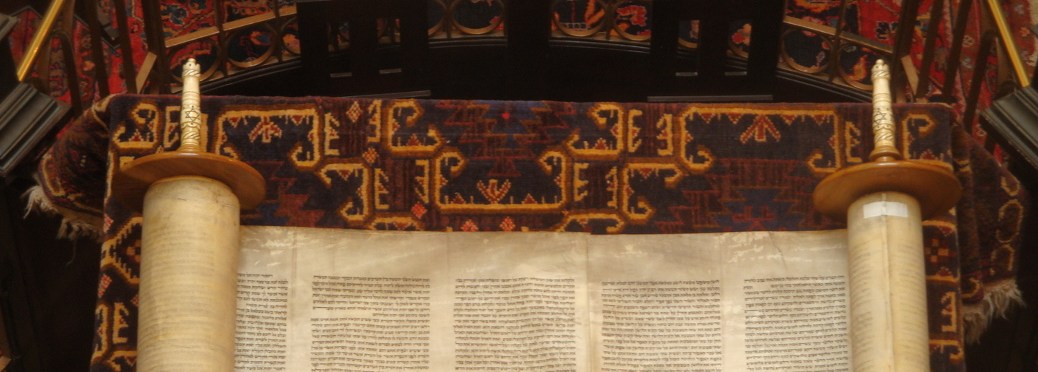
Question: What if I believe only in the written text of the Torah?

Answer: I’m glad to hear that you have such strong faith in the “Hebrew Bible.” My question is, how do you know that this is true? Certainly, you must be relying on tradition. Otherwise, how do you know that the words you have before you are the original words written by Moses and the prophets? How do you know that they ever received this to begin with? What other way is there than to rely on the integrity of the Jewish people over the ages?

-Rabbi Tzvi Freeman
-from “What If I Believe in Only the Written Text of the Torah?”
Chabad.org

Rabbi Freeman has written a multi-part series on the nature of Midrash which I plan to explore. The above-quoted text isn’t part of that series but I think it’s a good place to start my own investigation for a couple of reasons. The first, as I previously mentioned, is I have my doubts of the effectiveness of the philosophy of sola scriptura as practiced by certain expressions of “the Church”. I really don’t believe that most Christians really, really access “scripture alone.” To be fair, I believe they think they do and that they are sincere in their convictions, I just think they are either blind to the presence of interpretive tradition, or if aware of it, they do not believe it has as much influence on their “vision” as it actually does.

One of the things I admire about Judaism is that it admits to relying on tradition to interpret the Bible and in fact states that it is impossible to understand what the Bible is saying without a system of interpretation and tradition to use as a lens.

That’s going to freak out a lot of Biblical literalists in the Church and this isn’t the first time I’ve made such a statement (see Removing the Garments of Torah and The Purpose of Torah in New Testament Judaism series for examples).

I do want to state upfront that just because a tradition exists, either in the Christian or Jewish frameworks, doesn’t mean we should automatically accept it as fact and truth. On the other hand, without tradition (and I agree with the Jewish perspective on this), at least to some degree, we’d never be able to understand let alone implement various portions of the Bible.

I should also mention at this point that many (most?) Hebrew Roots groups echo the question stated above, believing in the accuracy and authority of the written Torah but disdaining any of the Rabbinic commentaries which are used to interpret and operationalize Torah (and how do they tie their tzitzit and lay their tefillin without relying on Rabbinic tradition?). Such groups seem to take what they want from normative Judaism while escorting the Rabbinic sages and their rulings and interpretations to the nearest dust bin.

And that, really, is Judaism: a faith in the integrity of the Jewish experience as transmitted to us by previous generations. It turns out that everything we believe, including faith in the word of the written Torah, is based on this faith in the Jewish people. Perhaps that is the reason we call it Judaism (or Yahadut, or Yiddishkeit) and not “Torahism” (or Karaism)—because the most basic faith we have is in the Jewish people, and from there extends our faith in the written word and in the prophets.

As I read Rabbi Freeman, I get the impression that one of the functions of Judaism is to provide the traditions by which Jews interpret the Torah. This gets complicated in that there is no one “Judaism” and thus no one authoritative interpretation of Torah, although within the larger “Judaism” construct, meanings heavily overlap.

But how the Chabad traditionally interprets a portion of the Torah and how to perform the associated mitzvot may differ greatly from how a Reform or Conservative synagogue may read and understand the same material. Thus, from an outsider’s point of view, it makes Judaism seem very inconsistent, highly variable, and the meaning taken from the Bible to be incredibly fractured.

But what about the untold hundreds or even thousands of denominations, subgroups, and sects of Christianity? The answer my Pastor would give me is that there is only one right answer, which is why the Fundamentalist movement was established in the early days of the 20th century…to create (or return to) that one “right” answer. My Pastor has tried to explain the core meaning of Fundamentalism to me, apart from all of the media hype and unfair interpretation of the “label,” and I’ve recorded that understanding on my blog so I wouldn’t lose track.

Really, Fundamentalism at its center is just “getting back to the basics” of Christianity, but those “basics” were established barely a hundred years ago. Would the apostles have understood their faith in the same way as John MacArthur, R.C. Sproul, or Steven J. Cole?

R.C. Sproul
R.C. Sproul

So the best we can say at this point is that Judaism and Christianity both heavily utilize tradition to tell each religious body and their various subgroups  (actually, each of the subgroups have their own traditions) what the Bible is supposed to be saying and how we are to live out what the Bible tells us in our individual and corporate worship lives.

I’ve also recently mentioned the story of Hillel, Shammai, and the Three Converts, which Rabbi Freeman too mentions in his commentary.

Another gentile who accepted only the Written Torah, came to convert. Shammai refused, so he went to Hillel. The first day, Hillel taught him the correct order of the Hebrew Alphabet. The next day he reversed the letters. The convert was confused:”But yesterday you said the opposite!?” Said Hillel: “You now see that the Written Word alone is insufficient. We need the Oral Tradition to explain G-d’s Word.”

Rabbi Freeman’s point, citing Hillel, is “that without an oral tradition, there is no written Torah. Written symbols on a scroll are meaningless without context. We have no clue what the words mean, or even whether they are at all true.”

But is that really true? Does not understanding the original language in and of itself impart some meaning? Of course, you also have to understand the historic, cultural, national, linguistic, traditional, theological (and many other) contexts involved that subtly or significantly modify the meaning of the plain text. Could the overall understanding of those contexts be codified to become an interpretative tradition?

Because the prevailing interpretations have probed Paul’s text without sufficient appreciation of the powerful role of ironic inversion at work, at the formal as well as functional level, the interpretation of the apostle’s scathing rhetoric has exaggerated and, regardless of other plans, continues to accentuate the differences that are imagined to separate Christian and Jewish identity, behavior, and even intentions toward God and neighbor. The legacy of this perception of the Jewish other has proven often tragic for the Jewish people, at least in a world that has been often dominated by those who look to Paul to shape reality, and for others, as a foil to justify their twisted construal of what is right.

-Mark D. Nanos,
from the Prologue of his book (pg 2)
The Irony of Galatians: Paul’s Letter in First-Century Context

It is Nanos’ belief that Christianity’s understanding of the basic nature and personality of the apostle Paul has changed not very much since the days of the so-called “Church fathers” and hardly at all in the last five-hundred years since the Reformation. While the Church doesn’t cite time-honored Christian tradition as the necessary element to understand the letters of Paul or as required to comprehend his actions as recorded in Luke’s Book of Acts, nevertheless, my recent reviews of some of the sermons of John MacArthur have convinced me completely that Christianity’s understanding of the meaning of scripture is totally reliant on revered Christian traditions.

When, on occasion, I’ve tried to challenge those traditions (and not the scriptures themselves), the reaction I observed could at least be called resistance.

Judaism has its traditions as well, but Jewish authorities are quite upfront about saying that they have a tradition and that, as far as Rabbi Freeman goes, “Judaism-colored glasses” (my phrase, not his) are required when reading the Word of God.

The Torah says to rest on the seventh day. I once met a man who told me that he tried to keep the Sabbath as written in the Torah, but it was too hard—by four in the afternoon he just had to get up out of bed! Who says his interpretation is worth anything less than anyone else’s?

The Torah says that “these words should be totafot between your eyes.” What on earth are totafot? Where is “between your eyes”? When do you wear them, and how?

The Torah says, “You shall slaughter an animal as I have commanded you.” What was it that G‑d commanded Moses? How can we know? There seems to be no hint whatsoever in the entire Five Books of Moses. Obviously, everybody knew what Moses had been told; they did it all the time, and nobody needed it in writing.

Praying with tefillinGood points, Rabbi Freeman. Of course modern Christians would say all that stuff is dead and gone, so who cares if we don’t know how to properly rest on Shabbat, figure out what “totafot” means or how to put them “between your eyes,” and what the correct method of “slaughtering an animal” was as required by God?

But even if I took the Christian point of view, I’d have to admit those things meant something once. Just how were they enacted in ancient days without sufficient written instructions? When asked, how did Moses answer those questions? In the days of the Temple, how did Solomon address those issues? And did Jesus even obey those requirements since the Temple still stood during his “earthly ministry?”

It seems like neither Christianity or Judaism can exist and practice their faiths without a rich tradition of…tradition.

Protestants, as I experience them anyway, seem to have a deep-rooted resentment against a central authority in religion. I’ve heard Evangelicals say some pretty rough things about Catholics and their Pope, and I’ve listened to more than one Christian say (more or less) that it was part of God’s plan for the Apostles to die off so “Christian authority” could be de-centralized. Never mind that Christians tend to revere the “Church fathers” and particularly the authors of the Reformation. Some churches, including the one I attend, even celebrate Reformation Day.

The oral tradition also includes later decisions and exegeses made by those who led the Jewish people and were empowered to make decisions on their behalf. These are the seventy elders in every generation, as established originally by Moses himself (read all about it in Numbers 11). It is to these sages that Moses refers when he charges the Jewish people that if anything is to difficult for them to solve, they must take it to these wise leaders, and “do not turn from whatever they tell you, not to the right and not to the left” (read that one in Deuteronomy 17:8–12). Otherwise, what on earth are we supposed to do when Faraday discovers how to harness electrical power? Is it fire? If not, what is it? So, a rabbinical assembly came to the consensus that we will treat it as fire, and not turn it on or off on the Shabbat. Now all the Jewish people can keep one rule and one Torah.

These same sages were empowered to protect the Jewish people from breaking the Torah by “building fences” about the prohibitions. If you can walk right up to the edge of a serious transgression, it’s unlikely that no one is going to fall off. Which should provide an answer to your question about the boundaries for walking on Shabbat.

All this is seen by Christians as “adding to the Bible.” I’ve heard Matthew 23:4 and the surrounding text applied to Rabbinic Judaism as a whole, casting all Jewish practices into the same bucket and observant Jewish people under a bus.

On the other hand, try telling people in a church to do away with their Christmas and Easter (or Resurrection Day) observances because they’re “man-made traditions” (not to mention the previously cited “Reformation Day”) and you’ll likely start a riot (OK, probably an angry and offended discussion, not a riot).

Christians don’t like the Rabbinic sages for the same reason they don’t like the Pope. They don’t like or trust a central authority that can establish binding religious rulings over their lives. It interferes with the “freedom of the gospel” they enjoy, but do Christians really have that much freedom?

It depends on the church and which Pastors and teachers are favored, with their books enshrined in the church’s library or bookstore. Which books are studied by the Wednesday night woman’s group or deemed worthy of possessing lessons to be followed by the men’s ministry? Are preachers like John MacArthur, R.C. Sproul, and Steven J. Cole considered the “sages” of modern Evangelical Christianity? Do the churches that follow their particular teachings not rely on these men and their theologies and doctrines to interpret the Bible for them?

But allow me to summarize the most crucial point: You can choose to believe in a book. Or you can choose to believe in a divine revelation. The divine revelation was encoded into a book by Moses, but its light never ceased to shine. In every generation, more and more of it enters into the world, through the medium of those sages who study the book and its surrounding traditions and all the accumulated wisdom that has unfolded over the millennia. One day, we will see how all that we unfold was contained in those original words Moses wrote. But to access it all now, make yourself part of the Jewish people, and have a little faith in us. After all, if it weren’t for us, where would that little book be?

To be fair, the whole concept of a set of traditions being required for understanding what God’s Divine Revelation means, especially as adapted across multiple generations, is alien to Christian thought, even if it’s not foreign to Christian interpretative practice. We just don’t talk about it, like some dirty family secret, some hidden skeletons in the Church’s closet.

Christian BookshelfAlso to be fair, Rabbi Freeman wouldn’t have written such an article if some Jewish people, perhaps a lot of Jewish people, weren’t as critical of midrash and oral tradition as we Christians are.

R. Freeman offered some additional resources for the Jewish (and Christian?) curious including The Essential Talmud by Rabbi Adin Steinsaltz, R. Freeman’s own article Is It Really the Torah, Or Is It Just the Rabbis, and a series of audio teachings by Rabbi Lazer Gurkow called The Oral Tradition. You also might consider Is Torah Just For Jews?

I encourage you to read the responding comments to Rabbi Freeman’s article (scroll down) so you can see that among individual Jewish people, what the Rabbi professes is not a “slam dunk” in their minds and hearts. Hopefully, that will help dispel the idea held among some Christians that Jewish people are “all the same,” meant in the worst possible manner.

When the Church and its “sages” disregard and denigrate Jewish traditions while upholding Christianity’s own long history of interpretive tradition (all the while denying its existence), then it participates in another historical tradition of the Church that, while also “hidden,” is nevertheless still a potent force in the lives of many Gentile believers: anti-Semitism and supersessionism.

For more on the same topic, see Tradition!, According to the Traditions: A Primer for Christians, and Introduction to Messianic Judaism: Tradition!, my review of Rabbi Dr. Carl Kinbar’s article “Messianic Jews and Jewish Traditions”.

Review: John MacArthur on Judaism, Part 2

Now, I’ve entitled this portion, beginning in chapter 18 verse 18 through chapter 19 verse 7, we’ve entitle (sic) it From Judaism to Jesus because it does portray for us a transition. We have made the mention in past studies that the Book of Acts records for us transitions and we see the fading out of Judaism and the coming in of Christianity. In understanding this, we have to understand that it sometimes was a slow transition. Salvation is not a transition; it’s a momentary miracle. But losing all of the trappings of Judaism came a little slower. People would get saved and then find it hard to let go over everything, and so there was a certain amount of difficulty in making the transition from Judaism to Jesus. And as I said last week, we find that true very often today, even with Jews who come to Jesus Christ and find it difficult to break with patterns that were so much a part of Judaism.

Now, I think part of this is due to the fact, maybe most of it is due to the fact that Judaism in itself is such a distinct kind of life. Now, we could talk for a long time about the distinctions of Judaism and I don’t mean to do that, but in some generality to point out to you the distinctness of Judaism, in order that you might understand how difficult the transition comes about.

-John MacArthur
“From Judaism to Jesus, Part 2,” January 20, 1974
Commentary on Acts 18:24-28
GTY.org

I reviewed part one of this series last week and I can’t say I’ve received Pastor MacArthur’s rendering of ancient or modern Judaism with any sort of enthusiasm. MacArthur characterizes the Book of Acts as a chronicle of transition, literally “from Judaism to Jesus.” I couldn’t disagree more, but to give him a fair shake (to the best of my admittedly waning ability), I’ll continue to read the sermons of this series and offer my comments.

MacArthur says that the transition away from Judaism was really difficult for the Jewish people because of this:

For example, a Jewish town or a Jewish city or township or village, no matter whether it was centered right in the midst of a Pagan country or whether it was butted up against a Pagan society in another city, still maintained an amazing uniqueness, and no matter how much interrelation and intercourse economically and culturally and all it happened to have with Pagans, it seemed never to be tainted by Paganism. There was just such a unique identity and this was particularly around the time of Christ and the time of the New Testament.

You couldn’t even enter a Jewish town or enter a Jewish village without feeling like you had almost stepped into another world. You get that feeling today when you go to Jerusalem, not so much when you see the hustle and bustle of a modern city, but when you happen to be isolated with a group, say, of Orthodox Jews who are doing what only Orthodox Jews do, you feel that somehow something’s wrong. You’re out of whack or they’re out of whack with the world.

Interestingly enough, even among modern observant Jews, the sense of distinctiveness between the Jewish community and the surrounding peoples is considered not only normal but necessary in order to fulfill the requirements of God for the Jewish people.

MacArthur distinguishes Christianity and Judaism in a number of ways during his sermon, but I found this paragraph rather telling.

I think that, for most of us, we tend to look at religion in this frame. But Judaism was not such an isolated creed of theology. You see, it was a whole way of life. It pervaded every single human relationship. It pervaded every single attitude toward eating and drinking and clothing and all kinds of things in terms of economy, not just a set of observances, not just a creed, but a way of life and you could never just suck Jewish theology out and remove Judaism. No, because Judaism was a way of life.

Although, at least in theory, being a Christian should also be a way of life, in fact, MacArthur seems to say that Judaism is more of a way of life than Christianity. He says this is why the Jewish people had so difficult a time in giving up Judaism, because it completely defined every aspect of Jewish living. Really, MacArthur. You say all that and you still don’t see a problem with requiring that Jewish people surrender everything that defines them, makes them unique, and enables them to continue forward through history without being destroyed on the altar of assimilation?

To his credit, MacArthur does say that there was faith, grace, and salvation in the Old Testament, but he blows past that part very quickly and “starts in” on the Rabbis.

…throughout the history of Israel, there have always been rabbis, which means teacher or master. And all of these rabbis were teaching and interpreting and adding to Scripture. And, of course, the esteem of a rabbi was so great that what the rabbi said was often written down. And all of these things were gathered and gathered and accumulated until today, you have this monstrous set of volumes known as the Talmud. And the Talmud is all of these rabbinical statements added onto the Biblical, and you will find that if you visit any rabbi who was at all involved in what he ought to be involved in as a rabbi, you would find that he has not only prescribed his life around the Old Testament, but perhaps even more so around the Talmud where he is following up all of the interpretations and suggestions of all the rabbis, some of which, most of which are unnecessary and unbiblical.

ancient_rabbisThis is MacArthur’s conceptualization of Rabbinic Judaism, the body of religious and cultural Judaism that enabled the continuation of the Jewish people after the destruction of the Temple and after most of collective human Israel had been exiled from their Land. In the world according to MacArthur, the Rabbis were just a bunch of guys who added unnecessary stuff to the Bible.

He briefly makes some sort of commentary on the “Shimah.” I’ll take it for granted that whoever transcribed MacArthur’s sermon didn’t know the accepted English spelling of “Shema” and that MacArthur didn’t find it necessary to proofread the text. On the other hand, his sermons could have been transcribed years or decades after the fact.

But then there’s this story:

There was a rabbi by the name of Rabbi Jacanon Van Saccai (sic). It was written of him that he said this at his death. And it was interesting because he was called The Light of Israel. He lived at the time of the destruction of the temple. He was a very famous man, highly esteemed. And he was the president of the San Hedron (sic) or the ruling body of Israel. So he was not a small-time rabbi, but a very important man. On his deathbed, he began to weep just bitterly and profusely, and some of his students who had studied under him and sat at his feet couldn’t believe this.

Just to clarify, MacArthur is referring to Rabbi Yohanan ben Zakkai who I’ll discuss a bit later, and the “San Hedron” is the Sanhedrin, which is not a ruling body but the highest religious court assembly in ancient Israel.

And they asked him how such a man who had lived as he could have such fear of death, and this was his reply and I quote, “If I were now to be brought before an Earthly kind who lives today and dies tomorrow, whose wrath and whose bonds are not everlasting and whose sentence of death even is not that to everlasting death, who can be assuaged by arguments or perhaps bought off by money, I should still tremble and weep. How much more reason have I for it when about to be led before the King of Kings, the Holy One, Blessed by (sic) He who liveth and abideth forever, whose chains are chains forevermore, whose sentence of death kills forever, whom I cannot assuage with words nor bride (sic) with money and not only so, but there are before me two ways: one’s a paradise and the other one to hell. And I know not which of the two ways I shall have to go. How then shall I not shed tears?” End quote. The man believed that there was only one (way) to enter into heaven and that was to keep the law and he knew in his conscious (conscience?) that he hadn’t done it, and he had a fear of spending forever in hell. You see, he had no concept of faith, no concept of grace. He was in a system that bound him and if he didn’t do what the system wanted him to do, he believed he’d go to hell forever.

This is a fairly well-known story, but my memory of it didn’t match MacArthur’s description which seems to contain blatant assumptions about why the revered sage was so fearful. I did a bit of research and found more about the rather tragic deathbed scene as recorded by Rabbi Dovid Rosenfeld at Torah.org

In spite of it all, R. Yochanan was plagued with doubts for the rest of his life. The Talmud records that on his deathbed, he tearfully told his students that he has two paths before him — to Heaven and to Hell — and he was literally unsure along which one he would be led (Brachos 28b). He took it upon himself to change the course of Jewish history, and to his dying moments was never truly sure he had chosen right. (I heard this explanation of the Talmud from R. Berel Wein.)

jewish-traditionBut according to Rabbi Rosenfeld, R. Yochanan was not terrified of “going to Hell” because he relied on an unreliable Torah and lacked the grace of Jesus Christ, he was deeply troubled that he had not made the correct decision in preserving the Jewish people and the Torah.

According to the Talmud (Gittin 56), when the Romans had surrounded Jerusalem in the final siege that heralded the destruction of the Temple, many Jewish people wanted to fight and die rather than give in to the Romans, but R. Yochanan was concerned that this would only result in total extermination of the Jews and elimination of the Torah from all the earth.

As the story goes, R. Yochanan had himself smuggled out of Jerusalem in a coffin and eventually made an arrangement with the Roman general Vespasian to establish a center of learning in Yavneh, along with its sages, so that the study and observance of Torah could continue.

This agreement wasn’t incredibly popular with a lot of Jewish people as you might imagine, and even to the end of his days, R. Yochanan was tortured with whether or not he made the right decision to hand Jerusalem and the Temple over to the enemy, even to preserve Jewish lives and ensure the continuation of Torah study.

Sorry to occupy so much space on what seems to be a minor portion of MacArthur’s sermon, but I felt it necessary to set the record straight and present the Jewish point of view (to the best of my ability) on the life and death of Yochanan ben Zakkai.

MacArthur tends to play fast and loose with Jewish history, Jewish concepts, and Jewish people (see his comments on “sloppy” below), and since he’s made the decision to eliminate Judaism at Acts 2 and to declare that it was going through a slow and agonizing death, I have some concerns that MacArthur, for all of his apparent education, may not truly understand some of the things and people he’s talking about.

Now that we have MacArthur’s opinion on R. Yochanan, this is how he sees the apostle Paul:

Well, now watch. Into this system comes a man by the name of Paul and he’s running around say(ing), “Grace. Grace. Forget all the laws.” And the Jews are having culture shock. There’s no way they can handle that. That’s why when he went into the synagogue the reaction was so violent. See?

Never mind a more scholarly approach that does not present Paul as rather gleefully “Law-free,” such as what I’ve been studying in the Mark Nanos books The Mystery of Romans and The Irony of Galatians. According to MacArthur, Paul just made Judaism go away and proceeded to enter the various synagogues in the diaspora claiming, “Grace. Grace. Forget all the laws.” This isn’t a description of a real to life, complicated, intelligent human being with a very difficult task as the Jewish emissary of Messiah to the Gentiles. MacArthur seems to be describing Paul as a cartoon. Who’s adding to scripture now?

And what about Peter and Acts 10?

“And which were all matter of four-footed beasts of the earth, wild beasts, creeping things,” that’s snakes and reptiles and birds, fowls of the air. “And there came a voice to him, ‘Rise, Peter. Kill and eat.'” Now, that sounds like a simple thing. He sees in his vision all these animals and the voice says, “Go ahead, Peter, just kill them all and eat.”

Now what’s he saying? Well, in effect, he’s saying there’s no distinction because in the Old Testament there were certain things a Jew couldn’t eat, right? And Peter had lived all his life that way. And now in the New Covenant, Jew and Gentile were going to be one in the church, and God didn’t want any difference anymore. There is no difference.

You think Peter could’ve gone, “Oh, fine Lord. Sure. Just pass the plate. I’ll eat whatever’s there.” No. Couldn’t handle it.

Verse 14. “And Peter said, ‘Not so Lord.'” Peter actually said, “No, Lord.” That’s pretty flagrant disobedience. This can’t be. Are you kidding me? “For I’ve never eaten anything that is common or unclean in my life, I’ve never done that. Salvation or no salvation, I can’t handle it.” See.

jewish-t-shirtMaybe what’s rubbing me the wrong way is MacArthur’s casual and even disrespectful manner in talking about Yochanan ben Zakkai, Paul, and Peter. He seems to be making fun of them because they couldn’t “let go” of this “Jewish stuff.” Maybe it’s because my wife and kids are Jewish. I just get the feeling MacArthur wants to laugh at them or to discount them. I hope I’m not being too personal in my review.

It also seems like MacArthur is reading a lot into the text (adding to scripture?), as if God really expected Peter to start shoveling a sheet load of “trief” down without so much as a by your leave. In fact, the vision of Peter in Acts 10 had nothing to do with unclean food:

And he said to them, “You yourselves know how unlawful it is for a man who is a Jew to associate with a foreigner or to visit him; and yet God has shown me that I should not call any man unholy or unclean. (emph. mine)

Acts 10:28

There’s also a difference between unkosher animals and unclean foods, but for the sake of time, I’ll refer you to the First Fruits of Zion (FFOZ) television episode All Foods Clean or my review of the program for the details.

Of the lives of the apostles, MacArthur said:

Now, we want to live by biblical doctrine, but I’m not interested in going back there. I’m not interested in having trouble over what I eat like Peter did. I’m not interested in going over to the temple in Jerusalem and making vows like Paul did and having to take a Nazarite vow and cut all my hair and haul my hair half way across the world so I can burn it properly in Jerusalem. I’m not interested in all the trappings of Judaism.

I suppose I don’t blame him for saying that since he believes Judaism was horribly burdensome and became extinct after Acts 2, but he really shouldn’t worry since, not being Jewish, he wouldn’t have been required to observe Torah in the manner of believing (or unbelieving) Jews (see the Acts 15 legal decision). Besides, a Nazarite vow was totally voluntary and most Jews likely never took that particular vow.

But what does any of this have to do with Acts 18:24-28? Not much. Apparently it takes MacArthur quite a while to set the stage for what he’s actually going to talk about.

And you see, here’s Paul. You say, “He’s a Christian. What’s he doing?” Sure, he’s a Christian, but as a Christian, he’s also a Jew. He’s been a Christian a little while. He’s been a Jew all his life. And he’s saying to himself, “I’m grateful to God for what He did, and the way that I know best how to show Him how grateful I am is to do what all good Jews do.” And the high point of their thanks is to take a Nazarite vow, and so he did what a Jew would do. Because that was his life, that was the way he thought.

This is part of what was taught during the sermon and at Sunday school last week at the church I attend. I didn’t go last week, but I did do the homework for class, which is based in part on MacArthur’s opinion of Paul and Nazarite vows. I didn’t find anything in Numbers 6 that mapped to why MacArthur believes one takes such a vow out of gratitude for what God has done. My understanding is that one took a Nazarite vow in order to temporarily experience a heightened state of ritual purity.

Now a Jew named Apollos, an Alexandrian by birth, an eloquent man, came to Ephesus; and he was mighty in the Scriptures. This man had been instructed in the way of the Lord; and being fervent in spirit, he was speaking and teaching accurately the things concerning Jesus, being acquainted only with the baptism of John; and he began to speak out boldly in the synagogue. But when Priscilla and Aquila heard him, they took him aside and explained to him the way of God more accurately. And when he wanted to go across to Achaia, the brethren encouraged him and wrote to the disciples to welcome him; and when he had arrived, he greatly helped those who had believed through grace, for he powerfully refuted the Jews in public, demonstrating by the Scriptures that Jesus was the Christ.

Acts 18:24-28 (NASB)

I didn’t really think much about all this. It made sense in those days that because information traveled rather slowly throughout the then-civilized world, different bodies of believers might have inconsistent knowledge of the teachings of the Master and the experience of disciples in other places.

But MacArthur interprets this portion of scripture in a unique way:

Now, Apollos is a Jew and he is from the city of Alexandria.

He was a powerful man in terms of teaching. And let me just say at this point that his power at this point was the natural. He was not a Christian at this point, so consequently, did not have the indwelling Holy Spirit.

I believe that Apollos was not a Christian but that he was a student of John the Baptist.

Now, see, here is a man who accepted all the way of the Lord in the Old Testament, accepted the ministry of John the Baptist, saw that John pointed to Jesus and said, Behold the lamb of God that taketh away the sin of the world,” and he believed that Jesus was the Messiah. You say then, “Why wasn’t he a Christian?” Because he didn’t know what happened in the death, resurrection and Pentecost that followed the life of Jesus. He was pre-cross.

On the wrong side of the cross? Oh gee. Is that concept even in scripture as applied to the apostolic age? And Apollos didn’t have the Spirit?  What about verse 25 where it says, “and being fervent in spirit?” In reading MacArthur’s sermons, I get the impression the man is always shooting from the hip. Anyway…

No, he wasn’t a Christian. But technically, neither were any of the apostles, including Paul, or any of the Jewish (and arguably Gentile) disciples. You can’t anachronistically force the concept of Christianity as we understand it today back into the apostolic era. Apollos was a Jew and he practiced Judaism as a disciple of Moshiach (Messiah).

And just to wrap things up:

Now, there’s another angle in this word. It’s used one other time in Ephesians 5:15, which would be helpful. Paul says “See that you walk acrabos, with exactness.” The Christian should live his life with the same kind of preciseness that we interpret the Scripture, with the same kind of preciseness that God wrote it. God didn’t give us a sloppy revelation, did he? And God doesn’t want us to slop up his revelation and God doesn’t want us to slop up our lives either. Same word in all three areas.

Well, there you meet two in transition, Paul and Apollos. And how exciting it is to see what God is doing in their lives and how grateful we are that the Spirit of God brought about the transition that they might have influence on us.

MacArthur in churchSee what I mean about “sloppy?”

What really scares me is the thought that, back in January 1974 (and no doubt today), the people listening to MacArthur’s sermon probably lapped it up. How many of them would have decided to look up his references and examine his sources, especially about Jewish Biblical and Rabbinic history? After all, the entire thrust of this sermon series is to declare the elimination of Judaism in any form in the pages of Luke’s Acts of the Apostles. But I don’t find MacArthur’s presentation on Judaism to be either serious or accurate.

It’s like he’s saying, “Gee, look how dumb these Jews were. They had Jesus and grace and still couldn’t give up that nasty, ol’ law. Thank the Lord we’re nothing like them. I’m so glad God doesn’t care about what food I eat or what day of the week I worship, or any of that terrible stuff.”

OK, I made that last bit up, but it certainly seems to fit the tone of what MacArthur was preaching.

I can’t do this. I can’t think like he does. I can’t believe like he does. How am I supposed to participate in the rebuilding of the Tent of David in the Christian church when men like MacArthur and sermons such as this one are expending no small effort in cheerfully burning that tent down to the ground?

See Part 3 of my review on this series to see how it turns out.

If You Could Personally Witness Just One Event in the Bible…

Have you ever read a passage of the Bible and thought, Oh, I wish I were there! I have. I have longed to be the third dude on the road to Emmaus, listening to Yeshua expound on the Messiah’s role.

And beginning with Moses and all the Prophets, he explained to them what was said in all the Scriptures concerning himself. (Lk. 23:7)

Being present on Shavuot (Pentecost) when the Holy Spirit birthed a revival in Jerusalem would have been amazing. Many would, no doubt, choose to witness the parting of the Red Sea or the crucifixion of Yeshua. As for me, I would choose something in the future. I have always been intrigued by the prophets in the eleventh chapter of Revelation. These two witness appear sometime during the Great Tribulation and proceed to prophesy for three and a half years.

-Ron Cantor
“The Cantor Comment: Fire-Breathing Prophets!”
maozblog.com

Actually, I share in Cantor’s first wish. I’ve always been slightly annoyed that Luke didn’t include what Jesus actually said when he “explained to them what was said in all the Scriptures concerning himself.” I want to know. Certain parts of my life would go a whole lot easier if we just had a detailed “map” of how Jesus saw the various portions of the Torah and the Prophets which referred to him.

Alas, such is not to be.

I was considering leaving a comment on the blog with Cantor’s article, but his story really didn’t seem to be asking the question I wanted to answer. I wanted to answer the question, If you could personally witness just one event that occurred in the Bible, which one would it be?

Here’s mine:

From it Moses and Aaron and his sons washed their hands and their feet. When they entered the tent of meeting, and when they approached the altar, they washed, just as the Lord had commanded Moses. He erected the court all around the tabernacle and the altar, and hung up the veil for the gateway of the court. Thus Moses finished the work. Then the cloud covered the tent of meeting, and the glory of the Lord filled the tabernacle. Moses was not able to enter the tent of meeting because the cloud had settled on it, and the glory of the Lord filled the tabernacle. Throughout all their journeys whenever the cloud was taken up from over the tabernacle, the sons of Israel would set out; but if the cloud was not taken up, then they did not set out until the day when it was taken up. For throughout all their journeys, the cloud of the Lord was on the tabernacle by day, and there was fire in it by night, in the sight of all the house of Israel.

Exodus 40:31-38 (NASB)

I haven’t literally dreamed of being there, but if it were possible, it would be my fervent wish. Imagine the scene. Moses has just finished erecting the Tabernacle. Millions of people are surrounding the structure, waiting in hushed anticipation, expecting a miracle, expecting God.

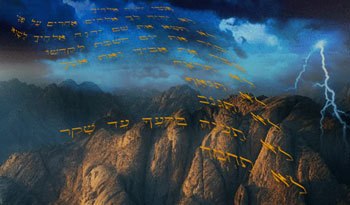
Torah at SinaiThen, something appears from the sky and begins its descent toward the Tabernacle. It probably looks like a big cloud, but it would be familiar to any one who had been in the company of the Israelites and who had been present at Sinai for the giving of the Torah.

The Torah text doesn’t describe it this way, but I imagine this event happens at night. The cloud is slightly illuminated from within, but when it enters the tent, the darkened structure bursts into magnificent, blazing light. Millions of people cry out as one, praising God and glorifying His Name.

This probably isn’t the typical scene most Christians would want to attend. Most believers would likely choose an event from the New Testament, being present at the Olivet Discourse, witnessing the resurrection or the ascension, perhaps accompanying Paul on one of his journeys, but for me, nothing describes the desire of God to dwell among His people quite like the end of the book of Exodus.

Now I turn it over to you. If you could be present during any event that happened in the Bible, what would it be and why?

What is Faith?

What is real? How do you define ‘real’? If you’re talking about what you can feel, what you can smell, what you can taste and see, then ‘real’ is simply electrical signals interpreted by your brain.

-Morpheus played by Laurence Fishburne
from The Matrix (1999)

I thought about this quote as I was driving home this evening (as I write this) and wondering what happened between Monday and now. On Monday evening and into Tuesday morning, and even as far as this morning, something carried over from a new or rejuvenated sense of faith and spirituality. Then, as I was driving home, it was like a balloon popped and I could feel myself sinking back into my previous template, which is at a depth where contact with God is like a faint echo struggling to make its way through the cold deeps of a twilight ocean.

What’s stronger, something new or something old? Answer: something old. Something new is exciting in the moment, but what’s old, like old habits, have a much greater and firmer foothold on your life or, in this case mine.

To paraphrase Morpheus, “What is faith? How do you define ‘faith’? If you’re talking about what you can feel emotionally, what you experience in response to stimulating books on faith, on hearing rousing music with impassioned lyrics, then ‘faith’ is simply electrical signals interpreted by your brain.”

That’s a horrible realization and it was even more horrible that such a thought reminded me John MacArthur speaks against a faith based on sensation and experience. Of course, he goes in the opposite direction and believes in a faith based almost exclusively on the intellect and his version of Bible study, making him not unlike some Rabbis in some traditional corners of Judaism.

You’re a great one for logic. I’m a great one for rushing in where angels fear to tread. We are both extremists. Reality has brought us somewhere in-between.

-Captain James Kirk (William Shatner)
from Star Trek VI: The Undiscovered Country (1991)

Apparently the 1990s were very good for movie quotes.

coastKirk and Spock seem to be polar opposites: an emotionalist always looking for his next adventure, and a logical rationalist, always seeking the calm of study, knowledge, and wisdom. But as Kirk pointed out, both of them are extremists. Reality (what is “real?”) is somewhere in the middle.

And so we arrive at attempting to define the essential elements of a life of faith. Certainly not just a stimulating book about a faithful man of God who could perform healing miracles, or music and lyrics that touch the emotions and hopefully the soul. Certainly not just the enthralling study of the Bible, of interesting commentaries, of Talmud and midrash.

Reality is somewhere in the middle because human beings are emotional and intellectual beings. Too much of either side of the equation leaves our faith woefully off-balance, and us teetering on the edge of plummeting into one abyss or another.

A little over two weeks ago, I wrote a blog post quoting First Fruits of Zion (FFOZ) Founder and President Boaz Michael saying that faith is a platform supported by three legs: the Spirit of the Lord, the Torah of Moses, and the Gospel of the Messianic Kingdom.

In 1 Corinthians 13:12-13, the apostle Paul speaks of another three “legs:” faith, hope, and love. It seems we are not complete as devotees of the God of Israel and disciples of Messiah unless we not only value multiple elements in a living faith, but we allow those elements to exist in balance relative to one another. Depending too much on any one “leg” for support, will likely find us about to fall in the opposite direction.

I’ve heard it said that it takes six-weeks to either make a new habit or break an old one. I’m sure that’s overly simplistic, but if you are trying to break an old, unwanted but familiar and relatively comfortable habit, six weeks can seem like a long time. After the initial excitement at any resolution, after a few days pass, the old and familiar assert their influence.

I suppose I could immerse myself in inspirational books and music, but that’s just swinging in another extreme direction and it won’t last. What I think will last is establishing a balance, realizing that there will be moments of disappointment and let down, moments when things will seem dry and uninteresting, and that those moments do not have to stand in the way of a new or renewed sense of the presence of God.

Some habits are good. Continuing to read and to study the Bible is good. Listening to faith-based music is good. Set times of prayer and “davening” from the Siddur is good. Reaching out to God, not only when He seems close, but when He seems far away is good.

Most people who are religious I think organize their activities into the holy and the secular. It’s holy to go to church and secular to go to work. It’s holy to sing a hymn and secular to sing a rock song from the ’60s. It’s holy to pray, and it’s secular to wish.

Leonard CohenThat’s the problem. From God’s point of view, we are all His creations and thus we all share some small part of the Divine. As people of faith, the awareness of that state should be present in us…in me. There really are no times or circumstances or tasks where God is not present. It’s just a matter of whether or not I chose to be aware of the presence during those times I deem “secular”

A momentary pause in the music doesn’t mean the song has ended. The end of a paragraph or chapter doesn’t mean the book is done. And the realization that I won’t always “feel” that God is near doesn’t mean God isn’t near. Faith is continuing to act faithfully even if the physical and spiritual world seems silent and empty.

Faith isn’t a feeling and it isn’t a thought. Faith is a habit or at least it’s supported by habits…praying, singing, reading the Bible, pondering God’s wondrous acts and wisdom, opening your cognition and emotions to God, even if He should choose not to fill them.

And even though it all went wrong
I’ll stand before the Lord of Song
With nothing on my tongue but Hallelujah!

-Leonard Cohen, “Hallelujah”

Faith is that moment when all is silent and void and yet there is still nothing on my tongue but Hallelujah.

For Now We See Through A Bible Darkly

John MacArthurWhen Jesus came, everything changed, everything changed.… He didn’t just want to clean up the people’s attitudes as they gave their sacrifices, He obliterated the sacrificial system because He brought an end to Judaism with all its ceremonies, all its rituals, all its sacrifices, all of its external trappings, the Temple, the Holy of Holies, all of it.

-Pastor John MacArthur
“Understanding the Sabbath,” September 20, 2009, posted on the Grace to You blog.
As quoted in Lois Tverberg’s blog post Test Your “Jesus Theories” in the Book of Acts

One of the folks who commented on a recent blog post of mine mentioned that Messianic Jewish/Hebrew Roots blogger Judah Himango had written a particularly illuminating article recently, based on Tverberg’s November 2013 commentary. I finished reading Judah’s write-up, suitably impressed, and clicked the link to his source material.

I really thought I was done with John MacArthur after my final series of reviews on First Fruits of Zion’s (FFOZ) book Gifts of the Spirit. But seeing that Tverberg had quoted MacArthur on her blog, I had to find the original sermon and see the quote in context.

It didn’t make me happy.

As you can probably tell from the above-quoted paragraph, in one fell swoop, MacArthur kills the Torah, the Temple, and Judaism (if not the Jewish people) and summarily replaces them with Gentile Christianity in a lecture I could characterize as one of the more noteworthy flowers in the garden of supersessionism.

I was still going to resist writing about all of this. After all, Judah covered the issues brought up by Tverberg’s blog and expanded on them in a way that would make anything else I had to say on the subject redundant. And I’m sure most cessationists and anyone else who thinks John MacArthur is “the cat’s meow” probably believes by now that I have nothing better to do with my time than to endlessly bash MacArthur, using my blog as a blunt instrument.

I wouldn’t have even put my fingers on the keyboard over all of this if I hadn’t read the following:

In 1982:

“The Bible clearly teaches, starting in the tenth chapter of Genesis and going all the way through, that God has put differences among people on the earth to keep the earth divided.”

– Bob Jones III, defending Bob Jones University’s policy banning interracial dating/marriage. The policy was changed in 2000.

In 1823:

“The right of holding slaves is clearly established by the Holy Scriptures, both by precept and example.”

– Rev. Richard Furman, first president of the South Carolina State Baptist Convention.

In the 16th Century:

“People gave ear to an upstart astrologer who strove to show that the earth revolves, not the heavens or the firmament, the sun and the moon. This fool…wishes to reverse the entire science of astronomy; but sacred Scripture tells us that Joshua commanded the sun to stand still, and not the earth.”

– Martin Luther in “Table Talk” on a heliocentric solar system.

Rachel Held EvansI took these quotes (there are plenty more where they came from) from an article called “The Bible was ‘clear’ …” by Rachel Held Evans.

Here’s part of the commentary summarizing these quotes of various religious, social, political, and scientific opinions, all based on scripture (emph. below is Evans’):

Of course, for every Christian who appealed to Scripture to oppose abolition, integration, women’s suffrage, and the acceptance of a heliocentric solar system, there were Christians who appealed to Scripture to support those things too.

But these quotes should serve as a humbling reminder that rhetorical claims to the Bible’s clarity on a subject do not automatically make it so. One need not discount the inspiration and authority of Scripture to hold one’s interpretations of Scripture with an open hand.

We like to characterize the people in the quotes above as having used Scripture to their own advantage. But I find it both frightening and humbling to note that, often, the way we make the distinction between those who loved Scripture and those who used Scripture is hindsight.

So maybe let’s use that phrase—“the Bible is clear”— a bit more sparingly.

Now let’s compare that to how MacArthur summed up his 2009 sermon on “Understanding the Sabbath”:

Father, we thank You for a wonderful day. We thank You for the consistency of Your truth. We thank You for the Word which opens up our understanding to all things. We’re so unendingly thrilled at the glorious truth of Scripture that comes clear and unmistakable to us. (emph. mine)

I know that MacArthur is big proponent of sola scriptura and the sufficiency of the Bible and, based on that, he believes that any and all conclusions at which he arrives must be air tight and iron clad because after all, it’s not him, it’s what scripture says, right?

But as Rachel Held Evans so aptly illustrated, lots and lots of people have depended on sola scriptura and the sufficiency of the Bible over the long centuries of Church history, and in many cases (such as the “fact” that the Bible supports everything in the heavens orbiting Earth), they were wrong. They were also doing what so many of us in the body of faith do today: use the Bible to support whatever theological, social, political, scientific, or other important ax we have to grind, and after we sharpen the ax, we use it to chop down whoever or whatever we stand in opposition against.

Coffee and BibleNo, I’m not saying that we can’t rely on the Bible, but I am saying that given a good enough reason, we can all go off half-cocked and make the Bible say whatever we want it to say. To be fair, most of us are unconscious to our own process and as such, we actually believe we are being unbiased, unprejudicial, non-bigoted, and completely objective.

More’s the pity.

It’s one thing to constantly investigate yourself and your opinions to verify and re-verify that what you believe isn’t too heavily colored by whatever filters you happen to be wearing over your eyes (and we all wear some), and it’s another thing to be so sure that you aren’t wearing any filters at all, that any of your opinions, because they’re “based on the Bible” must be the truth because “the Bible is clear” on the subject.

Usually, “the Bible is clear” when we “discover” it says something that exactly maps to some long-held belief that provides us comfort and confirms our own identity and convictions. We don’t like it when the Bible contradicts us and says something clearly that we don’t want to be true. Maybe that’s the real litmus test of Biblical interpretation, when we let what the Bible says show us what we need to believe rather than the other way around.

God Was In Church Today

ChurchI went back to church today after a three-week absence. I’ll admit that I was avoiding Christmas. I’m OK with people in the general public wishing me a “Merry Christmas” but knowing the additional meaning those two words carry in Christianity, I thought it best to keep a low profile. No one mentioned my not being around and they probably just assumed I was spending the holidays out-of-town with relatives.

God reminded me that He is still in church today. No, I didn’t have a vision or hear a loud, booming voice or anything like that. Three things happened.

The first was a missionary to Ireland (I never heard of such a thing before) who was diagnosed with cancer back in August while serving on his mission, was in our church with his wife today (they attended our church until leaving for Ireland on their mission in 2005). He still walks with a limp and a cane, but the tumor was removed from the bone in his leg and the radiation treatments are done, so he’s finally beginning to heal and go into physical therapy.

I was surprised how young Dean (the missionary) was. Not a grey hair in his head. For some reason, I expected him to be older. He also was very gracious about having cancer. He said it opened up opportunities while in Ireland once word got around. People approached him with their own physical or medical difficulties or crises in relation to faith and their spiritual lives. Sure, maybe between him, his wife, and God, Dean had a lot of hurt and angry things to say, but you’d never know it by listening to him in church this Sunday.

The second thing that happened was Pastor Dave leading prayer. No, that’s not unusual of course, but he’s going in for some surgery tomorrow (three people in church are all having surgery on Monday). Dave is also a young guy, in his 40s but he looks younger to me (I guess that doesn’t hurt when you’re the youth Pastor). I didn’t write down the prayer and I don’t remember the words, but the “feeling” of graciousness is what sticks with me. I know that some people in Hebrew Roots and related movements have left “the Church” because of some harm (real or perceived) they endured at the hands of Christians, but even though I don’t always agree with the standard theology and doctrine, I will never criticize the people I worshiped with today for a lack of compassion and love of God and each other.

The third thing that happened was during the music. Pastor Bill (who is an older gentleman) sometimes leads the singing when the usual people who are more “officially” musical are unavailable. There are hymn books, but most people use the projection of the lyrics on the screen at the front of the room. At one point early in the first hymn, Pastor Bill stopped the singing. There was a lyric about surrendering everything to Jesus. He pointed out that it doesn’t mean just “Sundays” or just a few things, but everything. I wonder how many of us really, really have surrendered everything? I know I have a long way to go in working through my imperfections as a human being who purports to be a disciple of Messiah.

God was in church today.

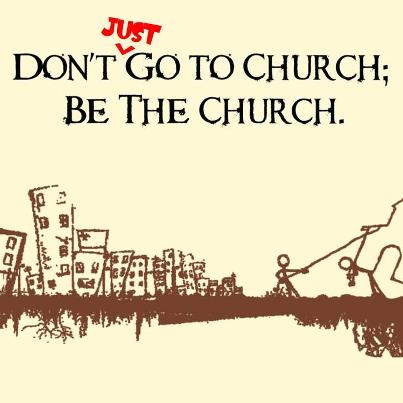
Be the ChurchTrue, I felt a few disturbing tremors in Pastor Randy’s sermon, reminding me that he still reads my blog (though I could be reading too much between the lines of his message) and doesn’t always agree with my opinions, but his grasp of history related to scripture always opens up new worlds in the Bible for me. It’s also true that when I got to the Sunday school class, it was uncharacteristically dark, with no indication that the teacher or anyone else had set the room up for us. Since we have a “guest missionary” with us today, and since plans change at church quickly sometimes, I figured we weren’t having class after all, so I turned around and headed on home. I was disappointed, but things happen.

Pastor Randy’s been out-of-town for a few weeks for a family reunion, and I just found out that he’s going to be gone in relation to his doctorate program for most of January, so I guess our conversations are on an extended hiatus. Another disappointment.

But God was in church today, so that makes up for those few things that didn’t quite work out.

I’ve been struggling with church for a while now and being out for three weeks only made it that much more difficult to go back today. But instead of focusing on the differences I experience between my viewpoint and the “official story” of doctrine and dogma, I need to look at what we all have in common and what I am learning about God, the Bible, and myself.

God was in church today. Maybe He’ll be there next Sunday, too.