Tag Archives: blogging

What’s Important Now?

When you try to help others and they don’t listen to you, you have a choice. You can say “it’s impossible to help them” and blame them for not being more open. Or you can view the situation as your own lack of proficiency at influencing and motivating others.

A blame-free attitude is the best path to choose. This can motivate you to develop your skills and talents on how to persuade, influence, and motivate. It could be that what you said is exactly what this person needs. As you enhance your presentation skills, in the future you will influence others to follow your beneficial suggestions.

-Rabbi Zelig Pliskin
“Develop your Motivational Skills”
Daily Lift #570
Aish.com

Oh my! This could be applied to every blogger who has ever tried to convince (often in vain) an audience why their point of view is correct and why his/her audience should change their minds and adopt the blogger’s perspective/belief/faith/whatever.

Really, how many blogs and how many comments on those blogs are specifically dedicated to the blogger blaming the audience (or at least those people in the audience who disagree with him/her) for being blockheaded, stubborn, ignorant, and “impossible to help?”

More than I can count, I’m sure.

So what should we do with this piece of advice? Should we redouble our efforts as bloggers, assume that our presentation skills are lacking somehow, and focus on how better to “influence others to follow our beneficial suggestions” in future blog posts?

Is Rabbi Pliskin’s advice here the answer?

A person who feels joy when performing mitzvahs will forget all his suffering and misfortunes. In comparison to becoming closer to the Almighty, of what import is pettiness and trivialities?

A person who experiences joy in doing good deeds will feel greater joy than a person who finds a large sum of money. Why should a person expend his efforts trying to find happiness in areas where the basis is transient and ultimately meaningless, when he has a far better alternative?

I suspect it is the answer, if we were to take Rabbi Pliskin seriously and actually apply his suggestion to our lives in a consistent manner. Unfortunately, we who continue to participate in the blogosphere, either as active bloggers or the observers who don’t blog but who frequently comment on the blogs of others, take ourselves way too seriously (me included). This is true in spite of the fact that there are probably well over 181 million blogs in the world right now. As far as U.S. bloggers are concerned, our “right” to have our say and express our opinion seems to have reached crazy, chaotic, out-of-control proportions, thanks to cheap, high-speed Internet access and the ability to create a blog for absolutely no cost in just a few minutes.

So what’s the answer, what’s the answer, what’s the answer?

I’d like to say “turn it all off,” but I know how difficult that would be in my own case, so I can hardly make that suggestion to others. But Rabbi Noah Weinberg, of blessed memory, makes that exact suggestion, at least in part.

Imagine someone calling you an idiot. Or that you’re stuck in traffic. Or that the boss is hassling you.

When this happens, you can become angry and caught up in the pettiness of life.

The remedy? Take a moment to go outside and walk under the stars. When you witness the vastness of the universe, it puts things into perspective. When you come back inside, you won’t be starry-eyed. You’ll be energized. You’ll say, I’m sorry. Let’s forget it and move on.

Awe helps release you from the limits of the body. You are suddenly in a world of different dimensions, transported into the eternity of beauty, power, majesty. You’ve got an expanded perspective. It’s no longer me versus you. We’re all one. So why be aggravated?

Awe carries us beyond ourselves. In times of war and tragedy – as well as prosperity and joy – people get “bigger.” They treat each other nicer. Pettiness is forgotten.

Anytime you’re in a rut, blast yourself out. Take a walk under the stars. This will unleash the power. You cannot be bored or petty when you are in awe.

The ultimate source of awe is, of course, God. Since we often can’t directly experience God, we usually must “settle” for experiencing the reminders of Him that He has left for us; that is, His universe, His creation.

It’s ironic that when we compare ourselves to the vastness of God and His Glory, we feel very small, and humbled, and yet at the same time, grateful and even exhilarated. We don’t feel jealous that God is so big and we are so tiny. We don’t resent God for being omnipotent while we are so powerless.

And yet let another human being or another group of people claim some heritage, some experience, some relationship that we ourselves don’t have access to, and suddenly we’re deeply envious, hurt, and outraged. We feel victimized. We feel as if our “rights” have been violated. Why can’t we have the same access to what “those people” claim is uniquely theirs?

Yes, of course I’m talking about the current (and seemingly endless) debate between certain corners of Christianity which can be thought of as “Hebrew Roots” or more specifically “One Law” and the various Judaisms, including “Messianic Judaism.”  The struggle is fueled by those who find in the Bible the justification for “One Law” Christians to have the “right” to everything that God granted Israel as a perpetual gift at Sinai, which is the heritage of every Jew on earth today. Naturally, when Jewish people hear such rhetoric, they tend to “push back.”

I suppose this too is an “issue” that we people who were born and raised in the West and specifically in the U.S. have to deal with, since “our rights” are all we tend to think about (or is that “our entitlements?”) relative to what other people have that we want.

But what should we have learned by now as people of faith? What did Jesus teach? To claim our rights? To take what wasn’t given to us? What did he teach that we seem to be forgetting?

“When the Son of Man comes in his glory, and all the angels with him, then he will sit on his glorious throne. Before him will be gathered all the nations, and he will separate people one from another as a shepherd separates the sheep from the goats. And he will place the sheep on his right, but the goats on the left. Then the King will say to those on his right, ‘Come, you who are blessed by my Father, inherit the kingdom prepared for you from the foundation of the world. For I was hungry and you gave me food, I was thirsty and you gave me drink, I was a stranger and you welcomed me, I was naked and you clothed me, I was sick and you visited me, I was in prison and you came to me.’ Then the righteous will answer him, saying, ‘Lord, when did we see you hungry and feed you, or thirsty and give you drink? And when did we see you a stranger and welcome you, or naked and clothe you? And when did we see you sick or in prison and visit you?’ And the King will answer them, ‘Truly, I say to you, as you did it to one of the least of these my brothers, you did it to me.’ –Matthew 25:31-40 (ESV)

Did Jesus “teach Torah?” Absolutely! What else would a Second Temple period itinerant Rabbi teach to the “lost sheep of Israel?” Did he expect his disciples to take his teachings and pass them on through imitation and active “preaching?” Absolutely! That’s what disciples do. Do we see Jesus overtly teaching Jewish covenant signs and identity markers to his Jewish audience? Not as such, since each Jew in Roman-occupied “Palestine” would have been raised from birth to know all these things. In other words, for a Jew in that place at that time,  knowing how to tie tzitzit would have been a “no-brainer.”

So what did he teach and what did he expect his Jewish disciples to pass on to the disciples from the nations? (Matthew 28:18-20) What were his most important commandments?

A new commandment I give to you, that you love one another: just as I have loved you, you also are to love one another. –John 13:34 (ESV)

Jesus replied: “‘Love the Lord your God with all your heart and with all your soul and with all your mind.’ This is the first and greatest commandment. And the second is like it: ‘Love your neighbor as yourself.’ All the Law and the Prophets hang on these two commandments.” –Matthew 22:37-40 (ESV)

That takes us right back to what Rabbi Pliskin said earlier:

A person who feels joy when performing mitzvahs will forget all his suffering and misfortunes. In comparison to becoming closer to the Almighty, of what import is pettiness and trivialities?
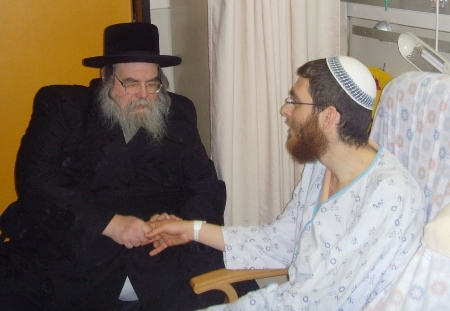
It’s pointless to fuss and argue over God and His special relationship with the Jewish people. After all, God gave the nations of the world the most precious gift possible; the life of His one and only son, the unique one, the Messiah, who died so that our sins could be forgiven and who lived so that we could have eternal life with the Father as His own sons and daughters.

The next time someone says something outrageous about religion (or anything else) on the Internet and you want to fight back and stand up for your rights, step away from the keyboard. Go outside. Experience the awesomeness of a thunderstorm or the magnificence of the starry, starry night. Perform a mitzvah such as visiting a sick friend in the hospital or donating a few canned goods to your local food bank. Retire into a quiet place and pray, turning your heart away from your own small concerns or hurt feelings and turning your spirit toward God.

After you have done that, ask yourself, “What’s important now?”

Do I need to take my own advice? Yes. Fortunately, Shabbat is coming up. When sundown approaches, I can put away the Internet and return my heart and spirit more fully to the God of all creation, may His Name be blessed eternally and without end.

What Do You Know?

Man, like all creatures . . . possesses both a body and a soul. And just as there are those who are poor in body and bodily needs, so, too, are there paupers in spirit and spiritual needs. Thus, the mitzvah of charity includes both physical charity and spiritual charity. In the words of our sages: “[It is written:] ‘If you see a naked person, you should cover him.’ What is the meaning of this? If you see a person who is naked of the words of Torah, take him into your home, teach him to read the Shema and pray, teach him… and enjoin him regarding the mitzvot….”

Regarding material charity, the law is that the material pauper is also obligated [to give], for even the most impoverished person can find a way to help his fellow pauper. The same applies to spiritual charity. There is no man or woman in Israel who cannot, in some way, influence his or her fellow Jews and bring them closer to the fear of Heaven, the Torah and the mitzvot.

Freely translated excerpt from the very first “public letter” written by the Rebbe
dated Elul 18, 5710 (August 31, 1950)
Printed in Igrot Kodesh vol. 3, pg. 463-4.
As quoted from “A Poor Man’s Gift”
in the “What the Rebbe Taught Me” series
Chabad.org

When I attended my former One Law congregation, it used to bother me a little to teach. Don’t get me wrong, I absolutely loved to teach. I used to craft a lesson the way I write blogs. I’d find inspiration everywhere. I couldn’t read the Bible without getting ideas for future lessons.

But there’s a problem.

I have absolutely no formal educational or vocational background in teaching on Biblical and religious topics. I’m kind of a blockhead that way. I tend to teach as I write; not so much on the nuts and bolts facts, translations, and Greek or Hebrew “wordplay” you see on so many other religious blogs, but on the themes raised by the text and the moral and ethical lessons we can glean from the Word.

It still bothers me to blog for pretty much the same reasons it bothered me to teach. At least now, I’m only representing myself and not a congregation or organization. I don’t have to be worried that what I say and my personal opinions will reflect poorly on others. Now, when I (virtually) shoot off my big mouth, it only reflects poorly (or otherwise) on me.

Well, that’s not absolutely true. As a disciple of Jesus and a worshiper of the God of Abraham, anything I say or do, for good or for ill, reflects upon my Creator. That’s hardly to be taken lightly, but on the other hand, with so many religious bloggers out there, one or two others are probably going to make a few mistakes, too. That’s no excuse of course, but I have to plead that I’m only human. My mistakes are my own, not God’s.

Just in case you were wondering, just how many blogs and bloggers are out there, (I can’t drill down to the specific number of religious blogs, alas) according to nielsen.com, at the end of 2011, there were “over 181 million blogs around the world, up from 36 million only five years earlier.”

Wow!

That’s pretty humbling.

If you’re one of those bloggers and you think your blog is really cool beans, just remember that no matter what you write and how important it is to you, there are almost 200 million other bloggers out there who feel the same way about their messages. Talk about a drop in a bucket.

HumbleThere are a lot of reasons why I continually entertain the thought that I should just quit. Especially after a “bad day” online, I brood a bit and figure I’ll set a date to stop blogging, delete my Facebook and twitter accounts, and let the rest of the world duke it out in cyberspace. I’m sure there are a lot of other things I could do with my time besides blogging a ridiculous amount in the Christian/Jewish/Messianic blogosphere. Besides, it’s not as if my one little online contribution could possibly make any sort of difference in the greater scheme of things.

But remember that I quoted from the Rebbe’s letter at the start of this particular missive.

Often, I use my blog as a platform to encourage and support giving tzedakah in a variety of forms, including material, emotional, and spiritual. But Rabbi Mendel Kalmenson in this commentary presents another idea:

What is often overlooked, however, is the fact that charity not only means feeding empty stomachs, but also includes the nourishing of needy hearts, ignorant minds, misguided spirits, and stagnant souls.

While a now-famous Jewish teaching states, “Whoever saves a life, it is considered as if he saved an entire world,” according to one Talmudic master, “He who teaches Torah to his neighbor’s son is regarded by Scripture as though he created him.”

But wouldn’t that presuppose being a competent Torah teacher? I mean, it’s not like just anyone can teach Torah or, to put it in more “Christian” terms, it’s not like just anybody can be a Bible teacher.

According to our aforementioned commentary, the Rebbe was fond of quoting the following:

“If only you know aleph (the first letter of the Hebrew alphabet) – teach aleph!”

-Old Chassidic Proverb

I suppose that’s sort of like saying, “if you only know the ABCs, teach the ABCs.” But what does that have to do with teaching the Bible or blogging about religious topics, particularly if you are untrained and uneducated?

Herb Brin, a noted author and the editor of four newspapers, met with the Rebbe after becoming editor of the L.A.-based Jewish newspaper Heritage. The private audience lasted six hours. At some point, the following exchange took place:

“Rebbe, I recently became editor of a Jewish publication. The problem is, I know very little about my people and their heritage. Do I have the right to make sensitive editorial judgments as I do not understand Hebrew, my Jewish education was truncated, and I only know fragments of Yiddish?”

Looking him in the eye, the Rebbe said, “Do you have the right to withhold that which you do know?”

OK, that was only a longer and slightly more detailed commentary on what Rabbi Kalmenson said a moment earlier, so not much more was illuminated.

There are actually two problems here. The first is that you should teach only what you are competent to teach. That can be a tough one because human beings are notorious for grossly overestimating what they know and how far their skill sets can take them. The blogosphere is replete with self-appointed “experts” in their fields, particularly when the field is religion, so it would be easy for someone with limited qualifications, or even a reasonably well-educated person, but with a serious ax to grind, to use Rabbi Kalmenson’s lesson as tacit permission to rattle off whatever “teachings” they feel capable of presenting to a spiritually hungry and needy audience.

I can’t speak for all bloggers everywhere, but for my own part, I make every effort to teach and write within the boundaries of my knowledge. I also have a trusted friend or two who, behind the scenes, lets me know when I’ve gone a bit too far.

But what about the second problem?

Say that as a student, I have the right, even the obligation, to teach, to inform, to educate, to share information with those uninformed; but how dare I encourage others when it comes to Jewish observance? How can I promote the practice of a lifestyle that I myself continue to struggle with?

That is an absolutely excellent question, and one that we should all consider when consulting the various blogs out there (including mine) that suggest how to go about living a moral, ethical, and spiritual lifestyle. How can you know if the author is living up to the standards he or she is teaching to others?

The Rebbe had an answer for that one, too.

A college student once approached the Rebbe in the middle of a chassidic gathering to greet him with a l’chaim. The Rebbe turned and asked him if he was involved with encouraging and helping his fellow students to put on tefillin every day.”But Rebbe,” admitted the young man, “I myself don’t put on tefillin every day!”

“Why is that their fault…?” replied the Rebbe, with a smile.

In sum, Judaism teaches that you don’t have to be rich to give to the poor, you don’t have to be a scholar in order to teach the ignorant, and you don’t have to be perfect in order to help others perfect themselves.

That’s absolutely amazing and explains why the poor can give to the poorer or sometimes, even to the rich. You don’t have to be perfect. You don’t have to have a perfect religious or spiritual walk. Granted, I don’t think the Rebbe was suggesting that it’s OK to be a phony, a hypocrite, or a charlatan, but it is OK to be an honest and well-meaning person with a limited skill set and who struggles with their walk of faith and to still teach what they know and what you know to others. I guess on that basis, I’ll continue to blog for a bit longer. You never know what might happen as a result.

What can the poor man give? The answer is, whatever he has. Jesus talked about this too, but he used more concrete terms in his parable.

And he sat down opposite the treasury and watched the people putting money into the offering box. Many rich people put in large sums. And a poor widow came and put in two small copper coins, which make a penny. And he called his disciples to him and said to them, “Truly, I say to you, this poor widow has put in more than all those who are contributing to the offering box. For they all contributed out of their abundance, but she out of her poverty has put in everything she had, all she had to live on.” –Mark 12:41-44 (ESV)

Now imagine that instead of material funds, the Master was talking about what you know, how you encourage, and your example of living out your faith.

What do you have to give? What do I?

Who Do We See In The Mirror?

Whenever you notice a fault in another person, check where you have that fault yourself. We have a strong tendency to notice our own faults in others. This awareness gives us many opportunities to learn about our own shortcomings -since it is easier to recognize a fault in someone else than in ourselves.”

What fault do you commonly notice in other people? In what ways do you have that fault yourself?

Use this awareness as a tool to stop yourself from speaking against others. Who would want to speak against others knowing that you are merely drawing attention to that same fault in yourself?!

Today, catch yourself in the act of criticizing others. Then think about the implications for yourself.

-see Talmud Kiddushin 70b; Rabbi Chaim of Volozhin – Ruach Chaim 2:1
quoted from Aish.com

“The fault, dear Brutus, is not in our stars, But in ourselves…”

-William Shakespeare’s
“Julius Caesar (I, ii, 140-141)”

According to Attribution Theory in the field of Social Psychology, we tend to think that a person’s behavior is attributed to something we believe about them. For instance, let’s say you don’t like “Fred” for whatever reason. You think Fred is a blockhead and a pain-in-the-neck. You see Fred at your local fast food place and just after picking up his order, he trips and spills his tray all over the floor. This just “proves” what you’ve known all along. Fred is a klutz and a moron. See how he spilled his tray?

On the other hand, you may really like Sally and think she’s a great person. She’s kind, gives to charity, and is nice to children and small animals. You see Sally at the same fast food joint and she spills her tray in an identical fashion to Fred. However, you feel sorry for Sally. Someone (like Fred) must have tripped her. Instead of gloating, you rush over to help Sally clean up the mess.

Why we like or don’t like other people may be just what we believe about them. It may also be what we see in them. If Fred has characteristics that are like those in ourselves that we don’t like, we probably aren’t going to like Fred. If, on the other hand, we see things about Sally that are the same as some of the characteristics we like in ourselves, we’ll probably like Sally.

That’s a gross oversimplification of a complex set of variables, but you get the idea.

But what does this have to do with the Internet?

Plenty.

I mentioned yesterday that we do a fair amount of complaining on the blogosphere about a lot of things and a lot of people. But is it really necessary?

I suppose wearing the “mask” of the web over our “faces,” and given the fact that you can create a functional blog in just a few minutes, we all suddenly have the ability to spew our thoughts and feelings out to whatever audience chooses to read them. Once we start interconnecting, we start seeing people we like and don’t like and naturally, since we don’t have to face any of these people in real life, we tell them what we think about them.

Or are we really revealing something about how we like or don’t like ourselves under the mask?

Interesting, isn’t it?

Of course, if all of our complaining is really telling the world how we see ourselves, maybe it would be a good idea to turn it down a notch before everyone notices that we’re airing out our dirty laundry on the most public clothes line in the universe.

Whenever you see that someone has made a mistake, view the situation as a learning experience to prevent yourself from making similar mistakes.

Moreover, utilize this experience to discover what knowledge you may be able to impart to others so they, too, can avoid making similar mistakes.

Today, think of three mistakes you have seen people make recently. In what way have you made similar mistakes?

-see Ralbag – Shaar hachochmah, no.11
quoted from Aish.com

Turning that piece of advice around, if we look at the “faults” of others as if they’re our own, maybe we are really just learning from our own mistakes as we project them outward.

That would make the blogosphere one really, really big mirror. That ugly, nasty troll or witch you see on someone else’s blog is actually just your own reflection.

Terrifying thought.

I’ve got a suggestion. Visit the blog or website of the one person who really gets under your skin and read through a significant portion of their content. Pay close attention to what it is about the stuff you’re reading that really sets you off. Make a list of suggestions you’d like to give the blog writer about how they could improve themselves as a writer and a person. Then stop and ask yourself if you tend to say things or hold attitudes that are equally irritating, annoying, and offensive.

If (being perfectly honest since this is all happening within the privacy of your own thoughts) you start seeing these rather ghastly connections between them and you, begin considering the advice you wanted to give to that other person. Would it be good advice for you to take as well?

For those of us who have faith, we’re supposed to live in a community of like-minded believers. Our ideal is to obey the “new commandment” of our Master and to love one another (John 13:34). It’s supposed to be the defining characteristic of disciples of Jesus. Yet, given the nature and tone of our conversations on the Internet, we do everything else except love.

One should daven together with the community – 8a

Someone asked R’ Moshe Feinstein, zt”l, would it be better if one davened without a minyan if he felt he could daven with more kavannah in a room by himself. Which was more important, davening with a tzibbur or increased kavannah?

R’ Moshe responded (Igros Moshe O.C. 3:7): If the person can concentrate even minimally while with a minyan, it is better to daven with the tzibbur, even at the expense of added kavannah. We find that a person must extend himself to daven with a minyan, and it is even an obligation to do so. In an earlier letter (O.C. 2:27) R’ Moshe contends that the obligation stems from the fact that the prayers of a person who is in a group are certain to be accepted, while the prayers of an individual are not necessarily accepted. A person has the responsibility to daven to the best of his abilities, so he must go to daven where his prayers are more readily desirable. Accordingly, the advantage of davening with a minyan is essential, for this can make the difference whether one’s prayers are accepted or not. Davening with a bit more kavannah is only a substantive advantage. Therefore, a person must daven with a minyan, even though his kavannah may be somewhat diminished.

Daf Yomi Digest
Distinctive Insight
“Davening with a minyan or davening with more kavannah?”
Berachos 8

As we can see here, the sense of community and davening with a minyan is considered more important than experiencing greater kavannah in prayer by davening alone. God never really designed us, Jew, Christian, or anyone else, to relate to Him by ourselves. We know that loving God and loving other people are incredibly intertwined so perhaps that’s part of where this principle comes in. But whether we always like each other (or ourselves) or not, we are still all his disciples (I’m speaking of the community of faith now). We don’t get to escape from one another just because we sometimes fuss and bicker.

I recently issued a sort of challenge to Judah Gabriel Himango on his blog suggesting, starting next Sunday (or Saturday night after Shabbat) that “we spend a week posting only uplifting material and not announcing to the world why we think we’re right and the other guy or gal (it doesn’t matter who they are) is wrong.” For me, that means writing a minimum of six blog posts that don’t mention supersessionism, replacement theology, and my opinions on some of the major theological expressions in the Messianic Jewish/One Law community. I suppose it also means I can’t take the church to task for any of its perceived failings or take shots at atheists either.

All Judah has to do is not blog for a week and he’s covered, so I’m biasing this challenge in his favor just because I post “morning meditations” six-days a week. If anyone wanted to take a cheap shot at me in the comments section of my blog and not receive a pithy rebuttal, this coming week is the time to do it (I’m saying all this somewhat tongue-in-cheek).

Let’s see if I and anyone else, can choose to consistently take the moral high road and only offer uplifting, supportive, and encouraging words on the “intertubes.” I predict that the number of hits on my blog will plummet like a stone dropped in Lake Mead (I hope I’m wrong).

But I also hope that maybe the online community of faith will get something positive out of it, too.

We’ll see how it goes. Anyone else out there game?