Tag Archives: Christian

The Best Within Us

If I speak in the tongues of men and of angels, but have not love, I am a noisy gong or a clanging cymbal. And if I have prophetic powers, and understand all mysteries and all knowledge, and if I have all faith, so as to remove mountains, but have not love, I am nothing. If I give away all I have, and if I deliver up my body to be burned, but have not love, I gain nothing.

Love is patient and kind; love does not envy or boast; it is not arrogant or rude. It does not insist on its own way; it is not irritable or resentful; it does not rejoice at wrongdoing, but rejoices with the truth. Love bears all things, believes all things, hopes all things, endures all things.

Love never ends. As for prophecies, they will pass away; as for tongues, they will cease; as for knowledge, it will pass away. For we know in part and we prophesy in part, but when the perfect comes, the partial will pass away. When I was a child, I spoke like a child, I thought like a child, I reasoned like a child. When I became a man, I gave up childish ways. For now we see in a mirror dimly, but then face to face. Now I know in part; then I shall know fully, even as I have been fully known.

So now faith, hope, and love abide, these three; but the greatest of these is love.

1 Corinthians 13:1-13 (ESV)

In spite of the fact that this passage from Paul’s letter to the Corinthian church has often been read as part of the vows at innumerable weddings, it has nothing to do with romantic love. It is Paul’s message about a much greater love and, in my opinion, a love that it much more difficult to express consistently in a life of faith. In fact, I think the kind of love Paul is describing has a lot more to do with what he had to say to the church in Rome.

Bless those who persecute you; bless and do not curse them. Rejoice with those who rejoice, weep with those who weep. Live in harmony with one another. Do not be haughty, but associate with the lowly.Never be wise in your own sight. Repay no one evil for evil, but give thought to do what is honorable in the sight of all. If possible, so far as it depends on you, live peaceably with all. Beloved, never avenge yourselves, but leave itto the wrath of God, for it is written, “Vengeance is mine, I will repay, says the Lord.” To the contrary, “if your enemy is hungry, feed him; if he is thirsty, give him something to drink; for by so doing you will heap burning coals on his head.” Do not be overcome by evil, but overcome evil with good. –Romans 12:14-21 (ESV)

Interestingly enough, the Talmud seems to echo the same lessons that Paul teaches:

“They said of Rabbi Yochanan ben Zakai that no man ever greeted him first, even idol worshippers in the market” [i.e., Rabbi Yochanan ben Zakai was the first to greet every person, even idol worshippers] (Berachot 17). At the same location the sage Abaye advocated soft speech and words of peace to everyone, especially including idol worshippers.

“[it is proper to] support the idol worshippers during the sabbatical year… and to inquire after their welfare [commentators: even on the days of the holidays of their idols, even if they do not keep the seven Noahide commandments] because of the ways of peace.” (Shevi’it 4,3)

The rabbis taught: ‘We support poor Gentiles with the poor people of Israel, and we visit sick Gentiles as well as the sick of Israel and we bury the dead of the Gentiles as well as the dead of Israel, because of the ways of peace.” (Gitin 61a)

I suppose I’m belaboring the point I was trying to make last Friday afternoon, but this blog isn’t about presenting topicial commentary or clever scholastic mysteries, it’s about me writing what’s on my mind, my heart, and my spirit as I approach each new day. The sorry state of love among the human race, including those who claim faith in God is still consuming me. What makes it worse is the lack of love among people of faith seems not to bother them (us) at all. And I have to share the name “Christian” with some of these folks. No wonder the atheists accuse us of hypocracy.

I just recently saw the film The Avengers (2012) for the first time. I know that’s a strange statement for me to make given the context of today’s “meditation,” but I do have a point. As well as being a top notch action film and a lot of fun to watch, there were a few good lessons to be found about love, honor, and sacrifice. Ironically, it took a completely secular film to talk about the qualities we Christians are supposed to possess by definition.

Of all the characters in the film, Captain America (played by Chris Evans) is the epitome of those qualities I just named. He is what we think of, in old fashioned terms, as “the greatest American hero.” He’s the ideal of what we used to believe were the finest qualities about our nation and our citizens. National cynicism has since destroyed those ideals but maybe not completely. The film has more than a few reminders for us that not only does the character Captain America have a much needed place in our world today, but the ideals Captain America represents are what we most long for in our lives.

Cap is sometimes juxtaposed in the film against the character of Tony Stark/Iron Man, a person who at once has everything and nothing. A man who has wealth, position, power, and glamour, but at the expense of the finer qualities of Captain America, such as love of humanity, purpose, conviction, honor, and the ability to sacrifice even his own life if it will save others. Stark is always looking for the loophole. Steve Rogers, Captain America’s other identity, always faces his challenges head on.

Toward the climax of the film (and I’m sorry if I’m giving too much away), the only way for Stark to save New York City from nuclear destruction is to carry a nuclear missile through a dimensional rift out of our world, in order to destroy the attacking army. This is supposed to be a one-way trip, but there are no other options and no loopholes. Captain America’s example throughout the movie finally made an impression on Iron Man so that what began beating in his chest was not the electronic perfection of the machine keeping him alive, but a real human heart of compassion, even for millions of people who he’ll never know.

As in most fantasies, Stark is saved at the last minute and rewarded for his willingness to sacrifice his life by survival and the opportunity to appear in more movies, but what about the reality of this lesson? What can we learn about love and even about “heaping burning coals on the head of those who hate us?”

Remember, this lesson comes to us courtesy of a secular and atheist entertainment industry. It is however, an industry that does, within the context of the film, allow Captain American to utter one single line of dialog confirming his faith in God, which I found just amazing. This lesson in love, honor, and sacrifice (as opposed to raw vengence and self-satisfaction) comes to us from people who, in all likelihood, have never met the God of the Bible and perhaps never will this side of the Messiah.

Where is our lesson? Where is the lesson of the church?

I don’t doubt that many Christians do live up to the ideals of our Master. Many believers do not just speak, but live out the example of Jesus Christ. Many extend themselves to feeding the hungry, providing clothing to those who need it, welcoming strangers into their homes, visiting the sick in the hospital, and even extending a smile and a hand of friendship to those who revile them, even if they are other Christians.

The sad and sorry part of our faith is that there are those among us who use Christ as a blunt instrument with which to beat their perceived enemies about the head and shoulders until they’re bloody and bruised. And then these Christians congratulate themselves for aptly employing Jesus as an object of vengence and an example of “tough love” which is neither particularly “tough” in the sense of true strength and honor, or at all loving in the way Paul described love to the Corinthians.

More’s the pity.

What is the defining quality of Christianity, judgment or love? They both exist within our theology. We know a time of judgment is coming and most Christians feel immune to it, imagining that only their enemies the atheists will face such a terrifying fate. And yet the Master tells us this is absolutely not true. Just who do you think Jesus is talking to in Matthew 25:34-46? Why would athests be expected to give water to the thirsty and clothe the naked in Christ’s name? And why would the Master say this?

“Not everyone who says to me, ‘Lord, Lord,’ will enter the kingdom of heaven, but the one who does the will of my Father who is in heaven. On that day many will say to me, ‘Lord, Lord, did we not prophesy in your name, and cast out demons in your name, and do many mighty works in your name?’ And then will I declare to them, ‘I never knew you; depart from me, you workers of lawlessness.’ –Matthew 7:21-23 (ESV)

In Romans 12:19, Paul quoted Leviticus 19:18 to remind us that vengence belongs to God, not men. The Master gave us all a new commandment to love each other as a way of showing the world around us that we belong to him (John 13:34-35). If I have to err in the expression of my faith, I prefer to err on the side of love and to leave (to the best of my limited abilities) the vengence to God. God’s vengence, when He chooses to express it, does not contain our human faults, hositilities, and insecurities, but only His justice, which is neither ours to take or to give.

If secular films such as The Avengers can be an inspiration for us to be better people, to be “heroic” in the love we can show others, why doesn’t the church show the world that Christ brings out the best within each of us? If you want to carry the Gospel message to a desperate and unbelieving world and show other Christians “how it’s done,” I can think of no better way to do it than to show love especially toward your “enemies” because of the ways of peace.

“The whole problem with the world is that fools and fanatics are always so certain of themselves, and wiser people so full of doubts.”

-Bertrand Russell


Forgive

“If your brother sins against you, go and tell him his fault, between you and him alone. If he listens to you, you have gained your brother. But if he does not listen, take one or two others along with you, that every charge may be established by the evidence of two or three witnesses. If he refuses to listen to them, tell it to the church. And if he refuses to listen even to the church, let him be to you as a Gentile and a tax collector. Truly, I say to you, whatever you bind on earth shall be bound in heaven, and whatever you loose on earth shall be loosed in heaven. Again I say to you, if two of you agree on earth about anything they ask, it will be done for them by my Father in heaven. For where two or three are gathered in my name, there am I among them.”

Then Peter came up and said to him, “Lord, how often will my brother sin against me, and I forgive him? As many as seven times?” Jesus said to him, “I do not say to you seven times, but seventy-seven times.

Matthew 18:15-22 (ESV)

This is a unprecidented third “meditation” in one day, but I saw the accompanying photo on Facebook and it just fit. It’s been a tough week in the Messianic blogosphere and I’ve got the (virtual) bruises to prove it (It’s been a tough week anyway, but that’s beside the point). Most people who give me a hard time for my specific beliefs and their accompanying statements are actually really nice people who love God and want to do good to others. The vast majority of them, I consider my friends and for those who I’ve never met before, I’d love to get together over coffee or a beer and get to know you better. Most of them actually do perform deeds of lovingkindness and have extremely generous hearts.

Just a tiny few however, seem to have a tough time “letting go,” as if what I’m saying is a direct challenge to the doctrine of salvation and the grace of Jesus Christ. I’m not making any such challenge, but for some believers, any suggestion of change or deviation from the norm, particularly in the arena of supersessionism and anti-Jewish rhetoric, is to be feared and even shunned. I admit that there are moments when I want to snap back (more than I already do) but I don’t because I know it wouldn’t be the right thing. How can I exemplify the teachings of my Master if I allow myself to get caught up in the rapid volley, tennis match exchange of angry and upset comments?

Sometimes, along with everyone else, I get caught up in arguing all of the little minutia of religion; all of the arcane details that would make most Rabbis and Pastors go nuts and want to toss in the towel on the human race, but really, God is very simple.

At the end of the day, when you look back at who you are, who you claim to be, what you’ve done with your time, and how you’ve treated other people, you have to say to yourself, “Stop being a jerk and just forgive.” As someone commented on another of my blogs (this isn’t an exact quote), “it’s more important to do right than to be right.”

How can we enter a Shabbat’s rest with anger and frustration tying our hearts and souls into something that looks like a design by M.C. Escher? Let go. Tell the people who you love, “I love you.” Cup a small child’s face in the palm of your hand. Forget all the words and actions that have caused you pain. Remember what’s important.

Forgive.

If you’ve hurt me, I forgive you.

May God go with us all on our journey of faith.

nightsky1

Toby’s Story and Mine

I promise. I’m running out of Shavuot conference stories. It won’t be long now until I’m tapped out. Be patient.

I mentioned in my recent review of Toby Janicki’s book God-Fearers: Gentiles and the God of Israel that I was just a tad disappointed that he didn’t describe anything about his personal journey in transitioning away from One Law. I kind of expected that he would have included some of those details, because he told a lot of his personal story at the conference last week.

I promised to share one of those stories with you (I have Toby’s permission to do so). I don’t think I’ll be able to tell it as well as Toby did. Certainly, I’ve forgotten a lot of the little details by now. In fact, since I’m telling all of this from memory, doubtless my story will contain just a ton of errors. Hopefully, I’ll still be able to get the main point across. Then I’ll tell you a story of my own.

But Toby’s story first.

Toby talked about visiting what sounds like some sort of upscale food store in the Denver area several years ago. He was wearing a talit katan under his shirt with the four tzitzit extending out into public view. He apparently was very satisfied with the tzitzit being the correct halakhic length and with the proper blue for the techelet threads. His observance of the mitzvot of the tzitzit was just flawless.

As Toby was approaching the check out line, he heard a man’s voice from behind him, “Excuse me.”

Toby paused and turned as the man continued to speak.

“Are you Jewish?”

At this point in Toby’s story, I can imagine him freezing momentarily in a sort of “deer in the headlights” pose.

Toby said, “No.” This prompted the other fellow, who was Jewish, to ask Toby a number of questions. Why would someone who wasn’t Jewish wear tzitzit, and particularly pay such fine attention to the relevant halachah? Toby most likely answered each of this Jewish person’s questions and I don’t doubt it would have been a fascinating conversation to watch and hear. I somehow believe that the Jewish gentleman never quite understood the whole concept of “One Law” and why anyone who wasn’t Jewish would desire such an experience. On the other hand, he may full well have understood the implications of people who were not Jewish entering into behaviors that, on the surface, made them seem as if they were.

It’s what I would call an epiphany event for Toby. The light bulb went off over his head. He realized something that had never occurred to him before on a very fundamental level.

That’s the best I can do about Toby’s story but before getting to my own, I want to share another one I heard at the conference.

A non-Jewish fellow at the conference described how he once went into a church, not his home church by any means, wearing a kippah and carrying a talit gadol over his arm. He elicited a lot of questions from the other Christians there, particularly, “Are you Jewish?” Of course, the answer had to be no, but the fellow in question felt that dressing as he did would be a witness to the Christians and allow him to speak about the Jewishness of Jesus. Perhaps in that one church it did, but what does it say when someone who is not Jewish dresses in a manner that seems to say he is a Jew? Toby’s encounter was accidental. This other gentlemen deliberately presented a confusing message about his identity.

What are we really saying to the Jews and Christians around us when we create the impression that we are someone we really aren’t?

Praying with tefillinNow to my story. It’s not a single event, but I’ll pretend it is so this blog post won’t go on too long.

Like most people who live in a suburban home, my house’s master bedroom has a walk-in closet. It used to be my habit to pray in that closet in the mornings. I would take my siddur with me and reciting the proper blessings, don my talit and lay tefillin (I want to thank my friend Baruch Hopkins for teaching me the proper manner of laying tefillin, particularly since being left handed, my technique must be different from most other people). My Hebrew is terrible (as many people at the conference I recently attended can attest), but I prayed from my heart and my humble devotion to God. I believed that, imperfect though my prayers were, imperfect though my Hebrew was, and imperfect as my performance of the relevant halachah was, I was doing my best. I hoped God would understand.

And I didn’t want my Jewish wife to walk in on me during my prayers. I tried to time everything so she’d either be asleep or already gone to work when I’d pray. I know it may sound silly to you, but I had a couple of important reasons.

The first was that I wanted to be able to completely focus on my prayers. I didn’t want to be interrupted or to have to worry about being interrupted during prayer. I wanted and needed to have a private time when I could connect to God.

The second reason was that I was embarrassed. It wasn’t just that I have no command of Hebrew and that I don’t really know how to don a talit, although that’s embarassing, too. It’s that she’s Jewish and I’m not. Although she wasn’t raised in a Jewish home and for many years, did not have a lived cultural and religious experience, she has overcome many barriers and worked extremely hard to connect and integrate with the Jewish community. She has finally become a member of our local Jewish community and her habits, viewpoint, and even thought processes have become increasingly Jewish.

I certainly can’t say the same thing for me, and yet there I was, wearing a kippah, wearing tzitzit, binding tefillin on my arm and on my forehead, and trying to pray in bad Hebrew from a siddur.

When Toby was telling his story and how he felt when he was speaking with a Jewish man about why a Gentile Christian should be dressing like a Jew, I wondered if he felt even half as uncomfortable as I did when I just imagined how my wife pictured me. Toby’s encounter was with a stranger he probably never saw again. I had the same encounter but with my wife who I see all the time.

Toby’s encounter was probably only one of the steps he took on his journey which resulted in him re-evaluating his One Law beliefs. My “quasi-Jewish prayer life” was only one of the steps in my journey. But they’re both examples of our realizing that there is some part of the One Law assumption that just doesn’t “feel” right. When we put it into practice outside of our cloistered little groups, we have experiences that help us realize, however unintentionally, that we are putting on a mask when we wear tzitzit in public. As Gentiles, we are telling the world that we are a person who we really aren’t. Regardless of our intent, we are saying we’re Jewish when we know we’re not.

One SoulAnd when we do that, what do we do to the Jewish people around us? That’s a question I had to ask myself. What was I telling my wife about her Jewishness when I behaved in a manner that is unmistakably Jewish? What was I saying about how I viewed her unique choseness by the God of her fathers? Was I cheapening that specialness by adopting Jewish prayer behaviors? My prayers were in private. No strangers could have been offended. But if I don’t choose to respect my own Jewish wife and instead, I insist I have a right to wear tzitzit and tefillin, what commandments am I “obeying”…and which ones have I just shattered?

Therefore a man shall leave his father and his mother and hold fast to his wife, and they shall become one flesh. –Genesis 2:24 (ESV)

I’ve probably made a mess of Toby’s story and want to apologize to him and to everyone else for getting most of it wrong. However, I can tell you that I got my own story “spot on.” I’m not telling anyone out there what to do. I can only tell you why I stopped doing many things I still cherish and put away my tallit and tefillin. The siddur still sits on my night stand, but often it is abandoned. I still talk to God, but I’ve removed the “Jewish” elements.

When I was at the Shavuot conference, I arrived early on Friday morning. As I sat in the sanctuary, I heard the faint sound of praying from the direction of the library. I followed the sound and discovered that a number of men had met in an upper room for shacharit prayers. The Hebrew was beautiful, but it wasn’t just the language. Although Hebrew will always be a challenge for me and most likely beyond my grasp, these prayers speak to my heart in a way no other type of prayer can. I really miss it. I can’t explain why, but I really do.

In fiction, a story has a beginning, a middle, and an end. In real life, the story continues as long as we can draw a breath. My heart is still beating and my lungs still take in air, so my story is still moving forward. I still have no idea how it will end.

The only thing I can do is keep writing my story one blog post at a time and see what happens next.

Not Ashamed

Gentiles in Messiah have been transformed by Yeshua’s redeeming work and, as we shall see, are more than just mere Noachides or first-century God-fearers. Those of us from the nations should be proud of who God created us to be. We have an important opportunity to be a light for HaShem and his kingdom that only we can be. Together with our Jewish brothers and sisters in Messiah, we must work towards establishing Messiah’s kingdom and the rule of Torah, while at the same time accepting our own unique roles. At the same time, some may wonder whether it matters if a person is called a Jew or a Gentile.

Aren’t we all one new man in Messiah? Doesn’t the Torah say that there shall be one law for both the stranger and the native-born alike? In the next chapter, we will consider the context of those passages that seem to apply the same standard and obligation of Torah law to both Jews and Gentile believers.

-Toby Janicki
from his soon to be released book:
God-Fearers: Gentiles and the God of Israel
Chapter 1, pp 24-25

This book just became available from First Fruits of Zion (FFOZ) but I managed to get my hands on an advance copy last week at the FFOZ Shavuot conference, so I was able to read it several days ago. The first thing I thought of when I finished chapter one was the 1992 Newsboys pop song I’m Not Ashamed (boy, it was good to hear that song again). Of course the song focuses on Christians who are hesitant to share their faith in a world dominated by secular values, but I applied it to how a lot of non-Jews in the Messianic movement seem “ashamed” or “embarrassed” just to be Gentiles in a Jewish religious context. I’ve met more than a few non-Jews in the movement who somehow feel that being a Gentile just isn’t good enough. They seem to think that being Jewish is where the “action” is.

I’ve already written about the absolutely fabulous role that Gentiles play in God’s plan in the redemption of national Israel and the return of the Messiah (see Redeeming the Heart of Israel, Part 1 and Part 2). That means I certainly believe we have no reason whatsoever to be ashamed, embarrassed, or put off about not being Jewish and still worship and honor God in Messianic Judaism. Nevertheless, these emotions are ubiquitous among Gentiles in the various flavors of Messianic Judaism. I suspect this is the motivation, conscious or otherwise, for some Gentiles to be attracted to either the One Law or Two-House theologies (although I know this isn’t true of everyone in those two traditions), each of which require some “equalization” of Jews and Gentiles within Messianic Judaism though a process of homogenization of Jewish and Gentile distinction.

About the only other “cure” (besides just getting past this insecurity and being delighted in who God made you to be) for this condition among some (but far from all) Messianic Gentiles, is to leave the Messianic movement entirely, abandoning faith in the Jewish Messiah King and converting to some other form (usually Orthodox) of Judaism. This is pretty much “throwing out the baby with the bath water” and our movement has been torpedoed (yes, I said “our” since even though I’m a Christian, I can still embrace Jesus as the Jewish Messiah within his correct context) on multiple occasions by people who are struggling with personal faith and identity issues.

I must admit, I can hardly be critical of these folks since more than once I’ve been severely tempted to “throw in the towel” myself, not only in terms of the Messianic perspective, but as far as any faith tradition at all. This life can be miserably hard and lonely and it would be easier to follow the path of least resistance and to either join and blend into a traditional church or just forsake Jesus altogether and enter into the masses of the secular herd.

But I just can’t make myself do it. I can’t make myself walk away. Some incredible drive keeps pulling me back, like an enormous elastic band holding me to the center of God so that I can only run so far away from Him before being snapped back.

The marketing material for Toby’s book wasn’t available from FFOZ when I originally wrote this “meditation,” so my full review won’t appear for the next day or so. I will tell you though, that the direction this book takes dovetails quite nicely with FFOZ’s current and future vision and frankly, it works very well with my vision, too.

Like many Christians who have been involved in the Messianic movement for a while, I’ve gone through the “developmental phase” of almost hating being a Gentile and longing to discover some hidden “crypto-Jewishness” in my genealogy. I never found any, which is fortunate, because if I did, it would have robbed me of the opportunity to discover that God loves Gentile Christians, too and that He has a very specific and incredibly vital role in His plan just for us.

But the most important gift I received over the past week that I want to share with you, is that we don’t have to be ashamed or embarrassed because we’re not Jewish. We don’t have to be jealous of envious of Jews and their unique covenant relationship with God. We have something that is better even than sons and daughters. We have the right to be called God’s sons and daughters. We have the right to be the precious crown jewels among the nations.

I’m not ashamed. You don’t have to be either.

Addendum: I’ve been reminded recently that there are many congregations of non-Jews in Hebrew Roots who are not looking to create their own “Judaism.” Instead, they seek to express their worship and devotion to God in a manner that acknowledges the Jewishness of Jesus. If that’s you and you are perfectly fine being a Gentile Christian in a Messianic Jewish or Hebrew Roots congregation, then this blog post may not be speaking to you. That’s OK, too.

To Serve My Creator

“Everything was created to serve me,” states the Talmud, “and I was created to serve my Creator.”

-Talmud, Kiddushin 82a.

“I was created to serve my Creator.” With these words, the Talmud sums up the purpose of life. But there is also another version of this talmudic passage, which reads. “I was not created, but to serve my Creator.” A similar “double negative” is employed by our mishnah: “All that G-d created in His world, He did not create but for His glory.”

The difference is significant. The statement, “I was created to serve my Creator,” recognizes man as an existence in his own right (“I was created”), though one whose ultimate raison d’etre is defined by a reality greater than himself. The second version, however, attributes no legitimacy whatsoever to man as an entity distinct from his role: “I was not created, but to serve my Creator”–therein, and only therein, lies the fact of his being.

One of Torah’s basic rule is: “These and these are both the words of the Living G-d.” When the Torah mentions two opinions or interpretations it is because both are valid and relevant. Differing versions and manners of articulation of the same statement also complement one another, each providing another perspective to the concept they express.

The same applies to two descriptions of man’s identity and purpose: both are integral to our lives. There is an aspect to our mission in life that involves the total abnegation of self. But our service of the Creator also includes an element that allows for–indeed demands–the retaining of an individual identity, an “I” which serves as opposed to an egoless service.

from an Ethics of Our Fathers commentary
Sivan 2, 5772 * May 23, 2012
Chabad.org

Recently, I’ve been exploring the identity of “faithful man” based on Rabbi Joseph Soloveitchik’s book The Lonely Man of Faith. You may have read some of my musings in “meditations” like Burning the Plow and Behar-Behukotai: Seeking Crowns. But in all of the explorations of the purpose of man I’ve read that were written by people of faith, I continue to collide with one important fact: each of us as individuals is important to God.

On the one hand, I guess that doesn’t come as much of a shock, since we assume it all the time, particularly when we pray. But on the other hand, the significance of a single human soul seems so unimaginably small when compared to the infinite being of the eternal Creator. Even David remarked on it in this famous passage from one of his psalms:

O Lord, what is man that you regard him,
or the son of man that you think of him?
Man is like a breath;
his days are like a passing shadow. –Psalm 144:3-4 (ESV)

Interestingly enough, Shakespeare “answered” David’s query.

What a piece of work is a man, how noble in reason, how infinite in faculties, in form and moving how express and admirable, in action how like an angel, in apprehension how like a god!

-Hamlet Act 2, scene 2

But what Shakespeare quipped in irony, we might say with conviction. I’ve been tempted more than once to imagine that God created the Universe for the sake of humanity but not necessarily for individual people. Then, I’ve imagined that only certain people have been worthy of Creation and the rest of us just got a “free ride,” but is that selling God and His intentions short?

There’s no way to know for sure, except when we read David’s psalm, but then, was David only talking about himself, or was he describing even the most humble of God’s creations? All men, great and small alike, are equal in that our “days are like a passing shadow” and each of us is “like a breath.” No one is immune from loneliness, loss, sickness, pain, and finally, death. We take comfort in the hope of the life in the world to come, but we live here and now and frankly, even people of faith can feel scared and small. In fact, we may be uniquely suited to feel scared and small because we are, in some tiny sense, aware of the vastness of God. Secular man in his self-appointed position of supremacy over the earth, knows only himself as the largest and most dominant of beings and only in vague impressions may get glimpses of something bigger…but then that might only be “the environment” or whatever is out there in “the universe.”

All Israel has a share in the World to Come, as is stated: “And your people are all righteous; they shall inherit the land forever. They are the shoot of My planting, the work of My hands, in which I take pride.” -Sanhedrin, 11:1

“G-d makes the spiritual physical; the Jew makes the physical spiritual” -Rabbi Israel Baal Shem Tov

The Jew of faith, can take comfort in these words but what about the rest of us? What about the non-Jewish disciples of the Jewish Messiah? What about Christians? Actually, Christians tend to be a little arrogant in their…in our salvation. We believe only those who are exactly like us have “saved” and will “go to Heaven” but we deny Sanhedrin 11:1 (which is understandable for most Christians) as well as Paul’s own words:

And in this way all Israel will be saved, as it is written, “The Deliverer will come from Zion, he will banish ungodliness from Jacob”; –Romans 11:26 (ESV)

Somewhere between the crushing humility of insignificance in God’s incredible universe and the Babel-like pedestal some Christians put themselves on, is the reality of who we are as individual disciples of Christ, and what all that means. However, it’s not just individual Christians and Jews who are significant and important in the vision of God but, if we believe that “God so loved the world” (John 3:16), then God loves everyone. We were, after all, created in His image, each of us, as individuals, as single, tiny, frail, and frightened human beings. He loves us and cares for us, whether we acknowledge His existence or not.

And He loves us so much, all humanity, each and every person, that He made it possible for us all to be aware of Him, to know Him (to the best of our ability and comprehension), and to love Him.

And you were dead in the trespasses and sins in which you once walked, following the course of this world, following the prince of the power of the air, the spirit that is now at work in the sons of disobedience – among whom we all once lived in the passions of our flesh, carrying out the desires of the body and the mind, and were by nature children of wrath, like the rest of mankind. But God, being rich in mercy, because of the great love with which he loved us, even when we were dead in our trespasses, made us alive together with Christ— by grace you have been saved – and raised us up with him and seated us with him in the heavenly places in Christ Jesus, so that in the coming ages he might show the immeasurable riches of his grace in kindness toward us in Christ Jesus. For by grace you have been saved through faith. And this is not your own doing; it is the gift of God, not a result of works, so that no one may boast. For we are his workmanship, created in Christ Jesus for good works, which God prepared beforehand, that we should walk in them. –Ephesians 2:1-10 (ESV)

We were once “strangers to the covenants of promise, having no hope and without God in the world.” (Ephesians 2:12 ESV) but no longer. Not because we are just part of humanity but because each and every one of us as an individual person was crafted by God’s own hand. He made us lovingly, He cherished us, He caused us to be born, He’s helping us grow.

and I was created to serve my Creator…

Addendum: As most of you know, I recently attended the First Fruits of Zion (FFOZ) 2012 Shavuot Conference hosted by Beth Immanuel Shabbath Fellowship in Hudson, WI. It was fabulous but it will take quite a number of “meditations” to describe all of my experiences, including the wonderful people I met and the very interesting ideas, concepts, and teachings to which I was exposed. For those of you who attended with me and everyone else who want to know how things went, please be patient. I’ll be writing about all this shortly.

Our Teacher Moshe the Shepherd

The Baal Shem Tov was once shown from heaven that a certain simple man called Moshe the Shepherd served G‑d, blessed be He, better than he did. He longed to meet this shepherd, so he ordered his horses harnessed to his coach, and traveled, with a few of his disciples, to the place where he was told the shepherd lived.

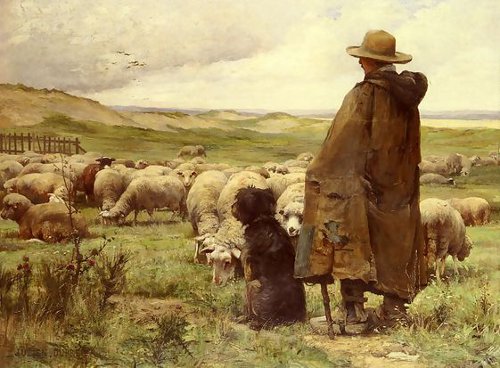
They stopped in a field at the foot of a hill, and saw, on the hillside above them, a shepherd who was blowing his horn to call his flock. After the sheep gathered to him, he led them to a nearby trough to water them. While they were drinking, he looked up to heaven and began to call out loudly, “Master of the world, You are so great! You created heaven and earth, and everything else! I’m a simple man; I’m ignorant and unlearned, and I don’t know how to serve You or praise You. I was orphaned as a child and raised among gentiles, so I never learned any Torah. But I can blow on my shepherd’s horn like a shofar, with all my strength, and call out, ‘The L-rd is G‑d!’” After blowing with all his might on the horn, he collapsed to the ground, without an ounce of energy, and lay there motionless until his strength returned.

Then he got up and said, “Master of the world, I’m just a simple shepherd; I don’t know any Torah, and I don’t know how to pray. What can I do for You? The only thing I know is to sing shepherds’ songs!” He then began to sing loudly and fervently with all his strength until, again, he fell to the earth, exhausted, without an ounce of energy.

-Yitzchak Buxbaum
“The Shepherd”
from his book, Light and Fire of the Baal Shem Tov
quoted from Chabad.org

You shall love the Lord your God with all your heart and with all your soul and with all your might.Deuteronomy 6:5 (ESV)

Buxbaum goes on to describe the shepherd’s further efforts to love and please God, some which may sound almost ludicrous, such as standing on his head and waving his feet wildly in the air, but we can learn a lesson from this shepherd and this tale of the Baal Shem Tov.

In all likelihood, no such shepherd ever existed and God never showed the Baal Shem Tov how to find him, but that’s not the point. The point is to learn something about us and about God and about how we’re supposed to connect our lives to Him. That’s what Chassidic tales are all about.

In our tale, the shepherd, who God tells the Baal Shem Tov worships Him better than the venerated Chassidic sage, is a Jew who was raised among Gentiles and who has absolutely no grasp of Torah, Talmud, or even the most basic understanding of halachah. He has no formal education in any of the mitzvot and although the shepherd knows he is to honor, worship, and give glory to God, he doesn’t know the first thing about how a Jew is supposed accomplish this.

Interesting, isn’t it.

This isn’t to say that we shouldn’t study and learn and strive to comprehend what God expects of us, but the information seems to be secondary to the desire, the will, and the intent of the person in worship. Moshe the Shepherd knew nothing but in a sense, he knew everything. He knew to take care of his sheep just as shepherds such as Moshe the Prophet, David the King, and our “good shepherd” Jesus the Rabbi knew how to take care of their sheep, even to the point of laying down their lives.

Moshe the Shepherd called to his sheep by blowing his horn which he compared to a shofar, and since the sheep responded by going to him, it shows he had certainly earned their trust. He gathered his sheep and watered them, and while watering them, cried out to God, blew his horn for Him, sang shepherd’s songs for Him, acknowledged God’s might and glory in the loudest voice he could muster, and he did all this with such zeal and energy that he collapsed, exhausted upon the ground.

And after seeing Moshe the Shepherd do this over and over again to the point of total collapse, we reach the dramatic conclusion of our tale:

What more can I do to serve You?” After pausing to reflect, he said, “Yesterday, the nobleman who owns the flock made a feast for his servants, and when it ended, he gave each of us a silver coin. I’m giving that coin to You as a gift, O G‑d, because You created everything and You feed all Your creatures, including me, Moshe the little shepherd!” Saying this, he threw the coin upward.

At that moment, the Baal Shem Tov saw a hand reach out from heaven to receive the coin. He said to his disciples, “This shepherd has taught me how to fulfill the verse: ‘You shall love the L‑rd your G‑d with all your heart, with all your soul and with all your might.’”

What does God want from you? The answer is amazingly simple:

He has told you, O man, what is good; and what does the LORD require of you but to do justice, and to love kindness, and to walk humbly with your God? –Micah 6:8 (ESV)

Without studying the Bible, Moshe the Shepherd knew what pleased God and he worshiped and pleased God with all his strength. How much more should we who study the Bible know and then do what pleases God. But do we try to please Him with all our might as did Moshe the Shepherd?

Torah is not about getting to the truth. When you are immersed in Torah, even while pondering the question, even while struggling to make sense of it all, you are at truth already.

Torah is about being truth.

-Rabbi Tzvi Freeman
“The Process”
Based on letters and talks of the Rebbe
Rabbi M. M. Schneerson
Chabad.org