Tag Archives: Christianity

Being Married to the Girl with the Jewish Soul

“To get to the point, our daughter has informed us that she has fallen in love with a non-Jew, and that they intend to marry. We have tried everything to dissuade her, but our arguments, appeals, threats and tears have all been to no avail. She now refuses to discuss the matter with us at all, and has moved out of our home. Rabbi! You are our only hope! Perhaps you can reach her; perhaps you can impress upon her the gravity of the betrayal against her people, her parents and her own identity in what she intends to do!”

“Would she agree to meet with me?” I asked.

“If she knew that we had spoken to you, she’d refuse.”

“Then I’ll go speak to her on my own.”

I took her address from her parents, and rang her bell that very evening. She was visibly annoyed to learn of my mission, but too well-mannered not to invite me in. We ended up speaking for several hours. She listened politely, and promised to consider everything I said, but I came away with the feeling that I had had little effect on her decision.

For several days I pondered the matter, trying to think of what might possibly be done to prevent the loss of a Jewish soul.

-Aaron Dov Halprin
“A Jew in Brooklyn”
from “The Life and Teachings of Rabbi Menachem M. Schneerson”
Translated from the Hebrew by Yanki Tauber
Chabad.org

The loss of a Jewish soul.

Derek Leman recently posted a link to a discussion “between Messianic Jew David Brickner and John Piper” concerning “supersessionism.” From a supersessionist Christian point of view, the only way for a Jewish person to become reconciled to God and the Jewish Messiah is to forfeit his or her Jewish soul.

The loss of a Jewish soul.

Is that really what the God of Abraham, Isaac, and Jacob would want?

I know Christians who would answer “yes” so fast that it would make my head spin. But then you see, I have a Jewish wife. She is a Jewish soul.

I’m not going to go into the whole “is she saved or not” argument, which is probably way over my head (though I frequently wade into waters that are way over my head). Of course, it would gladden my heart if she would come to know, or at least be re-acquainted with (as she was in years past) the Jewish Messiah, but in her view of Judaism, which is not unlike that of the Chabad, a Jew does not believe the “Messiah of the goyim” is the Jewish Moshiach.

The local Rabbi consults the Rebbe and he presents a solution. The solution to the problem of the Jewish girl who intended to marry a non-Jew was to tell her that there was a Jew in Brooklyn who was deeply troubled and could not sleep at night because of her intentions. The Jew (whether this story is true or not, I have no idea) was named “Rabbi Menachem Mendel Schneerson, known as the Lubavitcher Rebbe.” Although the girl lived in Brazil and had never met the Rebbe or even seen a picture of him, when the local Rabbi showed her a photo of the Rebbe, she exclaimed, “this man has been appearing in my dreams and imploring me not to abandon my people.”

The story ends without telling us what the girl does, but presumably, she breaks off her engagement to the non-Jewish fellow and returns to her family. Not very much like the story between me and my wife, but then we were married for many years before she became determined to enter into the Jewish community and decided that a Jew would never believe that Jesus was the Messiah.

I’ve been pondering this story for several days but only read the following tale just a few minutes ago (as I write this):

Rabbi Zalman Serebryanski, a senior chassid from Russia and dean of the Lubavitch Rabbinical College in Melbourne, Australia, once brought a girl to Rabbi Chaim Gutnick. “Please, help this girl convert,” he asked.

Rabbi Gutnick listened to the girl’s story. She lived in Balaclava, and from her youth had felt a strong attraction to Judaism. Whenever she heard stories of the Holocaust, she was deeply touched. She had been reading and studying about Judaism for a long time, and now wanted to convert.

Rabbi Gutnick was moved by her sincerity. Nevertheless, he did not want to perform the conversion. The girl was still living at home with her non-Jewish parents. Would she be able to practice Judaism in her parents’ home? Would her interest continue as she matured into adulthood? Since he could not answer these questions, he decided to let time take its course. If the girl was still interested when she was older, she could convert then.

Rabbi Gutnick’s refusal plunged the girl into deep depression, to the extent that she had to be confined to a hospital. The elder Reb Zalman, stirred by the depth of her feelings, continued to visit her from time to time.

After several weeks, he called Rabbi Gutnick, telling him of the girl’s condition and asking him whether perhaps he would change his mind because of the strength of her feelings.

-Eli and Malka Touger
“The Girl Who Had To Be Jewish”
from “The Life and Teachings of Rabbi Menachem M. Schneerson”
Chabad.org

This appears to be the opposite of the previous story. Here, a non-Jewish girl is pursuing Judaism to the point that she becomes severely depressed when the option is denied her. On the surface, it seemed conversion was impossible because her family was Anglican, but appearances can be deceiving. In this case, the Rebbe is once again consulted and the results are surprising.

Rabbi Gutnick did not receive an immediate reply to his letter. But at a later date, at the end of a reply to another issue, the Rebbe added: “What’s happening with the Jewish girl from Balaclava?”

Rabbi Gutnick was surprised. The girl and Reb Zalman had both made it clear that her family was Anglican!

He and Reb Zalman went to confront the girl’s mother. At first, she continued to insist that she was Anglican, but as the sincerity of the two rabbis impressed her, she broke down and told her story. She had been raised in an Orthodox Jewish home in England. As a young girl, she had rebelled against her parents and abandoned Jewish life entirely, marrying a gentile and moving to Australia. She had not given Judaism a thought since. She loved her daughter, however, and would not oppose her if she wished to live a Jewish life.

Once the girl’s Jewishness was established, Rabbis Serebryanski and Gutnick helped her feel at home in Melbourne’s Lubavitch community. She continued to make progress in her Jewish commitment, and today is a teacher in a Lubavitch school.

But Rabbi Gutnick still had a question: How did the Rebbe know she was Jewish? At his next yechidut (audience with the Rebbe) he mustered the chutzpah to ask.

The Rebbe replied that, at Reb Zalman’s urging, the girl had also written him a letter. “Such a letter,” the Rebbe declared, “could only have been written by a Jewish girl.”

Again, I have no idea if this story is true, but it is compelling, especially to me.

My wife’s mother was Jewish and her father was a non-Jew (both of my in-laws passed away many years ago). My wife’s mother, as a young woman, rejected her family in Boston and her Judaism and walked away from both, about seventy years ago. My mother-in-law met my father-in-law on a blind date and they subsequently married and had five children. At no time did the fact that my mother-in-law was Jewish ever come up in the family.

True, my wife as a child, knew that her maternal aunt and cousin, who lived in Southern California where she grew up, were Jewish, but she never made the connection that her mother was Jewish (and thus, her children) until my wife was a young woman herself.

Of her two sisters and two brothers, only my wife was driven to self-identify as a Jew and decades later, to pursue a life as a Jewish woman.

The girl who had to be Jewish.

These two stories collide because the girl who had to be Jewish married the guy who ended up being Christian.

The thirty years of our marriage haven’t always been easy for one reason or another. I think any couple who has been married for decades will say that there have been trials in their relationship from time to time. It’s not all romance and flowers. But typically, at a foundational level, the couple is united in terms of their basic worldview. If the husband is a Christian, usually so is the wife. If the wife is an atheist, usually so is the husband. You get the idea.

Jewish/non-Jewish interfaith marriages are at an all-time high as far as I understand the statistics, and this is a crisis in the world of Judaism. Particularly Orthodox Jews see the marriage of a Jew to a non-Jew (and especially a Christian) as the loss of a Jewish soul.

There are plenty of books, guides, and advice blogs that address interfaith marriages, but usually the couples being targeted arrive at their wedding day as fully realized Jews and Christians. As far as I know, all interfaith couples at my local Reform/Conservative and Chabad synagogues are Jew/Goy (non-Christian). Some of the non-Jews who have married Jews convert to Judaism. The issues are complex and troublesome but not insurmountable.

A few weeks ago, I was talking to my wife about some of the things that had happened at the First Fruits of Zion (FFOZ) Shavuot conference in Hudson, Wisconsin. One of the issues was having Christians who are already in a church or who would be willing to return to a church, be sort of “messengers” and advocates for a positive relationship with Jewish people within the Christian community.

My wife’s response was something like, “Are you thinking of going back to church?” I wish I could remember her exact words. They could have been, You aren’t thinking of going back to a church, are you?” But I’m not sure. I’m also not sure if the tone of her voice registered any distress or not. It’s hard to tell with her sometimes. She plays her cards “close to the vest,” so to speak.

If we had entered our marriage with her as a fully realized Jew and me as a fully realized Christians (we were agnostics/atheists on our wedding day and for many years afterwards) and if we agreed to still get married, we probably wouldn’t be experiencing what we are today with each other. I’ve asked her about this aspect of our relationship point-blank, but she remains elusive.

As nearly as I can understand my options, the best thing for me to do is to let her be “the girl who has to be Jewish” and for me to be a low profile Christian at home. I don’t think we have a “typical” interfaith marriage, if there is such a thing. I don’t know if she sees my faith as somehow threatening to her, but it isn’t something that she’s comfortable discussing.

PrayingBut I don’t want the world to lose another Jewish soul. Supersessionist Christianity wouldn’t care, and would walk all over her Jewish soul without feeling the slightest pang of guilt or remorse. However, that Jewish soul is my wife. She gave birth to three other Jewish souls who are my children. Like any husband and father, when confronted with a threat to the family, I become defensive and protective. I cannot let their Judaism be extinguished for the sake of someone else’s theology…not even my own.

For I could wish that I myself were accursed and cut off from Christ for the sake of my brothers, my kinsmen according to the flesh. They are Israelites, and to them belong the adoption, the glory, the covenants, the giving of the law, the worship, and the promises. –Romans 9:3-4 (ESV)

Paul was in anguish over his Jewish brothers and sisters who did not understand the blessings of Jesus the Messiah and who would be temporarily “cut off.” He was sincerely willing to become accursed and cut off from his own salvation for the sake of other Jews. It meant that much to him; his Jewish brothers and sisters meant that much to him.

Although I am not a Jew, how much more should my Jewish wife and children mean to me?

When Christians Do Good

We are seriously getting love aimed at us by a little church nearby. Out of the blue, the pastor had contacted me wanting to know if some of their members could do anything for us and he wouldn’t take no for an answer unless it really was no.

Today some amazingly nice folks showed up and hauled off to the dump our junk too big for our own vehicle, in one of the guy’s large truck.

Meanwhile, the ladies scoot in to do some cleaning while visiting with Heidi.

And meanwhile another great guy is walking me around our deck, explaining to me how he is going to prep the bannister and then paint it for us.

And they’re coming back tomorrow!

-Joe Hendricks

I embarrass Joe and Heidi on my blog a lot so I’ll try not to do it again today, but I want to show you how the church isn’t evil.

Joe is a cancer survivor and Heidi has multiple organs that are cancer involved including her brain. I know compressing their struggle into a single sentence seems rather cold, but I’ve written other blog posts about them, and I want to show you another picture today.

In spite of their amazing and horrendous struggles, their faith remains absolutely steadfast in God. They aren’t (as far as I know) involved in a church on a regular basis but rather, take God with them wherever they go, which is often into the mountains and onto the hiking trails near their home in Washington’s Puget Sound area.

I was surprised, very pleasantly so, when Joe posted the above-quoted statement on his Facebook page. It came out of a clear blue sky, as the saying goes. I guess that’s how miracles happen.

Maybe I’m overstating the point. After all, aren’t Christians supposed to do good things for other people without it being miraculous or even unusual? Not according to some atheists and people from other religious and philosophical traditions. All of the evil in the world is typically blamed on religion in general and Christianity in particular. Everything from the Lindbergh kidnapping to global warming has been blamed on Christianity (well, maybe not exactly). Even though some other spiritual people who disagree with the validity of Christianity claim to “respect our path,” there is little respect in describing us at our worst as pagan worshiping, war-mongering, racists.

I have to admit that I don’t often trust the church myself. I find the church rather intimidating. Beneath the facade of friendliness and good fellowship, what judgmentalism and harsh opinions do they harbor about me, a Christian who doesn’t go to church, who is married to a Jewish wife, has Jewish children, and who (if given a choice) prefers a siddur to a hymnal? On my blog, religious though it is, I am “flamed” more often by Christians than by atheists or people adhering to less traditional spiritual philosophies (though that could just be a result of me being beneath the notice of these other philosophies).

But this is exactly why Joe’s recent statement on Facebook is so important. The church can be a force for good in the world. The church can express itself as warmth, compassion, caring, and love. The church, often accused as merely a house of prayer and bigotry, can actually do something to help other people, such as hauling away junk, cleaning a house, doing some painting, and continuing to be a presence in the lives of two wonderful people who need the presence of God’s servants in their lives and in their home.

I know Christianity’s detractors will say that this is only one instance (and a rare one at that) of Christians doing something good. Then, these detractors will cite numerous examples from the mainstream news of Christians doing harsh, bigoted, rotten, and evil things.

But what makes the six o’clock news, Christians going a kindness (I don’t think Joe saw any cameras from CNN at his place the other day) or the Westboro Baptist Church (who I don’t consider Christian at all) desecrating the name of Jesus by picketing the funeral of another fallen American warrior? So who do atheists and various spiritual people look to when they want to get an example of who a Christian is?

OK, it’s not a simple as that, but sometimes it seems to be. Sometimes it seems like people just don’t want to see the good that Christianity does. They only want to point to its flaws, both in the present and historically. People seem to want to define themselves and whatever philosophy they follow in terms of who they oppose and the church makes a convenient target to oppose.

But they are also, at their best, a reflection of what they were taught by Jesus Christ. Visit the sick. Feed the hungry. Comfort the grieving. Make peace between one person and another. And although it doesn’t say so in the Bible, clean someone’s house when they’re too sick to do it themselves. Haul away the garbage that is too big for someone else to haul away. Look around someone’s home, notice that their deck needs painting, and then paint it.

In other words, do whatever good that needs to be done if for no other reason than because God is good and it’s the right thing to do.

If you have something against Christianity, you can react two ways. You can complain about Christians, or you can do what the best of them do. You can help people who need help instead of elevating yourselves by pointing at what the worst of those who claim to be Christian (but by their actions, show themselves to be anything else but) are doing.

You therefore must be perfect, as your heavenly Father is perfect. –Matthew 5:48 (ESV)

I don’t care who you are. If you want to be good, do good.

Grandmother of Valor

Rav Moshe Aharon Stern, zt”l, explains that determining who has attained true greatness is no simple matter. “There is no middle way when dealing with the absolute truth. Either something is true or it is false. But how can one tell if someone is truly G-d fearing and whether he is a true scholar? We find an answer in an aggadata brought on today’s daf. In Niddah 33, we learn that when Rav Pappa visited a certain city and wished to determine whether there was a G-d fearing scholar to be found there, he addressed his question to a certain grandmother who resided in that place. He asked, ‘Is there a talmid chacham in this city?’ She immediately replied that there was. ‘There is a talmid chacham called Rav Shmuel. If only I could be like him!’

“Rav Pappa thought to himself, ‘Since she blesses herself to be like him, he obviously has yir’as shamayim.’ One may wonder why he chose to rely on this woman’s reply, of all the people of the town. We can understand this in light of a different statement recorded in the name of the sages. In Berachos we find that women tend to understand the true character of their guests more than men. G-d created women with a special sense to recognize falsehood immediately. This is why Rav Pappa asked a grandmother. He wanted a true answer and figured that, in that town, his best chance of getting one was from a woman!”

Daf Yomi Digest
Stories Off the Daf
“Women’s Intuition”
Niddah 33

While you may assign little reliability to this commentary, I think there may be some truth in it. In this age of “everyone has to be equal,” we tend to interpret that statement as “everyone has to be the same.” Of course, there are obvious physical differences between men and women but even those are coming under scrutiny and being discounted as “not that different.” For instance, this recent article published at The Good Men Project, a website that supposedly gives us a “glimpse of what enlightened masculinity might look like in the 21st century,” (according to their About Us page) seems to say that “masculinity” can only be “enlightened” by “confessing” that men and women are almost completely alike, with only minor differences in mental, emotional, and physical structure and functioning.

Please understand that I’m not promoting sexism or exploitation of women by men in framing my comments this way. Quite the opposite. I’m saying that men and women can and should have equal opportunity to resources and be treated with equal honor and respect, but that doesn’t mean men and women have absolutely no intrinsic differences.

However, in the viewpoint of Christianity, Paul may appear to muddy the waters just a little bit.

There is neither Jew nor Greek, there is neither slave nor free, there is no male and female, for you are all one in Christ Jesus. –Galatians 3:28 (ESV)

In certain areas of Christianity, the phrase “neither Jew nor Greek” (with “Greek” often interpreted to mean “Gentile” or “non-Jewish person”) seems to indicate that whatever roles, functions, and covenant differences that once existed between the Jewish and non-Jewish disciples of the Jewish Messiah were eliminated because of the death and resurrection of Jesus Christ. But did Paul also mean that the roles and functional differences between males and females were also eliminated?

Probably not, since in context we see that Paul is referring to different groups having equal access to being “Abraham’s offsprings” through the promise of Christ. Slaves were still slaves, freemen were still free, men were still men, and women were still women. It is interesting to note that since Paul declared both men and women having equal access to the “resource” of Christ, he may appear to be somewhat “feminist” in his approach to the men and women of his day.

That’s not how the Bible usually depicts him.

Derek Leman recently posted an article on this blog called, Now a Non-Jewish Messianic Female Rabbi/Pastor. This topic has spawned a lively discussion in the comments section about the nature of the rights of women in the early first century church. The rights and restrictions applied to women in the church today seem to hinge on whether we see the letters of Paul as eternal truths or as contextually limited instructions to specific groups. According to a series of Leman’s comments on his blog, he supports the latter interpretation.

You learned from your background to read the Epistles like unchanging halakhah. Guess what? They’re not. They are specific advice to specific congregations and in particular situations. There … is … no … unchanging … law … against … female … leaders.
…..

(1) Letters from apostles to congregations do not establish new timeless commandments.

(2) Female leadership was accepted in Israel and by the apostles (Priscilla, Phoebe, Junia, Philip’s daughters).

(3) Apostolic instructions for various congregations are not uniform because there is no one model of congregational structure that is a pattern in heaven (an absolute divinely commanded model).
…..

Okay, let’s start with your understanding of the epistles. You think they are new Torah establishing new timeless laws which must be followed for all time, right? I said they are not. I said they are letters about specific congregations in specific places and times.

So, step 1. Is there a law before Paul write 1 Timothy (and/or 1 Corinthians) that women may not have leadership? Please tell me where it is.

Step 2. So I am supposed to believe that God waited until one of Paul’s later writings before revealing a new commandment: woman, thou shalt not teach or have leadership?

Step 3. If you say that the letters of the apostles are timeless commandments, how do you understand numerous scriptures like: 2 Tim 4:13; 2 John 10; 1 Cor 7:8; 1 Cor 7:26-27 (are we still in that “present distress” Paul mentioned?); 1 Cor 11:5 (it means a veil over the face, not a hat); etc.

Step 4. Tell me how the epistles “command” a congregation to be structured. What must the leadership structure be? Are the various letters consistent?

Step 5. Or you could come to realize epistles are not “new Torahs” but advice usually based on Torah and the teaching of Yeshua to specific congregations in particular situations. We no longer live in a world where slavery is widespread (in the West, I mean); so 1 Cor 7:21 makes a little less sense now. There are no bad connotations for women not wearing veils in our society (so no Messianic or Christian burkhas necessary). So we should read epistles differently, as applications of Torah and Messiah to specific situations. We can learn from the way these were applied to specific situations. But, back to 1 Timothy 2, how do we justify the idea that God was laying down a new commandment here? Is this the way God gives commandments? Or is it more reasonable to assume this is something that fit the situation of Paul’s congregations in Paul’s time?
…..

I’m not sure how this debate is going to turn out and my goal for this “meditation” isn’t to “join the fray.” I only want to show how devisive the issue of the role of women in the church and synagogue remains in the arena of religion.

Now let’s move one step backward from this debate and take a look at two related viewpoints of women in Judaism. The first is from Proverbs 31:10-31 which describes “the woman who fears the Lord.” This is the basis for the other related perspective of women in Judaism, referred to as Eishet Chayil or “Woman of Valor,” which is a blessing typically sung in Jewish homes on Erev Shabbat.

The English translation of the first part of the song says:

A Woman of Valor, who can find? She is more precious than corals.
Her husband places his trust in her and profits only thereby.
She brings him good, not harm, all the days of her life.
She seeks out wool and flax and cheerfully does the work of her hands.

This may not fit your picture of a completely liberated, self-actualized, feminist woman of the 21st century, but we do see that Judaism has a history of honoring and valuing women within the community. That “valuation” may have become distorted over time, relative to the history of patriarchal rule we find in both traditional Christianity and Judaism, but I think we should re-examine those assumptions. Regardless of your views about whether a woman should teach men or should lead a congregation, we have ample enough evidence to believe that women tend to be more sensitive to the needs of the family and community, including their spiritual needs.

When I regularly attended a congregation, I couldn’t count the number of women who would come to services bringing their children and, in some cases, grandchildren with them because they wanted the children to honor God, while their “men-folk” remained at home or were off doing some chore or playing some sport. Of course, this isn’t universally true, but the anecdotal evidence is so ubiquitous that it has become cliche. A classic example of this phenomenon on the web is the Spiritually Unequal Marriage blog, which provides a forum for Christian women to interact and share their experiences being married to men who don’t share their faith.

In a way, this seems to lead us back to our “story off the daf” and the grandmother who could immediately identify the most “God-fearing scholar” in her town. Consider that the fellow she identified might not have had the reputation of being the most “God-fearing scholar” in the eyes of the town’s populace, but even someone humble and unassuming in his piety wouldn’t escape the detection of a true “woman of valor,” especially one who has lived many years, raised children and grandchildren, and has the experience and wisdom to see past the surface of a man and into his heart.

The differences between men and women go all the way back to Genesis and reflect the design of God for each of us. While human beings have imposed different roles, responsibilities, and restrictions onto males and females over human societial and cultural history, I believe there is something that God programmed and hardwired into humanity that serves to define us as men and women. Modern secular, progressive thought sees sex differences (as opposed to gender differences, which can become much more complicated) as socially imposed and with those impositions removed, imagines that men and women are not only be equal but hemogenous, and exhibit few if any differences.

While I believe (I state this again for clarity) that men and women should have equal access to resources in society and have been designed under Heaven to have equal access to God, that equality doesn’t presuppose or require homogenization. Replacing “him” and “her” with “it” neither elevates women in a social and cultural context nor reflects the true honor of women as originally established by God.

Differences aren’t bad and being different doesn’t mean you are unequal. It can mean that you are special and have a purpose to fulfill that cannot be accomplished by anyone else.

Sometimes only a grandmother can tell you where to find a talmid chacham in her town.

Korach: Who is Speaking to Your Heart?

In the Torah portion Korach we read how Korach led a band of 250 men in a rebellion against Moshe and Aharon. Underlying their revolt against Aharon’s High Priesthood was the charge: “All the people in the community are holy and G-d is in their midst; why are you setting yourselves above G-d’s congregation?” (Bamidbar 16:3.)

From Moshe’s response, (Ibid. verse 10.) “…and you seek priesthood as well,” we readily perceive that Korach and his band desired to become priests. This being so, their argument that “All the people…are holy,” and nobody can set himself above anybody else seems to contradict their desire to be above others by obtaining priesthood.

“A Lesson in Priesthood”
Based on Likkutei Sichos Vol. VIII, pp. 116-118
Commentary on Torah Portion Korach
The Chassidic Dimension series
Chabad.org

Rav Yisrael of Ruzhin, zt”l, gives a fascinating explanation of a famous statement on today’s daf. “Our sages say that today the yetzer hara says to do one sin, tomorrow another, until one finally falls to idolatry. This statement does not mean that the yetzer hara increases the sins that one indulges in from day to day. It means that the yetzer hara pushes a person who falls to keep falling in the same manner day after day, time after time. Even this is enough to cause one to worship idolatry eventually, God forbid!

“This can be compared to a sick person whose weakened constitution does not improve. If his system does not overcome what ails it, he gets sicker and sicker and eventually he reaches the point where he is dangerously ill.” Rav Shalom Schwadron, zt”l, offers his own insight here. “It is interesting that the yetzer doesn’t demand that one stop fulfilling mitzvos; it merely pushes one to follow his instructions. He wants to bring a person to a place where he will fulfill only that which interests him. A student in yeshiva will learn Torah until very late at night, missing out on a meaningful shachris. Another person will express his zealousness at the expense of fulfilling his obligations to his fellow human beings.

“The yetzer wants to be in the driver’s seat; that one should only do what interests him in the manner that he prefers. He knows that a person who only acts when he is inclined to do so will eventually stop fulfilling the mitzvos. We need to recall that the main thing is to fulfill the mitzvos of the Torah because this is the will of the Creator. We must not be swayed by the compelling-seeming logic of the yetzer hara which causes one to forget God.”

Daf Yomi Digest
Stories Off the Daf
“In the Driver’s Seat”
Niddah 13

Here’s the key portion of the above-quoted lesson:

He wants to bring a person to a place where he will fulfill only that which interests him.

By the time I finished reading this “story off the Daf,” I found that the conclusion didn’t match up with what I thought it would be at the beginning of the story. I thought fulfilling certain of the mitzvot would be contrasted against overt sin, such as a person who fulfills the mitzvah of feeding the hungry and then turns around and cheats his business partner. I didn’t think it would be focusing on fulfilling one mitzvah, the one that fits your personal desires, at the expense of other equally worthy mitzvot.

We’ve seen this sort of thing before:

Then Pharisees and scribes came to Jesus from Jerusalem and said, “Why do your disciples break the tradition of the elders? For they do not wash their hands when they eat.” He answered them, “And why do you break the commandment of God for the sake of your tradition? For God commanded, ‘Honor your father and your mother,’ and, ‘Whoever reviles father or mother must surely die.’ But you say, ‘If anyone tells his father or his mother, “What you would have gained from me is given to God,” he need not honor his father.’ So for the sake of your tradition you have made void the word of God. –Matthew 15:1-6 (ESV)

“Woe to you, scribes and Pharisees, hypocrites! For you tithe mint and dill and cumin, and have neglected the weightier matters of the law: justice and mercy and faithfulness. These you ought to have done, without neglecting the others.” –Matthew 23:23 (ESV)

We see a couple of important points taught by the Master relative to the story off the Daf, and both are related to hypocracy and setting human priorities on what we choose to do for good.

In the example from Matthew 15 (yes, I know this passage is typically used to say Jesus did away with man-made traditions and only endorses obeying pure Torah law, but he was perfectly fine with many other aspects of the normative halachah of the Judaism of his day, so I consider his main “rant” against hypocrisy, not tradition) , Jesus turns on his critics and accuses them of neglecting the commandment to honor parents by committing the money that could have been used to support their parents to the Temple. Outwardly, the Pharisees involved may have appeared holy, but in their neglect of their parents, they were reprehensible.

The short quote from Matthew 23:23 shows us something similar. Certain Pharisees were again, outwardly appearing as holy by their tithes but in the process, they completely ignored what Jesus called, “weightier matters of the law” such as the principles of “justice and mercy and faithfulness.” I should note that Jesus did not say one was really better than the other and told his audience that they should have performed their tithes without neglecting the other mitzvot.

But what does that have to do with us? On the one hand, these arguments could support the classic One Law position in the Hebrew Roots movement which states that non-Jewish people, when we become Christians and are “grafted in” (Romans 11) to the Jewish root, are obligated to the identical set of commandments as the Jews are, and we should not pick and choose which ones to obey. It would appear as if Jesus is telling us to not pick and choose as well, but to obey all of the 613 commandments, or at least as many as can be obeyed without the existence of a Temple, a Levitical priesthood, a Sanhedrin court system, and (for most of us), while living outside the Land of Israel.

On the other hand, we could use the same texts to consider just what our (I’m speaking to Gentile Christians now) true obligations are to God and whether, in our performance of the mitzvot, we are doing what God actually wants us to do, or only obeying what we want, what makes us feel righteous, and what makes us look “cool” in the eyes of our peer group. Are we falling into the same trap as Korach, Heaven forbid?

I know that sounds a little harsh, but I’ve encountered more than one non-Jewish person in the Hebrew Roots movement who seems really pleased with his tzitzit, his Hebrew prayers, and how he laid tefillin. OK, I want to be fair and say that there are many who subscribe to the One Law position who sincerely believe this is the one and only way a Gentile can please the God of Heaven, and these folks feel really picked on when people like me say that obeying many of the Torah commandments is a choice and not an obligation (your behavior doesn’t have to change in any way just because it’s voluntary rather than obligatory). But consider this.

When you say that non-Jewish believers in the Jewish Messiah are obligated to obey the full yoke of Torah, your saying that it is a sin for any Christian to fail to observe the full range of the mitzvot. You are condemning the vast, vast majority of Christians who have lived, loved the Master, observed the “weighter matters of the Torah,” and died, based on your personal interpretation of the Bible. By saying you are obligated to the Torah and that you are fulfilling the Torah, you aren’t equalizing conditions between Christians and Messianic Jews but (whether you mean to or not) elevating yourself above your brothers and sisters in the church.

Let’s continue the Chabad commentary on Korach. I think you’ll see that he and his followers were doing something very similar.

The Kohanim , the priestly class, differed from the rest of the Jewish people in that the Kohanim were wholly dedicated to spiritual matters. This was especially true with regard to the Kohen Gadol , the High Priest, who was commanded “not to leave the Sanctuary.” (Vayikra 21:12.)

Their apartness from the general populace notwithstanding, the Kohanim in general, and the Kohen Gadol in particular, imparted their level of sanctity to all the Jews. Thus we find that Aharon’s service of lighting the Menorah in the Sanctuary imparted sanctity to all Jews, and enabled them to reach Aharon’s level of service and love of G-d. (See Likkutei Torah , beginning of portion Beha’alosecha.)

You may consider this a bit of a stretch, but I think the unique standing and “choseness” of the Jewish people and their obligation Sinai covenant also imparts a “level of sanctity” to we who are grafted in from among the nations. I think there’s a relationship to Israel being a light and to those of us who have seen and been attracted to that light.

I’ve tried talking about this before, especially in blog posts such as Redeeming the Heart of Israel, Part 1 and Part 2, where we see a partnership between the Jewish and Gentile disciples of the Master that is complementary and interwoven, and I’ve tried to show that this partnership does not require a fused or homogenous identity between Christians and Jews in the Messianic realm.

Granted, I believe this manner of thinking is still in its formative stages and requires a great deal more research, especially in Scripture, but we see a classic example in the Korach rebellion of how a group desiring to separate themselves from their fellows and assume an identity not their own results in disaster. In the end, Korach and the rebels didn’t really believe that all of Israel had the right to become priests.

Korach and his band’s complaint that “All the people…are holy,” however, did not contradict their own desire for priesthood, for they desired a manner of priesthood totally removed from the rest of the congregation.

This manner of priesthood would not cause them to feel superior to the rest of the Jewish people, a superiority that resulted from their imparting holiness to them, for in their scheme of things they would not impart holiness to other Jews — they would remain totally separate and apart.

But Korach and his band were badly mistaken: It is true that there are different categories of service — Jews who are solely occupied with spiritual matters, and other Jews whose task it is to purify and elevate the physical world through the service of “All your actions should be for the sake of heaven,” (Avos 2:12.) and “In all your ways you shall know Him.” (Mishlei 3:6.)

Putting all this together, we can paint a picture of those Gentiles who want to assume a full “Jewish” identity without having to convert to Judaism as not demonstrating equality between Jews and Gentiles in the covenant, but perhaps setting themselves above their fellow Christians by taking on Jewish identity markers. I’m sure that many One Law proponents aren’t motivated in this direction, but ask yourself if this could be describing you.

If you, as a Christian (non-Jewish disciple of the Jewish Messiah) in the Hebrew Roots movement, choose to take on additional mitzvot that could be considered specific to Jews, please study up on them first, including the relevant halachah for performing the mitzvot. Shooting from the hip probably isn’t as effective way to perform any of the Torah commandments as using the accepted standards established in normative Judaism.

From my personal perspective, a Gentile publicly appearing as a Jew, even with completely pure motives, is like walking into a room full of trapdoors and tripwires. You might be successful in your efforts, but more than likely, once you step outside your local congregations and into the larger world, you could encounter unanticipated conflicts. Be sure whatever you do is actually what God wants and not just something that makes you feel special.

I’m sure no one wants to make Korach’s mistake. Ask yourself who or what is speaking to your heart?

Addendum: This all gets more complicated when you factor in people who claim a Jewish identity without Jewish parents and exist outside of Messianic Judaism, as we see in this Huffington Post article. One person has blogged about her experiences as a “Jewish” non-Jew, and Derek Leman has offered his own commentary. True, it doesn’t have a direct relationship with this week’s Torah portion or the matter of any Christian’s perceived obligation of Torah, but it is very much relevant to the “identity wars” between Jews and non-Jews, so I include these references here.

Good Shabbos.

Collision

Criticizing another person is not out of the question. It’s just that there are a few conditions to attend to before you start.

The first condition is to make sure this person is your close friend. Those are the only people worth criticizing—not just because they may actually listen, but also since you run a lower risk of making them into your sworn enemies.

If this person you feel an urge to criticize is not yet your close friend, you’ll need to spend some time with him. Find out everything that’s good about him, and go out of your way to help him out. Eventually, a real friendship will develop.

Also, you’ll need to ensure that this person has the same knowledge, understanding and perspective of right and wrong as you do before you can attack his decisions. If he doesn’t, you’ll need to spend some time learning and discussing together until you see each other’s point of view.

Once the two of you are in the same space in Torah and observance of mitzvot, and he’s your good friend to boot, then it’s okay to criticize—if necessary. And if you can remember what there was to criticize.

-Rabbi Tzvi Freeman
from How to Criticize and More on How to Criticize
Based on letters and talks of the Rebbe
Rabbi M. M. Schneerson
Chabad.org

“Any fool can criticize, condemn and complain and most fools do.”

-Benjamin Franklin

I was recently involved in a Facebook conversation started by a fellow who took exception to the King James Version of the Bible and, by inference, all of Christianity. He was very nice about it, but just because someone says “please” and kisses you on the cheek before punching you in the face doesn’t mean it doesn’t hurt.

OK, that’s a little unfair and he did say something about his motivation for “sharing” the photo criticizing the KJV Bible:

…if something can’t stand inquiry at every level, do we have any business basing huge belief systems on it?

I suppose that’s true and there are many people, both atheists and Christians, who spend a great deal of time examining the Bible and offering critical analyses of the text. I don’t mind serious scholars investigating the writings of Judaism and Christianity and providing illuminating and challenging questions, but at one point does the motivation of those who criticize people of faith become less than scholarly?

And then there’s reddit or more specifically, the sub-reddit on atheism. For those of you who don’t know, reddit is a social news website where the registered users submit content, in the form of either a link or a text “self” post. Other users then vote the submission “up” or “down”, which is used to rank the post and determine its position on the site’s pages and front page. (source: Wikipedia) Sub-reddits are pages within the larger whole that address specific topics of interest, such as music, movies, science, and atheism. However, the atheism sub-reddit isn’t defined so much by what atheists believe as by what they’re against which is, for the most part, Christianity (although the atheist sub-reddit page is probably doing it wrong).

I only bring up reddit because I read it daily and because they go out of their way to bash Christians daily. The fact that popular online social venues regularly criticize not only religious beliefs but religious believers shouldn’t exactly come as a shock. After all, atheism is probably the predominant “religion” in the west today (I say that last part somewhat ironically).

Besides, weren’t Christians told to expect this sort of behavior?

Blessed are you when others revile you and persecute you and utter all kinds of evil against you falsely on my account. –Matthew 5:11 (ESV)

Count it all joy, my brothers, when you meet trials of various kinds, for you know that the testing of your faith produces steadfastness. And let steadfastness have its full effect, that you may be perfect and complete, lacking in nothing. –James 1:2-4 (ESV)

However, I’d be remiss if I didn’t consider the other side of the coin. Just why is there so much criticism being directed at Christianity? There are a few reasons.

You can’t really be an atheist unless you are defining yourself against a theist, someone who believes in a god or gods of some sort. Since belief in a god or gods requires a belief in the supernatural, something you can’t examine objectively using the scientific method, atheists who are scientifically oriented define themselves in opposition to religious people who are considered irrational, superstitious, or just plain stupid.

Atheists who may or may not be scientifically oriented have another, wider motivation for not only refuting religion, but particularly being really angry at Christianity. Christians tend to be viewed (and not unjustly in many cases) as being pushy, self-righteous, opinionated, bigoted, hostile, narrow-minded, and generally “in-your-face” about what they believe.

The basis for some of this is “the great commission,” which we find in Matthew 28:19-20:

Go therefore and make disciples of all nations, baptizing them in the name of the Father and of the Son and of the Holy Spirit, teaching them to observe all that I have commanded you.

In other words, Christians are commanded to carry the “Good News of Jesus Christ” to everybody who will listen. That’s fine as far as it goes. If someone is curious about me and my faith, I’ll be glad to explain to them why I believe what I believe and to suggest (if they’re still willing to listen) that a life lived in relation with our Creator has many benefits.

But it doesn’t stop there for many believers.

I mentioned before that atheists tend to define themselves in relation to who they’re against. So does Christianity. Christianity defines itself against sin, or so it says. Christians pursue this definition to the degree that they can be very outspoken (depending on the denomination and how conservative they are) against the values and people currently held in high esteem by popular western culture.

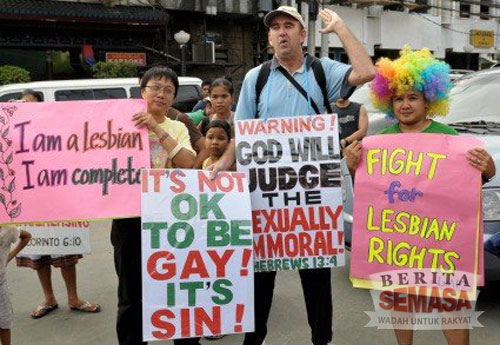
The current popular debates between Christianity often are not based on whether God exists or not, but on the so-called “culture wars” between what some consider Christian values and the more popular, progressive viewpoint. These topics tend to center around social issues such as the rights of women, people of color, and particularly (since it’s been in the news a lot lately) gay rights and what is referred to as “marriage equality.”  Each side accuses the other of heavy-handed tactics in promoting their agenda and attempting to manipulate the minds and beliefs of the next generation.

As an example, I’m presenting an interesting photo (no, not the one below, you’ll have to click the link) I found on the atheist sub-reddit page. Although there’s no explanation regarding the photo of this person’s facial bruise and his bumper sticker, since it is posted on the atheist sub-reddit page, I can only assume it’s meant to indicate that a person of faith, possibly a Christian, assaulted this man because the person of faith believed the man in the photo was gay.

This plays into the reputation Christians have in the secular world relative to gays (even though the Bible doesn’t specifically command a Christian to give a gay man a black eye). To say that this particular (assumed) example of “Christian hostility” is unfair and possibly inaccurate is obvious, but to be fair, we have been rather oppressive at times in our treatment not only of gay people, but of any person who doesn’t measure up to the particular standards of the church, however those standards are understood.

In other words, religious people and non-religious people are capable of being unfair and critical. Religious people and non-religious people are easily offended and need to strike back against the person or organization that offered the offense. Religious people and non-religious people believe their particular system of beliefs are right, correct, represent basic reality, and are not only fact but truth.

What do religious people and non-religious people have in common.

They’re all people.

It’s important to remember (curb your dogma for a second) that we all operate inside of systems. Having a particular religious orientation means you are operating within that system and are subject to all of the conditions imposed by that system. Having an orientation toward atheism means you are operating within that system and are subject to all of the conditions imposed by that system. Sure, religion tends to believe that it is a container for truth while atheism tends to believe that it is a container for fact, but both are systems and the people within them will go to great lengths to defend their beliefs including attacking people who hold differing beliefs.

If you’re a Christian and an atheist says or does something that offends you, hurts your feelings, or makes you angry, that happens because you are human. Your faith is important to you and when it’s attacked, it’s like someone has just jabbed you in the eye with a sharp stick. If you’re an atheist and a Christian says or does something that offends you, hurts your feelings, or makes you angry, that happens because you are human. Your beliefs are important to you and when they’re attacked, it’s like someone has just jabbed you in the eye with a sharp stick.

I’m not here to “prove” that Christianity is right or wrong or that atheism is right or wrong. I’m here to say that we are spending a tremendous amount of time defining ourselves by who and what we are against and going out of our way…all of us, to hurt as many people as we can in the process, whether we think that’s our motivation or not.

Since atheism has no formal moral or ethical code attached to it, I can’t hold atheists to any standard of right or wrong. If an atheist wants to go out of his or her way to hurt a Christian, Jew, Muslim, I can’t blame them too much. After all, they are only acting according to human nature.

However, Christianity does come with a formal moral and ethical code (which varies a bit depending on denomination) and I can (and will) hold Christians to a moral and ethical standard. If you’re a Christian and you’re going out of your way to hurt someone just because you can, I’m going call you on it. That’s not “church bashing,” that’s calling believers to return to behaving as we were taught by Jesus and his example.

As I recall, when Jesus became angry, he was usually criticizing the religious authorities around him, not unbelievers and sinners. He used to hang out with sinners, eat with them, talk with them, and provide charity for them. If he defined himself at all, it was in comparison to the standards of the One who sent him, not against the people around him.

So Jesus said to them, “Truly, truly, I say to you, the Son can do nothing of his own accord, but only what he sees the Father doing. For whatever the Father does, that the Son does likewise. –John 5:19 (ESV)

No one is born a Christian. Unlike Judaism, we don’t have a biological, genetic, inheritance from our “fathers.” We each come to know God through the example of our Master and teacher at some point in our existence. Then we spend the rest of our lives trying to figure out what that means by acting out of our understanding and Christ’s example. We don’t always do such a great job of it, unfortunately.

But since no one is born a Christian, that means anyone who isn’t a Christian might come to faith one day. If we are obligated to share our “good news” with everyone else, we need to make sure we are really sharing good news and not criticism, judgmentalism, hostility, and bigotry. We must remember that we have been taught to share the good news by feeding the hungry, clothing the naked, and visiting the sick and imprisoned, and there are penalties against us when we fail to do so. (Matthew 25:31-46)

Rabbi Freeman said, The first condition is to make sure this person is your close friend. Those are the only people worth criticizing—not just because they may actually listen, but also since you run a lower risk of making them into your sworn enemies. In other words, all of the time we (believer, atheist, whatever) spend on the web criticizing other people and their beliefs isn’t going to change anything. No one will listen let alone change their minds just because someone they’ve never met thinks they’re either godless or superstitious.

I have no hope of changing anyone as a result of today’s “morning meditation,” either. But who knows? Maybe by advocating that all parties put down their guns, knives, and boxing gloves, maybe we can temporarily arrive at an uneasy truce. In the end, we all want to know the same things.

Who am I and what am I doing here? Is this all there is, or is there something more?

I’m pretty sure bashing people who don’t share our belief system won’t answer those questions.

This is the first part of a series that continues in Repairing Life.


Underlying Reality

At the core of all our thoughts and beliefs lies the conviction that the underlying reality is wholly good. That evil lies only at the surface, a thin film of distortion soon to be washed away by the waves.

-Rabbi Tzvi Freeman
“Essential Good”
Based on letters and talks of the Rebbe
Rabbi M. M. Schneerson
Chabad.org

That hardly seems likely. Given the record of wars, crime, and rampant injustice that is written all over human history, it’s extremely difficult to reconcile all of that with the statement, “reality is wholly good.” For me, it’s as difficult as believing the following to be true:

Despite everything, I believe that people are really good at heart.

-Anne Frank

I still experience astonishment when imagining how a young Jew in the middle of the Holocaust could pen such a statement. Didn’t the Nazis teach her that humanity is essentially evil?

Of course religious Jews and Christians see the nature of humanity as fundamentally different. Jews see our nature as basically good but influenced by an inclination for evil while Christians see that the fall of Adam resulted in the nature of human beings becoming wholly evil and irredeemable without Jesus Christ. Jews believe people have an active part in working toward repairing themselves and their damaged world while Christians believe we are totally helpless and only through Christ is there any hope at all.

I believe Jesus was serious when he said:

Nevertheless, when the Son of Man comes, will he find faith on earth?” –Luke 18:8 (ESV)

Our modern religious world isn’t in any better shape than the secular world surrounding us. We are subject to the same pressures, frailties, passions, temptations, and lusts as the rest of humanity. Christians like to believe we are somehow immune from those forces thanks to the grace of Jesus Christ but scandal upon scandal in the church that has made the headlines over the past several decades shows us otherwise. Dear Christian, if God were to open your heart and show every dirty sin you’ve ever committed in living color on national television, would the reputation of God (already rather shaky in a progressive secular politically correct society) topple completely in the eyes of the common person?

Many religious and inspirational pundits, including Rabbi Freeman have said in one way or another that, “you are what you think,” but what you think won’t affect a morally and ethically corrupt reality.

To know that this world is not some wild jungle where whoever is stronger or richer or smarter can abuse and destroy without regard for those beneath them — this is not a matter of religion or faith, particular to one people or group of believers. This is the underlying reality — that this world has a Master, and it is not any of us.

A peaceful society can only endure when it is built upon that which is real.

-Rabbi Tzvi Freeman
“Getting Real”
Based on letters and talks of the Rebbe
Rabbi M. M. Schneerson
Chabad.org

There are times when I can see the attraction of retreats and monasteries; of withdrawing into a cloistered and sheltered environment isolated from the hideousness of the world around us. In truth though, what I seek most when I have such thoughts, is to be isolated from the corruption within myself. At least if I say or do something that is considered unacceptable to the irreligious and progressive world, in an isolated sanctuary, there are a limited number of people who will be impacted and hopefully, I will be my only victim.

Unfortunately, there’s nowhere to go and no place to hide, even from myself, and between the options of seeking hope and expecting total, catastrophic failure in my life, I can only sit and wait to see which one will endure and which one will perish. Anne Frank had hope and she died anyway. The Nazis were ultimately defeated and the death camps turned into testaments warning the next generation against evil, but antisemitism, Jew hatred, and the desire among almost all the nations of the world (and all the major news agencies) to exterminate every living Israeli (Jewish) man, woman, and infant are still unashamedly rampant.

In spite of all this, Rabbi Freeman still has the nerve (I’m speaking tongue-in-cheek right now) to post a series of articles called meditations on happiness. Even if an individual can somehow achieve a state of happiness or (amazingly) joy, the world should just surround that person with its very nature and crush that spirit to a bloody death, as a serpent might crush the eggs of a swan. But then Rabbi Freeman also said this:

It’s not that Abraham and Moses gave the world the ideas of morality and value of life. These ideas were known to Adam and to Noah — only that with time, humankind had mostly forgotten them.

What these giants brought to the world was a greater idea: That the values essential to humanity’s survival can only endure when they are seen as an outcome of monotheism. They must be tied to an underlying reality, and that reality is the knowledge of a Oneness that brings us into being.

One of my favorite episodes of the TV series M*A*S*H (1972-1983) is called Dear Sigmund. Psychiatrist Sydney Freedman (played by Allan Arbus) is undergoing what you might call a “crisis of faith,” but in his case, it isn’t faith in God but rather, faith in his abilities as a psychiatrist. One of his patients has committed suicide, so he “retreats” to the 4077 and amid the insanity typical among people like Hawkeye, BJ, and Klinger, he starts writing a letter to the founder of modern psychoanalysis Sigmund Freud. This doesn’t go unnoticed:

Capt. B.J. Hunnicut (Mike Farrell): We couldn’t help but notice that you came for the poker game and stayed two weeks.
Maj. Sidney Freedman: Well, I just wanted a little vacation.
Capt. Benjamin Franklin “Hawkeye” Pierce (Alan Alda): Sydney, Venice is a vacation. The Swiss Alps is a vacation. This is a fungus convention in Atlantic City.

At one point in his letter to Freud (who at that point in history, was already deceased), Sydney crystallizes the alternative to rage or despair in the face of hopelessness:

Anger turned inwards is depression. Anger turned sideways… is Hawkeye.

I suppose that was the whole point of the eleven year run of the M*A*S*H series. In the face of something has horrible and crazy as war, it is still possible to survive it and find a third alternative besides depression and anger…controlled insanity.

Well, to be fair, a wacky sense of humor.

I used to believe that the last coping mechanism that would fail me when all others went the way of the Dodo bird would be humor, but that too becomes buried along with everything else when the weight of both the world and my personality descend upon me. But then neither Hawkeye or Sydney relied on anything like faith in God (which was already unpopular in 1976 when the “Dear Sigmund” episode first aired).

At the end of the episode, Sydney’s “vacation” at M*A*S*H enabled him to realize that a small bud of hope had begun to grow within him and he felt the need to nurture it. God doesn’t provide vacations for the “tired soul” so all I have to hope for is that He’ll eventually show a small bit of mercy.

It’s not like life is so bad. Compared to most folks, I’ve got it pretty good. It’s just that I can see past the facade into the inner workings of the machine, and I realize that the spinning of its cogs and sprockets and all the stuff we tend to believe makes life meaningful are just the mechanism operating in futility, like some obscene Rube Goldberg machine that looks wonderful but performs absolutely no useful function.

So I’m sitting at a bus stop at the intersection of Hope and Futility waiting to see which bus will show up first…and which one I’ll take for a ride.

I wonder what would happen if I wrote a letter called, “Dear God?”