Tag Archives: Christianity

Vayikra: Voluntary Offering

The Torah portion Vayikra discusses various types of korbanos, sacrificial offerings, first relating the laws of voluntary offerings and then of obligatory offerings. Why does the Torah begin with free-will offerings; one would think that we should first be made aware of the laws regarding the korbanos that must be brought, and only then learn about the details of the voluntary offerings. The answer is that, by doing so, it indicates that the most crucial aspect of all offerings is that they be offered from a genuine desire to come closer to G-d – “his heart’s intent is for the sake of Heaven.”

It can thus be said that all korbanos are to be considered free-will offerings, for at the crux of all offerings are the feelings of the individual bringing them.

In fact, the intention required is found within each and every Jew, but when an individual brings a free-will offering, these latent desires are revealed for all to see.

Thus, it is not necessary for the Torah to command this intent, for it is found in any case; bringing the offering will automatically reveal the Jew’s innate intention of drawing close to G-d.

-from “Korbanos and the Heart’s Intent”
Commentary on Torah Portion Vayikra
Based on Likkutei Sichos, Vol. XVII, pp. 9-13
and the teachings of the Lubavitcher Rebbe
Rabbi Menachem M. Schneerson
Chabad.org

In Christianity, we have a tendency to view Jewish religious behavior as obligatory, works-driven acts; almost a kind of “slavery” to God. By comparison, the Christian believes that grace makes us as free as a bird in flight to enjoy the peace and understanding of a loving and forgiving God. What we do in response to the grace of God and the crucifixion of Jesus Christ is based (ideally) on sheer gratitude for all God has done for us. There are few, if any, obligations incumbent on the Christian, or at least that’s how it sounds when most Pastors deliver their message from the pulpit on Sunday.

But here we see a different side of Judaism, one that we’re not always aware of. We see that a Jew is encouraged to embrace the motivation of voluntarily drawing closer to God. It’s not a slave approaching a Master with bloody sacrifices on a hot, burning, and ash-filled altar, but a person who actually wants to approach, as a lover with a gift, desiring to enter into the presence of her paramour.

Today’s daf continues to discuss the halachos of various issurei kareis.

The evil inclination will drive a person insane if given half a chance. First it entices a person to sin. Then it riddles him with thoughts of guilt and gloomy thoughts of what will be the result of his sinful activities.

Rav Yitzchak Sher, zt”l, explained why the yetzer hara won’t even allow a person to enjoy having sinned. “The yetzer wants to kill us, as our sages teach. He therefore pushes one to sin and urges God to punish the hapless fellow. Even if he cannot kill us, he wants us to suffer. He is in essence saying, ‘You sinned, now give up all the pleasure too.’”

One of the strongest arguments the yetzer has is when a person transgresses issurei kareis, chas v’shalom. The evil inclination immediately begins harping on this stain, insisting that teshuvah doesn’t help—in direct contradiction of the Gemara itself. Yet even one who learned that kareis can be rectified cannot help being daunted by the need for Yom Kippur and yesurin to clean away such guilt. Although the Meiri there adds that a complete teshuvah also atones alone, who can say he has done a complete teshuvah?

The Chofetz Chaim, zt”l, brings that the Yesod V’Shoresh Ha’avodah, zt”l, teaches how to wipe away even the kareissins. “It is brought from the Arizal that one who did a sin punishable by kareis should stay awake the entire night and learn Torah, especially those segments where the sin he transgressed is discussed.”

The Yesod V’Shoresh Ha’avodah adds, “This practice is most frequently followed during the nights of Aseres Yemei Teshuvah. The custom is for people to stay on their feet and learn Meseches Kareisos the entire night.”

The Chofetz Chaim adds that one who learns Meseches Kareisos well attains added holiness and purity. Learning this tractate is a segulah to rectify transgressions.

Daf Yomi Digest
Stories Off the Daf
“Repairing the Damage”
Kereisos 3

That doesn’t sound very voluntary, but when we have distanced ourselves from God, it’s pretty tough to actually want to face Him again, particularly after we’ve sinned and let Him down. Guilt makes things a mess and we’ll put ourselves through all kinds of pain and sorrow as a result.

But God does not want sin to make His people distant and desires that His chosen ones draw close, even after periods of separation.

The unique love which G-d shows the Jewish people is reflected in the beginning of our Torah reading, which states: “And He called to Moshe, and G-d spoke to him.” Before G-d spoke to Moshe, He called to him, showing him a unique measure of endearment. G-d did not call Moshe to impart information; on the contrary, He called him to express the fundamental love He shares with our people. (For although it was Moshe alone who was called, this call was addressed to him as the leader of our people as a whole.)

The inner G-dly nature which we possess constantly “calls” to us, seeking to express itself. This is reflected by the subject of the Torah reading, the sacrificial offerings. The Hebrew word for sacrifice, korban, shares a root with the word kerov, meaning “close.” Sacrifices bring the Jews’ spiritual potential to the surface, carrying our people and each individual closer to G-d.

-Rabbi Eli Touger
from “The Dearness of Every Jew”
Commentary on Torah Portion Vayikra
Adapted from
Likkutei Sichos, Vol. VII, pgs. 24-26;
Vol. XVII, pgs. 12-15;
Sefer HaSichos 5750, Vol. I, p. 327ff
Chabad.org

But how does this speak to the Christian? Actually, it speaks to us especially so that me might understand how passionately God does not want His chosen ones, the Jewish people, to be distant from Him…ever. How can the joining of the nations to the God of Israel ever diminish, or God forbid, destroy the loving union between the Jews and God? How can we ever dare believe such as thing?

But if God is so close to the Jew, where does that leave the Gentile?

“For God so loved the world, that he gave his only Son, that whoever believes in him should not perish but have eternal life. –John 3:16 (ESV)

And Jesus came and said to them, “All authority in heaven and on earth has been given to me. Go therefore and make disciples of all nations, baptizing them in the name of the Father and of the Son and of the Holy Spirit, teaching them to observe all that I have commanded you. And behold, I am with you always, to the end of the age.” –Matthew 28:18-20 (ESV)

Therefore remember that at one time you Gentiles in the flesh, called “the uncircumcision” by what is called the circumcision, which is made in the flesh by hands – remember that you were at that time separated from Christ, alienated from the commonwealth of Israel and strangers to the covenants of promise, having no hope and without God in the world. But now in Christ Jesus you who once were far off have been brought near by the blood of Christ. –Ephesians 2:11-13 (ESV)

God’s grace and mercy are not limited to the Jewish people, although the Jews have been and always shall be a special people unto the Creator. God grants His grace to the nations of the world as well, but here’s the catch. We must volunteer to draw near to Him. We are not compelled to do so, nor are we born into His grace.

To one degree or another, if you are born Jewish, even though God desires the Jewish person to draw near of his or her own free will, there is an attachment of the Jew to all other Jews and to the Torah that can never be disconnected. You belong, quite frankly, whether you want to or not. This is not true for the rest of us. Although each of us was created in God’s own image, we either choose to draw near to Him or we choose to be distant. Even the atheist, who believes it is more rational to disbelieve in the existence of God, is still making a choice, since knowledge of God is abundant in the world around us.

But God desires us. He desires that we all draw near to Him and that none should be lost or perish (2 Peter 3:9). But we must desire Him. How can this be done, since all human beings desire only their own wants and needs without hardly a thought of God? It would take a miracle. Rabbi Touger’s commentary continues.

The G-dly potential within every Jew and within our people as a whole will not remain dormant. Its blossoming will lead to an age when the G-dliness latent in the world at large will become manifest, the Era of the Redemption. At that time, the Jewish people will “relate [G-d’s] praise” in a complete manner, showing our gratitude for the miracles performed on our behalf.

Herein we see a connection to the month of Nissan, during which Parshas Vayikra usually falls. Our Sages associate Nissan with miracles. Further, Nissan is the month in which the Jews were redeemed, and the month in which we will be redeemed in the future. At that time, our entire nation will proceed to our Holy Land and “relate [G-d’s] praise” in the Beis HaMikdash. May this take place in the immediate future.

The Rabbi’s words echo those of the Apostle Paul who also said that “all Israel will be saved” (Romans 11:26). We also see how the rest of us are included in God’s grace, as Rabbi Touger says that the “blossoming” of Jewish holiness, “will lead to an age when the G-dliness latent in the world at large will become manifest, the Era of the Redemption.”

This is the era of the Messiah’s return.

The Christian world is looking forward to a reminder of the return of Jesus in its celebration of his resurrection on Easter Sunday, which is on April 8th this year. For the Jew, the special time of redemption is when the Jewish people were redeemed from slavery by God, during the Passover season, which begins at sundown on Thursday, April 5th. I personally relate more to the Passover season for reasons too numerous to mention here, but regardless of which time you hold dear in your heart, realize that we are called, not to be chained to God, but to fervently desire to be near to Him, to draw close, to love His Word and His Presence in our lives.
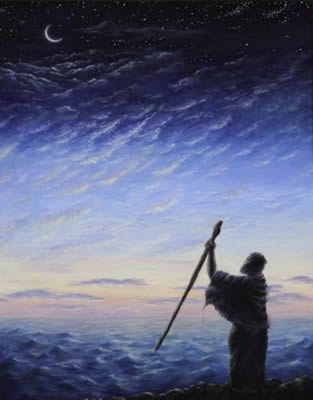
To want to be near God, we must believe we are safe when we are with Him. We must do more than hope in Him, we must trust in God, something that is not always easy for me. I suppose this is a major reason why our relationship isn’t what it should be. I suppose it’s why God drops little reminders into my calendar; little invitations to draw near to Him. He does so every week on Shabbat. He does so every day for morning and evening prayers. He does so many times a year and, after all, as I just mentioned, Passover is drawing near. These are times when God asks me to set aside my doubts and fears, to trust Him, to believe in miracles, and to approach.

Trust transcends hope, as the sky above transcends the earth below.

The heart that clings to a thread of hope is anchored to its earthly bounds. It desires to receive, but its capacity is tightly defined. The thread snaps and your eyes look up to see nothing more than the open sky. Hope is gone. All you can do now is trust the One who has no bounds.

That is Trust: When you stop suggesting to your Maker what He should do. When you are prepared to be surprised and open to wonders and miracles.

-Rabbi Tzvi Freeman
“Trust over Hope”
Based on letters and talks of the Rebbe
Rabbi M. M. Schneerson
Chabad.org

Good Shabbos.

Walking in the Shadow of God

Our sages tell us that one who mourns the destruction of the Beis HaMikdash will see its comfort. The Maharal, zt”l, was asked why this should be so. “What difference does it make if one mourns the destruction or not? If one is present in the ultimate future isn’t it obvious that he will experience the nechamah?”

The Maharal explained the need to mourn to attain the nechamah. “Before something comes to a new level, it first must decompose. In the creation of the world, God first made tohu va’vohu; only then could the world come into being. When a seed is planted in the ground, it decomposes. Only then can a tree sprout. The same is true with the gestation of a man or an animal. The seed must decompose before the embryo begins to grow. The same is true regarding an egg, as we find in Temurah 31. First the egg must decompose; then it can become a chick. The reason for this phenomenon is that there must be a lack for more perfection to fill. If there is nothing missing, it is impossible to come to a new level. Similarly, one who does not mourn the destruction of the Beis HaMikdash feels complete. He has no space for the nechamah, since he never experienced the lack in the first place!”

The Shem MiShmuel, zt”l, learns a practical lesson from this same statement. “One who wishes to start again and that his earlier sins should not be considered should make himself like dirt. He must completely nullify all of his senses and desires to God. In this way, he will become a completely new creation. The proof to this is from the case of a ger. Although a ger comes from a distant spiritual place, he is like a newborn baby by making just such a new start. He immerses in a mikveh to symbolize this, and if he is male he does a bris. Why should a Jew who makes a new start be any less?”

Daf Yomi Digest
Stories Off the Daf
“The Destruction before the Renewal”
Termurah 31

Therefore remember that at one time you Gentiles in the flesh, called “the uncircumcision” by what is called the circumcision, which is made in the flesh by hands – remember that you were at that time separated from Christ, alienated from the commonwealth of Israel and strangers to the covenants of promise, having no hope and without God in the world. But now in Christ Jesus you who once were far off have been brought near by the blood of Christ.Ephesians 2:11-13 (ESV)

Maybe the story off the Daf and Paul’s message to the Ephesians aren’t telling the exact same story, but they seem to be related, at least to me. We have two groups, Jews who have been distant from God and who need to “make themselves like dirt” in order to “become a completely new creation”, and Gentiles who were once far off from God but who have been brought near “by the blood of Christ.” The Shem MiShmuel even invokes the imagery of the convert to Judaism, a Gentile who goes down into the mikvah a goy and who rises out of the water “like a newborn baby…making a new start.”

That’s not much different than what I was describing in my previous meditation. As a new creation, we stumble and fall a lot, trying to get used to the new person we are trying to become. Sometimes we fall back and have to relearn skills and sometimes we are trying to advance spiritually and come to a point where we feel like infants again, rather than mature in the faith. Amazingly, having once felt secure in our relationship with God, we might find that we are no longer sure who we are in Him and how we are to serve Him.

I know that description fits me pretty well these days.

Despite the fact that human beings have free will and angels do not, we can still learn a great deal from their behavior. Like the angels, it’s important to acknowledge that there is more than one way to serve God. Whether you are an introvert or extrovert, teacher or rabbi, businessman or stay-at-home mom, there is a place for all of us among the Jewish people. For example, each one of the Twelve Tribes of Israel carried out different tasks. Some engaged in commerce or working the fields, others in religious study, and yet others in military or temple service – and all were essential to the survival of the nation as a whole. Quite frankly, we’re not all supposed to be doing the same kind of work or serving God the exact same way.

The Chofetz Chaim was once approached by a successful businessman who decided to scale down his business so that he could dedicate himself to Torah study. The Chofetz Chaim explained why his decision was wrong by way of a parable. During wartime, if a soldier unilaterally decides to leave his current post to fight in a different capacity, he will be court-martialed. A soldier must obey orders and man the position to which he was assigned. The Chofetz Chaim went on to say that this businessman’s responsibility was to support Jewish institutions and the poor. If he decided to go through with ending his business success, he would be jeopardizing the position God gave him within the Jewish community.

We have to give fellow Jews the space to become the individuals God intended them to be. Otherwise, we will be contributing to unnecessary tension and divisiveness.

-Asher
“Living Like the Angels”
Lev Echad

Blog writer Asher is addressing a primarily Jewish audience and is encouraging them to try not to “turn everyone into replicas” of each other. As much as Judaism is a unique kahal, like Christianity or any other faith or people group, it is made up of individuals, each with a unique purpose in life and over time, that purpose can even change. Asher continues:

Remember, those differences ultimately constitute the entirety of our people. Our strength can be found via our uniqueness as individuals.

Assuming I can apply all that to me, what does it mean for my life as a Christian? Who am I and who does God intend me to be? One thing is for certain…I don’t seem to be like any other Christian I’ve ever met. On the other hand, I have things in common with everyone else in the church.

Yet in some sense, because I claim the name “Christian,” I, like all other believers, have a lot to make up for in how we have treated the Jewish people.

For the one whom You smote they persecuted and they tell about the pain of Your mortally wounded. Add iniquity to their iniquity, and let them not have access to Your righteousness. May they be erased from the Book of Life, and let them not be inscribed with the righteous. –Psalm 69:27-29 (Stone Edition Tanakh)

While David isn’t writing about Christians as such, he is writing about those who have persecuted Israel, and the church has done this in abundance. Only through making ourselves (myself) like dirt and in sincere repentance, can we have any hope, through Christ, of being written in the Book of Life with the righteous.

I bet, as a Christian, you never thought that part of professing your faith and repenting of your sins would be repenting of Christian mistreatment of the Jewish people. If you want to learn more about this, I encourage you to read a post written by my friend Gene Shlomovich called A story of one Christian’s after-death regret about Israel and Judaism. A sobering and mystic tale of just how much we need to turn our hearts.

For God shall save Zion and build the cities of Judah, and they shall settle there and possess it. The offspring of His servants shall inherit it, and those who love His Name shall dwell in it. –Psalm 69:36-37 (Stone Edition Tanakh)

Lest you be wise in your own sight, I do not want you to be unaware of this mystery, brothers: a partial hardening has come upon Israel, until the fullness of the Gentiles has come in. And in this way all Israel will be saved, as it is written,
“The Deliverer will come from Zion,
he will banish ungodliness from Jacob”;
“and this will be my covenant with them
when I take away their sins.” –Romans 11:25-27 (ESV)

The prophesies regarding Israel are clear but what if we who, even calling ourselves Christian, have disdained God’s chosen and holy ones? Can it be that without repentance of our sins against Israel, we will ultimately be rejected by her King?

“Not everyone who says to me, ‘Lord, Lord,’ will enter the kingdom of heaven, but the one who does the will of my Father who is in heaven. On that day many will say to me, ‘Lord, Lord, did we not prophesy in your name, and cast out demons in your name, and do many mighty works in your name?’ And then will I declare to them, ‘I never knew you; depart from me, you workers of lawlessness.’ –Matthew 7:21-23 (ESV)

I’m probably stretching the interpretation of this verse out of its context, but it does illustrate that many of those who feel secure in their salvation have already been lost, even as they call themselves “Christian.” If this is their fate, then what of mine?

O God, You know my folly, and my guilty acts are not hidden from You. Let those who wait for You not be shamed through me, O Lord Hashem/Elohim, Master of Legions; let those who seek You not be humiliated through me, O God of Israel. –Psalm 69:6-7 (Stone Edition Tanakh)

Let not my mistakes, my errors, my sins, prevent another from turning to God through Jesus Christ, or to taint the name and reputation of the Messiah. For I know that…

The peoples will acknowledge You, O God; the peoples will acknowledge You – all of them. Regimes will be glad and sing for joy, because You will judge the peoples fairly and guide with fairness the regimes of the earth, Selah. –Psalm 67:4-5 (Stone Edition Tanakh)

But in verse 8 of that Psalm, when David says, “May God bless us, and may all the ends of the earth fear Him,” will only Israel be blessed, or will “the peoples;” the nations of the earth, including we non-Jewish Christians, have a blessing too?

Do not cast me off in time of old age; when my strength fails, forsake me not. –Psalm 71:9 (Stone Edition Tanakh)

Our hope is in Jesus Christ but we must never forget that part of that hope is attached to Israel, and Jesus is her first born son and King. He would never betray his own and would never tolerate those who do. In Romans 11, Paul was very clear about how we “grafted in” branches can be easily detached from the root should be become arrogant and self-serving, and should we consider ourselves superior to the natural branches, who after all, have only been removed temporarily.

I’ve been trying to write about my own condition, but I keep coming back to the church; her flaws, her scars, and her needs. I keep wanting to write “I” but I continue to stray into writing “we”. I wonder if God is trying to tell me something. As much as I feel detached from wider Christianity, I cannot divorce it entirely, for the body of Gentile disciples in the Messiah is part of who I am. Yet, I am also this.

Yochanan answered and said to him, “Rabbi, we saw a man driving out demons in your name, but he does not follow us, so we stopped him, on account of the fact that he did not follow us.”

Yeshua said, “Do not stop him, because no one who does an act of power in my name can quickly speak evil of me. For whoever is not for our foes is for us. For all who let you drink a cup of water in my name, because you belong to the Mashiach, amen, I say to you, he will not lose his reward.” –Mark (Markos) 9:38-41 (DHE Gospels)

I’ve never read this statement of the Master before as one that would allow someone not directly attached to the larger body of Christ as still belonging to him, but maybe I can hope that it represents me. Unfortunately, I think the following is also speaking of me.

Yeshua answered and said, “Amen, I say to you that there is no one who has left behind his home or his brothers or his sisters or his father or his mother or his wife or his children or his fields for my sake and for the sake of the good news who will not receive now at this time, with all the persecutions, a hundred times as many houses and brothers and sisters and mothers and children and fields, and in the age to come, eternal life. However, many of the first will be last, and the last will be first.” –Mark (Markos) 10:29-31 (DHE Gospels)

As much of a reward as there is in following the Messiah as his disciple, it is still a bitter thing to be separated from those whom you love. One day, Jesus cursed a fig tree (Matthew 21:18-19, Mark 11:12-14) as a lesson in lacking faith. We see in both Matthew 21:20-22 and Mark 11:20-21 that the fig tree subsequently withered from its roots. Jesus commented on the withered tree and perhaps on many a withered soul thus:

Yeshua answered and said to them, “Let the faith of God be in you. For amen, I say to you, any one who says to this mountain, ‘Be lifted up and moved into the middle of the sea,’ and does not doubt in his heart, bu trather believes that what he says will be done, so it will be for him as he has said. Therefore I say to you, all that you aks in your prayer, believe that you have received it, and it will be so for you. And when you stand to pray, pardon everyone for what is in your heart against them, so that your Father who is in heaven will also forgive your transgressions. But as for you, if you do not pardon, neither will your Father who is in heaven forgive your transgressions.” –Mark (Markos) 11:22-26 (DHE Gospels)

So, to return to the beginning of this meditation, I have made myself like dirt and humble myself before God and man. I turn away from my sins and ask forgiveness from all I have offended. May God wash me and clean me whiter than snow (Psalm 51:7). Then though I may walk alone among humanity and even be set apart from family and the larger community of Christ because of my faith, I ask that I be allowed to humbly walk in the shadow of God. May I never desecrate what is holy, even if the holy one happens to be me.

Vayakhel-Pekudei: The Missing Kahal

The Hebrew language does not lack synonyms, and there are several other verbs which could have been chosen to begin the verse: “And Moshe gathered together the children of Israel.” The word employed, vayakhel, is significant, for it implies the fusion of the people into a kahal or communal entity, far more than a collection of individuals.

A group which gathers together can also move apart, and even while together, the union is not complete. A kahal, by contrast, represents an eternal entity that unites individuals in a new framework, highlighting the fundamental bond that joins them.

-Rabbi Eli Touger
“More than Gathering Together”
Commentary on Vayakhel; Exodus 35:1-38:20
Adapted from
Likkutei Sichos, Vol. XXI, p. 250ff;
Sefer HaSichos 5749, p. 292ff;
Sichos Shabbos Parshas Vayakhel, 5752
Chabad.org

This commentary should speak to those people who believe that the Jewish people no longer are a people before God. It should speak to those who believe that God divorced Israel and married the Christian church. It should speak to those who believe that God abandoned His people Israel and transferred His eternal covenants to the church as the “new Israel.” It probably won’t, but it should. Look at what Rabbi Touger is saying. He’s saying that the Jewish people are uniquely a people, a unity, a kahal. They were at Sinai and they remain so today.

But what about the church?

I’m sure I’ve written about this before (but the problem with writing so many “meditations” is that I can’t be sure when or where), but is Christianity “a people?” In the strictest sense of the term, the answer is “no.” One is only a Jew if you have a Jewish mother (though having two Jewish parents would be really great) or if you converted to Judaism using a formalized process in a recognized branch of Judaism (this last part is problematic, since Orthodox Jews don’t recognize converts who went through Conservative or Reform synagogues). On the other hand, anyone can be a Christian. All you have to do is profess faith in Jesus Christ. You can come from any language, nation, or tongue, and God will not withhold the grace of Christ from you. You will belong (actually, I’m still working on that “belong” part).

But will you be a “kahal?” Will you be an “eternal entity that unites individuals in a new framework, highlighting the fundamental bond that joins them?”

How many Christian denominations exist today? I can’t find any one statistic that is authoritative or definitive, but it seems to be in the tens of thousands. Tens of thousands of individual and unique Christian denominations.

That’s a lot. Are they all a unity together; an eternal entity together?

That’s hard to say.

I’m not just commenting on this week’s torah portion (which is a double portion that includes Vayakhel and Pekudei). I’m performing a minor comparison of Judaism and Christianity. This is extremely oversimplified and open to tons of criticism, but hear me out.

My friend Gene Shlomovich has written a couple of blog posts recently. One is 50 signs you may subscribe to Replacement Theology which, as you might imagine, highlights a series of factors that contribute to elevating the Christian church at the expense of Jews, both in society and supposedly in the eyes of God. The more recent blog that caught my attention though is Test of a true convert to Judaism. The test is an easy one. If you want to convert to Judaism but you find out that the next Holocaust is just around the corner, would you still convert?

This is one of the reasons that Jews do not evangelize and are very hesitant to accept converts. When the going gets tough, the converts may not see themselves as integrated with the Jewish kahal. If you are born a Jew, it doesn’t matter how you see yourself. Hitler’s Nazis took all Jews to the camps, religious or secular. It didn’t matter if they saw themselves as part of the kahal of Israel, they still suffered and died. A Jew is bound the the community body and soul.

But is a Christian?

I admit, the church probably has to work harder at it, since we come from such a diverse set of backgrounds, but it’s not impossible to become a unified entity under Christ. The problem is how we see the rest of the world. Unlike Judaism, Christianity has a mandate to speak to the rest of the world. We are directed by Christ to make converts of all nations (see Matthew 28:18-20). No man must be our enemy because he has the potential to be our brother in the Messiah, regardless of his former life.

I had a discussion on another Christian blog recently regarding the Coexist Bumper Sticker phenomenon. The writer of that blog (no, I won’t provide links) was generally against the bumper sticker campaign as he felt it was directing Christians to simply get along with those of different faiths or or no faith at all, denying our mandate to evangelize to those groups. He also felt the coexist bumper stickers denied this:

Jesus said to him, “I am the way, and the truth, and the life. No one comes to the Father except through me. –John 14:6 (ESV)

The blog writer separated the world into two camps…us and them. Those who are not part of us (Christianity) are against us. But if that’s true in an absolute sense, how will we ever be able to share the “good news” to people we hold in disdain? To be fair, he wasn’t really rejecting secular humanity, just resisting the “dumbing down” of Christian convictions for the sake of political correctness. But it reminded me of how many other churches erect extremely rigid barriers against the “unsaved,” and those of us who came to Christ late in life and with “a past.”

I’ve always been bothered by the arrogance and even apparent cruelty of these type of churches. This is particularly poignant for me, as I’ve mentioned, since I didn’t become a believer until my early 40s. If any of these folks had encountered me in those days, what would they have thought of me? Would they have thought I against them? Would they have thought I was their enemy? But weren’t we all enemies of Christ at one time?

For if while we were enemies we were reconciled to God by the death of his Son, much more, now that we are reconciled, shall we be saved by his life. –Romans 5:10 (ESV)

No one is born God’s “friend.” As we grow and develop and become aware of God, we each negotiate our relationship with Him. It may be different from a Jewish point of view, I don’t know. I suspect that although God has promised that all of Israel will be saved (Romans 11:26), that doesn’t give each and every individual Jew a free pass to ignore God or the Torah without certain consequences.

I don’t have all the answers, so don’t ask me to provide them.

But I do know that we, as Christians, cannot simply dismiss the Jewish people or Judaism just because it suits our “superiority” theology, and we certainly can’t spit on those who have not accepted Christ as Lord and Savior because we can only feel better about our salvation in comparison to other people’s state of being without God. There are plenty of people I don’t really like and maybe a few really bad people I’m absolutely against, but how can I be an enemy to someone who was once just like me? How can I refuse to speak to anyone who desires to hear the good news just because they aren’t already just like me?

For me, coexisting isn’t surrendering my convictions in order to get along with the political correctness of the world. It’s the willingness to walk and talk and live in the world around me in all of its diversity, to illustrate that a life lived as a disciple of the Master is not one lived in vain (no matter how many secular and religious people tell me otherwise). How can anyone come to a knowledge of the Messiah if we refuse to share that knowledge, in love and forbearance, with others?

Returning to Rabbi Touger’s commentary, we can’t forget that what God has promised His people Israel was long ago said and done, and we in the church (though I attend no church) cannot undo the will of God toward His kahal.

The most complete expression of this oneness will come in the Era of the Redemption, when “a great congregation (kahal gadol) will return there.”Jews from all over the world will stream together to Eretz Yisrael. This ingathering will be more than geographic in nature. G-d will “bring us together from the four corners of the earth.”But more importantly, there will be unity and harmony among us, and this unity will embrace all existence. “The world will be filled with the knowledge of G-d as the waters cover the ocean bed.”

These are not merely promises for the future, but potentials that can be anticipated today. The massive waves of immigration that have reached Eretz Yisrael in recent years are obvious harbingers of the ultimate ingathering of our nation. And even as the physical reality of the Redemption is coming to pass, so too we can have a foretaste of its spiritual elements. We have the potential to establish a new harmony within ourselves, and to spread that harmony among others. And by these efforts to anticipate the Redemption, we will help make it a reality.

We cannot live in arrogance, taking the place of the groom at the wedding feast (Luke 14:7-11) when we have been commanded to sit down at the lowest place. Not if we expect to be a part of the harmony of which Rabbi Touger speaks. If God wants to honor us, He will move us to a more distinguished seat. It is not up to us to automatically occupy the head of the table.

If Christianity wants to be a kahal of God, unified under our Master and Savior, we must emulate him in being loving to others, as he was to the woman at the well (John 4:7-26). He was not dishonest with her, nor did he “soft pedal” his message to her, but he did not send her summarily away, either.

AbyssI tried to explain my point of view on the aforementioned blog, but the blog owner and I continued to talk at cross purposes (forgive the small pun). Eventually, I was inspired to write today’s Torah commentary, such as it is, not speaking to the blog writer as such, but to all Christians in the hope that someone will listen with a softened heart.

Lately, I’ve been writing about my own spiritual journey, which admittedly has become interrupted “at the bottom of a well.” I’m focusing on prayer as the means by which to respond to being “stalled in traffic” so to speak. I understand that a great many things I object to today, I’ll eventually have to accept and let them be. One of them is the idea that I can always have fellowship with other Christians. I want not to be hostile or anxious or upset with those people who are different than I am. Unfortunately, if the church, or some of its members, are circling the wagons and defending themselves against anyone who is even slightly different, then what fellowship do I have with them?

I should say at this point that we are all doing our best to understand and obey God, so I can’t really be upset or angry at the blog writer I’ve been referencing. I know he’s sincere and really does want to help others, but where he may see enemies such as Stalin, Haman, Hu Jintao and Ahmedinijad, I see my next door neighbor, my co-workers, and my family.

I may have to accept that the church is not my kahal and that such a unity will never exist for me. My closeness and unity to God may be found, not within the walls of a church or synagogue, but in the slender pages of the Bible and in solitary prayer. But then, not every Christian blog has the same response to the “coexist” bumper stickers, so who knows what the future may bring?

Good Shabbos.

Restructuring Meaning

Praying with tefillinIf you ever hire an architect to design a synagogue, you will need to inform him of the two-door rule: The worshipper must first enter into a vestibule that precedes the sanctuary before walking through the doors of the sanctuary itself, as verse in Proverbs goes, “Fortunate is the man who listens to me to watch by my doors day by day, to watch the doorposts of my entrances.” (Talmud Berachot 8a. Tur, Shulchan Aruch Orach Chaim, Levush 90:2. Magen Avraham ibid. Shulchan Aruch Harav 90:19.)

The first door, explains Rabbi Sholom Ber of Lubavitch in his “Booklet on Tefillah,” (Kuntres Hatefillah, siman 11) is the door in from the street. You first need to leave the confusion of the world outside and empty your mind of all worldly concerns, power down your cellphone, spend a few moments to gain calm and focus. As Rabbi Shimon ben Gamliel would say (Avot 1:17), “All my life, I grew up among the sages and I did not find anything better for a person than quietness.” That is the point of that first door, something particularly necessary in our modern, cacophonous world: You want your mind to settle down, like a bubbling brook might settle into a still pond. There, reflected in that still water, it may be possible to behold a clearer image of the universe.

-Rabbi Tzvi Freeman
“Meditation’s Hallway”
from “A Guide to Jewish Prayer” series
Chabad.org

I wrote Choosing a Storyteller for yesterday’s “morning mediation” and then realized that I have more control over this whole process than I previously thought.

Here’s part of the quote I pulled yesterday from Peale’s book The Power of Positive Thinking from the “prayer” chapter:

An illustration of a scientific use of prayer is the experience of two famous industrialists, whose names would be known to many readers were I permitted to mention them, who had a conference about a business and technical matter. One might think that these men would approach such a problem on a purely technical basis, and they did that and more; they also prayed about it. But they did not get a successful result. Therefore they called in a country preacher, an old friend of one of them, because, as they explained, the Bible prayer formula is, “Where two or three are gathered together in my name, there am I in the midst of them.” (Matthew 18:20) They also pointed to a further formula, namely, “If two of you shall agree on earth as touching any thing that they shall ask, it shall be done for them of my Father which is in heaven.” (Matthew 18:19)

Now, let me back up in Rabbi’s Freeman’s Guide to Jewish Prayer series and quote from the first article, Is Prayer Normal:

With this passage and other similar such statements, Maimonides makes it clear that G-d could run the universe perfectly well without our prayers. The implication is that we are the ones who need prayer—in order to connect Him to our lives.

In fact, we may be using the wrong word altogether. The English word, prayer, means to beseech, to implore, to plead for something.

There is another word, bakashah, that certainly does mean all those things. But that’s not the word we use. We use tefillah. Does tefillah really mean “prayer”?

Tefillah is etymologically related to the root word tofel—meaning reconnect or bond.

While I’m not trying to appropriate any sort of “Jewish identity marker” or make myself a pain in the neck to Jewish people, on a fundamental level, prayer is prayer, regardless of who is doing the praying. If “God so loved the world, that he gave his only Son, that whoever believes in him should not perish but have eternal life,” then certainly He desires both the Jew and the non-Jew to pray and to “bond” or “reconnect” with Him. If the first century Roman centurion Cornelius (see Acts 10) learned to pray from his Jewish mentors, I don’t think it’s so out of line for me to take what I find valuable about the Jewish prayer and adapt it for my own use.

Chapter 4 in Peale’s book is called “Try Prayer Power.” I’m willing to admit that I’ve been looking for something I’ve had access to all along. Perhaps it just needs a bit of refreshing. I am not going to “pray as a Jew” as such, but since the Jewish people have been “bonding” to God a lot longer than we Christians, on the order of thousands of years longer, maybe they have a few ideas on the subject.

During the Cuban Missile Crisis, then Attorney General Robert Kennedy ignored a threat made by Soviet Ambassador Anatoly Dobrynin and proceeded with negotiations to defuse the crisis as if he had never heard Dobrynin’s original. It was Kennedy’s setting aside of Dobrynin’s statement that allowed the Soviet Ambassador to safe face and continue to proceed to a peaceful conclusion that prevented a nuclear war (I know this is a strange metaphor, but please bear with me).

If I can somewhat apply the same principle and temporarily set aside the fact that Freeman’s series on Jewish prayer is intended only for Jews, I can imagine that it can apply to me too. Then maybe this particular series can be a story that I can use in seeking my own connection to God as a means of “cognitive restructuring.” A sort of “refactoring” of Peale’s ‘Chapter 4″ in a way that uses better metaphors.

It’s a matter of learning how to walk again.

WalkingLearning to walk involves taking the first step, and then another, and then another. I’ll probably never find the “perfect” inspirational book (excepting the Bible) out there, so I’ll have to construct one of my own. I guess that’s part of the reason I created this blog series in the first place. They’re “morning mediations” that are supposed to start a person’s day. I can start out by letting each one be a meditation for me again, and then, as Meditation’s Hallway suggests, move from my morning meditation, into prayer.

When you awake in the morning, learn something to inspire you and mediate upon it, then plunge forward full of light with which to illuminate the darkness.

-Rabbi Tzvi Freeman
“Morning Meditation”
Based on letters and talks of the Rebbe
Rabbi M. M. Schneerson
Chabad.org

I have always known the storyteller I have ears to listen to. I just need to restructure the meaning for a wider focus; one that includes me. I hope nobody minds.

Choosing a Storyteller

An illustration of a scientific use of prayer is the experience of two famous industrialists, whose names would be known to many readers were I permitted to mention them, who had a conference about a business and technical matter. One might think that these men would approach such a problem on a purely technical basis, and they did that and more; they also prayed about it. But they did not get a successful result. Therefore they called in a country preacher, an old friend of one of them, because, as they explained, the Bible prayer formula is, “Where two or three are gathered together in my name, there am I in the midst of them.” (Matthew 18:20) They also pointed to a further formula, namely, “If two of you shall agree on earth as touching any thing that they shall ask, it shall be done for them of my Father which is in heaven.” (Matthew 18:19)

Being schooled in scientific practice, they believe that in dealing with prayer as a phenomenon they should scrupulously follow the formulas outlined in the Bible which they described as a textbook of spiritual science. The proper method for employing a science is to use the accepted formulas outlined in the textbook of that science. They reasoned that if the Bible provides that two or three should be gathered together, perhaps the reason they were not succeeding what the they needed a third party.

-Norman Vincent Peale
Chapter 4: Try Prayer Power
The Power of Positive Thinking

As some of you know who have been reading this blog for a while, I’ve been considering going back to a church. Of course, there are many barriers to this goal, if it is even an appropriate goal for me, so I don’t know if I will end up at that particular destination or not. However, if I ever find myself sitting in a church sanctuary, and the Pastor delivers a message that sounds anything like the quote from Peale’s book I posted above, I would immediately start looking for the nearest exit.

Why?

I’ve commented on Peale’s book before, and now that I’m almost a quarter of the way through, I remain dubious of how he treats the Bible and prayer. Can the Bible be reduced down to a “textbook” and can one pray by a formula?

Actually, in Judaism, prayer is a highly formal and routinized matter, so on this point, I guess I can’t complain, since I find Jewish prayer beautiful. But Peale’s presentation makes it sound like some sort of scam. I feel like I’m listening to some slick, phony prayer service headed up by the likes of Benny Hinn. I feel like I’m listening to someone trying to sell me the “name it, claim it” philosophy of God; as if God were Aladdin’s genie and had to do what I told Him to do because of some “magic prayer” in the Bible.

No, really, I’m trying to like this book, but I don’t think it speaks my language. Let’s try a different approach.

During tefillah, you must focus your heart on the meaning of the words your lips are uttering. You must imagine G-d’s presence right there before you. Dismiss whatever thoughts are bothering you until you are left with a clear mind to focus on your tefillah…

This was the practice of inspired and legendary people; they would seclude themselves and focus on their tefillah to the point that they transcended their physical senses, and their mental powers dominated bringing them close to prophecy.

If an extraneous thought comes into your mind during the tefillah, stay quiet until the thought disappears.

It’s necessary to think about matters that subdue the heart and focus it on your Father in heaven. Don’t think about empty matters.

—Tur and Shulchan Aruch, Orach Chaim 98:1
as quoted from Chabad.org

Really, what’s the difference here? Peale characterizes prayer as a “scientific formula” while the quote from Tur and Shulchan Aruch, Orach Chaim 98:1 presents mediation and prayer as a transcendental and mystical practice. Who is right? Neither? Both? Does it matter?

Maybe it doesn’t matter which approach you take as long as it works for you. I’m not sure that Peale works for me, and maybe my continuing attraction to the various Jewish sages and their opinions is telling me something about what does work for me.

When I started reading Peale’s book, I did a bit of research on the man and, according to Wikipedia, he’s not exactly without critics. Given the various doctors and scientists and scholars to whom Peale refers to in the book I’m reading, there are concerns that these so-called experts may have just been fabricated by Peale for the sake of telling a story. But then, I’m not above telling a tale and having it interpreted as fact if there’s a good reason for doing so, and some moral or lesson is imparted that way. Milton Erickson was the absolute master of the “therapeutic tale” and, when I used to be a practicing family therapist, he was one of my “heroes”. The use of metaphor and storytelling in promoting psychological change can be amazingly effective, so I can hardly criticize Peale if that’s the way he chose to transmit his lessons in his book. It’s the way the tales of the Baal Shem Tov have come to us from ages past, still full of power and wisdom.

I think Peale’s book really has worked out well for thousands and perhaps millions of people, but the reason it doesn’t work for me is that it doesn’t say that thing I need it to say in a language that makes sense to me. One can tell the same basic story in a Saturday morning cartoon or an erudite philosophical tome, and one method or the other will work out better depending on the audience. I know now that I’m an audience looking for the right storyteller. I don’t think Peale is that guy, so I need to find someone else saying the same thing in a different way.

So was the practice of Abraham, Isaac and Jacob as they sat in perfect awe beneath the star-speckled sky of the still desert night; so too, the ancient prophets in the Judean hills, strumming musical instruments as they gazed upon the mysteries of heaven and earth, awaiting the vision of prophecy as the morning’s horizon awaits the rising sun; so did the sages of the Talmud, the Bahir and the Zohar lift their souls on mystic journeys through orchards and palaces, chambers and pathways of the spiritual realms, never sure that they could return to their earthly bounds; so too the chassidim were lost in contemplation and the ecstasy of their prayer from early morning until the hours of night.

-Rabbi Tzvi Freeman
“Meditation’s Hallway”
Chabad.org

But if Peale, as the Christian storyteller seems too “phony” and (as I’ve been told) the Jewish storytellers are just for Jews, where is my storyteller?

Waiting for Hope in the Abyss

AbyssRav Simcha Bunim of Peshischa, zt”l, taught great inspiration from a statement on today’s daf.

“A person who has sinned and fallen to the lowest place, banished from God’s presence, should also never despair. A sacrifice that was fitting but then lost its status is no longer accepted even if afterward it regained its original status. But Rav holds that if the animal is still alive, it is not rejected absolutely. This fallen soul is no different. As long as he has some chiyus, some vitality, it is always possible to start again and attain forgiveness. This is the deeper meaning of the words, ‘Forgive our sins for they are many.’ This can be also be read, ‘Forgive our sins, because the halachah follows Rav—that ba’alei chaim are not rejected.'”

The Lechivitcher, zt”l, offered a parable to help understand this better. “A Jew is like a valuable coin. Even if it rusts and has mud crusted over it, it still retains its original value. The owner must clean the coin by removing the rust and the caked mud, but once he does so it shines just the same as it did when it was new.”

Rav Moshe of Kovrin, zt”l, was once encouraging some young chassidim who were struggling in spiritual matters. “Even if one falls again and again—even one hundred times—he must strengthen himself again and again. It is incumbent upon us to always find a way to encourage ourselves again and again, until we climb out of our spiritual rut!”

Daf Yomi Digest
Stories Off the Daf
“Ba’alei Chaim”
Temurah 23

I always have to be careful when I generalize a Jewish commentary and try to apply it to Christianity. After all, the Rabbis didn’t produce these Dafs with Christians in mind and sometimes, the judgments and insights they generate are specifically not to be applied to non-Jews. However, when reading Derek Leman’s book review of Daniel Boyarin’s book The Jewish Gospels: The Story of the Jewish Christ, I found something interesting.

So, it might surprise you to know that Boyarin thinks Judaism and Christianity are compatible. His goal, stated on pages 6-7 is to help Christians and Jews to stop vilifying each other. He doesn’t follow Jesus and isn’t asking fellow Jews to do so. But he demolishes all ideas that Christian devotion to Jesus is contrary to Judaism or that Christianity is anything other than a Judaism to which mostly non-Jews have been drawn. Jews in the time of Jesus were looking, he says, for a divine messiah. And Jesus’ earliest followers were kosher Jews. The sad separation and enmity of Judaism and Christianity is something to get beyond, not something to perpetuate.

According to how I’m reading Leman (I haven’t read Boyarin’s book yet), Boyarin doesn’t see a severe “disconnect” between first century Jewish and Gentile worship of God through the “path” of “the Way”. But, as Boyarin declares, if Christianity is not directly contrary to Judaism, can I say the reverse, that Judaism is not directly contrary to Christianity? Further, can I stretch my metaphor to say that Jewish teachings are not directly contrary to Christianity?

You probably think I’m grasping at straws. On the other hand, let’s look at our “story off the Daf” again. What is the theme? That even the person who is most distanced from God because of their sin should not dispair and give up all hope of reconciliation. Doesn’t that sound like it could be a Christian theme as well?

Not only that, but we rejoice in our sufferings, knowing that suffering produces endurance, and endurance produces character, and character produces hope, and hope does not put us to shame, because God’s love has been poured into our hearts through the Holy Spirit who has been given to us. –Romans 5:3-5 (ESV)

For I am already being poured out as a drink offering, and the time of my departure has come. I have fought the good fight, I have finished the race, I have kept the faith. Henceforth there is laid up for me the crown of righteousness, which the Lord, the righteous judge, will award to me on that Day, and not only to me but also to all who have loved his appearing. –2 Timothy 4:6-8 (ESV)

I believe we who are Christians can take the same hope that, no matter how far we have fallen away from God, we can rise back up to Him, even as Rav Simcha Bunim teaches.

Yesterday, the Jewish world celebrated Purim, the commemoration of the victory of the Jewish people in ancient Persia over Haman’s plan of genocide. If you read the Book of Esther on Purim, you realized how desperate it was for the Jews and how hopeless everything seemed. Even after Esther revealed the evil Haman’s plot to King Achashverosh, it was not in his power to reverse his decree. The destruction of the Jews seemed inevitable. And yet, through the courage of Esther and Mordechai and the love of God for His people, the King granted the Jews the ability to fight back and to defend themselves.

Hopelessness was turned into hope and defeat was transformed into victory; a victory that is still commemorated many thousands of years later, for with God, all things are possible (Matthew 19:26). Although God is not explicitly mentioned in Esther, we know that He was there with Israel, defending them and encouraging them. It was a miracle that the Jews survived the enormous threat against them. It is always a miracle when the Jews survive, since often it is only God who is for them, and an entire world who desires that they perish. Remember this too, as you study the sin of the Golden Calf for this Shabbat’s Torah Reading. There is no failing or sin so great that you become irredeemable.

Yet most of God’s miracles are not in the realm of the supernatural. It was (seemingly) through very natural processes that the Jews were saved from the plan of Haman. Seas did not part. The earth did not stop rotating on its axis, Fire and destruction did not rain down from heaven upon the enemies of the Jews. So it is in our lives today, even in the most dire and hopeless of circumstances. You may not feel the hand of God touching you or see His finger writing in the dust, but He is there and while you live, there is hope, but only if you hope in Him.

The philosopher, when he sees a miracle, looks for a natural explanation. The Jew, when he sees nature, looks for the miracle.

-Rabbi Tsvi Freeman
“Unnatural Response”
Based on letters and talks of the Rebbe
Rabbi M. M. Schneerson
Chabad.org

Blessings and hope.