Tag Archives: Christianity

Dealing with the Heresy Hunters

Saul understood the disciples of Yeshua as a dangerous sect of Judaism that needed to be silenced before it spread any further. In Saul’s day Judaism contained a variety of sectarian movements. The word “sect” translates the Greek word “hairesis.” It is the same word for “choice,” or “opinion.” Over time, as Christianity battled against the deviant hairesis of Gnosticism, the meaning of the word evolved into the new concept of “heresy.” In the days of the apostles, however, the word primarily referred to a faction of thought and practice within a larger group. For example, the book of Acts refers to the “sect of the Sadducees” (Acts 5:17) and the “sect of the Pharisees” (Acts 15:5), which was “the strictest sect of [the Jews’] religion” (Acts 26:5 NASB). It also refers to the disciples of Yeshua as the “sect of the Nazarenes” (Acts 24:5).

The first-century Jewish historian Josephus used the word hairesis to describe “schools of thought” within the Jewish people: Pharisees, Sadducees, Zealots, and Essenes. In Josephus’ writings the word hairesis only means a faction within the broader religion of Judaism. It does not imply heresy.

-D. Thomas Lancaster
from “Damascus Road Encounter,” pp.15-16
Messiah Magazine issue 8, Winter 2015/5775

I find I can’t read Luke’s “Acts of the Apostles” anymore without thinking about the church I used to attend and the reasons I left. The head Pastor during the two years I attended, was working his way through the Book of Acts in his sermon series, preaching on it verse by verse.

During the first year I was at this church, I was studying Lancaster’s Torah Club Volume 6: “Chronicles of the Apostles,” which is a detailed analysis of Acts from a Messianic Jewish point of view (based on the theology and doctrine espoused by First Fruits of Zion). Between Pastor’s weekly sermons and my Torah Club studies, I became very familiar with Acts, perhaps more so than any other single book in the Bible. So now, when I read Acts, I think both of Pastor’s sermons and of Lancaster’s teachings.

FFOZ’s Messiah Magazine is a less “scholarly” publication compared to Messiah Journal and is written, in my opinion, for people with a more traditional Christian mindset who are interested in what I call “Messianic Judaism 101.”

That’s not a bad thing. When encountering Messianic Judaism for the first time, it’s helpful to have an elementary point of entry that speaks to someone not familiar with that perspective. I guess I’ve been studying too long to be challenged by entry-level material.

But I found myself wishing this (Sunday) morning that I could share Lancaster’s article with the folks at the Sunday School class I used to attend. It’s a vain hope. For two years, I tried to make a positive impression on the class regarding Messianic Jewish thought and perspective on the Bible, and while some people found some of what I said compelling, ultimately, for two years, I was spinning my wheels. Paradigms are not easily shifted, and sometimes they are so cemented into place, that it becomes all but impossible (at least for human beings) to shift them perceptibly. Any doctrine outside of what is taught by the local church is considered heresy.

Which brings me to the quote from Lancaster’s article.

We experience now, as did the Jewish people in the days of Saul/Paul, a number of different “sects,” both within Christianity and Judaism. If we take all this within the context of the original meaning of the word “hairesis,” then we can consider the different denominations of Christianity and the different branches of Judaism as different factions, or schools of thought and practice, within their broader respective religions.

But where does that leave modern Messianic Judaism and her (somewhat) parallel sister movement Hebrew Roots? Can we consider them two different “sects,” and valid “schools of thought and practice” within a larger religious context?

I’ve been following a number of different blogs over the past week or so and monitoring a series of “differences of opinion” (to put it mildly in some cases) that would seem to belie that thought.
Derek Leman
Derek Leman

For instance, on Derek Leman’s Messianic Jewish Musings, there is a lively debate between Messianic Jews (and Gentiles) and an Orthodox Jewish person about the validity of Christianity as a religion, including Messianic Judaism, which this fellow (Hi, Gene) believes to be a subset of Christianity rather than a “school of thought” within Judaism.

Pete Rambo issued a rather provocative challenge on his blog by “offering a $10,000 reward to the person who can prove unequivocally, from Scripture alone, that God changed the Sabbath day from Saturday, the seventh day, to Sunday the first day.” Naturally, a “spirited debate” ensued, although there only seems to be one person attempting to “collect the reward.”

And then, on Peter Vest’s blog, he proposes the interesting idea that the later Rabbis of the Talmud rejected what Peter believes was the “One Law” teachings of the Second Temple era Rabbis. There’s no particular argument going on in the comments section of that blog (yet), but it nevertheless presents another variant opinion on what the Bible teaches us about Jewish and Gentile interactions in the first-century Jewish “stream of thought” of “the Way.”

I must say that adherents to these various “sects,” in these blog discussions, can express quite a bit of “passion” in defending their particular opinions, but sometimes it (seemingly) goes beyond that.

I haven’t watched the YouTube video yet (and I probably never will), but according to Peter on his blog, a couple of gentlemen in some sort of One Law radio talk show outright said that Peter was a “liar” relative to his statements about Judaism and the validity of the Oral Torah.

Now I can’t state strongly enough that I haven’t watched the video and so I don’t directly know what was or wasn’t said. I do know that it’s not unheard of to misinterpret someone’s opinion of you, especially if that opinion is at all critical. I don’t know what the people Peter mentions said or didn’t say, so what I’m writing here isn’t a matter of taking sides or calling anyone out.

However, if we, for the moment, accept Peter’s allegations at face value, then we have encountered a problem. All of us in our various “sects” of Christianity, Judaism, or whatever, actually have the same core goal: drawing nearer to God. However, each of us within our own specific “streams of thought” imagine the details of just how to accomplish that task rather differently. And yet, in spite of the fact that we know there have been multiple differing “streams of thought and practice” about the Bible and God for well over two-thousand years, significantly predating the existence of anything called “Christianity,” we still insist that whatever religious stream in which we find ourselves is the only one with “the truth.”

Everyone else is wrong and we have a duty and obligation to go online and, by golly, prove it.

It is one thing to disagree with someone else, to believe their particular interpretation of the Bible is in error, that the person is (Heaven forbid) wrong, mislead, or even deluded. It’s another thing entirely to believe another person’s difference of opinion indicates that the individual is a willful liar. I hope that’s not what’s going on here, because it would be a sad commentary on two people who are professed disciples of Yeshua (Jesus),  but as I said, I don’t really know.

And that brings us back to Lancaster’s article and “Saul, the Heresy Hunter” (I say that somewhat tongue-in-cheek).

Christian teaching emphasizes the story of the conversion of Saul the Jew, a persecutor of the early church, into Paul the Christian, as a pattern for Jewish believers to follow. Just as Saul renounced Judaism and even changed his name to Paul, so too, Jewish believers should renounce their old allegiances and embrace their new identity in Christ. A careful reading of the story of Saul’s Damascus road encounter, however, does not indicate a conversion from Judaism to Christianity, nor does it indicate a change in name from Saul to Paul.

-Lancaster, p.15

You’ll have to read Lancaster’s full article (only four pages long) to see how he defends his opinion (successfully from my point of view), but it indicates a couple of things. First, that Saul was wrong about his persecution of the Jewish members of “the Way,” and that he was rather dramatically forced to face his mistakes by an encounter with the Master of that movement, Yeshua (Jesus) of Nazareth. Second, we discover that (in my opinion and Lancaster’s) Christian interpretive tradition is wrong about what happened to Saul, what sort of “conversion” he underwent, and why he had two names.

Saul did undergo a radical transformation of the heart, soul, and mind. One might say that he experienced a spiritual conversion — something the Master called being “born again.” His life would never be the same. Compared with the “surpassing value of knowing Messiah Yeshua,” Saul counted all his prestigious heritage and achievements in Judaism as mere rubbish (Philippians 3:8 NASB). Yet that change in priority did not indicate a change in religious affiliation. Saul encountered the Messiah on the way to Damascus, but he did not abandon his Jewish identity or his loyalty to the Torah, the Jewish people, or Jewish practice.

-ibid, p.18
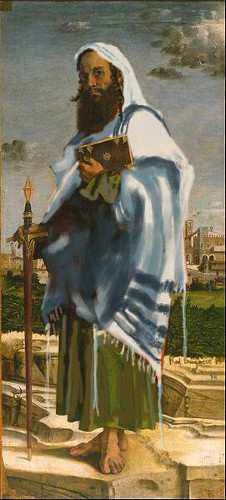
The Jewish PaulIf I said something like that in at least some churches, I would likely encounter strong and passionate counter arguments that anything “Jewish” did not survive in Paul after his Acts 9 encounter with Jesus. Nevertheless, that’s how I (and Lancaster, and many others) read the life of Paul in the Apostolic Scriptures.

So as we’ve seen, there have been multiple sects of Judaism that predated the earthly ministry of Jesus by quite a bit, and there have been multiple sects of Christianity from pretty much the point when the term was first used.

What do we do about that, especially in the volatile environment of the religious blogosphere?

View people you are likely to quarrel with as your partners in personal growth. They are likely to make you more aware of your vulnerabilities, limitations, and mistakes. Don’t let this get you down. Rather, let it serve as your coach. You now have more awareness of what you need to strengthen, fix, and keep on developing.

(from Rabbi Zelig Pliskin’s book: Harmony with Others, p.36, http://www.artscroll.com)

-Rabbi Zelig Pliskin
from Daily Lift #236: “My Partner in Personal Growth”
Aish.com

If you’re religious in any sense of the word (I know that some Christians say their faith is a “relationship, not a religion” but go with me on this one) then other people are going to disagree with you. Get used to it. If you are going to discuss your religious beliefs on a blog and allow others to comment on your blog, people will comment and some will disagree with you. Others will write their own blog posts disagreeing with you, sometimes in the most caustic and “unChristian” like manner.

If we are to believe what Rabbi Pliskin says, all of our opponents are our partners in personal growth. Without them, we might never discover weaknesses, vulnerabilities, and limitations in our own character as well as our knowledge. They force us to constantly stretch ourselves so that we will be more aware of our strengths and deficits tomorrow than we are today. As one motivational statement I’ve seen at my gym says, “If it doesn’t challenge you, it doesn’t change you.”

Consider it all joy, my brethren, when you encounter various trials, knowing that the testing of your faith produces endurance. And let endurance have its perfect result, so that you may be perfect and complete, lacking in nothing.

James 1:2-4 (NASB)

It seems that Rav Shaul (otherwise known as Paul the Apostle) and Rabbi Pliskin agree on something.

The Yoke We Must Bear

An implement taken from the pastoral life served as a metaphor in rabbinic literature, itself the product of city life. That implement was the yoke, which in linking animals to the plow and to one another made farming possible. For the rabbis, there were two yokes. The first was the yoke of Heaven: the acceptance of the existence of God as one and unique and the proclamation that there was no other. The second was the yoke of commandments: the acceptance by a Jew that the same God had enjoined the people to follow a particular path and to live a particular kind of life. The commandments were both ceremonial and ethical; their specificity grew out of a specific concept of God. Thus the yoke of Heaven created a particular kind of yoke of commandments.

“The Yoke of Torah,” p.50
from Chapter Three: “Know Where You Came From; Know Where You Are Going”
Pirke Avot: A Modern Commentary on Jewish Ethics

After there had been much debate, Peter stood up and said to them, “Brethren, you know that in the early days God made a choice among you, that by my mouth the Gentiles would hear the word of the gospel and believe. And God, who knows the heart, testified to them giving them the Holy Spirit, just as He also did to us; and He made no distinction between us and them, cleansing their hearts by faith. Now therefore why do you put God to the test by placing upon the neck of the disciples a yoke which neither our fathers nor we have been able to bear?”

Acts 15:7-10 (NASB)

I have no doubt that God desires that all human beings, not just the Jewish people, acknowledge the “yoke of Heaven,” that is, accept “the existence of God as one and unique and the proclamation that there was no other.” After all, this is the very first commandment that God gave the Children of Israel at Sinai:

I am the Lord your God, who brought you out of the land of Egypt, out of the house of slavery.

Exodus 20:2

Most Christians don’t realize this is a commandment because it reads more like a declarative statement, but it is a commandment. However, as I said above, God desires “all flesh” to bow before him, not just “Jewish flesh”. The question is how?

That’s not much of a question for most of us. The vast, vast majority of church-going Christians have a fairly good idea of what they think they need to do to serve God. So do the vast majority of religious Jews. But somewhere in between is a group of Jews and Gentiles who are affiliated, to one degree or another, under the banner of “Messianic Judaism.”

Of course, and I’ve written many times on this before, it becomes somewhat problematic to think about a non-Jew having involvement in a Judaism as such. This is one reason why the other branches of Judaism consider Messianic Judaism to be a form of Christianity with a thin Jewish overlay. For their part, many Christians see Messianic Judaism as “too Jewish” for their taste and this “yoke of commandments” seems rather “legalistic,” though they misunderstand the role of Torah and the mitzvot in the lives of Messianic Jews (and Gentiles).

But as indicated above, the yoke of Heaven and the yoke of the (Torah) commandments are metaphors used to describe the relationship between humanity and Deity. These yokes then, are the connection between who we are as living creations of Hashem and the Creator Himself. The first is awareness and acknowledgement of the very existence of God and our willing proclamation of that fact, and the second, which our writer from the Pirke Avot commentary calls a particular path for the Jewish people, is a living response or extension of the first yoke, but only for the Jew.

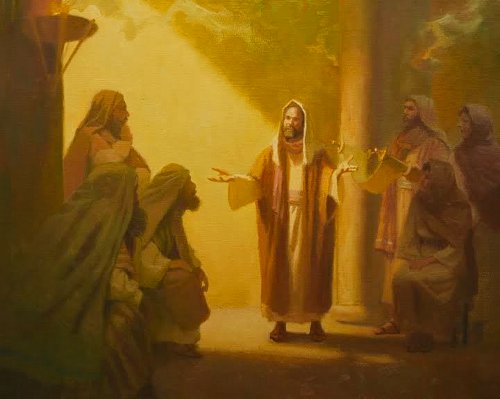
Apostle Paul preachingOf course the commentary I’m citing doesn’t take into account the role of Yeshua (Jesus) as Master, Messiah, and Mediator of the New Covenant, so it could be said, at least by some non-Jews, that in coming to Messianic faith, the Gentile takes on board both yokes, just as does the Jew.

But what yoke was Peter talking about in Acts 15:10?

Now therefore why do you put God to the test by placing upon the neck of the disciples a yoke which neither our fathers nor we have been able to bear?

Peter certainly couldn’t have been dismissing the yoke of Heaven as a requirement of becoming a disciple of the Master, since without a basic acknowledgement of God as Creator and Sovereign, everything that follows is meaningless. But there’s only one other yoke to consider: the commandments, that is, the Torah of Moses.

Now many, most, or all Christians will consider “the disciples” to be all disciples, Jewish and Gentile, and thus reach the conclusion that Peter was advocating for doing away with the commandments (and replacing them with grace). But they miss the fact that in verse 7, Peter identifies the object of his statement as “the Gentiles,” thus he is talking about the yoke of the commandments as being too great a burden to place on them, that is, on us, the non-Jewish disciples.

All of Acts 15 is an attempt to answer the question, “What do you do with a bunch of Gentiles who are being invited to become disciples within Judaism?” Since even a brief inventory of the Tanakh (what Christians call the “Old Testament”) describes the rather difficult history of the ancient Jewish people relative to their obedience to God, I think Peter is justified in saying that the mitzvot are a yoke which neither their (Jewish) fathers nor they (the Jews present at this legal proceeding, and by extension, Jewish people in general) could bear.

This isn’t to say that God expected any Jewish person to perfectly and flawlessly perform the mitzvot. God doesn’t expect the unreasonable out of flawed human beings. Certainly King David, “a man after God’s own heart” (1 Samuel 13:14, Acts 13:22), was less than perfect, and yet even in light of his many human mistakes, he continually and passionately pursued God. James, the brother of the Master, said that “works without faith is dead” (James 2:17, 2:26), so obviously both are required in a life acknowledging the yoke of Heaven and of the mitzvot.

In reading the continuation of the Acts 15 narrative, we see James and the Council ultimately ruling in favor of Peter’s (and Paul’s) interpretation of scripture that the Gentiles should be exempt from many elements of the yoke of Torah. As I mentioned, the yoke of Heaven is a minimum requirement for anyone oriented toward God, so no one can be made exempt from this requirement.

In fact (citing Acts 15:28), it (that is, this decision) seemed “good to the Holy Spirit” that only a limited subset of mitzvot be applied to the Gentile disciples, rather than test God by laying a stumbling block in their path and causing them to repel from coming to faith.

But if God provided two yokes for the Jewish people, the yoke of Heaven and then a path to live out their faith in the yoke of the commandments, what about the rest of us? Actually, I attempted to answer that question, not by providing an exhaustive list of “do this” and “don’t do that” (which seems to be the standard expectation), but rather a higher level conceptualization of humanity’s overarching relationship with God.

Orthodox Jewish manThe Jewish people continue to bear a greater level of responsibility in their obedience to God because of their unique covenant status, but God in His graciousness and mercy, granted access for the Gentile to the Holy Spirit and the promise of the resurrection to come without requiring that we shoulder the same “burdening yoke” (though that yoke is also “perfect for restoring the soul”; see Psalm 19:7).

As I’ve mentioned many times before, I don’t think Acts 15 is the end of the story, and I believe that oral instruction must have accompanied “the letter” as it made its rounds (perhaps eventually being formalized in that document we have called the Didache).

Just in living my own life day-to-day, I find that I have my hands full simply “doing justice, loving kindness and walking humbly with my God (Micah 6:8).” If we can master loving our neighbor as ourselves, as James the Just said, we “are doing well” (James 2:8). This is what James called “the royal law” and part of what the Master called “the greatest commandments” (Matthew 22:36-40). Since this “royal law” is linked to loving God, that brings us full circle back to the yoke of Heaven.

Maybe if you think you have completely mastered the yoke of Heaven, you, as a Gentile, feel you have merited also taking on the yoke of Torah. If you have mastered even that first yoke, then I envy you, for it seems that I and the believers I know have fallen short on some aspect or another in attempting to pull this “plow”.

If humility is about seeking a balance between the extremes of thinking too well of ourselves and thinking too poorly, where is that balancing point for the Gentile in Messiah? It may not be along the same path as the one God placed before the Jewish people.

One final note. As was said in the very first quote at the top of the page, a yoke not only links an animal to the plow but it links two animals to each other. If I say that the yoke of the commandments links Jewish people to God and to each other as Jews, I believe the yoke of Heaven links all of the faithful together, Jew and Gentile alike. So in this, I am not creating a barrier between Jewish and Gentile believers in Yeshua, rather, I am showing you by which yoke we are linked, for we are all yoked by Heaven.

Notes from the Wrong Side of the Jordan

I shall make a distinction between My people and your people.

Exodus 8:19 Stone Edition Chumash (v23 in Christian Bibles)

R’ Shamshon Raphael Hirsch suggests that the phrase “between My people and your people” is a reference to the differing perspectives possessed by the people of the two nations.

-from “A Mussar Thought for the Day,” p.101
Friday’s commentary on Parashas Va’eira
A Daily Dose of Torah

I’ve definitely experienced some “distinctiveness” in opinion over the past several days in the comments section of my blog posts Saving Israel After the Fullness of the Gentiles Has Come (and Gone) and In the Image of God.

(I suppose I should note that even the title of the first blog post I mentioned, the phrase “Saving Israel” was taken as some sort of insult when I posted it in a private Facebook group on Messianic Judaism, due to a misunderstanding of my intent and my citing Paul’s words in Romans 11:26, and the reaction was so strongly disapproving of me, that I removed my Facebook post entirely.)

It’s true that if you’re going to write a “religious” blog, sooner or later, you’re going to rub someone the wrong way, but there are people out there who just can’t seem to tolerate that we are all going to either misunderstand each other from time to time, or that we will disagree on something, and there’s no way to any sort of peace with them.

OK. I get that. So I try not to enter into those debates so much anymore. They never end well. But sometimes these situations seem unavoidable.

Relative to my recent blog posts, there’s a particular group of Jewish people who are offering a service to larger Jewry by “exposing” the fallacies involved in Christianity as well as Messianic Judaism. I periodically had visits in the comments section of my blog from one such person, the subject of this blog post, until I finally had to ban him. I hate banning people, but sometimes a person is so persistently annoying and counterproductive that they inhibit any good that might come out of a discussion on at least some of the topics I write about.

Hence another couple of gentlemen, and I will continue to believe that they are well-meaning in their efforts, made some comments that were designed to be provocative and could well fall into the category of antimissionaries. But while their efforts may be seen as good for Jewish people, they’re not so good for the disciples of Yeshua, Jewish or Gentile.

I can sort of see why they’d want to “visit” Messianic Jewish blogs in an attempt, however misguided, to convince the Jewish blog writers of the error of their ways, but what did I do? I’m not Jewish and I try as much as I can to do no harm to Jewish people or national Israel in word or deed.

(I should say there was a third individual involved in some of these comments who isn’t Jewish and sadly seemed to be more of a troll than anything else).

For those of us who identify as Messianic Gentiles, these situations present an odd conundrum. On the one hand, I relate to Messianic Judaism, at least in its ideal state, as another branch of Judaism that runs parallel to Orthodox, Conservative, Reform, and the rest of the various streams of Judaism.

On the other hand, antimissionaries relate to Messianic Judaism as a form of Christianity, and a rather deceitful one at that.

This also invokes Rabbi Stuart Dauermann’s essay for issue 114 of Messiah Journal, “The Jewish People are Us – Not Them”. It’s a strange thing to relate positively to Messianic Judaism as a Judaism and at the same time, to find yourself at odds with people operating in other branches of Judaism.

Or maybe not. Let me tell you a joke (and I have to thank reader “ProclaimLiberty” for telling me this one):

There were two Jewish men, David and Joel, who were the only survivors of a shipwreck at sea. The two men were washed up on the shores of a deserted island.

A year later, rescuers found them and discovered that they had built three synagogues on the island. One of the rescuers asked David why the two men built three synagogues. David answered, “That synagogue is the one I go to, the one over there is the one Joel goes to, and the one way over there is the synagogue neither of us would be caught dead in.”

Don't ArgueIf you don’t get the joke, it would be kind of hard to explain it to you. Another way of putting it is by expressing the Jewish adage, “two Jews, three opinions.”

Here’s another example:

At that time Jesus went through the grain fields on the Sabbath, and His disciples became hungry and began to pick the heads of grain and eat. But when the Pharisees saw this, they said to Him, “Look, Your disciples do what is not lawful to do on a Sabbath.” But He said to them, “Have you not read what David did when he became hungry, he and his companions, how he entered the house of God, and they ate the consecrated bread, which was not lawful for him to eat nor for those with him, but for the priests alone? Or have you not read in the Law, that on the Sabbath the priests in the temple break the Sabbath and are innocent? But I say to you that something greater than the temple is here. But if you had known what this means, ‘I desire compassion, and not a sacrifice,’ you would not have condemned the innocent.

Matthew 12:1-7 (NASB)

From a traditionally Christian interpretive dynamic, this looks like Jesus is contradicting or just doing away with “the Law” of Shabbat, but from a Jewish perspective (to the best of my ability to render one), it’s two groups of Jews debating on what is and isn’t permissible on Shabbat, more specifically, the melachot or acts of work that are considered forbidden to perform on Shabbos.

Remember, some of the Pharisees felt so strongly about Shabbat and performance of melachot that they even planned to destroy the Master (see Matthew 12:14). Fortunately, these disagreements don’t get to that point in this day and age, however, that doesn’t mean they can’t be quite passionate.

So where does that leave me in these discussions? I can’t resolve them. There’s little to benefit from entering into another long and useless debate, batting their proof texts and mine back and forth like so many tennis balls.

Of course, from my critics’ point of view, we aren’t discussing a simple disagreement. This is a matter of heresy, apostasy, sacrilege, and even idol worship.

So where am I to turn?

The clear inference of these passages is that the recognition of Hashem’s mastery over all areas of life is a liberating force, rather than a debilitating one. This concept is illustrated in the simple, yet extraordinarily profound saying of Ben Zoma in Pirkei Avos (4:1), which asks, “Who is rich? He who is happy with his lot.” Rashi concludes that even the wealthiest person who is discontented with his lot will be in a constant state of fear and despondency, and is considered a pauper.

-from “A Mussar Thought for the Day, p.102

Oh yeah, God. Remember God? This is supposed to be about God and not winning arguments or rattling “pagan” Christian cages just to get a reaction.

When I get tired of religious people and religious arguments, I take some comfort in the Bible such as this reading from the Psalms for this past Shabbat:

Desist, and know that I am God; I will be exalted among the nations, I will be exalted upon the earth.

Psalm 46:11

Unfortunately, even here with the (apparent) reassurance that it is right and appropriate for the nations to exalt God, Rashi’s commentary on the verse as found at Chabad.org states:

Desist: all nations from further marching upon Jerusalem.

and know that I am God: That I will execute judgment upon you.

I will be exalted among the nations: I will be exalted with My vengeance which I will wreak upon those nations.

leaving churchNot very soothing sentiments for a Gentile who is trying to relate to Yeshua-faith as a form of Jewish worship and study. Well, maybe Rashi wasn’t talking about people like me (although I think he actually was).

So why do I do this to myself? Why do I continually inject my attention, my studies, and my commentary into what is obviously Jewish space? Because traditional Christian study materials, interpretations, and doctrine are somewhat…how should I say it…wanting. I suppose it’s one of the reasons I left church last fall after attending for two years (and those of you who’ve been following my blog for a long time know how agonizing my decision to return to the church was back then).

So once again I’m standing in-between multiple opposing forces within my little corner of the religious blogosphere and in my life as well. But I did mention something earlier:

I wait for the Lord, my soul does wait,
And in His word do I hope.

My soul waits for the Lord
More than the watchmen for the morning;
Indeed, more than the watchmen for the morning.

O Israel, hope in the Lord;
For with the Lord there is lovingkindness,
And with Him is abundant redemption.

And He will redeem Israel
From all his iniquities

Psalm 130:5-8 (NASB)

I have no doubt that God will fulfill His promises to redeem Israel. I just hope that when the dust settles, there will be something left for the rest of us…for me.

Addendum: For more perspective on the debate between Messianic Judaism and other Jewish religious groups and branches (in this case, Yad L’Achim and Chabad) please read Yad L’Achim’s Personal Jesus: the Berditchever Rebbe at the Rosh Pina Project.

The Myth of Visiting Heaven and Coming Back to Talk About It

Nearly five years after it hit best-seller lists, a book that purported to be a 6-year-old boy’s story of visiting angels and heaven after being injured in a bad car crash is being pulled from shelves. The young man at the center of “The Boy Who Came Back from Heaven,” Alex Malarkey, said this week that the story was all made up.

The book’s publisher, Tyndale House, had promoted it as “a supernatural encounter that will give you new insights on Heaven, angels, and hearing the voice of God.”

But Thursday, Tyndale House confirmed to NPR that it is taking “the book and all ancillary products out of print.”

-Bill Chappell
“Boy Says He Didn’t Go To Heaven; Publisher Says It Will Pull Book,” Jan. 15, 2015, 10:20 p.m. ET
NPR.org

I suppose this will be all over social media today and that many people will be commenting on their blogs about everything from fraud to faith. Frankly, I’ve always ignored these sensationalist stories about people having near-death or death experiences, visiting Heaven, then being resuscitated and telling everyone they sat on Jesus’s (Yeshua’s) lap or something. I’ve ignored these stories, well, almost ignored them, because they never said anything that surprised me.

These stories always confirmed the traditional Christian view of the afterlife, of Jesus, of everything preached from church pulpits all over the world, or at least in the U.S. and Canada. Assuming (and this is my assumption) that standard Evangelical Christian theology and doctrine doesn’t have a perfect picture of everything having to do with God, Jesus, and Heaven, then I’d expect that a person who had actually experienced a mystical encounter and visited the Heavenly Court would say something that Christianity hadn’t anticipated, but at the same time made sense once we heard it and compared it to experiences such as Ezekiel’s or John’s we find in the Bible.

And to the best of my knowledge, that’s never happened.

Here’s the reason I’m writing this “extra meditation” today:

“I did not die. I did not go to Heaven,” Alex wrote. He continued, “I said I went to heaven because I thought it would get me attention. When I made the claims that I did, I had never read the Bible. People have profited from lies, and continue to.”

Now here’s the kicker:

“They should read the Bible, which is enough. The Bible is the only source of truth. Anything written by man cannot be infallible.”

When I read that sentence, I immediately thought of the following:

And he said, ‘Then I beg you, father, that you send him to my father’s house—for I have five brothers—in order that he may warn them, so that they will not also come to this place of torment.’ But Abraham said, ‘They have Moses and the Prophets; let them hear them.’ But he said, ‘No, father Abraham, but if someone goes to them from the dead, they will repent!’ But he said to him, ‘If they do not listen to Moses and the Prophets, they will not be persuaded even if someone rises from the dead.’”

Luke 16:27-31 (NASB)

This is a parable and probably not a literal story involving real people, but the tale makes a point that is very relevant to the current topic. While some people may accept and believe stories like Alex’s, most people won’t including most religious people. After all, the Master was resurrected and is called “the first fruits of those who are asleep” (1 Corinthians 15:20) and yet not everyone believes his testimony or the testimonies of the direct witnesses to his resurrection.

Alex Malarkey is right. The only information source we can trust is the Bible and believe me, Bible study is a lifelong effort in learning and drawing nearer to our Creator.

We do know that some people have “visited Heaven”. We have the mystical experiences of Ezekiel and the Apostle John recorded in the Bible that renders their visions or visits (not sure which) in vivid, if sometimes incomprehensible detail. We have the Apostle Paul writing that he (apparently) was “caught up to the third heaven,” though he provided no details of the experience because he heard “inexpressible words, which a man is not permitted to speak.”

Alex Malarkey
Alex Malarkey, seen here in a 2009 photo, has written an open letter saying that events described in the best-seller The Boy Who Came Back from Heaven were made up.
John Kuntz/The Plain Dealer/Landov

So we have a few Biblical examples of such mystical experiences, but they seem rather rare.

Both Judaism and Christianity have rich mystical heritages, but I’m not qualified to speak to all that because I’m not a mystic. To me, the mystic tales of the Hasidim (for example) seem more metaphorical than literal. For my part, I have a tough enough time just being ordinary and living life exploring my faith from my own limited perspective.

So I’ll continue to muddle along the old-fashioned way, by reading and studying the Bible, by praying, by visiting with other believers, and I’ll let God tell me what He wants me to know in whatever way He sees fit.

I wonder how many people based their faith or came to faith because of stories like the one Alex told? I wonder how many people’s faith will be shaken or even shattered now that they know that he lied?

Actually, I feel sorry for him. He’s just a kid. It must have taken a lot of courage for him to come clean in so public a manner. I just hope everyone else involved also does the right thing.

Saving Israel After the Fullness of the Gentiles Has Come (and Gone)

But when they heard this, they were cut to the quick and intended to kill them. But a Pharisee named Gamaliel, a teacher of the Law, respected by all the people, stood up in the Council and gave orders to put the men outside for a short time. And he said to them, “Men of Israel, take care what you propose to do with these men. For some time ago Theudas rose up, claiming to be somebody, and a group of about four hundred men joined up with him. But he was killed, and all who followed him were dispersed and came to nothing. After this man, Judas of Galilee rose up in the days of the census and drew away some people after him; he too perished, and all those who followed him were scattered. So in the present case, I say to you, stay away from these men and let them alone, for if this plan or action is of men, it will be overthrown; but if it is of God, you will not be able to overthrow them; or else you may even be found fighting against God.”

Acts 5:33-39 (NASB)

James, I think…the ironic part of those words is that the plan and action of these men was indeed overthrown. The early Jewish Jesus-followers ceased to exist in a short order. Their sect was replaced by a religion quite foreign to them in deed and thought, one in total opposition to Judaism and one that worshiped a man as a deity. This is definitely not something that Gamaliel would have approved as mainstream Judaism nor would he have taken a wait and see approach, that is had he actually known that to be the case with the members of the Jesus sect standing in front of him. That’s something to consider.

-Gene Shlomovich
from his comment on my recent blog post

That is very interesting and it’s something I never thought of before. Of course most Christians would disagree that the ancient Jewish movement of “the Way” was overthrown and thus proven to not be of God. Or maybe they would agree since it was the Jewish expression of faith in Yeshua (Jesus) that was overthrown. But the flip side of the coin is that Christians would say the rise of the (Gentile) Church was always God’s plan and that anyone who is against the Church is “found fighting against God.”

But of course as a Messianic Gentile, I’m all for the Messianic movement being a Jewish religious stream rather than a faith co-opted and significantly redesigned by and for Gentiles. Not that Gentiles don’t have a place in that Messianic Jewish stream, but we’re just not the ones sitting in the catbird seat, so to speak.

So, was the early Messianic movement overthrown by the invalid religion of Gentile Christianity? I can almost feel some Christians out there bristling at the suggestion.

Or was the “time of the Gentiles” all part of the plan?

For I do not want you, brethren, to be uninformed of this mystery—so that you will not be wise in your own estimation—that a partial hardening has happened to Israel until the fullness of the Gentiles has come in; and so all Israel will be saved… (emph. mine)

Romans 11:25-26 (NASB)

Paul appears to link “fullness of the Gentiles” with “all Israel will be saved,” as if the former were necessary so that the latter could be fulfilled. Perhaps, in all its imperfection and even its historical cruelty to the Jewish people, the Gentile Church was somehow a requirement in God’s plan to ultimately redeem all of Israel, making her a light to the nations (Isaiah 49:6) and sending the Torah to all of the earth (Isaiah 2:3).

But how are we to understand this?

The Torah is not in heaven. The voice of God is unambiguous; it is the confusion of man, of the best of us, that creates the ambiguity.

-Abraham Joshua Heschel
from “The Primacy of Literal Meaning,” p.133
Man’s Quest for God

However, a few pages later (p.142) Heschel also states:

The soul of the religious man lives in the depth of certainty…

A Jewish person such as Gene would say that the efforts of the young Messianic Jewish movement in the late-Second Temple period and thereafter was not of God since it was overthrown by the new Gentile religion Christianity. A Christian might say that the Jewish movement of “the Way” was always meant to be transformed by God from one based on Law to a better one based on Grace.

I can’t accept either explanation because I think we’re looking at the idea of being “overthrown” in rather limited terms.

The Jewish people have been exiled on numerous occasions over the course of history by the will of God, though I’m convinced not by any desire of Hashem to do harm to His people Israel. This most recent exile has been nearly two-thousand years long and it is said the exile will not end until every Jew is returned to the Land and national Israel is totally sovereign and at the head of all the other nations in the world.

According to Paul’s criteria, Israel hasn’t been saved yet. According to most modern religious Jews, Israel will not have been redeemed until Messiah comes and accomplishes it.

calloused handsFrom both a Jew’s and a Christian’s point of view, that event has yet to take place.

So was “the Way” was overthrown or is its Jewish core merely waiting for the proper time for the healing of calloused hands (Romans 11:25, see Nanos)?

Yes, I realize that I’ve probably written things here that will make both Jews and Christians unhappy with me. That was not my intent, but I don’t doubt it will be the result. I’m not writing this to be deliberately insulting but as an attempt to address Gene’s observation and how I see the consequences of historic actions in the long haul.

What God Expects of the Jew and Also the Gentile

R’ Moshe Feinstein (in his Darash Moshe) explains that greatness is not defined by a person’s accomplishments, but rather by the person’s success in fulfilling the tasks for which Hashem equipped him and sent him to this world. Every person enters the world with unique abilities and a specific set of tasks to accomplish. Some are given tremendous ability, and are expected to achieve a great deal, while others are endowed with lesser abilities, and correspondingly, smaller tasks. But every person’s job is identical — use the skills you have been given to the utmost, to accomplish as much as you can.

-from “A Torah Thought for the Day,” p.75
Tuesday’s commentary on Parashas Va’eira
A Daily Dose of Torah

From a rationalist’s point of view it does not seem plausible to assume that the infinite, supreme Being is concerned with my putting on Tefillin every day. It is, indeed strange to believe that God should care whether a particular individual will eat leavened or unleavened bread during a particular season of the year. However, it is that paradox, namely, that the infinite God is intimately concerned with finite man and his finite deeds; that nothing is trite or irrelevant in the eyes of God, which is the very essence of the prophetic faith.

-Abraham Joshua Heschel
from “Does God Require Anything of Man?” p.102
Man’s Quest for God

You may not think the two quotes just above have much to do with one another, but bear with me. The former is addressing how each human being is placed on earth to fulfill his or her specific potential understanding that we all have different potentials, and the latter is discussing, not generally human response to God, but a Jew’s response to Hashem through performance of the mitzvot.

There are many problems which we encounter in our reflections on the issue of Jewish observance. I would like to discuss briefly several of these problems, namely, the relation of observance to our understanding of the will of God; the meaning of observance to man; the regularity of worship; inwardness and the essence of religion; the relevance of the external deeds.

-Heschel
“To Obey or to Play with the Will of God.” p.102

Is Heschel using “man” and “Jewish” as interchangeable terms, or can we infer that he means that all human beings are responsible for obeying God, and then drawing out Jewish observance as distinct from God’s expectations for the rest of us?

I doubt Heschel meant to include that meaning into his writing but I’m going to “force” the issue based on my particular perspective.

You see, not only do I believe that each individual human being was placed here in life for a purpose that has been assigned to us by God, but I believe that God has placed the Jewish people and the Gentile nations here to fulfill specific purposes depending on which corporate body we are born into (aside from some Gentiles converting to Judaism).

praying_jewIn other words, there are specific tasks God placed Jewish people here to perform, and we Gentiles have specific tasks we also are here to perform, all in the service of God.

But those Jewish and Gentile tasks aren’t necessarily the same (though there’s probably some overlap).

I know that will ruffle a few feathers out there, but I’ve said this often enough and in so many different ways, it shouldn’t really surprise anyone by now.

As for the “equality” of women in Torah, a great deal depends on what you think “equality” means. In Torah, it does not mean that every member of the community is authorized to perform the identically same roles and tasks. Leviim may not perform some tasks reserved for Cohanim. Other Jews who are not in these categories may not perform the tasks reserved for priestly categories (with some rare and constrained exceptions). Men may not bear children nor are they exempt from time-critical tasks required of them (the men, not the children [:)]). Women may not perform certain tasks required specifically of men. Children are constrained from performing adult tasks and are not to be relied upon to perform adult responsibilities (though their training will include learning by doing, emulating such tasks). None of these categories are less to be valued because of what they may not do; and each is to be highly valued for what they *are* given to do. They are all equally valuable and honorable; but they are not identical in their assignments nor may they trade off their specific responsibilities, though some tasks may be shared by more than one of these categories.

-from a comment made by “ProclaimLiberty”
on my blog post Jews Defining Their Own Relationship With God And The Torah

While the conversation was about male and female equality of roles within Jewish religious and communal space, I chose to expand the concept to include Jewish and Gentile roles within that same space and particularly within Messianic Judaism.

Individuals are granted potentials to fulfill and so are people groups, namely Jewish and Gentile. After all, the Torah was given to Israel at Sinai, not all of the human beings living on the Earth. So if there were a Gentile “mixed multitude” also standing at Sinai saying as one man, “all that you have said we will do” (Exodus 19:8; 24:3), those from outside Israel either assimilated into the tribes, losing their Gentile heritage forever, or they left without so much as a “by your leave” to return to the rest of the nations, probably the lands from which they came.

But what about the rest of us? I mentioned that I thought the nations had specific tasks hard-coded into our potential as well. I suppose I could start with Genesis 9 which is the basis for what in Judaism is referred to as The Seven Laws of Noah, but I can go further than that.

“Therefore it is my judgment that we do not trouble those who are turning to God from among the Gentiles, but that we write to them that they abstain from things contaminated by idols and from fornication and from what is strangled and from blood. For Moses from ancient generations has in every city those who preach him, since he is read in the synagogues every Sabbath.”

Acts 15:19-21 (NASB)

But concerning the Gentiles who have believed, we wrote, having decided that they should abstain from meat sacrificed to idols and from blood and from what is strangled and from fornication.”

Acts 21:25

It would seem, at least from my point of view, that the Bible presupposes a distinction in the duties human beings have to God depending on whether or not you’re Jewish.

Yet we all wholeheartedly accept Micah’s words: “He has showed you, O man, what is good, and what does the Lord require of you, but to do justice, and to love kindness and to walk humbly with your God” (Micah 6:8). If we believe that there is something which God requires of man, then what is our belief if not faith in the will of God, certainty of knowing what His will demands of us?

-Heschel
“Does God Require Anything of Man,” p.103

Toby Janicki
Toby Janicki

But from a “Messianic Gentile’s” perspective, what is the “certainty of knowing what His will demands of us?” The overly simplistic answer some have selected is that “one size fits all.” In other words, there are 613 commandments that Jews are obligated to perform (though many of them are in abeyance since we are without a Temple, a Levitical Priesthood, and a Sanhedrin in Israel), and God has only one standard of piety and righteousness for the whole human race, that is, the aforementioned 613 commandments, the Torah.

But if we accept that, then we must accept that God first chose Israel to be a light to the nations, then at some point, “unchose” her, and instead, chose all followers of Jesus Christ (Yeshua HaMashiach). Except that’s exactly what the Christian Church believes. Christians believe that God “unchose” Israel and the Torah and then chose “the Church,” the worldwide body of believers in Jesus. Hebrew Roots generally (but not universally) believes that (again, please bear with me) God “unchose” Israel and then chose all followers of Messiah Yeshua and applied the Torah to his latter selection in the same manner as He did with His former selection (and as I’ve said before, I don’t for a split second believe that Gentile disciples actually become “non-Jewish Israel”).

It is so difficult from a western egalitarian mindset to imagine that God would be so “unfair” as to have different standards and different expectations for different people groups. And yet, He is God and His will be done.

Heschel calls observing the mitzvot “the Jewish way of life,” (p.105) and he takes Christian theology and specifically the writings of the Apostle Paul to task for emphasizing that a man is justified by faith apart from the Law (p.108 citing Romans 3:28), which he doesn’t consider to be a particularly Jewish attitude.

The highest peak of spiritual living is not necessarily reached in rare moments of ecstasy; the highest peak lies wherever we are and may be ascended in a common deed. There can be as sublime a holiness in fulfilling a friendship, in observing dietary laws, day by day, as in uttering a prayer on the Day of Atonement.

-ibid
“There is No Exterritoriality,” p.111

I agree, however Heschel seems to have missed this:

What use is it, my brethren, if someone says he has faith but he has no works? Can that faith save him? If a brother or sister is without clothing and in need of daily food, and one of you says to them, “Go in peace, be warmed and be filled,” and yet you do not give them what is necessary for their body, what use is that? Even so faith, if it has no works, is dead, being by itself.

James 2:14-16

Of course James (Ya’akov or Jacob), the head of the Council of Apostles and Elders and brother to the Master was (and is) also Jewish so it stands to reason that he and Heschel might have some common insights on a Jewish response to God.

One of the questions I am asked when I bring up this subject is what specifically does God expect of the Gentile in Messiah? I’ve tried to answer that question on multiple occasions over the past several years, most recently in The Duty of Messianic Gentiles and Christians to the Jews, Messianic Judaism for the Rest of Us and Gentiles Studying Torah for the Sake of Doing. But in reading Heschel another detail came to mind.

While not prescribing a diet — vegetarian or otherwise — or demanding abstinence from narcotics or stimulants, Judaism is very much concerned with what and how a person ought to eat. A sacred discipline for the body is as important as bodily strength.

-Heschel, pp.111-12

So God isn’t concerned about what a Gentile ought to eat?

Or do you not know that your body is a temple of the Holy Spirit who is in you, whom you have from God, and that you are not your own? For you have been bought with a price: therefore glorify God in your body.

1 Corinthians 6:19-20

No longer drink water exclusively, but use a little wine for the sake of your stomach and your frequent ailments.

1 Timothy 5:23

The Kosher laws aren’t exclusively a list of “health foods” and in fact, some of the dietary requirements God has for the Jewish people defy logic, but let’s say God does care what we eat (he cares about everything we do, but I’ll use this as an example). Since the Jewish people, God’s nation Israel, has been called out forever from the rest of the nations, which includes the people of the nations who have come to faith in Yeshua, His list of expectations maps to what he has “wired” into them as a set of “potentials”. That goes to every little detail in life, as Heschel alluded to above, including food.

Now let’s say that God also has dietary expectations for the rest of us but that those requirements are less stringent. What if the specific examples we see Paul issuing in his epistles all come down to a general principle (or a few of them if you include the Jerusalem letter) of “eating right?” After all, Paul in his missives seems to be mainly concerned on matters of health, probably for the sake of the Gentile disciples honoring God by behavioral performance (praying, doing good deeds), which is better done if you aren’t sick.

I’m limiting this to food but there’s a lot of things we can do with our bodies to either sanctify or desecrate the Name of God.

kosher deliWhat I’m getting from all this is that God’s behavioral expectations of the Jewish people are much more specific and strict than His expectations for the rest of us because that’s the role He assigned them in this life. He assigned the Gentiles a more “generic” but no less important role and thus the expectations attached to our role are more “relaxed” as reflected in the quotes from Acts 15 and Acts 21.

This isn’t to say that a Gentile disciple can’t go “above and beyond” as a matter of personal conviction. After all, God allowed Jewish people to go “above and beyond” by taking a Nazarite Vow (Numbers 6). However, we are no more required to behave beyond our basic assigned requirements than a Israelite was required to undergo the Nazarite ritual (with notable exceptions such as Samson, Samuel, and John the Immerser who were all life-long Nazarim).

It’s not that the Jews have the Law and the Christians (all non-Jewish believers in Messiah) have Grace. We all have Law and we all have Grace. It’s just that the “Law” for the Gentile disciple isn’t as highly specific as it is for the Jew. There’s more flexibility built into our lives than there is for the Jewish people. God expects them to uphold a higher standard and they bear a greater responsibility. Being “chosen” isn’t always a walk in the park.

That’s not the end of the discussion and there are a lot more details involved, but for those, I’ll refer you to Review of the Gentile Believer’s Obligation to the Torah of Moses and The Gentile Believer’s Obligation to the Torah of Moses Revisited.

I know this won’t satisfy some of you out there, but I don’t expect to be able to do so. This is just me refining my understanding of who I am as a Messianic Gentile and my duties to God as a disciple of the Master, may he come soon and in our day.