Tag Archives: Christianity

A Quick View of the Coming of Messiah Through a Jewish Lens

cloaked-in-light-tallitBelief in the eventual coming of the mashiach is a basic and fundamental part of traditional Judaism. It is part of Rambam’s 13 Principles of Faith, the minimum requirements of Jewish belief. In the Shemoneh Esrei prayer, recited three times daily, we pray for all of the elements of the coming of the mashiach: ingathering of the exiles; restoration of the religious courts of justice; an end of wickedness, sin and heresy; reward to the righteous; rebuilding of Jerusalem; restoration of the line of King David; and restoration of Temple service.

Modern scholars suggest that the messianic concept was introduced later in the history of Judaism, during the age of the prophets. They note that the messianic concept is not explicitly mentioned anywhere in the Torah (the first five books of the Bible).

However, traditional Judaism maintains that the messianic idea has always been a part of Judaism. The mashiach is not mentioned explicitly in the Torah, because the Torah was written in terms that all people could understand, and the abstract concept of a distant, spiritual, future reward was beyond the comprehension of some people. However, the Torah contains several references to “the End of Days” (acharit ha-yamim), which is the time of the mashiach; thus, the concept of mashiach was known in the most ancient times.

from “Mashiach: The Messiah”
Judaism 101

The Jewish people are compared to the stars twinkling in the high heavens. By their light, even he who walks in the darkness of night shall not blunder. Every Jew, man or woman, possesses enough moral and spiritual strength to influence friends and acquaintances, and bring them into the light.

-from “Today’s Day”
Wednesday – Cheshvan 5 – 5704
Compiled by the Lubavitcher Rebbe; Translated by Yitschak Meir Kagan
Chabad.org

Tales of the Messianic Era series

A few days ago, I wrote a blog post called A Quick View of Revelation Through a Christian Lens, which presented what I thought was a traditional fundamentalist Christian viewpoint of the Book of Revelation and the “end times.” It turned out to be one of my more popular blog posts and I hope laid the groundwork for further investigations into this area of study.

I want to be fair, and since I’m searching for a more Jewish understanding of this topic, I thought the next step should be for me to offer the opposite side of the coin: to show a portrait of a wholly and non-Messianic Jewish perspective on the coming of Moshiach. What would a distillation of the Jewish prophesies about Messiah taken just from the Tanakh (Old Testament) look like? Fortunately a few days ago, one fell quite conveniently in my lap.

The real Jewish messiah appears on the scene. He’s not Jesus, but a virtuous and devout Jewish man who is able to unite all Jews, a scholar and wise military leader. The nations of the world hate and oppose him and work against him, as they’ve done to every Jewish leader in Israel’s history. He’s nothing like what they expected to see – not the glorious all-powerful heavenly Jesus. He regathers the rest of the Jews from all around the world. Many wars against Israel break out, but the Messiah leads Israel in defeating their many enemies and in rebuilding the Third and final Temple.

True prophets once again appear in Israel and they are able to recognize the lineage of all Jews, including of priests, Levites and especially that of the Messiah himself, with many Jews recognizing their leader as the awaited Messiah. Christians, however, almost unanimously speak against him, brand him the “antichrist” of their bible, preaching fiery sermons in their churches against the “antichrist” and against the Jews who fell “under his spell just as Jesus, Paul and John predicted”. No Christian may believe in him, or they risk losing their salvation. Jews are ridiculed and the New Testament is held up as having predicted everything the Jews will do. Muslims, who along with Christians likewise believe that Jesus is the Messiah and that no one else fits the bill, also reject the kingship of the Jewish Messiah and join with the Western world in their opposition to him and the nation of Israel.

Finally, all nations gather against Israel for the ultimate conflagration, attacking Jerusalem and causing much damage. The war against Israel appears to be won and situation is hopeless. However, G-d himself intervenes, and sends his fire on earth and destroys the armies of “G-g and Magog and all the cohorts.” The weakest in Israel chases away thousands. The nations of the world are humbled, they are in awe of what G-d has done for Israel, of His salvation. The idols of the nations which do not save (including Jesus) are destroyed, are put away for good and are remembered no more. All false prophets and idol worshipers will be ashamed, they will realize that they inherited nothing but lies from their forefathers. The earth will be finally at peace. G-d raises all the righteous dead and all peoples of the earth are required to come to Jerusalem to worship Hashem in his Temple. The true Messiah of Israel (which could be the resurrected king David himself) will fear G-d, rule justly and will forever reign as prince/king over the Jewish people.
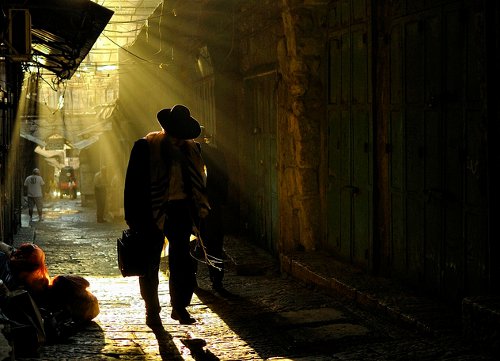
Jewish in Jerusalem(I just want to mention that although Islam considers Jesus a prophet, they do not see him as their “Messiah.” Rather, the Mahdi is the redeemer of Islam).

Just about all Christians and not a few Hebrew Roots and Messianic Jewish adherents are bound to find the above rendition of the coming of Messiah disturbing. The Jewish Messiah is treated by Christians as the “antichrist” because he’s “too Jewish” and fits the description of Moshiach in Jewish understanding too closely. The Church is waiting for someone who never comes, waiting for a rapture up to Heaven that never occurs. In the end, Christianity becomes just another enemy of Judaism and Israel that God defeats. Humiliated, Christians all over the world discover that they’ve been following a false god all along, and either they surrender their “faith” and pay homage the true King of Israel and worship Israel’s God, or they remain defiant, and continue to pray for a Jesus who never existed and who will never answer.

That’s a horrible thought. Here’s a worse one.

The above summary, at least on the surface, seems to fit quite well with what we understand of the Messianic prophesies in the Tanakh. That is, if we don’t factor in the New Testament, this summary seems to connect almost seamlessly with the words of the ancient Jewish prophets about the coming Moshiach.

You don’t have to worry about the distinctions between the raptured Church and resurrected Israelites because no such dissonance exists. It’s all about Israel. Period.

Interestingly enough, this isn’t tremendously far from what I’ve been trying to find in Messianic Judaism, a completely Jewish Messiah King whose focus is first and foremost on national Israel and the Jewish people. From this focus, the people of the rest of the world receive blessings, but ultimately it’s all about Israel. Period.

If there isn’t a “happy meeting place” between the ancient portrait of the Jewish Messiah King who has yet to come and the promise of a resurrected Yeshua who will come again, then either New Testament Christians must be ready to admit that there is a very fuzzy connection between the Old Testament prophesies of Messiah and how the New Testament describes Jesus, or we have to take a whole new look at the Messianic prophesies in the Tanakh and see who we are really supposed to be waiting for.

This isn’t going to be easy, especially when I’m tossing aside the Church’s assumptions and traditions that make it possible to reconcile what doesn’t seem to fit very well, and re-examine the identity of Messiah and his redemptive mission at its core.

I know in my previous blog post, I received a large number of responses explaining the problems with some of the Christian assumptions about the return of Jesus. I’m hoping a similar reaction will be forthcoming, discussing the Jewish viewpoint of Moshiach and how (or if) a Jewish perspective can factor in and make it understandable that Jesus is the same Messiah we find in the Old and New Testaments.

Now it will come about that
In the last days
The mountain of the house of the Lord
Will be established as the chief of the mountains,
And will be raised above the hills;
And all the nations will stream to it.
And many peoples will come and say,
“Come, let us go up to the mountain of the Lord,
To the house of the God of Jacob;
That He may teach us concerning His ways
And that we may walk in His paths.”
For the law will go forth from Zion
And the word of the Lord from Jerusalem.
And He will judge between the nations,
And will render decisions for many peoples;
And they will hammer their swords into plowshares and their spears into pruning hooks.
Nation will not lift up sword against nation,
never again will they learn war.

Isaiah 2:2-4 (NASB)

tallit-prayerWho is the Messiah who will redeem Israel, gather in her exiles, restore tranquility within her borders, vanquish her enemies, rebuild the Temple, and establish a rule of peace and justice over the entire world? Is it the man we see described by such prophets as Isaiah, Jeremiah, Ezekiel, Hosea, and Micah? Or is it the Son of God who we encounter in Matthew, Mark, Luke, and John, the one spoken of by the apostle Paul as he established the churches of the Gentiles, and the one who we find in all majesty and glory within the pages of Revelation?

Or somehow, is it both?

Lech Lecha: Did You Hear the One About the Jewish Student and the Priest?

strangers-in-israelThe Lord said to Abram, Go forth from your native land and from your father’s house to the land that I will show you.

I will make of you a great nation, And I will bless you; I will make your name great, And you shall be a blessing. I will bless those who bless you And curse him that curses you; And all the families of the earth shall bless themselves by you.”

Abram went forth as the Lord had commanded him, and Lot went with him. Abram was seventy-five years old when he left Haran. Abram took his wife Sarai and his brother’s son Lot, and all the wealth that they had amassed, and the persons that they had acquired in Haran; and they set out for the land of Canaan. When they arrived in the land of Canaan, Abram passed through the land as far as the site of Shechem, at the terebinth of Moreh. The Canaanites were then in the land.

Genesis 12:1-6 (JPS Tanakh)

Thus Abraham took his first steps on a journey that would result in the vast and astonishing progression of the Jewish people across the grand panorama of human history. Abraham the Hebrew “crossed over” not just a geographical boundary, but a spiritual one.

I’ve said on a number of occasions that I thought one of the missions of the Christian church was to provoke zealousness among the Jewish people, to inspire Jews to return to Torah, return to Judaism, return to being who God made them to be.

Although I don’t believe God would allow it, there is a tremendous and ongoing concern, especially in America, that the Jewish population will continually assimilate, and ultimately vanish from our national landscape. And while many Christians believe that the only hope for the Jewish people is to convert to Christianity no matter what, there are some Jewish believers who insist that only when the Jewish people repent and return to Torah that the Messiah will finally return, and all of God’s promises to Israel and the people of the nations who are called by His Name (Amos 9:11-12) will finally come to pass.

In this week’s Torah portion, Avraham (Abraham) makes his way to the land of Israel and begins the journey of the Jewish people through history. Along that path we have seen nations rise and fall and have survived them, even through massive persecution. There were 2 million Jews during the Roman Empire 2,000 years ago. Demographers state that though there are approximately 14 million Jews identified worldwide, there are possibly 400 million halachic Jews (Jews whose mother’s were Jewish or converted according to Jewish law). Many Jews have fallen by the wayside of history. This week I share with you a story of one Jew who made his way back to identifying with the Almighty, the Jewish people and the Torah … albeit in a rather unusual way.

-Rabbi Kalman Packouz
“Shabbat Shalom Weekly”
Commentary on Torah Portion Lech Lecha
Aish.com

orthodox-talmud-studyRabbi Packouz goes on to tell the story of “Lance,” a young Jewish fellow who came from a family so assimilated that they sent him to a Catholic school to get the “best education.” One of Lance’s instructors, a Priest, found out that Lance was Jewish only by accident. Lance chose to write an essay about Rabbi Akiva for an assignment in the Priest’s class. Curious, the Priest asked Lance why he chose a great Jewish sage as the topic and Lance answered, “Because I’m Jewish.” This simple statement launched another journey into Judaism with some surprising twists:

The priest was surprised that he had a Jewish pupil and asked Lance if he had ever studied the Five Books of Moses with Rashi, the great commentator, or if he had ever learned the Mishna, part of the Talmud. When Lance told him “No,” the priest offered to teach him. For an hour a day after school, they learned together.

One day it occurred to Lance that Judaic studies were not the usual curriculum for the priesthood, so he asked his mentor, “How did you become so knowledgeable in Torah?”

The priest replied, “Before I entered the seminary, I traveled to Israel. While visiting the Western Wall a man asked me if I was Jewish. Curious as to why he asked, I answered ‘Yes.’ The man then asked me if I was interested in learning about my heritage. I figured it would be interesting, so I said, ‘Sure.’ He took me to a yeshiva in the Old City of Jerusalem and I was so impressed that I stayed for close to a year, never revealing that I wasn’t Jewish. I considered converting, but decided that it would be too difficult and too much of a shock to my family, so here I am.”

One Jewish young man who had grown up never knowing what it is to be Jewish and a Catholic priest who nearly converted to Judaism. What strange partners of God. A Priest encouraged his Jewish student, not to convert to Catholicism, but to become knowledgable in Torah and Mishnah. He encouraged “zealousness.”

Protestantism struggles with how to support the Jewish people but gets hung up on Jews who are not in the Church. They can’t always see that we can also “provoke zealousness” and that Messianic Judaism is the most likely vehicle for doing so. If Jesus is Jewish and the Messiah, then his Jewish followers will not abandon being Jewish and will not neglect Torah as his disciples.

Abraham took all that he had and, at the command of God, went to the Land of Promise in obedience. God put Lance and a Priest together and using a highly unlikely set of circumstances, sent one lost Jewish person on the correct path as well. According to Rabbi Packouz, Lance continued pursuing his Jewish studies and presumably became observant.

If you are a Christian, what does this tell you about what God wants you to do? If you are Jewish, where should you be going?

Good Shabbos.

Returning to the Tent of David: The Clay Jar

eph-2-10-potter-clayDo you wrestle with dreams?
Do you contend with shadows?
Do you move in a kind of sleep?
Time has slipped away.
Your life is stolen.
You tarried with trifles
Victim of your folly.

Dirge for Jamis on the Funeral Plain, from “Songs of the Muad’Dib” by the Princess Irulan
quoted from pg 126 of Frank Herbert’s novel
Dune

This book outlines a vast mission and vision. At first it can seem overwhelming both in the scope it entails and in the sacrifice it requires.

-Boaz Michael
“Strategic Mission,” pg 164
Tent of David: Healing the Vision of the Messianic Gentile

Part of the Returning to the Tent of David series

Ever since I’ve been writing about my “re-review” of Boaz’s TOD book and the re-evaluation of my “mission” in my local church, I’ve received a certain amount of pushback in various online venues, speaking of “coming out” of the church, as if the church was some kind of prison or trap. Some people talk about being “unequally yoked,” as if the “Messianic Gentile” and the church-going Christian are not the same and are even diametrically opposed spiritual beings.

The quote from Boaz’s book I posted above reminds me of the difference between the first day of class and mid-terms. I remember in any class I took, no matter how difficult the subject, the first day was always a breeze because there were no expectations of me yet. By the time mid-terms rolled around though, I always knew if I was going to be OK, or if I was in way over my head.

I took a lot of notes as I was going over TOD again, but I decided I wasn’t going to use most of them. I don’t want to re-analyze every page of what Boaz wrote. I want to analyze how I am now against who I was a year ago when I was anticipating a return to church. I struggled greatly against my own inhibitions. It finally took the mocking of someone I disagree with a great deal to push me forward. He too “went back to church,” even as he complained about it (and the irony is not lost on me as I type these words).

True imitation of our Master was practiced by no one better than Paul, who left Jerusalem, the Temple, and the apostolic community behind to go through the Diaspora and spread the message of the kingdom.

-Michael, TOD
“Becoming a Shaliach,” pg 94

If I look at my TOD experience in church as a “diaspora” experience, I’ll forever be alienated from church and only be a perpetual visitor. On the other hand, the model of Boaz’s TOD book is focused on the “Messianic Gentile” as a messenger, an emissary, a “sent out one.” Paul founded many Gentile churches, but though he was united with the non-Jewish disciples in Messiah, he was never a part of them in many other ways. He was a Jew, a Pharisee of Pharisees, a Benjaminite, circumcised on the eighth day, obedient to the mitzvot, bound to the Torah of Moses and the Temple, even as he was bound to Messiah.

But the flip side of the coin is that the “Messianic Gentile” isn’t in church to illustrate how different he or she is from Christians but that it is the Jewish Messiah King who unites them…who unites all of us.

I have a Jewish friend who has been very kindly encouraging me to realize that Jesus is a false Messiah and that I should join the ranks of the Noahides; become a “righteous Gentile.” He sees Christianity, no matter how well intended, as ultimately anti-semitic, just as my wife sees the Church. If he’s right, then my efforts in emulating the Master and his emissaries are doomed to failure. If Boaz is right, then imitating my Master makes me stronger than anyone could possibly imagine.

I can do all things through Him who strengthens me.

Philippians 4:13 (NASB)

But such strength must be in God’s service.

These are all vitally important concepts, but cannot compare to the work of God in reconciling humanity to himself and consummating his entire creation through Yeshua the Messiah.

-ibid, pg 102

jewish-handsLater in the same chapter, Boaz speaks of the Chabad chasidim who are sent out into the world and who believe their efforts are watched over by the Rebbe. How much more should disciples of Messiah feel the watchful eye and empowerment of our Master in our endeavors?

Boaz also speaks of setting priorities, not losing the vision, and being silent rather than talking as the situation demands. As I went through his book again, I found I could argue against a lot of his optimism, but if that’s true, then maybe I’m the wrong man for the job…or I just want to be.

I can make excuses or I can persevere. If I am doing the will of my Master, then I will continue. If I’m not, then whatever I do will fade.

For some time ago Theudas rose up, claiming to be somebody, and a group of about four hundred men joined up with him. But he was killed, and all who followed him were dispersed and came to nothing. After this man, Judas of Galilee rose up in the days of the census and drew away some people after him; he too perished, and all those who followed him were scattered. So in the present case, I say to you, stay away from these men and let them alone, for if this plan or action is of men, it will be overthrown; but if it is of God, you will not be able to overthrow them; or else you may even be found fighting against God.”

Acts 5:36-39 (NASB)

No, I am not comparing myself to the apostles in any sense. I am not worthy to wash the dust from their feet. And yet, the principle is sound. I do nothing on my own, but only what I do when I’m in my Master.

I am the vine, you are the branches; he who abides in Me and I in him, he bears much fruit, for apart from Me you can do nothing.

John 15:5 (NASB)

Even in pleading with critics of this “mission” to not see the “Messianic Gentile” and “Christians” as separate things, I’ve been making the distinction myself. Even considering myself on a “mission” in church makes the distinction. That’s intolerable because in making such a distinction, I’m implying that I’m somehow “better” or “higher” than the people I worship with every week. But I’ve forgotten something.

In fact, I’ve forgotten the most important thing of all: to seek God where ever I happen to be. If I’m in a church, my purpose is to seek an encounter with God. If I’m in a synagogue, that it is also my purpose. It’s the same if I’m praying alone at home, if I’m in Sunday school, if I’m meeting a few Christian men for coffee, if I’m meeting my Pastor in his office.

If that “mission” is forgotten, the overwhelming priority to meet with God and serve God in every situation and circumstance, then everything that follows is a mere shadow by comparison or in fact, nothing at all.

But if I believe I am serving God, encountering God, encouraging others to encounter God by envisioning Jesus Christ as the Jewish Messiah King, the Moshiach, the Holy One of Yisrael, then I must be in the Church and of the Church without having my convictions and my vision dissolved.

Another step to blessing the church is to maintain your distinctiveness as a Messianic Gentile. Be different; exemplify the change you wish to see in mainstream Christianity.

-ibid, “Restoring the Tent of David,” pg 148

You must be the change you wish to see in the world.

-Mahatma Gandhi

I must be who I am and who I am learning to be, because it is God who made me. No matter where I am and what I’m doing I must be that person. To me, this is the only way to be in church and to live out what I’m seeing in the TOD book. To see it any other way, is to be disingenuous in my Christian worship and to possess ulterior motives in every conversation I have with other believers.

sparksThe interface, the transactions, the meetings, the worship, the study, everything I do in church and with Christians (or anywhere else) is the crucible in which we burn away the differences and the inconsistencies and finally arrive at the true Jesus, the Messiah, the King, the High Priest in the Heavenly Mishkan (Tabernacle).

It’s not being the change I wish to see, but being the person God wants me to be. Then, if God choses, that person people see will be one of His agents of change. If what I have to say and the life I’m living is worthy, then Messiah will be visible through me as who he really is, the King of Israel, the final inheritor of the Throne of David ben Yishai.

As I was reading the last pages of Boaz’s book, I was feeling the weight of his words. After all I’ve just written, I am, in the end, just flesh and blood. How could so much ride on someone like me?

Arrakis teaches the attitude of the knife — chopping off what’s incomplete and saying: “Now, it’s complete because it’s ended here.”

-from “Collected Sayings of Muad’Dib”
by the Princess Irulan
quoted from pg 137 of Frank Herbert’s novel
Dune

If I am indeed the branch in the vine, then I will not be cut off. If I’m not, nothing can keep me from being “complete” in the manner of the quote above. I must have faith that God did not give me life for a vain purpose.

The day is short, the task is abundant, the laborers are lazy, the wage is great, and the Master of the house is insistent.

-Pirkei Avot 2:20

He is indeed. And I must listen more carefully to his voice, tarry on each command, ponder his meaning, savor his teachings, sit at his feet as does the faithful servant, and in letting him show me how to become myself, the man God made me to be, the clay jar in the potter’s hand, I will be the shaliach, the lamp, and the light that goes forth into the world, not for my sake, but for God’s.

This is the end of my Tent of David review. I only ask one thing. If there are other TOD shaliach online, perhaps we could dialog with each other. Is anybody out there?

Conversion At Any Cost?

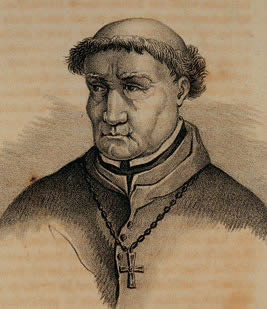
tomas-de-torquemadaIn 1483, Tomas de Torquemada was appointed as “Grand Inquisitor of the Spanish Inquisition.” Jews of Spain had been forced to convert to Christianity, and the Inquisition was designed to uncover those who were continuing to practice their Judaism in secret (called Conversos or Marranos). Those who never confessed were burned at the stake; those who did confess were strangled first. Torquemada believed that as long as the Jews remained in Spain, they might influence the tens of thousands of Jews who had converted to Christianity. It was on his recommendation that the remainder of the Jewish community — 200,000 people — was expelled from Spain in 1492. An estimated 32,000 were burned at the stake, and Torquemada’s name became a byword for cruelty and fanaticism in the service of religion. The order of expulsion was not officially voided by the government of Spain until 1968.

Today in Jewish History
Cheshvan 4
Aish.com

This will be short but not sweet. There are some Christians who say that it was a sin for Jews to refuse to convert to Christianity across the last two-thousand years of history. Yes, these are Christians living today in my little corner of the world. I’ve brought this issue up to them. Is it right for Christians to torture Jews into “conversion?”

They say the torture part was wrong, but that the Jews should have studied scripture and discovered the truth of Jesus for themselves. I’m also told that Christians who resorted to torturing Jews in order to gain their conversions were not “true Christians.”

Unfortunately, as far as I can tell, they represented the normative Church of their day and as far as I can tell, there were no opposing bodies in the Church crying out against the torture and murder of the Jewish people.

I think forcing anyone to convert to Christianity on pain of torture and death is wrong. Period. I don’t think such conversions would be valid in any case. You can torture a person’s body and you can make them speak the words, you can even make someone afraid to think thoughts of refusing Christianity, but you can’t control the spirit, and God knows the truth.

And yet, there are Christians today that say that the Jews under Tomas de Torquemada and those like him should have converted when requested to. I disagree. I think men such as this one are reprehensible villains and should be reviled. The only reason to keep their names in our history books is so that their bad example will never be repeated. I think the Jewish people who resisted this monster are heroes and the ones who “converted” should be pitied.

If any person, Jewish or Gentile, of their own free will, chooses to accept Jesus as the Messiah, that’s between them and God. The minute a so-called “Christian” takes up any manner of coercion against another human being to trick or force them to convert, both that “Christian” and their victim lose.

A Quick View of Revelation Through a Christian Lens

trumpets-on-the-lords-dayI was in the Spirit on the Lord’s day, and I heard behind me a loud voice like the sound of a trumpet, saying, “Write in a book what you see, and send it to the seven churches: to Ephesus and to Smyrna and to Pergamum and to Thyatira and to Sardis and to Philadelphia and to Laodicea.”

Then I turned to see the voice that was speaking with me. And having turned I saw seven golden lampstands; and in the middle of the lampstands I saw one like a son of man, clothed in a robe reaching to the feet, and girded across His chest with a golden sash. His head and His hair were white like white wool, like snow; and His eyes were like a flame of fire. His feet were like burnished bronze, when it has been made to glow in a furnace, and His voice was like the sound of many waters. In His right hand He held seven stars, and out of His mouth came a sharp two-edged sword; and His face was like the sun shining in its strength.

Revelation 1:10-16 (NASB)

Tales of the Messianic Era series

The previous entry is Trouble Breaking into Church with Messianic Prophesy.

Last Wednesday, Pastor and I talked about (among other things) a summary of his understanding of the Book of Revelation, that really confusing, mystic experience of the apostle John, the vision he experienced during his exile on Patmos.

In one of my previous blog posts, I had tried to sketch out my understanding of Pastor’s conceptualization of Revelation but missed the mark. This is my attempt to correct my mistake, but it’s also part of my investigation into “the end times,” that part of Christian/Hebrew Roots/Messianic Jewish doctrine I’ve been avoiding for so very long.

The following (and this time, I took notes) is my summary of Pastor’s summary of Revelation. Basically, I’m just laying a little groundwork for what follows. No conclusions, just the fundamentalist Christian mapping to the return of Jesus, the rapture, the tribulation, and the Messianic Era.

Here goes.

According to Pastor, in Revelation 1, we see the resurrected Jesus. As you might imagine, he’s not quite the way John remembered him during their time together in Israel.

In Revelation chapters 2 and 3, we see the churches, but according to Pastor, after this point in the book, the Church (big C), the entire body of Jewish and Gentile believers in Jesus Christ everywhere, disappears, to be taken up to Heaven with Jesus for the seven years of tribulation. For those seven years, there are no Christians on Earth at all.

Chapters 4 and 5 show us the Church in Heaven.

Chapters 6 through 19 show us the tribulation period, God’s judgment and wrath on the unsaved of the Earth. Since there is no mention of the Church in these chapters, Pastor believes the “argument by silence” here supports the Church being absent from the Earth during this time. Those people who come to faith in Jesus during the tribulation are saved, but they are not part of the Church. Those ancient Israelites who lived and died before Jesus are resurrected (Pastor says he’s not quite sure on the timing of this event) and are saved, but they too are not part of the Church.

Chapter 19 says something important.

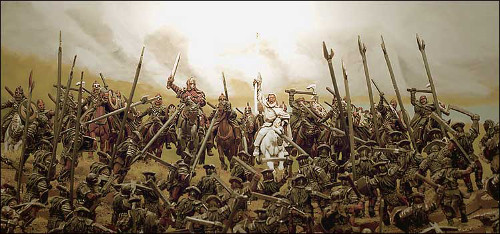
And the armies which are in heaven, clothed in fine linen, white and clean, were following Him on white horses.

Revelation 19:14 (NASB)

Depending on which Bible translation you use, the phrase could be rendered “armies in heaven” or “armies of heaven.” If it’s of heaven, then it’s most likely talking about angels. But according to Pastor, if it’s in heaven, then it’s likely talking about the Church, the group of Jewish and Gentile believers who were raptured up to Heaven with Jesus but who now follows Jesus back down to Earth. Their being “clothed in fine linen, white and clean” indicates their righteousness and purity. There’s a further implication that in Jesus striking “down the nations,” that as his army, the Church, will also “strike” (Pastor didn’t mention that last part, but seems to make sense, given the context).

Chapter 20 of Revelation is the Messianic reign. I mentioned to Pastor that one chapter being devoted to such an important time period seemed a little skimpy, but he reminded me that there are many prophesies in the Old Testament (Tanakh) that speak at length about the Messianic reign. I can’t wait to map them to the fundamentalist Christian interpretation of events to see how (or if) it all connects.

final_battleRevelation chapters 21-22 are the final battle, the new Heaven and new Earth and progressing into Eternity.

We spent some time covering a little theoretical ground on the rapture before tribulation (which is Pastor’s viewpoint), rapture after tribulation (which Pastor says most churches go with), and rapture in the middle of the tribulation. Pastor believes the following is the critical portion of scripture that supports his perspective and that all other perspectives must somehow explain it in order to be considered valid.

But we do not want you to be uninformed, brethren, about those who are asleep, so that you will not grieve as do the rest who have no hope. For if we believe that Jesus died and rose again, even so God will bring with Him those who have fallen asleep in Jesus. For this we say to you by the word of the Lord, that we who are alive and remain until the coming of the Lord, will not precede those who have fallen asleep. For the Lord Himself will descend from heaven with a shout, with the voice of the archangel and with the trumpet of God, and the dead in Christ will rise first. Then we who are alive and remain will be caught up together with them in the clouds to meet the Lord in the air, and so we shall always be with the Lord. Therefore comfort one another with these words.

1 Thessalonians 4:13-18 (NASB)

Pastor also mentioned there are differences of opinion about when the Messianic Era will occur, but my current opinion is that the wars (all but the final one) must all occur and all of Israel’s enemies must be defeated before we experience a thousand years (or a long but undefined period of time) of peace under the reign of the King.

This all leads back to who and what is the church, the fate of ethnic Israel (Romans 11:26), and what I consider the “splitting” of “saved Israel” (the righteous Israelites such as Abraham, Jacob, Moses, David, and so forth) vs. the Jewish people who believed in Jesus and are part of the Church. It still bothers me that Israel has two separate expressions in the Millennial Kingdom, one as saved Israel and one as Israel in the Church (occupying the body of Messiah with the Gentile Christians).

The prophesies in the Tanakh don’t presuppose a divided Jewish people unless you consider those that mention Israel and Judah, such as the following:

“Behold, days are coming,” declares the Lord, “when I will make a new covenant with the house of Israel and with the house of Judah, not like the covenant which I made with their fathers in the day I took them by the hand to bring them out of the land of Egypt, My covenant which they broke, although I was a husband to them,” declares the Lord.

Jeremiah 31:31-32 (NASB)

I don’t want to go too far down that road right now. Like I said, I’m just laying the groundwork for what follows, but if you have any ideas about how the Christian and Jewish points of view about the coming (or return) of Messiah are supposed to fit together, let me know.

This Can’t Be It

That-s-all-folks“Fear is the parent of cruelty.”

-James Anthony Froude

I’ve tried to be fearless in pursuit of God and chronicling my journey along the way. I can pretty much put up with name calling and people disagreeing with me. What I can’t tolerate is being the source of pain for other human beings, and yet no matter what I do or say, I end up hurting someone. I don’t think you can really blog in the religious space without stepping on toes, but we were commanded to love one another, not to step on each other’s toes.

Far from pronouncing judgment and condemnation and trying to constantly correct others, Yeshua taught his disciples to be peacemakers, merciful, meek, humble, patient, and longsuffering, even under persecution (Matthew 5:1-10). Rather than boasting about being right, we should seek to do what is right.

-Boaz Michael
“Becoming a Shaliach,” pg 95
Tent of David: Healing the Vision of the Messianic Gentile

I’ve come that close to shutting down this blog on more than one occasion over the differences between being right and doing right, but never closer than I have with today’s “meditation.” I had a email “conversation” with a friend who both (without his realizing it) triggered the desire to close up shop and then encouraged me to keep on going. I won’t go into the details, but all kinds of misunderstandings can happen when we rely on the Internet for communication. I’m thankful that God is patient and that He gave me the time to reconsider my original course of action.

The image at the top of this missive was the one I originally selected and I decided to keep it because one: I love Looney Toons, and two: as a reminder that the show must go on.

You are not required to complete the task, you are not free to withdraw from it … but be aware that the reward of the righteous will be given in the World to Come.

-Pirkei Avot 2:21

strengthSo the sages say I can’t give up, even when I want to, even when I don’t think I’m doing such a good job, even when any blog post I create can be sharply diverted from its course by someone commenting off topic. I guess like Bugs Bunny and company, as well as everyone in show business has traditionally said (and as I said above), “the show must go on.”

But as I wrote yesterday, I need to spend a lot of time at the feet of my Master, learning, studying, meditating, and pondering on his words and his teachings. If what I do isn’t about serving God and showing love, then it’s not worth it at all. I need you, my readers, to understand that. I think a lot of you do, but there’s always the potential for the more “controversial issues” in the religious blogosphere to get in the way, especially through comments and conversation.

You hypocrite, first take the log out of your own eye, and then you will see clearly to take the speck out of your brother’s eye.

Matthew 7:5 (NASB)

Even when I express frustration at what happens at church sometimes, I am absolutely not placing myself above the church or criticizing other human beings in the church. We’re all running madly along the edge of a razor blade anyway, desperate to not fall one way or the other and be sliced to ribbons on the blade of our own folly.

For man is born for trouble, As sparks fly upward.

Job 5:7 (NASB)

This much is true, but I’m reminded that in some corners of Judaism, the Divine in each of us can be seen as “sparks” and these “sparks” always desire to fly upward to rejoin their Source, the Holy One of Israel. This same train of thought states that we are all put into this life to search for very specific “sparks,” the shards of Divinity “with our name on them,” so to speak. It is our task to uncover these sparks to send them upward again. The world is in disguise, covered with mud, and blood, and worse, but that’s not how it was created and that’s not how it’s going to end up. Beneath the disguise is something beautiful. Beneath the masks of ugly, base humanity we wear, we are beautiful people made in God’s image. All we need to do is learn how to uncover the world and ourselves to see the beauty that God built into Creation and into us.

bugs-bunnyIf that is my mission, then as you can see, I have little time to focus on “negativity.” If I’m tempted to take pot shots at someone else or some organization, I should take the Master’s rather sarcastic words from Matthew 7:5 to heart.

The blog post I originally intended for today was difficult to write and I couldn’t think of a single portion of scripture that seemed to fit. After some reflection and no small amount of influence from the Holy Spirit, this “replacement” for today’s “morning meditation” is more in touch with who I believe I am in Messiah.

It’s funny how something as simple as a childhood memory can remind you of what’s really important. Thanks, Chuck Jones. You’ll never know how much of a hero you are, and through your artwork, humor, and a scrappy little “wascally wabbit,” how much you showed me that being down doesn’t mean being out. On with the show, this is it.

Overture, curtains, lights
This is it, you’ll hit the heights

Tonight what heights we’ll hit
On with the show this is it

Peace.