Tag Archives: Christianity

Returning to the Tent of David: Notes from an Emissary

notes-in-the-darkMany Christians have chosen the path of the Messianic Gentile. They have seen their lives changed for the better as a result of the strides they have taken towards an understanding of their Jewish roots. They have studied, learned, and grown. At a certain point in this process of growth, though, it is not always obvious what to do next. I am frequently contacted by Messianic Gentiles who are debating what do to with their new understanding. I have connected with many communities in which this is a serious problem.

For the most part, Messianic Gentiles want to share the Messianic renewal with other believers. Grasping hold of one’s Jewish roots is a wonderful thing. It is a beautiful feeling to learn about the biblical feasts, the Sabbath, and other Jewish practices which our Master embraced and taught. Our love for Yeshua makes these things precious to us. For disciples of Yeshua, finding our Jewish roots is like discovering a beautiful, long-lost treasure.

-Boaz Michael
“Introduction,” pg 18
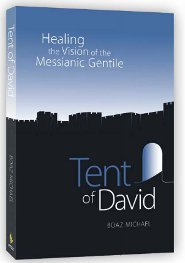
Tent of David: Healing the Vision of the Messianic Gentile

Part of the Returning to the Tent of David series

Here is where I come in. I should say that I’m not really a typical “Messianic Gentile.” I think the model may have been more appropriate back in the day, but not so much anymore, primarily because I’m a believer going to a church, and the missus is Jewish and not a believer. Furthermore, as Boaz says several times in his book, a “Messianic Gentile” is indeed a “Christian.” I’ve adopted the latter “title” to clarify my vision: that there’s nothing about a Messianic perspective on Messiah and the Bible that should be considered separate or apart from Christians and the Church (big “C”).

The other reason I don’t call myself a “Messianic Gentile” is that I don’t “keep Torah” in many of the ways someone on a Messianic community might. Even at the height of my so-called “observance,” I still drove on Shabbat, cooked on Shabbat, ate what you might call “Kosher-style” rather than what my local Chabad Rabbi would consider kosher, used the Siddur poorly, had (and still have) by and large no command of Hebrew at all, and so forth. I was a lousy “Messianic Gentile” in my practice. But the study and the information flow was and is fabulous.

Among the many things our Master taught us was the command to love each other as he loved us (John 13:34).

-ibid

This is a core of the message and the vision. If we don’t do these “Tent of David” experiences out of love rather than some other motivation, we lose and the Church loses.

And that’s not easy.

What is easy is to get involved in theological and doctrinal debates trying to show who is wrong and who is right. That’s no different from the typical “dust ups” we have in the religious blogosphere, and I’ve been critical of those before.

Becoming a living and active part of the church community isn’t always easy. I go to services, attend Sunday school, visit weekly with the Pastor, but that’s about it. Oh, I’ve taken on a special project that has required I work with one of the Associate Pastors and some of the staff, but I don’t know if that qualifies me as part of the community. Maybe it just takes more time or maybe I’m holding back.

Can one live as a Messianic Gentile among Christians who don’t yet embrace his lifestyle or viewpoint?

-ibid, pg 19
boaz-michael-beth-immanuelAs Boaz says on the previous page, “Yet this is not always easy. Churches can be resistant to the message of the Messianic Gentile.” But is my mission and purpose to go into church with the idea of changing people? This is one of the most difficult parts of the “TOD” experience. The vision is vast and glorious, but living it out day by day is difficult, especially when I’m not a gifted teacher, theologian, and publisher, but rather, just a guy “on the ground,” so to speak.

I don’t really try to live my life as a “Messianic Gentile” in the church. I just try to be me, which I suppose is both my greatest strength and my staggering weakness.

And why should the church listen to the rather odd sounding message of the “Messianic Gentile?” I mean, it’s their home ground. They hold all the keys that open all of the doors in their realm. They are comfortable with what they are being taught and what they believe fundamentalist and evangelical Pastors and their books and sermons tell them. Saying something like the Torah is not canceled is not just different or new information, it’s radical and potentially “dangerous”. It flies in the face of everything the average Christian in the pew has ever been taught.

The Gentile believers, as part of the commonwealth, had a unique and vital role in the process of building the Tent of David, using their numbers and resources to empower and bless the Jewish community and spread the message of the kingdom in their own culture. In this way, the apostles envisioned the imminent restoration of the Tent of David and the establishment of Yeshua’s hegemony over the entire world…It would hardly be an overstatement to say that this apostolic vision is Christianity’s raison d’être, its reason for existing.

-ibid, pg 22

That’s only vaguely how most Christians and most Christian churches see themselves. Frankly, it took me awhile to even see this aspect of my “reason for existing” and even longer to get comfortable with it. A tremendous amount of internal struggle along with lots of prayer and studying had to take place before I was able to put together all the pieces of the puzzle and to recognize that the completed picture was “me.” I’ve spent many months trying to communicate on this blog what I see and while the people who already share that vision are enthusiastic, those who don’t are going to be just as blind to it as I was.

As disciples of the Messiah, Messianic Gentiles must live out by personal example the teachings of Yeshua…

-ibid, pg 24

I read this sentence and immediately thought about Sukkot. I happened to mention to my Sunday school teacher that I built a sukkah in my backyard, as I do every year, and a little bit about the customs around Sukkot. He seemed interested and enthusiastic, but not in the way I anticipated. It was more like a novelty item to him…something interesting and curious to look at but nothing that had to do with him and his lived experience. The idea of him building a sukkah would be seen in the same way as the idea of living in a Buddhist monastery in Tibet for a year. A fascinating thought but in no way connected to his experiential reality.

Who will show the institutional church its blind spot?

-ibid, pg 26

Who says they want to see it? The most interesting part of this experience is not the response, but the silence. I recently had a bit of a disagreement with my Sunday school teacher over the meaning of Acts 15:1-2. He says that the Jewish people who stated that Gentiles needed to be circumcised were “Satanically-inspired” and I said that they were Jewish people who had a legitimate theological question that needed to be resolved.

hereticBut we were the only two engaged on this issue. Everyone else in the room was silent. What were they thinking? Did they imagine I’d flipped out or was I just a heretic? OK, probably nothing that strong, but I really don’t think most of the Christians in that room had a clue how to deal with the idea that first century Jews requiring Gentiles to covert to Judaism as the only way to be saved were at all people expressing a valid concern, as opposed to a bunch of trouble makers and Judaizers.

“The church desperately needs creative heretics. A “creative heretic,” an independent thinker, is an example of the “unbalanced” force to which Newton refers in his first law of motion. Only the person who breaks with tradition can change the direction of an institution. A heretic is not an enemy of God but one who is more interested in truth than in tradition.”

-John Sloat, A Handbook for Heretics

Imparting the vision of the “Messianic Gentile” within a church setting requires a great deal of tact. I’ve tried as best I can to restrain myself. I almost always pick just one question (out of the many I could cite) to ask in Sunday school so as not to appear like I’m trying to argue. I can be candid with my Pastor but that’s part of our relationship, and all of those conversations only involve the two of us.

This can only happen, though, if those Christians who understand their Jewish roots choose to remain in their churches as faithful congregants.

-Boaz, pg 26

I’ve had this discussion before about whether or not the “Messianic Gentile,” that is, “me,” should join the church as an official member. My good friend with whom I have coffee every other Sunday afternoon says absolutely “yes.” I must join the church as a full member in order to be accepted and integrated into the body.

But I don’t know if I’d ever by a good Baptist when their’s so much about the theology involved with which I don’t agree. If being a good Calvinist is required, then it’s a “showstopper.”

Which brings me to the question of who changes? Boaz mentioned previously in his Introduction about the challenges of living as a Messianic Gentile in the Christian church. Part of the difficulty as I see it is that the church is exerting an effort to change the Messianic Gentile even as the Messianic Gentile is making the same effort to change the church. Boaz says that all committed Christians want to know Jesus better, and while I believe that’s true, they also anticipate that Jesus won’t look too “Jewish” as they draw nearer to him. The portrait of Moshiach I have to paint is far more semitic than any Jesus they’ve ever seen or want to see.

darkmirrorThe Tent of David book is designed to reach out to a vast population of Messianic Gentile and Hebrew Roots Gentile people in our country and either support them in the churches they already attend, or encourage some of them, like me, to return to the church as emissaries of the Messianic viewpoint on the Jewish Messiah. We’re not “secret agents” on a covert mission, we’re representatives of an idea and a perspective that isn’t common in the church. We’re part of Boaz’s vision of reaching the church with a new (or renewed) way of conceptualizing the Jewish Jesus. And we are only one stream among several they are trying to produce, another such stream being their A Promise of What is to Come television series (available for free over the Internet), which is designed to impart much of this information at a very accessible level for most Christians.

You are not required to complete the task, you are not free to withdraw from it … but be aware that the reward of the righteous will be given in the World to Come.

-Pirkei Avot 2:21

That sounds incredibly noble, but I’ve always had a tough time seeing myself as incredibly noble. I know too much about myself to see the reflection of a hero in the mirror when I shave in the morning.

So after nearly a year, who do I see when I look at my reflection? Most mornings, it’s easy to ignore the question. I’m getting ready to go to work or if it’s Saturday, I’m mulling over my “honey do” list for the day. If it’s Sunday, then I’m anticipating Pastor’s sermon and considering what I’m going to say in Sunday school, and then thinking about what the rest of the day will bring.

But this blog post series (assuming I write future entries) is about stopping and taking the time to look at the scruffy older guy in the mirror. Am I living up to my mission as an emissary to the church, as it were? Have I been successful in delivering my message and more importantly, in living it out?

I can’t say I’ve been wildly successful. A few people have expressed an interest in what I have to say, but they seem to only just get started on the trail and then stop. I have had conversations with one of the older Associate Pastors who is interested in Hebrew Roots but when I directed him to the First Fruits of Zion website to access some resources, I got the impression that he was quite overwhelmed.

I think there is a desire to learn more about the Jewish Jesus in the church, but there are two issues of concern. The first has to do with what Christians expect to learn. They expect that the Jewish Jesus will look and act just as they imagine him to be. They think the “Messianic Gentile” will teach them “more of the same” but maybe with some interesting but minor details. What they don’t expect is to learn anything different and especially anything challenging. The second issue comes out of the first: getting people to think outside the box without feeling like they’re being heretics or, heaven forbid, being brought “under the Law.”

That second part is really important, because if people aren’t willing to even consider a paradigm shift to a new perspective, they’ll never accept what the “Messianic Gentile” has to offer beyond the superficial.

thinking-inside-the-boxMy impression is that the mission of the Messianic Gentile in the church is a lengthy if not life long process. It also requires a great deal of commitment, not only to the church, but to God. My Crossing the Ford of the Jabbok blog post illustrates how I see what I need to do, not only for the sake of the mission but for the sake of my relationship with God. I do no one any good if I neglect dedication and devotion to Hashem, Master of Legions, Lord of Creation, while otherwise beating my brains out against the stucco walls of the church (or in the blogosphere).

If I am ever to be successful in showing the Christian world around me a true portrait of the Moshiach, the Jewish Messiah King who has come once and who will come again, then I must spend every possible moment at his feet studying, learning from his wise teachings, and becoming an ever more dedicated disciple of my Master.

Addendum: It has come to my attention that I need to be spending a lot more time sitting at the feet of my great Teacher than doing many other things. I’ll speak more on this in tomorrow’s “morning meditation,” but things are going to change.

Straightening the Road of the King

what-is-the-churchWhat is the “church?” Who belongs to the church? How is the church related to Judaism or is the church related to Judaism in the current age? These are the questions my Pastor and I discussed last Wednesday night. Sometimes, when we talk of these puzzling subjects, I have a difficult time conceptualizing my thoughts and feelings and articulating them while I’m with him in his office. So I ponder, and think, and occasionally, I draw (you’ll see what I mean as you scroll down while reading).

I think I’ve come up with a “vision” of Pastor’s understanding of the evolution of the church from its beginnings in Judaism as well as my own “vision.” I apologize to Pastor and to you in advance for any misunderstanding I have of his point of view. He recently pointed out to me how I didn’t have a correct understanding of his view of the “end times” (which I blogged about) and sometime soon, I’ll need to post a retraction (he told me he doesn’t find a retraction or correction necessary, but I find it necessary if I intend to be honest in my transactions with him and everyone else).

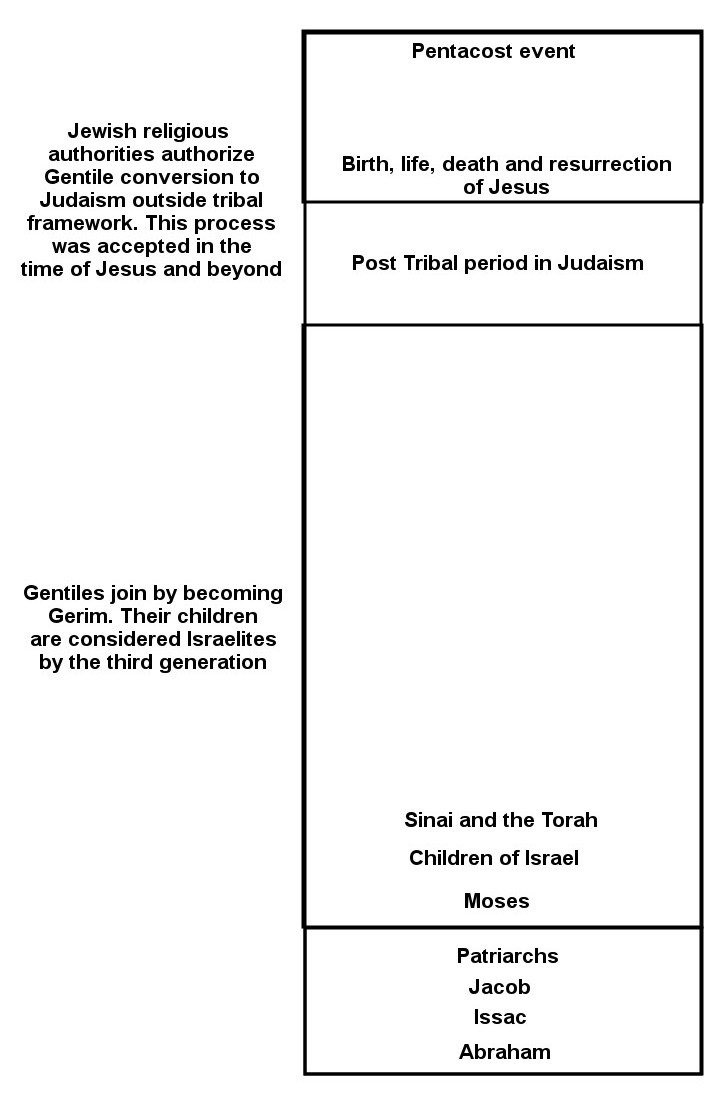
First things first. There are some areas we necessarily agree upon. God made a covenant with Abraham, with Isaac, and with Jacob involving promises relating to the Land of Israel, making their descendants very numerous, promises that they would be a blessing to all nations (through Messiah), and that circumcision would be the physical sign between God and the specific, biological descendants of Abraham and Isaac, and Jacob that their descendants would be the inheritors of these covenant promises.

The patriarchs came from Jacob and the twelve tribes of Israel came from the patriarchs. Moses led the twelve tribes out of slavery in Egypt and God redeemed them as His special people, as per the promises made to Abraham and his descendants. God then added to His promises at Sinai and gave the Torah, the teaching and instruction for righteous living to the physical descendants of Abraham, Isaac, and Jacob. This also functions as the national constitution of Israel, and has multiple other purposes.

At this point in history, Gentiles can only join Israel as gerim, which isn’t exactly conversion. The idea is that a Gentile would do what the Israelites would do in terms of the mitzvot, but the Gentiles would never become Israelites in their generation. More like resident aliens. No one can convert to a tribe or a family clan. Only after the third generation, would the ger’s children have intermarried into tribal Israel and ultimately assimilate into the Israelites. This was the only path for a Gentile to join the covenant people of God.

After the Babylonian exile and a lot of history passed by, tribal and clan affiliations were all but lost. The Jewish religious authorities instituted what we understand as the ritual of conversion. Now, if a Gentile wants to join national Israel and the Jewish people, they must undergo a process supervised by Jewish religious authorities (in modern Orthodox Judaism, it is a group of three Rabbis who form a Beit Din). The men are circumcised and both men and women are “mikvahed” as the final act of conversion. They go down into the water as a Gentile and come up as a Jew. There is no multi-generational “delay” and the individual Gentile who desires to be Jewish can become Jewish and thereafter, they and all of their descendants are considered Jews.

stream1Then Jesus comes. At this point, there are born Jews and there are Jewish converts or proselytes to Judaism. Jesus doesn’t speak against the ritual of the proselytes and does not overturn this institution, even though it is not directly found in the Torah. Remember, Jesus wasn’t adverse to opposing Jewish traditions and he did overturn or object to other halachah of the scribes and Pharisees on occasion (Matthew 15:1-14 for example). We also see that Paul encountered Jewish proselytes (Acts 13:43 for instance) and he too never said a cross word about the Jewish converts or the practice of converting Gentiles to Judaism (though in Galatians, he spoke strongly against Gentiles converting to Judaism as the only way to be justified before God). Both Jesus and Paul were very direct about expressing their thoughts and feelings and if either one had a problem with the Jewish conversion process, they would have said so…but they never did.

But something new happened after the death and resurrection of Jesus.

And Jesus came up and spoke to them, saying, “All authority has been given to Me in heaven and on earth. Go therefore and make disciples of all the nations, baptizing them in the name of the Father and the Son and the Holy Spirit, teaching them to observe all that I commanded you; and lo, I am with you always, even to the end of the age.”

Matthew 28:18-20 (NASB)

I wonder if the Jewish apostles truly understood the implications of Messiah’s words. Did they believe he wanted them to make converts of the Gentiles, “mikvahing” them into Judaism? All of the other streams of Judaism accepted Gentile converts, why should “the Way” be any different?

But it was and is.

While Peter was still speaking these words, the Holy Spirit fell upon all those who were listening to the message. All the circumcised believers who came with Peter were amazed, because the gift of the Holy Spirit had been poured out on the Gentiles also. For they were hearing them speaking with tongues and exalting God. Then Peter answered, “Surely no one can refuse the water for these to be baptized who have received the Holy Spirit just as we did, can he?” And he ordered them to be baptized in the name of Jesus Christ.

Acts 10:44-48 (NASB)

stream2Here we see our answer. Gentile believers, like the Jewish believers, received the Holy Spirit and were baptized by water without being circumcised and converting to Judaism! This was revolutionary. This was astounding. This had never, ever happened before. It was without compare. Paul perceived this vision clearly in his subsequent work with Gentiles, but it wasn’t until the matter was brought before the council of apostles and elders of the Way in Jerusalem that a formal, legal status was granted to the Gentiles entering into a wholly Jewish religious stream (see my Return to Jerusalem series for a detailed analysis of this process).

But it’s at Acts 2 that Pastor and I disagree. He believes that Pentecost is the “Birthday of the Church” and that sometime remarkable happened. Something remarkable did happen, but we don’t agree on exactly what it is. To the best of my ability to relate (and again, I apologize in advance if I mess any of this up), Pastor believes that an entirely new entity, “the Church” emerged from a Jewish religious stream and although it is made up of both Jewish and Gentile members, the members all form a single, uniform body of Messiah. At this point, the Torah is “fulfilled” and is no longer a set of commandments or obligations for the Jewish Christians. Jewish and Gentile Christians share a single set of obligations under the grace of Jesus Christ.

This effectively separates the Jewish members in the Church from larger Israel and the Jewish people. Pastor says that all Jews share in the covenant promises of God, particularly possession of the Land of Israel in perpetuity, but that only the Jewish Christians are saved.

My point of view is different.

I see the creation of the Body of Messiah (I’m not going to call it “the Church” in order to distinguish Pastor’s perspective from mine) as the natural and logical extension of everything that happened in Biblical and historical Judaism before it. The entire stream of history and prophesy for Israel pointed inevitably to the Jewish Messiah, so when Jesus came, it was the pinnacle, the focal point, the historical hinge upon which everything in Judaism was aimed at and upon which it turned.

But while it was revolutionary for Gentiles to be allowed to enter a stream of Judaism without converting to Judaism and being considered Jewish, their admittance wasn’t the end of the Jewish stream that accepted Jesus as Messiah as a Judaism, nor was it replaced by another religion or religious entity. It was a Judaism that had Gentiles admitted as equal members in relation to salvation and access to God, but it didn’t turn “the Way” or “Messianic Judaism” into “the Church.”

That happened unfortunately, after the Jewish/Gentile schism in the movement (and there’s a lot of history available to describe the details, so I won’t replicate it here) and in my opinion, the “Gentile Church” was born when the Gentile Church leadership agreed that it was no longer a Judaism and that Jews were not welcome unless they converted to Christianity!

If Pastor is right, then we have to consider the Jews in the Church as irrevocably separated from their Jewish brothers and sisters and perhaps even national Israel, since they no longer can identify with Israel, the Torah, and the connection the Torah provides a Jew with his nation and his God. If I’m right, then we have to consider the Body of Believers in Messiah as a Jewish stream, albeit a somewhat unique one because of such a large Gentile membership, that runs parallel to all other Jewish religious streams pointing toward the future and the eventual return of the King. We also have to admit that the Torah is not canceled and that Messianic Jews share an equal obligation to the mitzvot as all other Jewish people.

stream3Again, I sincerely apologize to my Pastor and to everyone reading this if I got his perspective on these matters wrong, in even the slightest detail. It is not my intention to misrepresent anyone, but it is my intention to draw a distinction between our two viewpoints.

Does it matter who is right? Is my purpose in the church, let alone the reason for my existence, simply to be right? As I’ve discovered (or re-discovered) recently, the answer is yes and no. No, it doesn’t matter if I personally am right. The world doesn’t depend on my one, small opinion. Statistics vary, but recent research indicates that there are anywhere between one and three-quarter million blogs to perhaps up to 164 million blogs in existence, and even the people compiling these numbers admit the list is incomplete. The number of individual blog posts goes into the billions and billions. Compared to all that, my one little blog can hardly matter, even in the human realm, let alone God’s. Any religious blogger who thinks they’re “all that and a bag of chips” can only make me laugh.

On the other hand, it’s vitally important to examine the question “who is the Church” and especially “what is the Church”. If “the Church” turns out to be a terribly misguided Judaism that has wildly deviated from its original course, then we require an exceptionally radical “course correction.” No, I’m not suggesting a revolution in the Church as such, where we strip away 100% of church culture as it has evolved over the past twenty centuries, but I am suggesting some form of change.

This is exactly the sort of process described by First Fruits of Zion (FFOZ) Founder and President Boaz Michael in his book Tent of David. The answer to the question of who and what “the Church” is has profound implications if we believe that the modern Messianic Jewish opinion is correct and that “the Church” was never intended to be a totally unique religious unit, disconnected forever from Israel, the Torah, and the Jewish people.

In my opinion, everything God did across human history was ultimately additive, no replacements or substitutions accepted. Abraham and God make a covenant, and as part of the conditions of that covenant, Isaac is added, then Jacob is added, then Jacob’s children are added as the patriarchs, and then their descendants, the Children of Israel are added, and they are made into a nation and the Torah is added, and possessing the Land of Israel is added, and all of the prophesies by all of the prophets pointing to the Messiah and the Kingdom of Heaven are added, and the birth of Messiah is added, and the death and resurrection of Messiah are added, and the Jewish religious stream that is identified by faith in Messiah is added, which includes the Gentiles entering this Jewish stream being recipients of the blessings of the covenant God made with Abraham…all in one, nice, neat, straight line across history as drawn on the canvas of time by God.

What we have now in the 21st century is something of a mess, but that’s what happens when God gives us a gift and then lets us play with it for 2,000 years. We’ve bent, folded, spindled, and mutilated it, but not beyond repair. Repair is what I think Messianic Judaism is all about. It’s tikkun olam or repairing the world with a Messianic twist. It’s a voice in the wilderness calling out to the synagogue and the church saying, “It’s time to take a fresh look at all this so we can clean the place up and get ready for the King’s return.”

The roadOne nice, neat, straight line from Abraham to Moshiach. Any bends in the road, any wrinkles in the asphalt, any potholes, any mudslides, any detours, have nothing to do with God and His intent. We’re the ones with the jack hammers and sledge hammers pounding away at that line, making it crooked and not straight. But we’re the ones who were charged with caring for the road, just as Adam was charged with caring for the Garden (and look how that one turned out).

I’m not in charge with being “right” but God did say that I’m supposed to take care of my little section of the road upon which the King will walk as he returns. I can’t fix it all, but I have to do something. He’s coming soon. I can’t just lie down on the job and call it good. He’s coming soon. I’ve got to do my best, with the help and by the will and grace of God, to make and keep my little piece of the road of the King straight.

For more about the relationship between Jewish and Gentile believers in the Body of Messiah, see Derek Leman’s short article, Citizens, Not Natives.

The Christianization of Acts 15

phariseesSome men came down from Judea and began teaching the brethren, “Unless you are circumcised according to the custom of Moses, you cannot be saved.”

Acts 15:1 (NASB)

In Acts 15:1-2 and 15:24, Now with what Satanically-inspired and dogmatic false teaching did these “certain men from Judaea” try to infect the church at Antioch, and why according to Galatians 2:4-5? (emph. mine)

-From the notes for Sunday School class on Acts 15:1-21
For September 29, 2013

Part of the Return to the Tent of David Series

This past Sunday, Pastor’s sermon was on Acts 15:1-21. I knew from our conversations that I was going to disagree on some of his points, and I knew by “doing my homework” for Sunday school class, that I was going to disagree with my teacher.

I’m making this part of my Returning to the Tent of David series, since it chronicles how I’m doing in my church after nearly a year. I can’t say that in last week’s Sunday school experience, I covered myself in glory.

I know my teacher tends to be rather dogmatic and inflexible on his points, but I felt he was so far off base with his “Satanically-inspired” comment directed to “the men from Judea” we find in Acts 15:1, that I had to speak up. I’ve expressed opinions that conflicted with his in the past, but usually they’re easily set aside, however there was real tension in the air as we had our exchange of words this time. I promised that this issue would be the only one I’d argue with him about and kept silent for the rest of class. Boy, was that a challenge.

There was another fellow there who is older, both chronologically and as a believer, and wiser, who also took our teacher to task about certain of his assumptions. Because this gentleman has been a long-time church member and is well-respected, I think he was tolerated more easily than I am.

Which brings me to a point that I struggled with when I first returned to church. Just how long would it be before I’m accepted within the ranks of the church as a “regular?” The answer may be “never.” Yes, most Wednesday evenings find me in Pastor’s office for a one-on-one discussion on the book of Galatians and the interface between fundamental Christianity and my understanding of Messianic Judaism, but that doesn’t necessarily add to my “cred” with the congregation as a whole.

Every time I open my mouth, I risk alienating someone. I know my teacher struggled with my idea that the “men from Judea” not only weren’t “Satanically-inspired” but had a legitimate theological concern, but who knows how many other people in that class were equally put out by my comments? No one else said a word.

There is such a misconceptualization about what happened in Acts 15 and the relationship between Torah (law) and saving grace that it’s hard to get enough information expressed to correct the errors. The basic argument is that you are only saved by grace and not through obedience to the Torah, which is true, but since the Law doesn’t save, the assumption is that it is of no use at all and thus is bad, wrong, awful, and aren’t we glad James and the boys made the decision to get rid of it once and for all. Most Christians can’t see that for a Jewish believer, yes faith saves, but this doesn’t annul the Sinai covenant and the command to live a certain lifestyle in obedience to God.

My frustration in this situation was compounded by the Bible Study Fellowship (BSF) model of teaching being used by my instructor. It emphasizes getting the maximum amount of class notes presented with a minimum of questions and interactions between teacher and student. Sure, teacher asks if we have any questions, but the class has about sixty seconds to respond before being shut down and the next point in the notes being addressed. Any serious attempt at debate over a questionable item in the teaching gets almost no “air time.”

ancient_beit_dinNot only did I press my point that the men from Judea had good reason to make the statements they did (yes, they were wrong, but it was going to be an uphill battle to convince most first century Jewish authorities that Gentiles didn’t have to be circumcised and convert to Judaism in order to have a saving relationship with God), but that the “private meeting” (Acts 15:6-11) involving the apostles and elders was actually a judicial body attempting to make a legal decision (akin to the function of a Beit Din) about how to admit Gentiles into a wholly Jewish religious stream as equal members and not require conversion.

How do you see Peter’s wisdom as he waited God’s timing before speaking?

-Class notes referring to Acts 15:7-11

If this was a legal proceeding, which makes a lot of sense to me, then Peter’s wisdom and God’s timing had less influence than the idea of a series of witnesses each giving testimony one at a time. It just happened to be Peter’s turn to testify. If there was any cross talk or overlapping discussions, they were probably analogous to how spectators in a modern courtroom can sometimes get out of hand and start talking. At that point, the Judge has to regain order.

I won’t quote from all of the notes for this class but they are a testimony to the “Christianization” of the Bible and in this particular case, Acts 15. This is not unlike what I previously said about the Rabbinization of Abraham, where the Jewish sages anachronistically apply Rabbinic concepts to the lives of Abraham and the other patriarchs. It’s also akin to what my teacher was speaking against, the “Judaizing” of the Gentile believers.

In each episode of FFOZ TV: A Promise of What is to Come, First Fruits of Zion teacher Toby Janicki strongly emphasizes the absolute necessity of reading the Jewish Biblical texts from the Jewish perspective of the original writers and audience. While Christians may not realize it on the surface, the New Testament texts are Jewish. Reading them through “Christian-colored lens” will produce a false effect, and lead to lots of misunderstanding.

But some of the sect of the Pharisees who had believed stood up, saying, “It is necessary to circumcise them and to direct them to observe the Law of Moses.”

Acts 15:5 (NASB)

In his sermon, Pastor said that the Pharisees were the “fundamentalists” of their day and he further said that if we lived in those days (and were Jewish), we, that is, the people in his church, would be Pharisees. He said that Jesus had issues with those Pharisees who started making up their own extra-Biblical rules, but Pastor praised the Pharisees as the movement in first century Judaism that supported using the Bible (Torah) as the guide to righteous living.

My Sunday school teacher uses the works of Pastor and theologian John MacArthur as the main source material for his classes. I praise MacArthur for his efforts to direct Christians back to reading the Bible, but in many other ways, he drives me nuts. According to my teacher, he said the “men from Judea” we find in Acts 15:1 and the believing Pharisees we see in Acts 15:5 are two separate groups with two separate perspectives and agendas.

I, on the other hand, believe they may have been the same or similar enough to have identical concerns and the legitimate question of what to do with the Gentiles pouring into the Jewish religious movement of “the Way.”

bang-head-hereAfter almost a year of being back in church, last Sunday’s “Tent of David” experience for me was one of almost beating my head against a brick wall. It’s frustrating to see things so clearly from a particular perspective, and yet to be shut down so abruptly and completely by an alternate perspective that is greatly divorced from the ancient Jewish context of the ancient Jewish text.

I may be in a position to be making my voice heard, and I may even be gingerly choosing my moments and words in expressing my opinion, but will that ever result in people hearing and actually considering that opinion, or am I always going to on the outs with my “fellow Christians?”

Now, having said all that, there is a flip side to the coin, which I’ll present in an extra meditation later today.

Returning to the Tent of David: An Introduction

serpentThe serpent enticed Chavah by predicting beneficial outcomes. “Your eyes will be opened… The fruit will awaken a new desire and appreciation for the pleasures around you. It will be a source of intellectual benefit.”

Chavah longed for this new knowledge and exciting awakening, and she ate the forbidden fruit. She then used her persuasive powers to convince her husband to eat it as well.

Chavah’s downfall began when she expanded upon and distorted G-d’s command, which she did not personally hear.

-Chana Weisberg
“Woman and the Forbidden Fruit”
Chabad.org

Beginning the Returning to the Tent of David series

This depiction of Chavah (Eve) and her interaction with the serpent casts her in a more favorable light than we typically see her by in Christianity. Rather than being disobedient and rebellious, she is either a bold explorer of new knowledge, or an innocent dupe of the serpent who physically pushed her in to the tree of the knowledge of good and evil and after all, it’s not her fault because God did not tell Chavah directly not to touch the tree or to eat from it.

Chavah added the prohibition of touching the Tree of Knowledge. The serpent then forcibly pushed Chavah against the tree, and victoriously claimed, “See, just as death did not ensue from touching, so it will not follow from eating.”

In this way, the serpent introduced doubt into Chavah’s mind. It now became easier to dare Chavah to taste the forbidden fruit. He convinced her that G-d did not actually intend to kill her and Adam, but merely threatened them to intimidate them.

I know, I know. The Torah reading for Beresheet (Genesis) is behind us. Why do I continue to write about it now? Shouldn’t I be preparing my commentary on Noah? Be patient. There’s a reason.

That’s my ministry in a nutshell; it’s a not-so-interesting and rather Baptist-intensive story. I am eternally grateful for my family and for my Baptist heritage. God has used both to lead me to commit my life to Christ, to follow him with my life and to serve him through the church. However, the past eighteen months have opened up for me a more complete picture of who I am and where I came from. Through a series of circumstances, curiosity, and new friendships, I am being exposed to my Jewish roots. I have no doubt that all of these circumstances and friendships, and even my own curiosity that opened me up to the Jewish roots movement, are all God-ordained.

-Durwin Kicker
Senior Pastor at Marshfield First Baptist
From the Foreword (pg 10) of Boaz Michael’s book
Tent of David: Healing the Vision of the Messianic Gentile

tent-of-davidYou may think it’s terrifically unfair of me to compare Chavah’s situation to Pastor Kicker’s. I’m not really, but it occurs to me that, at least in midrash, we all have something in common with the wife of the first man. When exposed to be brand-new world with seemingly endless possibilities, we want to explore. However, like Chavah, we may also have reservations, since some of the things that we are tempted to explore may not be what God wants us to investigate, even when we get a “helpful” shove.

God has used Boaz Michael and the ministry of First Fruits of Zion to impact my life in a profound way in a very short amount of time. It is my great honor and privilege to call Boaz my friend. His passion and love for Messiah and his gentle spirit have struck a chord in our church family which has served to open many of our people to our Jewish roots, God’s everlasting covenants with his people, and our place as Gentiles in God’s family through our Jewish Messiah.

Boaz’s desire is that this kind of loving impact will be repeated over and over again in church after church. I join with Boaz in saying, the church needs you! The church is good, yet the church needs to change. Each individual who comes to know our Jewish Messiah in his Jewish context can play a part in lovingly and patiently helping brothers and sisters in Messiah come to know him in this way as well.

-Kicker, pg 12

I reviewed Boaz’s book about nine months ago in several blog posts, the two most notable being Return of the Christian and Returning to Faith. I had read an advanced copy of the book months previously, and it was instrumental in overcoming my inertia and inspiring my own return to a local church.

And now it’s been nearly a year later. The progression through the Jewish holiday season and the beginning of a new Torah cycle seem a very good time to review my own “Tent of David” experience and to see how things actually have ended up (not that anything has really ended yet).

Pastor Kicker seems enthusiastic about pursuing the vision of the “Messianic Gentile” in the church by way of his friendship with Boaz but of course, he’s been in the church for quite some time and as Pastor, he is a fully integrated unit within that cultural, social, and theological construct. In other words, he “fits.” Boaz’s book speaks of “Healing the Vision of the Messianic Gentile.” For me as a recent “returnee,” what has been healed, if anything?

My perception of Boaz’s book (I can’t speak directly to his intent, nor would I ever try…this is my own opinion) is that there are two kinds of healing going on, at least in theory.

There’s the healing of the “Messianic Gentile,” the Christian (non-Jewish disciple of Jesus Christ) who often has left the church because of some emotional or spiritual injury or hurt (real or perceived) caused somehow by the Christian church or some of its members. Many people in Hebrew or Jewish roots congregations believe they have sought refuge in a “safe place” outside of “the Church” and continue to view church and people who identify as Christians as adversaries. Finding a mechanism to have the Hebrew/Jewish roots Gentile return to church in a safe manner and to share who they are with their fellow Christians certainly opens the avenue for healing between the parties involved.

Then there’s the more historic healing between the traditional church of Jesus Christ and the historic and Biblical Jewish Jesus and the Jewish and Gentile body of Messiah. A great deal of damage has been done to Jewish and Christian hearts, and that has sustained the separate trajectories believing Gentiles and the Jewish community (including Messianic Jews) have been traveling for twenty centuries.

church-and-crossA non-Jewish believer possessing a Hebraic view and even a passion for the “Jewishness” of Jesus, and one willing to communicate that with his or her Christian counterparts in a church community could facilitate a great deal of healing, ultimately between Christianity and Judaism. Certainly, great strides have already been made in this area between some churches and various expressions of Messianic Judaism, although a lot of work still needs to be done.

But what about me and what I’m doing in the small church I attend? I’d like to completely re-read Boaz’s book before venturing to answer that question in full, but I did want to keep my promise and at least introduce the journey I’m taking in returning to the Tent of David and Boaz’s vision of the healing of Christian and Jewish communities. His book speaks on a larger scope by necessity, but nearly a year down the road,  how has Boaz’s vision worked “on the ground,” so to speak. I can only lend my own single, small voice and my individual experience. As this series progresses, I’ll share my insights with you. Perhaps you will return the favor.

Trouble Breaking Into Church With Messianic Prophesy

daniel“Seventy weeks have been decreed for your people and your holy city, to finish the transgression, to make an end of sin, to make atonement for iniquity, to bring in everlasting righteousness, to seal up vision and prophecy and to anoint the most holy place. So you are to know and discern that from the issuing of a decree to restore and rebuild Jerusalem until Messiah the Prince there will be seven weeks and sixty-two weeks; it will be built again, with plaza and moat, even in times of distress. Then after the sixty-two weeks the Messiah will be cut off and have nothing, and the people of the prince who is to come will destroy the city and the sanctuary. And its end will come with a flood; even to the end there will be war; desolations are determined. And he will make a firm covenant with the many for one week, but in the middle of the week he will put a stop to sacrifice and grain offering; and on the wing of abominations will come one who makes desolate, even until a complete destruction, one that is decreed, is poured out on the one who makes desolate.”

Daniel 9:24-27 (NASB)

Then I saw thrones, and they sat on them, and judgment was given to them. And I saw the souls of those who had been beheaded because of their testimony of Jesus and because of the word of God, and those who had not worshiped the beast or his image, and had not received the mark on their forehead and on their hand; and they came to life and reigned with Christ for a thousand years. The rest of the dead did not come to life until the thousand years were completed. This is the first resurrection. Blessed and holy is the one who has a part in the first resurrection; over these the second death has no power, but they will be priests of God and of Christ and will reign with Him for a thousand years.

Revelation 20:4-6 (NASB)

Tales of the Messianic Era series

The previous entry is The Obscured Messiah in the Bible.

Last Wednesday night, my Pastor and I got through the majority of Chapter 8 (it’s not a long chapter and only covers Galatians 2:11-14) in D. Thomas Lancaster’s book The Holy Epistle of the Galatians. We disagreed so much about the content, that I apologized for seeming so oppositional. We continue to “butt heads” over the purpose and function of the Torah in the lives of the Jewish disciples of the Jewish Messiah in the Apostolic age and beyond.

But we got sidetracked again. Pastor asked me about the nature and function of “the Church,” the collection of Jewish and Gentile disciples of Messiah. I knew Pastor saw the Church as separate from Judaism…well, sort of, but I had no idea how separate it was supposed to be.

From my point of view, “the Church,” the body of Jewish and Gentile disciples of Messiah, is the logical extension of Biblical and historic Judaism that began with Abraham and was formalized in law at Sinai. Judaism has always looked forward to Messiah, so when Jesus was revealed as Moshiach, it wasn’t a departure from Jewish history but rather, the fulfillment of Jewish hopes and dreams. Of course, that fulfillment isn’t really filled full and it won’t be until his second advent when he will establish his reign of peace in Israel and across the entire world.

messiah-prayerSo if Jewish discipleship in Messiah is the natural and logical extension of Jewish history in the first century CE, then what was Gentile discipleship? I’ve said over and over that it was a major chore for Paul and the other Apostles to figure out a way to legally include Gentile disciples into the community of Jewish faith in Messiah without requiring that they convert to Judaism through the ritual of the proselyte and become obligated to the full yoke of Torah (and my Pastor and I also continue to debate what the Torah is and what purpose it has in Judaism) in the manner of the Jews.

It’s like Israel is the main event and enters through the front door of the mansion, while Gentiles get to come in but have to be admitted through the side entrance near the kitchen (but once we’re in, we’re in). I know that’s an unflattering image for most Christians, but that’s how the Bible reads. Going to the Old Testament (Tanakh), all of the prophesies about Messiah and what he will do emphasize blessings for Israel, not particularly for “the Church” (since “the Church” isn’t even a glimmer in any prophet’s eye in the Tanakh), but thanks to a single line in the Abrahamic covenant, the Gentiles in the world will receive blessings as well.

Did you get that? Israel is the main beneficiary of the blessings of the Messiah and the rest of the world benefits from the “spillover,” so to speak.

“Arise, shine; for your light has come,
And the glory of the Lord has risen upon you.
“For behold, darkness will cover the earth
And deep darkness the peoples;
But the Lord will rise upon you
And His glory will appear upon you.
“Nations will come to your light,
And kings to the brightness of your rising.”

Isaiah 60:1-3 (NASB)

I’ve said before that only a single verse in Genesis 12 links the people of the nations to the Abrahamic covenant, and it is only that verse that allows us to have a connection with God at all, through our faith in Messiah. All of the conditions of all of the covenants God made with Israel continue forward in time and, although major sections of the Torah are held in abeyance until such time as the Messiah comes, rebuilds the Temple, re-establishes the priesthood and the Sanhedrin, and ascends the Throne of David, everything else that God “covenanted” with the Jewish people remains in effect.

So how did the tail end up being the head? How did the Church get to think of itself as first and the Jewish people second.

Here, I’ll give you an example. Let’s go back to my conversation with Pastor about the Church and all that must occur when Messiah returns.

rapturePastor, like most Christians, believes that when Messiah comes, all members of the Church, Jews and Gentiles alike, will be taken up into the air with him and be raptured to Heaven. And there we’ll stay. Meanwhile, a lot of bad, ugly things will be happening on the earth. Lots of people will be “left behind” and many will come to faith at that time. But they won’t be “the Church”. According to Pastor, they’ll be believers, but they’ll form a distinct group outside of the Church. The Church at that time will be in Heaven with Christ. Only believers and non-believers will be on earth enduring the tribulation.

Pastor said he wasn’t sure of the timing, but that all of the Israelites, the ancient Jewish people who lived and died before the first advent of Christ, will be resurrected and they will stay on earth. They are “believers” but not the Church. They will have a special and unique role as the 144,000 (Revelation 7:4-8), but the Church disappears from the face of the planet with Jesus and they (we?) don’t return until Jesus returns, all the way down into Revelation 20. But how can Israel, the Jewish people, be fractured into two groups: those who are in the Church in Heaven, and those who are “mere” believers on earth? Abraham saw Messiah’s day (John 8:56) but he lived before the first advent. Does that mean Abraham is in Heaven as part of the Church or on earth as a “believer?” It all doesn’t make sense.

No wonder my Sunday school teacher balked when I said his calling the people of the nations in Zechariah 14:16 “unsaved Gentiles” was anachronistically projecting a “Christianism” into the Jewish text. But then again, I still think my teacher was wrong, because according to both him and Pastor, it is possible for people to come to faith during the Messianic reign, although they won’t be part of “the Church,” they will still be “saved.”

But I’ve got a problem. Whenever I read Isaiah, Jeremiah, Ezekiel, and the other prophets who speak of Messiah, I get one picture. But when I read Revelation and the sections of the Gospels and Epistles that mention the second coming of Jesus, I get a faintly related but mainly different picture.

I’ve avoided the whole issue of the second coming and the “end times” for most of my “career” as a believer because, frankly, I’ve met so many “nuts” in the Hebrew Roots movement who were incredibly obsessed about “the end times” and who weaved all kinds of bizarre scenarios around it. However, if I ever hope to understand the past, present, and future of the Jewish Messiah King, I’m going to have to take all this head on.

My Sunday school class just finished a multi-week inventory of the end times, the Messianic age, and the final events leading into eternity, but I prefer a fresh look at the material. I’m probably not going to throw myself headlong into the subject if, for no other reason, than the only information sources I have immediately handy are Christian sources (I know that sounds strange, but how does Judaism in general and Messianic Judaism in particular treat this topic?).

walking-into-churchAfter nearly a year of going back to church (although I guess I’ve been a part of “the Church” all along), I still find it hard to break into the church. Break into the church? I mean I still lack the ability to take on traditionally Christian concepts and doctrines with any amount of ease. I question everything. Everything seems strange or at least unanticipated. Is it just my ignorance of the Bible and how to interpret it, or has the Church become so comfortable with its historic perspectives that it has lost the ability (or the will) to ask itself if it could possibly be wrong?

I’m going to have to “cut and paste” everything the Bible says about the future Messianic age together on one page to even begin to make sense of it. Is there any hope of reconciling the prophesies of the Jewish Messiah in the Tanakh with the prophesies about the risen Christ in the New Testament?

“Every day people are straying away from the church and going back to God.”

Lenny Bruce

Genesis: Searching for the Self-Evident God

Simchat Torah

By contrast, on Simchat Torah we do not celebrate our national receiving of the Torah; we celebrate our personal one. God gave us the Second Tablets because He deemed us worthy of receiving them. He had just forgiven us on Yom Kippur and decided to take us anew. And we celebrate by each of us holding close that Torah God entrusted us with and dancing with it. And likewise every single member of the synagogue is called up to the Torah for the reading of a section.
-Rabbi Dovid Rosenfeld
“Simchat Torah: Just You and Me”
Aish.com

As you read this, it is Simchat Torah, the celebration of the end of one Torah cycle and the beginning of another. Yesterday was Shemini Atzeret which is considered the last day of Sukkot but in fact is a separate festival, the eighth day of assembly. Of course, sundown tonight begins the weekly Shabbat, and tomorrow in synagogues all over the world, the very first words of Genesis will be read again.

A lot is going on and almost all of it exclusively has to do with the Jewish people. Let me explain.

The seven days of Sukkot have a great deal of meaning, not the least of which is an invitation for guests to join a Jewish family in their sukkah. Some synagogues have congregational sukkot (plural of sukkah) and will invite in anyone who desires to enter. Especially the Chabad will invite non-religious Jews in order to reacquaint them with the Torah and Jewish religious practice, but it’s not unheard of for non-Jews to also join in on the fun.

But that’s for seven days. While Shemini Atzeret is considered an eighth day of Sukkot, it is not the same as the other days of the festival. I once heard a commentary stating that while guests are invited on the seven days of Sukkot and that everyone is engaged with each other and with God, the eighth day is more intimate, more of a personal encounter, a private exchange between the Jewish people and their loving Father. It’s like having a houseful of family and friends in your home for a seven-day party, but on the eighth day, the guests all go back to their homes, and the family spends one special day of closeness with their Father.

Doesn’t sound very flattering if you’re a guest but we understand that family is special and they need the time to be together as family.

But what if you’re a Christian? Aren’t you family? In terms of traditional Judaism, no (for the most part, Messianic Judaism would have a different take). It’s not that God isn’t the Creator of Jews and Gentiles, but Shemini Atzeret commemorates the unique relationship God has with the Jewish people and, as Rabbi Rosenfeld suggests relative to Simchat Torah, God commemorates His relationship on this day with each, individual Jew.

clinging_to_torahSimchat Torah celebrates the special relationship of the Jewish people and the Torah. While Shavuot (Pentecost) observes the anniversary of the giving of the Torah to the Jewish people at Sinai, Simchat Torah is the celebration of the unbroken joy of ending one cycle of readings and beginning another, dancing with the Torah and with God on the very final day of the holiday season, for tomorrow the Torah readings begin again.

And there’s something else.

“He stared at me for a moment seeming very moved by the idea that this Torah would help people come closer to Judaism. All of a sudden, he started crying — I mean really crying with tears streaming down his face. I was trying to get him to talk, but he literally couldn’t get any words out. Finally, he explained. He had drifted away from Judaism and married a Buddhist woman. This Torah scroll was his only connection, and at this point, he felt so cut off that he thought he might as well sell it. But when he found out that this Torah would help reconnect people to Judaism, he wanted to give it to me as a gift. In this way, he felt he would perhaps have the merit to be reconnected too and find his way home at last.

“I didn’t know what to say, but I certainly appreciated his incredible gift. I realized that this was a Torah that had been basically homeless for the past 50 years. There was no one to read it, hold it or keep it properly, and now God gave the Torah a home, and would hopefully bring this lonely Jew back in the near future as well.

“Now, what about an ark? That’s a story of its own. I found an online ad for an old Jewish artifact, a Jewish chest. The sellers weren’t Jewish, but they had bought it from a priest who told them it was of Jewish origin.

“When I opened the online pictures of the chest, I saw before me what seemed to be a beautifully crafted ark. It was small, so it wouldn’t be able to hold a regular sized Torah, but would be perfect for the Torah we had. But when I viewed a picture of the top of the ark, I almost fainted. There was a large cross attached to it.”

-Rabbi Binyomin Pruzansky
“The Lost Torah Scroll: Bringing Torah Home”
Aish.com

simhat-torahI’ve read Rabbi Pruzansky’s story in years past, and it’s a good one. He relates how he habitually held Shabbos meals in his home for 30 or 40 young Jewish people, Jews who for one reason or another, don’t feel comfortable entering a synagogue. In a more home-like setting, the Rabbi wanted to give these young Jews the opportunity to eat a kosher meal and even to have an aliyah, to be called up to read the Torah from a kosher scroll.

As you read, he had some difficulties acquiring a proper scroll for a reasonable cost and an authentic Jewish ark for the scroll. In different ways, the scroll and the ark had “strayed from the path,” so to speak, with the scroll all but neglected and the ark having been in possession of a Christian Priest.

“My dear friends, look at what we have here. A Torah that was neglected for so many years was finally given a home in an ark that had been used by a priest. Yet the message was clear that God would never give up on them. He had not forgotten about this lost ark and Torah scroll, and finally the two of them were brought together and can now be used to bring young men and woman back to their Father in Heaven as well.

“This Torah has not been danced with for over 50 years, and now we have the chance to welcome it home. Let’s give it the welcome it deserves.”

I know Gentile followers of Jesus who steadfastly maintain that the Torah belongs to both Jewish people and Gentile believers in exactly the same way, but I consider this not only to be untrue, but to be incredibly insensitive to the connection between the Jewish people and God. It’s not that I don’t believe God loves those of us from the nations who are called by His Name (Amos 9:11-12), but I do draw a distinction between the nature and character of God’s relationship with and purpose for the Jewish people and how God relates to the rest of us (yes, even the rest of us who are in Christ).

Yes, I firmly believe Christians have a special role and purpose that God has assigned us and that only we can accomplish and fulfill. Yes, I do believe that God loves us as much as He loves the Jewish people and that we are not second class citizens in the Kingdom of Heaven. But I also believe that the Jewish people are unique to God and have a place that is especially near to His heart. They are His treasured splendorous people (Exodus 19:5). I can hardly begrudge God and the Jewish people special times in which they meet just between the two of them to acknowledge, celebrate, and experience what is uniquely between God and the Jews.

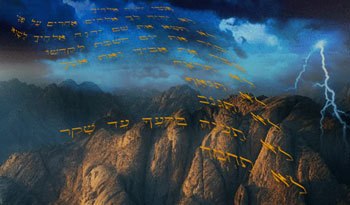
Torah at SinaiWe need to acknowledge the complexity of human relationships with God, what makes the connection especially precious regarding the Jewish people, and what we all can share together as human beings who live in a universe authored by the Creator.

“In the beginning of God’s creating the heavens and the earth” “… God blessed the seventh day and sanctified it because on it He abstained from all His work which God created to make”.

Genesis 1:1, 2:3

These two verses encompass all of Creation. The opening three words end in the Hebrew letters taf, aleph, mem which comprise “emet” (truth), and the closing three words end in aleph, mem, taf which spells “emet”. Reb Simcha Bunim of P’shis’che cites the Talmudic statement, “The seal of God is emet” and comments, “It is customary for an author to place his name in the opening of his book. God placed His Name, emet, in the opening chapter of the Torah. Emet thus envelops all of creation, a testimony to God as the Creator.”

Divrei Shaul notes that all traits can be a matter of degree. There can be greater beauty and lesser beauty, greater wisdom and lesser wisdom, greater strength and lesser strength. Only one trait cannot be more or less: truth. Something is either true or it is not true.

God is identified with truth. Just as truth can never be altered, because altered truth is no longer truth, there can be no change in God (Malachi 2:6).

The Talmud says that emet is broad-based, consisting of the first letter of the alphabet, aleph, the middle letter, mem and the last letter, taf (Shabbos 55a). Truth, therefore, has stability and durability. Falsehood, on the other hand is the Hebrew word sheker, consisting of three letters near the end of the alphabet. Sheker is top-heavy and cannot endure.

To the extent that a person lives with truth is the extent one identifies with God. Any falsehood distances a person from God.

Dvar Torah for Beresheet
Based on Twerski on Chumash by Rabbi Abraham J. Twerski
as quoted by Rabbi Kalman Packouz
“Shabbat Shalom Weekly: V’Zot HaBracha-Bereishit”
Aish.com

seek-truthOne of the things we all have in common if we have any sort of relationship with God at all is that we are all truth seekers. If we can see God’s “signature” on His Creation and know that it is truth, then we will seek out that truth. We will discover God’s truth, and in order to foster closeness between us and God, we will increase the truth in us and remove the falsehood.

All truth passes through three stages. First, it is ridiculed. Second, it is violently opposed. Third, it is accepted as being self-evident.

-Arthur Schopenhauer, German philosopher (1788 – 1860)

Once we accept the truth, God’s love and grace will be self-evident in all of our lives, Jewish and Gentile alike.

“I do not ask on behalf of these alone, but for those also who believe in Me through their word; that they may all be one; even as You, Father, are in Me and I in You, that they also may be in Us, so that the world may believe that You sent Me. The glory which You have given Me I have given to them, that they may be one, just as We are one; I in them and You in Me, that they may be perfected in unity, so that the world may know that You sent Me, and loved them, even as You have loved Me.”

John 17:20-23 (NASB)

Good Shabbos.