Tag Archives: church

Missing Author

empty-bibleWho wrote the Torah? Most people you ask — depending on your circle of friends — will answer, “A group of very wise men got together and wrote it.” For the past 3,300 years the Jewish people have lived with the consciousness that the Almighty dictated the Torah to Moses who wrote it down word for word, letter by letter. Every Torah-educated Orthodox Jew believes that. Are they fools, fantasizers, misguided religious fanatics?

It will surprise some people to know that for the past 3,300 the Jewish people have taught their children the evidence for the belief that there is a God and that He dictated the Torah to Moses. Actually, I am sure that for the first hundred or two hundred years after the giving of the Torah at Mt. Sinai the authorship of the Torah was not even a question. For generations all a Jewish child had to do was to ask his father if he was at Mt. Sinai or if his father or grandfather was there. Even Moses himself tells all generations to “Go and ask … has a people ever heard the voice of God speaking … as you have heard and survived?” (Deuteronomy 4:32-35).

-Rabbi Kalman Packouz
“Shabbat Shalom Weekly”
Commentary on Torah Portion Vaeira
Aish.com

This post may trouble some readers. It really shouldn’t. Religious leaders in some circles have sought to suppress the overwhelming evidence that something like the Documentary Hypothesis is true. Attacks against this idea usually claim that those who believe this theory simply disbelieve God. Such attacks also tend to refer to Julius Wellhausen and his views, which actually do not represent what is essential about the Documentary Hypothesis. The Documentary Hypothesis (DH) has many forms and is better known as JEDP. In my opinion, the best developed understanding of the DH is found in Richard Friedman’s work, including the very readable Who Wrote the Bible? (which was a bestseller).

-Derek Leman
“Exodus 6:2-3 and the Documentary Hypothesis”
Messianic Jewish Musings

I haven’t revisited this topic in a long time and even after I read Derek’s blog post, I was determined not to regurgitate it again from the murky depths so that it could come back up into the cold light of day. Then I read Rabbi Packouz and I was reminded that there is a fair distance between the stories we tell ourselves about the Bible and the story that the Bible tells us about itself (I know these gentlemen are specifically discussing the Torah, the Five Books of Moses, but I’m choosing to expand the discussion to the Bible as a whole).

I don’t mean the story the Bible tells in the actual text, but the history and evolution of the creation of the Bible as we have it today. I’m no scholar, but even I’ve read enough to realize that the Bible has lots and lots of warts, bruises, wrinkles, and other imperfections. No reliable and trustworthy Bible scholar would suggest that God literally dictated the Bible word-for-word to its various human authors.

So where is God in the Bible? No I don’t mean where is God mentioned, but is there anything of God in the actual composition of the Bible? Or is the Bible just the stories we tell ourselves about it? Frankly, we have told ourselves some pretty interesting stories about the Bible.

One way to establish and support an acceptance of Talmudic interpretation and judgment relative to Torah for post-Second Temple Judaism is to project the values and even the “reality” of Talmud (and later, Kabbalah) not only forward in time but backward. Peering at the Patriarchs through this lens, we can indeed “see” Abraham, Isaac, and Jacob studying Torah and Talmud in the study house of Shem when by historical knowledge and a plain reading of the Torah, such events seem very unlikely to have actually taken place.

-from my blog post:
The Rabbinization of Abraham

study-in-the-darkI periodically wrestle with this issue. Back on my previous blog, I wrote such articles as Reading the Bible in the Dark, The Bible is a Mystery Novel, and Who to Believe. I manage to “tame” the questions and conundrums by reading the Bible as if it were a series of Chassidic, or in my case, Messianic Tales. Maybe that’s the only way to make sense of the Bible, and especially the Gospels.

He read the Gospels in German. Then he obtained a Hebrew version and reread them. Though he was in the midst of a Gentile, Christian city where Jesus was worshiped in churches and honored in every home, Feivel felt the Gospels belonged more to him and the Chasidic world than they did to the Gentiles who revered them. He found the Gospels to be thoroughly Jewish and conceptually similar to Chasidic Judaism. He wondered how Gentile Christians could hope to comprehend Yeshua (Jesus) and His words without the benefit of a classical Jewish education or experience with the esoteric works of the Chasidim.

Taken from Jorge Quinonez:
“Paul Philip Levertoff: Pioneering Hebrew-Christian Scholar and Leader”
Mishkan 37 (2002): 21-34
as quoted from Love and the Messianic Age

But this presents a problem. During last Sunday’s sermon, Pastor said (I don’t have my notes with me, so what I’m about to write isn’t an entirely accurate quote) that the only way to show an unbeliever how to encounter God and come to faith in the Father through Jesus Christ is by reading and using scripture.

Um…whoa. Waitaminute.

Given everything I’ve said above, plus Derek’s commentary, plus just a boatload of Biblical scholars , scripture is not and cannot be the literally dictated words of the God of Heaven as whispered into the little, shell-like ears of the prophets and other writers of the books of the Bible.

In fact, I’m hard-pressed to tell you what the Bible is and who actually wrote it. Even portions of the New Testament weren’t in all likelihood, written by the people whose names are attached to them. Not all of the epistles written by Paul? Probably not. Did the Apostle John who (supposedly) wrote the Gospel of John also write Revelation?

Once you stop taking the Bible for granted, a lot of new territory opens up in front of you…in front of me.

In defense of the Bible (the Torah actually), Rabbi Packouz has this to say:

Perhaps the most powerful example is Shmitah (the Sabbatical year for the land). Modern agriculture science has taught us the value of letting the land rest and replenish itself. A sensible law would be to divide the Land of Israel into 7 regions and each year let one region lie fallow while people eat from the crops of the other 6 regions. However, that’s not the law of the Torah! The Torah writes, “For six years you may plant your fields … but the seventh year is the Sabbath of the land in which you may not plant your fields nor prune your vineyards (Leviticus 25:36).

The WHOLE land is to rest all at the same time! What happens to an agrarian society that stops farming for one year? Starvation! And how long does a religion last that advocates letting the whole land rest in the 7th year? My guess … about 6 years!

Perhaps they could avoid starvation by buying food from surrounding countries? A good idea and a reasonable idea … but the Torah has other plans. The Almighty says, “I have commanded My blessing to you in the sixth year and you will have produce for three years” (Leviticus 25:20-22).

Either one has to be God to have the “audacity” to make a law for the whole land to rest and then to promise a bounty crop 3 times as large as usual in the sixth year — or a stark raving mad lunatic!

Yet, the Jewish people neither starved nor abandoned the Torah! 3,300 years later a sizable portion of our people still adhere to the laws of Torah and still trust in the promises of the Almighty!

How could any human being promise in writing something that requires powers totally beyond his control?

And furthermore, why would anyone be willing to risk his own credibility and the legitimacy of his religion, when it would be easier to present a more rational solution and avoid the credibility issues.

Going to GodCan we accept that somewhere in the pages of the Bible we might actually be able to encounter the Divine? If so, where and how (apart from Shmitah)? If we can’t take the Bible as literally, page-by-page, the Word of God, then what do we consider it? If God is in there somewhere, then is it an intellectual and scholarly race to discover the secret location of the well of God’s Spirit?

Derek Leman seems to think that it’s possible to have a very questioning view of the Bible and yet still have faith:

People get from their religious background the idea that “Moses wrote all” or “Moses wrote almost all” of the Torah. For example, people will say “Moses wrote Genesis.”

This is complicated by things like Yeshua referring to “Moses and the prophets.” People take this to mean that Yeshua, who they suppose was omniscient during his earthly sojourn (but he was not) affirmed that Moses wrote all of Gen-Deut. He did not. His references to Moses actually writing all concern commandments, not narratives. With Moses as the originator of the commandments (or original vessel through whom they were revealed), all the five books are called “of Moses” but this need not mean authorship.

Anyway, because some of the earliest people to doubt Moses as the final author of Torah were skeptics, it is common for people to think anyone with a more complicated view than “Moses wrote it” are doing so because of a small faith or a lack of faith or a dislike of faith.

But I’ve never heard a satisfactory explanation of how other people do it. I only have how I do it and my “method” requires usually suspending disbelief for the sake of faith. I have encountered God before, so in an extraordinarily subjective way, I know He is real, He is alive, and He is God. I’m not going through the crisis of faith I had when I first faced this particular realization, but I do allow myself to periodically become aware of just how fragile a knowledge of God is if based solely on the Bible. On the other hand (and I’ve alluded to this already), basing knowledge of God solely on our experiences with the Holy Spirit can be just as hazardous, because most human beings have very little ability to tell the difference between an emotional experience and a spiritual one (barring the occasional saint or tzaddik).

I may not be able to take everything I read in the Bible and everything that Christianity and Judaism says about those events as actual, factual events (though some of them probably are), but I can still take what I read and what I study and try to apply them so that I can learn to live a better life.

The Patriarch Abraham was tested (by God) ten times and withstood them all. This proves Abraham’s great love for God.

-Ethics of the Fathers 5:3

Abraham was tested with ten trials of progressively increasing severity, ultimately culminating in the test of sacrificing his beloved son Isaac if God so willed.

Abraham successfully passed all the tests. Still, while he did demonstrate his intense loyalty and devotion to God, how did it prove his love for God?

In yesterday’s message we learned that God does not challenge people beyond their capacities. It follows, then, that as they advance in spiritual growth and strength, they actually render themselves vulnerable to trials of greater intensity. In the course of his many trials, Abraham detected this pattern. He could have logically decided to avoid any further spiritual progression, because it might subject him to even greater ordeals than those he had already sustained.

Abraham decided otherwise. He desired so much to come closer to God that he was willing to pay any price. Thus, when he was put to the ultimate task – to sacrifice Isaac – Abraham was not taken aback. He had fully anticipated such an eventuality.

We are not of the mettle of Abraham, and we pray every day, “Do not put us to test.” While we indeed wish to advance spiritually, we ask to be spared the distress of trial. Yet, should we experience adversity in life, we would do well to realize that this may be a testimony to our spiritual strength.

looking-upToday I shall…

try to advance myself spiritually. Although I pray to be spared from distress, I will try not to recoil if adversity does occur.

-Rabbi Abraham J. Twerski
“Growing Each Day, Tevet 26”
Aish.com

Thomas Gray once penned the famous words, “Where ignorance is bliss, ’tis folly to be wise” (in the poem “Ode on a Distant Prospect of Eton College,” 1742). I suppose many “Bible-believing Christians” feel very blissful as long as they don’t consider the rather troubling questions I’m bringing up this morning. On the other hand, once the “bliss bubble” is popped, then we can only face the painful trial of reality, if not the wisdom, of whatever we have left.

Chances are, Abraham never faced the ten challenges, at least as we see chronicled in Pirkei Avot (but not the Bible). Chances are Abraham, Isaac, and Jacob never studied Torah in the academies of Shem and Eber as we learn from the Talmud. Maybe the only place we really encounter God is in our prayers. Or maybe we encounter God everyday, as long as we continue to seek Him.

According to Gedaliah Nigal’s book The Hasidic Tale, some of the goals of the hasidic story are to “rouse its hearers into action for the service of God” and to win “adherents, among them some outstanding individuals, to hasidim.” In relation to this, I’ve said:

The “Chasidim” of Jesus also made sure the stories of their Master were passed on from generation to generation, eventually being recorded and passed on to the future…to us.

Paul Philip Levertoff thought that the teachings of Jesus read like a collection of Chasdic tales. Perhaps as Gentile Christians reading tales of the Chasidim, we can also find a connection to the Messiah, the Prophet, and the greatest Tzadik, whose own death atoned for not just a few, but for all.

Having gone through all this again, I feel reassured.
Message to the Sons of Solomon

philip_and_the_ethiopianAnd King Solomon gave to the queen of Sheba all that she desired, whatever she asked besides what was given her by the bounty of King Solomon. So she turned and went back to her own land with her servants.

1 Kings 10:13 (ESV)

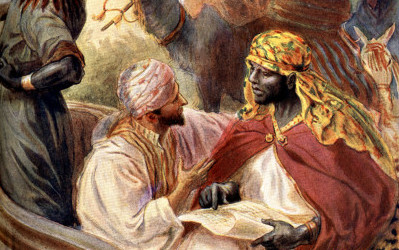
Now an angel of the Lord said to Philip, “Rise and go toward the south to the road that goes down from Jerusalem to Gaza.” This is a desert place. And he rose and went. And there was an Ethiopian, a eunuch, a court official of Candace, queen of the Ethiopians, who was in charge of all her treasure. He had come to Jerusalem to worship…

Acts 8:26-27 (ESV)

The Ethiopian history described in the Kebra Negast, or “Book of the Glory of Kings,” relates that Ethiopians are descendants of Israelite tribes who came to Ethiopia with Menelik I, alleged to be the son of King Solomon and the Queen of Sheba (or Makeda, in the legend) (see 1 Kings 10:1-13 and 2 Chronicles 9:1-12). The legend relates that Menelik, as an adult, returned to his father in Jerusalem, and then resettled in Ethiopia, and that he took with him the Ark of the Covenant.

-Budge, Queen of Sheba, Kebra Negast, chap. 61.
quoted from Wikipedia

I’ve written before about the section of Acts 8 that chronicles the encounter between Philip and the Ethiopian eunuch in relation to D. Thomas Lancaster’s commentary in Volume 6 of the Torah Club: Chronicles of the Apostles. Today (as I write this “church report”), it was Pastor Randy’s turn to teach us his perspective during Sunday services where I go to church.

It was also Charlie’s turn to discuss it in Sunday school and it was interesting. I already knew that Charlie believed the Ethiopian was Jewish but as Pastor started delivering his message, he shared with us that he just that week had changed his opinion about the Ethiopian and now believes that he must have been a Jew! Interesting.

I’m torn between whether to write about the history of the Ethiopian Jews, which is a topic of some controversy and speculation, or if I should focus on why God found it necessary to send an angel to tell Philip to find the Ethiopian (Acts 8:26). I think I’ll focus on the latter.

Let me explain.

In teaching the Sunday school lesson, Charlie remarked more than once how unusual he thought it was for God to send “an angel of the Lord” to tell Philip to stop everything he was doing in Samaria and travel south on the desert road to find one man who was returning to his native Ethiopia after a pilgrimage to Jerusalem. Why was this one man so important?

From a traditional evangelical Christian point of view, converting a high-ranking official of a foreign country to faith in Jesus Christ is a great way to spread the gospel message to all of the other high-ranking government officials in that country as well as to the general body of citizens. But I don’t think we can exactly map 21st Century evangelical strategies to First Century CE Jewish devotion to the sect of “the Way.” Charlie thought, given how the message of Christ was transmitted first to the Jews, then to the Samaritans, and finally to the rest of the nations, that God believed the Jewish population in Ethiopia was close to the heart of their Creator, and that the “Good News” of Messiah was a message God intended for all Jews to embrace. After all, much of the New Testament text addresses the spread of the Gospel into Europe, Asia, and the Near East. What about the Jews to the south?

This is all speculation of course, and only one part of a single chapter in the New Testament is devoted to transmitting such a message in that particular direction, but what Charlie also said more than once got my attention. He said that God wanted to make sure all of the Jews got the message that God had changed the rules.

What? What rules?

(I should say at this point, when Charlie made his comment about “changing rules” I was seriously considering what I should say or do in response. I chose not to say or do anything, but given my sensitivity to the matter of supersessionism in the church, I was afraid that I would have to defend against such a theology at the cost of my budding relationship among these fellow believers. Fortunately, it didn’t come to that.)

Actually, something important did change thanks to Christ.

Go therefore and make disciples of all nations, baptizing them in the name of the Father and of the Son and of the Holy Spirit…

Matthew 28:19 (ESV)

While Israel had always been intended to be a “light to the nations” (Isaiah 49:6), this is the first indication that the Messiah wanted people from all of the nations, and not just from Israel, to become disciples of the Master and grafted in sons and daughters of God. As we progress forward and especially attending to Acts 10 and beyond, we see that God’s intent was not to require the Gentiles to convert to Judaism or abandon their own national and ethnic uniqueness in order to become disciples. The Holy Spirit was just as available to the Gentile disciple as to the Jew.

Walking TogetherIn this specific sense, something had changed. Prior to this moment in time, if a Gentile wanted to worship the God of Israel in a covenant relationship, he or she had to embrace Judaism (that’s more or less an exact quote from Pastor Randy). With the command of Christ, which the church calls “the great commission,” anyone from anywhere could worship God in a covenant relationship without converting to Judaism (the concept of conversion is complicated…it probably didn’t exist as such during the days of Moses or David, but it was a recognized practice during the late Second Temple period and beyond).

Did God want Philip to tell the Ethiopian that God changed the rules? A plain reading of the text doesn’t suggest such a thing. From my point of view, what God wanted Philip to tell the Jewish Ethiopian was the good news of the Messiah who had come and will come again, as revealed by Isaiah 53. Why God wanted this event to occur is up for grabs, but what the Ethiopian carried back with him to his land and to his people was the gospel message, or as much of it as Philip was able to transmit in the time they were together and related to the passages from Isaiah. What fruit resulted upon the eunuch’s homecoming and in the years and centuries to follow, we cannot know.

But if God changed anything, it wasn’t His “rules” or His Torah but rather access. God opened up covenant access to Himself for all peoples. There are two portions to the good news of Christ. Of course, there is the good news for the Gentile, that we can now come to God in covenant through the blood of His son. However, Christianity rarely considers the good news of Christ to the Jew who already had such a covenant relationship (which would include the Jews in Ethiopia), that the Messiah had come, the King of Israel had been born, that he died and rose and sits at the Father’s right hand, and that at the proper time, Messiah would cause a scattered Israel to be gathered together as a nation and one day, the King would rule from Jerusalem (I’m not suggesting two, separate paths of salvation, one for Gentiles and one for Jews, but because of Israel’s special unique relationship with God, the Messiah has more and different good news for the Jews in addition to the good news he has for the Gentiles).

On Friday May 24, 1991: Over the course of 36 hours, a total of 34 El Al Hercules c-130s – with their seats removed to maximize passenger capacity – flew non-stop.

14,325 Ethiopian Jews came home to Israel, to be greeted by thousands of Israelis who gathered at temporary absorption centers, hotels and hostels to welcome their brethren.

Operation Solomon saw the rescue of twice the number of Ethiopian Jews in Operations Moses and Joshua put together.

-from bluestarpr.com

A Christian group said Tuesday, June 7, it would help organize “the return of the last 8,700 Ethiopian Jews to Israel” by sponsoring what are known as “Aliyah” flights, the coming months.

“Last Ethiopian Jews to Return to Israel, Christian Group Says”
-from worthynews.com, June 8, 2011

I know I’m stringing together bits and pieces of scripture, news, and commentary in a less than rock-solid structure, but consider for a moment that Jews from all across the nations have been returning to Israel and are being gathered to their people. God has never forgotten them nor will He ever forsake them. Perhaps that’s why He made it a point to send an angel to Philip and to insure that the message of the Messiah would reach all of his people, including the Jewish Ethiopians.

Just a thought.

Tent of David: Returning to Faith

TeshuvahFirst, the Christian church has forgotten that Jesus was and is a practicing Jew. Second, Christians have forgotten the centrality of Israel in God’s plan to redeem the world and her continued covenant status as God’s chosen people. Third, Christianity has an extremely low view of the Torah itself and the commandments God gave to the Jewish people. Fourth, the Christian gospel message, having replaced the broad and majestic vision of the kingdom of heaven with a knowledge-based individualistic salvation, has been emptied of its power.

-Boaz Michael
Chapter 2: The Church Needs to Change (pg 61)
Tent of David: Healing the Vision of the Messianic Gentile

If anything in the above-quoted paragraph shocked you as a Christian, then you probably need to get a copy of Boaz’s book and read it all the way through. However, I’m not writing this “meditation” today to shock you, but to remind you of something.

One of the objections I hear about “going to church” from believers who are not church-goers is that the church gives a whitewashed, “feel good” message, that doesn’t communicate the reality of the Bible, sin, and salvation. That may be true in other churches but it wasn’t in the one I attended last Sunday. It was anything but “whitewashed, feel-good.” The quote I opened this “meditation” with is part of that message. The message is that just because you believe, you may not have a terrifically realistic grip on the consequences of your belief. If you call yourself a Christian or a believer, but still can violate the Word of God with no feelings of guilt, anguish, or remorse, what you have may not even be what is called “faith.” Believing isn’t enough.

-from Day Zero

I mentioned in my last “church report” blog that Pastor Randy delivered anything but a “feel good” sermon about Christians and salvation. In fact, he was very pointed that “just believing” was not enough. We have to remember who Christ is and who we are in him and above all, why he had to die.

Interestingly enough, Boaz’s point about the Christian gospel message being emptied of its power seems to connect quite well to the Pastor’s sermon. Boaz continues.

Yeshua (Jesus) surely preached the gospel; his message – “Repent, for the kingdom of heaven is at hand” – is just as much “the gospel” today as it was two thousand years ago. When Peter adjured the crowds after the coming of the Spirit on Shavuoat in Acts 2:38-39, his message was not “believe in Jesus; go to heaven.” It was “Repent and be baptized every one of you in the name of Jesus Christ for the forgiveness of your sins, and you will receive the gift of the Holy Spirit. For the promise is for you and for your children and for all who are far off, everyone whom the Lord our God calls to himself.

-Michael, pg 87

Admittedly, Peter was delivering this message, the message of salvation, to a totally Jewish audience, and so there is no misunderstanding, let me verify that this message is for the “rest of us” who once were far off.

Therefore remember that at one time you Gentiles in the flesh, called “the uncircumcision” by what is called the circumcision, which is made in the flesh by hands—remember that you were at that time separated from Christ, alienated from the commonwealth of Israel and strangers to the covenants of promise, having no hope and without God in the world. But now in Christ Jesus you who once were far off have been brought near by the blood of Christ.

Ephesians 2:11-13 (ESV)

We non-Jews were also once “far off,” as Peter said, but now we too have been brought near thanks to the Messiah, the Christ.

But if Peter says “Repent, for the kingdom of heaven is at hand,” what does that mean? Does it mean what you think it means?

That is the gospel message. Repent – change the way you live and your life and begin to obey the commandments of God. For the kingdom of heaven is at hand – you can, in some way, bring God’s rule down to earth through your actions; it is possible to “live now for the realization of this Messianic Age” (quoting Levertoff, “Love and the Messianic Age” (Marshfield, Mo: Vine of David, 2009), 32).

-Michael, pg 89

That’s probably not quite what Pastor Randy was getting at in his sermon last Sunday. Pastor was talking about people who have made an intellectual assertion that Jesus is Lord without ever incorporating that knowledge into an actual, lived faith…without any realization that Jesus died for my sins and that I have a personal responsibility to repent and beg for forgiveness.

awareness-of-godThat’s not the wrong thing to do of course, but looking at what Boaz is writing, salvation means more than just the saving of individual upon individual by giving out “go to heaven free” cards. The kingdom of heaven isn’t heaven, according to Boaz, and it has little to do with personal salvation as such, at least not as much as most of us were led to believe. Making a commitment of faith to God through Christ is an entire change of lifestyle in the here and now that has the power to change everything in the here and now. Salvation isn’t just the promise that we’ll go to heaven, it’s the promise that we’ll receive the power to, in some sense, bring heaven to earth.

As Boaz says, Yeshua didn’t simply teach “believe in me and go to heaven when you die.” If you read the Gospels carefully, you’ll see that he doesn’t really mention anything about what happens to you when you die. He mentions what happens to you when you live, if you repent and come to a true and saving faith.

The church needs to change, but not because the church is bad or that Christians are bad. The church needs to change because much of Christianity has taken the message of the Gospel and reduced it down to a simple “get saved” footnote and missed the larger point of what happens while we’re alive. No, it’s not a “works-based” salvation, but one of Pastor Randy’s scripture examples in last Sunday’s sermon was from James.

What good is it, my brothers, if someone says he has faith but does not have works? Can that faith save him? If a brother or sister is poorly clothed and lacking in daily food, and one of you says to them, “Go in peace, be warmed and filled,” without giving them the things needed for the body, what good is that? So also faith by itself, if it does not have works, is dead.

But someone will say, “You have faith and I have works.” Show me your faith apart from your works, and I will show you my faith by my works. You believe that God is one; you do well. Even the demons believe—and shudder! Do you want to be shown, you foolish person, that faith apart from works is useless? Was not Abraham our father justified by works when he offered up his son Isaac on the altar? You see that faith was active along with his works, and faith was completed by his works; and the Scripture was fulfilled that says, “Abraham believed God, and it was counted to him as righteousness”—and he was called a friend of God. You see that a person is justified by works and not by faith alone. And in the same way was not also Rahab the prostitute justified by works when she received the messengers and sent them out by another way? For as the body apart from the spirit is dead, so also faith apart from works is dead.

James 2:14-26 (ESV)

You cannot have a true and saving faith unless it has changed your life. If your every action does not conform to the message of James and you are not behaving in a manner that reflects faith, then you probably should ask yourself if you ever repented at all when you “confessed Christ.” And beyond the “generic” helping to repair the world, as I learned recently (and this is also echoed in Boaz’s book), when we are adjured to help the needy, we in the church have a special duty to assist the poor, the sick, and the needy of Israel as it is said:

Then the King will say to those on his right, ‘Come, you who are blessed by my Father, inherit the kingdom prepared for you from the foundation of the world. For I was hungry and you gave me food, I was thirsty and you gave me drink, I was a stranger and you welcomed me, I was naked and you clothed me, I was sick and you visited me, I was in prison and you came to me.’ Then the righteous will answer him, saying, ‘Lord, when did we see you hungry and feed you, or thirsty and give you drink? And when did we see you a stranger and welcome you, or naked and clothe you? And when did we see you sick or in prison and visit you?’ And the King will answer them, ‘Truly, I say to you, as you did it to one of the least of these my brothers, you did it to me.’

“Then he will say to those on his left, ‘Depart from me, you cursed, into the eternal fire prepared for the devil and his angels. For I was hungry and you gave me no food, I was thirsty and you gave me no drink, I was a stranger and you did not welcome me, naked and you did not clothe me, sick and in prison and you did not visit me.’ Then they also will answer, saying, ‘Lord, when did we see you hungry or thirsty or a stranger or naked or sick or in prison, and did not minister to you?’ Then he will answer them, saying, ‘Truly, I say to you, as you did not do it to one of the least of these, you did not do it to me.’ And these will go away into eternal punishment, but the righteous into eternal life.”

Matthew 25:34-46 (ESV)

sukkoth-feastI know I’ve said a lot of this before, but I want to illustrate that Boaz Michael’s book has a much broader scope than you may have gathered from my previous review. It’s not just directed at those non-Jewish “Messianic” believers who are in the church or who are contemplating returning to church…it’s a message for all believers everywhere who may not have a complete understanding of what the Gospel is trying to tell us.

This is a message about who we are, who we are in Christ, and most importantly, what to do with the rest of our lives. It’s not a message about packing our bags and getting ready for the trip to heaven, it’s about what we do as disciples of the Master and sons and daughters of the living God. Where do we find God? Why are we needed by other people? How do we inspire hope in the world around us and be a light in the darkness?

This is the kingdom of heaven being drawn near to us and to the people around us…by who we are in our faith.

Day Zero

divide-by-zeroThat fall, Pastor S. from a church in another county came to our church to share in a morning service how they felt led to the mission field and were going to go to another country. S. shared his testimony followed by his wife L. L’s testimony paralleled my life closely, baptized at an early age, regular in church and youth activities but still felt empty. However in her early 20s she realized that she had not admitted that she personally was a sinner and that Christ’s death was for her. At that moment, God opened my eyes and I realized why I had been feeling guilty as my own pastor was preaching. I know the facts about Christ, his birth, life and death but had never applied them personally to myself. I had never admitted I personally was a sinner destined to hell without the shed blood of Jesus and had not believed in the reason for his death on the cross. My sin.

-Testimony found in last Sunday’s church bulletin.

There’s more to the writer’s testimony but I decided to quote just the portion specific to this blog post and of course, I took out any information that might identify the parties involved. This is Day Zero, the last few hours of the last day. At midnight tonight, time runs out in my countdown.

Yesterday, I went to church. It was interesting.

I walked in the side door and immediately ran into Pastor Randy. He smiled and greeted me. In a very friendly way, he asked where I’d been the last couple of weeks (he wouldn’t be the only one). He also surprised me. The day I met him and we had our rather lengthy chat in his office, I had volunteered to do some work for the church that is within my skill set. He hadn’t brought it up again, but yesterday, he said he talked with the deacons and they’d like me to proceed. He’ll email me later this week to set up a meeting and tell me what he has in mind. I’ll keep the nature of the work to myself for now, but in the moment that Pastor brought it up, I knew I was committed to the church. Actually, I knew that before I walked in the door that morning.

I also saw Charlie, who teaches my Sunday school class. He said he’d been thinking about me and wondering where I was. I saw Dick and Virgil and a number of other people whose names I still can’t remember (I’m getting better at it, though). People were friendly, but the friendliness was a different quality. I can’t explain it in so many words, but I felt more welcome somehow. As my wife says, maybe what’s different was my attitude.

Church was still church. There was a brief DVD presentation made by missionaries in the Congo. They baptized 18 people in the first month they were there. They make bricks for their worship structure out of clay that has to be dried in the sun. After the first Sunday service, a storm blew the thatch roof off of the structure and they had a “church work day” to put it back up. Services are spoken in French and then translated into one of the indigenous languages. It’s a different world, and yet, we’re all human beings on a journey to encounter God in our lives.

Pastor spoke on Acts 8:9-25. I’d recently covered the same material in D. Thomas Lancaster’s Torah Club Vol. 6, Chronicles of the Apostles, and Pastor Randy’s treatment of Philip’s encounter with Simon in Samaria seemed very different from Torah Club. The immediate impression I got was that the church was trying a little too hard to apply a modern Christian sense of evangelism to people and events that are 2000 years distant. Ancient Judaism likely didn’t concern itself with how converting someone of Simon Magus’s statue would be a big accomplishment.

But he said something else that made more sense.

Even Simon himself believed, and after being baptized he continued with Philip. And seeing signs and great miracles performed, he was amazed…Then they laid their hands on them and they received the Holy Spirit. Now when Simon saw that the Spirit was given through the laying on of the apostles’ hands, he offered them money, saying, “Give me this power also, so that anyone on whom I lay my hands may receive the Holy Spirit.” But Peter said to him, “May your silver perish with you, because you thought you could obtain the gift of God with money! You have neither part nor lot in this matter, for your heart is not right before God.

Acts 8:14, 17-21 (ESV)

simon-the-magicianWhen Simon first hears the Good News from Philip, it seems like he too comes to faith in the Jewish Messiah King and is willing to reconcile his life to the will of the God of Israel. In other words, it seems like he has converted to Christianity. But his subsequent response to seeing the giving of the Holy Spirit indicates that he completely misunderstands what he is observing and what his faith in God is supposed to really mean. Pastor Randy says there is a faith that doesn’t save. And he said more than that.

He ran off a litany of verses from the New Testament, all “convicting Christians of their sin.” Verses such as 2 Cor. 13:5, Gal. 5:19-21, Eph 5:5-6, 1 Jn 3:6-10. Here’s another one.

For this very reason, make every effort to supplement your faith with virtue, and virtue with knowledge, and knowledge with self-control, and self-control with steadfastness, and steadfastness with godliness, and godliness with brotherly affection, and brotherly affection with love. For if these qualities are yours and are increasing, they keep you from being ineffective or unfruitful in the knowledge of our Lord Jesus Christ. For whoever lacks these qualities is so nearsighted that he is blind, having forgotten that he was cleansed from his former sins. Therefore, brothers, be all the more diligent to confirm your calling and election, for if you practice these qualities you will never fall. For in this way there will be richly provided for you an entrance into the eternal kingdom of our Lord and Savior Jesus Christ.

2 Peter 1:5-11 (ESV)

One of the objections I hear about “going to church” from believers who are not church-goers is that the church gives a whitewashed, “feel good” message, that doesn’t communicate the reality of the Bible, sin, and salvation. That may be true in other churches but it wasn’t in the one I attended last Sunday. It was anything but “whitewashed, feel-good.” The quote I opened this “meditation” with is part of that message. The message is that just because you believe, you may not have a terrifically realistic grip on the consequences of your belief. If you call yourself a Christian or a believer, but still can violate the Word of God with no feelings of guilt, anguish, or remorse, what you have may not even be what is called “faith.” Believing isn’t enough.

You believe that God is one; you do well. Even the demons believe—and shudder!

James 2:19 (ESV)

“Not everyone who says to me, ‘Lord, Lord,’ will enter the kingdom of heaven, but the one who does the will of my Father who is in heaven. On that day many will say to me, ‘Lord, Lord, did we not prophesy in your name, and cast out demons in your name, and do many mighty works in your name?’ And then will I declare to them, ‘I never knew you; depart from me, you workers of lawlessness.’

Matthew 7:21-23 (ESV)

Think about the author of the text I quoted from at the top of this blog post. If he hadn’t experienced God’s message about his life, at the end of all things, he might have been one who the Master declared that “I never knew you…depart from me!” How horrible that a person might live that long and believe they are truly in the service of God through Jesus Christ only to be told to their face that they have been woefully mistaken about what faith means. Even performing great signs and wonders isn’t meaningful. Simon in Samaria was a magician who was called “great,” and yet his magic meant nothing to God.

hourglassIn the days of the Torah the great magician Balaam was commissioned by Balak, a King, to curse the Children of Israel. Balaam spoke with God and an angel of the Lord appeared to Balaam, but he was no servant of the God of Israel (see Torah Portion Balak). Yes, what you do matters (James 2:14-24), but behavior, purpose, and intent all go hand in hand. Everyone has times of doubt when we wonder if God will ever come near, including me, but there comes a time that we can’t simply wait on God to tell us what we need to know, we must pursue God with all of our strength, our will, and our resources. If He is our goal, then we have only one avenue to reach it; Jesus Christ and a true and saving faith in the promises of the Messiah.

There’s much more to do once faith is affirmed or reaffirmed, but sometimes you need to touch home plate to make sure your foundation is solid. It’s like I went to church and God asked me, “Do you know what you’re doing here?” “Do you know what you want?” “Are you sure you want this?” The answer is either “yes” or “no.”

My time is up. The clock is running to zero. Before the last hours, minutes, and seconds ticked down and the hourglass emptied, I said, “yes.”

Tent of David: Return of the Christian

restoring-davids-fallen-tentYet even before delving into an appraisal of the institutional church, it is important to recognize the common ground on which we stand. By any biblical definition, all believers in Yeshua the Messiah (Jesus Christ) are part of one body, the ecclesia of God. All who have made Yeshua their master are subjects of one kingdom, the kingdom of heaven.

I believe the term “Messianic” is an easy-to-understand descriptor that helps Christians who understand their Jewish roots to find a concrete identity and definition. Yet to be a “Messianic Gentile” does not make one something other than “Christian.”

-Boaz Michael
“Chapter One: The Church is Good,” pg 36
Tent of David: Healing the Vision of the Messianic Gentile

I started my somewhat unique review of Boaz’s book in yesterday’s extra meditation so you may want to go back and read it before continuing here. I’m only “sort of” reviewing the book, as I’m not presenting my assessment in a single chunk, nor am I trying to look at it with an objective eye. The book is primarily intended to impact the Christian already in the church who has become somewhat “Judaically-aware.” That doesn’t describe me, since I left the church for many years and have only recently returned, and I am writing my response to Tent of David from the viewpoint of my personal experience as a church “returnee.”

Boaz continues to talk about the definition of a Christian in relation to being a “Messianic Gentile,” which he began in the Introduction of his book. I think identity is very important because so many people have left behind the church and the identity of “Christian” out of a sense of disillusionment, seeking something more authentic in other realms, particularly that venue we tend to call Messianic Judaism.

I’ve received quite a bit of encouragement to return to the church recently, both from a friend and from my Mom (hi, Mom). I’ve concluded that God must want me in the church, regardless how I may feel about it and that there is some intended good in my returning there, and perhaps even in the particular church I currently attend. Of course it’s important, as Boaz points out in the first chapter of his book, to remember that there is much good in the Christian church, even if you’ve been told otherwise.

The first good mentioned is community, but the nature and scope of that community may not be what you expect. In the quote above, Boaz mentioned that everyone who is a believer in Jesus Christ is a member of the ecclesia of God. But just who is that exactly?

As a Messianic Jew, I am a Jewish follower of the Jewish Messiah; Gentile believers have also attached themselves to the same Messiah. So we are all Christians according to the word’s original, lexical meaning – Christ-followers. God forbid, that the term “Messianic” should foster an “us vs. them” mentality toward Christians who do not accept the Messianic viewpoint; this attitude is counterproductive, unbiblical, and unnecessary.

-Michael, pg 37

Boaz means to communicate that those Christians who consider themselves (ourselves) “Messianic” should not allow their (our) identity to separate them (us) from Christians who do not necessarily see themselves in the same light, relative to the Torah, the mitzvot, and Jewish practice. However he uses himself as a Messianic Jew in the example and that might not fit the metaphor, at least not according to Rabbi Dr. Michael Schiffman in his blog post Messianic Judaism and Christianity: Two Religions With The Same Messiah.

Messianic Judaism affirms that the Jewish people, believing in Yeshua or not, have been, are, and will always be the chosen people of God. The only nation God ever linked His name to in Scripture is Israel, calling Himself, the God of Israel. Scripture tells us His promises to Israel are eternal, and extend to the sons of Jacob, the House of Israel, known today as the Jewish People. Those leaders of the church did not affirm this. To them, 2000 years of post-Yeshua Jewish history, a history of spirituality and suffering for being Jewish, was worthless. In their view, 2000 years of Jewish unbelief in Yeshua means Twenty centuries of Jews went to hell. I have to confess that the concept doesn’t sit well with me. For Yeshua to be the Messiah of Israel, he would have to be good for the Jews. If his coming resulted in twenty centuries of Jewish people going to hell, the bottom line is, he wasn’t very good for the Jews. Either he wasn’t the Messiah, or the doctrinal understanding is wrong. I believe the latter. Yeshua brings salvation, but is that the only reason to believe in Him; for something we get? I think we should believe in Him because he is the Messiah, and being in relationship to Him brings us closer to God, and increases our kavvanah, or spiritual connection with God.

What they don’t grasp, is the idea put forth by R. Kendall Soulen in his book, The God Of Israel In Christian Theology, that after the first century, the Jewish Yeshua was virtually unrecognizable as a Jew, and therefore, as the Messiah. Jewish rejection of Yeshua was not an act of infidelity towards Yeshua, as much as it was an act of fidelity towards His Father.

infinite_pathsWhile Rabbi Dr. Schiffman has assured me that his writings were not intended to be anti-Gentile, they do draw a sharp distinction between what Jews do and who Jews are within a Messianic Jewish context, and what Gentile Christians do and who we are (Messianic Gentiles or otherwise) within a church or other primarily Gentile believing context. One God, One Messiah, two religions.

If I were to return to Boaz’s definition, then I’d have to believe that at some “meta-religious” level, both the Jewish and Gentile believers of the Jewish Messiah King must belong to the “Kingdom of God,” however you want to define it (In a recent conversation with Boaz, he talked about devoting a great deal of First Fruits of Zion’s (FFOZ’s) resources to address the nature of the Kingdom of God in the coming year. You can get a preview of what he’s talking about at tv.ffoz.org).

But now in Christ Jesus you who once were far off have been brought near by the blood of Christ. For he himself is our peace, who has made us both one and has broken down in his flesh the dividing wall of hostility by abolishing the law of commandments expressed in ordinances, that he might create in himself one new man in place of the two, so making peace, and might reconcile us both to God in one body through the cross, thereby killing the hostility. And he came and preached peace to you who were far off and peace to those who were near. For through him we both have access in one Spirit to the Father. So then you are no longer strangers and aliens, but you are fellow citizens with the saints and members of the household of God, built on the foundation of the apostles and prophets, Christ Jesus himself being the cornerstone, in whom the whole structure, being joined together, grows into a holy temple in the Lord. In him you also are being built together into a dwelling place for God by the Spirit.

Ephesians 2:13-22 (ESV)

Is this where Paul tries to describe that “meta-level” where both the Jewish and Gentile disciples of the Master exist in some sort of common framework? If so, then I have to conclude, going back to Rabbi Dr. Schiffman, that said-framework is virtual, spiritual, supernatural, or even mystical, since a united platform of Jews and Gentiles as believers cannot exist and yet maintain two separate and distinct religious identities.

In any event, that meta-level can’t really help me right now if I must adopt a specific Christian persona within a traditional church context. And yet the concept of identity gets complicated even if we just stick to Christians.

It is not anyone’s place to pass judgment on those who are infants in their faith, who have not taken on this or that mitzvah. James wrote in his epistle (4:11-12), “Do not speak evil against one another, brothers. The one who speaks against a brother or judges his brother, speaks evil against the law and judges the law. But if you judge the law, you are not a doer of the law but a judge. There is only one lawgiver and judge, he who is able to save and to destroy. But who are you to judge your neighbor?”

In essence, this passage communicates to us that the pace of someone else’s spiritual development is God’s concern alone…God has not appointed us to judge someone else based on his or her level of observance; to do so is tantamount to judging the law itself. James even goes so far as to say that one who judges another’s level of observance has ceased to observe the Torah himself.

-Michael, pg 38

I know Boaz intended to address the “Messianic Gentile” in the church or returning to the church, but that person isn’t me. In the past several weeks, Christians have shown me where I am immature in my faith. I have no judgment to offer anyone in the church, who have been performing the “weightier matters of the law” for much longer than I’ve even been considering them. Heck, on Christmas, I found out that one of the local Boise restaurants volunteered free meals to the hundreds and even thousands of homeless. My wife told me someone she works with volunteers for this project every year. Imagine that. I didn’t even know about it. Organizations such as the Boise Rescue Mission, Lighthouse Rescue Mission, City Light Home for Women and Children and Interfaith Sanctuary Housing Service, the CraftWorks Foundation, and others in the local Boise community regularly perform these “mitzvot,” so I along with many others, should be careful who we judge. I certainly have no room to say that who I am and what I do is better than any of these people and agencies.

That’s a rather humbling realization (I’ve been having a lot of them lately) when facing the daunting task of returning to God’s ecclesia and trying to find a place among them.

divergence0-3-negative_pointsBut “levels of spiritual development” aren’t always a simple set of stairs. For me, the different spiritual paths of the people around me and my own path look like a set of divergent vectors, different not only in level, but in character, trajectory, and “texture.”

In his book, Boaz says that some people who become “Judaically-aware” modify their trajectory to adapt their new experiences within the church context, but others allow it to drive their entire course, altering it so drastically, that it carries them completely out of the church and out of Christian fellowship. Of the former group, Boaz has this to say.

I know a number of Christian pastors who have seen the merit in Messianic theology and practice, and have embraced the feasts and even the dietary law on some level, but have no desire to leave their denominations, or their particular theological and cultural distinctiveness, behind. One, an Independent Fundamental Baptist, restricts himself to clean meat and attends Erev Shabbat dinners, yet still puts on his suit and tie for church every Sunday morning and evening, and goes door-to-door every Saturday. Another, a Methodist, erected a sukkah in his backyard last year, yet proudly supports his denomination at the state and national level.

-Michael pp 46-7

These people are the opposite of me. Instead of being in the church as my “home” and extending myself outward toward some modest Judaic awareness, I’m trying to reinsert my Judaically-aware self back into the church and discovering, much to my shock, that I’ve been terribly wrong about a good many things. It isn’t the church that has been resisting me, but rather me resisting the church, and from what I’ve been able to tell so far, they know a great deal more about the “weightier matters of Torah” than I do.

The Christians who, throughout the ages, have propagated this message and tried to soothe the hurting, feed the hungry, and speak to social injustice have been keeping the weightier matters of the Torah. Both Yeshua (Mark 12:31) and the Sages (Rabbi Hillel in b.Shabbat 31a and Rabbi Akiva in Sifra, Kedoshim 4:12) taught that love of neighbor is the essence of Torah. These are non-trivial accomplishments which speak to the robust, biblical ethical system which many devout Christians have embraced.

-Michael, pg 49

The one thing Boaz doesn’t do, and this is where I will have to watch my balance, is he doesn’t “chase the Gentiles back into church” with no inherit connection to the origins of our faith as it was born in ancient Judaism.

One thing Messianic Gentiles must learn is that they do not have a direct, unmediated relationship with God. Jews have many covenants with God by virtue of their very existence as descendants of the Patriarchs. In contrast, Ephesians 2:12-13 describes the state of Gentiles as “separated from Christ, alienated from the commonwealth of Israel and strangers to the covenants of promise, having no hope with out God in the world. But now in Christ Jesus you who once were far off have been brough near by the blood of Christ.”

-Michael, pg 50

I know I quoted from Ephesians 2 earlier but Boaz uses it in a different manner. He’s talking about what links the Gentile to Messiah and God and that link only exists through the covenants God established with Israel and the Jewish people. Without them, we Gentiles would have no connection to Jesus and to God. I’ve tried to explore this in my own covenants series, but it’s a very complex and elusive topic of investigation. Even trying to isolate and examine Ephesians 2 led to a divisive “discussion.”

Nevertheless, Boaz tells us that going back to the basis of our faith, the Jewish Messiah King, and his Jewish apostles, we see that we owe a debt of gratitude to them and their inheritors.

Pirkei Avot 6:3 contains a profound teaching that is particularly relevant here:

One who learns from his fellow a single chapter, or a single law, or a single verse, or a single word, or even a single letter, he must treat him with respect. For so we find with David, king of Israel, who did not learn anything from Achitofel except for two things alone, yet he called him his “master,” his “guide” and his “intimate,” as is stated, “And you are a man of my worth, my guide and intimate friend.” [Psalm 55:13] Surely we can infer a fortiori: if David, king of Israel, who learned nothing from Achitofel except for two things alone, nevertheless referred to him as his master, guide and intimate, it certainly goes without saying that one who learns from his fellow a single chapter, a law, a verse, a saying, or even a single letter, is obligated to revere him. And there is no reverence but Torah, as is stated “The sages shall inherit honor” [Proverbs 3:35] “and the integral shall inherit good” [Proverbs 28:10]; and there is no good but Torah, as is stated, “I have given you a good purchase; My Torah, do not forsake it.” [Proverbs 4:2]

Messianic Gentiles would do well to heed the teaching of this mishnah. Showing reverence towards one’s teacher, even if what they learned was small – a single letter or verse – is showing reverence toward God and the Torah. Conversely, dishonoring one’s teacher is in fact dishonoring God’s work in one’s life.

Michael, pp 51-2

Out of the darknessFor me, the door swings both ways. Not only must I maintain a sense of honoring my ancient and modern Jewish teachers (since I often quote from modern Jewish teachers and scholars), but I must also sustain my respect and honor for the Pastors and Bible teachers at the church I’m attending. That can extend to Christian friends with whom I meet and from whom I learn a great deal.

I suppose in addition to this being a commentary on one of the chapters in the Tent of David book, it could also be part of my “Days” series (though I haven’t titled it as such), but it’s pretty much a foregone conclusion at this point that I’ll be going back to church next Sunday and continuing to go in coming year. But while Tent of David may be a guide for Pastors who build a sukkah or who have decided to eat kosher meat, I don’t know if is particularly aimed at me. Boaz told me that between the preliminary drafts, which I previously reviewed, and the current, final publication, the intended audience shifted from people like me who left and are now returning (or considering returning) to church, to those Christians who are currently in the church and part of its culture, and who have also recently become aware of the Jewish origins of Christianity and the significance of Torah as the foundation of Christian faith.

It’s not like I’m without a guide and in fact, I may even have found a mentor of sorts, but I am unlikely to be able to use Boaz’s book as a direct mapping to my own, personal experience. As I continue to read what he’s written, attend services at church, and record my experiences a chapter at a time, I will share that with you and we will see together how accurate my prediction is…and where I go from here.

5 Days: Practicing Christianity

pakistani-christians-singing-hymnsBoth the Jews and gentiles recognized that the Jews denied the gods of the nations and claimed that their God alone was the true God, the Lord of the universe, but for both Jews and gentiles the boundary line between Judaism and polytheism was determined more by Jewish observances than by Jewish theology. Josephus defines an apostate as a Jew who “hates the customs of the Jews” or “does not abide by the ancestral customs.” He defines a convert to Judaism as a gentile who, through circumcision, “adopts the ancestral customs of the Jews.”

-Shaye J. D. Cohen
Chapter 3: The Jewish “Religion”, Practices and Beliefs
From the Maccabees to the Mishnah, 2nd ed.

Many years later, as recorded in Acts 21, the apostles reaffirmed that the Jewish believers in Jerusalem were all “zealous for the Law.” To clarify the key difference between Jewish and Gentile believers, they continued: “But as for the Gentiles who have believed, we have sent a letter with our judgment that they should abstain from what has been sacrificed to idols, and from blood, and from what has been strangled, and from sexual immorality” (Acts 21:25).

Based on this ruling and on the revelation Christ gave to him personally, the apostle Paul staunchly fought for the right of Gentile believers to remain Gentiles. This is actually what Paul was arguing for in Galatians 3:28: “There is neither Jew nor Greek, there is neither slave nor free, there is no male and female, for you are all one in Christ Jesus.” In other words, the body of Messiah accepts everyone as they are – it doesn’t matter whether you’re slave or free, male or female, Jew or Gentile. You don’t have to become something you’re not in order to follow Yeshua.

-Boaz Michael
Introduction, pg 20
from his book
Tent of David: Healing the Vision of the Messianic Gentile

That’s comforting to know. God is the ultimate supporter of diversity. No matter who you are, where you come from, what your race, ethnicity, nationality, language, heritage, or anything else is, you can be reconciled to the Father through His Son, Jesus Christ, Yeshua HaMashiach, the Savior of the world and the Jewish Messiah King.

Only let each person lead the life that the Lord has assigned to him, and to which God has called him. This is my rule in all the churches. Was anyone at the time of his call already circumcised? Let him not seek to remove the marks of circumcision. Was anyone at the time of his call uncircumcised? Let him not seek circumcision. For neither circumcision counts for anything nor uncircumcision, but keeping the commandments of God. Each one should remain in the condition in which he was called.

1 Corinthians 7:17-20 (ESV)

This is Paul, saying the same thing we read in Galatians 3:28 and it fits very well with how Cohen states Josephus defines a convert to Judaism. Since we know that Paul opposed Gentile believers becoming circumcised when they came to faith in God through the Messiah, then we understand that the Gentiles did not convert to Judaism. They retained their Gentile identities. If we compare the message of Acts 21 with the rest of the definition of a convert as presented by Josephus, we can reasonably believe that the Gentile disciples of Messiah were not required to adopt the full yoke of the Torah and not commanded to perform the entire body of mitzvot.

I know I’ve talked about this before in The Uncircumcised Convert, Part 1 and Part 2, but when I started reading my actual, official, published copy of Boaz Michael’s book Tent of David (yes, it finally arrived) and in parallel, took up Cohen’s book again (I couldn’t access it for a while because I needed to get my Kindle Fire replaced – battery problems), I immediately saw how what both Michael and Cohen wrote dovetailed into this message.

christian-coffee-cultureI know it seems as if I’m off on another religious harangue designed to bring the so-called “One Law” or “One Torah” movements within Hebrew Roots (as opposed to Jewish roots and as more opposed to Messianic Judaism) to task, but this is more personal, or more to the point, this has more to do with my personal identity.

After a recent encounter, I’ve received a very strong message that I need to redouble my efforts to return to church, stay there, and become part of the body of believers within their walls and their context. Part of that effort is picking up, to whatever degree I’m able, the identity of a Gentile believer, a Christian. Boaz Michael in his book plainly defines a “Messianic Gentile” as:

While these believers are still Christians, for the sake of clarity and definition I will call them by the term “Messianic Gentile” (the term “Gentile” meaning nothing more than “non-Jew”). A Messianic Gentile is a non-Jewish Christian who appreciates the Torah, his relationship with Israel, and the Jewish roots of his faith.

-Michael, pg 17

There are probably a fair number of Christians in churches who are also “Messianic Gentiles” based on that definition, but who just haven’t thought of themselves in such a light.

Based on my recent coffee encounter as well as other factors, not the least of which is Boaz’s book, I know I have to go to church and stay in church. It still doesn’t particularly thrill me at this stage, but I must proceed hopefully. And I know I’m not going in to change anyone or to present myself as some sort of “expert.” I’m certainly not going to bill myself as a “Messianic Gentile,” though I suppose the definition fits me after a fashion.

But who I am needs to fit better with other Christians. I can study the Jewish texts forever, and forever I will be isolated and alone because I’m not Jewish. It’s not my “Messianic Gentileness” I’m taking into the church and it’s not even my Christianity…it’s my desire to encounter God within the context of his non-Jewish disciples. Perhaps at some point, my voice will be added to theirs but for now, I need to be a learner and not a teacher.

I know I’m not a Jew and I know based on the Bible, that I’m not required or directed to act like one. Yes, the very early Gentile believers took on a number of the mitzvot such as giving to the poor among Israel, donating to build synagogues, studying the Law of Moses, and the fixed times of prayer.

All these texts imply that the recitation of prayers was a prominent feature of Jewish piety, not just for sectarians like the Jews of Qumran but also for plain folk. Jews who lived in or near Jerusalem prayed regularly at the temple. This is the plausible claim of Luke 1:10, “Now at the time of the incense offering, the whole assembly of the people was praying outside [the temple],” and Acts 3:1, “One day Peter and John were going up to the temple at the hour of prayer, at three o’clock in the afternoon.”

-Cohen, Chapter 3

PrayingWe know the early Jewish disciples met at Solomon’s colonnade (John 10:23, Acts 3:11, 5:12) at the Temple for daily prayers. The later Gentile converts to “the Way” most likely adopted the times and “the prayers” in their own worship (Acts 10:3) as well as other Jewish customs and practices, but of course, as we’ve seen above, they were not considered converts to Judaism nor obligated to the mitzvot, although it seems like they were certainly allowed to perform the mitzvot in a number of instances. That had limits, particularly in terms of access to the Temple.

When the seven days were almost completed, the Jews from Asia, seeing him in the temple, stirred up the whole crowd and laid hands on him, crying out, “Men of Israel, help! This is the man who is teaching everyone everywhere against the people and the law and this place. Moreover, he even brought Greeks into the temple and has defiled this holy place.” For they had previously seen Trophimus the Ephesian with him in the city, and they supposed that Paul had brought him into the temple.

Acts 21:27-29 (ESV)

We may never recapture the full history of what the relationship was like between the early Jewish and Gentile disciples of the Master, but we can take what information we have and use it to reasonably recognize who and what we are today as Christians. For me, that means pursuing a course of action that requires following both the timeless footsteps of the first Christians such as Cornelius (Acts 10) and the modern Gentile believers, with the firm conviction of who I am and who the Jewish people are in relation to God. If God permits, maybe my role will one day be of some use to Him among His people in the church, but for now, I just need to practice being who I am…a Christian.