Tag Archives: community

How Will We Live in the Bilateral Messianic Kingdom?

When I started writing this missive, I thought the answer had all to do with the Apostle Paul. By the time I finished, I realized I was dead wrong.

Let me explain.

This issue is compounded by two additional assumptions, based on the New Testament book of Romans – written by Paul whose authority is questionable because he never met Jesus.

-Rabbi Bentzion Kravitz
“Know How to Answer Christian Missionaries”
Aish.com

Articles like this make my heart ache because they are based on the assumption that everyone who has received and accepted the revelation that Rav Yeshua (Jesus) is the Messiah has an understanding of Jesus that’s exactly the same as Evangelical Christian theology and doctrine.

This is not consistent with many Messianic Jews I’ve met, either in person or over the web. In fact, most of those Jews have more in common with people like Rabbi Kravitz than they do with me.

But I’m not writing this to convince any Jewish person (or Gentile Noahide for that matter) of the validity of Yeshua’s identity and role, past, present, or future.

My current investigation has to do with a Gentile establishing and maintaining a relationship with Hashem outside traditional Christianity and Messianic Jewish community. For the former, this is the case because I’m definitely not a good fit for the Church, and for the latter, because I suspect any involvement on my part in either Christianity or the Messianic movement just drives my (non-Messianic) Jewish wife nuts.

Not that it’s her fault. That’s just the way it is. She’d probably get along famously with the above-quoted Rabbi Kravitz and eat up his responses to missionaries with a spoon.

So given my circumstances, and the circumstances of quite a number of “Judaicly aware” non-Jews who for many different reasons can’t or won’t join in a community, we turn back to the Bible and to God as our only resources.

I was trying to find a condensed list of the various directives that Paul issued to his non-Jewish disciples so I could “cut to the chase,” so to speak, but doing that search online is proving difficult. I keep encountering traditional interpretations of Paul as having done away with the Law and having replaced it with grace and so on.

I could turn to more “Messianic” or “Jewish” friendly commentaries, but many or most of them are quite scholarly and beyond my limited intellectual and educational abilities and experience.

I do point the reader to a source I’ve mentioned quite a bit of late, the Mark Nanos and Magnus Zetterholm volume Paul within Judaism: Restoring the First-Century Context to the Apostle. This is a collection of articles written by various researchers who are part of the “new perspective on Paul” movement, those who have chosen to reject the traditional interpretation of the apostle and who have taken a fresh look at his life and writings within the context of first century Judaism.
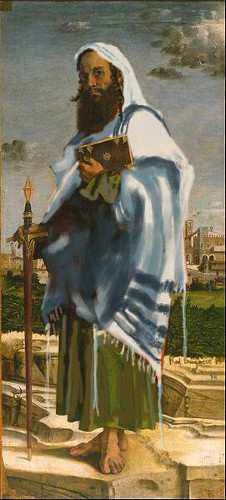
The Jewish PaulYou get a really different opinion of Paul when you take off your Christian blinders (sorry if that sounds a tad harsh).

I did look up Paul at beliefnet.com and they do seem to state that Paul was Jewish, but unfortunately, they take a more or less traditional point of view on what the apostle taught.

They did say that of all the epistles we have recorded in the Apostolic Scriptures, scholars are sure he was actually the author of:

  • 1 Thessalonians
  • Galatians
  • 1 & 2 Corinthians
  • Philippians
  • Philemon
  • Romans

Even limiting my investigation to those letters, I’m still faced with a lot of challenges. Romans alone is worth a book, actually many books, and is so complex I doubt I’d ever do more than scratch the surface of its meaning.

But maybe I don’t have to start from scratch. After all, in the several years I’m maintained this blogspot, I’ve written many times on Paul. Maybe I don’t have to reinvent the wheel. Perhaps all I have to do is read what I’ve already written.

Searching “Paul” on my own blog renders 33 pages of search results but I need to narrow it down more to what Rav Shaul specifically said about the Gentiles.

Actually, only the first two pages contain blog posts specifically with “Paul” in the title. It gets a little more generalized after that.

The added problem is typically, any time I wrote about Paul and the Gentile, it was usually in relation to or contrasting the role of Messianic Jew and Judaicly aware Gentile. I produced very little, if anything, about Gentiles as Gentiles. After all, I’ve been a champion (minor league, of course) of the cause of Messianic Jews to be considered Jewish and operating within a Judaism, just the same as other observant Jews in various other religious Jewish streams.

Only of late have I found it necessary to advocate for the Gentiles, and more specifically, me. Only recently have I realized that while it’s a good thing to emphasize Judaism for the Messianic Jew, it has some serious drawbacks for the so-called “Messianic Gentile,” not the least of which is resulting in some non-Jewish believers losing their identity because they’re surrounded by all things Jewish, including siddurim, kippot, Torah services, and tallit gadolim.

While I still believe that a significant role of the Judaicly aware Gentile as well as the more “standard” Christian is in support of Israel and the Jewish people, just as Paul required of his Gentile disciples in ancient times, I also believe there has to be something more for us to hang onto.

Or to borrow and adapt a hashtag from recent social media outbursts, #GentileLivesMatter (by the way, using Google image search to look up “goy” or “goyishe” returns some pretty anti-Semitic graphics).

multiculturalI did find a blog post I wrote in January 2014 called The Consequences of Gentile Identity in Messiah, but I’m not sure how useful it is in my current quest, in part because I wrote:

I wrote a number of detailed reviews of the Nanos book The Mystery of Romans including this one that described a sort of mutual dependency Paul characterized between the believing Gentiles and believing and non-believing Jews in Rome.

You can go to the original blog post to click on the links I embedded into that paragraph, but if part of who we non-Jews are is mutually dependent on Jews in Messiah, that leaves me pretty much up the creek without a paddle.

Of course, that’s citing Nanos and his classic commentary The Mystery of Romans, which describes a rather particular and even unique social context, so there may be more than one way to be a Judaicly aware Gentile and relate to God.

The problem then is how to take all this “Judaic awareness” and manage to pull a Gentile identity out of it that doesn’t depend on (Messianic) Jewish community. Actually, I would think this would be as much a priority for Messianic Jews as it is for me, especially when, as I’ve said in the past, in order for Messianic Jewish community to survive let alone thrive, Messianic Jewish community must be by and for Jews.

To put it another way quoting Rabbi Kravitz’s lengthy article:

The growth of Christian support for Israel has created an illusion that we have nothing to worry about because “they are our best friends.”

It would be a mistake to think the risk has been minimized, especially to Jewish students and young adults, just because missionaries are less visible on street corners and offer much appreciated Christian support for Israel.

Granted, R. Kravitz must paint the Church in the role of adversary if he believes that Christians are dedicated to missionizing young Jews so that they’ll abandon Jewish identity and convert to Goyishe Christianity, but we non-Jews in Messianic Jewish community are also sometimes cast as a danger in said-community because our very presence requires some “watering down” of Jewish praxis and Jewish interaction.

I suspect the same was true in Paul’s day and ultimately, it was this dissonance that resulted in a rather ugly divorce between ancient Jewish and Gentile disciples of Messiah.

Gentiles resolved the conflict by inventing a new religion: Christianity, and they kicked the Jews out of their own party, so to speak, by refactoring everything Jesus and Paul wrote as anti-Torah, anti-Temple, and anti-Judaism.

That does me no good because I don’t believe all that stuff, that is, I’m not an Evangelical Christian. I need an identity that allows for my current perspective, my pro-centrality of Israel and Torah for the Jews perspective, my King Messiah is the King of Israel and will reign over all the nations from Jerusalem in Messianic Days perspective, and still lets me be me, or the “me” I will be in those days, Hashem be willing.

Think about it.

All Jewish people will live in Israel. It will once again be a totally Jewish nation. As far as I can tell, people from the nations will be able to visit as tourists, but by and large, besides a rare exception or two, we will live in our own countries, which in my case is the United States of America…a United States devoid of Jews, synagogues, tallit gadolim, and all that, because they will only exist among the Jews in Israel.

MessiahI don’t know the answer to this one, but I think this is the central question I’m approaching. How will we Gentiles live in our own nations half a world away from Israel and King Yeshua? What will our relationship be to God?

The answer to how we’ll live in the future is the answer to my current puzzle.

As I ponder what I just wrote, I realize that even searching out Paul’s perspective on the Gentiles is a mistake. He was trying to find a way for Jews and Gentiles to co-exist in Jewish community. He never succeeded as far as I can tell. No one has succeeded since then, including in the modern Messianic Jewish movement.

But in the Messianic future, as such, Jews and Gentiles really won’t be co-existing in Jewish communal space. Jewish communal space will be the nation, the physical nation of Israel. We goys will be living every place else except in Israel. Maybe the Kingdom of Heaven will be more “bilateral” than I previously imagined.

Or have I answered my own question?

Review of Loving God When You Don’t Love the Church, Part Three

Snakebites are common to humanity. Jesus said, “Offences come” (Matthew 18:7 KJV). Offenses do come! The tragic thing is that they often come through the people with whom we are closest.

Pastor Chris Jackson
from Chapter 6: Snakebites
Loving God When You Don’t Love the Church: Opening the Door to Healing (Kindle Edition)

Continued from Part Two of this review as well as a brief commentary on Hebrews 10:23-25.

Pastor Jackson leverages Paul’s misadventure with a viper (see Acts 28:1-10) metaphorically to describe the injuries some people receive from others within Christian community. He also renders an interesting interpretation of the serpent in Gan Eden (Garden of Eden).

Of course those closest to us have the greatest capacity to create the deepest wounds (although Adam and Eve’s serpent and Paul’s viper weren’t all that close to them relationally). In this, I suppose my unfortunate set of final transactions with the Pastor at the church I used to attend applies since we had become friends over our two-year association. We haven’t spoken or exchanged so much as an email since that time and I doubt we ever will.

Interestingly enough, Pastor Jackson unwittingly gives a hint to one of the reasons:

In it, Peter quoted the Lord, saying “I lay in Zion a choice stone…a stone of stumbling and offense…” That doesn’t sound right does it? God lays a rock of offense in the middle of His Church?

-ibid

Jackson clearly equates Zion with the Church, but Zion isn’t the Christian Church, it’s Israel, the Jewish people. Even for Christians who say they are opposed to supersessionism or what is also called replacement or fulfillment theology, once you say “the Church” was born in Acts 2 and that it’s the Church that, from that point forward, has all of God’s attention and not Israel, at the very least, you have diminished the power of God’s promises to Israel and elevated the (Gentile) Christian Church, to which God made no promises at all.

No, it’s not to say that God does not have a redemptive plan for the Gentile members of the ekklesia of Messiah, He just doesn’t have plans for this thing we’ve come to know as “the Church”.

That’s my stumbling block.

I’m convinced that the number-one cause of spiritual death among Christians is not outright demonic attacks, but snakebites.

-ibid

I’m convinced that a lot of Christians attribute way too much trouble in their lives to evil supernatural forces and not enough to their own human natures. I think Jackson agrees with me here, but the whole concept of “demonic attacks” bothers me as even a potential causal element in our lives. People are all too well equipped to hurt each other. We don’t need outside help.

Do you know anyone who was bitten and then walked away from the faith?

walkingSure. We probably all do if we’re willing to admit it. I recall a conversation I once had with my former Pastor. As a younger man, he knew a Pastor in another country, a truly Godly man, or so he thought. Later in life, this man left his wife and took up with a younger woman. Pastor is a Calvinist and believes God pre-selected certain people for salvation. Since one discovers these people by their “fruits,” Pastor was convinced, based on this fellow’s lifetime history for the most part, that he was “chosen”. Pastor was baffled at the sudden and complete turn around and didn’t really know how to explain it.

My opinions on Calvinism aside, I’m a firm believer in free will. God is open and available to all human beings but He won’t hold a gun to our heads (so to speak). Although He empowers us to accept the offer to come to Him, we still have the power to refuse it or even once accepting, later refusing it.

For if, after they have escaped the defilements of the world by the knowledge of the Lord and Savior Jesus Christ, they are again entangled in them and are overcome, the last state has become worse for them than the first.

2 Peter 2:20 (NASB)

I suppose all this answers Jackson’s question above. Coming to God is our choice, but ultimately, so is leaving Him.

Satan’s snakebites usually come from other people.

-Jackson, ibid

See my comment above about Christian attribution habits.

Shifting to Chapter 7: Tattooed: A Tale of Two Piercings:

There’s another form of tattooing in effect, though, that we can’t see with the naked eye. Oh, we can certainly see it–we can discern it–but it’s more of an internal tattoo. It’s a tattoo of the soul.

This is another metaphor of Jackson’s for our wounds or “the state of our soul.”

Next, Jackson spends a lot of time comparing “brokenness” and “woundedness”:

This is such an important question because Christlike brokenness can be used by God to powerfully catapult us along the path of our destinies, while woundedness will derail us before we ever begin.

Broken AngelHe explains that there is no brokenness without wounding but you can be wounded without allowing yourself to experience “Christlike brokenness.” Brokenness allows a person to submit himself to God, while being wounded but unbroken is all about focusing on the pain and not the healer.

A broken man embraces correction. A wounded man fears correction.

How many of the Proverbs wisely advises accepting correction and discipline?

I’m actually intimidated by the question because I don’t like the answer I find in myself. One way to interpret all this is to submit to God by submitting to the Church. I know the Pastor at the church I used to attend probably believes that I need correction in the sense that I need to accept his doctrine over my current viewpoints.

But could I have handled all this any differently and would the outcome have resulted in something more positive coming out of my church experience?

There are four end of chapter questions and I think only the last one is relevant.

Are you committed to moving from woundedness to brokenness so that the beauty of the Lord can shine through you?

Jackson continues this theme in Chapter 8: It’s Hard To Be Beautiful:

Likewise, it takes time and focused effort for us to move from a wounded state to a broken one.

Assuming this speaks to me at any level, I guess there’s hope if I find that I’m currently wounded but unbroken.

And then he said:

As I meditated on those words, I felt the Lord speak to my heart.

I won’t quote what Jackson said the Lord said, but not being a mystic, I have a hard time believing that this Pastor heard, word for word, exactly what he wrote in his book. It’s another one of those things about certain Christian circles that don’t make a connection. On the other hand, some of the tales of the Chasidim are truly fantastic.

Quoting Psalm 23:3, Jackson says the Lord restores the soul, but practically in the same breath, he states:

…some people carry the sting of divorce, bereavement, betrayal and rejection for a lifetime without ever experiencing lasting freedom.

True. Also…

…the more we love the offender, the deeper the hurt we experience.

life under repairWhich is why some divorced couples can still have awful encounters with each other, even years after parting.

Which leads to…

…some wounds will go away over time, but others require outside assistance to be healed.

Also, true. Some wounds will heal with the simple application of a band-aid while others need stitches to stop the bleeding. Sometimes a computer just needs to be reboot, and on other occasions, it’s time to bring out the repair tools and open the machine’s cover.

We must repent. We must choose to forgive. We must process the hurt.

Very true. Especially the last part since I do an awful lot of processing here.

“I’ve seen enough in the church to make me an infidel,” the man said, “but I still have a made-up mind and determination to see what lies at the end of a successful Christian race!”

Which goes back to what I said before about free will. We can have a bad time in church and we can experience circumstances, something like the readers of the Holy Epistle to the Hebrews, that prevent us from having fellowship as they were prevented from the prayers and offering korban at the Temple.

While my circumstances can’t be presupposed in Jackson’s narrative, he mentions another chronic situation encapsulated in the title of a sermon: “The Crisis of Spiritual Fatigue.”

I read a blog post just the other day about fatigue, being worn out, and needing a break.

Jackson says “one of the first things to go in our spiritual lives is the awe and wonder of simply knowing Jesus and being who He’s called us to be.”

I remember when I first became a believer, I was thrilled just to be able to read the Bible and go to church. It was all bright and shiny and new, like I had found an amazing treasure. I couldn’t wait to read more of the Bible, go to Sunday school, and learn more about Jesus and the “new man” I was in him.

I suppose it was the same way when I transitioned into the Hebrew Roots movement. All the “Jewish stuff” was bright and shiny and new, and I loved putting on a tallit and kippah and (very, very badly) saying the prayers from the little beginner’s siddur we used to use.

But like that new car smell eventually fades, so does the newness of faith. We have to put away all of the “stuff” and come to an understanding of God (or with God) on our own terms.

There is a difference between a life of faith and a life of community. Sure, they’re supposed to overlap significantly, but if you were stranded on the proverbial desert island, all alone with just a Bible, would you eventually lose faith because you had lost community, or would you gain faith by continually being alone with God without pesky humans there to get in the way?

keyboardInterestingly enough, on his blog, Pastor Jackson recently wrote about “holding patterns.” While he was addressing a person’s relationship with God being put on hold, I could equally apply his words to the relationship between an individual and religious community. Of these “holding patterns,” Jackson says in part:

They break us…or they make us. And just as our favorite Bible heroes taught us, how a person handles their holding patterns determines whether or not they’ll land in safety.

I’m like that man on the proverbial desert island except I have Internet access and a refrigerator. I’m not really alone, but if God does intend for me to be in community, then I guess I’ll have to wait for it, or make it myself through virtual means.

I’ll continue my review soon.

Review of Loving God When You Don’t Love the Church, Part Two

Why is it that people who have been wounded in church will still be talking about their wounds years later? Why can people forgive a betraying friend or experience a business meltdown and move on with their life, but if it is a church that fails them, it is nearly impossible to let it go? Have you ever seen this dynamic in others? Have you ever lived it yourself?

-Pastor Chris Jackson
from Chapter 3: Church Wounds
Loving God When You Don’t Love the Church: Opening the Door to Healing (Kindle Edition)

Reviewing Pastor Jackson’s book (Here’s the link to Part One) is my way of attempting to respond to what I am calling a pesky challenge to find fellowship and community (or something) with like-minded believers. I’m not sure such a thing is possible for reasons I outlined yesterday, but since a friend asked me to consider it, I suppose I should.

A couple of days ago, Derek Leman wrote the blog post Gentiles Who Feel Left Out which sort of addresses my current situation but not really.

But first things first. To answer Pastor Jackson’s question, a great many Christians who have left the Church and affiliated with Messianic Judaism and/or the Hebrew Roots movements have lived out the dynamic he describes above. And seemingly in response, Leman wrote in the aforementioned blog post:

I also say to disenfranchised non-Jews not to give up on churches. Many have not tried really looking. Some came from churches with certain labels and assume they can only return to those places. Be more open minded. There are churches, often outside of evangelicalism, whose clergy are better educated (evangelicalism is heir to revivalist Christianity and tends to squash intellectual growth).

That may well be true for some Christians and some churches. After all, I’ve read that First Fruits of Zion‘s (FFOZ) HaYesod and Torah Club materials are being taught in churches. I’ve heard that episodes of FFOZ’s television program A Promise of What is to Come are viewed and then discussed in Sunday School classes in some churches. So it’s apparent that there are some Christian churches that are open to this perspective and to “Messianic Gentile” worshipers.

But I’m reviewing Pastor Jackson’s book through the lens of my own experience, so finding “the right church” and fitting in isn’t the entire solution. In fact, it really isn’t a solution at all.

I feel like I’m participating in Pastor Jackson’s statement of talking about my “hurt” months and even years later, but again, I’m only revisiting all this because I was asked. Also, everything has been resolved between me and the church I used to attend to the extent possible. That doesn’t mean there’s going to be reconciliation and return and, relative to my home life, even if I did return, it wouldn’t be helpful.

unworthyPastor Jackson, answering his own question, says “We don’t expect to get hurt in church.” That’s true. At least in an ideal sense, we expect “church” to be a safe place, maybe the safest of places, given how many Christians see secular society as unfriendly or even dangerous to religious people.

I only perceive church as “hazardous” to the degree that, at least in my own recent experience, what I believe is incompatible with how they define “sound doctrine.” Granted, it was only one church, but I do live in a pretty conservative part of the country and religious views in many local churches are also “fundamental”.

Pastor Jackson says one of the problems is that those hurt in churches are never heard. That is, they never get the opportunity to express their side of the story. That’s not the case with me. I had abundant opportunities to be heard by the Head Pastor and he listened to me at length. Jackson asked how there can be healing without closure. I have closure. I made a very definite decision on what to do in leaving church and why I was doing it. The door is closed. It’s over.

The end of chapter questions have to do with being accepting of differences, carrying around anger, and coming to the realization that some of your hurts may be your own doing.

I don’t think I understand the last question:

Do you know that God believes you can make it?

I’m not sure if Jackson means “make it” in life or “make it” in church.

In Chapter 4: The Other Life, Jackson makes an interesting statement:

Religion has left me parched and dry and wondering if it was really what God intended for me when He drew me into the other life.

By “other life,” Jackson means a life of faith and a personal journey with Christ. I find myself closer to God when I’m reading and studying the Bible (or writing this blog), so my “other life” is lived, for the most part, outside of any immediate fellowship. Although I don’t observe a proper Shabbat, I’m usually able to carve out a few hours to study the weekly Torah portion which often is the most rewarding part of my day and week. It’s the closest I come to the “other life”.

I read this next statement of Jackson’s and realized we conceptualize prayer in different ways:

A few weeks ago, I felt like the Lord spoke to me in one of my morning prayer times. I was journaling my thoughts to the Lord and then recording what I felt He was speaking to me in response.

Is that normal? Oh, I get the part about writing my thoughts down. I do that all the time. But writing down what I imagine God is saying back to me? Isn’t that substituting my personality for God?

prayerI’ve never heard audible voices from Heaven but on those occasions when I thought God was trying to tell me something, it was usually through an unusual set of circumstances. That’s what led me to attend that little Baptist church a few miles from my house for two years. I won’t go into the story, but an unlikely set of events occurred that led me to call the Pastor of that church, set up a meeting, and then decide to go to Sunday services. It was so unusual, I just couldn’t chalk it up to coincidence. I felt as if God wanted me to go to that church as a sort of Tent of David experience.

Either I was wrong and God didn’t want me to go to that church or God did want me to go and I blew it. But I’ll never know which one it was.

The Chapter 4 end of chapter questions address hearing the “other life” speaking to you and what it said, whether or not religious life stifled or accentuated that voice, and taking the road less traveled. Nothing that really connected to my experience.

In Chapter 5: Troubled Waters, Jackson says:

A great feeling of personal satisfaction ensures when we are fulfilling the commands of God.

Jackson surely doesn’t realize what a loaded statement that is in Messianic and Hebrew Roots circles when applied to a Christian. He did connect that to “serving our fellow man” which I felt was encouraging, because much of the Biblical message has to do with loving God by serving people. Tikkun Olam or “repairing the world” after all is the Jewish mission and the Church has inherited some of that whether they realize it or not.

Jackson was raised in a Christian home and has fond memories of church:

I know it helped me. I can’t imagine what my life would be like or what temptations I might have fallen into had I not been raised in a Christian home. Church has always been the backdrop of my earliest memories.

I periodically encounter a “life long Christian,” someone who came to faith early in life and who was raised in a Christian home. When I tell them I didn’t come to faith until I was about 40 years old or so, they are almost always astonished. From their point of view, it is inconceivable that someone could live the first half of their life as a “sinner” and then come to faith. It’s funny that Yeshua and Paul never seemed to have an age limit on repentance.

One of my earliest memories was of my parents being water baptized in a swimming pool.

Just thought I’d toss that quote in there.

Jackson includes a number of other pleasant childhood memories about church involvement. He calls it “a flowing current of life that overwhelms us.”

But a few pages later he says:

It’s happening every day, you know. People are leaving the church by the thousands. They’ve tasted what church has to offer and, still dissatisfied, they are abandoning organized Christianity in droves.

quitting churchJackson attributes this mass exodus away from local churches to people being mistreated, misunderstood, or just plain bored. He wisely states:

They’re not searching for a different gospel or a different God–they just want more of Him.

“Get to know Jesus better.” That phrase was used to promote the Torah Club a few years back. I think Jackson is right. I think a lot of Christians are reading the Bible for themselves and realizing that the Bible doesn’t say what they’ve been taught it says from the pulpit or in Sunday School.

In that sense, people may not all be leaving church because they’re hurt but because they’re “hungry”. Jackson says, “Jesus didn’t come to earth to institute a religion–He came to reveal God.” True. Jesus didn’t invent Christianity, he practiced a normative Judaism of his day, specifically Pharisaism (I know a lot of Christians who would be really upset at that statement). The invention of Christianity only came later, much later.

Jesus did come as Prophet and Messiah to reveal God, first to the Jews but ultimately, to the rest of the world.

Jackson doesn’t want that message to be contingent upon what the local church does or fails to do. But he also says:

God created us to be part of a community, and from the beginning He determined that it wasn’t good for man to be alone. We need the Church!

Well, that “not good for man to be alone” addressed Adam and having a suitable “helpmate”, not religious community as such. Also, I believe in Messianic Days the Church as most Christians conceptualize it, will cease to exist and be replaced by Messiah’s ekklesia (which does not translate into “Church” in English). Messiah will define the correct sort of community/communities for his Jewish and Gentile subjects.

At the end of this chapter, Jackson asked four questions, but only the last is relevant:

Do you think this is what Jesus wanted?

If he means the Church as it exists today, I’d have to say “yes and no”. I think he wanted communities of disciples who would obey his commandments to love God and to love others, doing good, feeding the hungry, giving hope to the hopeless, visiting the lonely, making peace in the home, which many churches do, but there’s a lot that has happened in the history of the Church he definitely didn’t and doesn’t want.

He absolutely didn’t want all of the crimes Christianity has committed against the Jewish people and Judaism. How could he? The Bible speaks of the Messiah coming (returning) to defeat Israel’s enemies and to judge those who have harmed his beloved Jewish people. Imagine Jesus judging all of the resurrected Christians across the ages who were taught to hate the Jews, who were taught that the Jews killed Jesus, who participated in burning volumes of Talmud, burning Torah scrolls, burning down synagogues, who tortured, maimed, and murdered countless Jewish people whose only crime was to faithfully cleave to the God of their fathers, and who died in pain while singing the Shema.

No, that isn’t want Jesus wanted, and in the resurrection, there are going to be a lot of shocked and dismayed Christians.

MessiahI realize this wasn’t what Pastor Jackson meant but his focus and mine are different. He’s talking to Christians who have been hurt by other Christians and who have chosen to respond by leaving community. But when you ask me what Jesus wanted out of “the Church,” I have an entirely different viewpoint.

At the end of Chapter 5, I’m still not finding much of what Jackson is writing that speaks to my own experience. If anything, as good a guy as I think Jackson is, what he has recorded in his book simply emphasizes for me how differently he and I understand God, Messiah, and the Bible.

I’ll continue my review in a few days.

The Return of the Pesky Challenge

Every other Sunday, a friend of mine and I have coffee together and talk about whatever. Some of what we discuss is religion (his beliefs are close but not exactly the same as mine), but we talk about everything else under the sun, too. So, as he reminded me, we can’t strictly define our conversations as “fellowship” in the Christian (or Messianic) sense.

And that concerns him.

Many of you know that after a two-year experiment in attending a local church, I found it necessary to leave church again. For sometime now, I’ve pondered joining some sort of virtual religious community via the Internet, but I know that virtual relationships can’t take the place of face-to-face connection and communication with human beings. It’s just not fellowship in the truly realized sense of a community of faith.

A few weeks ago, out of the blue, my wife (who is Jewish, not Messianic, and who does have community) asked if I missed having a congregation to go to (and I am pleased that she seems to be making attending services at Chabad on Shabbat a regular thing). I have no idea what brought that comment up, but I played it off like it wasn’t an issue. Most of the time it’s not, at least consciously, and I relegate the idea to some dark closet in the back of my mind. But then Sunday before last, my friend challenged me over coffee.

He really, really thinks I should be in religious community. He isn’t the only one. I receive emails occasionally from people who believe I should not set aside fellowship indefinitely. In principle, I agree, but as a matter of practicality, I have nowhere to turn for two basic reasons:

  1. I have no idea how to go “church shopping” and the very idea of randomly visiting churches in my area hoping to get lucky and find a theological match is not even slightly attractive.
  2. The effect of my going to church has on my wife.

infinite_pathsI sometimes receive what I feel are mixed signals from her. I know that she believes I should be in community too, but she’s already embarrassed by having a Christian husband, and my being in Christian community only makes it worse. I used to struggle within myself every Sunday morning as I got ready to leave for church while she was staying at home and being uncomfortable with the thought of my going (not that she’d say anything about it, of course).

And the one time I went to Easter services just about crushed her. I could see it on her face, in her eyes, as I walked out the door. I guess it would do that to any Jewish wife of a Christian husband.

I’m not doing that to her again.

Which led me to download a book (it was a special deal from Amazon so I got it for free) called Loving God When You Don’t Love The Church by Chris Jackson. Jackson is a Pastor who uses his book as a forum to talk about how damaging church experience can be to some people (including him), and damaging to the degree that people don’t (necessarily) leave the faith, but they do leave their churches in droves.

I can relate.

But I don’t relate to most of the reasons these people are leaving. I wasn’t kicked out, scorned, called a “sinner” or “demonic” or anything like that. The Pastor, who I had become friends with and who knew exactly what my doctrinal position on the Bible was (and is), directly contradicted everything I believe and called a Messianic faith a “misuse of the Law“.

He had to have known how I’d feel listening to his sermon.

(I should note at this point that I have no ill feelings for the Pastor, leadership, or members of the church I used to attend. I met many genuinely kind and caring people, all of whom were serving God and other people in their walk of faith with Christ. But in the end, I was an elephant in a roomful of gazelles. I was never going to fit in.)

I’m only about a quarter of the way through Pastor Jackson’s book, but it’s an easy read. At the end of each chapter there are study questions, so I guess the book can be used in small groups of people who have all felt alienated by their local churches (or “the Church” with a big “C”).

I guess I’m looking to see how others have responded to this situation and I’m finding that (of course) I’m not a typical Christian. It’s not just a matter of being burned by some snobby clique at one local church (although that also happened to me back when I first came to faith). If that were the case, I could just go to another church, since the theological dissonance between me and other Christians would be slight (if it existed at all since I’d be blissfully ignorant of everything I know now).

But standing on the foundation of the Jewish Bible and declaring myself a Messianic Gentile (in two parts), means that my theology and doctrine differs significantly from the vast majority of people you’ll find in most churches on any Sunday morning.

chris jackson
Pastor Chris Jackson

However, for lack of any other course of action for the reasons I specified above, I’m going to work my way through Pastor Jackson’s book and see if there’s anything he presents that I can somehow adapt. Jackson seems sincere, reasonably transparent, friendly, and approachable. But knowing myself as I do and getting a sense of who he is in his writing and on his blog, I suspect he’d drop me like a hot rock if we ever entered into conversation and I told him exactly what I believe about the New Covenant, the Bible in general, God’s promises to Israel, and the specific sort of “connectedness” we Gentiles have to all that through Messiah (Christ).

I suppose it’s not a coincidence that Derek Leman recently wrote a blog post called How to Read the Bible if You’re Not Jewish, highlighting the focus of scripture on national Israel and the Jewish people and not so much the rest of the world (that is, the goyim).

The uncomfortable truth of the Bible in general and my faith in particular is that I continue to find myself where I left off at the end of this missive. Both church and synagogue (and I would be fine with Jewish community if it could be with my wife) of any variety are out-of-bounds for me and as concerned as some people are for me because of that, I simply see no viable option.

I’m sorry to keep revisiting old ground. It’s not like I’m the only person without community. Both Gentiles and Jews find themselves in this situation as part of the consequence of being Messianic. I’ll keep reading Pastor Jackson’s book and post my thoughts about it here in the coming days, but this is as much in God’s hands as it is mine. I’m still trying to decide of He’s painting me into a corner or if I’m the one doing it.

Here’s the link to Part One of my book review.

Who Am I and Why Am I Here?

Indeed, surveys show that actual converts to Judaism are far outnumbered by Americans born outside the faith who consider themselves Jewish despite having never formally converted to Judaism. However, even in the most liberal Jewish communities, there is a dividing line that excludes non-Jews. Practically no synagogues allow non-Jews to be called to the Torah (unless they are accompanying a Jewish spouse at their kid’s bar mitzvah). Jews married to non-Jews are barred from admission to rabbinical school. And, of course, non-Jews can’t marry Jews under Conservative or Orthodox auspices.

Most importantly, you can call yourself whatever you want – friend of, member of, parent of. But unless you formally join, you’re no Jew.

-from the article “10 Questions About Jewish Conversions You Want to Know but are Afraid to Ask”
VirtualJerusalem.com

Don’t worry. I’m not considering converting. However, I saw a link to this article on Facebook and was interested about which ten questions one might be afraid to ask.

In my two most recent “meditations,” Are Christians Idol Worshipers and Doing It Right, the conversations kept returning to what Derek Leman might call “the intersection of Judaism and Christianity, Jesus and Torah, temple and atonement.”

But while many or most traditional Christians don’t see much of an intersection between their faith and Judaism, those of us involved, at some level in Messianic Judaism find it unavoidable. In a comment to Gene on Doing It Right, I said in part:

From my point of view (and I could be wrong, of course), you have a ready-made world, a Jewish community, to which you belong and in which roles, identity, and expectations are all clearly defined. It would seem to me that all you have to do is step inside of that community, close the door, and never look back.

I, on the other hand, picture myself fighting my way through the Bible tooth and nail, clawing my way through the collision (Derek calls it an intersection) between the Jewish and Christian aspects of my faith, feeling like the inside of a sandwich being squeezed by two opposing slices of bread.

I could make up a story or a series of stories about the Jews and Gentiles who left Messianic Judaism and entered a more mainstream Judaism or entered (re-entered) the Church.

disconnectedI could say that the dissonance (remember, I’m making all this up) experienced living in-between various elements of Jewish and Christian faith are very “crazy making” and that in order to reduce or even eliminate the inherit discomfort of being identified as “Messianic,” these individuals chose to escape into a more internally consistent or at least more readily acceptable religious identity.

I’ve heard stories of more than a few non-Jews in Messianic Judaism who (in my opinion) became confused about what to prioritize in a life of faith and mistook function for devotion by converting to Orthodox Judaism. It’s not being Jewish that makes one acceptable to God, since even the Orthodox readily admit that Gentile conversion isn’t the only way, or even the primary way, a Goy may merit life in the world to come and be considered righteous. It’s living a life that is Holy to God by transforming our lives from being focused on ourselves to being focused on service to others and service to God (think Matthew 22:36-40).

Of course, that’s not the only path leading out of Messianic Judaism. For Jews, there’s going to/returning to a more normative Judaism such as Orthodox Judaism, and for the Gentile, there’s going to/returning to normative Christianity. Those groups disagree with each other, but the world generally accepts them as valid religious expressions.

But the world, including the religious world, doesn’t always know what to do with Messianic Judaism. While many of the Jewish people within the movement strive greatly to live authentically Jewish lives, in some cases, indistinguishable from Jews in Reform, Conservative, and even Orthodox Judaism, the really big question (and I’ve brought this up before) is what to do with all the Goyim in Messianic Jewish community space.

Actually, there are two other escape paths, particularly for the Gentile, I haven’t mentioned. Leaving the world of faith entirely and becoming an atheist, and continuing to adhere to faith but leaving all forms of religious community and considering all such community as non-sustainable.

I rarely quote from Christian articles and blogs, but the other day, I did find something written by A.W. Tozer called The Saint Must Walk Alone.

The idea, based on a number of Biblical precedences, is that the person of faith by definition is isolated from the larger culture. Tozer cited a number of the Prophets including Noah, Abraham, and Moses, but while it’s true that, in the end, Noah only had his family as his form of community, and Abraham had to gather people around him in order to construct community, Moses, though effectively isolated from the community of God for the first forty years of his life, found a ready-made body of millions of Israelites once God commanded him to rescue His people Israel.

In the Apostolic Scriptures. Jesus (Yeshua) called apostles and disciples to himself, and after the crucifixion, resurrection, and ascension, the apostles and disciples, made many more disciples, both Jewish and Gentile, across the latter part of the First Century CE and beyond.

I’ve said before that people gravitate to groups made up of “their own kind”, that is, others who are like themselves. That’s why in older cities in our nation, you have neighborhoods defined by nationality and ethnicity. Visit New York, Chicago, or San Francisco to see what I mean.

And I believe the same is true of religious people. We all want to hang out with people like us, so we don’t get thrown too many theological curve balls. The secular world is a hard place to live in, so it’s comforting to know you have a place to retreat once in a while where you can truly be yourself and be understood without being judged or maligned (ironically, sort of like being a recovering alcoholic at an AA meeting).

Tozer writes:

The pain of loneliness arises from the constitution of our nature. God made us for each other. The desire for human companionship is completely natural and right. The loneliness of the Christian results from his walk with God in an ungodly world, a walk that must often take him away from the fellowship of good Christians as well as from that of the unregenerate world. His God-given instincts cry out for companionship with others of his kind, others who can understand his longings, his aspirations, his absorption in the love of Christ; and because within his circle of friends there are so few who share inner experiences, he is forced to walk alone. The unsatisfied longings of the prophets for human understanding caused them to cry out in their complaint, and even our Lord Himself suffered in the same way.

A.W. Tozer
A.W. Tozer

Of course, Tozer’s “Saint” is only lonely away from the authentic community of the Church, and while he says that there may be few who have great devotion to Christ in the body of believers, he hasn’t taken into consideration the fact that there could be “Saints” who have no access to fellowship, and any such like-minded communities nearby could be too internally conflicted and even unstable to be viable options.

Ultimately, the person of faith may be isolated and alone not only from society but from other religious people, even those who fundamentally conceptualize their theology in similar way.

The problem for many of these “Messianic Gentiles,” is not that they/we are attracted to God, but we’re attracted to a particular exegetical system that allows us to read the entire Bible (Tanakh and Apostolic Scriptures) as a unified Jewish document that upholds the primacy of national Israel and the Gospel message as one of national and even worldwide redemption rather than a truncated plan addressing salvation on an individual-by-individual basis.

By definition, we find Judaism more attractive than Christianity (I speak of institutions, traditions, and lifestyles here). However, as the VirtualJerusalem.com article I quoted from states, “you can call yourself whatever you want – friend of, member of, parent of. But unless you formally join, you’re no Jew.”

Not that I would try to be, but many others like me can’t separate their identities from Jewish (quasi-Jewish really) identities. In the end, we either find others who accept us as we are in religious community, we change our identity by conversion to find acceptance, we retreat into the Church (abandoning Messianic theology) to find acceptance, or we just retreat and call an end to seeking acceptance and community. In the latter case, acceptance comes from secular community. We’ve thrown our net very wide and through the wide gate, everyone can travel together.

Tozer concludes:

The weakness of so many modern Christians is that they feel too much at home in the world. In their effort to achieve restful “adjustment” to unregenerate society they have lost their pilgrim character and become an essential part of the very moral order against which they are sent to protest. The world recognizes them and accepts them for what they are. And this is the saddest thing that can be said about them. They are not lonely, but neither are they saints.

Earlier in his article, Tozer admits that those Christians who say they are never alone because Jesus is always with them, echo a rather hollow message. Remember, he also said man was made for community, and the people of God are made for community with their fellows.

But in the end, all we really have is God. No religious community is perfect, and some of them are downright toxic. There are who knows how many wounded souls who have sought fellowship, but once burned are thereafter “twice shy.”

I’ve been pleased with how discussions have gone on in my two previous blog posts, especially given the rather controversial nature of the topics at hand. After all is said and done, we “odd balls,” many of whom are like me and simply are not made to be in community, or who otherwise have no acceptable peer group at hand, in addition to God, have the Internet. This is the only place we can find each other, through our communication is merely so much binary and electrical chatter across fiber, copper, and wifi.

Since I’ve pulled back from writing so much, I can feel my intellectual and emotional attachment to the “Messianic blogosphere” wane correspondingly. I don’t scour the web looking at other blogs the way I used to. I don’t view each article and quote at Aish.com or Chabad.org as inspiration for yet another “morning meditation.” I no longer even peek out of my home office on Friday evenings to see if my wife is about to light the Shabbos candles. They either are lit or not as she wills.

purim
Purim Parade in Hebron

Right now (Sunday afternoon), she’s at the Chabad helping to prepare for the upcoming Purim celebration. I couldn’t be more pleased. That’s where she belongs, in Jewish community because that’s who she is. Given the enormous barriers she’s had to cross, I’m glad she’s found her way home. Her experience has taught me that my having community doesn’t seem to be part of the reason I exist. If my marriage to a Jewish woman has previously inhibited her from a Jewish life, maybe our union also helps to reveal my purpose in supporting and encouraging her pursuit of that Jewish life.

I believe for the Messianic Gentile, that’s why we are here, not to promote ourselves but to support Jews, both in Messiah and otherwise, to return to devotion to Torah, devotion to Jewish community, and devotion to Hashem.

As a “Messianic Gentile,” if that’s who I am and why I’m here, it’s enough.

Doing It Right

My family lives in Greenwood, Mississippi. Nestled in the heart of the Delta, we are proud of our small-but-vibrant shul; even when only a dozen or so folks fill the pews, time spent in our building is meaningful. However, recently we saw our sanctuary overflowing with guests for the first time in years—and we were honored to host an event that led to powerful connections and conversations with our Delta neighbors.

-Gail Goldberg
“Christians and Jews Sharing Shabbat in the Delta”
MyJewishLearning.com

Derek Leman on this blog Messianic Jewish Musings, refers to himself as:

…a rabbi, writer, and speaker at the intersection of Judaism and Christianity, Jesus and Torah, temple and atonement.

That last part about being at an intersection probably describes any Jew or Gentile who is involved in the Messianic movement in any sense, for we hold views and convictions that aren’t exactly typical in more normative Judaism or Christianity. In fact, we end up getting into plenty of arguments with just about everyone because we don’t fit into anyone’s convenient religious mold.

But Gail Goldberg’s article attracted my attention because it shows a portrait of Jews and Christians “doing it right,” of laying aside the ancient apprehension and animosity and for one brief evening, sharing the Shabbat in a synagogue in peace.

People came from all over to hear her speak; Christians were challenged and enriched by her teachings on Christianity, and Jewish attendees were similarly riveted by her approach to scholarship and religious studies transcending both religions. Though the program took place in a synagogue, AJ knew her audience was primarily Christian. She addressed all equally, and encouraged all to be open to challenge and new notions. As local bookstore employee and program partner Steve Iwanski noted in his wonderful blog following AJ’s presentation: “…she sought to bring light to the parts of Jewish faith that may be unfamiliar to the typical Christian.

beth immanuel
Beth Immanuel Sabbath Fellowship

This isn’t describing a Messianic anything. These are Jews and Christians outside our little movement who nevertheless, found a bridge by which they could cross a two-thousand year old gap and find some common ground. There could be a majority of Christians amid Jewish community and no one felt threatened.

Ms. Goldberg’s article finishes with:

That night, I felt the pride of our ancestors – Ilse (Ilse Goldberg, Gail Goldberg’s 86-year-old mother-in-law) in the room, and others no longer with us. If they could have seen the full pews and felt the support and investment of our neighbors, I know how proud the previous generations of the congregation would be. I’m just honored that I could be part of such a wonderful communal experience, and grateful to see our shul stuffed to the gills with long-time supporters and first-time visitors. I hope to see our friends and neighbors joining us in fellowship many more times in the future.

The Messianic Jewish movement purports to share a common Messiah and a common God between Jewish and non-Jewish disciples of the Master, and yet we see a lot of friction and many separate ways of attempting to operationalize our “union”. Some Jews who aren’t Messianic like my friend Gene, find it necessary to point out the rather stark differences between Messianic Judaism/Christianity and Orthodox Judaism, which, whether he means to or not, continues to drive a wedge between Jew and Christian.

But as we’ve seen in the quotes above, it doesn’t have to be that way.

But this isn’t the only example:

We moved to the Czech Republic eight years ago to serve God and our new community and I had expectations of what life would be like. When I stand in the synagogue now on Friday nights, looking out at our growing group of spiritual sojourners singing and praying in Hebrew, Czech, and English, I am taken aback by what God has done. He has demolished my expectations and from the rubble built something worthy, something glorious.

My husband and I had just started being observant. We started slowly, first lighting candles on Shabbat, then observing festivals. He began to wear his kippah, I would cover my head during prayer. I started learning Hebrew and to sing the prayers in my new siddur. Each tentative step brought me closer to my heritage and closer to the way I found to truly express my love for God. As we strolled one day through the medieval alleyways of Cesky Krumlov, we stumbled upon a synagogue, hidden away off the beaten path. It was just finished being reconstructed and I felt a leap from within me. “Wouldn’t it be amazing if we could sometime light the Shabbat candles here at the synagogue?”, I whispered in my heart and ever so quietly to my husband. It was as if saying the words too loudly would damage them extinguishing the hope that had been lit..

Derek Leman
Derek Leman

This was written by Krista, one of Derek’s students, for his blog post A Synagogue in the Czech Republic. You can click on the link to get the whole story, but here’s what I want to show you:

Ours is an inter-faith group. All are welcome. “Isms” are left at the door. Though the service is conservative and very traditional, there is an atmosphere of family here, humanity seeking the Creator and learning how to worship together. Many who come are Christian, Baha’i, Hindu, Jewish and agnostic. We save the discussions for the café which used to be the Rabbi’s house. Ruth remembers it as it was when her dear Rabbi lived there. Now we sing and pray and talk about deep topics there over tea and cake. I invite those who might want to delve deeper to our house for once a week gatherings, Mussar and Bible Studies. As a Messianic Jew, I share my thoughts and beliefs about Messiah during these group times at our home.

I’m not saying every synagogue, Messianic or otherwise, has to be this way, but here we have two examples where in Jewish religious and community space, not everyone was Jewish and in the latter case, there was acceptance of a Messianic Jew as a Jew by non-Messianic Jews and by many other faith traditions including Christianity.

Krista also wrote:

This burgeoning community is in need. We have just filled out the paperwork to be recognized as a Jewish Community by the Ministry of the Interior.

Unfortunately, it was suggested that this Czech synagogue was pulling a “bait-and-switch” since Krista describes it as an interfaith community, but in his response to that comment, Derek said that:

Gene is wondering if a bait and switch is going on in Cesky Krumlov and I answered that: no. The people there are happy with an interfaith community and there is nothing deceptive about it.

Derek also said to Gene (sorry to keep bringing you up Gene, but I can’t avoid it in this context):

Your idea that Jews don’t like Christians or that Jews want to keep Jesus away with a ten foot pole, just isn’t true. Maybe your journey away from Jesus into Orthodox Judaism colors your perception. Most Jews are open to all sorts of things, including Bahai and Buddhism. People who insist on sharp borderlines do not represent most people in the world who take joy in learning from many streams of religion, philosophy, arts, politics, etc. If you were to approach these people and say, “This is bad, you shouldn’t do it,” I think they’d ask who the heck you think you are. Now having said that, the services in the synagogue are simply Jewish prayers and songs. The groups that meet at other times are not in the synagogue. It is called Interfaith. Some people like it. You might not be one of them.

I found that statement slightly ironic given that within Messianic Judaism, there are voices who advocate for a sharp division between Gentiles and Jews, and at times I’ve been one of those voices.

sky bridgeBut there’s got to be someplace where we too can build our bridge, stand together in a common place, break bread together, and find a mutual peace.

Maybe Gail Goldberg’s synagogue in Greenwood, Mississippi, and Krista’s shul in Cesky Krumlov are giving us just a tiny peek into the world of the Messianic Kingdom of peace. Maybe someday we can all learn to “do it right.” Someday, we can put aside our differences and while being distinct, also as one bow our knee to One God.