Tag Archives: doctrine

The Challies Chronicles: MacArthur’s Strange Fire Keynote

elephant-in-the-living-roomIt’s the elephant in the room, isn’t it? We can’t all be right and we can’t both be right. Sooner or later we have to have a discussion about charismatic (continuationist) theology and whether or not the miraculous gifts of the Holy Spirit remain in operation in the church today (or, if you prefer, about cessationist theology and whether or not the miraculous gifts of the Holy Spirit have ceased in the church today). We have wanted to make sure New Calvinism is large enough for both, that it will not fracture along this particular line, and this has delayed the conversation. But at some point we just have to talk about it.

John MacArthur is forcing the issue with a book and a conference titled Strange Fire. The conference is still several weeks away and the book will not be widely available until a few weeks after that. However, I recently received an advance copy of the book and have read it a couple of times now. I want to begin a conversation today, and my purpose is really to get an idea of how people feel about the whole issue.

Tim Challies
“John MacArthur and Strange Fire” (September 26, 2013)
Challies.com

I want to be fair. I imagine that there are some of you out there who don’t believe me, who find me terrifically unfair because I don’t agree with you, but I really do want to be fair. That’s why I’m posting this.

Not to long ago, I aimed more than a little criticism at MacArthur, Strange Fire, and the battle to control the Christian mind on my blog. My Pastor felt I wasn’t giving MacArthur the benefit of the doubt or looking at the positive aspects of his conference. He recommended Pastor Tim Challies and his blog as a good counterpoint to MacArthur’s critics.

If found out that Challies had a lot to say about Strange Fire. As far as I can tell, I quoted from his first blog post on the topic, before the conference even took place. It helps to address this Pastor’s impressions of Strange Fire in a chronological order. I guess he attended the conference and live blogged the different speakers.

I won’t attempt to blog on everything Challies wrote, but I do want to try to get a representative sample, just to get the flavor of what was said. Of course (please forgive me), I don’t expect Challis to be entirely objective (who is?) so part of my analysis will be of Challies as well as of the conference and the presenters who offer their own “fire,” so to speak.

For me, the issue isn’t who is right and who is wrong, but whether or not MacArthur was “playing fair” for the sake of edification and education. Was he being fair or could there have been other motivations? It’s possible the “Challies chronicles” will reveal this, but I don’t know for sure.

Challies’s pre-conference intro to Strange Fire won’t reveal much except at the very end. After Challies wrote his missive, MacArthur reviewed it and asked him to append one brief statement:

Tempting as it might be for my Reformed continuationist friends to read the last chapter first, that would be a mistake. The points in that chapter might seem arbitrary to someone who has not read the preceding material. Those early chapters trace the roots of charismatic teaching; they show the biblical rationale for cessationist conviction; and they demonstrate why aberrant doctrines and practices are not minor, occasional anomalies but the inevitable fruits of charismatic presuppositions. Anyone predisposed to disagree anyway would probably find it easy to be dismissive if they skipped to the end first. The final chapter is simply the logical conclusion to the arguments set forth in all the others.

I suppose that’s also a matter of being fair to MacArthur.

John MacArthur’s Opening Keynote

john-macarthurIn reading Strange Fire Conference: John MacArthur’s Opening Address, I found out I was wrong. Challies did not attend, but listened via Strange Fire site. Unlike Challies, I don’t have time to listen to hours and hours of audio recordings, so I hope he took good notes.

When people ask MacArthur for his view on the biggest issue in the church, he always says it is the lack of discernment since, sadly, a great number of those who profess Christianity are lacking in discernment. The purpose of this conference is to be like the Bereans by looking at the work of the Holy Spirit through the lens of Scripture. He hopes to address it lovingly and compassionately, but in a straightforward way.

I can relate to that. I try to do a lot of studying and judiciously read the Bible. The interesting thing is that, even among people who all have the same intellectual and study emphasis, conclusions about what the Bible says vary, sometimes dramatically. And yet all parties say the same thing MacArthur said in his keynote. The desire to be like Bereans, using the Bible as a lens (then what lens do we use to look at the Bible?), addressing differences lovingly and compassionately…and in a straightforward way.

Why do the results of such words and intentions turn out badly so much of the time?

What is the scope of the issue? There are half a billion professed charismatics on the planet. He pointed out that we feel great freedom to confront Mormons and Mormonism, though there are merely 14 million of them. Yet we hesitate to address 500 million charismatics.

I live in Idaho and I used to live in Nevada. Both states have a large Mormon population. Even after I became a believer, I never felt drawn to confront every Mormon in my environment, which would be quite a lot. Is that what’s required?

He turned to Leviticus 10 to explain the name of the conference and the heart behind it, showing true and false worship from Leviticus 9 and 10.

The sons of Aaron had been given special privilege and were in line for the high priesthood. They seemed so godly and so secure, and yet God consumed them because they offered strange fire, worshipping in a way he did not sanction. What may have seemed like a minor matter was actually a serious and significant sin. This shows that the most serious crimes against God occur in corrupt worship.

I have to say that one thing about MacArthur that bothers me is that he seems so sure of conclusions he can’t possibly be that sure about. Look at his commentary on the sons of Aaron. Christian theologians have been trying to figure out exactly what happened with Nadab and Abihu (yes, they do have names) for ages, and Jewish sages have been studying the incident of these two sons of Aaron (he had four in all) a lot longer, but no one is sure what they did or didn’t do or what the “strange fire” was that resulted in such a dramatic and fatal response from God.

The fire they offered has been translated as “unauthorized,” “wrong kind of,” “strange,” and “unholy.” Most translations follow-up with something like, “which He had not commanded them,” indicating that whatever they did in making their offering, it was not what God asked of them…or maybe it was that they weren’t supposed to make any sort of approach at all right then. Maybe the problem was their timing was bad.

The Lord also said to Moses, “Go to the people and consecrate them today and tomorrow, and let them wash their garments; and let them be ready for the third day, for on the third day the Lord will come down on Mount Sinai in the sight of all the people. You shall set bounds for the people all around, saying, ‘Beware that you do not go up on the mountain or touch the border of it; whoever touches the mountain shall surely be put to death.

Exodus 19:10-12 (NASB)

nadab-abihu-fireThe long and the short of it is, “don’t get too close.”

I say all of this because MacArthur carefully chose the name of his conference and his book. In assessing intent, the symbolism involved and how it’s used can be revealing.

He paused to state that he is not discrediting everyone in the movement. He knows there are charismatics who desire to worship God in a true way. Yet the movement itself has brought nothing that enriches true worship.

That’s an important point. Naturally, discrediting anyone’s preferred method of worship is likely to elicit a harsh or hurt response, but that’s still preferable to naming names, so to speak.

In many places in the charismatic movement they are attributing to the Holy Spirit works that have actually been generated by Satan.

Invoking such a sentiment should be done with care because it’s only one small step from a statement such as that, to one saying anyone who is a charismatic is Satanic and even may be worshiping Satan. No, of course I don’t think MacArthur said that, but when addressing such an emotionally loaded topic, you have to pay attention, not only to what you are saying, but to how you know people will interpret (or misinterpret) your words.

I had to establish a comments policy on my blog recently in order to contain some otherwise negative statements being made. As part of my policy, I issued the following statement:

In Jewish religious tradition, Leviticus 25:17 which states “You will not wrong one another,” is interpreted as wronging someone in speech. This includes any statement that will embarrass, insult, or deceive a person or cause that person emotional pain and distress. Even statements believed to be true and factual but that cause another harm are considered wrongful speech.

You can’t hide behind, “but I’m only telling the truth” if you know that what you’re saying will directly result in injuring people. Something to keep in mind, although in both Judaism and Christianity, this mitzvah is not strictly observed for the sake of “truth.”

In the middle of recording the Keynote, Challies inserted his own commentary:

(Note: I am adding a clarifying note (3:57 PM EST). I do not take MacArthur to mean “nothing good has ever come out of the charismatic movement” but “nothing good has come out of the charismatic movement that is attributable to charismatic theology.”)

I found this part illuminating:

And despite this, Evangelicalism has thrown open its arms and welcomed this Trojan Horse, allowing an idol in the city of God. This idol has fast taken over.

MacArthur then contrasted Reformed theology with the charismatic movement and said that Reformed theology is not a haven for false teachers. It is not where false teachers reside or where greedy deceivers and liars end up.

charismatic-prayerCharismatics, Evangelicals, and Reforms all compared and contrasted in one fell swoop, with Reformed theology coming out on top. But then, anyone holding a conference is going to present their own point of view as advantageous, so I can hardly hold that against MacArthur. Although, being objective and outside of the Reformed theology framework, I wonder how MacArthur can know in absolute terms that there are no “false teachers” within his entire movement, right down to the last man? Also, what’s the difference between a “false teacher” and an erroneous one? Does he believe Reformed theology contains no teachers capable of making a mistake?

Once experience, emotion and intuition become the definition of what is true, all hell breaks loose.

In what seemed to be a brief aside, he called for the restoration of the true worship of the Holy Spirit in the church and said that it is zeal for God’s honor that consumes him here. As he sees and hears this false worship, he feels God’s own pain and wonders why the church won’t rise up to defend the Holy Spirit as it has done with the Father and the Son.

I was selected for jury duty in a drunk driving case many years ago. Part of the instructions the judge gave to the jury was to evaluate just the facts of the case without any emotional bias. And then both the prosecuting and defense attorneys did everything in their power to manipulate the emotions of the jury.

I put those two statements together in the quote just above (they don’t occur contiguously in the article) because I got the same feeling reading them as I did when I was on jury duty. Emotion can’t define truth (and I generally agree with this statement) but here, MacArthur seems to say, ” let me make an emotional appeal promoting my viewpoint by feeling ‘God’s own pain’ (I was also somewhat reminded of one of Bill Clinton’s iconic and often parodied statements) in order to evoke an emotional response from my audience.”

I’m sorry. I really didn’t intend to be this snarky and cynical when I started writing my blog post, but as I’m reading through the Challies report on MacArthur’s keynote, I’m “live blogging” my responses, which include emotional responses. I’ll try to end on an up note.

MacArthur concluded by saying we can see in Christ a picture of the perfect work of the Holy Spirit, for the Spirit has committed to do in us what he did in Christ. The Spirit was the constant companion of Jesus; Jesus was conceived by the Holy Spirit, matured by the Spirit, anointed by the Spirit at his baptism, sustained by the Spirit in his temptation, empowered by the Spirit for ministry, filled with the Spirit so he walked in perfect obedience while displaying the Spirit’s fruit, perfected by obedience wrought in the Spirit’s power, raised by the power of the Spirit, and even in his post-resurrection ministry was in the power of the Spirit. The Spirit is to us as he was to Christ. If you want to know how he works in us, look at Jesus. Ultimately, the work of the Holy Spirit is to take corrupted image bearers and to restore in them the likeness of Jesus Christ.

He ended with this challenge: “I will start believing that the truth prevails in the charismatic movement when I see the leaders looking more like Jesus Christ and I see that they really are partakers of the divine nature.”

tim_challiesKeep in mind that I’m receiving my impressions from a blogger who, as far as I can tell, should see the world in general and Christianity in particular in roughly the same way as MacArthur, so I’d expect his rendition of his experience to be positive and supportive of MacArthur.

At the same time, I keep wondering that if I found it necessary to challenge the Charismatic movement as a matter of principle and truth, and to try to prevent millions and millions of people from being swayed by what I thought was a harmful and error-filled theology, what approach would I take?

The next blog post in this series is The Challies Chronicles: John MacArthur and Joni Eareckson Tada.

The Failing Light

Candle in ObsidianIn some naïve areas of Christian consensus people imagine that Jews obey Torah because they believe that this will save them. However, a simple conversation with the average religious Jew, or reading in books by religious Jews will demonstrate this to be a fantasy. And which of us has not heard the proposition that Judaism is a religion of law and Christianity a religion of grace, with Judaism being pictured as Mount Sinai covered in thunderbolts, and Christianity, the grace of Jesus dying on the cross. People forget, or never seem to get, that it was on that very same Mount Sinai that God revealed himself as “the LORD, the LORD, merciful and abounding in steadfast love and faithfulness.”

-Rabbi Dr. Stuart Dauermann
“The Foundational Reason Jews, Including Messianic Jews, Should Obey Torah”
Interfaithfulness.org

There are times when I think I’m going crazy. No, not hallucinating, voice-hearing, I-need-my-meds crazy, but when the world of Messiah that I see being constructed around me is roundly and soundly contradicted in every detail by people I respect and admire, I feel crazy.

I had the “crazy” experience last night in my weekly meeting with my Pastor. I had several weeks to “get my ducks in a row,” so to speak, to present my side of the story about why Jews remain obligated to Torah, but there’s a difference between walking into your Pastor’s office with half a dozen books in hand plus a bunch of notes, and being a Pastor who has decades of experience interpreting scripture, a Master’s degree in the subject, and someone in a Doctoral program in religious studies.

I’d need about twenty years to catch up and he’d always have the same amount of time to stay ahead of me.

I used to be amazed that I seemed to be able to “hold my own” in our little debates, but last night was proof positive that I’ve definitely been “fighting out of my weight class” all along.

As a “Messianic apologist,” I’m terrible.

But when I read commentaries such as Dr. Dauermann’s or many of the resources produced by First Fruits of Zion (FFOZ), what they say seems to make so much sense, and they don’t require “retrofitting” the Tanakh (Old Testament) with later interpretations to make the Messianic prophesies work alongside what the Apostolic Scriptures say about Yeshua (Jesus).

They answered and said to Him, “Abraham is our father.” Yeshua said to them, “If you are Abraham’s children, do the deeds of Abraham.”

John 8:39

Deeds are a natural response to faith. In fact, one can’t exist without the other. Messiah’s brother knew this all too well.

What use is it, my brethren, if someone says he has faith but he has no works? Can that faith save him? If a brother or sister is without clothing and in need of daily food, and one of you says to them, “Go in peace, be warmed and be filled,” and yet you do not give them what is necessary for their body, what use is that? Even so faith, if it has no works, is dead, being by itself.

But someone may well say, “You have faith and I have works; show me your faith without the works, and I will show you my faith by my works.” You believe that God is one. You do well; the demons also believe, and shudder. But are you willing to recognize, you foolish fellow, that faith without works is useless? Was not Abraham our father justified by works when he offered up Isaac his son on the altar? You see that faith was working with his works, and as a result of the works, faith was perfected; and the Scripture was fulfilled which says, “And Abraham believed God, and it was reckoned to him as righteousness,” and he was called the friend of God. You see that a man is justified by works and not by faith alone. In the same way, was not Rahab the harlot also justified by works when she received the messengers and sent them out by another way? For just as the body without the spirit is dead, so also faith without works is dead.

James 2:14-26 (NASB)

abraham-covenant-starsI see a completely clear line leading from Abraham to his physical son, the only son he had that was promised the inheritance, his son Isaac, and that line extends to Isaac’s son Jacob (but not Esau), and then to Jacob’s offspring, whose descendants are the twelve tribes of Israel, with that line extending out of Egypt, to Sinai, to the Torah, to the Mountain of God, to the Land of Israel, to the Messianic promises, to Messiah.

Unfortunately, I can’t verbally articulate that line and all of its details, at least not convincingly. Sure, I can write and write and write, but as you can see, over a thousand blog posts later, I’m still writing, I’m still exploring. I’m still trying to understand.

But I still can’t explain why it seems so simple and so reasonable and so Biblical that Jewish people, past, present, and future, and yes, Jewish people in Messiah, are obligated to observe the mitzvot, not as a condition of salvation, but because of the continual stream of ratified covenants God made with Israel and only Israel (name a covenant God made that wasn’t with Israel) and as a definition of the relationship Jewish people have with each other, with the Land of Israel, and with God.

The LORD appeared to Isaac just as He had appeared to Abraham. He told him, “I will establish the oath which I swore to your father Abraham” (Genesis 26:3). He restated the promise to multiply his descendants, to give them the land and to bless all nations through them “because Abraham obeyed Me and kept My charge, My commandments, My statutes and My laws” (Genesis 26:5). Isaac was inheriting the Abrahamic blessing because Abraham had merited God’s favor.

How did Abraham keep God’s charge, commandments, statutes and laws? The commandments of God’s Torah—His divine law—had not been given yet. Did Abraham know all the laws of the Torah given through Moses at Mount Sinai? If not, how could he be said to have kept them?

Rashi claims that this means Abraham kept the entire Torah and the oral traditional law of Judaism. That seems like a stretch, but what does it really mean? What laws did Abraham keep?

-from “Abraham’s Torah”
Commentary on Torah Portion Toldot
FFOZ.org

The Torah and the Prophets never really talk about salvation the way the New Testament does, so it’s hard to make comparisons. People like Abraham, Jacob, Moses, and Joshua didn’t seem to worry or fret over their own salvation or the personal salvation of others. They worried about listening to God, and obeying God, and encouraging others to obey God, lest they become disobedient and as a consequence, die physically (their ultimate spiritual fate was never discussed).

So how can I compare the importance of obedience as we see in the case of Abraham above, when we have to deal with Paul?

But now apart from the Law the righteousness of God has been manifested, being witnessed by the Law and the Prophets, even the righteousness of God through faith in Jesus Christ for all those who believe; for there is no distinction; for all have sinned and fall short of the glory of God, being justified as a gift by His grace through the redemption which is in Christ Jesus; whom God displayed publicly as a propitiation in His blood through faith. This was to demonstrate His righteousness, because in the forbearance of God He passed over the sins previously committed; for the demonstration, I say, of His righteousness at the present time, so that He would be just and the justifier of the one who has faith in Jesus.

Where then is boasting? It is excluded. By what kind of law? Of works? No, but by a law of faith. For we maintain that a man is justified by faith apart from works of the Law. Or is God the God of Jews only? Is He not the God of Gentiles also? Yes, of Gentiles also, since indeed God who will justify the circumcised by faith and the uncircumcised through faith is one.

Romans 3:21-30 (NASB)

practicing_faithFaith has to be the common currency for salvation, otherwise non-Jews could never be justified before God without converting to Judaism and observing the entire Torah. Faith was counted to Abraham as righteousness, and so it is with us, but then why does God commend Abraham, not for his faith, but for obeying God and keeping his “commandments, statutes, and laws?” (Genesis 26:5). In fact, in verse 3 of the same chapter, God says that it’s because of Abraham’s obedience that he re-established this promise with Isaac to multiply Abraham’s descendants, to give those descendants the Land of Israel, and “bless all nations through them.” It’s because of Abraham’s faith and obedience to God’s commandments, statues, and laws that we, the people of the nations, are blessed through Abraham’s seed, that is, Messiah.

I don’t want to quote from too much of Dr. Dauermann’s article, but commenting on the siege of Jerusalem by Babylon recorded in Jeremiah 35, he says:

What point is the Holy One Blessed be He making here? Just this: that the Jewish people have failed to show to Him the honor and respect due him. While the Rechabites show honor to their father Jonadab by obeying his rulings, the people of Israel dishonor God by not obeying his Torah.

And THAT is the reason we as a people, and as a movement, should be far more concerned with Torah living—because we honor God when we do so, and we dishonor him when we do not.

This very closely mirrors something the Master said to his disciples and his critics among the Jewish people:

Whoever then annuls one of the least of these commandments, and teaches others to do the same, shall be called least in the kingdom of heaven; but whoever keeps and teaches them, he shall be called great in the kingdom of heaven.

Matthew 5:19 (NASB)

Jewish people, and especially Jewish teachers, who annul (fail to obey or disregard) the least of the commandments of God (Torah), will be called the least in the Kingdom of Heaven, the Messianic Age. But those who keep and teach the commandments, statutes, and laws of the Torah will be called great in the Kingdom of Heaven. A Jew annulling the Torah is dishonoring God and as a result, will be least, but a Jew who keeps the Law and teaches other Jews to do so, is honoring God and as a result, will be great.

If this makes so much sense to me, why can’t I communicate that convincingly to someone else? Really, I’m not making all this up, it’s in the Bible. If the primary matrix with which you interact with God is your intellect, and your primary tool for doing so is the Bible, shouldn’t you at least consider the possibility that this explanation has merit, even if it conflicts with your current tradition of Biblical interpretation?

Sigh.

smallI’m ranting. It’s been a frustrating week. I have to keep reminding myself that no matter what happens to me, if I get tossed out on my ear into the street tomorrow, it won’t affect God or His promises to Jewish Israel in the slightest. The fate of the world doesn’t rest on my shoulders.

So why am I here? Why do I matter? Do I matter?

In principle, the Bible seems to say so, but in the face of an infinite God, I always feel so terribly small and insignificant.

After reading some commentaries written by Christian blogger Tim Challies about MacArthur’s Strange Fire conference, I posted this on Facebook and Google+:

I was just thinking of MacArthur and his “Strange Fire” conference again (reading a Fundamentalist blogger my Pastor recommended). It occurred to me that MacArthur would no doubt view the Messianic movement as “strange fire” as well. I got to thinking that if MacArthur were aware of my existence, he might “come after” me, too. Then I realized I’m just small potatoes and I would be totally beneath his notice. I also realized in the same moment that I am never beneath God’s notice. What an odd situation. I can be too small to be noticed by a big-time famous Christian Pastor but I’m never too small to escape the notice of God.

In the 1994 film True Lies, starring Arnold Schwarzenegger and Jamie Lee Curtis, the character Simon, played by Bill Paxton, delivers this line when he erroneously thinks he’s going to be killed by Schwarzenegger’s character:

Oh God, no, please don’t kill me. I’m not a spy. I’m nothing. I’m navel lint!

Compared to all the Christian Pastors, and Christian bloggers, and Christian theological instructors, a guy like me “on the ground,” just praying, and studying, and worshiping day by day is pretty much “navel lint.” Compared to an infinite and cosmic God, I absolutely am “navel lint,” and actually, far, far less.

So why am I here? Why do I matter? Do I matter?

Why do I feel like God expects something out of me and that I have some sort of job to do…and if I fail, it won’t be a good thing…it will matter if I fail?

There are two ways of spreading light: to be the candle or the mirror that reflects it.

-Edith Wharton, American writer

I don’t know what’s going to happen. I know that Israel was called to be a light to the nations by God (Israel 42:6). I know that Jesus, as Messiah, the firstborn son of Israel said he was the light of the world (nations) (John 8:12), and he said that his disciples (presumably including all future disciples such as me) are the light of the world (nations) (Matthew 5:14). If all that is true and it filters down to the level of the individual, that is to say, me, then I’m supposed to be a light to the world around me.

As Edith Wharton rather aptly states, I can be a candle or a mirror. I guess either will do. The worst thing that can happen is that I can go dark, either because I’ve been blown out or I’ve been shattered into tiny pieces.

walking-into-churchFortunately, Messiah’s light can never go out, and his light isn’t dependent on me. In the parable of the ten virgins (Matthew 25:1-12), five let their lamps go out, so I guess it’s not impossible for my light to fail as well, at least while it’s in my charge.

But if I have failed, then what use am I? Of the billions of “second chances” God has already given me, does He have one more, or is it all over?

I don’t know. I guess all I can do is keep showing up until I find out one way or another.

A Quick View of Revelation Through a Christian Lens

trumpets-on-the-lords-dayI was in the Spirit on the Lord’s day, and I heard behind me a loud voice like the sound of a trumpet, saying, “Write in a book what you see, and send it to the seven churches: to Ephesus and to Smyrna and to Pergamum and to Thyatira and to Sardis and to Philadelphia and to Laodicea.”

Then I turned to see the voice that was speaking with me. And having turned I saw seven golden lampstands; and in the middle of the lampstands I saw one like a son of man, clothed in a robe reaching to the feet, and girded across His chest with a golden sash. His head and His hair were white like white wool, like snow; and His eyes were like a flame of fire. His feet were like burnished bronze, when it has been made to glow in a furnace, and His voice was like the sound of many waters. In His right hand He held seven stars, and out of His mouth came a sharp two-edged sword; and His face was like the sun shining in its strength.

Revelation 1:10-16 (NASB)

Tales of the Messianic Era series

The previous entry is Trouble Breaking into Church with Messianic Prophesy.

Last Wednesday, Pastor and I talked about (among other things) a summary of his understanding of the Book of Revelation, that really confusing, mystic experience of the apostle John, the vision he experienced during his exile on Patmos.

In one of my previous blog posts, I had tried to sketch out my understanding of Pastor’s conceptualization of Revelation but missed the mark. This is my attempt to correct my mistake, but it’s also part of my investigation into “the end times,” that part of Christian/Hebrew Roots/Messianic Jewish doctrine I’ve been avoiding for so very long.

The following (and this time, I took notes) is my summary of Pastor’s summary of Revelation. Basically, I’m just laying a little groundwork for what follows. No conclusions, just the fundamentalist Christian mapping to the return of Jesus, the rapture, the tribulation, and the Messianic Era.

Here goes.

According to Pastor, in Revelation 1, we see the resurrected Jesus. As you might imagine, he’s not quite the way John remembered him during their time together in Israel.

In Revelation chapters 2 and 3, we see the churches, but according to Pastor, after this point in the book, the Church (big C), the entire body of Jewish and Gentile believers in Jesus Christ everywhere, disappears, to be taken up to Heaven with Jesus for the seven years of tribulation. For those seven years, there are no Christians on Earth at all.

Chapters 4 and 5 show us the Church in Heaven.

Chapters 6 through 19 show us the tribulation period, God’s judgment and wrath on the unsaved of the Earth. Since there is no mention of the Church in these chapters, Pastor believes the “argument by silence” here supports the Church being absent from the Earth during this time. Those people who come to faith in Jesus during the tribulation are saved, but they are not part of the Church. Those ancient Israelites who lived and died before Jesus are resurrected (Pastor says he’s not quite sure on the timing of this event) and are saved, but they too are not part of the Church.

Chapter 19 says something important.

And the armies which are in heaven, clothed in fine linen, white and clean, were following Him on white horses.

Revelation 19:14 (NASB)

Depending on which Bible translation you use, the phrase could be rendered “armies in heaven” or “armies of heaven.” If it’s of heaven, then it’s most likely talking about angels. But according to Pastor, if it’s in heaven, then it’s likely talking about the Church, the group of Jewish and Gentile believers who were raptured up to Heaven with Jesus but who now follows Jesus back down to Earth. Their being “clothed in fine linen, white and clean” indicates their righteousness and purity. There’s a further implication that in Jesus striking “down the nations,” that as his army, the Church, will also “strike” (Pastor didn’t mention that last part, but seems to make sense, given the context).

Chapter 20 of Revelation is the Messianic reign. I mentioned to Pastor that one chapter being devoted to such an important time period seemed a little skimpy, but he reminded me that there are many prophesies in the Old Testament (Tanakh) that speak at length about the Messianic reign. I can’t wait to map them to the fundamentalist Christian interpretation of events to see how (or if) it all connects.

final_battleRevelation chapters 21-22 are the final battle, the new Heaven and new Earth and progressing into Eternity.

We spent some time covering a little theoretical ground on the rapture before tribulation (which is Pastor’s viewpoint), rapture after tribulation (which Pastor says most churches go with), and rapture in the middle of the tribulation. Pastor believes the following is the critical portion of scripture that supports his perspective and that all other perspectives must somehow explain it in order to be considered valid.

But we do not want you to be uninformed, brethren, about those who are asleep, so that you will not grieve as do the rest who have no hope. For if we believe that Jesus died and rose again, even so God will bring with Him those who have fallen asleep in Jesus. For this we say to you by the word of the Lord, that we who are alive and remain until the coming of the Lord, will not precede those who have fallen asleep. For the Lord Himself will descend from heaven with a shout, with the voice of the archangel and with the trumpet of God, and the dead in Christ will rise first. Then we who are alive and remain will be caught up together with them in the clouds to meet the Lord in the air, and so we shall always be with the Lord. Therefore comfort one another with these words.

1 Thessalonians 4:13-18 (NASB)

Pastor also mentioned there are differences of opinion about when the Messianic Era will occur, but my current opinion is that the wars (all but the final one) must all occur and all of Israel’s enemies must be defeated before we experience a thousand years (or a long but undefined period of time) of peace under the reign of the King.

This all leads back to who and what is the church, the fate of ethnic Israel (Romans 11:26), and what I consider the “splitting” of “saved Israel” (the righteous Israelites such as Abraham, Jacob, Moses, David, and so forth) vs. the Jewish people who believed in Jesus and are part of the Church. It still bothers me that Israel has two separate expressions in the Millennial Kingdom, one as saved Israel and one as Israel in the Church (occupying the body of Messiah with the Gentile Christians).

The prophesies in the Tanakh don’t presuppose a divided Jewish people unless you consider those that mention Israel and Judah, such as the following:

“Behold, days are coming,” declares the Lord, “when I will make a new covenant with the house of Israel and with the house of Judah, not like the covenant which I made with their fathers in the day I took them by the hand to bring them out of the land of Egypt, My covenant which they broke, although I was a husband to them,” declares the Lord.

Jeremiah 31:31-32 (NASB)

I don’t want to go too far down that road right now. Like I said, I’m just laying the groundwork for what follows, but if you have any ideas about how the Christian and Jewish points of view about the coming (or return) of Messiah are supposed to fit together, let me know.

That Square Peg in a World of Round Holes Feeling

Worker Hammering Square Peg into Round HoleAccording to Ezekiel chapters 40-48, the millennial age will feature a magnificent temple (much larger than any historic temple of Israel) that will serve as the center for the priestly rituals and offerings. In attempting to explain the sacrifices of this temple, the thought is not that the death of Christ is insufficient but rather that the sacrifices are a memorial of Christ’s sacrifice on Calvary, much as those in the Old Testament looked forward to the fulfillment in Christ’s death. (emph. mine)

-John F. Walvoord from his book
Major Bible Prophecies
as quoted in my Sunday School class notes for Sept. 22nd

I’ve got material in my head for three, maybe four blog posts, but I’ve only got time to write one. So which one shall I write?

In going over my notes of Pastor’s sermon on Sukkot, I could make a blog post out of it, but I really think Pastor did a very good job on this topic. Nothing he said particularly surprised me and I don’t have hardly anything to disagree with him on (except maybe to say that while the future of Sukkot is the “meat” on his plate, we don’t have as much linkage into the future of “the feast” without a present, lived experience).

I have somethings I want to say about reading the last entry in the First Fruits of Zion (FFOZ) Torah Club and ending my year-long study of Volume 6, Chronicles of the Apostles, but I think I’ll save that for another later this week.

Especially as the Torah cycle is ending and about to begin again, which marks the approach of the first anniversary of my return to church, I want to write an update to my review of Boaz Michael’s book Tent of David, describing my own experience, but I’ll need more time to re-acquaint myself with the book’s material and view it through fresh eyes.

But I do want to comment on my experience in the Christian church through the lens of today’s Sunday school class. Notice in the above quoted passage from Walvoord’s book, I emphasized text that threw me for a loop. Am I reading this wrong, or is Walvoord (and by inference, my Sunday school teacher), saying that the Israelites of old while making offerings to God realized that somehow this was all deficient and they looked forward to their fulfillment in Christ’s death? Of course, after reading the sentence a few dozen times, I realize Walvoord may not have meant that the ancient Israelites thought this way, but that the Temple sacrifices “looked forward” to a time when they would be fulfilled (ended) by the crucifixion.

Either way though, the anachronism is blatant.

jerusalem_templeFrom the context of the Israelites at the time of the Tabernacle, and later, Solomon’s Temple, the sacrifices were korban, a way of drawing closer to God, by removing barriers and obeying the God who gave them the Torah through Moses at Sinai. I seriously doubt that most of them considered a future time when the Temple would not exist and certainly they never would have imagined that Messiah, hung on a tree to die, would kill the sacrificial system. Sure, from a traditional Christian perspective, we’ve been taught to believe such things, but that means we become incapable of putting ourselves in the shoes of a Jewish person of old and comprehending his or her lived experience and how wonderful they thought the Torah mitzvot were (and modern religious Jews continue to see the Torah as a joy). Read Psalm 19 and Psalm 119 for examples of what I mean.

How about this?

Then it will come about that any who are left of all the nations that went against Jerusalem will go up from year to year to worship the King, the Lord of hosts, and to celebrate the Feast of Booths.

Zechariah 14:16 (NASB)

It shall be that all who are left over from all the nations who had invaded Jerusalem will come up every year to worship the King Hashem, Master of Legions, and to celebrate the festival of Succos.

Zechariah 14:16 (Stone Edition Tanakh)

Now, here’s one of the questions in my Sunday school notes regarding this verse:

In verse 16, what will the unsaved Gentiles in the Millennium be required to do each year? (emph. mine)

Excuse me? Unsaved Gentiles? Where does it say that in the verse? Actually, the answer has to do with my teacher’s perspective on “the end times” and the “Millennial reign of Christ” based on very traditionally Christian sources. I actually challenged him, saying that the term “saved” was being anachronistically inserted into the Jewish text. It just says that each of the nations that went to war against Israel will be responsible for sending representatives to Jerusalem at Sukkot to pay homage to the Jewish Messiah King and to celebrate the festival. There’s no implication regarding their spiritual state.

(For an alternate commentary on this passage, see Toby Janicki’s blog post God-Fearers: Zechariah 14, Sukkot, and Anti-Semitism.)

churchesBut then I realized that he believes (or could believe) that all of the “saved Gentiles” were living with the “saved Jews” in Israel and only “unsaved Gentiles” lived in the other nations of the world. Of course, that implies that somehow we believing Gentiles are given a portion of the Land, of Israel, during Messiah’s reign. I’m not sure how or if that sort of thing works out and I’m inclined to believe it doesn’t.

Pastor preached on this when he said that once the Church is “raptured” (in his view, up to Heaven) with Christ, they (we) will return to Earth with him with special jobs to do, especially during Sukkot. This is very confusing because it seems as if there aren’t very many believing Gentiles and Jews around if we can all fit in a country about the size of New Jersey. It’s also rather strange if only we believers live in Israel and the rest of the world are “Goyishe sinners” living in all of the other countries on the planet…and yet somehow, they acknowledge that they are ruled by the Jewish King from the Jewish Kingdom of Israel.

I guess the idea is all of those “unsaved Gentiles” will use the time and opportunity to become “saved,” but then, as my Sunday school teacher asked, will they receive “glorified bodies” instantly or will only their children get those? My question is, when a Gentile is “saved” during the “Millennial reign,” do they immediately “make aliyah” to Israel?

I’m putting a lot of words and phrases in quotes because most of them are Christian anachronisms and theological concepts being forced into the Jewish text (and let’s keep in mind that the New Testament is also a Jewish text). I think I’m getting a headache.

Here’s something else from my class notes. I’m not sure if it’s from Walvoord since the citation seems a little confused:

Note: The battle of God and Magog here (after the Millennium) is totally different from that in Ezekiel chapters 38 & 39 (during the Tribulation) -Walvoord. There, Israel is attacked (while her “friends” watch) by a coalition of Russian and Muslim nations from the north at a time when Israel is at peace. (emph. mine)

Not that it couldn’t happen this way, but how can the author possibly know with such certainty exactly which nations/powers are involved? Couldn’t some European (or other) nations also be attackers (and the way the EU and especially the French have been treating Israel lately, I wouldn’t be surprised)?

In discussing Revelation 20:11-15, the class notes ask the question, When they face Jesus Christ as their Judge (II Tim. 4:1, Phil. 2:9-11), what 66 “books” will He open to judge “their works”? In class, the teacher said he supposed other books could be involved besides the Bible, but even putting such a detail in these notes assumes quite a bit about what we think we know.

The last such “interesting” bit of wording I’ll insert comes from the notes for next Sunday’s class on Acts 15:1-21 (one of my favorite themes):

In Acts 15:1-2 and 15:24, Now with what Satanically inspired and dogmatic false teaching did these “certain men from Judaea” try to infect the church at Antioch, and why according to Galatians 2:4-5? (emph. mine)

Apostle-Paul-Preaches“Satanically inspired” teaching? Since when is discussing opposing theological viewpoints considered Satanic. Most Wednesday evenings, I meet with my Pastor to discuss similar topics and we don’t always agree with each other. Is that disagreement “Satanic?” Am I being “Satanic” when I disagree with my Pastor, since he represents a more mainstream Christian theological perspective?

I know it seems I’m really bashing my Sunday school teacher. Actually, he’s a great guy and I like him. He teaches a lot of the retired guys in the church on Wednesday mornings, which I consider a mitzvah. He obviously loves his wife and she loves him. He has a heart for Christ and is enthusiastic about the Master’s return and the restoration of Israel and the world.

But there are just some times I get that “square peg in a world of round holes” feeling, particularly in Sunday school.

Addendum: See an extension to this “meditation” by reading The Obscured Messiah in the Bible.

Systems

broken-crossThe eye sees, and the heart desires.

-Rashi, Numbers 15:39

People cannot help when an improper impulse comes to mind, but they certainly can stop themselves from harboring the thought and allowing it to dominate their thinking. Yet, sometimes one may be responsible even for the impulse itself.

While some impulses are completely spontaneous, others arise out of stimulation. If a person reads, hears, or sees things which can provoke improper thoughts and feelings, he or she is then responsible for the impulses that are the consequences of that reading, listening, or observing.

This concept is especially important in our era, when not even a semblance of a code of decency exists as to what may or may not be publicly displayed. All varieties of media exploit our basest biological drives.

Given the interpretation of the right of free speech under which such provocative displays occur, the government has no way to restrain them. However, each person has not only a right, but also an obligation to be his or her own censor. No one has to look at everything that is displayed nor hear everything that is broadcast. Those who fail to exert their own personal censorship are tacitly stimulating immoral impulses, and for that alone they are liable.

Today I shall…

…try to avoid looking, hearing, and reading things which can have a degenerating effect.

-Rabbi Abraham J. Twerski
“Growing Each Day, Elul 16”
Aish.com

I know that Rabbi Twerski was thinking of something else entirely, but when I consider trying to avoid exposing myself to things that have a “degenerating effect,” I have to include the world around me, including the world of “religion.” Well, “degenerating” isn’t the right term. “Discouraging” is.

Although you won’t read this until Sunday morning, I’m writing this on Thursday in response to my Wednesday night meeting with my Pastor. We were supposed to be discussing Chapter 8 in D. Thomas Lancaster’s book The Holy Epistle to the Galatians, but we got sidetracked on a few things.

I bring up the book because of my Pastor’s response to it. He told me that he was having difficulty accepting some of Lancaster’s assertions early on in the book out of concern that if he assented, he would end up traveling down a trail he didn’t agree with. That’s how I felt last night as Pastor and I talked about salvation, Jewish people, and the future of Judaism and Torah. I felt like I was being led to agree with doctrines that I wasn’t comfortable with but didn’t know how to refute. In going over the little pamphlet about Baptist Distinctives (that is, what makes the Baptist church different from all other churches), I could feel myself being tugged down the “garden path,” so to speak.

I ended our meeting by stepping out of the bowl of alphabet soup, all the letters and words of denominational doctrine and distinctives, and exploring actual experiences and relationships.

Well, sort of.

I’ve often imagined what it would have been like to live in the late Second Temple period in Jerusalem. What would it have been like to go into the Court of the Gentiles at the Temple. How many people would be there? Who would I see? What would the air smell like? Then, I’d humbly kneel and pray to Hashem. This close to the actual “house of prayer for all peoples,” would I feel the tangible presence of the God of Israel? Would I hear the songs of the priests ministering in the inner court?

0 RI’ve often imagined what it would have been like to be one of the non-Hebrew shepherds tending the flocks of Abraham in Canaan. In the heat of the day, I watch him in the distance, studying his mannerisms and appearance, knowing that this is a man, among all human beings, who has spoken to God “face to face.” In the evenings after a meal, around the fire, would he teach us of his God? What would he tell us about a relationship with Him? How does one pray to the God of Abraham as a humble shepherd? In blessing Abraham, would I be blessing God and also myself? What a hard and yet simple life, living close to a prophet and to the One God.

We read “Bible stories” about “Bible characters” as if reading morality fables or fairy tales. We “know” that they’re real, but do we? It’s just words on a page. Does “Biblical inerrancy” result in forgetting that Abraham was and is a real human being? Do we discount the moments of his life we don’t find in the Bible but nevertheless, moments that must have occurred? When, in reading the Bible and praying, do we allow Abraham to stop being a work of “fiction” and become a living, breathing, talking, experiencing human being?

Religion is all about systems, and Christianity, in all of its flavors, is just another series of systems. The systems exist to tell us what the Bible means and how we are supposed to live our lives. The systems tell us what is right and what is wrong, who is right and who is wrong, and what, if anything, we’re supposed to do about it.

But the systems totally ignore awe, majesty, terror, magnificence, and everything else everyone from Abraham in Canaan to a lowly, nameless goy in the Court of the Gentiles would experience in a living, breathing, bleeding, authentic, moment-by-moment encounter with God; the sights, sounds, smells, touches, tastes, thoughts, feelings, and dreams of actually being there instead of just reading the Bible and especially instead of filtering the Bible and everything else through religious systems that so very much remove us from authenticity and the jarring, electrifying, naked connection to our Creator.

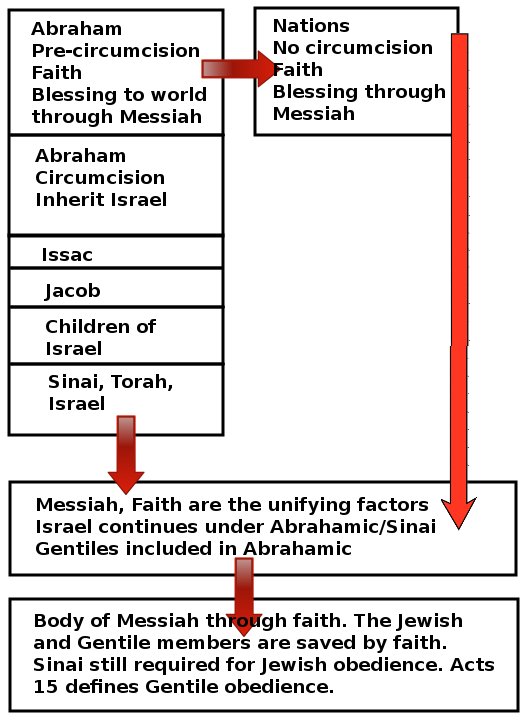
I tried to explain how I thought that Jews and Gentiles both are a part of the unified body of Christ and yet the Jewish connection to the Sinai covenant and its conditions, the Torah, are not undone by that unity. I drew a diagram, which I’ve reproduced below, to explain my thoughts. “But the Jewish people haven’t accepted Christ, so they can’t be saved,” he says (I’m paraphrasing). “Not just faith in ‘a Messiah’ but ‘The Messiah,’ in Jesus,” he says (I’m paraphrasing again).

Something’s wrong. I’m agreeing to things I’m not sure about. My Pastor is so sure of so many things that I think we can only see through “a glass darkly,” and that exist as much in the realm of God as they do in the material world. I don’t know how to explain it, so it’s difficult to know what to say.

covenant_chart1And there are so many other people who seem so sure about unsure things. I suppose it shouldn’t have surprised me that U.S. Army PFC Bradley Manning, just one day after being sentenced to 35 years in Federal Prison for releasing 700,000 secret military documents to Wikileaks, should come out as transsexual and declare that he wants to live the rest of his life as a woman, obviously changing how prison will be “applied” to Manning.

Religious systems. We craft them saying that we see their foundations in the Bible. But we craft them to say whatever we believe is important to us, and thus they reflect the political and social agendas and imperatives of the occupants of these systems. Extracting religious systems from the Bible is supposed to be guided by the Holy Spirit, but because human beings are involved, they end up dramatically contradicting each other, sometimes (often?) based on generational changes in attitudes.

I’ve mentioned before that I don’t think I’d make a good Baptist, not because I have anything against Baptists per se, but because I don’t think any denomination or modern religious stream, old school or new, holds all the keys and unlocks all the doors.

I know they think they do. They all think they do. But being an outsider, I can see a different perspective. I can see lots of perspectives, and none of them make a lot of sense. Pastor pretty much agrees with what he reads in Thomas Schreiner’s book 40 Questions About Christians and Biblical Law and I can barely stand a single thing Schreiner wrote.

Pastor is also reading Rudolph’s and Willitts’s book Introduction to Messianic Judaism: Its Ecclesial Context and Biblical Foundations. He’s just finished the chapter written by Scott J. Hafemann, “The Redemption of Israel for the Sake of the Gentiles” and he likes it very much. I’m going to re-read it to refresh my memory of the text. What did the Pastor see in this chapter that we can agree upon?

Can there be a peace? Or is the only peace in the presence of God and to heck with the systems?

On Being a Good Christian

churchesAfter they had preached the gospel to that city and had made many disciples…

Acts 14:21a (NASB)

Last Sunday, Pastor Randy preached on Acts 14:21-28 in a sermon he called, “What Makes a Good Missionary (Part 3)?” In many ways, the title could be expressed as “What Makes a Good Christian” since it is Pastor’s opinion that all believers are responsible for preaching the Good News of Jesus Christ, whether we’re formally called missionaries or not. Pastor spent most of his adult life as a missionary and his parents were missionaries, so it’s completely understandable why his perspective would be as it is.

When he was teaching about what a disciple is, he used several different phrases to describe them/us. I want to focus on one of those phrases:

A good Christian is a person who places himself/herself under a local church authority as a member.

Whoa!

Yeah, I even wrote “whoa” in my notes during the sermon. A member?

Pastor listed a number or reasons for this including giving the person a sense of accountability, opportunities for service, both to the other members of the church and to the larger world, and displaying commitment to the body of believers.

I know what you’re thinking? Aren’t we all as believers, part of the body of Christ anyway, what Pastor called “the universal church?”

Yes, but he used Paul’s model of “planting churches” (I can’t imagine Paul actually used that term) to emphasize how we can’t really function effectively in the body unless we join with a local church and display a commitment to that body as one of the operational parts. The sense of community would also contribute to the individual growing in “Christ-likeness” and, as I said before, providing a platform to allow the individual to minister to God’s people.

I’ve been campaigning to completely redesign the church’s website, which currently looks like a throwback to the ancient web of the 1990s. I’ve gotten some traction, but there’s a bottleneck in the process and until that bottleneck is cleared (which I’m told will be soon), I can’t actively begin my redesign project. Most of the information on the current site is obsolete, however, I did manage to pull this from the “Beliefs” page:

Because the Bible is the complete, true and sufficient Word of God, holding absolute authority for the church and the individual, we believe and teach the following:

  • Jesus Christ as the one and only begotten Son of God, is fully Jehovah God (the second person of the trinity) (John 1:1-14). In Mary’s womb, He joined to His divine nature, a human nature and was virgin born, thus becoming ‘God-man’ (Philippians 2:5-7 / Hebrews 10:5-10).
  • Jesus was tempted by Satan but remained sinless because He was and is God, and it is impossible for God to sin (Deuteronomy 32:3-4). Still, the temptations were both valid and real to the God-man. Oh, how he can sympathize with us (Hebrews 4:15-16).
  • Christ was literally crucified on the cross, His blood becoming the sufficient cleansing for our sins. He died and was buried. Then on the third day, He physically arose in victory over sin and death (1st Corinthians 1-5). He who truly believes that Jesus is the Christ, the Son of God is rescued from eternity in hell and given eternal life (Salvation – John 20:31).
  • The next prophetic event will be the taking up into heaven of all believers, ‘The Rapture,’ (1st Thessalonians 4:15-17). Then following the tribulation, Christ will return to the earth with us, His glorified saints, to establish His literal rule over all the earth for 1,000 years (The Millennial Kingdom), and we will rule with Him (Jude 14-15). This is our destiny as Sons of God (Romans 8).
  • Saving faith is by grace alone and not by works of merit that we can do (Ephesians 2:8-9).

churchmembershipI object to the use of “Jehovah” as if that were the actual pronunciation of the Tetragrammaton, and I’m not crazy about the “rapture” doctrine. Becoming an actual church member means taking some classes and then signing on the dotted line that you buy all of their doctrine, dogma, and theology hook, line, and sinker.

I’ve had enough conversations with my Pastor to realize our points of disagreement and, if being a member of my church or some other local church is a requirement for being a “good Christian,” then I have a problem.

Sunday afternoon, I had coffee with my good friend Tom. Tom’s been a Christian for over forty years and he and I have both been through the Hebrew Roots “wringer” as well. We have a good many attitudes in common, but he agrees with my Pastor that I will never be truly effective in my community until I formally become a member. Tom’s been a member of his church for about three years now. I asked him what he does about the bits and pieces of church doctrine with which he disagrees. He’s discussed it with his Pastor and his Pastor’s response is, “We’ll work on that.”

I’d interpret that statement to mean that Tom’s Pastor will try to convince Tom of the correctness of whatever Tom currently has issues with. I guess that situation is a work in progress.

But what about me? Frankly, I don’t think any church has their understanding 100% correct. How am I supposed to pretend that the church I attend does? I’m already anticipating a major disagreement next week in Sunday school class over the “symbolic” meaning of the moadim.

By the way, I took a closer look at the study notes for next week’s class and my blood ran cold. I’m actually kind of nervous about this. The notes mainly describe how the primary purpose of all of the Festivals just point to the reality of Jesus Christ. In other words, they had no value of their own to draw the Israelites closer to God (never mind that the word “sacrifice” in Hebrew is “korban” which gives the meaning of “drawing closer to” God). Dispensationalism isn’t supposed to be inherently supersessionistic but this part of it is getting close.

But anyway…

Since Pastor is anachronistically applying the “missionary journeys” of Paul to modern Christian missionary work anyway, let’s apply that process to “church membership.” When Paul “planted churches,” and appointed leaders, how did Gentiles join the community? Besides professing faith in Messiah, was there some additional process of agreeing to the specific conditions and rules of that community in order to join? Maybe, but remember, there weren’t “church denominations” in those days. Yes, there were different streams of Judaism, and “the Way” was the Jewish stream that contained the Jewish and Gentile disciples of Messiah. However, within the Way, were there different and competing variations? Did you have to choose one and forsake all others or could you just be a “generic” Jewish or Gentile disciple of the Jewish Messiah?

Actually, it looks like there were some divisions:

Now I exhort you, brethren, by the name of our Lord Jesus Christ, that you all agree and that there be no divisions among you, but that you be made complete in the same mind and in the same judgment. For I have been informed concerning you, my brethren, by Chloe’s people, that there are quarrels among you. Now I mean this, that each one of you is saying, “I am of Paul,” and “I of Apollos,” and “I of Cephas,” and “I of Christ.” Has Christ been divided? Paul was not crucified for you, was he? Or were you baptized in the name of Paul? I thank God that I baptized none of you except Crispus and Gaius, so that no one would say you were baptized in my name. Now I did baptize also the household of Stephanas; beyond that, I do not know whether I baptized any other. For Christ did not send me to baptize, but to preach the gospel, not in cleverness of speech, so that the cross of Christ would not be made void.

1 Corinthians 1:10-17 (NASB)

broken-crossOn the other hand, it looks like Paul took a dim view of these divisions and urged unity in Messiah, not in the name of some “leader” or “teacher” (or “denomination”).

I know, I know. I can’t anachronistically apply conditions as they existed in Paul’s day to the modern “church” because after all, the “church” isn’t a unified entity, at least at the level of human organizational meaning. Times have changed significantly in the past twenty centuries or so, and being a “good Christian” now means different things to different streams of Christianity.

I currently attend a small, Baptist church in Southwestern Idaho. They have definite standards and a formal process of baptism and education leading to entry into membership. I suppose I could attend and worship there forever as unaffiliated, but then, I wouldn’t meet the qualifications of a “good Christian.”

It’s not that I object to being committed to a community, having affiliation, accountability, and opportunity for service, but it’s the albatross being hung around my neck of all the specific doctrine and dogma to which I object (and if taking Calvinism on board is a requirement, then it’s an absolute “showstopper”). I can’t lie about believing stuff when I don’t believe it, so how can I ever join any church anywhere? How can I, as Pastor puts it, be a “good Christian?”

Oh, and apparently Pastor isn’t alone in his opinion about joining a church. Another collision between the principals outlined in Boaz Michael’s book Tent of David and the reality of “going to church.”