Tag Archives: Easter

The Battle Between Easter and Passover

Passover and Easter are fast approaching, and I am still immersed in speaking and traveling in support of my book, Being Both. So I am reposting some essays from the archives. This one dates from the spring of 2010. Enjoy!

-Susan Katz Miller
“Passover: Three Generations of Interfaith Family”
On Being Both

The “collision” of Easter and Passover is hitting me particularly hard this year. Last year I “celebrated” both. I put that word in quotes because I had the traditional Passover seder in my home as I do every year, but for the first time in over a decade, I went to the “Resurrection Sunday” (they don’t call it “Easter”) service at the church I currently attend.

I remember that Sunday morning as I was leaving for services. It was too late to do anything about it and since I’d been going to church for months, I didn’t think my wife would mind. But as I was getting up to leave, the hurt I saw in her eyes was almost tangible. It was too late to stop and as I drove away from our house, I realized that this was probably the worst thing I could have done…attend an Easter service while being married to a Jew.

In the history of the Church how many passion plays were immediately followed by a pogrom?

I remember quite some number of years ago attending Shabbat services at our local Conservative/Reform synagogue. Everyone was talking about the Mel Gibson film The Passion of the Christ (2004) which had just been released. All of the Jewish people in the room were absolutely terrified.

In the history of the Church how many passion plays were immediately followed by a pogrom?

I’ve never seen “Passion” and I never will. I realize Evangelical Christians won’t understand my reasoning, but I know the film would just make me angry and I know bringing the DVD into my home would be insulting to my Jewish family.

Passover this year begins the evening of Monday, April 14th and concludes the evening of Tuesday, April 22nd. Easter Sunday is on April 20th. I’ve never really connected to Palm Sunday or Good Friday, so I’m pretty detached from the whole sequence of Easter related events. And yet, especially this year, Easter and Passover seem heavily intertwined.

This coming Sunday, the church service will be quite different from normal. Not only will Pastor be speaking about Passover, but the entire service will be geared around Pesach. No, I don’t mean they will be conducting a seder, but there will be “Passover related” music such as “My Passover Things,” “The Ballad of the Four Sons,” and “Don’t Sit on the Afikomen.” The program does include a couple of more traditional pieces of music such as “Dayeinu” and Hallel,” but when I first saw this in the church bulletin last week, I wasn’t sure if I wanted to attend or not. Also, and this is the heavy punctuation to the event, they will also be conducting a communion service. I don’t begin to know how to wrap my brain around a matzah-communion wafer mashup.

Normally, communion is only offered in the evening service at this church, perhaps as an inducement to get people to attend both morning and evening services. I haven’t taken an actual communion since first coming to faith as a Christian. I’ve always practiced ”Do this in remembrance of me” (Luke 22:19, 1 Corinthians 11:24) as part of my Passover observance. Communion, to me, seemed at least redundant if not a skewed path away from this additional meaning Messiah attached to the Pesach meal.

The problem of whether or not to attend became moot when I was asked to help a family move to their new home this coming weekend. This is a friend of my wife’s, a Jewish woman, a single mother with three sons, all with some degree of disability. I’ve helped out this family in small ways before and long-planned to be part of the “grunt labor” when it was time for them to move.
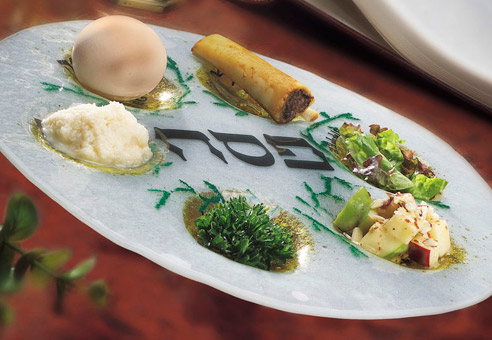
PassoverMy wife is slowly winding things up for our Pesach seder this year. She ordered the matzah for the meal from some place in Vermont that processes the matzah from the growing of the wheat through baking, packaging, and shipping the matzah. For the rest of the week of unleavened bread, we’ll be eating more local fare (although we’ve already opened a box and have started munching).

But while people like Susan Katz Miller can celebrate interfaith families and (apparently) not encounter significant dissonance between Christian and Jewish worlds, there are points in my life experience where I can’t avoid them. One point I faced was last year on Easter, uh…excuse me, Resurrection Sunday, as I was about to walk out the door and looked one more time at the expression on my Jewish wife’s face. I don’t think I can take seeing that hurt and feeling that guilt again.

But there’s another less personal but still important reason.

Imagine this alternate prophetic scenario, which I believe accords far better with the Jewish prophets than the New Testament’s version of the future, where the glorious multinational Church and Jesus are reunited. This is not a version of future events where Jews belatedly accept and worship the messiah they “murdered” two thousand years ago, and finally join the Church, feeling very sorry for not recognizing Jesus all along. The unfolding events looks (sic) decidedly different than what the authors of the gospels, Paul and the author of Revelation would have their readers believe. This is my reading of the Jewish prophets. I took some liberties with filling in the blanks.

-Gene Shlomovich
“The future of Israel, Messiah and the World (the Jewish version)”
Daily Minyan
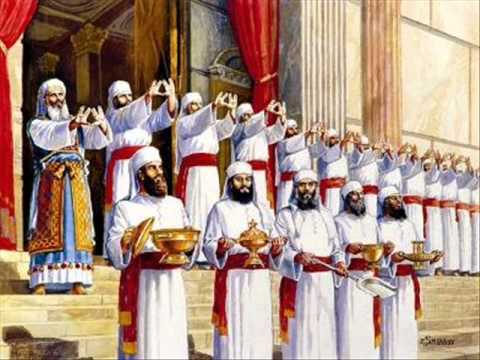
LevitesGene has made it something of a mission to try to educate Christians, including Hebrew Roots Christians and Messianic Gentiles, of the error of our ways, and how the Bible does not really presuppose “the Church” in any form, but still allows the people of the nations to join with Israel in the worship of the God of Israel. But the people of the nations, including (especially) Christians, are much less Israel-friendly in his scenario.

The real Jewish messiah appears on the scene. He’s not Jesus, but a virtuous and devout Jewish man who is able to unite all Jews. While he knows full well the tradition of Davidic lineage of his family, he does not find it significant when it comes to himself, at least not at this time. After all, many Jews today are able to do the same. Coming from a deeply devout family which nevertheless identified with Jews of all walks of life and participated in the national life of Israel, he is both a scholar and experienced military leader. Humble and wise, he is respected by all sections of the Jewish society. He doesn’t call himself a messiah. In fact, just like his ancient predecessor, Moses, he doesn’t even know that he too one day will help lead Israel – only G-d does. Neither has he been anointed – this is still to come. Still, the nations of the world hate and oppose him and work against him, as they’ve done to every Jewish leader in Israel‘s history. Some already derogatorily speak of this Jewish leader as a false messiah, scorning and ridiculing the fact that he’s so respected by the Jewish people while Jesus has been rejected.

Indeed, he’s nothing what they expected to see in a messiah as Christianity long portrayed him – not the glorious all-powerful heavenly god-man coming back for his beloved Church. It does not take long for this leader of the Jewish nation to branded as the “antichrist”. Preachers preach fiery sermons in their churches against him and against the Jews who fell “under his spell just as Jesus, Paul and John predicted”. No Christian may believe in him or support him in any way, or they risk losing their salvation. Christian tourism to Israel dries up as do other forms of Christian support, with many Christians denominations joining the boycott of the Jewish nation. Jews are ridiculed for their “folly” and the New Testament is held up as having already predicted everything the Jews will do. Muslims, who along with Christians likewise believe that Jesus is the Messiah and that no one else fits the bill, also reject the leadership of the real Jewish Messiah and join with the Western world in their opposition to him and the nation of Israel.

This is the more traditional Jewish viewpoint of the Messiah, the last battle, and the ultimate victory of Israel over her enemies. Gene’s last mention of Jesus will seem particularly difficult for most Christians:

The idols of the nations which do not save (including Jesus) are destroyed, are put away for good and are remembered no more. All false prophets and idol worshipers will be ashamed – they will all realize that they inherited nothing but lies from their forefathers.
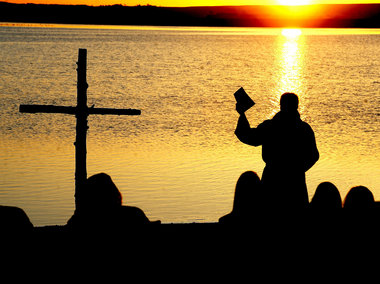
sunrise-easter-serviceWhile I consider Gene to be my friend, I am more than conscious of the gulf that lies between us, it’s incredible width, it’s gaping depth, because while I believe (unlike most Christians) in the primacy of Israel and that it will not be replaced by “the Church” as God’s central focus of devotion, love, and the receiver of all the covenant promises, our perception of not only the identity of Messiah, but of his very nature, character, role, and mission as Israel’s King are dramatically different and tremendously at odds.

And as Gene knows quite well, having personally experienced persecution as a Jew in his native Russia, after every passion play, there is a pogrom.

We don’t have pogroms as such in America in the 21st century, but the very act of celebrating Easter is bound to send out some sort of spiritual tremor into the atmosphere that is keenly felt by many Jews. Certainly in interfaith families, it is unavoidable. A collision of Easter and Passover.

My own answer this year will be to not attend Easter or Resurrection Day services. I’m not even sure that Jesus intended to add Easter to the calendar of religious moedim and I’m sure he didn’t intend for Easter to actually replace Passover.

Today, churches all over the U.S. pay some sort of attention to Passover. It’s usually the one festival of Judaism Christians know something about, thanks to the “Last Supper” of Jesus. One of the Jewish Christians at the church I attend will be holding a Passover seder and is inviting anyone in the church who wants to attend. Church and the Passover. It almost seems like an oxymoron.

What will Passover be like in the Messianic Age? My guess is that, from Gene’s point of view, “reformed Christians” will not be attending, at least to eat the Pascal meal, since only men who are circumcised may eat of the sacrifice in the Messiah-built temple. From the Church’s point of view, while some Christians believe there will be a third temple, many more believe that since “Christ is our sacrifice,” the actual sacrificial system will not be reinitiated, and therefore, there will be no Passover sacrifice.

If anyone celebrates Passover, it will be as a memorial of Christ’s Last Supper. Probably the expectation is that since Communion seems to have replaced Passover, that will be the more significant event.

Even from my point of view, one that holds the belief in a third temple, in the return of the sacrifices, and the continued commemoration of all of the moadim, including Passover, I can’t see how I, an uncircumcised male, would be able to eat of the Pascal offering with my Jewish family (assuming they made the pilgrimage to Jerusalem for Pesach) or even sit at the same table with them, lest my presence render the offering tamei (unclean).

i_give_upI know Christians and Hebrew Roots Gentiles will say that I’m rebuilding the dividing wall between Gentiles and Jews, but the Bible is the Bible. I can’t simply ignore certain parts of God’s Word because it’s inconvenient to Christian theology. I must not allow myself to stand in the way of God’s special, chosen people, the Jewish people. I believe there are personal sacrifices all believing Gentiles must make for the sake of Israel.

Only God can heal the nations after the terrible wars against Israel that will occur in the future. Only God can heal the rift between believing Gentiles and the Jewish people. For Gene, that healing comes at the price of our faith in Jesus as the Messiah. From my point of view, it comes at the price of Christian arrogant presumption that they (we) are the center of God’s universe and that the Jews either mean nothing at all, or at least have been reduced to “shield carriers” standing silently in the background of our tragic play.

Only God can heal how distant I feel from Him sometimes, and how distant I can feel from Jewish people, even in my own family, because of my faith.

Only God can heal us…

Easterphobia or Why Do You Have to Throw Christians Under a Bus?

i-hate-easterYour newfoumd (sic) respect for a holiday named after a goddess is coupled with a newfound (sic) contempt for Hebrew Roots.

While you say your new book is about respecting others, I notice in your blog posts, comments, and writings, the Hebrew Roots whom your organization once seved (sic) is referred to almost exclusively in the negative light. Your above comment is no exception.

Judah Gabriel Himango
from a comment on the blog post
God Fearers: Easter Ham or Passover Lamb?

If you’ve been reading my blog over the past few days, you’ve seen how my own recent Easter experience went as well as my own inability to make a connection to the observance. Nevertheless, I don’t think Easter is evil, wrong, bad, or pagan, whatever the origin of the name of the observance. I suppose my Pastor used terms such as “Resurrection Day” and “The Lord’s Day” last Sunday to get around that little problem, but since there were absolutely no bunnies or eggs present (well, eggs were probably served for brunch, but most likely they were scrambled), I didn’t see any obvious idolatry involved.

I didn’t want to write on the conflicts between some minority expressions of Hebrew Roots Christianity and the more traditional Christian churches, but when I read some of the comments on Toby’s blog post, including the one I quoted above, I couldn’t let it lie (and I didn’t want to start something again with Judah because I actually like the guy). My personal struggles are what they are, but I get a little tired of Hebrew Roots people playing the “superiority” card and saying that Christians in churches are terrible people because they won’t embrace some of the Hebrew Roots priorities. Frankly, such bigotry against Christians by these groups is ill-befitting of anyone who claims to be a disciple of Christ (or Messiah if that’s your preference).

I was just talking about this issue a couple of weeks ago when discussing the problem with religious people. If a religious person, particularly in a minority variant of Christianity which sees itself as above or superior to the majority of Christians, encounters other believers who hold different views, sooner or later, there’s going to be a “spitting match” in the blogosphere. I have tried avoiding blog posts such as this one because I didn’t want to participate in such a match, but where do I draw the line when I see unjust comments being made against believers by other believers?

I suppose I could have ignored this poorly considered jab against Christians who celebrate Easter and that would have ended it, at least from my point of view, but it was included in a collection of remarks that were direct responses to something I’d said on Toby’s blog. Yes, I still should have ignored it.

But I chose not to.

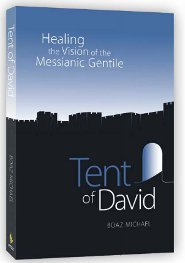
Boaz Michael, author of the book Tent of David, which I mentioned on Toby’s blog, corrected something I said:

TOD addresses Easter, “Another area of difficulty involves the observance of Christian holidays. Some churches heartily embrace some of the pagan-derived aspects of Easter and Christmas. Understandably, this makes many Messianic Gentiles uncomfortable. The simple solution is not to go during that time of year. It should not have too significant an impact on your relationships there to miss church for one or two weeks; in fact, it’s quite common for people to be out of town during holidays.”

tent-of-davidLate last year, I deliberately didn’t go to church for Christmas services for more or less the reasons Boaz stated, but to my way of thinking, Easter is the “higher” tradition as far as the church is concerned. The crucifixion and resurrection of the Master is at the center of all things and without these events, there would be no salvation for all of mankind. That the church should ignore something so vitally important seems ridiculous and while I believe the Passover Seder could have much meaning for Christians, it doesn’t always cover the full, expansive intent and glory of the risen King.

So I chose to attend Easter Sunday services at my church and did not consider such services optional. As I mentioned above, it wasn’t a spiritual “power surge” and I ended up feeling more disconnected from the community because of my lack of emotional attachment, but that has more to do with me than the importance of fellowship and the beauty of watching a new day dawning and knowing that the tomb is empty.

One of the other comments Boaz made addresses this point very well:

Actually, the consequence of Tent of David is not necessarily the celebration of Easter but rather a respect for those that do honor the resurrection of the Messiah. It is about learning to see the good in others, appreciating and valuing people’s attempts to connect with God. It is about learning to manage things Easter with love and care of the individual that is sincere in their intentions and efforts. It is about building relationships that will create bridges of dialog.

At the end of the day TOD is about respecting others, not assuming evil intentions, and a mission of transformation.

He said, It is about learning to see the good in others.” Isn’t that what we’re supposed to be doing?

Nevertheless, I’ll probably get “slam dunked” by my critics and my friends alike for how I’m wording all this, but what I’m writing at least has the benefit of sincerity and transparency. If you disagree with how different churches do things, then don’t go to those churches. If you have a problem with church in general, you don’t have to go to church. I don’t complain about where you go to worship. Why do you (whoever you are, since I’m addressing more than one disgruntled person at this point) have to complain about where I choose to worship?

I know Judah was complaining more to Boaz about TOD than he was to me, and I don’t think Judah intentionally disdains all people who go to church and call themselves “Christian” instead of “Messianic,” but the Boaz has a point. Even if we struggle with some of the practices in the church, we cannot dismiss her or her service to Christ. We must, since we also call ourselves disciples of Messiah, learn to see the best in others. After all, Christ died, even for those believers we may not like or don’t agree with. If Jesus thought his sacrifice, even for “those people,” was worth it, who are we to say he was wrong?

Being Filled

jewish-temple-messiahWe celebrated Easter this year with our community of Christian and Jewish interfaith families. Our minister started off by pointing out that Easter is not in the Bible, and that our holiday traditions make reference to ancient goddesses, and the fertility rites of spring. She then gathered the children together and talked to them about the Buddhist metaphor of a cup of tea representing the comforting memories of life after the tea bag (or body) is gone. She’s not your typical minister.

Next, our rabbi gave an adult sermon about the themes of intimacy, transcendence and unity in the story of the resurrection of Jesus. Somehow, the idea of life beyond death, of renewal and regeneration, seemed completely universal to me as he spoke. As a Jew, I do not feel I need to believe in a messiah or a personal savior in order to celebrate these Easter messages. Our rabbi spent his career at Georgetown, knows his gospels, and has been called a “closet Catholic” by Catholic friends. And yet, he’s an erudite, dedicated and deeply spiritual Jew. He’s not your typical rabbi.

After our Easter morning with Christians and Jews, I made a quick change out of my pastel dress and Easter bonnet and into a bold print Senegalese outfit, in order to join a community of Catholics and Muslims for our second Easter event of the day, a gathering of the local Catholic Senegalese association. We had the great fortune to be invited to this event by two Senegalese-American friends, one Catholic and one Muslim, who are cousins from an interfaith family, and who know that my husband and I crave Senegalese food and company ever since our years in Dakar. Intermarriage between Muslims and Catholics is not uncommon in Senegal. In fact, both of the Muslim Presidents of Senegal I interviewed as a journalist (Abdou Diouf and Abdoulaye Wade) had Catholic wives.

-Susan Katz Miller
from “My Easter with Christians, Jews and Muslims”
On Being Both

There is even a Chassidic custom, instituted by the Baal Shem Tov and further developed by the Rebbes of Chabad, to conduct a “mirror-seder” in the closing hours of the last day of Passover, complete with matzah and four cups of wine. These are hours, say the Chassidic masters, when time relinquishes its last hold upon our lives; when the future, too, can be remembered, and the Era of Moshiach tasted and digested as the Exodus is on the seder night.

-Rabbi Yanki Tauber
“The Third Seder”
Chabad.org

Ever since Easter Sunday services and particularly this morning, I’ve been feeling a profound sense of disconnection or maybe it’s just disappointment. I don’t know what it is, but I don’t like it.

I don’t know what I expected out of Easter or Resurrection Day, but whatever it was, I didn’t get it. Then I read Susan Katz Miller’s article, which I partially quoted from above, and I was captivated by the variety and “differentness” of her intermarriage, multicultural celebration of the resurrection. I’m sure a staunch Christian would be set back on his/her heels by even reading of, let alone participating in, such a “mash-up” of different religious practices and calling it “Easter,” but then I can see the meaning infused in this series of events, meant to speak to people from different religious backgrounds and to bring them all together in the service of the King.

I’m not setting aside the idea that God is an objective God and that His understanding of Himself is the understanding of God, but human beings are highly variable. Even within this thing we call “Christianity,” there are hundreds or perhaps even thousands of different and distinct expressions, theologies, doctrines, and dogmas. That’s why we have such a tough time getting along with each other.

meal-of-moshiachAnd yet, Katz Miller deftly merges these different traditions together within the span of a short blog post, and makes them live together, if not seamlessly, then at least in a complementary manner. I mean, how many different ways and different cultural and religious contexts can be applied to the resurrection and still have a proper celebration? Easter is a tradition, not a mitzvah (at least not one explicitly expressed in scripture), so how far can it be extended beyond Christian choirs, ham dinners, cries of “He has risen,” and still remain “kosher?”

In the seventeenth century the founder of the Chassidic movement, Rabbi Israel ben Eliezer (the Baal Shem Tov) instituted a new custom for the last day of Passover. He called it the Meal of Messiah (Seudat Mashiach,סעודת משיח ). It consisted of a special, additional meal on the afternoon of the last day of Passover, paralleling the traditional third meal of Shabbat. The Baal Shem Tov emphasized that the main component of the meal was matzah. After all, it was the last meal on the last day of Chag HaMatzot, the feast of Unleavened Bread. A few generations later, the Rebbe Rashab (1860-1920) added the custom of four cups of wine, mirroring the seder of the first night. Some Chassidic Jews still celebrate this special Messiah seder on the last day of the festival. They gather together to end the festival with matzah, four cups of wine, and a special focus on the Messiah.

The entire theme of the meal focuses on the coming of Messiah and the final redemption. The meal is festive in spirit. Everyone wishes one another “L’chayim! (to life!)” while discussing their insights into Messiah and their dreams and hopes for the Messianic Era. The meal concludes with fervent singing and dancing in joyous elation over the promise of the Messianic redemption.

What is the connection between the last day of Passover and the coming of Messiah? The Tzemach Tzedek writes:

The last day of Pesach is the conclusion of that which began on the first night of Pesach. The first night of Pesach is our festival commemorating our redemption from Egypt by the Holy One, Blessed be He. It was the first redemption, carried out through Moshe Rabbeinu, who was the first redeemer; it was the beginning. The last day of Pesach is our festival commemorating the final redemption, when the Holy One, Blessed be He, will redeem us from the last exile through our righteous Moshiach, who is the final redeemer. The first day of Pesach is Moshe Rabbeinu’s festival; the last day of Pesach is Moshiach’s festival.

One is incomplete without the other: the first redemption is connected to the last. The sages say, “In Nisan they were redeemed and in Nisan they will be redeemed in the time to come.” In fact the prophet Jeremiah tells us that the second exodus will be so great that it will overshadow the first.

-Boaz Michael
“What is the Meal of Messiah? Part 2 of 3”
First Fruits of Zion (FFOZ)

I suppose there is a limit to how much diversity we can cram into Easter, and certainly the Baal Shem Tov’s creation of this meal probably exceeds the comfort zone of even the most liberal church, but if we consider the themes being introduced and recall that the Messiah is irrefutably, irreducibly Jewish, then we must allow the celebration of the resurrection of King Messiah to also be cast in a Jewish mold and produced as a Jewish rite and tradition.

And yet, as I said above, the Messiah also transcends Judaism and extends himself to all of the people groups and nations of the world.

“Thus it is written, that the Christ should suffer and on the third day rise from the dead, and that repentance and forgiveness of sins should be proclaimed in his name to all nations, beginning from Jerusalem.”

Luke 24:46-47

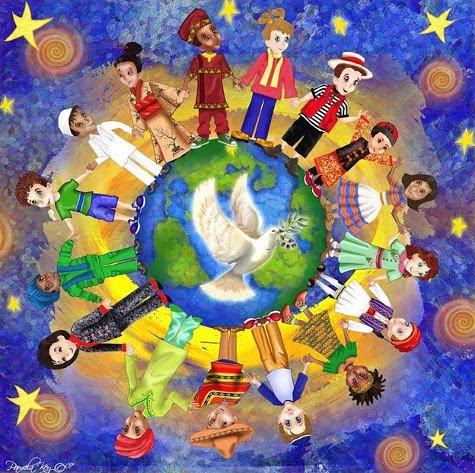
multicultural-celebrationWhat is Easter like for the Christians in Egypt, for the Christians in China, for the Christians in Norway, for the Christians in New Zealand? How many different peoples have how many different traditions to commemorate the risen King and the resurrected Jesus? What do they look like? What foods are eaten? What prayers are said? What songs are sung?

I imagine if you could gather representatives of the faith from each nation and province from the four corners of the earth, and have them join together to celebrate Resurrection Day, you’d get a set of observances something like what we see on Susan Katz Miller’s blog. Add the Meal of the Messiah on the last day of Matzot and it would be complete.

The Messiah is the hope of the Jewish nation and the King of the House of David, but although he first and foremost came for the lost sheep of Israel, we also see that he came for humanity. God so loved the world that He gave His only and unique son so that none should be lost but all who choose to come to faith should be saved.

What am I looking for? In my small corner of the world, perhaps it cannot be found. But if I can transcend my world, what I want to discover is this:

Some Chassidic sources say that participation in the Meal of Messiah causes the person to carry the light of Messiah within him throughout the rest of the year and thus it infuses every action of his day. It foreshadows the Messianic Era when all mankind will be saturated with Godliness. Through this feast, the Chassid hopes that he has connected with the very soul of Messiah.

Boaz Michael’s words express my desire for what I think we are all looking for…hope. Hope in the future, hope that there is a future, hope that our lives have meaning beyond the day-to-day routine and rut of existence, hope that there is a God and that He loves us, hope that we are more than we think we are, and that we can do more than the world around thinks we’re capable of.

Rabbi Tauber says of Passover:

The “first days” with its seders and its reliving of history, and the “final days” with its messianic themes — days that herald the divine goodness and perfection which, the prophets promise us, is the end-goal of creation and the fulfillment of our present-day lives.

What I was looking for, and what I’m still looking for is the encounter with the infinite, and to be filled full of the promises of the prophets, and the final promise, the Messiah, the end-goal of creation.

Someday, we are told that we will sit at the banquet table of Abraham, Isaac, and Jacob, each of us from the north, south, east, and west who proclaims Messiah, and we will eat of that meal

Jesus said to them, “I am the bread of life; whoever comes to me shall not hunger, and whoever believes in me shall never thirst.

John 6:35

…and be filled.

“He is Risen” Day

he-is-risenBut on the first day of the week, at early dawn, they went to the tomb, taking the spices they had prepared. And they found the stone rolled away from the tomb, but when they went in they did not find the body of the Lord Jesus. While they were perplexed about this, behold, two men stood by them in dazzling apparel. And as they were frightened and bowed their faces to the ground, the men said to them, “Why do you seek the living among the dead? He is not here, but has risen. Remember how he told you, while he was still in Galilee, that the Son of Man must be delivered into the hands of sinful men and be crucified and on the third day rise.” And they remembered his words, and returning from the tomb they told all these things to the eleven and to all the rest. Now it was Mary Magdalene and Joanna and Mary the mother of James and the other women with them who told these things to the apostles, but these words seemed to them an idle tale, and they did not believe them. But Peter rose and ran to the tomb; stooping and looking in, he saw the linen cloths by themselves; and he went home marveling at what had happened.

Luke 24:1-12

I learned something new on Sunday morning. I learned that on Easter, when a Christian greets you by saying “He is risen,” the proper response is He is risen, indeed.” Seriously, I’d never heard that before Pastor Randy greeted me that way right before “sunrise services” (I say that in quotes because sunrise yesterday was at 7:27 a.m. and our “sunrise services” were scheduled to kick off at 8:30 a.m.).

I also remembered something that I had completely forgotten. Easter is usually the service which requires a multimedia program for the main event. But I didn’t remember that until the program actually started.

I did remember that church is usually packed on Easter and tried to arrive early, but the real crowds didn’t show up by 8:30 (though there was a respectable attendance). By the middle of the main service (or around 10:30 or so), people were still coming in and it was practically standing room only.

Or almost.

But the thing that struck me most of all was my lack of emotional attachment to Easter. Everyone was fairly gushing with joy and happiness over Easter and while I think it is important to commemorate the resurrection of the Master, I just didn’t “feel” it, at least not with an intense power surge.

I dunno…maybe there’s something wrong with me. As an emotional experience, it felt pretty much like any other Sunday at church. I had some friendly conversations with folks. I enjoyed Pastor Randy’s teachings. I was OK with the music and the Easter program.

But it wasn’t like the day was incredibly, amazingly, profoundly, special. I’m sure that after it was all over (around 11:30), families went home for a big Easter Sunday feast, but because I’m the lone Christian in my house, I went home and helped my wife pull weeds and water the new plants.

I don’t know how it happened, but I’m more attached to Passover than I am Easter. It’s probably through sheer repetition. Even when I first became a believer, I only attended a church for a few years before becoming “Messianic.” I’ve probably been to a lot more Seders than I have Easter Sunday sunrise services. In fact, this was the first early morning service I’ve ever attended for “Resurrection Day.”

Actually, besides Pastor Randy’s teaching on Luke 24, I’d have to say that the early morning outdoor service was my favorite part. I learned that even when the high for the day is projected to be about 70 degrees F, it’s still quite cold outside at 8:30 in the morning. I’m glad I wore a sweater, but people brought blankets, and when I first sat down, that chair seat was freezing!

Boise-SunriseThe outdoor service was simple.

Someone reads a section of Luke spanning chapters 22 through 24 and we sing a little bit. Back and forth, back and forth. Three stanzas and five readers. Sing a stanza, a reader reads. I like having the Bible read to me. It sort of reminds me of a Torah service when readers are each called up for an aliyah.

Other than that, I especially liked when, during the main service, Pastor explained what “TaNaKh” meant, including that “Law” is a poor translation of the word “Torah,” and that “Torah” comes from a Hebrew root word related to “teaching.” I did a silent little happy dance inside when he was sharing that from the pulpit.

I almost felt him chiding me when he was talking about how we need to study the scriptures, and especially on “things to come.” We had the identical conversation last Wednesday. I told him I tended to steer clear of studies and commentaries about “the end times” because I’ve encountered too many people who are just “conspiracy theory crazy” about “the end times.” He said to everyone else on Sunday what he more or less said to me last Wednesday. I doubt he was trying to “zing” me, but maybe my response to him resulted in the topic being included in his sermon.

I learned the theological use for the words “inspiration” and “illumination.” Apparently inspiration is directly related to this:

All Scripture is breathed out by God and profitable for teaching, for reproof, for correction, and for training in righteousness…

2 Timothy 3:16

“Inspiration” really means “expiration” (actually, “exhalation”) or breathing out, so imagine God exhaling and His Word leaves His lips and enters the ears of man. Pastor Randy said that each word of the Bible was written exactly as God intended it to be written and thus is perfect. I tend to think of the Bible more like a partnership between God and human beings so that something supernatural is experienced by the writer, but the vocabulary, style, syntax, and everything else about the written scriptures has the “thumbprint” of the human author. That’s why we see such variability between accounts of the same event in different Gospels, for instance.

“Illumination” is just what it sounds like, light or enlightening.

And beginning with Moses and all the Prophets, he interpreted to them in all the Scriptures the things concerning himself…They said to each other, “Did not our hearts burn within us while he talked to us on the road, while he opened to us the Scriptures?”

Luke 24:27, 32

Then he opened their minds to understand the Scriptures…

Luke 24:45

light-in-my-handsDuring his sermon, Pastor Randy said almost exactly what I often think about. He said that he would love to be able to watch and listen as Jesus opened the minds of the apostles and explained scripture. From my point of view, I would be ecstatic if Messiah would open up my rusty mind and interpret the scriptures with absolute fidelity for me.

I’ve said before that I believe one of the roles of the returned Messiah is that he will be a great teacher (the greatest) and teach what the Bible means in absolutely correct and perfectly enlightening terms to all of us.

Please, illuminate me.

But that, among many other things, is yet to come.

I wish I could get all worked up about Jesus being risen. But in my mind, he was risen a thousand years ago, he was risen the day before yesterday, and he’ll still be risen the day after tomorrow. I know Easter (interestingly, Pastor Randy referred to the day as “Resurrection Day” or “the Lord’s Day,” but he didn’t say “Easter” once…he did mention the Didache, which surprised me, since FFOZ articles refer to it with some regularity) is the Christian equivalent to Passover; a sort of “retelling” of the greatest event in the history of the church.

But like I said, I didn’t feel it. Easter Sunday didn’t resonate within me. I went to have fellowship and to worship, but the fact that it was Easter didn’t set off any bells and whistles. I wonder if it ever will?

He explained those statements, saying that it was energetically imperative for human beings to realize that the only thing that matters is their encounter with infinity.

-Carlos Castaneda
from The Author’s Commentaries on the Occasion of the Thirtieth Year of Publication of The Teachings of Don Juan: A Yaqui Way of Knowledge, pg xiii

Maybe I’m just bad at Christian traditions and culture. Or maybe I missed out on a special encounter with infinity; with the infinite One.

Converging On the House of Prayer

Walking TogetherIn each one of us there is an Egypt and a Pharaoh and a Moses and Freedom in a Promised Land. And every point in time is an opportunity for another Exodus.

Egypt is a place that chains you to who you are, constraining you from growth and change. And Pharaoh is that voice inside that mocks your gambit to escape, saying, “How could you attempt being today something you were not yesterday? Aren’t you good enough just as you are? Don’t you know who you are?”

Moses is the liberator, the infinite force deep within, an impetuous and all-powerful drive to break out from any bondage, to always transcend, to connect with that which has no bounds.

But Freedom and the Promised Land are not static elements that lie in wait. They are your own achievements which you may create at any moment, in any thing that you do, simply by breaking free from whoever you were the day before.

Last Passover you may not have yet begun to light a candle. Or some other mitzvah still waits for you to fulfill its full potential. This year, defy Pharaoh and light up your world. With unbounded light.

-Rabbi Tzvi Freeman
“The Inside Story on Passover”
Based on letters and talks of the Rebbe
Rabbi M. M. Schneerson
Chabad.org

But thanks be to God, that you who were once slaves of sin have become obedient from the heart to the standard of teaching to which you were committed, and, having been set free from sin, have become slaves of righteousness.

Romans 6:17-18 (ESV)

Speaking of slavery and freedom, I debated a great deal within myself whether or not to continue posting blog meditations for Tuesday and Wednesday, considering that the first two days of Passover are considered Sabbaths of complete rest. After all, I don’t post a meditation on the Saturday Shabbat (although I often write for the following days) in order to honor the Sabbath rest. And yet there is so much going on that, if I don’t write about it now, it will be lost, thanks to my failing middle-age memory.

I had a brief transaction with Derek Leman on this blog about my “adventures:”

Derek: I will be looking for the most interesting blog posts, James, which I expect will come from your Passover-and-also-Easter experience.

James: Thanks, Derek.

It’s interesting because events like this are a natural consequence behind Boaz Michael’s book Tent of David and yet no one seems to talk about them. I’m sure I can’t be the only one and in fact, I would be willing to bet (well, not literally) that there are some Christian/Jewish intermarrieds who have these experiences. You’d think they’d turn up more in the Messianic realm, since it tends to be a haven for many intermarried couples.

In a sense, I walk on both sides of the street, being a “practicing Christian” and being married to a Jewish wife. As you read this, it’s Tuesday morning and my family will have had our Passover Seder last night (it hasn’t happened yet as I’m writing this, but I promise to give you all a full report soon). Next Sunday morning, I’ll be attending sunrise services for Easter at my church. I’ll try not to feel too schizophrenic as a process both experiences inside my one and only brain.

But the reality of my life is that I’m not Jewish. As I’ve said on numerous occasions, I believe that the halachah James and the Counsel of Apostles in Jerusalem established for the Gentile disciples of the Master (i.e. Christians) does not obligate us to live our lives in precisely the same manner as the Jewish believers. I suppose if I was more closely connected to the local Jewish population or even if my wife and daughter were more observant, I might interrupt my daily meditations for the sake of the mitzvah of Pesach, but then again, they won’t be observing a full Shabbat’s rest during the festival, and on Wednesday evening, before havdalah to mark the end of the first two days of Passover, I will be meeting with Pastor Randy.

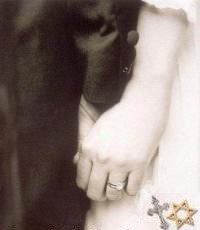
intermarriageWhat is it to be intermarried and to experience the subtle as well as the overt patterns and colors of a life in (for me, anyway) mostly Christianity with some Jewish overtones? What is freedom and what is slavery, or do we simply exchange one master for another as Paul suggests (sin to righteousness)? I’ve already said that there is ample evidence in the Bible of the Messiah’s Gentile disciples being well versed in Passover, so there’s no excuse for me to not observe it in some reasonable fashion.

But then where does that leave Easter? Are Passover and Easter mutually exclusive or can they be complementary? Or in fact, should they both be mandatory?

There’s no “point-blank” commandment to celebrate Easter or “Resurrection Day,” but there is a firm tradition in Christianity to do so. Some Christians reading this may be shocked that I call Easter a tradition, since it is arguably the single most Holy Day on the Christian calendar.

But many Jewish believers probably feel uncomfortable with Easter because historically, after every Passion Play, there’s been a pogrom. To respond to this, First Fruits of Zion (FFOZ) suggested an alternative to Easter in the Meal of the Messiah. That doesn’t do me any good because the only people I’ll be commemorating Pesach with are my immediate (non-believing) Jewish family, and the only ones I’ll be celebrating the resurrection with are the people at my church.

As I continue to process my experiences, I find that they are less “Messianic” and based more on interfaith and intermarriage issues. They are the result of my being the Gentile head of a Jewish family for nearly thirty-one years (although we’ve only been “religious” for about a third of that time).

At the first seder my father would be brief, in order to eat the afikoman before midnight. On the second night, however, he would expound at length; he began the seder before 9 p.m. and ended at about 3 or 4 in the morning, dwelling at length on the explanation of the Haggada.

The Alter Rebbe declared: The matza of the first evening of Pesach is called the Food of Faith; the matza of the second evening is called the Food of Healing. When healing brings faith (“Thank you, G-d, for healing me”) then clearly there has been illness. When faith brings healing, there is no illness to start with.

“Today’s Day”
Tuesday, Nissan 15 (1st day of chag ha’matzot – Pesach), 5703
Compiled by the Lubavitcher Rebbe
Translated by Yitschak Meir Kagan
Chabad.org

I included that last quote to shake up any Christians reading this message. I want to remind you all of the unique and special purpose and experience Passover has for the Jewish people. I want to emphasize to you all just how “Jewish” it is. I want to make sure that Christians of any sort don’t think they (we) now “own” Passover and that it is no longer Jewish. In spite of Paul teaching some of the God-fearing Gentile disciples about the Seder, I want to make sure we all understand that especially in today’s world, Christianity and Judaism stand apart, traveling two independent trajectories through history, and that a Christian attending a Seder let alone leading it, is a wonderful but also a strange thing. It would be just as strange as a religious Jew attending Easter services (and I don’t know any who are planning to do that next Sunday).

two-roads-joinI want to make sure everyone understands that we are still in the middle of an incomplete process. As believers, we may be free from sin thanks for the grace of Jesus Christ, but we are still slaves to our humanity and also to the plan of God in that the time for the Gentile disciples to return to our Jewish mentors has not yet come, although many, including me, can see the signs of an impending approach.

Israel was intended to be a light to the world, to attract and gather the people of the nations to God. That light came into the world in the form of a human being who most people call Jesus. He said he was the light of the world (John 8:12) and he has attracted millions to the God of Jacob as Israel’s firstborn Son. The Jewish and Gentile believers were added as differing members of the same Body of Messiah (Romans 12:4-5) and so there were two, parallel streams of people existing within a single, living being, the Son of David.

But then the two streams within a single container became two separate and diverging streams of humanity, growing further apart and more opposed to each other with each passing decade and century, until now, the idea of one believing person celebrating both Passover and Easter doesn’t seem just like a minor anomaly, but actually a strange and discordant event.

Except that the discordance is temporary.

So I ask, did they stumble in order that they might fall? By no means! Rather through their trespass salvation has come to the Gentiles, so as to make Israel jealous. Now if their trespass means riches for the world, and if their failure means riches for the Gentiles, how much more will their full inclusion mean!

Romans 11:11-12 (ESV)

Paul tells us how much full inclusion in the body of Messiah will mean to not just the Jewish people, but to all people. It is the completion of a dream, the healing of the horribly painful wound, and gift of the returning King.

Lest you be wise in your own sight, I do not want you to be unaware of this mystery, brothers: a partial hardening has come upon Israel, until the fullness of the Gentiles has come in.

Romans 11:25 (ESV)

I can’t summon the future but I can try to preview a tiny portion of it in the present. I can be the Christian leading a Seder in my Jewish family, and I can be the Christian who lives with a Jewish family who also attends a sunrise Easter service. As great a difficulty as intermarriage is for Judaism, perhaps there is a benefit as well. Who else but an intermarried person actually lives in both divergent worlds? And as they slowly draw closer to each other again in Messiah, who else will be able to navigate their currents and negotiate their paths than someone who already walks upon them?

sukkoth-feastLast year for Purim, I wrote Hadassah and the King, a tale of two heroes, the Jewish Queen and Gentile King of an ancient land where only an intermarried couple could save all of the Hebrews from certain destruction.

I’m not heroic but I and those like me have our parts to play out in God’s drama for humanity and his plan for the return of King Messiah. Today, as I write this, the Christian and Jewish worlds exist mainly apart, with just a few tenuous bridges connecting this bit of land and that. But days are coming when we’ll need to have greater fellowship, when we will be expected to attend the celebrations at our Monarch’s throne in Jerusalem, when believing Jew and Gentile will sit together at the Passover Seder, “and recline at table with Abraham, Isaac, and Jacob in the kingdom of heaven.” (Matthew 8:11)

On all other nights we eat while sitting upright, but on this night we eat reclining.

-from the Four Questions

We are limited by the very fact that we have human form. There is no freedom in following our whim, only further slavery to our own limited selves. Freedom can only come by connecting to something infinite and beyond us.

And so Moses was told, “When you take the people out from Egypt, you shall all serve G‑d on this mountain.”

-Rabbi Tzvi Freeman
“The Freedom Connection”
Chabad.org

…these I will bring to my holy mountain, and make them joyful in my house of prayer; their burnt offerings and their sacrifices will be accepted on my altar; for my house shall be called a house of prayer for all peoples.

Isaiah 56:7 (ESV)

May we all one day come together and as our own different and unique parts in the body of Messiah, serve our God and celebrate together in the house of prayer of our King.

Tzav: Ashes at Dawn

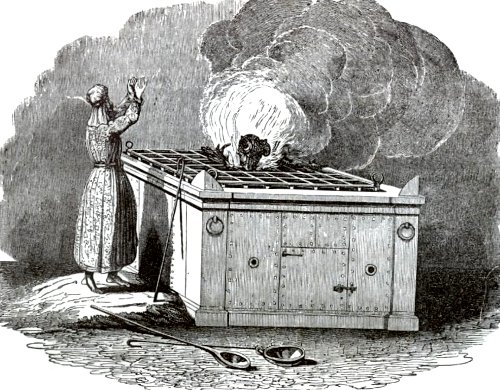
burnt-offering-altarHe shall then take off his vestments and put on other vestments, and carry the ashes outside the camp to a clean place.

Leviticus 6:4 (JPS Tanakh)

What lesson do we learn from the ceremonious taking out the ashes from the altar each morning?

Rabbi Samson Raphael Hirsch comments that the taking out of the ashes that remained on the altar from the previous day expresses the thought that with each new day, the Torah mission must be accomplished afresh, as if nothing had yet been accomplished. Every new day calls us to our mission with new devotion and sacrifice. The thought of what has already been accomplished can be the death of that which is still to be accomplished. Woe unto him who with smug self-complacency thinks he can rest on his laurels, on what he has already achieved, and who does not meet the task of every fresh day with full devotion as if it were the first day of his life’s work!

“Carry forth the ashes out of the camp.” Every trace of yesterday’s sacrifice is to be removed from the hearth on the Altar, so that the service of the new day can be started on completely fresh ground. Given these considerations, we can understand the law that prescribes the wearing of worn-out garments when one is occupied with the achievements of the previous day. The past is not to be forgotten. However, it is to be retired to the background, and is not to invest us with pride before the fresh task to which each new day calls us. (Rabbi Hirsch’s commentary)

-Rabbi Kalman Packouz
“Shabbat Shalom Weekly”
Commentary on Torah Portion Tzav
Aish.com

I have been accused of being a very simplistic, very lyrical player, and that’s okay. That just comes from the blues, which is my background. But every day you wake up and transcend. You can’t ever rest on your laurels.

Carlos Santana

I could probably find dozens of similar quotes to illustrate this single point. But it’s a difficult point. Rabbi Packouz uses this lesson to tell us that our past successes do not transfer into the present. No matter how well you’ve done in anything, even serving God, you are only as good as you are today. Serving God well yesterday and then not serving God today just means you’re not serving God. Your “laurels” are already wilting, so to speak.

Carlos Santana says that “every day you wake up and transcend.” The Rebbe, Rabbi M. M. Schneerson said this:

When you awake in the morning, learn something to inspire you and mediate upon it, then plunge forward full of light with which to illuminate the darkness.

Each day is a new opportunity to live, to serve God, to serve other people. Each day is a new opportunity to discover something new and exciting about yourself. It is why observant Jews recite the following blessing as their very first blessing to God, even before getting out of bed in the morning.

“I gratefully thank You, living and existing King
for restoring my soul to me with compassion.
Abundant is your faithfulness.”

But the sentiment works in another direction as well.

Success isn’t permanent and failure isn’t fatal.

-Mike Ditka
US football player and coach

failureI’ve noticed a good many people working in sales have that particular quote jotted on a sticky note or written on a white board in or around their work area. Success isn’t permanent. Rabbi Packouz and Carlos Santana both agree on that. But failure isn’t fatal, either. It only feels that way sometimes.

We were told to transcend limitations — but that doesn’t mean just jumping into the air with no idea of where you’re going to land!

-Rabbi Tzvi Freeman
Based on letters and talks of the Rebbe
Rabbi M. M. Schneerson
Said to one who fell into enormous debt trying to achieve miracles
Chabad.org

Adding all this up, you might say, success isn’t permanent, serve God today as well as yesterday. Failure isn’t fatal, but don’t do anything stupid that will likely result in you failing God.

And Jesus answered him, “It is said, ‘You shall not put the Lord your God to the test.’”

Luke 4:12 (ESV)

You may be eager to serve God but good intentions aside, eagerness is not enough. In fact misdirected, eagerness can get you in a lot of trouble. One horrible modern example is the “eagerness” of the Westboro Baptist Church which results only in demonstrations of bigotry and increasing the grief of the families of our fallen military personnel who gave their lives in the service of our nation.

Here’s another example of misguided eagerness and zealousness.

And there arose on that day a great persecution against the church in Jerusalem, and they were all scattered throughout the regions of Judea and Samaria, except the apostles. Devout men buried Stephen and made great lamentation over him. But Saul was ravaging the church, and entering house after house, he dragged off men and women and committed them to prison.

But Saul, still breathing threats and murder against the disciples of the Lord, went to the high priest and asked him for letters to the synagogues at Damascus, so that if he found any belonging to the Way, men or women, he might bring them bound to Jerusalem. Now as he went on his way, he approached Damascus, and suddenly a light from heaven shone around him. And falling to the ground he heard a voice saying to him, “Saul, Saul, why are you persecuting me?” And he said, “Who are you, Lord?” And he said, “I am Jesus, whom you are persecuting.

Acts 8:1-3, 9:1-5 (ESV)

Fortunately, Paul’s zealousness took a turn for the better, but he had to encounter the Master in a dramatic and startling way and be robbed of his sight before Paul could begin to see that he needed to travel in a different direction. Before that, he jumped into the air but didn’t realize where he was going to land.

Serving God is a partnership. It’s not just what you do and it’s not just what God does. We know we have a God who neither slumbers or sleeps (Psalm 121:4) and He is at work continually in the lives of human beings. But He requires that we work each day in His service, and that our work be considered and mindful, not random and reckless. This is why we not only read the Bible but study it. This is why we seek out fellowship with sober and mindful believers. This is why we pray for guidance and direction from the Holy Spirit. This is why we strive to do His will rather than our will.

“Father, if you are willing, remove this cup from me. Nevertheless, not my will, but yours, be done.”

Luke 22:42 (ESV)

Landron Paule_Histoire Sainte_Première Alliance_Droguet Ardant_Limoges 1991We don’t often think about the Master having a choice as to being crucified. It’s an uncomfortable thought that Jesus could have just said “no,” and escaped that night as he prayed in Gethsemane rather than surrender to God’s will and death.

But he had a choice. He could have said “no.” Instead, he said, “not my will, but yours, be done.”

Jesus had served God and human beings flawlessly for three years. He was without sin, so for his entire lifetime, we have to believe he never sinned. But it wasn’t about what he did yesterday. It was always about what he was going to do next with each coming dawn. So it should be with us.

Soon, Christians and believing Jews will mourn the loss of our Lamb and rejoice in the resurrection of our King. He teaches us that there are days when we dine on ashes, but then, the ashes of the offering are removed. Then it is time for us to rise from those ashes at dawn and to serve God anew. Some days we feel as if we have failed and have been burned out. But there is a new day coming, like the resurrection from the dead. If we fail to serve God today, it is as if we are still in the tomb. If we resolve to approach the service of the King as the dawning light of a new day, then we rise with him and in some small measure, share in his glory.

Remove the ashes of yesterday’s service for it is done. The sun has set and darkness is here. Then rise from the cold and dead ash and fly up like sparks into the flaming dawn. Today is bright and clear. It is life from the dead.

Good Shabbos.