Tag Archives: First Fruits of Zion

Transmissions from Church: The Missionaries

acts_isaac_maryAfter some days Paul said to Barnabas, “Let us return and visit the brethren in every city in which we proclaimed the word of the Lord, and see how they are.” Barnabas wanted to take John, called Mark, along with them also. But Paul kept insisting that they should not take him along who had deserted them in Pamphylia and had not gone with them to the work. And there occurred such a sharp disagreement that they separated from one another, and Barnabas took Mark with him and sailed away to Cyprus. But Paul chose Silas and left, being committed by the brethren to the grace of the Lord. And he was traveling through Syria and Cilicia, strengthening the churches.

Acts 15:36-41 (NASB)

I’m debating about whether or not to make “Transmissions from Church” a series, basically my “voice” about my experiences in Church worship and Bible study. I’ll make up my mind by the by, I suppose.

The above-quoted scripture was the basis for Pastor’s sermon last Sunday and the teaching in Sunday school. It’s always very interesting to me to see how Pastor can take a few verses that don’t seem to communicate a great deal theologically, and speak on them for ninety minutes.

But the sermon isn’t the first thing that happened in church last Sunday. The first thing that happened “officially” at the start of the announcements was an update about a missionary family that’s been serving in Papua New Guinea (PNG). What got my attention the most was the interaction the missionary had with one of the local Pastors, a man with only an elementary school education who on one Sunday, baptized twenty-two people. This Pastor lived and served in the mountains, a two-day walk from the nearest town. More than anything, he asked and even begged for more missionaries and more Pastors to speak the word of Christ to those people in the remotest parts of PNG who had never heard of Jesus.

I believe the Pastor’s name was David Livingston Tila. He was a man of great Spirit but his valiant heart was weak and he died not to long ago at too young an age.

I sometimes live in a very sheltered world in terms of my faith, and especially in terms of my theology and doctrine. I have a very narrow focus as far as what the Bible is trying to say, the identity of the Messiah, and how what God is trying to pass along to us may best be comprehended when viewed through a Jewish lens.

I was reminded recently that one of the primary functions of a disciple is to memorize the teachings of his Master and then pass those teachings along to the next generation, usually when that disciple has started to make his own disciples.

That’s also what missionaries do. They pass along the teachings of Jesus Christ to people who have never heard of Jesus before.

acts_messiah_ferret_visit_05Who are the missionaries? Except for A.C.T.S. for Messiah, the vast, vast majority of them are traditionally Christian Pastors and teachers, sent out by traditionally Christian churches and other organizations.

Within my own small set of connections across the blogosphere and occasionally in person, we debate about how movements such as Hebrew Roots and Messianic Judaism see things like the “message of salvation,” the identity of the Jewish Messiah, and what life will be like when the Son of David once again rules in Jerusalem.

I promise you that on a planetary scale, most people are not learning those things in the way Hebrew Roots and Messianic Judaism teaches them. They are learning those things the way the Church (big “C”) teaches them.

If you’re involved in Hebrew Roots or Messianic Judaism, that should make you feel kind of small.

Well, maybe not. I know that First Fruits of Zion (FFOZ) manages to get around, not only in the United States, but in the Middle East and South Africa (and probably other places I don’t know about). The most recent eye-opening announcement from FFOZ is that they will soon be going to Hong Kong. Bet you didn’t see that one coming. I know I didn’t.

My opinion is that stuff like this happens when Messianic Judaism approaches the Christian Church with an olive branch and an offer to partner on the mutual imperative (since we all serve one Messiah, and One God) to tell the world of the Messiah and make disciples of all nations.

But we have a long way to go.

Going back to last Sunday’s sermon, Pastor said that “the Church” in Antioch commended Paul and Sirus on their trip back to the churches in Galatia (no, there was no such thing as a “church” yet as we think of it in modern times). In Sunday school, it was noted that at one point Paul referred to himself as a “Father” to some of his disciples, and also that Peter called Mark his “son.” While everyone felt this expressed the love that Paul and Peter had for the “churches” and “Christians” they made, I reflected (silently) that it is common for a Rabbi to be considered the father of his disciples.
churchesA few weeks back, I wrote a blog post called The Christianization of Acts 15. I haven’t been to church again since I wrote that blog post until last Sunday. I had a legitimate reason on one Sunday, but on the other, I was just tired and I needed a break. I was even a little nervous about going back, but it all worked out. I even saw someone I hadn’t visited with in a long time. He was only there for that Sunday and I would have missed him if I hadn’t decided to go to services.

And I was reminded that the Church is still in charge of the Gospel of Jesus Christ, no matter what the Hebrew Roots and Messianic Jewish movements may think about that. As I write this, it is quite possible that Pastor David’s plea for Pastors and missionaries to be sent to the remote areas of PNG is being fulfilled by the Holy Spirit, and that men and women living in these areas, who have little education and who live very hard lives, are being taught about Jesus for the very first time. You and I can walk down any street in America and we can ask anyone we meet if they know who Jesus was and what a Christian is. Even if they are atheists, they’ll be able to give us an answer.

In PNG and many places on Earth like it, Pastors and missionaries are talking to people who have no idea who Jesus is but are more than eager to learn.

Pastor David baptized twenty-two people on a single Sunday. They worship in a church with no walls and they use wooden boards to sit on. Their biggest need until recently, was building materials so they could make a roof to keep out the rain.

In Acts 15:36-41, Paul and Barnabas, men who were friends and who had served God together for years, came to sharp disagreement, a violent argument, over whether or not Barnabas’s nephew John Mark should accompany them. The argument had an explosive ending when Paul chose Silas to go with him in his return trip to Galatia and Barnabas left with Mark for Cyprus.

Who was right and who was wrong? The “Church” in Antioch commended Paul and Silas, not Barnabas and Mark. Paul was always the point man for the mission to take the Gospel to the Gentiles, the function of any good disciple. Barnabas was in the background, supporting and encouraging Paul in his trials. Here, he supported Mark and the result was a splitting with Paul.

But something about that situation must have worked out. We learn later that Paul amended his opinion of Mark and considered him a valuable co-worker, helpful, and a comfort (Col. 4:10-11, 2 Tim 4:11, Philemon 1:24). Mark became Peter’s disciple and Peter (1 Peter 5:13) called Mark his “son.” And as Peter’s disciple, it was Mark’s responsibility to memorize everything Peter said about the teachings of Jesus (since Peter had been Messiah’s disciple), and he wrote everything down, which is where we get the Gospel of Mark.

We see that even situational arguments that seemingly end in disaster can have a good end, in part perhaps because of the situational arguments and other disasters.

broken-crossHow too is the body of Messiah currently carved up like a turkey on Thanksgiving, dark meat and light, giblets and gravy, drumsticks and wings, so many parts. On the one hand, we’re arguing and disagreeing on what we think the Bible is telling us and emphasizing why we’re right and the other folks are wrong (regardless of who “we” are and who the “other folks” are). On the other hand, we can see from Acts 15:36-41 and from the other scriptures I mined from my “church experience” last Sunday, that things didn’t turn out so bad for Mark down the road. Sure, he was accused of deserting Paul (in Acts 13:13) but for reasons we do not know, was able to restore himself in the community of “the Way” and specifically with Paul.

In the end for us, I don’t doubt that those problems we now have with each other, that we view as insurmountable barriers, will be smoothed down (or violently torn down) in Messiah’s reign, and every knee will bow to the King.

Some of those knees currently belong to people who live in the most remote areas of Papua New Guinea, who were brought to Christ as disciples by the now deceased Pastor David Livingston Tila, who are hungry to hear any Word of the Lord from whoever is willing to come as missionary or Pastor. The Master said, “the harvest is plentiful, but the workers are few.” (Matthew 9:37). That’s because too many workers are still arguing with each other over theologies and doctrines instead of actually working.

FFOZ TV Review: Thy Kingdom Come

ffoz_tv15mainEpisode 15: Every day Christians around the world pray the Lord’s Prayer which includes the line “thy kingdom come.” But what are we praying for when asking for his kingdom to come? In episode fifteen viewers will learn that the entire Lord’s Prayer is about the promises of the coming kingdom, the Messianic Era. Prayers for daily bread, forgiveness, and deliverance from evil all find their context in the coming kingdom of God. By teaching his disciples this prayer, Jesus instructs all his followers to take hold of this future today.

-from the Introduction to FFOZ TV: The Promise of What is to Come
Episode 15: Thy Kingdom Come

The Lesson: The Mystery of Thy Kingdom Come

First Fruits of Zion teachers Toby Janicki and Aaron Eby have been spending a number of recent episodes focusing on different aspects of “the Kingdom of God” which is defined as the Messianic Age. Today’s episode drills down into what most Christians call “the Lord’s Prayer” and examines the phrase “Thy Kingdom Come.” We all think we know what that means from a Church context, but when Messiah’s disciples asked him how they should pray and he taught them this prayer, what did “Thy Kingdom Come” sound like to first century Israeli Jewish ears? That’s what this lesson proposes to answer.

Toby adds what I considered a little “tongue-in-cheek” (but I’m probably mistaken here) when introducing this subject by saying, “why didn’t Jesus just tell his disciples to pray from their heart?” This could be addressing the distaste most Evangelicals have for liturgical prayer, as if it is dry and spiritless. And yet, it certainly seems like Jesus did teach liturgical prayer to his disciples, and by inference, to us. But more on that in a bit.

Toby refers to the Sermon on the Mount as a description of what it will be like to live in the Messianic Era. Since the Lord’s Prayer is in the portion of scripture that contains the sermon, that must mean, from FFOZ’s point of view, that the Lord’s Prayer also addresses the Kingdom, perhaps more than just by saying “Thy Kingdom Come.”

Therefore, this is what you should pray:

“Our Father, who is in heaven,
may your name be sanctified.
May your Kingdom come;
as your will is done in heaven,
may it also be done on earth.
Give us the bread that is our allotment today,
and pardon us our debts,
as we also have pardoned those indebted to us.
And do not bring us into the hands of testing,
but rescue us from what is evil.

Matthew 6:9-13 (DHE Gospels)

ffoz_tv15tobyA lot of this episode retraced material about the “Kingdom of Heaven” and the “Kingdom of God” actually being the same thing as the “Messianic Age” and not literally about going to Heaven where God lives or any sort of “afterlife.” The Messianic Era is a span of future time, not a place (although I suppose you could say that it takes place all over the Earth). Toby quotes Isaiah 11:6-7, 10 to tell the audience that it will be a time of absolute peace all over our world. And then he gives us the first clue:

Clue 1: The Kingdom is the Messianic Era.

That’s not much of a clue since this information has been provided to the audience (assuming they’re watching all of these episodes in order) a number of times before. Nevertheless, Toby is building up to something. Part of what he’s saying is that “Thy Kingdom Come” was a Jewish phrase long before it was identified as a Christian phrase. To more completely establish this point and to define the Hebrew word “Malkhut” (Kingdom) for us, the scene shifts to Aaron Eby in Israel.

Aaron introduces the Siddur or Jewish Prayerbook to his Christian audience and says that “Thy Kingdom Come” and similar phrases are very common in Jewish prayers. Many of the prayers in the Siddur quote directly from scripture, but others are quite old and date back to the time of Jesus and earlier.

Before getting to the meat of the matter, Aaron gives his viewers a small lesson on Jewish prayer and the use of the Siddur. He then quotes from such prayers as Kaddish and Aleinu to show parallel passages between the prayers in the Siddur and the different sentences and phrases in the Lord’s Prayer. Aaron attempts to establish the “Jewishness” of the Lord’s Prayer and at least implies the prayers in the Siddur we have today that use similar language to the Lord’s Prayer also date back to the time of Jesus or prior in history.

That actually would have been a good piece of information to nail down more definitely by showing when each of the prayers that contain such language were written (if known). Were the Jews who contributed to those prayers contemporaries of Jesus, did they pre-date him, or did the live many centuries afterward. It would help to know if Jesus was mining liturgical language of the normalized Judaisms of his day or if a much later Judaism could be accused of “borrowing” Jesus words from history (and I encourage you to watch the episode to see the complete explanation Aaron offers).

Returning to Toby in the studio, we are presented with the second clue:

Clue 2: “Thy Kingdom Come” is a common sentiment in Jewish Liturgy.

ffoz_tv15AaronToby also said that Jesus was “drawing from the well of liturgical prayers of the Judaism of his day,” echoing Aaron’s statements. If true (and I don’t doubt it), then by doing so, Jesus was saying that there was nothing wrong with incorporating normative Jewish liturgy and practices into the worship of God for his Jewish disciples. That begs the question about modern Messianic Jews incorporating today’s practices from the different streams of 21st century Judaism as disciples of Messiah in their worship and if this is acceptable. Another discussion I sometimes have with my Pastor. Jewish liturgy and tradition being used to teach Jewish and Biblical views of God’s Kingdom, Imagine that.

Toby re-reads the Lord’s Prayer, this time from the ESV Bible translation, and asks the question, if a single phrase in the prayer speaks of the Kingdom to Come, what about the rest of the prayer? He tells us that it is his understanding that the Lord’s Prayer speaks of both a believer’s present needs and life, and also addresses the future Messianic Age.

As far as God’s provision goes in “give us this day our daily bread,” Toby quotes from Leviticus 26:5, Ezekiel 34:29, and Joel 2:24-26 to show how each of these prophets foretell of God’s perfect provision in the Messianic Era. Of all that Messiah will accomplish, he will eliminate famine and hunger worldwide, giving each of us our “daily allotment of bread.”

“Forgiveness of debts (sins)” also happens in the Messianic Age according to Jeremiah 31:34 and the following:

I will cleanse them from all their iniquity by which they have sinned against Me, and I will pardon all their iniquities by which they have sinned against Me and by which they have transgressed against Me.

Jeremiah 33:8 (NASB)

“Lead us not into temptation and deliver us from evil” is also an indicator of the Messianic Era, since we are given a new heart and a new spirit that we might not sin against God or human beings.

Then I will sprinkle clean water on you, and you will be clean; I will cleanse you from all your filthiness and from all your idols. Moreover, I will give you a new heart and put a new spirit within you; and I will remove the heart of stone from your flesh and give you a heart of flesh. I will put My Spirit within you and cause you to walk in My statutes, and you will be careful to observe My ordinances.

Ezekiel 36:25-27 (NASB)

What Toby doesn’t mention is that this specific scripture also establishes that in the Messianic Age, the Spirit within us (or at least the Jewish audience presupposed by Ezekiel) will cause us (them) to “walk in My statutes, and you will be careful to observe My ordinances.” It’s hard to not to read “Torah” into “statutes” and “ordinances,” and echos another recent FFOZ TV episode.

And our third and final clue is:

Clue 3: The Lord’s Prayer is all about the Messianic Age.

Boaz appears on camera at the end of the episode and introduces next week’s topic: the “Keys of the Kingdom”. It seemed to me that after a standard thirty-minute episode, there should have been something more.

What Did I Learn?

I hadn’t really given much thought about the tie-in between the Lord’s Prayer and the Messianic Age. I suppose, like so many other Christians, I believed I completely understood what Jesus was saying and didn’t feel it necessary to dig any deeper. But again, I’ve been shown that the Bible contains a greater depth and mystery than seems obvious by just a surface reading, especially in English.

ffoz_tv15boazI have to admit to not being as “compelled” by this episode as I have by some of the past shows, maybe because so much of the material seemed like a review rather than fresh information. The main thrust of the message seemed to be a simple “the Lord’s Prayer is Jewish and not Christian, and here’s how we prove it.” It’s another brick inserted in the overall structure Toby and Aaron have been trying to construct for their traditionally Christian viewers in an attempt to make Messianic Judaism more accessible and even palatable.

I got more out of the further descriptions of the Messianic Era from the Old Testament (Tanakh) scriptures, since this contributes to my investigation of what the Messianic Age looks like when viewed only from the Tanakh. Capturing that view is critical for me in understanding how or if the Tanakh’s portrait of Moshiach matches up to the New Testament’s, particularly the fundamentalist and evangelical Christian interpretations of the apostolic writings. FFOZ is one of the few places I can turn to in order to realize a Jewish perspective on both the Tanakh and the later writings. If they can’t be reconciled, then either our interpretations are flawed or something more dire has happened.

I will review another episode next week.

Returning to the Tent of David: The Clay Jar

eph-2-10-potter-clayDo you wrestle with dreams?
Do you contend with shadows?
Do you move in a kind of sleep?
Time has slipped away.
Your life is stolen.
You tarried with trifles
Victim of your folly.

Dirge for Jamis on the Funeral Plain, from “Songs of the Muad’Dib” by the Princess Irulan
quoted from pg 126 of Frank Herbert’s novel
Dune

This book outlines a vast mission and vision. At first it can seem overwhelming both in the scope it entails and in the sacrifice it requires.

-Boaz Michael
“Strategic Mission,” pg 164
Tent of David: Healing the Vision of the Messianic Gentile

Part of the Returning to the Tent of David series

Ever since I’ve been writing about my “re-review” of Boaz’s TOD book and the re-evaluation of my “mission” in my local church, I’ve received a certain amount of pushback in various online venues, speaking of “coming out” of the church, as if the church was some kind of prison or trap. Some people talk about being “unequally yoked,” as if the “Messianic Gentile” and the church-going Christian are not the same and are even diametrically opposed spiritual beings.

The quote from Boaz’s book I posted above reminds me of the difference between the first day of class and mid-terms. I remember in any class I took, no matter how difficult the subject, the first day was always a breeze because there were no expectations of me yet. By the time mid-terms rolled around though, I always knew if I was going to be OK, or if I was in way over my head.

I took a lot of notes as I was going over TOD again, but I decided I wasn’t going to use most of them. I don’t want to re-analyze every page of what Boaz wrote. I want to analyze how I am now against who I was a year ago when I was anticipating a return to church. I struggled greatly against my own inhibitions. It finally took the mocking of someone I disagree with a great deal to push me forward. He too “went back to church,” even as he complained about it (and the irony is not lost on me as I type these words).

True imitation of our Master was practiced by no one better than Paul, who left Jerusalem, the Temple, and the apostolic community behind to go through the Diaspora and spread the message of the kingdom.

-Michael, TOD
“Becoming a Shaliach,” pg 94

If I look at my TOD experience in church as a “diaspora” experience, I’ll forever be alienated from church and only be a perpetual visitor. On the other hand, the model of Boaz’s TOD book is focused on the “Messianic Gentile” as a messenger, an emissary, a “sent out one.” Paul founded many Gentile churches, but though he was united with the non-Jewish disciples in Messiah, he was never a part of them in many other ways. He was a Jew, a Pharisee of Pharisees, a Benjaminite, circumcised on the eighth day, obedient to the mitzvot, bound to the Torah of Moses and the Temple, even as he was bound to Messiah.

But the flip side of the coin is that the “Messianic Gentile” isn’t in church to illustrate how different he or she is from Christians but that it is the Jewish Messiah King who unites them…who unites all of us.

I have a Jewish friend who has been very kindly encouraging me to realize that Jesus is a false Messiah and that I should join the ranks of the Noahides; become a “righteous Gentile.” He sees Christianity, no matter how well intended, as ultimately anti-semitic, just as my wife sees the Church. If he’s right, then my efforts in emulating the Master and his emissaries are doomed to failure. If Boaz is right, then imitating my Master makes me stronger than anyone could possibly imagine.

I can do all things through Him who strengthens me.

Philippians 4:13 (NASB)

But such strength must be in God’s service.

These are all vitally important concepts, but cannot compare to the work of God in reconciling humanity to himself and consummating his entire creation through Yeshua the Messiah.

-ibid, pg 102

jewish-handsLater in the same chapter, Boaz speaks of the Chabad chasidim who are sent out into the world and who believe their efforts are watched over by the Rebbe. How much more should disciples of Messiah feel the watchful eye and empowerment of our Master in our endeavors?

Boaz also speaks of setting priorities, not losing the vision, and being silent rather than talking as the situation demands. As I went through his book again, I found I could argue against a lot of his optimism, but if that’s true, then maybe I’m the wrong man for the job…or I just want to be.

I can make excuses or I can persevere. If I am doing the will of my Master, then I will continue. If I’m not, then whatever I do will fade.

For some time ago Theudas rose up, claiming to be somebody, and a group of about four hundred men joined up with him. But he was killed, and all who followed him were dispersed and came to nothing. After this man, Judas of Galilee rose up in the days of the census and drew away some people after him; he too perished, and all those who followed him were scattered. So in the present case, I say to you, stay away from these men and let them alone, for if this plan or action is of men, it will be overthrown; but if it is of God, you will not be able to overthrow them; or else you may even be found fighting against God.”

Acts 5:36-39 (NASB)

No, I am not comparing myself to the apostles in any sense. I am not worthy to wash the dust from their feet. And yet, the principle is sound. I do nothing on my own, but only what I do when I’m in my Master.

I am the vine, you are the branches; he who abides in Me and I in him, he bears much fruit, for apart from Me you can do nothing.

John 15:5 (NASB)

Even in pleading with critics of this “mission” to not see the “Messianic Gentile” and “Christians” as separate things, I’ve been making the distinction myself. Even considering myself on a “mission” in church makes the distinction. That’s intolerable because in making such a distinction, I’m implying that I’m somehow “better” or “higher” than the people I worship with every week. But I’ve forgotten something.

In fact, I’ve forgotten the most important thing of all: to seek God where ever I happen to be. If I’m in a church, my purpose is to seek an encounter with God. If I’m in a synagogue, that it is also my purpose. It’s the same if I’m praying alone at home, if I’m in Sunday school, if I’m meeting a few Christian men for coffee, if I’m meeting my Pastor in his office.

If that “mission” is forgotten, the overwhelming priority to meet with God and serve God in every situation and circumstance, then everything that follows is a mere shadow by comparison or in fact, nothing at all.

But if I believe I am serving God, encountering God, encouraging others to encounter God by envisioning Jesus Christ as the Jewish Messiah King, the Moshiach, the Holy One of Yisrael, then I must be in the Church and of the Church without having my convictions and my vision dissolved.

Another step to blessing the church is to maintain your distinctiveness as a Messianic Gentile. Be different; exemplify the change you wish to see in mainstream Christianity.

-ibid, “Restoring the Tent of David,” pg 148

You must be the change you wish to see in the world.

-Mahatma Gandhi

I must be who I am and who I am learning to be, because it is God who made me. No matter where I am and what I’m doing I must be that person. To me, this is the only way to be in church and to live out what I’m seeing in the TOD book. To see it any other way, is to be disingenuous in my Christian worship and to possess ulterior motives in every conversation I have with other believers.

sparksThe interface, the transactions, the meetings, the worship, the study, everything I do in church and with Christians (or anywhere else) is the crucible in which we burn away the differences and the inconsistencies and finally arrive at the true Jesus, the Messiah, the King, the High Priest in the Heavenly Mishkan (Tabernacle).

It’s not being the change I wish to see, but being the person God wants me to be. Then, if God choses, that person people see will be one of His agents of change. If what I have to say and the life I’m living is worthy, then Messiah will be visible through me as who he really is, the King of Israel, the final inheritor of the Throne of David ben Yishai.

As I was reading the last pages of Boaz’s book, I was feeling the weight of his words. After all I’ve just written, I am, in the end, just flesh and blood. How could so much ride on someone like me?

Arrakis teaches the attitude of the knife — chopping off what’s incomplete and saying: “Now, it’s complete because it’s ended here.”

-from “Collected Sayings of Muad’Dib”
by the Princess Irulan
quoted from pg 137 of Frank Herbert’s novel
Dune

If I am indeed the branch in the vine, then I will not be cut off. If I’m not, nothing can keep me from being “complete” in the manner of the quote above. I must have faith that God did not give me life for a vain purpose.

The day is short, the task is abundant, the laborers are lazy, the wage is great, and the Master of the house is insistent.

-Pirkei Avot 2:20

He is indeed. And I must listen more carefully to his voice, tarry on each command, ponder his meaning, savor his teachings, sit at his feet as does the faithful servant, and in letting him show me how to become myself, the man God made me to be, the clay jar in the potter’s hand, I will be the shaliach, the lamp, and the light that goes forth into the world, not for my sake, but for God’s.

This is the end of my Tent of David review. I only ask one thing. If there are other TOD shaliach online, perhaps we could dialog with each other. Is anybody out there?

FFOZ TV Review: Seek First the Kingdom

ffoz_14mainEpisode 14: For Christians, nothing should be more important than seeking first the kingdom. Episode fourteen will take a deeper look at what it means to “Seek first the kingdom of God” from a Jewish perspective. Viewers will learn that the kingdom of God is the Messianic Era. To seek first the kingdom is to obey the teachings of Jesus and do the will of God while always leaning on God’s grace. The Sermon on the Mount is the long answer to what it means to seek to enter his kingdom.

-from the Introduction to FFOZ TV: The Promise of What is to Come
Episode 14: Seek First the Kingdom

The Lesson: The Mystery of Seeking First the Kingdom of God

What is it to seek first the Kingdom of God? We’ve learned from previous episodes of this program, that the Kingdom of God is actually the Messianic Era, not “going to Heaven.” It’s the Kingdom that Jesus will establish upon his second advent into our world, where he will rule and reign over Israel as her King, and as King of all the nations of the Earth.

But let’s take a closer look at an important saying of the Master from Matthew 6:31-34 using the Delitzsch Hebrew Gospels translation to begin to address this mystery:

Therefore, do not worry, saying, “What will we eat?” or “What will we drink?” or “What will we wear?” For the Gentiles request all of these. Does your Father who is in heaven not know that you need all these? But seek first the kingdom of God and his tzedakah, and all these things will be added to you. Therefore do not worry about tomorrow, because tomorrow will worry for itself. It is sufficient for trouble to come at its time.

As always, First Fruits of Zion (FFOZ) teacher and author Toby Janicki tells his audience that we may be led into error if we do not look at these scriptures from the original linguistic, historical, and cultural context, the context of the audience for whom Matthew wrote his gospel, the context of the audience of Jesus and his Sermon on the Mount. This is the lynchpin that holds together FFOZ’s interpretation of the New Testament and folds it into the overall Jewish context of the entire Bible.

Toby says that Jesus is telling us we are not to focus on our immediate, material needs, but rather to seek first the Kingdom of God and His righteousness. Toby summarizes the Kingdom using material presented in previous episodes:

  • The Kingdom of God is Messiah’s rule over the earth upon his second coming.
  • The exiles of Israel, the Jewish people, will be regathered to their nation.
  • God will defeat all of Israel’s enemies.
  • Messiah establishes a rule of peace over all the Earth.
  • The Torah will go forth from Zion.
  • Everyone will be filled with the Knowledge of God through the Holy Spirit.

I immediately thought of my conversation with my Pastor last week. Part of our discussion included a quick summary of the Book of Revelation, and I noticed that Toby didn’t touch on the “rapture of the Church” to Heaven with Jesus for the seven years of tribulation. I suppose that will be a topic for another time, although previously, Toby mentioned that “the Church” would be raptured with Jesus to Jerusalem. I suppose that means “the Church” won’t be “off planet” for the seven years of woe and judgment, but that’s a topic for another time.

Toby said that the Sermon of the Mount is the overall context for today’s lesson and that Matthew 5:20 is the key to understanding the Sermon. It functions like a thesis statement, and not correctly understanding this single verse will lead to misunderstanding the entire sermon.

I found this terrifically compelling, because Pastor and I got “hung up” on this very verse last week. I was presenting my understanding of the terms “abolish” and “fulfill” we encounter in Matthew 5:17-19 based on the previous episode of the show: The Torah is Not Canceled (see my review of that episode for more details).

However, verse 20, as I mentioned, was a problem:

For I say to you that unless your righteousness surpasses that of the scribes and Pharisees, you will not enter the kingdom of heaven.

ffoz_tv14tobyThe context of verses 17-19 discuss the Torah and how Messiah did not come to disobey (abolish) the Torah, but to obey (fulfill) it. Pastor says that “fulfill” can’t possibly mean “obey” in context because of verse 20. No amount of obedience of the mitzvot can lead to saving righteousness. The only answer I had to give was that Jesus was contrasting Torah obedience with faith, essentially saying that the scribes and Pharisees were depending on what they did to save them, and, as important as obedience is relative to Jews and the Torah, it’s only faith that saves. I was trying to pull a rabbit out of my hat, so to speak, thinking “theologically” on the fly.

So I was hoping that Toby was going to offer a link from verse 20 back to verses 17-19 and give me a more “fleshed out” explanation. What ultimately happened was unexpected.

Toby forged a direct connection between Matthew 5:20 and Matthew 6:33

For I say to you that unless your righteousness surpasses that of the scribes and Pharisees, you will not enter the kingdom of heaven.

Matthew 5:20

But seek first His kingdom and His righteousness, and all these things will be added to you.

Matthew 6:33

As I’ve said in the past, it would be helpful to know the source for making such connections in the Bible. A bibliography for each episode would enhance my ability to understand. But we have arrived at our first clue:

Clue 1: Make it your top priority to enter the Messianic Era.

But there’s another part to all of this. While we can grasp the meaning of the Kingdom of Heaven, what does “righteousness” mean in these contexts? Seek first the Kingdom of Heaven and his righteousness. You might think you know what “righteousness” is, but remember, this show is all about presenting familiar parts of the Bible as seen through the historical, cultural, and linguistic lens of first century Judaism. What does “righteousness” look like when you put those glasses on?

To learn the answer, the scene shifts to FFOZ teacher and translator Aaron Eby in Israel. Aaron teaches us (and I apologize for the poor spelling of the transliterations) that “righteousness” can be mapped back to two Hebrew words: “Tzeddik” and “Tzadakah”. “Tzeddik” gives us the sense of “justice,” “correctness,” “equitability,” and “uprightness.” It’s an abstract concept and is more about being righteous. “Tzadakah,” on the other hand, is a more “hands on” term, according to Aaron. It’s more about doing right things, doing the correct thing, and doing righteousness rather than being righteous.

It will be righteousness for us if we are careful to observe all this commandment before the Lord our God, just as He commanded us. (emph. mine)

Deuteronomy 6:25 (NASB)

Aaron explains that the word “righteousness” or “tzedakah” used in this verse speaks of doing the correct thing, which here is performing particular Torah mitzvot. The concept of righteousness and doing right are completely fused. One cannot be righteous without doing righteousness. This should remind most Christians of the following:

But someone may well say, “You have faith and I have works; show me your faith without the works, and I will show you my faith by my works.” You believe that God is one. You do well; the demons also believe, and shudder. But are you willing to recognize, you foolish fellow, that faith without works is useless? Was not Abraham our father justified by works when he offered up Isaac his son on the altar? You see that faith was working with his works, and as a result of the works, faith was perfected; and the Scripture was fulfilled which says, “And Abraham believed God, and it was reckoned to him as righteousness,” and he was called the friend of God. You see that a man is justified by works and not by faith alone.

James 2:18-24 (NASB)

ffoz_tv14aaronOver time, the meaning of the word “tzedakah” has changed. It is commonly thought of today as specifically giving to charity, but Aaron says that it did not lose its previous meaning in taking on a more modern way of being understood. The underlying concept of the word is doing kindness to others, kind treatment of others. When God shows us His righteousness, he is being kind to us. When we show others righteousness, we are doing good things for them. Although Aaron and Toby didn’t say this specifically, I think we can link tzedakah back to being a tzeddik (a righteous one). You cannot be righteous without doing righteousness. Let’s look at Matthew 5:20 again.

For I say to you that unless your righteousness surpasses that of the scribes and Pharisees, you will not enter the kingdom of heaven. (emph. mine)

So, given all that we’ve learned up to this point, are Aaron and Toby telling us that entering the Messianic Era, the Kingdom of God, is dependent on how much kindness we do for other human beings? But how can we be more “righteous” than the scribes and the Pharisees, who set the bar pretty high?

Woe to you, scribes and Pharisees, hypocrites! For you tithe mint and dill and cummin, and have neglected the weightier provisions of the law: justice and mercy and faithfulness; but these are the things you should have done without neglecting the others.

Matthew 23:23 (NASB)

While the scribes and the Pharisees were all about doing “righteousness,” that is, acts of kindness and justice (the two can’t be separated in our understanding of tzedakah) toward others, still, they had problems, and these were problems Jesus brought to light. They were hypocritical (or some of them were). They taught righteousness but didn’t do righteousness. This is why Jesus told his disciples to do what the Pharisees taught but not to emulate their actual behavior (Matthew 23:1-3). There was nothing wrong with the teaching of righteousness of the Pharisees, but in many cases, they didn’t “walk the walk”. Jesus seems to be telling his disciples (and us) that our righteous deeds must exceed those of the Pharisees if we are to enter into the Kingdom of God.

Let’s refactor the two scriptures that Toby says are key to our understanding of today’s mystery:

For I say to you that unless your good deeds surpass that of the scribes and Pharisees, you will not enter the kingdom of heaven.

Matthew 5:20 (NASB)

But seek first His kingdom and His good deeds, and all these things will be added to you.

Matthew 6:33 (NASB)

Returning to Toby in the studio, we have arrived at our second clue:

Clue 2: Righteousness = Acts of the Law; Good Deeds of God’s Torah.

Toby says that if Jesus has to give this instruction, it begs the question of whether or not some disciples of the Master will not enter the Messianic Era. He offers the following as an answer:

“Not everyone who says to Me, ‘Lord, Lord,’ will enter the kingdom of heaven, but he who does the will of My Father who is in heaven will enter. Many will say to Me on that day, ‘Lord, Lord, did we not prophesy in Your name, and in Your name cast out demons, and in Your name perform many miracles?’ And then I will declare to them, ‘I never knew you; depart from Me, you who practice lawlessness.’

Matthew 7:21-23 (NASB)

charity-tzedakahToby’s coming really close to saying that all disciples of Jesus who do not practice the Torah mitzvot, or at least those that command acts of kindness and charity to others, will not enter into the Messianic Era. In other words, they “practice lawlessness.” However, Toby was quick to point out that this isn’t a matter of salvation. Even if you do no acts of kindness, you can still be saved by the grace of Jesus Christ through faith (though if you have faith, then why aren’t you performing tzadakah?). But this brings up a critical question. How can you be saved but not enter the Messianic Age? Where will you be if you’re not there?

Oh, and this is the third and final clue:

Clue 3: Not everyone will enter the Messianic Era.

Toby again tells us that not entering the Kingdom and not performing acts of kindness and charity to others does not negate the free gift of grace through Christ. But the Messianic Era is a span of historical time in which all those resurrected and all those who are born in it are in that Era. How can you not enter a span of history unless you’re dead…but if you’re saved, you’re not dead?

What Did I Learn?

Linking last week’s review to today’s, let’s have another look at a key passage of scripture:

“Do not think that I came to abolish the Law or the Prophets; I did not come to abolish but to fulfill. For truly I say to you, until heaven and earth pass away, not the smallest letter or stroke shall pass from the Law until all is accomplished. Whoever then annuls one of the least of these commandments, and teaches others to do the same, shall be called least in the kingdom of heaven; but whoever keeps and teaches them, he shall be called great in the kingdom of heaven.

“For I say to you that unless your righteousness surpasses that of the scribes and Pharisees, you will not enter the kingdom of heaven.

Matthew 5:17-20 (NASB)

Here I see that, at least from FFOZ’s point of view, my response on verse 20 was wrong. Putting all this in one basket, the FFOZ perspective is that Jesus, having been criticized and accused of not living out and teaching the Torah correctly by the scribes and Pharisees, uses this opportunity to clarify his position. He has not come to abolish (disobey) the Torah, but rather to fulfill (obey) the Torah. Any Jew (his intended audience in this context was Jewish) who annuls even the least of the mitzvot (in contrast to Jesus who says he doesn’t) will be called least in the Kingdom of Heaven (the Messianic Age). Anyone who keeps and teaches the Torah mitzvot will be called great in the Kingdom (and since Jesus was the only person who kept the mitzvot perfectly, this implies that he will be the very greatest in the Kingdom).

(I should note at this point, that Aaron chose to interpret the term “righteousness” we see in Matthew 5 and 6 as “tzedakah” rather than “tzeddik.” If it could be either/or, it would be helpful to understand on what basis “tzedakah” was selected over “tzeddik” … on the other hand, as I mentioned above, can we really separate these two words … can one be a tzeddik without performing tzedakah?)

Continuing to address his audience and building on what he’s just said, Jesus instructs that unless their good deeds according to the performance of the Torah mitzvot, exceed those of the scribes and Pharisees (who later Jesus accuses of teaching well but not performing well), then they will not merit entering the Kingdom of Heaven (the Messianic Age).

On the one hand, a person who annuls the least of the mitzvot and teaches others to annul them will be in the Kingdom of Heaven but will be least there, and on the other hand, unless a person’s performance of the mitzvot related to good deeds does not exceed the hypocritical scribes and Pharisees, they will not enter the Kingdom at all, not even as the least.

I think this needs some clarification. I know my Pastor would not likely be convinced by this argument. For him, righteousness is a state of being (being a tzeddik, which no one achieves without faith in Christ) that no person can earn regardless of what they do. He would call this “salvation by works,” even though Toby is saying that it’s actually admission into the Messianic Kingdom for the already saved. Salvation isn’t earned but admission to the Messianic Kingdom apparently is.

waiting-for-mannaI will admit to being confused by this one for the reasons I’ve already stated. However, like other episodes of this program, complete ideas are expressed not in one episode, but in connecting many episodes together to form the total message. Hopefully, that’s what’s happening here.

FFOZ President and Founder Boaz Michael, as always, came on camera at the very end of the episode to announce that next week’s show would address “the Lord’s Prayer.” Maybe the part that says, thy Kingdom come, they will be done, on Earth as it is in Heaven” will be used to help clarify today’s commentary on the Mystery of Seeking First the Kingdom of God.

I will review another episode next week.

Returning to the Tent of David: Notes from an Emissary

notes-in-the-darkMany Christians have chosen the path of the Messianic Gentile. They have seen their lives changed for the better as a result of the strides they have taken towards an understanding of their Jewish roots. They have studied, learned, and grown. At a certain point in this process of growth, though, it is not always obvious what to do next. I am frequently contacted by Messianic Gentiles who are debating what do to with their new understanding. I have connected with many communities in which this is a serious problem.

For the most part, Messianic Gentiles want to share the Messianic renewal with other believers. Grasping hold of one’s Jewish roots is a wonderful thing. It is a beautiful feeling to learn about the biblical feasts, the Sabbath, and other Jewish practices which our Master embraced and taught. Our love for Yeshua makes these things precious to us. For disciples of Yeshua, finding our Jewish roots is like discovering a beautiful, long-lost treasure.

-Boaz Michael
“Introduction,” pg 18
Tent of David: Healing the Vision of the Messianic Gentile

Part of the Returning to the Tent of David series

Here is where I come in. I should say that I’m not really a typical “Messianic Gentile.” I think the model may have been more appropriate back in the day, but not so much anymore, primarily because I’m a believer going to a church, and the missus is Jewish and not a believer. Furthermore, as Boaz says several times in his book, a “Messianic Gentile” is indeed a “Christian.” I’ve adopted the latter “title” to clarify my vision: that there’s nothing about a Messianic perspective on Messiah and the Bible that should be considered separate or apart from Christians and the Church (big “C”).

The other reason I don’t call myself a “Messianic Gentile” is that I don’t “keep Torah” in many of the ways someone on a Messianic community might. Even at the height of my so-called “observance,” I still drove on Shabbat, cooked on Shabbat, ate what you might call “Kosher-style” rather than what my local Chabad Rabbi would consider kosher, used the Siddur poorly, had (and still have) by and large no command of Hebrew at all, and so forth. I was a lousy “Messianic Gentile” in my practice. But the study and the information flow was and is fabulous.

Among the many things our Master taught us was the command to love each other as he loved us (John 13:34).

-ibid

This is a core of the message and the vision. If we don’t do these “Tent of David” experiences out of love rather than some other motivation, we lose and the Church loses.

And that’s not easy.

What is easy is to get involved in theological and doctrinal debates trying to show who is wrong and who is right. That’s no different from the typical “dust ups” we have in the religious blogosphere, and I’ve been critical of those before.

Becoming a living and active part of the church community isn’t always easy. I go to services, attend Sunday school, visit weekly with the Pastor, but that’s about it. Oh, I’ve taken on a special project that has required I work with one of the Associate Pastors and some of the staff, but I don’t know if that qualifies me as part of the community. Maybe it just takes more time or maybe I’m holding back.

Can one live as a Messianic Gentile among Christians who don’t yet embrace his lifestyle or viewpoint?

-ibid, pg 19

boaz-michael-beth-immanuelAs Boaz says on the previous page, “Yet this is not always easy. Churches can be resistant to the message of the Messianic Gentile.” But is my mission and purpose to go into church with the idea of changing people? This is one of the most difficult parts of the “TOD” experience. The vision is vast and glorious, but living it out day by day is difficult, especially when I’m not a gifted teacher, theologian, and publisher, but rather, just a guy “on the ground,” so to speak.

I don’t really try to live my life as a “Messianic Gentile” in the church. I just try to be me, which I suppose is both my greatest strength and my staggering weakness.

And why should the church listen to the rather odd sounding message of the “Messianic Gentile?” I mean, it’s their home ground. They hold all the keys that open all of the doors in their realm. They are comfortable with what they are being taught and what they believe fundamentalist and evangelical Pastors and their books and sermons tell them. Saying something like the Torah is not canceled is not just different or new information, it’s radical and potentially “dangerous”. It flies in the face of everything the average Christian in the pew has ever been taught.

The Gentile believers, as part of the commonwealth, had a unique and vital role in the process of building the Tent of David, using their numbers and resources to empower and bless the Jewish community and spread the message of the kingdom in their own culture. In this way, the apostles envisioned the imminent restoration of the Tent of David and the establishment of Yeshua’s hegemony over the entire world…It would hardly be an overstatement to say that this apostolic vision is Christianity’s raison d’être, its reason for existing.

-ibid, pg 22

That’s only vaguely how most Christians and most Christian churches see themselves. Frankly, it took me awhile to even see this aspect of my “reason for existing” and even longer to get comfortable with it. A tremendous amount of internal struggle along with lots of prayer and studying had to take place before I was able to put together all the pieces of the puzzle and to recognize that the completed picture was “me.” I’ve spent many months trying to communicate on this blog what I see and while the people who already share that vision are enthusiastic, those who don’t are going to be just as blind to it as I was.

As disciples of the Messiah, Messianic Gentiles must live out by personal example the teachings of Yeshua…

-ibid, pg 24

I read this sentence and immediately thought about Sukkot. I happened to mention to my Sunday school teacher that I built a sukkah in my backyard, as I do every year, and a little bit about the customs around Sukkot. He seemed interested and enthusiastic, but not in the way I anticipated. It was more like a novelty item to him…something interesting and curious to look at but nothing that had to do with him and his lived experience. The idea of him building a sukkah would be seen in the same way as the idea of living in a Buddhist monastery in Tibet for a year. A fascinating thought but in no way connected to his experiential reality.

Who will show the institutional church its blind spot?

-ibid, pg 26

Who says they want to see it? The most interesting part of this experience is not the response, but the silence. I recently had a bit of a disagreement with my Sunday school teacher over the meaning of Acts 15:1-2. He says that the Jewish people who stated that Gentiles needed to be circumcised were “Satanically-inspired” and I said that they were Jewish people who had a legitimate theological question that needed to be resolved.

hereticBut we were the only two engaged on this issue. Everyone else in the room was silent. What were they thinking? Did they imagine I’d flipped out or was I just a heretic? OK, probably nothing that strong, but I really don’t think most of the Christians in that room had a clue how to deal with the idea that first century Jews requiring Gentiles to covert to Judaism as the only way to be saved were at all people expressing a valid concern, as opposed to a bunch of trouble makers and Judaizers.

“The church desperately needs creative heretics. A “creative heretic,” an independent thinker, is an example of the “unbalanced” force to which Newton refers in his first law of motion. Only the person who breaks with tradition can change the direction of an institution. A heretic is not an enemy of God but one who is more interested in truth than in tradition.”

-John Sloat, A Handbook for Heretics

Imparting the vision of the “Messianic Gentile” within a church setting requires a great deal of tact. I’ve tried as best I can to restrain myself. I almost always pick just one question (out of the many I could cite) to ask in Sunday school so as not to appear like I’m trying to argue. I can be candid with my Pastor but that’s part of our relationship, and all of those conversations only involve the two of us.

This can only happen, though, if those Christians who understand their Jewish roots choose to remain in their churches as faithful congregants.

-Boaz, pg 26

I’ve had this discussion before about whether or not the “Messianic Gentile,” that is, “me,” should join the church as an official member. My good friend with whom I have coffee every other Sunday afternoon says absolutely “yes.” I must join the church as a full member in order to be accepted and integrated into the body.

But I don’t know if I’d ever by a good Baptist when their’s so much about the theology involved with which I don’t agree. If being a good Calvinist is required, then it’s a “showstopper.”

Which brings me to the question of who changes? Boaz mentioned previously in his Introduction about the challenges of living as a Messianic Gentile in the Christian church. Part of the difficulty as I see it is that the church is exerting an effort to change the Messianic Gentile even as the Messianic Gentile is making the same effort to change the church. Boaz says that all committed Christians want to know Jesus better, and while I believe that’s true, they also anticipate that Jesus won’t look too “Jewish” as they draw nearer to him. The portrait of Moshiach I have to paint is far more semitic than any Jesus they’ve ever seen or want to see.

darkmirrorThe Tent of David book is designed to reach out to a vast population of Messianic Gentile and Hebrew Roots Gentile people in our country and either support them in the churches they already attend, or encourage some of them, like me, to return to the church as emissaries of the Messianic viewpoint on the Jewish Messiah. We’re not “secret agents” on a covert mission, we’re representatives of an idea and a perspective that isn’t common in the church. We’re part of Boaz’s vision of reaching the church with a new (or renewed) way of conceptualizing the Jewish Jesus. And we are only one stream among several they are trying to produce, another such stream being their A Promise of What is to Come television series (available for free over the Internet), which is designed to impart much of this information at a very accessible level for most Christians.

You are not required to complete the task, you are not free to withdraw from it … but be aware that the reward of the righteous will be given in the World to Come.

-Pirkei Avot 2:21

That sounds incredibly noble, but I’ve always had a tough time seeing myself as incredibly noble. I know too much about myself to see the reflection of a hero in the mirror when I shave in the morning.

So after nearly a year, who do I see when I look at my reflection? Most mornings, it’s easy to ignore the question. I’m getting ready to go to work or if it’s Saturday, I’m mulling over my “honey do” list for the day. If it’s Sunday, then I’m anticipating Pastor’s sermon and considering what I’m going to say in Sunday school, and then thinking about what the rest of the day will bring.

But this blog post series (assuming I write future entries) is about stopping and taking the time to look at the scruffy older guy in the mirror. Am I living up to my mission as an emissary to the church, as it were? Have I been successful in delivering my message and more importantly, in living it out?

I can’t say I’ve been wildly successful. A few people have expressed an interest in what I have to say, but they seem to only just get started on the trail and then stop. I have had conversations with one of the older Associate Pastors who is interested in Hebrew Roots but when I directed him to the First Fruits of Zion website to access some resources, I got the impression that he was quite overwhelmed.

I think there is a desire to learn more about the Jewish Jesus in the church, but there are two issues of concern. The first has to do with what Christians expect to learn. They expect that the Jewish Jesus will look and act just as they imagine him to be. They think the “Messianic Gentile” will teach them “more of the same” but maybe with some interesting but minor details. What they don’t expect is to learn anything different and especially anything challenging. The second issue comes out of the first: getting people to think outside the box without feeling like they’re being heretics or, heaven forbid, being brought “under the Law.”

That second part is really important, because if people aren’t willing to even consider a paradigm shift to a new perspective, they’ll never accept what the “Messianic Gentile” has to offer beyond the superficial.

thinking-inside-the-boxMy impression is that the mission of the Messianic Gentile in the church is a lengthy if not life long process. It also requires a great deal of commitment, not only to the church, but to God. My Crossing the Ford of the Jabbok blog post illustrates how I see what I need to do, not only for the sake of the mission but for the sake of my relationship with God. I do no one any good if I neglect dedication and devotion to Hashem, Master of Legions, Lord of Creation, while otherwise beating my brains out against the stucco walls of the church (or in the blogosphere).

If I am ever to be successful in showing the Christian world around me a true portrait of the Moshiach, the Jewish Messiah King who has come once and who will come again, then I must spend every possible moment at his feet studying, learning from his wise teachings, and becoming an ever more dedicated disciple of my Master.

Addendum: It has come to my attention that I need to be spending a lot more time sitting at the feet of my great Teacher than doing many other things. I’ll speak more on this in tomorrow’s “morning meditation,” but things are going to change.

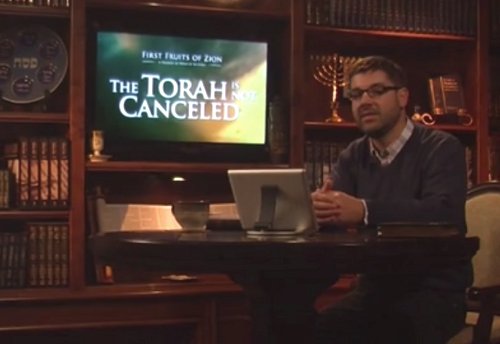
FFOZ TV Review: The Torah Is Not Canceled

ffoz_tv13_mainEpisode 13: It is commonly taught that Jesus came to cancel the law but Jesus tells his disciples “I did not come to abolish the law.” Episode thirteen will revolutionize the viewer’s understanding of the law by learning that the law was given for Godly instruction. They will discover that not only has the law of God not been done away with but the prophets tell us that it will be observed even in the Messianic Era. It will also be taught that the law has different applications for different people, with some commandments only being applicable to Jewish people.

-from the Introduction to FFOZ TV: The Promise of What is to Come
Episode 13: The Torah Is Not Canceled

The Lesson: The Mystery of Jesus and the Torah

In this episode, First Fruits of Zion (FFOZ) teachers Toby Janicki and Aaron Eby take on one of the major misconceptions of Christian doctrine, that the death of Jesus canceled the Torah and invalidated the Law. Toby calls this “The Mystery of the Torah is not Canceled,” but I prefer the other expression he used: “The Mystery of Jesus and the Torah.”

The core to this episode is a scripture that practically everyone in the Hebrew Roots and Messianic Jewish movements is keenly aware of:

Do not imagine that I have come to violate the Torah or the words of the prophets. I have not come to violate but to fulfill. For, amen, I say to you, until heaven and earth pass away, not one yod or one thorn will pass away from the Torah until all has been established.

Matthew 5:17-18 (DHE Gospels)

These verses are part of what is called the Sermon on the Mount, which is thought of in Christianity as the core of Jesus’s moral teachings.

Toby tells his audience that a closer analysis of Matthew 5:17 will help us get to our first clue in solving today’s mystery.

Do not think that I came to abolish the Law or the Prophets; I did not come to abolish but to fulfill.

Matthew 5:17 (NASB)

According to Toby, Jesus had been criticized by the Jewish religious authorities, saying that he was not teaching and living by the Torah correctly. Jesus was taking this opportunity to explain his intent as a teacher. The phrase “I have come” has the sense in the Hebrew of purpose and intention. Toby tells us that in this section of his sermon, Jesus isn’t explaining his role as Messiah in relationship to the Torah, but his intention and purpose in teaching the Torah. He wants to clear up any misunderstanding about what he’s teaching, not explain how he is going to impact Torah obedience in Israel as the coming Messiah.

ffoz_tv13_tobyBut we have to have a proper understanding of the terms “abolish” and “fulfill” in order to understand Jesus’s words. While Christians have to take at face value the verse saying that Jesus didn’t come to “abolish” the Law, that is, to destroy, discard, overturn, or annul, they often interpret “fulfill” as abolish, since the net effect in Christian thinking is that Jesus “nailed the Law to the cross.”

But within a first century Jewish Rabbinic context, how are the words “abolish” and “fulfill” understood?

Rabbi Jonathan would say: Whoever fulfills the Torah in poverty, will ultimately fulfill it in wealth; and whoever abolishes the Torah in wealth, will ultimately abolish it in poverty. (emph. mine)

-Pirkei Avot 4:9

Pirkei Avot is also called Ethics of Our Fathers, and is a collection of ancient Rabbinic teachings compiled from 200 years before Jesus’s birth until 200 years after his resurrection.

Here we see how the early Sages defined the use of fulfill and abolish in relation to the Torah (the word “neglect” was in place of the word “abolish” in the quote of Pirkei Avot 4:9 I copied from a Chabad email newsletter). I bolded some of the words in the above quoted phrase so you could better see Toby’s point.

To “abolish” in this context, means to disobey Torah.
To “fulfill” in this context, means to obey Torah.

Jesus is saying that in his teaching and his life, he did not come, that is, it was not his intention and purpose as a teacher, to disobey the Torah, but rather, to obey the Torah. Let’s look at Matthew 5:17 again but in a modified form.

Do not think that I came to disobey the Law or the Prophets; I did not come to disobey but to obey. (emph. mine)

A rather startling change of meaning, don’t you think? Now we have the first clue we need to solve the mystery:

Clue 1: Jesus came to obey and teach the Law.

But exactly what is “the Law” and why does Christianity see it so negatively? To get the answer, the scene shifts to FFOZ teacher and translator Aaron Eby in Israel.

ffoz_tv13_aaronWhat is the Torah? Most often, we think of it as the first five books of the Bible: Genesis, Exodus, Leviticus, Numbers, and Deuteronomy. And while the Torah does contain many laws for Jews living in the Land of Israel and diaspora, as well as Jewish ethical and moral conduct, it also contains the story of Creation, the calling of Abraham, Isaac, and Jacob, and the astonishing redemption of the Israelites from slavery in Egypt.

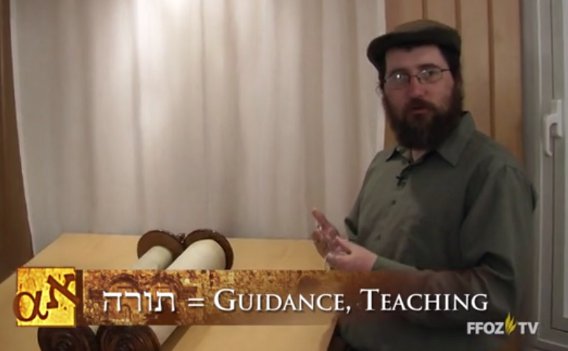
Aaron teaches us that Torah means something like “guidance,” “teaching,” or “instruction.” The root word in Hebrew is an archery term implying something that is cast, thrown, or shot with aiming or guidance, like one might shoot an arrow at a target. In this sense the Torah can be any spiritual or Biblical teaching directing someone toward righteousness. To differentiate this broader meaning from the first five books of the Bible, we call those five books the Torah of Moses.

The main point of Aaron’s teaching is rather straightforward. Torah doesn’t mean “law,” it means teaching, instruction, and guidance, in a spiritual or moral sense. It doesn’t have to refer only to the “mechanics” of the legal parts of the Torah of Moses. He also explains what a “jot” and a “tittle” or “thorn” is which illuminates how Jesus used those terms in Matthew 5:18. Jesus was saying that he did not intend to abolish or disobey even the smallest detail of the Torah until heaven and earth passed away.

Returning to Toby, we have our second clue:

Clue 2: Torah is God’s Instruction.

Toby takes the lesson one step further and describes the future role and function of the Torah in the Messianic Era. To understand how this works, we must turn to Jeremiah 31:31-34

“Behold, days are coming,” declares the Lord, “when I will make a new covenant with the house of Israel and with the house of Judah, not like the covenant which I made with their fathers in the day I took them by the hand to bring them out of the land of Egypt, My covenant which they broke, although I was a husband to them,” declares the Lord. “But this is the covenant which I will make with the house of Israel after those days,” declares the Lord, “I will put My law within them and on their heart I will write it; and I will be their God, and they shall be My people. They will not teach again, each man his neighbor and each man his brother, saying, ‘Know the Lord,’ for they will all know Me, from the least of them to the greatest of them,” declares the Lord, “for I will forgive their iniquity, and their sin I will remember no more.”

Here, Toby interprets this scripture about the New Covenant in the same way I’ve been doing on this blog for quite some time. On the surface, the prophet is saying that there will be a new covenant and that it will be different from the old covenant, but what exactly will be different. Grace instead of Law? That’s not what scripture says. Let’s drill down into verse 33:

I will put My Torah within them and on their heart I will write it; and I will be their God, and they shall be My people. (emph. mine)

ffoz_tv13_torah_bethemmanuelI substituted the word “Torah” for “Law” since that’s how it’s rendered in the Hebrew. Remember, the New Covenant is made with Judah and Israel, not with the church or the nations. God still expects the Jewish people to obey the Torah, His guidance and instruction, but it will be written internally and will be part of the fiber of their being, rather than being written externally. My understanding is that it will be second nature for the Jewish people to live a lifestyle in obedience to God, rather than struggling between the good and evil inclinations.

We saw in the FFOZ TV show None Greater Than John that verse 34 refers to the state of the people of God during the Messianic Era. We will all know God, from the greatest to the least of us, as prophets, with an overabundance of the Spirit of God upon us.

This is the Messianic Era, when the Jewish exiles are returned to their Land, the Land of Israel, all of Israel’s enemies are finally defeated forever, and King Messiah establishes world peace. In those days, all Jews will obey Torah and even the Gentiles of the nations will go up to Jerusalem to learn:

And many peoples will come and say,
“Come, let us go up to the mountain of the Lord,
To the house of the God of Jacob;
That He may teach us concerning His ways
And that we may walk in His paths.”
For the law will go forth from Zion
And the word of the Lord from Jerusalem.

Isaiah 2:3 (NASB)

Here we have the third and final clue:

Clue 3: The Torah will be obeyed in the Messianic Era

But this brings up the subject about the relationship of the Torah to the non-Jewish people. I thought that the topic would be ignored as in past episodes, but Toby briefly touches on it by saying that the Torah has different applications to Jewish and non-Jewish people. Most (non-Messianic) Jews would probably say the Torah has little to no application to the goyim at all, but Messianic Judaism sometimes has a unique perspective regarding non-Jews and particularly Christians.

At the end of the episode, FFOZ Founder and President Boaz Michael comes on camera and refers to the Torah as “God’s loving instruction.” He says that both Jews and Gentiles need to study the Torah and discover how it applies to our lives, also implying that there are different applications of the Torah to Jewish and non-Jewish people.

What Did I Learn?

ffoz_tv13_torah_lettersI gained a greater appreciation of the Rabbinic use of the terms “fulfill” and “abolish,” although I’d heard something similar in the past. I was also reminded of a discussion I had with my Pastor last week on this very topic: will there be distinctions between Jews and Gentiles in the Messianic Era and will there be any such thing as “Torah” in those days? He says “no” and I say “yes.” I don’t think the Torah ceases as we understand it today until “all is accomplished” (Matthew 5:18). The question is, when is everything that must be accomplished actually accomplished? If not even the smallest detail of the Torah pass away until heaven and earth pass away, then the only possible answer is that the Torah passes away only when there is a new heaven and earth.

Then I saw a new heaven and a new earth; for the first heaven and the first earth passed away, and there is no longer any sea. And I saw the holy city, new Jerusalem, coming down out of heaven from God, made ready as a bride adorned for her husband. And I heard a loud voice from the throne, saying, “Behold, the tabernacle of God is among men, and He will dwell among them, and they shall be His people, and God Himself will be among them…

Revelation 21:1-3 (NASB)

When the Messianic Age is established, the Torah will still be in effect upon Israel, that is the Jewish people. There will be some applications for non-Jewish believers, but Toby was deliberately vague in this area. Only after everything has been accomplished, evil has finally been defeated, and a new heaven and earth have been established, that the Torah, as we understand it, will pass away.

But as I was watching this episode and reflecting on my conversation with Pastor last week, I was reminded of a question he asked me. There are several Jewish people who attend my church. None of them are “Messianic,” and would be better called “Hebrew Christians,” people of Jewish ethnic and family lineage but those who practice a traditional Christianity. In other words, they likely believe the law is abolished in the sense of being permanently destroyed.

Pastor asked me if I thought they are obligated to the Torah. My principles say “yes,” but I was suddenly confronted with the reality of my words. Could I go up to any of these individuals unbidden, and tell them to their face that they should be performing the mitzvot, not as a matter of salvation or justification, but out of covenant obedience? Probably not (not unless they asked, of course…). It would be like going up to a Jewish person driving to shul on Shabbos and telling them they shouldn’t drive but walk instead. Who am I, the religious police? On the other hand, if the Torah is incumbent upon all the Jewish people now and will be even into the Messianic Age…what are the consequences to a Jew for abandoning the Torah, even at the behest of the Christian church?

Whoever then annuls one of the least of these commandments, and teaches others to do the same, shall be called least in the kingdom of heaven; but whoever keeps and teaches them, he shall be called great in the kingdom of heaven.

Matthew 5:19 (NASB)

prophetic_return1I believe that Jewish people are currently obligated to perform the mitzvot, but that doesn’t mean I must forcibly impose my beliefs upon them. Every person negotiates their own relationship with God. Every Jew must discover who they are as a Jew in relation to Hashem. I can only pray that all Jewish people everywhere return to the Torah and thus bring the Messiah that much closer to bringing his rule and reign fully into our world. For when he returns, as Toby and Aaron teach, the Torah will be established in Israel and will go forth into the nations from Zion.

When G‑d made the world He gave each creature, each nation and each individual a role and a meaning.
When each plays its part there is harmony.
When the lines become too blurred, there is acrimony.

-Rabbi Tzvi Freeman
“Distinctions”
Based on letters and talks of the Rebbe, Rabbi M. M. Schneerson
Chabad.org

I will review another episode next week.