Tag Archives: First Fruits of Zion

FFOZ TV Review: Call His Name Yeshua

ffoz_tv1Episode 03: It may be shocking to learn, but the fact is that many people were named Jesus in first century Israel. So how is it then that his name is the name above all names? In episode three the name of Jesus is explored in depth in order to gain a better understanding of the significance of not only Christ’s name but his mission. The name Jesus means “salvation” and it was preordained in the prophecies of the Hebrew Scriptures that the messiah would bring salvation not only to Israel but to all mankind.

From the intro to the episode: Call His Name Yeshua
FFOZ TV: The Promise of What is to Come

The Lesson: What does the Name “Jesus” Mean?

I know I’m a little late with this one, two weeks late actually, but my weekend viewing of FFOZ TV has been short circuited by weekend yard projects. I was finally able to carve out some free time to view Episode 3: Call His Name Yeshua.

This episode builds on the basics learned in Episode 1: The Good News and Episode 2: Messiah. Both of those shows focused on presenting a definition of a very basic concept in the Bible, except that in each case, the traditionally Christian audience discovered that the concepts weren’t quite so basic.

Episode 3 focuses on the meaning of the name “Jesus.” I suppose there are Christians in the world who actually believe that “Jesus” was the original name used by the Messiah, that his disciples, his friends, his mother called him “Jesus.” This isn’t possible when we consider that they would all be speaking in Hebrew or Aramaic and in those languages, it’s impossible to make a hard “J” sound.

As always, teacher Toby Janicki offers up the lesson as a mystery that must be solved using three clues. Today’s mystery is “The Mystery of the Name Jesus.” The first verse that leads into the first clue is this one.

But as he considered these things, behold, an angel of the Lord appeared to him in a dream, saying, “Joseph, son of David, do not fear to take Mary as your wife, for that which is conceived in her is from the Holy Spirit. She will bear a son, and you shall call his name Jesus, for he will save his people from their sins.”

Matthew 1:20-21 (ESV)

After using a translation with which most Christians would be familiar, Toby read the same verses again using the Delitzsch Hebrew Gospels:

He was thinking this way, but then an angel of HaShem appeared to him in a dream, saying, “Yosef son of David! Do not be afraid to take Miryam, your wife, for what has been formed within her is from the Holy Spirit. She is giving birth to a son, and you are to name him Yeshua, because he will save his people from their sins.”

As Toby pointed out, many Christians are fond of a hymn called “Jesus, Name Above All Names.” Have they gotten it wrong all these years? Is the true name of Messiah “Yeshua?” Is he offended when we call him “Jesus?” For that matter, how do we know “Yeshua” was/is his original name?

We’ll get to all that in a minute. Toby points to the first clue:

Messiah is named Jesus by direct command of God.

There’s something else. There seems to be a connection between the name Yeshua and what the angel said about him saving his people from their sins.

aaron-ebyThe scene shifts to Aaron Eby in Israel who provides the episode’s language lesson. As it turns out, we get the name “Jesus” from the Latin and Greek translations of the Hebrew word Yeshua. In Latin, his name is translated as “Iesus” and from the Greek, it’s “Ἰησοῦς”. Aaron says that we know Messiah’s name was Yeshua because it was actually a common name for Jewish men at that point in history in Israel. It’s actually a shortened version of Yehoshua which we translate into English as “Joshua.” Yehoshua means “The Lord is Salvation.”

Also, the name Yeshua, when it occurred in the Old Testament, was translated in the Septuagint as we see it also translated in the New Testament, so we can confidently say that Yeshua is the Hebrew name of Jesus.

And from what Aaron presented in his portion of this episode, the definition of the longer version of Yeshua’s name seems to be the connection in the angel’s words to Joseph. Name him “Jesus” (salvation) because he will bring salvation to his people.

Going back to Toby, we hit the second clue:

Jesus means salvation.

Since Jesus was such a common name at the time, it was important to differentiate the Messiah from all of the other Jewish boys and men called Yeshua, so he was referred to as “Yeshua of Nazareth.”

But we need one more clue and it comes from the Old Testament (Tanakh). Actually there are a lot of prophesies in the Old Testament that speak of the Messiah bringing salvation to Israel. Probably one of the oldest is in Genesis 49 when Jacob, before he dies, blesses his sons.

For Your salvation do I long, O Hashem!

Genesis 49:18 (Stone Edition Tanakh)

Toby says that according to the Jewish sages, right before Jacob uttered this exclamation, he had a vision of the end times and was longing for the coming of Messiah and his salvation.

Toby quoted from a number of prophesies, and you can find out what they are by viewing the episode, but he also spent some time using word substitution to illustrate his point: salvation = Yeshua and salvation = Jesus. Here’s a couple of examples. First, the original verse in the NASB translation:

Behold, the Lord has proclaimed to the end of the earth, Say to the daughter of Zion, “Lo, your salvation comes; Behold His reward is with Him, and His recompense before Him.”

Isaiah 62:11

Now with the first word substitution:

Behold, the Lord has proclaimed to the end of the earth, Say to the daughter of Zion, “Lo, your Yeshua comes; Behold His reward is with Him, and His recompense before Him.”

…and then the second:

Behold, the Lord has proclaimed to the end of the earth, Say to the daughter of Zion, “Lo, your Jesus comes; Behold His reward is with Him, and His recompense before Him.”

I know this program is written for a traditional Christian audience, so these verses are designed to make the greatest impact on them, but if there are any traditional (non-Messianic) Jewish viewers, they might have a hard time with the name “Jesus” being directly inserted into the Tanakh as an equivalent term for God’s salvation.

But the prophesies that Toby quotes also lead to the third and final clue:

The Prophets predicted that Messiah would bring salvation.

The lesson in this episode is as simple as that. The name “Jesus” is an English translation of the Greek and Latin translations of Messiah’s name from Hebrew, which is “Yeshua.” Yeshua relates to the Hebrew word for “salvation” and basically means that Messiah brings salvation. This was prophesied many times by many Old Testament prophets, so his name would have meaning to the Jewish people when linked with his Messianic mission.

What Did I Learn?

DaveningI learned that there is a liturgical prayer said by devout Jews three times a day that includes the phrase, …”whose horn will be raised with your salvation.”

Interestingly enough, we find something like it directly referring to Yeshua:

Blessed is HaShem, God of Yisrael, for he has taken note of his people and sent them redemption. He will cause a horn of salvation to sprout for us in the house of David his servant…

Luke 1:68-69 (DHE Gospels)

This is the blessing said over the infant Yeshua by Zecharyah the prophet at the Temple. As Toby points out, this isn’t Zecharyah asking for God to provide salvation for Israel, it’s the prophet thanking Hashem for having sent salvation in the form of the new-born Messiah Yeshua. Messiah and salvation had come.

I hadn’t made the connection between these verses and the daily prayers of Jews all over the world, all of whom are asking for one who has already arrived and who will come again: Yeshua of Nazareth, the Messiah and King of Israel.

I hope to review the next episode very soon.
FFOZ TV Review: Messiah

ffoz_tv2Episode 02: The term Christ is one of the most important terms in all of Scripture and yet is seldom fully understood by followers of Jesus. In episode two we will explore the prophecies of the Hebrew Scriptures and learn about the Jewish people’s expectation of the coming messiah. We will study the Hebrew Scriptures and learn that they speak of a coming anointed one, a king who will come to redeem mankind, defeat Israel’s enemies, and set up his kingdom.

The Lesson: What Does Messiah Mean?

In Episode 2: Messiah, the First Fruits of Zion (FFOZ) television series A Promise of What is to Come takes the audience through what to me was like “The Name of Christ 101.” I don’t mean to be flippant or disrespectful in saying it that way, but I guess I didn’t realize that there were so many Christians in the world today who still labor under a lack of comprehension of the meaning of the title “Christ”.

FFOZ teacher and narrator Toby Janicki starts off this episode correcting what most of us probably believed as children, if we were believers as children, that “Christ” is not simply the last name of Jesus. It’s a title and more than that, probably the most important concept in the Bible, particularly to the Jewish people. It not only tells us what Jesus did but what he is going to do.

Let’s look at two ways we can view Peter’s revelation that Jesus is “the Christ.”

And he asked them, “But who do you say that I am?” Peter answered him, “You are the Christ.”

Mark 8:29 (ESV)

He asked them, saying, “And you, what do you say about me — who am I?” Petros answered and said to him, “You are the Mashiach!”

Markos 8:29 (DHE Gospels)

By reading this verse using two different translations, Toby illustrates how the declaration of Peter can be viewed in two quite different ways. I find it interesting that Toby used the ESV translation, since in my Pastor’s opinion, it is actually one that promotes more of a supersessionistic or replacement theology viewpoint. Obviously, the Delitzsch Hebrew Gospels are designed to “retro-translate” the Greek into Hebrew and then translate that Hebrew forward into English to give the reader a more Jewish context for understanding the gospel message.

As in other episodes, information is cast as a mystery and we are provided with three clues in order to solve the mystery. Today, we confront the Mystery of Christ.

Toby uses John 1:41 and especially the text, “We have found the Messiah” (which means Christ) in order to show us the relationship or equivalency between the English words “Messiah” and “Christ.” This text was written for the sake of what John anticipated was a mixed Jewish and non-Jewish audience but as Toby points out, the original readers of this gospel weren’t provided with a definition of the term “Messiah.” That means the Jewish people involved, including Andrew and Simon Peter, already knew what “Messiah” meant. Yeshua (Jesus) did not invent a new role, “the Christ” but came to fulfill a pre-existing role: “Messiah.”

This gives us Clue 1:

The Title “Christ” was not new.

aaron-ebyThe scene shifts to Aaron Eby in Israel who provides the audience with a language lesson about the meaning of “Messiah” or rather, the Hebrew word “Moshiach.” He tells us that the Hebrew word “Mashach” means “to smear with oil.” We have examples in the Old Testament of both Kings and High Priests being inaugurated into office by literally having oil poured or smeared all over them.

For instance:

Then Samuel took the flask of oil, poured it on his head, kissed him and said, “Has not the Lord anointed you a ruler over His inheritance?

1 Samuel 10:1 (NASB)

So he said to his men, “Far be it from me because of the Lord that I should do this thing to my lord, the Lord’s anointed, to stretch out my hand against him, since he is the Lord’s anointed.”

1 Samuel 24:6 (NASB)

The “one who is anointed” or “anointed one” is “Moshiach” in Hebrew. When this Hebrew word had to be translated into Greek, the Greek word for “smeared with oil” was used, “Christos.” When the Greek was translated into English, rather than render it as “anointed one” or even “Messiah,” translators created a brand new word in English: “Christ.”

The scene returns to Toby for the rest of the message and we arrive at the final two clues.

Clue 2:

Messiah = Anointed One

And Clue 3:

Old Testament prophesies talk about the anointed one.

No one in the days of Jesus had to define what “Messiah” meant because every Jewish person already knew.

Philip found Nathanael and said to him, “We have found Him of whom Moses in the Law and also the Prophets wrote—Jesus of Nazareth, the son of Joseph.”

John 1:45 (NASB)

Messiah had been written about in the Torah of Moses and in the Prophets. Toby provides some key texts citing an anointed King such as David or Solomon and linking them to the anointed King: Messiah. He also reminds us of the two roles that Messiah fulfills, being both King, which we have already seen, and High Priest:

He became to all those who obey Him the source of eternal salvation, being designated by God as a high priest according to the order of Melchizedek.

Hebrews 5:9-10 (NASB)

In addition to quoting from Psalm 2 and Psalm 132, Toby relates the Messianic prophesies from Daniel 9:25, where we learn that Messiah will come to rebuild the ruins of Jerusalem, and Isaiah 61:1-3 where Messiah speaks in his own voice through the prophet. This is also the scroll that Jesus read in the synagogue as he declared himself as Moshiach before his people.

The scroll of Yeshayah the Prophet was given to him, and he opened the scroll and found the place where it is written:

The spirit of HaShem is upon me in order to anoint me to bring good news to the humble. He has sent me to care for the brokenhearted, to proclaim freedom for the exiles, and for the blind an opening release … to send the oppressed away free … to proclaim a year of favor for HaShem.

When he rolled up the scroll, returned it to the chazzan, and sat, the eyes of all who were in the synagogue were focused on him. He began saying to them, “Today this passage is fulfilled in your hearing.”

Lukas 4:17-21 (DHE Gospels)

But all is not fulfilled. The Messiah came once but, as we saw in the previous episode The Good News, the Messiah has yet to establish Israel as the head of all nations, redeem her people, and bring peace to Israel and the nations.

As we Christians wait for his return, Jews all over the world wait also for Messiah, as it is said:

I believe with great faith in the coming of Messiah, and even though he may delay, nevertheless, I still believe every day that he will come.

the twelfth declaration of faith

ffoz-tv-messiah
Maimonides, also known as the Rambam, wrote that declaration over a thousand years ago, and still Jews all over the world await the Messiah in great and perfect faith.

And so do we.

What Did I Learn?

Not to put too fine a point on it, I have heard most or all of this information about the meaning of “Christ” and “Moshiach” before. I guess you don’t have to spend too much time in the Hebrew Roots or Messianic movements before the subject comes up. Also, I believe this information is (or should be) largely available in most churches.

If I learned anything new, it was that, by creating this specific episode, the content planners at FFOZ must believe that this is new and valuable information for a traditionally Christian television audience. If that’s the case, then many Christians must have a great need for even the most basic information about the “Jewish Jesus” or Yeshua HaMoshiach.

If you found this message about the true meaning of the title “Christ” interesting and illuminating, I highly encourage you to watch the complete episode and all of the other episodes available at tv.ffoz.org. It is First Fruits of Zion: A promise of what is to come.

I hope to review the next episode very soon.

FFOZ TV Review: The Good News

ffoz_tv1Episode 01: Most Christians believe that the gospel message of Jesus is that he died for our sins and if we have faith in him we will be given the gift of eternal life. While certainly this is a major component of the gospel, it is not the whole story. In episode one viewers will learn that the concept of the gospel wasn’t invented by Jesus or the disciples, but rather was prophesied in the Hebrew Scriptures. The “Good News” was the promise of the coming messiah and that he would bring redemption to the children of Israel.

At the First Fruits of Zion (FFOZ) Shavuot conference last spring, I told FFOZ President Boaz Michael that I’d like to spread the “good news” of their television ministry through my blog by reviewing one episode of their TV show per week. Obviously, I’ve fallen down on the job. My life has been busy and there have been so many things I’ve wanted to write about. A few months ago, I did write a review about the FFOZ TV series as a whole, and watched a few episodes to get a “flavor” of how the show is organized. But that doesn’t impart the nature of the message each show offers its audience.

Today (as I write this), I’ve revisited my promise and watched the first episode, The Good News. This is actually about the “mystery” of the good news or gospel, since what Christians believe about the gospel message is only part of the story.

The Lesson: What is the Good News?

Toby Janicki is the main speaker and teacher for this and every episode and he asks the question, “what is the gospel message?” Christians think we know the answer. The gospels are the books of Matthew, Mark, Luke, and John and the gospel message is that Jesus died for our sins and was resurrected. Through his atoning work, anyone who believes in Christ will have their sins forgiven, receive eternal life, and go to heaven when they die.

Toby doesn’t deny any of that for a second but tells us that it is only part of the message of the gospel or “good news.”

This episode, like the entire TV series itself, encourages the viewer to look at the New Testament from its original First Century CE Jewish context. What would the Jewish people in the time of the apostles have heard and understood when Jesus spoke? How the church presents the gospel today does not carry forward that context and what we hear preached every Sunday is only a portion of the message. That’s the value of this television series to its defined audience, traditional Christian believers. Know Christ better by learning to understand the Jewish Jesus.

Jesus and the apostles were teaching the gospel or good news message long before the crucifixion and it wasn’t “Jesus will die for your sins.” In fact, Jesus spoke the good news in the very beginning:

The Spirit of Hashem is upon me in order to anoint me to bring good news to the humble. He has sent me to care for the brokenhearted, to proclaim freedom for the exiles, and for the blind an opening release … to send the oppressed free … to proclaim a year of favor for Hashem.

Luke 4:18-19 (DHE Gospels)

I used the Delitzch Hebrew Gospels translation for these verses, which Toby also reads from on the show when he quotes from the gospels. It imparts a greater sense of the Hebrew message by “retro-translating” the Greek text into Hebrew and is very helpful in drawing the mind of the Christian reader into the Jewish world of the Messiah.

You may also know that, in the above-quoted verses, Jesus was reading Isaiah 61:1-2 in the synagogue and he was speaking about himself. That scripture, along with several others from Isaiah, will provide valuable source information later in the show that is used to define “good news”.

So who are exiles, the blind, and the oppressed and what do they have to do with the gospel message?

The fact that the apostles didn’t seem to understand that Jesus had to die, and when he did, the shock, disappointment, and fear they experienced before his resurrection, as well as the surprise they felt after he was, tells us that they did not realize the good news had anything to do with the death and resurrection of the Messiah. What then did they think they were preaching to Israel and what was this “good news?”

Then Yeshua traveled around in all the Galil. He taught in their synagogues, he proclaimed the good news of the kingdom, and he healed every sickness and every disease among the people.

Matthew 4:23 (DHE Gospels)

It’s interesting that Toby notes Jesus never defines what the good news is to either the apostles or to anyone he preaches to. He assumes they already know what the gospel message is. But if even the apostles didn’t realize it meant that Jesus was to die, what were they supposed to know?

In this and the other FFOZ TV episodes, Toby presents information and then summaries it as clues, in this case three clues. The first is that the gospel or good news is actually the “good news of the Kingdom” as stated in the above-quoted passage from Matthew. This was a message specifically meant for the Jewish people in Israel and it was good news they were wanting to hear, a message of something they had been waiting for.

To understand what the gospel message is, the scene switches from Toby in the studio to FFOZ teacher and translator Aaron Eby in Israel. He provides the Hebrew language background for each lesson including this one.

ffoz-teaching-teamAaron takes us through a series of passages from the book of Isaiah including Isaiah 40:9, 52:7, 60:6, and of course, 61:1. In each case the good news is the message of the Messianic mission, the redemption of Israel, that is, physical, national Israel, as well as the entire world, when the Messiah comes to reign as King. The Hebrew word for “good news” is related to the Greek word and its variants that we translate into English as “evangelism” and “gospel”. It’s easy to see how the church has historically understood the message in one sense, but missed its larger meaning.

The scene shifts back to Toby who gives us the second clue: there is a gospel message in the Old Testament. That also takes us to clue 3: the gospel in the Old Testament is the promise of the coming of Messiah and the redemption of Israel, the Jewish people.

We can clearly see that the apostles expected this after the resurrection:

So when they had come together, they were asking Him, saying, “Lord, is it at this time You are restoring the kingdom to Israel?” He said to them, “It is not for you to know times or epochs which the Father has fixed by His own authority; but you will receive power when the Holy Spirit has come upon you; and you shall be My witnesses both in Jerusalem, and in all Judea and Samaria, and even to the remotest part of the earth.”

Acts 1:6-8 (NASB)

Notice that Jesus doesn’t rebuke the apostles for desiring national redemption and self-rule, he just says they don’t have the right to know when it will occur. He does say that before his return and the establishment of the Messianic Kingdom, they will receive power from the Holy Spirit to be Messianic witnesses “in Jerusalem, and in all Judea and Samaria, and even to the remotest part of the earth,” which is exactly what we see in the rest of the book of Acts and the New Testament.

Toby then takes the audience through a more detailed examination of each of the previously identified passages in Isaiah, closely drawing the meaning of the good news out and illustrating for us repeatedly how the Jewish audience in the time of the apostles would have understood the good news of Jesus as the coming of the Messiah and the redemption and restoration of Israel, and a reign of peace throughout the entire world.

Who are the exiles? Who are the blind? Who are the persecuted? Exiled and persecuted Israel, temporarily blinded to the Messiah for the sake of the Gentiles:

For I would not, brethren, that ye should be ignorant of this mystery, lest ye should be wise in your own conceits; that blindness in part is happened to Israel, until the fulness of the Gentiles be come in.

Romans 11:25 (KJV)

The Greek word most Bibles translate as “hardening” or some variant, is sometimes rendered as “blindness,” such as the King James Bible does. Read in a Jewish context and heard through a Jewish consciousness, when Jesus recited the words of the Prophet Isaiah in Luke 4:18-19, he was saying that he was the Messiah who had come to bring the good news to Israel and to one day redeem and restore her as a physical Kingdom on Earth.

Toby said something interesting about one of the Isaiah prophesies I want to share:

An abundance of camels will envelop you, camel colts of Midian and Ephah, and all of them will come from Sheba; gold and frankincense will they bear, and they praises of Hashem will they proclaim.

Isaiah 60:6 (Stone Edition Tanakh)

Toby relates that according to the Jewish sages, this describes the Gentile nations coming to Jerusalem to pay tribute to King Messiah. However, we have already seen something similar in the Magi of the East coming with gifts to pay tribute to the newborn Jesus. Of course, it is quite possible that Isaiah’s prophesy may have more than a single application. And it’s important to know the relationship between Gentile Christianity, the redeemed Israel, and the Jewish Messiah King.

The other interesting thing that Toby brought up (and I never realized this before) is that Jesus is actually speaking in Isaiah 61:1. Notice the text says (as translated in the Stone Edition Tanakh) that “the spirit of my Lord, Hashem/Elohim, is upon me, because Hashem has anointed me to bring tidings to the humbled; He has sent me to bind up the brokenhearted…

The emphasis is obviously mine and I include it to illustrate that it is the Messiah who is directly speaking in these verses, the voice of Yeshua bringing hope to Israel in the pages of the Old Testament.

When Christians read about the redemption of Israel in Isaiah, they often interpret the prophesy to mean “spiritual Israel” or “the church.” And yet, the Jewish hearers of Jesus and the Jewish readers of the gospels of the apostles would have understood the message much differently. They would have understood that the good news of Jesus is the promise of the coming Messiah and the redemption and restoration of national, physical Israel as a Kingdom on Earth.

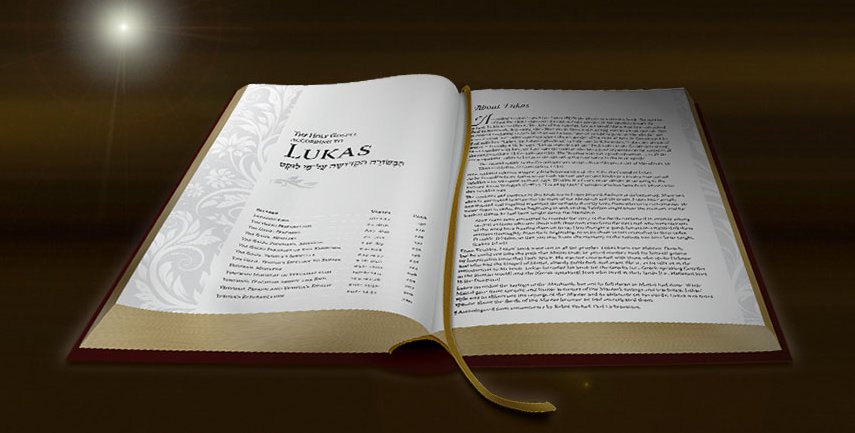
dhe_lukas

This does not unwrite or replace the fact that Jesus died for our sins and that in his resurrection, we have forgiveness and an eternal place in the world to come if we believe. However, we Gentiles are grafted in to the commonwealth of Israel, as Toby teaches. We don’t replace Israel, we come alongside her and partakers of the promises, and as subjects and servants of the Jewish Messiah King.
What Did I Learn?

I’ve consumed a great deal of this material at FFOZ conferences or from their audio CD lectures as well as reading it in their printed material, but this television episode titled “The Good News” helped me organize that information into something that is easier for me to remember and transmit to others, a message to my Christian reading audience (and I am a Christian among them) that we have only been taught part of the story of the good news.

Toby Janicki, Aaron Eby, and the rest of the FFOZ ministry have “solved” the mystery of the gospel and clued us in on the rest of the message: Jesus came to die for our sins and to deliver the promise of everlasting life for all who believe. But, and this is extremely important, as Messiah King, he came to deliver the promise of good news to all of Israel that when he returns, he will release the captives in exile, restore sight to the temporarily blinded, free the oppressed Jewish people, and proclaim freedom for Israel, the year of favor from the Lord.

If you found this message of the true good news of Jesus Christ interesting and illuminating, I highly encourage you to watch the complete episode The Good News, which is the first in the series, at tv.ffoz.org. It is First Fruits of Zion: A promise of what is to come.

I hope to review the next episode very soon.

The Jewish Gospel, Part 2

studying-talmudBut the way Boaz teaches this lesson teaches us something about Biblical sufficiency. The idea of sufficiency is that the Bible is all that we need to understand the Bible. That’s not exactly true. While the plain meaning of the text does teach us something about Jesus and who we are as Christians, an understanding of early Jewish thought, writings, and midrash, shows us that the text contains a deeper meaning, one that would elude us if we ignored the extra-Biblical understanding of how an early Jewish audience would have comprehended these verses and associated them with other parts of the Bible. Sola scriptura isn’t quite the beginning and end of how we can understand the Word of God.

We may call the Bible “sufficient” and it is, but it can be more “complete” only when we reinsert the Jewishness of its overall context and include both Jewish perspective and Jewish midrashic thought into our understanding.

That is some of my commentary from yesterday’s morning meditation (If you haven’t done so already, please click the link and read part 1 before continuing here) based on First Fruits of Zion (FFOZ) founder and director Boaz Michael’s “Moses in Matthew” presentation. The original lecture series is a couple of years old, but it was recently released on audio CD and I’ve had the opportunity to listen to this teaching. I learned a few things from this lecture and by sharing some of it, I hope you can learn a few things, too.

One of the scribes came near and heard them disputing with one another, and seeing that he answered them well, he asked him, “Which commandment is the first of all?” Jesus answered, “The first is, ‘Hear, O Israel: the Lord our God, the Lord is one; you shall love the Lord your God with all your heart, and with all your soul, and with all your mind, and with all your strength.’ The second is this, ‘You shall love your neighbor as yourself.’ There is no other commandment greater than these.”

Mark 12:28-31 (NRSV)

It’s interesting that Matthew’s rendition of this event (Matthew 22:36-40) doesn’t include a more direct reference to the Shema. Many Christians imagine that Jesus replaced the 613 commandments of the Torah (though the Torah wouldn’t be formally codified in this manner for many centuries after the resurrection) with just two, thus substituting grace for the law. But that’s not how it would have sounded to Messiah’s original Jewish audience.

In yesterday’s blog post, I related the part of Boaz’s teaching illustrating how the Master (or any Jewish teacher in those days) could quote from just a single verse in a Psalm or other portions of the Tanakh (Old Testament), and his audience would immediately recall the full text of the part of scripture to which he was referring, connecting the teaching to the much wider body of words and imagery. When Jesus taught about the two greatest commandments and in Hebrew said, “Shema Yisrael” (Hear O Israel), the people listening wouldn’t have just thought of Deuteronomy 6:4-7, but to the rest of the content of that chapter as well as Deuteronomy 11 and Numbers 28 which also are part of the Shema. The reason the Pharisee who was an expert in the law agreed with Jesus so strongly is because he not only agreed with the interpretation of the immediate text under discussion, but the wider implications of how Jesus was presenting and teaching the Shema and Torah as good news and hope to Israel.

And again, Christians tend to miss this point, especially since we are (most likely) reading the text in English and not viewing it with a Jewish mindset. But the further importance of the Delitzsch Hebrew Gospels being presented at the same time as Boaz’s teaching is that “retro-translating” the Greek back into a “Hebrew voice,” allows for a more “Jewish” reading of this lesson, giving us a closer look at how the ancient Jewish listeners were hearing and understanding Jesus. Even reading the Gospels in Greek would still “miss” what the ancient Jews were hearing when Jesus taught.

We can see a further connection here:

Everyone then who hears these words of mine and acts on them will be like a wise man who built his house on rock.

Matthew 7:24 (NRSV)

The two greatest commandments do not replace the Torah nor do they really condense the Torah. This teaching actually unpackages the meaning of the Shema and defines any Jewish person who has faith in God and who is zealous for the Torah to be both hearers and doers of the Word and will of God.

That’s a lot to pull out of a short discussion between Jesus and a legal expert.

the-teacherBut Boaz’s teaching is called “Moses in Matthew” and in referencing Matthew chapters 1 and 2, he says that it was the Apostle’s intent to mirror the birth and childhood narratives of Jesus with Moses. That may not be immediately obvious to the Christian reader, which is why lectures such as this one are so important.

I won’t go into all of the details (since my notes are limited) but making the connection requires some knowledge of Jewish midrash (Maybe books such as those written by Daube and Lachs would help) about the early life of Moses and his parents, information that isn’t available in the Bible (and Bible sufficiency proponents will likely struggle at this point). But Jesus’s audience would have been aware of some form of the midrashim connected to the early life of Moses, and when reading how Matthew wrote about the early life of Jesus, Boaz believes Matthew’s audience would be saying to themselves, “I’ve heard this story before.”

As an aside, I just read Dr. Michael L. Brown’s review of David Klinghoffer’s book Why the Jews Rejected Jesus in which Dr. Brown writes the following:

Klinghoffer fails to grasp the depth of Matthew’s hermeneutic (along with the hermeneutic of other NT authors), noting, “Pointing out the imprecision of proof texts like these, one feels almost unsporting. It’s too easy” (66). To the contrary, as top Matthew scholars have observed, “Matthew was not above scattering items in his Greek text whose deeper meaning could only be appreciated by those with a knowledge of Hebrew. Indeed, it might even be that Matthew found authorial delight in hiding ‘bonus points’ for those willing and able to look a little beneath the gospel’s surface.”3 At times it is clear that Klinghoffer simply failed to get the NT author’s point (see again 66, citing Matt 2:23 and Isa 11:1).

Boaz Michael’s perspective on Matthew’s Gospel is not in isolation. Now to continue with the main portion of my missive.

Please keep in mind that the point isn’t whether or not midrash is literally true. It probably isn’t. But the cultural context of the midrashim and what it means to a Jewish audience is what connects and binds the interpretive stories about Moses to the stories Matthew was telling about the young Jesus and his family.

Boaz went on in his teaching to compare the temptation accounts in Luke 4 and Matthew 4. They’re not the same. Matthew includes specific details that Luke leaves out, such as the Master fasting for forty days and forty nights. That specific time period (as opposed to just forty days) is mentioned only four times in the Bible, and three of those events are related to fasts (Elijah’s fast is one of them). How could Matthew’s readers not associate Jesus’s fast in the wilderness with that of Moses on the Mountain with God. It is further said in midrash that Moses dined on the bread of angels on the Mountain (somewhat contradicting that he was fasting) and in Matthew’s account of the temptation, the Adversary said that Jesus could command stones to become bread.

The order of the temptations is reversed from Luke to Matthew, with Matthew’s account presenting Jesus being taken to a high mountain and shown all the nations as the last temptation. Just before Moses’s death, God took him to a high mountain and showed him all of the nation of Israel.

(You might be thinking that these comparisons aren’t very strong, but it’s the way Matthew is writing his entire Gospel that provides the complete illustration of Messiah and Moses. The Gospels differ from each other, not because the Gospel writers were inconsistent, but because they each had a different emphasis on Messiah to present, like four different artists each painting a different portrait of Messiah. Same guy but different styles and interpretations.)

When Jesus saw the crowds, he went up the mountain…

Matthew 5:1

When Jesus had come down from the mountain, great crowds followed him…

Matthew 8:1

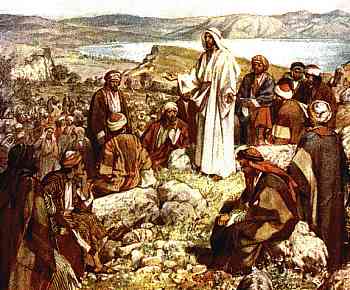
In between these two events, Yeshua (Jesus) delivered what has come to be called “the Sermon on the Mount.” It might surprise you to hear that Boaz believes Jesus going up the mountain and then coming back down can be compared to Moses going up to receive the Torah and coming back down. That probably sounds a little thin to you, but consider the function of the sermon itself. It’s been called the greatest distillation of the Torah. Moses ascended the mountain to receive the Torah and descended to deliver it to Israel. Jesus ascended the mountain to teach the Torah and descended when he had finished.

Also, when Moses descended, he encountered the faithless Children of Israel worshiping the Golden Calf. When Jesus descended, he encountered a leper (actually, a Jewish man with a form of “spiritual skin disease”) who through faith was made clean of his disease. There’s a “mirror effect” being created between Moses and Jesus by Matthew for his readers.

Now here’s something really interesting.

“Do not think that I have come to abolish the law or the prophets; I have come not to abolish but to fulfill. For truly I tell you, until heaven and earth pass away, not one letter, not one stroke of a letter, will pass from the law until all is accomplished.

Matthew 5:17-18

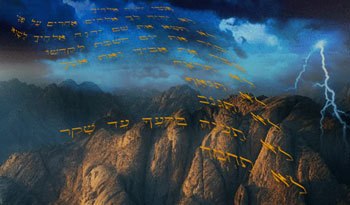
Torah at SinaiAnyone involved in either the Messianic Jewish or Hebrew Roots groups for more than five minutes will recognize this passage as the core message of those two movements. Yes the Torah will pass away, but not until Heaven and Earth pass away. Now here’s the really cool part.

Truly I tell you, this generation will not pass away until all these things have taken place. Heaven and earth will pass away, but my words will not pass away.

Matthew 24:34-35

The words of the Torah will pass away at some point in the future, but Messiah says that his words will never pass away.

The Torah is greatly praised both in the Tanakh (Old Testament) and in the New Testament but if you study the Torah, a great deal of its content has to do with daily living in Israel, daily human living on earth. All of that will eventually fade away after a long, long period of time.

I saw no temple in the city, for its temple is the Lord God the Almighty and the Lamb. And the city has no need of sun or moon to shine on it, for the glory of God is its light, and its lamp is the Lamb. The nations will walk by its light, and the kings of the earth will bring their glory into it. Its gates will never be shut by day—and there will be no night there. People will bring into it the glory and the honor of the nations. But nothing unclean will enter it, nor anyone who practices abomination or falsehood, but only those who are written in the Lamb’s book of life.

Revelation 21:22-27

With no temple currently existing in Jerusalem, most Christians think the Torah has already been done away with and been replaced by Christ’s grace, but I believe another temple will be built. It would be impossible to observe the laws related to the temple without the Torah being in effect for the Jewish people. We know that the Gentile nations will be required to send representatives to Jerusalem to observe Sukkot every year in the Messianic Era. Again, observing the festival requires a temple in Jerusalem and the laws of the Torah for temple worship. Jesus said the Torah will be with us as long as there are a heaven and earth. Eventually there will be no Torah and no Temple, but we aren’t there yet. But even when we get there, the words of the Lamb will remain, for they are eternal.

All the nations you have made shall come and bow down before you, O Lord, and shall glorify your name.

Teach me your way, O Lord, that I may walk in your truth; give me an undivided heart to revere your name.

Psalm 86:9, 11

I’ve said in today’s “meditation” as I’ve said many times before, that the Torah remains and functions. It remained and functioned after Christ’s ascension and in the days of James, Peter, and Paul. In order for prophesy to be fulfilled, the Torah needs to remain in force for the Jewish people until all has been completed and as long as there is a heaven and an earth.

But if you’re a Christian reading this, you’re probably wondering what that means to you. Even if you’re willing to accept the continued authority of the Torah for the Jewish people (a big “if” for many Christians), what does it have to do with a believer who isn’t Jewish?

There’s a great deal in even a surface reading of the Torah that has to do with a Christian living a holy life. All of the principles upon which we live a life of faith are from Torah; caring for the disadvantaged, feeding the hungry, comforting the widow, helping a neighbor, visiting the sick…these are all from Torah and they all apply to Christians today.

Boaz said that the heart of discipleship is to study the teachings of our Master and to apply those parts of the teachings that directly connect to us to our daily living. Remember, Jesus primarily taught to Jewish audiences who were perceiving his teachings from a Jewish worldview. Paul was the primary agent responsible for taking those Jewish teachings and crafting them in a manner “digestible” to a God-fearing Gentile audience.

The first discourse Paul gave at the synagogue in Pisidian Antioch (Acts 13:13-43) was a teaching of Jesus the Messiah as the culmination of Jewish history condensed (and most likely summarized by Luke) by the Apostle and presented to Jewish and God-fearing Gentile listeners. Their response was overwhelmingly enthusiastic.

messiah-prayerBut as time passed, the message of the good news of Messiah became increasingly “Gentilized” and eventually divorced from its Jewish context. Even those Christian scholars who can read the New Testament in the Greek can easily miss the “Hebrew voice” of the Apostles and thus lose a great deal of their intent and meaning.

Which is why teachings such as this one given by Boaz Michael are important. It’s why studying midrash and Jewish thought are exceptionally helpful in augmenting our understanding of the Bible.

The value of the Messianic Jewish and Hebrew Roots movements for non-Jewish believers is to teach us the Torah and how to read it in relation to the New Testament scriptures. It’s to help us filter the Bible through the eyes of Jewish thinkers, writers, and sages. It’s to encourage us to think outside the traditional Christian “box,” not to turn us into quasi-Jewish people, but to define and illuminate the Christian relationship to the Jewish people, the chosen ones of God, and thus to Messiah himself, the first-born son of Israel.

If you are intrigued but unfamiliar with the perspectives I’ve been discussing in yesterday’s and today’s blog posts, I encourage you to go to First Fruits of Zion and see what else they have to offer. As a fellow Christian and student of the Bible, I’ve found many of their materials invaluable in my own exploration of my faith.

Who is the Jewish Jesus and how does a “Jewish” understanding of the scriptures make us better Christians? It’s a journey I hope you’ll join me on as we investigate this “undiscovered country,” including the Jewish Gospel of Matthew.

The Jewish Gospel, Part 1

620_moses-in-matthewLast night, the new MJTI Interfaith Center in Beverly Hills hosted a seminar on the Gospels with special guest, Boaz Michael, the founder and director of First Fruits of Zion.

The two-hour seminar introduced many of the typologies throughout Matthew to Yeshua’s “Moses-like” fulfillment. The Gospels are composed in a thoroughly Jewish manner and need to be understood within that context to fully see what and why things take place and are said. The Moses in Matthew seminars are currently being offered at various locations and if you have the opportunity to attend one of these seminars, definitely do it! I found myself not only intellectually engaged and enlightened, but spiritually encouraged by this discussion.

-Rabbi Joshua Brumbach
“Moses in Matthew”
Yinon Blog

I acquired an audio CD of this presentation from First Fruits of Zion (FFOZ) through the FFOZ Friends program and have been meaning to review it for awhile now. It’s hard for me to sit still and listen to a recorded audio lecture, but I took my wife’s portable CD player outside and, as I weeded in the back yard, allowed my mind to be illuminated by Boaz Michael’s teaching while my body took care of the home that God has graciously provided. I learned a few things. I’d like to pass them along to you (and I apologize if I got anything in Boaz’s presentation not quite right…it’s tough to take notes while weeding).

The Lord your God will raise up for you a prophet like me from among your own people; you shall heed such a prophet.

Deuteronomy 18:15 (NRSV)

According to Boaz’s teaching, the Gospel of Matthew was written specifically for a Jewish audience and was probably the only one of the Gospels originally written in Hebrew (although the Hebrew original is lost to us). The words of Moses quoted above foretell of a prophet greater than Moses who would one day rise up from among Israel. This prophet would be Messiah and he would also be a King and do many great signs and wonders. Messiah would be known by the prophesies he would tell and he would lead Israel back to faithfulness in the Torah.

In Matthew and the other synoptic gospels, it was asked if Yeshua (Jesus) was the prophet, but in John’s gospel, it was declared that he was (and is) the prophet.

Boaz tied his teaching to the release of the Delitzsch Hebrew Gospels (this was a few years back) and he described at length the history of Franz Delitzsch and his mission to “retro-translate” the Greek language of the Gospels back into Hebrew. This doesn’t restore the “Hebrew text” but it does provide the “original voice,” the Hebrew voice of the gospels and the gospel writers.

That’s an important point to get because the focus of Boaz’s “Moses in Matthew” teaching is to be able to read Matthew the way a Jewish person would have read it during the early days of the Jewish religious movement “the Way.”

Boaz said something I consider very important (paraphrasing): “Every translation is really a commentary.” I know my own Pastor has said that we need to be able to understand the Bible in its original languages and within its own context in order to gain an objective understanding of what God is trying to say. My counter argument is that any translation imposes a certain set of assumptions being made by the translator so that interpretation doesn’t begin after translation but during translation. It’s at this point when we also start making connections from one text in the Bible to another and deciding what those connections mean.

And there shall come forth a shoot out of the stock of Jesse, and a twig shall grow forth out of his roots. And the spirit of the Lord shall rest upon him, the spirit of wisdom and understanding, the spirit of counsel and might, the spirit of knowledge and of the fear of the Lord. And his delight shall be in the fear of the Lord; and he shall not judge after the sight of his eyes, neither decide after the hearing of his ears.

Isaiah 11:1-3 (JPS Tanakh)

The people of Nineveh will stand in judgment of this generation and condemn it, for they repented at the call of Yonah. But look! One greater than Yonah is here. The queen of Teiman will stand in judgment of this generation and condemn it, because she came from the ends of the earth to hear the wisdom of Shlomoh. But look! One greater than Shlomoh is here.

Matthew 12:41-42 (DHE Gospels)

shlomo-hamelechThese verses tell a Jewish audience (and hopefully the rest of us) something about the Messiah. The prophet Isaiah tells us that the Spirit of the Lord shall rest upon the Messiah, Son of David, and he shall be wise and understanding and knowledgeable, more so than Solomon. The idea is that Messiah isn’t just like Moses the Prophet, David the King, and Solomon the Wise, but he is greater than all of those. The Hebrew word translated as “delight” from the passage in Isaiah actually is better translated as “sense,” giving the idea of sense of smell, so it is like Messiah can sense, almost “smell out” the truth.

While a general audience can “get” the meaning of all this, it would, according to Boaz, have been quite a bit more obvious to a Jewish audience in the days of Matthew and in fact, it was Matthew’s intent to write in a manner that would demonstrate Messiah to them in a uniquely Jewish way. The gospels, and especially Matthew’s, are considered the greatest Jewish story ever told, if we just know how to properly read it.

Here’s another Jewish story:

During the fourth watch, Yeshua came to them, walking on the surface of the water. His disciples saw him walking on the surface of the sea and were terrified. They said, “It is the appearance of a spirit!” and they cried out in fright. Yeshua called to them, “Be strong, for it is I. Do not fear!”

Matthew 14:25-27 (DHE Gospels)

The full text of this event is in Matthew 14:22-33. You probably think you know everything there is to know about this story, including Peter’s brief ability to also walk as long as he kept his eyes on the Master.

But to an ancient Jewish audience, it says so much more.

When God began to create heaven and earth — the earth being unformed and void, with darkness over the surface of the deep and a wind from God sweeping over the water…

Genesis 1:1-2 (JPS Tanakh)

The Hebrew word translated as “wind” can also be translated as “spirit,” thus we understand that it was the spirit from God that was hovering over the water.

This is the part where you have to “think Jewishly” and moreover, to have access to popular Jewish writings and teachings that are now collected in a large number of written works but at the time Matthew was writing his gospel, were more likely conveyed through oral tradition in less refined forms.

Boaz states in his presentation that according to Midrash Rabbah, it was the spirit of Moshiach (Messiah) that hovered over the waters. We know (and Matthew’s Jewish audience would have known) that from Isaiah 11:1-3 the spirit from God rested upon Moshiach. We know from Matthew 3:16-17 that the spirit came from God “like a dove” and rested on Jesus.

According to midrash, whose spirit hovered over the water? The Spirit of Moshiach. Putting all this together, the Messiah “hovering” or “walking” over the water would have summoned an immediate connection between that event and Moshiach’s Spirit hovering over the waters at creation.

This is also an indication that Messiah is greater than Moses. Moses’s name indicates one who was saved or drawn from water. We also know of Moses, through the power of God, splitting the Reed Sea (yes, that’s “Reed Sea.” “Red Sea” is a poor translation) and walking at the bottom of the sea with the water over him. Yeshua is greater because he is over the water as was his spirit at creation.

Your way was through the sea, your path, through the mighty waters; yet your footprints were unseen.

Psalm 77:19 (NRSV)

walking_on_waterThis verse seems to reference Moses but it is also Messianic because footprints are “unseen” when someone is walking on top of water. Also water, in ancient Jewish thought, represents chaos. In the story of creation, God “binds” and limits the great waters with shores. Yeshua is above the chaos and Matthew telling this story as he does, is declaring to his Jewish audience that Jesus is the Messiah from creation. For the rest of us, his message is that the good news of Moshiach is “first to the Jews.” It is the story of Jewish good news.

But the way Boaz teaches this lesson teaches us something about Biblical sufficiency. The idea of sufficiency is that the Bible is all that we need to understand the Bible. That’s not exactly true. While the plain meaning of the text does teach us something about Jesus and who we are as Christians, an understanding of early Jewish thought, writings, and midrash, shows us that the text contains a deeper meaning, one that would elude us if we ignored the extra-Biblical understanding of how an early Jewish audience would have comprehended these verses and associated them with other parts of the Bible. Sola scriptura isn’t quite the beginning and end of how we can understand the Word of God.

There’s another message here according to Boaz. In his presentation, he was addressing a traditionally Christian audience, one who was just becoming involved in FFOZ’s HaYesod program. Historically in the Messianic Jewish and Hebrew Roots movements (and I can attest to this personally), there’s been a tendency for Gentile believers to become enamored with the Torah to the exclusion of the rest of the Bible. It has tended to “defocus” Gentile believers involved in either of these movements from the Gospels and from the Messiah. Just as the Gospels don’t replace Moses and the Torah, Moses and the Torah don’t replace Jesus and the Gospels. The Gospels require the Torah to illustrate and validate the message of Messiah but always remember, the Messiah is the Prophet, the one who is greater than Moses.

But there’s more in Matthew that teaches us about Messiah:

They remained there until the death of Hordos, fulfilling the word of HaShem through the prophet, sayings, “Out of Mitzrayim I called my son.”

Matthew 2:15 (DHE Gospels)

This is a direct reference to the following:

When Israel was a child, then I loved him, and out of Egypt I called My son.

Hosea 11:1 (JPS Tanakh)

Modern Jewish commentators cry “foul” at Matthew’s application because Hosea is clearly referring to Israel the nation as God’s son, not the Messiah. But the heart of Jewish interpretation and application is taking scripture and applying it differently to other circumstances. This also does something special that I completely agree with. Matthew is creating a one-to-one equivalency between Israel and Messiah. Messiah is not only the Son of God, but the living embodiment of the nation of Israel; the Jewish people. Moshiach is Israel’s first-born son.

Yeshua spoke all these things in parables to the crowd of people, and other than parables, he did not speak to them at all, fulfilling what the prophet spoke, saying, “I will open my mouth with a parable; I will utter riddles from ancient times.”

Matthew 13:34-35 (DHE Gospels)

This compares to the following:

I will open my mouth in a parable; I will utter dark sayings from of old.

Psalm 78:2 (NRSV)

But here we learn something else. Typically, a Christian will understand that Matthew 13:34-35 is relating back to Psalm 78:2. In a Bible study on the verses from Matthew, a Christian teacher would probably include a reference specifically to Psalm 78:2 rather than the entire content of that Psalm. But from a Jewish writer’s point of view, he intends for his audience to read or hear that portion cited from Matthew and to recall all of the Psalm.

bet_midrash_temaniPsalm 78 as a whole, describes the repeating cycle of Jewish faithfulness and unfaithfulness, faithfulness and unfaithfulness to God. Matthew wants his audience to “get” this point and associate it with Yeshua as Messiah and that Messiah has come to restore Israel’s faithfulness to God.

Again, if we just isolate and link Matthew 13:34-35 and Psalm 78:2, we miss the larger message Matthew is transmitting to his Jewish readership. We may call the Bible “sufficient” and it is, but it can be more “complete” only when we reinsert the Jewishness of its overall context and include both Jewish perspective and Jewish midrashic thought into our understanding.

I’m going to split this teaching into two posts for the sake of length. There are other important parts to what Boaz Michael spoke that I don’t want to miss or gloss over. Part 2 will be in tomorrow’s “morning meditation.”

The Undiscovered Continent of God

mysterious_land

All scripture is inspired by God and is useful for teaching, for reproof, for correction, and for training in righteousness, so that everyone who belongs to God may be proficient, equipped for every good work.
2 Timothy 3:16-17 (NRSV)

Wisdom that can only be accessed by the angels or by enlightened sages is limited wisdom. Torah is said to be G-d’s wisdom and as such must be boundless. Just as G-d is everywhere and in all things, while at the same time entirely transcendent of all things, so His wisdom must be a wisdom that is equally accessible to a five-year-old child as to a great scholar–as long as there is a mind there to receive. Stories about two brothers fighting, rules about splitting an article of disputed ownership–these are simple matters that everyone can relate to. And yet, in the way Torah deals with them, you can find a well of infinite wisdom.

-Rabbi Tzvi Freeman
“G-d in the Talmud”
Chabad.org

This will probably get me in a lot of trouble, but I’ve been thinking about part of the conversation Pastor Randy and I had last Wednesday night. We had gotten together to discuss chapters 6 and 7 of D. Thomas Lancaster’s book The Holy Epistle to the Galatians, but one discussion inspiring comment in this book often sends Pastor Randy and I down unanticipated trails.

We were talking about the “nature” of the Bible. Pastor Randy is a self-proclaimed literalist and rests the core of his understanding of the Bible on being able to read the text in its original languages, factoring in the context, history, and “personhood” of the writing and the writer. On that level, you should be able to understand 100% of the Bible’s content as long as you have a sufficient background in the ancient languages, cultures, histories, and in some cases, biographies involved in the authoring of the various books and chapters.

But we both acknowledge that it doesn’t seem to work out that way. While some parts of the Bible seem to be understood in the same manner by most people, others elicit wild disagreements, sometimes even by people within the same church, let alone between different Christian churches, between different denominations, and certainly between Christianity and Judaism.

The other part that came up, as noted by Rabbi Freeman above, is that the Bible can be accessed on a variety of conceptual levels, from that of a five-year old child, to an aged, wise, and highly educated scholar. Pastor and I agreed that the Bible contains “depths” such that we can continue to explore forever and we will never comprehend all that there is this side of the Messiah.

I tried to introduce the idea that there might be a “mystic” side to all this built into the Bible itself but that statement came into conflict with Pastor Randy’s view of the Bible as an “object” that God deliberately caused to be written in human languages by human beings. In other words, God wants us to understand the Bible as a revelation…

…doesn’t He?

In my opinion, yes and no.

An atheist can look at the Bible and compare it with other religious, mystical, and philosophical texts. The Bible is sometimes studied in universities as literature rather than as a sacred text. If only viewed at the level of an object containing words on paper, it should be ultimately knowable, and if it wasn’t uniquely inspired by God, it should be ultimately known. After almost two-thousand years of intense study, you’d think we’d have the Bible pretty much “mapped” by now.

mariana_trench_edgepointExcept we don’t. We haven’t reached the “limits” of the Bible. In plumbing its depths, we haven’t reached the bottom of its Mariana Trench. Those people who feel there’s nothing left to learn from the Bible either gave up too soon or they are choosing not to take the Bible seriously and meet it at where the Bible “lives.”

In the beginning when God created the heavens and the earth, the earth was a formless void and darkness covered the face of the deep, while a wind from God swept over the face of the waters. Then God said, “Let there be light”; and there was light. And God saw that the light was good; and God separated the light from the darkness. God called the light Day, and the darkness he called Night. And there was evening and there was morning, the first day.

Genesis 1:1-5

In the beginning was the Word, and the Word was with God, and the Word was God. He was in the beginning with God. All things came into being through him, and without him not one thing came into being. What has come into being in him was life, and the life was the light of all people. The light shines in the darkness, and the darkness did not overcome it.

John 1:1-5

God spoke and the world was, and yet that spoken word is somehow also the living Messiah and if every word in what we call “the Bible” is also God-breathed, then the Bible we hold in our hands, though it is a printed book, is also something much more. So what do we find in the Bible when we actually try to read and understand what God is trying to tell us and how do we find the deeper message?

But the Advocate, the Holy Spirit, whom the Father will send in my name, will teach you everything, and remind you of all that I have said to you.

John 14:26

Now we have received not the spirit of the world, but the Spirit that is from God, so that we may understand the gifts bestowed on us by God. And we speak of these things in words not taught by human wisdom but taught by the Spirit, interpreting spiritual things to those who are spiritual.

Those who are unspiritual do not receive the gifts of God’s Spirit, for they are foolishness to them, and they are unable to understand them because they are spiritually discerned. Those who are spiritual discern all things, and they are themselves subject to no one else’s scrutiny.

“For who has known the mind of the Lord
so as to instruct him?”

But we have the mind of Christ.

1 Corinthians 2:12-16

explorerWe seem to require a unique set of tools beyond the usual hermeneutics, at least if we want to get past a certain level of comprehending the Bible. We actually seems to require some spirit-breathed help, since the Bible is as much a spiritual entity as it is a physical document. Perhaps those depths I’ve been discussing cannot be understood or even discovered without a competent guide, much like Indiana Jones following an ancient map in order to find an even more ancient and elusive treasure.

Or as Rabbi Freeman writes:

Similarly, Torah is not just about “what G-d thinks about” but also about “how to think like G-d.” G-d can choose to think about whatever He wishes to think about. The issue is not the subject but its treatment. That’s why Torah learning, as distinct from typical academic studies, is much more about process than about content. More about “how you got there” and less about “where you got to.”

Certain streams of Judaism have no problem at all understanding the Torah as associated with and even equivalent to God’s own wisdom and thoughts, not just the content of His mind, but the process of God’s thinking. And didn’t Paul say “we have the mind of Christ?”

Almost a month ago, I said that the Bible is water, but from a Chasidic point of view, this is more true than you might think:

When the sages compared the Torah to water, Rabbi Schneur Zalman explains, they had this quality in mind: Just as water descends from the highest place to the lowest without change, so the Torah descends from its place in the highest realms to become invested in mundane, material issues so that every person can grasp it–without any essential change in that wisdom.

It is true that God wants us to know Him from the Bible, but that may be a greater truth than we realize. The Bible is designed to be accessible and knowable to just about anyone, and yet it is not so knowable that it can ever completely be known, even by the greatest sage or scholar in any tradition across the vast span of human history.

The Bible is at once a book that can be read in its simplicity and an amazingly vast and unknown continent that has never been visited by people before. And it is all good, it is all very good.

The law of the Lord is perfect, reviving the soul;
the testimony of the Lord is sure, making wise the simple;
the precepts of the Lord are right, rejoicing the heart;
the commandment of the Lord is pure, enlightening the eyes;
the fear of the Lord is clean, enduring forever;
the rules of the Lord are true, and righteous altogether.
More to be desired are they than gold, even much fine gold;
sweeter also than honey and drippings of the honeycomb.
Moreover, by them is your servant warned; in keeping them there is great reward.

Psalm 19:7-11 (ESV)

But as accessible as the Bible is supposed to be to anyone and everyone, beyond a certain point, it’s best not to “go it alone.” When exploring unknown or uncertain territory, in addition to a map, it never hurts to have one or more experienced guides.

I’m convinced that it is the viewpoints of men like Paul Philip Levertoff and their uniquely Jewish view of the teachings of Messiah that will help open up the unknown continent to us. It is true that said “lost continent” will never be completely known, but it is completely knowable, and that is the challenge is before us (I’m hardly discounting the Spirit of God as our guide, but scholars and theologians are also men of the Spirit who can teach us).

Everlasting-JewI heard Daniel Lancaster recently say that we must examine the New Testament within its native environment: Judaism. In the case of most Christians, I don’t think it would hurt to have a guide who is Jewish and who knows the lay of the land.

It’s books like Levertoff’s Love and the Messianic Age and its accompanying commentary, as well as the soon to be released The Everlasting Jew by Rabbi Isaac Lichtenstein that will be our traveling companions.

Ultimately the Spirit of God and the mind of Messiah will be our guides but we are the explorers. We are the men and women putting on our expedition hats or strapping on an Aqualung to our backs, getting ready to stride into the antediluvian forests or dive into the prehistoric oceans in search of secrets that have only been whispered since the Spirit of the Word moved over those waters who knows how long ago.

Looking at the Bible as a book with words and language and history and context makes it approachable by human beings and thus not so intimidating. Looking at the Bible like mystery novel and mysticism helps us realize how far beyond humanity is the wisdom and words of an infinite God.

This is only the beginning of the adventure.