Tag Archives: First Fruits of Zion

Who is Righteous?

goodly-tents-of-jacobHow goodly are your tents, O Jacob, your dwelling places O Israel. As for me, through Your abundant kindness, I will enter Your House. I will prostrate myself toward Your Holy Sanctuary in awe of You. O HASHEM, I love the house where you dwell and the place where your glory resides. I will prostrate myself and bow, I will kneel before HASHEM my Maker. As for me, may my prayer to You HASHEM come at an opportune time; O God, in Your abundant kindness, answer me with the truth of Your salvation.

“Mah Tovu (How Good)”
-from the Siddur

This is the beginning of the Shacharit or morning prayers, said by Jewish people around the world at the beginning of each day.

I have a sad confession to make. I don’t pray in the morning very often. The first hour or so after I get up is dedicated to a cup of coffee, a glass of water, and slowly waking up in front of my computer. Oh sure, I recite the Modeh Ani upon awakening, but that takes only a few seconds and I’m still in bed when I make the blessing.

However, this morning my son wasn’t feeling well and frankly, neither was I, so we decided to skip the 5 a.m. visit to the gym. I could have noodled around on the web or even read a book, but I decided to pray.

I began with extemporaneous prayer and my mind scattered all over the place. I kept trying to focus it back, but that would last only a few seconds. I can certainly see the benefits of hitbodeut since it actually encourages “talking” to God as one talks passionately to a close companion, but for that, I’d need to be completely alone (I don’t want to wake my wife and daughter).

Then I remembered my siddur. I opened it up to the Shacharis/Morning Services section and began to read. And I began to pray.

I know that I previously expressed some hesitation and even trepidation at attending the recent First Fruits of Zion Shavuot Conference. I wondered if I really belonged in a “Jewish” worship context anymore (or if I ever did). I wondered why it didn’t feel like “home” anymore.

But praying, even somewhat briefly, with the siddur this morning did feel like home. I limited my prayers, trying to avoid those that overtly identified the person praying as Jewish, but I feel as if the pattern and rhythm of the siddur is almost calling to me.

After Mah Tovu, I prayed Adon Olam (all this is in English and I’m softly reciting, not singing), skipped the blessings of the Torah, and continued with the liturgy up to the Akeidah portion.

It’s not very long, actually.

But why don’t I do this every morning? I can’t say I don’t have the time, because I can find the time.

Then I was reminded of something else that happened at the conference.

I won’t go into too many details, but one person giving a presentation referenced another individual present and called him a tzadik. This was because the person being referenced is scrupulous in all the prayers, rituals, and traditions of observant Judaism. He refrains from all inappropriate forms of work on the Shabbat and festivals, observes each time of prayer, davening in Hebrew, and otherwise is diligently mindful of his duty to Hashem…

…even though he’s not Jewish.

That last part’s important because it brings up the question of whether or not observing Jewish religious practices makes a non-Jew more holy, more righteous, more “tzadik-like.” Particularly as a non-Jewish person involved in the Messianic Jewish movement, however tangentially, do the Jews and Gentiles in that movement consider me a failure for not following Jewish religious observances?

After a wave of guilt passed over me, I realized that some of the most righteous men I know are Christians who probably don’t pray one word in Hebrew. I’ve come to develop a great admiration particularly for a few of the men at the church I attend. I’ve learned some things about one specific individual that he’d never tell me himself, but that are completely consistent with how I experience him.

israel_prayingIf he were Jewish, I’d probably call him a tzadik. But what makes him such isn’t his “Jewish” observance, because as far as I know, he has none. What makes him such is that he is devoted to God in all of his ways, not only in prayer and worship, but in everything that he does.

How a life of righteousness looks, at least superficially, may be different depending on whether or not you’re a Christian or a Jew, but at the core, living a life that is pleasing to God should be the same regardless of who you are.

Jews pray and Christians pray. I remember my Pastor said that there were times in Israel when he was traveling with Jewish men. They would daven shacharit in a minyan and he would sit off to one side and silently pray, not intruding on them, but observing the holy time nonetheless. They all honored God and each other with their prayers and their devotion.

Jews give to charity and Christians give to charity. Jews visit the sick and Christians visit the sick. Jews feed the hungry and Christians feed the hungry. Jews gather together regularly to worship God and Christians gather together regularly to worship God.

Do you see what I’m getting at?

A “tzadik” isn’t just a Jewish righteous person, it’s any righteous person. Granted, the term itself is Jewish, but the concept behind it can be applied to any individual who seeks the will of God and then does the will of God.

I guess a Christian would use the word “saint” but I’m not quite sure it is an equivalent term exactly.

But the words used matter less than the life that’s lived. While in the example I cited above from the conference, one person acknowledged that another was a tzadik, but the recognition matters less than the life that’s lived, even if it is lived in obscurity so that no one knows.

But God knows.

God knows everything about the righteous and the unrighteous.

…as it is written:

“There is no one who is righteous, not even one; there is no one who has understanding, there is no one who seeks God.”

Romans 3:10-11 (NRSV)

There is no one who is righteous just because of who he is or what he does. Paul goes on in the same chapter to say that we are only righteous by faith. It is by faith that we seek God at all. It is by faith that we pray.

Rabbi Abraham J. Twerski writes an online “column” for Aish.com called Growing Each Day in which he begins with a quote from the Bible, Talmud, the Siddur, or some similar text. He then writes a brief commentary and finishes by applying the principle to his own life (and by inference, his readers are invited to apply it to their lives in order to “grow each day.”

Adapting his model to today’s “extra meditation:”

Today I shall…

…seek God each morning by turning to Him in prayer, so that my life will begin to conform to His will.

Good Shabbos.

110 days.

Acting for the Messiah

acts_isaac_maryThe Torah of Moses and the instructions of our Master Yeshua instruct us to open our hands to the poor and not hold back from providing for the needy. As disciples of the Master, it is our duty to fulfill these obligations to the best of our ability and to meet the need where it is greatest. Tororo, Uganda, like many other locations around the world, is subject to harsh poverty, low quality of life, and often a dangerous environment to live in, especially for the young.

-from the A.C.T.S. for Messiah website.

I know I said I wasn’t going to discuss the First Fruits of Zion Shavuot Conference anymore, but there is one important aspect I forgot to mention. During the conference, there were two meals not covered by the conference registration. They were fundraisers for a missionary effort called A.C.T.S. for Messiah, which according to their About page:

…is a non-profit organization dedicated to helping the orphaned, widows, poor and needy in Africa. This Messianic Jewish mission is based in the East African nation of Uganda where Emily Dwyer brings the Gospel of Yeshua to remote villages, teaches discipleship, feeds the hungry and cares for a group of orphaned children. Our ministry is based in the village of Tororo, Uganda.

One thing I know about the Christian church is that they’re very good at sending compassionate missions outside of their own walls, to destinations ranging from different cities in the U.S., to the towns, villages and refuge camps where ever they are found across far-flung corners of the Earth. Messianic Judaism and Hebrew Roots, not so much. Traditionally, Messianic Judaism and Hebrew Roots have focused their attention and resources on establishing their movements and the primacy of the Torah. But Messianic Judaism, thanks in part to the aforementioned Shavuot Conference, First Fruits of Zion (FFOZ) as an educational ministry, and other Messianic organizations, that viewpoint is becoming more balanced, resting upon (if I can “borrow” from the conference again) Torah, the Good News of Messiah, and the Holy Spirit.

I first encountered A.C.T.S. (the acronym means “Action, Compassion, Teaching and Service”) during last year’s conference. Fortunately this year, they accepted credit cards as well as cash, so I didn’t have to depend on the kindness of strangers (I don’t like traveling with cash) when I wanted to participate.

I’m incredibly pleased to see Messianic Judaism embrace this long-established function of the church in extending itself to uphold this principle of Torah and ancient Judaism. I think it means the movement is maturing beyond its “start-up” stage and is becoming a more holistically functioning expression of the Messiah’s love in the world.

And while you may think that such compassion is primarily Christian/Messianic, I just want to remind you that modern Judaism is an abundant source of love for others.

Dr. Rick Hodes concluded his May 19, 2013 commencement address at Brandeis University this way (the link above leads to the entire content of the article which includes many examples of Jewish compassion to the disadvantaged, the sick, and the dying):

You now start a lifelong link with a great name – Brandeis. What can we learn from Louis Brandeis? He was described as “the disturbing element in any gentleman’s club,” he owned a canoe, not a yacht, he angered clients by trying to be fair to both sides; the judge who succeeded him, called him “a militant crusader for social justice… dangerous because he was incorruptible.” Live up to his legacy.

Spread kindness. You are here because a lot of people helped you along the way. Maybe it was your 10th-grade math teacher who gave you a second chance, maybe it was someone who inspired you in a summer job.

This week, buy beautiful cards and send out four or five, to people who’ve helped you. Let them know you’ve just graduated from Brandeis and they were important to you. They’re going to feel great, and they’ll do it again for others.

Remember this: Run to do good. Create a momentum in the right direction. Get your hands dirty. Wear out your shoes. Don’t try to get too comfortable, please!

Now I imagine the start of a horse race and the bell rings. But you don’t need to race against each other. Whatever horse you choose, and whatever path you follow, I wish you great success and great happiness.

I wish you a lot more than luck, and may God bless you all.

syrian-refugeesThe Pastor of my church was raised by missionary parents and he became a missionary himself. The church I attend aggressively supports multiple missionary efforts around the globe. Many people who attend the church volunteer their time to travel to other countries to pray, encourage, support, build, teach, and do whatever else it takes to feed the hungry, heal the sick and injured, and show the love of Jesus Christ to whoever they may encounter.

A video news story was shown at the beginning of last Sunday’s worship service at my church (found online at CBN.com). It was a Skype interview of a missionary in Syria whose group is providing shelter, food, and support to anyone in need, Christian, Muslim, or anyone else. My words fail dismally to describe what this almost four-minute long video illustrates (I’ve posted the video from YouTube at the bottom of this blog post). The devastation of life is just ghastly, but one courageous group of Christians work to help just because God so loved the world, not just the Christian world, not just the white world, not just the American world, but every man, woman, and child who were created in the image of God.

In other words, everyone.

Part of why I’m writing this is to show that Messianic Judaism is indeed following the will of the Master and the teachings of the Torah, as is much of the traditional Christian church. Another part of why I’m writing this is to ask you to care. Yes, some of you really do care. Some of you give generously, work endlessly, pray fervently for those in need. But more of you…of us need to do the same. Love and worship is more than just showing up to the church on time for Sunday services and going to Sunday school afterwards, strolling through the Bible while drinking coffee and munching on muffins.

Love and caring means giving of whatever you have to give and sharing whatever God has given you to share.

Oh people, look around you
The signs are everywhere
You’ve left it for somebody other than you
To be the one to care
You’re lost inside your houses
There’s no time to find you now
Your walls are burning and your towers are turning
I’m going to leave you here and try to get down to the sea somehow

-Jackson Browne
Rock Me On The Water (1972)

Feed the hungry, take care of the widow and orphan, provide medical care for the sick, make a difference.

Act now.

111 days.

Gifts of the Spirit: Building God’s Dwelling Place, Part 2

tabernacle-sea-caveAnd Moses finished setting up the Tent of Meeting.

Exodus 40:33

…no place on earth is devoid of the Shechinah. Rabbi Joshua of Sikhnin said in the name of Rabbi Levi, What is the Tabernacle compared with? With a cave situated on the edge of the sea. When the sea rises and floods it, the cave is filled by the sea, yet the sea is not diminished. Likewise, the Tabernacle was filled with the radiance of the Shechinah.

-Pesikta Derab Kahana 1.3

If you haven’t done so already, please read Part 1 of this “meditation” before continuing here. This is a continuation of my commentary on the teaching “For God’s Dwelling Place” presented at the First Fruits of Zion Shavuot conference at Beth Immanuel Sabbath Fellowship by Rabbi Carl Kinbar.

Yesterday, I suggested that there is no inconsistency between the Spirit of God dwelling within each of us as disciples of the Jewish Messiah and God dwelling among His people Israel in the Tabernacle and later the Temple in Holy Jerusalem. That’s not exactly traditional thinking for most Christians, and at least in the western world, we tend to think in terms of “either/or” rather than “why not both.”

But to borrow a little “rabbinic language,” to what can the dwelling place of God be compared?

Now Moses was faithful in all God’s house as a servant, to testify to the things that would be spoken later. Christ, however, was faithful over God’s house as a son, and we are his house if we hold firm the confidence and the pride that belong to hope.

Hebrews 3:5-6 (NRSV)

The end of the Book of Exodus records Moses finishing the work of setting up the Tabernacle and then the Divine Presence covering and filling the Mishkan. Moses was faithful in the construction of a dwelling place for God among His people Israel as God’s servant. But there is one who is more than a servant. He is a son. How much more faithful is the son over the house of the father than the servant?

Come to him, a living stone, though rejected by mortals yet chosen and precious in God’s sight, and like living stones, let yourselves be built into a spiritual house, to be a holy priesthood, to offer spiritual sacrifices acceptable to God through Jesus Christ.

1 Peter 2:4-5

Reading Hebrews and Peter’s first letter gives the impression of an “either-or” situation. Either God dwells in a Temple of stone or He dwells in a Temple of flesh and blood, with a flesh and blood Son being the cornerstone of the “structure.” But is this necessarily true in a permanent sense? It is true that there is no Temple in Jerusalem today, and it is true that the Spirit dwells within each of God’s people, that we come together as “living stones” and united, we form a “Temple” of God, the body of Messiah.

And it is true that today we offer spiritual sacrifices to God through Messiah.

The sacrifices God desires are a broken spirit; a heart broken and humbled, O God, You will not despise.

Psalm 51:19 (Stone Edition Tanakh)

Not too long ago, I wrote about what it is to be broken in heart and in spirit before God and among other heartbroken people. These were the sacrifices we offered to God at Shavuot and His Spirit filled the synagogue in Hudson, Wisconsin during the days of the festival.

There is no Temple sacrifice that atones for murder and adultery, both of which David was guilty of, except on Yom Kippur. He must have known this when he wrote his famous Psalm. But what is the state of the heart of one who approaches God in abject humility on Yom Kippur? Is not every Jew heartbroken, contrite, and humbled? Are these not the sacrifices we make to God with our lives as we turn away from our sins and turn to Him begging for forgiveness?

Rescue me from blood-guilt, O God, God of my salvation, let my tongue sing joyously of Your righteousness. O Lord, open my lips that my mouth may declare Your praise.

Psalm 51:16-17 (Stone Edition Tanakh)

David seems to paint a portrait that is completely appropriate for the disciple of Jesus in the world today. No stone Temple is required when we turn to God and offer spiritual sacrifices of the heart. But then, David says something that doesn’t fit into the Christian template.

Then You will desire the offerings of righteousness, burnt-offering, and whole offering; then will bulls go up upon Your altar.

Psalm 51:21 (Stone Edition Tanakh)

The Jewish disciples of Messiah in the days of the apostles would have had no problem with Temple sacrifices, and it is said that under certain conditions, even the God-fearing Gentiles could offer sacrifices at the Temple through the Priests. It is only today, and especially with no House of God standing on the Temple Mount that Gentile Christians balk at the thought of “bulls going up upon God’s altar.”

jerusalem_templeAnd yet we know that there will be a physical Temple in Jerusalem again, and we know that each of the nations who went up against (who will go up against) Jerusalem in the final days, will be commanded to send representatives to Jerusalem for Sukkot each year (Zechariah 14:16). True celebration of Sukkot in the days when there is a Temple in Jerusalem require that sacrifices be made in the Temple (Leviticus 23:33-43).

In the days of the Temple, will the sacrifices of the heart no longer be required? Hardly. Read Psalm 51 again. Once our hearts and spirits are broken before God as spiritual sacrifices, then will the offerings of bulls be accepted upon the Temple altar.

And God will once again dwell among His nation Israel and in the hearts of His devout ones, first the Jew and also the Gentile who is called by His Name.

But let’s take a closer look at what’s happening now.

So he came and proclaimed peace to you who were far off and peace to those who were near; for through him both of us have access in one Spirit to the Father. So then you are no longer strangers and aliens, but you are citizens with the saints and also members of the household of God, built upon the foundation of the apostles and prophets, with Christ Jesus himself as the cornerstone. In him the whole structure is joined together and grows into a holy temple in the Lord; in whom you also are built together spiritually into a dwelling place for God.

Ephesians 2:17-22 (NRSV)

Notice that we Gentiles who were far off were brought near and united as members of God’s household through the Spirit and not by the Torah mitzvot in the manner of the Jews. Rabbi Kinbar says that the phrase referring to Gentiles “who were far off” literally describes being “outside the house” in Greek. He also said, according to my notes, that the reference to “house” both means “house” as a structure and also the process of “building the house.”

Gentiles are brought near to Israel, bringing us inside the house, but we also join Israel in the process of building the house of God with Messiah as the cornerstone. Jewish and Gentile disciples of the Master are all part of a single household; a holy Temple of God. Jesus is the house and the house is also in him. Jesus is pre-eminent and pre-dominant in the house.

For we are God’s servants, working together; you are God’s field, God’s building. According to the grace of God given to me, like a skilled master builder I laid a foundation, and someone else is building on it. Each builder must choose with care how to build on it.

1 Corinthians 3:9-10 (NRSV)

However, Rabbi Kinbar suggests that we should be careful what materials we use to lay upon the foundation stones of the house. A quick look at the condition of “the church” today, at least in the United States, suggests that many Christians aren’t using the finest materials for the construction job. In fact, sad to say, many churches are using sub-standard materials, flimsy and faulty wood, stone, and tools. Precious stones were used in the construction of the Jerusalem Temple. Should we use anything less in the Temple where we are the stones?

Those who speak in a tongue build up themselves, but those who prophesy build up the church…So with yourselves; since you are eager for spiritual gifts, strive to excel in them for building up the church…What should be done then, my friends? When you come together, each one has a hymn, a lesson, a revelation, a tongue, or an interpretation. Let all things be done for building up.

1 Corinthians 14:4, 12, 26 (NRSV)

These are all images of building up the house of God as members of the house, the body, the community of faith. We build with our spiritual gifts, we build with prayer, with hope, with love, with faith. 1 Corinthians 12:11 says that we are all one by the same Spirit but each one of us individually has specific gifts. We’re not all alike. We each have something unique to contribute, just as Bezalel and Oholiab and “every skillful one to whom the Lord had given skill” had unique talents they used in making the elements of the Tabernacle (Exodus 36:1-3).

I’ve said previously that we are a work in progress as a body of faith. God has not yet written his Torah on our hearts, nor have our hearts been fully transformed from stone to blood-pumping hot flesh. We still cry out to one another, “Know God!” (see Jeremiah 31; Hebrews 8; 10).

Receiving the SpiritRabbi Kinbar finished his presentation by stating something I consider remarkable about our “living house.” God is actually living in the dwelling place we are constructing while it is still in the process of being built. This is completely unlike His dwelling in the Tabernacle and later, the Temple, because those projects had to be fully completed before the Divine Presence filled them. For He lives within us as we are still measuring and hammering and raising wooden beams and laying precious foundation stones.

The plans for the Tabernacle and the Temple were exquisitely precise and each and every piece of stone and wood was of the finest quality, constructed by exceptionally skilled craftsmen. Not so God’s living house today. We stumble half blind to draw and redraw the blueprints, reach for any tool handy, and much of the time, employ shoddy workmanship and poor materials in our efforts. And yet God is tolerant of us and what we’re doing. He continues to live among us and to live in us as we build and rebuild ourselves as believers, striving forward, falling back, but never taking our gaze from the soul of our Master.

The dwelling place of God is past, present and future all at once. Just imagine when the house if finally complete, when the imperfections have been burned away like dross, leaving only a precious and perfect product. When that day comes, then our King will be evident in the house, and he will be one and His Name one. And God will dwell within us as the Presence dwells in the Jerusalem Temple. And Messiah will walk among His people again.

But He’s also in His house now, and we are here too, united in His Spirit as His Spirit unites us.

“One who romanticizes over Judaism and loses focus of the kingdom of Heaven can be compared to a carpenter who is infatuated with the hammer, rather than the house it was meant to build.”

Troy Mitchell

119 days.

Gifts of the Spirit Poured Out On All Flesh

Pouring waterAnd it shall come to pass afterward, that I will pour out my Spirit on all flesh; your sons and your daughters shall prophesy, your old men shall dream dreams, and your young men shall see visions. Even on the male and female servants in those days I will pour out my Spirit.

And it shall come to pass that everyone who calls on the name of the Lord shall be saved.

Joel 2:28-29, 32

“I will pour out my spirit on all flesh.”

That’s a pretty exciting statement when taken at face value, and it filled in a gap in my understanding of how non-Jews are supposed to fit into the New Covenant God made (is making, will make) with Israel.

I’ve spent a great deal of time trying to follow the threads from the covenant God made with Noah, to the one He made with Abraham, to the one He made with Isaac, to the one He made with Jacob, to the one He made with Moses and the Children of Israel, to the New Covenant language recorded in Jeremiah 31 and Ezekiel 36, to the language of Messiah in Luke 22:14-23, and so on.

Classic replacement theology in Christianity has historically made the New Covenant fit but it must grossly misread the text in order to accomplish its goal. Instead of replacing Israel with “the church,” God has renewed and amplified His covenants with Israel in the New Covenant language and is in the process of or is yet to actually write the Torah upon the heart of Israel and to redeem her to Himself.

Only Messiah’s declaration faintly hints that somehow the Gentiles might be involved as well, and I’ve had to satisfy myself with that “slender thread” using more than a little faith and hope, because it’s not all that clear in the Bible just how Gentiles are attached to God through Israel. Oh, we have plenty of evidence that we are. Paul made considerable effort to engage Gentiles and to bring them into the faith after his encounter with Messiah in Acts 9. Then there’s Peter’s encounter with Cornelius and his entire Gentile household and the astonishing event of all those non-Jews actually receiving the Holy Spirit, just as the Jews had in Acts 2, which completely blew the socks off Peter and his Jewish companions (no, they didn’t really wear socks).

But let’s back up a step.

I’m referencing a presentation given by Toby Janicki at the First Fruits of Zion (FFOZ) Shavuot conference at Beth Immanuel Sabbath Fellowship in Hudson, Wisconsin. The name of his teaching was Spirit on all Flesh, and it was one of the few presentations when I addressed the speaker (Toby) afterward with both a question and a thank you.

One of the things Toby established was that there was a movement of the Spirit prior to Acts 2. It’s hard to believe anyone could not know that since the Spirit is all over the Tanakh (Old Testament), but I guess some Christians have a rather myopic view of the Bible. After all, whose Spirit was it that was hovering over the waters? (Genesis 1:2) In Acts 2:2-3, a sound like a mighty rushing wind filled the entire house where they were sitting. And divided tongues as of fire appeared to them and rested on each one of them.

tape-over-mouthIt is further said that after the Spirit rested on them, each of the apostles could speak foreign languages that they did not know. This ability allowed them to be united with many other Jews from the various nations in the diaspora. But if language can unite, where do we see it breaking unity?

Come, let us go down and there confuse their language, so that they may not understand one another’s speech.” So the Lord dispersed them from there over the face of all the earth, and they left off building the city. Therefore its name was called Babel, because there the Lord confused the language of all the earth. And from there the Lord dispersed them over the face of all the earth.

Genesis 11:7-9

According to the beginning of this chapter, the “whole earth had one language,” and they used this ability to unite in arrogance against God. God confused their languages into, according to midrash, the seventy languages among the nations, and thus was scattered mankind.

Now when all the people saw the thunder and the flashes of lightning and the sound of the trumpet and the mountain smoking, the people were afraid and trembled, and they stood far off and said to Moses, “You speak to us, and we will listen; but do not let God speak to us, lest we die.” Moses said to the people, “Do not fear, for God has come to test you, that the fear of him may be before you, that you may not sin.” The people stood far off, while Moses drew near to the thick darkness where God was.

Exodus 20:18-21

The word of God was pronounced on Mount Sinai in seventy languages (Shab. 88a; Ex. R. v.; comp. Acts ii. 5). The Torah was written in seventy languages in order that the nations should not be able to plead ignorance as their excuse for rejecting it (Tosef., Soṭah, viii.). Among the seventy languages the most noble is Hebrew, for in it was pronounced the creative word of God (Gen. R. xviii., xxxi.; Yalḳ., Gen. 52). The Jewish law required that every member of the Sanhedrin should have sufficient knowledge of the seventy languages to be able to do without an interpreter (Sanh. 17a; comp. Meg. 73b; Men. 65a).

“The Seventy Nations and Languages”
JewishEncyclopedia.com

It is said in midrash that seventy tongues of fire issued forth from the mountain and that the people could actually see the sound of God’s voice, and it was as if God had spoken the Torah in all seventy languages in a single utterance. And that God had spoken in the languages of all the nations of the earth because the Torah was given to all mankind.

Hebrew FireIf you couple this imagery with Acts 2 and then with Acts 10, you can see God reversing what he did in Genesis 11 providing a source of unity rather than division.

But it’s not as if the Spirit never encountered non-Israelites prior to Acts 10. In Toby’s presentation, he asked how Rahab (Joshua 2:16) knew that the Jewish spies could hide in the mountains and that their pursuers would stop looking for them after three days? Why not two, or four, or six? Midrash suggests that the Spirit rested upon Rahab and she prophesied. Certainly, the Gentile magician Baalam also had access to the Spirit, for he could even speak to God. In fact, Judaism considers that there were seven prophets among the Gentiles, although they were not as elevated as the prophets of Israel.

But when Peter and his companions saw the Spirit descending upon Cornelius and the Gentiles, they must have thought that the Messianic Age prophesied by Joel had come and indeed, that the Spirit had been poured out on “all flesh.” I don’t doubt that prior to that event, few if any Jews believed that a Gentile could receive the Spirit and thus forgiveness of sins.

For the Gentiles, who were once far off from Israel and the promises, had been brought near (Ephesians 2:13) by the blood of Christ and their faith in the Messiah, and the Gentiles too received the Spirit and forgiveness. Thus Jew and Gentile became one in Messiah (Galatians 3:28) upon receiving the Spirit, with both being included in the body of Jesus and both having a place in the life of the world to come by the Master’s merit.

Receiving the Spirit is a sign of repentance. Although Luke doesn’t record Cornelius making teshuvah, he must have in order for Peter to witness the Spirit resting upon the Gentiles in the Roman’s home. Once Peter related what he and the other Jewish witnesses saw, the Council of Apostles and the elders praised God (Acts 11:18) that He showed no distinction and gave the Spirit and forgiveness of sins to all who repented, both the Jews and the people of the nations. What a wonderful gift.

For me, Joel 2:28-32 is the necessary linkage between Jeremiah 31 and Ezekiel 36 and binding the New Covenant prophesies to Luke 22:14-23, Acts 2, Acts 10, and finally Acts 15. I know from various sources, including John W. Mauck’s book Paul On Trial: The Book Of Acts As A Defense Of Christianity, that it was always God’s plan to include the Gentiles in a relationship with Him through Messiah.

…that the church’s disruption of the social/religious status quo (allowing Gentiles to become full members of the faith without circumcision and observance of the Torah)…

When I put all this together with everything I’ve learned so far about the connection between the covenants and all the material I’ve gathered about the meaning of the Acts 15 declaration, the relevance of Gentiles as members of the Kingdom becomes increasingly clear.

creative-torahThe Jewish people have been the keepers of the Torah, the Shabbat, and the knowledge of One God for thousands of years, while the people of the nations were worshiping figures made of stone and wood. But it was always God’s plan to include us as equal members in the Kingdom of Heaven, and the unique purpose of the Messiah was to allow us to come along side the Jewish people as equal sharers of the Spirit of God and of salvation, in order to give glory and honor to the King of Israel, the Holy One of Heaven.

God indeed has united all of His people among Israel and the people of the nations who are called by His Name. Just as God is One, we are One in Spirit and in the Kingdom, the Jew first and then also the Gentile. The Kingdom isn’t here yet because the Torah has yet to be written on our hearts. Peace has not arrived. We continue to struggle. But now there is hope. Now there is a path for the rest of us to follow. May the Lord of Heaven grant us wisdom and grace so that we can help in repairing our broken world and straightening the now crooked road upon which the King will walk when he returns to Israel and his throne in Holy Jerusalem.

Thanks for the good news, Toby.

Addendum: This ties up the end of my “Jesus Covenant” series called Building My Model and the other parts that came before it.

121 days.

Behaalotecha: The Journey of Grass

desert-islandThen Moses said to Hobab, son of Reuel the Midianite, Moses’ father-in-law, “We are journeying to the place about which the L‑rd said, ‘I will give it to you.’ Go with us, and we will be good to you.”

Numbers 10:29

Note that Moses said that the Israelites would journey to Israel, whereas Jethro was invited to go to Israel. The difference between “going” and “journeying” is that going can mean to travel physically but remain emotionally unwilling. The body moves along, but the heart remains in place. Journeying means to go physically and mentally—the entire person journeys to the destination.

It is possible to go without journeying. One can board a plane and travel with reluctance. Your heart and spirit are with your family, but you have no choice, because circumstances force you to make the trip.

As we read these lines, we can reflect on our own lives. Those of us privileged to be born into Judaism are in possession of a gem we don’t fully value. It is incumbent on us to learn from righteous proselytes (The same applies to those holy souls who do teshuvah midstream in life and adapt to a whole new lifestyle) how to value the privilege of Judaism.

-Rabbi Lazer Gurkow
“Live Every Moment”
Commentary on Torah Portion Behaalotecha
Chabad.org

Last week I was in the middle of a journey, at least I hope it was a journey. To tell the truth, I always think of myself as in the middle of a journey, but last week at this time, as you read my Friday missive, I was also far from home. Specifically, I was attending the First Fruits of Zion (FFOZ) Shavuot conference at Beth Immanuel Sabbath Fellowship in Hudson, Wisconsin.

Although I had made my airline reservations months in advance and on some level was looking forward to attending the conference, part of me wanted to cancel everything and just stay at home. It’s more comfortable at home, more predictable…it’s safer. I suppose I was “going” to the conference but not “journeying,” to borrow Rabbi Gurkow’s metaphor. But then again, I was forgetting something.

Now the Lord said to Abram, “Go forth from your country, And from your relatives, And from your father’s house, To the land which I will show you…

Genesis 12:1

That’s how the verse is translated in the NASB version of the Bible. Now let’s look at how the Aish Ask the Rabbi writer translates the same verse and then read his brief commentary.

God appears to Abraham and commands him: “Go to yourself” (“Lech Lecha”) – away from your country, your relatives, and your father’s house.” God is telling Abraham that in order to become truly great, he must “cut the umbilical cord,” and embark on a journey of growth and self-discovery – away from the familiar routine.

In commanding Abraham to go away from his country, his family, everything he ever knew, God is also commanding him to “go to himself.” We can understand this as going to the Land of Promise, to Canaan, to the Land that would one day be known as Israel. This was the core of everything God intended Abraham to be as the Father of Judaism and the spiritual father of all of those who turn to the God of Abraham through faith in Messiah.

Go to yourself.

In some sense, that’s what I discovered (or rediscovered) in returning to Hudson last week. I expressed some misgivings about going to the conference right before my trip and it turns out, on that first Tuesday night as I sat in services and listening to the teachers, I was right to feel that way. Instead of everything feeling comfortable and familiar, I felt like a literal “stranger in a strange land.”

boaz-michael-beth-immanuelEven as Boaz Michael was welcoming all of the attendees that first night, encouraging those who were completely unfamiliar with synagogue worship to engage in the process on whatever level they felt they could, it was as if I was standing on the outside looking in through a dirty window. I realized that I was at the intersection, or some might say, the point of collision, between the Shavuot conference and my Tent of David experience.

Seven months ago or so, I started attending church again. In spite of the discomfort I felt on multiple levels, I eventually settled into a sort of “rhythm” in my church attendance, in my fellowship with other Christians, in my weekly conversations with Pastor Randy, and everything has gradually become “normal.”

But in sitting in the pew at Beth Immanuel on the first night of the conference, I was struck by how familiar and unfamiliar everything was. Even as I moved through the subsequent days of the conference and gradually re-acquainted myself with Jewish worship, eventually drawing a sense of comfort and even enjoyment in the Jewish expression of encountering God, I realized what it was really like to stand between two worlds. In some ways, the typical Sunday worship service at church couldn’t hold a candle to the Jewish prayer and Torah services, the depth they generated in me, and the complex pattern that davening in a synagogue weaves in my personal fabric.

But while I realized that the synagogue wasn’t my world, it reminded me that the church really isn’t my world either. I started wondering about the consequences of Calvinism and perhaps I was one of those consequences. What happens when a person who God doesn’t choose for salvation ends up on the House of God anyway? What happens when he wants to love an encounter with God but feels completely foreign to the attempt?

Was this God’s way of telling me that I didn’t belong? Were others called to “journey” but I was merely “going” along for the ride?

Go to yourself? But exactly where does “myself” reside?

I declare to you today, that you shall surely perish. You shall not live long in the land that you are going over the Jordan to enter and possess. I call heaven and earth to witness against you today, that I have set before you life and death, blessing and curse. Therefore choose life, that you and your offspring may live, loving the Lord your God, obeying his voice and holding fast to him, for he is your life and length of days, that you may dwell in the land that the Lord swore to your fathers, to Abraham, to Isaac, and to Jacob, to give them.”

Deuteronomy 30:18-20

Tree of LifeIf Calvin is right, then how dare God tell the Children of Israel as a corporate body to “choose life” knowing that He had deliberately programmed some of them to not choose life? Talk about setting people up for destruction. Was that what God did to me? Did he program me for destruction and then allow me to find myself among the people of God? If that was so, then my sitting in Beth Immanuel listening to the prayers, listening to the Torah being read, listening to the Spirit of God speaking to the hearts of everyone around me except me was a cruel and horrible jest.

Behold, the LORD’s hand is not shortened, that it cannot save, or his ear dull, that it cannot hear…

Isaiah 59:1

No, the arm of the Lord is not too short that it cannot save, if God actually chooses to save. Was God choosing to save me or condemn me as I sat among those at Beth Immanuel on the first night of the conference?

Either Calvin was having a hardy laugh from Heaven (or from the grave…whatever) or I was being kicked in the gut by bilateral, bicultural ecclesiology.

I realized looking around me at Beth Immanuel, how vitally important it is to create and preserve a fully religious, cultural, and halachic Jewish experience within the context of Jewish disciples of Messiah. This must feel like “home” to the Messianic Jews (and not a few Gentiles) in attendance, both those who had traveled far to be there, and those who attend every week.

But as I cruised into the synagogue at a pretty good clip emotionally, I suddenly hit a major cultural wall and dropped from warp speed down to sublight down to a full, complete, and abrupt stop. It was like being dropped from an airplane down, down into the ocean. Splash! I was underwater and I couldn’t breathe. Which way was up? Would I drown?

I eventually found the surface and oriented myself. Eventually things got better. While I didn’t always understand everything that was happening around me, it was the people who made me feel at home.

“One who romanticizes over Judaism and loses focus of the kingdom of Heaven can be compared to a carpenter who is infatuated with the hammer, rather than the house it was meant to build.”

Troy Mitchell

Troy was kind enough to let me know the actual words of his midrash, which Boaz was quoting from memory at the conference.

It was the teachings at the conference that helped me focus on what’s truly important, which is building the Kingdom of God. I’ve already blogged on what that means and will continue to do so from different perspectives and through the eyes of different teachers as I keep writing into next week. When we proceed forward under our own effort or feel as if we’re being dragged along for the sake of social or moral obligation, we are merely “going.” To actually, willingly follow the Spirit on the path of God, it is then we are on a “journey.”

The goal of humankind is to reach beyond the state of Adam and Eve in the Garden—to a state where any sense of ego is meaningless. A place called Eden, which is beyond the Garden, the place of Essential Being from where all delights flow . . .

“And a river went out from Eden to water the Garden.”

And now you know the secret of why such a tree was created.

-Rabbi Tzvi Freeman
“Beyond”
Based on letters and talks of the Rebbe, Rabbi M. M. Schneerson
Chabad.org

Over every single blade of grass, there is a heavenly force that whispers to it and commands, “Grow!”

-Bereishis Rabbah 10:7

Hands of the GardenerAccording to Rabbi Abraham J. Twerski, midrash says that human beings must struggle against two forces as we strive for spiritual growth, inertia, which affects all things, and the yetzer hara, which is unique to people.

While Christianity sees our “sin nature” wholly as an impediment to be done away with, Jewish thought considers both inertia and the yetzer hara as motivators, urging us on, pushing us to achieve more, to climb higher, to plumb ever greater spiritual depths, to strive toward the sun, the light, the air…to overcome who we are in order to become who we were meant to be.

That’s what I found at the intersection, or even the terrific, horrific collision of this year’s Shavuot conference and my Tent of David experience in the church. Rabbi Twerski’s commentary puts the finishing touches on my journey like this:

If a lowly blade of grass has both a tendency towards inertia and a spiritual “mentor” which demands that it fulfill itself, we human beings, with two adversaries, certainly have even more powerful forces urging us to achieve our full potential. We should be aware of what can hamper our achievement and make the effort to overcome it.

Today I shall…

…bear in mind that there are numerous obstacles to spiritual growth, and that I must try to triumph over them.

May it be so by the will of God.

Good Shabbos.

124 days.

Gifts of the Spirit: For the Common Good

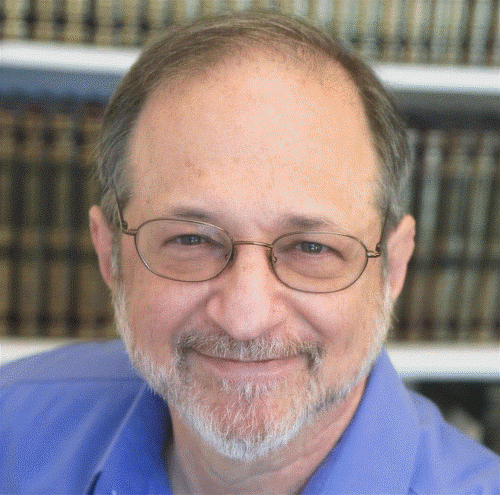
kinbar“Everyone knew I was Jewish. It just didn’t mean anything.”

-Rabbi Carl Kinbar

I will feed you with the heritage of Jacob your father, for the mouth of the Lord has spoken.

Isaiah 58:14

Rabbi Kinbar gave his first presentation called For the Common Good last week on Wednesday morning during the First Fruits of Zion Shavuot conference at Beth Immanuel Sabbath Fellowship in Hudson, Wisconsin. He told a story about himself that most of the audience, including me, probably didn’t know. Rabbi Kinbar was a Pastor for many years before he entered into Messianic Judaism and eventually became a Rabbi.

I won’t go into all of the details (I didn’t chronicle all of them in my notes of his presentation) but I wanted you to get that the vast, vast majority of Jewish people I know who are active and teaching in Messianic Judaism came to the movement by way of the church. Many of them were Pastors and teachers. But something called to them.

In Rabbi Kinbar’s case, Isaiah 58:14 called to him…literally.

He recalls a time (again, no specific details) when his eyes were closed and he was enjoying the presence of God in his life. At that moment, he felt a hand touch his shoulder and someone said, “I will feed you with the heritage of Jacob your father.”

Rabbi Kinbar didn’t know what it meant at the time, although he wondered if it was about his father since he actually is named Jacob. As it turns out, this experience (Rabbi Kinbar never saw the person who touched him) spoke both about his father and about the patriarch, his father Jacob.

The general theme of the conference was the gifts of the spirit and you may be wondering what the above story has to do with the Holy Spirit of God. For me, it seems clear, since by God’s Spirit, Rabbi Kinbar was drawn toward a different path than the one he was traveling and by the Spirit, we are each drawn to the path that God would have us walk.

Why?

On an individual level, the answer is so we can be who God designed us to be. It would be tragic if God designed you to write grand symphonies but you were stuck putting together widgets on an assembly line. It would be equally tragic if you were trying to learn medicine, but God designed you to be a Forest Ranger.

But that’s not the kind of design I’m talking about.

I’m talking about how we know and serve God and how we know and serve each other, and that is a large part of the point Rabbi Kinbar was making and the point of the conference as well.

When we think of spirituality or the gifts of the spirit, most Christians think of the Pentecostals and Charismatics, but what about Judaism and particularly Messianic Judaism and its traditions? Spirituality in modern Judaism, Messianic or otherwise, may seem absent or at best disguised, but it’s quite clear in ancient Messianic Judaism as illustrated in the letters of Paul.

In many ways, we mirror the problems Paul was attempting to deal with in his day.

I give thanks to my God always for you because of the grace of God that was given you in Christ Jesus, that in every way you were enriched in him in all speech and all knowledge—even as the testimony about Christ was confirmed among you—so that you are not lacking in any gift, as you wait for the revealing of our Lord Jesus Christ, who will sustain you to the end, guiltless in the day of our Lord Jesus Christ. God is faithful, by whom you were called into the fellowship of his Son, Jesus Christ our Lord.

I appeal to you, brothers, by the name of our Lord Jesus Christ, that all of you agree, and that there be no divisions among you, but that you be united in the same mind and the same judgment. For it has been reported to me by Chloe’s people that there is quarreling among you, my brothers.

1 Corinthians 1:4-11

Rabbi Kinbar states that they really did lack nothing in terms of the gifts of the Spirit, but they did lack unity. Although all of the teachers and participants at the conference were well unified, though from widely different backgrounds, the larger Messianic Jewish and Hebrew Roots movements do suffer from lack of unity in many things, as does larger, mainstream Christianity.

But what does this have to do with the “path” and “identity” issues I mentioned at the beginning of this article?

For though I am free from all, I have made myself a servant to all, that I might win more of them. To the Jews I became as a Jew, in order to win Jews. To those under the law I became as one under the law (though not being myself under the law) that I might win those under the law. To those outside the law I became as one outside the law (not being outside the law of God but under the law of Christ) that I might win those outside the law. To the weak I became weak, that I might win the weak. I have become all things to all people, that by all means I might save some. I do it all for the sake of the gospel, that I may share with them in its blessings.

1 Corinthians 9:19-23

pathPaul isn’t saying that he was some sort of chameleon, shifting practices from Jewish to Gentile, from weak to strong, and that his own Jewishness had no meaning to him. He was dealing (as we saw above) with a fractured population or at least a diverse one. He became a Jew to the Jew and not a Jew to the Gentile because he didn’t teach Torah to the Gentile. The one under the law is probably a Gentile convert to Judaism, and Paul learned to speak to these proselytes from the same position and set of concerns they were experiencing. It’s interesting to speak of a fractured population because Rabbi Kinbar said that if Paul had chosen to introduce the Jewish observance of Torah to all populations uniformly, he would have actually fractured them further rather than setting each group on their correct and individual paths, Jew, convert, and Gentile alike.

But Paul had to speak to each of these populations within the context of who they were in order to win more of them to the Gospel message of Messiah; so they could repent, for the Kingdom of Heaven is near.

In listening to Rabbi Kinbar’s message, I thought of the different populations I encounter. I thought of how I could present something like this to Pastor Randy, who doesn’t believe the Jewish disciples of Messiah were to continue to observe the Torah mitzvot, and to the Hebrew Roots people who occasionally read my blog, who believe that everyone is meant to observe the Torah mitzvot identically.

Rabbi Kinbar’s own encounter with the Spirit set him on a particular path because he is Jewish. He was and is supposed to be fed with the heritage of his father Jacob, the Jewish patriarch. But this isn’t just a message of distinctions but of distinctions drawn into unity.

Let’s see if you can spot what’s missing in the following passage:

For just as the body is one and has many members, and all the members of the body, though many, are one body, so it is with Christ. For in one Spirit we were all baptized into one body—Jews or Greeks, slaves or free—and all were made to drink of one Spirit.

For the body does not consist of one member but of many. If the foot should say, “Because I am not a hand, I do not belong to the body,” that would not make it any less a part of the body.

1 Corinthians 12:12-15

I didn’t see it either, but in fact, there is no mention of Torah in this portion of Paul’s letter. For we were all baptized into one body—Jews or Greeks. Does that mean we are all supposed to obey the Torah in an identical fashion, Jews and Greeks, or all of us are supposed to discard the Torah?

Not at all, because we are united in the Spirit, not in the Torah. Many good things are said of the Torah, but it is applied differently to different populations within the unity of the Spirit, hence Paul’s statement in 1 Corinthians 9:19-23.

Two paths, two peoples, one body, one Spirit, one Messiah.

There shall come forth a shoot from the stump of Jesse, and a branch from his roots shall bear fruit. And the Spirit of the Lord shall rest upon him, the Spirit of wisdom and understanding, the Spirit of counsel and might, the Spirit of knowledge and the fear of the Lord.

Isaiah 11:1-2

Now when all the people were baptized, and when Jesus also had been baptized and was praying, the heavens were opened, and the Holy Spirit descended on him in bodily form, like a dove; and a voice came from heaven, “You are my beloved Son; with you I am well pleased.”

Luke 3:21-22

For Jews demand signs and Greeks seek wisdom, but we preach Christ crucified, a stumbling block to Jews and folly to Gentiles, but to those who are called, both Jews and Greeks, Christ the power of God and the wisdom of God. For the foolishness of God is wiser than men, and the weakness of God is stronger than men.

1 Corinthians 1:22-24

And I, when I came to you, brothers, did not come proclaiming to you the testimony of God with lofty speech or wisdom. For I decided to know nothing among you except Jesus Christ and him crucified.

1 Corinthians 2:1-2

dove-peaceThe wisdom of God rests upon the Messiah in the full measure of the Spirit and in him, we are united if we accept this or torn apart if we do not. The Messiah crucified is the wisdom of God.

That last part is important, because Rabbi Kinbar isn’t talking about Jesus as he was before the crucifixion, for his death was necessary so we could all be reborn in him and indeed, so we could all be in him. For in him, both Jew and Gentile are one, not meaning identical behavior or identity, but one in purpose and in spirit.

I mentioned in a previous blog post that the Gospel message isn’t simply the individual accepting Jesus Christ as Lord and being saved. The Gospel message for Jews and Gentiles is “Repent for the Kingdom of Heaven is at hand.” It’s a message of unity in the Kingdom. Our salvation, our purpose, our unity in the Spirit is to be for the common good of all, not just the personal benefit you and I might derive from being a disciple of the Master.

But to be of any use to the common good, we must consider other people first rather than ourselves. Especially in America, we tend to be individualists, and in the worst possible expression, we tend to pursue “me first, because it’s a dog eat dog world.” But that’s not Messiah’s message and it’s not Paul’s message. You aren’t unified with the body through the Spirit and you aren’t serving your neighbor as yourself if all you think about is yourself and your so-called “rights.”

I was talking to a gentleman named Kevin while we were waiting in line for one of the meals at the conference. He regularly attends Beth Immanuel and he mentioned a certain event that occurred some years ago. When First Fruits of Zion moved away from a “One Law” position to one that reflected the reality of Jews and Gentiles as differing populations within a single Messianic body, a lot of people became upset. This was also reflected in the membership at Beth Immanuel and Kevin pointed out something I hadn’t really noticed.

Except for two or three non-Jews, the only people wearing tallitot during the prayer and Torah services were Jewish men. If any non-Jewish men were wearing a tallit katan, the tzitzit were tucked into their trousers so as not to be visible.

Apparently the shift in perspective at Beth Immanuel had two general reactions among the non-Jewish membership. One was what I just described, Gentiles who adjusted their outward appearance so that they could not be mistaken for Jews (although I must say that during the Torah services at Beth Immanuel, many non-Jews were called up for an aliyah). The other was a group of non-Jews who sought formal conversion to Judaism, usually within an Orthodox synagogue. They could not give up “Judaism,” so they surrendered the Messiah instead.

Rabbi Kinbar heard a voice telling him to feed from the inheritance of his father Jacob and he began a long journey in order to fulfill that mission for his life, and ultimately for the common good within Messianic Judaism. His being Jewish used to not mean anything when he was in a group where everyone was supposed to be inclusive, uniform, and the same, but God was not going to allow that. God wanted Rabbi Kinbar to not only be Jewish as a string of DNA or a piece of intellectual information, but to be Jewish and to live a fully realized Jewish life as a disciple of the Messiah.

Others among the Gentiles received a similar message and were obedient to the Spirit of God. Some Gentiles, however, could not operate for the common good and sought their own path instead, setting the Master and the will of God aside.

One who focuses on and romanticizes Judaism is focusing on the hammer and not the house it is intended to build.

-Troy Mitchell as related by Boaz Michael

Don’t seek Christianity and don’t seek Judaism, but seek an encounter with God.

-Tom

I mentioned previously that Troy’s “midrash” (Boaz didn’t get the quote quite right, but Troy sent me the correction which I’ll publish in tomorrow’s “meditation”) could be adjusted in a number of useful ways. Here’s one of them: One who focuses on and romanticizes the Torah is focusing on the hammer and not the house it is intended to build.

Boaz, Troy, Rabbi Kinbar, and my friend Tom are all delivering the same message from differing viewpoints. Seek first the Kingdom of God and not the various tools and materials we are trying to use to build the kingdom.

As with my previous blog posts about lessons I heard at the conference, I’ve departed from a simple chronicle of the message and allowed this teaching to take me down personal roads that have meaning to me. I realize that after I absorb and process everything I learned, my next task is much more difficult.

Everything I saw and heard was shown to me from a different perspective and can only be understood from that perspective. If I’m supposed to pass this along to others, including my Pastor, I must find a way to help him…to help anyone who is interested, to see the same information, the same Bible, the same God, the same Messiah, from a different point of view. I’m not changing anything about what the Bible says or what the Spirit says. I’m only trying to change the person receiving those statements by changing their perspective.

grand-canyonThe Grand Canyon can be seen from a number of perspectives…from the north rim, the south rim, riding a donkey down narrow trails to the bottom, riding a raft on the Colorado river inside the canyon, flying over the canyon in a helicopter, and probably in other ways as well.

Depending on which perspective you choose, you will be looking at a different landscape, as if it were a different canyon. But the Grand Canyon isn’t changing (well, yes it is, albeit very, very slowly). What is changing is how you look at it.

The same God, the same Messiah, the same Bible, but different perspectives. But there is one overriding message to get from all this. I want you to at least try to temporarily change your perspective (yes, I know it’s difficult and can even feel threatening) to get the message I believe God is trying to tell each and every one of us. The Gospel message is for us to repent and seek first the common good of the Kingdom of God. In the Messianic Era, we will be united in Messiah and every knee will bow to the King.

In the present age, it is not so, but we can strive toward that goal. To do that, we must love God with all of our being and we must love our neighbors…all of them…as ourselves. The common good. The unity of the Messiah. Being connected through the Spirit that dwells within each of us.

Let us consume and be consumed by the Spirit of God for in doing so, while remaining man and woman, slave and free, Jew and Greek, we are all one in the Messiah and we are all servants to the King and to each other. The greatest will become the least and the least will become the greatest. Seek to be a servant and seek the path God has drawn you to and you will be among those who are called His sons and daughters.

I want to apologize for all of the errors that probably crept in as I was writing this “meditation.” My notes are pretty messy as I was working with a lot of loose pieces of paper. I neglected to pack a notebook for the trip. I especially apologize to Rabbi Carl Kinbar for any portion of his presentation I messed up. I do hope that my rather large missive really does serve the common good for all who read it.

Blessings.

125 days.