Tag Archives: First Fruits of Zion

Book Review of J.K McKee’s “One Law for All,” Part 1

When I write a book review, I normally start at the beginning of the book and move through to the end. I don’t know why. I guess I’m just kind of linear that way. But J.K. McKee’s book One Law for All: From the Mosaic Texts to the Work of the Holy Spirit was organized in such a way that I decided to start in the middle and work my way out from there.

A little background. McKee in the center of his work, is comparing what has been called “Divine Invitation” (which is an unfortunate label for reasons I’ll address later in this review) with “Covenant Obligation”. These are difficult issues to discuss with a general audience since they require a great deal of specialized knowledge and tend to apply to only very small subgroups within both Christianity and Judaism, specifically movements called Hebrew Roots and Messianic Judaism.

The question, within those particular contexts, is whether non-Jewish believers in Jesus as the Jewish Messiah, are allowed to observe some, most, or even all of the commandments in the Five Books of Moses, also known as the Pentateuch in Christianity and the Torah in Judaism, or if Christians are actually under a covenant obligation to observe all of these commandments exactly or at least more or less like religious Jewish people?

I should say that even addressing what this sort of observance looks like, regardless of it being voluntary or mandatory, is highly variable. How the mitzvot (commandments) are to be observed aren’t always agreed upon even between different branches of Judaism. And particularly in Hebrew Roots, there’s a tendency to believe one can disregard any Jewish authority or opinion regarding how one is to perform a mitzvah and choose your own method based on whatever reason you want as long as you deem it “Biblical.”

In the introduction to the book (p. x), McKee states:

It can be definitely said that a ministry like Outreach Israel and TNN Online adheres to a One Law position, after a fashion.

Here’s where things start to get interesting. Unless otherwise stated, all emphasis in a quote from the “One Law” book belong to McKee.

A question that I have been asked by more than a few people is which option they are to choose: Is the Torah a Divine Invitation to non-Jewish Believers, or is it a Covenant Obligation upon non-Jewish believers? Is the Torah mandatory for Jews to follow, and an option for non-Jews to follow? Or is the Torah something mandatory for all of God’s people to follow?

-McKee, p. 83

First Fruits of Zion (FFOZ) Founder and President Boaz Michael coined the phrase “Divine Invitation” some years ago in explaining how FFOZ had shifted its theological stance from supporting a single standard of observance for both Jewish and Gentile Messianic believers to a viewpoint that advocated Jewish distinctiveness and the understanding that certain of the mitzvot are exclusively reserved for the Jewish people. He never intended it to become a theology all its own but unfortunately, the label stuck. The idea is better expressed as Gentiles in Messiah indeed being obligated, but to a certain subset of the Torah commandments (see Toby Janicki’s article “The Gentile Believer’s Obligation to the Torah of Moses” in the Winter 2012 issue of Messiah Journal for a detailed discussion on this matter) as opposed to a single, uniform application of the mitzvot for all human beings.

McKee’s commentary seems to assume that a Gentile is obligated to exactly zero Torah commandments or all of them, with no variability based on covenant role, identity, nationality, gender, geolocation, and so on.

McKee opposes the position of “divine invitation” which I expected, stating that it is bound to be confusing to non-Jewish Messianics relative to which parts of the invitation to accept, which parts to turn down, and just how one accepts the various invitations (do Gentiles have to perform an accepted mitzvah in exactly the same way as a Jewish person?). At one point in his criticism of this “theology,” he seems to attack Jewish Torah observance as well, replacing it with a more “Christian” concept of “Jewish identity”:

More importantly, though, if there is anything seriously being overlooked about the unique distinctiveness of Jewish people, it is that “salvation is from the Jews” (John 4:22), with Yeshua the Messiah Himself being the quintessential Jew. This is far more significant than Torah-keeping being what apparently makes the Jewish people distinct.

-ibid, p.85

Just a few paragraphs later however, he surprises me by saying something I more or less agree with.

For Messianic Believers today, our family has always emphasized the need to love people into this — rather than issue condemning and mean-spirited words. Much of the “pagan” rhetoric that one sees in fringe parts of the Messianic world has significantly impeded progress for the Kingdom of God, and is a major blight that is not spoken against enough. Yet at the same time, if Divine Invitation presents Shabbat, the appointed times, or kosher eating as entirely optional, what is keeping someone from turning it down?

-p. 86

one law bookThe only parts I didn’t agree with were McKee’s identifying the “pagan rhetoric” against the Christian Church as originating in the “Messianic world”. I organize Messianic Judaism and Hebrew Roots (One Law is a subset group within larger Hebrew Roots) as two separate movements with only a superficial overlap, usually at the level of the non-Jewish believer who is attracted to Judaism to some degree. I don’t typically hear Messianic Jews or Gentiles denigrate Christianity and find the “pagan rhetoric” confined to certain circles within Hebrew Roots (although, to be fair, as McKee said, they are “fringe parts” of the movement or even “fringe individuals”).

The other part I question is if something is considered an option, then there’s nothing preventing a person from saying, “No, I don’t feel led to do that.” That’s what optional means. You don’t have to. McKee’s commentary about Christians and Torah observance becomes confusing and even mysterious just a few pages later.

But before that, in addressing Covenant Obligation, McKee says:

If Believers are “obligated” to “keep Torah,” then this can quite easily lead to a few people thinking that their Torah-keeping will earn them their salvation, and can manifest itself in rather rigid and legalistic assemblies forming.

-ibid

Born again Believers are not required to keep God’s Torah as though it were some kind of debt or obligation (cf. Galatians 5:3); on the contrary, we are told, “Owe nothing to anyone except to love one another; for he who loves his neighbor has fulfilled the law” (Romans 13:8).

-p. 87

On the one hand, I was pleasantly surprised to see a supposed One Law proponent recognize some difficult truths about the movement, but on the other hand, he had to denigrate all Torah observance, even for Jewish believers, by saying loving one’s neighbor fulfills (abrogates, demolishes, deletes) the law. McKee seems to miss the nuances Paul is injecting into Romans 13 and how they connect back to what Jesus calls “the Two Greatest Commandments” (Matt. 22:35-40; Mark 12:28-31; Luke 10:25-28 citing Deut. 6:4-5 and Lev. 19:18).

But that can’t possibly be what McKee’s saying because of the major theme of the book, which is to advocate for Torah observance for Gentiles. I find this author to be a sometimes confusing blend of One Law and Wesleyan perspectives (McKee states that he had a Wesleyan upbringing to which he apparently still adheres) and as I was reading through the rest of this section, I started to think of him as a “One Law Wesleyan.”

McKee continued to defend the Church and to criticize One Law adherents for throwing Christianity under the bus, so to speak:

I have constantly asked various individuals who are “One Law” why they criticize elements of today’s Church who follow well over ninety-percent of the Torah that can be followed today, and why they treat our Christian brothers and sisters as some kind of perpetual “enemy.”

-p. 88

This is one of McKee’s confusing messages. He defends the Church as it is and states they are already observing most of the mitzvot, and yet he is pushing (apparently) for greater “jewishly” Torah observance by (One Law) Christians.

Further…

Our ministry has never advocated that today’s evangelical Christianity is some kind of illegitimate impostor religion, more in touch with accomplishing the objectives of the Adversary than in achieving the mission of God. We have advocated that the Church has flaws to be certain, but that it is the responsibility of Messianic Believers to build on a positive legacy of faithful Christian men and women who have preceded us in the faith…

p. 93

The last paragraph I quoted was startling to me because it reminded me of what Boaz Michael wrote in his book Tent of David: Healing the Vision of the Messianic Gentile:

The church is good but the church needs to change.
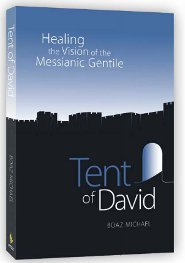
Tent of DavidI’ve written a number of different commentaries on his book including this one, and acknowledge that what Boaz produced challenged me personally to set aside my discomfort about going back to church and to “take the plunge,” which was nearly two years ago. Boaz was instrumental in getting me to see what is good in the Church, which is the same message McKee is delivering.

I applaud McKee for maintaining a high view of Christianity and the faithful men and women in the Church, which he acknowledges is practically unknown within One Law communities, but if he does not advocate for One Law anymore than “divine invitation,” and he apparently does not identify with mainstream Christian assembly (although he protects and defends Christians), what else is there that could be considered “One Law”?

As it turns out, McKee’s third viable option is:

Obeying the Lord is neither an optional invitation nor a mandated obligation, it is a supernatural compulsion enacted by the perfecting activity of the Holy Spirit on the human soul.

p.91

I’m disappointed. I expected a much stronger approach to his application of One Law. But this is like just redressing the One Law argument in spiritual rather than covenantal language. The Holy Spirit (supposedly) compels the individual to desire to observe the 613 commandments or something like them, give or take your opinion on the halachah established by the various Rabbinic sages in the numerous streams of Judaism across thousands of years of history.

Actually, I know where he’s getting this:

“Behold, days are coming,” declares the Lord, “when I will make a new covenant with the house of Israel and with the house of Judah, not like the covenant which I made with their fathers in the day I took them by the hand to bring them out of the land of Egypt, My covenant which they broke, although I was a husband to them,” declares the Lord. “But this is the covenant which I will make with the house of Israel after those days,” declares the Lord, “I will put My law within them and on their heart I will write it; and I will be their God, and they shall be My people. They will not teach again, each man his neighbor and each man his brother, saying, ‘Know the Lord,’ for they will all know Me, from the least of them to the greatest of them,” declares the Lord, “for I will forgive their iniquity, and their sin I will remember no more.”

Jeremiah 31:31-34 (NASB)

Unfortunately, McKee has a couple of problems. The first is that the New Covenant was made exclusively with the House of Judah and the House of Israel and does not presuppose any other nations or people groups at all (least of all he and me). Yes, there is a New Covenant application for Gentiles which I summarized here, but up to this point in the book, while McKee mentions various aspects of the New Covenant, he jumps from Jeremiah 31 straight to the Last Supper (Matt. 26:17-30; Mark 14:12-26; Luke 22:7-39; and John 13:1-17:26) without making the connection explicit. I know how it works (and it took me months of study to figure it out) but chances are many of McKee’s readers don’t (or they don’t understand it correctly).

The other major problem is that the New Covenant hasn’t been fully enacted yet. It’s not here. Jesus inaugurated it with his life, death, and resurrection, but until his return, we are only living in what you might consider the leading edge of the Messianic Age. What that means is until the resurrection and until Messiah returns to us here on Earth and ascends the Throne of David in Holy Jerusalem, we are still living in Old (Sinai) Covenant times!

So we don’t have the Torah supernaturally written on our hearts yet and thus, neither Jews and certainly not Gentiles have the Holy Spirit granted ability to naturally obey God and never sin, which is what the New Covenant is all about…the forgiveness of all sins and the ability to never sin again and obey God’s law (as it applies to each individual and each people group).

And yet he says:

A position of Supernatural Compulsion does advocate that a Torah obedient walk of faith is expected of all God’s people but it is to be found as an individual grows in holiness and spiritual maturity…

-McKee, ibid

While “expected” and “obligated” sound really similar to me, I like that, at least, McKee is acknowledging not everyone is going to adopt the various mitzvot at the same rate or to the same degree. It’s a matter of spiritual growth and maturity. Interestingly enough, I’ve heard many stories of secular Jews who became “religious” and this is more or less how they approach the vast body of mitzvot, taking a mitzvah at a time and growing into it.

But for a Christian, there are additional roadblocks, such as a lifetime of being taught that the law is dead.
ChurchMcKee said in his book that he advocates for a gentle, educational approach rather than going into a church and beating Christians over the head with a Torah scroll. In some sense, this is reminiscent of my own Tent of David experience. It’s sort of like evangelizing the church by encouraging them to consider a more Messianic perspective on the Bible, but where I desire to educate about how the New Covenant works and thus alter Christian perceptions on the primacy of national Israel and the Jewish people in the age to come, McKee is hoping to encourage more “Torah observant” behavior in normalized Christianity.

This is still refreshing because a lot of One Law people I’ve encountered in person and online hate the Church, call it “Babylon,” “pagan,” and “apostate,” and encourage Christians to abandon the Church. His attitudes about the Church are very similar to mine.

But here’s one more surprise I didn’t see coming:

Does a ministry like Outreach Israel and TNN Online think the Torah is for everyone? Yes. Does this include things like Shabbat, the appointed times, and kosher? Yes. But such an affirmative also needs to be tempered with another question: Are these aspects of God’s Torah for everyone right now in the 2010s? This is something that only God, in His plans for an individual’s or a family’s life, especially evangelical Christians, knows for sure — and I cannot fully answer.

-p.93

As I am reading McKee, I think he’s saying that believing non-Jews can and should observe the mitzvot in a more or less “Jewish” manner and to the same degree as Jewish believers (and Jewish unbelievers), but that such standards cannot be imposed from the outside by human agency. Even if one worships with other One Law advocates, that community has no right to direct a person or a family to observe this or that mitzvah. Such a directive will only come from the Holy Spirit and only in the way God’s plan is designed for the individual or family and through the process of spiritual growth and maturity.

I’m a little uncomfortable saying that Christians who don’t have a One Law or even a Messianic Gentile perspective are spiritually immature. I happen to know some people at the church I attend who are models of spiritual maturity and who I admire greatly. Just associating with such people is an honor. From a Jewish perspective, they could be referred to as tzaddikim (“righteous ones”). A Christian would say “saints”.

In the first century C.E. before the destruction of the Temple and the exile of the Jewish people from Israel, Paul’s Gentile disciples in Syrian Antioch and the various communities he established in the diaspora probably behaved in a distinctively Jewish manner, much more so than Christians would consider “normal” today, even acknowledging the “Jewish roots of the faith.” In those days there was no such thing as “the Church” or “Christianity,” there was only the Jewish movement of “the Way,” the “Ekklesia of Messiah” which included Jewish and Gentile members.

I suspect that after the resurrection and in the reign of King Messiah, we will have something similar, not a Church and then a Judaism but rather an Ekklesia with two distinct populations: Israel or the Jewish people, and the people of the nations who are called by His Name. This isn’t exactly what McKee is advocating because he believes Jesus-worshiping Jews and Gentiles are all citizens of Israel, but it’s kind of similar.

What McKee may be shooting all around but not quite hitting is the fact that the New Covenant age has yet to arrive (although we’re currently experiencing a foretaste of the promises yet to come) and that the Torah will only be written on our hearts in the future. While some non-Jews will acquire an apprehension of the centrality of the Jewish people in God’s redemptive plan prior to that time, many others, and probably most Christians, won’t.

white-pigeon-kotelI think the reason McKee can’t answer the question about when or how Gentile Christians will be drawn to naturally obey God is because it’s not going to happen until after we are resurrected and perfected in Messiah by the power of the Holy Spirit and in accordance to God’s New Covenant promises.

With the center of McKee’s book laid as a foundation, I’ll use it to build my review of the first and last parts of his text in part 2 of my “meditation” on One Law for All.

Addendum: My partner in this endeavor, Pete Rambo, just published Part 1 of his own review of McKee’s book.

Sermon Review of the Holy Epistle to the Hebrews: Our Hope is not in Heaven

Therefore leaving the elementary teaching about the Christ, let us press on to maturity, not laying again a foundation of repentance from dead works and of faith toward God, of instruction about washings and laying on of hands, the resurrection of the dead, and eternal judgment. And this we will do if God permits.

Hebrews 6:1-3 (ESV)

The Evangelical gospel asks, “Are you certain you are going to go to heaven when you die?” The Christian objective seems to be to secure a place in heaven, but the Bible says very little about heaven. Find out why most passages about heaven are actually not about heaven at all in this installment on the basic teachings of the Messiah from Hebrews 6.

-D. Thomas Lancaster
Sermon Twenty-four: Our Hope is not in Heaven
Originally presented on July 27, 2013
from the Holy Epistle to the Hebrews sermon series

Lancaster starts out his sermon by telling a joke about Heaven. I won’t retell it here. You can listen to it in the recording (link above) or read it at the beginning of Chapter 8: “Our Hope is not in Heaven,” pp 97-8 in his book Elementary Principles: Six Foundational Principles of Ancient Jewish Christianity. The thrust of today’s sermon is based on one phrase from Hebrews 6:2, “the resurrection from the dead.”

He’s talked before about what I call the truncated gospel message of Christianity which basically says, “Believe in Jesus so you can go to Heaven when you die.” That’s the whole point of being a Christian for many believers. The other part of it is to convince as many people as possible to believe in Jesus so they can go to Heaven when they die.

Except, you don’t go to Heaven when you die and you don’t stay in Heaven forever as a disembodied spirit after you die.

According to Lancaster, and I agree with him, there’s a lot of confusion about Heaven in Christianity, especially since the Bible doesn’t spend a lot of time talking about Heaven. If you are a traditional Evangelical Christian, that statement might seem confusing. After all, didn’t Jesus and the apostles talk about Heaven all the time?

Repent, for the kingdom of heaven is at hand.

Matthew 3:2

But seek first His kingdom and His righteousness…

Matthew 6:33

And as you go, preach, saying, `The kingdom of heaven is at hand.’

Matthew 10:7

Also see Philippians 3:20, Colossians 1:5, and 2 Timothy 4:18 and many other verses in the apostolic scriptures that mention Heaven.

keys to the kingdomExcept the Heaven mentioned in all or most of these verses isn’t the Heaven in the sky where God lives, it’s what’s called a circumlocution, a way of talking about God without saying “God.” In other words, when Jesus said “Kingdom of Heaven” as recorded in Matthew’s gospel, he was really saying “Kingdom of God,” and that Kingdom will finally be completely established here on earth when Jesus comes back as King and Lord.

The First Fruits of Zion (FFOZ) television series A Promise of What is to Come contains a number of episodes that discuss what the Kingdom of Heaven is, where it is, how it works, why Peter has the keys of the Kingdom, and how treasure can be stored there. See episodes such as The Kingdom is Now, Seek First the Kingdom, Thy Kingdom Come, Keys to the Kingdom, Foretaste of the Kingdom, Treasure in Heaven, and Restoring the Kingdom for details. Each episode is about thirty minutes long and the content opens up and expands in great detail about the concepts Lancaster covers in his sermon. In fact, Lancaster seems to be summarizing all of that material in his thirty-four minute lecture today.

Just a couple of things. Philippians 3:20 talks about Christians having citizenship in Heaven. Does that mean when we die, we go live in Heaven as citizens, like how we have American citizenship (or whatever national citizenship you may have)? No. We are resurrected physically on earth and live here in bodies in the Messianic Kingdom. Our citizenship may be in Heaven, but we’ll be living here. After all, Paul was born a Roman citizen but he wasn’t born in Rome. He never even lived there, at least not until near the end of his life.

According to Lancaster, there is a paradise, a Gan Eden (Garden of Eden) where the spirits of the righteous go when the person dies, but that’s temporary. The spirit is reunited with the body at the resurrection.

Remember the empty tomb and Jesus?

While they were telling these things, He Himself stood in their midst and said to them, “Peace be to you.” But they were startled and frightened and thought that they were seeing a spirit. And He said to them, “Why are you troubled, and why do doubts arise in your hearts? See My hands and My feet, that it is I Myself; touch Me and see, for a spirit does not have flesh and bones as you see that I have.” And when He had said this, He showed them His hands and His feet. While they still could not believe it because of their joy and amazement, He said to them, “Have you anything here to eat?” They gave Him a piece of a broiled fish; and He took it and ate it before them.

Luke 24:36-43

This is the resurrection we can expect, because Jesus was the first fruits of the dead (1 Corinthians 15:20). We will also be resurrected in our original bodies (remember, Jesus still had the wounds, he didn’t get a new body) but we will not die again. This is what we can expect after we die and are resurrected, not going to Heaven like Casper the Friendly Ghost to float around on clouds for eternity.

What Did I Learn?

Since I’ve watched all of the FFOZ television episodes I mentioned above, I already had a pretty good idea what Lancaster was going to teach about. Lancaster based a number of things he taught on the writings of Christian theologian N.T. Wright, as well as his own teaching What About Heaven and Hell.

wind-sky-spirit-ruachLancaster also said that the reason Christians are so confused about Heaven and Hell is because Christianity separated itself from Judaism, and thus from the first century CE Jewish view of the meaning of the resurrection. He even went so far as to compare typical Christian understanding about what happens when we die to how the gnostics saw the dichotomy between the earthly corruptness and heavenly purity. Generally, Judaism doesn’t have “issues” with a flesh and blood physical existence (unless you get into Jewish mysticism, but that’s another story).

I see these comments as a continuation of the points Lancaster has made in other sermons in this series. He seems to be advocating a return to Judaism (specifically Messianic Judaism) for believers in Jesus, with an eye on first century C.E. Judaism. While the idea has merit, it’s important to remember that as the various Judaisms evolved over the last two-thousand years, they likely also do not contain perfect interpretations of the scriptures and probably possess a few misunderstandings of their own. We can all do the best we can to understand what God is saying to us in the Bible, but when Messiah returns, I suspect he’ll have to correct us in a few of the details of our doctrine and theology.

Is our hope in Heaven? It depends. If we put our hope, according to Lancaster, in being a “floaty ghost” in Heaven when we die, then no. If, on the other hand, we put our hope in God who is in Heaven (yes, Heaven is real), then yes…our hope is in Heaven, our hope is in God.

This too is one of the elementary teachings of the faith, as stated by the writer of the epistle to the Hebrews, one of those “milk” things.

I’ve become quite accustomed to the belief in a physical resurrection and an existence on earth as part of the literal Kingdom of God with King Messiah reigning on the throne of David in Jerusalem, so I didn’t experience any surprises or curve balls in today’s sermon. If, on the other hand, you are an Evangelical Christian who has been taught you’re going to become a “floaty soul” on a cloud playing a harp for all eternity when you die (actually the harps seem unescapable in Heaven based on Revelation 5:8, 14:2, and 15:2), then you might want to listen to Lancaster’s sermon or, better yet, spend a few hours viewing the selection of TV episodes I mentioned above (just click the links and view them online).

It could be an eye opener.

Sermon Review of the Holy Epistle to the Hebrews: The Initiation

Therefore leaving the elementary teaching about the Christ, let us press on to maturity, not laying again a foundation of repentance from dead works and of faith toward God, of instruction about washings and laying on of hands, the resurrection of the dead, and eternal judgment. And this we will do if God permits.

Hebrews 6:1-3 (ESV)

On the subject of Baptism and Instructions regarding Immersions in Hebrews 6, we look at the evidence from early Christian documents. Find out how the second-century Christians welcomed new converts into the body of Messiah. This teaching contains quotations from Justin Martyr’s First Apology, from the Didache, and from the Apostolic Constitutions. The quotations are available in the PDF document below titled “Initiation Texts.”

-D. Thomas Lancaster
Sermon Twenty-three: Laying on of Hands
Originally presented on July 7, 2013
from the Holy Epistle to the Hebrews sermon series

This is one of the shorter sermons in the series (barely thirty minutes long) as well as a short chapter in Lancaster’s book Elementary Principles. In this sermon, Lancaster proposes to show how the basic foundational principles he has covered in previous sermons, particularly as mapped to the Didache, were carried forward in time to the second and even the third century CE, using classic Christian documents.

To review these first four principles covered so far:

  1. Repentance from dead works (sin)
  2. Faith toward God (through Messiah)
  3. Instruction about washings (elemental instructions of the faith prior to immersion in the name of Messiah)
  4. Laying on of hands (to confer discipleship and possibly the Holy Spirit)

Lancaster outlines the challenge in what he’s trying to do, since the writer of the Epistle to the Hebrews felt the six principles were so basic that he didn’t bother to write them down. Neither did any of the other New Testament writers. Lancaster states that he believes Paul taught these principles orally, and that by the time the Hebrews writer was composing his letter, it was just assumed everyone knew all about this “milk”.

But we know nothing about them today since they weren’t written down in much detail, if at all.

Lancaster turns to three Christian documents to prove his point that these elemental principles were indeed carried forward in time with Christianity:

  1. Justin Martyr’s “First Apology”
  2. The Didache
  3. The Apostolic Constitutions

first apologyI’ve posted the link above to the relevant document, but here it is again. Click the link to open the PDF and you’ll find the list of documents and specific quotes Lancaster uses.

He uses these quotes to map back to the specific phrases in Hebrews 6:1-3 that list the six elementary principles.

Justin Martyr was writing around 150 CE and Lancaster paints a brief portrait of Martyr’s environment. The Bar Kochba rebellion ended in failure. Jerusalem has been destroyed, Herod’s Temple razed, and a pagan temple built on its ruins. The Jewish people have been exiled and in the midst of all that, the new religion Gentile Christianity and the original Jewish Messianic movement of “the Way” have just gone through a nasty divorce.

Martyr wrote his document, which we call “The First Apology” to the Roman Emperor as an appeal that the Empire stop persecuting Christians.

It’s Lancaster’s contention that these later Christian documents, especially the Didache, were based on much earlier writings and oral traditions going back to the second and even the first century, and perhaps even reflecting the teachings of the apostles.

Lancaster’s handout is organized as follows:

  1. Instructions before Immersion (Apostolic Constitutions 7.39.2-4)
  2. Preparing for Immersion (Justin Martyr, First Apology 61)
  3. Fasting Before Immersion (Didache 7:1-4)
  4. The Immersion (Justin Martyr, First Apology 61, Didache 7:1-3)
  5. The Investiture (Laying on of Hands) (Justin Martyr, First Apology 65)
  6. Prayer for the New Disciple (Apostolic Constitutions 8.6.5-8)
  7. Breaking the Fast (Justin Martyr, First Apology 65)

I won’t go into all of the details. You can read the PDF and listen to Lancaster’s sermon (only half an hour) for the details, but there are some questions.

What Did I Learn?

Lancaster has a talent for pulling together information and documents from (sometimes) widely disparate sources and then attempts to make them work together. To the degree that he’s comparing ancient Christian documents, I can see where he’s going, but Lancaster admits that these are documents originating in different time periods, so care should be taken in making very close comparisons.

messianic judaism for the nationsAlso, he states that the “nasty divorce” between Jesus-believing Jews and Gentile Christians had already occurred, and except for arguably the Didache, the other two documents Lancaster is using are from the Gentile side of the equation. Why is that important? Because Lancaster’s purpose in this investigation is to uncover the practices of ancient Messianic Judaism so we can practice this way, too.

But a lot of what he introduces isn’t from, strictly speaking, Jewish sources. These are interpretations made by Christian Gentiles who, after the aforementioned “nasty divorce,” have no reason to spread any sort of love for their Jesus-believing Jewish counterparts.

In fact, quoting Paul Meier from his recent Messiah Journal article which I reviewed:

Marcion’s contemporary Justin Martyr was one of the first to articulate a position of replacement theology, also known as displacement, transfer, or supersessionist theology. Avner Boskey succinctly described this theological stream as “an expression of Gentile triumphalism in the early church.”

-Meier, pg 81

I’m not saying Lancaster is wrong, and he’s certainly more studied and better educated in these matters than I am, but I don’t want to get too excited about drawing firm conclusions from a little bit of documentation and a lot of supposition.

That said, I don’t know if it would hurt to add some or a lot of this structure to modern Christian practice. Think about it. As you follow the train of Lancaster’s logic and observe the linear fashion by which an ancient novice disciple of the Master is initiated, educated, and baptized into the faith, becoming a Christian in the first and second centuries was a much more formal affair than it is in Evangelical Christianity today.

The initiate had to give a great deal of serious consideration to their decision to become a disciple, study quite a bit, deeply repent of their sins, dedicate themselves to a life-long pattern of righteousness, and be willing to take a solemn vow before God prior to baptism.

Can you say that all or even most professing Christians today take their faith that seriously and were that prepared even before baptism? How many Christians today came to faith simply by raising their hand at a Christian camp meeting or answering an altar call at church? Even after years or even decades, many Christians still may just be “going with the flow” and have never come to the realization of what they’ve committed to.

This is where I see Lancaster making his point very strongly. Today, we don’t even know much about what the writer of the Book of Hebrews took for granted to be the “milk”, the “baby food”, the six elemental principles of the faith. They were so basic and so well-known, that they were never documented, at least not in any text we have with us today.

Orthodox JewsLancaster’s point, as I understand it, is that we should return to the formal seriousness and dedicated preparedness of inducting novices into true discipleship, taking time to make sure that the person is ready to enter this tremendously august relationship, and only after all that, actually proceed forward, pressing “on to maturity” (Hebrews 6:1).

Lancaster is quite serious about rediscovering the ancient teachings and practices of Messianic Judaism as it existed in the first century and into the second, and that desire has merit, but is it do-able? All of the other ancient streams of Judaism from that era either were extinguished or progressed forward, morphing and evolving across the long centuries. What was Pharisaic Judaism in the days of Jesus and Paul is now called “Rabbinic Judaism,” although there are indeed multiple Judaisms in our day and age.

I guess I could say that Orthodox Judaism (although there is no single expression of Orthodox Judaism in modern times) is the most direct inheritor of ancient Pharisaic Judaism, but you many not be able to directly compare the two. So much has happened, the definition of practicing Judaism in Orthodox thought is quite different from how the Pharisees saw themselves.

Should we contrast modern Messianic Judaism with the ancient Jewish practice of “the Way” in the same manner? If “the Way” was most closely compared to the Pharisees in the first century, what does that say about the relationship between modern Orthodox Judaism and Messianic Judaism or what should it say?

I don’t know that Lancaster has set a completely achievable goal for himself and particularly for his (mostly Gentile) congregation. If he’s been lobbying for a mikvah to be built for the past several years but support hasn’t been overwhelming among his constituency, is that indicative of how difficult it is for we modern Gentiles coming out of our church experiences to fully embrace a strongly observant Jewish lifestyle?

I’m not trying to be a wet blanket, but even most of the Messianic Gentiles in Messianic Judaism may not be ready to take on board the full yoke of Torah, either as it was expressed in the days of Paul, or as we understand it in Orthodox Judaism today, assuming that is the model to be followed.

Review of Messiah Journal: Christian Theology and the Old Testament

I’ve slowly been reading through the various articles in the latest issue of Messiah Journal (issue 116/Summer 2014) but haven’t had the time to comment on it before this. While there are many good and worthy articles contained therein (as always), I was most taken with the one written by Paul E. Meier called “Christian Theology and the Old Testament” (pp 76-94).

First, a little background:

Paul Meier and his wife, Inge, spent over three decades as Bible translators with Wycliffe Bible Translators and SIL International in Nigeria before retiring in 1996. Meier and his wife heard Messianic Jewish pioneer Abram Poljak in Switzerland in the 1950s and, since 2000, have worked with friends who knew Poljak to preserve his writings in an online archive at www.abrampoljak.net. To learn more about their experiences in Bible translation, visit their website at www.israel-pro.org.

-from the article’s introduction, pg 76

I’ve spent almost no time on either website mentioned above. I want to focus on Meier’s article and what it means to me both generally and in terms of recent issues in my little corner of the blogosphere.

Meier compares the Bible to a structure with two stories. Access to that structure is on the main floor. To understand the structure as a whole, a visitor must start with the first room on the first floor, visit each room in turn, and only then proceed to the second floor and visit all of those rooms in turn. Upon completing the visits to all of the rooms, the visitor then returns to the first floor, exits the building, and contemplates the experience as a whole to gain insights as to what the structure means.

The first floor is what Christianity calls the Old Testament and the second floor is the New Testament. The building is locked, so to gain entrance to the main lobby, you need a key. This key is “interpretation”. In many Christian churches, the main agent of interpreting the Bible is the Holy Spirit.

But…

If we believe that God inspired the books of the Bible, we must also accept that God had an overarching plan and purpose as he inspired these various texts. Yet if this is the case, we need to ask, why are there so many extant interpretations of these same texts? Why do so many interpreters arrive at different conclusions? How can they all claim to have been led to these disparate conclusions by the same Holy Spirit?

-Meier, pg 77

Meier “hooked” me at “overarching plan and purpose.”, because I believe the Bible is a holistic document describing the historically sweeping panorama of God’s plan for Israel and the world, not something to be carved and sliced like a Thanksgiving turkey (“I only like the drumsticks”). I have asked the exact same question that Meier posed above to Pastors and online religious pundits, and their answers have ranged from “sin” to “not trusting the Holy Spirit” to “being influenced by the interpretations of men.” None of these responses have been particularly satisfying, since you’d expect some subset of Christians who are truly receiving interpretive revelations from the Spirit to all share an identical perception and understanding of the Bible.

And that body does not exist. Instead, we have churches upon churches upon churches and many other congregational groups that all have their individual “take” on the Bible, and even within a single congregation, it’s common to encounter many different individuals who have their own way of looking at different areas of scripture. I think I’m getting a headache.

Meier’s answer makes as much sense as any other one and perhaps more sense than most:

Scripture points out that the understanding of individual believers is fragmental; each one of us has been granted a different degree of insight (1 Corinthians 13:9-10). The dimensions of God’s love are so vast that the whole body of believers is needed in order to comprehend them (Ephesians 3:18). God may give more insight to some than to others; he gives to each one according to the measure of his grace (Romans 12:3, Ephesians 4:7).

-ibid

In other words, not all believers are created equal in terms of how the Holy Spirit will speak to them of the Bible, nor are all believers identical as far as their innate cognitive, perceptual, and interpretive skills sets relative to the Bible. We are each granted the gifts God has provided “according to the measure of his grace” which may have something to do with why we all see the message of the Bible differently.

That doesn’t explain why many of us have contradictory perceptions of the Bible, but what can and does get in the way is our own humanity, our needs, our wants, our “I’ve got to have it this way”. This may also explain why it’s better for us to congregate in somewhat diverse groups rather than go it alone in Bible study or only study with people who think and believe exactly as we do.

Think of it as a group of people all trying to put a jigsaw puzzle together. But the pieces of the puzzle aren’t loosely collected in a central box, they’re loosely collected in the pockets of the different people building the puzzle. First, these people have to come together and be willing to cooperate by sharing their pieces with the others. Ideas of how the pieces fit together will vary, sometimes widely, but (and this is where I think the Holy Spirit comes into my little analogy) finally with all the pieces on the table, one by one, the group begins to see a pattern starting to emerge.

puzzleBut what if you go to a Baptist church, and the person who holds some of the vital pieces to the interpretive puzzle attends a Messianic synagogue thousands of miles away? Interesting problem. We might have to expand our understanding of Biblical hermeneutics to realize that it’s not just the particular method we employ in our interpretive process, it’s the people we have on our team, the necessary talent that they possess and we lack, that will make the difference.

A second principle to keep in mind is the fact that the different texts that comprise the Bible were written in diverse literary styles; furthermore, they were composed over hundreds of years, and each text reflects a then-current understanding of the past, present, and future. Different parts of the story were revealed at different times; God alone sees the entire story from beginning to end.

-ibid

This will likely appeal to dispensationalists and progressive revelationists, and Meier does believe that God progressively revealed himself in history. On the other hand, most dispensationalists believe that the text of the Bible becomes more important and relevant as time passes, leaving the older sections of the Bible to decay and finally become obsolete. This leads most Christians to possess a very high view of the New Testament and a lower to very low view of the Old Testament, with some church Pastors almost never referring to the Old Testament at all in their sermons and classes.

As Meier says (pg 78), the “Christian aversion to the Old Testament is not a modern phenomenon.”

Meier spends some time on the “church fathers,” introducing Marcion (the Heretic) who we tend to dismiss but who nevertheless has an echo of influence on the modern Church. And then there’s this:

Marcion’s contemporary Justin Martyr was one of the first to articulate a position of replacement theology, also known as displacement, transfer, or supersessionist theology. Avner Boskey succinctly described this theological stream as “an expression of Gentile triumphalism in the early church.”

-ibid, pg 81

churchThis hasn’t subsequently gone away. Any church that teaches “the Church” is the primary body of Messiah and the center of God’s attention and relegates national Israel and the corporate body of Jewish people to playing second fiddle is an inheritor of “Gentile triumphalism.” And lest you are tempted to include Jews in “the Church,” I must remind you that the price of admission a Jewish person must pay for entry into “the Church” is a surrender of most if not all that makes that individual a Jew, apart from a string of DNA, including any view of the Torah that has the mitzvot remaining relevant and obligatory for a Jew.

If you are thinking the “men of the Reformation” corrected all of the errors that came in before them, think again:

The great reformers Calvin and Luther modified their inherited filter and read the Old Testament in fresh light; unfortunately, they were not able to overcome their inherited tendency to interpret many Old Testament prophecies allegorically.

-ibid, pg 84

Thus the history of the (Gentile) Church, from its very inception in the second century CE into the modern age, has inherited interpretive traditions and structures that are so integrated into general Christian theology and doctrine as to be indistinguishable from actual “God-breathed” scripture itself. My own attempts to summarize Gentile involvement in the New Covenant, which depart from standard Christian fare, illustrate how tightly bound are inherited interpretive tradition in Christianity to what the Bible does and doesn’t say.

If I could give the Meier article to each person reading this review, I would, because it’s just that important to how Christians interpret and (often) misinterpret the Bible. I can’t describe everything Meier wrote, but I can point to a few important matters related to how we generally devalue the Old Testament and build our New Testament “castle” in the clouds with practically no foundation at all.

The Old Testament is a record of the history of the Hebrew people, the history of Israel. A theology in which Israel has no prophetically significant role in the future is a theology in which Israel has no significant role in the present.

-ibid, pg 79

I point you to recent events in Israel to illustrate Christianity’s (or some of its representatives) disdain for the Jewish people as a result of the devaluation of Israel’s history, the Old Testament.

Further:

If all prophecies concerning Israel have been fulfilled in Christ and all that remains to be accomplished is the establishment of the new heaven and the new earth, then there is no difference left between Israel and the church or between Israel and the nations. (emph. mine)

-ibid

Messiah JournalThis is the classic error in much of Christianity including some portions of the Hebrew Roots movement, and their requirement for this lack of distinction between Jews and Gentiles in the body of Messiah necessitates them making artificial, interpretive shifts in their viewpoint of the Bible, particularly the Old Testament, to justify their position.

If Israel has been replaced by the church, either through having been deprived of its original identity or else through having been set aside during the so-called church age, then all the prophecies concerning the future of Israel must be divorced from the context in which they were delivered — the context of the greater story of Israel as told by the Old Testament. (emph. mine)

-ibid

Do you see where this is going? Regardless of whether Israel’s original identity as a unique and especially chosen nation, the Jewish nation, is removed (Hebrew Roots/One Law) and/or replaced with a fused Jewish/Gentile identity, or it is set aside during the “church age” (Christianity), the result is exactly the same, and the cause is a misunderstanding and misapprehension of the content and significance of the Old Testament in being the chronicle of God’s covenant relationship with Israel.

When we do not understand the Old Testament on its own terms, it becomes difficult if not impossible to understand God’s nature, plan, and purpose. We find it difficult to explain why God chose one nation through which to reveal his being to the rest of mankind and to express his desire to bring salvation, because we fail to acknowledge the historical reality that Israel and God have been in covenant for millennia and that God chose to reveal the texts of the Old Testament within the context of this covenant relationship.

-ibid, pg 80

And yet, many, many Christians put the New Testament at a far more exalted level than the Old Testament, ironically enough, cutting themselves (or the true understanding of salvation and the Good News of Messiah to Israel and then the nations) off at the knees.

A third problem is that many Christians believe that the Old Testament must be understood through the eyes of the New Testament.

-ibid, pg 82

Abrahamic CovenantI’ve spoken with Christians, both in person and online, who do not believe that any rendition of living relationships and events in the Old Testament have any intrinsic value or meaning, but only exist as “types and shadows” of Jesus and the Church. Some don’t even believe that the people we see in the Old Testament were real people, only “stories” pointing to Jesus. From their perspective, Abraham and Sarah never existed as actual individuals. Neither did Boaz and Ruth. They were mere representatives of Christian redemption and salvation. Only the Church matters, just “me and Jesus”.

An interesting variant of supersessionism is brought out by Meier, one that I hadn’t considered before. Typically, I have run into a replacement theology that says the Church has taken the place of Israel and the Jewish people in all of the covenant promises and blessings. But something else has emerged:

As a result, he now incorporates, as N.T. Wright has put it, “Israel-in-person.” This type of “fulfillment” theology is merely a new incarnation of replacement theology, regardless of what exactly was fulfilled in the life of Jesus…

-ibid, pg 83

I ran into this “Israel-in-person” theology just the other day in the Jesus-believing blogosphere which illustrates that even with the best intentions, and even with believers who have a strongly stated love for Israel and the Jewish people, it is still quite possible to let a deeply underlying tradition and multi-generational history of how we view the Old Testament and consequentially, the Jewish people, distort the reality of God’s New Covenant plan for Israel (and for Gentile Christians), present and future.

You may be thinking that I’m (again) removing the Gentiles from any connectedness to the New Covenant, for it is only through the blessings of that covenant that we may be saved, but look at this:

Jesus stated that he was sent only to the house of Israel, yet he came to prepare that house to carry God’s message to all humanity. This plan was described throughout the Old Testament (for instance, Psalm 87, Isaiah 49;6).

-ibid, pg 85

JudaismThe plan and purpose of Messiah in relation to Israel, the New Covenant, and inclusion of Gentiles can only be properly understood by taking a high view of the Old Testament and being willing to make the Old Testament the foundation of your understanding of the Bible, reading scripture from earlier to later rather from Paul backward. Otherwise, you end up with what Meier calls a “Christianized Jesus” rather than Moshiach, Son of David, the Jewish King.

One of the key points Meier made was:

God revealed his nature and his intentions progressively across the history of Israel. Yet later revelations do not replace earlier ones; rather, they build upon them.

-ibid, pg 86

If you remove the earlier covenants and their conditions in order to “make room” for later ones, you are removing the foundation and framework of the house in order to put on the siding and the roof. You end up with a structure that cannot possibly stand.

Of all the different forms of replacement theology Meier described, I found the following most illuminating as it describes my current church experience:

On the other end of the spectrum, the most conservative scholars take an overly restrictive stance, teaching that one must rely on these kinds of typological interpretations only when the New Testament explicitly confirms them.

-ibid, pg 88

Have you ever heard a Christian Pastor or lay teacher say that commandments in the Old Testament only remain valid for Christians if confirmed in the New Testament? I have. It’s like saying the “sacrament” of marriage remains valid because it was confirmed by Jesus in the New Testament (Matthew 19:5, Mark 10:8) but keeping Kosher is not, presumably because of Mark 7:19 and Acts 10:15.

Really, who made that rule up? Obviously someone who didn’t believe “all scripture is God-breathed” (2 Timothy 3:16-17). For if all scripture comes from God, and the only Bible Paul had when he wrote those words was the “Old Testament,” then whatever we have in those ancient scriptures can stand on its own “legs” and doesn’t need the writings of the apostles to support it.

sefer torahThere’s a lot more I wish I could share with you about Meier’s article, but this blog post is long enough as it is. I may write one more “meditation” on something Meier said about how much we do (or don’t) translate sections of the Old Testament into the languages of people in other cultures who have never been exposed to the Bible before. How much of the Bible do we really teach them in their own language, and what impact on their understanding of the true Jesus Christ do missionaries impart who not only distort the Old Testament due to their devaluing it, but who actually leave out much or most of the Old Testament books in their work with new disciples of the Master?

I don’t believe Meier is attributing bad motives to Christians who take a low view of the Old Testament. After all, they (we) are doing what Christians have been taught to do for hundreds and hundreds of years, by a tradition that goes back to the early church fathers and was then inherited and re-enforced by the men of the Reformation.

But a low view of the Old Testament means a low view of Israel in God’s past, present, and future plans, and a low view of Israel fragments the foundation upon which the redemption and salvation of Gentile Christianity is supposed to rest. When we disdain the Old Testament and set aside the centrality of Israel, we not only insult God, we destroy our own future in the Kingdom.

This is why I keep on writing as I do. I cannot allow so many believers to innocently, unknowingly face a supposed salvation in which they feel utterly secure, but in reality, one that is constructed firmly on shifting sand.

Old Wine Made New

He told them this parable: “No one tears a piece out of a new garment to patch an old one. Otherwise, they will have torn the new garment, and the patch from the new will not match the old. And no one pours new wine into old wineskins. Otherwise, the new wine will burst the skins; the wine will run out and the wineskins will be ruined. No, new wine must be poured into new wineskins. And no one after drinking old wine wants the new, for they say, ‘The old is better.’”

Luke 5:36:39 (NIV)

I normally don’t use the NIV translation, but it more accurately translates Yeshua’s (Jesus’) last word as “better” rather than “good” or “fine”.

Let me explain.

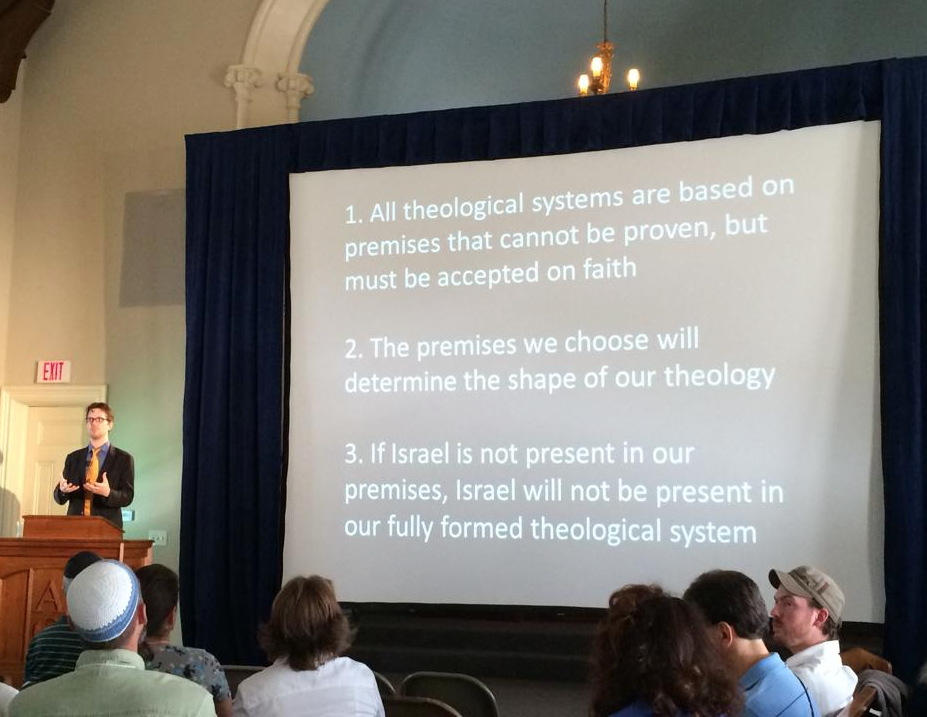
I wasn’t going to write another blog post so soon, but two things happened. The first is that I saw yet another photo posted on Facebook of a presentation, in this case, by Jacob Fronczak, at the First Fruits of Zion (FFOZ) 2014 Shavuot Conference at Beth Immanuel Sabbath Fellowship in Hudson, WI (the photo is posted below), and the second was a comment made by Steve Petersen on a prior blog post:

New wine = new teachings
Old wineskins = disciples who can’t embrace new teaching.

He also provided a link to an article written by D. Thomas Lancaster called New Wine and Old Wineskins: The Parable of Luke 5:36-39 Re-examined.

According to Lancaster, the “wineskin” parable is typically interpreted by the Church as old wine/wineskin being the old, outmoded Law, and new wine/wineskin being the new teaching of salvation by the grace of Christ.

Just as the new wine would burst the old skins and be spilled, so too the New Covenant Gospel of the Church Kingdom would be wasted if it was poured into the Old Covenant, Mosaic, legalistic religion of Judaism. In almost unanimous consent interpreters and commentators have agreed that the old wine, old wineskins and the old coat are all symbols of Judaism and Law whereas the new wine and the new coat are symbols of Christianity and Grace.

The problem, and maybe you spotted it, comes in with the last sentence: “The old is better.” If the Old is the Law and Jesus was teaching that the New, that is grace replacing the Law, is better, how can he possibly say that the old is better?

That is, unless the traditional Christian interpretation has problems.

The answer lies in interpreting Yeshua’s words through the lens of other, similar Rabbinic teachings of that era rather than filtering them through modern Christian doctrine. I won’t go into all the details. I’ve provided the link to Lancaster’s original article. It’s not long and you can read it for yourself.

I want to point out something else, something that’s directly related to my experience at church last Sunday.

Jacob Fronczak, a church Pastor and contributor to First Fruits of Zion, particularly in recent issues of Messiah Journal, is one of the presenters at this year’s Shavuot Conference. I saw his photo next to a projection of a PowerPoint slide. The slide displayed numbered list:

  1. All theological systems are based on premises that cannot be proved, but must be accepted on faith.
  2. The premises we choose will determine the shape of our theology.
  3. If Israel is not present in our premises, Israel will not be present in our fully formed theological system.

Beyond what I can read on the screen, I have no idea what Jacob is teaching, nor will I until FFOZ publishes his presentation in a text or audio format. However, I’d like to take his list and add a little something to it. Especially relative to point three, I’d like to say that it is how Israel is presented in our premises, assuming it’s present at all, that will shape our theological system.

ffoz1Many churches, including the one I attend, believe that Israel and the Jewish people have eschatological significance, that is, they have an existence and purpose in the end times. On the other hand, it is “the Church” as a unique and even supernatural entity that has primacy and is ultimately ascendant (as Israel is presumed to be based on the Hebrew Scriptures and New Covenant language contained therein). So Israel can be present in our premises but cast in a role that renders it secondary to the Church and ultimately, totally subjugated by said-Church (which includes Jews who have converted to Christianity).

Lancaster’s article speaks also to my experience in class last Sunday at church. Here’s his interpretation of the Luke 5:36:39 parable:

No one takes a lesson meant for a new student and tries to teach it to an old (already educated) student. If he does, he will fail to teach the new student, and the lesson meant for the new student will be rejected by the old student.

No one teaches new Torah-teaching to old (previously educated) students. If he does, the new teaching will be rejected, the student will be lost. No. Instead new Torah-teaching must be taught to new students. And no one after receiving old teaching (previous education) wants the new, for he says, “The old teaching is better.”

I’m not sure what to do with this. People, once educated in a particular system, rarely step outside that system or accept new information that apparently contradicts that system, even if the new interpretation objectively makes more sense and is more consistent with the source document (in this case, the Bible) than their current system.

No one likes change. I know I don’t. I’m a real creature of habit. I love my routine. It bugs me when my schedule is thrown off, even a little.

On the other hand, I love learning new things. And over time, I’ve learned many new things and have slowly allowed my perspective on theology and doctrine to change as new information became available and, after I thoroughly assessed it, determined that this “new wine” did indeed belong in my “old wineskin” (go figure). I guess to a limited degree, this old leopard can take on a few new spots.

walking-into-churchBut that means certain things relative to being at church and being in Sunday school. It means that I was right (or rather, my wife was) in saying that I have nothing to offer anyone at church. This assumes that everyone is there at church because they want to be there and that they agree with everything (or most everything) being taught. Even if there are minor disagreements with particular points, there is still more agreement between all the people within that system than there would be with just about anything I had to say from my “alien” viewpoint.

So, for them, “the old is better.” Who wants the new wine I’ve tried to peddle in their midst? I was right to keep quiet in Sunday school, even when I heard Jewish people and Israel being momentarily “dissed”.

On the other hand (like Tevye, I find there’s almost always an “other hand”), people have periodically approached me and said that they liked some point I made or found something I said interesting or enlightening. I assume that everyone in Sunday school and in church all universally agree with each other and unless they say otherwise, there’s no way to know for sure. I can speak up from time to time and hope I get lucky (or perhaps hope that the Holy Spirit will render someone’s heart a little more open to my opinions), or keep quiet, respecting the majority (including the church leadership since several members of the Board of Elders go to the same class) and withhold anything that might be elucidating to the possible minority who could be open to hearing it.

On that day, when two, poorly educated fishermen stood before the Sanhedrin, they demonstrated the full caliber of their education under Yeshua and vindicated his choice of disciples. New garments, new wineskins and new students.

Lancaster’s interpretation of Yeshua’s parable has limits. It assumes that only new (uneducated) students would accept the Master’s teachings, but we know he attracted the attention of “old wineskins” such as Nicodemus (John 3:1-21) and Joseph of Arimathea (John 19:38). Who knows how many other “old” and well-educated disciples Yeshua attracted, either during his “earthly ministry” or later, during the time of the apostles?

I think an old dog can learn new tricks, it’s just not as easy as when you were (I was) a new dog.

Everyone listening to Jacob Fronczak and the other presenters at the Shavuot conference wants to be there. They bought tickets to attend the event, arranged to travel there, arranged for lodgings, and so on. They went through no small effort to make their way to Hudson and to find themselves sitting in the pews of this beautiful synagogue setting. So each and every person there is open to what is being taught.

And like I said, although it’s not quite the same effort to attend my local church, all of the people present are there willingly, and they all are open to learning what is being taught, even if they don’t agree one-hundred percent of the time.

But they didn’t sign up to listen to me spout off about new wine. That’s not my job and no one asked me to take it onboard. Maybe there are some old wineskins that might want a little new wine, but I can hardly tell who they are and what they might be open to.

On the other hand, my blog is open to the world or at least anyone with Internet access. I can only assume that each person who visits, if they stay long enough to read, is doing so willingly, even if they disagree with some of the things I say. My “wine” is welcome for the most part within their “wineskins.” At least I don’t have worry that there’ll be some outcry to ban me from the web.

wineThe Internet isn’t “community” though sometimes we fall into the illusion that it is. Facebook, twitter, and blogging aside, you don’t really form a community in virtual reality. I know the difference between Facebook “friends” and face-to-face friends.

But sometimes the Internet is all you’ve got, especially if “face-to-face” are old wineskins and all you’ve got to offer is new wine.

But my new wine has the flavor of the centrality of Israel, the primacy of the Jewish people in past and future prophesy, with the capstone being Messiah, Son of David, Son of God. My wine doesn’t spill all over the pages of the Torah, blotting out major sections, shuffling about the letters and words, and making them appear as if God said one thing but really meant another.

In a very real way, my “new wine” is actually old, really old. In fact, I’m banking that it’s at least as old as what the apostles, and even the Master taught. That means the old really is better, for the old is God who makes a covenant and never breaks it, who embraces Israel and never releases her, who presents the Torah through Moses and never changes a word or a letter as long as Heaven and Earth continue to exist.

In my bottle of old wine, Messiah brings a Gospel message that really is good news to the Jewish people and that supports and upholds the dignity and preservation of national Israel. It’s also good news for the Gentiles as long as we realize that salvation comes from the Jews (John 4:22).

It’s amazing what a single photograph and a few sentences of text will inspire. A toast to old wine made new again.

Chag Shavuot Sameach!

Book Review: Divine Messiah

“We don’t need a Messiah actually,” she argued. I’ve had this conversation a number of times and on this occasion we were relaxing over coffee. “Everything you say Jesus does we say God does. God is our savior and the whole Messiah thing is not what you make it to be. God redeems, heals, raises the dead, is the king, brings the age to come, restores Israel, and gives knowledge in the future time to the Gentiles.”

-Derek Leman
“Chapter One: Seated at the Right Hand,” (loc 23)
Divine Messiah (Kindle Edition)

Note: Lacking page numbers, I’ll use the “location” (loc) notation in Kindle to describe approximately where in the book each quote is to be found. Also, be prepared. This is pretty long.

Most of my regular readers know or at least are aware of Derek Leman, who he is, what he believes, and what he teaches, but for those of you who surfed in to read yet another book review, on his author’s page at Amazon.com Derek says:

I am a rabbi, writer, and speaker focused on the Jewish context of faith in Jesus (Yeshua), on making the Hebrew Bible (Old Testament) simple, and on the intersection of Judaism and Christianity. Linda and I have eight children who fill our lives with fun and friendship. We are a homeschooling family dedicated personally to the value of a faith-filled home. My special interests include the Hebrew Bible, the Gospels, the life and teachings of Yeshua, theology, Second Temple Jewish history, Abraham Joshua Heschel, the early midrashim of the land of Israel, mussar, mysticism, the Hebrew language, Isaiah, the works of J.R.R. Tolkien and C.S. Lewis, science fiction, fantasy, Star Trek, and beer. Not necessarily in that order.

He has been heavily marketing his Divine Messiah eBook on his blog for months, the most recent effort (as I write this) being Preview: Divine Messiah.

In this short book (the print length is only 98 pages, so hardly the length of a chapter or two in most larger texts) which I downloaded onto my Kindle Fire for a nominal cost, Derek proposes to do what I would consider the impossible: to describe, from a Messianic Jewish point of view, the “mechanics” of Yeshua (Jesus) being co-equal to God the Father.

My personal opinion is that the Deity and Divinity of Yeshua remains a profound mystery that defies analysis and that can only be reasonably discussed in the realm of mysticism (I refer the reader to Messianic Luminary Paul Philip Levertoff’s classic Love and the Messianic Age along with its accompanying textual commentary, both published by First Fruits of Zion, for insights into Jewish mysticism within the Messianic perspective).

The purpose of my current review is to determine if Derek reasonably makes his case that Jesus Christ, that is Yeshua HaMashiach, is indeed God as God the Father is God, that he is worthy of worship and devotion as God, and that the early Messianic Jewish and Gentile disciples worshiped Jesus as God beginning in the early to mid-first century CE.

I will mention as a caveat that there is no one “Messianic Jewish perspective” on anything. Derek represents primarily his own point of view although I can only imagine he draws heavily from his affiliation with the scholarly and authoritative body Messianic Jewish Rabbinical Council. He also draws a great deal from the work of Dr. Larry Hurtado, “New Testament scholar, historian of early Christianity and Emeritus Professor of New Testament Language, Literature and Theology at the University of Edinburgh, Scotland.” I should say that I am also a “fan” of Dr. Hurtado’s work and have received a number of personal insights from his recent and classical writings.

Derek wrote his book in six chapters and I’ll structure my review likewise, followed by a conclusions section.

Chapter One: Seated at the Right Hand

Derek starts out with the issue of what Yeshua brings to the table as Divine Messiah. Referencing the dialog I quoted above from his first chapter, traditional Jewish thought has no need for a Messiah who is also God. The God of the Hebrew scriptures is the God of Israel, the God who was, who is, and who forever shall be. Who is this “figure” who supposedly sits at God’s “right hand?”

Derek Leman
Derek Leman

The first chapter lays out all the questions. “Is Yeshua really needed, given that God is already in charge?” How can Messiah, a man, a human being, say that he is God? “Doesn’t God say, ‘I am not a man’?” And if Yeshua isn’t Divine, is “he nothing more than a doorway to the future world we will enjoy?” (a question that I recently explored)

Larry Hurtado, in a recent blog post, brings forth questions about what Jesus did or didn’t believe about himself and how his disciples and apostles perceived him, both before his crucifixion and after his resurrection. Derek seems to understand that Jesus knew exactly who he was and is by quoting the following:

But He kept silent and did not answer. Again the high priest was questioning Him, and saying to Him, “Are You the Christ, the Son of the Blessed One?” And Jesus said, “I am; and you shall see the Son of Man sitting at the right hand of Power, and coming with the clouds of heaven.”

Mark 14:61-62 (NASB)

Derek then proceeds to a number of texts in the Hebrew Bible, principally Daniel 7, also referencing Talmudic scholar Daniel Boyarin’s commentary on the same scripture in his book The Jewish Gospels: The Story of the Jewish Christ, as well as historical notes from other noteworthy Jewish sources such as Rabbi Akiva, Don Issac Abravanel, and of course, the apostle Paul, in order to build a case for how Jewish thought at different points in history, considered God and his “chief agents” as well as how these agents were similar to and different from Yeshua.

Derek’s conclusion here is that no other figure of honor or representing God was treated in the same manner as Jesus:

They saw the Glory of God reflected in the face of Yeshua the Messiah. They saw Yeshua enthroned at God’s right hand and heavenly beings prostrate before both of them. They saw something new, far beyond the other kinds of divine agents in the Hebrew Bible and in Jewish literature of various types.

-Leman, loc 150

While this may seem apparent to most Christians, we don’t often attempt to struggle with comprehending the following:

The belief in Yeshua as Divine Messiah is, in the words of Larry Hurtado “a mutation or variant form of exclusivist monotheism.”

-ibid, loc 161

Chapter Two: God’s Nature in the Hebrew Bible

Having set the stage, Derek next takes a look at the traditional Jewish view of God in the Tanakh (Old Testament), although it should be noted that there is no single, overarching Jewish “opinion” on the nature of God.

The Hebrew Bible is not the record of a God who can be fathomed. His appearance to people is always a surprise. He can appear in ways deceptively small, a bush in the desert. He reveals himself as eternal, with foreknowledge and an unchanging nature, yet acting in human history, regretting things, and at least in appearance moving with events as a participant in them.

-ibid, loc 201

Additionally, and this seems to be the capstone of the chapter:

Monotheism may not be as simple as it seems.

-ibid, loc 210

Standing before GodAs you might expect, the Hebrew Bible declares God a complete and indivisible unity without differentiation. Derek proposes however, based on the Hebrew Scriptures that “God’s nature is differentiated in the Bible (in that) he is at the same time in more than one place and fulfilling multiple roles.” (loc 245)

One vital piece of information Derek confirms is:

The Divine Messiah realization was not disclosed in the Hebrew Bible, but only afterward.

-ibid, loc 257

This may be rather shocking to most Evangelical Christians who cite various proof texts from the Old Testament which they believe establishes Jesus as Messiah as well as Jesus as God. And yet, a careful reading of the Torah, Prophets, and Writings does not lead us to obviously conclude that the Messiah must be God. Apart from the aforementioned Daniel 7, we don’t have any evidence that the Bible presupposed Messiah as God prior to the New Testament.

However, God does appear “differentiated” relative to the various manifestations we see described, such as “Spirit,” “Glory,” and other “forms,” and it’s Derek’s contention that “the Spirit of God” describes something personal about God as opposed to poetic language or even a circumlocution for God’s power such as “the Hand of God.”

God’s Spirit does things requiring active verbs. God’s Spirit was brooding.

-ibid, loc 290

Also…

God does not directly enter the world but sends aspects of his being which are mysteriously undefined.

-ibid, loc 323

Humanity can hardly grasp even imagining the totality of an infinite God. We can’t even grasp the vastness of God’s creation, the universe which is inconceivably large and yet which must be finite. So then, God in all His infinity does not intersect with our universe but rather “aspects” of God that can be witnessed and can interact with our environment and with ourselves. Hence the various “forms” of God we see evidenced in the writings of the Tanakh.

At one point, I believe Derek gets a little premature in saying:

God is not a man, but he is not averse to appearing as one.

-ibid, loc 356

It can be argued that none of the “man-like” supernatural figures appearing in the Tanakh, including Jacob’s “wrestling partner” (Genesis 32:24-32) are not God but angelic representatives or agents, so we may never see God incarnated as a man in the Hebrew texts. Exactly who or what walked with Adam in the Garden (Genesis 3:8), I have no idea, but God did not have to appear human.

Derek does follow-up by stating:

…it should be clear by now that the appearances of God are extraordinarily incomprehensible.

-ibid, loc 411

Throne of GodThe one appearance that is most challenging is the “enigmatic person” who appears with the “Ancient of Days” in Daniel 7 (it always comes back to Daniel 7 it seems) including the mention of a figure “like the son of man” (Daniel 7:13). Derek argues against the modern Jewish interpretation of the “son of man” as national or corporate Israel and gives evidence for a specific individual who is both martyr and ruler, this being “one more example of a seeming paradox.” (in Judaism, paradox and dynamic tension between apparently opposing ideas is sometimes embraced rather than avoided as Christianity does)

Derek even suggests that Trinitarianism (God, Messiah, and Spirit) is supported in the Hebrew Bible, but is far less specific than Christianity’s view of the nature of God.

Chapter Three: Jewish Precursors, Parallels, and Providence

Derek continues to address the nature of God starting out with the two views: God as Force vs. God as Distant. God as Force is seen as the prime actor within our universe but not transcending our universe…personal, active, but wholly embedded in Creation. God as Distant is ultimately transcendent and who set all into motion but then ignores the universe as we might ignore a clock once we set it to the correct time. God is impersonal, the subject of philosophical study, but supremely unapproachable and incomprehensible.

And yet the God of the Bible is both, although His transcendent qualities are obviously more difficult to document. His interaction with our world, as mentioned above, is not through direct contact but accomplished by aspects or agents, and although angelic beings and unique individuals such as Enoch were highly elevated and exalted, “Judaism was not going so far as to say that God became an actual human…” (loc 563)

And again, as mentioned before, Derek tells his audience:

Let me be clear from the beginning (note: though we’re about a third of the way through his book at this point) there was not in normative Judaism the idea exactly like the “binitarian monotheism” of the early Jewish believers.

-ibid, loc 574

Caveat stated, moving forward in history into the time of the New Testament, Derek offers a tour of the “chief agent figures in second temple Judaism.”  He explains how the various streams of normative Judaism of that era were reacting to Gentile influences by creating a number of supernatural “divine agents”. Moving still forward in time, Derek then comments on “Rabbinic thought after the first century.”

Did the rabbis have any comparable inspiration to offer regarding God being present in the world of their time? They certainly did and with great beauty they talked about the Word (Memra, Dibbur, Davar), the Shechinah (Presence), and the Spirit. What they did not do — though some have misinterpreted their words as if the divinity of Yeshua is paralleled in rabbinic sayings about Messiah or the Word — is describe any separate entity equal to God.

-ibid, loc 705

Christianity as well as Messianic Judaism, has been accused repeatedly by more normative branches of modern Judaism as well as “anti-missionary” organizations, of deliberately (or sometimes just naively) misusing rabbinic literature as evidence of “Jewish” support for Yeshua as Messiah as well as a “Divine Messiah”. I appreciate Derek’s integrity here in refuting this practice, and twisting the teachings of the rabbinic sages to say what the authors never intended merely cheapens our efforts to be a witness of Yeshua as Messiah.

That said, I do think it’s true that the later rabbis may have interpreted sections of the Bible to deliberately create distance between Jewish and Christian perspectives.

…that in early rabbinic works references to the Holy Spirit were restrained. The Shechinah was used instead, so as not to seem in agreement with Christians…

-ibid, loc 751

Larry Hurtado
Larry Hurtado

Derek returns to the first century Biblical narrative and particularly to Paul and how his letters seem to manage the “Divine Messiah realization.” Agreeing with Hurtado, Derek proposes an early worship of Messiah as God but does say that such a “realization was thought blasphemy when it first appeared” as implied in the story of Paul.

Again citing Hurtado, Derek states that Paul actually inherited the concept of “Messiah as Divine” from the earlier Judean Yeshua-believers, rather than, as many critics claim, “reinventing” Yeshua the itinerant rabbi from the Galilee as a Deity.

Chapter Four: The Early Believers’ Devotion to the Divine Messiah

In the early half of the first century, it happened so suddenly that there are no records of the way the innovation came about. The early community of Yeshua-followers started believing and practicing something beyond any previous concept.

-ibid, loc 860

Hurtado’s 2005 book How on Earth Did Jesus Become God: Historical Questions about Earliest Devotion to Jesus covers this territory more thoroughly and is the source of much of Derek’s material. Interestingly enough, Derek also leverages Bart Ehrman’s newly published book How Jesus Became God: The Exaltation of a Jewish Preacher from Galilee. I say “interestingly” because Ehrman is both a New Testament scholar and an agnostic, and because Hurtado recently reviewed the same book by Ehrman, providing additional dimension to Derek’s research.

Key support for Derek’s assertion of a Divine Messiah who was worshipped early in the existence of the Yeshua-believing Jewish/Gentile ekklesia is a comparison between Isaiah 45 and the “hymn” of Philippians 2 as well as the “Shema” of 1 Corinthians 8. He also comments on the arguments of Chris Tilling regarding the Corinthian letter and what Tilling calls “relational monotheism.”

In other words, Paul is willing to see Yeshua in the Shema, regards Yeshua as worthy of equal relational faith as God, and sees the one God as the Father and the one Lord as Yeshua.

-ibid, loc 967

I have to admit at this point, it’s difficult for me to sort out how “God is One” and yet to have God the Father and Jesus the Lord so differentiated and yet both being God. I think this is what happens by necessity when anyone actually attempts to analyze or map out the “nuts and bolts” of trinitarian thought.

Derek calls one of the sections of this chapter “Careful but Confusing Language about Yeshua,” which says mouthfuls. Some of the doubt critics of Christianity have regarding the Deity of Jesus is that the Bible never comes out and says “Jesus is God.” It certainly would be helpful for those of us who don’t always want to be reading the Bible as a puzzle or a mystery story to be solved, if the New Testament writers would have been more explicit.

But they said “Yeshua is Lord” not “Yeshua is God,” so we’re left with something to interpret rather than a plain, peshat statement.

Derek again emphasizes that no other Biblical figure save God was accorded such devotion and worship, as evidenced by the early hymns about Jesus, prayer to God “through” Jesus, calling upon the name of Jesus, confessing Jesus, and so on.

They went on stoning Stephen as he called on the Lord and said, “Lord Jesus, receive my spirit!”

Acts 7:59 (NASB)

Even Derek admits that this verse may not be sufficient to support the idea that the early disciples prayed directly to Jesus (bypassing God the Father altogether), but then he goes on to present a larger body of evidence.

D. Thomas Lancaster
D. Thomas Lancaster

In one of my reviews (I don’t recall which one) of D. Thomas Lancaster’s The Holy Epistle to the Hebrews sermon series, I mention that Lancaster says Yeshua’s statement in Mark 14:64 (which I mentioned above) is what got him killed. Derek mentions this again as the foundation of how later opponents to the concept of a Divine Messiah saw the actual worship of Yeshua as Lord (God) as blasphemy, leading to persecution of the Jewish Jesus-believing ekklesia by other branches of first century Judaism.

And yet, referencing Hurtado and Tilling, Derek believes the evidence of Yeshua-worshiping Jewish and Gentile believers is painted all over the New Testament writings.

Some have complained that Hurtado’s evidence that the early believers regarded Yeshua as divine is sparse, based on too few examples and that there is inadequate information about the causes of the new belief. Tilling says language about God-like relational aspects of Messiah with believers nullifies this objection.

-ibid, loc 1185

Further, according to Derek, Paul most often refers to “the Lord” when addressing Yeshua but in referencing God, he uses  “Father” or “Abba,” apprehending both as God but differentiated with different titles.

One traditional criticism, both in ancient and modern times, from normative Judaism is that “Christian devotion to Jesus is idolatry.” If you literally worship a common human being as a “god” then you do have problems, but all of Derek’s narrative has been illustrating that not only is Yeshua unique among humans and agents of God, but that he is specifically and uniquely an object of worship equal to God but not representing a separate “power” from God (no “two powers in Heaven”).

He presents his evidence (though exclusively from the New Testament) that worship of Jesus is directly opposed to worshiping idols or pagan (false) gods, and how worship activities such as “the cup of Yeshua” or “the Lord’s supper” were considered “as being as sacred as the Israelite sacrificial meals.” Of course, from a normative Jewish point of view, if you discount the New Testament as an authoritative source, this doesn’t behave much like evidence.

In the end, Derek’s concluding paragraph to this epic chapter addresses our confusion and our need for faith through the Spirit:

It is by the Spirit that we can say, “Yeshua is Lord.” In other words, there is a mystical communication to the soul which cannot be put into words.

-ibid, loc 1298

Chapter Five: Being Followers of a Divine Messiah

The last two chapters of the book are relatively brief and seem to be Derek’s summing up of what all this is supposed to mean to us today.

Fire on a mountain is one thing. A divine man is quite something else.

-ibid, loc 1336

That’s rather an understatement given the task of communicating a Divine Messiah to a disbelieving world or even those who doubt within the body of faith today, or as Derek also puts it, “Welcome to the mysteries of life and teaching of Yeshua.”

god-is-oneWe can’t just study the Bible and expect to learn and grow. “Knowing is experiential as well as intellectual.” Being a disciple of a living and Divine Master is just as much a matter of doing as thinking or feeling. We “behave” in our lives and toward Jesus as teacher, prophet, master and yes, God as Derek would have us believe and do. And yet he says again, “The nature of Messiah, a mystery we only begin to perceive…” (loc 1356) We learn, we know, we believe, and it is all still a profound mystery, which by its very definition, makes writing a book about said-mystery problematic at best and impossible at worst.

And yet, we have Yeshua himself speaking of returning in power and glory and:

“For whoever is ashamed of Me and My words in this adulterous and sinful generation, the Son of Man will also be ashamed of him when He comes in the glory of His Father with the holy angels.”

Mark 8:38 (NASB)

We have consequences for not having faith in the Divine Messiah when he returns.

Chapter Six: The Case in Short

This is Derek’s final conclusions of his evidentiary arguments for the Divine Messiah, the unsolvable mystery that has many clues. The clues are listed in bullet points within these last few (virtual) pages. His final words are:

The Messianic Jewish belief about God and Messiah is that God has taken an unprecedented new step in lifting up to himself all humanity. This idea is based on a real historical phenomenon that requires some sort of explanation. People could obviously quibble with us about this or that point. But the case has its own internal consistency and a compelling persuasiveness worth considering.

-Leman, loc 1559

Conclusion

Given the open ended nature of Turning Torah how is one to know which meaning is the right one? This is an excellent question, but not a Jewish one. For us there is no one right reading of Torah. There is only the next reading. Of course different Jews will have their preferences, claiming one reading to be superior to others, but this is personal bias rather than a system of right and wrong readings built into the process of Torah Turning.

-Rabbi Rami Shapiro
“Arguing for the Sake of Heaven”
Patheos.com

In reading Rabbi Shapiro’s commentary, I thought of my own Why No One Comes to the Father Except Through the Son. The Torah, and by extension, the entire Bible, from a Jewish perspective, is not a fixed, inflexible, immutable document. According to R. Shapiro, “there is no one right reading of the Torah. There is only the next reading.”

And so it goes with how we read the story of Yeshua in the Gospels and other Apostolic Writings.

Christian literature is replete with apologetics in support of Jesus as Deity, as co-equal with God the Father and God the Spirit. It’s not as if what Derek Leman wrote was the first ever attempt at revealing Lord Jesus to the believing masses.

What was unique, at least relatively so, was making this effort from a Messianic Jewish perspective. I liken it to D. Thomas Lancaster’s presentation of the New Covenant and his interpretation of The Epistle to the Hebrews. This has long since been considered as “Christian” material, completely disconnected from any association with Judaism, reconsidered and reinterpreted from a Messianic Jewish framework.

If you weren’t convinced of a Divine Messiah before this, chances are you won’t be convinced by this book. However, if you are a Jew or Gentile worshiping and studying within a Messianic Jewish context, either individually or in community, I think Derek may have given more than a few of you something new to think about by writing this book.

Remember though that while I (and many others) consider Messianic Judaism to be a Judaism (and not a Christianity as such), it is hardly universally accepted as a Judaism, either by the Church or by the other branches of Judaism as Rabbi Shapiro aptly points out.

There is one limit, however, that is imposed from the outside: arguing for the sake of heaven cannot lead you out of the community. This is a sociological argument imposed by most rabbis. If, for example, a someone turns Torah and finds in God’s use of the plural “us” in “Let us create humanity in our image after our likeness” (Genesis 1:26) proof of the Christian Trinity of Father, Son, and Holy Spirit, almost every rabbi would disavow such a reading. But there is no reason to do so other than the fact that it leads one out of Judaism and into Christianity.

The good Reform Rabbi’s commentary is written to address how Torah can be interpreted and reinterpreted to respond to the needs and even the desires of changing societal imperatives, and can accept many new things that would have been ignored or even shunned by the Rabbis of old, but the hard limit is an interpretation that takes the Jew outside of Jewish community so that even a religious and social liberal opinion as what R. Shapiro seems to represent draws an uncrossable line at a “Divine Messiah.”

praying-at-the-kotelThis is the bitter pill Messianic Judaism swallows in its desire to consider the other Judaisms us, not them. Here is where Derek Leman and the other Jews in Messiah walk a difficult line, embracing a vision of Messiah that has long been associated with Christianity while attempting to refactor it through the lens of Hebrew thinking, scripture, and commentary as wholly Jewish.

Repeatedly, Derek said that the evidence indicates Yeshua-worship in the first century CE was an entirely new and unanticipated concept and activity for any branch of Judaism. The Jewish disciples must have been startled at the sudden inception of a Divine Messiah. They scarcely could have believed in a Messiah that could actually be God. It must have been far easier for the Greeks to adopt this notion, and no wonder so many Jews could not accept it.

Christianity has long assumed that the Jewish “offense of the cross” was Jesus as God, but my studies have often shown me that it was Gentile inclusion in the ekklesia as equal co-participants that was the main reason so many other Jewish sects rejected “the Way.” Could another reason for the early rift between the Jesus-believing Jews and all of their brethren also have been the unprecedented worship of the God-Messiah?

Read Derek’s book and see where his arguments take you.