Tag Archives: First Fruits of Zion

What Should Shavuot Mean to Me?

Yesterday, I attended a class called “The Laws of Shavuot.” Being relatively new to Judaism, I expected a class similar to those before Passover or Sukkot. Many technical laws. Lots of “do”s and “do not”s.

To my surprise, other than going to synagogue to hear the reading of the Ten Commandments, there are very few laws unique to Shavuot. Unlike Rosh Hashanah and Yom Kippur, there are no lengthy prayers. And unlike Sukkot and Passover, we can eat whatever we like, as well as wherever we like. Sure there are the customs related to flowers, blintzes, and cheesecakes, but hey, it’s a piece of (cheese)cake compared to the other holidays.

Am I missing something here? Shouldn’t the holiday on which we received the many laws of the Torah have some laws of its own?

-from “Why is Shavuot So Easy?”
Chabad.org

I suppose I should write something about Shavuot. The festival begins at sundown this Tuesday, June 3rd and continues through sundown on Thursday, June 5th. It’s the only one of the Jewish moadim (appointed times) that has a direct corollary in the Christian religious calendar since the Church observes the Pentecost event (Acts 2:1-13), however, while Christians consider Pentecost a one time occurrence, Shavuot, from a Jewish perspective, is an annually recurring celebration.

As the person writing to the Chabad “Ask the Rabbi” column observes, unlike the other Jewish festivals, Shavuot doesn’t seem to have much in the way of customs or commandments associated with it. Of course, neither does the typical observance of Pentecost in churches. In fact, growing up in a Lutheran church, I didn’t even know Pentecost was an event. I only thought we celebrated Christmas and Easter. The same was true when I actually (finally) came to faith (as a child, I never understood I was supposed to do something like “accept Christ into my heart,” so I couldn’t be considered a Christian in those days) in a Nazarene church when in my early forties.

I guess I should correct a point I made above. Shavuot celebrates a one time event also, the giving of the Torah at Sinai. Yet, the Bible commands the Jewish people to observe the moadim in perpetuity, while Church custom added the “observance” of the giving of the Holy Spirit outside of the Biblical canon.

For Paul had decided to sail past Ephesus so that he would not have to spend time in Asia; for he was hurrying to be in Jerusalem, if possible, on the day of Pentecost.

Acts 20:16 (NASB)

In the church I attend, both in the sermons on this verse and in Sunday school class, it is imagined that Paul’s primary motivation to get to Jerusalem in a hurry has to do with the significance of the Pentecost event, the giving of the Holy Spirit, which the Pastor refers to as “the birthday of the Church”. And while Pastor does acknowledge that Paul, as an observant Jew (though he believes that in this “transitional period”, Torah observance was on its way to extinction among the Jewish ekklesia), would also be motivated to return to Jerusalem to celebrate Shavuot in accordance to the commandment, my Sunday school teacher is all but blind to the “Jewishness” of Paul and focuses exclusively on Pentecost as the apostle’s overriding concern.

More’s the pity. The Church wholly misunderstands Paul and has led the rest of the world, including ancient and modern Judaism, to misunderstand him, too. We also tend to miss why Shavuot would have been so special to Paul as a Jew and especially as the apostle to the Gentiles in the diaspora.

Torah is the life blood of the Jewish people. Our enemies have always known that when we Jews stop learning Torah, our assimilation is inevitable. Without knowledge there is no commitment. One cannot love what he does not know. A person cannot do or understand what he has never learned.

-Rabbi Kalman Packouz
“Shabbat Shalom Weekly”
Aish.com

Magnus Zetterholm
Magnus Zetterholm

As I’ve mentioned in one or two commentaries on Magnus Zetterholm’s book The Formation of Christianity in Antioch: A Social-Scientific Approach to the Separation between Judaism and Christianity, there were always Jews in the first-century diaspora who were at risk of abandoning Judaism and being assimilated into pagan Greek culture. Paul must have seen evidence of this in Antioch and other cities in the galut and I can only imagine how it pained him.

He, of all people, should have known the vital importance of Torah study and observance for Jews, Jesus-believers or otherwise, in order to maintain Jewish identity and covenant integrity. After all, he declared himself…

…a Jew, born in Tarsus of Cilicia, but brought up in this city, educated under Gamaliel, strictly according to the law of our fathers, being zealous for God…

Acts 22:3 (NASB)

Also, on many occasions after his initial arrest, he proclaimed his innocence, including in Rome:

Paul called together those who were the leading men of the Jews, and when they came together, he began saying to them, “Brethren, though I had done nothing against our people or the customs of our fathers, yet I was delivered as a prisoner from Jerusalem into the hands of the Romans.”

Acts 28:17 (NASB)

The Torah was always close to Paul and in spite of how the Church has distorted Paul’s teachings and his reputation and taught the Jewish people to distrust if not actively despise Paul, the meaning of Shavuot must have been heavily upon him during his last visit to Jerusalem.

What is it supposed to mean to Jews today? What is Rabbi Yisroel Cotlar’s answer to the question of why Shavuot is so “easy”?

Here’s what R. Cotlar says the answer isn’t:

The Torah is often seen as a “bandage” solution. The world is essentially a dark and scary jungle filled with all sorts of unhealthy foods, relationships and forms of recreation. So the Torah keeps us out of trouble.

Essentially, this perspective is saying that there was always a world, stuff, and us. The Torah? That came later on. It wasn’t until 2,448 years after creation that G‑d decided to work on the glitches, or at least provide us a way to maneuver around them.

With this approach, the Torah is an imposed set of laws—one that clashes with the world around us.

Now here’s the correct response:

The Torah is G‑d’s own wisdom. It existed long before there was a world. But G‑d wasn’t happy with this wisdom staying in the spiritual realms. He wanted a physical world where this wisdom would be studied and its commandments observed. To make things challenging, He planted obstacles and distractions, but these are merely masks that conceal the world’s true purpose: An activity center for Torah and mitzvahs, a place where every word can be transformed into Torah, every gadget used for holiness, every dollar turned into a mitzvah.

And because this was the intent from the very beginning, it’s Torah—not the craziness on the outside—that is the world’s true genetic makeup. We need the Torah merely to reveal what the world always was meant to be: a home for G‑d.

ShavuotThe celebration of the giving of the Torah seems so “ordinary” because the Torah represents what is supposed to be “normal life” for the Jewish people, it’s a reflection of what God’s intent for Creation was always supposed to be. R. Cotlar even calls the Torah the “very DNA of the world.”

He concludes:

Each year on Shavuot, when we re-experience Sinai, we show our appreciation for Torah through normal eating and celebrating—without any special rules. For the Torah does not introduce a new reality, but rather sheds light, purpose and sanctity into everything that is already here now. Even cheesecake.

What should Shavuot or “Pentecost” if you will, mean to Christians today? In most churches, not much. Even those churches that observe some sort of Pentecost celebration rarely, if ever, even give lip service to Shavuot. Until I started studying within a Hebrew Roots context, I had no idea what so many “out-of-town” Jews were doing in Jerusalem when the Pentecost event happened. I had no idea that Jews from all over the civilized world would be flooding into Jerusalem to observe Shavuot and to offer sacrifices at the Temple.

Although I won’t have the opportunity this time around, for the previous two years, I’ve seen first hand what Shavuot should mean to Jews and Gentiles celebrating together in response to the ancient mitzvot and through the revelation of Messiah. This year, First Fruits of Zion (FFOZ) is holding it’s annual National Shavuot Conference at Beth Immanuel Sabbath Fellowship in Hudson, Wisconsin from May 30th through June 5th. Messianic Jews and Gentiles from all over the U.S. and some from other nations, are currently gathering together for a time of worship, fellowship, and celebration in Messiah, perhaps not entirely unlike that early Jesus-believing “Synagogue of the Way” in ancient Syrian Antioch.

A Jew is commanded to learn Torah day and night and to teach it to his children. If a Jew wants his family to be Jewish and his children to marry other Jews, then he must integrate a Torah study program into his life and implement the teachings into his home and his being. One can tell his children anything, but only if they see their parents learning and doing mitzvot, will they inherit the love for being Jewish.

-R. Packouz

But if this is what the Torah, and by extension Shavuot, means to the Jews, what does it mean to those of us from “all the nations (who) will grasp the garment of a Jew, saying, “Let us go with you, for we have heard that God is with you” (Zechariah 8:23)? Do the Jews celebrate the giving of Torah while the Gentiles celebrate the giving of the Spirit?

We can see the application of celebrating the Spirit to both the Messianic Jews and the believing Gentiles, but what about the Torah?

conference2Last year at the Shavuot conference, during the Shabbat and Shavuot Torah services, I was reluctant to participate because of this very question. I had embraced Boaz Michael’s vision of the Tent of David and was attempting to integrate into “church life.” Would I damage that effort by not only participating in but thoroughly enjoying celebrating Shavuot within a wholly Jewish context?

I’m afraid my identity and affiliation confusion made me seem “inhibited” and I lost the sense of closeness I felt toward people the year before. I only started to “get into it” at the very end but by then it was too late. And when returning home, almost before the plane landed back in Boise, I thought I shouldn’t go back the following year. I felt like I embarrassed myself in front of many of the people I respect, people who I consider friends but who now seem distant.

In the past year, I find I don’t really fit in at church though I’ve tried to remain devoted to my mission. I seem to be making a mess of all of my relationships on both sides of the aisle. I’ve been reconsidering my purpose in church, but I’m rapidly running out of options and ideas except maybe continuing to attend while keeping my head down and my mouth shut.

My wife surprised me a few weeks ago. Actually, it was on the day she called me arrogant for thinking I had a purpose to change anyone or anything in any Christian church. She asked me why I wasn’t going to this year’s Shavuot conference.

I was more than surprised by her asking. I didn’t even realize she was aware that another conference was coming up. I told her the truth. First off, we always have a “discussion” about the financial cost of my attending, even though I’ve received generous support in the past. I also mentioned (again) the relative level of embarrassment I cause her in the local Jewish community, not only as a church-going Christian, but as a “Messianic” and one who periodically associates with “Messianic Jews.”

But she’s worried about my “fellowship,” which she brings up from time to time (again, to my surprise), and she said that for those people in the Jewish community who she’s closest to, my being a Christian probably doesn’t make a difference one way or the other. It’s not as if I interact with any of her Jewish friends, or at least I haven’t for many years.

Shavuot is a time of community. I suppose you could say that of any of the moadim, but on Shavuot, God forged the nation of Israel at Sinai, He created a Covenant relationship with Israel and delivered, through Moses, the conditions of that relationship, the Torah, which gives joy and is a tree of life to all those who cling to her. We grafted in Gentiles, by clinging to the garments of the Jewish people through faith, apprehend salvation and some of the covenant blessings. Through faith in Messiah who leads us to the Father, we can sit at the same table as the Jews in Messiah as equal co-participants, and be blessed as well as be a blessing as the crowning jewels of the nations.

Up to JerusalemThis Sunday (today, as you read this), I expect to be in Church listening to a sermon on Acts 21 and 22 and discussing Paul’s initial defense against the charges leveled against him by some Jewish agitators, largely due to his close association with Gentiles, both in the diaspora and in Jerusalem.

Yet Paul fought tremendous opposition to his return to Jerusalem, and many of his closest friends and advisors thought it was a mistake for him to enter the Holy City. Nevertheless, he went, for he was traveling not of his own accord but in response to God’s will. He knew it would be the last time he would see Jerusalem and that he was quite likely to die. His dedication to the Torah, to the Temple, and to the Jewish people was brought into question and many believed him to be a traitor, but he was responding to a higher purpose, not higher than Temple and Torah, but higher than criticism, insult, and even threats of death.

What should Shavuot mean? It should mean choosing (or being chosen, if speaking of the Jewish people) a way of life that isn’t comfortable and for some, isn’t even safe. It’s recognizing that God comes bearing gifts, but those gifts aren’t always easy to carry. Actually, the yoke of the Master is light, but in my case, I find the burden of my human character flaws to be an unwieldy weight that I stagger under and yet cannot release.

Shavuot means accepting what God gives in obedience and realizing your life isn’t your own anymore. It never was of course, but the illusion of “self-ownership” is swept away. Shavuot may be a time of fellowship, but can also bring near the realization that your “ekklesia” may be nowhere nearby, and in the stillness and quiet, you, or rather I, turn to the One who has taken my life and the One to whom I willingly surrender it.

As a result of this many of His disciples withdrew and were not walking with Him anymore. So Jesus said to the twelve, “You do not want to go away also, do you?” Simon Peter answered Him, “Lord, to whom shall we go? You have words of eternal life.”

John 6:66-68 (NASB)

Shavuot is a reminder to accept whatever comes from the hand of God, whether bitter or sweet.

Sermon Review of the Holy Epistle to the Hebrews: The Evangelical Gospel

Introduction to the Six Elementary Teachings of Messiah with a look at Evangelicalism and the Evangelical Gospel, citing Scot McKnight’s book The King Jesus Gospel.

-D. Thomas Lancaster
Sermon Seventeen: The Evangelical Gospel
Originally presented on May 25, 2013
from the Holy Epistle to the Hebrews sermon series

Therefore let us leave the elementary doctrine of Christ and go on to maturity, not laying again a foundation of repentance from dead works and of faith toward God, and of instruction about washings, the laying on of hands, the resurrection of the dead, and eternal judgment. And this we will do if God permits.

Hebrews 6:1-3

As Lancaster began talking about Shavuot, about Pentecost, about what the Evangelical Church calls “the birthday of the Church,” I wondered where his lectures on the Book of Hebrews went. I knew that he was going to spend some time on the six basic foundations of the faith, but I didn’t know this would entail exiting the Epistle to the Hebrews altogether.

He did quote the following Psalm, which is a Psalm about Shavuot, however:

The Lord announces the word, and the women who proclaim it are a mighty throng…

Psalm 68:11 (NIV)

No, that doesn’t seem to have anything to do with Hebrews either, but we’ll get to that.

Lancaster spent a lot of time talking about, really reviewing Scot McKnight’s book The King Jesus Gospel. This sermon was given right after First Fruits of Zion’s 2013 Shavuot conference (although that link takes you to info about this year’s conference). It’s always held at Lancaster’s home congregation, Beth Immanuel Sabbath Fellowship.

I attended the conference in 2013 and also went the previous year. I didn’t spend a lot of “face time” with Lancaster, usually because he’s pretty busy and in demand, but last year we talked for a bit and he recommended McKnight’s book. I formally reviewed the book as well as mentioned it elsewhere, and found it reassuring if not illuminating.

Like Lancaster, I didn’t agree with everything McKnight said, but it was refreshing to read an Evangelical teacher and author saying that Evangelical Christianity is serving up a hopelessly truncated gospel message.

I’ll skip over Lancaster’s history of the Evangelical Church but I will mention that Lancaster started out his ministry as an Evangelical Pastor and he’s the son of an Evangelical Pastor.

But as a teenager, Lancaster said he got so frustrated with trying to find the Evangelical Gospel message spoken by Jesus in the scriptures, that he threw his Bible across the room.

Here’s a summary of the Gospel message according to, not Matthew, Mark, Luke, or John, but according to Evangelicalism.

Imagine Jesus saying this:

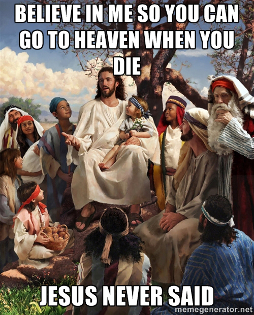
Believe in me for the forgiveness of your sins so you can go to Heaven when you die.

Jesus never saidThat’s the Evangelical message of the Gospel in a nutshell but Jesus never said it…ever. For that matter, neither did Paul, Peter, James, or any of the other apostles.

In fact, Jesus rarely spoke of personal salvation and when he did, the teenage Lancaster thought it sounded…legalistic:

And someone came to Him and said, “Teacher, what good thing shall I do that I may obtain eternal life?” And He said to him, “Why are you asking Me about what is good? There is only One who is good; but if you wish to enter into life, keep the commandments.” Then he said to Him, “Which ones?” And Jesus said, “You shall not commit murder; You shall not commit adultery; You shall not steal; You shall not bear false witness; Honor your father and mother; and You shall love your neighbor as yourself.” The young man said to Him, “All these things I have kept; what am I still lacking?” Jesus said to him, “If you wish to be complete, go and sell your possessions and give to the poor, and you will have treasure in heaven; and come, follow Me.” But when the young man heard this statement, he went away grieving; for he was one who owned much property.

Matthew 19:16-22 (NASB)

The traditional Evangelical interpretation is that Jesus was playing a little game with this fellow to help him realize that he needed to leave his wealth behind and learn to trust Jesus, but I don’t see how the fellow in question could come to that conclusion when Jesus was speaking of the commandments and merit, a very Jewish message.

But the Evangelical message of the plan of salvation, although it’s some part of the Gospel message, is not only a small part of that overall good news, it’s terrifically misleading. It only teaches that you have to confess Jesus as Savior and believe in him. That’s it. In fact, Lancaster says Evangelicals shouldn’t really be called Evangelicals but rather “Salvationists” because of the narrow focus of their message.

They’re not even replacement theologists but rather displacement theologists, because the plan of personal salvation, as the length, breadth, and depth of their doctrine, displaces all of the Old Testament, the resurrection, a literal Israel, and the establishment of the Kingdom of Messiah on Earth. Why would you need an Earthly Kingdom if you go to Heaven when you die to be with Jesus?

What was the central message of the Messiah?

From that time Jesus began to preach and say, “Repent, for the kingdom of heaven is at hand.”

Matthew 4:17 (NASB)

Gates of HeavenThe NIV and other translations use the word “near” rather than “at hand.” The Kingdom of God is near. How near is it? Lancaster says it’s so near that the Messiah has even been named. He’s Jesus of Nazareth. He’s teaching repent of your sins, return to God, be immersed in the name of Messiah for the forgiveness of sins (after you fully repent), then you will participate in the building of the Kingdom, the restoration of national Israel, the return of the Jewish exiles to their Land, the raising of Israel as the head of all the nations.

Lancaster spoke too quickly for me to capture all of his points, but at the end, he said Peter’s message in Acts 2:37-42 is a much better representation of the actual Biblical Gospel message than what Evangelicals preach.

And at the culmination of the Kingdom, all of humanity, each and every individual, will stand before the throne of judgment. The Evangelical message of salvation is only included in bits and pieces of the total Gospel, and it’s still an anti-Jewish people and anti-Judaism message if only because it wholly denies the centrality of Israel and the Jewish people in its own salvational plan.

It gets worse. Jesus preached:

And someone said to Him, “Lord, are there just a few who are being saved?” And He said to them, “Strive to enter through the narrow door; for many, I tell you, will seek to enter and will not be able.

Luke 13:23-24 (NASB)

This is not what Evangelicals preach about salvation. For example, how can you “strive to enter the narrow door,” when there’s nothing you can do to merit salvation? Evangelicals say to “accept” and “make a decision for Christ” which are quite passive. Striving is active and implies you must do something to enter the narrow gate. Also, how can the gate be so narrow if whole stadiums and auditoriums of people are “getting saved” by some big name evangelist preacher at a huge revival?

milkThat last part is a little tongue-in-cheek, but you get the idea. Jesus didn’t teach that the Gospel message or even the salvational part of it was “believe in me and be saved.” He taught, “repent, have faith, become a disciple, for there will be a resurrection of the dead, and the living and the resurrected will participate in final redemption.” Lancaster says the actual Gospel message isn’t news to Messianic Judaism but it must be quite a shock to most of the world’s 100 million Evangelical believers. Most Evangelicals don’t even know about the “milk” being taught in the Bible, let alone the “meat,” and this is where we re-engage the Book of Hebrews.

Therefore leaving the elementary teaching about the Christ, let us press on to maturity…

Hebrews 6:1 (NASB)

Lancaster ended here a few weeks ago and this is the place where we have come to again. This is also the heart of Lancaster’s new book Elementary Principles: Six Foundational Principles of Early Jewish Christianity, which is available as a special promotion (sorry to sound like a commercial, but it’s a pretty good deal) until June 3rd.

Lancaster wound down his sermon with another summary of the six foundations of the faith and said starting next week, he’s going into each of them in detail, with repentance being the very first step.

What Did I Learn?

As I mentioned, I’ve read and reviewed McKnight’s book last year, so this was more like a review than a revelation. I’ve also been going through my own study of repentance or teshuvah, so his comments on repentance operated in parallel to my own thoughts.

I don’t think that all Evangelicals have quite such a narrow view of the message of the Gospel, but I agree that even the most enlightened Evangelical is missing at least part of the picture. I know Evangelical Christians who strongly preach repentance of sins and who even lament there are many people in the pews on Sunday, who in all probability, are not saved because all they know is to passively believe.

I don’t doubt that some and hopefully many Evangelicals are indeed saved and are faithfully serving God, but it’s not my place to say who is and who isn’t. It’s my place first and foremost to care for my own relationship with God, for without love of God how can I love my fellow human being in the manner my Master commands?

Elementary PrinciplesLancaster doesn’t recommend McKnight’s book to his congregation, probably because he believes they are more tuned in to the actual message of the Gospel because of their involvement in Messianic Judaism (and being consumers of Lancaster’s prolific teachings and writings). I do recommend McKnight’s book to Evangelical Christians as a means of understanding that what Lancaster is teaching isn’t “Evangelical bashing,” but rather a startling wake up call.

Do you really want to know what Jesus taught as the good news of Christ? You may not get the full message from your Pastor’s sermons or from popular books by Christian authors. You probably won’t even get it in Sunday school or at a Wednesday night Bible study. If you read McKnight’s book, please open your mind and heart and be prepared for a shock. If you survive the book intact and want to learn more, continue with Lancaster’s book and see where that takes you.

Chol HaMo’ed Pesach: Writing on Flesh

When Moses descended, he carried the Word of God—not the Word made flesh, but the word made stone upon the two tablets of the covenant.

“The Word from Heaven Was Broken”
Commentary on Chol HaMo’ed Pesach
First Fruits of Zion (FFOZ)

The obvious image those words should invoke is this:

And the Word became flesh, and dwelt among us, and we saw His glory, glory as of the only begotten from the Father, full of grace and truth.

John1:14 (NASB)

The Old Covenant was established with the Children of Israel at Mount Sinai and the conditions of that covenant, the Torah, were given on stone tablets.

The mediator of the New Covenant entered our world as “the Word made flesh” and the conditions of that covenant were in every spoken word and action of that “Word,” in the person of Yeshua (Jesus) of Nazareth, HaMaschiach (the Messiah). But of course, the conditions previously established didn’t change, and everything taught by the Rav from Nazareth was Torah.

“Do not think that I came to abolish the Law or the Prophets; I did not come to abolish but to fulfill. For truly I say to you, until heaven and earth pass away, not the smallest letter or stroke shall pass from the Law until all is accomplished.”

Matthew 5:17-18 (NASB)

The conditions of the Old Covenant were written on stone tablets. Exodus 32:16 says the finger of God wrote on the first set of tablets before the sin of the Golden Calf, before Moses broke them.

The FFOZ commentary tells us that according to midrash, the tablets that descended from Mount Sinai can be compared to a human body, and when Moses broke that “body,” because of the sin of Israel, the letters on the tablets flew off the stone and returned to their Source in Heaven.

When Messiah Yeshua’s body was broken due to the sin of Israel, his spirit left him and returned to its Source.

letters-on-stoneAfter the sin of the Golden Calf, Moses returned to the mountain and to God to plead for Israel and to renew the covenant (Exodus 34). This began a long and cyclical pattern of sin and repentance for Israel.

After the death of the Master, he was resurrected three days later and thus was completed the inauguration or the very starting of the New Covenant, a process that will not reach fruition until the Master’s return, for he ascended to Heaven and sits on the right hand of the Father, our High Priest in the Heavenly Court, who makes final atonement for the sins of humanity, who is the mediator of better promises. But get this:

“Moreover, I will give you a new heart and put a new spirit within you; and I will remove the heart of stone from your flesh and give you a heart of flesh. I will put My Spirit within you and cause you to walk in My statutes, and you will be careful to observe My ordinances.” (emph. mine)

Ezekiel 36:26-27 (NASB)

“But this is the covenant which I will make with the house of Israel after those days,” declares the Lord, “I will put My law within them and on their heart I will write it; and I will be their God, and they shall be My people. They will not teach again, each man his neighbor and each man his brother, saying, ‘Know the Lord,’ for they will all know Me, from the least of them to the greatest of them,” declares the Lord, “for I will forgive their iniquity, and their sin I will remember no more.” (emph. mine)

Jeremiah 31:33-34 (NASB)

The conditions of the Old Covenant were written on stone tablets and on scrolls, objects that are inanimate and external to human beings. If we want to know about God and if we want to “know God,” we must study and practice, and yet Biblical and human history is all too clear that even the best of us fail, no matter how great our desire to serve God.

praying_at_masadaYeshua came as the “Word made flesh,” the living embodiment of the Torah, the walking, talking, flesh and blood, human expression of the will and wonder of God, all contained within a human body. He was the perfect image of what we strive for, the Word written on flesh.

There’s a difference. John’s Gospel says that Yeshua was the Word made flesh, while we get from Ezekiel and Jeremiah that the Word will be written on our fleshy hearts. We don’t literally become the Word as a human being, we “merely” have it wholly integrated into our being.

But here’s the result.

Amen, I say to you, none among those born of a woman has arisen greater than Yochanan the Immerser; yet the smallest in the kingdom of Heaven will be greater than he.

Matthew 11:11 (DHE Gospels)

I mentioned above the concepts of knowing about God vs. knowing God. I don’t doubt that there are people today, great tzaddikim or saints who know God, at least to the current extent of human ability, but the Bible records that Moses spoke with God “face to face” (Exodus 33:11). That’s pretty hard for me to imagine, especially since God is considered Spirit and without physical form (the third of the Rambam’s Thirteen Principles of Faith).

But the Master prophesied that when the New Covenant is fully enacted, then the finger of God will have finished writing His Word on our hearts of flesh and, like Moses and the Prophets of Old, including John the Baptizer, we will all know God, God’s Spirit will be poured out on all flesh (Joel 2:28, Acts 2:17), and everyone, from the least to the greatest, will have a full knowledge and intimate relationship with God. We won’t just know about Him, we will know Him.

Jesus, when the Spirit was poured out on him at his immersion (Matthew 3:16) became the forerunner, the first fruits of New Covenant human beings. He was still fully human, but with the Spirit poured out on him as it will be someday in the Messianic Era, a human being who could be tempted but still not sin. He’s the living promise that we will be perfected even as he was perfected.

It’s exciting to watch God’s plan open up in the pages of the Bible. The progression from the tablets and scrolls to the first fruits of the New Covenant, Messiah, coming as the “Word made flesh,” and then anticipating the day when that Word will be written on our flesh as well.

Right now, we experience just the leading edge of that New Covenant as we continue to live in the Old Covenant era, the Spirit was given as a pledge and a promise of what is yet to come (2 Corinthians 1:22). We aren’t there yet, but God has given His Spirit to us as His bond that what He has promised will indeed occur.

But there’s a catch.

For I am already being poured out as a drink offering, and the time of my departure has come. I have fought the good fight, I have finished the course, I have kept the faith; in the future there is laid up for me the crown of righteousness, which the Lord, the righteous Judge, will award to me on that day; and not only to me, but also to all who have loved His appearing.

2 Timothy 4:6-8 (NASB)

PrayingThis doesn’t just happen.

Yes, God promised it and it will happen, but it won’t just happen to us without an effort on our part. It isn’t just an intellectual and emotional acceptance we make that Jesus is Lord and then suddenly we’re in. As we see from Paul’s example, we only get to the finish line after running the race, after exerting ourselves, after keeping the faith and holding fast to our confession (Hebrews 4:11, 14).

Recently, I wrote of some of this as applied to me personally in For Redemption is Not Yet Complete and next week’s review of D. Thomas Lancaster’s Epistle to the Hebrews sermon The Source of Eternal Salvation will speak strongly to who we are in Messiah and our role in the process of repentance and salvation.

Each day, we struggle to reaffirm our faith. Each day we must repent anew, plead for the forgiveness of our sins, and turn to Yeshua as our atonement. The finger of God is moving and writing, but only if we are willing participants in allowing our stony heart to be transformed, only if we surrender ourselves as the material upon which (upon whom) God may write His Torah.

And we do that only by recognizing the one who came from God and who returned to God and who will come again. The one who arrived as a flesh and blood man and who was (and is) also the Word. For only through him can we find the Word within us as we are within Him.

Review of “What About the New Covenant,” Part 5

Session Five: From Glory to Glory

“Behold, days are coming,” declares the Lord, “when I will make a new covenant with the house of Israel and with the house of Judah, not like the covenant which I made with their fathers in the day I took them by the hand to bring them out of the land of Egypt, My covenant which they broke, although I was a husband to them,” declares the Lord.

Jeremiah 31:31-32 (NASB)

This is the fifth and final lecture in the series What About the New Covenant presented by D. Thomas Lancaster and produced by First Fruits of Zion (FFOZ). This sermon is the one that wraps everything up, at least hopefully. We’ve gone through the other four lectures and I’ve offered my thoughts and opinions. Let’s see how everything ends.

Lancaster says the above-quoted text from the New Covenant language in Jeremiah reminds him of the incident with the Golden Calf (Exodus 32). Moses smashed the first set of tablets, symbolizing how Israel broke the covenant, rebuked the people, then went back up the mountain to make atonement. He came back down with another set of tablets, symbolizing the renewal of the covenant.

It came about when Moses was coming down from Mount Sinai (and the two tablets of the testimony were in Moses’ hand as he was coming down from the mountain), that Moses did not know that the skin of his face shone because of his speaking with Him. So when Aaron and all the sons of Israel saw Moses, behold, the skin of his face shone, and they were afraid to come near him. Then Moses called to them, and Aaron and all the rulers in the congregation returned to him; and Moses spoke to them. Afterward all the sons of Israel came near, and he commanded them to do everything that the Lord had spoken to him on Mount Sinai. When Moses had finished speaking with them, he put a veil over his face. But whenever Moses went in before the Lord to speak with Him, he would take off the veil until he came out; and whenever he came out and spoke to the sons of Israel what he had been commanded, the sons of Israel would see the face of Moses, that the skin of Moses’ face shone. So Moses would replace the veil over his face until he went in to speak with Him.

Exodus 34:29-35 (NASB)

There’s a lot going on in this paragraph in the Torah. The only time I’ve heard this passage explained before was on Christian radio, and the Pastor doing the teaching (I can’t recall who it was) used it as some sort of evidence to how bad the law was. I can’t remember his arguments, but it seemed more than a little allegorical and was yet another shot by the Church from its Replacement Theology arsenal. Lancaster gives this portion of scripture a fresh look.

When Moses was in the presence of God, his face took on the “radiance of the Divine Presence” but it eventually faded. The people were initially afraid of seeing the light of God’s Glory shining on Moses’ face but he called them back to him. When he was around people, he veiled his face, maybe to keep from scaring people, but maybe to keep them from realizing that the light eventually faded. Only when he was with God did he unveil his face and the shining glory returned to him. almost like Moses was being “recharged.”

This will all become important shortly as we get into Lancaster’s commentary on Paul’s midrash:

For we are not like many, peddling the word of God, but as from sincerity, but as from God, we speak in Christ in the sight of God.

2 Corinthians 2:17 (NASB)

Lancaster and the rest of the FFOZ staff typically default to the ESV Bible when writing or teaching, but this time Lancaster switched to the NASB, explaining that the ESV Bible does a poor job at translating the verses he’s going to teach from. This matches what Pastor Randy told me one time, saying that he found the ESV Bible in general to give a certain amount of support to Replacement Theology by how it translates the original languages.

The Jewish PaulWe start with Paul defending himself from allegations that he is not really an apostle because he was not commissioned as were the other apostles, by Yeshua (Jesus) during the Messiah’s “earthly ministry.” Paul explains that he did not come “peddling the word of God,” that is, asking for money, but he worked to support himself. He also said “we speak Christ in the sight of God,” explaining that he and his companions were commissioned by God as it were.

Then Paul got a little sarcastic (an attitude New Testament scholar Mark Nanos called “an ironic rebuke” in his book The Irony of Galatians: Paul’s Letter in First-Century Context).

Are we beginning to commend ourselves again? Or do we need, as some, letters of commendation to you or from you? You are our letter, written in our hearts, known and read by all men; being manifested that you are a letter of Christ, cared for by us, written not with ink but with the Spirit of the living God, not on tablets of stone but on tablets of human hearts.

2 Corinthians 3:1-3 (NASB)

Without stealing Lancaster’s thunder by explaining everything, he describes Paul as sarcastically asking if his Master or the Council of Apostles in Jerusalem, should have sent him out with a letter or recommendation, sort of like asking, “Should I have brought a note from my Mother?”

But he also says something interesting. He says “you,” his audience, “are our letter of recommendation,” indicating that their behavior, their lives changed by the knowledge of and faith in Messiah, are what establishes Paul’s “cred” as an apostle. But a letter written on hearts by the Spirit of God? Where have we heard that before?

And I will give them one heart, and put a new spirit within them. And I will take the heart of stone out of their flesh and give them a heart of flesh, that they may walk in My statutes and keep My ordinances and do them. Then they will be My people, and I shall be their God.

Ezekiel 11:19-20 (NASB)

“But this is the covenant which I will make with the house of Israel after those days,” declares the Lord, “I will put My law within them and on their heart I will write it; and I will be their God, and they shall be My people.

Jeremiah 31:33 (NASB)

TorahLancaster says that Paul took those two passages, both of which end with the same declaration of Israel being His people and He being Israel’s God in New Covenant language, and leveraged them in this 2 Corinthians 3:1-3 commentary. Paul is continuing to establish himself as an apostle and emissary of the New Covenant, contrasting the Old Covenant and New Covenant, not that the conditions are different, because the Torah as the conditions, are the same between one covenant to the other, but that those conditions, written on stone tablets in the Old Covenant, are written on hearts by the Spirit of God in the New Covenant.

Such confidence we have through Christ toward God. Not that we are adequate in ourselves to consider anything as coming from ourselves, but our adequacy is from God, who also made us adequate as servants of a new covenant, not of the letter but of the Spirit; for the letter kills, but the Spirit gives life.

But if the ministry of death, in letters engraved on stones, came with glory, so that the sons of Israel could not look intently at the face of Moses because of the glory of his face, fading as it was, how will the ministry of the Spirit fail to be even more with glory? For if the ministry of condemnation has glory, much more does the ministry of righteousness abound in glory. For indeed what had glory, in this case has no glory because of the glory that surpasses it. For if that which fades away was with glory, much more that which remains is in glory.

2 Corinthians 3:4-11 (NASB)

Especially starting at verse 7, these scriptures are used by many Christian teachers and Pastors to substantiate the allegation that the Torah was “bad” and killed, and that it was replaced by the grace of Jesus which is “good” and gave life. I have to admit, if you had no context for interpreting Paul’s meaning, then “the ministry of death, in letters engraved on stones” sounds pretty grim. The Torah brings death, the ministry of Moses was (and is) deadly, he seems to say. But look at the full message from the point of view of a val chomer or from lighter to heavier argument. I’ll paraphrase somewhat:

But if the ministry of death, in letters engraved on stones, came with glory, so that the sons of Israel could not look intently at the face of Moses because of the glory of his face, fading as it was, how will the ministry of the Spirit fail to be even more with glory?

I guess this “ministry of death” thing needs some explanation. What brings death, obeying the Torah? That hardly seems likely since God gave Israel the Torah as the conditions of the Old Covenant at Sinai and, as we’ve seen these past several weeks, the Torah represents the conditions of the New Covenant as well. So how can the Old Covenant and the Torah be a “ministry of death?” What’s the difference between the Old and New Covenants?

Under the Old Covenant, if you disobey the conditions, thereby disobeying God, the consequences were exile and death. The wages of sin is death (Romans 6:23). It’s not the Torah that brings death, and it is not fidelity to the Torah and to God that brings death, the ministry of death is disobedience and sin, the consequences for which, under the Old Covenant, bring death.

gloryBut as we’ve previously seen, under the New Covenant, the Torah or the conditions don’t change, it’s the people who change. It becomes possible for people to not sin at all thanks to what God does in the New Covenant, writing the Torah on people’s hearts so obedience to God becomes part of human nature. It is the ministry of righteousness because the people become righteous.

Paul is saying something like:

If you thought the Old Covenant came in tremendous glory, just you wait. The New Covenant comes with even much more glory, so much in fact that, by comparison, the shining of the New Covenant will make the light and glory of the Old Covenant seem like a dim night-light!

Paul isn’t saying that the Old Covenant had no glory, only that by comparison, the New Covenant, because it makes it basically impossible for people to sin, will seem so much more glorious. In a val chomer argument, the second condition cannot be true unless the first condition is true, so if the New Covenant has tremendous glory, the Old Covenant is glorious as well (present tense), just not quite so much.

Like the glow on Moses’ face, it was brilliant in its illumination, but it had a tendency to fade and needed to be renewed. Something like the pattern of Israel under the glorious Old Covenant. Israel’s faith tended to fade and they sinned, requiring repeated renewal efforts. Christianity has a similar problem but then, we’re still living in Old Covenant times, too. We do however have a pledge of the coming New Covenant, just as all believers do, Jew and Gentile alike.

Lancaster previously talked about a Heavenly Torah that, in order to be understood and accessed by man, had to be “clothed” so to speak, to “translate” from Heaven to Earth. The Torah of the Lord is perfect, restoring the soul (Psalm 19:7), but since it exists in our world, it is also temporal. Basically, it’s glory “fades.” The Torah of Messiah in the New Covenant is the Supernal Torah and will never fade but instead, Messiah will reveal what is now concealed in the Torah, removing the veil, as it were, from the Torah and from in front of our eyes, so we can see the full glory, just as Moses saw God’s glory on the mountain.

Do not think that I came to abolish the Law or the Prophets; I did not come to abolish but to fulfill. For truly I say to you, until heaven and earth pass away, not the smallest letter or stroke shall pass from the Law until all is accomplished.

Matthew 5:17-18 (NASB)

heaven and earthThe Old Covenant does not change at all while Heaven and Earth are still here, but eventually, we get a New Heaven and New Earth, so the Old Covenant will eventually cease. Actually I had a problem with this example of Lancaster’s because what I see Yeshua (Jesus) saying is that the Torah, the conditions of the Old and New Covenants, don’t change as long as Heaven and Earth exist, so it seems that the conditions of even the New Covenant will change once we get a New Heaven and a New Earth. Of course, until then, we are living in Old Covenant times, holding only a pledge of the New Covenant through receiving the Holy Spirit, so the conditions are still with us under the Old Covenant and the emerging New Covenant.

When He said, “A new covenant,” He has made the first obsolete. But whatever is becoming obsolete and growing old is ready to disappear.

Hebrews 8:13 (NASB)

Sure, the Old Covenant is becoming obsolete, but that’s a long, drawn out process, and it won’t disappear until Messiah returns bringing the fully realized New Covenant with him.

Let’s finish up with chapter three of 2 Corinthians:

Therefore having such a hope, we use great boldness in our speech, and are not like Moses, who used to put a veil over his face so that the sons of Israel would not look intently at the end of what was fading away. But their minds were hardened; for until this very day at the reading of the old covenant the same veil remains unlifted, because it is removed in Christ. But to this day whenever Moses is read, a veil lies over their heart; but whenever a person turns to the Lord, the veil is taken away. Now the Lord is the Spirit, and where the Spirit of the Lord is, there is liberty. But we all, with unveiled face, beholding as in a mirror the glory of the Lord, are being transformed into the same image from glory to glory, just as from the Lord, the Spirit.

2 Corinthians 3:12-18 (NASB)

Lancaster goes through this line by line, but what I found important was how his interpretation of Paul redeemed Paul from the criticism of many Jewish people or for that matter, the mistaken understanding of many Christians, who saw Paul as anti-Torah and Law-free, and was teaching Jews and Gentiles to also forsake Torah and to believe the Torah was a “ministry of death”.

Lancaster describes why the Jewish people couldn’t simply obey the Torah as they had always done and have that be enough. It’s why there aren’t two paths to salvation, Moses for the Jews and Jesus for the Gentiles. Hear me out. I think this explanation makes sense.

Under the Old Covenant, as hard as a Jewish person might strive, being only human, sooner or later he would sin and require atonement under the conditions of that Covenant, that is, the Torah. When Israel sinned greatly and did not repent, the conditions of the Old Covenant required exile and death. Nothing in that Covenant made Jewish people “sin proof,” so to speak.

Look at Israel’s history. It’s glorious but it’s also terrible. How many exiles have there been? How many times has Jerusalem been destroyed? How many times has God (temporarily) withdrawn His presence from among Israel due to their “hearts of stone?”

tallit_templeBut under the New Covenant, God makes it possible for Israel not to sin at all and further, God promises to forgive all of Israel’s sins past and present. Apprehending the first fruits of the New Covenant through faithfulness to Yeshua HaMashiach, the conditions of the Old Covenant and New Covenant, that is, the Torah, don’t change, so Jews are still required to perform the mitzvot, but God starts writing on their hearts, starts softening hearts, begins to lead His people Israel into the better promises of the New Covenant.

The veil is lifted and the concealed Torah is revealed. Israel is liberated, not from the Torah but liberated from sin.

What does from glory to glory mean?

From the glory of the Old Covenant, which was and is glorious indeed, but to the greater glory of the New Covenant, which will be eternal and in which all men will know God face to face, the way Moses knows God, not dimly through a mirror, as we know God now.

The glory of the Old Covenant forgives sin but does not make people sinless. The glorious New Covenant forgives all sins past and present, and then makes it possible for people to naturally obey God so that we will never again sin. The Old Covenant was and is good, but the New Covenant really is the better deal. It’s incredibly fabulous.

I’m kind of sad to see this study end. I was really enjoying it. Of course, I’ve got about a year’s worth of Lancaster’s Epistle to the Hebrews study to still work through, so it’s not like I’m out of material to review.

I deliberately left out quite a bit of detail from my reviews, so if these “meditations” have piqued your interest, I’d recommend you order the full five-disc set of audio CDs What About the New Covenant. May you be as illuminated as I have been.

Sermon Review of the Holy Epistle to the Hebrews: The Messiah Psalm

Psalm 110 is the most frequently quoted text in the New Testament. Why? And what did Yeshua mean when he quoted it to challenge the concept of a Davidic Messiah?

Listen to a study of Hebrews 4:14-5:6 which unwraps Psalm 110 and introduces the priesthood of Messiah. “The Messiah Psalm” offers discussion about the Messianic interpretation of Psalm 110 as it appears in the teaching of Yeshua (Mark 12) and the Epistle of Hebrews.

-D. Thomas Lancaster
Sermon Thirteen: The Messiah Psalm
Originally presented on April 13, 2013
from the Holy Epistle to the Hebrews sermon series

Therefore, since we have a great high priest who has passed through the heavens, Jesus the Son of God, let us hold fast our confession. For we do not have a high priest who cannot sympathize with our weaknesses, but One who has been tempted in all things as we are, yet without sin. Therefore let us draw near with confidence to the throne of grace, so that we may receive mercy and find grace to help in time of need.

For every high priest taken from among men is appointed on behalf of men in things pertaining to God, in order to offer both gifts and sacrifices for sins; he can deal gently with the ignorant and misguided, since he himself also is beset with weakness; and because of it he is obligated to offer sacrifices for sins, as for the people, so also for himself. And no one takes the honor to himself, but receives it when he is called by God, even as Aaron was.

So also Christ did not glorify Himself so as to become a high priest, but He who said to Him,

“You are My Son,
Today I have begotten You”;
just as He says also in another passage,

“You are a priest forever
According to the order of Melchizedek.”

Hebrews 4:14-5:6 (NASB)

Lancaster teaches some really interesting things in this session, but we have to get there first.

As he often does, Lancaster begins by recapping his previous sermon, in this case by reminding us that we need a priest to approach God, to approach paradise, because we have big angels and a flaming sword keeping us out.

Lancaster also reminds us of who the original readership of the writer of the Hebrews epistle was, and it sure wasn’t us, that is, twenty-first century (Gentile) Christians. The original audience, from Lancaster’s point of view, were first century Hellenistic Jews living in Judea. They had just suffered the martyrdom of James the Just, brother of the Master, the head of the Apostolic Council, along with other important leaders, and they had either just been denied access to the Temple and Priesthood or they were about to be denied. The Sadducees, who controlled access to the Temple, never got along with the Master Yeshua (Jesus) because they deny the resurrection and the existence of the divine soul, both of which the Master taught.

PriestsFrom a Christian’s point of view, it’s very important to realize that the Jewish disciples of the Master did not have a problem with the Temple or the Priesthood at all. They only had a problem with the corruption of the Sadducees who at that point in history controlled access to the Priesthood and the Temple sacrifices. Most Christians read Hebrews as the anti-Levitical Priesthood and anti-Temple book in the Bible, so it’s important to point out these distinctions.

In the next part of the sermon, Lancaster takes us on a small but important detour away from Hebrews and into the Gospel of Mark:

They came again to Jerusalem. And as He was walking in the temple, the chief priests and the scribes and the elders came to Him, and began saying to Him, “By what authority are You doing these things, or who gave You this authority to do these things?”

Mark 11:27-28 (NASB)

Lancaster says that Yeshua evaded the question for about a chapter and then got down to the heart of the matter.

By chapter 12, verse 34, Jesus had so deftly responded to all of his challengers that no one dared to ask him anymore questions. Then Jesus had a question of his own:

And Jesus began to say, as He taught in the temple, “How is it that the scribes say that the Christ [Messiah] is the son of David?”

Mark 12:35 (NASB)

This is one of those questions that if we don’t consider the context of what was going on and we don’t apprehend the query in the manner of a first-century Jew, we’ll completely miss the meaning. Asking if the Messiah is the Son of David is like asking if the Pope is Catholic. Of course, he is! It’s incredibly obvious. So why did Jesus ask this question?

David himself said in the Holy Spirit,

‘The Lord said to my Lord,
“Sit at My right hand,
Until I put Your enemies beneath Your feet.”’

David himself calls Him ‘Lord’; so in what sense is He his son?” And the large crowd enjoyed listening to Him.

Mark 12:36-37 (NASB)

Jesus quotes from Psalm 110. It was common for him to refer to older scriptures, so on the surface, this doesn’t seem unusual. It was common for Paul and the other apostles to quote from previous scriptures, so again, it doesn’t seem to be an unusual event.

King DavidBut of all the Old Testament scriptures quoted in the New Testament, Psalm 110 is the one quoted most often, being cited a total of fifteen times, with nine of those mentions in the Epistle to the Hebrews. The apostles related to Psalm 110 as one of these most noteworthy Messianic prophesies (with Psalm 2 being the other). What was Jesus, and later the writer to the Hebrews, trying to say that we miss, especially in English?

Lancaster tells us that English language Bibles render Psalm 110 poorly because they generally translate the words “my Master” and “Hashem” both as “Lord”. This gives the impression that God is talking to Himself.

Lancaster reads the ESV translation of Psalm 110 but with some slight differences that render it more comprehensible. I’ll reproduce it here with those differences formatted in bold and underlined text.

Hashem says to my Master:
“Sit at my right hand,
until I make your enemies your footstool.”
Hashem sends forth from Zion
your mighty scepter.
Rule in the midst of your enemies!
Your people will offer themselves freely
on the day of your power,
in holy garments;
from the womb of the morning,
the dew of your youth will be yours.
Hashem has sworn
and will not change his mind,
“You are a priest forever
after the order of Melchizedek.”
The Master is at your right hand;
he will shatter kings on the day of his wrath.
He will execute judgment among the nations,
filling them with corpses;
he will shatter chiefs
over the wide earth.
He will drink from the brook by the way;
therefore he will lift up his head.

Psalm 110

The craziness of this Psalm is that David, under inspiration from the Holy Spirit, referred to his descendent, his “son” as it were, as his “Master.” No son is Master of his father. This was Yeshua’s point. The Messiah was surely the Son of David but Psalm 110 also understands that Messiah is more than the Son of David. If Messiah was only the Son of David, he would be seated at David’s right hand.

Licht senderSince Messiah is seated at God’s right hand, whose son does that make him (hint, hint)?

Lancaster read from a collection of traditional Jewish midrash which incredibly, has Abraham also asking why Messiah, Son of David, Son of Abraham ultimately, is seated at God’s right hand.

The Even Zohar, Rabbi Yeshiel Tzvi Lichtenstein in his commentary on Mark 12:25 states that Messiah was indeed the Son of David in the flesh and the Son of God in the Spirit.

Yeshua was confirming that he was the Messiah, Son of David and Son of God. Lancaster says it was Yeshua’s interpretation of Psalm 110 that resulted in his execution.

Again the high priest was questioning Him, and saying to Him, “Are You the Christ [Messiah], the Son of the Blessed One?” And Jesus said, “I am; and you shall see the Son of Man sitting at the right hand of Power, and coming with the clouds of heaven.” Tearing his clothes, the high priest said, “What further need do we have of witnesses? You have heard the blasphemy; how does it seem to you?” And they all condemned Him to be deserving of death.

Mark 14:61-64 (NASB)

If the high priest had just asked “are you the Messiah” and Jesus had said “yes,” maybe he could have been wrong but it wouldn’t be blasphemy. But the high priest asked if Jesus was Messiah and Son of God, and Jesus answered yes. That’s what caused the high priest to condemn Jesus to death.

Now back to Hebrews 4 and our need for a high priest.

Lancaster spent a fair amount of time stating that Jesus had to be fully a human being, not just God or an angel masquerading as a human being. When Jesus was tempted, it had to be completely possible for him to give in to temptation and sin. It’s not temptation if there isn’t a real risk of sinning and if it was actually impossible for Jesus to sin, then he wasn’t really tempted, and therefore, he wasn’t really human. It had to be very possible for Jesus to sin, just like the rest of us. The only difference is that unlike the rest of us, Jesus passed every test and never, ever sinned.

This is where I got stuck last week, since it seems like someone who passed every test still wouldn’t be able to empathize with all of humanity because only he passed all the tests. The rest of us fail.

The High PriestBut in his sermon, as Lancaster entered Hebrews 5, he said this was a very important point. When the writer of Hebrews describes the high priest in verses 1 and 2, he’s not thinking of the then corrupt Sadduceeian high priest, but the ideal among high priests, Aaron. Ironically, one of Aaron’s highest qualifications, according to Lancaster, for the high priesthood was his sin in the incident of the Golden Calf (Exodus 32). It was because Aaron sinned that he could empathize with the weakness of the Israelites and have compassion as he atoned for their sins.

But this presents a problem, at least in an eternal sense.

…he can deal gently with the ignorant and misguided, since he himself also is beset with weakness; and because of it he is obligated to offer sacrifices for sins, as for the people, so also for himself.

Hebrews 5:2-3 (NASB)

Aaron, or the idealized high priest, could “deal gently with the ignorant and misguided” but on the other hand, he still had to offer sacrifices for himself because he too sinned.

While Aaron was the greatest and most noble of the high priests, there was still one who had better qualifications, one who could also empathize and “deal gently with the ignorant and misguided” but ”One who has been tempted in all things as we are, yet without sin” (Hebrews 4:15).

Verse 5 quotes from Psalm 110 and verse 6 is the writer’s proof text:

“You are a priest forever
According to the order of Melchizedek.”

Lancaster leaves us hanging at the meaning of “priest forever according to the order of Melchizedek,” so I suppose we’ll have to wait until next week to get into what all that’s about.

What Did I Learn?

I liked the “straightening out” of Psalm 110 so that it becomes easier to tell “who’s who” in the text. Also, I found the emphasis of Lancaster (and the writer of Hebrews) on the humanity of Jesus compelling. I’ve heard Christians refer to Jesus again and again as a “man-god,” which makes him sound like something out of a science fiction or fantasy novel rather than who he was and is. It’s fascinating to consider Jesus, our high priest in the Heavenly Court, as fully a human being and out of that sinless humanity, he is able to empathize with flawed and failing people in his being the atonement for our sins. I still struggle with how one who has never failed, as Aaron failed, could ever really feel empathy and completely understand, not only real temptation and the risk of failure, which Jesus did experience, but also how we actually, miserably fail, which Jesus never experienced.

The Death of the MasterIf Jesus had failed, he’d understand us better, but if he failed, he would have been disqualified and never would have ascended to be seated at Hashem’s right hand as our Master.

I can imagine this interpretation presenting some difficulties for many Christians relative to the traditional understanding of the “Godhead” and Trinitarian doctrine. I don’t think Lancaster is challenging this necessarily, but he is forcing us (me, anyway) to view the nature and character of Messiah differently. He was, and arguably still is, fully and completely human and the Son of David according to the flesh, but also fully and completely the Son of God according to the Spirit. How this works, I don’t know. I’m not sure anyone really knows, although there are plenty of opinions to go around, including the denial of the Master’s divine nature completely.

I can only imagine that Lancaster in his analysis of the Book of Hebrews, may have taken this one on as his sermon series progressed. Right now, at the end of sermon thirteen, we’re hanging at the priesthood of Melchizedek. Next week, Hashem be willing, we’ll learn more.

Review of “What About the New Covenant,” Part 4

Session Four: Better Promises

But Jesus has now obtained a more excellent ministry, and to that degree he is the mediator of a better covenant, which has been enacted through better promises.

Hebrews 8:6 (NRSV)

I have a feeling I’m going to encounter this material again when I listen to and review the relevant presentations in D. Thomas Lancaster’s Holy Epistle to the Hebrews sermon series. However, the Hebrews material has been folded into a different context, one contrasting and comparing the Old and New Covenants in First Fruits of Zion’s (FFOZ) latest teaching lectures What’s New About the New Covenant.

On disc four, Lancaster starts with a brief summary of the previous lectures. We learned that Old Covenant doesn’t mean Old Testament, and it doesn’t even mean the Torah. It is an agreement God made with Israel (and only Israel) at Sinai stating that He would be Israel’s God and they would be His people as long as they obeyed His commandments (the conditions recorded in the Torah), and should Israel disobey, God would punish them and exile them (but not forever reject them).

We also learned that the New Covenant doesn’t mean the New Testament and it doesn’t mean the Church. It also doesn’t mean “renewed” Covenant because it indeed is something new. The New Covenant is also an agreement made between God and the Houses of Judah and Israel (and only the Houses of Judah and Israel) and that, according to the writer of the Epistle to the Hebrews, the New Covenant is made of “better promises” and Jesus is the mediator of that New Covenant.

But what are the better promises and how can they be better if between the Old and New Covenants, God does not change even a single condition or requirement for Israel (the Torah mitzvot) but does change the hearts of all Jewish people, making it possible for them to correctly perform all of the mitzvot?

To answer that question, Lancaster takes us through a study of a few of the chapters in the book of Jeremiah. This is why I like reading large portions of the Bible in one setting. I can get the full message of God to Israel in its complete context rather than parsing bits and pieces and verses together artificially to form a picture that might not be correct.

Better Promises in the Messianic Future

The days are surely coming, says the Lord, when I will make a new covenant with the house of Israel and the house of Judah.

Jeremiah 31:31

“The days are surely coming” indicates the end of days, the final redemption, the future Messianic Era. For those Christians who believe that the New Covenant has already replaced the Old Covenant, this statement makes that particular doctrine impossible because the New Covenant hasn’t been enacted or completed yet. The death and resurrection of Jesus only got the ball rolling, so to speak. We’re still in the Old Covenant age. The Torah is still in effect as it always has been since Sinai.

Good News for Israel and Judah

Simchat TorahNotice (and I’ve mentioned this before) that the addressees of the New Covenant are “the house of Israel and the house of Judah.” This is only with the house of Israel and the house of Judah. Period. It’s an exclusive relationship between God and the Jewish people, just as the Old Covenant defined an exclusive relationship between God and the Jewish people. The New Covenant (pay attention please, this is important) has nothing to do with the nations, with Gentiles, or with anything called “Christianity” or “the Church.” The New Covenant does not create a stand-alone covenant relationship between the Church and God. The only covenant that all the people of the earth can claim for their (our) very own is the Noahide Covenant (Genesis 9:1-17).

The Transformation of the Jewish Heart

It will not be like the covenant that I made with their ancestors when I took them by the hand to bring them out of the land of Egypt—a covenant that they broke, though I was their husband, says the Lord. But this is the covenant that I will make with the house of Israel after those days, says the Lord: I will put my law within them, and I will write it on their hearts; and I will be their God, and they shall be my people.

Jeremiah 32-33

The next “better promise” is that God will make it possible for the Jewish people to obey His righteous standards and not sin by writing those standards on the Jewish heart.

Husband and Wife

Lancaster says an oath the groom would recite at the wedding ceremony in the ancient near east was to declare, “I will be your husband and you will be my wife.” God declared “I will be a God to you and you will be a people to me,” but that was contingent upon Israel not disobeying God and worshiping idols. Idol worship was considered as adultery by God, a wife going astray with other lovers (gods). Under the Old Covenant, Israel went astray, but under the better promises of the New Covenant, since the Torah will be written on their hearts and not just on tablets and scrolls, Israel will never again “cheat” on God, so to speak, and will always remain faithful.

Intimate Knowledge of God

No longer shall they teach one another, or say to each other, “Know the Lord,” for they shall all know me, from the least of them to the greatest, says the Lord; for I will forgive their iniquity, and remember their sin no more.

Jeremiah 31:34

Master and disciplesUnder the Old Covenant, many times the people of Israel, including the Priests and Prophets knew about God, but they didn’t know Him in the sense of an intimate knowledge that led to obedience. This is often true of Jews and Christians today. It’s easy to study the Bible and learn about God but not so easy to live a life that is consistently, day-by-day, hour-by-hour pleasing to God. Under the New Covenant, there will be a universal revelation of God to the whole world. It will be natural for everyone to obey God.

I know I said the New Covenant is an agreement just between God and the Jewish people, and I, or rather Lancaster, will get to the issue of Gentiles by the by.

Forgiving All of Israel’s Sins Forever

So that you may not claim to be wiser than you are, brothers and sisters, I want you to understand this mystery: a hardening has come upon part of Israel, until the full number of the Gentiles has come in. And so all Israel will be saved; as it is written,

“Out of Zion will come the Deliverer; he will banish ungodliness from Jacob. And this is my covenant with them, when I take away their sins.”

Romans 11:25-27

Lancaster didn’t cite Paul or Romans 11 but I felt it an appropriate addition. Lately, I’ve been hearing some bad opinions about Paul and his so-called anti-Torah, anti-Judaism, and anti-Jewish people letters, and I thought this would be a good time to clear some of that up, since Paul is preaching to the Romans New Covenant doctrine that is highly favorable to the Jewish people and to Israel.

Jeremiah, according to Lancaster, is saying one of the “better promises” of the New Covenant mediated by Messiah, is that God will forget all of Israel’s sins which is what makes it possible for Paul to literally mean that “all Israel will be saved” rather than some tiny remnant who, according to the Church, must leave Judaism and convert and assimilate into (Gentile) Christianity. God doesn’t change the Torah. The Torah is unchangeable at its core. God does change the Jewish people so that they naturally will be faithful to God and God, for His part, will forgive all of Israel’s sins, from the Golden Calf forward throughout all of history and into the Messianic Age.

That’s very good news, a wonderful gospel for the Jews.

Israel Will Always Be a Nation Before God

Thus says the Lord,
who gives the sun for light by day
and the fixed order of the moon and the stars for light by night,
who stirs up the sea so that its waves roar—
the Lord of hosts is his name:
If this fixed order were ever to cease
from my presence, says the Lord,
then also the offspring of Israel would cease
to be a nation before me forever.
Thus says the Lord:
If the heavens above can be measured,
and the foundations of the earth below can be explored,
then I will reject all the offspring of Israel
because of all they have done,
says the Lord.

Jeremiah 31:35-37

Moon and StarsI suppose this could be two “better promises.” Israel will be a distinct nation and the Jewish people will be a distinct and identifiable people as long as there is a sun, a moon, stars, and a sea, which is to say, as long as the earth, our solar system, and the universe exists. It is also a promise that God will never reject Israel and the Jewish people and they will remain a people and a nation until the heavens can be measured and the foundations of the earth can be explored. These conditions, by the way, are rhetorical language meaning “always.” Israel will always be a nation before God and God will never reject the Jewish people. Ever.

This flies in the face of the various churches who still adhere to some form of Replacement Theology because for them, the New Covenant replaces the Old Covenant, and they interpret that to mean that God rejected Israel permanently because Israel rejected Jesus as Messiah. God then replaced Israel with the (Gentile) Church which accepted Jesus. Now, the only way God will accept a Jew is for the Jew to reject Judaism and convert to (Gentile) Christianity. However, examining the New Covenant language reveals that Replacement Theology is hopelessly unBiblical.

Jerusalem the Eternal City

The days are surely coming, says the Lord, when the city shall be rebuilt for the Lord from the tower of Hananel to the Corner Gate. And the measuring line shall go out farther, straight to the hill Gareb, and shall then turn to Goah. The whole valley of the dead bodies and the ashes, and all the fields as far as the Wadi Kidron, to the corner of the Horse Gate toward the east, shall be sacred to the Lord. It shall never again be uprooted or overthrown.

Jeremiah 31:38-39

Who can count the number of times Jerusalem has been conquered and destroyed? OK, probably someone has, but the point is that historically, whenever Israel sins, the Temple is destroyed and Jerusalem is left in ruins. This “better promise” for the Jewish people states that Jerusalem will be rebuilt and expanded and it will never again be destroyed because the Jewish people will never again sin against God or other people.

Some of the really exciting “better promises.”

Jeremiah 32:1-15 tells of God commanding Jeremiah to buy a field in Judah during Nebuchadrezzar’s siege against Jerusalem, a command Jeremiah couldn’t understand. It would have been crazy to do so, but God had something in mind: more “better promises.”

MessiahI don’t really want to reveal all of the better promises since if I do, you might not be as inclined to listen to the full lecture. In brief, the other promises include the regathering of the Jewish people to their Land, giving the Jewish people all one heart, and one way (in my opinion, “the Way”) so that there will be no division among Jews, that the New Covenant will be everlasting, that God will rejoice over doing good for Israel, that a “righteous branch” meaning the Messiah, will rise from the line of David. In addition to a return of the Davidic dynasty on the throne of Israel, the line of Aaron and the Levitical priests will return, which means there must be a Temple for them to offer sacrifices in.

God even says that He will only break His covenant with David and with Aaron if someone can break God’s covenant with day and night. More rhetorical language meaning “never.”

But there is something more about Lancaster’s sermon I do want to reveal since it contains a dire warning.

Those Who Say God Rejected Israel

The word of the Lord came to Jeremiah: Have you not observed how these people say, “The two families that the Lord chose have been rejected by him,” and how they hold my people in such contempt that they no longer regard them as a nation? Thus says the Lord: Only if I had not established my covenant with day and night and the ordinances of heaven and earth, would I reject the offspring of Jacob and of my servant David and not choose any of his descendants as rulers over the offspring of Abraham, Isaac, and Jacob. For I will restore their fortunes, and will have mercy upon them.

Jeremiah 33:23-26

ChurchHistorically, who has held Israel in contempt and said that God no longer regards the Jewish people as a nation? OK, just about everybody, but that “everybody” includes the Christian church. Even today, many churches continue to adhere to some form of Replacement or Fulfillment Theology, and any Christian who does espouse such a theology is who God, through Jeremiah, said “hold my people in such contempt” (emph. mine). Really, do you want to be on God’s “wrong side” by holding Israel in contempt, or even in the slightest degree, believe that God has rejected Israel and replaced her with the Church?

In addition to their being more “better promises” and “good news” for the Jewish people in these chapters of Jeremiah, Lancaster mentioned that there are still more better promises littered about the various books of the Prophets including Isaiah, Ezekiel, Amos, and Joel. That’s really a lot of better promises and good news for Jewish people.

But What About the Gentiles?

Then certain individuals came down from Judea and were teaching the brothers, “Unless you are circumcised according to the custom of Moses, you cannot be saved.”

But some believers who belonged to the sect of the Pharisees stood up and said, “It is necessary for them to be circumcised and ordered to keep the law of Moses.”

Acts 15:1, 5

Remember what I (citing Lancaster) said above about the New Covenant being made only with the House of Israel and the House of Judah? No mention of Gentiles at all. So do we even figure in? There’s a lot of language in the Apostolic Scriptures that says “yes” but we have to dig for it.

However, from the point of view of the various Jewish sects in the late second temple period, including believing Jews in “the Way,” recalling the New Covenant language, the only way they could see how Gentiles could be included in these “better promises” was to convert to Judaism.

In Acts 15:1-2 and 15:24, Now with what Satanically-inspired and dogmatic false teaching did these “certain men from Judaea” try to infect the church at Antioch, and why according to Galatians 2:4-5? (emph. mine)

That quote is from the study notes for the Sunday school class I attend when they were teaching on Acts 15 last September (here’s the link to the relevant blog post). What they couldn’t see was that the Jewish people asking these questions were not “Satanically-inspired” but rather, asking a legitimate question based on the Jeremiah 31 text.

Paul knew that the Gentiles didn’t have to convert to Judaism in order to be included in better promises (hence his letter to the Galatians), and Peter witnessed this first hand as recorded in Acts 10:44-48, but no formal decision had been rendered by the Council of Apostles and Elders defining Gentile legal identity within the Jewish community. Acts 15:6-29 records a summary of the legal hearing, including the testimony of various witnesses, and the conclusion and ruling of the Council that Gentiles could be granted honorary status within the commonwealth of Israel, grafted into the nation (see Romans 11:11-24), but only because of their association with Israel through faith in King Messiah.

Apostle Paul preachingThat’s an incredibly vital point to get, because without the New Covenant “better promises” being applied exclusively to the House of Israel and the House of Judah, if God really did reject Israel and the Jewish people in perpetuity, then we Gentiles would have absolutely, positively no hope of salvation at all! Israel is central in God’s plan to redeem the people of all the nations of the earth.

When King Messiah returns, he will be King of Israel, King of the Jews, and he will conquer all of the other nations and be their King. He will annex all of the other countries and Israel will be at the head of the nations, and all of the other nations will be vassal servants to Israel. As citizens of these vassal nations, we too will be annexed subjects of Israel and her King. The good news for the Gentiles is if we swear allegiance to King Messiah now, even before his return, we become his subjects and the New Covenant blessings become ours.

No, we don’t become Jews because we are citizens of a nation annexed by Israel and not citizens of Israel itself. We are granted an honorary status in the commonwealth of Israel. We’re grafted in.

As I’ve mentioned about a million times elsewhere, we don’t come under “One Law” in terms of being commanded to wear tzitzit, lay tefillin, and such, but we do become people who are called by His Name, and partisans or freedom fighters, so to speak, who are defending our King and his people until he returns and ascends his throne in Jerusalem, much as Robin Hood and his Merry Men of legend fought against the tyranny of Prince John and protected the innocent until King Richard’s return.

And many peoples will come and say, “Come, let us go up to the mountain of the LORD, To the house of the God of Jacob; That He may teach us concerning His ways And that we may walk in His paths.” For the law will go forth from Zion And the word of the LORD from Jerusalem.

Isaiah 2:3

New CovenantIf you are not a Jew and if you call yourself a Christian or any other name that indicates an allegiance to the King of the Jews, to Jesus Christ, then this is your hope in the New Covenant through national Israel, the Messianic Kingdom, and through the Messianic King. The Master said, Salvation comes from the Jews,” (John 4:22) and according to Lancaster, he was talking about the New Covenant and everything that was presented in this lecture ”Better Promises.”

If you want to be part of those “better promises” then please carefully consider everything you’ve read here today. It really wouldn’t hurt and might do a great deal of good if you got a hold of the five-disc set of What’s New About the New Covenant and listened to all of the content, since it really applies to who we are as Christians and what God expects of us and of how we treat His people Israel. Our salvation comes from Israel and her firstborn son Yeshua of Nazareth, the Messiah, the King…not the other way around.