Tag Archives: forgiveness

Tazria-Metzora: Time Out

whispererTzara’at, the skin discoloration mistranslated for millennia as “leprosy,” is a curious disease. It is not contagious—it was only acquired by virtue of speaking badly of other people. It was a physical skin discoloration caused by a spiritual defect. The “metzora,” the sufferer with tzara’at, had to stay outside the city and inform all that he or she was spiritually impure.

-Rabbi Shlomo Yaffe
“Healing Hubris”
Chabad.org

Judaism does not believe in free speech.

Talking ill of your neighbor, even if it is the truth, is unequivocally banned. In fact, the Talmud (Erchin 15b.) equates gossip-mongering with idolatry, licentiousness and murder—the three cardinal sins—combined!

Moreover, the Jerusalem Talmud tells us that “King David’s soldiers would fall at war, for although they were completely righteous, tale-bearing was widespread among their ranks… Ahab’s militia, however, although they were notorious idol-worshippers, were victorious on the battlefield because of their exceptional camaraderie . . .” (Pe’ah 1:1.)

Apparently, G‑d takes greater offense at the badmouthing of His children than at the badmouthing of Himself!

In some ways, then, the gossiper is the worst sinner of all. As such, his “punishment” teaches us much about the nature of all the punishments prescribed by the Torah.

-Rabbi Mendel Kalmenson
“Spiritual Rehab”
Chabad.org

Commenting on this week’s Torah Portion TazriaMetzora is a difficult task, at least if I don’t want to seem repetitive. After all, I’ve been “bashing” lashon hara or “evil speech” for a few days now as a problem I have with religious people and in how such speech destroys God’s reputation and all our lives.

It is thought in some circles of Judaism, that the cause of tzara’at in ancient times was evil or ill speech. The consequence was that, after the condition was confirmed by a Priest (with the cry of “Unclean!”), the metzora was set outside the camp. There was a period of waiting and then re-examination. If the metzora was declared clean, then he or she undertook a certain set of rituals and then could re-enter the camp. If not, then they had to wait some more and the process would repeat itself. Presumably, anyone who was a metzora would eventually be declared clean and then re-enter the camp of God.

But what if someone was never declared clean? What if the disease wouldn’t go away? I guess that would mean not only the symptoms would remain, the skin disease, but the underlying cause would keep hanging around: talking ill of your neighbor (and your neighbor ultimately could be anyone).

“If your brother sins against you, go and tell him his fault, between you and him alone. If he listens to you, you have gained your brother. But if he does not listen, take one or two others along with you, that every charge may be established by the evidence of two or three witnesses. If he refuses to listen to them, tell it to the church. And if he refuses to listen even to the church, let him be to you as a Gentile and a tax collector.

Matthew 18:15-17

I suppose that’s the closest New Testament equivalent to the condition of the metzora who sinned against his or her neighbor by gossiping against them. Well, it’s not as if the metzora didn’t exist in the days when Jesus walked in Israel:

When he came down from the mountain, great crowds followed him. And behold, a leper came to him and knelt before him, saying, “Lord, if you will, you can make me clean.” And Jesus stretched out his hand and touched him, saying, “I will; be clean.” And immediately his leprosy was cleansed. And Jesus said to him, “See that you say nothing to anyone, but go, show yourself to the priest and offer the gift that Moses commanded, for a proof to them.”

Matthew 8:1-4

The word rendered as “leper” in verse two is probably a rather poor translation or there was no Greek word that captured the Hebrew “metzora.” It seems that, in one fell swoop, Jesus forgave the metzora of his sin and cured his physical and spiritual ailments.
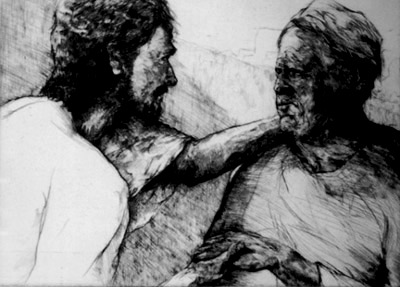
the_leperIn some sense, it’s a shame we don’t suffer from tzara’at today. If our sins were as plain as the noses on our faces, perhaps we would be much more diligent in avoiding sin. Then again, to the degree that there was such a law that required the metzora be examined and isolated from the camp, I guess people under such a law weren’t able to avoid such a sin, even knowing the consequences.

Still, it seems cruel. Why isolate someone from the community if they’ve sinned? We see examples in both the Tanakh and in the Apostolic Scriptures. The metzora endured temporary (hopefully) exile, while the passage from Matthew 15 teaches that a person gets “three strikes” before they are “out.” Do they ever get back in? How did the metzora get back into the camp?

Rather than talk to others, he needed to talk to himself.

This wasn’t about revenge; it was about reflection.

He wasn’t being hurt because he’d hurt others in the past. He wasn’t even being isolated so that he wouldn’t come to socially isolate others in the future. He was simply being given the opportunity to get to know his present self.

People who hurt and isolate others are lonely and in pain themselves. Those who try to destroy other people’s security and happiness are themselves often sad and insecure.

The Torah—which is concerned with kindness, not power—sees the sinner as a victim, not an enemy, and therefore recognizes his need to be strengthened rather than weakened. This, the Torah perceives, cannot be done in the presence of others, but has to be done alone.

In the presence of others, he would see that which he lacked. Alone with himself, he was able to see that which he possessed.

-Rabbi Kalmenson

This isn’t hard to understand. Any parent who has put their child in “time out” understands what is happening. This is what parenting experts and educators call “logical consequences.” If you can’t get along with your community (your brother, mother, playmate), you don’t get to be with them for a certain period of time. If you sin against your brother (in Christ), and you don’t repent, you don’t get to be with your brother or any of your brothers, presumably until you are able to repent.

Then Peter came up and said to him, “Lord, how often will my brother sin against me, and I forgive him? As many as seven times?” Jesus said to him, “I do not say to you seven times, but seventy-seven times.

Matthew 18:21-22

Oh, yes. When they do repent, you take them back. That’s what happened to the recovered metzora and what was supposed to happen to the brother who sinned against you. When they repent, you take them back. Even if they sin against you later and then repent, and then sin against you later, and then repent, and then…

Gee, really? Is this like a sin and repent and forgive revolving door? I suppose there must be limits.

Or do you not know that the unrighteous will not inherit the kingdom of God? Do not be deceived: neither the sexually immoral, nor idolaters, nor adulterers, nor men who practice homosexuality, nor thieves, nor the greedy, nor drunkards, nor revilers, nor swindlers will inherit the kingdom of God.

1 Corinthians 6:9-10

That sounds pretty harsh, but then again, if someone is willfully and habitually sinning, are they really saved at all? Are they really members of Messiah’s “sheep pen?” Can we flaunt the will of God to His Face and still expect that He will write our names in His book of life?

Why are we sometimes exiled from the community of brothers?

And so, ultimately, this was a therapeutic time for the metzora, focused not on hurting him but on curing him. Rather than confine him, this procedure aimed to free him.

Could this be the reason that the Torah portion which describes the metzora’s impurity, likened in Jewish literature to spiritual death, (Talmud, Nedarim 64b.) is called Tazria, which means “conception,” or the beginning of new life? (see Likkutei Sichot, vol. 22, pp. 70ff.)

-Rabbi Kalmenson

isolationI suppose there’s a certain merit in the idea of isolating yourself when you realize that you are living a double-minded life. Why wait to be publicly humiliated when you can stop it now, take a “time out,” and turn to God to get yourself straight. How that’s implemented depends on your sins. Are you a gossip? Are you a drunk? Are you into “inappropriate adult material?”

For some of that, you might not be able to deal with it alone and in fact, being alone might make it worse. Sometimes you have to withdraw from your usual social avenues and connect with a group or individual who is there specifically to help you out with your specific problem.

The closest ancient analogy is the Priest, who was responsible for the initial and subsequent examinations of the metzora. The metzora’s counselor during isolation was God. In modern times, we continue to need God, but sometimes he sends us additional, human help.

And there’s hope for life after “tzara’at.”

Life isn’t out to get you.

It’s out to be gotten by you.

And if and when in life you are forced to punish, do it like a pro.

Imitate G‑d.

Don’t hurt out of weakness; repair out of strength.

-Rabbi Kalmenson

A life under repair might not look pretty, at least in the beginning, but if the life is truly being repaired, that means productive work is being done. Give it time. Give God time to work with you (and me). Jesus told Peter to forgive repeatedly, over and over again, so that none should perish but everyone come to repentance.

Good Shabbos.

Yitro: Walking with Israel

Har_SinaiOn the third new moon after the Israelites had gone forth from the land of Egypt, on that very day, they entered the wilderness of Sinai. Having journeyed from Rephidim, they entered the wilderness of Sinai and encamped in the wilderness. Israel encamped there in front of the mountain, and Moses went up to God. The Lord called to him from the mountain, saying, “Thus shall you say to the house of Jacob and declare to the children of Israel: ‘You have seen what I did to the Egyptians, how I bore you on eagles’ wings and brought you to Me. Now then, if you will obey Me faithfully and keep My covenant, you shall be My treasured possession among all the peoples. Indeed, all the earth is Mine, but you shall be to Me a kingdom of priests and a holy nation.’ These are the words that you shall speak to the children of Israel.” Moses came and summoned the elders of the people and put before them all that the Lord had commanded him. All the people answered as one, saying, “All that the Lord has spoken we will do!” And Moses brought back the people’s words to the Lord.

Exodus 19:1-8 (JPS Tanakh)

Did you ever get angry about what someone did and say, “I would have never done that if I were him!”? Probably most of us have said that one time or another.

I’ve got news for you! You would have done EXACTLY what he did if you were him. If you had his genes, his upbringing, his education and philosophy on life along with his desires and attitudes … you would have done precisely what he did. The proof is … that’s what HE did! The difference is that you are not him and you think that with all that you are, that you would have acted differently. Hopefully, if you were in his situation, you would not do what he did.

What we have here is a failure to judge our fellow human being favorably.

-Rabbi Kalman Packouz
“Shabbat Shalom Weekly”
Commentary on Torah Portion Yitro
Aish.com

This week’s Torah Portion is kind of a big deal. It’s the parashah where we see the Children of Israel “as one man” receiving the Torah from God! This is the defining moment when Israel truly becomes a nation before God and it also is what, more than any other single event, defines the Jewish people today, in spite of what some people may say about Jews, Judaism, and Israel.

But we have a problem, at least on the surface. The Children of Israel stood before Moses and before God and said as a single group, as a nation, that “All that the Lord has spoken we will do!” That response is not only the agreement of all the people who were actually there, but for all of their descendants across the ages as well. Israel said that they would do everything that God had spoken, all of His laws, all of His ordinances, everything.

Did they? Do they?

I won’t go through a lengthy list of quotes from the Tanakh, but the simple answer is “no.” That first generation out of Israel did not enter the Land and take it at the command of God. Forty years of wandering in the wilderness was also forty years of struggling with God as well as Moses and Aaron struggling with God to preserve the People from their own disobedience and grumbling.

Even after Joshua led the next generation to take the Land (and Moses was also disobedient and as a consequence, was not allowed to enter Israel), there were problems. In fact, reading through the Tanakh reveals a significant history of Israel and her Kings, even David and Solomon, disobeying God and failing to do all that the Lord had said.

joshua-in-israelNo, I’m not going out of my way to “Jew bash,” simply stating what we all know. Does that mean the Torah is useless, the Israelites weak and disobedient, and the modern Jewish people are followers of a “dead religion?”

Absolutely not. What it means is that they are human.

I’ve sat in a Bible study in church (not the church I go to now…this was many years ago) and heard a man, a retired Pastor (normally a very nice guy) say point-blank that “we Christians” would never disobey God the way the Israelites did.

Oh really?

Remember what Rabbi Packouz said above?

If we were living in those days, had experienced what they experienced, had lived through slavery, were suddenly thrust into a brand new world, even experienced the amazing, awesome, unimaginable presence of God among us, yes we too would have said and done all the things the Children of Israel did.

Sorry to say.

There is a saying in Pirke Avos 2:5 (“Ethics of the Fathers”), “Hillel says, ‘Don’t judge your fellow human being until you have been in his place.” It is upon us to try to put ourselves in someone else’s situation before passing judgment.

Also in Pirke Avos 4:3, Ben Azai says, “Do not scorn any person, nor be disdainful of any thing for there is no person who does not have his hour and no thing which does not have its place.”

The Torah source for this mitzvah, commandment, is “You shall judge your fellow human being with righteousness” (Leviticus 19:15). This verse obligates us to give someone the benefit of the doubt when we see him performing an action that could be interpreted in his favor.

The Torah also teaches us, “Love your fellow human being as yourself …” (Leviticus 19:18). The Baal Shem Tov used to say, “Love others as yourself. You know that you have many faults, nevertheless, you still love yourself. That is how you should feel toward your friend. Despite his faults, love him” (Likutai Abraham, p. 221).

Setting aside Rabbi Packouz, what can we learn from another “Rav” with whom we Christians might be more familiar?

“Judge not, that you be not judged. For with the judgment you pronounce you will be judged, and with the measure you use it will be measured to you. Why do you see the speck that is in your brother’s eye, but do not notice the log that is in your own eye? Or how can you say to your brother, ‘Let me take the speck out of your eye,’ when there is the log in your own eye? You hypocrite, first take the log out of your own eye, and then you will see clearly to take the speck out of your brother’s eye.

Matthew 7:1-5 (ESV)

old-city-jerusalemAll week long, I’ve been writing blog post after blog post presenting some rather unusual ideas about the Torah, the instructions to the Israelites from God, and how it is lived out in Judaism and sometimes within Christianity. My friend Boaz Michael says that the weightier matters of the Torah are also taught in church, such as love of kindness, feeding the hungry, compassion for the widow, and so on. Granted when we get into the area of halachah and how the Jewish community will walk before God, things become complicated, but lately, I’ve been encouraged to see halachah as the communal conversation and response of the Jewish people to the Torah and to God. It’s a living, interactive process by which Jews seek to obey God and live their lives before God as Jews. By definition, Christians, who are taught to conceptualize God and the Bible in fundamentally different ways, are going to have a tough time with this (even some Jewish people have a tough time with this).

But do we judge the ancient Israelites, the more recent Jewish population who lived in the days of Jesus, Peter, and Paul, and the modern Jewish community, particularly those in the Messianic space, by our own Gentile Christian standards, given that those standards do not have much of a basis in common with Judaism? Have we walked a mile in the shoes of a Jew?

Even if you are a Christian who has spent a lot of time with the Jewish community, either here in the U.S. or even in Israel, while you may have some insights into Jews and Judaism that many Christians lack, there’s still a long road between living with Jews and being Jewish. Even converts to Judaism will struggle to make up the distance, the lack of a Jewish childhood, the lack of Jewish parents and growing up in a Jewish community.

There’s a lot of judgement and disdain of Jews by Christians, including those in the Hebrew Roots community, but upon what is it based? It is especially surprising and disappointing that a Gentile Christian can say they are “observing Torah,” wear a kippah and tallit katan in their daily lives, daven with a siddur while wearing a tallit gadol and laying tefillin, keep Leviticus 11 “kosher,” and claim to love Israel and the Jewish people, and yet still judge and reject everything it is to be Jewish and to live as a Jew. Sometimes, I think it’s even worse for some of those same Gentiles who style themselves as “academic” or “resource institute” experts to treat the Jewish people as a “thing” or an “object” for study (and it’s easier to throw away an object than a human being), rather than as living, breathing, people.

You don’t have to agree with how Jewish people conceptualize their world, but then again, you don’t have to attempt to live as a Jew either, if that is your opinion.

It’s been a busy and difficult week in this little corner of the blogosphere. I don’t usually spend so much time and effort on a single topic across an entire week, but this theme took over my thoughts and emotions and I had to write (and write and write) about it.

I don’t claim to bear any great wisdom or insights, but writing is what I do when I want to explore and I’m trying to understand. Blog comment contributor “ProclaimLiberty” has suggested that halachah is akin to the Jewish communal conversation with God and the sages. Writing is part of what I do as an individual when I’m trying to talk to God. I just share the conversation (my end of it, anyway) with the Internet.

PleadThe Children of Israel failed God because we all fail God! If God’s grace wasn’t with humanity from the very beginning, we never would have survived, and there would be no human population in the world today. God is gracious and we know this, but we cannot even begin to comprehend the extent, scope, and vastness of His graciousness to us all, and especially to Israel, the apple of His eye, His treasured, splendorous people.

The Lord said to Moses: Thus shall you say to the Israelites: You yourselves saw that I spoke to you from the very heavens…

Exodus 20:19 (JPS Tanakh)

And Jesus said, “Father, forgive them, for they know not what they do.”

Luke 23:34 (ESV)

God speaks to us all but we don’t always understand. It would have been amazing if we could have been there among Israel to actually see and hear God speak from the very heavens, but God gives us enough. And yet we don’t always know what we’re doing, including when we curse rather than bless Israel. We should try to understand Israel and understand God.

The first positive mitzva is, in the words of Rambam, (Maimonides: Mishneh Torah, Yesodei haTorah 1:1.) “To know that there is a First Being, who caused the existence of all beings…The knowledge of this principle is a positive command, as it is said, I am the Eternal your G-d.”

This is a Mitzva relating to mind and intellect. True, every one of Israel believes in G-d with a simple faith, and his heart is whole with G-d; still it is the duty of the mind and intellect to bring this faith to a level of knowledge and comprehension. This is the meaning of “To know that there is a First Being;” the Mitzva specifies comprehension and intellectual grasp, as written in Torah: “Know the G-d of your father and serve Him with a whole heart” (Divrei Hayamim I, 28:9.) and it is also written, “know this day etc.” (Devarim 4:9.)

“Today’s Day”
Monday, Sh’vat 19, 5703
Compiled by the Lubavitcher Rebbe
Translated by Yitschak Meir Kagan
Chabad.org

If we don’t understand Israel perhaps it is because we don’t really understand God, and we should spend some time in Jewish shoes; standing in their place. Failing that, we should seek God’s wisdom and particularly, we should repent and seek His forgiveness.

Erev Shabbat is coming. This would be a good time.

Good Shabbos.

The Divine Path to Taking Out the Garbage

shhhhOne who degrades another person is a fool, and a man of understanding will make himself deaf to his words.

Proverbs 11:12

When people feel good about themselves, they have no need to enhance their self-evaluation by berating others. Those who do so are exposing their own poor self-worth and to what extremes they will go in order to achieve any feeling of worth.

-Rabbi Abraham J. Twerski
“Growing Each Day, Shevet 13”
Aish.com

I don’t mind people disagreeing with me, but it’s when they do so behind my back that I take a certain amount of offense. When I read Rabbi Twerski’s commentary from which I just quoted, I had an ugly feeling I’d need it in a day or so. Although he is giving a lesson on gossip (lashon hara), I find that it applies to those who choose to call others out by name and denigrate them just because they can.

Rabbi Twerski is correct in saying that when someone employs such tactics, it reveals more about them than the person they’re attempting to malign. Nevertheless, I feel we are not to respond by using the same tactics (and so my critic will remain anonymous) and we must even do our best to forgive the victim.

In another article, Rabbi Twersky quotes Ecclesiastes 7:9 in support of his dedication to…

…try to avoid erupting in anger when I feel offended and at least delay an angry response until I have more thoroughly evaluated the situation.

That’s not easy, since we are all human and, when slapped in the face, our first response is to want to slap back. I can understand that my critic may take this particular blog post as my taking a “shot at him,” but consider this.

May no person be made to suffer on my account.

-Siddur, Prayer on Retiring

Although the Torah does not require people to love their enemies, it does demand restraint, in the sense of not seeking revenge (Leviticus 19:18). The Talmud extends this concept to forbid not only the act of revenge, but even a prayer that God should punish our enemies. “If someone is punished on account of another person, the latter is not admitted to the Divine Presence, for as Solomon says in Proverbs (17:16), ‘For the righteous, too, punishment is not good’ “(Shabbos 149b).

When Rabbi Levi Yitzchok of Berdichev’s adversaries expelled his family from town during his absence, his colleagues asked Rabbi Wolf of Zhitomir to invoke the Divine wrath upon them for their heinous deed. “I cannot do anything,” Rabbi Wolf said, “because Rabbi Levi Yitzchok has anticipated us and is now standing before the open Ark, praying fervently that no harm come to them.”

Actions like this incident may appear to be the ultimate of magnanimity, but it is not necessarily so. To the contrary, they can also be understood as helping one’s own interests. If we pray that another person be punished for his or her misdeeds, we become vulnerable ourselves (see 3 Kislev), for the Divine sense of justice may then bring our own actions under greater scrutiny. After all, is it not reasonable to expect a high standard of personal conduct in someone who invokes harsh treatment of his neighbors?

Consequently, it is wiser to seek forgiveness for others and thereby merit forgiveness for ourselves than to pray for absolute justice and stern punishment for others’ misdeeds and thereby expose ourselves to be similarly judged.

Today I shall…

…try to avoid wishing harm to anyone, even to those who have greviously offended me.

-Rabbi Abraham J. Twerski
“Growing Each Day, Shevet 17”
Aish.com

Kind of reminds me of some lessons taught by other wise Jewish sages.

And Jesus said, “Father, forgive them, for they know not what they do.”

Luke 23:34 (ESV)

Beloved, never avenge yourselves, but leave it to the wrath of God, for it is written, “Vengeance is mine, I will repay, says the Lord.” To the contrary, “if your enemy is hungry, feed him; if he is thirsty, give him something to drink; for by so doing you will heap burning coals on his head.” Do not be overcome by evil, but overcome evil with good.

Romans 12:19-21 (ESV)

ForgivenessI suppose Paul, in quoting from Proverbs 25:22, might be the more appropriate scripture, since Jesus is asking God to forgive his executioners, and not just a few people (who in this case are a blogger and a few of his friends who cheer him on) who have “badmouthed” him. Nevertheless, we have a clear principle to not retaliate against someone, whether they’re another believer or not (though it’s sad when a believer should actually create such a situation in the first place).

I just read a blog post written by Rabbi Dr. Stuart Dauermann called Stumbling Towards Shalom. In part, this article says:

I remember years ago helping at a wedding of a friend. This bride, at her rehearsal, was standing on the platform when her bad knee (with an untended to bad ligament) went out of its socket. I still remember seeing that. It meant she had to hobble in order to meet her bridegroom.

Will the same be true for all of us, as we prepare to meet our Bridegroom? Will we be stumbling and falling because of matters untended to?

How are we doing? And what are the prospects for our movement if we do not do better than we are? The author of the letter to the Hebrews leaves us with a final word about our ligament of peace and how we are walking. . . or not walking well together:

Therefore lift your drooping hands and strengthen your weak knees, and make straight paths for your feet, so that what is lame may not be put out of joint but rather be healed. Strive for peace with everyone, and for the holiness without which no one will see the Lord (Hebrews 12:12-14).

While Rabbi Dr. Dauermann is specifically addressing division and unity within the Messianic Jewish movement, I believe it is appropriate to apply his words to the wider context of Christianity and the body of both Jewish and Gentile believers.

The body of Messiah will never achieve its goals while we continue to take pot shots and cheap shots at each other in an attempt to add supports to our own flagging egos. The cause of Christ is not our cause or something we invented out of our own righteousness, it’s God’s. We can either choose to sanctify the Name or desecrate it with our words and deeds.

I used to think that all forgiveness first required repentance, and in terms of our relationship with God, I believe that’s true. And yet I want you to notice something.

Now as he went on his way, he approached Damascus, and suddenly a light from heaven shone around him. And falling to the ground he heard a voice saying to him, “Saul, Saul, why are you persecuting me?” And he said, “Who are you, Lord?” And he said, “I am Jesus, whom you are persecuting. But rise and enter the city, and you will be told what you are to do.” The men who were traveling with him stood speechless, hearing the voice but seeing no one. Saul rose from the ground, and although his eyes were opened, he saw nothing. So they led him by the hand and brought him into Damascus. And for three days he was without sight, and neither ate nor drank.

Acts 9:3-9 (ESV)

In his conversation with Ananias (see Acts 9:15), the Lord calls Saul “a chosen instrument of mine,” and yet in the encounter between Messiah and Saul, at no time do we see that Saul ever repented or asked for forgiveness. Of course Luke may have simply omitted these overt statements assuming his readers would understand that such actions are implied. After all, Saul’s life does dramatically change almost immediately as he turns away from his former persecution of the Master and his servants and turns toward God. But there’s still a lesson here for me to learn.

clean-upI have no choice but to respond with a forgiving heart, even though it’s not in my human desire to do so. I have prayed for my adversary when he has asked it (in a general request on his blog and not to me specifically). I will continue to do so, for I desire no harm should come to any critic of mine or to their families. I recently said that we will all have to give an accounting to God as to how we lived our lives. I’m not suggesting that I am focused on my critic’s encounter with God but rather my own. If I don’t forgive, if I allow anger or the desire for retribution to rule me, when I am facing my God, what will I have to say about it?

Everyone has his share of “not good.” It’s impossible that a physical being should be devoid of faults. The point is not to flee or hide from them. Nor is it to resign yourself to it all. It is to face up to the fact that they are there, and to systematically chase them away.

Recognizing who you are and gradually cleaning up your act—it may look ugly, but it is a divine path.

-Rabbi Tzvi Freeman
“Cleaning Up”
Based on letters and talks of the Rebbe
Rabbi M. M. Schneerson
Chabad.org

It is better to forgive others, to let go of grudges and hurts and allow God to take care of such matters, than to have to explain to God why you bore a vengeful heart and intent toward someone He loves as much as He does you…and me. I admit by even writing this blog post that it still “smarts” to be taken to task, particularly when I am being honest, forthright, and transparent, but as Rabbi Freeman says, I’m striving to recognize the “ugly” in me and to take the “divine path” toward cleaning up my garbage.

I hope to meet the others I have contended with on that path as well someday.

“In youth we learn; in age we understand.”

-Marie von Ebner-Eschenbach, Austrian writer

Doing Love

unworthyAaron was ashamed [and was reluctant to assume the position of High Priest] because of his role in the Golden Calf episode, and Moses said, “This is why you were selected.”

-Rashi, Leviticus 9:7

I was once asked to see a student nurse who was beside herself because she had made an error in medication. While this particular error was harmless, she felt that she lacked the competency to be a nurse, because she saw that she was capable of making even more serious errors.

I told the young woman that I did not know of anyone who can go through life without making any errors. Perfection belongs to God alone. If all nurses who became so upset because of a medication error would leave the field, the only ones who would remain would be those indifferent to making errors, and that would be the worst disservice to mankind.

We must try to do our very best at everything we do, particularly when it concerns others’ welfare. We must not be lax, negligent, nor reckless. We should of course be reasonably upset upon making a mistake and learn from such experiences how we might avoid repeating them. However, if in spite of our best efforts we commit errors as a result of our human fallibility, we should not give up. Allowing a mistake to totally shatter us would result in our not doing anything in order to avoid mistakes. This non-action would constitute the greatest mistake of all.

Today I shall…

…try to realize that the distress I feel upon making a mistake is a constructive feeling that can help me improve myself.

-Rabbi Abraham J Twerski
“Growing Each Day, Shevat 12”
Aish.com

No one wants to make a mistake. Certainly we all want to “get it right” the first time, whatever “it” happens to be. And when you are a person of faith, you particularly want to get moral and ethical stuff right all of the time.

It’s rather humbling when we do not. More than that, the rest of the world, both religious and non-religious people, seems to be just waiting for us to slip up so they can criticize us.

I suppose religious people are used to being put down by atheists because we’re “superstitious” or “irrational” or we’re “non-inclusive bigots” or something. However, some people of faith are no better, and tend to jump on other believers who have opinions and convictions that don’t line up with their own. You see this most often within Christianity from “Evangelical Fundamentalists” or whatever label is appropriate to use here…people who are uncompromising on matters of abortion or gay marriage (for example) and who only see the black-and-white of the issues and not the human beings involved. Christians say “love the sinner but hate the sin,” but truth be told, some Christian human beings often don’t know how to tell the difference so they hate them both.

If only we realized that we are just as capable of making mistakes as anyone else. It’s worse for us though, since we know that we are accountable to God for every word and deed we commit in our lives. One day, we’ll have to make an accounting. One day, we’ll have to face God! What the heck is wrong with us? Don’t we get it?

Rabbi Eliezer said: “Repent one day before your death.” His disciples asked him, “Does then one know on what day he will die?” “All the more reason he should repent today, lest he die tomorrow.”

-Shabbat 153a

But what is it to repent?

“It is told that once there was a wicked man who committed all kinds of sins. One day he asked a wise man to teach him an easy way to repent, and the latter said to him: ‘Refrain from telling lies.’ He went forth happily, thinking that he could follow the wise man’s advice, and still go on as before. When he decided to steal, as had been his custom, he reflected: ‘What will I do in case somebody asks me, “Where are you going?” If I tell the truth, “To steal,” I shall be arrested. If I tell a lie, I shall be violating the command of this wise man.’ In the same manner he reflected on all other sins, until he repented with a perfect repentance.”

-Rabbi Judah ben Asher, fourteenth century

love-in-lightsIs making a mistake the same as sinning? Sometimes I suppose, but as we saw in the example of the student nurse above, sometimes we just make mistakes. Even when someone gets hurt, it’s still a mistake and not a sin. But mistakes and sins have a few things in common. If we are morally adequate people, they both make us feel guilty and they both show us that we need to improve and change our ways.

Sin and repentance have been written about endlessly by people far wiser and more worthy than I, so what’s the point of me putting in my two cents? Nothing, I suppose, except for timing. There are times when we need to say such things and times when we need to hear them as well. We may not realize that it’s time and we may not seek out the information which would then inspire us to be convicted and (hopefully) to then transform. So I offer this to you just in case it’s your time. And if we are, as Rabbi Eliezer suggests, to repent today (lest we die tomorrow), then every day is our time.

There are parallel guidelines which are set to direct us in our life goals. On the one hand, we are encouraged and even obligated to state, “When will my actions be as those of our patriarchs?” In this regard we should feel that we can achieve the same levels as our ancestors. On the other hand, we must recognize that we are worlds apart from the lofty levels of our forefathers. In fact, it would be highly presumptuous to even think that we have the ability to match their accomplishments, as our Gemara reports. Even the greatest among us must acknowledge that compared to the personalities of the Torah, who were giants in character and sainted servants of Hashem, we are as mere humans as compared to angels. How are we to balance the approach we are to take in setting our goals and aspirations?

Daf Yomi Digest
Gemara Gem
“Great Asperations”
from the Commentary on Shabbos 112

We may never achieve a state of spirituality and holiness like those people we see in the Bible or those people of faith who we admire, but we can continue to seek God, and to seek His will, and to live the life he created us to live. At a very basic level, it’s really quite simple.

To love is to sigh at another’s sorrow, to rejoice at another’s good fortune. To love is the deepest of all pleasures.

-Rabbi Tzvi Freeman
“To Love”
Based on letters and talks of the Rebbe
Rabbi M. M. Schneerson
Chabad.org

Sometimes after a mistake or failure, the first person we need to learn to love is ourselves. That isn’t easy but we do have someone who can teach us. He’s the lover of our souls, and if anyone can see something inside of each of us that is worthy of love, it’s Him.

Go do like He does. Love who you are, then go love others for who they are.

My Strength

Do you want to enhance your life? Keep repeating throughout the day, “I love you, Hashem, my strength.” As you repeat this a number of times each day, you will feel yourself being strengthened spiritually and emotionally. You will be able to remember that Hashem is your Rock, your Fortress, and your Rescuer (Psalms 18:2,3). Hashem is the source of your strength. Recognizing this, gives you an inner strength that will sustain you on a high level each and every day.

-Rabbi Zelig Pliskin
“Sustaining Inner Strength, Daily Lift #581”
Aish.com

As I write this, it is the morning of the last day of Rosh Hashanah as it is traditionally celebrated. Yom Kippur is yet to come but it is fast approaching. Many Jews around the world are rapt in solemn awe of God and praying, repenting and seeking forgiveness and redemption for themselves, their loved ones, the state of world Jewry, and the state of the world.

I said not too long ago that it’s important to take care of yourself. Letting yourself get beaten up too much, even for the sake of Heaven, could inhibit you from performing those tasks that God set before you for the sake of Heaven. While it is important and sometimes even vital to “fight the good fight,” it is also said that you should “choose your battles.” Remember, especially in the blogosphere, there are many, many people who argue for the sake of arguing, though they will always tell you that they have a more noble point to make. I suppose it should be easy to pick out the toxic people who blog or worse, who are part of your face-to-face life, and then avoid them, but engaging such people and trying to “debate” them is like staring at the aftermath of a terrible auto accident. It’s horrible to watch, but you can’t turn away.

But that’s not the point of life nor is it the reason God caused each of us to come into existence.

As young boys, Abaye and Rava were sitting in front of Rabbah, when Rabbah asked them, “To whom do we speak when we are saying a brachah?”

-Berachos 48a

Abaye and Rava both said that it is to ‫ – רחמנא‬the Merciful One— that we daven. When Rabbah asked them where ‫ רחמנא‬is found, Rava pointed toward the beams of the roof, and Abaye walked outside and pointed to the sky. Rabbah declared, “You are both destined to be great Rabbis! This is what is meant when people say that large squash plants can be detected from when they are already just blossoming.”

We often find Hashem referred to as “‫ – רחמנא‬The Merciful One”. This is rooted in our belief that everything Hashem does is only for our benefit. Hashem is infinitely compassionate, and He is merciful and kind in all His ways. When we recite blessings before we eat, it is an expression of our belief in Hashem’s precise supervision and specific care of all aspects of the world. Our proclaiming a brachah inspires an influence of holiness upon the world, and all spiritual entities associated with this food and the process involved in its preparation are activated.

Daf Yomi Digest
Gemara Gem
“Making of a Gadol”
Berachos 48

That’s closer to the point. “This is rooted in our belief that everything Hashem does is only for our benefit. Hashem is infinitely compassionate, and He is merciful and kind in all His ways.”

For some people, the solemn, august ceremony of Yom Kippur may not particularly emphasize God’s compassion and mercy. Particularly for non-Jews or Jews who were not raised in a religious home, encountering Yom Kippur “abruptly” in the middle of your life may seem not just humbling, but humiliating. You have sinned. You have failed everyone who depends on you, and you have failed God. How is it possible to approach the Throne and beg for another chance, another year, another life? After all, you’ve failed so often and so severely. People don’t change. People can’t change (or can we?).

Last year at this time, I wrote a blog post called Dancing with God on Yom Kippur. Seems like a rather odd image, but actually, it’s more appropriate than you might imagine. God is all about second chances. God, of course, knows how frail and error-prone we human beings are, and how easily we are lead astray, most often by our own delusions and desires. We think God wants us to talk incessantly when He really wants us to be quiet. We think God wants us to be a warrior, battling everyone who has a different theological bent than we do, but He really just wants us to be lovers of peace.

All things being equal, human beings would mess up a free lunch. We are the only elements in all of God’s Creation who don’t understand how to fit in and live our lives purposefully.

It takes great strength to face the worst aspects of who you are. It takes enormous courage to say, “I’m wrong” and “Will you forgive me?” not just to God, but to other people you or I or anyone has hurt. Most people don’t have that kind of strength and courage without humbling themselves before God. Most people defend themselves by becoming defensive and never imagine that they have made mistakes. Well, perhaps in their heart of hearts they do, but they fear the sense of self-humiliation that they think will accompany apologizing and making amends. They think it will trap them in a downward spiral of depression but in fact, it is ultimately liberating.

Remember what Rabbi Pliskin advised: “Keep repeating throughout the day, ‘I love you, Hashem, my strength.’ As you repeat this a number of times each day, you will feel yourself being strengthened spiritually and emotionally.”

The Lord is my light and my salvation;
whom shall I fear?
The Lord is the stronghold of my life;
of whom shall I be afraid?

Psalm 27:1 (ESV)

It may seem like a strange paradox, but in order to gain the strength we need to serve God in the coming year, we must become the least of all people, humbling ourselves even though we are terrified of feeling humiliation. We must become the least of all creatures, smaller and more helpless than even an infant. In humility, as children of God, we have the right to ask for His mercy. It is in our weakness that we are strong.

And calling to him a child, he put him in the midst of them and said, “Truly, I say to you, unless you turn and become like children, you will never enter the kingdom of heaven. Whoever humbles himself like this child is the greatest in the kingdom of heaven. –Matthew 18:2-4 (ESV)

For the sake of Christ, then, I am content with weaknesses, insults, hardships, persecutions, and calamities. For when I am weak, then I am strong. –2 Corinthians 12:10 (ESV)

I love you, Hashem, my strength.

When I Was Foolish…

When I was young, and foolish I used to argue with Christian missionaries (I later graduated to arguing with OJ fundies, and have since realized that is foolish, too.)

-DovBear
“Matthew and midrash?”
dovbear.blogspot.com

Well, I’m not young but I guess I’m guilty of being foolish. I’ve been accused of being too “thin-skinned” before, but I seriously don’t believe that God intended our primary means of communication to be arguing and bickering. Recently, I was (again) told that I don’t understand the educational value of discussing disagreements. In fact, I do. I just don’t understand personalizing conflicts. I’ve recently dismissed the idea that we can engage in any sort of Chavruta debate on the web, and fortunately, since I wrote that blog post, no one has tried to challenge me on it…exactly.

I know that in the controversial world of religion, and particularly the variants of Christianity that we find in Hebrew Roots, there is a lot of disagreement. That’s not really a problem as such, but when people are called out by name in the title of blog posts, or “Anonymous” commenters feel free to use profanity in referring to a fellow brother in Christ, then there is a problem. The problem gets worse when blog owners are confronted and yet deny that there is any sort of difficulty with the management of their blog or with their own ideas about what constitutes treating a fellow believer (let alone, any human being) in a respectful and loving way.

Telling me, “I’m saying it all in love,” doesn’t really cut it, since anyone can scream, and carry on, and spout the most disagreeable accusations and assumptions about another’s character and then say, “but I’m saying it (sometimes “it” is in ALL CAPS, which is really screaming “it”) all in love.”

My calendar says it’s day 28 (out of 40) of repentance. Elul ends at sundown on Sunday, and I feel in no way ready to encounter God, Tishei, or Rosh Hashanah (and certainly not Yom Kippur). Not that I really have to I suppose, since of everything I just mentioned, only God appears on the typical Christian landscape, and the concepts of confession, repentance, and renewal aren’t (for the most part) tied to a particular time of year.

Nevertheless, the habit of considering the High Holidays and living with a Jewish wife make the days of repentance impossible to ignore, and if I feel the need to write a third “meditation” in one day, then obviously I’ve got some last-minute house cleaning to do.

I’m a really big fan of forgiveness, but I seem to have forgotten recently that one can forgive a difficult and unrepentant person and still not reconcile with them. I’ve been trying engage such a person, not with the idea of ever-changing what we disagree over, but with the hope of improving the process of our communication.

It didn’t work.

How can I maintain even a tenuous fellowship with someone who, although nowhere near perfect, continues to behave as if every conflict and disagreement they encounter is caused outside of themselves, and without recognizing that they too contribute to disagreement and discord?

I can’t. More to the point, I really don’t have the time or inclination to, in essence, beat my head against a stone wall. For the most part, I’ve already given up going to specific websites or blogs that I know will just raise my blood pressure and yield no positive fruit. I had hopes for one, but now I realize that seeking peace with God and with my fellow human being isn’t going to be accomplished by continuing to pursue what is, by definition, an individual with an adversarial (at least online) personality.

I’m not saying that people can’t post a comment on my blog and disagree with me. Far from it. I welcome differing points of view. I do draw the line at personalizing disagreements and certainly “name calling” is way over the line. However that doesn’t mean I have to go “looking for trouble” either. In Matthew 6:34, Jesus said, “Therefore do not be anxious about tomorrow, for tomorrow will be anxious for itself. Sufficient for the day is its own trouble.” I think I’m going to take the Master’s advice and let trouble take care of itself. It doesn’t need my help.

I’ll certainly continue to visit and comment on blogs that I find uplifting and informative, but there’s enough craziness that happens in life just because it happens without me pursuing it and letting it aggravate me over what one of my instructors in Graduate school used to call “OPPs” (other people’s priorities).

If the High Holidays are for repairing and renewing relationships with God and other people, one of those relationships has to be with me. I think I’ll feel better about living in my own skin and be a better companion with everyone I connect with, if I follow a couple of pieces of advice from a sage advisor:

Let no corrupting talk come out of your mouths, but only such as is good for building up, as fits the occasion, that it may give grace to those who hear. And do not grieve the Holy Spirit of God, by whom you were sealed for the day of redemption. Let all bitterness and wrath and anger and clamor and slander be put away from you, along with all malice. Be kind to one another, tenderhearted, forgiving one another, as God in Christ forgave you. –Ephesians 4:29-32 (ESV)

Finally, brothers, whatever is true, whatever is honorable, whatever is just, whatever is pure, whatever is lovely, whatever is commendable, if there is any excellence, if there is anything worthy of praise, think about these things. What you have learned and received and heard and seen in me—practice these things, and the God of peace will be with you. –Philippians 4:8-9 (ESV)

The phrase “Charity begins at home” originated with Sir Thomas Browne but has been echoed by many others, including John Wycliff and Charles Dickens. In the same vein, I think peace, and particularly peace of mind begins “at home.” Sorry if this sounds a tad self-serving, but I’m going to focus on my peace of mind by thinking about things and associating with people who are honorable, lovely, commendable, excellent, and worthy of praise.” I think I’ll be a nicer person and more like the person God wants me to be if I pursue that course.

As DovBear might say, “when I was young (though not actually young) and foolish, I used to argue with people who argued for its own sake.” By God’s grace, I’m not going to do that anymore.

Please feel free to visit my blog and if you disagree with me (and I don’t really mind), it’s OK to talk about it with me. Just keep personalities out of it. However, I’m no longer going to visit places in the blogosphere that forsake the ways of peace because they absolutely need to answer the clarion call, someone is wrong on the Internet.

Nitai the Arbelite would say: Distance yourself from a bad neighbor, and do not cleave to a wicked person.

– Ethics of our Fathers, 1:7

Peace.