Tag Archives: God

Shepherd, Pens, and Flock, Part 1

ancient_beit_dinThe apostles, after some deliberation, dispensed four rulings. Their letter to these Gentiles who are coming to faith indicated that they must abstain:

  • from what has been sacrificed to idols
  • from blood
  • from what has been strangled
  • from sexual immorality

The text of the letter is found in Acts 15:23-29. (Re-statements of these rulings appear in Acts 15:20, 21:25. Also note that manuscript variants exist with different versions of this list.)

Numerous and varied interpretations exist as to the exact intent and purpose of these rulings. Regardless, it is unreasonable to think that these four laws constitute the complete list of obligations of a Gentile before God. They say nothing about stealing, oppression, justice, or honor for parents, for example. Furthermore, the laws are not specific enough to be practical. What, for example, constitutes “sexual immorality”? Where does one go to find that definition, if not the Torah?

Regardless of their exact meaning and purpose, we can see from these rulings that they are not an end, but a beginning of a Gentile’s journey into a life conformed to God’s will. Consider the rationale for these four prohibitions:

Therefore my judgment is that we should not trouble those of the Gentiles who turn to God, but should write to them to abstain from the things polluted by idols, and from sexual immorality, and from what has been strangled, and from blood. For from ancient generations Moses has had in every city those who proclaim him, for he is read every Sabbath in the synagogues. (Acts 15:19-21)

What purpose does it serve to mention the fact that [the Torah of] Moses is read every Sabbath in the synagogues in conjunction with the list of obligations for Gentiles?

-Aaron Eby
“Divine Invitation”
Adapted from Messiah Journal #100
First Fruits of Zion (FFOZ)

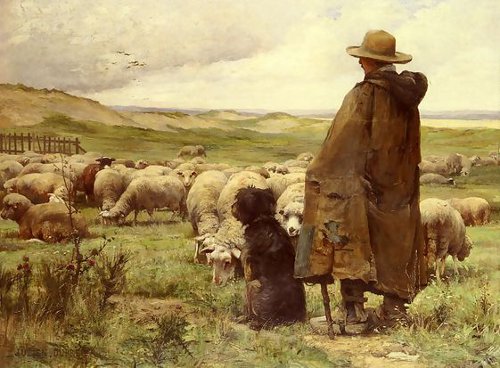
As my regular readers must realize by now, I’ve been writing “fast and furious” about the topics of halachah in the Messianic Jewish world and the application of the Torah commandments to Christianity. I feel as if I’m trying to think in two opposite directions simultaneously, and it’s giving me a headache. But it’s also fascinating me and as you can tell, I can’t put these topics down. It is or should be part of the continual dialog between the believing Jewish and Gentile communities, and provide a point where we can meet to compare our similarities and our differences; a place in the meadow where the sheep from the two sheep pens participate in the flock of the Good Shepherd (see John 10:1-18).

I’m not a real fan of the term “divine invitation,” mainly because I don’t think it can be derived from the Bible or even necessarily implied. I’d rather have the Christian’s role in relation to Judaism defined by a more substantial mission.

That doesn’t mean to say that I disagree with Aaron, but his article poses more questions than answers. He suggests that more of the Torah and the Prophets apply to the Gentile church than what is intimated in the “Jerusalem letter,” but he doesn’t define just how far we are to take it. I suppose the answers are contained elsewhere, but I’m not going to wait until I can discover their location in order to comment.

Aaron says correctly that Israel has always been intended to be a light to the nations (Deuteronomy 4:5-8, Isaiah 49:1-6). This “light” is to extend well beyond the first coming of the Messiah and project itself far into the Messianic Age (Micah 4:1-2, Isaiah 42:1-4). He even goes so far as to suggest that Messiah always meant the Torah to be the light for the Gentiles:

You are the light of the world. A city set on a hill cannot be hidden. Nor do people light a lamp and put it under a basket, but on a stand, and it gives light to all in the house. In the same way, let your light shine before others [anthropon, literally “men, humans, mankind”], so that they may see your good works and give glory to your Father who is in heaven.

Matthew 5:14-16

praying-jewish-womanBut as I’ve previously said, just how was and is the Torah meant to be applied to the Jewish and Gentile populations of believers? As I’ve met Aaron and I know Boaz Michael as well as the philosophy of FFOZ. I know they don’t believe in a theology that does away with Jewish identity and fuses Jew and Gentile believers into a homogeneous mass of generic humanity, but how we Gentiles are to “do” Torah has never been clear, except as an effect of love of God and of humanity, which I have commented on and related to the new commandment of Messiah.

I did suggest to my Pastor not too long ago that if a Christian wanted to voluntarily choose to take on additional mitzvot as a personal conviction, it would not be such a bad thing. The fact that he lived in Israel for fifteen years meant, in his case, that he did observe such things as Shabbat and a form of kosher, because his environment supported it. Granted, the environment outside of Israel is less friendly to Jewish observance, particularly among Christians, but that doesn’t mean a Christian who is so led can’t perform some of the same “Torah” out of love and solidarity, especially in interfaith families such as mine.

But why can’t Gentile Christians simply mimic Jewish religious behavior down to the last detail? I mean, what’s the problem if, as Aaron says, the Torah is for the Gentiles, too?

Each human being possesses a unique combination of personality, talents, timing and circumstances – a specific role to play in this world. Our role is dependent on many factors – not only our innate talents, but also on the needs of the times.

The important thing is to discover your unique contribution – and fulfill it.

The Torah tells us that one day Moses saw an Egyptian taskmaster killing a Jew.

“And Moses looked all around, and when he saw that there was no man, he took action.” (Exodus 2:11-12)

Why does the Torah tell us “there was no man”? Because Moses was checking to see if someone else was available, someone better qualified to do the job. Because if you reach for leadership when it’s not necessary, then you’re doing it more out of your own desire than for the needs of the people. Only when Moses saw there was nobody else qualified, did he take action.

-Rabbi Noah Weinberg
“Way #26: Know Your Place”
from 48 Ways to Wisdom
Aish.com

If Gentile Christians were to observe the mitzvot in a manner completely like the Jewish people, then the most straightforward way to accomplish this would be for Jews to convert Gentiles to Judaism. While such a process didn’t exist in the days of Moses because Israel was organized around tribal identity, and after the Babylonian exile, around clan identity (see Cohen, From the Maccabees to the Mishnah, Westminster John Knox Press; 2006) it was completely available in the days of Jesus. But that didn’t happen in the New Testament as the application of Christ’s Matthew 28:19-20 command. We see this acted out by Peter in response to Cornelius and his household:

While Peter was still saying these things, the Holy Spirit fell on all who heard the word. And the believers from among the circumcised who had come with Peter were amazed, because the gift of the Holy Spirit was poured out even on the Gentiles. For they were hearing them speaking in tongues and extolling God. Then Peter declared, “Can anyone withhold water for baptizing these people, who have received the Holy Spirit just as we have?” And he commanded them to be baptized in the name of Jesus Christ.

Acts 10:44-48 (ESV)

Notice what didn’t happen here. If it had been Peter’s intention to convert the Gentiles to Judaism, between Cornelius and his household receiving the Holy Spirit and being baptized in water, Peter should have arranged for Cornelius and the other men to be circumcised. He didn’t and in fact, we don’t see any of the new disciples of Christ from among the nations ever converting to Judaism (I believe Timothy was considered Jewish because of his Jewish mother and that’s why Paul circumcised him). Paul spent a great deal of effort in his letter to the Galatians specifically discouraging them from converting, and as I’ve said before, also citing Paul from Galatians, if you’re not a Jew or a righteous convert, you are not obligated to the full “yoke of Torah,” both as defined by the actual Books of Moses and the Prophets, and by accepted halachah.
the_shepherd1Rabbi Weinberg suggests that we are each created for a purpose as individuals and should pursue that purpose in order to fulfill God’s design for our lives. What if it’s true that God’s intent was and is to have a specific purpose for the Jews and another (and perhaps overlapping) specific purpose for the Gentile Christians?

Jesus opens all the doors and holds all the keys. He is the portal by which we Gentiles enter into any sort of covenant relationship with God at all, and he also fully reconciles and restores the Jewish nation to the Father as the fulfillment of all His covenants with and His promises to the Jewish people. Make no mistake, the Sinai covenant made between God and Israel didn’t vanish simply because Messiah came. It would be insane to suggest otherwise. Not only did Jesus live a lifestyle in obedience to Torah and not only did his teachings support Torah and the Temple, but his Jewish disciples were never seen to do otherwise, either. The history of the Messianic movement forward isn’t abundantly clear, but I don’t believe that next generation of Jews after Paul and Peter were any less Jewish even as they continued to worship Jesus as Messiah (we never see Paul, for example, telling Timothy that he doesn’t have to observe the mitzvot as a Jew).

But that’s a direction I’m saving for part 2 of this article. For now, although we don’t have an image we could define as crystal clear regarding just how far to apply Torah to Christians, we do know that it is well-applied in the weighty matters of the Law: doing justice, loving kindness, and walking humbly with our God.
The Jewish Girl Who Saved Her Children

intermarriageSome of my friends began dating non-Jews. I stopped socializing with them in silent protest, after a more outspoken effort had failed. I self-righteously concluded that we had nothing in common, since they were prepared to give their Jewish identity the backseat. I was sitting firmly in the driver’s seat with mine, so much so that I became the leader of a Zionist youth movement, and started to mix with an idealistic new crowd.

In Ethics of Our Fathers, Rabbi Hillel warns us that we should be careful not to judge another person until we have stood in their place. And I was going places…

I don’t remember making conversation, but apparently I must have mumbled something, since the next morning the host of the party told me that Mr. Attractive had inquired after me. As I was catching my breath, she casually mentioned, “Oh, I told him you don’t date non-Jews, and he’s fine with that. He just wants to meet you. He really liked you.”

This was a delicate situation, to say the least. Here I was, being pursued by a bona fide heartthrob with absolutely no strings attached. He was an advertising executive. Flutter. He had a motorbike. Swoon. And, if that wasn’t enough for my ego, he was a commercial pilot.

Help!

-Jennifer Cooper
“My Non-Jewish Boyfriend”
Aish.com

You’ll never realize how many blog posts I don’t write just because I don’t have time. I’ll read something or hear a snippet of conversation, and my mind pursues it and I begin to internally construct a short essay on the topic between 1500 and 3000 words. I never mean to write as much as I do, which includes this story about the girl who would never intermarry. It just happens.

In Christianity, this is yet another thing about Judaism that simply doesn’t register with us. What’s the big deal exactly? OK, among many Christians, there’s the idea that it’s not a good thing to be “unequally yoked” and I suppose the equivalent quandary would involve a young Christian woman dating a handsome, talented, and very romantic atheist guy. Look out. Danger up ahead.

But there’s something more operating here. There’s a lot more operating here.

I’ve written many times before about intermarriage and part of this blog’s mission is to address the challenges and dynamics of Christians and Jews being married. You can see the angst and the ecstasy expressed in missives such as Opting Out of Yiddishkeit and Cherishing Her Yiddisher Neshamah. If my wife had been observant when we met or even if she had been raised in a secular Jewish home, we might never have gotten married since I am a goy (we were both atheists when we met and her parents were also intermarried).

I’ve been spending some blog time lately struggling to define why it’s important for believing Jews to continue to live as halalaic Jews. If Jesus saves, what difference does it make if a Jewish person lives a Jewish life or not?

Plenty, as Cooper’s story reminds me.

The next day I found myself in the car with my father. We parked in the driveway. There we sat for a good few minutes, lost in our separate worlds. I, in my bubble of optimistic self-gratification, and my father – mourning the potential loss of future generations. Finally, I broke the heavy silence.

“Dad, why is it so important that Jews marry Jews?”

“Because it’s important that we preserve our unique heritage.” he replied, surprised by this basic question coming from me.

I wasn’t buying it.

“Yes, but what’s so special about our heritage, I mean, why is it SO important that there be Jews in the world?” I challenged.

“Because we are supposed to be a light among the nations,” he stressed, wondering where this was going. I pressed on, going for the jugular.

“So, Dad, if our heritage is so special, and we have to be a light among the nations, and my entire future depends on it, why do I eat McDonalds, and why on earth don’t we keep Shabbat?!”

More silence. This time, it was my father that spoke. “I don’t know. I guess I never thought that far,” he admitted, somewhat ashamed.

For the first time ever, I had stumped my brilliant lawyer father. But he still had one last trick up his sleeve.

broken-marriageI’ve heard it said you can’t choose who you fall in love with, but Jennifer had a problem. Without intending to, she had fallen in love with a non-Jew and all of her determination to never “marry out” was fast evaporating. Her parents were culturally but not religiously Jewish, but you can’t dismiss the importance of Jewish identity based on lack of religious observance. Something deeper was in operation here and it was enough to turn Jennifer and her father into emotional pretzels, turned and twisted and trying to straighten out again.

My heart was heavy with respect for my parents and the desire to please them. I felt the weight of my Jewish identity on my fragile shoulders. What exactly was I trying to preserve and protect? After all, I was not religious. Why had it been so fundamentally clear to me that I would marry a Jew? And what had happened to that clarity?

I had been taking my Jewishness for granted. Jewish day school, Jewish friends, a traditional Jewish home. There had been no challenge, no threat, no temptation. No chance to think or look outside the box. But now my exclusive Jewish education and traditional upbringing was on trial. Was it enough to save me?

I took the witness stand. For the first time in my life, I consciously thought about, and decided, who I was, what I wanted to be, and what was truly important. I was first and foremost a Jew. My heritage mattered. I wanted it to continue to be a part of my life. And it was vitally important that my future husband feel the same.

The Verdict: A strong Jewish identity saves Jews.

It wasn’t so difficult after that. A short, tense phone call ended what would have been the mistake of a lifetime. I never saw or spoke to him again, although I cried for days. I don’t really know why, but I think it had something to do with my soul.

There’s something more to being Jewish than just a string of DNA or whether or not you eat McRibs at McDonalds. It’s not just the cultural aspects of Judaism because films like My Big Fat Greek Wedding (2002) have shown us that cultural differences can be bridged (Nia Vardalos wrote and starred in the film and in real life, she is a Greek woman married to a non-Greek man…Ian Gomez, who plays “Mike” in the film).

No, there’s more than just genetics, religion, and culture going on with Jennifer and with Jewish people in general, but you have to go back to Abraham, Issac, and Jacob to find it. You have to go back to Moses and Sinai to find it. You have to look into a pillar of cloud by day and a column of flame by night and deep inside you’ll see the God who molded, formed, fashioned, and defined the Jewish people to be a unique and special people before Him for all time.

And every intermarriage, particularly where the intermarried Jew does not maintain their identity and pass that identity along to the next generation removes not just one more Jew from eternity, but that Jew and all of his or her descendents. Yes, if Jennifer had married her handsome, charming goyishe suitor, her children would have been halachically Jewish, but how would they have been raised and how strongly would they cherish their own Jewish identity?

Memories and regrets are part of what it is to being human, and if I had it all to do over again, I would still have married my wife and had our children, but I would have fought tooth and nail to instill a strong Jewish identity in all of them.

But that ship has sailed and here I am standing at the dock watching it slip over the horizon and into the distance and darkness beyond.

We want our children to care about the meaning of being Jewish. We need to nurture their Jewish identity to the point that it becomes innate. Our homes are where we nurture, and where our children learn to care. Our homes are where we show our children what it is important to care about.

A lot of people feel that they need to make a great sacrifice to live out their Jewishness. It is an even greater sacrifice not to. We can’t be complacent for lack of funding, knowledge, the right address or social circle. The good news is, caring is not a sacrifice. It’s fun, and it’s far-reaching.

How do we put a little Yiddishkeit into our homes? If you ask anyone that grew up with it, they will tell you the same thing: it’s the simple rituals that have the greatest impact. Lighting Shabbat candles, decorating a sukkah or eating matzah on Passover, putting up mezuzahs on every doorway, laying some Jewish books proudly out on the coffee table, saying Shema Yisrael with our children, hanging out an Israeli flag on Israel’s Independence Day. These are the definitive moments that can carve a caring Jew out of the stoniest backdrop of threatened assimilation.

Our Torah and Jewish calendar are filled with a veritable treasure trove of tradition and meaningful ritual, enabling us to live uniquely enhanced lives filled with memorable moments of celebration and wisdom, all with that inimitable Jewish flavor.

These are the moments that kept me in the fold. They can impact you and your children, too.

jewish-t-shirtI can’t change the past, but I can tell you that I will not be responsible for separating even one more Jewish person from his or her God-given identity. I can’t change the past but I can learn from it, and more than that, I can teach from it. I can pass my knowledge on to whoever cares to read these words and explain that this is why it is not only important but absolutely vital that Jews who are Messianic must establish and maintain a strong Jewish identity, must observe the mitzvot, must walk in the footsteps of their Fathers and actively live out the wisdom of their sages.

I can’t tell you the right and wrong of every single mitzvot and the amazingly intricate details of each little item of halachah within each of the Judaisms in our world today, but I can tell you that without them, without all of the behaviors and the activities that define a person as a Jew, not only are the Jewish people in danger of disappearing from the face of the earth (although I believe God would never allow this), but that Jews who come to Jesus will vanish into the mass of Gentile Christians in the church, never to be seen or heard from again. Only God will know that Jews ever stood among the disciples of the Jewish Messiah in these latter days of history.

But it all starts with one Jewish person who realizes that his or her identity as a Jew is more important than almost anything because that identity comes directly from God. And we in the church must also learn to cherish Jewish uniqueness, to support it, to uphold it, to esteem it, for our Master said that “salvation comes from the Jews.” (John 4:22)

The story Jennifer Cooper relates occurred almost twenty years ago, but the heartbreaking actions of one young Jewish girl saved not only her, but her children, and future generations of children who would not otherwise be Jewish or value who God made them all to be. The Good Shepherd will come and seek out all of his sheep…those of the Gentile pen, but also those who know his voice from the sheep of Israel. God forbid that when he returns, he discovers that none of them survived.

Love and Commentary

praying_jewFrom where do we learn from the Torah that changing one’s clothes is a sign of respect?

-Shabbos 114a

The verse from Yeshaya 58:13 was already expounded to teach, among other things, that one’s Shabbos clothes should not be like one’s weekday garments (113a). Nevertheless, Rabbi Yochanan is quoted trying to show that this concept is indicated not only from a verse in the prophets, but that it is also rooted in the Torah. Ben Ish Chai explains that based upon this verse from the Torah, there is a practical difference which can be derived regarding the need to wear special clothing on Shabbos.

Daf Yomi Digest
Distinctive Insight
“Suiting up for Shabbos”
Commentary on Shabbos 114a

I’ve been pondering a few things lately regarding Judaism and particularly the Messianic sect of Judaism which recognizes Yeshua (Jesus) as the Moshiach (Christ). There are many things about Judaism that I find beautiful and I find myself sometimes drawn to those traditions. In the days when I used to worship on Shabbos and pray while wearing a tallit gadol, there was a “specialness” about it I can’t articulate. Weekday mornings when I would pray shacharit while wearing a tallit and laying tefillin had a texture and a quality about them that I can’t describe. The blessings I recited from the Siddur (which are taken from Hosea 2:21-22 in the Tanakh or verses 19-20 in Christian Bibles) when donning the arm tallit, invoked a particular unity between me and my God that I think Christians miss some of the time.

I will betroth you to Me forever; and I will betroth you to Me with righteousness, with justice, with kindness, and with mercy; and I will betroth you to Me with fidelity, and you will know Hashem.

Hosea 2:21-22 (Stone Edition Tanakh)

Christians sometimes criticize Jews for all their “man-made traditions” but there is a certain beauty in how observant Jews even prepare themselves for encountering God in prayer. After all, if you were summoned to appear before an earthly ruler, such as a King or President, you would certainly prepare yourself, including dressing for the occasion. Why shouldn’t the same be true if we are summoned to appear before the Ultimate King: God? And after all, Jews are indeed commanded to wear tzitzit (Deuteronomy 22:12) and to, in some sense, wear the Torah (Deuteronomy 6:8).

Hear, O Israel! The Lord is our God, the Lord alone. You shall love the Lord your God with all your heart and with all your soul and with all your might. Take to heart these instructions with which I charge you this day. Impress them upon your children. Recite them when you stay at home and when you are away, when you lie down and when you get up. Bind them as a sign on your hand and let them serve as a symbol on your forehead; inscribe them on the doorposts of your house and on your gates.

Deuteronomy 6:4-8 (JPS Tanakh)

But as my conversation with Pastor Randy reminded me the other day, there are also commandments and rulings that are beyond my comprehension.

All holy writings may be saved from a fire.

-Shabbos 115a

Perek teaches the laws of saving items from being burned in a fire on Shabbos. On the one hand, our sages realized that if a person is given an unlimited license to save everything he can possibly grab, the person would invariably be driven to try to extinguish the flames, which is a Torah violation… This is why the halachah put a finite limit on what a person is allowed to salvage from a fire. Once this quota of clothing and food is met, the person may not remove anything more from the burning building, even if the particular situation allows the time and conditions to retrieve more.

On the other hand, our sages were lenient to allow saving holy scrolls from a burning building. It is permitted to remove a Torah scroll, for example, to a domain which is normally rabbinically restricted. This is the topic which the first Mishnah discusses.

It is interesting to note that the sages put limits on a person regarding his property pulled from a fire in a building, whereas in other cases we find the opposite. If a person is traveling up to the last minute before Shabbos, and he fails to make it to the city, what should he do with the valuables he is carrying? The Gemara (153a) rules that a Jew in this predicament may instruct a gentile who may be traveling with him to bring the items into the city for him. This is normally a violation of “amira l’nochri – telling a non-Jew to do a melachah for a Jew on Shabbos”, but in this case our sages allowed it, being that they felt that if the Jew would have no recourse, he
might carry the items into the city himself. The Rishonim deal with this apparent inconsistent approach of the halachah to a Jewish person who is faced with a risk to his property. In the case of a fire we limit him although he is not doing any melachah, but when carrying into the city as Shabbos begins, we are lenient.

PogromFor a Christian, the problems being posed here and their solutions do not appear on our “radar screens,” so to speak. It’s as if a difficulty was made up for the sake of proposing a solution. Yes, the Jewish people are commanded to observe the Shabbat and to keep it Holy (see Exodus 20:8, Exodus 31:15-17, and Deuteronomy 5:12), but all of the Rabbinic rulings that go along with these commandments are enormously complex, at least to me. How can one even begin to observe Shabbos and remember each and every condition and circumstance that could possibly apply in a flawless manner?

But then again, I don’t live in the Orthodox Jewish space, so what do I know?

(I should say at this point that being married to a Jewish wife does give me an insight that a Christian who is not intermarried lacks, but on the other hand, my wife is the first one to say that she’s hardly Orthodox)

I can only imagine that there are many, many Jews who are Shomer Shabbos. I know that after the local Chabad Rebbetzin gave birth to her youngest child on a Friday night, her husband, the Rabbi, walked from the hospital to the synagogue in the middle of the night (since it was Shabbos and he was forbidden to drive or to even accept a ride from another) so that he could be at shul to lead Shabbat services Saturday morning.

I can’t imagine a Pastor ever being in a similar situation and from a Christian’s point of view, even if we had such a restriction, it is very likely that we would depend on the grace of Jesus and under unusual circumstances, overlook the commandment by allowing ourselves to drive or, in the case of a fire, retrieve any of our property we could lay our hands on before the fire could get to it (or to even put out the fire if we could).

Do we admire such dedication to the commandments of God as they are understood in religious Judaism or do we consider observant Jewish people to be bound and gagged by the letter of the Law and also by the commentary on the letter of the Law?

That’s a tough one. Even if we in the church disagree with how Jews choose to obey God, it’s their choice, not ours.

But if those Jews are also Messianic, should we look at the mitzvot any differently? Should we allow ourselves to judge others because they are Jewish and they choose to live a religious Jewish lifestyle?

I’m in no position to do any such thing, but it does bring forth interesting questions. There is not always a single tradition in religious Judaism as to how to perform the mitzvot because there isn’t a single Judaism. Further, there isn’t always agreement between the ancient or modern sages as to how to perform certain of the mitzvot, and so one much choose which tradition to follow, usually based on which Judaism you are operating within.

But those are human choices not necessarily the will of God, unless we want to consider that God is “OK” with all of the variants on Rabbinic teachings, and that is a big “if.”

Setting that aside for a moment, another problem presents itself, but it too is a man-made problem.

I was recently criticized on another person’s blog about the questions I was bringing up as a result of last Wednesday evening’s conversation with Pastor Randy, but the criticism wasn’t coming from anyone Jewish. There is a certain corner of Christianity that believes we Christians are identical to the Jewish people once we come to faith in the Jewish Messiah, at least as far as the mitzvot are concerned…well, sort of. It’s complicated, but the core of their argument is that there is such a thing as a perfect Christianity/Judaism that can be divined solely from the Bible, and that it is possible to practice this very particular form of religion without any (or any excessive) human-created interpretation and set of attendant traditions, and using more than a little theological sleight of hand to “prove” their position.

What’s really interesting is that my critic and his friends who have commented on the matter, didn’t seem to actually read what I’d written. I was asking questions, not making pronouncements, and yet they were actively condemning my “conclusions.” The one thing I can say with certainty though, is that I see no directive for modern Christians to mimic modern Jewish religious behavior in an attempt to worship as if we are in one of Paul’s first century churches or synagogues.

I’m not here to criticize Jewish people or Jewish religious observance. I don’t have the right or the necessary qualifications to render a definitive commentary, only the drive to share my questions and thoughts on the matter, such as they are. I’m not even really criticizing how other Christians choose to view their religious obligations to God, except to the degree that they attempt to impose their personal viewpoints on other Christians and on observant Jews.

To the best of my understanding (and I’m attempting to improve my understanding all of the time), no human being has the ability to perfectly obey God in every single detail, regardless of the religious tradition to which they belong. This was probably as true in the days of Moses, Solomon, and Elijah, as it was true in the days of Jesus and Paul, as indeed, it is true today.

studying_tanakh_messiahPastor Randy suggested a very straightforward method of studying the Bible based on the three steps of observation, interpretation, and application. That requires some fluency in Biblical Hebrew and Greek, and lacking much ability in that linguistic arena, I’m already handicapped. This is why I speak with teachers who I respect to discuss and debate them on their insights. This is why I have so many questions.

But in the end, the advice of another friend of mine must be at the heart of every question and lay the foundation for every answer. In the end, and in the beginning, we should not seek out Judaism or Christianity, but only an encounter with God. This is something that not only are we all capable of, regardless of who we are, but in fact, it is something that we are all commanded to do, because it is God’s greatest desire.

“What you dislike, do not do to your friend. That is the basis of the Torah. The rest is commentary; go and learn!”

-Shabbos 31a

Yeshua answered him, the first of all the mitzvot is: “Hear, O Yisra’el! HaShem is our God; HaShem is one. Love HaShem, your God, with all of your heart, with all of your soul, with all of your knowledge, and with all of your strength.” This is the first mitzvah. Now the second is similar to it: “Love your fellow as yourself.” There is no mitzvah greater than these.

Mark 12:29-31 (DHE Gospels)

Love God and seek Him and, if you do love God, seek out your fellows and love them, too.

Beshalach: Traveling to Meet God

train-october-expressAround the turn of the twentieth century, Vladimir, an illiterate and unworldly Siberian peasant, struck it rich. One day he was offered a very lucrative business proposition. Closing the deal, however, required his presence in Moscow.

Moscow. He was pretty sure that a horse—even the sturdiest his village had to offer—would not be able to make the trip of several thousand kilometers . . . Some of the more sophisticated residents of the town came to his rescue, advising him about the existence of a new mode of transportation, a “train.” If he were to travel to Novosibirsk, the closest large city, he would be able to catch a train to Moscow.

Thus, one fine day found Vladimir in the central train station of Novosibirsk. When he informed the lady behind the ticket counter of his intended destination, she asked him what sort of ticket he wished to purchase. Observing his confusion, she told him that he could purchase a first-, second- or third-class ticket. A third-class ticket, she explained, offered absolutely no amenities, and didn’t even guarantee a spot on the train. If the arriving train was already filled to capacity, he would have to wait for the next one. A second-class ticket offered a greater chance of a spot on the train, along with more comfortable accommodations. A first-class ticket came with a guaranteed seat, and all amenities necessary to ensure a luxurious and comfortable journey.

Money was hardly an issue, so first class it would be. The ticket lady explained to her consumer that the ticket was non-refundable, and should be guarded carefully…

-Rabbi Naftali Silberberg
“First-Class Stowaway”
Chabad.org

At this stage of reading the Rabbi’s fable, I was anticipating disaster at any second. While Vladimir had certainly done well for himself in a material sense, anyone who didn’t know what a train was and needed one as a mode of transportation was certainly bound to get into trouble. I guess that’s what happens when you have too much of one thing but not enough of another. Money minus common-sense or experience equals what?

But before getting to the answer, you may be asking yourself what Vladimir’s predicament has to do with Torah Portion Beshalach?

That’s a very good question.

And the Lord said to Moses, “I will rain down bread for you from the sky, and the people shall go out and gather each day that day’s portion — that I may thus test them, to see whether they will follow My instructions or not. But on the sixth day, when they apportion what they have brought in, it shall prove to be double the amount they gather each day.” So Moses and Aaron said to all the Israelites, “By evening you shall know it was the Lord who brought you out from the land of Egypt; and in the morning you shall behold the Presence of the Lord…

So they gathered it every morning, each as much as he needed to eat; for when the sun grew hot, it would melt. On the sixth day they gathered double the amount of food, two omers for each; and when all the chieftains of the community came and told Moses, he said to them, “This is what the Lord meant: Tomorrow is a day of rest, a holy sabbath of the Lord. Bake what you would bake and boil what you would boil; and all that is left put aside to be kept until morning.” So they put it aside until morning, as Moses had ordered; and it did not turn foul, and there were no maggots in it. Then Moses said, “Eat it today, for today is a sabbath of the Lord; you will not find it today on the plain. Six days you shall gather it; on the seventh day, the sabbath, there will be none.”

Yet some of the people went out on the seventh day to gather, but they found nothing. And the Lord said to Moses, “How long will you men refuse to obey My commandments and My teachings? Mark that the Lord has given you the sabbath; therefore He gives you two days’ food on the sixth day. Let everyone remain where he is: let no one leave his place on the seventh day.” So the people remained inactive on the seventh day.

Exodus 16:4-7, 21-30 (JPS Tanakh)

I suppose the Children of Israel couldn’t be blamed. After all, no one had ever seen or heard of such a thing as manna before. I mean, food that rained out of the sky? C’mon! And once they got used to the idea that they could gather food that had rained right on the ground every morning, they had to get past the idea that it would be there tomorrow and the next day. They didn’t have to save up. But then, on top of all that, they had to get used to the idea that a double-portion would fall on only Friday morning, and that double-portion they could save overnight, so that they’d have food for Shabbat. No food was going to rain from Heaven on Shabbat.

waiting-for-mannaToday, it is typical that we have jobs, earn money, and go to the store when we want food. We don’t expect, nor has God promised that our food will literally fall out of the sky and into our backyards. And yet, we are expected to know when to make an effort in order to meet our needs as God provides, and when to wait for God alone to fulfill our requirements.

It’s not easy.

Part of it has to do with experience. The Children of Israel eventually became quite accustomed to manna and how to manage it, including its “gathering schedule.” But at first it was quite awkward and difficult to figure out, even after Moses told them what God had to say about manna. That takes us back to Vladimir and his predicament.

The train arrived. After his initial shock at seeing such a monstrously large caravan of cars, Vladimir regained his composure and scanned the terminal to see what to do. As it was early, most of the passengers had not yet arrived, but he noticed three passengers boarding the very last car on the train. He followed them into the car, and when each one climbed beneath one of the benches in the car, he did the same. Unfortunately, he wasn’t fully familiar with proper stowaway protocol, and his feet jutted out across the aisle of the third-class car.

It was dark and lonely beneath the bench, and Vladimir quickly dozed off. He didn’t feel the train start to move, and didn’t hear the conductor entering the car. He did, however, feel a sharp kick to his shins, and the startled peasant was expertly hoisted out by the burly conductor.

“You moron, you think this is a free ride?” he bellowed. “You need a ticket to ride this train!”

“What’s the problem, sir,” Vladimir meekly responded. “I have a ticket.”

The other travelers on the train car burst out laughing at this ludicrous claim. Their laughter only intensified when he started peeling off layer after layer of clothing, starting with his expensive fur coat and ending with his undergarments. But, much to their astonishment, he pulled out a ticket—a first-class ticket, no less!

After verifying that the ticket was indeed authentic, the conductor, in a distinctly humbled tone of voice, asked the obvious: “Sir, you have an expensive first-class ticket; pray tell me why you are lying under a bench in the third-class car?!”

“Because that’s what the others were doing . . .” was the embarrassed response.

What is it about being a Christian that’s so difficult? Lots of things. What is it about being a person who hasn’t been a Christian for very long that’s so difficult? Lots of things. Like Vladimir, we have been given a tremendous gift, something of great value, but we have no experience with it.

In some ways, this is a very enviable position, because we don’t come with years or decades of dogma riding on our shoulders and getting in the way. It’s just the new Christian and God. Probably some of the most honest prayers a person will ever utter will be when he or she has just come to faith.

But there are liabilities attached. When you don’t know much about the God you’re supposed to have a relationship with, you don’t know what to expect, you don’t know how to act, you are like a person who has a ticket for a first-class train ride, and you’ve just seen your first train that morning. So, when you don’t know what to do, you do like everyone else is doing, even if they’re exactly the wrong people to emulate.

transcendenceBut how do we know who to imitate?

I could get on my soapbox about mentorship and discipleship and the responsibility of experienced believers to help teach “newbies,” but I suppose you’ve heard all that before. Vladimir learned an embarrassing but not disastrous lesson (he didn’t lose his expensive ticket as I imagined when I read just the first half of the tale).

But what about you and me?

I suppose Vladimir eventually learned the ins and outs of rail travel and probably became quite good at it, but the moral of this particular story is that we will be held accountable by God, not for just what we did in the first days and weeks after becoming a believer, but what we did with our “first-class ticket” for our entire lives. Experience is only valuable if we learn from it and let it modify our behavior. We have to grow spiritually or we get stuck doing the moral equivalent of sneaking on board a train for which we have a ticket. We waste what God has given us (reminds me of Matthew 25:14-30). This too is the lesson of the manna. We can use it wisely, learning when to gather and when not to, when to save and when to use it all in the evening, or we can waste what God has provided.

The Children of Israel were on a journey to go and meet God. So are we. The manna was just one of the lessons they needed to learn along the way in order to get ready to encounter God. What lessons is God giving us that we need to learn before our encounter?

When God calls for an accounting of what you did with your first-class ticket, your life as a believer, what will you say?

Good Shabbos.

Doing Love

unworthyAaron was ashamed [and was reluctant to assume the position of High Priest] because of his role in the Golden Calf episode, and Moses said, “This is why you were selected.”

-Rashi, Leviticus 9:7

I was once asked to see a student nurse who was beside herself because she had made an error in medication. While this particular error was harmless, she felt that she lacked the competency to be a nurse, because she saw that she was capable of making even more serious errors.

I told the young woman that I did not know of anyone who can go through life without making any errors. Perfection belongs to God alone. If all nurses who became so upset because of a medication error would leave the field, the only ones who would remain would be those indifferent to making errors, and that would be the worst disservice to mankind.

We must try to do our very best at everything we do, particularly when it concerns others’ welfare. We must not be lax, negligent, nor reckless. We should of course be reasonably upset upon making a mistake and learn from such experiences how we might avoid repeating them. However, if in spite of our best efforts we commit errors as a result of our human fallibility, we should not give up. Allowing a mistake to totally shatter us would result in our not doing anything in order to avoid mistakes. This non-action would constitute the greatest mistake of all.

Today I shall…

…try to realize that the distress I feel upon making a mistake is a constructive feeling that can help me improve myself.

-Rabbi Abraham J Twerski
“Growing Each Day, Shevat 12”
Aish.com

No one wants to make a mistake. Certainly we all want to “get it right” the first time, whatever “it” happens to be. And when you are a person of faith, you particularly want to get moral and ethical stuff right all of the time.

It’s rather humbling when we do not. More than that, the rest of the world, both religious and non-religious people, seems to be just waiting for us to slip up so they can criticize us.

I suppose religious people are used to being put down by atheists because we’re “superstitious” or “irrational” or we’re “non-inclusive bigots” or something. However, some people of faith are no better, and tend to jump on other believers who have opinions and convictions that don’t line up with their own. You see this most often within Christianity from “Evangelical Fundamentalists” or whatever label is appropriate to use here…people who are uncompromising on matters of abortion or gay marriage (for example) and who only see the black-and-white of the issues and not the human beings involved. Christians say “love the sinner but hate the sin,” but truth be told, some Christian human beings often don’t know how to tell the difference so they hate them both.

If only we realized that we are just as capable of making mistakes as anyone else. It’s worse for us though, since we know that we are accountable to God for every word and deed we commit in our lives. One day, we’ll have to make an accounting. One day, we’ll have to face God! What the heck is wrong with us? Don’t we get it?

Rabbi Eliezer said: “Repent one day before your death.” His disciples asked him, “Does then one know on what day he will die?” “All the more reason he should repent today, lest he die tomorrow.”

-Shabbat 153a

But what is it to repent?

“It is told that once there was a wicked man who committed all kinds of sins. One day he asked a wise man to teach him an easy way to repent, and the latter said to him: ‘Refrain from telling lies.’ He went forth happily, thinking that he could follow the wise man’s advice, and still go on as before. When he decided to steal, as had been his custom, he reflected: ‘What will I do in case somebody asks me, “Where are you going?” If I tell the truth, “To steal,” I shall be arrested. If I tell a lie, I shall be violating the command of this wise man.’ In the same manner he reflected on all other sins, until he repented with a perfect repentance.”

-Rabbi Judah ben Asher, fourteenth century

love-in-lightsIs making a mistake the same as sinning? Sometimes I suppose, but as we saw in the example of the student nurse above, sometimes we just make mistakes. Even when someone gets hurt, it’s still a mistake and not a sin. But mistakes and sins have a few things in common. If we are morally adequate people, they both make us feel guilty and they both show us that we need to improve and change our ways.

Sin and repentance have been written about endlessly by people far wiser and more worthy than I, so what’s the point of me putting in my two cents? Nothing, I suppose, except for timing. There are times when we need to say such things and times when we need to hear them as well. We may not realize that it’s time and we may not seek out the information which would then inspire us to be convicted and (hopefully) to then transform. So I offer this to you just in case it’s your time. And if we are, as Rabbi Eliezer suggests, to repent today (lest we die tomorrow), then every day is our time.

There are parallel guidelines which are set to direct us in our life goals. On the one hand, we are encouraged and even obligated to state, “When will my actions be as those of our patriarchs?” In this regard we should feel that we can achieve the same levels as our ancestors. On the other hand, we must recognize that we are worlds apart from the lofty levels of our forefathers. In fact, it would be highly presumptuous to even think that we have the ability to match their accomplishments, as our Gemara reports. Even the greatest among us must acknowledge that compared to the personalities of the Torah, who were giants in character and sainted servants of Hashem, we are as mere humans as compared to angels. How are we to balance the approach we are to take in setting our goals and aspirations?

Daf Yomi Digest
Gemara Gem
“Great Asperations”
from the Commentary on Shabbos 112

We may never achieve a state of spirituality and holiness like those people we see in the Bible or those people of faith who we admire, but we can continue to seek God, and to seek His will, and to live the life he created us to live. At a very basic level, it’s really quite simple.

To love is to sigh at another’s sorrow, to rejoice at another’s good fortune. To love is the deepest of all pleasures.

-Rabbi Tzvi Freeman
“To Love”
Based on letters and talks of the Rebbe
Rabbi M. M. Schneerson
Chabad.org

Sometimes after a mistake or failure, the first person we need to learn to love is ourselves. That isn’t easy but we do have someone who can teach us. He’s the lover of our souls, and if anyone can see something inside of each of us that is worthy of love, it’s Him.

Go do like He does. Love who you are, then go love others for who they are.

Sunday School Homework: Acts 9:1-31

paul-on-the-road-to-damascusBut Saul, still breathing threats and murder against the disciples of the Lord, went to the high priest and asked him for letters to the synagogues at Damascus, so that if he found any belonging to the Way, men or women, he might bring them bound to Jerusalem. Now as he went on his way, he approached Damascus, and suddenly a light from heaven shone around him. And falling to the ground he heard a voice saying to him, “Saul, Saul, why are you persecuting me?” And he said, “Who are you, Lord?” And he said, “I am Jesus, whom you are persecuting. But rise and enter the city, and you will be told what you are to do.” The men who were traveling with him stood speechless, hearing the voice but seeing no one. Saul rose from the ground, and although his eyes were opened, he saw nothing. So they led him by the hand and brought him into Damascus. And for three days he was without sight, and neither ate nor drank.

Acts 9:1-9 (ESV)

This is part of the book of Acts generally referred to as “the Conversion of Saul,” and from a traditional Christian point of view, records the event of the Jewish Pharisee Saul, hater of all Christians and followers of Jesus, converting and becoming Paul the Christian, and Apostle to the Gentiles in the diaspora.

If you’ve been reading my blog for very long, you know that I’m not likely to accept the exact understanding most Christians have of this event, but I must say things have been illuminating. A new teacher is taking over the Sunday school class I’m attending and he’s coming in with a different style. It’s not particularly unusual, though. He assigns “homework” for the upcoming Sunday school class, in this case on the aforementioned Acts 9, and presents a series of questions that we students are supposed to research (he provides the relevant scriptures) and answer, and then bring our answers to the next class, which for me, is later today.

I debated within myself (and with God) whether or not I should even write about my Sunday school assignment. After all, my first impression upon receiving my assignment by mail several days ago and taking a look at it, was that it’s rather traditional Christian fare in terms of its content and perspective. I was wondering if there was anything I could learn from it (I know that sounds arrogant on my part, but I’m pretty familiar with how Christian tradition views Saul/Paul). I was also wondering what the rest of the class could learn, since the lesson seems relatively elementary, and I recently discovered that several members of the class are on the church’s board of elders, and thus are likely long-term Christians, well established in their faith and knowledge of the Bible.

I can’t speak for them of course, but I learned a few things.

I tend to think and write thematically, and while I am detail oriented, some of the finer points of scripture escape me at times, or at least don’t make it from short-term to long-term memory. According to Galatians 1:16-19, after Paul’s “conversion,” having his sight restored, and his escape from Damascus (Acts 9:23-25), Paul spent three years in Arabia (presumably it was Arabia) before going to Jerusalem. According to Galatians 1:18-19, once Paul returned from Arabia and journeyed to Jerusalem, he spent fifteen days in the Holy City (Acts 9:26-30) before leaving again (apparently in haste to escape the “Greek-speaking Jews” who were trying to kill him).

paul-damascus-basketI’m not sure those details are important, but they were recorded by Luke and Paul so I suppose I should acknowledge them.

I did find it ironic that Paul most likely discovered that the shoe was on the other foot as he found himself being lowered in a basket, through an opening in the exterior wall of Damascus to escape those trying to kill him.

For some days he was with the disciples at Damascus. And immediately he proclaimed Jesus in the synagogues, saying, “He is the Son of God.” And all who heard him were amazed and said, “Is not this the man who made havoc in Jerusalem of those who called upon this name? And has he not come here for this purpose, to bring them bound before the chief priests?” But Saul increased all the more in strength, and confounded the Jews who lived in Damascus by proving that Jesus was the Christ.

When many days had passed, the Jews plotted to kill him, but their plot became known to Saul. They were watching the gates day and night in order to kill him, but his disciples took him by night and let him down through an opening in the wall, lowering him in a basket.

Acts 9:19-25 (ESV)

Compare that to what we read here:

But Saul, still breathing threats and murder against the disciples of the Lord, went to the high priest and asked him for letters to the synagogues at Damascus, so that if he found any belonging to the Way, men or women, he might bring them bound to Jerusalem.

Acts 1:1-2 (ESV)

In Acts 9:23, when it says the Jews plotted to kill him, the word translated into English as “Jews” is the Greek word “Ioudaioi,” which specifically refers to the Jewish religious leaders and their supporters, not all Jewish people in general. Paul was a representative of the Jewish authorities in Jerusalem, and only a short time before, he was the one who was seeking to imprison and kill the Jewish believers belonging to “the Way.” Now, he was in the exact position of those he formerly sought to harm, and his opponents were the ones who only a tiny march of days before, would have been his allies. It must have been like facing a reflection of his former self as he was before encountering the Master on the road to Damascus. His “Damascus experience” had changed and completely reversed itself from what he thought it was to be when he originally left Jerusalem.

Jesus, it seems, is not without a sense of irony.

And when he had come to Jerusalem, he attempted to join the disciples. And they were all afraid of him, for they did not believe that he was a disciple. But Barnabas took him and brought him to the apostles and declared to them how on the road he had seen the Lord, who spoke to him, and how at Damascus he had preached boldly in the name of Jesus. So he went in and out among them at Jerusalem, preaching boldly in the name of the Lord. And he spoke and disputed against the Hellenists. But they were seeking to kill him. And when the brothers learned this, they brought him down to Caesarea and sent him off to Tarsus.

Acts 9:26-30

OK, let me get this straight. After an absence “off the grid” of three years, Paul returns to Jerusalem and attempts to make contact with the Apostles. They are naturally dubious, since the last time they heard about Paul, he was an enemy of the Way and had made it his “mission” to persecute the movement and eradicate its followers. Now he’s claiming to be one of them, to have had a vision of the Master himself, and that Jesus had given Paul a completely different mission, one of announcing the good news of Messiah to the Gentiles of the nations. It sounds like a bad joke.

PaulFortunately, Barnabas was there to back Paul up and to verify everything Paul was saying. Scripture doesn’t record how the Apostles reacted, but I guess it was favorably enough to allow Paul to go “in and out among them at Jerusalem” and to preach “boldly in the name of the Lord.” However, for whatever reason, Paul found it necessary to speak and dispute against the Hellenists (Greek-speaking Jews) in Jerusalem, which resulted in said-Hellenists wanting to kill him. Again, we don’t have the details, but commentary suggests that these Hellenistic Jews were not believers (as were the “Hellenists” we find in Acts 6:1), however, they may have been some of these guys.

And Stephen, full of grace and power, was doing great wonders and signs among the people. Then some of those who belonged to the synagogue of the Freedmen (as it was called), and of the Cyrenians, and of the Alexandrians, and of those from Cilicia and Asia, rose up and disputed with Stephen. But they could not withstand the wisdom and the Spirit with which he was speaking. Then they secretly instigated men who said, “We have heard him speak blasphemous words against Moses and God.” And they stirred up the people and the elders and the scribes, and they came upon him and seized him and brought him before the council, and they set up false witnesses who said, “This man never ceases to speak words against this holy place and the law, for we have heard him say that this Jesus of Nazareth will destroy this place and will change the customs that Moses delivered to us.”

Acts 6:8-14 (ESV)

That’s just speculation and the interpretation I found in my ESV Bible, but it’s as good as anything, lacking further information. All this does suggest something though.

The main understanding I’ve gained here is that not all Jews were against Paul, against following Jesus as the Messiah, or against the Way. There were obviously believers in Damascus, and Ananias, who was directed by Jesus to restore Paul’s sight (Acts 9:10-16) is thought by Christian tradition to have been the leader of the Jewish believers in that city. It is in the same city after his sight was restored, that Paul (amazingly, given who he was just a few days before) began to proclaim the Master in the local synagogues (Acts 9:19-22) and he did so for “many days” (v 23), and only when the non-believing Jewish religious leaders (as opposed to the Damascus Jews in general) tried to kill Paul (presumably for reasons similar to why Stephen was stoned in Acts 6), that he had to leave in secret.

Similarly, after his three-year absence, Paul returned to Jerusalem to find Jews who were Apostles and followers of Jesus and Jews who were not. The believing Jewish Apostles cautiously supported him (small wonder, given his former reputation) while other Jews, because he spoke against them (the reasons aren’t clear), opposed him and wanted to kill him (a recurring theme in Paul’s life).

prince-of-peaceThe upshot is that “the Jews” as a people and a nation, did not “reject Jesus.” Opinions between Jewish sects varied widely on theological grounds, but the most likely reason why the “official” (that is, established and supported by Rome) Jewish religious leaders wanted to kill Paul (and other members of the Way) was because they were rocking the political boat and upsetting the status quo of a corrupt and invalid leadership that was firmly in Rome’s back pocket.

Even studying for Sunday school, using a traditional Christian Bible and only consulting accepted Christian commentary, I still find that many, many Jews, including one of the (former) chief opponents of the Way, firmly accepted the Gospel message and were loyal and devoted disciples and Apostles of Jesus Christ of Nazareth. Yes, other Jewish sects had reasons not only to disbelieve Jesus was Messiah but to passionately oppose the Jewish sect of the Way, but they didn’t represent all Jews everywhere. Paul spent “many days” in Damascus preaching the message of Messiah among all of the local synagogues (not just those belonging to Christ’s Jewish followers), so obviously he had a Jewish audience who wanted to repeatedly hear what he had to say (we see this again in the latter part of Acts 13 which I’ll introduce tomorrow).

Paul only spent fifteen days in Jerusalem before some of the Jewish believers heard of the plot to kill Paul and helped him escape (Acts 9:30), but he continued to speak boldly in the Master’s name. And even after leaving Jerusalem, we can see the effect of his subsequent journey.

So the church throughout all Judea and Galilee and Samaria had peace and was being built up. And walking in the fear of the Lord and in the comfort of the Holy Spirit, it multiplied.

Acts 9:31 (ESV)

While this translation of the Bible speaks of “the church” throughout all Judea and the Galilee and Samaria, who were the believers living in those regions? Jews and Samaritans. Probably lots of Jews and Samaritans. The first Gentile we know who became a disciple of Jesus was Cornelius, and Peter had yet to encounter him (see Acts 10). The Jews and Samaritans were not Christ’s enemies, at least not all of them. Many desired to hear the message of hope and they believed. Luke’s chronicle in the early chapters of Acts records this clearly. Those Christians who doubt this because of our own traditions may want to re-examine the scriptures with open eyes and see what is actually there.

christian-coffee-cultureJesus said, “salvation is from the Jews.” (John 4:22 ESV). Paul said, “first for the Jew, then for the Gentile.” (Romans 1:16, 2:10 ESV). If we in the church ignore or worse, cut off our root, we separate ourselves from the only source of our faith, our hope, and our salvation.

Oh, one more thing.

And falling to the ground he heard a voice saying to him, “Saul, Saul, why are you persecuting me?” And he said, “Who are you, Lord?” And he said, “I am Jesus, whom you are persecuting.

Acts 9:4-5 (ESV)

I knew of the extremely close association between Jesus and his people Israel and particularly his Jewish disciples, but I didn’t know it was also revealed here. Jesus didn’t ask, “Why are you persecuting my people” or “my disciples” but “Why are you persecuting me.” The better part of a year ago, I painted similar portraits of the Master as the Son of Israel in Minister of Peace and Gift of the Firstborn of Israel. Jesus revealed this part of his nature to Paul as well, and I hadn’t even realized it.

Now I wonder how much of this I should share in Sunday school?