Tag Archives: God

76 Days: The Encouraging Shepherd

Realize that if you ever feel discouraged, your attitude of discouragement is a greater problem than any external hardship.

You can change your attitude.

-Rabbi Zelig Pliskin
“Daily Lift #607, At Least Don’t Be Discouraged”
Aish.com

A kind word can last forever. An encouraging word can be the foundation upon which many constructive years will be established. Enhancing the self-image of a child with a brief but powerful comment can create a magnificent human being. Words that inspire function like the fuel that enables the rocket to fly high and far.

-Rabbi Zelig Pliskin
“Daily Lift #608, An Encouraging Word”
Aish.com

Thanks for that, Rabbi. Maybe I ought to buy your book and read that every day rather than some of the more discouraging content found on the web. But on the other hand, even in the midst of contention and chaos can come a small thread of hope.

drschiffman: Dan that’s your opinion but you state it as a fact. I wouldn’t deny you your right to your opinion but I must ask your forgiveness that I can’t continue the discussion at this time. I’m dealing with very serious health issues and am just not up to it right now. I respect you and am sorry but this is how it’s got to be for now. Be well.

Dan: Praying for you Dr.

drschiffman: Thanks Dan, I appreciate it

-from comments on Drschiffman’s Blog post
Messianic Judaism and Christianity: Two Religions With The Same Messiah

If you take the time to read the content of the blog post and the entire discussion in the comments section below, you’ll see that Dr. Schiffman and Dan are not exactly in agreement on the topic in question. On the other hand, the second that it became clear Dr. Schiffman was dealing with a serious health problem, the disagreement was set aside and Dan’s compassion became immediately evident. In fact, looking at the quote of their conversation, both of these men, even in disagreement, remained courteous and respectful toward each other.

That’s sort of the model I have been hoping to follow in my “blogosphere” transactions with the folks who disagree with me. I’ve had similar conversations with Dan in the past, and as much of a “firebrand” as he can be at times, his ability to put that all to one side and express warmth toward others including me, seems rare in our little part of the world of religious blogging. He’s not the only one, and to be fair, I’ll assume that most of the people I disagree with are good people who only desire to do the will of God, but those few voices that don’t seem to give a rip about anything except “winning” (in a Charlie Sheen sort of way) speak (or yell) so much louder.

That’s why it was important for me to quote from the brief exchange between Dr Schiffman and Dan this morning. That’s why their words are linked back to Rabbi Pliskin’s brief commentaries on encouragement. That’s why the encouragement of others is so important and why we must encourage, rather than discourage, each other:

Hi James. Don’t let a small number of people sour you on blogging and transparency. That, my friend, would be awarding them a very undeserved victory.

-Rabbi Carl Kinbar
from a recent comment on my blog

I have keep reminding myself that as loud as discouraging voices can be, there really are just a few of them. It’s not disagreement that’s the problem, it’s the joy killers and the attack dogs who are the real adversaries, not necessarily to me, but to the purposes and plan of God.

Therefore encourage one another and build one another up, just as you are doing.

1 Thessalonians 5:11 (ESV)

Admittedly, it’s difficult to have a conversation where you’re building someone up while also disagreeing with them on the purpose and mission of believing Jews and non-Jews in God’s plan, but as we’ve seen in the transaction between Dr. Schiffman and Dan above, when something immediate and important comes up, the disagreement can be easily set aside and the “building up” instantly comes to the forefront.

It’s such a pity that not everyone in the body of believers can see that this is how it should be. It’s why I’m looking at the next 76 days and wondering what will happen next.

Actually, I feel more refreshed as I write this than when I pounded out the previous entry in this series, so there is hope. I’ve received a fair amount of encouragement, not just in blog comments, but also in emails and on Facebook, so I know that there are many more voices supporting me than tearing me down. I think that’s the important part to remember and it’s what I keep returning to. Only a few people see me as making “wrongful criticisms,” as if my motivation were one of malice. I’m not above admitting that I’m wrong, and I’ve done so in the past, but there’s a difference between that, and accusing me of bad motives and desiring to hurt others.

Really, in all that I’ve written to date, my desire has been to preserve, restore, and uplift others, not just believing Jews, but we non-Jewish Christians as well, illuminating the path we each must take, and showing how we all have a glorious mission and future in the plan of God. It just doesn’t have to be an identical path for the different parts of the body.

The goal is the same though, as is the Messiah, and as is God.

Behold, He stands behind our walls, looking through the windows, and peering through the lattices.

Song of Songs 2:9

“Whether God watches through the windows or through the lattices,” said Rabbi Yisrael of Salant, “God watches over us. The difference is that sometimes it is through a window, and then we can see Him just as He sees us. At other times, it is through a crack in the partition, where He can see us, but we do not see Him.”

Both in the history of the nation and in our personal lives, there have been times when Divine intervention was manifest. There have also been times when we were in great distress and felt abandoned, but even then, though God seemed to be absent, He was watching over us. The Torah foretold that there would be times of anguish when we would feel that God is not among us. At such times we must strengthen our faith and declare, “Behold, the Keeper of Israel does not sleep nor slumber.”

Commenting on the verse, He does great marvels alone (Psalms 136:4), our Sages tell us that “alone” means that only God is aware of some of the miracles He performs for us, because we are unable to recognize them as such. Those who failed to see the protective hand of God when the Iraqis rained scuds on Israel were morally and psychologically blind; anyone should have been aware of God’s protection. But even when His intervention is less evident, we must know that He watches over us, albeit “through cracks in the lattices.”

Today I shall…

try to reinforce my faith in the everpresent watchfulness of God over Israel as a whole, and over me as an individual.

-Rabbi Abraham J. Twerski
“Growing Each Day, Tishrei 28”
Aish.com

To adapt Rabbi Twerski’s lesson just slightly, I’ll say that God watches over not just Israel, although this is certainly important, but He also watches over us all, as a mother hen might watch over her precious chicks. He never slumbers or sleeps, and it is the Good Shepherd who guards his flock, all of us, and though we are from our different sheep pens, we are all his.

If we truly know his voice, we will follow him in peace.

Obeying God

May He Who knows what is hidden accept our call for help and listen to our cry.

-Siddur

The Talmud states that a person may be coerced to perform a mitzvah even if it is required that the mitzvah be done of one’s own volition (Rosh Hashanah 6a).

But are not coercion and volition mutually exclusive? Not necessarily, explains Rambam. Inasmuch as the soul of the Jew intrinsically wishes to do the Divine will, and it is only the physical self – which is subject to temptation – that may be resistive, the coercion inflicted upon the person overcomes that external resistance. Thus, when one performs the mitzvah, it is with the full volition of the inner self, the true self, for at his core, every Jew wishes to comply with the mandates of the Torah.

There is a hidden part of us, to which we may have limited access, yet we know it is there. When we pray for our needs, said Rabbi Uri of Strelisk, we generally ask only for that which we feel ourselves to be lacking. However, we must also recognize that our soul has spiritual needs, and that we may not be aware of its cravings.

We therefore pray, said Rabbi Uri, that God should listen not only to the requests that we verbalize, but also to our hidden needs that are very important to us – but which He knows much better than we.

Today I shall…

try to realize that there is a part of me of which I am only vaguely aware. I must try to get to know that part of myself, because it is my very essence.

-Rabbi Abraham J. Twerski
“Growing Each Day, Tishrei 26”
Aish.com

The commentary of Rabbi Twerski will no doubt seem strange to most Christians. How can one be forced to obey God and why split your personality into two parts, the one tempted by the physical world, and the “true self” who “wishes to comply with the mandates of the Torah?” Of course, Christianity commonly splits life into the secular and the spiritual and recognizes that the believer constantly struggles between human desire and obedience to God.

But in our heart of hearts, as children of God, we do want to please our Father and obey our Savior in Heaven. It’s just a matter of what that means. For a Christian, devotion to God is largely an internal process. Sure, Christians go to church and commune with their fellows, but prayer and belief are at the core of the Christian faith. For Jews, it seems almost the opposite. Performing the mitzvot and obedience to the commandments are at the heart of Jewish devotion to God. Of course, prayer is a very important mitzvah, but in religious Judaism, faith is not so much what you believe but what you do.

Torah and mitzvot encompass man from the instant of emergence from his mother’s womb until his final time comes. They place him in a light-filled situation, with healthy intelligence and acquisition of excellent moral virtues and upright conduct – not only in relation to G-d but also in relation to his fellow-man. For whoever is guided by Torah and the instructions of our sages has a life of good fortune, materially and in spirit.

“Today’s Day”
Tuesday, Tishrei 27, 5704
Compiled by the Lubavitcher Rebbe
Translated by Yitschak Meir Kagan
Chabad.org

I read Psalm 119 on Shabbat from the Stone Edition Tanakh (Jewish Bible) and was particularly taken by the psalmist’s devotion to God and the Torah:

Praiseworthy are those whose way is perfect, who walk with the Torah of Hashem. Praiseworthy are those who guard His testimonies, they seek Him wholeheartedly. They have also done no iniquity, for they have walked in His ways. You have issued Your precepts to be kept diligently. My prayers: May my ways be firmly guided to keep Your statutes. Then I will not be ashamed, when I gaze at all Your commandments. I will give thanks to You with upright heart, when I study Your righteous ordinances. I will keep Your statues, O, do not forsake me utterly.

Psalm 119:1-8 (Stone Edition Tanakh)

I find these words and their meaning to be very beautiful, and they weave for me, a life of study, contemplation, and devotion to the Words and ways of God. And yet, they seem (apparently) at odds with how Christians see obedience to God:

But now in Christ Jesus you who once were far off have been brought near by the blood of Christ. For he himself is our peace, who has made us both one and has broken down in his flesh the dividing wall of hostility by abolishing the law of commandments expressed in ordinances, that he might create in himself one new man in place of the two…

Ephesians 2:13-15 (ESV)

The Jewish psalmist builds up and praises God’s “righteous ordinances” and “statues,” while Paul (apparently) in his letter to the Ephesians declares that “by abolishing the law of commandments expressed in ordinances” the psalmist holds so dear, Christ obliterates the “dividing wall of hostility” between Gentile and Jewish believers, in order to create “one new man in place of two.”

However you choose to interpret that portion of Ephesians 2, it seems as if the traditional viewpoints of how to cherish and obey God between the Jew and the Christian are at odds (and aren’t the Psalmist and Paul also at odds?).

I periodically converse with and debate (click the link and scroll down to the comments section) with Christians (mostly Gentiles and a very few Jews) who attempt to reconcile these two perspectives into one, combining Christian faith through belief in the atoning sacrifice of Jesus Christ with an attempt to obey the mitzvot as a response to that faith, thus imitating the Jewish Messiah in his Judaism, though with 21st century rather than 1st century Jewish methods. There is a great debate between Messianic Judaism (and probably other forms of Judaism if they would choose to enter the online discussion) and what is commonly referred to as “One Law” Christianity, regarding how proper this approach is, but I’m not here to discuss those matters today…at least not exactly.

I’ll take it for granted that all servants of the Master want to obey God. The question then becomes how is this done. For the traditional Jew, it is through the mitzvot. For the traditional Christian, it is through belief and prayer. Messianic Jews tend to take on the practices of the other Judaisms, and we see that the Messianic Jewish Rabbinical Council (which represents a sizeable portion of American Messianic Jews but cannot speak for the entire movement), according to their Standards of Observance (PDF), is strongly aligned with Conservative and Reform Judaism in terms of halakhah, however, as a Jewish body who has accepted Jesus Christ as the Jewish Messiah within a Jewish conceptual and practical context, there are other considerations:

In addition to Tanakh, we as Messianic Jews have another authoritative source for the making of halakhic decisions: the Apostolic Writings. Yeshua himself did not act primarily as a Posek (Jewish legal authority) issuing halakhic rulings, but rather as a prophetic teacher who illumined the purpose of the Torah and the inner orientation we should have in fulfilling it. Nevertheless, his teaching about the Torah has a direct bearing on how we address particular halakhic questions. As followers of Messiah Yeshua, we look to him as the greatest Rabbi of all, and his example and his instruction are definitive for us in matters of Halakhah as in every other sphere.

In addition, the Book of Acts and the Apostolic Letters provide crucial halakhic guidance for us in our lives as Messianic Jews. They are especially important in showing us how the early Jewish believers in Yeshua combined a concern for Israel’s distinctive calling according to the Torah with a recognition of the new relationship with God and Israel available to Gentiles in the Messiah. They also provide guidelines relevant to other areas of Messianic Jewish Halakhah, including (but not restricted to) areas such as distinctive Messianic rites, household relationships, and dealing with secular authorities.

If all that looks complicated, it’s important to remember that even traditional Christians struggle to understand how best to obey God and where we fit into His Holy plan.

But is it really so hard to understand at its core. Even for the non-Jewish Christians who are drawn to the Torah, is there such a great distance between them and their brothers and sisters in the church? For that matter, is there such a great distance behaviorally between religious Judaism in any of its forms and the body of Christian believers who also desire to obey God with all their hearts?

Let’s take a look at some of those behaviors of obedience. I’ll be using the list of the 613 mitzvot Jews believe God gave to Israel at Sinai which were (much) later codified by Maimonides. I’m specifically referencing the list found at Judaism 101.

It should be noted that exactly how one is to obey the mitzvot isn’t always a straightforward affair. Particularly in Orthodox Judaism, a large, documented body of rulings, judgments, and interpretations collectively known as the Talmud defines the methods and procedures whereby a Jew can fulfill the various mitzvot (most of which cannot be performed without the Temple in Jerusalem, an active Levitical priesthood, a Sanhedrin court system, or outside of the Land of Israel), but I won’t be going into those details as they are far outside the scope of this humble blog post. I should almost mention that the various Judaisms (Orthodox, Conservative, Reform, and so on) have differing approaches to halakhah and the mitzvot, so their prioritization and interpretation of how, when, or if to perform various acts of obedience will not be the same among all the modern “Judaisms”.

Naturally, I can’t list all 613 commandments so I’ll take just a few examples to examine.

To know that God exists (Ex. 20:2; Deut. 5:6)

Exodus 20:2 in the Stone Edition Tanakh states:

I am Hashem, your God, Who has taken you out of the land of Egypt, from the house of slavery.

That doesn’t sound like a command or a mitzvot (something you can do) to most Christians, but for a Jew, it’s the first of the Ten Commandments. If you think about it for a second, you really can’t obey God at all unless you know that He exists and you know that He is God. Once you accept those things, then the rest of the commandments can follow.

While God didn’t bring the Christians out of the Land of Egypt and the “house of slavery” (except in a metaphorical sense when Jesus delivered us from the slavery of our sins), He is just as much a God to us as He is to the Jewish people. In fact, whether the rest of the world chooses to believe or not, God is God to all of humanity since we were all made in His image. If this is a commandment of God, then by definition, both Jews and Christians must obey.

To give charity according to one’s means (Deut. 15:11)

Deuteronomy 15:11 states in the Tanakh:

You shall surely open your hand to your brother, to the poor, and to your destitute in your Land.

The last portion of this verse, within its context, seems to be a commandment specifically on how Jews should treat the poor within the ancient Land of Israel, but it is an enduring commandment among Jews to this very day. Giving tzedakah (charity) is a great virtue in Judaism and there are a large number of Jewish organization dedicated to providing for the needy, both among Jews and also the rest of the world. Christianity also has this value.

Then the King will say to those on his right, ‘Come, you who are blessed by my Father, inherit the kingdom prepared for you from the foundation of the world. For I was hungry and you gave me food, I was thirsty and you gave me drink, I was a stranger and you welcomed me, I was naked and you clothed me, I was sick and you visited me, I was in prison and you came to me.’ Then the righteous will answer him, saying, ‘Lord, when did we see you hungry and feed you, or thirsty and give you drink? And when did we see you a stranger and welcome you, or naked and clothe you? And when did we see you sick or in prison and visit you?’ And the King will answer them, ‘Truly, I say to you, as you did it to one of the least of these my brothers, you did it to me.’

Matthew 25:34-40 (ESV)

This great virtue of providing for the needy and suffering exists in modern Christianity. At every disaster, you will find Christian professionals and laypeople volunteering to render aid to the suffering by providing medical treatment and supplies, food, water, clothing, and other needs. There are Christian missions all over the world building churches, sheltering the persecuted, comforting the dying, and offering time, money, and material goods to anyone in need.

To love the stranger (Deut. 10:19)

Deuteronomy 10:19 in the Tanakh states:

You shall love the proselyte for you were strangers in the land of Egypt.

Based on this translation and within its context, this specifically means that the native-born Israelite is to love the non-Israelite who has bound himself to the Laws of Hashem with the intent of having themselves and their descendents become full members of the community. Ultimately, the proselyte’s descendants (third generation and later) would fully assimilate and intermarry within Israel and history would “forget” whose ancestors were from among the proselytes and whose were from among the native-born Israelites.

Because “strangers,” “aliens,” or proselytes had no tribal affiliations, they could easily be victimized or treated as “second-class citizens” within Israel. God is commanding that they be loved by Israel in the memory of how Israel was treated as “strangers” (and slaves) in Egypt, not to replicate victimizing the stranger in the way that Israel was victimized in Egypt.

Today, this mitzvah is most commonly expressed in how Jews treat a Gentile who is in the process of converting or who has converted to Judaism. They are not to be treated differently within their community than the “native-born” Jew. This could, particularly within Reform synagogues, also be generalized to the Gentiles in their midst. There are a fair number of Jewish/Christian intermarried couples in Reform communities. At my own local Reform-Conservative shul, Gentiles even sit on the synagogue’s board of directors, so they are quite integrated into the Jewish community in that respect. A Gentile is still very unlikely to be called up for an aliyah to read the Torah on Shabbat or to lead the service when the Rabbi is unavailable, but in most other ways, they are equal in the community (perhaps this is the model for how non-Jews are treated in Messianic Jewish synagogues as well). This would be less true in Conservative Judaism and not even possible among the Orthodox, but even then, Gentiles who were intermarried to Jews in those communities would be treated (ideally) with respect and courtesy (and probably the best example of this is within Chabad synagogues).

This is a mitzvah that is looked at differently in Christianity since, by its very nature, no one is born a believer, even people who are born and raised in Christian families. We were all “strangers” to God and to Christianity at one point in our lives. Our duty is not to shun the non-believer but to welcome him and her into our midst in the name of the Christ who welcomed us.

OK, that was only three commandments out of 613, but it’s a nice start. We can see that in many important ways, how Jews and Christians obey God are identical or very similar. Know God. Give to the needy. Love the stranger among you. Both Christians and Jews do this. Identity is all but irrelevant in these cases. A Christian can as easily and as effectively give food to a hungry person as a Jew. You don’t have to bend yourself into an alternate identity to accomplish this. Really folks, it’s not rocket science.

I suppose you noticed that the list includes a great many items that Christians don’t address, such as “To circumcise the male offspring (Gen. 17:12; Lev. 12:3)”, “To put tzitzit on the corners of clothing (Num. 15:38)”, “To bind tefillin on the head (Deut. 6:8)”, and so on. These are behaviors that are typically associated with Jewish identity. That is, you perform these commandments specifically because you are Jewish and anyone who performs them, whether it’s their intent or not, will very likely appear Jewish to anyone who sees them.

In certain small religious circles, the question of whether or not Christians should perform these mitzvot as an act of a disciple imitating their Rabbi and Master Jesus is an ongoing debate. For the vast majority of Christianity, obeying the mitzvot of feeding the hungry and visiting the sick seems much more substantial and possesses a greater quality of imitating Jesus than (purposefully or otherwise) appearing overtly Jewish. How you choose to obey God must be within your understanding of Scripture and as it exists within your conscience. However, don’t disregard the “weightier matters of the Law” for the sake of your perceived devotion to the more superficial signs. Filling a hungry five-year old’s tummy will always trump whether or not to lay tefillin during morning prayers, at least within my conscience.

 

78 Days: Peace and War

Boaz says that you are like the heretic Korach if you question the Mosaic authority of the Rabbis…

This is how he scared those former One Law guys into reverting to racially-classed M.J. He tells the gentiles they are heretics on par with Korach if they go against the Rabbis. So they got scared and gave in. Good ol’ scare tactics.

But guess what, folks? If you believe Yeshua is G-d then you’ve already gone against the “Mosaic” authority of the Rabbis. You want you should be a more acceptable heretic to them? A more pleasing apostate?

-from a comment on Gene Shlomovich’s blog

…their view in simple terms is not only a form of apartheid, it is demonstrably anti-biblical. Folks like some of those in UMJC and in leadership at FFOZ may try, but they simply cannot smother the Torah lifestyle movement among HaShem’s elect. How sad for them.

-from a comment on Judah Himango’s blog

I’m tired. My daughter had to be at work at five this (Sunday) morning so I had to get up at about a quarter to four so I’d be available to drive her. So as I write this (between 6:30 and 8 a.m.), I’m tired. Coffee doesn’t seem to be helping and I’ve got a full day ahead of me between watching my grandson, doing the lawn, including winterizing the trees, and hopefully being able to get to the gym.

But that’s not the only reason I’m tired. I’m tired of all the fighting in my little corner of the religious blogosphere. I’m tired of the backbiting, the demanding attitudes, the self-righteous attitudes, the “I have my rights” attitudes, and those people who think Jews are being racist because they feel that Gentiles (including Christians) aren’t Jewish.

So much for the united and loving body of Christ. So much for John 13:34 and 1 Corinthians 13. If we are supposed to be loving because God so loved the world, then obviously, we’ve failed miserably.

Regardless of whatever branch or variant of Christianity to which you find yourself attached, there always seems to be those people who can’t stand other Christians in different types of churches, who can’t stand people in their own congregations who disagree with them personally, and who barely can stand to live inside their own skin. It goes without saying that they can barely stand Jewish people or can’t stand them at all. And yet Paul said that Christianity is grafted into (in some manner or fashion) Judaism (see Romans 11:11-24).

In spite of that, I see (One Law) Christians calling Jews racist, which brings them frighteningly close to the old, lamented, historical church and its vitriolic supersessionism and anti-Jewish rhetoric that I hoped was rapidly fading from our ranks.

Boy was I wrong.

Rav Levi Yitzchok of Berditchev was known for his love and good will toward his fellow Jews always trying to assess the good in people rather than expose the bad.

Rabbi Mordechai Kamenetzky

That’s where we should be. Sadly, I find few of my fellow Gentile Christians who even aspire to be like Rav Levi Yitzchok.

I recently read another One Law Christian’s commentary (I don’t dignify the source by linking to it) who accused the Chabad of “brainwashing” someone (probably a Jewish someone) into rejecting Jesus. From a Christian point of view, that’s probably what it looks like and how it seems functionally, but from the Chabad’s point of view, they are “evangelizing” to the secular and apostate Jewish population (from their point of view) in a manner similar to how Christians see their mission to offer Christ’s salvation to the world.

I’m reasonably sure this is what convinced my wife to accept a more standard Jewish theology and what caused her to believe that Jesus couldn’t be the Jewish Messiah. I’m not happy about this turn of events because it places a wedge between how my wife and I see and understand God, but I can’t deny her the choice of understanding and accepting her Judaism on her own terms. I certainly don’t think she’s any more “brainwashed” as a Jew than I am as a Christian. I don’t see her as a racist because she believes that the Torah is for her and not for me. It’s not always an easy peace I’ve come to as far as this dynamic in my marriage is concerned, but it is a peace.

But every time I visit the blogosphere, I don’t find peace at all, but war.

Long has my soul dwelt with those who hate peace. I am peace; but when I speak, they are for war.

Psalm 120:6-7 (Stone Edition Tanakh)

I’ve been debating within myself about what I should do, if anything, in response. More and more, the topics on my “meditations” have been in reply to this “war” I see happening within the confines of the Messianic Jewish and Hebrew Roots sphere of communication. I understand that the larger Christian community is not a peaceful one (in spite of John 13:34) but this is ridiculous.

While I’ve been trying to decide, in recent weeks, whether or not to return to a traditional Christian church to foster a sense of fellowship with other believers, I’ve come to the conclusion that going back to church won’t make things better at home or in me. I left my previous religious community because (in part) of the negative impact it caused on my wife and the embarrassment my being “One Law” caused her as a Jew. I had hoped that my departure would ease things enough so that I could participate with her in synagogue life, but I recently learned this was a vain hope. I have chosen to proceed hopefully forward anyway for the sake of cherishing her yiddisher neshamah, but that doesn’t mean there aren’t consequences to my decisions.

My original intent for this blog was to record my transition in theology and to learn to find my faith in a more traditional Jewish setting. But the anticipated outcome never happened, and now I realize, it never will. I’ve mentioned before that I will need to chart a new course, but while in an ultimate sense, Jesus is still the goal, the path to reach him, from where I’m standing, has become increasingly indistinct. It’s like realizing that I’m stranded in a forested valley and completely shrouded by a dense fog. I can’t see well enough to even tell which direction the trail leads. I can’t see how to climb out at all.

But in the dark all around me, I hear the sounds of battle, fighting, growling, and hostility. That would be the people who are backbiting, the “believers” with demanding attitudes, self-righteous attitudes, “I have my rights” attitudes, and those people who think Jews are being racist because they feel that Gentiles (including Christians) aren’t Jewish.

Is this all I’ve got to look forward to by continuing to participate in this online community? If so, where the heck can I find the Jewish Messiah in it? Among people who say they love Israel but who (seemingly) hate Jews; who accuse Jews of racism and brainwashing?

This blog was never intended to be an endless stream of my thoughts and feelings without a goal or destination in mind. It was intended to be a chronicle of my journey of faith, not a “war journal” describing battle after meaningless battle between people who supposedly all share the same Messiah and the same God.

Maybe I’m just tired and maybe I’ll see this all differently if I manage to get some rest, but these thoughts have been plaguing me for some time now.

I found a site that uses a simple bit of JavaScript to display a countdown from the present date and time to New Year’s Day 2013. 78 days seems as good as any time limit to give this journey of mine to reach a conclusion. I’m giving myself (I guess I can’t really give it to anyone else) 78 days from today, Sunday, October 14, 2012, to either find a way to come to terms with the baloney I’ve been describing or to pull the plug on this blog and possibly any public participation in Christian faith. I’m really tired of the fighting and I’m not Running out of timegoing to contend with any sort of anti-Jewish Christian (whether you call yourselves “One Law,” “One Torah,” “Two House” or anything else) “baloney” (imagine I’m using a much stronger term) for much longer.

Maybe I’ll wake up tomorrow, or next week, or next month, or the morning of December 31st (a Monday), and feel that I can go on writing meditations regardless of the fog or the clanging of sword and shield resounding in the mist surrounding me. Maybe I’ll wake up and find the fog has lifted and the din has ceased or at least traveled a good distance from me…or I’ll discover that the weapons of hostility and war simply don’t affect me anymore, and everyone else can just knock themselves out in their need to fight, while I can pass safely among them.

And maybe not.

There are infinite worlds beyond ours and beyond the worlds of the angels, all full of divine light, beauty and oneness.

But know also that all this was brought into being with a single purpose: G‑d desires to be at home within your mundane world.

-Rabbi Tzvi Freeman
“The Purpose”
Based on letters and talks of the Rebbe
Rabbi M. M. Schneerson
Chabad.org

This is what I’m looking for or close to it.

Anyway, I’m giving myself 78 days to find it or to figure it out. I’ll continue writing “meditations” as I always have during that time period, but I’ll also continue to contribute to this “time-limited series” as a commentary on this branch of my journey of discovery. Where will I end up when January 1, 2013 rolls around? Stick around and see. I don’t even know the answer yet myself.

Who Let The Dogs Out?

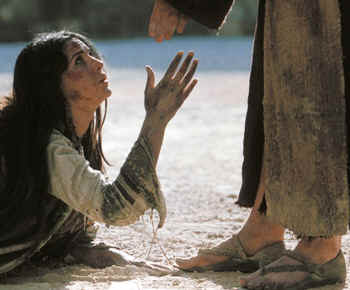
And from there he arose and went away to the region of Tyre and Sidon. And he entered a house and did not want anyone to know, yet he could not be hidden. But immediately a woman whose little daughter had an unclean spirit heard of him and came and fell down at his feet. Now the woman was a Gentile, a Syrophoenician by birth. And she begged him to cast the demon out of her daughter. And he said to her, “Let the children be fed first, for it is not right to take the children’s bread and throw it to the dogs.” But she answered him, “Yes, Lord; yet even the dogs under the table eat the children’s crumbs.” And he said to her, “For this statement you may go your way; the demon has left your daughter.” And she went home and found the child lying in bed and the demon gone.

Mark 7:24-30 (ESV)

Since the assigned lection a few Sundays ago on Jesus and the Syro-Phoenician woman (Mark 7:24-30), I’ve intended to comment on what appears to me a surprisingly widespread mis-reading of the passage. Essentially, the “dogs” (who Jesus says here must wait till after the “children” have eaten before they can be fed) are taken with an extremely pejorative connotation as feral mongrels, and the scene is read as if Jesus is pictured insulting the woman and treating her with contempt. I am embarrassed to find this basic take on the passage even in the learned commentary on Mark by a scholar I deeply admire: Adela Yarbro Collins, Mark: Hermeneia (Fortress Press, 2007), 366-67. But for several reasons, among them prominently the specifics of the Greek term used (unusually) in this passage, I think it pretty clear that this take is wrong.

Dr. Larry W. Hurtado
“Dogs, Doggies, and Exegesis”
Lary Hurtado’s Blog

Disclaimer: In using the title of the song Who Let the Dogs Out? written by Anselem Douglas and originally covered by the Baha Men, I am in no way attempting to be insulting to any individual or group of people, either those addressed within the context of this blog post or otherwise. Given the core statement made by Jesus in the Mark 7 quote, it just seemed like a “clever” title for my missive. That is the complete extent of my intention for using the song title.

Note: I’m taking an interpretation written by well-known New Testament scholar Larry Hurtado and using it as a springboard to make a suggestion of my own. I certainly don’t expect Hurtado (should he ever read this) to agree with me and frankly, what I’m doing in today’s blog post is something of an “experiment.” Just so you know.

Was Jesus a racist? This question doesn’t come out of thin air. There have been several recent conversations in the blogosphere in relation to Messianic Judaism (click the link to see my rather specific definition for the term) and whether or not proponents of Messianic Judaism as a form of Judaism, rather than an all-inclusive “Christianity,” is racist. (See Judah Himango’s blog post Two Church: Defining Bilateral Ecclesiology in Simple Terms for the latest discussion) The suggestion is that, by insisting that the modern Jewish disciples of the ancient Jewish Messiah are a Judaism and, like all other Jews, are the sole inheritors of the Mosaic covenant because they are the physical descendants of Abraham, Isaac, and Jacob, that Messianic Judaism and Messianic Jews are being racist. That is, Messianic Jews, by overtly excluding non-Jewish Christians from the conditions of the Mosaic covenant (the Torah), are denying people access to being obligated to the full weight of the Torah mitzvot based on race.

The topic is extremely rich and can be taken in a lot of different directions, but since I had recently read Dr. Hurtado’s above-quoted blog post and it’s companion article, I thought I’d use them as the focus of my investigation. They really are quite fitting since they directly address Christ’s interaction with the (non-Jewish) Syro-Phoenician woman in Mark 7 and he appears to treat her rather badly because she’s not Jewish. But is that really the case?

This sense of a domestic scene ought to be obvious simply in reading the passage. Jesus is pictured as responding to the woman’s request by saying, “Let the children be fed first, for it isn’t right to give the childrens’ food to the dogs.” The point of the statement is the temporal priority of the “children”, of course in this case, referring to Jesus directing his ministry to fellow Jews. The metaphor presumes a setting in which the household dogs are fed the leftovers after the family has eaten (not custom-produced dog-food). (I know the practice well, having grown up in a rural setting in which the household dogs ate what we ate, only after we had eaten.)

The woman’s clever reply confirms this, respectfully pointing out that “the dogs under the table eat from the portions of the children.” “Wild” dogs and “scavenger dogs of the street” aren’t typically allowed “under the table” and around the children! And anyone with both children and household dogs will know how it goes at mealtime: If allowed, the dogs hang about the children’s chairs, knowing that children love to “drop” morsels to their pets.

Finally, we also have to ask ourselves how likely it is that the authors of Mark (writing for a Christian readership at least largely made up of converted gentiles) would have inserted a scene in which supposedly Jesus insults a gentile woman in the harsh terms imputed by some modern readers. She is “put in her place” as a gentile, but it’s a temporal place. The scene functions to explain that, although Jesus’ own ministry was confined to his Jewish people (apparently, a tradition that Mark couldn’t deny/ignore), the subsequent mission to gentiles was (Mark wants to imply) on the agenda, only it had to wait its time, and Jesus is pictured as anticipating that gentile-mission in responding positively to the woman’s respectful but clever response.

Was Jesus racist? Seemingly not, according to Dr. Hurtado, at least not in a way where he was being “cruel” to the non-Jewish woman. What Hurtado describes is a situation whereby Jesus seems to order his overall ministry, with the Jews (“the children”) “served” first, and only afterwards are the domesticated “dogs” under the table (non-Jews) fed. According to Hurtado, Jesus wasn’t being insulting or racist and in fact, he was certainly “inclusive” (using a modern term appropriate for such discussions) of non-Jews, but he did not see them on the same lateral plane at that point in time. They (we) wouldn’t be served until after his death, resurrection, and ascension. During his first coming, Gentiles didn’t occupy the same “space” or the same roles relative to his mission to the Jews as the Jewish redeeming Messiah and Savior. Nevertheless, he did take the time to “feed the dog under the table” so to speak.

This is made a bit more clear by Dr. Hurtado’s subsequent blog post:

One further observation about the little scene between Jesus and the Syro-Phoenician woman in Mark 7:24-30 is that the initial response ascribed to Jesus is not a derogatory reference to the woman, or a simple misogynist or racial put-down, but is instead a parable-like saying specifically appropriate to the woman.

The part about the “parable-like saying specifically appropriate to the woman” could stand some examination. If I say that the sequence of events we see in Mark 7:24-30 represents how Jesus saw the prioritization of his ministry in relation to Jews and Gentiles, and if I say that, based on these verses, it was Christ’s intent to “feed” both the “lost sheep of Israel” and the non-Jews living among Israel, but giving a later temporal priority to the non-Jews, then can I generalize this as Christ’s intent to maintain some sort of distinction for the disciples among the nations that he would later (after the resurrection) command his Jewish disciples to make? (see Matthew 28:18-20).

Hurtado doesn’t directly address this issue and he would probably disagree with how I’m using his material. He seems to say that the only difference between Jewish disciples and Gentile disciples is that the Jews would be brought in first. The Gentiles would enter discipleship later on. But is the only distinction temporal?

Based on the Last Supper narratives (Matthew 26:17-30, Mark 14:12-26, Luke 22:7-39 and John 13:1-17:26), Jesus intended on bringing all of his followers, Jewish and Gentile alike, into covenant relationship with God via the New Covenant (see Jeremiah 31 and Ezekiel 36), a covenant which confirmed and expanded upon the previous covenants God made with Israel. Prior to this point, the non-Jewish nations did not have direct access to God through covenant (unless they converted to Judaism). Only through the blood and bodily death of Jesus and his subsequent resurrection could we be brought in and placed on a level plane in the Kingdom relative to access to God and experiencing God’s love for us. This fits quite well with what Hurtado wrote.

But would that make a difference in how Jesus saw the Gentile disciples made after his ascension to how he saw the Syro-Phoenician woman? Was it his intention to elevate the “dogs sitting under the table” to the status of “children sitting around the table?” Given that Mark was writing his Gospel primarily to non-Jewish disciples, I believe I can make a case for the answer “no.” Otherwise, Mark’s description of this transaction becomes wholly anachronistic to the disciples from the nations (i.e. non-Jewish Christians).

I’d like to suggest that the distinction between the Jewish and Gentile disciples wasn’t necessarily temporal, but sequential and derivative. In fact, the way I understand how Gentiles manage to be injected into a relationship with God through the covenants (specifically Abrahamic and New) made with Israel, it would have to be.

Paul appears to echo Mark’s theme and suggest one that mirrors my suggestion in his famous letter to the church in Rome:

There will be tribulation and distress for every human being who does evil, the Jew first and also the Greek, but glory and honor and peace for everyone who does good, the Jew first and also the Greek. For God shows no partiality.

Romans 2:9-11 (ESV)

PaulThis short verse tells us several things. First, Paul, in speaking to a “mixed congregation” of Jews and non-Jews, continues to draw a distinction between them (he calls them “Jews” and “Greeks,” not “Christians” or some other all-inclusive term designed to negate any distinction between the two groups). He also says two things that seem to be contradictory. He says that God shows no partiality” between Jews and Greeks, but he also says “the Jew first and also the Greek,” which dovetails very nicely into Hurtado’s analysis of the Mark 7 passage where he describes a “temporal” prioritization, but also a sequential prioritization, where the Jews would always be considered before the non-Jews regardless of circumstances, good or bad.

Since Paul at this point, is addressing Jews and Gentiles who are all covenant members under the Messiah, it is reasonable to say, in my opinion, that the relationship between Jews and non-Jews remains distinctive. The non-Jews are not considered before the Jewish disciples, and their (our) relationship with God derives from the Jews after the non-Jews have entered into covenant relationship with God through Jesus Christ. We are equal, because God shows no partiality, but the distinction between Jew and Gentile is maintained as is the rather (on the surface) unflattering relationship between the Jewish “children” and the non-Jewish “domesticated dogs,” though a kinder metaphor such as parent to child (no, it’s not a perfect metaphor) might be more fitting.

There’s a strong tendency to try to understand the relationship between believing Jews and believing non-Jews in terms of 21st century western cultural, social, and legal definitions. America and the other nations of the west, are based on a strong imperative to treat all people of differing races, cultures, ethnic groups, languages, and nationalities as equal in terms of law and access to resources. Our system of equality is flawed, but the principle exists and it’s a good one.

But we can’t seem to get around the fact that first Jesus (as described by Mark) and later Paul both differentiated between the Jewish and non-Jewish followers and disciples of the Messiah. The Jews were brought in first but they continued to be first, even after the Gentiles were brought into covenant. The Jews were directly descended from Abraham, Isaac, and Jacob and as such, were the beneficiaries of all of the covenants God made with Israel. The people of the other nations would not be able to enter into covenant with God except through Jesus and the New Covenant (the original blessings can be traced back to the Abrahamic covenant) and thus, Jesus and later Paul, order their priorities differently depending on…yes, on race. They order them differently based on whether or not a person is physically a descendent of Abraham and Isaac and Jacob or not. Everybody except for the Jewish people, are not.

Was Jesus a racist? Not in the sense we understand the term today. He did however, differentiate based on racially associated covenant relationships. Being Jewish was one thing. Being non-Jewish was something else. Through Jesus, we Christians enter into a relationship with God, think of it as going from wild, scavenging dogs, to domesticated dogs. Not very flattering, as I said before, especially if we (to extend Mark’s metaphor) continue to consider the Jews as “children” by comparison. On the other hand, maybe we’re much newer additions to the family and must continue (as in many families) to pay deferential respect and have differing privileges than the older members of the family.

But setting aside the uncomfortable literal interpretation of this language, the difference between the Jewish believers and the Gentile believers is not one of God’s love or access to our Creator, but of older vs. younger or, who we are as non-Jews in the family is directly derived from the older Jewish members. Jews are “served first.” The dogs eat what the children eat but the children will always come first. Or the younger family members eat what the older members eat, but the younger eat later, waiting first for the older members to be served. Perhaps we even eat only because the older members of the family, the root, provides the nourishment.

I don’t think I’ve “solved” the “are Messianic Jews racist” debate. I admit that I’ve taken liberties with the text and explored alleyways Hurtado would likely not approve of. I’ve also probably raised more questions than I’ve answered,  but I wasn’t actually trying to answer questions. I’ve been trying to introduce the possibility that Jesus never intended to eliminate any of the “specialness” of the “Children” of Israel when he, through God’s grace and mercy, made a way possible for the people of the nations to also enter God’s Kingdom. I think our connection will always be through Israel and we will always be dependent on Israel (and Israel’s firstborn son Jesus) for our access to God.

Something to think about anyway.

Doing Joy

Rejoice always, pray without ceasing, give thanks in all circumstances; for this is the will of God in Christ Jesus for you.

1 Thessalonians 5:16-18 (ESV)

Therefore, first of all, man ought to be happy and joyous at all times, and truly live by his faith in the Lord who animates him and is benignant with him every moment. But he who is grieved and laments makes himself appear as if he has it somewhat bad, and is suffering, and lacking some goodness; he is like a heretic, Heaven forbid.

Igeret HaKodesh 11 (Kehot)

Apparently, I struggle with joy. I suppose it’s part of my nature or my personality to do so, just like I struggle with everything else, including God. I don’t have an easy relationship with joy. It’s like my relationship with all those religious and spiritual people who seem to be so happy and carefree all the time. I just don’t see how they can be perpetually “warm and fuzzy” (kittens, puppies, John Lennon quotes) and still manage to relate to those of us who seem to need to keep a toe or a foot in the real world.

Was that cynical?

While I have recently acknowledged joy, I have even more recently mourned its lack in my life. But I have still managed to say something hopeful about joy.

I can only conclude that joy, like love, is a verb; it’s something you do, not something you feel. We can love by performing acts of love, such as feeding the hungry, hugging a crying child who just skinned his knee, helping an elderly, infirm person across the street, or visiting a sick person in who is in the hospital. But how to you do joy?

This morning (as I write this), I realized that last night I actually did joy. I just didn’t know that’s what I was doing at the time. That means I actually do joy more often, much more often than I thought I did.

Here’s what happened.

On Tuesday evenings, my son and daughter-in-law take a class and they ask my wife and I to watch our grandson Landon while they’re out. Last Tuesday night, my wife had to work late, so when I dropped off my son at his place after work (we commute to and from work together), I took Landon home with me (oh, he’s three-and-a-half years old, just so you know). My daughter was home and cutting up lots and lots of organic and recently picked apples on the back patio as part of her latest culinary masterpiece project (cider, I believe). The sukkah was still up, which should help set the scene for you.

Oh, one more thing. Rabbit and Alley. We have two hand puppets that we acquired (I don’t remember the details) when our own children were small. One is a rabbit and the other is an alligator (hence, “Rabbit and Alley”). Landon adores Rabbit and Alley (or “Raddit and Alley” as he calls them). They are his very close friends, almost as close as “Baby” which is his favorite stuffed toy (a giraffe).

When we got to my place, he saw that his aunt was out back and he wanted us all (Grandpa, Rabbit, and Alley) to play outside so we could be with her. My grandson is a picky eater, so he didn’t want to have dinner with me. He did sit beside me and we chatted while I ate. After my hunger was sufficiently assuaged, we proceeded out back.

Landon consumed a lot of (Auntie provided) fresh apples between periods of playing in the sandbox. Rabbit and Alley (and I) watched him as he transferred sand almost endlessly from one container to another. He put sand in a small bucket and pretended that he was planting (alternately) “pretty flowers” and tomatoes. Rabbit received the honor of watering the “plants” (pouring more sand in the bucket). He gave Rabbit and Alley “flowers” to put in their “pockets” and fed them imaginary tomatoes, since Rabbit and Alley like their vegetables (Landon, not so much).

When the sun went down sufficiently, I turned the lights on that are mounted on the sukkah, and we went inside. Landon ate more apples and asked me to read the Hebrew that is on two walls of the sukkah. I can’t read Hebrew, but was able to point out the names of Abraham, Isaac, Jacob, Moses, Aaron, Joseph, and David. Landon was a little confused when I mentioned that David played a harp because his Dad (also David) plays the drums. I had to explain that one is a King and the other is his Daddy.

We ran around the outside of the sukkah “hiding” from each other. He hid behind bushes. He picked up a “pretty rock” and carried it around for a while. I’m pretty sure I was wearing Rabbit and Alley on my hands the whole time. I tend to forget they’re actually on my hands when I’m playing with him, unless I need to take them off to turn the pages of a book I’m reading to him, or some similar activity.

In fact, when the sun went down, we did go in and I read him two books, one about an adventurous young penguin, and the other about a duck who likes to make soup.

His parents came to pick him up and, as is true with most children who are in the middle of having a good time, he didn’t want to go. So, to encourage Landon to go to the car, Rabbit, Alley, and Grandpa went out to the front to see him off. After he and his parents left, I went back inside and only then remembered to take off Rabbit and Alley and place him in their seat of honor near the fireplace.

I woke up this morning and realized that playing with my grandson was “doing joy”. It’s not that I had been emotionally ecstatic and overwhelmed with mind-bending happiness, but I recalled, looking back on the evening, that I had been quietly, pleasantly happy. I’ve mentioned before that one of the acts of love we are able to perform is to hug a crying child who has just skinned his knee. If that’s love, then joy must be playing “Rabbit and Alley” with a small child who on some level (even though he sees me put the puppets on and take them off) believes that Grandpa, Rabbit, and Alley are his best friends.

Love and joy are playing with your grandson. The next time you can’t find the Spirit of God within you and you feel lost, abandoned, and arid inside, play with someone you love. There, you’ll find joy and every other gift that God provides.

When man has moved away from the Divine, the only rectification is for man to move back toward God. Therefore the Zohar concludes that repentance is the key to heal the rift, which caused the destruction of the second Temple. This would also explain the Midrash cited at the outset — Moses knew that the absence of the Temple necessitated man’s movement toward God; therefore, Moses instituted thrice daily prayer, in order to remind man constantly, in all his experiences, that he must not forget God, rather he should take every opportunity to stand in front of God.

Furthermore, prayer is described as “service of the heart.” Evidently the heart, the emotions are crucial for this return.

But the Zohar insists that repentance coming from the heart full of love is needed to return the Jews to the level which should have been reached via the first fruits offerings. When this happens, joy will become a reality — everlasting and complete joy.

-Rabbi Ari Kahn
“Joy: Commentary on Torah Portion Ki Tavo”
(Deuteronomy 26:1-29:8)
Aish.com

I’m beginning to think that Moses should have instituted thrice daily play times with small children to remind us constantly that we must not forget God.

Turn away from feeling lost and lonely by cherishing whoever God gives you to play with, and your heart will return to Him. Go do love and joy.

Returning the Torah

“I didn’t know what to say, but I certainly appreciated his incredible gift. I realized that this was a Torah that had been basically homeless for the past 50 years. There was no one to read it, hold it or keep it properly, and now God gave the Torah a home, and would hopefully bring this lonely Jew back in the near future as well.

“Now, what about an ark? That’s a story of its own. I found an online ad for an old Jewish artifact, a Jewish chest. The sellers weren’t Jewish, but they had bought it from a priest who told them it was of Jewish origin.

“When I opened the online pictures of the chest, I saw before me what seemed to be a beautifully crafted ark. It was small, so it wouldn’t be able to hold a regular sized Torah, but would be perfect for the Torah we had. But when I viewed a picture of the top of the ark, I almost fainted. There was a large cross attached to it. All of a sudden, I was not at all sure that this was an item of Jewish origin.

Suddenly I noticed a small plaque at the bottom of it. I asked the sellers to send me a photo of the plaque which appeared to have Hebrew writing on it. They sent me a picture where there was a clear inscription in Hebrew that said “Behold, the guardian of Israel neither sleeps nor slumbers Psalms 121), which proved that the item must be Jewish.

-Rabbi Binyomin Pruzansky
“The Lost Torah Scroll”
Commentary on Shmini Atzeret and Simchat Torah
Aish.com

Rabbi Pruzansky tells a story about regularly hosting 30 or 40 young Jews in his home for Shabbos meals. These are young people who are Jewish but who have never experienced a Shabbat in their own homes. They would be uncomfortable in a traditional synagogue setting, but feel comfortable as guests of Rabbi Pruzansky. So he set out on a quest to acquire a Torah scroll and ark for his home to give these young Jews an opportunity to make aliyah in a Jewish environment where they could feel more at ease.

While the scroll he eventually acquired was purchased from a Jew, although one who had fallen away from practicing Judaism for many years, the ark was another story.

The cross upon closer examination, they said, was a separate piece that had been attached. I realized that the priest who bought this ark must have made that addition. I was deeply moved, and was certain that the hand of God was clearly guiding me.

“I bought the ark and had it delivered to my home. The cross was removed and I marveled at the verse that was inscribed. I have never seen this particular verse inscribed on an ark before. And I realized that there was a message here. It was as if God were saying that although this ark was lost for many years, He would never forget about it. He didn’t rest until it finally was brought home to Jewish hands.

“My dear friends, look at what we have here. A Torah that was neglected for so many years was finally given a home in an ark that had been used by a priest. Yet the message was clear that God would never give up on them. He had not forgotten about this lost ark and Torah scroll, and finally the two of them were brought together and can now be used to bring young men and woman back to their Father in Heaven as well.

In reading Rabbi Pruznasky’s “adventure,” I couldn’t help but be reminded of another tale of the struggle to return Torah scrolls to Jewish hands:

Another thing happened as a result of Saddam’s demise. Iraqi mobs looted his crown jewel of culture, the national museum. The majestic Iraq Museum is still on Nasir Street but it’s under new management – the elected Iraqi government. A museum director, Dr. Donny George, was appointed to restore the museum in 2005.

Soon after, Canon White was invited for a private tour.

Dr. George and Canon White strolled through the grand halls. Eventually the priest was led down to the basement level. Dr. George opened the heavy doors of a vault.

Canon White couldn’t believe what he was looking it – rows and rows of Torah scrolls.

“There are 365 of them,” declared Dr. George.

Canon White’s surprise turned into horror. “The Torah scrolls were all at risk. Rats were eating some of the parchment. They were not properly preserved or displayed, just stacked up on the dirty floors,” he says.

Canon White wanted to rescue them, but he decided to try to obtain just one. He had a destination in mind.

-by Ari Werth
“Struggle for the Scrolls”
Aish.com

As I wrote in my blog post Hope and Love, “Andrew White is an Anglican priest risking his life helping Christians in Iraq. Even more dangerous, however, is what he volunteers to do – protecting the last few Iraqi Jews.”

He is also a Christian who is dedicated not just to protecting the Jews and Christians in Iraq, but to returning to the Jews that which rightfully belongs to them: the Torah scrolls held in Iraqi possession.

But there’s another way of looking at this. Although supersessionism is slowly declining in the Christian world, there is a very small subset of Christianity where a rather odd form of replacement theology is apparently on the rise. A group of non-Jewish believers holds to the theory that all of the contents and conditions of all of the covenants God made with the Children of Israel also belong to them. That means, except for a small strand of Jewish DNA, these Christians believe they are just as “Jewish” as Jewish people.

That’s an oversimplification of their beliefs, generally referred to as “One Law,” but I’m rather struck by the odd parallel (or “anti-parallel”) between their stance and the stories of Rabbi Pruzansky and Canon White. Both of these men, within their differing contexts, have worked very hard to return to the Jews something of the Torah, whether it’s hundreds of scrolls in danger of being destroyed in a sub-basement of a museum in Baghdad, or a Torah ark that had once belonged to a priest.

Traditional Christian supersessionism effectively recast the Jewish Torah into a dying or dead Law that had been replaced with Christ’s grace and “nailed to the cross”. Subsequent generations of Christians have been guilty of incinerating Torah scrolls, siddurim (Jewish prayer books), volumes of Talmud, and actual synagogue buildings.

While thankfully, the church has abandoned such heinous acts against God’s covenant people, a very tiny group of them (us) have taken on a different tactic. The tactic is subtle and for the vast majority of “One Law believers,” it is completely unconscious and innocent, as their leaders insist to them that God wants and even requires that they possess the full yoke of the Torah mitzvot as their very own. It’s not a matter of stealing it from the Jews and saying that the Torah is now “Christian.” Rather, it’s a matter of saying (in effect) that Judaism and everything that is distinctly Jewish is completely irrelevant, because Jesus made us all exactly the same. It’s the ultimate expression of equality and political correctness as applied to this minority Christian viewpoint.

(At this point, I want to say that for many years, I was a One Law believer and in my heart of hearts, I honestly believed I was doing God’s will by (poorly, in my case) imitating Jewish religious and identity practices. I still have many “One Law” friends, both locally and on the web, and they are doing what they believe they must in obedience to God. I pray that God will show them one day that while their desire to obey God is very sincere, a course correction is required. For some One Law Christians though, in spite of being presented with evidence and arguments to the contrary, they insist, as a matter of pride, that the Torah belongs to them. More’s the pity.)

In my blog posts Redeeming the Heart of Israel, Part 1 and Part 2, I tried to describe that a large part of our duty as Christians to the Jewish people is to help them return to the Torah. To bend that last sentence to fit the theme of this “meditation,” we Christians should be returning the Torah to the Jews, not claiming it for our own.

If Jesus had intended to include the rest of the world in covenant relationship with God using all of the conditions of all of the covenants God had made with Israel, in Matthew 28:18-20, he would have just commanded his Jewish disciples to make converts of the nations, not disciples. While one possible interpretation of this command would be for the non-Jewish disciples to directly imitate their Jewish mentors in all of their behaviors, including those that uniquely identify Jewish people as Jews, we don’t actually ever see that happening.

We do see, as in the example of Cornelius in Acts 10, how we non-Jews receive the Spirit the same as the Jews, and we’re baptized in water, the same as the Jews, but while many of the “God-fearers” of Peter’s and Paul’s day did pray three times daily, keep some or all of the dietary laws, and perhaps even keep a weekly Shabbos, they likely did not see becoming carbon copies of their Jewish teachers or (at that point in history) view becoming greater than the Jewish inheritors of Sinai as the desired result of their reconciliation to God.

Jesus and his Jewish Apostles lead and the Gentile disciples followed.

Now, we have a greater purpose. Rabbi Pruzansky’s story is just one small example of how modernity, moral relativism, intermarriage (and I say that as an intermarried Christian husband), and assimilation have grievously depleted the ranks of Jews who are culturally and religiously Jewish. There are so many people (my wife was once one of them), who are halachically Jewish but estranged from the synagogue, the siddur, and the Torah. We Christians who find ourselves drawn, often inexplicably, to Judaism have a great opportunity to, after our own fashion, do what Rabbi Pruzansky and Canon White are doing. We can return the Torah to the Jews or more accurately, we can encourage Jews to return to the Torah.

There is an idea in some corners of Judaism that says the Messiah will only come (or from a Christian point of view, “return”) when all Jews everywhere observe a single Shabbat. I don’t know if that’s true or not, but I believe that God will find favor in His Jewish people, as increasing numbers of them return to Him in obedience to the mitzvot. For a Jew, this means returning to the Torah. For a Jew, it means the Torah is returned to him. It does not mean, “the Torah is now for we Christians but we’re willing to share it with the Jew.” It does not mean, “the Torah is now for everyone and, strictly speaking, it isn’t Jewish anymore.”

Speaking to my Christian brothers and sisters who are not Jewish, whether you or I observe the Torah commandments that specifically identify Jewish people as Jews won’t make much of a difference to God, in my opinion. After all, the vast majority of the Torah speaks of those things that we Christians already do, such as feeding the hungry, visiting the sick, and comforting the grieving. We already do everything that our Master and Savior Jesus commanded his disciples to do.

But in a world that has always been opposed to the Jewish people, we can do something for them and for God. We can give them back what we have taken from them. We can allow them, without resisting any further, to be Jewish and to do Jewish. At Sinai, God created a unique and treasured nation that was never intended to be “xeroxed,” diluted, or deleted.  But through repeated acts of disobedience by the Israelites, God (temporarily) dispersed that nation to the four corners of the earth.

Rolling the Torah ScrollNow He is bringing them back to their peoplehood, to their Land, and God is bringing the Jewish people back to Himself. The mission of the Christian church is to serve God and to obey our Lord, and part of that service is to return the Torah to the Jews and to recognize that Israel will one day (I pray soon) be restored as the head of all nations.

Boaz Michael, the President and Founder of the educational ministry First Fruits of Zion (FFOZ) has written a soon-to-be published book called Tent of David (available January 2013) which outlines this mission for us from a Messianic Jewish perspective. These are exciting times for the church and we all have vital roles to play in the plan of God.

We just need to remember our roles. We just need to remember that our job is not to take, but to restore.

May the Messiah come soon and in our day.

Amen.