I am very encouraged by the overwhelming amount of support people are expressing toward Derek, with just a few, minor detractors chiming in.
We all have our problems, our failures, and our sins. They become much more public and more powerful when you happen to be a teacher and an organizational leader, especially in a movement as “intimate” as Messianic Judaism, where most folks involved have at least heard of each other if not personally know one another.
I suppose it’s one of the reasons why many of us should not be teachers (James 3:1). Who wants that kind of pressure, especially if we should sin (and who doesn’t sin)?
That certainly flies in the face of American particularism, independence, and a “get-er-done” attitude, and it probably wouldn’t have sat very well with the above-quoted Gene Kranz as he dedicated his efforts to rescuing the crew of the ill-fated Apollo 13.
But let’s face it, we’re all human. Failure is one of our defining qualities. Not that we should revel in failure, but it’s arrogant to presume that you or I will never sin.
Yet, some of our sins are rather spectacular and some of our sins are astonishing and shocking when they come into the public light. Some of our sins hurt not only us, but every one we have ever loved.
Even with confession, repentance, and undeserved forgiveness, the guilt can still be crushing.
I’m grateful for Derek’s sake, for everyone’s sake, particularly for my sake, that God is more forgiving than most human beings…more forgiving than I certainly am toward myself.
In the Future Buzz article I cited above, author Adam Singer wrote:
Failure is a beautiful thing, and if you organize your business around it you can gain a serious advantage over competitors who think they’re infallible and spend inordinate amounts of time trying to be perfect versus trying lots of things, failing like crazy, and seeing what sticks. The truth is we all fail, every one of us, and when you really stop and remove the societal stigmas associated with it, you realize it’s not actually a negative.
Granted, this particular message is directed toward a business and marketing environment, and yet it has applications on the social, personal, and religious levels of our existence. If we allow our sin to crush us, to prevent us from repenting, to inhibit the idea that there can be a road back, not only to God, but to our family and friends, then we truly have been defeated.
Failure is not falling down, it is not getting up again.
―Mary Pickford
There’s a plethora of similar quotes available on the web. I just picked the first one that came up in a Google search.
No one, no sports hero, champion, competitor in any human endeavor, or any human being at all has failed until they allow their failure to result in giving up.
I can do all things through Him who strengthens me.
–Philippians 4:13 (NASB)
Easier said than done as I imagine the Apostle Paul can attest.
And yet, it’s not the depth of sin we have fallen into that defines us but how we recover afterward.
Failure is always an option. It happens to us every day. Sometimes it happens with brutal intensity and swiftness, and when our failure is revealed for all to see, it’s easy to wonder how we’re going to survive the shame and humiliation. It’s easy to imagine the bridges have been burned and that our only option is, like Icarus, to fall out of the light and into the darkness.
Failure is always an option, but failure does not have to be permanent.
I can only imagine that it took a tremendous amount of courage for Derek to publicly confess his transgressions on his blog. He could have gone silent and stayed silent, containing the impact to those people directly involved.
No one likes to air their dirty laundry.
I wouldn’t recommend this method, but sometimes it may be possible to lead by starting at the bottom. If you have fallen and fallen far, and can pick yourself back up, by Hashem’s strength and grace, and start the long ascent, the rest of us who witness this, can come to realize there’s hope for us too, as we sit at the bottom of our wells and our caves, buried by the darkness and dreaming of the light.
Great Teshuva
My friend and I are having a disagreement about degrees of righteousness in God’s eyes. Who is greater: One who is virtuous by inclination, or one who is virtuous by choice – i.e. one who must struggle with his passions and transform vice into virtue?
The Aish Rabbi Replies:
The Talmud says: “In a place where a ba’al teshuva (spiritual returnee) stands, even a full tzaddik cannot stand” (Brachot 34b). The idea is that by having sunk to the lowest depths, and then genuinely turning one’s life around, the distance traveled in a positive direction is so great that it even exceeds those who have always been on the plus-side.
(Of course, one would not want to deliberately get into a negative situation, because there is no guarantee of coming out. Further, it often leaves residual stains.)
That’s only part of the Aish Rabbi’s reply, but it’s the most relevant part. If a life of righteousness comes (relatively) easy to you, what have you really accomplished? However, if acts of righteousness, charity, and piety are difficult, if they go against your nature, if you have to struggle everyday to do good or to recover from some monumental failure, how much greater will your success be than your failure?
How can I talk with anyone else about God when I can’t even talk about Him with my wife?
We were discussing this news story about how when Iran says “Death to America” it doesn’t really mean “Death to America”.
We were both equally outraged at such a sentiment, and I tried to express support for Israel and how when God came back…
Oops.
“Came back?” my wife queried.
I realized what I said and how she took it (and rightfully so) and tried to reorient the statement as best I could but the damage was done.
There are lots of reasons I don’t feel fit to occupy a space in the religious blogosphere, most of them having to do with my personal shortcomings, but some of them have to do with my apparent inability to talk with or about Messianic Jews and Messianic Judaism without stepping on some significant toes.
If I can’t talk about God and Israel in a positive, pro-Bible, pro-Israel, and pro-Judaism way with my wife without saying something stupid, how can I hope to talk with other Jews in Messianic Judaism without causing strife and offense?
I don’t enjoy getting emails saying that I said something wrong, objectionable, or whatever. I can’t live in the same home with a Jewish person without messing things up. How can I communicate with other Jewish people who don’t have that sort of emotional connection with me and get my point across without causing a mess?
This is my personal problem with being involved with Messianic Judaism. If I actually say what’s on my mind, even with the best intentions, it goes wrong. Some people might not care and just bulldoze their way through, but I don’t have that luxury, certainly not as a blogger, and definitely not as a husband and father.
I went out for coffee with my Christian friend last Sunday. He again strenuously encouraged me to join religious fellowship. I felt myself once again backed into a corner with no way out. If I go back to a church, I’ll be “sleeping with the enemy” as far as my wife is concerned. If I, even over the web, attempt to associate with some sort of Messianic community, sooner or later, I’m going to step all over someone’s priorities because either I have a mind of my own or because I make mistakes.
The problem is, just like in marriage, when you step on someone’s “sacred cow,” they take it personally.
That’s why I like writing about senior fitness. It may not have eternal consequences, but then again, no one gets bent all out of shape about my personal expressions on the topic either.
Yes, this is a rant.
This is why I believe my only option is to rely on Hashem alone. He’s got thousands of years of experience dealing with human stupidity. Fortunately, he doesn’t offended easily. If he did, I’d have been ashes ages ago.
If Hashem wants to take exception with me, He knows where to find me and if He choses to “consequence” me, it’s His privilege to do so, and I can’t say “boo” about it.
I realize now why so many people I know in the “Messianic” and “Hebrew Roots” space choose to be isolated in small family groups or home fellowships. A Messianic “luminary” once referred to these groups in an unflattering manner, but I think that at least some of them just don’t know who to trust, including whether or not to trust themselves.
We are supposed to trust in Hashem alone. That’s an answer that is not only appealing on a lot of levels, but one that may be the only remaining path for many of us. If we can’t trust God, we are undone anyway. If God is like people, then we have no hope.
The Torah states, “You shall trust wholeheartedly in the Lord, Your God” (Deuteronomy 18:13).
Rabbi Yisroel Meir Kagan, known as the Chofetz Chaim, used to say, “The Torah obliges us to trust wholeheartedly in God … but not in man. A person must always be on the alert not to be cheated.”
The Chofetz Chaim devoted his life to spreading the principle of brotherly love, the prohibition against speaking against others, and the commandment to judge people favorably. Though he was not the least bit cynical, he was also not naive. He understood the world and human weaknesses.
In Mesichta Derech Eretz Rabba (chapter 5) it states that we should honor every person we meet as we would (the great sage) Rabbi Gamliel, but we should nevertheless be suspicious that he might be dishonest.
Actually, it was something I wrote in response to another person’s post, plus a few other comments I’ve seen crop up in the religious blogosphere that prompted this particular “meditation.”
What is marriage?
Oh gee, is that all. How do we define marriage?
Rather than go into a complex set of situational, societal, moral, and religious variables, let’s stick with whatever it is that gives SCOTUS the right to define same-sex marriage as a right.
After all, there seems to be some online conservative push back that wants “the State” to keep out of our marriages. What gives the State the right to poke their noses into the state of matrimony?
At the level of two individuals committing their lives to one another, the answer is “nothing.” Any two people can approach the clergy-person of their choice and ask to be married. The kicker comes in when you include a marriage license.
Why does something sanctioned by God need to be licensed by the State?
So they are no longer two, but one flesh. What therefore God has joined together, let no man separate.
–Matthew 19:6 (NASB)
Taking that quote in isolation, it seems to send a pretty clear message. The “institution” of marriage is sanctioned by God. Couples, in the context of the Bible in general and Matthew 19 specifically, are made up of one man and one woman, are joined together by God and no person (or presumably human institution) should separate that union.
The Supreme Court Justices
So if God joins two people together, why does anyone need a marriage license issued by the state where they are to be married?
So that the state, and the nation (and really, the world) will legally recognize that marriage.
Why do we need that?
Well, for tax reasons for one thing. Haven’t you made decisions about tax exemptions based on whether or not you’re married and how many kids you have?
What about making someone who was once a stranger legally into a family member. This has terrific advantages if you get into an accident and are hospitalized, since your legal spouse, but not someone you’re just living with, has rights as far as visiting you in such a medical setting.
And if, heaven forbid, the marriage doesn’t work out and you two don’t see eye-to-eye about things like alimony or child support payments, the fact that you were in a legal marital relationship allows the court to administer said-relationship’s dissolution and issue orders for the caretaking and well-being of the financially disadvantaged spouse (if necessary) and any dependent children.
If you remove the state from all that, then you may have a marriage sanctioned by God, but you’ll have a heck of a time managing or even acquiring anything close to the legal rights you have relative to each other as a married couple as well as those to your children (although, even if you aren’t married to your partner, if you have biologically created a child with that person, you automatically have parental rights to said-child under most circumstances).
And so we come to the matter of opposite-sex marriage vs. same-sex marriage as a legal entity.
This really has nothing to do with how God sees things and what combination of human beings He sanctions to be joined within marriage. SCOTUS doesn’t get to say “boo” about what God desires and what He allows. A select group of five lawyers (the five Supreme Court Justices who voted to legalize marriage equality) are only empowered to decide how marriage is legally defined in the United States. It doesn’t determine how marriage is defined morally or religiously to the slightest degree.
So in reality, Gay and Lesbian couples could have gotten married in an emotional and relational sense (and even a religious sense given the number of liberal churches and synagogues available) for years or even decades (or longer) in this country (or anywhere).
It’s only the matter of the State (big “S”) granting gay couples the same legal rights that opposite-sex married couples often tend to take for granted that is the issue.
The United States of America has become the 21st nation on the planet to legalize same-sex marriage with no variation within its individual states, provinces, or territories. If we want to determine the social consequences of legalizing marriage equality, including the long-term results of same-sex parenting, we might want to see if any of those other nations can be compared to us.
I am more than aware there is what amounts to a collective panic attack within various religious spheres relative to “Sodom and Gomorrah” being legalized (and just exactly what the sin of Sodom and Gomorrah was that deserved a divine death penalty isn’t, at least Rabbinically, as straightforward as you might have been led to believe).
I’m also aware that of all the things Paul the Apostle addressed in his epistles, he never directly complained that idolatry and homosexuality were sanctioned within the Roman Empire.
He did preach against sexual immorality among the body of believers, but he never tried to change the laws of the prevailing society and culture in which these disciples lived.
Of course, there was no such a thing as “loving same-sex couples” or “marriage equality” in the Empire. To the best of my understanding, a Roman citizen could have a same-sex slave or non-citizen as a sexual partner as long (forgive me for being blunt) as the citizen was the “penetrator” and never the “penetratee”. Turns out these “relationships” were more about dominance and power and less (if at all) about love and affection, at least as far as the historical record is concerned.
So if the matter of homosexuality was ever on the Apostle’s radar, it was only in terms of those individuals making up the ekklesia of Messiah. For the Jewish members, it probably was already a well-known norm and Torah commandment. Paul most likely only had to deal with those non-Jews coming out of paganism whereby same-sex sex may have been involved as part of the local cultic temple practices or some such thing.
Given Paul’s example, do we need to start a revolution and overthrow our government in order to stop the national “sin” of marriage equality? Rome fell (and if homosexual practices were part of the Empire’s downfall, I have no way of telling), and no doubt at some point, so will the United States. I don’t think we can stop it.
As much as that might be a heartbreaker for you or for me, the only nation that really matters to God as far as being eternal is Israel.
SCOTUS has made a ruling involving the legal definition of marriage for our nation as related to the rights and responsibilities of married and divorced (or divorcing) couples in terms of each other and their children.
Anyone who desires to become legally married is really wanting to enter into a contractual relationship with another human being to gain certain financial advantages and other rights. In that sense, any two reasonable human beings should have that right, since it primarily is a right they acquire relative to each other and to the government (remember tax exemptions). It’s also a legal entity that is designed, however imperfectly, to protect children should one or both parents decide they don’t want to behave responsibly.
I am aware that are a lot of other collateral issues that legalizing same-sex marriage nationwide brings up, but I’m not going to address any of them. Plenty of other bloggers, news writers, and social and religious pundits can, will, and probably have already done so.
I just thought the little but important detail of what marriage is legally as separated from its relational, romantic, moral, and religious reality needed to be teased out and brought to the forefront for a little bit, just so we could take a look at what SCOTUS did in context.
Jay Michaelson
I’ve reviewed such books as God and the Gay Christian and God Vs. Gay: The Religious Case for Equality, and while I had to agree, based on what I read, that the “anti-Gay” message of the Bible isn’t nearly as definitive as Evangelical Christianity seems to believe, I also found no presumption for God’s sanctioning the marriage of “loving same-sex couples” within either the covenant people of Israel or the ekklesia of Messiah (body of Christ).
If two secular same-sex people want to get married, legally, in any state of the union, there’s nothing to stop them, and in most circumstances I can imagine, it has very little to do with we religious folk on a day-to-day basis.
On the other hand, if two same-sex people claim to be Christian or Torah-observant Jews and desire to become legally and God-sanctioned married, I still think there’s a problem, at least based on how I read the Bible.
Married same-sex couples are not represented or even presupposed in the Bible. I won’t speak to all of those secular gays who are married or who are going to become married. There are plenty of other laws in the U.S. I chafe against for various reasons, and some of them have more to do with my life as a believer and just plain human being than marriage equality.
All I will say, is that if you are Christian or a (an Orthodox) religious Jew, you’re gay, and you want your religious institution to sanction your marriage (believing God is sanctioning it, too), then I just don’t see a Biblical case for it. That’s out of the Supreme Court’s jurisdiction. God will have to make that judgment.
Oh, and if you haven’t figured it out already, then prepare to be inundated with all things rainbow in celebration of the SCOTUS decision. And I promise you that those rainbows have absolutely nothing to do with God’s covenant promise to all living things never again to flood the Earth.
We find that G-d’s love for our father Avraham was mainly because “…he will command (yetzaveh) his children and his household.”[1] Yetzaveh here connotes “bring into a communion (with G-d).” All of Avraham’s towering avoda in the tests to which he was subjected,[2] cannot be compared to his commanding others and bringing them into communion, i.e. to his bringing merit to others.
“Today’s Day” for Sunday, Tammuz 8, 5703/1943
Compiled and arranged by the Lubavitcher Rebbe, Rabbi Menachem Mendel Schneerson, of righteous memory, in 5703 (1943) from the talks and letters of the sixth Chabad Rebbe, Rabbi Yosef Yitzchak Schneersohn, of righteous memory. Chabad.org
This is a follow up to yesterday’s morning meditation, and although it, and my previous missive, may seem a bit schmaltzy for some of you, I feel it’s necessary to add some spiritual “ascent” to counter balance some of the “descent” we’ve been discussing lately.
I know that the phrase from Genesis 18:19 where God references Abraham saying “so that he may command his children and his household after him to keep the way of the Lord by doing righteousness and justice,” has been taken by some to mean that, as spiritual children of Abraham, we should be obligated to the Torah mitzvot in the same manner as the descendants of Abraham’s offspring Isaac and Jacob, that is, the Jewish people.
This would make things deceptively easy (not that they’d actually be easy) in terms of defining the role of the non-Jew within Messianic Jewish space. We’d just have the same role as the Jewish participants and thus we’d all be one big, happy family (not really, but that’s wish, anyway).
But the commentary about the aforementioned portion of scripture is very interesting. It states “…he will command (yetzaveh) his children and his household,” as meaning he [Abraham] will “bring [his children and his household] into a communion (with G-d).”
Except, because of our Abraham-like faith in Hashem through Yeshua, we can and are brought into communion with God. Having a halachic path identical to the Jewish people is completely unnecessary. How complicated does coming into communion with God have to be?
Although the Jewish Sages believe that Abraham kept all of the Torah mitzvot in the manner later commanded at Sinai, I don’t think we have to go that far in considering what Abraham may have taught, based on a reading of the plain meaning of the relevant texts.
At a very, very basic level, Abraham talked to God and God talked back. Their relationship was founded on Abraham’s unbounded trust in God, a trust that allowed Abraham to do the unthinkable; to trust God enough to place Isaac on the altar and risk losing his “child of promise.”
While I think most of us as parents have a terrifically difficult time imagining how Abraham was able to do this and what he was thinking (not to mention what Isaac was thinking when he allowed it) at the Akedah, we have to believe that Abraham trusted God and His promises enough to know that Isaac would not die or that, if he did, God would resurrect him.
After all, if Isaac was the sole source of Abraham’s future legacy, how could that be fulfilled if Isaac died, particularly by his father’s hand, before having children?
So to be in communion with God, to follow Abraham’s teachings may be as straightforward as continually talking with God and continually developing our trust in God so that we too may face our life difficulties with the same calm and grace as Avinu Avraham.
A lot of the issues we discuss among ourselves as “Messianics” have to do with how Jews and Gentiles are supposed to interact, particularly within a Jewish social and worship environment, but the question we seem to avoid is how are each of us as individuals (regardless of being Jewish or Gentile) supposed to relate to God?
If following Abraham’s teaching for both his biological descendants and those of us who are counted as children of Abraham by our trust in God is the key, then the door we’re trying to open is the one that leads us into the presence of Hashem.
G‑d desires to have a presence in this world, and in each mitzvah we do, however it is done, He is there.
G‑d desires that His light shine in this world, and in every word of divine wisdom and every heartfelt prayer, His light shines.
G‑d desires yet more—that He be found here in all His essence, that which can neither be spoken nor kept silent, neither of heaven nor of earth, neither of being nor of not-being—that which transcends all of these and from which all extends.
And that is how He is found in a simple, physical deed that shines brightly with divine light.
Everything we do in the service of God brings a little bit more of His presence into our reality. That’s the meaning of Tikkun Olam or repairing the world.
In that, anything we do to elevate ourselves spiritually, and that delivers charitable, righteous, and just acts to our fellow human beings, is part of bringing light into the world and are the behaviors that result from our communion with God.
We are students of Abraham it seems, Jew and Gentile alike. We all just have our own unique ways of acting out what we’ve learned.
I encourage you to read it all (it’s not very long), but he ends his missive by saying:
As another ancient Jewish teaching goes, “Every person has to say, ‘The whole world was created with me in mind.’” Meaning, for me to tip the scales. For me to make the entire world the way it was meant to be.
Because you are the world.
Whether you understand it or not, you (and I) were created to fulfill a specific purpose in life (and maybe more than one). As you are doing it, you may not even be aware of what or how you are part of God’s plan in the world. You may only realize it in the world to come when it is revealed.
Half the time, I have no idea what God wants out of me, either.
That’s where trust in God, the kind of trust Abraham had at the Akedah, comes in. We have to believe and live out our trust that the universe and our individual lives are unfolding as God intends them to.
Our teacher the Baal Shem Tov said: Every single thing one sees or hears is an instruction for his conduct in the service of G-d. This is the idea of avoda, service, to comprehend and discern in all things a way in which to serve G-d.
-Compiled by the Lubavitcher Rebbe;
Translation by Yitschak Meir Kagan Chabad.org
If only we could keep this in mind throughout our days and nights, in the midst of our conversations, and particularly when we “talk” to each other on the Web. But it seems that each disagreement, each challenge, is an excuse to forget about how all experiences are instructions for how to serve God, even as we believe we are serving God.
I suppose I could cite the Baltimore riots since it’s all over the news and social media just now, but a sense of powerlessness, fear, rage, and violence is what has fueled this latest conflagration.
And that has little or nothing to do with us as a community and how we are to serve God.
I know that we people of faith are also just people and we often use that as an excuse for our own outbursts (though thankfully, they’re not on the same order or scale as the aforementioned-rioting). Still, when we argue and particularly, when we go out of our way to tear down a fellow disciple, then we have borne witness to how far the ekklesia of Messiah has fallen in an already fallen world.
I don’t hold myself as some sterling example. I have failed God and my comrades in the Messiah’s “body” in many ways. I simply am astonished that, on the one hand, we have such wonderful words and sentiments to use as examples, such as the quote I begin this blog post with, and on the other hand, who we are and how we actually behave as flesh and blood people attempting, however poorly, to live the life we were born to live.
Show a mighty emperor the world and ask him where he most desires to conquer. He will spin the globe to the furthest peninsula of the most far-flung land, stab his finger upon it and declare, “This! When I have this, then I shall have greatness!”
So too, the Infinite Light. In those places most finite, where the light of day barely trickles in, there is found His greatest glory.
Pastor Jackson attributes the above quoted statements to “hurting church members who failed in their attempts to discuss their grievances with the church’s leadership.” Jackson further states that people typically don’t experience conflict with other church members but “with the leadership of the church.”
I suppose that’s what happened to me. My relationship with the church’s head Pastor reached a tipping point when, in a sermon, he discounted the foundations of my understanding of the Bible, calling it a “misuse of the Law.” He also laid that at the feet of more normative Judaism as well as Seventh Day Adventists, so it wasn’t solely aimed at me.
As far as airing my grievances, I did that. I made the mistake of doing so on my blog instead of phoning or meeting with the Pastor, and that just made a difficult situation even worse. I left the church not because I had been kicked out, and not because I was so offended, I left in a huff, but because I was incompatible with church and particularly with the church leadership. I don’t think anyone was sorry to see me go.
The next highlight I have in this chapter is Jackson citing the film adaptation of C.S. Lewis’s The Lion, the Witch and the Wardrobe in which the fox says of Aslan:
“He’s everything we hoped he would be.”
Jackson continues:
Unfortunately, the opposite of this sentiment is sometimes true in church.
We all have expectations of those around us. If people were truly unpredictable, our lives would be chaos. We couldn’t make plans with anyone. We have to have some sort of grasp of how our families and friends and the leaders and people in our houses of worship will react under certain circumstances.
I think a Pastor and church leadership have a certain expectation of what a person believes and stands for if they voluntarily attend their church week after week. If we choose a church or other sort of congregation, we probably do so because we expect that the leaders and members of the church think, believe, teach, and act in a certain way. It would be tough to drop a Messianic Gentile like me in the midst of a Fundamentalist Baptist church in Southwestern Idaho.
Oops.
But since this is a chapter on Pastors, let me be quick to say that none of my leaving church was the leadership’s fault. They were behaving and teaching as was expected by the vast majority of the people attending that church. I was the square peg vainly attempting to fit into a round hole, or conversely, trying to convince the round pegs to at least consider the benefits of thinking and studying like square pegs.
Ah, this next point is important:
What do good spiritual leaders look like? Spiritual leaders are very important for our spiritual growth and maturity so it’s important for us to know what to look for in one. I’m very selective and protective about the people I let speak to my wife…
What I’m about to say wasn’t exactly Jackson’s point, but it relates. One of a Pastor’s jobs is to protect the flock from wolves. In spite of the fact that Randy spent nearly two years meeting with me individually and attempting to convince me of the correctness of his “sound doctrine,” in the end, I was a rogue wolf in the fold.
After a number of discussions with a young man in the Sunday school class we attended, I suggested he borrow my audio CDs of D. Thomas Lancaster’s sermon series What About the New Covenant. He did. He listened to them. He seemed at least confused if not shocked. He asked to keep them a while longer so he could listen to the lessons again.
And when the Pastor found out about it, he was pretty unhappy with me. Based on our reading and discussing Lancaster’s book The Holy Epistle to the Galatians together, Pastor came to the realization that he disagreed with Lancaster on just about everything. So my lending one of his flock CDs containing Lancaster’s teachings (even though Pastor had never listened to those sermons) exposed that particular “sheep” to “danger.”
As much as I disagree with his opinions on Lancaster, Pastor’s doing his job. He’s protecting the flock.
Jackson, in describing the ideal Pastor says, “First of all, he loves you.” Yes, the Pastor loves his flock and out of that love (just as Jackson loves his wife), he’s protective and will defend them.
Jackson’s point in mentioning this love is that it’s healing. A hurting believer having the Pastor notice and love them will help heal that hurt. But going back to what I said earlier, the basic theology and doctrine of Pastor and church goer must be what the other expects and desires.
Jackson also describes the ideal Pastor as transparent. He must be approachable and human rather than someone who dwells on high in an ivory tower dispensing holy decrees. Yes, Pastor was approachable and probably as transparent as a human being can be and still have healthy boundaries. I wouldn’t say he was nonjudgmental, as Jackson would have us believe of ideal Pastors. Not that he beat people over the head with his Bible, but he definitely had a firm sense of right and wrong doctrine, and he stuck to his guns.
An ideal Pastor, according to Jackson, “sees the greatness in you.” I think Pastor saw potential in me, but doing anything about it was contingent upon being convinced of his “sound doctrine” so that I’d be safe within the fold. So although Jackson says the ideal Pastor is not controlling, it’s tough to exercise your role as protective shepherd without maintaining control of who has access to them and under what conditions.
This next statement I thought was a bit over the top:
When he speaks, it is as if God Himself was speaking to you.
I think Jackson means the ideal Pastor is “Christ-like” in his love, compassion, and understanding of the people in his flock, not that he’s all-seeing, all-knowing, and commands one hundred percent of everyone’s respect and obedience.
That said:
…there is no human leader who can fully provide all that we need as growing disciples of Jesus. We need Him.
“Him,” in this context, is God.
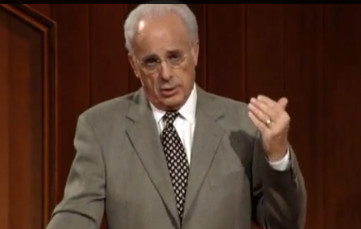
Rev. John MacArthur
And so Jackson urges his readers to realize that Pastors are also human, what he calls “tools of destiny,” and he wants us to know that someday, some of us may be in church leadership, which will further help us understand the responsibilities faced by our Pastors. Jackson also said that, given this, he urges reconciliation with church leaders when there’s a problem, and outlines the steps for his readers. Ultimately, it’s a call to forgive leaders who may have hurt us. Just for giggles, I included a photo of John MacArthur because to me, he exemplifies the sort of Pastor who generates a lot of “hurt” among people. But that’s just my opinion. What do you do when a well-known and influential Pastor has the ability to potentially hurt thousands?
The only end of chapter question I have highlighted is:
Are you looking for them (church leaders) to provide something that can only come from Jesus?
At this stage in the game, I don’t think I’m looking for a church Pastor to provide anything at all. How can they when my presence in almost any church (at least if I opened my mouth) would be a monkey wrench in the machinery?
In Chapter 11: The Cup of Misunderstanding (sounds like a little-known additional cup at a Passover seder), Jackson speaks of this metaphorical cup containing something that tastes bitter, tastes like injustice, and “those who drink it must do so alone.” He also says that this cup is usually received by “innocent people,” and is particularly harsh when “delivered to you by a brother or sister in Christ.”
Jackson compares being misunderstood and judged by someone in the church to the pain of betrayal suffered by Christ at the crucifixion.
I felt the comparison was a bit much. After all, human misunderstandings aren’t confined to the church, they happen in every human corporate venue, from the family to the workplace.
Jackson says this pain is intensified if the person you are trying to reconcile with makes it abundantly clear they have no intention of mending fences.
Someone once said, “You must embrace the cross if you would carry it with dignity.” The same is true of this cup.
I think what Jackson is saying is that being misunderstood, judged, and cut loose requires the Christian to be “Christ-like,” to bear the burden and the pain as Jesus did on the cross. Sounds pretty dramatic, but then, human conflict can elicit a lot of drama.
One of the end of chapter questions is:
Do you have a friend who can stand with you in your struggle?
In spite of my friend’s concerns about me and the issues Jackson addresses in his book, I don’t know that I’m really struggling, at least in relation to community or my lack thereof.
Jackson asks: “Are you passing the test? As you do, you’ll begin to look more like Him.” If the test is forgiving the Pastor, first of all, I doubt he thinks he needs my forgiveness. Nevertheless, I have forgiven him. After all, he’s only doing what he believes is right, and within his church’s context, it is the right thing to do.
In Chapter 12: Death by Religion, Jackson discusses watching an infomercial for Chuck Norris’s Total Gym product. The bottom line is that in spite of the seemingly fantastic claims made in the marketing of this all-in-one piece of exercise equipment, Jackson says if used as indicated, and if you eat a proper diet, the claims are all true.
Please forgive this sacrilegious comment, but I’ve noticed that in some ways, the Church is a lot like that infomercial–we’re touting a product that really works.
And by that he means:
A life devoted to His service is the only way to ensure our eternal salvation and to experience the life we were created to live.
But while a very fit Chuck Norris and Christie Brinkley sell their product on TV, Jackson says, by comparison, those Christians promoting a better life through Jesus are more like “a flabby, middle-aged guy who thinks he looks good in spandex.”
In other words, many believers promoting a better life through Christ don’t look or act like they’re participating in that life. They look like they’re participating in a marathon dining session at McDonald’s.
We’re selling relationship, but what they see is religion…and religion is killing our sales pitch.
I’ve mentioned this artificial split between these concepts in a previous blog post. It’s really the traditional Christian rant against their misconception of Judaism:
Religion breeds death because it is limited to man’s ability to comply with its codes and regulations.
If Jackson had my understanding of the New Covenant, he’d (hopefully) understand why his opinion is completely out of the ball park.
But I don’t have time or space to go into all that again in this rather lengthy series of book reviews.
Religion is easier to control than a relationship.
You may have noticed that Jackson has shifted his emphasis from the individual’s relationship with other Christians in church or their relationship with the Pastor and church leadership, and is now focusing on the person’s relationship with Christ.
…after all, we’re all under grace and God doesn’t get ticked if we skip a day of devotions.
I’m not sure what God does or doesn’t think about an individual being hit and miss on living a life of holiness, not that any one of us is perfect at it.
Jackson then proceeds to bash the Pharisees, even though (he probably doesn’t see this) Jesus lived a life consistent with the basic tenets of Pharisaism, and as a matter of fact, so did Paul.
In describing “religious systems,” he says they operate like “spiritual frat houses”. They have their secret handshakes, inside jokes, matching jackets, and the like. Yes, I’ve experienced cliques in church. People who were ‘in’ and people who were ‘out’, though to be fair, I didn’t experience them at the last church I attended (at least for the most part).
However, Jackson could have been describing how some people experience certain individuals and congregations involved in the Hebrew Roots and the Messianic Jewish movements.
I’ve mentioned before Derek Leman’s blog post Gentiles Who Feel Left Out which addresses this matter. If you feel you are “in”, then being in contributes to your sense of identity, according to Jackson. You may, again, as Jackson says, experience a sense of being among the elite by being in.
This next point is important:
Spiritual fraternities do not welcome different opinions or viewpoints.
I’ve experienced that in spades, but I think that a lot of religious communities are like this, based on a mutually accepted sense of “rightness” of their doctrine. Anything that contradicts their doctrine is automatically wrong. These congregations state, using Jackson’s words:
We want your input and opinions–as long as they agree with ours.
This goes back to what I said before about expectations within the group. Jackson also says such “frat houses” are full of cliques, difficult to fit into (again, I know what that’s like), and Jackson says the only way to combat this is to “make sure that our hearts are free from religion.”
And yet, I could probably speak to Jackson for less than an hour and elicit a very protective and “religious” (as he defines it) response from him, just by disagreeing with how he interprets the Bible’s message of the good news. Actually, all he’d have to do is read my reviews of his book.
Only two of the end of chapter questions seemed relevant:
Are you managing a religion or living in a relationship?
Has your religious experience become a duty or a delight?
Convincing Jackson of the beauty of the mitzvot, particularly with Passover and the family seder coming up in a few days, all the preparations, all of the ceremony, and the retelling of the Exodus, would be a lost cause if I were to make the attempt. I suspect all he’d see is “religion,” missing how the seder brings a Jewish family closer to God.
Of course, I wonder how he’s managing the “relationship” of the upcoming Easter Sunday service at his church, which usually involves a multi-media presentation and tons and tons of preparation and ceremony?
So far, having reviewed about half of Jackson’s book in a fair amount detail, I have two preliminary conclusions. The first is that I don’t think he’s speaking to my situation. The second is that my opinion of my being incompatible with “church” is being re-enforced. I find it impossible to review his book as related to my current status of being apart from “community” without being critical of his theology and doctrine.
I just can’t seem to put our obvious differences aside and simply listen to what he has to say on a human level. This is my fault. I have a friend who tells me I need to be more patient and to speak out less.
Probably true.
One last story.
I had coffee with my friend last Sunday. On the drive home, he mentioned that his congregation had a guest speaker from Africa on the previous Shabbat. Among other things, this speaker talked about lions and how they hunt only the sick, the weak, the old, and those who wander off and are alone.
Not-so-subtle point received, my friend. *grin*
"When you awake in the morning, learn something to inspire you and mediate upon it, then plunge forward full of light with which to illuminate the darkness." -Rabbi Tzvi Freeman


 There’s a plethora of similar quotes available on the web. I just picked the first one that came up in a Google search.
(Of course, one would not want to deliberately get into a negative situation, because there is no guarantee of coming out. Further, it often leaves residual stains.)














 Morning Meditations