Tag Archives: Hannukah

20 Days: Nosce te ipsum

jewish-t-shirtA convert who converted while among the gentiles.

-Shabbos 68b

Our Gemara introduces the concept of a convert who became Jewish on his own accord, without being informed of the mitzvah of Shabbos. We must understand, though, in what way can we consider this person to be a Jew, and responsible to bring a sin-offering for his unintentional violation of Shabbos, when he has no knowledge of mitzvos? How is this conversion valid?

Reb Tzadok HaKohen of Lublin points out that we see from here that one’s basic identity as a Jew comes from his being known as “a Jew”. The verse (Yeshayahu 44:5) states: “This one will say I belong to Hashem…and he will refer to himself as Yisroel”. The very connotation of being called a Jew is tantamount to being associated with belonging to Hashem.

Accordingly, Reb Tzadok notes that if one is forced to accept Islam, he must resist to the supreme degree of יהרג ואל יעבור Even though we might not consider Islam as being avoda zara, being that their basic belief is monotheistic, nevertheless the very fact that the Jew is being coerced to abandon his identity as being called a Jew is enough of a reason to resist, even if the consequences are severe (see Radva”z, Vol. 4 #92). Even in earlier generations, when a Jew would compromise his mitzvah observance, he nevertheless maintained his distinctive identity as being Jewish.

The verse (Hoshea 4:17) describes this condition, as we find, “Even as Ephraim is bound up…and he follows idols, let him alone.” From here we learn that because they remained bound up with the nation, and they did not assimilate with the surrounding nations, this saved them despite the fact that they were involved with idols.

Daf Yomi Digest
Distinctive Insight
“What is a Jew?”
Commentary on Shabbos 68b

I’m not writing this to try to answer the question “What is a Jew” but to illustrate how difficult it is to even address such a question from a Christian point of view. As I make my attempt to “assimilate” back into a more traditional Christian context, I discover that I may never understand the answer to questions like the one posed regarding Shabbos 68b. The discussion of Jewish identity involves the concept of a Jew who is Tinok SheNishbeh (Hebrew: תינוק שנשבה, literally, “captured infant”) which, according to Wikipedia, “is a Talmudical term that refers to a Jewish individual who sins inadvertently as a result of having been raised without an appreciation for the thought and practices of Judaism. Its status is widely applied in contemporary Orthodox Judaism to unaffiliated Jews today.

This naturally leads me to thinking about the Chabad and their primary mission to attract “unaffiliated Jews” and make them more familiar with Jewish thought and practices. Whatever else you may think of the Chabad (and like any other community, they have their faults, some of them significant), they are “out there,” extending themselves, reaching out to Jews who might otherwise completely assimilate and disappear into the surrounding Gentile culture and environment.

In today’s morning meditation, I addressed the issue of Christian evangelism and how the church, in spite of the many faults we may find in it, is doing all of the “heavy lifting” in terms of reaching out to the would around it and introducing that world to the teachings and grace of Jesus Christ. One of the comments I received is that “spreading the Good News” isn’t really what Jesus had in mind, but rather making disciples of the nations, which is a more involved, intricate, and in-depth process and relationship.

And I agree.
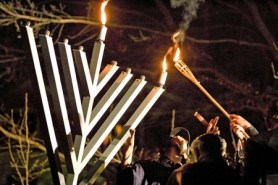
public-menorah-lightingUnfortunately, Christianity and Judaism tend to collide rather disastrously relative to these two imperatives. I liked Tsvi Sadan’s “solution” to this problem as he presented it in his article “You Have Not Obeyed Me in Proclaiming Liberty” (written for Messiah Journal) by using the concept of keruv to bring the Jewish people closer…

…to God and to one another, first and foremost through familiarity with their own religion and tradition…the Jewish people, as taught by Jesus, cannot comprehend his message apart from Moses (John 5:46)…Keruv is all about reassuring the Jewish people that Jesus came to reinforce the hope for Jews as a people under a unique covenant.”

As I learned recently, it may take me a good deal longer than I originally anticipated to make even the tiniest headway into the church. If I’m to make a go of it, I may have to dedicate myself to the “long haul” of “going to church” at the cost of just about everything else. How am I to begin to “understand church” and yet remain on my current educational trajectory relative to Jewish learning and education (such as it is since I’m pretty much self-taught)?

There’s this idea in some churches as well as within Judaism that requires one to acquire a “mentor.” I’ve previously mentioned how difficult it is just to find someone to talk to in the church beyond the simple “hi” and “bye.” Acquiring a mentor seems like an insurmountable task. And yet acquiring a mentor within a church context means necessarily setting aside any learning one might consider “Jewish.” Can I travel in two (apparently) opposite directions at the same time?

I ask that question with a certain sense of irony. Although my Jewish family is anything but strictly observant, my wife and daughter have been diligent to light the Chanukah candles, say the blessings, and to at least play some Chanukah music on each night. It reminds me of how we used to light the Shabbos candles, pray the prayers and sing songs of joy, welcoming the “Queen” into our home. It’s the most “Jewish” experience I’ve had in our house for a long, long time. Man, did that feel good.

And yet here I am, boarding a ship, and sailing the seas toward a “Christian” destination.

I know that my friend Boaz Michael has told me on more than one occasion that the Torah is taught in the church, and we can learn its lessons if only we are open to it. I guess he should know since he and his wife Tikvah attend a church in a small town in Missouri every Sunday that Boaz isn’t traveling.

And yet he and his family still keep Shabbos, keep kosher, and observe the other mitzvot.

But (as far as I know) they’re not intermarried and I’m not Jewish so I have to go somewhere and do something.

Frankly, as much as synagogue life would be alien to me at this point, I’d still rather go to shul with my wife on Shabbos than to church alone on Sunday if I felt I had a choice. But I won’t embarrass my wife by suggesting that she try to find a way to introduce me to her Jewish friends under those circumstances.
lost-in-an-angry-seaThe rationale of returning to church, at least in part, is defined by Boaz’s soon to be released book, Tent of David: Healing the Vision of the Messianic Gentile. I’ve been speaking of “mission work” for the past few days. According to Boaz and relative to his new book…

Mission is broader than theology and stronger than a personal identity. Mission allows one to stay focused on the goal while facing challenges, needing to be flexible, and always showing love. A deep and shared sense of mission and kingdom identity allows one to be shaped by their spiritual growth, gifts, desires, etc. yet stay focused on the greater goal.

I don’t know that I have a “mission” or even a purpose in going to church, particularly since at this church, the Pastor seems sufficiently aware of the Christian’s need to support the Jewish people. But here I am because I feel like I shouldn’t be alone and that I might actually have something to share belong a daily blog posting.

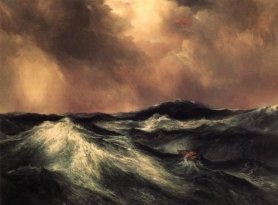
I feel like a person in a lifeboat somewhere out in the ocean. The waves lift me up and the waves dip me back down. I have higher days and lower days (today being “lower”). Do I want to invest a year just to explore the possibility that I might fit into a church and that I might have something to offer besides a few dollars in the donation plate and adding my body heat to a chair in the sanctuary?

Well, in spite of what I want, is it worthwhile? Is it what God wants? How do I know what God wants? I know what “feels” better to me and what doesn’t, but that’s hardly a litmus test that yields reliable results. 20 days and counting. The clock is ticking.

The Unburied Light

You can blunder around in the dark, carefully avoiding every pit. You can grope through the murky haze for the exit, stumbling and falling in the mud, then struggling back to your feet to try again.

Or you can turn on the light. There is a switch to the inner light buried without a doubt inside your heart. Even if it is ever so small, that is not important. Even a tiny flame can push away the darkness of an enormous cavern.

-Rabbi Tzvi Freeman
“Stop Groping”
Based on letters and talks of the Rebbe
Rabbi M. M. Schneerson
Chabad.org

This teaching seems fairly appropriate as we approach the close of Chanakuh. The lights and brightness of the menorah increase each night, declaring the glory of the miracles of God with greater illumination. This light also is a reminder to us that our “inner light” must glow and continue to shine brighter, declaring the glory of God and the message of salvation through His Son, Jesus Christ, our Lord. While it is easy to light the candles each night or the lights on a tree for those of you who have just finished your Christmas celebration, the light inside can be more stubborn to kindle. How many of us, as Rabbi Freeman says, “grope through the murky haze…stumbling and falling in the mud” when we could instead be lighting up our world?

This coming week, we study Torah Portion Vayigash where we find Joseph at last, revealing himself to his brothers.

Joseph could no longer control himself before all his attendants, and he cried out, “Have everyone withdraw from me!” So there was no one else about when Joseph made himself known to his brothers. His sobs were so loud that the Egyptians could hear, and so the news reached Pharaoh’s palace.

Joseph said to his brothers, “I am Joseph. Is my father still well?” But his brothers could not answer him, so dumfounded were they on account of him.

Then Joseph said to his brothers, “Come forward to me.” And when they came forward, he said, “I am your brother Joseph, he whom you sold into Egypt. Now do not be distressed or reproach Yourselves because you sold me hither; it was to save life that God sent me ahead of you. It is now two years that there has been famine in the land, and there are still five years to come in which there shall be no yield from tilling. God has sent me ahead of you to ensure Your survival on earth, and to save your lives in an extraordinary deliverance. So, it was not you who sent me here, but God; and He has made me a father to Pharaoh, lord of all his household, and ruler over the whole land of Egypt. –Genesis 45:1-8 (JPS Tanakh)

To insert my own metaphor, it’s as if Joseph turned on a switch and shown a light upon himself that revealed his true identity to his brothers when before, they had all been in the dark. Joseph did something else though. He also revealed the light of his character in reassuring his brothers that he bore them no ill will and that their acts of evil against him resulted in God doing immeasurable good. Joseph reveals this light again after the death of Jacob.

When Joseph’s brothers saw that their father was dead, they said, “What if Joseph still bears a grudge against us and pays us back for all the wrong that we did him!” So they sent this message to Joseph, “Before his death your father left this instruction: So shall you say to Joseph, ‘Forgive, I urge you, the offense and guilt of your brothers who treated you so harshly.’ Therefore, please forgive the offense of the servants of the God of your father.” And Joseph was in tears as they spoke to him.

His brothers went to him themselves, flung themselves before him, and said, “We are prepared to be your slaves.” But Joseph said to them, “Have no fear! Am I a substitute for God? Besides, although you intended me harm, God intended it for good, so as to bring about the present result — the survival of many people. And so, fear not. I will sustain you and your children.” Thus he reassured them, speaking kindly to them. –Genesis 50:18-21 (JPS Tanakh)

If Jacob was the last barrier between Joseph’s revenge and his brothers, certainly it was removed upon the death of their father and Joseph was free to lay the entire weight of his awesome authority upon those who had caused him so much harm. Yet it was not Jacob but God who illuminated Joseph’s life and from that light came grace and mercy, not condemnation and death.

How much like the light of the Messiah this is and this light is within each of us who call ourselves disciples of the Master. We know or we should learn, that shining this light upon others inspires them to in turn, become that light, just as the Messiah’s light has inspired us.

Rav Aharon of Belz once hired a certain workman to do some repairs in his home. While the man was busy at his job, the rebbe overheard others in the room say in an undertone, “This Jew works on Shabbos!”

The Belzer Rebbe immediately retorted, “Impossible! And if he did work on Shabbos, it must have been because he thought it was Friday!” He then turned to the workman who had heard the whole exchange and said, “Isn’t that right? You got confused and thought that it was Friday?”

The worker remained silent.

The rebbe again said softly, “You must have mixed up the date and thought it was Friday, correct?”

But the worker still wouldn’t answer. For the third time, the rebbe pleaded, “Didn’t you really believe it was Friday and not the holy Shabbos?”

At the rebbe’s final, exquisitely gentle insistence, the Jewish laborer mouthed, “Yes,” and then burst into tears. The man became a shomer Shabbos from that moment.

Similarly, Rav Shach was once in a taxi with Rav Shraga Grossbard. When Rav Shraga asked the driver if he was a shomer Shabbos, Rav Shach immediately cut him off.

“How can you ask a Jew if he is shomer Shabbos? Of course he is shomer Shabbos!” he exclaimed.

Some time later, Rav Grossbard was in the same taxi and the driver recognized him. The man turned toward the rav and said, “Don’t you remember me? The day that I heard the rav say I must be shomer Shabbos, I became one!”

Mishna Berura Yomi Digest
Stories to Share
“Turning a Blind Eye”
Siman 128 Seif 30-33

That we, as believers, should have an unshakable faith in God is a foregone conclusion, but here we see that in having faith in other people, though they may not deserve it, will yield wonderful rewards, not the least of which will be to turn their hearts to God. We cannot do this by condemning or ridiculing others but in treating even a person who is immersed in wrong doing as if they were already walking in the footsteps of God.

Working Out Love

The 251st prohibition is that we are forbidden from verbally wronging another person by telling him things that will distress and humiliate him, and make him discouraged. For example, when a person has sinned in his youth, but changed his ways, and someone tells him, “Thank G-d who has taken you away from that path to this good path,” or similar indirect references to faults that cause him pain.

The source of this prohibition is G-d’s statement (exalted be He), “V’lo sonu one another and you shall fear your G-d.” Our Sages said that this refers to verbally causing him pain (ona’as devarim).

Sefer Hamitzvot in English
“Hurtful Words”
Negative Commandment 251
Translated by Rabbi Berel Bell
Chabad.org

I receive daily emails on the commentaries of Maimonides on the 613 commandments as outlined in his classic work Sefer Hamitzvot, but I rarely use them as the basis for any of my “meditations”. The simple reason for this is that the vast, vast majority of these commandments aren’t considered to be applicable to the lives of non-Jewish people. Traditional Christianity considers the “Law is dead” and thus would tend to disregard these lessons in any case, and only some non-Jews in the “Messianic” movement feel that they share an equal obligation with the Jewish people to fulfill the full “yoke of Torah”. However, I’m not writing to address that issue, but because I believe we do have a parallel commandment in Christianity.

“If your brother or sister sins, go and point out their fault, just between the two of you. If they listen to you, you have won them over. But if they will not listen, take one or two others along, so that ‘every matter may be established by the testimony of two or three witnesses.’ If they still refuse to listen, tell it to the church; and if they refuse to listen even to the church, treat them as you would a pagan or a tax collector. –Matthew 18:15-17

You may be wondering why Jesus suggests that you go through all of these steps in trying to reconcile with a fellow believer who has sinned against you. Let’s review the process again. First you go to the person alone. If they don’t listen, take two or three witnesses (referencing Deuteronomy 19:15, which suggests that there is a legal component to these actions). If all else fails, bring the matter before the entire congregation and if the situation still can’t be resolved, only then must the offender be expelled from the body of believers.

The way I learned how to interpret this passage (you may have heard this before, too) is that you first go to the person alone so you don’t embarrass them. If you can take care of the problem just between the two of you, without bringing anyone else into it, you can avoid the other person digging their heels in, so to speak, because you have publicly humiliated them. Even if you can’t resolve it in that context, your next step is to bring in just two or three other trusted (that’s my interpretation) brothers and sisters to help mediate the problem. It still doesn’t have to be dragged in front of the entire congregation. The offender can still “save face”.

Why is this important? From a “common sense” point of view, we know that people are more likely to listen to criticism about themselves in a private rather than a public setting. An old adage in management says to “praise publicly and criticize privately.” If you’ve ever been yelled at by your spouse for something you did or gotten a good “dressing down” by your boss, you know it isn’t quite as painful if it’s just the two of you than if it’s in front of family, friends, or co-workers. People are more likely to listen to criticism privately and are more open to discussing their “issues” in a private setting than if it’s all happening in front of a crowd.

Is the “common sense” approach Biblical? I think it is.

If a person commits a sin punishable by death and is executed, and you hang the corpse on a tree, his body must not remain all night on the tree; instead you must make certain you bury him that same day, for the one who is left exposed on a tree is cursed by God. You must not defile your land which the Lord your God is giving you as an inheritance. –Deuteronomy 21:22-23

The idea behind the phrase cursed by God seems to be not that the person was impaled because he was cursed but that to leave him exposed there was to invite the curse of God upon the whole land. Why this would be so is not clear, though the rabbinic idea that even a criminal is created in the image of God may give some clue (thus J. H. Tigay, Deuteronomy [JPSTC], 198). Paul cites this text (see Gal 3:13) to make the point that Christ, suspended from a cross, thereby took upon himself the curse associated with such a display of divine wrath and judgment (T. George, Galatians [NAC], 238-39).

Commentary from net.bible.org

The phrase we need to key in on is “the rabbinic idea that even a criminal is created in the image of God may give some clue.” I tend to agree with the Talmudic interpretation of Deuteronomy 21:22-23. We are all created in the image of God, great and humble alike. On a very basic level, we are all entitled to a certain amount of care and dignity befitting the image of our Creator and in that sense, we should avoid going out of our way to embarrass or humiliate a person, even if we think “they deserve it”.

This brings me back to a “meditation” I wrote a few days ago called Considering Replies. Maybe you’re thinking that I’m beating a dead horse, but the Internet is a “rough neighborhood” and a lot of people get hurt out here. It’s not enough to say that we’re “telling the truth in love” when telling the truth can have devastating results. This is like embarrassing a “former sinner” by saying you are so glad they gave up their horrible lifestyle to come to Christ. If you make a person feel like dirt by “telling them the truth in love” you probably didn’t consider “love” before you opened your mouth or typed something on someone’s blog and then pressed “Publish”.

According to Rabbi Berel’s commentary on Maimonides, the Sages taught that uttering hurtful words is a worse sin than defrauding someone of money. I know someone out there will say that this teaching means we can never confront someone who is doing wrong for fear of embarrassing them, but look back at Matthew 18:15-17. There is a process for confronting a fellow believer if it’s necessary that is still compassionate and respectful. 1 Timothy 5:19-20 even describes how to address a church or congregational leader who has sinned, so your leaders are not “criticism proof” (I’ve seen congregational leaders falsely use the example of Korach and the “evil report” against Moses and Aaron in Numbers 16 as “proof” that no one is allowed to criticize a leader) but can be approached in a way that addresses the problem and truly shows respect and love.

The truth isn’t enough, even when we have a “loving” intent. Long before speaking the truth, we must bring love into the picture and make love and truth work together. We must consider the teachings of the Master and his close disciples before launching into any sort of action, especially if we’re emotionally involved in the conflict. The so-called “love passage” in 1 Corinthians 13 (which has nothing to do with weddings and marriage as such), is a very good map to consider when we need to talk to someone about any of their shortcomings. It’s also the guide I’m sure you’d like someone to use if or when you need to be confronted.

If I speak in the tongues of men or of angels, but do not have love, I am only a resounding gong or a clanging cymbal. If I have the gift of prophecy and can fathom all mysteries and all knowledge, and if I have a faith that can move mountains, but do not have love, I am nothing. If I give all I possess to the poor and give over my body to hardship that I may boast, but do not have love, I gain nothing.

Love is patient, love is kind. It does not envy, it does not boast, it is not proud. It does not dishonor others, it is not self-seeking, it is not easily angered, it keeps no record of wrongs. Love does not delight in evil but rejoices with the truth. It always protects, always trusts, always hopes, always perseveres. –1 Corinthians 13:1-7

Love does not dishonor others. It always protects and always trusts. Christians can choose to interpret the lights of Chanukah as representing the light of the world. As I’ve mentioned before, Jesus said that we are also supposed to be lights to the world. Christ gave us a new command to love each other (John 13:34). Let’s start there and then work out way out.

Happy Chanukah. Follow the light. Pass it on.

Pointing Light to Miracles

Without miracles, we might come to believe that the laws of physics define reality. Once we witness the inexplicable, we see that there is a higher reality. And then we look back at physics and say, “This too is a miracle.” The miracle of a small flask of oil burning for eight days was this sort of miracle.

Then there are those small miracles that occur every day. Those acts of synchronicity we call ‘coincidence’ because, in them, G-d prefers to remain anonymous. But when we open our eyes and hearts, we see there is truly no place void of this wondrous, unlimited G-d. These were the sort of miracles the Maccabees saw in their battles against the mighty Greek army.

-Rabbi Tzvi Freeman
“Chanukah Miracles”
Based on letters and talks of the Rebbe
Rabbi M. M. Schneerson
Chabad.org

God is not a scientific problem, and scientific methods are not capable of solving it. The reason why scientific methods are often thought to be capable of solving it is the success of their application in positive sciences. The fallacy involved in this analogy is that of treating God as if He were a phenomenon within the order of nature. The truth, however, is that the problem of God is not only related to phenomena within nature but to nature itself; not only to concepts within thinking but to thinking itself. It is a problem that refers to what surpasses nature, so what lies beyond all things and all concepts. (page 102)

The object of science is to explain the processes of nature. (page 104)

-Abraham Joshua Heschel
God in Search of Man: A Philosophy of Judaism
As quoted in Searching by Ineffable Light

Chanukah, or any time when we see or hear of God’s miracles, forces us to try and understand the nature and character of God’s activity in the world we experience. 21st century western thought is almost wholly focused on the observable, the measurable, the quantifiable. We are dazzled by the possibility of discovering the Higgs Boson particle and what it would mean about our understanding of the universe. We are hopeful that our latest probe to Mars will show us definitive proof that the red planet once harbored life. We are astounded that we might actually be able to detect other Earth-like planets in the galaxy.

We are so amazed with our own seeming “miracles” that there is hardly room left in our world for the miracles of God.

For me, the short definition of a miracle is an event that we can observe in our universe that defies the working laws of said-universe. It is an event that has its origins outside our four-dimensional realm but that intrudes in that realm to make itself known to us. In fact, the point of a miracle is to make God known to us.

Jesus performed many “signs and wonders”, not to dazzle the crowds like some traveling magician, but to show that he was from God. Miracles also sometimes result in directly helping others, such as curing illnesses and healing injuries (see Matthew 11:1-6 as an example). Miracles are one of the ways that God makes Himself known to us. But while they seemed plentiful in the Bible, they are all too rare (and too well “explained” by scientific means, supposedly) in the present age. Even those miracles of the past are subject to significant “armchair quarterbacking” these days, as far as what natural phenomena “could” have caused such supposed miracles. The modern world wants no part in the supernatural, probably because it takes away from the wonder of man (and no wonder so many people give Tim Tebow a hard time for making his faith public on national television in front of millions of sports fans).

Rabbi Abraham Joshua Heschel, who I quoted above, doesn’t believe that science has the right tools to examine the miracles of God let alone God Himself. This sounds like a cop out to secular people who want independent validation of the existence of God before believing. But while demanding evidence of the reality of the Divine, these secular folks are confident such validation will not be forthcoming, thus “proving” that they’re right.

But miracles aren’t about proof, they’re about faith.

Then some of the Pharisees and teachers of the law said to him, “Teacher, we want to see a sign from you.” He answered, “A wicked and adulterous generation asks for a sign! But none will be given it except the sign of the prophet Jonah. For as Jonah was three days and three nights in the belly of a huge fish, so the Son of Man will be three days and three nights in the heart of the earth. –Matthew 12:38-40

I mentioned in yesterday’s meditation that part of the purpose of lighting the menorah during Chanukah is to declare the miracles of God. This is an act of faith as well as tradition, since we were not there to witness the miracle. Given the cynicism most people bear for the wonders of God, it’s also a miracle that anyone comes to faith, since to do so goes against the majority of rational human beings and the “idol” of popular opinion.

Faith is a miracle. Publicly demonstrating faith is a miracle, too. It just doesn’t seem “supernatural”.

I periodically get notices from AskNoah.org which is an organization dedicated to the support of Gentile Noahides. I just got an email pointing me to an article about the proper way for a Noahide to light the menorah. Lest you think it’s unusual for Jews to encourage non-Jews to celebrate Chanukah, the advice comes with caveats.

If you are a Noahide who is observant of the 7 Noahide Commandments, you may be interested in lighting Hanukkah candles. If so, you can buy or make a menorah lamp for yourself (very easy), or you can usually obtain one from your local Chabad Center. If your intention is to publicize the Divine miracles of Hanukkah, and thereby educate and remind your family and others about the greatness of G-d, the candle lighting may be done in the correct manner according to the Jewish custom – but without saying the Jewish blessings when lighting the candles. (For non-Jews, those would be false statements said in G-d’s Name, G-d forbid, because they testify that the person lighting the candles is commanded to “kindle the lights of Hanukkah”, and that G-d did those miracles for “our fathers”.) There are alternative readings and Psalms that a Noahide can say when lighting Hanukkah candles, and we have posted some suggestions below.

Thus, it is proper for a non-Jew to light the Chanukah menorah if “your intention is to publicize the Divine miracles of Hanukkah, and thereby educate and remind your family and others about the greatness of G-d” but only if you do so “without saying the Jewish blessings when lighting the candles”. This may sound restrictive, especially to those Gentiles who consider themselves “Messianic” and “grafted in” to the root of Israel, but while there are Christian applications to Chanukah, we must not lose sight of the primarily Jewish applications.

I was reminded of this when reading various commentaries on Siman 672 that I receive from Mishna Berura Yomi. The laws and halachah relative to the Birkat Kohenim (Priestly Blessing) recited during a synagogue service are delineated in these particular commentaries. One of the obvious pieces of information presented is that this blessing should only be recited by a Kohen. Yet, I’ve heard this blessing (in English) recited by Pastors (non-Jews) at the end of church services, and I’ve heard this blessing said by Gentiles in “Messianic” worship. I’m embarrassed to admit that I’ve delivered this blessing myself many times in my previous congregation (since I’m not Jewish let alone a Kohen).

Miracles, faith, and worship are funny things. They all open certain doors but not the doors we think might be open. Lighting a menorah doesn’t make a Gentile person Jewish or the direct recipient of miracles or messages meant by God for Jews. Chanukah candle lighting also doesn’t open up the world of Jewish worship to Christians in the same way that this door is available to Jewish people. We must be cautious to make sure we are walking the right path.

On the other hand, there is a level where God’s presence and miracles are available to everyone. A Noahide, and I believe a Christian, may light the menorah if the purpose is to announce God’s miracles and their faith in God, particularly if their faith is not based on miracles. The blessing of the Birkat Kohenim in Hebrew is beautiful to hear and a tremendous reminder of God’s providence to the Children of Israel, even if you are not a Jew. Asher at the Lev Echad blog reminds us that even though we are all unique individuals and belong to unique and distinct people groups, we all have a common foundation.

This Mishnaic excerpt provides the quintessential response to anyone who claims that certain types of people are superior or inferior to others. Since all people descend from the same person, we are all related. There is no moral justification for dividing people based upon race or prominence or wealth. All of creation can be traced back to one God, and all of humanity can be traced back to one person. The very word for people in Hebrew is bnei adam (lit. children of Adam) – a subtle reminder that we all descend from one man, the first human ever created by God.

Perhaps God’s greatest miracle is the human race after all, not because we are so terrific and so accomplished (though He gave us the ability to perform terrific acts of accomplishment), but because we can learn to love each other, to recognize that unique as we are, we were created in a common image (Genesis 1:26), and out of that image, we can learn to love Him who has loved us first.

“Therefore was a single man created, to teach us that whoever takes a single life it is as though he destroyed an entire world, and whoever saves a single life it is as though he saved an entire world. It is also meant to foster peace between people, because no one can boast to his neighbor: ‘My ancestor was greater than your ancestor.'” –Mishnah, Sanhedrin 4:5

Though the intent of this Mishnaic quote, which I borrowed from Asher’s blog, is to reference Adam, the first man, in my personal faith, I choose to interpret it as illuminating another man who Christians call the “light of the world;” a man who has shown us that we can also be a light pointing to miracles.

Addendum: This doesn’t have anything to do with today’s “meditation”, but I happened across an interesting looking web resource called Halachipedia. It’s where “Halachah meets Wiki”. Enjoy.

Impossible Light

Shulchan Aruch rules that one should not kindle the Chanukah lights before shekiah; rather one should kindle the lights at the end of shekiah. Mishnah Berurah explains that when Shulchan Aruch refers to the end of shekiah he refers to tzeis hakochavim – the emergence of stars. That is the time that people are in the streets and thus the miracle will be publicized.

He then notes that according to many Rishonim the intent of the Gemara is that one should kindle the lights at the beginning of the second shekiah which is about a quarter of an hour before tzeis hakochavim. Poskim write that if one kindles the lights within half an hour of sunset (shekiah according to Gaonim) and they remain lit until half an hour after tzeis hakochavim one fulfills both opinions.

Mishna Berura Yomi Digest
Halacha Highlight
“Lighting after plag hamincha”
Siman 672 Seif 1

That the spark of G-d within us will ponder G-d, what is the surprise?

But when the animal lifts its eyes to the heavens, when the dark side of Man lets in a little light, that is truly wondrous. How can darkness know light? How can earth know heaven?

Only with the power of He who is beyond both darkness and light, heaven and earth.

-Rabbi Tzvi Freeman
“Dark Knowing Light”
Based on letters and talks of the Rebbe
Rabbi M. M. Schneerson
Chabad.org

Yesterday’s “morning meditation” Shine was an attempt to reach some sort of thematic connection between the miracle of the light of Chanukah and Jesus Christ, the light of the world. I also brought up the rather important point that we disciples of the Master are considered by him as “lights to the world” as well.

“You are the light of the world. A town built on a hill cannot be hidden. Neither do people light a lamp and put it under a bowl. Instead they put it on its stand, and it gives light to everyone in the house. In the same way, let your light shine before others, that they may see your good deeds and glorify your Father in heaven. –Matthew 5:14-16

While it would be more convenient for us if Jesus could stay as that light or if we could let Israel carry the burden (Isaiah 49:6), the master specifically expanded the mandate to include all of his disciples among the nations. We, like the ancient Israelites lifting their eyes to Heaven that they might live (Numbers 21:4-9), are the darkness lifting our eyes to the light and seeking life. Now let’s “marry” this idea back to the quote from the “Halacha Highlight” for Siman 672 Seif 1 and accept the responsibility to “lift” the miracle of the Savior of the world with our light, just as the Jewish people announce the miracle of Chanukah by lighting the menorah.

In my commentary for Torah Portion Vayeishev, I addressed how it would be so much easier to shine that light if we didn’t have to deal with the problems and pitfalls of day to day life. However, God has determined that the value of the light we shine is especially great when it illuminates a life that struggles in the same fashion as our neighbors. I think that was His point when He caused the “Word to become an ordinary human being and to live among us” (John 1:14). My humble opinion is that Jesus did not come as King but as pauper the first time around, so that he could show us we don’t have to be freed of an ordinary life in order to serve Heaven.

Going back to the life of Joseph, before he became “king”, he was also a slave and then a prison inmate. In both of these situations (which were far more difficult than the average “ordinary” life of a person in America), he served God so well that, relative to his position, he was exalted to the highest status a slave and prisoner could attain. Before Moses could lead an entire nation and speak to God as one speaks to a friend, he had to live as a prince and then a shepherd. Before Jesus comes as King and Lord, he first had to come as carpenter and itinerant teacher among his people Israel, living a life not substantially different than any other Jew and associating primarily with what today we would call “the working class”.

I’m saying all this to show that the typical “wear and tear” we take on every day doesn’t absolve us from our responsibilities to God and to other people. Sure, we’re busy people, but we can hardly tell God, when he calls us, that we are too preoccupied with our work to respond to Him. And even if we are, we still have to do something about it.

When this question reached Rav Yosef Shalom Eliyashiv, shlit”a, he ruled decisively and also gave sound advice. “A doctor who treats patients when the time to light the menorah arrives should first finish his shift, and then go home and light. In the case of a doctor who works a long shift in the hospital which encompasses the entire time that it is possible for him to light the menorah… Since he cannot go home in the middle because he is busy working the entire time, he is absolved from the mitzvah. This falls under the category of one who is involved in a mitzvah who is discharged from other mitzvos during this time.

Rav Eliyashiv added an essential point. “This is only true regarding one who lives alone. If the doctor has family he should instruct them to light when the time comes and he is discharged even if he comes home while it is still possible to light. And even if he lives alone he is obligated to designate a messenger to light for him when the time comes.”

Mishna Berura Yomi Digest
Stories to Share
“Occupied with a Mitzvah”
Siman 672 Seif 1

I’m stretching my metaphor pretty thin here, but bear with me. The Rav rules that a doctor who is treating patients at the time when the Chanukah menorah is to be lit is absolved of the mitzvah because of his important responsibilities, but only to the degree that he does not have to perform the mitzvah personally. The important part of this ruling states, “even if he lives alone he is obligated to designate a messenger to light for him when the time comes.” Putting that back into the topic I’m presenting, even if we feel we are “too busy” to perform the will of God as we understand it, do we also have the responsibility to make sure God’s will is done “by proxy?” The Rav first says if the doctor is married, he can have his wife perform the mitzvah, but then he says the doctor is still obligated, even if he lives alone. If we are alone, perhaps we still have a duty to make sure that whatever we believe God requires of us at any point in time is still be performed.

Of course, we have examples of people who literally dropped everything when Jesus called and followed him.

As Jesus was walking beside the Sea of Galilee, he saw two brothers, Simon called Peter and his brother Andrew. They were casting a net into the lake, for they were fishermen. “Come, follow me,” Jesus said, “and I will send you out to fish for people.” At once they left their nets and followed him.

Going on from there, he saw two other brothers, James son of Zebedee and his brother John. They were in a boat with their father Zebedee, preparing their nets. Jesus called them, and immediately they left the boat and their father and followed him. –Matthew 4:18-22

We also have examples of people who were in the middle of important work and asked to wait until that work was done, sometimes even though it would take a number of years as with the following person.

He said to another man, “Follow me.” But he replied, “Lord, first let me go and bury my father.” Jesus said to him, “Let the dead bury their own dead, but you go and proclaim the kingdom of God.” –Luke 9:59-60

In the latter example, Jesus took a dim view of this person wanting to wait until after his father died (the guy was being a dutiful son and working to help his father, presumably on the “family farm”, so he was fulfilling the commandment to honor his parents) and he put his father’s affairs in order before being free to follow Christ’s calling (It’s examples like this that some Jews use to prove Jesus couldn’t be the Messiah, since it looks like Jesus is telling this son to abandon his responsibilities to his parents, but I digress) .

I’m probably muddying up the waters here saying on the one hand, that we actually might be too busy to answer the call to a mitzvot but we must make sure it is done, even by proxy, and on the other hand saying that we must follow immediately and any delay will be viewed by Jesus in a negative light. This is the struggle we face in letting our light shine every single second in our lives. As human beings, we can be distracted, confused, upset, grief-stricken, afraid, or experience some other circumstance or state that seems to take us away from being that “light to the world”. You’ve probably seen examples of people who you know are believers who, when set upon by difficult problems, retreat into a human response and away from God.

But you’ve also probably seen people of faith who, even when undergoing the most difficult hardships, still are able to shine with a kind of light that communicates peace and love surpassing all human understanding (Ephesians 3:19, Philippians 4:7). It’s possible for us to continue shining our light in the midst of the mundane and perhaps even when disaster seizes us.

What can I say to all this? Do your best? That’s a good place to start. We’re in a relationship with God as junior partners in Tikkun Olam or “repairing the world”. We can only do what is humanly possible. When we seemingly shine an “impossible light” it is not just us and it is not just God, it is both of us. As people, we do one kind act at a time, one generous deed, one word of encouragement, and during Chanukah, we light one candle a night, so that we might show the world the miracle of God. It’s never easy but with God, it’s always possible (Matthew 19:26).

Happy Chanukah.

Shine

Inner lightThey set out from Mount Hor by way of the Sea of Reeds to skirt the land of Edom. But the people grew restive on the journey, and the people spoke against God and against Moses, “Why did you make us leave Egypt to die in the wilderness? There is no bread and no water, and we have come to loathe this miserable food.” The Lord sent seraph serpents against the people. They bit the people and many of the Israelites died. The people came to Moses and said, “We sinned by speaking against the Lord and against you. Intercede with the Lord to take away the serpents from us!” And Moses interceded for the people. Then the Lord said to Moses, “Make a seraph figure and mount it on a standard. And if anyone who is bitten looks at it, he shall recover.” Moses made a copper serpent and mounted it on a standard; and when anyone was bitten by a serpent, he would look at the copper serpent and recover.Numbers 21:4-9 (JPS Tanakh)

And just as Mosheh elevated the serpent in the wilderness, so must the son of man be lifted up, so that none who believe in his will perish, but rather they will live eternal life…

This is the verdict: that the light came into the world, but the sons of men loved the darkness more than the light because their deeds are evil. For all who do injustice hate the light and will not come to the light, so that they may not be rebuked for their deeds. But one who does the truth comes to the light so that it may be revealed that his deeds are done with God.John 3:14-15, 19-21 (DHE Gospels)

What does all this have to do with Chanukah? I admit, not very much. The themes are only superficial in terms of “light” and “renewal”. Or are they?

No, Chanukah doesn’t tell the story of Jesus in any real way, but it’s all but unavoidable to make some sort of connection between Chanukah and Jesus because the Festival of Rededication occurs so close to Christmas in our December calendar. Many Jewish parents struggle to try to disconnect this “proximity” association in my minds of their children, especially as their Jewish children see their goyim and especially Christian friends and classmates having fun with all the lights and music and Santa Claus and particularly all of the Christmas “loot”. The Christian Christmas has become tremendously influenced by the commercial, secular Christmas among the children of the church, and I can appreciate how Jewish parents don’t want all that to spill over into the lives of the children of Jacob.

Blogger Justin Bond recently wrote an article called Chanukah and a kosher Christmas, so I suppose anything I write that somehow associates these two events is redundant. On the other hand, my purpose today isn’t to compare and contrast the two holidays but to try to express what a Christian like me (and I’m not exactly a typical Christian) can get out of lighting the Menorah.

Look at the original event involving Moses and the copper snake on the staff. People were dying. Lots and lots of people were dying and frankly, it was their own fault. They had pushed God and pushed God and pushed God and this time, God pushed back. I wonder why people ever imagine they can just flaunt God’s will, but then, human beings have always been notoriously short-sighted.

So God tells Moses to do something a little unusual. He tells him to construct “a seraph figure and mount it on a standard. And if anyone who is bitten looks at it, he shall recover.” That’s kind of strange. It’s like God told Moses to make some sort of graven idol for the people to look at and then they would live. The interesting thing is, later in history, people actually did worship the thing (2 Kings 18:1-4). Given the commandment not to make any such images (Exodus 20:4), why would God put such an obvious temptation in the midst of the Children of Israel? Certainly he recalled the “incident” of the Golden Calf; the sin in which the Israelites partook while Moses was still on the mountain with God (Exodus 32).

And yet, Jesus actually compares himself to the copper snake in that, all who look upon him, as they looked upon the copper snake, though bitten and fatally poisoned, would live. Talmud Rosh Ha-Shanah 29a states that the reason people lived is that, in looking up to the snake (the image of what was killing them), they actually raised their eyes to Heaven. Though the son of God, Jesus allowed himself to be compressed or reduced or humbled so that he could become a human being, just like we are…something “ordinary” rather than Heavenly, so that we could actually see him and through him, the Father, and thus live.

Yeshua (Jesus) spoke to them once more, saying, “I am the light of the world. Anyone who follows me will not walk in darkness, for he will have the light of life. –John 8:12 (DHE Gospels)

We live in a world of darkness. I suppose it’s appropriate that Chanukah comes at this time of year, when it’s cold outside and the morning sun rises so late in our day. Each morning when I get up, it is still black outside, and it’s still, and it’s even lonely. Then the day comes and is gone and by the time I get home from work, it is black outside again. I suppose I can’t blame my Christian brothers and sisters for putting so many lights on their homes to keep the night and the coldness it brings at bay. During Chanukah in my home, only the light of a few tiny, faint candles illuminate the obsidian abyss, but that is a fitting metaphor for living in a dark and broken world.

We are all stumbling in the dark, like a blind person feeling about, trying to find some familiar landmark by touch alone. We strain to see even the faintest glimmer of hope and when we do, we rush toward it, terrified by what might be just behind us, pursuing us in the invisible space just inches from the nape of our necks. God sent a light into the world so we wouldn’t have to live in darkness but faith feeds the light. Fear, despair, and hopelessness feeds the darkness and human beings are suspended between these two forces, longing for illumination but struggling with the gloom.

Though it’s only symbolic, we can choose to see Messiah and Savior in the lights of our life and very soon, in the lights of the Chanukah menorah. The first night, we light only one, and the next night two, and the next night one more than two and so on, until we have fulfilled all eight nights. Each night our homes and presumably our hearts glow a little brighter as we push back the darkness and let the light enter more freely into our lives.

This year, Chanukah begins at sundown on Tuesday, December 20th and will continue through the 28th. Light the candles or the oil in your home this year. Create a spark in your life and in your heart. As Christians, we know that Jesus is the light of the world and he pushes back against the darkness that threatens to engulf us. As Christians we also know that we are the light of the world (Matthew 5:14-16) and that, to extend my metaphor, we must shine that light into not only our homes, but into lives of those around us.

So also, shine your light before sons of men, so that they may see your good deeds and praise your Father who is in heaven. –Matthew 5:16 (DHE Gospels)

Shine.

Happy Chanukah.