Tag Archives: Hebrew Roots

What Are We Looking For From God?

I recently blogged about a Christian turned Noahide who I accidentally discovered on the blogspot The Torah Way. In describing this person’s “journey” away from faith in Jesus (Rav Yeshua) to a traditional Noahide or “Righteous Gentile” viewpoint and praxis, I neglected to examine what they wrote on their other blog Cozy Kitchen Chats believing it was more or less a collection of recipes and other food related articles.

As it turns out, this is an older blog and contains a lot more detail about this woman’s (one of the things I discovered) spiritual travels.

I’m not trying to pick on her or demean her in any way. I do, however, find that what she’s been through over the past several years is illuminating, because she comes from a place that should be familiar to many of my readers.

Let’s go to the beginning, the very first blog post from July 17, 2014:

To formally introduce you to my Cozy Kitchen, I absolutely need to share with the you the Foundation of my world, Jesus Christ, the Son of God, my soon coming KING. I had always been brought up in the church, although I had bounced around from church to church seeking and hungering for something deeper. I tried small town churches, large Mega churches, Pentecostal churches, Baptist churches, even Catholic churches. Each had amazing truths and amazing people, but nothing felt comfortable to me. My heart was always drawn to the Church described in the Book of Acts.

This is a person devoted to Jesus as Savior and King in search of a church that reflects the Biblical “prototype” church, the ideal church where one can draw close to the Spirit of Jesus. Apparently, she couldn’t find it.

All I know is that I personally needed to walk away from everything I knew about the modern day church. I spent two years aggressively seeking God to show me the Truth, regardless what it may cost me, I wanted to know that I know Him and that I am following Him wholeheartedly. I read everything I could about the religions most commonly found in the United States. I set aside all that I knew, wiped away all the prejudice that I held and explored each asking the Holy Spirit to show me the Truth.

This part is funny in an ironic way, given where she’ll end up.

…at first I honestly didn’t like the Jesus I was learning about. Oh, I loved how others in the Bible would describe Him, but when I read His words, I thought they were harsh, aggressive and difficult to understand. I really liked Paul much more than Jesus, Paul’s teaching were soft and easy, Salvation by Grace alone, no actions or responsibility, once saved, always saved. Paul was much more appealing.

MessiahShe goes on to say that in order to learn more from Jesus, she set aside Paul’s writings so she could sit at the feet of her Master. That’s how she started out her blog.

I am here exclusively to show the Love of God to you and to serve you and others in anyway I can. Opening up my Cozy Kitchen Chats with you, I will share with you the Gospel of Jesus, how to have a thriving Christian home, how to serve your community and how to make YOUR own Cozy Kitchen your personal mission field.

But less than three months later:

I know this is topic that can really set some “believers” off balance, since there has always been a belief that the Torah or the Life Teaching and Instruction of God, given to Moses was done away with at the resurrection of Yeshua (Christ)

Nowhere in the Prophets nor in the instruction that was given to Moses was it ever mentioned that the Law would be done away with. During Yeshua’s time on earth, He never mentioned that the Law or the Word would be dismissed. He actual said the following.

First, she described a general dissatisfaction with all of the churches and Christian denominations she experienced and was determined to study the Bible at the feet of Jesus and gain wisdom from the Holy Spirit alone.

Then she discovered the Torah, started calling Jesus “Yeshua,” and described her understanding in terms more familiar with someone who was just introduced to either the Messianic Jewish or Hebrew Roots movements.

Based on a link she posted, her source material came, at least in part, from 119 Ministries (as of this writing, there’s a JavaScript pop-up that asks if you’re new and you have the option to click “Yes” or “No”. However, the box doesn’t go away when you click either button, so website content is blocked unless you edit the URL to go to the home page — Addendum: This problem has apparently been fixed, although the site still has connection difficulties).

Subsequently, she started writing about kosher foods, her opinion of the Christian Church and of Pastors continued to decline, she became focused on Sacred Name theology, and she decided that Christmas was pagan, thanks to 119 Ministries, and stopped celebrating it.

I don’t know if she actually started donning tzitzit, but it looks like she wanted to. Shabbat became important to her.
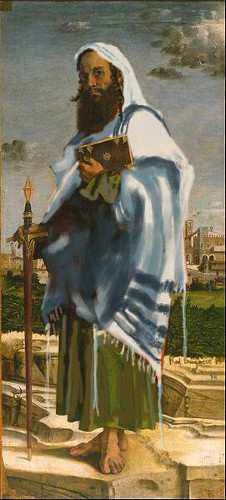
The Jewish PaulA really critical point though, is that her attitude about the Apostle Paul (Rav Shaul) changed remarkably. Remember, at the very beginning, she loved Paul’s teachings, but thought Jesus was too harsh and aggressive.

Don’t allow the mindless teaching of man separate you from the TRUTH. The Pharisees over taught the law with man made regulations to overwhelm man so he would not honor it, then the new Pharisees (Paulines, followers of Paul’s teaching rather than Jesus’) discounted the Sabbath with man made doctrines so men would not follow it. Seek God’s instruction to find the Truth.

Here, she’s reversed her original position and now sees the teachings of Paul in opposition to those of Jesus. Ironically (again), she denigrates the “man-made laws “of the “new Pharisees” and believes only in seeking God’s instructions of truth in Jesus. I say ironically because when she became a Noahide, she had to accept the validity of the teachings of the Rabbinic sages and their authoritative interpretations of Torah, which most Christians call “man-made laws”.

And most Christians consider the Sages to be something like “the new Pharisees”.

Here’s a little more:

A husband that truly LOVES his wife will catch on. Believers that are TRULY following, TRULY LOVING Him, TRULY READING Him will catch on. They will start to step away from Paul’s teaching or rather “un-teaching” and will seek to find out what the WILL of the Father is and what is meant by the “Word of God.” it’s an exciting time! An Awakening!

I’m emphasizing this because abandoning Paul is usually a major step in leaving Christianity, Hebrew Roots, and Messianic Judaism for a non-Jewish believer, since so much of our understanding of how to apply Torah to the Gentile and to live a life as devoted disciples of Rav Yeshua, depends on what he wrote.

She found this to be the best teaching on Paul she ever heard. I had a difficult time following the link and managed to navigate to the 119 Ministries video teachings page and found the correct video by searching for the lesson’s title: “The Deuteronomy 13 Test.”

I thought I should investigate what she was listening to in order to discover what was influencing her thinking and beliefs. The textual introduction to the “Deuteronomy 13 Test” states:

Have you ever considered why the Jews reject the Jewish Messiah, our Lord and Savior…What if it was because many today misunderstand Paul…Millions of Jews reject the Christian presentation of Jesus and Paul, alarmingly, because the Word of God says to. Sadly, if the misunderstanding continues, Jews are forever prevented from not only not knowing their Jewish Savior, but also from experiencing the blessings of the New Covenant. This teaching exposes the gap in the misunderstanding, and takes a first step into building a bridge…

119 video
Screen Capture: 119 Ministries

The video (about 41 minutes long) wasn’t exactly what I expected. It seemed, at the beginning, to be both very pro-Jesus and pro-Paul. The video instructor said that although Jesus and Paul didn’t teach against the Torah of Moses, but they did teach against the Oral Traditions, what is known today, according to this “teacher,” as the Talmud.

This instructor’s first mistake was defining the traditions and praxis of the Pharisees in the late second Temple period as the Talmud, which would not actually exist for centuries (Mishnah c. 200 CE, Gemara c. 500 CE)

This is very much an anti-Judaism (including Messianic Judaism) lesson. I needed to understand a little more about 119 Ministries itself. According to their site’s About page:

Our purpose is to seek and bring the truth to all nations, unlearn false doctrines and traditions of men, and to equip the body to live and practice the Word as God originally intended.

We find that continuously examining the Scriptures (in the same Hebraic first century context and perspective in which they were written and understood) reveals to His people much more understanding, as opposed to the more common Greek mindset that is a couple thousand years removed.

Sounds pretty much the same as when a Fundamentalist church says their doctrine is the only “sound doctrine.”

It’s difficult to tell if 119 Ministries is specifically “One Law” or “Two House,” but their Faith Statement says in part:

Another purpose of Yeshua was to begin calling back the scattered 10 tribes of Israel that were divorced, scattered, and became Gentiles.

This at least suggests a Two House theology, although it’s hardly conclusive.

Frankly, in listening to the above-mentioned anti-Judaism video teaching, it’s amazing that this woman finally became a Noahide, since as far as I can tell from her blogspot, 119 Ministries was her primary and possibly her only source of information relative to Hebrew Roots.

Listening to the 119 teacher was hard for me since his lesson was not only almost totally opposed to my personal beliefs, but it was thinly disguised anti-Jewish rhetoric which not-so-subtly was also a presentation of supersessionism, misappropriating the Torah from the Jewish people and denying observant Jews the right to establish their own interpretation of Torah.
Orthodox JewsAbout halfway through the video, the teacher started hammering away against modern observant Jews. To be fair, he seemed just as prejudiced against normative Christianity.

The 119 Ministries video teacher says he wants to bring Jewish people to faith in Yeshua, but his attitude toward observant Jews is so poor that I can’t imagine any Jewish person wanting to listen to this fellow. In this, his concept of Jewish people who “reject Jesus” is pretty much that of normative Christianity, at least in its worst expression.

This teacher is a great example of how a person who continually quotes from the Bible (and he did so, scripture after scripture) can still grossly misrepresent the intent of Hashem, Rav Yeshua, and Rav Shaul (In doing some subsequent research, I discovered that the people behind 119 Ministries are well-meaning and kind, but I still have to disagree with almost all of their conclusions).

Toward the end of the video, the teacher cited Romans 11, Ephesians 2 and Numbers 15:15-16 as “proof” that the Law of Moses was meant to be observed by, not just the Children of Israel and their descendants, but by all humanity, so he tips his hand, so to speak, and reveals that his ministry supports One Law. He does it however, in a really easily refuted way, so I readily set it aside.

(I found this half-hour long YouTube video of an interview with the two guys who founded and operate 119 Ministries, Steve and John. They seem like really nice guys. If you want to get to know who they are and why they started their organization, click the link).

The bulk of this blog’s content was written between July and December of 2014. The last blog post of 2014 was published on December 15th. The next missive, the last one here, was from January 24, 2016, and is simply a link to her article Leaving Christianity at The Torah Way.

There’s a gap of over a year where something must have happened, where her fascination with 119 Ministries and what they teach must have waned in the extreme. She would never have become a Noahide if she was listening to their anti-Judaism, anti-Jewish people diatribes.

interfaithI wonder if she and her family (she’s married with two children) went through something like this:

Jewish Values vs. Other Faiths

I am struggling with the sense that on one hand I want to instill Jewish beliefs in my children, but on the other hand I feel this would be diminishing the value of other faiths. I feel that love, harmony and happiness are the most important values, and that we need to be accepting of everyone’s beliefs. People are different, so isn’t truth relative for each individual?

The Aish Rabbi Replies:

This is an important question, one that I think goes to the heart of today’s society.

If you think about it, you’ll realize that “truth” cannot simply be everything that everyone wants.

from the “Ask the Rabbi” column
Aish.com

I think this blog writer held on to the love and truth of Torah she discovered early on, but for some reason, everything else had to give way. Maybe she finally figured out that the video teachings she was consuming ultimately didn’t hold water and actually disrespected the Jewish people who are the sole human objects of the Sinai Covenant.

I don’t know. She took the path of many Christians who become disillusioned with the Church and find Hebrew Roots as an alternative. Eventually, it becomes too difficult to balance love of Torah but not of Judaism and Jews, as well as seeing Yeshua and Shaul being depicted as somehow against their own people.

Granted, a life either in Hebrew Roots or Messianic Judaism isn’t easy. If you’re a believing Gentile, being a Christian is the path of least resistance, and if you are an observant Jew, then Orthodox Judaism is probably a more understandable option.

But if you’re a Gentile who comes to doubt first Paul and finally Yeshua, and who believes normative, observant Judaism to be true, what do you do?

Jewish ConversionYou either convert to Judaism or become a Noahide.

I don’t know if these individuals finally end their search for truth (or TRUTH as the subject of today’s “meditation” likes to write it). We all want to know who we are from Hashem’s perspective, and what His purpose is for our lives. We all want the easy, pre-programmed answer, where we don’t have to think, we don’t have to doubt, and we don’t have to be anxious.

We all want to settle down and relax, secure in the knowledge that we are finally “right” about everything and we have nothing else left to search out and study, and no other questions to ask that we might not find ready-made answers for.

Good luck with that.

Not to say that there aren’t plenty people in houses of worship all around the world who don’t feel settled and secure and who have stopped asking all but the most elementary of questions. But I think that a sense of insecurity, at least a little bit, is built into our relationship with God.

If we finally come to the point where we have no more questions, then we are saying that there’s a limit to God and His relationship with us.

I can accept a person who goes through a developmental process in their faith, exploring and seeking to understand what the Bible is really saying. I’ve gone through that process and am still progressing along that path. I probably never will arrive at a “settled” place, though there are a few things I accept in my understanding now.

But there’s a difference between that and moving around from one faith discipline to another seeking a “TRUTH” that answers “everything”. A human being’s relationship with Hashem is more “edgy” than that. Just look at anyone in the Bible who was close to God. Abraham wasn’t settled and comfortable, neither was Moses. None of the Prophets had peaceful lives. Paul certainly didn’t. If anything, when Rav Shaul was introduced to Yeshua, his life became remarkably “unpeaceful”.

Why should our lives be any different?

A final word. Paul’s life was unsettled and violent and yet in his relationship with Messiah, he said he found “the peace of God, which surpasses all comprehension” and that guards “your hearts and your minds in Christ Jesus” ( Philippians 4:7 NASB).

peaceThere’s a peace that goes beyond our day-to-day lives, and even beyond our occasional crisis of faith as we continue to study the Bible. There’s a peace we only find if we lay aside our doubts and turn to Him in trust, knowing He desires that we draw close to Him. All the religious pundits in the churches, synagogues, on streaming video, and in the blogosphere don’t hold a candle to authentic trust in Hashem and the peace that He brings to our troubled souls.

I hope the anonymous woman whose journey I’ve attempted to chronicle finds peace in God.

But I also hope she never stops asking questions.

Where Are All The Gentiles Who Are Drawn To The Torah?

A man with a brambly salt-and-pepper beard, a kippah on his head, and circular glasses balanced on his nose stood behind a podium, lecturing on the parasha, the weekly Torah reading, in a southern twang. He was not a rabbi. He wasn’t even Jewish.

In front of him, an audience of about 20 sat in rows, listening attentively. Some wore head wraps and dresses suitable for a wedding, and others looked like they came in off the street. One man boasted neck tattoos and a gauge earring.

I was the only Jew in the room, but everyone else was here to study Torah. I was here to study them.

-Ilana E. Strauss
“The Gentiles Who Act Like Jews”
Tablet Magazine

Given the nature of this blogspot’s audience, many of you may believe that this article is about non-Jews who practice their faith within the context of Messianic Judaism or the Hebrew Roots movement.

Not so.

They call themselves Righteous Noahides: non-Jews who believe in Orthodox Judaism. According to Jewish theology, there are laws that Jews must obey, the 613 mitzvot, but then there are seven laws for children of Noah—everyone else in the world. They are: Do not deny God; do not blaspheme; do not murder; do not engage in incest, adultery, pederasty, or bestiality; do not steal; do not eat of a live animal; and establish courts.

The group I visited, called Netiv, is a bustling 40-person community located in Humble, Texas—in the United States, Texas is the center of Noahide life. Some members travel over two hours each way, two or three times a week, for classes. They obey the Noahide laws, but they also take the concept further, endeavoring to obey other mitzvot and learn more from Judaism.

If this were a visual, I’d have just done a double-take. A group of forty people, all non-Jews, identifying as Noahides, meeting together regularly and studying the Torah…in Texas?

Up until now, I thought that any Noahide would be found within the context of a Jewish synagogue. Of course, Humble, Texas isn’t a very big place and the closest Orthodox Jew is probably 30 miles away in Houston.

And in reading the (rather lengthy) article, I was astonished to discover that the state of Texas is something of a hot bed for Noahide gatherings. Of all the places, why Texas?

But this movement isn’t limited to the U.S.

Noahidism now encompasses communities around the world, especially in Great Britain, the Philippines, Latin America, Nigeria, Russia, and the United States. According to Rabbi Michael Schulman, who runs Noahide website AskNoah.org, the Philippines may have the most developed community, with well over 1,000 adults and their children living in a collection of agricultural towns. They run Hebrew schools, community meetings, and even a national summit.

The RebbeHow did all this come to be?

But about 40 years ago, Chabad grand Rabbi Menachem Mendel Schneerson launched a global “Noahide Campaign,” writing and speaking about the need for Righteous Noahide communities, believing Noahide laws would bring about peace and understanding and would hasten the coming of the Messiah. Some non-Jews listened. For example, in 1987, President Reagan signed a proclamation glorifying “the historical tradition of ethical values and principles, which have been the bedrock of society from the dawn of civilization when they were known as the Seven Noahide Laws, transmitted through God to Moses on Mount Sinai.”

Here’s something that shouldn’t surprise you too much.

Bryant didn’t always teach Torah; he was a Pentecostal chaplain in the Army during the first Gulf War. He started a small study group in his house that got so large that it moved to a church. Around that time, Bryant began finding inconsistencies in Christian scripture, so he started digging into historical records.

The typical story goes like this: A person starts out Christian. (I’ve yet to meet someone who came to Noahidism from anything else. Bryant said one Muslim girl used to stop by, but her family found out and put a stop to it.) These seekers then find inconsistencies between the scripture and the priest’s or minister’s teachings. They start asking questions their religious leaders can’t answer to their satisfaction, questions like: “Why don’t we keep the Sabbath?” “Why do babies need to be baptized?” “If the Bible says God is one, why do we have a Trinity?”

And so on.

That’s very similar to what draws most of us non-Jews to either Messianic Judaism or Hebrew Roots. The only real difference is that these “inconsistencies” taught in normative Christianity are seen by Noahides as a problem with the beliefs spawned by the Apostolic Scriptures (New Testament) rather than a problem with how those scriptures are interpreted by the Church.

In other words (in my opinion), these Noahides have thrown out the baby with the bath water. They have certain issues with Christian doctrine and have determined that not only the doctrine, but the general theology behind it, is totally false and that only normative (in this case, Orthodox) Judaism is a valid expression of the worship of Hashem.

But it’s fascinating the similarities between these Noahides and that group I’ve come to call Talmidei Yeshua.

They obey the Noahide laws, but they also take the concept further, endeavoring to obey other mitzvot and learn more from Judaism.

And…

Some rabbis emphasize that Noahides should not perform any mitzvot designated specifically for Jews; they point to interpretations of Genesis 8:22 that argue it is forbidden for non-Jews to keep Shabbat.

Arilio Navarro understands these concerns, but he doesn’t abide by them.

“There are a lot of blessings that come with Shabbat, and I don’t want to leave them on the table,” he said. “I spent most of my life doing that; I don’t want to do that anymore. I have a Jewish soul.”

All the rabbis and Noahides I talked to agreed that Noahides don’t have an obligation to keep more than the seven laws. But the sort of people who go on a spiritual quest that leads them out of Christianity aren’t the sort who are typically satisfied with that. They want to do more.

Path of TorahLook at the last two sentences:

But the sort of people who go on a spiritual quest that leads them out of Christianity aren’t the sort who are typically satisfied with that. They want to do more.

That describes the drive in many non-Jews in both Messianic Jewish and Hebrew Roots contexts in terms of their preferred praxis. Even those Gentiles who understand and embrace the “bilateral” relationship between Jewish and Gentile disciples of Rav Yeshua tend to take on board more than the seven laws of Noah, and even more than what’s implied in the Acts 15 “Jerusalem letter.”

We all came from a church experience.

We all came to understand that Christian doctrine seemed less than satisfactory in explaining what we were reading in the Bible, particularly about Jews, Judaism, and the Torah.

We all started looking for someone or some group who/that could teach us a more Bible-consistent, Jewish-positive, Israel central interpretation of the Tanakh (Old Testament) and the Apostolic Scriptures.

But there’s one more thing.

And when Noahides show up at Chabad houses or synagogues, saying they want to learn Torah, they’re frequently turned away at the door.

“What about being a light to the nations?” asked Bryant, the Netiv leader. “Where else are they going to learn Torah? At church?”

One thing about Noahides: They really, really want to be accepted by Jews.

If, 40 years ago, Chabad grand Rabbi Menachem Mendel Schneerson launched a global “Noahide Campaign,” it is baffling that Chabad houses would turn away the very Noahides that campaign created.

And it’s true, all of us, whether Noahide, Talmid Yeshua, or Hebrew Roots follower, in some manner or fashion want to be accepted by the Jews associated with our respective movements.

“Rod” Reuven Dovid Bryant
“Rod” Reuven Dovid Bryant, Netiv.net

If you visit the Netiv.net About page, you’ll find:

Currently meeting in Humble Texas, Allen Texas, Fayetteville Arkansas, Central Texas, Calgary Alberta, Canada, soon to be Kingsland Texas, and Nashville Tennessee. Netiv Center for Study of Torah was originally established to serve the greater North Houston area in 2010. It began with a hand full of individuals seeking the treasures of Torah knowledge, who are not connected to Jewish community. Rabbinical adviser Abraham Ben Yaakov graciously guides our communities spiritual learning. The center host [sic] people from all over the greater Houston area for weekly classes and lectures. Check out our photo stream on Facebook.

All people benefit from Torah study. The center is designed specifically for those desiring to study but have limited knowledge of the first books of the Bible. Netiv is an education center for Torah study, providing the student with Torah knowledge from it original sources. The classes are geared toward a non-jewish or non-religious jewish audience. Because we believe in the concept of Universal Torah for all peoples, this community is open to all. We welcome all to participate in the study of the Torah. If you are interested in joining our community we would love to have you visit. The environment is casual and full of joy. Join us in the study of the Word of G-d.

Wow! A Universal Torah? There are no end of surprising parallels between these Noahides and some Gentile folks in either Messianic Judaism and Hebrew Roots. The desire to go “above and beyond” what is required of non-Jews by Hashem runs deep within those of us who are attracted to a more “Judaic” viewpoint and interpretation of the Bible, and particularly the Torah.

I didn’t find a nice, concise definition for “Universal Torah,” but I think the bio on that site for Rabbi Chaim Richman may be illuminating.

Rabbi Chaim Richman is the director of the international department of the Temple Institute in Jerusalem, Israel. He is an internationally respected and sought after lecturer and teacher on the projects and research of the Institute, as well as the Torah and the Temple as it relates to both Jews and non-Jews. His programs feature his vast Torah knowledge and draw from the diverse resources of the Temple Institute.

The phrase, “…as well as the Torah and the Temple as it relates to both Jews and non-Jews” seems to be the nexus of interest for all of the Gentile groups who are drawn to Judaism. For Jews, their relationship to the Torah and the Temple is well-defined, but for the rest of us, not so much.

JerusalemOh we think it is, but without a thorough understanding of the relevant material from a Judaic point of view that addresses specific Gentile involvement in Torah and Temple, we are often lost and left to our own efforts to create that understanding.

I sort of see the appeal of certain groups (I found the link to this article in a closed Facebook group for “Messianic Gentiles”) to derive some of their identity from Noahides because there is obviously a lot more material available serving them than there seems to be for us.

No, I’m hardly disdaining those fine individuals and organizations who are providing educational materials for we so-called Talmidei Yeshua, but these Noahides and their Jewish advisors have perspectives on the intersection between Judaism and the Goyim that I haven’t typically found in my own experience and from my usual information sources.

For any non-Jew who is attracted to Jewish praxis as a way of drawing closer to Hashem, we have a few options. I’ve mentioned most of them.

Join a Hebrew Roots group.

Join a Messianic Jewish group.

Join a group of Noahides.

Convert to Judaism.

The article mentions that a number of Netiv attendees would like to convert, but there’s no Orthodox Jewish community nearby to support such a thing. My wife, who is associated with both the local Chabad house and our Conservative/Reform shul here in town says the Chabad Rabbi won’t perform a conversion, first of all because there’s no local Beit Din, but also because there isn’t an Orthodox Jewish community to support a convert.

The Rabbi at the other synagogue has performed both Reform and Conservative conversions, but if like the Noahides I’ve cited from the Tablet article, you are specifically attracted to Orthodox Judaism, that’s not an option, either in Boise, Idaho or in Humble, Texas.

Oh, becoming a Noahide or converting to Judaism both require denying Yeshua (Jesus) as our Rav, Messiah, and King. For most of us, that’s a deal breaker, but obviously, for these Noahides, they were willing to exchange a Christian faith for a “Jewish” one, at least “Jewish” as it applies to Righteous Gentiles.

I’ve previously mentioned that the advantage for Talmidei Yeshua is that we are more than Noahides. Through Hashem’s mercy and grace, and through Rav Yeshua who is the mediator of the New Covenant, we are allowed to have access to many of the New Covenant blessings, the dwelling of the Holy Spirit within us, resurrection in the life to come, and in the Messianic Kingdom, an apprehension of Hashem equal to or greater than the Prophets of old.

Yes, I understand Noahides merit a place in the world to come, at least as understood by the Talmud and the Sages, but I don’t believe that encompasses the other blessings Yeshua-disciples experience:

The Noahide laws, which are derived from passages in the Torah, were enumerated in the Talmud. In the Middle Ages, Maimonides urged their observance on non-Jews, writing, “Anyone who accepts upon himself and carefully observes the Seven Commandments is of the Righteous of the Nations of the World and has a portion in the World to Come.”

leaving churchBut after the Rambam’s proclamation, non-Jewish participation in any sort of Noahide movement was minimal to non-existent, at least up until about 40 years ago or so. Now it seems to be booming, but unless you have your finger on that particular pulse, you’d never know it (I didn’t).

Is the church bleeding members like a ripped artery, and are they flowing into some expression of Jewish theology and praxis more so than at any other time in the past twenty centuries? If so, there must be a reason. Maybe Hashem really is preparing His remnant of the people of the nations for the coming/return of Moshiach.

Non-Jews and the Mitzvot: A Brief Commentary On One Orthodox Jewish Perspective

Moshe also does not need me to clarify for him. Nonetheless, I think his point is unexpected and worth considering, in that he is saying that many mitzvot aren’t inherently valuable, they’re only valuable as part of a particular relationship with Hashem. It’s not that he objects or is bothered by non-Jews doing them, he’s saying that in these areas, the differences between Jews and non-Jews are such that these actions are literally meaningless for them.

-Rabbi Dr. Gidon Rothstein
“Do Non-Jews Get Reward for Mitzvot?”
Torah Musings

Now before anyone flips out, I want to say that I found a link to this article on Facebook, and that “Torah Musings” is an Orthodox Jewish venue, so please take that perspective into consideration. In fact, their About states in part:

Torah Musings is a window into the Orthodox Jewish intellectual’s world, providing sophisticated but popular textual studies, important news stories and associated commentary from the perspective of an Orthodox Judaism that is intellectually open and halakhically conservative.

rothstein
Rabbi Dr. Gidon Rothstein

Further, the disclaimer at the very bottom of Rabbi Rothstein’s article says:

The opinions and facts here are presented solely by the author. Torah Musings assumes no responsibility for them. Please address religious questions to your rabbi.

Again, please keep in mind that the contents of this write-up, including the portions quoted here on my blog, are crafted within the conceptual and intellectual confines of Orthodox Judaism and are the educated opinions of R. Rothstein specifically.

So don’t lynch me or hang me in effigy just for reporting something I find interesting and, I believe, relevant.

Almost three months ago, in an effort to distance myself from some of the angst we find in certain corners of Messianic Judaism regarding Gentiles, identity, and mitzvot, I wrote and published What’s Yours is Yours. Really, if a Gentile in Jewish space is a problem, I’ll bow out.

Among other related articles, I also subsequently published Should Non-Jews Study the Torah and I concluded “yes,” with the proviso that studying Torah did not make one automatically obligated to perform each and every possible mitzvah described therein.

But having, to the best of my understanding and ability, examined the Messianic Jewish viewpoints (yes, there are more than one) as well as Hebrew Roots’ and Christianity’s opinions on the topic, how can I resist investigating how this Orthodox Jewish Rabbi answers the question he has asked?

As you can see from the above-quoted paragraph, R. Rothstein, in examining the “original responsum, Iggerot Moshe Orach Chayyim 6;2,” states that Moshe’s opinion would be that while we are not forbidden from performing the mitzvot, because many or most of them are directly linked to the (Sinai) covenant relationship Hashem has with the Jewish people, laying tefillin, wearing tzitzit, or building and living in a sukkah are simply meaningless to us relative to actually fulfilling these mitzvot, because non-Jews, even those living as Noahides, are not part of that covenant.

solomon's templeIs that the final word?

R. Rothstein reviewed the opinions of multiple authorities and they all differ somewhat in how strict they rule in this area.

1. Schepansky had noted that Rambam, in his Mishnah Commentary to Terumot 3;9, explained that even though non-Jews are not obligated in giving terumah, they still get reward for doing so, which is why the terumah they designate qualifies as actual terumah.

2. Moshe labels it one of the exceptions, donations to hekdesh (anything having to do with the Temple) and charity, examples he proves from the Talmudic assumption that Balak is rewarded for his sacrifices and Baba Batra 4a’s view that Nevuchadnezzar’s giving charity was effective. Non-Jews are also rewarded for appropriate speech, as Rashi says on Bereshit 19;39, where Lot’s younger daughter was more circumspect about her son’s paternity. Nevuchadnezzar also gets rewarded for the three steps he takes to hear the word of Hashem.

Those are all examples of non-Jews taking intuitively decent and good actions. When it comes to that which the Torah nonintuitively legislates for Jews, such as Shabbat, holidays, tefillin, tzitzit, sukkah, lulav, shofar, kosher, shatnez and anything like that, R. Moshe reverts to his view that these mitzvot only have value as a Jewish response to Hashem’s command.

This suggests that certain mitzvot might actually have meaning when performed by non-Jews, such as making an offering at or donations to the Temple (which currently does not exist), or other actions that any reasonable person would intuitively understand are morally good or right. On the other hand, those mitzvot that we would not intuitively realize are good, such and laying tefillin or donning a tallit gadol when praying, actions that are specifically associated with the Jewish people and their (Sinai) covenant relationship with Hashem, simply mean nothing to Hashem when we perform them, because we non-Jews stand outside the (Sinai) covenant.

Orthodox JewsI know pretty much who is going to object to all this, but please remember that these opinions are coming from an Orthodox Jewish source, so you can’t necessarily hang blame either on me or on any authorities existing within Messianic Judaism.

You’ll need to click the link I provided above to get the full gist of what R. Rothstein has composed, but he does cite other authorities who believe a non-Jew may receive a reward for performing mitzvot voluntarily, although this probably doesn’t include the previously mentioned observances specifically associated with Judaism. Some have even suggested that the non-Jew may receive a greater reward, but this is a minority opinion and possibly considered erroneous by the majority of authorities.

The article concludes:

In that sense, R. Moshe is actually being more lenient towards non-Jews, in that in his view they are not missing out on a good. For R. Moshe, a non-Jew who keeps the Noahides is doing all s/he should do, not just all the Torah happened to let him or her know about. It’s not that they are too benighted to know the wonders of our mitzvot, it’s that those mitzvot don’t apply to them, unless and until they decide to convert.

In other words, it is understood that Gentiles may recognize the beauty of all of the mitzvot once we study Torah and become aware of them, however that recognition goes not make us obligated unless we choose to convert to Judaism.

This is more or less what I’d expect given an Orthodox Jewish perspective, and is actually more liberal than I would have previously imagined.

Now the question is, from the viewpoint of disciples of Rav Yeshua and my understanding of our graciously being allowed to partake in some of the blessings of the New Covenant by Hashem’s mercy and through the symbolic sacrifice of our Rav, does this change anything as far as non-Jewish disciples, the mitzvot, and their significance?

That’s the $64,000 question.

And it’s one that A) I’ve answered before, and B), that I don’t intend to hash out again in this blog post.

rainbowI am writing this “mediation” and providing links to the source material because I find it fascinating that Orthodox Judaism would even pose the question for serious, scholarly debate. If it’s a question that Orthodox Jewish authorities find necessary to ask, given that they see non-Jews as subject only to the covenant Hashem made with Noah (see Genesis 9), how much more so should it be a question within Messianic Judaism, given that Hashem has allowed even the non-Jew to become a disciple of Yeshua by mercy and grace?

You can read other articles Rabbi Rothstein has written for Torah Musings as well as at the Orthodox Union (OU) and The Times of Israel to gain greater insights into his perspectives.

I know this will probably ruffle someone’s feathers, but really, I’m just publishing this as a matter of interest as to how wider Judaism considers a matter that is, from my point of view, highly relevant to non-Jews who are “Judaicly aware” and who are or have been involved in either the Messianic Jewish or Hebrew Roots communities.

Why Do Christians Hate Judaism?

This is the decree of the Torah, which Hashem has commanded, saying…

Bamidbar/Numbers 19:2

Rashi explains that the unusual introduction of “this is the decree of the Torah” (rather than an introduction specific to the subject of parah adumah), is a response to Satan and the nations, who tauntingly ask, “What is the purpose of this commandment?,” to which the Torah answers that it is a decree from Hashem, and it is not for anyone to question it.

-from “A Torah Thought for the Day,” p.62
Sunday’s commentary on Parashas Chukas
A Daily Dose of Torah

I’m continuing to write on the general theme of the role of non-Jews in Messianic Jewish community, a study started in this blog post and most recently addressed in yesterday’s morning meditation.

Chana Sara in her blog post from a few years back asks Where Do I Fit? It’s certainly a question I keep asking myself, both in relation to my decision to study the Bible through the lens of Judaism and particularly Messianic Judaism, and the larger existential question of where do I fit in my relationship to God.

Once you accept that any sort of connection to God must go through Israel, the Jewish people, and especially through the exceedingly Jewish Messianic King, then you must come to the realization that in order to relate to God you must enter into a completely alien world, that is, alien for the non-Jew. You must enter a Jewish world or at least a worldview.

Even many secular Jews feel, when attempting to observe a mitzvah or when attending a synagogue prayer service, that they are also “strangers in a strange land.” True, they are Jews in the midst of Jewish community, but the traditions, the customs, the halachah, the Hebrew, if you haven’t been raised in an observant home nor had the benefit of a traditional Jewish education, can seem even to the ethnic Jew, like a trip down the rabbit hole to “wonderland.”

And most people become uncomfortable when faced with the unfamiliar and the unknown. People become defensive and even hostile when thrown abruptly into an alien environment. We prefer what we’re used to.

Chana Sara wrote in the aforementioned blog post:

As a ba’alat teshuva, I have a lot of questions when it comes to where I “fit” within Judaism. I was born into a conservative Judaism family, meaning that my mother can’t part from the egalitarian idea of the conservative movement, but keeps conservative standards of kosher and Shabbat.

As soon as I had my bat mitzvah I don’t remember going back to shul for any reason. Possibly the high holidays, but possibly not even then.

jewish women prayingThis is a commentary on a Jewish journey into Yiddishkeit, which is also a journey my wife embarked upon a number of years ago. I remember the struggles she faced in her first attempts to connect to Jewish community and Jewish observant praxis. How much more difficult is it for the non-Jew, with no direct connection to Jewish community and lifestyle, to face the challenge of entering the Jewish world in order to comprehend and obey the Jewish Messiah?

I understand that God is not just the God of Israel but also the God of the nations, but every shred of Biblical content that we have with us today was produced by Jews, and, for the most part, for Jews. Only certain sections of the Bible directly address the nations, and not all of those references relate to us kindly. Amalek comes to mind.

The commentary I quoted from at the top of the page, specifies those commandments in the Torah that have no discernible reason or purpose, but nevertheless must be followed because they are God’s will for the Jewish people. Rashi’s interpretation of the above-quoted verse from Numbers supposes that HaSatan, the adversary, and the Goyim, the Gentiles, would criticize the Israelites for observing such commands or would actually bring into question the Torah as the Word of God based on what appears to be a collection of meaningless decrees.

And therein lies the root of my question, “Why Do Christians Hate Judaism?” I know “hate” is a strong word and I use it in part for dramatic emphasis as opposed to literal meaning. Most Christians don’t actually hate the Jewish religion or form of worship, but they do believe that it is merely a religion of works which exists in opposition to Christ and the Christian doctrine of salvation by grace.

I also don’t mean to indicate that Christians hate the Jewish people or the state of Israel. Many Evangelical churches say they love the Jewish people, and no doubt, they are sincere. Of course, that love for Jews and national Israel is predicated on a very Christian understanding of the eschatological meaning of the existence of Jews and Israel relative to the second coming of Christ.

This brings us back to those Christians who have come to realize that what they’ve learned from the pulpit or in Sunday school isn’t, strictly speaking, the exact Gospel message Messiah and his apostles taught in the late Second Temple period. Once we have learned that the Church’s current theology and doctrine is all based on a two-thousand year old mistake and is the result of a violent divorce between the early Jewish and Gentile Yeshua disciples, then we’re faced with a horrible reality.

In an ekklesia that is wholly Jewish and that can be only understood and communicated with through a wholly Jewish process, a process alien to anything we were formerly taught as Christians in our churches, who are we, what do we do, and where do we go to pursue our faith given this totally Jewish contextual reality?

unworthyDo you see where this might cause some anxiety or even a crisis of faith among the devout Gentiles when facing a life within Jewish community and educational space?

Do you see why Christianity was invented in the first place, as an alternative to this crisis, as a means to take control over worship of God and devotion to Christ by redefining it as Gentile and not Jewish?

Although my father’s recent illness is the primary reason I chose to abandon plans to be in Israel right now, another reason was the idea that, as a Gentile (and a flawed, imperfect human being) who is oriented toward but can never be a part of Israel, who am I to set foot in the Holy Land?

However, there are other responses to this crisis. There are some Christians who have walked away from the Church but who still do not feel comfortable surrendering their identity to Jewish interpretation. They have invented a world of their own which states that while they are not ethnically Jewish, nevertheless, they are Israel as much as the Jewish people are, and thus they are as obligated to the Torah of Moses as any observant Jew.

But there’s a caveat.

They still reject Judaism, or at least Judaism as it has evolved over the past nearly twenty centuries. They reject, for the most part, that entity we know as Rabbinic Judaism, the “traditions of the elders,” the so-called “made up” laws that add on to or perhaps even defy the plain meaning of the written Torah.

Now here’s the trick.

If we Messianic Gentiles accept Messianic Judaism as a Judaism, and accept the validity of the teachings of the Jewish Sages, teachings which, for the most part, have nothing to do with us, then what does that mean for us? For understandable reasons, as much as Christianity has rejected Judaism, Judaism has rejected Christianity. They aren’t on speaking terms and can barely stand being in the same room with each other.

JerusalemOnce we Gentile believers come to a Messianic Jewish understanding of the Bible, the Messiah, and God, once we see how much God loves Israel, how special Israel is to God, and how we people of the nations are only saved through Israel and not because the nations have any sort of direct covenant connection with God, what is our most likely initial response?

The Torah states, “And Korach, the son of Yitzhor, the son of Kehas, the son of Levy, took …” Why does the Torah take the time to tell us his lineage?

Rashi, the great French commentator, explains that the key reason for Korach’s rebellion was his envy of his cousin, Elizaphan the son of Uziel, who was appointed prince of the tribe of Levy. Moshe’s father was the first of four brothers and his sons were the leader of the Jewish people and the High Priest; Korach figured that since he himself was the firstborn of the second son, that he should have been appointed the Prince of the Tribe of Levy.

Envy is destructive. It prevents a person from enjoying life. If ones focus is on other’s success and possessions, it will cause pain and lead to highly counterproductive behavior. No wonder that Pirkei Avos, Ethics of the Fathers 4:28, lists envy as one of three things which destroy a person (the other two are lust and desire for honor).

To overcome envy, focus on what you have and what you can accomplish in this world. The ultimate that anyone can have in this world is happiness. The secret to happiness is focusing on what you have. And if you are happy, you won’t envy others!

-Rabbi Zelig Pliskin
based on his commentary on Parashas Korach in
Growth Through Torah
as found at Aish.com

Especially in our modern western egalitarian culture, the idea that any one group might be special and especially privileged is abhorrent to most of us. When encountering certain Biblical realities, we attempt to refactor them by applying our modern worldview, thus reinterpreting the Bible beyond all reasonable credibility. We make statements to the Jewish people in Messiah that are the moral equivalent of the politically correct comment to check your privilege:

“Check Your Privilege” is an online expression used mainly by social justice bloggers to remind others that the body and life they are born into comes with specific privileges that do not apply to all arguments or situations. The phrase also suggests that when considering another person’s plight, one must acknowledge one’s own inherent privileges and put them aside in order to gain a better understanding of his or her situation.

Rebbe
Rabbi M.M Schneerson, the Rebbe

While the concept of “check your privilege” is, in my opinion, somewhat questionable, or at least has the potential to be grossly misused, applying it to the relationship between Messianic Gentiles and Messianic Jews (or any group of Jews) is Biblically unsustainable.

So where does that leave us?

I don’t have an answer, at least not a whole one. I do have a clue, also written by Chana Sara in her recent blog post My Experience with the Rebbe:

But he was more than just a rebel. He was a person with a fervor for life, for Yiddishkeit and for people. Everyone was important, Jew or non-Jew, male or female, child or adult. Every person was important and he wanted to do good for all mankind. The U.S. has dedicated Education and Sharing Day as a tribute to the Rebbe and steps he took toward the betterment of education for all U.S. children. He stressed the importance of the Noahide laws. He wanted to make sure that all of mankind was healthy and well and ready to take on the world in the way Hashem desires them to. He was really into everyone being the best that they can be and being able to help them realize their potential. The world isn’t finished being built, and the Rebbe wanted to make sure we were aware of that and are putting on our best faces to be able to finish making this world a dira b’tachtonim, a dwelling place for Hashem.

While there are voices within Messianic Judaism who advocate for a strict bilateral relationship between Jews and Gentiles, it is also part of the process of tikkun olam for Jewish and non-Jewish scholars and teachers within Messianic Judaism to make their lessons available to the Messianic Goyim so that we may learn and understand the teachings of the Master within his own context and turn our praxis and our devotion to God accordingly.

While there are plenty of resources available including those authored by Christian Pastors writing from within a Messianic context, as far as my experience goes, there are still no real answers.

If we acknowledge that Christian tradition does not adequately or accurately reflect the Jewish context of the Bible, and if we admit that Jewish praxis is not Gentile praxis in any form, including one that adopts the appearance of Judaism while rejecting the last eighteen hundred years or so of Jewish teaching and writing, what do we have left?

A mystery and no answers.

In previous comments on other blog posts I’ve written on this topic, it has been suggested that Gentile identity within Jewish space will have to evolve over a long period of time, decades if not centuries (barring the timing of King Messiah’s return, of course).

But courageous Jewish leaders such as the Rebbe, Rabbi Menachem M. Schneerson of righteous memory, indeed, had a heart not just for the Jewish people but for all people. Although his special mission and devotion was for Yiddishkeit, he understood that Messiah’s coming would herald the redemption of all of humanity in an unparalleled era of peace.

That’s the heritage of not just Israel but of all mankind, of you and me, all of us.

rebbe yahrzeit
People visit the grave site of the late Lubavitcher Rebbe Rabbi Menachem Mendel Schneerson

The twenty-first yahrzeit of the Rebbe has just passed and perhaps, if I may be so bold, in his merit, we can remind ourselves that somewhere, somehow, the people of the nations have a place in God’s redemptive plan, too. However, that plan and how we figure into it, isn’t very clear when viewed through a Jewish lens, since that lens was designed to reveal God’s relationship with the Jewish people and with Israel.

But it is the only lens we have that most accurately reveals the true reality of God’s message to the world, one that doesn’t diminish or destroy Jewish people, the nation of Israel, or the traditions, writings, and praxis of Judaism.

However uncomfortable or disorienting it may be to live life as a Gentile poised on the edge of our understanding of the God of Israel, the Jewish Messiah, and the Jewish scriptures, our best response should never be envy, supersessionism, or disdain. Instead, let us don the garments of humility, wonder, and awe, and then begin walking our path, one that is uncharted and unknown, toward the undiscovered country of who we are, which isn’t really defined by Judaism or even Christianity but rather by God.

I saw no temple in it, for the Lord God the Almighty and the Lamb are its temple. And the city has no need of the sun or of the moon to shine on it, for the glory of God has illumined it, and its lamp is the Lamb. The nations will walk by its light, and the kings of the earth will bring their glory into it. In the daytime (for there will be no night there) its gates will never be closed; and they will bring the glory and the honor of the nations into it; and nothing unclean, and no one who practices abomination and lying, shall ever come into it, but only those whose names are written in the Lamb’s book of life.

Then he showed me a river of the water of life, clear as crystal, coming from the throne of God and of the Lamb, in the middle of its street. On either side of the river was the tree of life, bearing twelve kinds of fruit, yielding its fruit every month; and the leaves of the tree were for the healing of the nations. There will no longer be any curse; and the throne of God and of the Lamb will be in it, and His bond-servants will serve Him; they will see His face, and His name will be on their foreheads. And there will no longer be any night; and they will not have need of the light of a lamp nor the light of the sun, because the Lord God will illumine them; and they will reign forever and ever.

-Revelation 21:22-22:5 (NASB)

Notice that it’s not just Israel who exists in the presence of God and of the Lamb. The nations are there…we are there, too, and we will be healed.

The tzadik is one with G-d.

We recognize him because within each of us is also a tzadik who is one with G-d.

Inside each of us is a spark of Moses.

-Rabbi Tzvi Freeman
From the wisdom of the Lubavitcher Rebbe, of righteous memory
Chabad.org

Within each of us is a spark of the Messiah. Have faith and courage.

Up to Jerusalem

The Torah for the Nations of the World

Question:

Why is Judaism so intolerant of idolatry? I don’t mean massive temples with human sacrifices. What about a civilized idolater, in the privacy of his own home. With a job, a family, a mortgage, donates to the World Hunger Fund and Greenpeace — and instead of one G-d, he just happens to have two or three or even several dozen, all lined up on the dashboard of his car. Why does Judaism make a cardinal sin of it, demanding total eradication of idolatry in every corner the world? As long as it doesn’t hurt anyone else, what’s so terrible?

Answer:

There are many ways to answer this, but let’s take a historical perspective. Historians agree that our current standard of ethics stems from the Jewish ethic. Yes, the Greeks gave us the natural sciences, philosophy and art; the Romans gave us governmental structure and engineering; from the Persians we have poetry and astronomy; from the Chinese, paper, printing, gunpowder, acupuncture and more philosophy, and so on. But the historical fact is that all those cultures (and all the other unmentioned cultures) sustained and even glorified attitudes and behaviors that today we universally find abhorrent. Today, if you dispose of your unwanted infants, practice pederasty, set humans to kill each other for sport, ignore the rights of those lower than you on the social ladder and refuse to acknowledge any social responsibility to the poor and the unhealthy, and can’t wait to run to war against the nation next door, you are a barbarian. You may have made a wonderful citizen of Athens or Rome, but today, no club will take you.

Where did those values come from? There’s only one source historians can point to: Torah.

-Rabbi Tzvi Freeman
“What’s So Terrible About Idolatry?”
Commentary on Parshah Acharei-Kedoshim.
Chabad.org

Sorry to be such a “Chatty Cathy” and post two missives in one day, but when I read the paragraphs above, they seemed to spell out something a lot of non-Jewish believers operating in the Messianic Jewish and Hebrew Roots spaces have been puzzling over if not actively struggling with. Is there some sort of “universalism” to the Torah? That is, does the Torah apply to everyone and not just to the Jewish people?

The answer to that question is enormously complex, even though some people seem to believe the answer is an incredibly simple “yes.”

Toby Janicki
Toby Janicki

I’ve written on this topic at length including in my original review of Toby Janicki’s article The Gentile Believer’s Obligation to the Torah of Moses as well as my revisiting that material sometime later. I’ve also written of the Torah and Gentiles in my “in a nutshell” explanation of Torah and Christians and in Torah and the Gentile Believer. Hopefully, I’ve rendered a consistent message across those different blog posts that studying the Torah is appropriate for a non-Jewish believer for a wide variety of reasons, but stating that we share an identical obligation to observe the mitzvot with the Jewish people in a manner identical to theirs, and claiming that the Torah and being “grafted in” also makes Gentiles “Israel” is way over the top.

That’s not to say that we “Messianic Gentiles,” and arguably the mainstream Christian Church don’t have special obligations and duties. It’s just that the duty of Messianic Gentiles and Christians isn’t to observe the mitzvot but to encourage and support Jews to observe the mitzvot.

That said, I do think there is a universal aspect to the Torah, one that applies to every man, woman, and child who has lived throughout history and one that applies to all of us across the world today.

It’s spelled out in Rabbi Freeman’s answer to the question about idolatry.

We tend to think of application of Torah as an either/or sort of thing. Either it applies in exactly the same way to everyone, or it applies to no one at all. There’s no such thing in the minds of certain people as differentiation of application, or the idea that Torah is received by the Jews in one way and by the Gentiles in a different manner.

How the Torah applies to the world, even the world of people belonging to different religions or no religion at all, is in how it has shaped our world ethically and morally. American criminal and civil law, as well as many of our social mores, is based on the Torah.

This isn’t a religious application. Heck, you don’t even have to believe in God. You can be an atheist and still live in a world where the basic moral and ethical structure is based on the “blueprint” of the Torah.

Torah at SinaiRabbi Freeman in his somewhat lengthy answer says that while many peoples, nations, and civilizations have come and gone across the vast corridor of time, only the Jewish people have remained.

Why is that? For one thing, for the entire existence of the people of Israel, since Hashem gave the Torah at Sinai, the Jewish people have kept and preserved the Torah. If Israel had been wiped out by some ancient enemy and the Torah lost forever, upon what would the world have built its ethics and morals? As Freeman states, in ancient times (and maybe in modern ones), if you didn’t like the ethics of a particular “god,” you simply worshiped another one. After all, without the knowledge of a single, all-powerful, all-encompassing, creative God, morals and ethics are relative and impermanent.

The single greatest gift the Jewish people have given the world is the Torah. No, not the obligation to obey Torah on the level of the individual commandments in a way identical to the Jews, but as the broader basis of civilization. According to Freeman, what we think of as civilization wouldn’t exist without the Torah.

Today, we are witnessing the most dramatic results of Abraham’s strategy in action: Our progress in the last 500 years, to the point of the current empowerment of the consumer with technology and information, only became possible through the rise of this ethic. In a polytheistic world, this could never have occurred. It was only once the people of Europe began actually reading the Bible and discussing what it had to say to them, that the concepts of human rights, social responsibility, the value of life, and eventually the ideal of world peace took a front seat in civilization’s progress. And it is only such a world that could have developed public education and health care, old age pension, telephones, fax machines, personal computers, the Internet, environmental design and nuclear disarmament.

I’ve read other articles from Jewish sources stating that the Torah has applications for the whole world, but I never quite grasped what they meant. I guess it was because of the continuing debates we have on the web between Messianic Judaism(s) and various aspects of the Hebrew Roots movement regarding the question of how much of the mitzvot a Gentile should take upon himself or herself that blinded me to a wider perspective.

It’s about the people of the nations creating and then living in “a world that values life, world peace, individual rights, freedom of expression, literacy, knowledge and compassion for those who have less…” That’s the universal quality of the Torah. That’s the Torah for the nations.

The moral and ethical principles are identical for the Jews as they are for the rest of us. The only difference is that there are many additional instructions that only have to do with the Jewish people.

the crowdYou and I as non-Jews participate and “observe” the Torah every day, at least if we’re reasonably ethical, moral, and are law-abiding citizens. For those of us who are believers, this evidence of Torah in our lives becomes all the more apparent, but the larger reality is that untold millions of people everyday also live out the Torah just by committing acts of compassion, by sending their children to school, by obeying the highway speed laws, by upholding the rights of the disadvantaged, and in a thousand other ways.

The answer of how the Torah can be universal seems so elusive until you look at it from the perspective Rabbi Freeman brings in his online article. Once seen from that viewpoint however, everything becomes clear.

What God Expects of the Jew and Also the Gentile

R’ Moshe Feinstein (in his Darash Moshe) explains that greatness is not defined by a person’s accomplishments, but rather by the person’s success in fulfilling the tasks for which Hashem equipped him and sent him to this world. Every person enters the world with unique abilities and a specific set of tasks to accomplish. Some are given tremendous ability, and are expected to achieve a great deal, while others are endowed with lesser abilities, and correspondingly, smaller tasks. But every person’s job is identical — use the skills you have been given to the utmost, to accomplish as much as you can.

-from “A Torah Thought for the Day,” p.75
Tuesday’s commentary on Parashas Va’eira
A Daily Dose of Torah

From a rationalist’s point of view it does not seem plausible to assume that the infinite, supreme Being is concerned with my putting on Tefillin every day. It is, indeed strange to believe that God should care whether a particular individual will eat leavened or unleavened bread during a particular season of the year. However, it is that paradox, namely, that the infinite God is intimately concerned with finite man and his finite deeds; that nothing is trite or irrelevant in the eyes of God, which is the very essence of the prophetic faith.

-Abraham Joshua Heschel
from “Does God Require Anything of Man?” p.102
Man’s Quest for God

You may not think the two quotes just above have much to do with one another, but bear with me. The former is addressing how each human being is placed on earth to fulfill his or her specific potential understanding that we all have different potentials, and the latter is discussing, not generally human response to God, but a Jew’s response to Hashem through performance of the mitzvot.

There are many problems which we encounter in our reflections on the issue of Jewish observance. I would like to discuss briefly several of these problems, namely, the relation of observance to our understanding of the will of God; the meaning of observance to man; the regularity of worship; inwardness and the essence of religion; the relevance of the external deeds.

-Heschel
“To Obey or to Play with the Will of God.” p.102

Is Heschel using “man” and “Jewish” as interchangeable terms, or can we infer that he means that all human beings are responsible for obeying God, and then drawing out Jewish observance as distinct from God’s expectations for the rest of us?

I doubt Heschel meant to include that meaning into his writing but I’m going to “force” the issue based on my particular perspective.

You see, not only do I believe that each individual human being was placed here in life for a purpose that has been assigned to us by God, but I believe that God has placed the Jewish people and the Gentile nations here to fulfill specific purposes depending on which corporate body we are born into (aside from some Gentiles converting to Judaism).

praying_jewIn other words, there are specific tasks God placed Jewish people here to perform, and we Gentiles have specific tasks we also are here to perform, all in the service of God.

But those Jewish and Gentile tasks aren’t necessarily the same (though there’s probably some overlap).

I know that will ruffle a few feathers out there, but I’ve said this often enough and in so many different ways, it shouldn’t really surprise anyone by now.

As for the “equality” of women in Torah, a great deal depends on what you think “equality” means. In Torah, it does not mean that every member of the community is authorized to perform the identically same roles and tasks. Leviim may not perform some tasks reserved for Cohanim. Other Jews who are not in these categories may not perform the tasks reserved for priestly categories (with some rare and constrained exceptions). Men may not bear children nor are they exempt from time-critical tasks required of them (the men, not the children [:)]). Women may not perform certain tasks required specifically of men. Children are constrained from performing adult tasks and are not to be relied upon to perform adult responsibilities (though their training will include learning by doing, emulating such tasks). None of these categories are less to be valued because of what they may not do; and each is to be highly valued for what they *are* given to do. They are all equally valuable and honorable; but they are not identical in their assignments nor may they trade off their specific responsibilities, though some tasks may be shared by more than one of these categories.

-from a comment made by “ProclaimLiberty”
on my blog post Jews Defining Their Own Relationship With God And The Torah

While the conversation was about male and female equality of roles within Jewish religious and communal space, I chose to expand the concept to include Jewish and Gentile roles within that same space and particularly within Messianic Judaism.

Individuals are granted potentials to fulfill and so are people groups, namely Jewish and Gentile. After all, the Torah was given to Israel at Sinai, not all of the human beings living on the Earth. So if there were a Gentile “mixed multitude” also standing at Sinai saying as one man, “all that you have said we will do” (Exodus 19:8; 24:3), those from outside Israel either assimilated into the tribes, losing their Gentile heritage forever, or they left without so much as a “by your leave” to return to the rest of the nations, probably the lands from which they came.

But what about the rest of us? I mentioned that I thought the nations had specific tasks hard-coded into our potential as well. I suppose I could start with Genesis 9 which is the basis for what in Judaism is referred to as The Seven Laws of Noah, but I can go further than that.

“Therefore it is my judgment that we do not trouble those who are turning to God from among the Gentiles, but that we write to them that they abstain from things contaminated by idols and from fornication and from what is strangled and from blood. For Moses from ancient generations has in every city those who preach him, since he is read in the synagogues every Sabbath.”

Acts 15:19-21 (NASB)

But concerning the Gentiles who have believed, we wrote, having decided that they should abstain from meat sacrificed to idols and from blood and from what is strangled and from fornication.”

Acts 21:25

It would seem, at least from my point of view, that the Bible presupposes a distinction in the duties human beings have to God depending on whether or not you’re Jewish.

Yet we all wholeheartedly accept Micah’s words: “He has showed you, O man, what is good, and what does the Lord require of you, but to do justice, and to love kindness and to walk humbly with your God” (Micah 6:8). If we believe that there is something which God requires of man, then what is our belief if not faith in the will of God, certainty of knowing what His will demands of us?

-Heschel
“Does God Require Anything of Man,” p.103

Toby Janicki
Toby Janicki

But from a “Messianic Gentile’s” perspective, what is the “certainty of knowing what His will demands of us?” The overly simplistic answer some have selected is that “one size fits all.” In other words, there are 613 commandments that Jews are obligated to perform (though many of them are in abeyance since we are without a Temple, a Levitical Priesthood, and a Sanhedrin in Israel), and God has only one standard of piety and righteousness for the whole human race, that is, the aforementioned 613 commandments, the Torah.

But if we accept that, then we must accept that God first chose Israel to be a light to the nations, then at some point, “unchose” her, and instead, chose all followers of Jesus Christ (Yeshua HaMashiach). Except that’s exactly what the Christian Church believes. Christians believe that God “unchose” Israel and the Torah and then chose “the Church,” the worldwide body of believers in Jesus. Hebrew Roots generally (but not universally) believes that (again, please bear with me) God “unchose” Israel and then chose all followers of Messiah Yeshua and applied the Torah to his latter selection in the same manner as He did with His former selection (and as I’ve said before, I don’t for a split second believe that Gentile disciples actually become “non-Jewish Israel”).

It is so difficult from a western egalitarian mindset to imagine that God would be so “unfair” as to have different standards and different expectations for different people groups. And yet, He is God and His will be done.

Heschel calls observing the mitzvot “the Jewish way of life,” (p.105) and he takes Christian theology and specifically the writings of the Apostle Paul to task for emphasizing that a man is justified by faith apart from the Law (p.108 citing Romans 3:28), which he doesn’t consider to be a particularly Jewish attitude.

The highest peak of spiritual living is not necessarily reached in rare moments of ecstasy; the highest peak lies wherever we are and may be ascended in a common deed. There can be as sublime a holiness in fulfilling a friendship, in observing dietary laws, day by day, as in uttering a prayer on the Day of Atonement.

-ibid
“There is No Exterritoriality,” p.111

I agree, however Heschel seems to have missed this:

What use is it, my brethren, if someone says he has faith but he has no works? Can that faith save him? If a brother or sister is without clothing and in need of daily food, and one of you says to them, “Go in peace, be warmed and be filled,” and yet you do not give them what is necessary for their body, what use is that? Even so faith, if it has no works, is dead, being by itself.

James 2:14-16

Of course James (Ya’akov or Jacob), the head of the Council of Apostles and Elders and brother to the Master was (and is) also Jewish so it stands to reason that he and Heschel might have some common insights on a Jewish response to God.

One of the questions I am asked when I bring up this subject is what specifically does God expect of the Gentile in Messiah? I’ve tried to answer that question on multiple occasions over the past several years, most recently in The Duty of Messianic Gentiles and Christians to the Jews, Messianic Judaism for the Rest of Us and Gentiles Studying Torah for the Sake of Doing. But in reading Heschel another detail came to mind.

While not prescribing a diet — vegetarian or otherwise — or demanding abstinence from narcotics or stimulants, Judaism is very much concerned with what and how a person ought to eat. A sacred discipline for the body is as important as bodily strength.

-Heschel, pp.111-12

So God isn’t concerned about what a Gentile ought to eat?

Or do you not know that your body is a temple of the Holy Spirit who is in you, whom you have from God, and that you are not your own? For you have been bought with a price: therefore glorify God in your body.

1 Corinthians 6:19-20

No longer drink water exclusively, but use a little wine for the sake of your stomach and your frequent ailments.

1 Timothy 5:23

The Kosher laws aren’t exclusively a list of “health foods” and in fact, some of the dietary requirements God has for the Jewish people defy logic, but let’s say God does care what we eat (he cares about everything we do, but I’ll use this as an example). Since the Jewish people, God’s nation Israel, has been called out forever from the rest of the nations, which includes the people of the nations who have come to faith in Yeshua, His list of expectations maps to what he has “wired” into them as a set of “potentials”. That goes to every little detail in life, as Heschel alluded to above, including food.

Now let’s say that God also has dietary expectations for the rest of us but that those requirements are less stringent. What if the specific examples we see Paul issuing in his epistles all come down to a general principle (or a few of them if you include the Jerusalem letter) of “eating right?” After all, Paul in his missives seems to be mainly concerned on matters of health, probably for the sake of the Gentile disciples honoring God by behavioral performance (praying, doing good deeds), which is better done if you aren’t sick.

I’m limiting this to food but there’s a lot of things we can do with our bodies to either sanctify or desecrate the Name of God.

kosher deliWhat I’m getting from all this is that God’s behavioral expectations of the Jewish people are much more specific and strict than His expectations for the rest of us because that’s the role He assigned them in this life. He assigned the Gentiles a more “generic” but no less important role and thus the expectations attached to our role are more “relaxed” as reflected in the quotes from Acts 15 and Acts 21.

This isn’t to say that a Gentile disciple can’t go “above and beyond” as a matter of personal conviction. After all, God allowed Jewish people to go “above and beyond” by taking a Nazarite Vow (Numbers 6). However, we are no more required to behave beyond our basic assigned requirements than a Israelite was required to undergo the Nazarite ritual (with notable exceptions such as Samson, Samuel, and John the Immerser who were all life-long Nazarim).

It’s not that the Jews have the Law and the Christians (all non-Jewish believers in Messiah) have Grace. We all have Law and we all have Grace. It’s just that the “Law” for the Gentile disciple isn’t as highly specific as it is for the Jew. There’s more flexibility built into our lives than there is for the Jewish people. God expects them to uphold a higher standard and they bear a greater responsibility. Being “chosen” isn’t always a walk in the park.

That’s not the end of the discussion and there are a lot more details involved, but for those, I’ll refer you to Review of the Gentile Believer’s Obligation to the Torah of Moses and The Gentile Believer’s Obligation to the Torah of Moses Revisited.

I know this won’t satisfy some of you out there, but I don’t expect to be able to do so. This is just me refining my understanding of who I am as a Messianic Gentile and my duties to God as a disciple of the Master, may he come soon and in our day.