
 They shall make for Me a Sanctuary and I shall dwell among them.
–Exodus 25:8
The Midrash notes that God did not say, “I shall dwell within it” (the Sanctuary), but “I shall dwell among them” (the Israelites), i.e. the Divine Presence will be within each person.
There are two types of possible relationships. A person may relate to an object, which is a one-way relationship, since the object cannot reciprocate, or a person may react to God and to people, which should be a two-way relationship. Another difference between relating to objects and to beings is that things should be used, whereas God and people should be loved. Unfortunately, the reverse may occur, wherein people fall in love with things but they use God and people. People who behave this way perceive God and people as if they were objects. Inasmuch as the love of oneself is an inevitable fact, love of God and people can occur only when they are permitted to become part of oneself, because then one loves them as one does one’s own eyes and ears.
If my relationship to God is limited to going to the Sanctuary and praying for my needs, then I am merely using Him, and God becomes an external object. But when I make His will mine, then His will resides within me and He becomes part of me. This is undoubtedly what the Zohar means by, “Israel, the Torah, and God are one unit,” because the Torah, which is the Divine will, is inseparable from God, and when one incorporates the Torah with one’s own code of conduct and values, one unites with God.
Today I shall…
…try to make my relationship with God more than an object relationship, by incorporating the Torah to be my will.
-Rabbi Abraham J. Twerski
“Growing Each Day, Tammuz 26”
Aish.com
The midrash suggests something about Judaism that most Christians don’t see…the idea that there is something of God’s essence or spirit inside each Jewish person and within Israel, the Jewish nation. We tend to think of the Holy Spirit as being given only at Acts 2 to the apostles and subsequently to each Jewish and non-Jewish person who comes to faith in Christ. In Jewish midrash, this event, or something like it, would have occurred at the end of the book of Exodus.
OK, midrash isn’t scripture, so I can’t say that indeed, a portion of the Divine Presence really did inhabit each and every Israelite who lived during the time of the Mishkan (Tabernacle) and beyond. But at least in post-Biblical times, if not before, Judaism had the concept of a personal “indwelling” of God as well as God’s general presence among corporate Israel.
No, I’m not forgetting this:
So Moses went out and told the people the words of the Lord. Also, he gathered seventy men of the elders of the people, and stationed them around the tent. Then the Lord came down in the cloud and spoke to him; and He took of the Spirit who was upon him and placed Him upon the seventy elders. And when the Spirit rested upon them, they prophesied.
–Numbers 11:24-25 (NASB)
Not literally every Israelite had this Spirit, only Moses and the seventy elders. But this event is remarkably similar to the event of the giving of the Spirit in Acts 2 and the Spirit in both scriptures is given for the same reason: empowerment. The seventy elders required the Spirit of Hashem in order to judge with fairness and wisdom that matched God’s standards, and the apostles needed wisdom and empowerment to exceed their own human limits and to boldly go forth as emissaries of Moshiach to Jerusalem, Samaria, and beyond.
But Christianity tends to sell the average Israelite in the Tanakh (Old Testament) short. Some Christians hold themselves up as superior spiritually and personally to the Israelites because of the belief that the Holy Spirit automatically inhabited them when they confessed Christ during an altar call or other similar circumstance.
 I’m having a tough time believing that I have a closer relationship with God than men like Abraham (who we have no record of a Spirit coming upon) or Moses, both of whom spoke with God personally. What was the experience of an Israelite farmer or shepherd who brought a sacrifice to the Mishkah, who brought a Todah (thanksgiving) offering, who approached a God who actually, physically inhabited the Tabernacle as the Divine Presence? What was it like to actually see the pillar of cloud by day and the pillar of fire by night?
Can we say that the hearts and souls of the Children of Israel were empty of God as He dwelt among them in an incredibly tangible form?
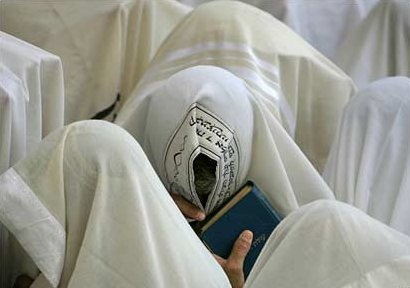
In Torah-study the person is devoted to the subject that he wishes to understand and comes to understand. In davening the devotion is directed to what surpasses understanding.
In learning Torah the Jew feels like a pupil with his master; in davening – like a child with his father.
-“Today’s Day”
Thursday, Tammuz 26, 5703
Compiled by the Lubavitcher Rebbe; Translated by Yitschak Meir Kagan
Chabad.org
Sometimes Christians believe they are more “spiritual” than religious Jews, but one of the reasons I tend to read and quote from sources such as Chabad.org and Aish.com is that they show me a spirituality in Judaism that I don’t always find in Christianity. This isn’t to say that there isn’t great spirituality in the church, far from it. It’s just that I don’t believe we have to make an “either/or” selection. I think that God dwelt among and within His people Israel in the desert of Sinai. I think He did so in a very physical and human way during the days when Jesus walked the earth.
And I believe that God is among His people Israel, the Jewish people even today. This does not undo the fact that God is also among and within the Gentiles who are called by His Name in the church as well.
No man can claim to have reached the ultimate truth as long as there is another who has not.
No one is redeemed until we are all redeemed.
Ultimate truth is an unlimited light—and if it is unlimited, how could it shine in one person’s realm and not in another’s?
-Rabbi Tzvi Freeman
“All or No One”
Based on letters and talks of the Rebbe, Rabbi M. M. Schneerson
Chabad.org
 I’m not saying that coming to faith in the Messiah doesn’t mean anything, quite the opposite. I’m also not saying there are two paths to salvation, one for the Gentile and one for the Jew (although very soon, I plan on expanding the definition of the “good news” of Messiah considerably in one of my blog posts). I am saying that God didn’t leave His people Israel to save the Gentiles, since we Gentiles only have access to God through the Abrahamic covenant, which comes to us only through Israel; the Jewish people.
I’m also saying this:
The Lord is not slow about His promise, as some count slowness, but is patient toward you, not wishing for any to perish but for all to come to repentance.
–2 Peter 3:9 (NASB)
This fits with what I just quoted from Rabbi Freeman (though I doubt the Rabbi would have applied it as such). In Christianity, we evangelize to take the good news of Messiah to all people. Judaism doesn’t evangelize but believes that all will be drawn to God through the Messiah, both Jews and Gentiles. From both points of view, God must be present and active in the lives of everybody everywhere, not just “special people.”
A friend of mine sent me a link to a commentary on last week’s Torah reading and pointed me to the last paragraph in the article:
The Midrash of Rav Yitzchak concludes that even today Elijah and Moshiach are still recording accounts of all our deeds to be included in future holy books. These works are sealed and affirmed by God Himself. From this we learn that our actions are not something between us and God alone, but must be done in such a way as to bring the respect and admiration of the surrounding society so as to promote the observance of Torah.
Again, this is midrash and not scripture, but it suggests something that “either/or” literalists may never consider. That the names of the “elect” in the book of the Lamb were written and sealed from before creation, and that names and acts are continually written inside the sealed book. If time were linear for God, words like “before,” “during,” and “after would mean something, but God exists quite outside of linear time. So when something was written before creation, since it is written outside of the linear stream of time and outside the bounds of a created universe, does our concept of “before” that exists within the universe even apply?
Who knows?
 I was talking earlier to some people at work about genius and “thinking outside the box.” Smart and clever people can be creative and even occasionally brilliant within their own “box” or how they conceptualize the world around them. Only a true genius or arguably a mystic can see themselves, how they think, and what they think about, from outside their own box, observing themselves, observing what they are considering, and realizing that there is an entirely different set of situations and circumstances outside of the box we continually are trying to put God in.
God’s Divine Presence was “contained” in the Tabernacle because God chose to allow it, but God also said that “Heaven is My throne, and the earth is My footstool” (Isaiah 66:1, Acts 7:49).
There are great mysteries about the nature of salvation, who is saved, and the role of Messiah in the salvation of Israel and the nations. While it is important for us to examine the meaning of all this, it is arrogant for us to assume that we can come to an understanding equal to God’s.
There are more things in heaven and earth, Horatio, than are dreamt of in your philosophy.
-Hamlet, Act 1, Scene 5
How is God with the Jewish people today? When God approaches us, are we able to respond to Him? Can we change our mind about God? How does God indwell human beings? I’m not convinced we should be absolutely sure how to answer any of those questions. All I know is that we should all sincerely seek God, and we should all sincerely seek peace, mercy, and justice by performing them day by day.
As it is said, when we study, we are a student and God is our Teacher. When we pray, we are a child and God is our Father. As it has also been said, “A disciple is not above his teacher, nor a slave above his master” (Matthew 10:24). Whether we see ourselves as students, as disciples, as children, or as slaves, we can only humbly turn to God, walk before Him, and wait His good pleasure to reveal what He will.
And only He will judge.
Addendum: See Rabbi Carl Kinbar’s comments below for some corrections to what I’ve written and quoted from in this blog post.












 Morning Meditations