Tag Archives: intermarriage

73 Days: The Higher Road Less Travelled

The number of Americans who say they have no religious affiliation has hit an all-time high — about one in five American adults — according to a new study released Tuesday (Oct. 9) by the Pew Forum on Religion & Public Life.

Labeled “nones” because they claim either no religious preference or no religion at all, their ranks have hit 46 million people. Much of the growth is among young people — one in three U.S. adults under 30 are now considered nones.

The report also found that the number of self-described atheists and agnostics has hit a peak — 13 million people, or 6 percent of the U.S. population. That’s a rise of 2 percentage points over five years.

Still, claiming no religious identity does not mean an absence of religious beliefs, the report found.

The majority of “nones” — 68 percent, including some who say they are atheists — say they believe in God or some form of higher being. Half say they feel “a deep connection with nature,” and 20 percent say they pray every day.

-Kimberly Winston
“Losing our religion: One in five Americans are now ‘nones'”
Religion News Service story

Those who intermarry face barriers to religious affiliation. Interfaith families who want to educate their children in two religions often cannot affiliate with religious institutions. Many religious institutions discourage or even forbid families from belonging to more than one religious community, or enrolling their children in more than one religious education program. These families may turn for support and religious education to independent interfaith communities such as the ones in New York, Chicago, and Washington DC. Or they end up religiously homeschooling their children in both religions. Either way, they may become part of the “religious but not religiously affiliated” demographic documented in the study.

-Susan Katz Miller
“Interfaith Marriage and the Rise of the Religious ‘Nones'”
On Being Both blog

This is the other road I could take and in fact, it’s probably, to some degree, the road I’ve been walking lately. Although I do have a “religious affiliation,” it is self-declared and unsupported by any larger group or community, at least in the face-to-face world. I’m a Christian, but one who doesn’t go to church or interact with other Christians in any manner except online. Even then, most of the Christians I interact with are otherwise identified as “Messianics” and a significant number of my online peers are Jewish.

Yeah, I’m one strange Christian.

Until I read the Susan Katz Miller article, I had no idea to what extent my situation was rooted in being intermarried. Here’s more of what she wrote:

I am grateful to Pew for drilling down into data on the “nones” and discovering some of the rich complexity of religiously-unaffiliated spiritual life. In an interesting parallel, many of the early studies on interfaith families conflated “doing nothing” with “doing both.” Just because a family does not affiliate with a church or a temple does not mean they are doing nothing. On the other hand, families may claim to be doing both, or attempt to do both, but cannot always follow through successfully without the support of clergy, family, or like-minded interfaith families. It will be important in future studies to examine the full range of practices, beliefs and experiences of unaffiliated interfaith families.

I encourage you to read Susan’s entire blog post to get the full context of what she’s saying about being intermarried and being “religiously unaffiliated.” In some sense, it’s rather empowering to think that there are many more people like me who, rather than “splitting the difference” so to speak, and having husband and wife exist in different religious worlds, choose instead to live “outside of official religious institutions.”

But that puts me into a state of flux again. Should I start attending a church, or some activity held at a church, and thus associate with other Christians? If I don’t and instead, continue on my current path, does that qualify me as a “none” and a “nobody?”

In the beginning, G‑d created everything out of nothing. He could have decided to make everything out of something, but He knew that nothing is better material than something. Because something is already whatever something is, but nothing can become anything.

That’s why, at least as far as this universe is concerned, the only way to become a real somebody is by being a nobody first.

Many of us today are nobodies. That’s okay. The moon must disappear before it becomes full again. The seed must rot away before it becomes a great oak.

-Rabbi Tzvi Freeman
“How Nobody Became Somebody”
Chabad.org

Rabbi Freeman tells an entire story between the second and third paragraphs of the quote just above, so you’ll have to click the link to find the full details. But the core of the message is just what I posted: there is a required relationship between being “nobody” and “somebody;” there is a necessary process involved in being emptied so you can become filled.

I started this “days” series at 78 Days, giving myself that amount of time (my time expires on New Year’s Day, 2013) to either figure out where I belong in the online and face-to-face community of God, or give it up, the blog, and maybe even my faith (outwardly, anyway) and just let the world of vitriolic attack dogs and nudniks (pests) toddle along on the web without me. That has nothing to do with being intermarried, but a lot to do with my patience running out for so-called “Christians” who completely miss the point of the one commandment of Jesus that we should all obey. Tragically, it’s the one commandment of the Jewish Messiah that is most often ignored. More’s the pity.

But while the visigoths may be pounding at the (metaphorical) gate of my so-called “peace of mind,” ready to invade and visit wide-spread destruction on everything in their path, though I could escape simply by withdrawing from the web, I can’t withdraw from the world. I know I’m supposed to do something, but I continue to vacillate between my options. I know that God has placed me here for a reason, and that unpleasant experiences (and unpleasant people) are also here for a reason. I’m not supposed to give up on even the nudniks, (although I finally had to on one) so I guess that means I can’t give up on myself.

I’m still not sure of what the process is where I’m supposed to be emptied now and filled later, but in trying to live out that process in writing and in person, I prefer to think of myself as taking “the higher road less traveled” (and I’m indebted to Lrw in her comment on one of my blog posts for suggesting the title of today’s “extra” missive). Whether I ultimately choose to contact a church, to attend church-sponsored activities up to and including Sunday services, and whether I maintain a long-term relationship with a church or not, (and I’m discovering that I’m not the only Christian who is afraid of church) I do trust that I am walking with God on that “higher road less traveled,” and that one of the reasons I have so few “traveling companions” is that my situation as an intermarried spouse really is unique.

“You block your dream when you allow your fear to grow bigger than your faith.”

-Mary Manin Morrissey

There’s got to be a reason for this mess and for “messy” people. I just need to keep walking on my higher road, and may I uncover the sparks I’m supposed to find, and then release them to Heaven, returning them, and you, and me, to the God who made us all.

“Not all those who wander are lost.”

-J.R.R. Tolkien, British writer

My Hope Comes From The Lord

Worry is self-humiliation. Trust is dignity.

To worry is to worship the world. To fall on your knees in dread and grovel before it.

To trust is to lift up your eyes and stand as tall as the heavens. To live with nothing else but the bond between G‑d above and you below.

-Rabbi Tzvi Freeman
“Just the Two of You”
Based on letters and talks of the Rebbe, Rabbi M. M. Schneerson
Chabad.org

OK, I need to review my own lessons on trust. Being human, I sometimes forget that reality exists on more than just a human level. As a person of faith, I believe in God, but it takes a person of trust to actually rely on God to do, if not the impossible, then the highly improbable. I speak of the topic I chronicled recently as Vain Hopes.

Yes, it’s no fun when your spouse tells you that the most important single aspect of your existence, your faith, is embarrassing to her, but that’s hardly something I can change. So what’s next?

Understanding. I can’t change who I am (well, I can, but that would involve not being a Christian anymore and I’m not willing to do that), but I can try to better understand who she is. Maybe that will be some comfort.

So who is she? Expanding on the question somewhat, what is being “Jewish?”

In a very real sense, I’m totally unqualified to answer that question since I’m not Jewish. Even if I received documentation tomorrow that proved beyond a shadow of a doubt that my mother was Jewish (which I’m sure would come as a complete shock to her) and that all of her ancestors were Jewish in a long line going back as far as could be recorded, thus establishing that I’m Jewish, it still wouldn’t give me something I would sorely lack: an actual, lived, experiential, Jewish life. So how can I describe something I’m not and that I have no experience in being?

Really, I can’t. You would think Jewish people could, but actually, it’s more complicated than it seems.

I’m just out of college and struggling to forge my identity. I have strong Jewish feelings, but am meeting some really nice non-Jewish women and am having trouble articulating why Judaism is so central to my identity.

Can you tell me why I should hang in there with the Jewish people?

“Why be Jewish?”
Ask the Rabbi
Aish.com

Please click the above link and read the Rabbi’s answer, but personally, I found his response rather disappointing. What the Rabbi outlines as the advantages of Judaism, living a moral life, specific Jewish values, and so on, could as well be applied to just about any person who follows the lessons of what God gave to the world, “a set of ‘instructions for living’ – the Torah.”

However, the answer to another Ask the Rabbi question may prove more illuminating.

To categorize Judaism “only” as a religion is a misunderstanding. The Jewish people are a nation, who share a common land (Israel), a common religion (Judaism) and a common history (dating back to Abraham).

What is amazing is how the Jews have maintained their distinct national identity having been scattered to the four corners of the globe. This achievement was possible only because of our adherence to the Torah, the “constitution” of the Jewish people. The Torah lays out the scope of personal rights and obligations, as well as laws covering lifecycle, business practice, medical ethics, parenting, married life, etc. Observance of the Torah was thus the thread which kept the Jewish people alive, and thriving, in every place and time.

Judaism cannot be classified as a race, because anyone can become a Jew by converting. The convert is considered a Jew in every regard, and his relationship with God is the same level as that of every other Jew. Come to Israel and you will find black Jews, oriental Jews, Indian Jews, etc.

This is what Christianity lacks. We can enter into a covenant relationship with God through Jesus Christ, and draw close to his covenant community Israel, but we don’t become what the Rabbi describes above; a nation, a people, a unified whole that transcends the boundaries of religion, and if you include those few who convert, ethnicity and race.

Well, that’s not quite true. Anyone, regardless of national origin, race, color, ethnicity, gender, or any other attribute, can come to Christ and worship the God of Israel. But we are of the many nations and the Jews, regardless of where they were born, what secular citizenship they may possess, and whether or not they were born of a Jewish mother or converted from the nations, are uniquely of Israel, and though scattered across the planet, form a united nation before God.

Chief Rabbi Lord Sacks, in his commentary on Torah Portion Nitzavim, said:

As the commentators point out, the phrase “whoever is not here” cannot refer to Israelites alive at the time who happened to be somewhere else. That cannot be since the entire nation was assembled there. It can only mean “generations not yet born.” The covenant bound all Jews from that day to this. As the Talmud says: we are all mushba ve-omed me-har Sinai, foresworn from Sinai (Yoma 73b, Nedarim 8a). By agreeing to be God’s people, subject to God’s laws, our ancestors obligated us.

Hence one of the most fundamental facts about Judaism. Converts excepted, we do not choose to be Jews. We are born as Jews. We become legal adults, subject to the commands and responsible for our actions, at the age of twelve for girls, thirteen for boys. But we are part of the covenant from birth. A bat or bar mitzvah is not a “confirmation.” It involves no voluntary acceptance of Jewish identity. That choice took place more than three thousand years ago when Moses said “It is not with you alone that I am making this sworn covenant, but with … whoever is not here with us today,” meaning all future generations including us.

But how can this be so? Surely a fundamental principle of Judaism is that there is no obligation without consent.

Please read the full commentary by clicking the link above, but the reality of the Jewish people and Judaism, is that it exists and is obligated to God beyond the simple will of the individual. When you are born a Jew, the mitzvot are yours, whether you want them or not. In the best of all possible circumstances, you are taught to live a Jewish life and you learn to love that life as a Jew before the Throne of Hashem. Judaism chooses the Jew, not the other way around (apart from converts).

In Exodus 4:22, God directly refers to Israel as “My child, my firstborn, Israel.” Whoever and whatever we are as Christians, we do not enter into the presence of God except through Israel.

You worship what you do not know; we worship what we know, for salvation is from the Jews.

John 4:22 (ESV)

If we consider the Jewish Messiah as the firstborn of Israel, this point becomes even more specific.

Jesus said to him, “I am the way, and the truth, and the life. No one comes to the Father except through me.

John 14:6 (ESV)

The irony for me is that my closest Jewish relative is my wife, and not for a split second would she consider Jesus as the Jewish Messiah, nor see herself and her people as the authors of my salvation through Christ.

More’s the pity, and I pray that it won’t always be that way.

None of this is doing a very good job of defining who a Jew is or what Judaism is, at least down to the finest details. In fact, it gets a little more confusing when you consider the Ask the Rabbi answer to Definition of a Jew:

Torah methodology is universal – for Jews and non-Jews, religious and secular, Israel and the Diaspora, left and right. The Torah is alive and relevant for today. And for the Jewish people, the ability to effectively communicate this message is our single most important undertaking.

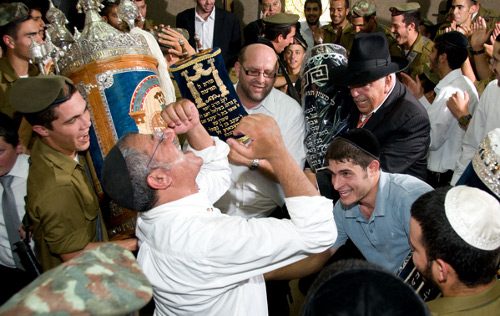
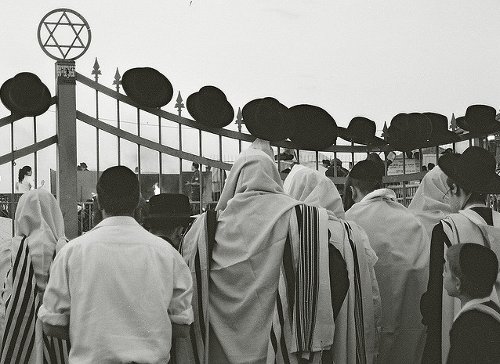
Simchat TorahThis makes it seem like what the Torah contains, at least at its core, is a set of instructions that applies to all of humanity, not just the Jewish people, but it is the responsibility of the Jews to “effectively communicate this message.” That sounds almost evangelical, until you realize the mission of Judaism isn’t to make the people of the nations into Jews, but to teach them/us about the One true God of Israel. In modern traditional Judaism, that extends no further than the level of the Noahide, but from Christianity’s point of view, we enter a whole new world when we know God by accepting Christ.

Where that world takes us is a journey beyond imagination, and one that is unique, in many ways, to each individual. In some ways, as is in my case, it actually leads somewhat away from its source; away from Judaism, at least at the personal level, since most Jews cannot tolerate a great deal of Christianity in their lives. But while faith is easy, trust comes very hard, especially in the presence of disappointment.

However, as Rabbi Freeman stated at the beginning of this “meditation,” “To trust is to lift up your eyes and stand as tall as the heavens. To live with nothing else but the bond between G‑d above and you below.”

Please forgive me if I take the liberty of applying those words of wisdom to all of us and not just to the Jewish people.

I lift up my eyes to the hills. From where does my help come? My help comes from the Lord, who made heaven and earth.

Psalm 121:1-2 (ESV)

When you’re in the middle of the journey and it all seems so futile and hopeless, then the path has reached its end, regardless of what actually lies before you. But when there is hope, when you lift your gaze out of the dust and darkness and raise your head up to see the light, the journey begins again as if you had just taken your first step.

Vain Hopes

“Cast your burden upon Hashem, and He will sustain you.”

Psalms 55:23

Everyone in the world has burdens. Some are heavier than others – some are lighter. You cannot always tell how heavy someone else’s burden is; you only have the subjective experience of your own. But know, with clarity, that just as you have burdens, so does everyone else.

Here we have the ultimate advice on how to handle your burdens: do not do it alone. You never have to do it all yourself. As a matter of fact, it’s impossible to do it all yourself. You can call upon the Almighty, your Father, your King, Creator and Sustainer of the universe to help you. Our verse tells us that you can give over your entire load of baggage to Hashem, and He will sustain you.

-Rabbi Zelig Pliskin
Casting Your Burdens, Daily Lift #595
Aish.com

I had a most illuminating conversation with my wife a few weeks ago. Actually, it wasn’t so much illuminating as it was confirming. I don’t know how we got on the subject. We were home alone, just the two of us. We were talking at the kitchen table. I can’t remember exactly the words that were used but I discovered, or rather confirmed, the reasons that I will never be part of my wife’s Jewish life. She’s embarrassed that I’m a Christian.

I guess that’s why she never invites her friends over to our house. She always meets them for coffee or something. I think it’s just awkward to acknowledge me in front of other Jews. She said during our conversation, “What am I supposed to do? Introduce you as my ‘Messianic husband’?”

I corrected her and said that I’m a Christian and that I walked away from the “Messianic” life, in part, just for this reason. I don’t think it helped. I think, in her eyes, it’s just as bad for a Jew to be married to a Christian as to a “Messianic Gentile.”

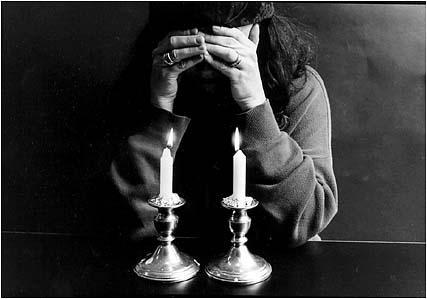
At any rate, the end result, which is now finally in the open, is that I will not be attending shul with her, nor any classes at synagogue, nor any public festivals such as Sukkot. I even wonder if this is why she stopped lighting the Shabbos candles in our home. For all I know, she doesn’t go to synagogue anymore because people there know she’s got a Christian husband. For all I know, tongues wag about this misfortune of my wife’s.

That last part is my imagination, but again, who knows?

I never wanted my faith to come between us. For over a year, I’ve done everything I could think of to minimize the “impact” of my Christian faith in her Jewish life. Now I know that nothing I did worked. I’m embarrassing. I recall a situation that happened some months ago when my wife and I were shopping at our local Costco. We had just checked out and were about to leave when my wife ran into a friend from synagogue. They chatted for several minutes and then parted. All during their conversation, at no time did my wife pause to introduce me to her friend. It was as if I wasn’t even there. I guess I know why now.

“I came to cast fire on the earth, and would that it were already kindled! I have a baptism to be baptized with, and how great is my distress until it is accomplished! Do you think that I have come to give peace on earth? No, I tell you, but rather division. For from now on in one house there will be five divided, three against two and two against three. They will be divided, father against son and son against father, mother against daughter and daughter against mother, mother-in-law against her daughter-in-law and daughter-in-law against mother-in-law.”

Luke 12:49-53 (ESV)

This compares to Matthew 10:34-39 which also quotes Micah 7:6. I thought I recalled a variant on the Gospel verse that specified “husband against his wife,” but I can’t find it.

Close enough, I guess.

But I don’t want to be against my wife, nor do I want her to be against me.

Tough luck, eh?

I used to say that “in a created universe, there’s no such thing as luck,” but just how closely does God control circumstances? Were my wife and I truly fated to be married, or did God allow random chance to take charge? What about our decisions of faith? I might never have become a Christian if not for a long and what seemed to be, highly orchestrated and unlikely series of events that occurred over several month’s time. My wife became a Christian at almost the same time and for a while, we had similar ways of looking at God, Christ, faith, and marriage.

Then, through another set of long, unlikely occurrences, we have found ourselves where we are now: at opposite ends of the identity of the Messiah, a Jew and a Christian searching for God while living in two very different worlds. And thereby hangs our tale. I could stand to have the rest of the world be the enemy of my faith as long as my wife was by my side. Now, I realize that such a wish is vain and foolish. If “God is in control” as the Christians like to sing in church on Sundays, then what he’s planning to do with all of His control is beyond my comprehension.

Or, as Paul Simon sings:

God only knows
God makes his plan
The information’s unavailable
To the mortal man
We work our jobs
Collect our pay
Believe we’re gliding down the highway
When in fact we’re slip slidin’ away

Or is that too cynical?

And he said, “Naked I came from my mother’s womb, and naked shall I return. The Lord gave, and the Lord has taken away; blessed be the name of the Lord.”

Job 1:21 (ESV)

I suppose that could be coupled with:

Though he slay me, I will hope in him; yet I will argue my ways to his face.

Job 13:15 (ESV)

Argue? Argue about what? Shall I adopt Adam’s argument?

He said, “Who told you that you were naked? Have you eaten of the tree of which I commanded you not to eat?” The man said, “The woman whom you gave to be with me, she gave me fruit of the tree, and I ate.”

Genesis 3:11-12 (ESV)

No, that’s as ridiculous now as it was the minute Adam said it. There’s no blame to be assigned, either to God or to my wife. I can’t even blame myself for being a Christian, since I must be convinced that this part of my experience was and is within the purposeful will of God.

So what do I do? Of late, I had been considering going back to a church. My son David told me he’d talked to a Pastor of a local Baptist church who had lived in Israel for fifteen years (not as a Pastor, but before being called into the ministry). No, he’s not Jewish, but this Pastor did tell my son that he didn’t consider himself “usual” for a Baptist Pastor.

But now I don’t know if it’s a good idea. The wedge is there between my wife and I and if I cannot bridge the gap and heal the wound that gapes wide and bleeding between us, I certainly don’t want to rip it open any further. Right now, I’m just one Christian alone in our house with no direct connection to any larger group of Christians. If I started going to church, how much worse would it be for the both of us?

My wife doesn’t invite her Jewish friends over because she’s embarrassed by me. She removed any pictures and other items from our home that were obviously communicating a faith in Christ (we once had a framed copy of the Lord’s Prayer written in Hebrew on the wall of our formal dining room), but unless she’s willing to give me the boot, my very presence (though I wouldn’t speak a word) is a glaring inconsistency to her faith and her life as a Jew.

Conversely, I couldn’t bring any Christian friends home, couldn’t host a Bible study, couldn’t have a few church friends around for coffee, not because I’m embarrassed that my wife is Jewish, far from it. No, but because it would be very difficult for her to tolerate.

Of course, she would say that I’m within my rights to practice whatever faith I choose in whatever manner I choose. She would never deny me that. But exercising my rights is still an embarrassment to her, at least in the presence of anyone she knows who is Jewish. Add this to my list of reasons why I can’t go to church.

I cannot do what logic would suggest, though, even for the sake of peace in the home:

So everyone who acknowledges me before men, I also will acknowledge before my Father who is in heaven, but whoever denies me before men, I also will deny before my Father who is in heaven.

Matthew 10:32-33 (ESV)

I sometimes envy those Christians out there in the “Messianic” space for whom faith is just an intellectual exercise. Those folks who are almost obsessed with their sometimes unique take on “Judaism” in terms of personal doctrinal statements, systematizing theologies, categorizing the Jewish mitzvot, and other arcane pursuits, and yet who never actually feel and live a life immersed in pools of infinitely deep faith, transcending the written word and living between life and death, between love and despair, between God and the emptiness of the abyss.

There are all manner of interfaith marriages and many are able to make their way across the differences and to share the commonalities. My wife and I too share many commonalities between us, but our lives of faith and our vision of God are not among them.

As I was “mentally composing” this missive some hours ago (as I write this), I couldn’t help but be reminded of Solomon and Ecclesiasties:

For what happens to the children of man and what happens to the beasts is the same; as one dies, so dies the other. They all have the same breath, and man has no advantage over the beasts, for all is vanity.

Ecclesiastes 3:19 (ESV)

(My son and I built the sukkah in my backyard on Sunday afternoon, just hours before Sukkot began and I suppose the experience is what brought all this to the surface with such force…after all, what business do I have performing the mitzvah of building a sukkah…and notice that I’m blogging during the first two days of Sukkot…however, my son is Jewish so I guess that covers it)

With all of this in mind, I have been examining time, the past, the future, marriage, life, faith, as if they were all in a sealed box that I am turning over and over in my hands. God made the box, inserted all that it contains, locked it tight, and gave it to me. No, that’s not fair. I’ve certainly contributed the vast majority of the items the box contains. We all take the basic materials God gives us at birth and make them into what we are today. I can’t blame God or argue with Him, tempting though that might be.

Maybe that’s why Solomon wrote Ecclesiasties…because no matter what we do, we’re born, we live through whatever happens, and then we die. In the end, what will it matter? Why do some of us who are unworthy live, and others who are very worthy die? (you’ll need a Facebook account to open that last link). It’s a mystery. Who can know the vastness of the mind of God?

I quoted Psalms 55:23 at the beginning of this blog post, but as I’ve been reminded periodically, not everything that is written in the Jewish texts, including the Psalms, can automatically be applied to we non-Jewish Christians. Perhaps my desire to cast my burdens on God is merely vanity as well.

If you are ever feeling sad or dejected, there is a faster and better way to create a more positive feeling that to simply wait until the feelings change through happenstance. There are a few basic choices with a multitude of variations. You can take positive actions. Perform a mitzvah and experience joy for the good deed you are doing. Also, you can remember the good in your life and the positive things that have happened to you in the past. If need be, you can find a positive lens through which to see your present distress.

-Rabbi Zelig Pliskn
Creating Positive Feelings, Daily Lift #594
Aish.com

Alone in silenceI can’t stop being a Christian and so I can’t stop being an embarrassment in the home. If I can’t openly express my faith, except in the blogosphere where she never travels to, then the mitzvah I must perform is to try to stay out of the way of her being Jewish. That’s kind of hard since we live in the same home, but I can only encourage her to do all that she can and must do as part of her Jewish community.

And as for me? I originally created this blog, this “morning meditation,” to chronicle my anticipated journey of faith with my wife into her Jewishness. Now that I realize my ambitions were only vanity and foolishness, what is there left to accomplish?

I have several projects related to this blog that are in process. Once those processes have reached their conclusion, the results may well dictate the continuation or dissolution of this experiment. As always, you’ll be the first to know of my decision.

Man On A String

interfaithFortunately, sociologist Steven M. Cohen has awakened me from my bloggy slumber with a post on Rosner’s Domain, a blog on L.A.’s Jewish Journal. Journalist/blogger Shmuel Rosner (who updates his blog just a wee bit more than I do) asks sociologist Steven M. Cohen, “Are you biased against intermarried Jews?” In essence, Cohen’s reply is that he has no problem with intermarried Jews, just with intermarriage.

-Julie Wiener
“Some Of My Best Friends Are Inmarried”
from the In the Mix series
The Jewish Week

I’ve missed Julie’s blogs. As an intermarried Christian husband to a Jewish wife, I have a sort of affinity with her favorite topic. On the other hand, even for an intermarried couple, my wife and I are very strange. We don’t fit anyone’s idea of intermarried, mainly because my wife’s parents were intermarried (her mother was Jewish) and she wasn’t raised in a Jewish household.

In a blog post called Being Married to the Girl with the Jewish Soul, I’ve mentioned how I feel about my wife, about her being Jewish, and about my absolute need for her to embrace her Judaism. If you haven’t read it yet, please do so before continuing here. It’ll provide a lot of context and dimension for what I’m going to say next.

Being intermarried is not bed of roses but it’s not exactly a bed of thorns, either. It does define a demarcation point between my wife and I on certain topics, but for the most part, our marriage is just like a lot of other marriages in the U.S. We’ve been married thirty years as of last April. We have three adult children. One of my sons is married and has a three-year old son of his own (my grandson, playmate, and fellow Spider-Man fan).

Another thing that makes our particular intermarriage unusual is my background in the Messianic Jewish/Hebrew Roots movement. As a blogger, I’m remain actively involved in that realm, but only because I tend to write on Jewish and Christian themes. My wife intermittently attends shul and I don’t attend a church or congregation of any kind (long story). We both have our faiths but except for brief moments of passionate interaction on some point, they have lives of their own and rarely show up in the same room. I started this blog fifteen months ago, in part to chronicle what I imagined would be my introduction into her religious world.

When that didn’t happen, I kept on writing because that’s just what I do. I write.

Back to why I’m writing this though. As I was reading Julie’s latest blog, I started thinking about my marriage and how it seems to mirror the larger dynamic between Christians and Jews in the world. More specifically, there is a significant parallel between how I live every day of my married life and the sort of relationship, call it a vision, I would wish upon the Christians and Jews to attempt to connect and interact within the Messianic space.

There’s a sort of debate going on in certain corners of the blogosphere about the exact interaction between Jews who believe that Jesus is the Messiah and those Christians who are drawn to a more Jewish (or Hebraic) lifestyle and worship template. For years, there’s been a kind of “jockeying for position” among the various groups that reside beneath the Messianic Jewish/Hebrew Roots umbrella regarding whether or not it was Christ’s original intent for non-Jewish disciples to perfectly emulate their Jewish mentors in all things, including a form of “Jewish” identity.

I used to believe that such an emulation should take place and now I don’t. Some people didn’t (and still don’t) appreciate that I changed my mind, let alone my lifestyle.

But here’s the interesting part.

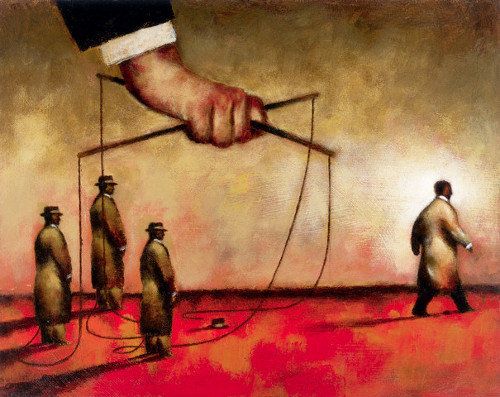
Sometimes, the motives for my change in perspective have been attributed by others to the influence of various individuals and groups in the Messianic Jewish world who advocate for a Jewish/Gentile distinction within Messianism. It was as if I was accused of being a type of Pinocchio to a Messianic Jewish Geppetto; a marionette dancing at the end of someone else’s strings.

I certainly won’t deny that I have been influenced by various folks in the online and real world Messianic community, but that alone probably wouldn’t have been enough to start me investigating the scholarly and Biblical evidence for Jewish and Christian covenant distinction and relationship. After all, organizational position statements and blogosphere commentaries have never changed anyone’s mind about anything.

But I’m married to the girl with the Jewish soul and that made all the difference in the world.

I know I’ve probably explained this before, but I don’t think people understand how important this is to me. I doubt that even my wife understands any of this. Remember in my previous blog post I stressed how vital it is for me to support my wife being Jewish. Obviously, I can’t direct her observance or her lifestyle, but I know how to avoid standing in her way.

In addition to traveling on my own journey of faith, I’ve been watching my wife’s journey. As the months and years passed, I saw just how critical it was and is for her to be part of the Jewish community, to be thought of and treated as a Jew. Every time I picked up a siddur or she “caught” me praying with a tallit and tefillin, I started to feel as if I were stealing from her. It was as if she walked into the room while my hand was in her purse. It was embarrassing and I felt it was pushing us apart rather than bringing us together.

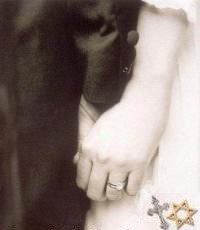
intermarriageNot that she said anything, of course. She always supported me in whatever expression of my faith I chose to observe (though there were times when she was vocal about not understanding it) but I could sense a growing wedge between us. She tried to discourage me from leaving my One Law congregation and I know she didn’t want to influence any of my decisions about what I believed and how I acted upon those beliefs.

Fat chance. How can a husband not let himself be influenced by his wife if he cares about her?

Setting all of those people, those congregations, those organizations aside who have some sort of stake in Messianic worship between Jews and Christians, I’m still a Christian husband married to a Jewish wife. I’m not the perfect husband of course (and my wife reminds me of that periodically), but that doesn’t mean I don’t love my wife and that what’s important to her doesn’t matter to me.

Being Jewish is important to her. Forging a Jewish identity and Jewish relationships for the first time as she’s well into middle-age wasn’t easy for her. She worked very hard to establish her place in the community of Jews. Being married to a non-Jew isn’t a disaster for a Jew, but my being a Christian does throw a monkey wrench into her machine (she’d deny this). My being “Messianic” and performing traditional Jewish acts of worship absolutely threw a pipe bomb into her machine (she’d deny this, too).

My wife is more important to me than whether or not someone on a blog somewhere thinks I should wear a tallit when praying, devote myself to a day of complete rest on Saturday, and try talking to God in a bad approximation of Hebrew (I know some of you are thinking about Matthew 10:34-39, but I don’t think that applies here). That’s why I do what I do and don’t do a bunch other things that other people do.

This next part is important, so pay close attention here! While I agree that Jews continue to have a special covenant relationship with God and unique covenant responsibilities that are not shared by the rest of the world, (including the world of Christians) what really sent me “over the edge” was filtering all that information through the lens of watching my Jewish wife be Jewish. If you’re not a Christian husband married to a Jewish wife, you don’t have my perspective and you are absolutely not going to get the lived experience of my point of view.

But there’s hope. I think I know how to show you what I’m feeling. I’m getting to that part.

Being married to a Jewish wife has allowed me to see Judaism from a singular perspective. I can see how important it is for a Jewish person to be uniquely Jewish and how some Jews struggle when they see others trying to co-opt that uniqueness for their own use. Part of that uniqueness is the way Jews talk, and pray, and worship, and interact, and what they wear sometimes, and lots and lots of other “identity” stuff.

And I don’t want to put my hand in my wife’s “purse” because I love her and I don’t want to take stuff from her.

Please understand that I’m not dancing at the end of some puppeteer’s strings. I’m just a husband who is looking out for his wife. I suppose my methods of doing so seem strange or unusual, but even for an intermarried couple, we can be strange and unusual. She’s not a stereotypical Jew (if there is such a thing) and I certainly am a very odd Christian.

But that’s who I am and who I choose to be and why I’ve made the choices I’ve made. I don’t think these are bad choices and in fact, I think there is a lot to be gained by we Christians coming alongside the Jewish people, even as I am “alongside” my wife, and being co-heirs with Israel, just as my wife and I share our lives together.

I was discussing some of this with my friend Gene on his blog Daily Minyan, and at one point, I made this observation in response to one of his comments:

When I was at the FFOZ Shavuot conference last spring, I met a young Jewish woman named Jordan. She is a gifted scholar and during one of her presentations at the conference, she referred to the Gentiles who supported the spiritual and national redemption of Israel as the crown jewels of the nations. Your comment reminded me of that and the fact that we Gentile disciples of the Master do have a wonderful gift from God, and He has planned out a terrific future for us.

Jordan’s teaching meant a lot to me, not just because it presented such a wonderfully unified vision of a Christian/Jewish “partnership” in the Kingdom of God, but because it so amazingly resonated with how I see my marriage. If I could give everyone reading this blog a gift, it would be to see the relationship between Christianity (that is, all non-Jews who are disciples of Jesus, regardless of denominational or congregational affilation) and Israel the way I see myself and my wife together. If we Jewish and Christian disciples of Jesus could achieve that level of affection and intimacy toward each other, we would be fulfilling the words of the Master.

A new commandment I give to you, that you love one another: just as I have loved you, you also are to love one another. By this all people will know that you are my disciples, if you have love for one another.” –John 13:34-35 (ESV)

Love and peace.

Cherishing Her Yiddisher Neshamah

Tonica Marlow stood looking down into the main hall of the synagogue. She couldn’t take her eyes off the rabbi or the Torah scroll he held in his hand as he faced the congregation. What am I doing here? she kept asking herself. So many times she had promised herself never to come here again, and yet here she was again, dressed in a brown wool habit, her hair covered with a brown scarf.

“Shema Yisroel Ado-nai Elo-heinu Ado-nai Echad,” the rabbi’s voice rang across the synagogue, and the congregants repeated after him. Tonica, too, found herself mouthing the words, though she knew not what they meant. She didn’t understand why her feet kept carrying her back here; but the more she came, the more she longed to hear those precious words again.

Her mother had been born a Jew, that much she knew. But then she’d converted, abandoning her Jewish faith at age 25 and marrying a gentile. Tonica, the youngest of five children, had been raised as a non-Jew. Nonetheless, the question cried out from her very soul: Who am I? It gave her no rest, the question; it tormented her, robbed her of her peace of mind.

Tonica watched as the rabbi lovingly replaced the Torah scroll into a wooden sculptured cabinet and drew the dark blue curtain over it. Then she hurried back to the theological college where she was studying to become a minister.

But she’d tarried too long; she was late for her responsibilities. The principal summoned her to his office. “Where were you?” he demanded.

“Why, I just popped into the synagogue for a few minutes,” she said.

“What?” the principal yelled. “I’m telling you, child, you are a gentile. I forbid you to go there.”

-Mirish Kiszner
“I’m Telling You, Child, You Are a Gentile
A spiritual journey: from Tonica Marlow to Tova Mordechai”
Chabad.org

I got an email announcing a beta version of the new Chabad.org website, so naturally, I clicked on the link. That’s where I found Tova’s story. I started reading it because of the provocative title (“I’m telling you child, you are a gentile”) and continued reading because it reminded me of my wife’s journey…with some differences.

Of course, my wife wasn’t studying for the ministry when she became connected to her Judaism but at the time, we were going to a church. She didn’t go to Israel for years afterwards and never lived with an Orthodox family, but the same “connectedness” was there, the same absolute “need” to be a part of the Jewish community was there for my wife as it was for Tova.

Maybe if she had started that journey at 25 instead of 45, things would have been different.

But she didn’t and they aren’t and here we are.

Tova’s story, at least as it’s rendered in this article, is very light on the details regarding her husband. If she was a Christian and studying for the ministry and she had married a Gentile, chances are that he was (and is?) a Christian, too.

I wonder what happened to him? What happened to their five children? They all live in Israel now. But who are they?

Of course, I could just buy Tova’s book, To Play with Fire, which is the chronicle of her journey from Christianity and return to Judaism. As I write these words, I realize that I probably will.

But what will it tell me about my life?

Probably not as much as I hope.

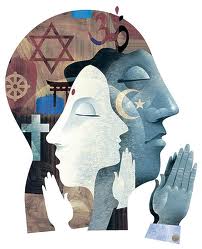
intermarriageI suppose this is a continuation my previous “meditation,” Opting Out of Yiddishkeit. It contains the same themes: identity, Judaism, intermarriage, interfaith, connectedness, and “just what the heck does God want from me, anyway?”

I was talking to my son this morning after our workout at the gym. He was asking how my Thursday afternoon “coffee meeting” went. I had taken him to one such meeting a few weeks ago with interesting results. Since the men I meet with are all believers, I think my Jewish wife thought I was trying to turn our Jewish son (though he’s not observant in the slightest right now) into a Christian.

That would not sit well with her.

I told him that his mother would be very happy if he’d start going to synagogue again, and asked how his wife would take it, since she (his wife, not mine) is seriously considering returning to church. He tells me that it would be fine with her, but then I brought up my grandson. At only age three, how confusing would it be to have his parents going in different directions?

But that brings me back to my own family and my own situation and the answers just aren’t getting any clearer. Some people would say that Messianic Judaism is the answer as the nexus of Christianity and Judaism, but it doesn’t really work that way. Why?

Sid (played by John Leguizamo): Then why are you trying so hard to convince her she’s a mammoth?
Manfred (played by Ray Romano): Because that’s what she is! I don’t care if she thinks she’s a possum. You can’t be two things.

-from Ice Age 2: The Meltdown (2006)

You can’t be two things. I don’t mean that you can’t be Jewish and have a deep, abiding, and real faith in Yeshua HaMashiach (Jesus the Christ). I mean that your identity, your culture, the very fabric of who you are, right down to the DNA level is either Gentile or Jewish. Just like Tova discovered; just like my wife discovered, you’re either one or the other. You can’t be both.

Most “Messianic Jewish” congregations aren’t all that Jewish, at least as far as I know. There are very few that have a completely Jewish synagogue identity and practice. Many, probably most, employ some aspects of a Jewish synagogue service, but largely, their identity as individuals and as a group are Gentiles who come from a strong, traditional, Christian background.

There’s nothing wrong with that, but then using the term “Jewish” becomes a misnomer. They may be a group who acknowledges the Jewishness of Jesus as the Messiah, who loves Israel, who honors the Shabbat and believes that the Torah continues to be alive and strong and incredibly present in the lives of the Jewish people today, but they aren’t Jewish.

Beth Immanuel Shabbat Fellowship is probably the Messianic congregation I’ve attended that has come closest to achieving a true Jewish synagogue identity, but I suspect that the majority of the members and the staff are still non-Jewish. Again, there’s nothing wrong with that, but what if you’re Jewish and you not only want, but you absolutely need to worship with Jews, be around Jews, and belong to a Jewish community?

I suppose like Tova, you stop being Christian and move from being Tonica Marlow to being Tova Mordechai. Or you move from being Lin to being Yaffa (my wife’s given and Hebrew names). Or, like my friend Gene, you maintain your Messianic faith, but you regularly worship with an Orthodox Jewish community.

None of this is at all easy.

I check the statistics for this blog and frankly, personal explorations such as this one just don’t capture a lot of reader interest. I don’t know why, since the stats only provide raw numbers without the attendant human motivation.

However, one of the “meditations” I wrote seems to be getting some attention recently: Fearfully in the Hands of God. Near the end of the blog post, I wrote this:

I know this sounds dismal and depressing, especially on the day when the vast majority of the Christian world is celebrating the birth of the King of Kings, but lest we imagine that God is obligated to grant us a perfect, stress free existence, the counterpoint is that we are but dust and ashes; we are grass that is growing today, and tomorrow, is withered and thrown into the fire. In the end, we can try to live healthy lives, lives of faith, devotion, charity, and study; we try take care of ourselves and others, but still, no one knows the hour of his own death.

In those moments of hideous uncertainty or in that final ”moment of truth”, we can only summon whatever trust in God we may possess and cry out to Him for His infinite mercy. If he should turn the hand of sickness and death away, we rejoice, and if not, we are with Him.

When a Christian cries out to God, we just cry out. But a Jew does something different.

Tova relates that some years ago her mother was lying on the operating table before undergoing life-threatening surgery. From the depths of her mother’s soul, a desperate cry shot forth, “Shema Yisroel Ado-nai Elo-heinu Ado-nai Echad.”

The Shema is the first prayer taught to children and it is the prayer at is on the lips of any Jew who is afraid they’re about to die. In some way we non-Jews don’t understand, it is a special conduit between a Jew and God.

Most Christians are baffled why Jews don’t convert to Christianity. Those Jews who come to faith in Jesus but express that faith within a Jewish Messianic context are thought by non-Messianic Jews to have converted to Christianity. Christians generally don’t think so and either publicly or privately, wish those “Messianic Jews” would stop “denying the power of Christ’s death on the cross” (as Pastor Tim Keller might say), and actually come to a “true faith” in Jesus Christ; that is, convert to Christianity.

But as you, my readers, already know…it’s not that simple.

And it’s not right. It’s not right to finish the job that the Holocaust started. It’s not right to cooperate with terrorists who are hurting and murdering Jews to his very day. It’s not right to try to reduce the Jewish population of the world to zero.

Most Christians and even most atheists would say that it’s a sin and a crime to commit genocide, to try to eradicate an entire race, population, or nation. “Ethnic cleansing” is considered barbaric and monstrous by every one except the barbaric monsters who are committing those acts…except when it happens to Jews. Then the world, including most of the Christian world, just doesn’t give a damn.

That’s why I have to support my Jewish wife being Jewish. That’s why I have to support my son returning to davening with a siddur and praying the Shema (though he’s not very close to this point at the moment). And that’s why Christian Tonica became Jewish Tova and currently “lives in Tzfas (Safed), Israel, with her husband and five children.”

I’m sure each interfaith marriage is different. I don’t doubt that each one has its challenges and even its heartaches. I do know that I have my own journey to travel, both as an individual of faith and as a Christian husband married to a Jewish wife. I know that journey is not as simple as converting to Judaism or simply abandoning Christianity for atheism, just for the ways of peace.

I keep asking the question, where do I go from here? I keep answering the question, I don’t know. Except I do know, albeit in an extremely limited sense. I keep going forward, day by day, moment by moment. Yesterday afternoon, I had coffee with a friend and then I went home. I made hamburgers and talked to my wife about her day. My daughter came home and we talked with her for a bit. Then I read for a while and went to bed.

Life is normal. Being married to the girl with the Jewish soul is not really fraught it anguish and troubles all of the time, at least not on the surface. Somewhere beneath the surface of the blue crystal waves, God waits and He’s doing stuff I can’t see. So I walk or I sail or I swim as best I can in the direction I think God wants me to go.

And maybe God has a few surprises left for me on this path I’ve chosen (or did He choose it for me?). I hope they are surprises I can take.

There is an easy path to fulfill the Torah as it is meant to be fulfilled. Not by forcing yourself, nor by convincing yourself, but by achieving awareness:

A constant awareness that all you see and hear, the wind against your face, the pulse of your own heart, the stars in the heavens and the earth beneath your feet, all things of this cosmos and beyond . . .

. . . all are but the outer garments of an inner consciousness, a projection of His will and thoughts. Nothing more than His words to us, within which He is concealed.

And the Master of that consciousness speaks to you and asks you to join Him in the mystic union of deed and study.

In such a state of mind, could you possibly choose otherwise?

-Rabbi Tzvi Freeman
“Natural Response”
Based on letters and talks of the Rebbe
Rabbi M. M. Schneerson
Chabad.org

It’s probably too much to ask that they be surprises that make me happy.

Opting Out of Yiddishkeit?

On today’s daf we find halachos that apply to converts.

Converting is a huge sacrifice, which God values greatly—and so should we. But as is well known there is a halachah that a non-Jew who converted as a minor can recant his decision upon reaching majority. In that case, he reverts to being a non-Jew. How sad that he lost out on such a special distinction due to some passing whim!

There was a case where a family converted together; mother, father and children. When one son heard that he was allowed to opt out of Yiddishkeit, he honestly said that he wanted to let go of his conversion. “If I am obligated to be a Jew that is one thing, since God wants me to fulfill the mitzvos. But if I am able to be a non-Jew, why should I take on the obligation to do all the mitzvos? How can I know that I will fulfill them as I should? Isn’t it better for me to go the easier but more sure way?”

But when he expressed this wish, the dayan he spoke to wasn’t sure what to do. “I am not sure whether when an entire family converts one who was a minor at the time can opt out. This is a machlokes Rishonim and I am not certain how we rule.”

When this question reached the Chasam Sofer, zt”l, he ruled decisively. “We hold like the Rishonim who rule that a convert whose entire family converted with him cannot opt out of his Jewishness.”

Daf Yomi Digest
Stories Off the Daf
“The Convert’s Choice”
Niddah 49

I’ve been thinking a lot about religious observance recently. Actually, I’ve been thinking about it for a long time and wondering if I’d ever get up the nerve to actually blog about it.

So here goes.

It’s fairly common knowledge within the Messianic Jewish and Hebrew Roots communities that the status of non-Jews and their possible obligation to Jewish religious observance is a matter of some concern. Mark Kinzer’s book Postmissionary Messianic Judaism: Redefining Christian Engagement with the Jewish People is something of a blueprint of one end of the spectrum of Messianic Judaism that advocates for parallel but wholly separate conduits of Jews occupying Messianic Judaism and Gentiles occupying traditional Christianity. In theory, both groups relate to One God and to Jesus (Yeshua) as the Jewish Messiah, but their recommended approaches to religious practice are totally different, and the two groups rarely if ever, interact.

On the other side of the spectrum is the One Law group which states that there are no distinctions or differences between Jews and non-Jews in the Messianic movement. Except for a matter of DNA, Jews are no different from Gentiles in their obligation to the 613 commandments that define the modern understanding of the Torah. This brings up the uncomfortable reality that all Christians everywhere have the same obligation to the Torah, whether they realize it or not. The One Law position must come to the conclusion (though I’ve never heard them state it as such) that the vast majority of the Christian church is continually in sin because they don’t refrain from eating trief and work and play on Saturday.

The educational ministry First Fruits of Zion (FFOZ) has proposed a sort of “middle ground” in this arena with the idea of something called “divine invitation.” FFOZ has produced a number of books and other, similar materials presenting information from Jewish literary sources suggesting that historically, Gentiles were not always completely forbidden from certain Jewish observances. I won’t attempt to list the details here since they are too numerous, but the basic idea is that, while non-Jews are not obligated to fulfill the Torah mitzvot in the manner of Jews, they are, in many cases, permitted to do so.

This would no doubt fly in the face of more traditional Jewish viewpoints and certainly Orthodox Judaism would be in almost complete disagreement. Nevertheless, within the Messianic context, you will find many non-Jewish people voluntarily taking on board some of the Torah mitzvot as they feel led to do so, but with the understanding that refraining from any of the mitzvot does not constitute a sin on the part of a non-Jewish Christian.

Divine invitation is an opportunity for non-Jews in the movement who have become accustomed to keeping certain of the mitzvot to continue to do so without necessarily crossing the distinction barrier between Gentile and Jew and thus preserving Jewish distinction in Messianic Judaism.

But there’s a flip side to the coin. Divine invitation allows non-Jews in the movement or at least associated with the movement to not observe the mitzvot…at all…ever.

It’s been well over a month since I attended FFOZ’s Shavuot conference at Beth Immanuel Sabbath Fellowship in Hudson, Wisconsin. For several days, I was allowed to worship in what seemed to be the ideal Messianic Jewish religious environment. The Gentiles still outnumbered the Jews by quite a bit, but the model for worship was definitely that of the synagogue, though great accommodations were made for non-Hebrew speakers and readers.

There were a lot of non-Jews worshiping in the Jewish manner, though in that environment, they were not obligated to do so. We non-Jews were not obligated to eat the fine kosher food that was provided. We were not obligated to daven shacharit. We were not obligated to don tzitzit. And yet most of the non-Jewish worshipers did so and no one seemed to mind.

But what if we didn’t? I mean, if we’re not obligated and let’s say, we don’t feel led, so what if we didn’t worship in even a remotely Jewish manner? I suppose nothing bad would happen. But is there an expectation that even if we don’t have to keep the mitzvot, that we should, particularly if we are choosing to worship with Jews who are worshiping God as Jews in a (Messianic) Jewish synagogue?

It would be an interesting experiment in that environment to have a non-Jew observe absolutely none of the mitzvot, just to see what it would be like to decline a “divine invitation.” I suppose it would be like going to your high school senior prom and then continually refusing invitations to dance. What would be the point?

The point I suppose, is that the “prom” is where you feel you belong, where your friends and maybe your family are, and yet you feel you aren’t called to dance their dance because you believe you don’t really belong to that group of dancers.

OK, it’s a crummy metaphor, but you get the idea.

Of course, most of the time, I don’t worship with anybody. In fact, I don’t worship in a community at all. This avoids the whole problem of how I should worship, identity confusion, and the whole shooting match, but there’s a problem. I live with Jewish people. Do I do what they do?

Well, sort of.

Here’s the scary part.

The Jewish people I live with aren’t particularly observant.

There, I said it.

It’s true. At this point, my wife and daughter don’t even light the candles on Erev Shabbat. For a long time, I was the only one doing it, but it seemed absurd that I continue since I’m the only non-Jew in the house and a male and I’m the one lighting the candles. I kept asking my wife on Friday as sundown approached, “Do you want to light the Shabbos candles?” Her response was always something like, “You can if you want to.”

Like I said, it got kind of absurd. No one seemed to care if I lit the candles or not. So I stopped.

My wife hasn’t gone so far as to serve up pork chops for dinner and in fact, she’s rather studious about making sure we all continue to eat “kosher style” (see Leviticus 11), but our kitchen isn’t kosher and, strictly speaking, my wife doesn’t understand why I don’t choose to eat trief, since the kosher obligation doesn’t apply to me.

We also (gasp) work on the Shabbat. This part really bothers me, but there’s not a lot I can do about it. My daughter’s and my wife’s employers require that they work highly variable hours including the weekends, and they often work late Friday nights and on Saturday. The missus has made no bones about saying she would like me to keep my writing and editing schedules up on the weekends, though I’m able to refrain from household chores on Shabbos for the most part, deferring them to Sunday. I can’t remember the last time she went to shul, except perhaps to cook for some special occasions.

Yes, I do know that my Jewish family members are obligated to the Torah, though none of them are observant at the moment.

I suppose that makes me a bad husband and father for not compelling them to do so.

But I can’t really compel them to do anything. I have tried being supportive, but my children are all of adult age and my wife is of course, my wife, so she takes responsibility for her Jewishness and again, it seems rather absurd for a non-Jew and particularly a Christian to be telling her the business of being Jewish.

So having tried that and seeing that it didn’t work out so well, I stopped.

(I suppose at this point I should add that my wife subscribes to and reads the same (more or less) Chabad.org newsletters and tutorials that I do, which means her “morning meditations” are substantially similar to my own. I should also say that she anticipates leaving her current “slave job” at some point in the reasonably near but not clearly defined future, so what she does with her “free” Sabbaths after that is up in the air…but I can hope.)

The whole “divine invitation” and Christian identity thing means that I am not obligated to a Jewish lifestyle. I’m sure most Jews out there are relieved to hear that I’m not living like a Jew. But depending on your view of Jewishness and Jewish obligations to God, some of you may be distressed that my Jewish family members are not observant. Heck, there are members of the local Reform shul who are more observant than my family.

I can imagine that many Jews would blame me for all of this. After all, my wife and I are intermarried. Intermarriage is usually seen as the gateway for a Jew to leave Judaism and assimilate into Gentile secular culture or even into Christianity. While I can assure you that my wife has no attraction to Christianity on any level and I don’t believe she has become secularized, she doesn’t display a strong religious Jewish lifestyle.

More’s the pity.

(I’ll add here that my wife does keep up on events at the local synagogues and does have definite opinions about people at the Reform shul with a “questionable” Jewish background positioning themselves to lead services and teach [and that would never happen at the Chabad]. She’s “OK” with non-Jews and even Christians attending synagogue as long as they don’t talk about their faith, but she draws the line at “Messianics” or those who were formerly associated with the movement assuming any formal synagogue role.)

I have been trying to encourage my son David to return to the synagogue. His wife has recently rekindled her interest in attending church but I don’t think David would go with her on a regular basis. His basic internal template for religion is still Jewish and he remembers fondly some of his “debates” with the local Reform Rabbi. Actually, just last Sunday, my wife said she’d love it is David would visit the Chabad here in town, so she has her hopes as well.

The “religious identity” of my family continues to be in flux. I’m not even sure how much more my wife can tolerate my Christianity, so where I’ll end up in the months and years ahead is uncertain. I’d like my Jewish family to return to Judaism as an observant lifestyle. I hope they don’t see me as a barrier. I’m really anything but. In fact, in a recent conversation about conversion with my wife, (hence the quote at the beginning of this “meditation”) she said it would be ridiculous for a Gentile to try to convert to Judaism in Boise, (although a good friend of hers converted within the past year) since the convert wouldn’t have a strong Jewish community in which to live. So I don’t think my wife wants me to be “Torah observant” in any way, shape, or form. But what about her?

It would seem that for the sake of peace in the home, I must decline my “invitation,” and as a Christian, I would not only make a poor model of Jewish observance for my Jewish family, but I would actually be an annoyance if I tried. Thus, I cannot encourage them by my example since my example would be completely unwelcome.

I suppose if I were a Jewish husband and father, it might be different, but that’s not an option. Maybe the fears of Judaism are authentic fears and intermarriage is the path to slow death for the Jewish people. Even though it is not my intent, I certainly seem to be killing the Judaism in my home.

Across the long span of history, an untold number of Jews have suffered and died to preserve who they are as Jews. Given that realization, I wish I understood what was going on in my own home. But then, in this particular case, I don’t have a say. I only have to wait and pray that God, who has never abandoned His people Israel before, won’t abandon those who live in my household now.

My wife and children are Jewish. I want and even need them to live like Jews. May the God of mercy grant this for them and for the sake of Israel.