Tag Archives: Israel

Abraham, Paul, Circumcision, and Galatians

Apostle-Paul-PreachesIt was for freedom that Christ set us free; therefore keep standing firm and do not be subject again to a yoke of slavery. Behold I, Paul, say to you that if you receive circumcision, Christ will be of no benefit to you. And I testify again to every man who receives circumcision, that he is under obligation to keep the whole Law. You have been severed from Christ, you who are seeking to be justified by law; you have fallen from grace. For we through the Spirit, by faith, are waiting for the hope of righteousness. For in Christ Jesus neither circumcision nor uncircumcision means anything, but faith working through love.

Galatians 5:1-6 (NASB)

On the surface, it seems as if Paul is speaking against circumcision, which is commanded by God to the Jewish people, that all their males will be circumcised on the eighth day of life. Did Paul just cancel God’s commandment to the Jews?

God said further to Abraham, “Now as for you, you shall keep My covenant, you and your descendants after you throughout their generations. This is My covenant, which you shall keep, between Me and you and your descendants after you: every male among you shall be circumcised. And you shall be circumcised in the flesh of your foreskin, and it shall be the sign of the covenant between Me and you. And every male among you who is eight days old shall be circumcised throughout your generations, a servant who is born in the house or who is bought with money from any foreigner, who is not of your descendants. A servant who is born in your house or who is bought with your money shall surely be circumcised; thus shall My covenant be in your flesh for an everlasting covenant. But an uncircumcised male who is not circumcised in the flesh of his foreskin, that person shall be cut off from his people; he has broken My covenant.”

Genesis 17:9-14 (NASB)

On the eighth day the flesh of his foreskin shall be circumcised.

Leviticus 12:3 (NASB)

I don’t see how Paul could be addressing Jewish people in the above-quoted scripture from Galatians and telling them not to circumcise. To do so would be in direct contradiction to God, and I don’t see Paul doing that. Neither does Ariel Berkowitz as he states in his article A Torah-Positive Summary of Sha’ul’s Letter to the Galatians:

We come now to another commonly misinterpreted passage in Galatians. This is the section about circumcision. Any reader of this letter written by Sha’ul who does not pick up the context of the Letter to the Galatians by now has one final opportunity to observe the context.

In verses 2 and 3, it appears at first sight that Sha’ul is teaching against circumcision. In turn, by doing so, he would appear to be teaching against following the teachings of Moses. On the one hand, Sha’ul is teaching against circumcision – and against Moses – if people follow those practices in order to earn, merit, or keep their salvation. Sha’ul, the staunch defender of justification by faith, seems almost at a loss for words in his determination to convince his students to abandon any effort to use God’s Torah, or any teaching, in order to achieve their justification by doing the works of that teaching.

The context for understanding why Sha’ul is against circumcision (and the Torah) for legalistic purposes is found in Galatians 5:4, which states, “You who are trying to be justified by Torah have been alienated from Messiah; you have fallen away from grace.” Here, the writer clearly states the problem he was having with their practicing circumcision: They were “trying to be justified by Torah.” This is in perfect keeping with the theme of the letter, which we saw in chapter two.

On the other hand, Sha’ul had absolutely no problem with circumcision (or living the Torah) — as long as it is done with the proper motives and for the right reasons. There are two reasons why we say this. First, we have already seen that his was a life of consistent Torah observance. Second, he had Timothy circumcised (Acts 16:1–3). One may debate about the reasons why Timothy was circumcised, but one cannot deny the fact that it was done and that Sha’ul was behind it. For these two reasons alone, we can see clearly that Sha’ul was not against circumcision per se, and consequently, not against proper Torah practice. But he was very much against it all if someone attempted to earn, merit, or keep his/her justification by performing it.
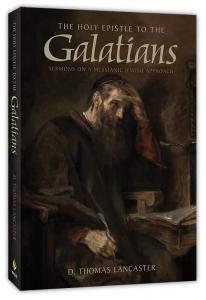
Galatians by D.T. LancasterThis explanation is in keeping with other portions of Berkowitz’s commentary, but here, he seems to indicate that both Jewish and Gentile believers should be circumcised in accordance to the commandments. That’s sort of understandable if we rely just on Genesis 17, but once we also involve Leviticus 12:3, we see circumcision as specifically a sign God gave for the Jewish males, not all males, such as Gentiles who are grafted in by faith in Messiah.

According to D. Thomas Lancaster in his book The Holy Epistle to the Galatians, in “Sermon Twenty-Three: Circumcision and Uncircumcision” (pg 231):

Paul warns Gentiles about relying on Jewish status for salvation and declares circumcision irrelevant with regard to salvation.

Berkowitz and Lancaster have similar perspectives regarding Paul’s intent, but Lancaster states that in this section of his letter, Paul is specifically addressing Gentiles. Based on the above quoted passages from Genesis 17 and Leviticus 12, it was an enduring commandment for the Jews to circumcise their males eight days after birth. Of course, Paul also said (1 Corinthians 7:19), “Circumcision is nothing, and uncircumcision is nothing, but what matters is the keeping of the commandments of God.”

That’s even more confusing because then we have to decide if Paul meant keeping all the commandments of God except the commandment to circumcise. However, in a larger context, Paul tells us:

Only, as the Lord has assigned to each one, as God has called each, in this manner let him walk. And so I direct in all the churches. Was any man called when he was already circumcised? He is not to become uncircumcised. Has anyone been called in uncircumcision? He is not to be circumcised. Circumcision is nothing, and uncircumcision is nothing, but what matters is the keeping of the commandments of God. Each man must remain in that condition in which he was called.

Were you called while a slave? Do not worry about it; but if you are able also to become free, rather do that. For he who was called in the Lord while a slave, is the Lord’s freedman; likewise he who was called while free, is Christ’s slave. You were bought with a price; do not become slaves of men. Brethren, each one is to remain with God in that condition in which he was called.

1 Corinthians 7:17-24 (NASB)

That’s rather similar to the following:

For all of you who were baptized into Christ have clothed yourselves with Christ. There is neither Jew nor Greek, there is neither slave nor free man, there is neither male nor female; for you are all one in Christ Jesus. And if you belong to Christ, then you are Abraham’s descendants, heirs according to promise.

Galatians 3:27-29 (NASB)

communityPut together, we seem to read that neither circumcision nor uncircumcision matters, just as there is neither Jew nor Greek. It appears as if we are all “one new man” (Ephesians 2:15) in Christ with no distinctions whatsoever. This argument has been used to justify both the complete rejection of observing the Torah mitzvot for any believing Jew or Gentile, and the complete acceptance of observing all the Torah mitzvot for every believing Jew or Gentile. It gets confusing.

Of course, when Paul says “neither male nor female,” he wasn’t obliterating physical distinctions between men and women. Another way to interpret Paul on this matter is to say that neither circumcision nor uncircumcision or being Jewish or Gentile matters as far as access to salvation and justification by faith in God through Messiah.

This preserves the commandment of circumcision for the Jews and still allows Paul’s statements to be consistent with God’s commandments.

I know there are some folks out there who will say that Abraham had faith and it was his seed (singular), the Messiah, that allows Gentiles to enter into a covenant relationship with God. And Abraham was commanded to be circumcised and to circumcise his male children and all the males in his household. Doesn’t that mean we Gentile believers need to be circumcised too?

Not so fast!

Then he believed in the LORD; and He reckoned it to him as righteousness.

Genesis 15:6 (NASB)

This is the establishment of faith as the primary linkage for anyone to enter into a covenant relationship with God. But the linkage for the blessings to the nations through Messiah comes earlier:

And I will bless those who bless you, and the one who curses you I will curse. And in you all the families of the earth will be blessed.

Genesis 12:3 (NASB)

Between the two above verses, we have the complete set of requirements that allows Gentiles to enter into covenant relationship with God through faith in Messiah (you can find a more complete description in my blog post The Jesus Covenant Part 8: Abraham, Jews, and Christians).

However, much later on, when Abraham was ninety-nine years old, something new happened. God made a covenant with Abraham that included a physical offspring, the Land of Israel, and circumcision. These, in my opinion, were conditions of God’s relationship with Abraham that took a different trajectory. Certainly the requirement of faith was carried down from the previous encounters with God, but God identified a specific population that were to be included relative to the Genesis 17 promises: Abraham’s physical descendents and members of his household were included in the circumcision requirement.

Does that mean Isaac, Ishmael, Eliezer, and all other males in Abraham’s household at this moment became Hebrews? No, because there’s more. Circumcision certainly created a linkage to Abraham but not all circumcised people become Hebrews, Israelites, or Jews.

Now Abraham took another wife, whose name was Keturah. She bore to him Zimran and Jokshan and Medan and Midian and Ishbak and Shuah. Jokshan became the father of Sheba and Dedan. And the sons of Dedan were Asshurim and Letushim and Leummim. The sons of Midian were Ephah and Epher and Hanoch and Abida and Eldaah. All these were the sons of Keturah. Now Abraham gave all that he had to Isaac; but to the sons of his concubines, Abraham gave gifts while he was still living, and sent them away from his son Isaac eastward, to the land of the east.

Genesis 25:1-6 (NASB)

abrahams-servantAfter Sarah died, Abraham married other wives and had other children. But before Abraham died, he sent away all of his other offspring, giving them gifts, and then singled out Isaac, the Child promised to him by God to fulfill the Genesis 17 covenant involving Abraham’s offspring, circumcision, and the Land of Israel. Of course, Abraham had circumcised Ishmael and all of his other sons as well as Isaac, but Isaac was the only beneficiary of the covenant relationship involving what would eventually become the Jewish people. Even his other sons, let alone the other non-relative males (servants, slaves, herdsmen) in his household who had been circumcised, were not inheritors of the covenant that led to possession of the Land of Israel and the conditions specified for the descendents of Isaac and Jacob, the Children of Israel, the Jewish people…the Torah of Moses.

If, as a Christian male, you believe you have an obligation to be circumcised and to circumcise your sons, no one is going to stop you, but being circumcised, even with the belief that it is required of the spiritual offspring of Abraham, does not create any sort of linkage between you and Abraham’s physical descendants. It doesn’t give you the Land of Israel, and it doesn’t obligate you to observing the Torah mitzvot in the manner of the Jews.

By Paul’s day, circumcision of males became a sort of shorthand way of saying “conversion to Judaism.” Paul was right in saying that circumcision (converting to Judaism) does not justify anyone before God, just as performing all of the mitzvot (for Jew or Gentile) does not justify.

Hopefully, at some point, I’ll be able to write on why Abraham was commanded to circumcise physical offspring who would not inherit Israel or non-relative males who also would not inherit, but for now, I will say that Paul did not believe that circumcision was a guarantee of salvation for Jew or Gentile, however I understand that he believed circumcision was still a requirement for the Jews, as were the other mitzvot of Torah. If he was teaching Jews not to circumcise their sons, then he was lying here:

After Paul arrived, the Jews who had come down from Jerusalem stood around him, bringing many and serious charges against him which they could not prove, while Paul said in his own defense, “I have committed no offense either against the Law of the Jews or against the temple or against Caesar.”

Acts 25:7-8 (NASB)

PaulActs 21:20-26 contains more complete text testifying to the fact that Paul never taught the diaspora Jews to fail to circumcise their sons. If he was lying here, then we can have no confidence in anything Paul wrote which would leave the majority of the New Testament in a shambles, along with our Christian faith.

If you, a Christian, feel you must be circumcised and you must circumcise your sons, remember that it does not justify you before God, it does not put you in the line of succession of Abraham, and Isaac, and Jacob, and Jacob’s twelve sons, and of the twelve tribes, and the Torah of Moses, and give you possession of the Land of Israel. At best, you may be aligned with the non-physical relative members of Abraham’s household, but then, we are still searching for what they and their circumcision mean.

Yes, Timothy was circumcised by Paul, but Titus the Gentile believer specifically was not. Neither was Cornelius the Roman and his entire household. Neither do we have a record of any other Gentile believers who were required to be circumcised as a condition of faith in Messiah. Think of this as you will.

For more on this topic, please read If Paul Had Circumcised Gentiles.

Ki Tavo: Chosen

jewish-davening-by-waterAnd the Lord has affirmed this day that you are, as He promised you, His treasured people who shall observe all His commandments, and that He will set you, in fame and renown and glory, high above all the nations that He has made; and that you shall be, as He promised, a holy people to the Lord your God.

Deuteronomy 26:18-19 (JPS Tanakh)

What does it mean to be the Chosen People? To many Jews it is a source of embarrassment and consternation. To many Christians it is a source of awe and admiration — and to some Christians, jealousy. And to our Muslim cousins — hatred?

Why is the concept of Chosen People an embarrassment and consternation to some Jews? The great concepts of equality and liberty flow from our Torah. That we should think of ourselves as “chosen” rubs against the grain that all people are created in the image of God. Also, if our Chosen-ness makes others jealous, who needs to give more justifications for crusades, pogroms and holocausts? Some Jews think that we have suffered because the Almighty calls us His Chosen People. And even if our suffering is not because of the appellation, then what good does it do for us to be called the Chosen People?

-Rabbi Kalman Packouz
“Shabbat Shalom Weekly”
Commentary for Torah Portion Ki Tavo
Aish.com

That’s a good question. Especially in America where we have the principles of equality and fair play, and especially in the modern, progressive age where it seems almost offensive to many if one group is given a special status, having a “chosen people” seems anachronistic, elitist, and even racist. How dare the Jewish people be chosen? What could God have been thinking? Who are the rest of us, chopped liver?

An additional wrinkle is that many Christians believe that they have taken over that “chosen” position and replaced the Jews and Israel in the covenant promises of God. Thomas Schreiner’s book 40 Questions About Christians and Biblical Law is a perfect example of this kind of thinking in the church. Fortunately, this perspective is slowly evolving beyond such a state, but we have a long way to go.

Rabbi Packouz cites the above quoted portion of Deuteronomy, from this week’s Torah reading, along with Exodus 19:5-6, Deuteronomy 7:6, and Deuteronomy 14:1-3 to illustrate Israel’s chosen status and specialness in the eyes of God.

The Rabbi further states:

While the concept of Chosen People does not mean a superior people, it does imply a special closeness of the Jewish people to the Almighty. Why is there that special closeness, that special relationship?

The concept of Chosen People means both chosen and choosing. Chosen for the responsibility to be a light unto the nations, to be a moral signpost for the nations of the world. Choosing means that the Jewish people accepted on Mt. Sinai to fulfill this mandate and to do the will of God. We are not chosen for special benefits; we are chosen for extra responsibility.

In my recent review of the FFOZ TV episode Ingathering of Israel, I mentioned that in the Biblical prophecies describing the ingathering of the elect at the second coming of Christ, the elect are clearly Israel, the Jewish people:

“Ho there! Flee from the land of the north,” declares the Lord, “for I have dispersed you as the four winds of the heavens,” declares the Lord. “Ho, Zion! Escape, you who are living with the daughter of Babylon.” For thus says the Lord of hosts, “After glory He has sent me against the nations which plunder you, for he who touches you, touches the apple of His eye. For behold, I will wave My hand over them so that they will be plunder for their slaves. Then you will know that the Lord of hosts has sent Me. Sing for joy and be glad, O daughter of Zion; for behold I am coming and I will dwell in your midst,” declares the Lord.

Zechariah 2:6-10 (NASB)

jewish-christianIt is true that the non-Jewish disciples of the Jewish Messiah also have a role to play, a very important role, but we must never lose sight of what the Bible says about the Jewish people, especially not in order to elevate ourselves as Gentile Christians above the status God gave to us as “people of the nations who are called by His Name.”

In considering the phrase “one new man” from Ephesians 2:15 (and it’s not like I haven’t written about Ephesians a time or two), Christianity has spun a web that captures all people in Christ as being the same and eliminating the “chosenness” from the Jewish people, replacing it with the “chosenness” of Christianity. If Jews wish to have a “chosen” status, they must now convert to (Gentile) Christianity, abandoning Jewishness, Judaism, and especially Torah observance.

The flip side, and this is a minority view among Gentile believers, is that the almost the opposite happens. “One new man” describes all believers, Jewish and Gentile, adopting and embracing Jewish identity, Judaism, and especially Torah observance, but without Gentile conversion to Judaism.

No matter which way you slice it though, Jewish people and Israel lose being chosen the minute they enter any sort of Gentile Christian religious space, Hebrew Roots included.

Elhanan Ben-Avraham, in his article “Replacing Replacement”, written for the Summer 2013 issue of Messiah Magazine, defends the Jewish people against the traditional Christian theology of supersessionism.

Adherents of replacement theology claim that God has rejected his rebellious firstborn son and adopted a new son in his place. Part of their perspective includes the viewpoint that Jews must now become part of that church in order to be saved. Throughout the ages this has forced Jewish people to reject living as Jews and to accept Christianity instead with all its forms, rituals, symbols, practices and theologies.

It’s like a loving father choosing to kick out his first-born son and adopt a different son to replace him. I know a few adoptive families and I also know it’s quite possible to adopt a child without first removing the other children in the home. And yet, this traditional doctrine of the church seems to deny that fact and also, to deny that God’s first-born son, the Jewish people, could possibly retain any specialness in God’s view after the coming of Jesus, who after all, is God’s first-born son as an individual, and the living embodiment of everything it is to be Jewish and to embrace a life of Torah observance.

In his Torah commentary, Rabbi Packouz concludes:

Because of our voluntary acceptance, the Almighty made an eternal covenant with us that we will be His people and He will be our God. Any individual can come close to the Almighty, but the ultimate relationship comes through entering the covenant of Abraham and fulfilling the Torah. This special relationship is open to any member of humanity who wishes to enter the covenant irrespective of race, religion or ethnic origin.

Every nation, every people, every religion thinks that it is better than any other nation, people or religion. The Jewish people know that the issue is not whether we are better than anyone else, but whether we fulfill our part of the covenant with the Almighty to hold high the values of the Torah and to do the Almighty’s will.

abraham-covenant-starsThat Messiah came and opened the door, though one of the conditions of the Abrahamic covenant for the people of the nations to also enter into a relationship with God, does not delete any other covenants God made with the nation of Israel and the Jewish people. They remain chosen. We Gentiles who voluntarily accepted Yeshua as Lord, also are considered chosen or elect, but not with an identical set of responsibilities as the Jewish people. This is the confusing part.

This is why most Christians believe that the Torah was done away with, so that Jews and Gentiles can be identical. This is why some folks in the Hebrew Roots movement believe that Jesus applied the Torah to all people equally upon coming to faith in Messiah. The splitting of status and responsibility and the Jewish people retaining “chosenness” unique to themselves, even among Gentiles who follow the God of Israel, is an extraordinarily difficult thing to grasp, let alone to embrace, for everyone (or almost everyone) who isn’t Jewish.

And yet to deny this is to deny all of the promises of God to Israel and indeed, to deny God’s authority to choose Israel and have them remain chosen.

Thus says the Lord, Who gives the sun for light by day And the fixed order of the moon and the stars for light by night, Who stirs up the sea so that its waves roar; The Lord of hosts is His name: “If this fixed order departs From before Me,” declares the Lord, “Then the offspring of Israel also will cease From being a nation before Me forever.”

Jeremiah 31:35-36 (NASB)

How can any non-Jewish religious movement or group demand that Jews cease to be unique, chosen, and set apart from the people of the nations, even the believing people of the nations, unless they set God’s Word aside in order to gratify the Gentile need to be “equal?”

As Rabbi Packouz said, being chosen isn’t easy. Being God’s elect has many difficult responsibilities attached. Pogroms, inquisitions, torture, maiming, blood libel, and murder have always followed the Jewish people because of their status. When the nations could not destroy them using those methods, they switched to assimilation, conversion, identity theft, and inclusion, and they are also very effective weapons.

And yet after thousands upon thousands of years, the Jewish people have not disappeared. God’s promises of return and restoration of the people to their Land, to Israel, remain intact. Only a fool would oppose God.

Good Shabbos.

33 days.

FFOZ TV Review: Jewish Prophecies

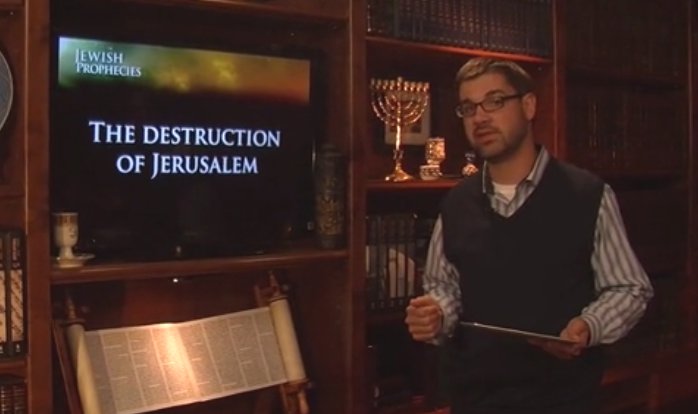
ffoz_tv4aEpisode 04: The land of Israel is a hot topic of debate not just amongst secular news but even in churches. It is key that Christians realize Israel is not just important because of what happened there in the past but also because of what is to take place in the future. In episode four viewers will learn that not only did the ancient Jewish prophets predict the coming of Messiah but they also predicted his second coming and the ingathering of the Jewish people back to their land. Israel thus becomes the stage on which the final redemption will happen.

-From the Intro to the episode Jewish Prophecies
FFOZ TV: The Promise of What is to Come

The Lesson: What Does Jewish Prophecy Say About Israel and the Jewish People?

The beginning of this episode, Jewish Prophecies seems to depart from the theme of the first three programs, which defined the basic concept of the gospels, the meaning of the word “Christ,” and the meaning of the name “Jesus” from a Messianic Jewish viewpoint. However, the focus, which is the specific Jewish prophecies that relate to the work of the Messiah and the gospel message, tie in very well, especially with the episode addressing The Good News.

This show is also different in that teacher Toby Janicki begins the program by discussing the modern nation of Israel within a political, social, and news media context (my review is timely given the current Israeli/Palestinian “peace talks”). However, he explains, we cannot really understand why the modern world is so focused on the tiny nation of Israel unless we look at it from a Spiritual and Biblical perspective.

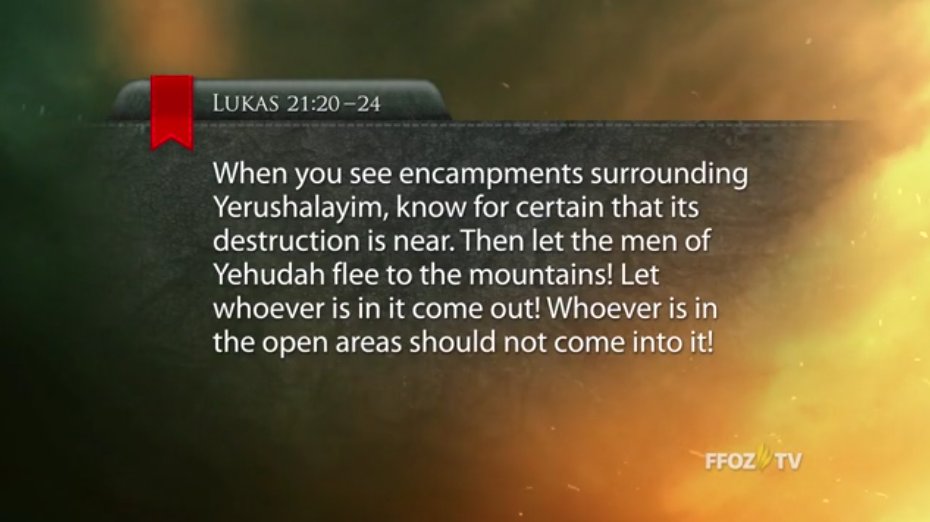
When you see encampments surrounding Yerushalayim, know for certain that its destruction is near. Then let the men of Yehudah flee to the mountains! Let whoever is in it come out! Whoever is in the open areas should not come into it! For they are days of vengeance to fulfill all of what is written. How terrible for those who are pregnant and for nursing mothers in those days! For there will be great distress in the land and wrath upon this people. They will fall by the sword and be exiled to all the nations. Yerushalayim will be a treading place for the Gentiles until the times of the Gentiles are fulfilled.

Luke 21:20-24 (DHE Gospels)

This is Messiah speaking of the destruction of Jerusalem by the Romans, which would occur several decades after his earthly ministry had ended. And yet, it’s the very last sentence that tells us of today’s topic. When will the times of the Gentiles be fulfilled and what will happen next?

Jesus is a Jewish prophet talking to Jewish people. He is also, as Toby states in this episode, presenting The Mystery of the Jewish People and their Return to the Land of Israel. This mystery is directly associated with the Messiah and the gospel message and is illustrated for us in the ancient Jewish prophecies as well as in the prophecies of Messiah.

And then they will see the Son of Man coming in a cloud with power and great glory.

Luke 21:27 (ESV)

ffoz_tv4bAnd what will Messiah do upon his return. According to Jewish prophesy, as described later in the episode, he will redeem Israel by gathering the Jewish people back to their Land. This leads to the first clue.

Clue 1: The Good News is the restoration of the Jewish people back to the Land of Israel.

The gospel message is to the Jews first and foremost. Prophecies in Isaiah 11:11-12 and Isaiah 61:1-4 teach us that the Root of Jesse, that is Messiah, will gather the Jewish people and return them to their Land, back to Israel. He will also show favor to Zion by rebuilding and restoring Jerusalem and the rest of Israel.

The gospel isn’t about the church, it’s about Jewish national restoration to Israel.

But what’s interesting is that this work has been going on for quite sometime. Depending on your point of view, it began with the modern Zionist movement in the 19th century. You could also consider it starting, or at least really getting off the ground, in 1948 with the establishment of the modern state of Israel.

The Jews have been returning to their Land in droves. But that begs the question, What is a Jew?

For the answer, the scene shifts to Israel and to teacher and translator Aaron Eby.

Simply said, the word “Jew” is derived from the word “Judah,” which is one of the twelve tribes of Israel. Judah was also one of the sons of Jacob. But what about all of the other Israelites? How come we call all Israelite descendents “Jews” today?

According to Aaron, in the time of King Solomon, the twelve tribes were united in a single nation, the Kingdom of Israel. After that time, ten of the twelve tribes separated from Judah and Benjamin. They were the Kingdom of Israel while Judah and Benjamin had control of the Kingdom of Judah, which included Jerusalem.

ffoz_tv4cThe Assyrians conquered the Kingdom of Israel and the majority of its inhabitants went into exile. Those who were left of the inhabitants of Israel moved to the Kingdom of Judah, and along with whatever members of the ten tribes were able to eventually return to the Land, they all were subsequently assimilated and absorbed into Judah. In a literal, physical sense, Judah…the Jews, are the descendents of all twelve tribes in our modern-day world (This process is described in more detail in Boaz Michael’s book, Twelve Gates: Where Do the Nations Enter?).

This takes us back to Toby and the second clue:

Clue 2: The Jewish People are the descendents of Abraham, Isaac, and Jacob.

This would seem to be an “oh duh,” but it’s actually an important point. Both traditional Christianity and some branches of the Hebrew Roots movement have been attempting to lay claim to the Land of Israel as well (in fact, just about the entire Arab word is laying claim to Israel as “Palestine,” so you can see this is a popular activity). It’s vital for the church to understand who the Jewish people are and that Biblical prophecy clearly states that Messiah’s mission is to restore the Jewish people to their Land, the Land of Israel, and he is to restore and rebuild it.

The Jews and their nation Israel don’t go away…ever.

Thus says the Lord, Who gives the sun for light by day And the fixed order of the moon and the stars for light by night, Who stirs up the sea so that its waves roar; The Lord of hosts is His name: “If this fixed order departs From before Me,” declares the Lord, “Then the offspring of Israel also will cease From being a nation before Me forever.”

Jeremiah 31:35-36 (NASB)

The offspring of Israel, that is, the Jewish people, will always be a nation before God forever as a nation, as Israel. Linking the verse from Jeremiah with Matthew 5:17-19, we plainly see that the Jewish people, national Israel, and the Torah will all continue to exist as long as the Earth and the “fixed order” of the Sun, the Moon, and the stars continue to exist. They are all tied together beyond any untying as declared by Messiah, by Jesus.

Really, the message doesn’t get any plainer than that. There are only two major themes in Jewish prophecy: Exile and Redemption. The story of the good news of Messiah is all about the redemption of the Jewish people to the Land of Israel and the restoration of Jerusalem.

But where does that leave the Gentiles? What about us?

Then in that day The nations will resort to the root of Jesse, Who will stand as a signal for the peoples; And His resting place will be glorious. Then it will happen on that day that the Lord Will again recover the second time with His hand The remnant of His people, who will remain, From Assyria, Egypt, Pathros, Cush, Elam, Shinar, Hamath, And from the islands of the sea. And He will lift up a standard for the nations And assemble the banished ones of Israel, And will gather the dispersed of Judah From the four corners of the earth.

Isaiah 11:10-12 (NASB)

ffoz_tv4dYou can see that as part of the plan for restoring the Jewish people to Israel, there will be another effect. When the Gentiles see what Messiah is doing, we will “resort to the root of Jesse,” that is, we will be drawn to him. Messiah will “lift up a standard for the nations” and he will redeem us, too.

This is the final clue:

Clue 3: The Ingathering of Israel will have an international effect.

According to Zechariah 9:9-10, Messiah will not just rule over and bring peace to national Israel, but to all the nations of the world. Messiah’s Kingdom will be over all the earth.

What Did I Learn?

It’s actually taken me over a year to really grasp the meaning of redemption and restoration as a Jewish story focused on national Israel. When I first heard of it at the 2012 First Fruits of Zion Shavuot conference, I couldn’t make the Biblical connections. Now it seems so obvious.

I learned today that we might consider the Messiah already working “behind the scenes” somewhat, since the nation of Israel has been re-established and the Jewish people are being gathered back in. I don’t mean to say that Messiah has returned, that is yet to come. But the Messianic mission is definitely moving forward through the Spirit of God.

Toby and Aaron made other important points in this television episode (I left a clue in the last screen capture I posted above), so I hope that you’ll take the time to view this thirty minute program and be illuminated.

I’ll review the next episode very soon.

Overcoming Life

Malala-YousafzaiThe scene took place last week at the United Nations. In attendance were nearly 1000 young students from around the world at a specially convened Youth Assembly in the presence of UN Secretary-General Ban Ki-moon as well as Gordon Brown, Britain’s former Prime Minister.

The guest of honor was a young girl celebrating her 16th birthday. It was a day that the Taliban, many months ago, cruelly sought to prevent her from living to see. Her name is Malala Yousafzai, a Pakistani whose crime was that she wanted to go to school to get an education. So, last October, when she was on a school bus in Pakistan, a man with a gun got on and said, “Where is Malala?” He shot her in the face at point-blank range. The bullet entered near an eye and ended up near her left shoulder, but miraculously she survived.

The Taliban proudly claimed responsibility. They called her efforts pro-Western. They feared she might set an example to other women. Education is their enemy. They desperately wanted Malala dead. But Malala refused to be intimidated.

-Rabbi Benjamin Blech
“Malala at the United Nations”
Aish.com

A great percentage of many people’s suffering is based on illusion. People feel they have problems and difficulties, when in reality the problem exists solely in their minds.

When you have a problem, ask yourself, “How would I view this problem if someone else were in this situation? Would I consider this a valid problem or not?” This can help you gain a more objective perspective.

-Rabbi Zelig Pliskin
“Today’s Daily Lift #892 – Put Troubles in Perspective”
Aish.com

We’re used to thinking that our problems are the worst problems to have. We tend to believe that no one could really understand what we’re going through and how bad we can feel sometimes. Of course, when we actually try to explain to someone else what’s going on with us, we’re likely to get a response that others have it a lot worse. That usually doesn’t help, because then, on top of whatever emotional pain we’re experiencing, we also feel guilty for hurting our own hurts when other people are suffering so much more. Further, we’re liable to also feel shame when we realize that people with greater hurts are handling (at least in public) their problems so much more gracefully and courageously than we are.

There’s no way to win.

Well, that’s not true. Sometimes the trap is to compare who we are and where we are with others and naturally, we can’t ever measure up. Rabbi Pliskin has sage advice in that area, too. Don’t compare situations.

Waitaminute. What about all those motivational books and blogs pointing to people who suffer with grace and humility and keep on cranking along? Aren’t we supposed to be inspired by them? Why do those stories seem so depressing instead? Because we are violating Rabbi Pliskin’s advice not to compare our current situation with others?

It is said that you are what you think (no, I haven’t read that book) and that attitude is everything (no, I haven’t read that book, either). But I think it may be possible to stress if not overwhelm a “positive attitude.”

In 2001, an Arab terrorist detonated a guitar case filled with explosives in Sbarro’s pizzeria at the corner of King George Street and Jaffa Road, the busiest area of downtown Jerusalem. The heinous attack killed 16 people and wounded 100. Among the dead were five members of the Schijveschuurder family, and Shoshana Greenbaum, an American who was pregnant with her first child. A few months later, Al-Najah University in Nablus opened a public exhibition, a gruesome reenactment of the Sbarro bombing, strewn with fake blood and body parts.

Day in Jewish History, Av 20
Aish.com

kerry-netanyahu-israelThere has been much ado about the so-called Israel-Palestine Peace Process lately, and for those of us who are Biblical, conservative, and pro-Israel, seems like just another round in a long list of futile and frustrating efforts to pander to the “two-state solution.”

Human beings struggle against injustice and many are willing to fight and even to die for our beliefs, and yet the soul that God created within us also desires peace. Watching the world around me, and especially Israel, it is difficult to imagine the Messiah’s return and his redemption and restoration of the Jewish homeland. There is so many people and nations against Israel and against what I consider to be justice.

Tishah B’av has passed, and we have now entered the seven weeks of consolation, seven weeks in which God is viewed as comforting us for our losses, both on the personal and the collective levels. People have different reactions and different ways to relate with calamity. Following the Torah’s inner dimension, we can identify four such ways, which in turn correspond to the four letters of God’s essential Name, Havayah (yud, hei, vav, and hei). We will consider them in reverse order (from the final hei, to the vav, to the higher hei, to the yud). Contemplating these will also give us deeper insight into the suffering that the Jewish people have endured throughout their history, up to and even including the Holocaust.

-Rabbi Yitzchak Ginsburgh
“The true meaning behind our sorrows”
Wonders from Your Torah

Rabbi Ginsburgh goes on in his article to describe the four different levels of how we can perceive difficult and even horrific events in our lives and in the world. We can get angry at God. We can believe that bad things happen because we sin. We can see God’s compassion in times of trouble.

And then there’s this:

The fourth and highest level (corresponding to the yud of Havayah) is to understand that God sends us woes in order to bring us to a higher level of consciousness. To better understand what it means that God seems to be absent for our own benefit, Rebbe Hillel of Paritsch offers an insightful parable involving a Rabbi and his beloved student. In the course of teaching his student Torah, the Rabbi suddenly falls silent. From the student’s point of view, it appears that his teacher is angry with him because of something he did wrong. The student’s point of view is reinforced when suddenly his teacher walks out of the room and does not return. However, Rebbe Hillel explains that the truth is that the teacher is not angry with his student but is preoccupied with a sudden spark of new insight he has received. Since the nature of such sparks of insight is to fade away back into the super-conscious and disappear altogether if they are not captured immediately and meditated upon, the teacher is forced to ignore his student for a time, forsake the current lesson, all in order to capture the insight. Actually, the Rabbi has his student in mind when doing so, since his ultimate intent is to pass the new teaching on to his beloved student. God too has acted in this way, says Rebbe Hillel. In those times when He seems to be absent from our lives, in truth, He is actually preparing a new light for us to enjoy.

sbarro_bombingYou say something to your spouse or loved one and he or she is silent in response. Are they angry? Did you say or do something wrong? If you respond from those assumptions by becoming defensive, angry, or sad, you may miss the point. Perhaps he or she didn’t hear you or was contemplating something else entirely. As the saying goes, “it’s not all about you.”

In 2001, a terrorist explodes a bomb in a popular pizza store and kills and maims innocent people. Later, the terrible scene is re-enacted as a tribute in a Palestinian controlled part of Israel.

One young, defiant, teenage girl is shot in the face by Taliban terrorists just because she wants what we take for granted in the United States: an education. She goes on to speak courageously in front of the United Nations about how education and not warfare, is our most powerful weapon.

One who is full of himself fills all the space around him. There is no room left for anyone else. Therefore, he despises another person by virtue of the space that other person consumes. He may give reasons for his disdain, but the reasons are secondary.

This is called wanton hatred. It is the reason given for our exile. It is the core of all evil. It is balanced and cured by wanton acts of love and kindness.

-Rabbi Tzvi Freeman
“Wanton Love”
Based on letters and talks of the Rebbe, Rabbi M. M. Schneerson
Chabad.org

How do we combat our personal struggles when contrasted against the world-wide stage of tragedy? How do we fight our own small battles that always seem to beat us down, when even young girls rise with amazing courage after horrible trauma and injury?

I know how to get along with humble means, and I also know how to live in prosperity; in any and every circumstance I have learned the secret of being filled and going hungry, both of having abundance and suffering need. I can do all things through Him who strengthens me.

Philippians 4:12-13 (NASB)

The Lord is my shepherd, I shall not want. He makes me lie down in green pastures; He leads me beside quiet waters. He restores my soul; He guides me in the paths of righteousness For His name’s sake.

Psalm 23:1-3 (NASB)

looking-at-heavenThere is a place we can go. There is someone who loves our very soul. Even the strongest among us sometimes feels defeated. Look at a powerful warrior such as King David. Look at the immense sufferings of Paul the Apostle. Yes, they were extraordinary human beings, but they were human nonetheless. You and I may not be extraordinary, but we have the same source of strength. Even when depressed, injured, beaten down, crippled, wounded, dying, He is there. He comforts us. Surely goodness and kindness will follow us all the days of our lives.

And we can immerse ourselves in goodness and kindness, letting God restore our souls. Then we can share goodness in an evil world.

“But if your enemy is hungry, feed him, and if he is thirsty, give him a drink; for in so doing you will heap burning coals on his head.” Do not be overcome by evil, but overcome evil with good.

Romans 12:20-21 (NASB)

You can sit in sorrow or you can make a difference in the world. You can become Partners in Kindness.

“People grow through experience if they meet life honestly and courageously.”

-Eleanor Roosevelt

Peace.

The Truncated Gospel

bible_read_me“The shortest and easiest route home for the two missionaries would have been to continue following the imperial highway through the mountain pass of the Cilician Gates east and then branch right southward to Syria. Surely they might have felt that they had done enough and suffered enough and could now take the easy way home! But Paul was not satisfied with doing a work ‘somehow.’ Always he was constrained to do God’s work ‘triumphantly’ – to finish God’s work with joy on each occasion.

“True shepherds know that it takes time to get a new convert rooted and built up in Christ. This involves sacrifice and hardship for the leader, but there is no eternal fruit without the Cross.”

-from the Sunday School Bible Study notes for Acts 14:21-28
“What Makes a Good Missionary?”

The Sunday School class I go to after church services directly addresses the topic of the Pastor’s sermon and gives the students the opportunity to dig deeper and to comment on the message for the day. Pastor Randy has been in California for the past several weeks but will be back next Sunday when he will be teaching on the aforementioned portion of Acts. My Sunday School teacher hands the study notes out a week early so we have time to review and answer the questions on its pages.

A number of Pastor’s messages about Paul and Acts are mapped to the modern concept and activities of Christian missionaries. This has always bothered me and I never understood why until I took a look at the title of next Sunday’s notes: “What Makes a Good Missionary?” Then it just hit me. Using Paul, beyond a certain point, as a model of the modern missionary is anachronistic. It doesn’t fit. The foundation is different.

Here’s what I mean.

In Paul’s day, he and other Jewish apostles and disciples were attempting to spread the good news of the Jewish Messiah to Jews in Israel, Samaria, and in the diaspora and also to give that news to the Gentiles. Jews had been waiting and waiting for the arrival of the Messiah for centuries, and the need for him to come was especially acute during periods of exile and occupation. Israel was a land occupied by a foreign army and desperate to realize its own liberation and redemption. The news of an arrived Messiah who would be King and who would redeem national Israel would be beyond good news…it would be immense in its impact among world Jewry.

From that point of view, explaining why news of the arrived Messiah would be good news to the Jewish people is a no brainer, but we have to work a little harder (which Paul does) to explain why it is also good news to the people of the nations.

Today, we’ve gotten it somewhat backwards. Not that modern Christian missionaries are doing it wrong. Missionary work is the source of great spiritual and material blessings all over the world. But they are missing a few things.

As I mentioned in my book review of Scot McKnight’s The King Jesus Gospel, and as McKnight correctly points out, the plan of salvation is only part of the gospel message. Sadly, modern Christian missionaries believe the salvation plan is the only part of the gospel message.

The more complete message is contained in my review of the First Fruits of Zion television series episode The Good News. What teachers Toby Janicki and Aaron Eby make seem incredibly easy and obvious has actually eluded Gentile Christianity for nearly two thousand years.

What missionaries do today doesn’t map well to what Paul was doing. Paul was delivering the good news that the Messiah had come, had offered salvation from sins for both Jews and Gentiles (and this part was huge since the Jewish people had not anticipated salvation for Gentiles) and that he would return to liberate the captives among Israel, gather the scattered Jewish exiles to their Land, and he would bring peace to Israel and to the nations of the world. The nations would be blessed through Israel, particularly as Israel was made the head of the nations in God’s Kingdom.

I seriously doubt too many Christian missionaries are spreading around that kind of gospel message today. That’s why Paul is used anachronistically as a model for modern Christian missionary work. Most Gentile Christians lack Paul’s vision and emphasis. We don’t exactly preach a different gospel, but it certainly is a truncated one. It’s also kind of upside down.

Apostle-Paul-PreachesPaul always visited the synagogues first and appealed to the local Jewish authorities in whatever place he was visiting. The good news of Messiah would make the most sense to the Jewish people. It would only make sense to Gentile God-fearers because they were spending time in synagogues being immersed in Torah and thus, in the knowledge of Messiah. It wouldn’t make sense at all to pagan Gentiles who had no knowledge of Jewish history or teachings about God (see Acts 14:8-20).

Ok, your counter-argument is that times have changed. Gentiles are largely “in charge” of the worship of the Jewish Messiah and disseminating the information about his birth, death, resurrection, ascendance, and ultimate return (as strange as it sounds for Gentiles to be “in charge” of the iconic Jewish message and King). But does it make sense to strip out what’s going to happen upon the Messiah’s return and why that’s good news for Jewish people and Israel?

Much of the history of the church has been based on the idea that Gentile Christianity has replaced Jewish Israel in all of the covenant promises of God. This is patiently untrue and I’ve discussed it in more blog posts and magazine articles than I can count. But it does make sense for the supersessionistic church to remove the good news of Jewish ascendency and Israel’s national supremacy since it reverses the roles upon which the Gentile church has historically been based. As I’m sure you realize at this point, I think that historical foundation is dead wrong.

…these I will bring to my holy mountain, and make them joyful in my house of prayer; their burnt offerings and their sacrifices will be accepted on my altar; for my house shall be called a house of prayer for all peoples.

Isaiah 56:7

Thus says the Lord of hosts: In those days ten men from nations of every language shall take hold of a Jew, grasping his garment and saying, “Let us go with you, for we have heard that God is with you.”

Zechariah 8:23

I was glad when they said to me, “Let us go to the house of the Lord!” Our feet are standing within your gates, O Jerusalem.

Psalm 122:1-2

I realize that Psalm 122 isn’t a Messianic prophesy and is addressing the tribes of Israel, but I believe it also speaks to the spirit of the Messianic age, when we will all be glad to hear the call to go up to Jerusalem and to the House of God, the Holy Temple.

jerusalem_templeEverything in the Jewish message of the gospel points to Messiah, to the Temple, to Jerusalem, to Israel, and to the Jewish people. The mystery of that message isn’t how the Jews will be saved but how everybody else will be saved. From a Jewish point of view, as much today as when Paul was on his “missionary journeys,” the good news of Messiah was a Jewish message aimed straight at the Jewish people and at Israel. It was a given. The big shocker and the mystery of the gospel was how the Gentiles could be saved and redeemed by God as well.

While Peter was still speaking, the Holy Spirit fell upon all who heard the word. The circumcised believers who had come with Peter were astounded that the gift of the Holy Spirit had been poured out even on the Gentiles, for they heard them speaking in tongues and extolling God (emph. mine).

Acts 10:44-46

Given how the Gentile God-fearers and even the pagans (who were probably told what to expect by their God-fearing neighbors and relatives) reacted to Paul’s gospel message in the synagogue at Pisidian Antioch (see Acts 13:48) we can see that they too were amazed at the graciousness of the God of Israel.

We’ve lost how amazing it is that Gentiles can be saved by the God of the Jews. We’ve lost how the message of the gospel is not just about a plan of salvation but about the return of the King and how his Kingdom will be established, restoring Israel to her rightful place, and elevating the people who were chosen by God at Sinai.

It’s time for us to remember and to teach all of the gospel message, as Paul once did. It shouldn’t be hard. Paul’s sermons, some of then anyway, are preserved in our Bibles. It’s all right there in front of us. We just need to take off our blinders and learn how to see and read the message again. Then we can spread the word, not of a truncated gospel, but of overflowing good news to all, good news first and foremost to Israel and yes, then to the rest of the nations.

Praying Where God Has Placed His Name

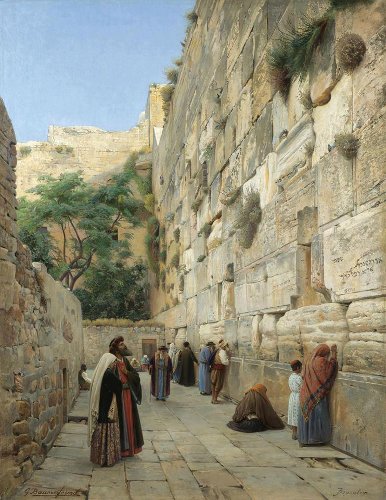
ancient-kotel-prayersWhen responding to the question, “Why do Jews pray at the Western Wall in Jerusalem,” Rabbi Tzvi Freeman had this to say.

I think what you’re really asking is: If G‑d is everywhere, why should prayer be more effective in one place than another? In truth, the same can be asked regarding praying in a synagogue vs. praying at home.

The question has been asked many times before in classical Jewish literature. Since this is a Chabad site, I’ll provide the answer given by Rabbi Schneur Zalman of Liadi (1745–1812), the first rebbe of Chabad.

The essence of his answer is that although G‑d is everywhere, His light shines stronger in some places than in others. He compares this to the human body: You are everywhere in your body, yet you are far more conscious of your mind than of your toes. So too, in the universe that G‑d created, there are places, times and states of being where we are able to be more aware of Him—and it is from those places/times/states that our prayers can fly best.

Any person is able to create for himself a time of day and a special place from which he or she reaches out to G‑d. And we all should—somewhere in our homes or gardens, set aside a place of prayer and meditation, along with a time of day or week that we sit there and connect. Even more special is a place that was chosen not just by us, but by G‑d as well. And that is the Temple Mount, which G‑d chose as His dwelling place in the time of King David.

Ever since then, that specialness has never left the Western Wall, the only remnant left standing.

The Talmud tells us that every synagogue is a “minor Holy Temple.” Thus the above also applies—in smaller measure—to any location designated to be a house of worship for G‑d.

I’ve probably mentioned this before, but one item on my bucket list (not that I have a well-defined bucket list) is to pray at the Kotel, otherwise called the Western Wall. I’m not even entirely sure that, from a Jewish point of view, it would be considered appropriate for a Christian to pray at the Kotel. After all, there is a certain controversy associated with some Jewish women davening at the Kotel, and I’m not even Jewish.

On the other hand, American Presidents and Catholic Popes have prayed at the Kotel, so I suppose it could be permissible for me to do so as well.

Why do I want to?

The Jewish person querying Rabbi Freeman was confused by the significance of even Jews davening at the Kotel. What’s the difference between praying there, in synagogue, at home, or, for a Christian, in church?

Rabbi Freeman answered the question from a Jewish point of view, but can any of that be applied to someone like me?

I think so.

So Abraham rose early in the morning and saddled his donkey, and took two of his young men with him and Isaac his son; and he split wood for the burnt offering, and arose and went to the place of which God had told him. On the third day Abraham raised his eyes and saw the place from a distance.

Genesis 22:3-4 (NASB)

So Jacob rose early in the morning, and took the stone that he had put under his head and set it up as a pillar and poured oil on its top. He called the name of that place Bethel; however, previously the name of the city had been Luz.

Genesis 28:18-19 (NASB)

But you shall seek the Lord at the place which the Lord your God will choose from all your tribes, to establish His name there for His dwelling, and there you shall come. There you shall bring your burnt offerings, your sacrifices, your tithes, the contribution of your hand, your votive offerings, your freewill offerings, and the firstborn of your herd and of your flock. There also you and your households shall eat before the Lord your God, and rejoice in all your undertakings in which the Lord your God has blessed you.

Deuteronomy 12:5-7 (NASB)

And every day, in the temple and from house to house, they kept right on teaching and preaching Jesus as the Christ.

Acts 5:42 (NASB)

Jacobs_LadderIt is said in midrash that the place where the Akedah (binding of Isaac) occurred was at the future Temple Mount in what would be Jerusalem. This is also supposed to be the identical site where Jacob experienced God at Beth El (literally, “House of God” in Hebrew). We also know from the Torah, that God intended to place His Name in a specific geographic location, which is also understood as the Temple Mount. Further, we see that the early Apostles of Messiah regularly taught and prayed at the Temple, specifically at Solomon’s portico (see Acts 3:11).

All of this seems to indicate that not only Jerusalem, but the site of the Temple, has a special significance to God. Yes, God is everywhere and we are not inhibited from praying to God anywhere, but no other place on Earth seems to hold the presence of God in such a way as Jerusalem and the Holy Temple.

And the Kotel is all that is left of the Temple, at least for now.

Also, if it is true that the Temple will be rebuilt and especially if Messiah, Son of David, will rule from Jerusalem and that his throne will be placed there, then any disciple of the Master should be drawn to the Holy City and to the location where Hashem’s Temple has and will once again be established.

Christians have to be careful though, because any attachment we show to Jerusalem and the Kotel can easily be misunderstood by Jewish people as our “taking over” Jewish Holy sites. The church as a long history of supersessionism, so it’s important to respect the overwhelming Jewish history and ownership of Jerusalem and Israel. However, many religious Jews believe that the people of the nations will one day be drawn to Messiah and worship God in Jerusalem, so in that context, we can present ourselves as desiring to honor Hashem at the Kotel. Even Solomon understood this from days of old.

“Also concerning the foreigner who is not of Your people Israel, when he comes from a far country for Your name’s sake (for they will hear of Your great name and Your mighty hand, and of Your outstretched arm); when he comes and prays toward this house, hear in heaven Your dwelling place, and do according to all for which the foreigner calls to You, in order that all the peoples of the earth may know Your name, to fear You, as do Your people Israel, and that they may know that this house which I have built is called by Your name.”

1 Kings 8:41-43 (NASB)

In desiring to pray at the Kotel, I am only responding to the prayers of the King.

I was glad when they said to me, “Let us go to the house of the Lord.”

Psalm 122:1 (NASB)

But again, Christians must not forget that it is Jewish eyes that are constantly looking toward Jerusalem and Jewish hearts that “sigh” for Messiah.

“Notwithstanding all this, the Jew … has his heart fixed upon Jerusalem, praying and sighing a waiting, and longing for the coming of the Messiah King, the promised Redeemer of the House of David.”

Rabbi Isaac Lichtenstein