Tag Archives: Israel

Toldot: Blessings Upon Israel

Isaac and Rebecca endure twenty childless years, until their prayers are answered and Rebecca conceives. She experiences a difficult pregnancy as the “children struggle inside her”; G-d tells her that “there are two nations in your womb,” and that the younger will prevail over the elder.

Esau emerges first; Jacob is born clutching Esau’s heel. Esau grows up to be “a cunning hunter, a man of the field”; Jacob is “a wholesome man,” a dweller in the tents of learning. Isaac favors Esau; Rebecca loves Jacob. Returning exhausted and hungry from the hunt one day, Esau sells his birthright (his rights as the firstborn) to Jacob for a pot of red lentil stew.

In Gerar, in the land of the Philistines, Isaac presents Rebecca as his sister, out of fear that he will be killed by someone coveting her beauty. He farms the land, reopens the wells dug by his father Abraham, and digs a series of his own wells: over the first two there is strife with the Philistines, but the waters of the third well are enjoyed in tranquility.

Esau marries two Hittite women. Isaac grows old and blind, and expresses his desire to bless Esau before he dies. While Esau goes off to hunt for his father’s favorite food, Rebecca dresses Jacob in Esau’s clothes, covers his arms and neck with goatskins to simulate the feel of his hairier brother, prepares a similar dish, and sends Jacob to his father. Jacob receives his father’s blessings for “the dew of the heaven and the fat of the land” and mastery over his brother. When Esau returns and the deception is revealed, all Isaac can do for his weeping son is to predict that he will live by his sword, and that when Jacob falters, the younger brother will forfeit his supremacy over the elder.

from “Toldot in a Nutshell”
Commentary on Torah Portion Toldot
Chabad.org

As I write this, it’s early in the Thursday morning, just past 3:30 a.m. If most of you have been keeping up on the events in Israel, you’re aware of the terrorist attacks from Gaza and the response of the IDF.

My wife and children are Jewish. I believe the Jewish people have a right to Israel and a deep connection to the Land. These events may signal not just another round of terrorism and response but a prelude to another war. I can’t know that, of course, but it’s not as if it hasn’t happened before. That’s enough to keep me up at night or to wake me up too early in the morning, but then a friend of mine’s daughter is currently serving with the IDF, so it’s feels personal as well.

But that’s not all I have on my mind.

you realize that israel is the aggressor, right? they’ve been shelling women & children forever… after stealing their land

the US may be the second most evil country on earth, but Israel has 1st place locked up by a few miles.

where do you come up with that? can you show me any evidence? You’re either brainwashed or willfully ignorant.

is that really what you believe? seriously? where do you get your intel? ZionistPress? get real! Israel is the aggressor.

-from my twitter feed

As you can see, I try to follow a variety of opinions on twitter, but as someone on Facebook (ironically) said just recently about twitter, “the noise to signal ratio dropped to nothing but noise.” I want to be fair and give other opinions consideration, but it’s not worth my health or peace of mind, is it?

What does this have to do with Toldot and the story of Esau and Jacob?

I couldn’t help but draw parallels between two warring brothers (and only one becomes the patriarch of the Children of Israel and the Jewish people) and the events in Israel right now. Two related people struggling over what they believe are their rights but with only one, in my opinion and my understanding of the Bible, having the superior claim on the inheritance of the Land promised to Abraham.

The story we read in Toldot ends with Jacob leaving his home for an uncertain future:

So Isaac sent for Jacob and blessed him. He instructed him, saying, “You shall not take a wife from among the Canaanite women. Up, go to Paddan-aram, to the house of Bethuel, your mother’s father, and take a wife there from among the daughters of Laban, your mother’s brother, May El Shaddai bless you, make you fertile and numerous, so that you become an assembly of peoples. May He grant the blessing of Abraham to you and your offspring, that you may possess the land where you are sojourning, which God assigned to Abraham.”

Then Isaac sent Jacob off, and he went to Paddan-aram, to Laban the son of Bethuel the Aramean, the brother of Rebekah, mother of Jacob and Esau.

Genesis 28:1-5 (JPS Tanakh)

The conclusion of Toldot is a little easier to take knowing what happens next and the ultimate outcome of the journeys of Jacob, but in a very real way, those journeys have not yet ended. The Jews have returned to the land of their inheritance but it is an uneasy return. They face strife from terrorism within their borders, the threat of war from outside, and the aggression of a world that does not believe that Israel has a right to exist, let alone defend itself from hostile people who use the weapons of rockets and public opinion to chip away at the Jewish land, taking the Land and the lives of the children of Jacob bit by bit.

It was decades before Jacob could return to Canaan and in the meantime, Esau was there, doing as he willed, and remaining a threat and a barrier to Jacob’s blessings in Israel. Jews believe that in the age of redemption, all Jews will live in Eretz Yisrael and motivate all mankind to seek God (see Inwardness: The Path to Posterity). But as the path for Jacob was not easy and required a great deal of suffering and searching, both in the material and the spiritual sense, so too is the future of Israel between now and the time of Messiah.

And the servants of Isaac dug in the valley, and they found a well of living water.

Genesis 26:19

If a person tells you “I have toiled but I have not found”—do not believe him.

-Talmud, Megillah 6b

Rabbi Sholom DovBer of Lubavitch was deep in thought, struggling with some elusive idea deep in the recesses of his mighty mind. A bowl of soup had been set before him some time earlier, but the Rebbe was in another world; sharp lines of concentration plowed his forehead, as he sat gazing into the bowl and slowly stirring the soup with his spoon.

The Rebbe’s servant, who figured that the Rebbe must be searching for the egg noodles, exclaimed: “Rebbe, dig in further! The lokshen lies deeper down.”

A wave of contentment passed over the Rebbe’s tensed features. “Thank you,” he said to his servant, “You have revived my soul…”

-Rabbi Yanki Tauber
“Digging for Noodles”
from Once Upon a Chassid
Chabad.org

Nothing is final. That Israel exists today is no assurance that it will continue as it is between now and the Messiah’s return. The people who govern Israel today are human. Israel is not yet perfected as a nation. As they are today, Israel is not immune from making mistakes out of their humanity. But that doesn’t mean that Israel and the Jewish people deserve annihilation as the Palestinian terrorists (and the Arab nations) and their supporters in the western nations declare.

I have faith that God will not let the Jewish people perish, but what is to happen in the Land of Israel now, I cannot know. Modern Israel has faced crisis after crisis in its young history. There were many times it looked as if it would be destroyed, only to be sustained by the miracles of God. Just as Jacob and his family ultimately returned and established themselves in Canaan, so too have the Jews returned to Israel. Just as Moses lead his people through the desert, there have been desperate struggles for the Jews. Just as Joshua lead Israel over the Jordan and into their Land, the Land promised to Abraham, and to Isaac, and to Jacob, so too will Messiah, son of David, lead his people to take final possession of their Land and into their promised rest.
But there is still much to do between now and then. The first task is to reassure and to fortify ourselves, to lift up and strengthen our faith. Israel is from God. It shall not be destroyed. God urges Joshua, as he takes command of Israel, to be “strong and courageous” four times in the first chapter of the book of Joshua. So too must the inhabitants of Israel today be strong and courageous. So too must we, the supporters of Israel and we who have faith in God’s promises…we must be strong and courageous, though Israel and everyone who loves her will be dragged through the mud and maligned for faith and trust and for obeying God.

Only God knows when the time of “living water” will come. We must be ready.

If you see what needs to be repaired and how to repair it,
then you have found a piece of the world that G-d has left for you to complete.

But if you only see what is wrong and how ugly it is,
then it is you yourself that needs repair.

-Rabbi Tzvi Freeman
“Perceptive Repair”
Based on letters and talks of the Rebbe
Rabbi M. M. Schneerson
Chabad.org

Blessings upon Israel and her people, the children of Abraham, and of Issac, and of Jacob.

If I forget you, O Jerusalem, let my right hand forget its skill. Let my tongue adhere to my palate, if I fail to elevate Jerusalem above my foremost joy.

Psalm 137:5-6 (Stone Edition Tanakh)

Continue to keep informed on the events in Israel at IsraelNationalNews.com.

Good Shabbos.

Reposted: Missiles Fired on Nuclear Reactor in Dimona

I’m reposting this news item from VirtualJerusalem.com

Palestinian terrorists have fired missiles at the Nuclear Reactor in the Israeli city of Dimona.

The missiles fell in an open field and did not cause any injuries, nor did it hit the intended target.

The missiles were launched shortly after the IDF launched operation “Amud Anan” early on Wednesday, November 14th with the targeted assassination of the commander of Hamas’s “military” terror wing, Ahmed Jaabari.

“Amud Anan” was launched in response to the hundreds of rockets that the residents of Southern Israel have encountered in the past week.

Prime Minister Netanyahu held a press conference on Wednesday evening stating that Israel will not “come to terms” with the attacks on its citizens.

The alert level in Israel was raised to “gimel”

Pray for the peace of Jerusalem, the safety of the nation of Israel, and all of the souls she nurtures and protects.

57 Days: The Lord has Promised Good to Me

Peace of mind is essential for obtaining many virtues. Its absence leads to all types of shortcomings. When you have peace of mind, you can use your mind constructively. Lack of peace of mind breeds anger and resentment.

The quality of one’s prayers and blessings is dependent on the mastery of one’s thoughts. Above all else, one’s ability to study Torah properly is based on having peace of mind.

-Rabbi Zelig Pliskin
“Daily Lift #628, Peace of Mind is Essential for Growth”
Aish.com

Every Sunday, my daughter has to be at work at 5 a.m. That means I need to wake up at four and get ready to drive her so she can be at work on time. After that, when I get back home, I can get in bed again if I want to.

And that’s just what I did. But church services start at 9:30, so I set the alarm for 6:30. Makes sense to me. Gives me time to wake up leisurely, read, study, check my blog, have breakfast, and figure out if I have any semi-dress clothes that will fit. Haven’t had to “dress up” in quite a while, but fortunately I know how to use an iron and I don’t clean up half bad.

Both my wife and daughter were already at work when I was ready to leave for church, so there was no one around to wish me luck.

Made it there about ten to fifteen minutes early, which is early enough (I figured) to find a parking spot, but not too early that I’d have to conspicuously hang around a bunch of people I don’t know. Found the men’s bathroom, which is an important task in attending any public social event. About four people greeted me and shook my hand before I even got to the entrance of the sanctuary. Saw Pastor Randy who also cleans up pretty good. He was encouraging as was everyone else I met. He sent around the teacher for the class my son and daughter-in-law attends at the church. B.J. just wanted to say “hi” because he knew I was David’s Dad.

Because I told Pastor Randy that my wife is Jewish, other people seemed to know. One woman introduced herself (I didn’t hear her name because of all the background noise hundreds of people make when they’re talking all at once) and told me she was a Jewish believer. More than a few people, including the Jewish woman, said they hoped my wife would come to church with me soon.

Which is kind of what I was dreading, and that will sound odd to most Christians, but let me explain.

My wife wouldn’t receive the kindness of Christian contact and an invitation to come to church as a particularly positive thing. While she’s been to church in the past, her Jewish identity as it currently exists, does not accommodate going to church or attending Christian functions, even though she also doesn’t attend many Jewish functions. I just hope no one tries to contact her independently (I haven’t written my address and phone number down on anything at church, but I’m not that hard to find, either). I tried to explain this to Pastor Randy yesterday, but I’m not sure how he received it.

OK, one issue to be concerned about, but hopefully I’m making it a bigger deal than it really is.

Everyone was very friendly. Lot’s of handshakes and “glad your here.” I know that the “corporate greet your neighbors” handshaking is a normal thing in churches, but I’m still shy enough for it to make me a tad nervous.

The order of service and music was about what I expected. In fact, I was surprised that I remembered the tunes so readily. Nothing mysterious or too difficult. Words were on the screen at the front of the sanctuary.

One Pastor read the text from Acts 7 and then Pastor Randy gave the lesson from that chapter (they’re going through the book of Acts right now, pretty much dissecting it, but the series is slightly ahead of where I am in my Torah Club study on Acts, so I couldn’t leverage Lancaster while listening to the sermon). The bulletin contained a sheet for taking notes about Stephen’s defense to the Sanhedrin, which I used. I was interested in how Pastor Randy would frame Stephen relative not just to the Sanhedrin, but to the rest of the Jewish people, and the nation of Israel as a whole.

He very much acknowledged that Stephen was a Jew, just as his “fathers and brothers” were (Acts 7:2). I won’t go through my notes on what Pastor preached about, but it didn’t reflect the traditional Christian view of Stephen rejecting the Temple, Law, or the customs of the Jewish people in favor of the grace of Jesus Christ. Stephen was portrayed as “convicting” the Sanhedrin of going against the Torah of Moses and being faithless to God, which is more consistent with how I’d read these verses. The sermon was worded to be more accessible to a Christian audience and there were a few times that I thought the message might have been “toned down” a bit for the sake of the people listening (but I can’t be really sure, of course).

The Pastor made good use of his knowledge of Biblical Hebrew and Greek, gently suggesting that the NIV translation may not be entirely accurate. He spent a lot of time on the Abrahamic covenant, a favorite topic of mine lately. He also backtracked into Acts 6 and illuminated “trust and obey” to all of us. How do we know we trust God? How do we know our faith is genuine? Because if it is, we obey God. But what do we obey?

This is the $64,000 question from my point of view, since traditional Christianity usually says that works is dead and all we have to do is believe, while in Judaism, performing the mitzvot has center stage in a Jew’s life. The answer from the Pastor was, “good works.” Our faith is genuine if it produces “good fruit” (he didn’t actually say “good fruit,” but I thought I’d insert it here).

Pastor leveraged the Akediah (he didn’t say “Akediah,” but with his knowledge of Hebrew and having lived fifteen years in Israel, he must have been thinking it) to show us how faith, trust, and obedience are married concepts for someone who is truly righteous (he might have said, “for a tzaddik”). In going back to the original command God gave Abraham to leave Haran (Genesis 12:1), Pastor took the principle of obedience a step further in telling a story about some early Christian missionaries in India.

These missionaries were continually debating how they were to start out on their task, anticipating what might happen if they took this step or that. Finally, one of the missionaries said something like the following:

A Christian doesn’t have the right to demand to know where he is going. He must walk by faith.

Given everything I’ve been going through in anticipating “church,” he might as well have been talking to me.

Even as I wrote down the quote, I couldn’t help but marvel at how much of last week’s Torah portion had been inserted into Pastor’s message on Acts 7. He also included portions of Genesis 45 and Genesis 50, as he followed Stephen’s defense, which included references to the Patriarchs and the people of Israel.

Overall, the message was not only one of hope for Christians, that God is faithful and gracious even while we may have troubles in our lives, but that God has always been faithful and gracious to Israel and the Jewish people, even in the midst of their trials and suffering. God remains the constant for both Christians and Jews, and Abraham is the father for both the Christians and the Jews (and Pastor was careful to say that the Abrahamic covenant does not make the Christian “Jewish”).

After the sermon and closing song and prayers ended, it was time for Sunday school. I had chosen a particular class to attend, and Pastor Randy let Charlie, the teacher, know I was coming. Several handshakes later (I don’t mean to belittle this and actually, everyone was very friendly, but it will take me awhile to get used to so much human attention compressed into such a small space and time), I found where I could get a cup of coffee before class. The coffee ran out just as I was about to get a cup, so I didn’t have that delay before finding my classroom.

Consequently, I was the first to arrive. People trickled in and introduced themselves. The teacher and class members were mostly my age or older (I think one couple was a bit younger).  The first person to come in after me was an older gentleman named Dick. We got to talking and at one point he said something like, “It can be hard to find a church that gives you what you need,” and went on to say how fortunate they were to have a Pastor who preached the whole Word, including the Old Testament. He pretty much summed things up for me.

Class wasn’t as organized as I would have expected. I was glad it wasn’t heavily scripted, because that tends to stifle individual or creative response, but I saw that people struggled to respond when Charlie threw a question out among us.

I really, really had intended to be quiet, and just to listen and observe. That didn’t last very long and all of my old “reflexes” in addressing classroom questions and answers, built up over the years in my previous congregational experience, immediately took over.

In fact, I realized at one point, that instead of answering a question, I expanded on it and turned the question back to the rest of the class.

Oops.

I tried to tone it down after that, but I may have come close to crossing the line when I suggested that no matter how much God has chastised Israel, He has always brought them back, and will continue to fulfill His promises to them by bringing them back (not by restoring only a tiny remnant, but by redeeming Israel) to Him.

After class was over, I apologized to the everyone and particularly to Charlie for my being such a chatterbox. Not many of the other class members talked much, although during one of my monologues, I entered a dialog with one of the other fellows. Everyone was gracious about it and I hope I didn’t offend anyone. I didn’t think I’d get this “interactive” for weeks, but the wheels kept spinning in my head and once I opened my mouth, words started zipping out.

I was kind of interesting that all of the other students there were married couples except for one woman whose husband was on some sort of business trip in Turkey. I can see it’s going to be awkward to be going “stag” to church every Sunday.

Oh, both in the service and during Sunday school, I liked how the Jews weren’t blamed for rejecting Jesus or being bad examples, and in fact, the teachings emphasized how we Christians were expected to live up to the teachings of our Master.

At one point, Charlie, in discussing how Jesus dealt with faith or its lack as recorded in Mark 9 and 10, said, “If Jesus attended this church, what issues would he have to address here?” A little later he asked, “What would Jesus have to say to me” (about my failings)?

The experience wasn’t perfect, but then I expected that I’d feel out of place in an unfamiliar social environment. It was very “Christian” in all the ways I thought it would be, except that Judaism was treated much better relative to the Jewish Messiah and the Gentile disciples than I had imagined. The music lacked a certain punch, but that’s not really an issue for me compared to the other matters I’ve discussed, although they did introduce a bit of an “experiment” by having band sing “Amazing Grace” to the tune of The House of the Rising Sun (originally recorded by the Animals in 1964). It totally rocked.

Yes, I’ll go back next week for a variety of reasons, not the least of which is that I’m curious as to how far I can enter Christian fellowship and how much I will be able to integrate and still keep the core of who I am as one of the world’s most unusual Christians. At this point, my only real reservation, as I said before, is how far some of the folks in the church will try to press me to bring my wife to services. I don’t think that part would go over well at all.

Guess I’ll see how it all works out week by week, day by day, by God’s grace.

The Lord has promised good to me…
His word my hope secures.
He will my shield and portion be…
as long as life endures.

-John Newton (1725-1807)
Amazing Grace


A Walk to Redemption

WalkingThe chassidic community in Poland was in a state of shock. The great chassidic master Rabbi Moshe of Lelov had decided to ascend to the Holy Land and settle there. How could they possibly go on without his leadership?

To his closest disciples the rebbe revealed that when he was a small boy, his father, Rabbi David of Lelov, had said to him: “I did not merit to see the Holy Land, but you must go there. Through your divine service which you will perform there, you will succeed in bringing Moshiach sooner, and hastening the Redemption.”

-Rabbi Yerachmiel Tilles
“The Shattered Goblet”
Chabad.org

Last spring, after Shavuot, I wrote a two-part meditation called “Redeeming the Heart of Israel,” Part 1 and Part 2. I received a certain amount of criticism because I was perceived as somehow elevating Israel and the Jewish people above the non-Jewish believer in the Messiah. While the church is slowly moving away from its stance of supersessionism (I know, I used that word, again) and anti-Israel/anti-Jewish beliefs, it is still difficult for many Christians to take Paul at his word and believe that “all Israel will be saved.” (Romans 11:26)

Part of the problem is understanding what redemption means. From a traditional Christian point of view, individuals are redeemed; we are saved by our faith in Jesus Christ, which generally means, when we die, we go to Heaven. All seems so nice and simple and reassuring. But that’s generally not how Jews see the concept of redemption and the coming of Messiah. As we see from Rabbi Tilles’ story, it is clear that the coming of the Messiah is closely coupled with the redemption of national Israel, not necessarily focused on each individual’s redemption (although this too is important). However, the Jewish point of view is often criticized by Christians as extra-Biblical and thus invalid.

But is this actually true or did Christ’s own disciples believe he was supposed to accomplish Israel’s national redemption?

So when they had come together, they asked him, “Lord, will you at this time restore the kingdom to Israel?” He said to them, “It is not for you to know times or seasons that the Father has fixed by his own authority. But you will receive power when the Holy Spirit has come upon you, and you will be my witnesses in Jerusalem and in all Judea and Samaria, and to the end of the earth.”

Acts 1:6-8 (ESV)

I’ve mentioned all this before, but I don’t know if anyone is taking the message seriously. I’m not trying to “undo” or contradict the doctrine of personal salvation through Jesus Christ, but to illustrate that one of the things he will do upon his return, that was expected the first time he was here but not accomplished, is to restore Israel as a nation to a state of rule over the earth, and return the Jewish people to their Land and heritage in glory and honor.

That’s the part some Christians, including some of those in the Hebrew Roots movement, have a problem with. The “inequality” among the body of believers in the form of salvation coming from the Jews. (John 4:22) Traditional Christianity has historically taught (and thankfully, this is changing) that the church has replaced the Jews in all of the covenant promises, and that Jesus killed the Torah in the process. Hebrew Roots maintains that the Torah still lives, but that the distinctions between Jew and (Christian) Gentile have been totally eliminated and there is only one new identity before God, the “Messianic” identity, despite the fact that God has promised to be a God to the Jewish people forever, to return them to their Land, and to establish Israel as the head of all the nations (i.e. the rest of us).

If you read all of Rabbi Tilles’ tale, you’ll see that sadly, Rabbi Moshe of Lelov never accomplished his mission to reach the Kotel and summon the Moshiach. It is believed that this occurred because the time for the Moshiach’s arrival had not yet come. While Christianity doesn’t believe we can do anything to hasten the return of Jesus, Jews believe by performing acts of tikkun olam or “repairing the world,” that we all, Jews and Gentiles alike, can take part in bringing the time of his coming (or return) just a little bit closer.

In the face of everything I’ve just said, we Christians have a couple of choices. We can accept that the Bible is telling us that we are dependent on the Jews for our salvation through the Jewish Messiah and our covenant relationship with the God of Israel, or we can ignore those parts of the Bible that present this information and focus on either the traditional church doctrine of supersession, or one of the variants being created in minority movements within larger Christianity (which includes Hebrew Roots in general and it’s subgroups such as One Law, which indeed is a Christianity and not a “Judaism”).

Probably the most lively debate on this topic currently happening (though it seems to be winding down) in the blogosphere is on Gene Shlomovich’s blog. I’m actually learning a great deal from a few of the individuals posting (and I may mine some of those comments and pull them together for a future “meditation”), mixed in with the more expected objections to Jewish “choseness” within the Messianic body. But I struggle to remember a lesson that I very recently wrote discouraging the acceptance of someone else’s “gift” of their own anger and hostility, which is not an easy task on the web, but one that is absolutely necessary if we are to truly call ourselves disciples of our Master.

We see in the early chapters of Acts that the community of disciples of Jesus Christ were all Jewish and that, upon accepting the Spirit and declaring their discipleship, the Jews did not deviate in any way from being Jewish. In fact, in the Torah Club commentary I’m reading this week, the early Jewish disciples are referred to as “The Temple Sect.”

Contrary to popular assumptions, the disciples did not teach against the Temple or the Levitical worship system. If the gospel did cancel the Torah and the Levitical worship system, the apostolic community in Jerusalem seems to have been ignorant about the change. They continued to revere the Temple and participate in its services throughout their lives.

The disciples of Yeshua revered the Temple because their Master revered it. He regarded the Temple as his “Father’s house.” As a boy, Yeshua was reluctant to leave the Temple courts. As an adult, He was found in the Temple teaching and attending the festival services. He spent the last days of His life, prior to his crucifixion, in the Temple. He prophesied its coming destruction only with sorrow and weeping…

After the ascension, his disciples “were continually in the temple praising God” (Luke 24:53). They were likely in the Temple when the Holy Spirit was poured out upon them on the day of Pentecost. Aftr that, they remained day by day in the Temple together.

As I continue my study of the book of Acts in the First Fruits of Zion (FFOZ) Torah Club, I hope to find that my perceptions are becoming clearer on these points, including what redemption truly means for Israel and the nations, and where we all stand, Jews and non-Jews, as brothers and sisters in the Messiah.

In my Days series, I’ve been recording my plans to return to more traditional Christian fellowship, in part to reconcile on some level with the larger body of Gentile believers. I don’t know how successful I will be, but I’ve been challenged to trust God more than I have in the past. Hopefully, the ground will remain firm rather than falling out from under me.

Walter Donovan (Julian Glover): As you can now see, Dr. Jones, we are on the verge of completing a quest that began almost two thousand years ago. We’re just one step away.

Indiana Jones (Harrison Ford): That’s usually when the ground falls out from underneath your feet.

from the film
Indiana Jones and the Last Crusade (1989)

Hopefully and with God’s grace, my journey toward reconciliation and redemption will also have a “happy ending.”

Sharing with Abraham

The Land of Israel is central to Judaism. It is an intrinsic part of the covenant that God promised to Abraham and his descendants (Genesis 12), and most events recorded in the Bible took place in Israel.

The mitzvah to live in Israel is based on the verse, “You shall possess the Land and dwell in it” (Numbers 33:53). The Talmud states that “every 4 amot (about 7 feet) that a person walks in Israel is another mitzvah.”

The question, however, is whether this mitzvah is compulsory in our times when the Holy Temple is not standing. This is the basis of a dispute between two great Talmudic commentators, Maimonides and Nachmanides. A leading 20th century sage, Rabbi Moshe Feinstein, concludes that living in Israel is a “mitzvah kiyuma” – while it is a great mitzvah, there is no absolute obligation to do so.

from Ask the Rabbi
“Mitzvah to Live in Israel”
Aish.com

I used to want to live in Israel. I gathered together various reading materials related to making aliyah. I often imagined what it would be like to permanently move to the Holy Land. It was a rather romantic notion and it wasn’t beyond the realm of possibility. I’m not Jewish, but my wife is. If she made aliyah, it’s not like the state of Israel would deny her just because she was married to a goy. I’d “go along for the ride,” so to speak.

As the years passed, my passion cooled and reality settled in for the long haul. I realized that my wife had no desire to actually live in Israel (though she and my daughter have visited). According to the Ask the Rabbi quote from above, there’s not an absolute obligation for a Jew to live in the Land, so I guess Jews can still choose to live where ever it pleases them.

But reading the article about the mitzvah of living in Israel reminded me of what I wrote yesterday about Abraham, Jews, and Christians. (I decided not to make this blog post part of The Jesus Covenant series since it’s more of a “side note” on the covenant than a direct investigation, however the relationship between this and the “covenant” series is obvious) The giving of the Land of Israel to the Jewish people in perpetuity is part and parcel of the Abrahamic covenant (see Genesis 12). As I outlined in my previous blog post, while one of the conditions of said-covenant provides a blessing to the nations through Abraham’s seed; through the Messiah, that is the only condition of the covenant that applies to Christianity.

In other words, the Land is promised to Israel through the Abrahamic covenant, but that doesn’t translate into Israel also “belonging” to Christians. My wife, as a Jew, has the perfect right to request and receive legal citizenship in Israel while I, a non-Jew, do not, even if I really, really want to live there.

This is sort of a metaphor for a larger set of obligations and permissions vs. human desires that I experience in my little corner of the blogosphere. As much as I may have wanted to live in the Land of Israel at one point in time, that would only have been accomplished in my case, if I accompanied my Jewish wife when she made aliyah. If she never makes aliyah, then I’m staying in the good ol’ U.S. of A. with her. She has the right to make aliyah to Israel. I can only live in Israel because of her being Jewish.

That covers so many other things. We Christians may see the many advantages the Jews have (see Romans 3:1-2) and we tend to want them for ourselves. That’s probably the desire that is at the heart of supersessionism in Christianity. We’ve been taught that every promise God made to the Jewish people has been taken from them and transferred to us, so when we see the beauty of the various aspects of Judaism, the lighting of the shabbos candles, praying the Shema, reading from the Torah scroll in the synagogue (another form of aliyah), we, or at least some of us, want them, too.

Nevermind that a “want” is not a “deserve,” we still want, much like a child in pre-school sees a playmate who has a cool toy, we want it for ourselves. It doesn’t matter if that toy belongs to our playmate. At that age, kids don’t have a terrific understanding of empathy, boundaries, and distinctions. They are very egocentric. If they want something, they take it. It doesn’t matter that the toy belongs to someone else. That’s why pre-school age children need adults to remind them that they can’t have everything they want, even when they see other kids playing with a really cool toy.

When you’re a small child, you think and feel like a small child and there are many things that you don’t understand. We adults are tolerant of this in our children and grandchildren because we know this behavior is a normal stage of development. We gently provide correction and eventually, the child grows and learns. The problem is when people grow up and they don’t learn, and they still keep thinking like children.

When I was a child, I spoke like a child, I thought like a child, I reasoned like a child. When I became a man, I gave up childish ways.

1 Corinthians 13:11 (ESV)

If we don’t develop properly and we cling to childish ideas, we grow up continually mistaking wants for needs and privileges for rights. In the western nations, we are taught to stand up for our rights, and then we believe that everything is a right. Our Constitution guarantees the right to pursue happiness but that’s no promise that we’ll actually attain it. There are a million things in the world we can have and a million things we can’t. It’s no fun facing that fact, but that is the reality of our existence. Some Christians may want all of the advantages of being a Jew, but it is not our right to take them. Taking something that doesn’t belong to you is called stealing.

The Land of Promise was given to the direct, physical descendents of Abraham, Isaac, and Jacob. Jacob was the father of the twelve tribes of Israel and those tribes eventually became the Jewish people. The promises were handed down like a baton in a relay race, from older to younger, down, down across the long generations and to this present day. But each of those runners is a Jew, not a Christian.

That does not mean, in an ultimate sense, that if a Christian finds beauty in Judaism, they are barred from any of the Jewish practices. Many Christians visit their local synagogues and respectfully worship with the Jewish congregation. Many classes are available at those synagogues and anyone, Jew or Gentile, is allowed to attend. No one will object if you choose to light the Shabbos candles on Friday night, or construct a small sukkah in your backyard at this time of year.

It’s like the two metaphorical pre-school children I was talking about before. We can’t just reach out and take what belongs to the other child and pretend that it is ours by right. But we can say something like, “Cool toy. Can I play with it for a little bit?” There is much beauty and joy in the mitzvot of the Jews that can also belong to us. We can feed the hungry, give a thirsty person a drink of water, visit the sick and the prisoner, give to worthy charitable causes, stand out of respect when an elderly person enters the room, and many other things. For those things that belong only to the Jews, some would be ridiculous for a Christian to perform, such as referring to ourselves as “Israel” while davening with a siddur. But there are many others that, even if they don’t belong to us, we can politely ask to share.

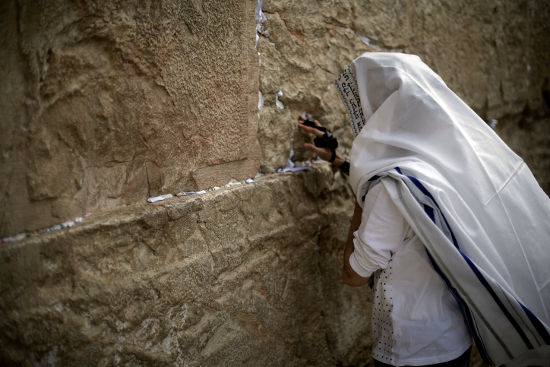
I will never live in Israel as a citizen, but someday before I die, I hope to visit and perhaps share in the experience of praying at the Kotel.

Mattot-Massei: Free At Last

The Torah portion of Masei informs us of G-d’s directive that 48 cities be given to the Levites as dwellings places. Among these cities were three Cities of Refuge located on the other side of the Jordan River.

In the previous section of Matos, we read how Moshe was extremely displeased when the tribes of Gad and Reuven asked to receive their portion of the land on the other side of the Jordan. His displeasure stemmed from the fact that it was inappropriate to desire a permanent place of residence outside Eretz Yisrael proper. (Bamidbar 31:6-15.)

This being so, why did G-d command that the Levites be given the three Cities of Refuge on the other side of the Jordan? And while it’s true that it was vital that Cities of Refuge be established on both sides of the Jordan, (See Sifri, Bamidbar 35:14; Makkos 9b.) this in itself is not sufficient reason to make these “extra-territorial” cities permanent dwelling places for the Levites.

Yes, we could point out that the verse states: (Bamidbar 35:2.) “Command the Children of Israel that they give the Levites residential cities from their hereditary holdings.” Thus, these cities were not given as an inheritance from G-d, but because of an obligation placed upon the Jewish people to give a portion of their inheritance to the priestly tribe.

But this answer is not entirely satisfactory. Knowing as they did that the main dwelling place of the Jewish people was in Eretz Yisrael proper, why should any Levites want to live on the other side of the Jordan?

In the…Torah portion of Matos, we find that Moshe gave half the tribe of Menashe a portion on the other side of the Jordan. (Bamidbar 32:33.) Our Sages point out (Yerushalmi, Bikkurim.) that they did not ask for this land; Moshe presented it to them on his own.

“Levitical Cities”
Based on Likkutei Sichos Vol. XXVIII, pp. 213-218
and the teachings of the Lubavitcher Rebbe
Rabbi Menachem M. Schneerson
from the Chassidic Dimension series
Commentary on Torah Portion MattotMassei
Chabad.org

What I’m about to say isn’t going to be terribly popular with some people. Israel is never a very popular topic with some folks, especially those who hold to a particular social and political viewpoint. Of course, basing any opinion of current events upon what is written in the Bible is never acceptable to more “rational” human beings who believe that public opinion always trumps the will of (from their point of view) a non-existent God.

But look at what has been written and where we find it in this week’s double Torah portion. Not only did Moses agree to let the tribes of Gad, Reuben, and the half-tribe of Manasseh settle east of the Jordan, outside the boundaries of Canaan, but it was commanded that three of the Levitical cities would also be outside “the Land.”

But these events occurred in ancient times, so what possible impact could they have on the boundaries and borders of the modern state of Israel in the 21st century, especially if you believe the “original” boundaries were fictional or at best, part of an act fo conquest committed by the Israelites of old?

Maybe nothing. But then again, maybe everything. Continuing with the commentary:

He did so because the first entry of the Jewish people into Israel is connected to their final entry through Moshiach, and Moshe is considered “both the first and the final redeemer.” (See Shmos Rabbah 2:6; Devarim Rabbah conclusion of ch. 9; Zohar, Vol. I, p. 253a; Torah Or, Mishpatim, p. 75b.) This being so, his giving this portion to Menashe served to foreshadow the future redemption, at which time the boundaries of Eretz Yisrael will be broadened to include the other side of the Jordan as well.

We thus see that taking a portion on the other side of the Jordan can be an entirely positive act, since it hinted at the borders of Eretz Yisrael in times to come.

OK, this is midrash and mysticism thrown in with what we read in the Torah, but if it’s true; if all this occurs upon the Messiah’s return, then Israel, a very “problem nation” for much of the world, will be a great deal larger in Messianic days then it is right now (and most of the world would prefer it if Israel were a good deal smaller, even to the point of non-existence and extinction).

If you don’t believe in God, the Messiah, religious Judaism, and (arguably) Christianity, you have nothing to worry about. All this is just smoke and mirrors. Even many religious and secular Jews today argue about what the borders of modern Israel should be like or even if Israel should currently exist.

And yet, the world seems to be fighting extra hard against Israel, more than it fights against any other nation. Why?

The wounded victims of Wednesday’s suicide terrorist attack at a Bulgarian airport have arrived home in Israel, with 32 of the wounded victims touching down in an IAF Hercules military transport aircraft at Ben-Gurion International Airport. Among them was Israeli Nurit Harush, photographed by Reuters as she was pushed in a stretcher by medics after her arrival.

Three others who were critically injured have remained in a hospital in Sofia, but will later be flown to Israel.

-Chana Ya’ar
“Israeli Terror Victims Arrive Home from Bulgaria”
First published 7/19/2012 – 1:12 p.m.
IsraelNationalNews.com

The latest act of terrorism against Israel and against Jews.

This is hardly an isolated incident, but because it was so public and so dramatic, the non-Israeli news agencies have been giving it a great deal of space on their webpages and on their airwaves along with Israeli news sources.

One explanation for why Jews are regularly attacked, injured, and murdered, and why Israel as a nation is somehow blamed for this just because it exists in the world, is the historic enmity between the Arab and Jewish people, or between the Muslim and Jewish people. Popular public opinion cites the “fact” that Israel is an “apartheid state” (in spite of the fact that there are Arab Palestinian MKs in the Israeli Knesset) and is “occupying” lands that are “Palestinian” as the root to the actions of these oppressed “freedom fighters” as the reason for these acts of violence (and many of Israel’s critics refuse to call this “terrorism”). And don’t forget that historically, people all over the world have fought against and even murdered Jews just because they were Jews.

But imagine.

Imagine that God is real and the national redemption of Israel in an absolute physical sense is going to occur. It’s just a matter of time. Imagine you are a Jew and you live in Israel and this is what you believe. And it’s no secret that you believe this. It’s no secret that you know God will accomplish this when Moshiach comes.

If you don’t believe in God or at least, you don’t believe in the God of the Jews, that probably sounds pretty arrogant. Even if you think it’s total fantasy, you might be concerned that the Jewish nation will try to expand its borders to ultimately match what they think they should be according to God. That would eat up all of so-called “Palestine” and a significant chunk of the modern nation of Jordan (which modern Jewish Israel does not claim as far as I know).

If you have enough of a social, political, national, or racial interest in all of this, you might get pretty angry. So angry that you light up the Internet with your rage. And a few folks out there might be a good deal more angry.

Angry enough to blow themselves up and to take as many Jews with them as they can.

Even if you believe in the prophesies in the Jewish Bible, we could still argue all day long about whether or not Israel should pursue national expansion now or wait until the coming of the Messiah. It would be a useless argument because, like so many other debates on the web, it would go exactly nowhere. A lot of people would get worked up and nothing; absolutely nothing would be accomplished.

So where do we go from here? People are dying. I call it “terrorism.” I’m sure you’ll be glad to tell me what you call it.

I don’t believe it’s a coincidence that this act of terror happened during what is called Bein Hametzarim, the three weeks between the fast of the Seventeenth of Tammuz and the fast of Tishah B’Av, which commemorates the occurrence of many Jewish tragedies, not the least of which are the destruction of the first and second Temples in Holy Jerusalem.

Parshas Matos is always read during Bein HaMetzarim the three weeks between the fast of the Seventeenth of Tammuz and the fast of Tishah BeAv (the Ninth of Av), which are associated with the destruction of Jerusalem and the Beis HaMikdash. This recalls the negative qualities of a staff’s firmness, the severed connection to the source of vitality.

On the other hand, this period is also connected with our people’s hopes of Redemption. Indeed, Tishah BeAv, the anniversary of the destruction of the Beis HaMikdash is described as “the birthday of Mashiach” a day which generates a new impetus for the coming of the Redemption. Herein lies a connection to a staff’s positive quality of firmness, because: a) in the Era of the Redemption, our people will reap the fruit of their determined resolution to carry out G-d’s will despite the challenges of Exile; and b) it is in the Era of the Redemption that G-d’s essence, the ultimate source of strength, will become manifest in our world, His dwelling.

-Rabbi Eli Touger
“True Strength”
from the “In the Garden of Torah” series
Commentary on Torah Portion Mattot
Chabad.org

Perhaps even during this time of double mourning, there is a ray of hope.

In every hardship, search for the spark of good and cling to it. The greater the hardship, the more wondrous the good it bears.

If you cannot find that spark, rejoice that wonder beyond your comprehension has befallen you.

Once you have unveiled and liberated the spark of good, it will rise to overcome its guise of darkness. It may perhaps even transform the darkness fully to light.

-Rabbi Tzvi Freeman
“Unveiling the Spark”
Based on letters and talks of the Rebbe
Rabbi M. M. Schneerson
Chabad.org

I know that there’s a lot of sadness and anger going on and redeeming “hidden sparks” is probably far from most people’s minds at the moment. All they can do is live inside the pain and sorrow and grief. It’s not yet time to start looking for the sparks, gathering them, and sending them back to their source in Heaven.

But the day will come when the sparks will fly free. The day will come when he will come; Messiah, Son of David, and he will liberate his people Israel and place his nation as the head of nations. And his people will be safe. And grief will be only in the past at last…at long last.

…but they shall sit every man under his vine and under his fig tree,
and no one shall make them afraid,
for the mouth of the Lord of hosts has spoken.

Micah 4:4 (ESV)

He will wipe away every tear from their eyes, and death shall be no more, neither shall there be mourning, nor crying, nor pain anymore, for the former things have passed away.

Revelation 21:4 (ESV)

When we let freedom ring, when we let it ring from every tenement and every hamlet, from every state and every city, we will be able to speed up that day when all of God’s children, black men and white men, Jews and Gentiles, Protestants and Catholics, will be able to join hands and sing in the words of the old spiritual, “Free at last, free at last. Thank God Almighty, we are free at last.”

-Dr. Martin Luther King, Jr.
“I Have a Dream” speech, August 28, 1963

Good Shabbos.