As I’ve been reminded, the tone of this blog has shifted considerably of late. It’s been a reflection of my mood and where my attention has been drawn, and that’s not a good thing.
I’d become stuck in the tawdry details of our world, politics, social trends, movies, television, everything there is to complain about. As the saying goes, it’s hard to soar with the eagles when you’re stuck in the dirt with the turkeys.
Last March, I got a big wake up call when my doctor discovered that my blood sugar was the thing that was soaring. These days, the epidemic of diabetes is almost always linked to lifestyle choices. My choices hadn’t been good.
I made the decision to cut out all the junk food, start consuming a lot more fruits and veggies, and to exercise. So far, exercise has consisted mainly of walking, which works pretty well. In the past four months, I’ve lost 22 pounds and my latest lab work says my blood chemistry is great. I’ve had to take on board a few medications, but once I get to a more reasonable weight (I’m hoping by December), I can try getting off of them.
I also started reading the Bible every morning again.
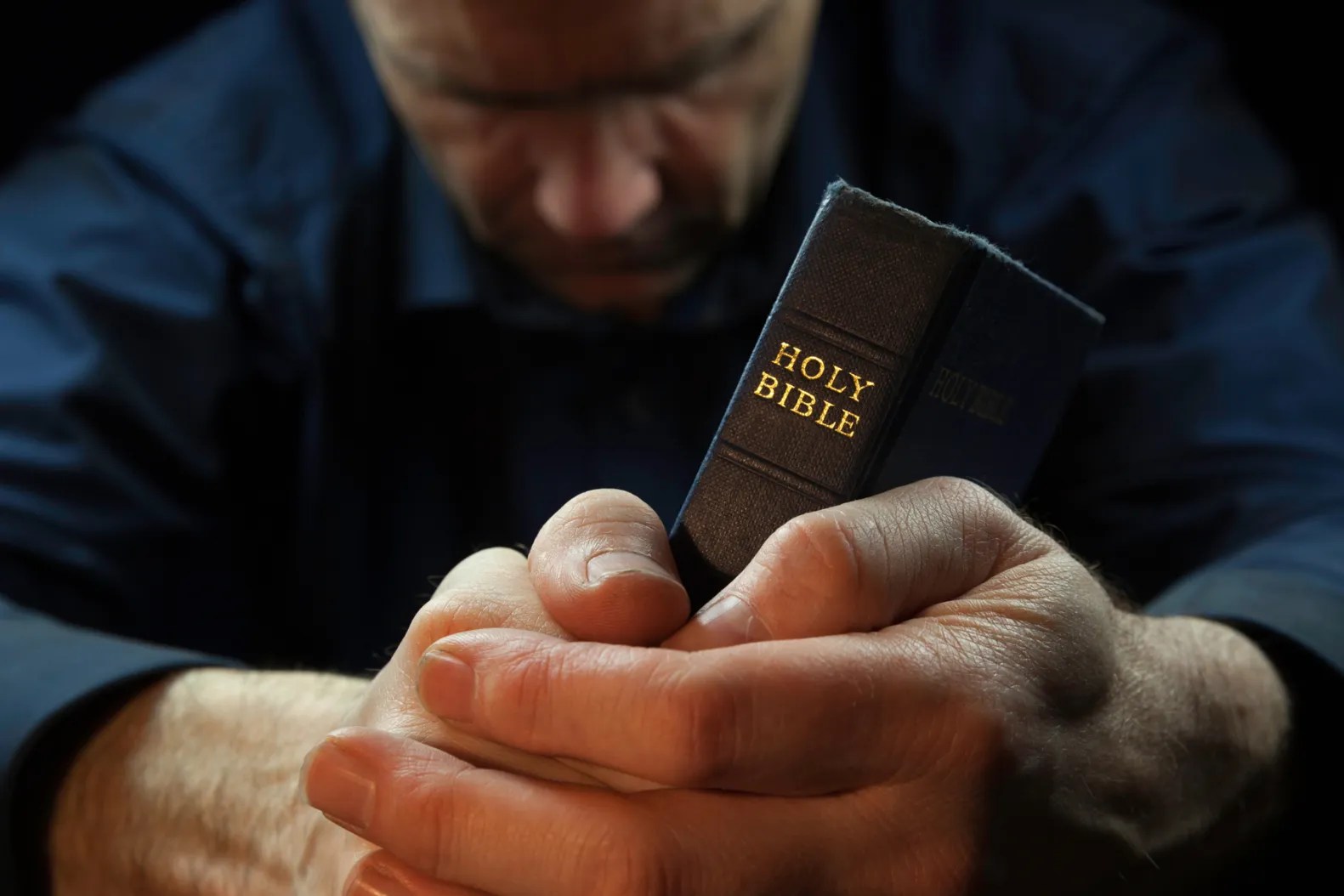
A Man praying holding a Holy Bible. DUNCAN ANDISON/ADOBE STOCK
So far in this series, I’ve been addressing how to define a man, his purpose (from part four) and the struggles of men from mostly a secular viewpoint. I’ve also been leaning heavily on feminism because, in spite of what fourth stage feminism and general progressivism says, it’s very hard to bring one group up without tearing another group down.
Certainly, there has been a great need in some areas to support women but as I’ve previously said, any effort to “dismantle the patriarchy” ends up dismantling men as individuals and a group as well. One example is changing the Boy Scouts of America from a boys/men only group aimed at building and nurturing the next generation of men to an equity for all poster child, including girls/women because anything “all male” is always deemed “non-inclusive,” “patriarchy,” and “misogynistic.”
In other words, many of the goals of feminism are resulting in creating the toxic masculinity they are trying to exterminate.
Image found at Wikimedia.org and is owned by Cgoodwin. Permission is granted to copy, distribute and/or modify this document under the terms of the GNU Free Documentation License
I was surprised to discover that I haven’t written here since last August. I had intended to write a series of articles based on the material presented by Chosen People Ministries Scott Brown.
I attended a full day discipleship training class, and since Brown is a Messianic Jew (however you choose to define the term), I was curious. It was free and it was on Saturday (I was interested in Brown’s apparent lack of Shabbos observance), so I went.
As my previous essay indicated, the study was inspiring.
I’m recovering from some sort of stomach bug so I’ve got some “down time” this weekend.
Thumbing through Brown’s study material, I came across a page that I found disturbing, especially when presented by a man who evangelizes young Israeli Jews every winter in New Zealand (their warm months).
He started that part of the lesson with some historical perspective. Remember, this is about making disciples. He said that “The Rabbi’s set of teachings was called his yoke (of Torah)”
Then he said that just about every use of the word “yoke” in the Bible has a negative connotation.
Now therefore why do you put God to the test by placing upon the neck of the disciples a yoke which neither our fathers nor we have been able to bear? –Acts 15:10
It was for freedom that Christ set us free; therefore keep standing firm and do not be subject again to a yoke of slavery. Behold I, Paul, say to you that if you receive circumcision, Christ will be of no benefit to you. –Galatians 5:1-2
Except this one:
Take My yoke upon you and learn from Me, for I am gentle and humble in heart, and you will find rest for souls. For My yoke is easy and My burden is light.” –Matthew 11:29-30
Unless otherwise indicated, all Bible quotes come from the NASB translation and the emphasis is mine.
Next, Scott described discipleship as a yoke equating it to labor. The juxtaposed this labor with Yeshua’s (Jesus’) yoke that gives rest. He cited John 21 and Hebrews 4, specifically verses 9 and 11 to illustrate said-rest.
I know he was talking to a bunch of Lutherans so he was appealing to his audience, but a number of other Bible verses (notice he was only quoting the New Testament) popped into my head, chiefly Psalm 19:7-14:
The law of the Lord is perfect, restoring the soul;
The testimony of the Lord is sure, making wise the simple.
The precepts of the Lord are right, rejoicing the heart;
The commandment of the Lord is pure, enlightening the eyes.
The fear of the Lord is clean, enduring forever;
The judgments of the Lord are true; they are righteous altogether.
They are more desirable than gold, yes, than much fine gold;
Sweeter also than honey and the drippings of the honeycomb.
Moreover, by them Your servant is warned;
In keeping them there is great reward.
Who can discern his errors? Acquit me of hidden faults.
Also keep back Your servant from presumptuous sins;
Let them not rule over me;
Then I will be blameless,
And I shall be acquitted of great transgression.
Let the words of my mouth and the meditation of my heart
Be acceptable in Your sight,
O Lord, my rock and my Redeemer.
There are any number of other Psalms and Proverbs praising the law. If I had taken that quote from a Jewish Bible, the word you read as “law” would likely be “Torah.”
No, I’m not advocating a sort of Torah observance for Christians, but no matter how many times I encounter it, I never fail to be amazed by the dissonance the church creates when it comes to “the Law.” Even though it was instituted by Hashem (God), even though He fully expected His laws and precepts to be obeyed by Israel, and even though He punished Israel for disobedience to the Torah, by the time we get to the beginning of the book of Acts, “the law” is bad.
I once asked a Baptist Pastor why God created the law if it was a bad thing. He immediately answered that it was to illustrate to the Jewish people how impossible it was to keep. I guess this was one of the setups for Jesus being later born, killed, and resurrected, in order to show how, compared to the Torah, his yoke was light. Far fewer expectations (supposedly).
See my series of reviews to find out why the New Covenant doesn’t replace the Torah or anything else.
Every Sunday without fail I take my 87-year-old Mom to church and sit with her. She’s a life long Lutheran, so I found a nearby church. The people are nice and the Pastor’s sermon’s aren’t bad (though I don’t always agree with everything he says). I take notes, but I don’t speak with him or anyone else about my opinions. I don’t even write about them here.
But at church today, Pastor was fired up about the start of the Advent season and the month long lead up to Christmas.
Even when I was going to church for myself, I always avoided the Christmas service for a number of reasons, not the least of which is the crowds.
I don’t have that luxury this year. Mom will want to go and I’ll be taking her. Then it hit me that she’ll expect to go to Easter services too, which presents even greater problems.
I have to say that in a created universe, there’s no such thing as coincidence, so I can only believe that God is working on something in me by having me be in that church.
However, one of the consequences is learning to keep my mouth shut. Occasionally, my poker face slips, especially last week when the Youth Pastor took over sermon duties. Maybe that’s why I’m there, to realize that my religious opinions don’t make me a better person.
But within my private thoughts, I will still maintain that God didn’t switch from plan A to plan B and replace Israel with the church.
Hopefully, I’ll come back sooner this time with another “chapter” on this commentary.
Last week when I took my Mom to church, the Pastor preached on the Ascension of Christ, which occurred 40 days after he rose. He surprised me by bringing in a copy of the Tanakh and describing, in elementary terms, the Torah, Nevim, and Ketuvim. He said he didn’t expect anyone in his audience to understand those terms, but then again, he didn’t anticipate me.
His sermon got me to thinking about the Counting of the Omer, and since we are in the days of Shavuot, which concludes the 50 days of the counting, I started to wonder if there was some significance in Judaism to the 40th day of that counting.
A quick Google search didn’t reveal anything very significant. Lag B’Omer occurs on the 33rd day, so no help there. While we understand, from a Messianic point of view, that Shavuot or Pentecost was the day of the giving of the Holy Spirit to the Apostles (see Acts 2), what, if anything, is significant about the 40th day of the Omer? Everything else in the Bible is so ordered, so I can’t believe the timing of the Ascension was random.
Okay, my search wasn’t completely futile, but it wasn’t conclusive either. Consider:
The first two seem to be merely daily commentaries, but the last entry said something interesting, though I don’t know how valid the information happens to be:
Since Yeshua rose from the dead on the Feast of First Fruits (Matt. 28:1-10), and ascended into heaven 40 days later (Acts 1:1-3), all of Yeshua’s post-resurrection appearances fall within the first 40 days of the Omer Count.
And
As I thought about the theme of each of these 40-day (or 40-year) events, I found three commonalities that all of them share:
They were times of preparation for those doing God’s work
During this timeframe the harvest was prepared – those who would receive God’s message
God’s power came forth in full strength after the 40 days
Is that the answer? Was it just another part of the 40 day pattern we often find in the Bible? It makes sense if it is, but is there any more?
I don’t know. Throwing it out to you for commentary.
Question:“Is it permissible for a Gentile to eat a Passover Seder meal?”
Answer: Gosh, I hope so, because I eat at my family’s Passover Seder every year.
That question was recently asked in a closed Facebook group for “Messianic Gentiles” and the moderator’s short answer was “yes”. The only prohibition would be if the Temple existed in Jerusalem, the Levitical priesthood was re-established, and the sacrifices, including those for Pesach, were resumed…and even then, that would only be a problem if the non-Jew in question were in Jerusalem for Passover.
This was discussed somewhere on this blogspot in years past, and reader ProclaimLiberty (PL) basically said that if an intermarried Gentile, such as me, (or any Gentile, I suppose) were in Jerusalem with his Jewish family, he (or she) could eat of the meal except for the Pascal lamb which is reserved for the Jewish people.
For any male to eat of it, he must be circumcised, which is shorthand for “covert to Judaism”.
However, not everyone sees it that way. Here’s a comment from the aforementioned closed Facebook group discussing the topic:
OK but if Gentiles are grafted in and there is one new man and all true believers become the Israel of God…(and, no, I do not adhere to replacement theology, neither am I a two house/stick guy) doesn’t that give us a different outlook on this subject?
I say this speaking from the notion that the Passover is ultimately pointing to Christ and not simply a cultural festival for only one group of people.
If the Passover is strictly about the Exodus and God showing Himself mighty to a certain group of people then yes, I agree.
But if the Passover ultimately points to Christ then you are saying that only one group of people (culturally Jewish people) are allowed to celebrate it and not the totality of God’s people (i.e. the Israel of God).
I don’t say this to be divisive.
I am asking a serious question.
One person answered this query by stating that non-Jewish (uncircumcised) Yeshua-believers are welcome to attend the seder in Jerusalem, even once the sacrifices have been restored, and he/she could “partake of the matzah, bitter herbs, the four cups, and the whole seven-day festival…there is no prohibition except in regard to the sacrificed lamb.”
Pretty much my opinion as well.
In the back-and-forth in the discussion thread, it is generally (but not universally) agreed that Gentiles can partake of the modern Passover seder, since we are without the Temple and the sacrifices, but are not to eat of the sacrificed lamb in Jerusalem in the days of the Temple (and there’s no other place to perform the sacrifices except in the Jerusalem Temple, so arguably, even in the Messianic Age, Gentiles in the diaspora can partake of the seder fully, since no lamb would be present).
The original asker cited Ephesians 2:14-19 in an attempt to invoke traditional Christian teaching to sustain a more egalitarian view of the Messiah’s work, diluting or obliterating the distinctions between Israel and the nations defined in the Torah relative to the requirement that only a circumcised (Jewish) male can eat of the lamb (and in case anyone asks, women, who can’t be circumcised as defined in Torah, must be Jewish in order to eat of the lamb as well).
The questioner lamented:
So we’re one…but not really?
We’re fellow citizens…except we’re still strangers and aliens?
This is a common complaint of some Gentiles in Messianic Jewish space, and in days gone by, I’ve made that complaint myself. But being “one” does not mean being “uniform”. It does mean that the ekklesia of Messiah is a single container that nurtures both Israel and the “people of the nations who are called by His Name” (Amos 9:12).
Then this came up:
But when Cephas came to Antioch, I opposed him to his face, because he stood condemned. For prior to the coming of certain men from James, he used to eat with the Gentiles; but when they came, he began to withdraw and hold himself aloof, fearing the party of the circumcision. The rest of the Jews joined him in hypocrisy, with the result that even Barnabas was carried away by their hypocrisy.
–Galatians 2:11-13 (NASB)
Except, of course, the above passage of scripture isn’t describing a Passover meal in Jerusalem, but (probably) an “ordinary” meal in which Peter felt inhibited sharing with Gentiles in the presence of (it is assumed) high-ranking Jewish members of the Messianic Council in Jerusalem who were apparently applying “peer pressure”. It’s been suggested that Paul and James (Ya’akov) disagreed about the cultural barriers (which are not found in Torah) between Jews and Gentiles, and whether or not just eating in the presence of a Gentile rendered a Jew ritualistically “unclean.”
Frankly, non-Jews are usually welcome (if invited) at most Jewish functions, including worshiping in the synagogue on Shabbat, attending an Erev Shabbat meal, attending a bar or bat mitzvah, and so on. Before my wife and I became religious, Jewish friends invited us to their Passover seders on numerous occasions. Granted, some of our friends weren’t Orthodox, but others were, so I can see a case being made for Gentiles in the current age being able to participate in many Jewish ritual activities, extending into the Messianic Age.
There are distinctions between Jews and Gentiles in the current age (including Jewish and Gentile Yeshua-believers) and I think those distinctions will continue in the Messianic Age. If there are to be any sort of “adjustments” in halachah to be made, Messiah will have to inform us of what they will be.
But even in the current age, it really depends on how closely you adhere to the halachah:
98:35 All the activities that are permitted on yom tov are only permitted for the sake of people, not for animals. The Torah tells us (Exodus 12:16), “do for yourselves” – for yourselves but not for animals. Therefore, we may not cook or carry outside for the sake of an animal just like on Shabbos. (We may add to a pot of human food for animals – Rema 412:3.) 98:36 We may not cook or bake for a non-Jew on yom tov. One who has a non-Jewish servant may add food and cook it all in one pot so that there will also be enough for the servant. (He must not specify that he is adding for the servant – Mishnah Brurah 512:11.) For an honored non-Jew, however, one may not even add. (We are concerned that one will do extra for an honored guest – see MB 512:10.) Not only that, even if the Jew cooked or baked for himself, he may not invite a non-Jew to eat with him on yom tov. One may give a non-Jew who isn’t particularly distinguished something that he cooked or baked but he may not bake a loaf even for his non-Jewish servant. (For the purposes of this halacha, an apostate Jew is the same as a non-Jew – MB 512:2.)
-Rabbi Jack Abramowitz
“Cooking for a Non-Jew on Yom Tov” OU.org
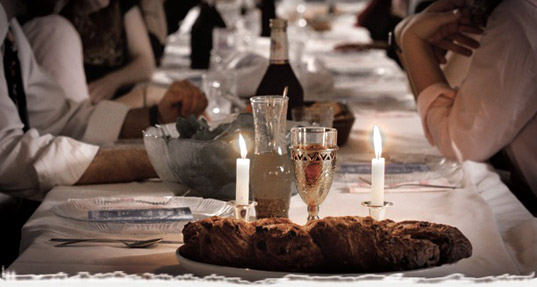
Shabbat meal, Photo: shelanu.cz
But it was also pointed out that Gentiles regularly attend Yom Tov events at Chabad and are welcome to do so.
The response was:
Sometimes there are halchot that people are much more lenient on these days, especially when kiruv is involved. I also read that in this particular halacha the concern is alleviated if the person shows up without an explicit invite. I think the underlying reason might be that Jews can cook on Yom Tov, but they can only cook for what is needed. Since a non-Jew can cook for themselves regardless of Yom Tov then a Jew should not cook for a non-Jew, but may serve them food if there are leftovers.
But the question is how or if this particular standard will be adhered to in the Messianic Age. Will this be one of the “adjustments” Messiah will make, or will he honor all halachah as it currently exists? Interesting question.
As of this writing, there’s no consensus in the closed Facebook group discussion on the matter of how restrictive or permissive Jews are or should be regarding a non-Jewish presence at a Passover seder. The most restrictive seems to be:
Another perspective that I have read about, is that since parts of the seder are done as a remembrance of the Korban Pesach some Jews will not invite gentiles to their seder or ask gentiles to not participate those parts. Just thinking off the top of my head this might include Korech and Afikomen. I am sure many people are not that strict, but it is an interesting thought.
I’ve written about Gentiles and Passover many times before, including in Passover, Messianic Judaism, and Mutual Inclusiveness and Passover for Gentiles in the Diaspora, Not in Jerusalem (the latter specifically addressing the topic of discussion going on in Facebook). And in spite of all that, I once even reblogged something about No Christian Seders, Please, but that was more specifically aimed at churches that conduct their own Passover seders rather than Christians who are guests at a Jewish seder (but of course, even President Obama conducts a Seder at the White House each year rather than being a guest of Jewish hosts).
Since my wife and kids are Jewish, I’ve got an automatic “in” at our family seder (though if my wife chooses to attend the Chabad seder, I’m definitely not invited). However, if a non-Jewish believer is to attend a seder, it should be at the invitation of Jewish hosts, and the expectation of a Gentile guest should be spelled out ahead of time relative to halachah.
It’s problematic in Messianic space to the degree that Gentile expectations can lead us down the “one new man” path a bit too far, but again, local customs should be understood ahead of time so there won’t be any surprises.
I don’t observe Easter in any sense and basically, I even shun it, so Passover is the Yom Tov in which I (silently within myself) honor Rav Yeshua’s symbolic sacrificial death and resurrection which gives us all the hope that in our Rav’s merit, we too shall share a place at the banquet of Abraham, Isaac, and Jacob (Matthew8:11)in the world to come.
Something to ponder. If Jesus died on Passover and rose again a few days later (depending on your timetable), then why are most people celebrating his resurrection a whole month before Passover this year (and various other years as well)? Respectful responses are welcome. No witch hunting.
-Query from Facebook
No, this wasn’t directed at me. It was a general question tossed out into social media by a Facebook “friend” (I put that in quotes because we’ve never met face-to-face).
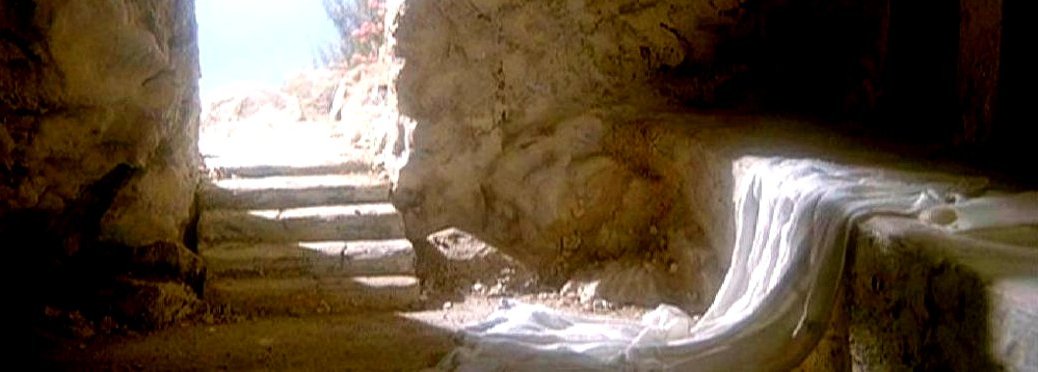
It’s an interesting question, but I must admit, it wasn’t the catalyst for today’s “morning meditation.” Easter was.
More specifically, my massive and total disconnect from Easter was the catalyst. For Easter, or perhaps more accurately expressed, for “Resurrection Day” three years ago, I crafted this little missive about my emotional disconnect from the event, even as I was attending Easter…uh, Resurrection Day services in a little, local Baptist church.
There were certain things I liked about the service. There were certain things I learned. But I wasn’t just gushing with joy like everyone else around me because “he is risen”.
Add to that, the memory of how my wife looked at me when I was walking out the door to go to Resurrection Day services, how crushed and betrayed she seemed, as if she found out I was cheating on her. I know I’ll never attend another Easter service in my life.
My regular readers are aware that my wife is Jewish and not a believer. More specifically, her viewpoint of Jesus, Paul, and Easter is what she learned from the local Chabad Rabbi. She would never stop me from expressing my faith in whatever way I choose, but I know it bothers her, at least on certain occasions…
…like Easter.
She sometimes surprises me, though. She said that although she wouldn’t take me to Israel with a Jewish group, she does want me to go with a more appropriate (for me) Messianic group. I once had a passion to do that, but a lot of things dried up for me, including my sense of community.
I’ve been thinking about Rabbi Stuart Dauermann’s essay “The Jewish People are Us — not them” which you can find published here and which I reviewed a few years back.
Rabbi Dauermann was emphasizing that a Jewish faith in Yeshua shouldn’t result in Jewish “messianists” considering the wider Jewish community as “them” or as “the other,” the way most Christians consider “unbelieving” Jews. From his perspective (as I understand it), Jewish devotion to Rav Yeshua is very Jewish and should, if anything, result in Jewish Yeshua-disciples being drawn closer to larger Jewish community because, after all, Moshiach is the first-born of Israel’s dead, living proof that the New Covenant promise of the resurrection to Israel will indeed come to pass.
What’s more Jewish than that (and I know I’ll take “heck” from one or two Jewish critics of my blog for that question)?
But what about those of us, we non-Jewish “Christians” who stand on the Jewish foundation of the Bible, who feel a greater connection to Passover and Sukkot (Festival of Booths) than Christmas and Easter? What about those non-Jewish believers who feel more comfortable calling ourselves “Messianic Gentiles” or Talmidei Yeshua than Christians?
While Rabbi Dauermann may feel a lot closer to Jewish community than the Christian Church (and I agree, he should), does a “Messianic” perspective for a Gentile believer draw us closer to the Church or push us further away?
Simply put, because Rabbi Dauermann is Jewish, he identifies with larger Jewish community, even those who are not disciples of Rav Yeshua (which just baffles the daylights out of most Christians I’ve spoken to about it). I have a Jewish wife, so I’ve seen that dynamic in action first hand, and any thought of my denying her or forbidding her to associate with Jews (not that I would, of course), is totally revolting to me, absolute anathema.
But to reverse the equation somewhat, being a Gentile disciple of Jesus does not automatically make me think of the Church as “us” or even “me”. In fact, on Easter, I feel more apart from “Church” than ever.
Going back to the previously mentioned Facebook commentary on Easter, there have been some interesting responses. There are others like me out there who also experience the disconnect from this Christian holiday, even those who remain in the Church. Some recognize Easter as a deliberate attempt by the early “Church Fathers” to co-opt the Passover/Resurrection event for Gentiles, divorcing it from its Jewish origins and context.
Others launched into “paganoia,” often a consequence of some Hebrew Roots teachings, saying that Easter was a deliberate attempt to introduce paganism, particularly worship of “Ishtar.”
I don’t think I’d take it that far.
But I am disturbed by one thing. The resurrection of Rav Yeshua is living proof that the New Covenant promises of God to Israel (Ezekiel 37:11-14) will indeed occur, and Yeshua is the “first fruits from the dead” (1 Corinthians 15:20).
Why don’t I feel connected to that?
Well I do, sort of, but it happens more on Passover and during the week of Unleavened Bread than it does at Easter, whether I’m in a church or not.
I know there are Hebrew Roots and Messianic Gentiles out there, those in their churches and elsewhere, who still have an emotional connection to Easter. These people were probably raised in a Christian setting by their Christian families or otherwise, spent enough time in a church to forge that visceral linkage.
I didn’t, not when my parents took me to church as a child, nor when I returned to Christian community as an adult.
Today being Easter punctuates for me that I consider normative Christianity as “them, not me.” I can’t say “us” because I don’t have an alternative “us” to relate to, at least not in an actual, physical form of community.
I’ve said before that I’ve given up the identity crisis that has seized so many non-Jews who are either in Messianic Jewish or Hebrew Roots community. As Popeye famously quipped, “I yam what I yam,” even if it doesn’t have a widely recognized name or label.
For those of you who are indeed emotionally and theologically attached and even thrilled by Easter or Resurrection Day, may you use your worship to strengthen your devotion to Rav Yeshua (Jesus Christ) and all he brings to us.
For those of you who are like me, any day is a good day to bring honor to our Rav and glory to the God of Israel. May the day come when we all merit the resurrection from the dead, and the life in the world to come.
"When you awake in the morning, learn something to inspire you and mediate upon it, then plunge forward full of light with which to illuminate the darkness." -Rabbi Tzvi Freeman









 Morning Meditations