Tag Archives: Jesus

If You Had to Choose Between Jesus and Your Spouse…

If someone comes to me and does not hate his father and his mother and his wife and his children and his brothers and his sisters and even his own life, he is not worthy to be my disciple.

Luke 14:26 (DHE Gospels)

I know I’m quoting this verse out of context, but I find it hard to reconcile with the following.

Have you not read that from the beginning the Maker “created them male and female,” and it says, “Therefore a man shall leave his father and mother and cling to his wife, and the two will become one flesh”? If so, they are not two any longer, but one flesh. Thus, what God has joined, man must not divide.

Matthew 19:6 (DHE Gospels)

On the one hand, Jesus seems to value marriage quite highly (what God has joined) but on the other hand, we are to reject (hate) our family including our wives, presumably if our family opposes our becoming disciples of Jesus.

As an intermarried husband, this is particularly difficult for me, especially when I see my marriage through this scripture:

But to the rest I say, not the Lord, that if any brother has a wife who is an unbeliever, and she consents to live with him, he must not divorce her. And a woman who has an unbelieving husband, and he consents to live with her, she must not send her husband away. For the unbelieving husband is sanctified through his wife, and the unbelieving wife is sanctified through [h]her believing husband; for otherwise your children are unclean, but now they are holy. Yet if the unbelieving one leaves, let him leave; the brother or the sister is not under bondage in such cases, but God has called us to peace. For how do you know, O wife, whether you will save your husband? Or how do you know, O husband, whether you will save your wife?

1 Corinthians 7:12-16 (NASB)

Also, Ephesians 5:22-33 says many fine things about marriage and how a husband and wife are to love one another. How can God join us together, tell us how to love, say that it is acceptable for a believing spouse to be joined with an unbelieving spouse if both are willing, and then tell the husband he is not worthy of being a disciple is he does not hate his wife?

intermarriageThis is one of those “difficult sayings of Jesus” that isn’t easy to answer.

Messianic or “Jewish-friendly” Christian commentaries on such specific topics aren’t always readily available, but I did find a conventional Christian response by Pastor Mark Driscoll. I know nothing about him, but he did write something detailed on this particular verse.

Jesus’ call to discipleship can be difficult. Contrary to common practice today, Jesus was not in the business of getting anyone and everyone he could in the door of his discipleship program. Instead, he took painstaking measures to clarify the costs of following him. Those who heard him often abandoned their pursuit after hearing his messages (John 6:52–71). In keeping with this truth, Jesus’ requirements for discipleship set out in Luke 14:26 are hard for us to hear.

Thankfully, there is another sense for the word “hate,” as it pertains to this passage. When it’s used in the Old Testament, particularly in the Wisdom Literature, the word loses its psychological force (Michel, “μισεω,” in TDNT, 4:687.). Instead, it carries a sense of intensified choice. For instance, in Proverbs, the writer often instructs the reader to choose righteousness over evil, often worded in terms of love and hate. The call is to reject (= hate) evil and to embrace (= love) righteousness. In Jesus’ statement here in Luke 14:26, the same principle is at play.

-Driscoll, “Tough Text Tuesday – Luke 14:26”
pastormark.tv

That helps a little but not as much as you might think. Still, the suggestion of a choice between two paths reminded me somewhat of a Kal va-chomer or “lighter to heavier” argument. If I reword the passage from Luke 14, I could say, “If you love your wife whom God has joined with you, how much more should you love Messiah, who God brought for the sake of the world?”

I suppose that could be worded better, but you get the idea. No, I’m not rewriting the Bible, far be it from me to do so. But I am suggesting in my own wee commentary (call it a small midrash, for what it’s worth) that, even if my wife is an unbeliever, I don’t have to hate her so I can love Jesus. I can love my wife, and I can also apprehend the great requirement to love and be devoted to Messiah, Son of David, who is the living embodiment of God’s promises for atonement, redemption, salvation, and the resurrection. He is the hope, not just for me, but for everyone. He is the hope that someday my wife will be saved, so in a way, by choosing him, I am also choosing her, for if I should choose her by rejecting Jesus, then how do I know I’m not dooming us both? Loving Jesus then, is also loving my wife.

Did Paul Know Jesus was the Second Person in the Trinity?

First, a quote: “The Church cannot indefinitely continue to believe about Jesus what he did not know to be true about himself,” J. W. Bowman, The Intention of Jesus (London: SCM, 1945), p. 108.

This is not really a historical claim but a theological one, and it reflects a common assumption: The assumption that the theological/religious validity of claims about Jesus rest upon what Jesus believed and taught about himself. In my book, Lord Jesus Christ (pp. 5-9), I’ve noted the irony of how this assumption has been shared by critics and advocates of Christian faith, and also how it has worked mischief in the historical investigation of Christian origins.

-Dr. Larry Hurtado
“Questioning a Common Assumption,” May 13, 2014
Larry Hurtado’s Blog

Dr. Larry Hurtado has been prolifically writing on something rather compelling over the past few days. Did Jesus know he was Divine during his “earthly ministry?” Did Jesus know he was to be an object of worship?

I think most Evangelicals would assume the answer to those questions is a resounding “yes,” but here we have one of the most preeminent New Testament scholars in the world drawing that assumption into question. I think Hurtado’s comments deserve further scrutiny.

(NOTE: I should mention here that I have no intention of matching my meager brain power and limited knowledge of New Testament scholarship with Dr. Hurtado’s. I merely want to bring this issue to my readership in order to explore what he presents on his own blog and to see what responses his viewpoints elicit here.)

Looking at the evidence in the New Testament, Hurtado concludes that the “high” view of Jesus as Divine Messiah didn’t emerge until what he calls “post-Easter.”

But I’d like to make two observations. First, the earliest extant Christian texts themselves make it perfectly clear that the “high” notions about Jesus sharing in divine glory, exalted to heavenly status, worthy of worship, etc., all erupted after Jesus’ ministry, not during it, and that the crucial impetus for these notions was what earliest believers saw as God’s actions, particularly their belief that God had raised Jesus from death to heavenly glory. (See, e.g., Philippians 2:9-11; Acts 2:36).

To underscore the point, the remarkable escalation in the status/significance of Jesus to the “right hand” of God, to sharing the divine name and glory, and to the central and programmatic place he held in earliest Christian devotional practice all rested on the fundamental conviction that God has exalted him and now required that Jesus’ exalted status be recognized, and that he should be reverenced accordingly.

My second observation is this: Why should this be taken as some kind of threat to the theological legitimacy of traditional Christian faith?

-Hurtado, ibid

Larry Hurtado
Larry Hurtado

This sounds like it was only after the resurrection that it was known to anyone else including Jesus that he was indeed the Divine Son of God the Father.

I think a lot of people would find that startling, but as Hurtado says above, why should that be a threat? And yet on the aforementioned blog post and two others, many, many comments were generated, some of them rather “impassioned.”

Indeed, more explicitly than any of the other Gospels, GJohn makes it clear that the author saw and accepted a distinction between what he regarded as the level of understanding of Jesus among his followers during his earthly life and the subsequently enhanced level of understanding in the “post-Easter” period.

But my point here is that even GJohn doesn’t make the high Christological claims affirmed by the author rest simply (or even particularly) on demands and teaching of the earthly Jesus. Instead, the text fully affirms that the realization of Jesus’ glorified/glorious status came subsequently, through the revelations of the Spirit.

-Hurtado, Jesus and Christology: The Gospel of John as a Case Study, May 14, 2014

Hurtado wrote this as a follow-up to his prior missive, which continued to inspire passionate discourse, and based on those comments, he wrote a third blog post, Jesus, “Pre-existence,” etc: Responding to Questions on May 15th.

He breaks his response down into four points to which he comments on his blog at length:

  1. His response to his emphasis that the NT makes God’s actions (esp. in raising Jesus from death and giving him glory) the basis for the “high” Christological claims and the remarkable devotional practice in which Jesus was included with God.
  2. His position about texts such as John 1:1-2, where, of the “Logos” (here, the “pre-incarnate” identity/form of the incarnate Jesus), we read: “he was with God and he was God”.
  3. What we are supposed to make of statements ascribing “pre-existence” to Jesus (to use the typical theological buzzword). If you entertain these, how could Jesus not have known this and spoken of it?
  4. What about subsequent creedal controversies and formulations? E.g., the three “persons” (or “hypostases”) that comprise the “Trinity,” etc.?

I don’t want to re-create the full content from Hurtado’s blog and reader comments, but I do want to draw attention to one particular paragraph (for full context, please use the links I provided and read all three of Hurtado’s posts):

But I suspect that if Paul were asked whether Jesus was the “second person of the Trinity,” he would likely have responded with a quizzical look, and asked for some explanation of what it meant! Were the patristic texts and creedal statements saying something beyond or distinguishable from what the NT texts say? Certainly. Does that invalidate those later creedal discussions and formulations? Well, if you recognize the necessity of the continuing theological task (of intelligently attempting to articulate Christian faith meaningfully in terms appropriate and understandable in particular times and cultures), then probably you’ll see the classic creedal statements as an appropriate such effort. But that’s a historical judgement about that later period, and/or a theological judgement. And my emphasis is on the historical question of what the NT texts say and how to understand them in their own historical context.

-Hurtado, Jesus, “Pre-existence,” etc: Responding to Questions

This goes not only to what Jesus thought of himself prior to his crucifixion and resurrection, but what Paul and the Jesus-believing Jews (and Gentiles) believed about the nature of Christ relative to God during the Biblical period.

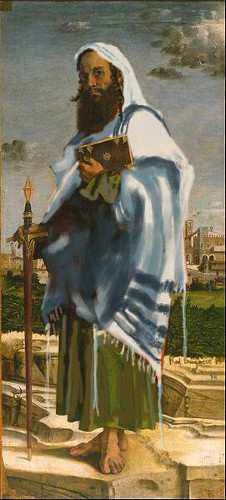
The Jewish PaulDid Paul believe in the Trinity? Again, an Evangelical wouldn’t miss a beat in saying, “Yes, of course,” but again, we have Hurtado, who we have every reason to believe is presenting a credible case from current NT research, saying that Paul wouldn’t have a clue about the Trinity.

I should mention that Derek Leman at Messianic Jewish Musings has been writing a great deal about the Divinity of Jesus lately, and a lot of his perspectives are based on Hurtado. His own research and conclusions will be presented in his forthcoming book Divine Messiah, which should be available for digital download from Amazon as early as May 23rd, so maybe Leman’s text will offer some insights.

In addition to my recent commentary on Zetterholm and the implications of his research on our view of the Church, I’ve recently read an article at Bible History Daily called The Origin of Christianity by Noah Wiener, which is a review of Geza Vermes’ work, From Jewish to Gentile: How the Jesus Movement Became Christianity (November/December 2012 issue of Biblical Archaeology Review).

By contrast, the early second century Epistle of Barnabas shows a distinctly gentile Christianity in its presentation of the Hebrew Bible as allegory instead of covenantal fact. The clearly divinized Jesus in this document is distanced from the Jewish Christians and the divide between the Christian communities continued to widen over time. Geza Vermes writes that after Hadrian’s suppression of the Second Jewish Revolt, the Jewish Christians quickly became a minority group in the newly established church. At this point we can see the origin of Christianity as a distinctly non-Jewish religion; late in the second century, the Jewish Christians either rejoined their Jewish peers or become part of the newly gentile Christian church.

-Wiener

The implication here, as I’m reading it, is that many of the Biblical truths we hold onto as Christians were conceptualized and codified after the Gentiles formed the Christian Church and left Jesus-worship within the Jewish context. In other words, the Jewish apostles and disciples wouldn’t have imagined many of the theologies developed later by the Gentiles in relation to their own understanding of scripture (the Tanakh/Old Testament) and of the teachings of Messiah. In fact, Jesus himself, even “post-Easter,” may not have seen/see himself as “the second person of the Trinity,” at least not using that particular language.

This isn’t to deny the Divine nature of Messiah, the profound mystery of him being “the visible image of the invisible God,” (Colossians 1:15) or his sitting at the right hand of the Father in all exalted honor and glory, but exactly how we see the nature of Jesus may be based more on Evangelical assumptions and long-cherished traditions than how the original authors of the Gospels and Epistles actually understood the nature and character of Messiah.

It seems clear then, that the origin and development of Christianity as a completely separate entity from the ekklesia we see recorded in the Bible, departed from the original theological and doctrinal template taught by the apostles, and I imagine Paul, witnessing the Evangelical Church of the twenty-first century CE, would find little if anything to relate to or even recognize as devotion to Messiah, Son of David.

Any thoughts?

Repentance and Resolution

The Torah teaches us that it is never too late to change.

Changing for the better is called doing teshuva. The Hebrew word teshuva, which is often translated as repentance, actually means to “return.” Return to God. Return to our pure self.

How do people become interested in self-improvement?

People have faults. The faults they have cause them to suffer in some way or another. This suffering limits an individual’s freedom and is often painful. Hence, people want to change… to improve. To be free once again.

How does one change for the better? How does one do teshuva?

There are four steps of teshuva.

-Rabbi Mordechai Rottman
“Four Steps to Change”
Aish.com

Resolution for the Future

There isn’t much to Rabbi Rottman’s last step in making teshuva, but I think it’s deceptively simple:

Make a firm decision not to repeat the negative behavior.
This step can be compared to stepping on the gas! Once you make this resolution, you’re really starting to move! Every minute that passes puts miles behind you and the negativity.

You’re on your way to becoming the “new you!”

After all of the regret, the struggle with negativity from yourself and others around you, and your agonizing confession to God and perhaps even to the people you have hurt, you come to this. You’ve gotten past the tough parts. You’re standing at the trailhead. The new journey is about to start, and it takes you in a different direction than you have previously traveled. The adventure begins.

But the spectre of sin is always following behind, perhaps at a great distance, perhaps right behind your shoulder.

I mean, it’s not like you’re never going to sin again, right?

We’ve been talking about teshuva or repenting of a single, habitual sin. This is something that’s been going on for years and that has consumed your life, made you a slave, and completely disrupted your relationship with God and with other people.

Now you’ve gone through three out of four steps of making teshuva and you stand at the threshold of that fourth step into freedom. Resolve not to return to the sins you have left behind.

walkingAlthough I’m a linear person (most guys are), I can still see or rather hear the echoes of the other steps, especially the negative self-talk. It may not be very strong at this stage, but I can’t say it’s completely absent, either. What if you move forward only to stumble again? What if you backslide? What if you make a mistake? What does that make you? If you screw this up after all you’ve gone through, does that mean all your work was for nothing?

Remember, we’re looking at sin and repentance from a fundamentally Jewish perspective.

Worse yet, biblical translation promotes misconceptions. For example, you’ll read a translation and come across the word “sin.” Uh-oh. Sin, evil, punishment. But the Hebrew word Chet does not mean sin at all. Chet appears in the Bible in reference to an arrow which missed the target. There is nothing inherently “bad” about the arrow (or the archer). Rather, a mistake was made – due to a lack of focus, concentration or skill.

From here we learn that human beings are essentially good. Nobody wants to sin. We may occasionally make a mistake, lose focus, and miss the target. But in essence we want to do good. This is a great lesson in self-esteem. Simply adjust your aim and try again!

-Rabbi Noah Weinberg
Written Instructions for Living
from the 48 Ways to Wisdom series

This certainly flies in the face of what we believe in Christianity; that human beings are essentially evil. But Rabbi Weinberg follows up with this statement:

In translation, the message is lost. In fact, entire religions have arose based on mistranslations. So get it straight. Learn Hebrew.

From a Jewish point of view, Christianity’s understanding of sin and evil is based on a misunderstanding of Hebrew.

In Christianity, guilt and sin define your identity before repentance. This is who you are. You are dead in your sins, lost, hopelessly separated from God.

And you were dead in your trespasses and sins, in which you formerly walked according to the course of this world, according to the prince of the power of the air, of the spirit that is now working in the sons of disobedience. Among them we too all formerly lived in the lusts of our flesh, indulging the desires of the flesh and of the mind, and were by nature children of wrath, even as the rest.

Ephesians 2:1-3 (NASB)

This is Paul’s description of pagan Gentiles before they became disciples of the Jewish Messiah and began to worship the God of Israel. Once they (we) make the transition, though:

But now in Christ Jesus you who formerly were far off have been brought near by the blood of Christ.

So then you are no longer strangers and aliens, but you are fellow citizens with the saints, and are of God’s household, having been built on the foundation of the apostles and prophets, Christ Jesus Himself being the corner stone, in whom the whole building, being fitted together, is growing into a holy temple in the Lord, in whom you also are being built together into a dwelling of God in the Spirit.

Ephesians 2:13, 19-22 (NASB)

newI’m deliberately leaving out the “one new man” language and the text that is commonly misinterpreted as Paul’s commentary on the Law being “nailed to the cross with Jesus” because it is not relevant here (and I’ll deal with those misunderstandings another time).

I’m quoting these verses to show that non-Jews can be grafted in and access the blessings of the covenants made between God and Israel, though of course, this doesn’t make us Israel. Paul was describing what we were before and who we are now.

But the writer of the Epistle to the Hebrews delivers a dire warning.

For in the case of those who have once been enlightened and have tasted of the heavenly gift and have been made partakers of the Holy Spirit, and have tasted the good word of God and the powers of the age to come, and then have fallen away, it is impossible to renew them again to repentance, since they again crucify to themselves the Son of God and put Him to open shame. For ground that drinks the rain which often falls on it and brings forth vegetation useful to those for whose sake it is also tilled, receives a blessing from God; but if it yields thorns and thistles, it is worthless and close to being cursed, and it ends up being burned.

Hebrews 6:4-8 (NASB)

You should recognize this if you’ve read my most recent review of D. Thomas Lancaster’s Hebrews sermon series Things that Belong to Salvation. If you haven’t read it, I highly recommend that you do, because Lancaster explains that this passage of scripture, while a critical warning against apostasy, is not an automatic “go to jail (hell) forever” card.

What happens when we come to faith as a Christian and continue to sin? If your faith hasn’t transformed your life at all, then it’s time to question whether you have any faith in God. If your life has changed for the better spiritually and morally, but you still struggle with sin, welcome to the club. I don’t know a single disciple of the Master, no matter how spiritually elevated, who has completely conquered sin.

In fact, we will continue to struggle between our old and new natures all of our human lives, until the Messiah comes, until the resurrection, until the Spirit is poured out on all flesh (Joel 2:28, Acts 2:17). The Acts 2 (for Jews) and Acts 10 (for Gentiles) events were only a down-payment, a guarantee that the promises of the future Messianic Age and that the coming of the Kingdom of God will indeed arrive.

WrestlingUntil then, we struggle with our humanity. Sin is what we do, not who we are. Sin is the influence of the world around us and of the spiritual world. Sin is a disturbance in our relationship with God, like a pool of water can be disturbed by dropping a stone into it.

Make no mistake. Disobedience and willfully defying God comes with horrible consequences. But God isn’t standing over us ready to drop the hammer at the first sign of a mistake. He wants us to succeed. He wants us to draw close to Him. He is our ultimate supporter, He’s always in our corner, cheering us on, calling us to run just a little harder, just a little faster, so we can get to the finish line and receive the trophies He has waiting.

For many of us, life is a very long and difficult road. We can let the hardships defeat us and permanently separate us from God, or we can expect to fall down periodically, so that we can learn to pick ourselves up. Don’t worry. Whether you realize it or not, God is there to lend a supportive hand and help us get back on our feet.

Some falls are worse than others. Sometimes the injuries are severe and leave scars and a limp. But God will not allow you or me to be completely broken and unable to continue the journey. That’s something only you can do to yourself by denying Him and failing to ask for His help.

The first sentence a Jewish child is taught is “Torah tziva lanu Moshe, morasha kehilat Yaakov” – “Torah was commanded to us through Moses and is the inheritance of every Jew.” Torah was meant for everybody. It is not the exclusive domain of some priestly class. Rather, it is a living, breathing document – the lifeblood of our Jewish nation. We are required at all times to involve ourselves in its study and practice. As it says, “You shall think about it day and night” (Joshua 1:8).

-Rabbi Noah Weinberg
Written Instructions for Living
from the 48 Ways to Wisdom series

Although the Torah in its fullness is the inheritance of every Jew, Rabbi Weinberg said it is also meant for everybody (not every Jewish person). I’ve said before that all believers, including Gentiles, have an obligation to the Torah of Moses as part of being a disciples of Jesus (Yeshua), and I’ve even revisited this opinion.

visualize successFor believers, not only is the Torah the written instructions for living, but so are all the scriptures, including the apostolic writings. The Torah is called a tree of life. Don’t just study the Bible, integrate its lessons into your entire lived experience. It’s never too late to begin studying the Bible, just as it’s never too late to make teshuva and return to God.

Visualize Your Success. Then Go And Do It.

-Arnold Schwarzenegger

Resolving not to return to sin is resolving to move toward God. Repent daily. Walk the path daily. Seek an encounter with God daily. Rabbi Zelig Pliskin has said that ”Whatever you focus your attention on, you increase.” Concentrate on the Spirit of God within yourself, focus on the Word of God, and God will increase within you and expand into the world around you.

Gifted souls enter this world and shine. All that surround them bathe in their light and their beauty. And when they are gone, their light is missed.

Challenged souls enter, stumble and fall. They pick themselves up and fall again. Eventually, they climb to a higher tier, where more stumbling blocks await them. Their accomplishments often go unnoticed—although their stumbling is obvious to all.

But by the time they leave, new paths have been forged, obstacles leveled, and life itself has gained a new clarity for all those yet to enter.

Both are pure souls, G‑dly in essence. But while the gifted shine their light from Above, the challenged meet the enemy on its own ground. Any real change in this world is only on their account.

-Rabbi Tzvi Freeman
“Gifted and Challenged”
Based on the letters and talks of the Rebbe, Rabbi M. M. Schneerson
Chabad.org

Blessings.

Nanos, Ancient Antioch, and the Problem with Peter

Paul told the Galatians of a time in Antioch when he “condemned” Peter “to his face” for failing to “walk straight toward the good news.” He attributed Peter’s change of mealtime behavior to a hypocritical effort to escape pressure from “the ones for the circumcision” (Gal 2:11-21). For before “certain ones came from James,” Peter “was eating with the Gentiles” but afterwards he “drew back and separated himself.

-Mark D. Nanos
“What Was at Stake in Peter’s ‘Eating with Gentiles’ at Antioch?” pg, 282 (pages 282-318) in The Galatians Debate. Edited by Mark Nanos. Peabody, Mass.: Hendrickson, 2002.

So begins Nanos’ article on a topic I’ve been exploring recently, the Messianic community of Jews and Gentiles in the “Synagogue of the Way” in first century CE Syrian Antioch, and more specifically, what is known as “the Antioch Incident” which involved the activity chronicled by the apostle Paul in Galatians 2:11-21.

While this article was included as a chapter (fifteen) in the book The Galatians Debate: Contemporary Issues in Rhetorical and Historical Interpretation, it also functions as a stand-alone paper which we can examine and from which we may be able to draw certain conclusions.

I’ve covered this material in two previous blog posts, both based on chapters from Magnus Zetterholm’s book The Formation of Christianity in Antioch: A Social-Scientific Approach to the Separation between Judaism and Christianity (See Zetterholm, Ancient Antioch and Today’s Messianic Judaism and Zetterholm, Ancient Antioch, and the Problem of the Gentiles). There is only one more chapter left in the Zetterholm book, which describes his perspective on the split between the Jewish and Gentile groups within the Messianic Antioch ekklesia (and ultimately all believing communities of that era), but someone suggested that I might want to review the Nanos paper on this topic first, since it may provide some clarification as to the actual problem between Paul and Peter as related to Gentile community and social status in this Jewish religious stream.

What Was at Stake in the Antioch Incident?

Nanos defines two “interpretive elements” that are “central for determining what was at stake” in “Peter’s eating or not eating with these Gentiles (pg 283):”

  1. What did the ones for the circumcision, whom Peter feared, find so objectionable about Peter’s eating with Gentiles?
  2. What did Paul find so objectionable about Peter’s decision to withdraw and separate from these mixed meals?

Keep in mind all this is from Paul’s point of view, so we don’t have the perspectives of Peter, the other Jewish believers (and unbelievers?) present, and particularly the Gentiles who were impacted by the incident.

According to Nanos, there are three possibilities as far as what the “ones advocating circumcision” could have found objectionable or offensive about Peter eating with the Jesus-believing Gentiles:

  1. The food served was objectionable according to Jewish dietary norms.
  2. Peter was violating halachah in even eating with Gentiles at all, even though the food was acceptable.
  3. It was the way Peter was eating with these Gentiles, rather than having a meal with them as such (and with the food being acceptable).

In trying to select an appropriate response, we also have to take Paul’s reaction into consideration. Which of these circumstances was most likely to elicit his offense and outrage and why?

Traditionally Paul has been understood to be upset because he maintained that faith in the gospel obviated continued regard for eating according to Jewish dietary regulations. But for Paul, did observing a Jewish diet compromise in principle “the truth of the gospel”? Or did he perhaps object instead to the degree of Jewish dietary rigor necessary to comply with the standards of those whom Peter feared? Or again, in a different direction, could it be that Paul understood that Peter’s withdrawal and separation undermined the identity of the Gentiles as equals while remaining Gentiles?

-Nanos, pg 284

At the church I currently attend (and I suspect at most or all Evangelical churches just about everywhere), it is assumed that the first and traditional Christian interpretation is obviously correct. Jesus canceled “the Law” including kashrut and Peter was eating ham sandwiches and shrimp scampi with his Gentile buds until other Jews who were “still under the Law” showed up and embarrassed Peter. Peter caved in to peer pressure and pulled away from eating trief with the goyim. Clearly for Evangelicals, the issue at hand was the food.

But before we get into whether this is actually supported by scripture or not, we need to identify the players. I used to think there were only two interest groups outside of Paul, Peter, Barnabas, and of course, the Gentiles present:

  1. The “certain men from James” who represented the “party of the circumcision” (Gal. 2:12 NASB).
  2. The rest of the Jews (Gal. 2:13 NASB) who “joined him (Peter) in hypocrisy.”

However, Nanos draws a distinction between the Jewish men from James and the advocates of circumcision as representing two different groups of Jews. Paul obviously knew the particulars and presumably, so did the intended audience of his epistle (Gentile believers in the Messianic synagogues in the area of Galatia), but because that understanding was assumed, this narrative doesn’t contain a lot of information to help us figure out who’s who.

Antioch Rubens“The rest of the Jews” probably isn’t a terribly significant group, according to Nanos. They could be local Jesus-believing Jews, or Jews who accompanied Peter from Jerusalem/Judea to Antioch (Peter’s personal disciples?).

More critical to grasp are the two other groups. From verse 12, the Greek describing the contingent from James is best translated, again according to Nanos, as ”certain/some ones came from James,” (pg 286) but doesn’t absolutely delineate whether James actually sent them or if they came from James but weren’t specifically his representatives.

This is important because in my previous blog posts citing Zetterholm, it was thought that Paul and James disagreed about the status of Gentiles in the Messianic Jewish community and even that James advocated for a total “bilateral” separation of Jewish and Gentile believers, while Paul supported covenant and social inclusion. It makes a difference if James sent this group to “spy out” the doings in the Antioch synagogue vs. this group was associated with James but didn’t directly represent his views.

The third group (pp 286-7), the ones Peter was actually afraid of (I guess this would mean he wasn’t afraid of the group from James), is simply identified as “circumcision” (Jews) as opposed to “foreskinned” (Gentiles). Why did Paul call this third group only “circumcision?” What did he mean? Were they believing or non-believing Jews?

It would seem odd, at least to me, for Paul to call this Jewish group “circumcision” in order to differentiate them from believing Jews (although according to one Pastor I’ve spoken with who represents the traditional Christian viewpoint, Paul was advocating against believing Jews becoming circumcised, though this should have happened when they were eight-days old, or having their male children circumcised). In Galatians 3:28, Paul wrote that Jews and Greeks are all “one in Christ” but he still differentiates Jews and Greeks, even as he differentiates men and women “in Christ.”

This would mean (and Nanos speaks of this on pg 287), that Paul and Peter self-identified as “Jews by birth” (v. 15…also see Rom. 9:3-5, 11:1; Phil. 3:3-5, and by inference, 1 Cor. 7:17-20), thus a Jew becoming a disciple of Messiah Jesus (Yeshua) did not remove the status of “Jew” from the Jewish person. In other words a Jesus-believing Jew and any other Jew are both considered Jews, with no distinction relative to their ethnic or (Sinai) covenant status. So Paul and Peter are just as Jewish as any other Jewish individual. Being called “circumcision” is only to differentiate Jews from the “foreskinned” Gentiles.

Citing Dunn (Dunn, “Echoes,” 460-61; see also, Dunn, Theology, 123, where he cites Rom 4:12; Col 4:11; Titus 1:10), Nanos states (pg 288):

…but an interest group specifically distinguished from other groups of circumcised Jews as advocates of circumcision.

And further:

Given the rhetorical context dealing with Gentile associates, the likely connotation of this particular advocacy is proselyte conversion.

The “circumcision” then are a group of Jews (believing or non-believing) who advocate for Gentiles in the Jewish religious space to gain equality with the “Jews by birth” only through the proselyte rite which includes circumcision.

This group represented the dominant viewpoint of Jewish communal norms (see Acts 15:1) relative to full Gentile inclusion in Jewish religious/communal space. Gentile God-fearers were attendees or guests in that space but were hardly considered of equal status to Jews in the synagogue and in Jewish society at large and they absolutely were not included in covenant.

fellowshipNanos presents what appears to be a new perspective (from an Evangelical Christian point of view) regarding the issue at hand. Paul considered the believing Gentiles as having equal status in the Jewish “Way,” both in terms of social status and covenant blessings, while still remaining Gentiles. In fact, Paul required that the Gentiles retain their status as Gentiles lest “Christ be of no benefit” to them (Galatians 5:2).

The problem was not food, and it was not a general ban of Jews eating with Gentiles (since in diaspora communities, the halachah for such mixed-meals would have to allow for some social intercourse), but rather non-proselyte believing Gentiles being treated as social and covenant equals within the Jewish community.

Nanos refers to v. 13 in terms of Peter and the other Jews as “masking their true conviction,” which will be seen as significant because:

Therefore, the Christ-believing Jews try to mask their convictions that these Gentiles are not regarded among their subgroups as mere “pagan” guests, but at the same time not as proselyte candidates either, by withdrawing from eating with Gentiles to distance themselves from meals symbolizing this nonconforming “truth.”

-ibid, pg 289

The “nonconforming truth” is that, through faith in Messiah, the Gentiles are considered equal co-participants in Jewish covenant and community while remaining Gentiles and with no intention of them ever participating in the proselyte rite. Something about the way Peter was eating with the Gentiles, indicated to outside Jewish observers, that Peter and the Jews with him considered the believing Gentiles as social/covenantal equals to the Jews, something that non-Jesus-believing Jews (or maybe Jesus-believing Jews from a different faction) found offensive and unsustainable.

Peter’s hypocrisy then, was pretending the Gentiles did not have equal social standing with the Jews of the Way when just previously, he had been eating with them as equals. Peter then included Barnabas and other Jews in his hypocrisy when his example resulted in their following his lead.

Nanos supports something that I’ve believed for a while now. The “offense of the cross” for non-believing Jews wasn’t Jesus himself, but rather Paul’s insistence that Jesus-believing Gentiles be included in the Jewish community as equal co-participants while remaining Gentiles.

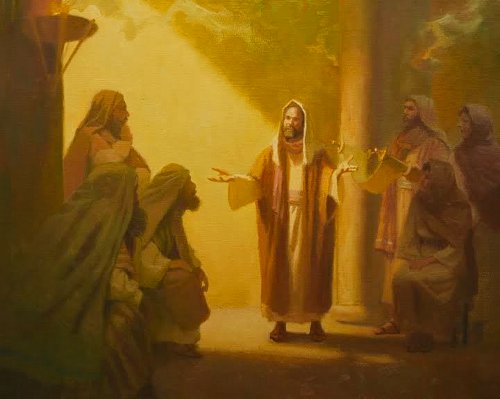
Apostle Paul preachingA classic example of this occurred at Pisidian Antioch. In Paul’s first appearance and “sermon” there on Shabbat, the Jews and Proselytes were quite interested in Paul’s message of the good news of Messiah and wanted him to return the following Shabbat to say more (Acts 13:43). However, the following Shabbat, it was apparent that the Gentile God-fearers, present the previous week, had “spread the word” to their Gentile families and friends, most likely not God-fearers, but “straight up” pagans and idol worshipers, because “crowds” of Gentiles showed up at the synagogue (v. 45) resulting in “jealousy” among the synagogue leaders, and with them responding to Paul with “blasphemy” and evicting Paul and his companions from the synagogue and the entire district.

Getting back to the two groups, the ones from James and the advocates of circumcision for Gentiles, Nanos states that we don’t know how they are related or what the timing of the arrival of the first group has to do with the presence of the second group. It could be a coincidence, but in the Bible, I tend to think there is no such critter.

That describes a great deal about the situation but doesn’t answer the question about what was at stake in Peter eating with and withdrawing from the Gentiles at Antioch.

J.B. Lightfoot argues that before the withdrawal Peter “had no scruples about living [like a gentile],” that is, without observing Jewish dietary restrictions (“discard Jewish customs”), for the vision of Acts 10 “taught him the worthlessness of these narrow traditions.” Lightfoot assumes that this change is the logical result of the desire to “mix freely with the Gentiles and thus of necessity disregard the Jewish law of meats.”

-ibid, pg 293

This is an example of the traditional Christian interpretation of the matter, but as I’ve stated here and in many other blog articles, this just doesn’t jibe with the overall presentation of Paul relative to the Torah as well and Jewish and Gentile status, and it certainly is inconsistent with Messiah’s interpretation of his own mission in terms of continued Torah observance by believing Jews (Matthew 5:17-19).

Nanos presented examples of the opinions of other New Testament scholars who support the traditional view and then more “recent trends in interpretation.”

As E.P. Sanders makes exceptionally clear, there is no reason to believe that observant Jewish people and groups did not eat with Gentles given the right conditions.

-ibid, pg 296

And…

There is no reason to believe that many, if not most, observant Jews, certainly those living in the Diaspora, would not and did not eat with Gentiles without compromising their Jewish dietary norms to do so.

-ibid, pg 297

However, other Jewish groups may have feared that such mixed meals between Jewish and Gentile “equals” would somehow lead to Jews ”eating of inappropriate food according to Jewish dietary norms, inclusive of the food and drink associated with idolatry.”

shared wineThere has been some support of the idea that God-fearing Gentiles remained polytheistic (M. Zetterholm, S.J.D Cohen), probably as a convenience since they had to continue to interact with individuals, groups, and businesses that were part of the diaspora pagan cult. If Jews witnessed other Jews and Gentiles eating (kosher food and wine) together as equals, they may have assumed that this represented a significant risk, based on their experience with and understanding of God-fearers. The only way they could be reasonably sure that such mixed meals weren’t “risky” was if the Gentiles involved were participants in the proselyte rite. The Jewish observers objecting to mixed meals didn’t “know,” they just assumed what was going on.

Nanos says Paul’s reference to the “truth of the gospel,” to which the circumcision advocate objected, was the way Gentiles were treated by Jews at the mixed meals, that is, the Gentiles were treated as full equals in the Jewish subgroup.

It pronounced these Gentiles full members of the people of God apart from the traditional conventions for rendering them such. Thus the pressure is specifically said to be from “advocates of circumcision.” And the reaction of Peter and the other Jews was to “withdraw” and “separate” in order to “hide” their conviction with behavior that does not exemplify “the truth of the gospel,” instead of dismissing the Gentiles as though they agreed in principle with those who brought the pressure…

ibid, pg 301

But what about this?

I said to Cephas in the presence of all, “If you, being a Jew, live like the Gentiles and not like the Jews, how is it that you compel the Gentiles to live like Jews?

Galatians 2:14 (NASB)

The issue of Peter “living like a Gentile” is traditionally assumed to mean that Peter gave up a life of Jewish Torah observance, including keeping the laws of kashrut, and felt free to live life as a Gentile, eating and drinking pretty much anything with disregard of Jewish norms. Also, and this is less clear in Christian thinking, Peter was somehow compelling the Gentiles present to live like Jews.

In Peter’s withdrawal and separation from the Jesus-believing Gentiles present, he was indicating that Gentile status in the Jewish ekklesia was not equal after all and that, by appearing to side with the Jewish circumcision advocates, he was implicitly saying that for the Gentiles to be considered equal, they had to participate in the proselyte rite and become Jews (compelling the Gentiles to live like Jews). This was Peter’s hypocrisy, because he actually believed the Gentiles were already equal co-participants due to their discipleship in Christ.

Did Peter compromise his Jewish identity by eating with the Gentiles (living like a Gentile)? The issue at hand relates to identity, both Jewish and Gentile:

The question before these Gentiles, as Paul sees the matter, is one of identity, not behavior per se, although it is Peter’s change in behavior — because of his desire to maintain the privileges of identity on terms that no longer should dictate behavior of members of this coalition — that provoked the incident around which Paul constructs his case.

-Nanos, pg 311

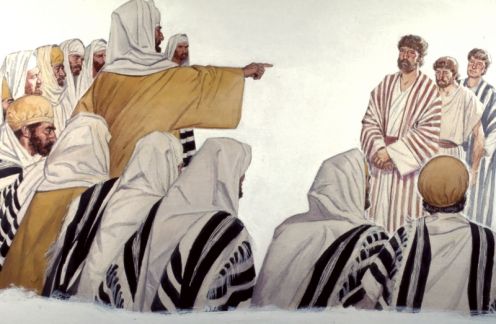
Peter and accusersPeter wasn’t “living like a Gentile” in the sense that he had abandoned his Jewish identity and affiliation, but he was behaving in a manner that was not dependent on absolutely separating himself from equal co-participation in the ekklesia, including mixed Jewish/Gentile meals, in order to maintain and affirm his Jewish identity. Jews and Gentiles could maintain distinct identities and yet, in terms of social behavior, they could be co-equals in fellowship within the Messianic Jewish ekklesia.

Peter’s behavior, when seen by Jewish outside observers, was criticized as violating Jewish social norms and thus Jewish identity (living like a Gentile) by the circumcision party, but they were unaware or they didn’t accept the new status of the Gentiles relative to Jewish community.

Nanos adds dimension to this by re-translating the relevant scripture in this way:

If you Peter, remain Jewish yet are identified now as a righteous one (justified) in the same way as are these Gentiles (by faith in/of Christ) and not by virtue of the fact that you were born a Jew, how can you decide to behave in a way that implies that these Gentiles are not your equal unless they become Jews too?

-ibid, pg 315

The mindset required here is a shift from Jewish privilege as justified by being born Jewish, to justification through faith in/of Christ in exactly the same manner as the Gentiles.

I found the following quote revealing:

The salient difference is the claim of this subgroup to live “in Christ” as equals before God and one another, as “one,” whether Jew or Gentile. Claiming that the end of the ages has dawned, this coalition seeks to exemplify this “truth” by living together without discrimination according to certain prevailing conventions of the present age (cf. 1:3-4; 3:27-29; 6:14-16).

-ibid, pg 316

I’ve mentioned previously, citing D.T. Lancaster (see the Holy Epistle to the Hebrews sermons and What About the New Covenant lectures), that the Messianic Age or Kingdom was inaugurated with the death and resurrection of Christ but will not be brought to fullness until the return of Messiah as conquering King. In the meantime, we believers, Jewish and Gentile, have received a “downpayment,” or a “guarantee” that the Messianic promises of the New Covenant will indeed reach fruition in their appointed time.

We are to live like partisans or freedom fighters resisting the current “King” in the present age, and living as if the “once and future King” were already here.

That’s what the mixed meals between Jewish and Gentile co-participants in the ekklesia as equals represents.

I say to you that many will come from east and west, and recline at the table with Abraham, Isaac and Jacob in the kingdom of heaven…

Matthew 8:11 (NASB)

This is one picture of the Messianic Kingdom, when we Gentiles will indeed ”come from east and west, and recline at the table with Abraham, Isaac and Jacob in the kingdom.” That’s what was at stake in the Antioch incident, the recognition and acceptance of Gentiles as equal co-participants in the coming Kingdom which has yet to arrive but is already here.

When Peter pulled away from the Gentiles and caused other Jesus-believing Jews to do likewise, he was sending a clear signal (whether he intended to or not) that the Gentiles were not equal, and he was actually denying the “truth of the gospel,” the good news of the coming Kingdom of God, the Kingdom of Messiah, and the reign of Messiah over Israel and the nations of the Earth in peace and unity.

Peter, in one simple but devastating act, denied that God had to power to bring about all He promised in the New Covenant times. No wonder Paul was so furious.

Conclusion

What I’ve gotten from Zetterholm so far is that in mid-first century CE in Antioch, and presumably influencing the rest of the Messianic communities (the “churches” Paul had “planted”), there was a dynamic “tension” between Paul and James, with Paul advocating for Jesus-believing Gentiles being included into the Jewish ekkelsia as equal co-participants socially and in covenant blessings, while James strongly thought the Gentiles should maintain their own separate and bilateral communities apart from the Jesus-believing Jews. This tension in my reading of Zetterholm so far, was never resolved, and the result was the ultimate schism between the Gentiles and Jews in the community of believers.

The Jewish PaulNanos doesn’t paint quite so grim a picture, but he’s writing while strictly considering only Paul’s perspective in Galatians 2. The ones from James may have had something to do with the Antioch incident, but Nanos believes the ones Peter actually feared were a separate group, a group of believing or non-believing Jews who advocated Gentile inclusion in Jewish religion and fellowship only by circumcision and participation in the proselyte rite.

Paul continues as the advocate for Gentile inclusion which he sees as a sign of the emergent Messianic Kingdom symbolized by Jews and Gentiles sharing meals as equals rather than the Gentiles being subordinate in the Jewish space, either as pagan guests or God-fearers. Peter’s withdrawal punched a really big hole in the structure Paul was trying to construct, a portrait, an image of the future age coming into the world now. Peter not only rejected Gentile equality in the ekklesia, he denied the power of God to bring about unity in the Kingdom to come.

What implications can we draw for the modern Messianic Jewish (MJ) movement. The current MJ movement exists as separate or interrelated streams with different standards of Torah observance, halachot, and particularly, different viewpoints on Jewish/Gentile community interaction and participation.

Many of the questions Paul was addressing are the same issues we find in MJ today. For the most part, communal meals aren’t an issue, since in the communities in which I’ve participated, either kosher meals are available prepared and served in accordance with accepted Jewish halachah, or kosher meal requirements have been loosened (for instance, the elimination of the requirement that said meals must be prepared in a kosher kitchen) to allow for mixed Jewish/Gentile (kosher or kosher-style) meals.

However, the issue of bilateral ecclesiology very much continues to be at the forefront of the debates regarding Jews and Gentiles in the Messianic Jewish community. Should Messianic Jewish synagogues only allow Jewish membership or should Gentiles be included? If Gentiles are included as members in Jewish religious space, should they be considered equals (as Paul likely advocated) or should they have a lesser status (associate membership) with lesser privileges and responsibilities? Should non-Jewish kids participate in a Bar/Bat Mitzvah? Can Gentiles be called up for an aliyah to read the Torah on Shabbat? What about Gentiles being included or excluded from davening in a minyan?

We have no record in the Bible of these questions being answered, but we do, at least in my opinion, have strong indications, both Biblically and through historical records, that Gentiles did participate in Jewish communal life in diaspora synagogues. They did eat together as equal co-participants.

Taking all of this into account, where does the modern Messianic Jewish movement go from here and what part do we “Messianic Gentiles” play in it?

I hope to finish my final review of Zetterholm soon.

Repentance and Confession

The Torah teaches us that it is never too late to change.

Changing for the better is called doing teshuva. The Hebrew word teshuva, which is often translated as repentance, actually means to “return.” Return to God. Return to our pure self.

How do people become interested in self-improvement?

People have faults. The faults they have cause them to suffer in some way or another. This suffering limits an individual’s freedom and is often painful. Hence, people want to change… to improve. To be free once again.

How does one change for the better? How does one do teshuva?

There are four steps of teshuva.

-Rabbi Mordechai Rottman
“Four Steps to Change”
Aish.com

I’m tempted to say something like, “Look! We’re halfway through the process of learning how to repent. Just two more steps to go and we’re home free.”

But if you’ve read the previous two steps and you’ve been paying attention, you realize it’s not that easy. Each step in this process could take weeks or even months to accomplish. I’m not sure if you have to completely finish one step before proceeding to the next, but being a rather linear fellow, that’s how I do it.

That means a single act of repentance isn’t an act at all, it’s a process. To focus on just one habitual sin and truly repent of it, to make teshuva, could take a very long time…it could be months or even years before you get to a place where you know you’ve finally, truly, authentically, completely repented.

And then what if you “backslide?”

But I digress. What about the third step in making teshuva?

Verbalization

Here’s how Rabbi Rottman describes it:

Why is it important to say it?

There is a power to saying things as opposed to just thinking about them. Verbalizing a thought brings the idea to a new level of reality, awareness and understanding.

The verbalization that is done after committing a transgression makes one more fully aware of what was done. It therefore heightens the regret and strengthens the resolution not to commit the act again.

This verbalization is not to be done before anyone other than God. Not even your rabbi needs to know about what you have done. It’s just between you and your Creator.

This reminds me of all the times I’ve seen an Alcoholics Anonymous meeting in TV or in a movie. Some guy gets up in front of the group and says, ”I’m So-and-So and I’m an alcoholic.” In the film Finding Nemo (2003), a group of sharks are used to parody this sort of “confessional” meeting (“Fish are friends, not food.”) If you recall that scene, you know things don’t always work out as well as planned.

Humor aside, admitting your sin, especially in front of witnesses, is very powerful, very humbling, and potentially very shaming. You’d have to know you were completely accepted by the group or the person you’re confessing in front of…and it could backfire horribly.

Or at least that’s the fear, which is why most people don’t like making embarrassing admissions about their sins in front of others. Fortunately R. Rottman says that the ”verbalization is not to be done before anyone other than God. Not even your rabbi needs to know about what you have done. It’s just between you and your Creator.”

But there’s always one other living spirit in the room besides God. You.

HitbodedutGod, of course, already knows about our sin, so He’s not exactly surprised. He has no “reaction” as such, except perhaps the reaction of a father welcoming home his wayward son (Luke 15:11-32). However, what happens when we hear ourselves say, “I have sinned”? We think all the time about our sin, particularly during the process of teshuva. We think, we ponder, we feel shame, humiliation, sorrow, regret. We tell ourselves all sorts of negative stories about our sin and who we are as a result of having sinned. We remind ourselves of how many people we’ve hurt or offended, or how hurt our friends and family would feel if they ever knew about our sin, assuming it’s a secret.

But admitting out loud that you have sinned, the nature of your sin, the impact of your sin on others…how would that be? There’s only one way to find out.

Say it.

No, really. Try it out. If you’re reading this blog post and you’re human, you probably have sinned. Unless you are an expert at repentance…true repentance as I’ve been describing in this series, chances are you have something to say to God. It’s not like you’re going to be saying something that you and God don’t already know about. But hearing your own voice articulate your sin makes it seem so…real.

To meditate, try saying a single word out loud, and concentrate on it’s meaning. After ten minutes, your mind will be fully focused.

-Rabbi Noah Weinberg
Total Concentration
from the 48 Ways to Wisdom series

I know ten minutes doesn’t seem very long, but try verbalizing your sins for that length of time and it will seem like an eternity.

Communal confession is not unknown in Judaism and in fact, as part of the Yom Kippur service each year, in synagogue, the people publicly confess in a short alphabetical prayer known as the vidui.

In Judaism, a penitent sinner must give verbal expression to his remorse: He must confess his sin before God pardons him. Strictly speaking, the confession is acceptable even in the bare formulation: “I have sinned,” but more elaborate forms have been compiled and used. Maimonides (Teshuvah, ch.1‑2) holds that the more the sinner confesses at length the better, but gives as the basic form: “O God! I have sinned, I have committed iniquity, I have transgressed before Thee by doing such‑and‑such. Behold now I am sorry for what I have done and am ashamed and I shall never do it again.”

Rabbi Louis Jacobs
“Confession (Vidui): A first step toward repairing wrong”
MyJewishLearning.com

ViduiIn a public confession, there is a formula by which the group recites the vidui and people never openly verbalize their actual, personal sins. This is a mirror of the ancient Yom Kippur service when the Temple was standing in Jerusalem, when the High Priest would enter the Most Holy Place once a year to make atonement for the nation of Israel.

But even hearing yourself recite the vidui should remind you of your actual, personal sins. Even actively contemplating them during the Yom Kippur service should have a profound effect.

Remember, confession isn’t designed to make you feel bad or more guilty. We’ve discussed this before and feeling bad is more likely to result in your continuing to sin and to give up on repentance. By increasing the “reality” of your sin through confession, the idea is to intensify your regret and minimize your negative thoughts and comments about yourself. Having a frank conversation with God is one way of doing that.

There’s a Chassidic concept of prayer called Hitbodedut that might be effective, but it requires that you get to someplace where you can be completely alone and isolated from all distractions.

Opening one’s heart to God is the highest form of Jewish worship. Crying out to Him in spontaneous prayer, even doing so silently, reveals the essence of being: faith. Faith is a natural state, which is why children tend to speak to God directly. As people grow older, many find that their access to faith is obstructed and they experience doubt and lose their faith.

Hitbodedut is a way to unburden the self of doubt and recover a natural state of faith. The best way to achieve this solitude is to leave civilisation and society in order to be surrounded by nature and the wonders of creation. Any form of self-isolation can be effective.

Hitbodedut involves (ideally) going to a natural and secluded setting and “letting it all hang out,” as my generation said in our youth. Yelling, screaming, crying, even playing music, just about any form of self-expression is allowed.

The key to successful hitbodedut is total abandonment of inhibition. Prayers are direct, immediate and uninhibited, a natural outpouring of the soul of all that clouds and confuses its sight. Any natural expression is admissible. This can take the form of weeping, song, conversation, mantra or silent meditation.

This is a no holds barred, knock down, drag out conversation with God. It’s not even remotely polite or reserved, so you have to be willing to be honest with God and with yourself, and then to express yourself out of that honestly. Why not? God knows it all anyway.

In the days of His flesh, He offered up both prayers and supplications with loud crying and tears to the One able to save Him from death, and He was heard because of His piety.

Hebrews 5:7 (NASB)

anguishThe writer of the book of Hebrews describes Jesus (Yeshua) as praying in such a manner ”with loud crying and tears.” D. Thomas Lancaster in the Source of Eternal Salvation lecture from his Holy Epistle to the Hebrews series believes this describes Jesus at Gethsemane.

And being in agony He was praying very fervently; and His sweat became like drops of blood, falling down upon the ground.

Luke 22:44 (NASB)

We may never experience the anguish and agony of the Master, but that doesn’t mean our own confessions and prayers to God should be any less passionate.

For successful teshuva, we have to realize that God loves us – even in light of all the mistakes we’ve made. Realize that God understands you, that He’s “cheering you on,” and wants to help. Don’t feel guilty; any mistakes you’ve made are part of a growth process to get where you are today. Growth is what God created us for, and even the hardships are the best thing for us. God is not the “big bully in the sky”; He’s on your side.

-from Ask the Rabbi
“Doing Teshuva”
Aish.com

The Aish Rabbi in his missive also reference to the four steps to making teshuva, but he adds this:

These steps go only so far, however. If our past actions have hurt another person, we must ask their forgiveness.

It is said that if we have sinned against God and confess to Him and make teshuva, He will forgive us. It is also said that if we have sinned against another, even if we confess to God, He will not forgive us until we have made amends to the person we’ve hurt.

Judaism, being a religion of action, says it is not enough to “mentally” regret one’s misdeeds. On this week’s verse that “very close is this (matter of Teshuva) to your mouth,” Nachmanides takes this passage literally; he understands that Teshuva requires verbal articulation of our misdeeds.

In instances where someone else was wronged, an apology must be made directly to that person. In instances where we transgressed the Almighty’s will, we must privately, with no one listening, confess to our Creator.

-Rabbi Yehuda Appel
“Asking Forgiveness”
Commentary on Torah Portion Nitzavim
Aish.com

TearsWhile the principle of confessing our sins to another person is sound, the practice may be fraught with problems, especially if the sin is secret and especially if your confession to the other person may cause them great harm. The complexities of confessing sin to another human being go beyond the scope of this small commentary, but I’ll try to address this part of making teshuva in brief, since it is an unavoidable truth that we have hurt another person in this life, and it is inevitable that we will have to face them.

For some people, the most difficult thing in the world is to ask for forgiveness.

If you find it difficult to ask for forgiveness, visualize yourself asking for forgiveness. Mentally see yourself approaching someone and saying, “I am sorry that I caused you pain. Please forgive me.” Rerun this picture in your mind over and over again. Feel a sense of strength and release at being able to do this.

Each time you ask for forgiveness and find it difficult, you are building up your inner resource of courage.

Rabbi Zelig Pliskin
“Asking For Forgiveness”
Daily Lift #353
Aish.com

The Bible tells us that if we confess to God and make teshuva, God will forgive, but with other people there are no guarantees. We can sincerely ask for their forgiveness, but they don’t have to forgive. Yes, they should, but people are fickle that way. This is the biggest risk in trying to a repair damaged relationship. The other party may be too hurt to forgive. They’re not ready. They may never be ready.

And even if they forgive, they may never reconcile with you because of their hurt. A wife may forgive her husband for abusing her after he has made teshuva, but she may never feel safe enough to stay with him and they may still divorce.

But what alternative do you have?

There is a flip side, also presented by Rabbi Pliskin:

When we forgive others, we help ourselves as much as we help those whom we forgive. We are elevating ourselves and will feel much better when we forgive, than if we would keep on adding more and more resentment.

Try it for a couple of weeks. At night, think about any difficulties you had with others and forgive them. Notice how it will change your attitude toward those people the next day.

A person who threatens, “I’ll remember that,” or “I’ll get even with you,” hurts himself more than he hurts others. Why suffer from resentment when you can choose the pleasure of forgiving?

Hitbodedut in ShiloConfess to God. Hear yourself say the words. Let yourself react to the reality of your sin. Let yourself be motivated to take further steps in making teshuva. If another person is suffering because of your sin, make amends as best as you can. This is part of healing the rift between you and that person and between you and God. This is part of repairing the world.

This is part of healing you.

The ultimate goal of teshuva is to draw nearer to God, to be Holy even as God is Holy (Leviticus 19:1-2). To learn more about holiness and how to become a Holy person in a hedonistic world, read Rabbi Yissocher Frand’s commentary on Torah Portion Kedoshim at Torah.org.

Do you think He created us because He wanted pristine, perfect beings?

He desired that a glimmer of Himself should descend into a creature who cries and laughs and dances and bleeds; who fails as much as he succeeds; who chases after fleeting moments and is torn by figments of his own mind.

He wanted to live in the petty world of such a being, and from within that place He will come to know His self that cannot be known.

-Rabbi Tzvi Freeman
“Demands”
Based on the letters and talks of the Rebbe, Rabbi M. M. Schneerson
Chabad.org

Zetterholm, Ancient Antioch, and Today’s Messianic Judaism

It is a sad fact that our knowledge of the Judaism of the first century CE is rather limited. It is true that we know quite a lot about the ideology of different Jewish groups. The pioneering works of C.G. Montefiore, G.F. Moore, R.T. Herford, J. Parkes, and W.D. Davies, for instance, culminating in that of E.P. Sanders, have been of tremendous importance in showing that ancient Judaism was not a legalistic religion in which salvation was earned by merit, but a living religion of grace and forgiveness.

-Magnus Zetterholm
Chapter 3: “The Cultural and Religious Differentiation,” pg 53
The Formation of Christianity in Antioch: A Social-Scientific Approach to the Separation between Judaism and Christianity

I wish Pastors preached sermons based on the latest research performed by New Testament theologians and historians. What we hear from the pulpit, more often than not, is doctrine that is decades if not centuries (or longer) old, the same standard preaching that declares Judaism of ancient and modern times as a “religion of dead works.” Even in the church I attend, which has a very pro-Jewish perspective, Jewish people and national Israel are loved, but the Christians are very happy that the old Law is dead and replaced by grace. Jews are loved but Judaism is not, even the (Pharisaic) Judaism practiced by Paul and by Jesus and by all the apostles.

Zetterholm’s book seeks to understand and explain the early schism between the Judaism once called “the Way” and the emergent religious form adopted by Gentile believers known as “Christianity” from a sociological rather than a theological point of view. Of course, it’s impossible to keep theology completely at bay, but Zetterholm, who doubts the accuracy of certain sections of Luke’s Book of Acts and any part of the Bible that speaks of miracles, does his best.

That said, I find his research compelling because he doesn’t have a doctrinal ax to grind and he does establish and confirm certain things about Judaism as practiced by the believing Jews in first century CE Syrian Antioch.

It is generally accepted that the Judaism of the first century CE was not homogeneous but a complex, diversified phenomenon. At the same time these somewhat different realizations of Jewish life had something in common. E.P. Sanders has referred to what he calls “common Judaism” as “what the priest and the people agreed on.”

-ibid, pp 55-6

This isn’t the first time I’ve heard of this concept. Nearly a year ago, Rabbi Dr. Carl Kinbar had this to say in different comments on one of my blog posts:

The situation today is very different. There is no common Judaism or commitment to Torah that is shared by the streams of Judaism and, especially, by individual Jews. Second Temple Judaism varied from one form of Torah observance to another. Today’s diversity is from ultra-orthodoxy to atheism.

To avoid misunderstanding, let me put it this way: common Judaism had a core of practices that all communities of any size considered mandatory while also having a diversity of practice in other matters. Diversity does not mean that some Jews ate pork and did not daven.

That is, unless the Jerusalem leadership objected to the common Judaism of their time. If they did object, they may have engaged in the project of bringing about uniformity. Again, there’s no direct evidence one way or the other. However, there’s some indirect support that they did not teach or enforce uniformity — there is no record that they directed Paul (or anyone, for that matter) to teach or enforce uniformity of practice. There is also nothing in the apostolic letters to indicate that the Jerusalem leadership or other apostles mandated uniformity. If they practiced uniformly in Jerusalem, why would they be indifferent to the lack of uniformity elsewhere?

The Jewish people (in the Land of Israel in particular – I’m not as familiar with the rest) actually did quite well during the time of common Judaism (from late Second Temple times to at least 400 CE). (emph. mine)

In another portion of his book, Zetterholm explains that while each synagogue adhered to a core of common Judaism, they also diverged in meeting the various needs of their differing populations, as R. Kinbar described above.

Antioch was religiously a highly pluralistic milieu. Even though the “zeal for the law” also influenced the Jewish communities in the Diaspora, Judaism was but one of many religions practiced contemporaneously at Antioch.

-ibid, pg 65

.
The various Jewish communities in Antioch had to exist perhaps in some sort of “tension” between each other, depending of their differences, but they also had to exist in a wider environment of many other religious entities, many or most of which would have opposed monotheistic Judaism, which I can only believe was one of the core beliefs of the common Judaism these synagogues shared.

This speaks to me somewhat of the struggle of Messianic Judaism today. Messianic Judaism isn’t a single, monolithic unit that has a definition easily applied to all Messianic Jewish groups (and I define the different streams of Messianic Judaism as an overarching entity distinct from any of the expressions of Hebrew Roots, even though some [many…most] Hebrew Roots congregations define themselves as “Messianic Judaism”) and there is some variability between the different synagogues (in the U.S.) of which I am aware.

Messianic Judaism is trying to relate within it’s various groups as a Judaism as well as relating to the larger Jewish community (and the rest of the world) as a Judaism, all within a diaspora (again, I’m speaking of U.S. congregations) that is poly-religious and areligious.

Carl Kinbar
Rabbi Carl Kinbar

I say all this acknowledging Rabbi Kinbar’s statement above that the modern Judaisms of today cannot be directly compared to the Judaisms of the first century because they lack a commonly held core set of convictions related to Torah . Nevertheless, I can see connecting threads, especially between modern, western Messianic Judaism and the Judaisms in first century Antioch.

A number of critics of modern Messianic Judaism emphasizing itself as a Judaism, complain that this emphasis bumps Messiah Yeshua (Christ Jesus) to the back of the bus if not off the bus altogether. Normative Christianity stresses that Judaism was indeed (they claim) replaced by a more generalized and generic faith in Jesus without tradition or ritual, and modern Hebrew Roots proposes that modern Rabbinic Judaism is adopted by Messianic Judaism in place of “Biblical Judaism” which was (they claim) practiced by both Gentiles and Jews in the first century Messianic community.

Their sons will, furthermore, be subject to compulsive epispasm since they will be “cut by physicians to bring forward their foreskins.” In 1 Corinthians 7:18, Paul admonishes the circumcised Jesus-believing Jews against having this operation performed.

-ibid, pg 72

Zetterholm goes on in pages 76 through 79 to provide numerous examples of what we may not get from just reading the Bible…the fact that Jews in the diaspora, perhaps many, many Jews, struggled with or just plain left the Jewish community, attempted to cover up the signs of their Judaism (males), and assimilated socially and religiously into Greek culture.

Do we have that today?

How many Jews have converted to Christianity and exist and worship as “Hebrew Christians” within the Church, having abandoned any and all practices of Judaism and Jewish identity and adopted living as “Goyishe Christians?” Even the observant Jews within Messianic Judaism are considered by most other Jewish communities (i.e. not Messianic) as “Jews for Jesus,” as converts to Christianity who have abandoned their own people and left Israel. To resist this impression as well as to resist the draw from the Church that says if you believe in Jesus, even as a Jewish disciple of the Jewish Messiah, you are a Christian and are “free from the Law,” the Messianic Jew must strictly adhere to a Jewish lifestyle, including observance of the mitzvot and the traditions.

…that most Jews, in Palestine as well as in the Diaspora, worshiped daily and weekly, kept the Sabbath, circumcised their sons, observed certain purity regulations and supported the temple. Despite mixed opinions on how this obedience would be realized, we can safely assume that the majority of the Antiochean Jews intended to live their lives obeying the torah.

-ibid pg 80

The Jewish communities in the diaspora including Antioch were at risk of assimilation and absorption into the wider Greek culture and religious milieu. The barrier to stave off this threat for Jewish communities was Jewish observance and adherence to Jewish identity as distinct and unique among the myriad people groups and religions existing in the galut.

Magnus Zetterholm
Magnus Zetterholm

Zetterholm cited (pp 83-4) the practice of Jews in Antioch refusing to use Greek-produced oil, but believes that it was more an indication of Jewish identity rather than outright devotion to the Jerusalem Temple. Nevertheless, this still indicates that these diaspora Jews were highly aware of the necessity to keep separate from the surrounding culture, even to the point of being selective about which source of oil they used.

Further, Zetterholm citing Sanders says:

Antioch was thus located in an area almost regarded as part of the Land of Israel, and there is evidence of a particularly strong connection between some Antiochean Jews at least and the temple in Jerusalem.

-ibid, pg 85

Zetterholm’s opinion isn’t quite in line with Sanders’, though.

I would therefore conclude that we may cautiously assume the existence of a group more strongly committed to Jewish life than the main body of Antiochean Jews…

-ibid, pg 86

While Zetterholm doesn’t give much credence to the Book of Acts as an accurate model for Jewish/Gentile interactions of the first century Jewish history in Antioch, he nevertheless states:

…we may assume that there was no intermarriage between Jesus-believing Jews and Jesus-believing Gentiles, because the Jesus movement was a completely Jewish one with an unusual openness towards Gentiles.

-ibid, pg 89

And…

While Antiochus had clearly left Judaism, most Jews who were interested in Hellenism and wanted to create a Hellenistic Judaism were at the same time concerned with the preservation of a Jewish identity and had no intention of ceasing to be Jewish.

-ibid, pg 90

The Jewish PaulIf, as Zetterholm says, the first century “Church” was a wholly Jewish movement, albeit with a high tolerance for Gentiles in the community, then even if this represented a Judaism that was “open,” to some degree, to Hellenistic influences (though this is very dicey material to seriously consider), the “Jesus-movement” had no interest in abandoning Judaism and Jewish practice for something foreign to them or more in line with the religious practices of the Greeks. Paul, as we saw above, was not convincing Jews to give up Judaism. Quite the opposite. Zetterholm’s research and the sources he cites do not support at all the creation of an alien Gentile religion out of the teachings of a rural Jewish Rav who was known by his Jewish followers to be Moshiach.

Zetterholm covers the diversity of Antioch’s synagogues (pp 90-91), including (as I stated above) how they served diverse Jewish populations, and it seems likely that the synagogue Paul and his companions used as their “home church” throughout Paul’s three “missionary journeys” was one of the (perhaps) thirteen synagogues in Antioch. In fact, he says of the Jewish Jesus-believers:

…it is highly unlikely that the Jesus-believing Jews in Antioch were organized in any other way than the synagogue.

-ibid, pg 93

Zetterholm cites Mark Nanos (The Mystery of Romans: The Jewish Context of Paul’s Letters, pp 289-336) as well as a wide selection of scriptures from the Book of Acts, to support this position. This includes the most likely common usage of “ekklesia” to mean “synagogue.” Additionally, Zetterholm references James 2:2 and James 5:14 as evidence that James the Just, brother of the Master, considered the “assembly” and “community” of Jesus-believers to be the synagogue:

We can thus conclude that the terminology does not speak against the view that the Jesus movement in Antioch was originally a synagogue consisting of Jesus-believing Jews, and that the Jesus-believing Gentiles related to this synagogue as any Gentiles related to any Jewish community. (emph. mine)

-ibid, pg 94

What might we conclude from all of this?

Judaism in the first century CE (and in my opinion, much of Judaism today) was not a “works-based religion” but rather a vibrant, faith-based practice of devotion to God. While there were many variations of Judaism practiced in that day, there was a core or common Judaism that served to define and identify all communities of Jews as Jewish and those who worshiped the God of Israel. This would have included the Judaism then known as “the Way.”

Jewish identity, performance of the Torah mitzvot, and devotion to the Temple services were among the common qualities of the Jewish community, both in Roman-occupied Judah and in the diaspora. Jews in the diaspora were at risk of assimilation and absorption into Greek culture, even to the point of attempting to cover the marks of circumcision. There was likely little to no intermarriage between Jewish and Gentile believers and if intermarriage occurred, Jewish identity would be staunchly adhered to by the Jewish spouse. If not, it was more likely that the Jew would undergo apostasy and assimilate into Greek religious and social culture.

Paul was very much opposed to Jews in the community of believers undergoing the medical procedure to restore their foreskin (males) and continued to encourage and support the Torah observance of the Jewish believers. There is no evidence, based on Zetterholm’s research, that the combined community of Jewish and Gentile believers left the synagogue or that they left Jewish practice and formed a new religion that was opposed to the other Judaisms and core Jewish practice. The Way remained a Judaism that was distinguished only by its unusual acceptance of large numbers of Gentiles who were identified neither as proselytes or God-fearers but had a different legal status allowing them to remain Gentiles and equal co-participants in the community (It should be noted that the Way wasn’t the only Jewish community that has ever claimed to follow the Messiah, so Messianic claims are not all that distinguishing).

Many of these conclusions can be applied to Messianic Judaism (and to a degree, larger Judaism) today. My experience with Messianic Judaism is within the confines of the United States, so I’ll restrict my opinions to that population. Messianic Judaism, existing in the diaspora amid a nation of religious plurality including a strong emphasis of no religion at all, faces some of the same risks as its ancient counterpart in Antioch. There is a strong pull, especially for Jews who are believers in Jesus as the Messiah, to apostate from a Jewish faith in Moshiach and “convert” to Christianity, effectively becoming Gentile believers with Jewish DNA.

Orthodox JewsIntermarriage, although exceptionally common within Messianic Judaism and relatively rampant within all of the other Judaisms (with the likely exception of Orthodox Judaism) presents a risk or at least a challenge to the Messianic Jewish spouse to remain Messianic and Jewish in his/her observance of Torah and overall lifestyle. If this isn’t supported by the non-Jewish spouse, it could spell trouble for the marriage and/or the Jewish identity of the Jewish spouse. How the children are to be raised and their identity as Jewish vs. Gentile is also a serious consideration.

For these reasons, I reaffirm my previous assertion that a strong Messianic Jewish community be available, both for Jewish and for intermarried families who identify as Messianic. Furthermore, the Jewish Messianics should be allowed and encouraged to maintain and embrace a Jewish identity, and to consider themselves and the Messianic synagogues as part of larger Jewry. The continued effort by Messianic Gentiles and Hebrew Roots Gentiles (and some Hebrew Roots Jews), as well as the overall normative Christian community to demean any Jew in Messiah who continues to live a halachically Jewish life, and who further demands that Messianic Jews abandon Judaism as a practice, or observe some unobservable entity as “Biblical Judaism” vs “Rabbinic Judaism” must cease. Don’t argue.

It’s not our place as Gentiles within or outside the Messianic Jewish movement to dictate terms relative to how a Jew should or shouldn’t live as a Jew. A Jew’s relationship is and always has been with God.

No, I’m not throwing Jesus off the back of the bus and in fact, he’s at the center of all of this. Who lived a perfectly Jewish, halachically correct, completely Torah observant life as evidenced by the Gospels and the rest of the Biblical narrative? Only Yeshua Ben Yosef of Nazareth. Only he was born a Jew, of observant Jewish parents, within the borders of the Land of Promise, faithfully studying the scriptures and performing the mitzvot, and yet he was without sin and totally obedient to God.

What a role model for the apostles, all of the Jewish disciples, and for Messianic Jews today. Could anybody be more Jewish and live a more Jewish life than Messiah, Son of David? Will anyone live a more Jewish life in the Messianic Kingdom than the King of the Jews upon his return?

Zetterholm’s book has certainly confirmed a few things for me and opened up other doors. When next I revisit the pages of his book on this blog, I’ll further examine the relationship between Jews and Gentiles in the Messianic community in Syrian Antioch as Zetterholm’s research reveals it to us.

This series continues in my blog post Zetterholm, Ancient Antioch, and the Problem of the Gentiles.