Tag Archives: Jesus

Returning to the Tent of David: The Clay Jar

eph-2-10-potter-clayDo you wrestle with dreams?
Do you contend with shadows?
Do you move in a kind of sleep?
Time has slipped away.
Your life is stolen.
You tarried with trifles
Victim of your folly.

Dirge for Jamis on the Funeral Plain, from “Songs of the Muad’Dib” by the Princess Irulan
quoted from pg 126 of Frank Herbert’s novel
Dune

This book outlines a vast mission and vision. At first it can seem overwhelming both in the scope it entails and in the sacrifice it requires.

-Boaz Michael
“Strategic Mission,” pg 164
Tent of David: Healing the Vision of the Messianic Gentile

Part of the Returning to the Tent of David series

Ever since I’ve been writing about my “re-review” of Boaz’s TOD book and the re-evaluation of my “mission” in my local church, I’ve received a certain amount of pushback in various online venues, speaking of “coming out” of the church, as if the church was some kind of prison or trap. Some people talk about being “unequally yoked,” as if the “Messianic Gentile” and the church-going Christian are not the same and are even diametrically opposed spiritual beings.

The quote from Boaz’s book I posted above reminds me of the difference between the first day of class and mid-terms. I remember in any class I took, no matter how difficult the subject, the first day was always a breeze because there were no expectations of me yet. By the time mid-terms rolled around though, I always knew if I was going to be OK, or if I was in way over my head.

I took a lot of notes as I was going over TOD again, but I decided I wasn’t going to use most of them. I don’t want to re-analyze every page of what Boaz wrote. I want to analyze how I am now against who I was a year ago when I was anticipating a return to church. I struggled greatly against my own inhibitions. It finally took the mocking of someone I disagree with a great deal to push me forward. He too “went back to church,” even as he complained about it (and the irony is not lost on me as I type these words).

True imitation of our Master was practiced by no one better than Paul, who left Jerusalem, the Temple, and the apostolic community behind to go through the Diaspora and spread the message of the kingdom.

-Michael, TOD
“Becoming a Shaliach,” pg 94

If I look at my TOD experience in church as a “diaspora” experience, I’ll forever be alienated from church and only be a perpetual visitor. On the other hand, the model of Boaz’s TOD book is focused on the “Messianic Gentile” as a messenger, an emissary, a “sent out one.” Paul founded many Gentile churches, but though he was united with the non-Jewish disciples in Messiah, he was never a part of them in many other ways. He was a Jew, a Pharisee of Pharisees, a Benjaminite, circumcised on the eighth day, obedient to the mitzvot, bound to the Torah of Moses and the Temple, even as he was bound to Messiah.

But the flip side of the coin is that the “Messianic Gentile” isn’t in church to illustrate how different he or she is from Christians but that it is the Jewish Messiah King who unites them…who unites all of us.

I have a Jewish friend who has been very kindly encouraging me to realize that Jesus is a false Messiah and that I should join the ranks of the Noahides; become a “righteous Gentile.” He sees Christianity, no matter how well intended, as ultimately anti-semitic, just as my wife sees the Church. If he’s right, then my efforts in emulating the Master and his emissaries are doomed to failure. If Boaz is right, then imitating my Master makes me stronger than anyone could possibly imagine.

I can do all things through Him who strengthens me.

Philippians 4:13 (NASB)

But such strength must be in God’s service.

These are all vitally important concepts, but cannot compare to the work of God in reconciling humanity to himself and consummating his entire creation through Yeshua the Messiah.

-ibid, pg 102

jewish-handsLater in the same chapter, Boaz speaks of the Chabad chasidim who are sent out into the world and who believe their efforts are watched over by the Rebbe. How much more should disciples of Messiah feel the watchful eye and empowerment of our Master in our endeavors?

Boaz also speaks of setting priorities, not losing the vision, and being silent rather than talking as the situation demands. As I went through his book again, I found I could argue against a lot of his optimism, but if that’s true, then maybe I’m the wrong man for the job…or I just want to be.

I can make excuses or I can persevere. If I am doing the will of my Master, then I will continue. If I’m not, then whatever I do will fade.

For some time ago Theudas rose up, claiming to be somebody, and a group of about four hundred men joined up with him. But he was killed, and all who followed him were dispersed and came to nothing. After this man, Judas of Galilee rose up in the days of the census and drew away some people after him; he too perished, and all those who followed him were scattered. So in the present case, I say to you, stay away from these men and let them alone, for if this plan or action is of men, it will be overthrown; but if it is of God, you will not be able to overthrow them; or else you may even be found fighting against God.”

Acts 5:36-39 (NASB)

No, I am not comparing myself to the apostles in any sense. I am not worthy to wash the dust from their feet. And yet, the principle is sound. I do nothing on my own, but only what I do when I’m in my Master.

I am the vine, you are the branches; he who abides in Me and I in him, he bears much fruit, for apart from Me you can do nothing.

John 15:5 (NASB)

Even in pleading with critics of this “mission” to not see the “Messianic Gentile” and “Christians” as separate things, I’ve been making the distinction myself. Even considering myself on a “mission” in church makes the distinction. That’s intolerable because in making such a distinction, I’m implying that I’m somehow “better” or “higher” than the people I worship with every week. But I’ve forgotten something.

In fact, I’ve forgotten the most important thing of all: to seek God where ever I happen to be. If I’m in a church, my purpose is to seek an encounter with God. If I’m in a synagogue, that it is also my purpose. It’s the same if I’m praying alone at home, if I’m in Sunday school, if I’m meeting a few Christian men for coffee, if I’m meeting my Pastor in his office.

If that “mission” is forgotten, the overwhelming priority to meet with God and serve God in every situation and circumstance, then everything that follows is a mere shadow by comparison or in fact, nothing at all.

But if I believe I am serving God, encountering God, encouraging others to encounter God by envisioning Jesus Christ as the Jewish Messiah King, the Moshiach, the Holy One of Yisrael, then I must be in the Church and of the Church without having my convictions and my vision dissolved.

Another step to blessing the church is to maintain your distinctiveness as a Messianic Gentile. Be different; exemplify the change you wish to see in mainstream Christianity.

-ibid, “Restoring the Tent of David,” pg 148

You must be the change you wish to see in the world.

-Mahatma Gandhi

I must be who I am and who I am learning to be, because it is God who made me. No matter where I am and what I’m doing I must be that person. To me, this is the only way to be in church and to live out what I’m seeing in the TOD book. To see it any other way, is to be disingenuous in my Christian worship and to possess ulterior motives in every conversation I have with other believers.

sparksThe interface, the transactions, the meetings, the worship, the study, everything I do in church and with Christians (or anywhere else) is the crucible in which we burn away the differences and the inconsistencies and finally arrive at the true Jesus, the Messiah, the King, the High Priest in the Heavenly Mishkan (Tabernacle).

It’s not being the change I wish to see, but being the person God wants me to be. Then, if God choses, that person people see will be one of His agents of change. If what I have to say and the life I’m living is worthy, then Messiah will be visible through me as who he really is, the King of Israel, the final inheritor of the Throne of David ben Yishai.

As I was reading the last pages of Boaz’s book, I was feeling the weight of his words. After all I’ve just written, I am, in the end, just flesh and blood. How could so much ride on someone like me?

Arrakis teaches the attitude of the knife — chopping off what’s incomplete and saying: “Now, it’s complete because it’s ended here.”

-from “Collected Sayings of Muad’Dib”
by the Princess Irulan
quoted from pg 137 of Frank Herbert’s novel
Dune

If I am indeed the branch in the vine, then I will not be cut off. If I’m not, nothing can keep me from being “complete” in the manner of the quote above. I must have faith that God did not give me life for a vain purpose.

The day is short, the task is abundant, the laborers are lazy, the wage is great, and the Master of the house is insistent.

-Pirkei Avot 2:20

He is indeed. And I must listen more carefully to his voice, tarry on each command, ponder his meaning, savor his teachings, sit at his feet as does the faithful servant, and in letting him show me how to become myself, the man God made me to be, the clay jar in the potter’s hand, I will be the shaliach, the lamp, and the light that goes forth into the world, not for my sake, but for God’s.

This is the end of my Tent of David review. I only ask one thing. If there are other TOD shaliach online, perhaps we could dialog with each other. Is anybody out there?

A Quick View of Revelation Through a Christian Lens

trumpets-on-the-lords-dayI was in the Spirit on the Lord’s day, and I heard behind me a loud voice like the sound of a trumpet, saying, “Write in a book what you see, and send it to the seven churches: to Ephesus and to Smyrna and to Pergamum and to Thyatira and to Sardis and to Philadelphia and to Laodicea.”

Then I turned to see the voice that was speaking with me. And having turned I saw seven golden lampstands; and in the middle of the lampstands I saw one like a son of man, clothed in a robe reaching to the feet, and girded across His chest with a golden sash. His head and His hair were white like white wool, like snow; and His eyes were like a flame of fire. His feet were like burnished bronze, when it has been made to glow in a furnace, and His voice was like the sound of many waters. In His right hand He held seven stars, and out of His mouth came a sharp two-edged sword; and His face was like the sun shining in its strength.

Revelation 1:10-16 (NASB)

Tales of the Messianic Era series

The previous entry is Trouble Breaking into Church with Messianic Prophesy.

Last Wednesday, Pastor and I talked about (among other things) a summary of his understanding of the Book of Revelation, that really confusing, mystic experience of the apostle John, the vision he experienced during his exile on Patmos.

In one of my previous blog posts, I had tried to sketch out my understanding of Pastor’s conceptualization of Revelation but missed the mark. This is my attempt to correct my mistake, but it’s also part of my investigation into “the end times,” that part of Christian/Hebrew Roots/Messianic Jewish doctrine I’ve been avoiding for so very long.

The following (and this time, I took notes) is my summary of Pastor’s summary of Revelation. Basically, I’m just laying a little groundwork for what follows. No conclusions, just the fundamentalist Christian mapping to the return of Jesus, the rapture, the tribulation, and the Messianic Era.

Here goes.

According to Pastor, in Revelation 1, we see the resurrected Jesus. As you might imagine, he’s not quite the way John remembered him during their time together in Israel.

In Revelation chapters 2 and 3, we see the churches, but according to Pastor, after this point in the book, the Church (big C), the entire body of Jewish and Gentile believers in Jesus Christ everywhere, disappears, to be taken up to Heaven with Jesus for the seven years of tribulation. For those seven years, there are no Christians on Earth at all.

Chapters 4 and 5 show us the Church in Heaven.

Chapters 6 through 19 show us the tribulation period, God’s judgment and wrath on the unsaved of the Earth. Since there is no mention of the Church in these chapters, Pastor believes the “argument by silence” here supports the Church being absent from the Earth during this time. Those people who come to faith in Jesus during the tribulation are saved, but they are not part of the Church. Those ancient Israelites who lived and died before Jesus are resurrected (Pastor says he’s not quite sure on the timing of this event) and are saved, but they too are not part of the Church.

Chapter 19 says something important.

And the armies which are in heaven, clothed in fine linen, white and clean, were following Him on white horses.

Revelation 19:14 (NASB)

Depending on which Bible translation you use, the phrase could be rendered “armies in heaven” or “armies of heaven.” If it’s of heaven, then it’s most likely talking about angels. But according to Pastor, if it’s in heaven, then it’s likely talking about the Church, the group of Jewish and Gentile believers who were raptured up to Heaven with Jesus but who now follows Jesus back down to Earth. Their being “clothed in fine linen, white and clean” indicates their righteousness and purity. There’s a further implication that in Jesus striking “down the nations,” that as his army, the Church, will also “strike” (Pastor didn’t mention that last part, but seems to make sense, given the context).

Chapter 20 of Revelation is the Messianic reign. I mentioned to Pastor that one chapter being devoted to such an important time period seemed a little skimpy, but he reminded me that there are many prophesies in the Old Testament (Tanakh) that speak at length about the Messianic reign. I can’t wait to map them to the fundamentalist Christian interpretation of events to see how (or if) it all connects.

final_battleRevelation chapters 21-22 are the final battle, the new Heaven and new Earth and progressing into Eternity.

We spent some time covering a little theoretical ground on the rapture before tribulation (which is Pastor’s viewpoint), rapture after tribulation (which Pastor says most churches go with), and rapture in the middle of the tribulation. Pastor believes the following is the critical portion of scripture that supports his perspective and that all other perspectives must somehow explain it in order to be considered valid.

But we do not want you to be uninformed, brethren, about those who are asleep, so that you will not grieve as do the rest who have no hope. For if we believe that Jesus died and rose again, even so God will bring with Him those who have fallen asleep in Jesus. For this we say to you by the word of the Lord, that we who are alive and remain until the coming of the Lord, will not precede those who have fallen asleep. For the Lord Himself will descend from heaven with a shout, with the voice of the archangel and with the trumpet of God, and the dead in Christ will rise first. Then we who are alive and remain will be caught up together with them in the clouds to meet the Lord in the air, and so we shall always be with the Lord. Therefore comfort one another with these words.

1 Thessalonians 4:13-18 (NASB)

Pastor also mentioned there are differences of opinion about when the Messianic Era will occur, but my current opinion is that the wars (all but the final one) must all occur and all of Israel’s enemies must be defeated before we experience a thousand years (or a long but undefined period of time) of peace under the reign of the King.

This all leads back to who and what is the church, the fate of ethnic Israel (Romans 11:26), and what I consider the “splitting” of “saved Israel” (the righteous Israelites such as Abraham, Jacob, Moses, David, and so forth) vs. the Jewish people who believed in Jesus and are part of the Church. It still bothers me that Israel has two separate expressions in the Millennial Kingdom, one as saved Israel and one as Israel in the Church (occupying the body of Messiah with the Gentile Christians).

The prophesies in the Tanakh don’t presuppose a divided Jewish people unless you consider those that mention Israel and Judah, such as the following:

“Behold, days are coming,” declares the Lord, “when I will make a new covenant with the house of Israel and with the house of Judah, not like the covenant which I made with their fathers in the day I took them by the hand to bring them out of the land of Egypt, My covenant which they broke, although I was a husband to them,” declares the Lord.

Jeremiah 31:31-32 (NASB)

I don’t want to go too far down that road right now. Like I said, I’m just laying the groundwork for what follows, but if you have any ideas about how the Christian and Jewish points of view about the coming (or return) of Messiah are supposed to fit together, let me know.

This Can’t Be It

That-s-all-folks“Fear is the parent of cruelty.”

-James Anthony Froude

I’ve tried to be fearless in pursuit of God and chronicling my journey along the way. I can pretty much put up with name calling and people disagreeing with me. What I can’t tolerate is being the source of pain for other human beings, and yet no matter what I do or say, I end up hurting someone. I don’t think you can really blog in the religious space without stepping on toes, but we were commanded to love one another, not to step on each other’s toes.

Far from pronouncing judgment and condemnation and trying to constantly correct others, Yeshua taught his disciples to be peacemakers, merciful, meek, humble, patient, and longsuffering, even under persecution (Matthew 5:1-10). Rather than boasting about being right, we should seek to do what is right.

-Boaz Michael
“Becoming a Shaliach,” pg 95
Tent of David: Healing the Vision of the Messianic Gentile

I’ve come that close to shutting down this blog on more than one occasion over the differences between being right and doing right, but never closer than I have with today’s “meditation.” I had a email “conversation” with a friend who both (without his realizing it) triggered the desire to close up shop and then encouraged me to keep on going. I won’t go into the details, but all kinds of misunderstandings can happen when we rely on the Internet for communication. I’m thankful that God is patient and that He gave me the time to reconsider my original course of action.

The image at the top of this missive was the one I originally selected and I decided to keep it because one: I love Looney Toons, and two: as a reminder that the show must go on.

You are not required to complete the task, you are not free to withdraw from it … but be aware that the reward of the righteous will be given in the World to Come.

-Pirkei Avot 2:21

strengthSo the sages say I can’t give up, even when I want to, even when I don’t think I’m doing such a good job, even when any blog post I create can be sharply diverted from its course by someone commenting off topic. I guess like Bugs Bunny and company, as well as everyone in show business has traditionally said (and as I said above), “the show must go on.”

But as I wrote yesterday, I need to spend a lot of time at the feet of my Master, learning, studying, meditating, and pondering on his words and his teachings. If what I do isn’t about serving God and showing love, then it’s not worth it at all. I need you, my readers, to understand that. I think a lot of you do, but there’s always the potential for the more “controversial issues” in the religious blogosphere to get in the way, especially through comments and conversation.

You hypocrite, first take the log out of your own eye, and then you will see clearly to take the speck out of your brother’s eye.

Matthew 7:5 (NASB)

Even when I express frustration at what happens at church sometimes, I am absolutely not placing myself above the church or criticizing other human beings in the church. We’re all running madly along the edge of a razor blade anyway, desperate to not fall one way or the other and be sliced to ribbons on the blade of our own folly.

For man is born for trouble, As sparks fly upward.

Job 5:7 (NASB)

This much is true, but I’m reminded that in some corners of Judaism, the Divine in each of us can be seen as “sparks” and these “sparks” always desire to fly upward to rejoin their Source, the Holy One of Israel. This same train of thought states that we are all put into this life to search for very specific “sparks,” the shards of Divinity “with our name on them,” so to speak. It is our task to uncover these sparks to send them upward again. The world is in disguise, covered with mud, and blood, and worse, but that’s not how it was created and that’s not how it’s going to end up. Beneath the disguise is something beautiful. Beneath the masks of ugly, base humanity we wear, we are beautiful people made in God’s image. All we need to do is learn how to uncover the world and ourselves to see the beauty that God built into Creation and into us.

bugs-bunnyIf that is my mission, then as you can see, I have little time to focus on “negativity.” If I’m tempted to take pot shots at someone else or some organization, I should take the Master’s rather sarcastic words from Matthew 7:5 to heart.

The blog post I originally intended for today was difficult to write and I couldn’t think of a single portion of scripture that seemed to fit. After some reflection and no small amount of influence from the Holy Spirit, this “replacement” for today’s “morning meditation” is more in touch with who I believe I am in Messiah.

It’s funny how something as simple as a childhood memory can remind you of what’s really important. Thanks, Chuck Jones. You’ll never know how much of a hero you are, and through your artwork, humor, and a scrappy little “wascally wabbit,” how much you showed me that being down doesn’t mean being out. On with the show, this is it.

Overture, curtains, lights
This is it, you’ll hit the heights

Tonight what heights we’ll hit
On with the show this is it

Peace.

Straightening the Road of the King

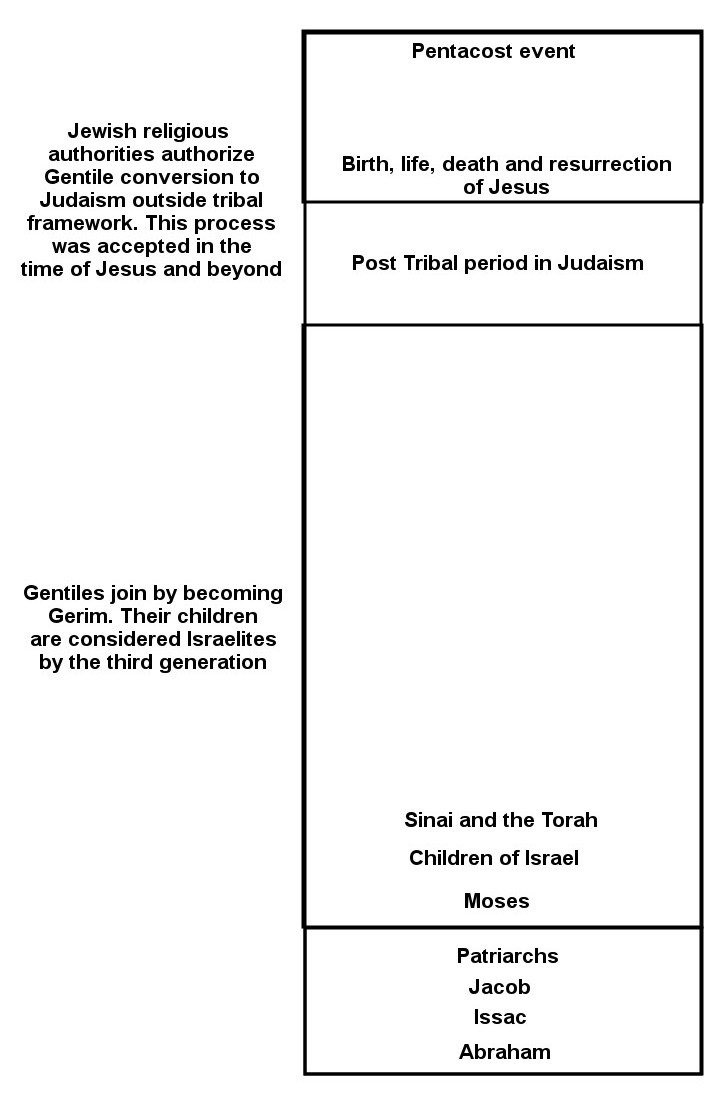
what-is-the-churchWhat is the “church?” Who belongs to the church? How is the church related to Judaism or is the church related to Judaism in the current age? These are the questions my Pastor and I discussed last Wednesday night. Sometimes, when we talk of these puzzling subjects, I have a difficult time conceptualizing my thoughts and feelings and articulating them while I’m with him in his office. So I ponder, and think, and occasionally, I draw (you’ll see what I mean as you scroll down while reading).

I think I’ve come up with a “vision” of Pastor’s understanding of the evolution of the church from its beginnings in Judaism as well as my own “vision.” I apologize to Pastor and to you in advance for any misunderstanding I have of his point of view. He recently pointed out to me how I didn’t have a correct understanding of his view of the “end times” (which I blogged about) and sometime soon, I’ll need to post a retraction (he told me he doesn’t find a retraction or correction necessary, but I find it necessary if I intend to be honest in my transactions with him and everyone else).

First things first. There are some areas we necessarily agree upon. God made a covenant with Abraham, with Isaac, and with Jacob involving promises relating to the Land of Israel, making their descendants very numerous, promises that they would be a blessing to all nations (through Messiah), and that circumcision would be the physical sign between God and the specific, biological descendants of Abraham and Isaac, and Jacob that their descendants would be the inheritors of these covenant promises.

The patriarchs came from Jacob and the twelve tribes of Israel came from the patriarchs. Moses led the twelve tribes out of slavery in Egypt and God redeemed them as His special people, as per the promises made to Abraham and his descendants. God then added to His promises at Sinai and gave the Torah, the teaching and instruction for righteous living to the physical descendants of Abraham, Isaac, and Jacob. This also functions as the national constitution of Israel, and has multiple other purposes.

At this point in history, Gentiles can only join Israel as gerim, which isn’t exactly conversion. The idea is that a Gentile would do what the Israelites would do in terms of the mitzvot, but the Gentiles would never become Israelites in their generation. More like resident aliens. No one can convert to a tribe or a family clan. Only after the third generation, would the ger’s children have intermarried into tribal Israel and ultimately assimilate into the Israelites. This was the only path for a Gentile to join the covenant people of God.

After the Babylonian exile and a lot of history passed by, tribal and clan affiliations were all but lost. The Jewish religious authorities instituted what we understand as the ritual of conversion. Now, if a Gentile wants to join national Israel and the Jewish people, they must undergo a process supervised by Jewish religious authorities (in modern Orthodox Judaism, it is a group of three Rabbis who form a Beit Din). The men are circumcised and both men and women are “mikvahed” as the final act of conversion. They go down into the water as a Gentile and come up as a Jew. There is no multi-generational “delay” and the individual Gentile who desires to be Jewish can become Jewish and thereafter, they and all of their descendants are considered Jews.

stream1Then Jesus comes. At this point, there are born Jews and there are Jewish converts or proselytes to Judaism. Jesus doesn’t speak against the ritual of the proselytes and does not overturn this institution, even though it is not directly found in the Torah. Remember, Jesus wasn’t adverse to opposing Jewish traditions and he did overturn or object to other halachah of the scribes and Pharisees on occasion (Matthew 15:1-14 for example). We also see that Paul encountered Jewish proselytes (Acts 13:43 for instance) and he too never said a cross word about the Jewish converts or the practice of converting Gentiles to Judaism (though in Galatians, he spoke strongly against Gentiles converting to Judaism as the only way to be justified before God). Both Jesus and Paul were very direct about expressing their thoughts and feelings and if either one had a problem with the Jewish conversion process, they would have said so…but they never did.

But something new happened after the death and resurrection of Jesus.

And Jesus came up and spoke to them, saying, “All authority has been given to Me in heaven and on earth. Go therefore and make disciples of all the nations, baptizing them in the name of the Father and the Son and the Holy Spirit, teaching them to observe all that I commanded you; and lo, I am with you always, even to the end of the age.”

Matthew 28:18-20 (NASB)

I wonder if the Jewish apostles truly understood the implications of Messiah’s words. Did they believe he wanted them to make converts of the Gentiles, “mikvahing” them into Judaism? All of the other streams of Judaism accepted Gentile converts, why should “the Way” be any different?

But it was and is.

While Peter was still speaking these words, the Holy Spirit fell upon all those who were listening to the message. All the circumcised believers who came with Peter were amazed, because the gift of the Holy Spirit had been poured out on the Gentiles also. For they were hearing them speaking with tongues and exalting God. Then Peter answered, “Surely no one can refuse the water for these to be baptized who have received the Holy Spirit just as we did, can he?” And he ordered them to be baptized in the name of Jesus Christ.

Acts 10:44-48 (NASB)

stream2Here we see our answer. Gentile believers, like the Jewish believers, received the Holy Spirit and were baptized by water without being circumcised and converting to Judaism! This was revolutionary. This was astounding. This had never, ever happened before. It was without compare. Paul perceived this vision clearly in his subsequent work with Gentiles, but it wasn’t until the matter was brought before the council of apostles and elders of the Way in Jerusalem that a formal, legal status was granted to the Gentiles entering into a wholly Jewish religious stream (see my Return to Jerusalem series for a detailed analysis of this process).

But it’s at Acts 2 that Pastor and I disagree. He believes that Pentecost is the “Birthday of the Church” and that sometime remarkable happened. Something remarkable did happen, but we don’t agree on exactly what it is. To the best of my ability to relate (and again, I apologize in advance if I mess any of this up), Pastor believes that an entirely new entity, “the Church” emerged from a Jewish religious stream and although it is made up of both Jewish and Gentile members, the members all form a single, uniform body of Messiah. At this point, the Torah is “fulfilled” and is no longer a set of commandments or obligations for the Jewish Christians. Jewish and Gentile Christians share a single set of obligations under the grace of Jesus Christ.

This effectively separates the Jewish members in the Church from larger Israel and the Jewish people. Pastor says that all Jews share in the covenant promises of God, particularly possession of the Land of Israel in perpetuity, but that only the Jewish Christians are saved.

My point of view is different.

I see the creation of the Body of Messiah (I’m not going to call it “the Church” in order to distinguish Pastor’s perspective from mine) as the natural and logical extension of everything that happened in Biblical and historical Judaism before it. The entire stream of history and prophesy for Israel pointed inevitably to the Jewish Messiah, so when Jesus came, it was the pinnacle, the focal point, the historical hinge upon which everything in Judaism was aimed at and upon which it turned.

But while it was revolutionary for Gentiles to be allowed to enter a stream of Judaism without converting to Judaism and being considered Jewish, their admittance wasn’t the end of the Jewish stream that accepted Jesus as Messiah as a Judaism, nor was it replaced by another religion or religious entity. It was a Judaism that had Gentiles admitted as equal members in relation to salvation and access to God, but it didn’t turn “the Way” or “Messianic Judaism” into “the Church.”

That happened unfortunately, after the Jewish/Gentile schism in the movement (and there’s a lot of history available to describe the details, so I won’t replicate it here) and in my opinion, the “Gentile Church” was born when the Gentile Church leadership agreed that it was no longer a Judaism and that Jews were not welcome unless they converted to Christianity!

If Pastor is right, then we have to consider the Jews in the Church as irrevocably separated from their Jewish brothers and sisters and perhaps even national Israel, since they no longer can identify with Israel, the Torah, and the connection the Torah provides a Jew with his nation and his God. If I’m right, then we have to consider the Body of Believers in Messiah as a Jewish stream, albeit a somewhat unique one because of such a large Gentile membership, that runs parallel to all other Jewish religious streams pointing toward the future and the eventual return of the King. We also have to admit that the Torah is not canceled and that Messianic Jews share an equal obligation to the mitzvot as all other Jewish people.

stream3Again, I sincerely apologize to my Pastor and to everyone reading this if I got his perspective on these matters wrong, in even the slightest detail. It is not my intention to misrepresent anyone, but it is my intention to draw a distinction between our two viewpoints.

Does it matter who is right? Is my purpose in the church, let alone the reason for my existence, simply to be right? As I’ve discovered (or re-discovered) recently, the answer is yes and no. No, it doesn’t matter if I personally am right. The world doesn’t depend on my one, small opinion. Statistics vary, but recent research indicates that there are anywhere between one and three-quarter million blogs to perhaps up to 164 million blogs in existence, and even the people compiling these numbers admit the list is incomplete. The number of individual blog posts goes into the billions and billions. Compared to all that, my one little blog can hardly matter, even in the human realm, let alone God’s. Any religious blogger who thinks they’re “all that and a bag of chips” can only make me laugh.

On the other hand, it’s vitally important to examine the question “who is the Church” and especially “what is the Church”. If “the Church” turns out to be a terribly misguided Judaism that has wildly deviated from its original course, then we require an exceptionally radical “course correction.” No, I’m not suggesting a revolution in the Church as such, where we strip away 100% of church culture as it has evolved over the past twenty centuries, but I am suggesting some form of change.

This is exactly the sort of process described by First Fruits of Zion (FFOZ) Founder and President Boaz Michael in his book Tent of David. The answer to the question of who and what “the Church” is has profound implications if we believe that the modern Messianic Jewish opinion is correct and that “the Church” was never intended to be a totally unique religious unit, disconnected forever from Israel, the Torah, and the Jewish people.

In my opinion, everything God did across human history was ultimately additive, no replacements or substitutions accepted. Abraham and God make a covenant, and as part of the conditions of that covenant, Isaac is added, then Jacob is added, then Jacob’s children are added as the patriarchs, and then their descendants, the Children of Israel are added, and they are made into a nation and the Torah is added, and possessing the Land of Israel is added, and all of the prophesies by all of the prophets pointing to the Messiah and the Kingdom of Heaven are added, and the birth of Messiah is added, and the death and resurrection of Messiah are added, and the Jewish religious stream that is identified by faith in Messiah is added, which includes the Gentiles entering this Jewish stream being recipients of the blessings of the covenant God made with Abraham…all in one, nice, neat, straight line across history as drawn on the canvas of time by God.

What we have now in the 21st century is something of a mess, but that’s what happens when God gives us a gift and then lets us play with it for 2,000 years. We’ve bent, folded, spindled, and mutilated it, but not beyond repair. Repair is what I think Messianic Judaism is all about. It’s tikkun olam or repairing the world with a Messianic twist. It’s a voice in the wilderness calling out to the synagogue and the church saying, “It’s time to take a fresh look at all this so we can clean the place up and get ready for the King’s return.”

The roadOne nice, neat, straight line from Abraham to Moshiach. Any bends in the road, any wrinkles in the asphalt, any potholes, any mudslides, any detours, have nothing to do with God and His intent. We’re the ones with the jack hammers and sledge hammers pounding away at that line, making it crooked and not straight. But we’re the ones who were charged with caring for the road, just as Adam was charged with caring for the Garden (and look how that one turned out).

I’m not in charge with being “right” but God did say that I’m supposed to take care of my little section of the road upon which the King will walk as he returns. I can’t fix it all, but I have to do something. He’s coming soon. I can’t just lie down on the job and call it good. He’s coming soon. I’ve got to do my best, with the help and by the will and grace of God, to make and keep my little piece of the road of the King straight.

For more about the relationship between Jewish and Gentile believers in the Body of Messiah, see Derek Leman’s short article, Citizens, Not Natives.

FFOZ TV Review: The Torah Is Not Canceled

ffoz_tv13_mainEpisode 13: It is commonly taught that Jesus came to cancel the law but Jesus tells his disciples “I did not come to abolish the law.” Episode thirteen will revolutionize the viewer’s understanding of the law by learning that the law was given for Godly instruction. They will discover that not only has the law of God not been done away with but the prophets tell us that it will be observed even in the Messianic Era. It will also be taught that the law has different applications for different people, with some commandments only being applicable to Jewish people.

-from the Introduction to FFOZ TV: The Promise of What is to Come
Episode 13: The Torah Is Not Canceled

The Lesson: The Mystery of Jesus and the Torah

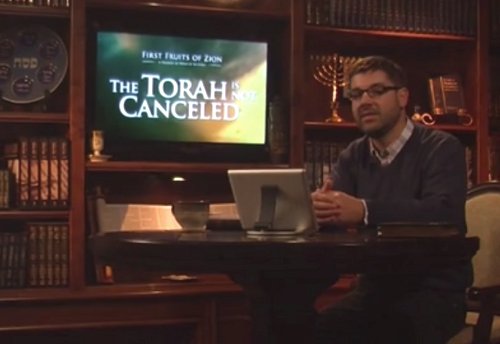
In this episode, First Fruits of Zion (FFOZ) teachers Toby Janicki and Aaron Eby take on one of the major misconceptions of Christian doctrine, that the death of Jesus canceled the Torah and invalidated the Law. Toby calls this “The Mystery of the Torah is not Canceled,” but I prefer the other expression he used: “The Mystery of Jesus and the Torah.”

The core to this episode is a scripture that practically everyone in the Hebrew Roots and Messianic Jewish movements is keenly aware of:

Do not imagine that I have come to violate the Torah or the words of the prophets. I have not come to violate but to fulfill. For, amen, I say to you, until heaven and earth pass away, not one yod or one thorn will pass away from the Torah until all has been established.

Matthew 5:17-18 (DHE Gospels)

These verses are part of what is called the Sermon on the Mount, which is thought of in Christianity as the core of Jesus’s moral teachings.

Toby tells his audience that a closer analysis of Matthew 5:17 will help us get to our first clue in solving today’s mystery.

Do not think that I came to abolish the Law or the Prophets; I did not come to abolish but to fulfill.

Matthew 5:17 (NASB)

According to Toby, Jesus had been criticized by the Jewish religious authorities, saying that he was not teaching and living by the Torah correctly. Jesus was taking this opportunity to explain his intent as a teacher. The phrase “I have come” has the sense in the Hebrew of purpose and intention. Toby tells us that in this section of his sermon, Jesus isn’t explaining his role as Messiah in relationship to the Torah, but his intention and purpose in teaching the Torah. He wants to clear up any misunderstanding about what he’s teaching, not explain how he is going to impact Torah obedience in Israel as the coming Messiah.

ffoz_tv13_tobyBut we have to have a proper understanding of the terms “abolish” and “fulfill” in order to understand Jesus’s words. While Christians have to take at face value the verse saying that Jesus didn’t come to “abolish” the Law, that is, to destroy, discard, overturn, or annul, they often interpret “fulfill” as abolish, since the net effect in Christian thinking is that Jesus “nailed the Law to the cross.”

But within a first century Jewish Rabbinic context, how are the words “abolish” and “fulfill” understood?

Rabbi Jonathan would say: Whoever fulfills the Torah in poverty, will ultimately fulfill it in wealth; and whoever abolishes the Torah in wealth, will ultimately abolish it in poverty. (emph. mine)

-Pirkei Avot 4:9

Pirkei Avot is also called Ethics of Our Fathers, and is a collection of ancient Rabbinic teachings compiled from 200 years before Jesus’s birth until 200 years after his resurrection.

Here we see how the early Sages defined the use of fulfill and abolish in relation to the Torah (the word “neglect” was in place of the word “abolish” in the quote of Pirkei Avot 4:9 I copied from a Chabad email newsletter). I bolded some of the words in the above quoted phrase so you could better see Toby’s point.

To “abolish” in this context, means to disobey Torah.
To “fulfill” in this context, means to obey Torah.

Jesus is saying that in his teaching and his life, he did not come, that is, it was not his intention and purpose as a teacher, to disobey the Torah, but rather, to obey the Torah. Let’s look at Matthew 5:17 again but in a modified form.

Do not think that I came to disobey the Law or the Prophets; I did not come to disobey but to obey. (emph. mine)

A rather startling change of meaning, don’t you think? Now we have the first clue we need to solve the mystery:

Clue 1: Jesus came to obey and teach the Law.

But exactly what is “the Law” and why does Christianity see it so negatively? To get the answer, the scene shifts to FFOZ teacher and translator Aaron Eby in Israel.

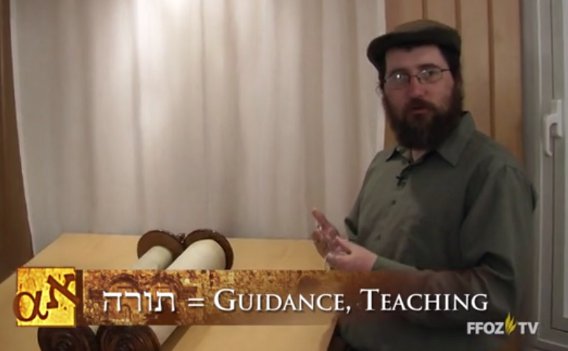
ffoz_tv13_aaronWhat is the Torah? Most often, we think of it as the first five books of the Bible: Genesis, Exodus, Leviticus, Numbers, and Deuteronomy. And while the Torah does contain many laws for Jews living in the Land of Israel and diaspora, as well as Jewish ethical and moral conduct, it also contains the story of Creation, the calling of Abraham, Isaac, and Jacob, and the astonishing redemption of the Israelites from slavery in Egypt.

Aaron teaches us that Torah means something like “guidance,” “teaching,” or “instruction.” The root word in Hebrew is an archery term implying something that is cast, thrown, or shot with aiming or guidance, like one might shoot an arrow at a target. In this sense the Torah can be any spiritual or Biblical teaching directing someone toward righteousness. To differentiate this broader meaning from the first five books of the Bible, we call those five books the Torah of Moses.

The main point of Aaron’s teaching is rather straightforward. Torah doesn’t mean “law,” it means teaching, instruction, and guidance, in a spiritual or moral sense. It doesn’t have to refer only to the “mechanics” of the legal parts of the Torah of Moses. He also explains what a “jot” and a “tittle” or “thorn” is which illuminates how Jesus used those terms in Matthew 5:18. Jesus was saying that he did not intend to abolish or disobey even the smallest detail of the Torah until heaven and earth passed away.

Returning to Toby, we have our second clue:

Clue 2: Torah is God’s Instruction.

Toby takes the lesson one step further and describes the future role and function of the Torah in the Messianic Era. To understand how this works, we must turn to Jeremiah 31:31-34

“Behold, days are coming,” declares the Lord, “when I will make a new covenant with the house of Israel and with the house of Judah, not like the covenant which I made with their fathers in the day I took them by the hand to bring them out of the land of Egypt, My covenant which they broke, although I was a husband to them,” declares the Lord. “But this is the covenant which I will make with the house of Israel after those days,” declares the Lord, “I will put My law within them and on their heart I will write it; and I will be their God, and they shall be My people. They will not teach again, each man his neighbor and each man his brother, saying, ‘Know the Lord,’ for they will all know Me, from the least of them to the greatest of them,” declares the Lord, “for I will forgive their iniquity, and their sin I will remember no more.”

Here, Toby interprets this scripture about the New Covenant in the same way I’ve been doing on this blog for quite some time. On the surface, the prophet is saying that there will be a new covenant and that it will be different from the old covenant, but what exactly will be different. Grace instead of Law? That’s not what scripture says. Let’s drill down into verse 33:

I will put My Torah within them and on their heart I will write it; and I will be their God, and they shall be My people. (emph. mine)

ffoz_tv13_torah_bethemmanuelI substituted the word “Torah” for “Law” since that’s how it’s rendered in the Hebrew. Remember, the New Covenant is made with Judah and Israel, not with the church or the nations. God still expects the Jewish people to obey the Torah, His guidance and instruction, but it will be written internally and will be part of the fiber of their being, rather than being written externally. My understanding is that it will be second nature for the Jewish people to live a lifestyle in obedience to God, rather than struggling between the good and evil inclinations.

We saw in the FFOZ TV show None Greater Than John that verse 34 refers to the state of the people of God during the Messianic Era. We will all know God, from the greatest to the least of us, as prophets, with an overabundance of the Spirit of God upon us.

This is the Messianic Era, when the Jewish exiles are returned to their Land, the Land of Israel, all of Israel’s enemies are finally defeated forever, and King Messiah establishes world peace. In those days, all Jews will obey Torah and even the Gentiles of the nations will go up to Jerusalem to learn:

And many peoples will come and say,
“Come, let us go up to the mountain of the Lord,
To the house of the God of Jacob;
That He may teach us concerning His ways
And that we may walk in His paths.”
For the law will go forth from Zion
And the word of the Lord from Jerusalem.

Isaiah 2:3 (NASB)

Here we have the third and final clue:

Clue 3: The Torah will be obeyed in the Messianic Era

But this brings up the subject about the relationship of the Torah to the non-Jewish people. I thought that the topic would be ignored as in past episodes, but Toby briefly touches on it by saying that the Torah has different applications to Jewish and non-Jewish people. Most (non-Messianic) Jews would probably say the Torah has little to no application to the goyim at all, but Messianic Judaism sometimes has a unique perspective regarding non-Jews and particularly Christians.

At the end of the episode, FFOZ Founder and President Boaz Michael comes on camera and refers to the Torah as “God’s loving instruction.” He says that both Jews and Gentiles need to study the Torah and discover how it applies to our lives, also implying that there are different applications of the Torah to Jewish and non-Jewish people.

What Did I Learn?

ffoz_tv13_torah_lettersI gained a greater appreciation of the Rabbinic use of the terms “fulfill” and “abolish,” although I’d heard something similar in the past. I was also reminded of a discussion I had with my Pastor last week on this very topic: will there be distinctions between Jews and Gentiles in the Messianic Era and will there be any such thing as “Torah” in those days? He says “no” and I say “yes.” I don’t think the Torah ceases as we understand it today until “all is accomplished” (Matthew 5:18). The question is, when is everything that must be accomplished actually accomplished? If not even the smallest detail of the Torah pass away until heaven and earth pass away, then the only possible answer is that the Torah passes away only when there is a new heaven and earth.

Then I saw a new heaven and a new earth; for the first heaven and the first earth passed away, and there is no longer any sea. And I saw the holy city, new Jerusalem, coming down out of heaven from God, made ready as a bride adorned for her husband. And I heard a loud voice from the throne, saying, “Behold, the tabernacle of God is among men, and He will dwell among them, and they shall be His people, and God Himself will be among them…

Revelation 21:1-3 (NASB)

When the Messianic Age is established, the Torah will still be in effect upon Israel, that is the Jewish people. There will be some applications for non-Jewish believers, but Toby was deliberately vague in this area. Only after everything has been accomplished, evil has finally been defeated, and a new heaven and earth have been established, that the Torah, as we understand it, will pass away.

But as I was watching this episode and reflecting on my conversation with Pastor last week, I was reminded of a question he asked me. There are several Jewish people who attend my church. None of them are “Messianic,” and would be better called “Hebrew Christians,” people of Jewish ethnic and family lineage but those who practice a traditional Christianity. In other words, they likely believe the law is abolished in the sense of being permanently destroyed.

Pastor asked me if I thought they are obligated to the Torah. My principles say “yes,” but I was suddenly confronted with the reality of my words. Could I go up to any of these individuals unbidden, and tell them to their face that they should be performing the mitzvot, not as a matter of salvation or justification, but out of covenant obedience? Probably not (not unless they asked, of course…). It would be like going up to a Jewish person driving to shul on Shabbos and telling them they shouldn’t drive but walk instead. Who am I, the religious police? On the other hand, if the Torah is incumbent upon all the Jewish people now and will be even into the Messianic Age…what are the consequences to a Jew for abandoning the Torah, even at the behest of the Christian church?

Whoever then annuls one of the least of these commandments, and teaches others to do the same, shall be called least in the kingdom of heaven; but whoever keeps and teaches them, he shall be called great in the kingdom of heaven.

Matthew 5:19 (NASB)

prophetic_return1I believe that Jewish people are currently obligated to perform the mitzvot, but that doesn’t mean I must forcibly impose my beliefs upon them. Every person negotiates their own relationship with God. Every Jew must discover who they are as a Jew in relation to Hashem. I can only pray that all Jewish people everywhere return to the Torah and thus bring the Messiah that much closer to bringing his rule and reign fully into our world. For when he returns, as Toby and Aaron teach, the Torah will be established in Israel and will go forth into the nations from Zion.

When G‑d made the world He gave each creature, each nation and each individual a role and a meaning.
When each plays its part there is harmony.
When the lines become too blurred, there is acrimony.

-Rabbi Tzvi Freeman
“Distinctions”
Based on letters and talks of the Rebbe, Rabbi M. M. Schneerson
Chabad.org

I will review another episode next week.

Trouble Breaking Into Church With Messianic Prophesy

daniel“Seventy weeks have been decreed for your people and your holy city, to finish the transgression, to make an end of sin, to make atonement for iniquity, to bring in everlasting righteousness, to seal up vision and prophecy and to anoint the most holy place. So you are to know and discern that from the issuing of a decree to restore and rebuild Jerusalem until Messiah the Prince there will be seven weeks and sixty-two weeks; it will be built again, with plaza and moat, even in times of distress. Then after the sixty-two weeks the Messiah will be cut off and have nothing, and the people of the prince who is to come will destroy the city and the sanctuary. And its end will come with a flood; even to the end there will be war; desolations are determined. And he will make a firm covenant with the many for one week, but in the middle of the week he will put a stop to sacrifice and grain offering; and on the wing of abominations will come one who makes desolate, even until a complete destruction, one that is decreed, is poured out on the one who makes desolate.”

Daniel 9:24-27 (NASB)

Then I saw thrones, and they sat on them, and judgment was given to them. And I saw the souls of those who had been beheaded because of their testimony of Jesus and because of the word of God, and those who had not worshiped the beast or his image, and had not received the mark on their forehead and on their hand; and they came to life and reigned with Christ for a thousand years. The rest of the dead did not come to life until the thousand years were completed. This is the first resurrection. Blessed and holy is the one who has a part in the first resurrection; over these the second death has no power, but they will be priests of God and of Christ and will reign with Him for a thousand years.

Revelation 20:4-6 (NASB)

Tales of the Messianic Era series

The previous entry is The Obscured Messiah in the Bible.

Last Wednesday night, my Pastor and I got through the majority of Chapter 8 (it’s not a long chapter and only covers Galatians 2:11-14) in D. Thomas Lancaster’s book The Holy Epistle of the Galatians. We disagreed so much about the content, that I apologized for seeming so oppositional. We continue to “butt heads” over the purpose and function of the Torah in the lives of the Jewish disciples of the Jewish Messiah in the Apostolic age and beyond.

But we got sidetracked again. Pastor asked me about the nature and function of “the Church,” the collection of Jewish and Gentile disciples of Messiah. I knew Pastor saw the Church as separate from Judaism…well, sort of, but I had no idea how separate it was supposed to be.

From my point of view, “the Church,” the body of Jewish and Gentile disciples of Messiah, is the logical extension of Biblical and historic Judaism that began with Abraham and was formalized in law at Sinai. Judaism has always looked forward to Messiah, so when Jesus was revealed as Moshiach, it wasn’t a departure from Jewish history but rather, the fulfillment of Jewish hopes and dreams. Of course, that fulfillment isn’t really filled full and it won’t be until his second advent when he will establish his reign of peace in Israel and across the entire world.

messiah-prayerSo if Jewish discipleship in Messiah is the natural and logical extension of Jewish history in the first century CE, then what was Gentile discipleship? I’ve said over and over that it was a major chore for Paul and the other Apostles to figure out a way to legally include Gentile disciples into the community of Jewish faith in Messiah without requiring that they convert to Judaism through the ritual of the proselyte and become obligated to the full yoke of Torah (and my Pastor and I also continue to debate what the Torah is and what purpose it has in Judaism) in the manner of the Jews.

It’s like Israel is the main event and enters through the front door of the mansion, while Gentiles get to come in but have to be admitted through the side entrance near the kitchen (but once we’re in, we’re in). I know that’s an unflattering image for most Christians, but that’s how the Bible reads. Going to the Old Testament (Tanakh), all of the prophesies about Messiah and what he will do emphasize blessings for Israel, not particularly for “the Church” (since “the Church” isn’t even a glimmer in any prophet’s eye in the Tanakh), but thanks to a single line in the Abrahamic covenant, the Gentiles in the world will receive blessings as well.

Did you get that? Israel is the main beneficiary of the blessings of the Messiah and the rest of the world benefits from the “spillover,” so to speak.

“Arise, shine; for your light has come,
And the glory of the Lord has risen upon you.
“For behold, darkness will cover the earth
And deep darkness the peoples;
But the Lord will rise upon you
And His glory will appear upon you.
“Nations will come to your light,
And kings to the brightness of your rising.”

Isaiah 60:1-3 (NASB)

I’ve said before that only a single verse in Genesis 12 links the people of the nations to the Abrahamic covenant, and it is only that verse that allows us to have a connection with God at all, through our faith in Messiah. All of the conditions of all of the covenants God made with Israel continue forward in time and, although major sections of the Torah are held in abeyance until such time as the Messiah comes, rebuilds the Temple, re-establishes the priesthood and the Sanhedrin, and ascends the Throne of David, everything else that God “covenanted” with the Jewish people remains in effect.

So how did the tail end up being the head? How did the Church get to think of itself as first and the Jewish people second.

Here, I’ll give you an example. Let’s go back to my conversation with Pastor about the Church and all that must occur when Messiah returns.

rapturePastor, like most Christians, believes that when Messiah comes, all members of the Church, Jews and Gentiles alike, will be taken up into the air with him and be raptured to Heaven. And there we’ll stay. Meanwhile, a lot of bad, ugly things will be happening on the earth. Lots of people will be “left behind” and many will come to faith at that time. But they won’t be “the Church”. According to Pastor, they’ll be believers, but they’ll form a distinct group outside of the Church. The Church at that time will be in Heaven with Christ. Only believers and non-believers will be on earth enduring the tribulation.

Pastor said he wasn’t sure of the timing, but that all of the Israelites, the ancient Jewish people who lived and died before the first advent of Christ, will be resurrected and they will stay on earth. They are “believers” but not the Church. They will have a special and unique role as the 144,000 (Revelation 7:4-8), but the Church disappears from the face of the planet with Jesus and they (we?) don’t return until Jesus returns, all the way down into Revelation 20. But how can Israel, the Jewish people, be fractured into two groups: those who are in the Church in Heaven, and those who are “mere” believers on earth? Abraham saw Messiah’s day (John 8:56) but he lived before the first advent. Does that mean Abraham is in Heaven as part of the Church or on earth as a “believer?” It all doesn’t make sense.

No wonder my Sunday school teacher balked when I said his calling the people of the nations in Zechariah 14:16 “unsaved Gentiles” was anachronistically projecting a “Christianism” into the Jewish text. But then again, I still think my teacher was wrong, because according to both him and Pastor, it is possible for people to come to faith during the Messianic reign, although they won’t be part of “the Church,” they will still be “saved.”

But I’ve got a problem. Whenever I read Isaiah, Jeremiah, Ezekiel, and the other prophets who speak of Messiah, I get one picture. But when I read Revelation and the sections of the Gospels and Epistles that mention the second coming of Jesus, I get a faintly related but mainly different picture.

I’ve avoided the whole issue of the second coming and the “end times” for most of my “career” as a believer because, frankly, I’ve met so many “nuts” in the Hebrew Roots movement who were incredibly obsessed about “the end times” and who weaved all kinds of bizarre scenarios around it. However, if I ever hope to understand the past, present, and future of the Jewish Messiah King, I’m going to have to take all this head on.

My Sunday school class just finished a multi-week inventory of the end times, the Messianic age, and the final events leading into eternity, but I prefer a fresh look at the material. I’m probably not going to throw myself headlong into the subject if, for no other reason, than the only information sources I have immediately handy are Christian sources (I know that sounds strange, but how does Judaism in general and Messianic Judaism in particular treat this topic?).

walking-into-churchAfter nearly a year of going back to church (although I guess I’ve been a part of “the Church” all along), I still find it hard to break into the church. Break into the church? I mean I still lack the ability to take on traditionally Christian concepts and doctrines with any amount of ease. I question everything. Everything seems strange or at least unanticipated. Is it just my ignorance of the Bible and how to interpret it, or has the Church become so comfortable with its historic perspectives that it has lost the ability (or the will) to ask itself if it could possibly be wrong?

I’m going to have to “cut and paste” everything the Bible says about the future Messianic age together on one page to even begin to make sense of it. Is there any hope of reconciling the prophesies of the Jewish Messiah in the Tanakh with the prophesies about the risen Christ in the New Testament?

“Every day people are straying away from the church and going back to God.”

Lenny Bruce