Tag Archives: Jesus

Hoping for Salvation

white-pigeon-kotelEach day we hope for Your salvation.

-Shemoneh Esrei

The Talmud states that one of the questions that will be posed to each person on his or her day of judgment is, “Did you look forward to salvation?” While the question refers to anticipating the ultimate Redemption, it can also refer to the salvation of the individual.

Positive attitudes beget positive results, and negative attitudes beget negative results. Books have been written about people who have recovered from hopeless illnesses because, contrary to medical opinion, they did not give up hope. On the contrary, they maintained a positive attitude. While this phenomenon may be controversial (for many people are skeptical that cheerful outlooks can cure), people certainly can and have killed themselves by depression. With a negative attitude, a person suffering from an illness may even abandon those practices that can give strength and prolong life, such as the treatment itself.

I have seen a poster that displays birds in flight. Its caption comments, “They fly because they think they can.” We could do much if we did not despair of our capacity to do it.

Looking forward to Divine salvation is one such positive attitude. The Talmud states that even when the blade of an enemy’s sword is at our throat, we have no right to abandon hope of help.

No one can ever take hope from us, but we can surrender it voluntarily. How foolish to do so.

Today I shall…

…try to always maintain a positive attitude and to hope for Divine salvation.

-Rabbi Abraham J. Twersky
“Growing Each Day, Elul 11”
Aish.com

Recently, I’ve written a number of reviews on portions of Thomas Schreiner’s book 40 Questions About Christians and Biblical Law. If you’ve read them, you know my feelings about Schreiner’s point of view on the Torah of Moses and how (or if) the Torah carries forward for the Jewish people into Apostolic times and beyond.

I want to take a step backward from that perspective this morning (but not too big a step). I’ve commented previously on the commonalities between Hebrew Roots, Messianic Judaism, and Christianity, as well as the fundamental platform upon which all who have faith in Yeshua (Jesus) as Messiah (the Christ) stand. While ultimately there is a dividing line between people who have faith in God through Jesus and those who do not, we can’t afford to dispense with authentic people of God who differ from us based on our opinions on “the Law” or how we understand God’s Word.

All people of faith face the same struggles. We are opposed by people who deny the existence of God, who deny that there is a core morality that is never-changing, who believe that human beings are the ultimate moral and intellectual force in the universe.

How can one be certain of the authority of the T’nach in all its particulars? The answer to this is based on common sense, and if one approaches the question open-mindedly and without prejudice, one must come to this conclusion. To put it very briefly, and going back from our present generation to preceding generations, we have before us the text of the T’nach as it was transmitted from one generation to the other by hundreds and thousands of parents of different backgrounds to their children. Even during the times of the greatest persecutions, and even after the destruction of the Beth Hamikdash, there always survived hundreds and thousands of Jews who preserved the text of the T’nach and the traditions, so that the chain has never been broken.

-from correspondence by Rabbi Menachem M. Schneerson
27th of Shevat, 5723 [February 21, 1963]
posted at Chabad.org

The Lubavitcher Rebbe has critics not only in Christianity but in different branches of Judaism, but the struggles he describes are the same as ours. Although I wouldn’t make a good Chabadnik for a number of reasons (not the least of which is the fact that I’m not Jewish), I often find their published writings and philosophies to be beautiful and reflective of God, especially when contrasted against criticisms against Torah and Judaism. No, it’s not that Judaism isn’t also critical of Christianity.

Furthermore, there is a basic difference between our Jewish tradition and those of other faiths, such as Christianity or Islam. For, whereas in the latter cases the traditions go back to one individual or a limited number of individuals, our traditions go back to a revelation which was experienced by a whole people at once, so that at no time did we have to place our trust in the veracity of one, or a few, individuals.

tallit-prayerThe Rebbe is being very “even-handed” in his response to Christianity in this letter. Some Jewish criticisms are far more biting.

I’m not saying we should compel religious Jews to abandon the practices of their faith or attempt to drive Christians from their (our) views on Jesus, but I am saying that we should stop trying so hard to jockey for position in order to establish our “lead” in the “race” by forcing the “defeat” of others.

Similarly in regard to the Torah. For the Torah, too, already contains the methods and principles whereby it is to be interpreted. Therefore, the traditional interpretation of the Torah is already contained in the Torah itself, and it is nothing but a continuation of the written Torah itself, so that only both together constitute one living organism.

I know one of the criticisms Christianity levels against religious Judaism is that Judaism interprets scripture according to a set of prescribed traditions. The assumption is that, by comparison, Christianity (in all its flavors and forms including Hebrew Roots) uses a Biblical hermeneutic that objectively examines the text and arrives at conclusions based only on what the words are saying in their various original languages.

But if anything convinces me that Protestant Christianity is also plumb full of traditions, it is theological texts such as Thomas Schreiner’s book. Only the fact that Schreiner must speak to a specific tradition of Christian Biblical interpretation can explain why he must base his theories on certain portions of the Bible, while ignoring other scriptures that directly refute his conclusions on the Torah’s purpose in ancient and modern Judaism (including Messianic Judaism). Also, the widely varying denominations that span the realm of Christianity are no different than the multiple streams of Jewish transitions and communities. How can one tradition criticize another when we all employ the same dynamics?

When Jews read in the Shemoneh Esrei, “Each day we hope for Your salvation,” it summons visions of the Moshiach coming to redeem and restore the Jewish people and Israel. And yet, those words should also bring to mind the second coming of Christ for anyone in the church. We may not agree as to the identity of Messiah, but the fact remains that we are all awaiting his ascent to the Throne of the King in Jerusalem, and his reign of peace throughout the Earth.

Right now, we all exist like a handful of sand slipping out from between clenched fingers, or millions of tiny shards of shattered glass strewn across a cold, dark ground. We’re broken apart. We’re disconnected. We’re separated and isolated. Each tiny shard cries out into an infinite universe, “I am the only one who truly knows God!” For the atheists, the “god” is themselves, the human being as final authority. For each religious person, it is the claim that we each “own” God. We claim Him exclusively as our private possession and denigrate all the other people in all the other faiths as mistaken, wrong, bad, evil.

From God’s point of view, what must we look like except a crowd of kindergarteners on a playground, each one of us chasing after the ball and screaming, “Mine! Mine!” I’m embarrassed to be reminded of the cartoon seagulls in the film Finding Nemo (2003).

And that is the much vaunted human race, religious and otherwise. No wonder in the Bible, we people are often compared to sheep.

And yet, every once in a while, someone among the “seagulls” and “sheep” rises higher and climbs above.

At the final ascent,
he clings to any crack or crevice
to pull higher.

That is where we are now:
Any spark of light that comes your way,
squeeze all you can from it.

-Rabbi Tzvi Freeman
“Mountain Climbing”
Based on letters and talks of the Rebbe, Rabbi M. M. Schneerson
Chabad.org

free-birdIt is easy in the study of the Bible to get caught up in the mechanics and lose our connection to the spirituality. When we “know” God, is that knowledge supposed to be exclusively intellectual, or is knowing God a transcendent experience…or both? Either extreme has its pitfalls and, as I’ve been trying to communicate, can lead us to believe that our little group, church, congregation, denomination, whatever, is the one, the only one that has the corner market on God.

We must become more than the sum of our doctrines. We must become the people God made us to be. We must seek Him with unbridled desire and not be tempted to control His image and put it into our box. In longing to fly, we must be willing to fall.

“One who romanticizes over Judaism and loses focus of the kingdom of Heaven can be compared to a carpenter who is infatuated with the hammer, rather than the house it was meant to build.”

-Troy Mitchell

“Our work involves trying to dance when others only know how to wrestle.”

-Rabbi Carl Kinbar

“Do not seek Christianity and do not seek Judaism. Seek an encounter with God.”

-Tom

Each day, I hope for your salvation, God. How long, O’ Lord, how long?

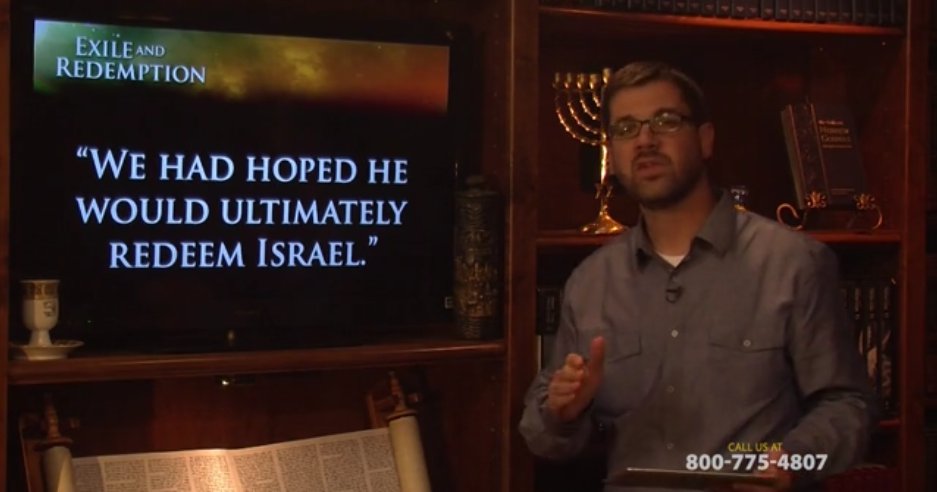
FFOZ TV Review: Exile and Redemption

tv_ffoz6_oneEpisode 06: Exile and redemption are two of the most significant Biblical concepts and in episode six viewers will learn that these two concepts play a major role in the job description of Messiah. It was the job of Messiah to bring redemption to Israel by ending their exile and gather them back to the land of Israel. While Messiah did bring a spiritual redemption at his first coming, he has some unfinished business to take care of upon his second return in the way of bringing a physical redemption to not only Israel but the entire world.

-from the Introduction to FFOZ TV: The Promise of What is to Come
episode 6: Exile and Redemption

The Lesson: What Does It Mean To Be Redeemed?

This lesson summoned a lot of material I recently read about and described in this blog. Toby Janicki explores what he called “The Mystery of Redemption”, which is far more than just what Scot McKnight in his book The King Jesus Gospel called “a plan for salvation.”

Toby, who was raised as a Christian, describes his own early understanding of terms such as “being saved” and “being redeemed.” Traditionally in the church, we are taught that Jesus died for our sins and that we have been redeemed by the blood of the lamb. But redeemed from what exactly? Typically, the answer is that we are saved or redeemed from the power of sin and any punishment in the afterlife.

But as McKnight says in his book, which I reviewed last month, and as Founder and President of First Fruits of Zion (FFOZ) Boaz Michael stated in his presentation “Moses in Matthew,” there’s a lot more going on in the gospel message of redemption than we get in the common Christian viewpoint. The gospel message is a message directed at the Jewish people, and only through the redemption of national Israel and the return of the Jews from exile to their Land, will be people of the nations who are called by His Name, that is, we Christians, also be fully redeemed.

One of them whos name was Kleyofas answered. He said to him, “Are you the only one residing in Yerusalayim that does not know what has happened within it in these days?” He said to them, “What is it?” They told him, the incident of Yeshua the Notzri, who was a prophet mighty in works and in speech before God and before all the people. “But our high priests and elders arrested him for a death sentence and crucified him. We had hoped that he would ultimately redeem Yisrael, but today it has been three days since these things happened.”

Luke 24:18-21 (DHE Gospels)

Here we see two Jewish men who were disciples of Yeshua (Jesus) and whose hopes of redemption for Israel had been dashed to the ground. They believed Yeshua was the Messiah, but the fact that he died and was buried meant for them that he couldn’t be, because he had not lived to redeem the nation of Israel. I should note here that most Jewish people today deny that Jesus could be the Messiah for exactly the same reasons. These are people who deny the resurrection, the ascension, and that one day, Jesus will return to finish the Messianic mission.

But I’m getting ahead of myself or rather the program. Toby teaches that this scripture gives us our first clue in solving today’s mystery:

Clue 1: Messiah will redeem Israel from exile.

This is not only what Jewish people believed in the late Second Temple period but what religious Jews believe today. Messiah must come to redeem the Jewish people and to restore Israel. But exactly what does that mean? Most Christians don’t know, which is the importance of this TV episode. Where did the Jewish people get the idea that Messiah as redeemer was more than just about redemption from personal sin and what will that teach Christians in the church?

Say to them, ‘Thus says the Lord God, “Behold, I will take the sons of Israel from among the nations where they have gone, and I will gather them from every side and bring them into their own land; and I will make them one nation in the land, on the mountains of Israel; and one king will be king for all of them; and they will no longer be two nations and no longer be divided into two kingdoms.

“I will make a covenant of peace with them; it will be an everlasting covenant with them. And I will place them and multiply them, and will set My sanctuary in their midst forever.”‘

Ezekiel 37:21-22, 26 (NASB)

The prophet Ezekiel is speaking of King Messiah who will return all of the Jewish people in exile to their Land, the Land of Israel. In addition, God will make a covenant of peace with Israel, which will last forever, and God will establish His sanctuary, the Temple, among the Jewish people in their nation forever.

This last part threw me a bit. Revelation 21:22 describes New Jerusalem as having no Temple in the sense of a structure, since God and the Lamb are the Temple. I suppose there’s another mystery we could explore here, but it’s not contained in this television episode, so it’ll have to wait for another time.

tv_ffoz6_threeWe know that God exiled the Jewish people and Israel at the end of the Second Temple period. Jewish sages believe this was because of the sin of baseless hatred among the Jewish people. But religious Jews also believe that God will one day redeem them by sending Messiah.

But there is a modern state of Israel. Jews can make aliyah at any time. Isn’t the exile over? Not according to Toby’s teaching. Israel may exist nationally but the restoration is not complete. There is no Davidic King on the Throne, there is no Sanhedrin court system, and there certainly is no Temple in Holy Jerusalem. The state of Israel has not been set right again and established as the head of the nations. The Temple is to be a house of prayer for all nations (Isaiah 56:7), but not one stone of the Temple stands upon another, so there is no “house of prayer” for anyone right now.

Shocking as this may seem to many Christians, Messiah’s work was not finished at the cross, not by a long shot.

Toby uses 1 Peter 1:17-19 to illustrate that not only are the Jewish people in exile, but as long as our King, Jesus the Messiah, is not sitting on his throne is Jerusalem, all of his disciples, Jewish and Gentile, are also in exile. In effect, Messiah himself went into exile when Jerusalem was destroyed nearly two-thousand years ago, much as God went down into Egypt and ultimately into slavery with Jacob and the seventy members of his family (Genesis 46:3-4).

Although Toby didn’t mention this at all, I should say that as long as the current Israeli government negotiates with the Arab “Palestinian” people to carve up Israel including Jerusalem, and give it away in exchange for the Arabs ceasing all acts of terrorism, then Israel can hardly be said to be “redeemed” and even Jews in the Land may as well consider themselves in exile. In fact, Israel itself is still in a sort of exile. I imagine the Jewish people trying desperately to hold onto their homes in the so-called “territories” feel that way, too.

Toby also didn’t say this explicitly, but we must consider it to be the drive and desire of all Christians everywhere to see King Messiah restored to his throne in Jerusalem because until this happens, redemption is not complete. Yes, we are still “saved” from sin and condemnation, but being personally “saved” is only the beginning. The greatest works of Messiah are yet to come.

The scene shifts to Israel and to teacher and translator Aaron Eby who discusses what the word “redeemer” means in Hebrew and what it means to “redeem” a person or property.

Thus for every piece of your property, you are to provide for the redemption of the land.

‘If a fellow countryman of yours becomes so poor he has to sell part of his property, then his nearest kinsman is to come and buy back what his relative has sold.’

Leviticus 25:24-25

This portion of the Torah explains that the concept of redemption is a buying back or re-acquiring of property or even a person who has been a slave. The principle and meaning of ancestral property is well-defined in the Torah and if it is lost, there is a strong expectation that the original owner or his heirs will buy it back; will redeem it.

tv_ffoz6_aaron2Aaron brought up a question (sort of) I have recently explored. What if the owner dies and has no heirs? The answer lies in the concept of the leverite marriage. Aaron draws examples from scripture including Ruth and Boaz. Ruth the Moabitess was married to a Jewish man who died. Boaz was a relative, a kinsman redeemer, and by marrying Boaz and having a son with him, she restored her former husband’s lost family line.

Aaron also says that, when God liberated the Israelites from slavery in Egypt, He was acting as a redeemer and indeed, as God’s agent in this matter, Moses was also a redeemer. But another redeemer is to come after Moses.

Returning to Toby, we reach our second clue:

Clue 2: Redemption means buying back, re-acquiring, and setting things right.

That’s the function of Messiah in terms of the Jewish people, the nation of Israel, and through redeeming them, he also redeems the rest of us who continue to have faith. Toby cites Paul in Romans 6:17-18 where Paul metaphorically uses the laws related to redeeming slaves in describing how believers in Jesus are redeemed from slavery to sin, which is also part of the Messianic mission.

Toby referred to another scripture as a way to get to the third clue, a passage that I also commented on less than a week ago.

The Lord your God will raise up for you a prophet like me from among you, from your countrymen, you shall listen to him.

Deuteronomy 18:15

Toby identifies Jesus as “the prophet” and directs his viewers to Peter in Acts 3 and Stephen in Acts 7 as evidence that the Jewish believers also saw Jesus as “the prophet” spoken of by Moses. Thus we have the third clue.

Clue 3: Prophesy says that Messiah will be the prophet like Moses. Moses was the first redeemer and Messiah will be the ultimate redeemer.

Part of this third clue is dependent on another portion of scripture and I’ll get to that momentarily.

What Did I Learn?

Actually, some interesting stuff.

“Therefore behold, days are coming,” declares the Lord, “when it will no longer be said, ‘As the Lord lives, who brought up the sons of Israel out of the land of Egypt,’ but, ‘As the Lord lives, who brought up the sons of Israel from the land of the north and from all the countries where He had banished them.’ For I will restore them to their own land which I gave to their fathers.

Jeremiah 16:14-15 (NASB)

passover-artIt never occurred to me to consider the return of the Jewish people to their Land from the current exile as a sort of second Exodus, one that makes the first Exodus from Egypt pale by comparison. I started to think, especially in light of how most Christians have to see Jesus in all of the moedim as their only application, if a new meaning will be assigned to Passover in the Messianic Age, one that reminds the Jewish people not only of their redemption from Egypt, but their ultimate redemption from exile and the restoration of Israel as a united people and a sovereign nation. If the absence of our King on his throne means that even the Gentile disciples are in exile, along with the Jewish people, and along with Israel itself, then we should be crying out to Heaven, “How long, God? How long?”

The other thing I learned, and I’m not sure what to make of it, is that when Jerusalem is redeemed by Messiah taking up his throne, that Jews and Christians will see Jerusalem as their (our) city. Of course, Jerusalem is the Jewish city, the City of David, but how can we Christians lay claim to it in any sense?

I suppose because our King will be sitting on the Throne and the Temple in Jerusalem will finally be a house of prayer for all peoples. I don’t think that means we Gentiles get to live there, but if God is willing, may I see Messiah on his throne in Holy Jerusalem in those days, and may my sacrifices and burnt offerings be a sweet aroma to him.

I’ll review the next episode very soon.

Intermarriage: Not Peace, But A Sword

onfire.jpgTo die while committed to a belief system that is idolatrous, false and contrary to what G-d has revealed to us AND has resulted in the persecution of the Jewish people for the last two thousand years, even if it doesn’t affect our eternity through the ever burning hell fires that Christianity reserves for those who didn’t believe in Jesus, is still not something I would desire for myself or anyone.

-from a private conversation

The simple believes everything, but the prudent gives thought to his steps.

Proverbs 14:15

Faith and belief are both defined as accepting as true something which transcends logic and which may not be subject to proof by rational argument. Yet, belief in God is not the “blind faith” of a simpleton.

A simpleton does not think, either because he lacks the capacity or does not wish to make the effort. Therefore, he is gullible and can be easily swayed in any direction. Being credulous is not the same as having faith.

When we reflect on the concept of a Supreme Being, Who is in every way infinite, we are likely to feel bewilderment, because our finite minds cannot grasp the infinite. Since all of our experiences involve finite objects, we lack a point of reference for dealing with the infinite.

When this reflection brings us to realize that the question of the existence of an infinite Supreme Being cannot be logically resolved, we then turn to the unbroken mesorah, the teachings which have been transmitted from generation to generation, from the time when more than two million people witnessed the Revelation at Sinai. When we accept our faith on this basis, we do so as the culmination of a process of profound thought which is no way similar to the credulousness of a simpleton.

This process also helps us with other questions that we have about God. For instance, the fact that we cannot possibly logically understand God does not preclude our coming to a knowledge of His Presence.

Today I shall…

…strengthen my faith by reflecting on the unbroken chain of tradition since Sinai.

-Rabbi Abraham J. Twersky
“Growing Each Day, Elul 3”
Aish.com

I’d like to think I’m not a simpleton. I hope I’m thoughtfully considering my steps. I have faith. I believe. The faith and belief of the Jewish people ultimately rests at Sinai, at the giving of the Torah. It is said that each Jewish person is to consider himself or herself as having personally stood at Sinai and having received the Torah directly. This communicates a sense of direct “ownership” of the commandments of God, rather than just the tradition of having them passed down from one generation to the next.

For a Christian, faith and belief ultimately rests at the foot of the cross, in a pool of blood shed for our sins. Christians aren’t “commanded” to consider ourselves as having personally stood at the foot of the cross of Christ, watching him die for our sake and for the sake of the world. Maybe we should.

But even so, people like me have a difficult thing to face. In my case, I have a Jewish wife, two Jewish sons, and a Jewish daughter. My children don’t speak to me one way or the other about my attending church and professing my Christian faith, but occasionally my wife does. Occasionally a few (non-believing) Jewish friends do (although in strictest confidence) as well.

If I love my Jewish family and friends, how can I be a part of a faith that historically has been guilty of “the persecution of the Jewish people for the last two thousand years”? I thought I knew, but when someone you deeply care about asks that question, it’s not so easy to answer. The answer is long and involved, and when someone is responding to your Christianity on a really emotional level, they don’t always want to hear long, involved explanations that they’ll probably do their level best to shoot out of the water in any case.

I don’t really want to argue. If someone wants to hear about my faith, I’ll do my best to explain it to them. If they don’t, I’m not invested in beating people over the head with a copy of the New Testament.

intermarriageIt doesn’t help (ironically enough) that my wife used to be a believer. My limited experience with Jewish people who were once believers and then returned or adopted a more traditional Jewish practice and worship, is that they are more highly resistant to any idea that there could be validity in Christianity or Messianic Judaism. I can only imagine it’s like being a person who is an ex-smoker (I used to smoke a number of decades ago) and a smoker is trying to convince the non-smoker to light up again.

“Yuck,” is the predictable reaction, followed by a series of reasons from the non-smoker why lighting up is an incredibly bad idea, and harmful not only to the smoker, but to everyone around the smoker, particularly the smoker’s loved ones.

As a Christian among Jews, I feel like a smoker among long-term non-smokers. If I want to “light up,” I sure better take it outside, down the alley, and around back behind a shed where no one can see me or smell me. As a Christian among Jews, I feel as if they see me like this:

In 1391, the Jews of Barcelona, Spain were victims of a massacre. This was part of three months of deadly riots throughout Spain, which left the Jewish community crushed and impoverished. Incredibly, on this same date 70 years later, a bishop named Alfonso de Espina urged the establishment of the Spanish Inquisition. The Inquisition was designed to uncover those Jews who continued to practice Judaism in secret (called Conversos or Marranos). During the years of brutal Inquisition, an estimated 32,000 Jews were burned at the stake and another 200,000 were expelled from Spain.

-from “Day in Jewish History” for Elul 4
Aish.com

You may consider that example a little extreme, but I’m not sure it’s that far out. I think it’s one thing to be Jewish and to be aware of Christians in your general environment, at the grocery store, at work, at the park, driving the streets of your city, and another thing entirely to be close to and even to live with a Christian. While my wife will occasionally give voice to her concerns, my children haven’t. My daughter, who is the only child left at home, has become more distant from me in recent months. She says everything’s OK, but everything else she says and does communicates otherwise. I can’t absolutely say it’s because of my continued church attendance and my reading from the Christian Bible, but it wouldn’t be much of a stretch, either.

Authentic Jewish life is characterized by the study of Torah, the observance of Shabbat and Kashrut, and the thrice-daily worship of God. Not Shabbes leichter as museum pieces, but a generation of Jewish women who light their candles to usher in the holy Shabbat. Not klezmer concerts to evoke nostalgia for the shtetl, but Jewish bands playing Jewish music at Jewish weddings where Jewish communities are celebrating the beginning of a new generation of a Jewish family.

I wish my niece Jodi had had such a wedding.

-Sara Yoheved Rigler
“The Dead End of Jewish Culture”
Aish.com

magen-davidRigler wrote this article as a description of how Jewish people identifying themselves as Jewish entirely on the basis of Jewish culture (as opposed to Jewish faith, observance of the mitzvot, and study of Torah) are reaching a dead-end to their Jewish identity. The painful result, from Rigler’s perspective, is her Jewish niece Jodi’s (not her real name) wedding to a Catholic husband in a Catholic church.

Rigler writes:

One December afternoon, my precious four-year-old niece Jodi walked into my mother’s suburban New Jersey kitchen and asked, “Bubbie, are you Jewish?”

“Yes, I am,” my mother answered proudly.

“So am I,” Jodi confided, “but don’t tell Santa Claus.”

I laughed when my mother told me this story, and I chuckled every time I thought of it – for 22 years. Last week, Jodi got married, in a Catholic church, kneeling in front of a huge gilded cross. I stopped laughing.

Apparently, Jodi’s perception of Judaism as a liability grew with the years. At the age of four, being Jewish made her a persona non grata to Santa Claus. At the age of 16, growing up in a town whose century-old bylaws stipulated, “No Jews or Negroes,” Jewish identity must have been a social non-starter. At the age of twenty, as a sophomore at Boston University, being Jewish must have threatened her budding romance with a handsome Catholic senior.

I’m sure Jodi’s Catholic husband doesn’t imagine that he might be considered guilty of any wrongdoing to Jodi or Jodi’s Jewish family, but, based on my experience, eventually he’ll have to confront those feelings. At least I don’t have Jewish in-laws who are upset with me, just the nuclear family and a few other Jewish people.

He who loves father or mother more than Me is not worthy of Me; and he who loves son or daughter more than Me is not worthy of Me.

Matthew 10:37 (NASB)

That’s a tough one to take. How am I supposed to respond to that, God? And what about this?

For whoever is ashamed of Me and My words, the Son of Man will be ashamed of him when He comes in His glory, and the glory of the Father and of the holy angels.

Luke 9:26 (NASB)

This next one is even worse.

For in the case of those who have once been enlightened and have tasted of the heavenly gift and have been made partakers of the Holy Spirit, and have tasted the good word of God and the powers of the age to come, and then have fallen away, it is impossible to renew them again to repentance, since they again crucify to themselves the Son of God and put Him to open shame. For ground that drinks the rain which often falls on it and brings forth vegetation useful to those for whose sake it is also tilled, receives a blessing from God; but if it yields thorns and thistles, it is worthless and close to being cursed, and it ends up being burned.

Hebrews 6:4-8 (NASB)

It would be worse to come to faith in Messiah and to fall away than never to have come to faith in the first place. Ouch.

So how am I supposed to choose, or if a choice is impossible, what am I supposed to do? At least in terms of marriage, Paul (and not God) had this to say:

But to the rest I say, not the Lord, that if any brother has a wife who is an unbeliever, and she consents to live with him, he must not divorce her. And a woman who has an unbelieving husband, and he consents to live with her, she must not send her husband away. For the unbelieving husband is sanctified through his wife, and the unbelieving wife is sanctified through her believing husband; for otherwise your children are unclean, but now they are holy. Yet if the unbelieving one leaves, let him leave; the brother or the sister is not under bondage in such cases, but God has called us to peace. For how do you know, O wife, whether you will save your husband? Or how do you know, O husband, whether you will save your wife?

1 Corinthians 7:12-16 (NASB)

separation“But God has called us to peace.” Really? Not until Messiah comes/returns (depending on who you are).

I don’t want to give the impression that I’m fighting with the missus (or anyone else) tooth and nail, and that I’m constantly engaged in some sort of “battle” of faith with the Jewish people in my life, but I can hardly ignore the steady undercurrent in these relationships as well as the occasional flare ups, either.

“Do not think that I came to bring peace on the earth; I did not come to bring peace, but a sword. For I came to set a man against his father, and a daughter against her mother, and a daughter-in-law against her mother-in-law; and a man’s enemies will be the members of his household.

Matthew 10:34-36 (NASB)

“Not peace, but a sword.”

Whoever has faith in individual Divine Providence knows that “Man’s steps are established by G-d,” (Tehillim 37:23) that this particular soul must purify and improve something specific in a particular place. For centuries, or even since the world’s creation, that which needs purification or improvement waits for this soul to come and purify or improve it. The soul too, has been waiting – ever since it came into being – for its time to descend, so that it can discharge the tasks of purification and improvement assigned to it.

“Today’s Day”
Friday, Elul 3, 5703
Compiled by the Lubavitcher Rebbe; Translated by Yitschak Meir Kagan
Chabad.org

Assuming God is establishing my steps too, I have to believe that I have come to this place, this time, this circumstance, for a reason. What that reason is, I cannot say. May it be right that I am here for a good purpose, and that God intends my existence and my presence in order to correct and purify some part of the world around me. I have no desire to hurt anyone, least of all those people I love who are Jewish.

Did Jesus Make a False Prophesy About His Return?

warner_bros_wolf_in_sheepBut any prophet who presumes to speak in My name an oracle that I did not command him to utter, or who speaks in the name of other gods — that prophet shall die.” And should you ask yourselves, “How can we know that the oracle was not spoken by the Lord?” — if the prophet speaks in the name of the Lord and the oracle does not come true, that oracle was not spoken by the Lord; the prophet has uttered it presumptuously: do not stand in dread of him.

Deuteronomy 18:20-22 (JPS Tanakh)

As He was going out of the temple, one of His disciples said to Him, “Teacher, behold what wonderful stones and what wonderful buildings!” And Jesus said to him, “Do you see these great buildings? Not one stone will be left upon another which will not be torn down.”

Mark 13:1-2 (NASB)

Last Friday, in my commentary on Torah Portion Shoftim, I stated that of the various prophesies of Jesus, we can verify those that described the destruction of the Temple and Jerusalem in 70 CE. However, a bit of a challenge came my way, questioning the certainty of my statement. The question was whether or not Jesus was foretelling of the destruction of ancient Jerusalem or a future Jerusalem.

Here’s what I mean.

“But in those days, after that tribulation, the sun will be darkened and the moon will not give its light, and the stars will be falling from heaven, and the powers that are in the heavens will be shaken. Then they will see the Son of Man coming in clouds with great power and glory. And then He will send forth the angels, and will gather together His elect from the four winds, from the farthest end of the earth to the farthest end of heaven.

“Now learn the parable from the fig tree: when its branch has already become tender and puts forth its leaves, you know that summer is near. Even so, you too, when you see these things happening, recognize that He is near, right at the door. Truly I say to you, this generation will not pass away until all these things take place.

Mark 13:24-30 (NASB)

If this is Jesus talking about the destruction of Jerusalem in 70 CE, we have to ask ourselves if the sun and moon went dark, the stars fell out of heaven, and the powers in the heavens were shaken. Of course, this part of his prophesy is generally applied to the return of Jesus in some unknown future except that he says, “I say to you, this generation will not pass away until all these things take place.” A plain reading of the text in English seems to indicate that Jesus was talking about his eventual return after a future destruction of Jerusalem and that he expected all of these events to take place during the lifetime of the (then) current generation.

Guess what? It didn’t happen.

However there are a few things to consider. We tend to read the Bible chronologically front to back, but it’s not always presented that way, even in the same book. I remember sitting in our local Reform/Conservative synagogue many years ago and hearing the Rabbi say that even the events that occurred in the Torah portion for that week (Mishpatim) may not be in chronological order. I don’t remember the details of that discussion, but it certainly got my attention.

Going back to Mark 13, what was the interval of time between the statement Jesus made in verses 1 and 2 and what he was saying in verse 3 and beyond? Remember, in verses 1 and 2, Jesus and his disciples were leaving the Temple. Starting in verse three, he was sitting on the Mount of Olives opposite the Temple. At least minutes and perhaps hours passed, but we don’t really know. We also don’t know in the first two verses, if he was talking about the 70 CE destruction of the Temple or the future destruction. Certainly the context would imply that all of Chapter 13 in Mark was a discussion of the same topic, but it’s not necessarily so. Remember, when this Gospel was written, there were no such things as chapters and verses. For that matter, the exact construction of sentences and insertion of punctuation isn’t absolutely fixed. Chapter 13 could involve more than a single topic, though the ancient and future destructions of Jerusalem are related.

messiah-prayerBut that doesn’t solve the problem that Jesus seemed to believe his return was going to be in the lifetime of his disciples, which makes it a matter of years or decades at most. How do we solve “this generation will not pass away until all these things take place”?

I’m sure someone must have addressed this puzzle throughout the long history of Christianity. It’s an obvious question. I also don’t doubt (sadly) that this chapter may have contributed to the loss of faith in more than a few people.

Without being a theologian or being able to ask one, I did find one thing. The word “generation” in verse 30 can also be translated as “race.” If that’s the case, then the sentence could read, “Truly I say to you, this race will not pass away until all these things take place” (emph. mine).

I’m assuming that “race” is being used as in racial type or addressing an entire people group. If that’s true, then maybe Jesus is saying that the Jewish people will not pass away before his return, which would seem obvious but it takes the idea of an imminent return out of the sentence. He may simply be reassuring his disciples that the Jewish people will not all be exterminated by the Romans (or anyone else) before he comes back.

On the other hand, multiple translations of that word always render it as “generation.”

I dunno. A plain read of the text still presents a problem. Here’s what a couple of Christian commentaries say about this verse:

“This generation shall not pass away, until all these things be accomplished.” This is one of those prophecies which admit of a growing fulfillment. If the word “generation” (γανεὰ) be understood (as it may undoubtedly be understood) to mean the sum total of those living at any time on the earth, the prediction would hold true as far as the destruction of Jerusalem was concerned. The destruction of Jerusalem took place within the limits of the generation living in our Lord’s time; and there might be some of those whom he was then addressing who would live to see the event. His prediction amounted, in fact, to this, that the destruction of Jerusalem would take place within forty years of the time when he was speaking. But it may have a wider meaning. It may mean the Jewish people. Their city would be destroyed their power overthrown. They would be “peeled and scattered.” But they would still remain a distinct and separate nation to the end of the world. And there are other prophecies which show that with their national conversion to Christianity will be associated all that is most glorious in the future Church of God.

-Pulpit Commentary

Verily I say unto you, that this generation shall not pass fill all these things be done—or “fulfilled” (Mt 24:34; Lu 21:32). Whether we take this to mean that the whole would be fulfilled within the limits of the generation then current, or, according to a usual way of speaking, that the generation then existing would not pass away without seeing a begun fulfilment of this prediction, the facts entirely correspond. For either the whole was fulfilled in the destruction accomplished by Titus, as many think; or, if we stretch it out, according to others, till the thorough dispersion of the Jews a little later, under Adrian, every requirement of our Lord’s words seems to be met.

-Jamieson-Fausset-Brown Bible Commentary

Seems kind of thin. It’s possible that Jesus was talking about all Jews who would ever live when he said “this generation (race)” or that what was to be “accomplished” wasn’t literally all the events leading up to his return, but only the beginning of a long list of signs that signal his eventual return. Yeah, like I said. It seems kind of thin.

waiting-for-mannaA number of other Christian commentaries on the same verse yield similar results. I can’t help but think these Christian Bible commentators are all reading into the text what they need to see in order to justify the fact that Jesus has yet to return. Unless there’s something about the original Greek that strongly suggests Jesus couldn’t have been talking about a literal generation of men, then Houston, I think we have a problem.

To add to the problem, there are other verses where Jesus spoke of “this generation” seeing his return.

“Truly I say to you, there are some of those who are standing here who will not taste death until they see the Son of Man coming in His kingdom.”

Matthew 16:28

“Truly I say to you, all these things will come upon this generation.”

Matthew 23:36

Jesus said to him, “If I want him to remain until I come, what is that to you? You follow Me!”

John 21:22

I can’t imagine that generations of Christian theologians simply missed all this or explained it away using inadequate interpretative methods, but then again, I don’t like to make assumptions. OK, Bible smart people, what is a credible way to refute the rather annoying problem…or does it exist?

The floor is now open.

Shoftim: The Messianic Prophet and King

king-priest-torahNOTE: I wrote this commentary a few days before my recent blog post, Can Jesus Inherit Lineage from his Adoptive Father Joseph?.

If, after you have entered the land that the Lord your God has assigned to you, and taken possession of it and settled in it, you decide, “I will set a king over me, as do all the nations about me,” you shall be free to set a king over yourself, one chosen by the Lord your God. Be sure to set as king over yourself one of your own people; you must not set a foreigner over you, one who is not your kinsman. Moreover, he shall not keep many horses or send people back to Egypt to add to his horses, since the Lord has warned you, “You must not go back that way again.” And he shall not have many wives, lest his heart go astray; nor shall he amass silver and gold to excess.

When he is seated on his royal throne, he shall have a copy of this Teaching written for him on a scroll by the levitical priests. Let it remain with him and let him read in it all his life, so that he may learn to revere the Lord his God, to observe faithfully every word of this Teaching as well as these laws. Thus he will not act haughtily toward his fellows or deviate from the Instruction to the right or to the left, to the end that he and his descendants may reign long in the midst of Israel.

Deuteronomy 17:14-20 (JPS Tanakh)

Of course, this instruction was incumbant upon all of Israel’s Kings beginning with Saul, but we know that subsequently Saul was removed from the Throne by God and David set in his place. Further, we know that God made a covenant with David that a descendent of his would always sit upon the Throne of Israel (2 Samuel 7:11-17), and the ultimate Davidic King is Messiah (John 1:49).

But if Messiah is a legitimate King of Israel, he should be subject to what we see in this week’s Torah Portion Shoftim, as quoted above.

The parsha goes further: the king is commanded to write two copies of the Torah, to keep the Torah with him, and should read from it “all the days of his life.” Thus the king was to acquire and maintain fear of Heaven, and to observe the Torah and perform its Commandments. A Jewish king recognizes that in actuality, he is merely a servant of a Higher authority. The Torah commands that he do all this “so that his heart does not lift itself over his brothers.” The intent is the same: he remains one of the people, and he is responsible for them and their spiritual well-being. Unlike monarchies in other nations, the Jewish king must remain part of the people, and care for them.

-Rabbi Yaakov Menken
Commentary on Shoftim
Torah.org

Perhaps Messiah was responding to this requirement when he said and did this:

So when He had washed their feet, and taken His garments and reclined at the table again, He said to them, “Do you know what I have done to you? You call Me Teacher and Lord; and you are right, for so I am. If I then, the Lord and the Teacher, washed your feet, you also ought to wash one another’s feet. For I gave you an example that you also should do as I did to you. Truly, truly, I say to you, a slave is not greater than his master, nor is one who is sent greater than the one who sent him. If you know these things, you are blessed if you do them.

John 13:12-17 (NASB)

But Jesus called them to Himself and said, “You know that the rulers of the Gentiles lord it over them, and their great men exercise authority over them. It is not this way among you, but whoever wishes to become great among you shall be your servant, and whoever wishes to be first among you shall be your slave; just as the Son of Man did not come to be served, but to serve, and to give His life a ransom for many.”

Matthew 20:25-28 (NASB)

And Jesus cried out again with a loud voice, and yielded up His spirit.

Matthew 27:50 (NASB)

We often think of Kings as rulers and especially in the case of David, as warriors, leading armies to defeat enemies, but what about the servant King who so identified with his subjects that he would give his life so they would live?

Although we don’t typically think of Moses as a King, we see that he possessed the same qualities:

Then Moses returned to the Lord, and said, “Alas, this people has committed a great sin, and they have made a god of gold for themselves. But now, if You will, forgive their sin—and if not, please blot me out from Your book which You have written!”

Exodus 32:31-32 (NASB)

moshiach-ben-yosefWe don’t think of Jesus as becoming a King until he returns, but even as Yeshua ben Yosef, the suffering servant, he was everything we could ever hope from a King, especially in his humility and his willingness to give his life for those he loves.

The Lord your God will raise up for you a prophet from among your own people, like myself; him you shall heed. This is just what you asked of the Lord your God at Horeb, on the day of the Assembly, saying, “Let me not hear the voice of the Lord my God any longer or see this wondrous fire any more, lest I die.” Whereupon the Lord said to me, “They have done well in speaking thus. I will raise up a prophet for them from among their own people, like yourself: I will put My words in his mouth and he will speak to them all that I command him; and if anybody fails to heed the words he speaks in My name, I myself will call him to account.

Deuteronomy 18:15-19 (JPS Tanakh)

Then a voice came out of the cloud, saying, “This is My Son, My Chosen One; listen to Him!”

John 9:35 (NASB)

But while it may not be obvious that Jesus was, in some sense, King upon his first coming, he certainly was a prophet, the prophet foretold in this week’s Torah portion.

Now when Jesus came into the district of Caesarea Philippi, He was asking His disciples, “Who do people say that the Son of Man is?” And they said, “Some say John the Baptist; and others, Elijah; but still others, Jeremiah, or one of the prophets.” He said to them, “But who do you say that I am?” Simon Peter answered, “You are the Christ, the Son of the living God.”

Matthew 16:13-16 (NASB)

When Moses was speaking of God raising a prophet like him, in one sense, he was speaking of all the prophets who came after him. The text immediately after the prophesy describes how to determine if one is a valid prophet or not.

Moses would not be the last of the prophets. He would have successors. Historically this was so. From the days of Samuel to the Second Temple period, each generation gave rise to men – and sometimes women – who spoke G‑d’s word with immense courage, unafraid to censure kings, criticize priests, or rebuke an entire generation for its lack of faith and moral integrity.

-Chief Rabbi Lord Jonathan Sacks
Chief Rabbi of the United Hebrew Congregations of the Commonwealth
“Testing Prophecy”
Chabad.org

Of course, this test should be applied to all who claim to be prophets and most importantly to one who claims to be Messiah, for if his prophesies are not true, then not only is he not a prophet, but he cannot be Moshiach.

There was, however, an obvious question: How does one tell a true prophet from a false one? Unlike kings or priests, prophets did not derive authority from formal office. Their authority lay in their personality, their ability to give voice to the word of G‑d, their self-evident inspiration. But precisely because a prophet has privileged access to the word others cannot hear, the visions others cannot see, the real possibility existed of false prophets – like those of Baal in the days of King Ahab. Charismatic authority is inherently destabilizing. What was there to prevent a fraudulent, or even a sincere but mistaken, figure, able to perform signs and wonders and move the people by the power of his words, from taking the nation in a wrong direction, misleading others and perhaps even himself?

-Lord Rabbi Sacks

the-prophetI’m sure this is how at least some Jewish people see Jesus if they acknowledge his ability to do signs and wonders as well as the power of his words of teaching. We know from the Biblical record that this is how some Jewish people even in the days Jesus walked in Israel thought of him. Christian apologetics tend to defend Jesus based on Jewish prophesy, but can they, can we defend him based on his own prophecies?

Unfortunately, while there is just tons and tons of information about the prophesies referring to Messiah, but I can’t immediately find anything available about the prophesies spoken by Jesus. Do we call these his prophesies?

From that time Jesus began to show His disciples that He must go to Jerusalem, and suffer many things from the elders and chief priests and scribes, and be killed, and be raised up on the third day.

Matthew 16:21

“But when the Son of Man comes in His glory, and all the angels with Him, then He will sit on His glorious throne. All the nations will be gathered before Him; and He will separate them from one another, as the shepherd separates the sheep from the goats; and He will put the sheep on His right, and the goats on the left. “Then the King will say to those on His right, ‘Come, you who are blessed of My Father, inherit the kingdom prepared for you from the foundation of the world.'”

Matthew 25:31-34

Jesus said to him, “You have said it yourself; nevertheless I tell you, hereafter you will see the Son of Man sitting at the right hand of Power, and coming on the clouds of heaven.”

Matthew 26:64

As He was going out of the temple, one of His disciples *said to Him, “Teacher, behold what wonderful stones and what wonderful buildings!” And Jesus said to him, “Do you see these great buildings? Not one stone will be left upon another which will not be torn down.”

Mark 13:1-2

“But when you see Jerusalem surrounded by armies, then recognize that her desolation is near. Then those who are in Judea must flee to the mountains, and those who are in the midst of the city must leave, and those who are in the country must not enter the city; because these are days of vengeance, so that all things which are written will be fulfilled. Woe to those who are pregnant and to those who are nursing babies in those days; for there will be great distress upon the land and wrath to this people; and they will fall by the edge of the sword, and will be led captive into all the nations; and Jerusalem will be trampled under foot by the Gentiles until the times of the Gentiles are fulfilled.

Luke 21:20-24

Now on the last day, the great day of the feast, Jesus stood and cried out, saying, “If anyone is thirsty, let him come to Me and drink. He who believes in Me, as the Scripture said, ‘From his innermost being will flow rivers of living water.’” But this He spoke of the Spirit, whom those who believed in Him were to receive; for the Spirit was not yet given, because Jesus was not yet glorified. Some of the people therefore, when they heard these words, were saying, “This certainly is the Prophet.”

John 7:37-40

rambamCertainly the prophesies where Jesus foretold his own death were accurate, as were the words he spoke of the destruction of Jerusalem and the Temple. But he hasn’t returned in power yet to restore Israel, return the exiles, and rebuild the Temple. It is these prophesies modern Jews point to and say, “he didn’t fulfill these,” thus declaring that Jesus can’t have been the Messiah.

There are other prophesies in the Bible that just “hang out there” in the air awaiting fulfillment. It is only faith that allows us to wait for them, just as observant Jews faithfully await the coming of Messiah, as Rabbi Mosheh ben Maimon, also known as Maimonides or Rambam said in the twelfth of his Thirteen Principles of Faith:

I believe with a complete faith in the coming of the Messiah, and even though he may delay, nevertheless, every day I anticipate that he will come.

There is much evidence in scripture that Jesus (Yeshua) is the awaited Messiah, that he came and will return, but there is not absolute proof. We are expected to also exercise faith. One of the criticisms of the “two comings model” of Messiah is that it’s been nearly two-thousand years since his death, resurrection, and ascent. Why does he delay? What’s he waiting for? Isn’t the world screwed up enough yet? Aren’t we long overdue for a Savior?

Jesus said he would return “soon” (Revelation 22:20), but apparently that isn’t “soon” by human standards. On the other hand, the prophet Jonah declared that in forty days, the great city Ninevah would be overthrown (Jonah 4:4) but the King, the city, and even the animals repented (Jonah 4:5-9) and as a result, God relented and did not destroy Ninevah (Jonah 4:10), which made Jonah pretty unhappy.

But since Jonah made a prophesy and it didn’t come true (because God apparently overrode the prophesy), does that make Jonah a false prophet? It doesn’t appear so. Then what happened?

Of course, Ninevah was eventually destroyed, so their repentance wasn’t what you would call “permanent.” But that’s not good enough. Jonah said that Ninevah would be destroyed in forty days, not eventually.

Rabbi Sacks has, what for Christians, is an uncomfortable answer.

Fundamental conclusions follow from this. A prophet is not an oracle: a prophecy is not a prediction. Precisely because Judaism believes in free will, the human future can never be unfailingly predicted. People are capable of change. G‑d forgives. As we say in our prayers on the High Holy Days: “Prayer, penitence and charity avert the evil decree.” There is no decree that cannot be revoked. A prophet does not foretell. He warns. A prophet does not speak to predict future catastrophe but rather to avert it. If a prediction comes true it has succeeded. If a prophecy comes true it has failed.

This only applies to what Rabbi Sacks calls a “negative prophecy,” one that foretells some dire event or punishment. If it comes true, then God kept His word. If it does not come true (in the case of Ninevah), it meant that the people repented and God relented of His punishment. They heeded God’s warning and He was merciful.

But what of Messiah’s prophesies of his return as King? First, no specific time frame was set except “soon.” In fact, we are told that he will come as a thief in the night (1 Thessalonians 5:2), and that no one, not even the angels in Heaven, know the time of Messiah’s return (Mark 13:32). However, let’s assume that (here’s the problematic part) human beings have some sort of impact on the timing of Messiah. There are many opinions in Judaism about this timing. Some say that only when Israel is completely faithless will he return, others say only when Israel is completely faithful. However, there is an enduring idea that in some way our behavior or our worthiness or lack of worthiness all affect exactly when Messiah will come.

tallit-prayerHuman free will doesn’t override God’s plan, but in Judaism, free will has an “interactive” relationship with that plan, making some adjustments on it. It’s like God’s plan is a mighty river. The river cannot be stopped, but the various objects and structures in the river might affect its flow one way or the other. It will still wind its way to the delta and meet the ocean, so the end is a foregone conclusion, but the little details potentially are adjustable.

That’s one way of looking at the return of the King. It probably won’t be palatable to Christians, but then, we tend not to want to think in those directions, anyway.

So what do we have? We have a Jesus who we know was a prophet in his first coming and who less obviously also was a King, at least in his service to Israel up to and including his sacrificial death. As prophet, the events he prophesied that have already come to pass can be verified (his death and resurrection, the destruction of the Temple and Jerusalem). But the prophesies of his return cannot be verified for they have yet to arrive.

It is faith that helps us believe that the prophesies will be fulfilled, and that we will see the return of the Messiah King.

Addendum: Rabbi Joshua Brumbach wrote an excellent commentary on this week’s Torah Portion that also addresses Messiah as a Prophet like Moses, but from a Jewish perspective: Why Do We Need Yeshua? I encourage you to read it.

Good Shabbos.

47 days.

What Good is There in the Hebrew Roots Movement?

rootsNOTE: I wrote this commentary a few days before my recent blog post, Can Jesus Inherit Lineage from his Adoptive Father Joseph?.

I’ve heard it said that there are two kinds of people in the world: those who define themselves by what they’re for, and those who define themselves by what they’re against. I know it’s really more complicated than that, but if you’ve spent any amount of time in the blogosphere, it might seem just that simple. I sometimes get the feeling that the Internet was created to assist the latter sort of person to quickly, easily, and sometimes anonymously express their opinions about who and what they oppose.

I try to define myself by what I am for and generally post blogs on whatever happens to be rolling around inside my skull at any given point in time. I also have participated in debates about the relative merits of Christianity, Judaism, Messianic Judaism, and Hebrew Roots (I’m using these terms in the most general way possible). I want to talk about some of the differences between certain groups, primarily Messianic Judaism and Hebrew Roots but first, I’d like to provide some links that quickly define Christianity and Judaism just to be able to set them to one side.

The next set of definitions are based on well over a decade of experience in the Hebrew Roots movement. Not everyone is going to agree with me, but as I’ve suggested, that’s the nature of the blogosphere and probably human nature as well.

Nearly a year ago, I wrote a blog post called What is Messianic Judaism, so you can refer back to that for additional details, but as far as a thumbnail sketch goes, the following should serve fairly well.

Messianic Judaism, in its ideal form, is a stream of Judaism that operates alongside the other branches of Judaism such as Orthodox, Conservative, Reform, and so on. It’s principle difference is the belief by the Jewish adherents within that stream that Yeshua (Jesus) of Nazareth, as we see him in the Apostolic Scriptures, is the prophesied Messiah, who came once to redeem humanity from sin, and who will come again to liberate Israel, restore the captives to their Land, and usher in an era of worldwide peace.

In its current form (again, I’m speaking generally), the majority of members of Messianic Jewish congregations are non-Jews who have chosen to come alongside the Jewish believers while maintaining the distinction between Jews and Gentiles worshiping within a Jewish context. Messianic Jewish groups are led by the Jewish membership, and established by and for Jews in Messiah. Additionally, like other Jewish streams, many traditional and cultural practices are upheld, such as common halachah observed by many religious Jews. Both Torah and Talmud are studied, the traditional festivals are observed, observance of a Saturday Shabbat is practiced, and worship services are what would be found in any synagogue setting.

Hebrew Roots is a general umbrella term defining groups of primarily non-Jewish believers in Yeshua (Jesus) who adopt some Jewish/Hebraic religious practices and traditions to varying degrees. There are a number of sub-sets within Hebrew Roots, the two primary groups being:

  • One Law: This group tends to practice what they call “Messianic Judaism” and believes that the New Testament supports Jewish and non-Jewish believers having no distinctions in identity and practice. In the ideal sense, it makes no difference if the groups are organized and operated by Jews or Gentiles, although the vast majority of One-Law groups are almost always Gentile driven. One Law groups distinguish themselves from Messianic Judaism and the other Judaisms by a general dislike if not disdain of anything that isn’t “written Torah,” although it is impossible for them to practice any religious, synagogue-like service without borrowing heavily from Jewish tradition. One Law groups also tend to dislike if not disdain the traditional Christian church and claims that Christians are universally “anti-Judaic” and even apostate.
  • Two House: This group tends to believe that non-Jewish people who are attracted to Judaism and the Torah are the descendants of the “lost ten tribes” of Israel and that God has supernaturally inspired them to return to a Jewish/Hebraic worship practice and lifestyle. They do not believe that non-Jewish Christians have the same obligation to the Torah as Jewish people do, but they believe that, because they are “Israelites,” they are not truly non-Jewish, and therefore are part of the modern Jewish people. A different stream of two-house doesn’t literally believe that they are the biological descendants of Israel, but that they are spiritual descendants and thus not really Gentiles.

many people

I want to make clear that my definitions are extremely general and within those two groups, there are multiple (probably hundreds) variations of belief and practice. Also, “Hebrew Roots” can include any congregation of Christians (though most won’t claim that particular label), that incorporate some “Jewishness” in their religious lives. This could include church services that use certain Hebrew words, keeping a “kosher-style” diet based on Leviticus 11, wearing kippot and tallitot during services, but not necessarily believing that the full yoke of Torah is incumbent upon them, let alone any significant number of traditions. The one element that unifies all Hebrew Roots groups is the belief that something went wrong in traditional Christianity, usually its historic rejection of the Jewish/Hebrew identity of Jesus and his teachings. The label “Hebrew Roots” is used to separate this group of non-Jewish believers from what they see as the flawed theological, doctrinal, and cultural identity typically associated with the “Christianity” label.
Just to give you an idea of how some Hebrew Roots groups define themselves, I culled the following comments from a One Law blogspot:

As for Seventh-Day Adventists…don’t know much about them except they are Christian and, therefore, anti-Judaic.

In short, the Christian message to Jews is anti-Judaic: “Stop practicing Judaism!”

Yeshua kept the Law, but not any form of Judaism.

Christians believe that the Sinaitic Torah has been abolished; Messianics believe it is valid. Christians believe that the New Testament is anti-Judaic; Messianics believe that the Apostolic Writings are pro-Judaic. And there are divisions with the system of Christianities and also within the Messianic movement. These are all caused by certain convictions.

Are these convictions worth dividing over?

I believe so. We can’t build Messianic communities in the same way that Christians build their communities.

Admittedly, these comments were taken out of context (I added the emphasis because it was apparently missed before), but as you can see, they communicate a less than complementary attitude toward any form of Christianity and sometimes Judaism (although arguably, each and every one of the non-Jewish followers in this movement are Christian by definition).

To be fair, I should mention that at times, there is a positive and supportive connection between Hebrew Roots and the Christian church.

Now that I’ve got all that out of the way, what good can I say about Hebrew Roots? It’s not a matter of whether or not I agree with their basic doctrines. What we all share is faith in Jesus Christ. In that sense, Christianity, Messianic Judaism, and Hebrew Roots have a common Messiah and thus a common bond. Where we differ is how we conceptualize the meaning of the Messiah in our lives and what we believe our response should be to him and to the human beings around us. Probably thousands if not tens of thousands (or more) books, blogs, and websites have been created and dedicated to waging the “war” between Messianic Judaism vs. Hebrew Roots, or Hebrew Roots vs. Christianity, or Christianity vs. Messianic Judaism. I don’t want this to be another blog post carrying on the battle.

I’m not saying I won’t complain again, but I want to take this opportunity to say that in spite of our different outlooks, we must admit that we have things in common as well…all of us who claim the name of Christ, though others call him Messiah.

We believe in the God of the Bible. We believe that all of the Bible is “inspired by God and profitable for teaching, for reproof, for correction, for training in righteousness” (2 Timothy 3:16). We believe that Jesus (Yeshua) is the Messiah spoken of in the Jewish prophesies, that it was necessary for him to come once to redeem us from sin, and that he’ll come a second time to establish the Messianic Kingdom and bring world-wide peace. We believe that Jesus taught from the Torah and the Prophets, and that we all have a responsibility to follow teachings such as feeding the hungry, clothing the unclothed, visiting the sick, comforting the grieving, and performing many other acts of kindness as “the weightier matters of the Torah.”

Hebrew Roots folks also uphold the “Jewishness” of Jesus and his Apostles, the continued authority of Torah, the continued Jewish practice of Paul, of Paul not teaching against Torah, the continued vital importance of the Jewish people and Israel in God’s plan. Traditional Christianity isn’t as good at recognizing this and although some of the details between Messianic Judaism and Hebrew Roots differ, we all should recognize what we hold as common beliefs.

more-silosBut as long as we continue to define ourselves by who we oppose, we will always be stuck inside our little silos and the only people we will ever talk to is ourselves. One of the reasons I chose to return to a church worship setting is that I didn’t want to get stuck in a silo. I wanted to talk to people who didn’t always think like me, in order to build bridges, share information, and contribute to mutual learning “across the aisle.”

Given my regular meetings with my Pastor and some other relationships I’m nurturing within the church I attend, I think I’m headed in the right direction. Nothing is perfect, and sometimes I become frustrated and discouraged, but overall, I’ve been able to express a number of my opinions and beliefs and not only have I not been given the boot yet, but some people seem authentically interested in continuing our dialog.

That wouldn’t be possible if I took the attitude that anyone who isn’t like me or who doesn’t think or believe as I do must be “bad.”

I once heard President and Founder of First Fruits of Zion (FFOZ) Boaz Michael say (this isn’t an exact quote) that hitting someone over the head with a Torah scroll won’t give them a different insight into the Torah. We can’t just beat people up with our beliefs. Plenty of atheists complain that Christians are hitting them with their Bibles in their evangelical efforts and guess what? Hostile or aggressive behavior doesn’t change people. You can’t yell at someone as an effective method of convincing them your position has merit. You certainly can’t inspire someone to listen to you if you call them names and denigrate their faith and their worship context.

But we all do that all the time.

While I agree there are some lines in the sand I am not willing to cross, I also must admit that it is important to acknowledge good in someone when you see it, even if you don’t agree with that person on other occasions. In the blogosphere, we all get caught up too much in being theology police. Building the road to accepting each other as members of the body of Messiah requires a willingness to talk to people who are different than you, and to listen to them as well. You may never come to a place where you will always agree on everything, but you may build a place where two people who both love Messiah can get together and share who they are with each other. Once you do that, who knows what you could end up learning and building upon the foundation you’ve started?

Every person you meet has a wellspring deep inside.

If you can’t find it, your own wellspring needs clearing.
Remove the rust from your shovel, sharpen its blade, and dig harder and deeper.

-Rabbi Tzvi Freeman
“Dig Deeper”
Based on letters and talks of the Rebbe, Rabbi M. M. Schneerson
Chabad.org

Addendum: August 8, 1:15 p.m. Mountain Time: Peter, the person who commented below, chose to take our conversation back to his blog. To be fair, I thought it was important to display the continued results of our dialog which can be found in the comments section. I see we have a long way to go.