Tag Archives: Jesus

Does the Pope Know Something The Rest of Us Don’t?

The Vatican says the Catholic Church must not try to convert Jews to Christianity.

Instead, the Catholic Church must work with Jews and Jewish institutions to further dialogue and mutually understand and fight anti-Semitism, according to the Vatican, which pledged “to do all that is possible with our Jewish friends to repel anti-Semitic tendencies.”

It [the document “The Gifts and Calling of God are Irrevocable”] added, “In concrete terms this means that the Catholic Church neither conducts nor supports any specific institutional mission work directed towards Jews.”

Goals in Jewish-Catholic dialogue, according to the document, include “joint engagement throughout the world for justice, peace, conservation of creation, and reconciliation” in a way that would make the religious contribute toward world peace. “Religious freedom guaranteed by civil authority is the prerequisite for such dialogue and peace,” it said.

“In Jewish-Christian dialogue the situation of Christian communities in the state of Israel is of great relevance, since there — as nowhere else in the world — a Christian minority faces a Jewish majority,” the document said. “Peace in the Holy Land — lacking and constantly prayed for — plays a major role in dialogue between Jews and Christians.”

from the article “Vatican Says Jews Don’t Need Christ to be Saved”
VirtualJerusalem.com

Well, that’s quite the revelation.

I’m sure anti-missionary groups such as Jews for Judaism will be happy to hear they won’t have to worry about Roman Catholics trying to convert Jews anymore.

I do agree that, as much as evangelism is a priority for the Christian Church, most Christians seem to think of converting Jews in a different light than any other people group. Maybe they think they get extra “points” from God when they convert a Jew (not that most Jewish people would feel good about this).

According to an Arutz Sheva story on the same matter, the authors of the aforementioned paper state:

How Jews being saved while not believing in Christ “can be possible remains an unfathomable mystery in the salvific plan of God,” they say.
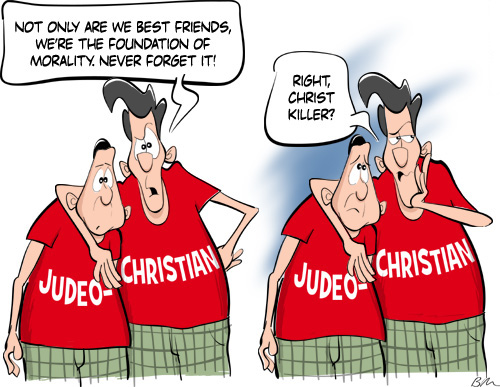
judeo-christianI tried to find Christian reactions to this situation, but the closest thing I could find was at Rapture Forums (the name already has my spider-sense tingling).

One person wrote:

Clearly, they don’t believe the Bible…Acts 4:12.

The word MUST, must be emphasised.

Another person commented:

So much for John 14:6.
Don’t need that anymore.

Another referenced Matthew 23:37:

“Jerusalem, Jerusalem, who kills the prophets and stones those who are sent to her! How often I wanted to gather your children together, the way a hen gathers her chicks under her wings, and you were unwilling.”

The news is pretty new, so a lot of folks may not have weighed in with their opinions yet.

I turned to Facebook and something called The Truth is Viral displayed the most comments of anyone posting this story, at least as far as my short search could find.

Of 27 comments, the first two that appeared were:

Ronald: The Babylon Whore that rides on the Beast and commits fornication with the kings of the Earth . The Anti-Messiah who is drunk with the blood of the saints.

Matt: There was a Twilight Zone like this, the whole world had to change and we thought it was to get along but the reality was to see who was strongest and we destroyed ourselves.
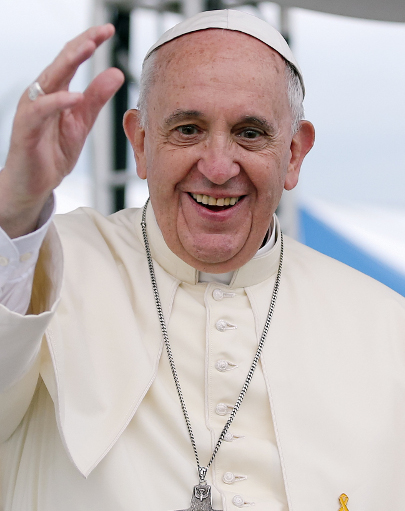
pope francis
2014 Pastoral Visit of Pope Francis to Korea

Others accused the Pope of worshiping Satan, that Mohammad was a false prophet (though Mohammad and Islam have nothing to do with this as far as I can tell), and other similar statements.

I decided to return to an old source for a more sane perspective:

But the Gospel for Jews works differently. It’s the same Gospel, but because the Jews are already God’s people, the Gospel of Yeshua the Messiah comes in a different way. It is still the case that through the Messiah, and only through Him, individual Jews receive atonement and forgiveness of sin – “For there is no other name under heaven given to mankind by whom we must be saved!” (Acts 4:12). But Jews are not alienated from the commonwealth of Israel, they are the commonwealth of Israel! They already have the covenants and the promises; and therefore in a communal sense they already have hope and “have” God. Before accepting Yeshua, Jews do not “have” God and His hope in the same sense as after accepting Him. After accepting Yeshua they have hope and God in an individual, salvific sense – they have forgiveness of their sins, God sees them as righteous because of Yeshua’s atoning death, and they have the certain hope of eternal life with God. Before accepting Yeshua a Jew does not have the certain hope of eternal life with God, but he does share in the communal promises to the Jewish people as a whole – for example, a share in the Land of Israel. A Jew needs God in both the communal and individual senses because this is how God has ordained that it should be.

The Christian attitude toward the Jewish people should be, “The Jews are my home, my family.” Whether the Jewish people will accept Christians as family will depend on how the Gospel is presented to them, and it is the task of Christians and Messianic Jews to find the right way. But an essential aspect of this presentation will be defining the Gentile Christian in the way I have done – rather than in the way Christians have, by their words and deeds, defined themselves: either as enemies of the Jewish people, alienated from their national life, or as people who have no connection with the Jews and can be oblivious to them, or even as outsiders who respect and love the Jews a lot. These definitions not only contradict texts Christians claim to believe, but often foster behavior toward the Jewish people that is sinful, behavior which distances Jewish people from the Gospel and from the Gentile branch of the People of God.

Christians need to redefine who they are in relation to the Jewish people – and then act on the consequences of that redefinition with a renewed commitment to bringing the gospel to Jews. This is the biggest challenge facing the Church.

-Dr. David H. Stern
taken from his book Restoring the Jewishness of the Gospel
as quoted at Tikkun Ministries

I’ve heard it said, according to a source I quoted over eighteen months ago, that one of the primary functions of Yeshua’s first coming was to provide proof that God’s New Covenant promises to the Jewish people were true.

emergeFor instance, the New Covenant (see Jeremiah 31 and Ezekiel 36) promises a universal resurrection from the dead. Yeshua was the first person resurrected from the dead, also called “the firstborn of the dead” (Colossians 1:18). He’s the first, but certainly not the last. His resurrection establishes proof that God will resurrect all of the dead in time.

The indwelling of the Holy Spirit, to the point where even the least among humanity will have an apprehension of God greater than the prophets of old, was also established, first by Yeshua (Matthew 3:13:17), then by the Jewish apostles (Acts 2:1-4), and finally even coming to the Gentiles (Acts 10:44-46).

The New Covenant states that God will forgive the sins of all Israel, which is restated in Romans 11:25-27, and Yeshua forgave the sins of many due to their faith in Hashem and his ability to do so.

Thus Yeshua made a partial delivery on God’s promises and he will complete his mission fulfilling all that Messiah is to do upon his return.

You can click this link to read my thoughts on an insightful comparison between those Jews who have accepted the revelation of Yeshua as Messiah and those who haven’t. In essence, it seems to partly agree with the Pope that the Jewish people are already born into a covenant relationship with Hashem, so that even those who reject Yeshua are not excluded from the Sinai covenant or necessarily from the New Covenant, even though Messiah is the arbiter of that covenant.

I also have to agree somewhat with this latest assessment by the Catholic Church that we do not fully understand the exact mechanism by which Hashem will accomplish all these things. We do know from the New Covenant language that He has promised to do it, and so He will.

MessiahYeshua points Israel back to Hashem and His promises to them. For the rest of us, who were born with no covenant relationship with God whatsoever (unless you accept what is written in Genesis 9 as the Noahide covenant which is binding on us), God, through His mercy and grace, is willing to include us in many of the blessings of the New Covenant, even though we are not named participants, and for the sake of His prophets who declared that every knee will bow (Psalm 72:11; Isaiah 45:22-25; Romans 14:11).

So it’s not like Yeshua is a moot point to the Jewish people or Israel. But Israel’s status in relation to Hashem is somewhat different from that of the Gentile believers because they have a pre-established relationship with God that the rest of the world lacks. Yeshua is the lynchpin, but as Stern pointed out, that works out somewhat differently for the Jewish people than it does for everyone else.

I think I understand, at least a tiny bit, what the Pope is trying to do, relative to establishing better relations between the Catholic Church and the Jewish people, but how he delivered his information, or at least how it’s been covered in the media, is probably going to kick up a major dust storm in the Christian world, particularly with conservative Evangelicals and Fundamentalists.

Christians, in general, believe the New Covenant fully replaced all prior covenants God made, and so they believe that God’s relationship with everyone, including Jews, is identical and that the Jews have no special status. Until the Church learns to accept that Israel remains in covenant relationship with God, they will continue to woefully misunderstand the Jewish people and God’s plan of redemption.

I can only imagine that this blog post could be read with considerable “annoyance” by some Jewish people as well as some Christians, and believe me, I did not write this to offend. I did want to explain (and obviously, I’ve written on similar matters previously) that what the Pope’s comments touched upon is a highly complex situation that is poorly understood by the vast majority of believers, including Christian clergy and scholars.

For that matter, the role of Yeshua as the forerunner of the completed New Covenant promises is poorly understood by both Christians and Jews. Again, I say this not to offend, but to illustrate that what we think we know from the Bible is a highly nuanced and subtle set of messages that requires careful unpacking and analysis. This is difficult for most people because long-established traditions on both sides of the aisle have been constructed to obscure this perspective.
JerusalemIf anyone is tempted to complain to me about this, I ask that you first consider these words:

Instead of complaining about someone’s behavior toward you, it is more constructive to work on your own behavior toward him.

Ignore another person’s grouchiness and anger, and speak cheerfully and with compassion. If you find this difficult, pretend that you are an actor on stage. Adopting this attitude can keep people from much needless quarreling and suffering. Do it consistently and you will see major improvements in their behavior toward you.

Be flexible. People differ greatly on what they evaluate as “positive,” and it is necessary to understand the unique needs of each person you’re dealing with. If one approach is unsuccessful, try other approaches. But keep trying.

-Rabbi Zelig Pliskin
“Put On Your Best Act”
from the Rabbi’s book Gateway to Happiness, p. 137
quoted at Aish.com

As I mentioned a few days ago, in a difficult situation, it is best to seek that small encouraging light in otherwise dark and foreboding surroundings. A fitting sentiment for the current season.

The Illusion of the Unified Body of Messiah

In the article, I tackled the now-familiar “trajectories” model of early Christian developments proposed influentially by James Robinson and Helmut Koester, showing examples of how it has involved dubious results. The trajectories model does reflect the sense of diversity in early Christianity, but I contend that it is inadequate as a model in allowing for the complexity of that diversity. For it seems to me that all our evidence points to a rich and vibrant interaction of the various early Christian groups.

Sometimes this was of a hostile nature, as in the well-known conflict of Paul and certain other Jewish Christians whom Paul refers to as “false brothers,” and even agents of Satan. Sometimes, however, perhaps more typically, this interaction was of a more positive nature, as reflected in the appropriation of “Q material” in the Gospels of Matthew and Luke, or the implicit affirmation of Peter in John 21.

-Dr. Larry Hurtado
discussing the presentation of his paper,
Interactive Diversity: A Proposed Model of Christian Origins,” Journal of Theological Studies 64 (2013): 445-62
on his blog post “Interactive Diversity SBL Session”
Larry Hurtado’s Blog

I suppose it would be naive to consider that there was a single, uniform expression of Christianity in the mid-to-late first century CE. As Dr. Hurtado points out, both on this blog and in his paper, there are multiple different theories to describe these varying expressions including the “trajectories model.”

However, in his paper, Dr. Hurtado suggests a different viewpoint he calls “Interactive-Diversity”.

As early as the Jerusalem church, there was linguistic diversity, as likely reflected in the Acts depiction of ‘Hebrews’ and ‘Hellenists,’ terms which probably designate respectively those Jews in the Jerusalem church whose first language was Aramaic and those whose first/primary language was Greek. Also, Paul’s deployment of the little ‘Marana tha’ formula in 1 Corinthians 16:22 is commonly taken as reflecting his acquaintance with Aramaic-speaking circles of Jewish believers, as distinguished from the Greek-speaking (gentile) congregations to whom he wrote.

I should note that regardless of believers being Jewish or Gentile, Dr. Hurtado refers to them as Christians.

In this first example, the diversity is linguistic and between Greek speaking and Aramaoic speaking Jewish disciples of Rav Yeshua (Jesus), as well as distinguishing them from the Greek speaking Gentiles.

However…

Moreover, remarkably early there was also a trans-local diversity. In Acts we have reports of the young Christian movement quickly spreading from Jerusalem and other sites in Jewish Palestine, to Damascus, Antioch and Samaria, and through the activities of Paul and others (often anonymous) spreading through various locations in Asia Minor, Greece, Rome and elsewhere. Though the historicity of some features of
Acts has been challenged, it is commonly accepted that there was an early and rapid trans-local spread of the young Christian movement to locations such as these. It is to
be expected that this remarkably rapid spread of the Christian movement would have been accompanied by diversity, Christian circles taking on something of the character of
the various locales, and also the varying ethnic groups and social classes from which converts came.

Larry Hurtado
Larry Hurtado

There was, as we might expect, also diversity among the Gentiles based on “trans-local diversity,” or distinctions of geography, nationality, ethnicity, and custom.

All this seems to suggest that there were different interpretive traditions of not only the Jewish scriptures (remember, at this time there was no such thing as the “New Testament”) but how these differing groups understood the letters of Paul as well.

The different attitudes toward ‘food sacrificed to idols’ (8:1-13) comprised another potentially serious difference in Corinth that may well have reflected different social groups. Likewise, Paul’s exhortations in Romans 14:1—15:6 are widely thought to address differences that likely reflect a diversity of a social or ethnic nature.

But along with the evident diversity, a well-attested ‘networking’ was another feature of early Christianity. This involved various activities, among them the sending
and exchange of texts, believers travelling for trans-local promotion of their views (as, e.g., the ‘men from James’ in Gal 2:11, or Apollos’ travels to Corinth in 1 Cor 1:12; 3:5-
9; 16:12), representatives sent for conferral with believers elsewhere (as depicted, e.g., Acts 15:1-35), or sent to express solidarity with other circles of believers (as, e.g., those accompanying the Jerusalem offering in 1 Cor 16:3-4).

For that matter, Paul wasn’t the only one establishing “churches” in the diaspora. There were others, most or all of whom were anonymous, who were also “planting” faith communities and apparently establishing differences in teaching and praxis.

However, it wasn’t because these communities were isolated from each other geographically that allowed the rise of diversity. In fact, according to Hurtado’s paper, they were quite interactive, sometimes uncomfortably so.

On the other hand, there are also indications of far more adversarial interactions as well, and at a very early date. Paul’s letter to the Galatians will serve to illustrate this. Exegetes are agreed that this epistle reflects Paul’s exasperation over unidentified other Christians (probably Jewish) who have visited the Galatian churches calling into question the adequacy of Paul’s gospel and urging his gentile converts to complete their conversion by circumcision and a commitment to Torah-observance. Paul represents these people as proclaiming ‘a different gospel . . . confusing you and seeking to pervert the gospel of Christ’ (Gal 1:6-7), and he thunders an anathema on anyone who proclaims a gospel contrary to that which he preached (1:9).

And…

This is rather clearly an example of early Christian diversity of a more hostile variety! But it is also indication of the interaction that I emphasize here, with non-Pauline teachers visiting Corinth (with intent!) and Paul reacting with an uncompromising vigour.

It can result in some exchange and adaptation or in a hardening of previous positions. But my point is that early Christian diversity was often (even typically?) of a highly interactive nature.

Apostle Paul preachingDoesn’t sound terrifically different than how different Christian denominations “get along” in the 21st century CE.

You can read the full 16 page document as a PDF to get all of Dr. Hurtado’s message on this topic. My point in bringing all this out on my own blog is somewhat similar to what I pointed out in one of my reviews of the Nanos and Zetterholm volume Paul within Judaism: Restoring the First-Century Context to the Apostle.

Various articles within “Paul within Judaism” put forth the idea that Jews and Gentiles “in Christ” not only did not share a single, uniform identity and role within the faith, but that the identity and role of the Gentile within the first century Jewish movement of “the Way,” was ill defined and incomplete.

Paul and others may not have thought this was a problem if they believed that the Messiah’s return was imminent. If Messiah was coming back in a year or two, or a decade or two, he would straighten things out as he completed establishing his Kingdom.

That may also be one way to view the diversity between various diaspora congregations and their differences in interpretation, doctrine, and praxis. While it’s compelling to imagine that in the beginning of the Yeshua movement within Judaism, and as it was being exported to the diaspora Gentiles, the conditions operating within the overall movement and trickling down to specific “churches” were uniform, representing a single, complete unity, perspectives such as “Interactive-Diversity” paint a much different portrait.

What we think of may never have been unified, at least not since Rav Yeshua lead his small inner circle of apostles and disciples through the Galilee or taught from Solomon’s Portico at the Holy Temple in Jerusalem. His teachings wouldn’t be documented and widely disseminated for decades, and even then, they would likely have been interpreted differently by the numerous congregations and house fellowships of Jews and Gentiles in both Israel and the diaspora nations.

I remember during my early days in the Hebrew Roots movement (some fifteen years ago or more) I thought what I was experiencing in my local, little “One Law” group was something akin to what the Gentiles experienced in their congregations in the days of Paul.

I was really inexperienced and unstudied.

I’m not exactly a genius now, but as time has passed and I’ve accessed a wider variety of information sources, I’ve come to realize that we aren’t particularly certain of what was normative practice for Gentiles in Messiah while Paul was on his journeys and writing his letters. Here we see that there probably was no one normative practice, but that not only were the teachings and praxis of the different groups of Gentiles highly variable and even competitive, but that their very identities and roles as disciples of our Rav were probably indistinct and variable as well.

Granted, I’m drawing a great deal out of a few small examples, but it does possibly mean we do have one thing in common with the earliest non-Jewish followers of Yeshua. Our variability or interpretation and practice and even the competition and (sometimes) hostility between differing factions within both the Hebrew Roots and Messianic Jewish movements is normal.

Like Paul, we too may have to wait until Messiah comes so he can sort everything out.

Christian CoffeeAlmost a week ago, I had coffee with a friend, and we were discussing this topic. He believes that as the time of Messiah’s return draws near, the variability between all the denominations of Christianity, let alone those of us who, at least in name, don’t call ourselves “Christians” (well, we do and don’t…long story), will begin to erode and a clearer vision and more stable platform will emerge for Messiah’s disciples.

I disagree.

In fact, I think the opposite will happen. I think we’ll all become increasingly fragmented and confused. Sure, there will be a remnant that will maintain a stable perception of God, Messiah, Israel, and the Bible consistent with God’s redemptive plan for His Jewish nation, and through them, the people of the nations, but a lot of “nutsiness” will emerge and thrive as well.

I even think there will be scores of churches that will reject the resurrected Messiah and ascended King because he’s too Jewish, because he rebuilds the Temple in Jerusalem, because he rules from Jerusalem instead of Heaven, and because the “raptured” will join him in Jerusalem instead of Heaven…

…and because Israel will rule the nations of the world with King Messiah instead of “the Church”.

I’m not saying we should just sit on our laurels and wait around for Messiah to come back. I’m not saying we shouldn’t continue to study the scriptures, to teach, to go to teachings, to seek out greater truth, to improve our walk, or any of that.

I’m saying it’s expected if we don’t know everything right now. It’s normal not to get everything right. We should accept that, when Messiah does come and when he teaches, that he will point out where we made mistakes, even as we were (and are) sincerely seeking him and searching out the face of God.

Fortunately, Hashem is patient. He understands us, even though we don’t always understand Him or what He’s trying to tell us. We may have the Spirit of God, but that doesn’t mean we always listen to the Spirit either, no matter how much we think we want to.

We aren’t one candle, but many, yet all burning for our God.

Illuminating the Darkness

“When you awake in the morning, learn something to inspire you and mediate upon it, then plunge forward full of light with which to illuminate the darkness.”

-Rabbi Tzvi Freeman

In the wake of the devastating Islamic terrorist attack on the city of Paris, I really wish I could “illuminate the darkness,” as Rabbi Freeman suggests. But all I can see is the encroachment of that darkness on our world, the coming of destruction, the advent of great evil.

MessiahYesterday, I cried out how long, Moshiach…how long until you come? I know he heard. I know he will come. But how many more must suffer and die, how often must evil believe it has won because it stands unopposed, until Hashem has said it is enough, and the final war begins?

Insanity, from frivolity to massacre, rule our planet, and if I had to depend on the news media for my global view, I would believe there were no sane human beings left and that our world was already doomed.

And yet, these are the times when our faith is tested, when we have to face the question of whether God has abandoned us, or worse, that there is no God and we live in a universe where morality is always relative, and that one person’s terrorist is another person’s freedom fighter. Or can we believe that this too indicates the birth pangs of the Messiah must become ever more severe before the time of his return?

If we can sustain our faith, we will believe the latter.

I want to illuminate the darkness, to sweep away despair, to shine like a light on a hilltop, but frankly, I’m not that heroic. All I can do is keep slogging away, moving forward, hip deep in mud, doggedly determined, and hope and pray I can keep going until the great and terrible day of the Lord.

I pray that for us all. I pray that for Paris, for those who continue to suffer in the aftermath of September 11th, for those who suffer everyday in Israel at the hands of terrorists…at the hands of evil.

In a statement attributed to Edmund Burke, Charles F. Aked, and others, “the only thing necessary for the triumph of evil is that good men do nothing.”

I want to get political and say that the “good men” of our government habitually “do nothing,” but this war won’t be won by nations and political parties because it’s not a war of nationalities, but rather, of light vs. darkness, good vs. evil.

However, this isn’t to say we have no participation and that we must watch silently as this all plays out in the spiritual world. No, we are very much involved. People are dying. Our enemies are gloating. We must respond.

paris attacks
Credit: BBC News

But how?

Pray?

Yes, but as a meme I saw recently on the web stated, we must also be prepared for violence, and even for some of us, to do violence. Soldiers will fight in very human wars as they always have, and many more will die.

I don’t know what to do except what I am doing…writing. Pray for Paris, pray for the defeat of ISIS, but most of all, pray for the peace of Jerusalem. It’s not that God doesn’t weep for the people slain in France last Friday night, but we must admit that Israel, of all the nations, is at the center of His mind and heart and spirit. It is through the redemption of Israel that the rest of the nations will be redeemed.

It is in the war to defend Israel that Hashem, Master of Legions, will defeat all evil forever.

However horrible the terrorist attack against Paris is, it’s just another skirmish. The war is coming. We must be ready. We must be ready to give battle. We must be ready to be the light of the world. We must be the light of the world now, so the world, if it wills, will draw near the light of Moshiach, our master, our King.

peaceHe will prevail and in him, we will prevail as well. Indeed. We have already prevailed if we don’t wait for the peace of our Rav to come in the future but to seek it and embrace it now, even in the face of great adversity.

Rejoice in the Lord always; again I will say, rejoice! Let your gentle spirit be known to all men. The Lord is near. Be anxious for nothing, but in everything by prayer and supplication with thanksgiving let your requests be made known to God. And the peace of God, which surpasses all comprehension, will guard your hearts and your minds in Christ Jesus.

Philippians 4:4-7 (NASB)

Who Delivers the Consequences for Sin?

Fortunate is the person who fears God, and has a great desire for His mitzvos.

Psalms 112:1

We think of fear as a negative emotion, so we try to eliminate it. We therefore lose sight of the fact that fear can also be constructive. Fear motivates us to drive cautiously even when in a great hurry, and fear makes a diabetic adhere to his diet and take his insulin daily.

Religion has often been criticized for advocating the fear of God. This criticism may be justified if we were conditioned to think of Him as an all-powerful Being holding a huge club, ready to beat a sinner to a pulp for doing something wrong. All ethical works discourage the use of this type of fear as motivation. Rather, fear of God should be understood to mean the fear of the harmful consequences that are inherent in violating His instructions. The Psalmist says that wickedness itself destroys the wicked person (see Psalms 34:22).

“Fortunate is the person who fears God,” in the sense that “he has great desire for His mitzvos” (Psalms 112:1). It is only natural for one to desire the very best, and the realization that observing the mitzvos is indeed in one’s best interest should constitute the “fear” that should deter someone from transgressing the Divine will.

Today I shall…

…try to realize that observance of the mitzvos is in my best interest, and that I should fear transgressing the mitzvos in the same way I fear any injurious act.

-Rabbi Abraham J. Twerski
from “Growing Each Day”
Aish.com

I blame myselfI’ve been thinking about this in terms of my own shortcomings, my own fears, and my own relationship with God and with other people.

In the Church, there’s this implicit idea that God punishes sin, and if you step out of line, you will be struck down by God in some manner. Keep stepping out of line, and you’ll be sent on a one-way trip to Hell without an electric fan.

That’s a really good reason to be afraid of God.

But as Rabbi Twerski describes it, the “fear” of God should take the form of a deep respect for the Creator of the Universe and a corresponding desire to obey Him. In fact, to repeat part of the above-quoted passage:

This criticism may be justified if we were conditioned to think of Him as an all-powerful Being holding a huge club, ready to beat a sinner to a pulp for doing something wrong. All ethical works discourage the use of this type of fear as motivation. (emph. mine)

While in traditional, fundamentalist Christianity, the “fire and brimstone” approach is supposed to be our prime motivator for not sinning and walking the straight and narrow, in Judaism, it is ethically unsustainable to use fear of harm and punishment from God to drive us to proper behavior.

Instead, what we “fear” is the natural consequences of our misbehavior.

Afterward Jesus found him in the temple and said to him, “Behold, you have become well; do not sin anymore, so that nothing worse happens to you.”

John 5:14 (NASB)

It would seem that Rav Yeshua (Jesus) agrees with this perspective. How about the Apostle Paul?

In the name of our Lord Jesus, when you are assembled, and I with you in spirit, with the power of our Lord Jesus, I have decided to deliver such a one to Satan for the destruction of his flesh, so that his spirit may be saved in the day of the Lord Jesus.

1 Corinthians 5:4-5

consequences
Credit: NPR.org

So is Paul advocating for the sinner to literally be dragged to the gates of Hell and handed over to the Adversary to be physically destroyed? Probably not. This is just a guess on my part, but it sort of sounds like Paul is willing to give the sinner enough rope to hang himself with, so to speak.

It comes back to consequences. Drink enough alcohol or do enough drugs, and you’ll destroy your body. View enough “adult material,” and you’ll destroy your marriage. Spend enough money gambling or even just binge buying a bunch of stuff you don’t need and can’t afford, and you’ll destroy your family’s finances.

Or as the Psalmist said, “…wickedness itself destroys the wicked person.”

In most cases, you won’t have to wait for some sort of supernatural intervention. You’ll turn your life into a pile of doggy doo all by yourself…

…or myself.

But if you have the power to destroy your own life, you also have the power to save it.

I’ve always been mystified when I hear Christians saying things like “I turned it all over to the Lord,” or “The Lord released me from my bondage to [fill in the blank].”

How in the world did they perform an action that sounds like a symbolic or even a hypothetical concept?

I think it means that the person finally trusted God so completely that he/she was willing to endure the consequences of making teshuvah (repentance or turning away from sin and back to God), believing that those consequences, no matter how difficult in the short run, would be ultimately beneficial in the long run.

wheelbarrowI suppose “I turned it all over to the Lord” is “Christianese” for expressing an act of great trust in God that, no matter what the consequences, teshuvah will always be the better course of action than living with the consequences of sin.

So God isn’t a mean old man with a club waiting to beat us half to death the second we step out of line. He’s a Father and a Teacher, guiding us in a particular direction and letting us know the consequences of each action we take. What He won’t do is override our free will. We have to choose the right path because, right or wrong, we are responsible for the consequences.

The longer we sin, the greater the consequences, or as our Rav put it so long ago, “do not sin anymore, so that nothing worse happens to you.”

The Apostle Paul: Interpreter of the Gospel of Jesus Christ to the Gentiles

How does a Christian know what Jesus wants of us? From a traditional Church perspective, the answer is easy. Read the New Testament, that is the Apostolic Scriptures.

So primarily, Christians study the words of Jesus as recorded by four Jewish guys (I’m being way overly simplistic here regarding the source materials of the Gospels) Matthew, Mark, Luke, and John, the “Acts of the Apostles,” which is mainly about the life of the Jewish Apostle to the Gentiles, Paul, as recorded by the aforementioned, Luke, and a whole bunch of letters generally attributed to the aforementioned Paul.

But arguably, Jesus taught almost exclusively or exclusively to Jewish audiences. The Gospel of Matthew is definitely written to Jews, while Luke’s Gospel may well have been intended for a wider audience. According to some sources, Acts may have been composed as part of Paul’s legal defense when he appeared before Caesar in Rome (as possibly was Luke’s Gospel), and we have to assume that most or all of Paul’s letters were addressing his Gentile students, although he may have had messages for particular Jewish people or communities as well.

MessiahHere’s one startling thought that occurred to me. For the most part, we can’t really depend on the actual, quoted words of Jesus or Rav Yeshua as a guide to worship and devotion for the non-Jewish disciple.

Why not?

Remember, I said that Jesus primarily or exclusively taught Jews about the true interpretation of Torah and performance of the mitzvot. He was a Jewish teacher teaching Jewish students about the Jewish mitzvot. What does that have to do with non-Jews?

In yesterday’s blog post about the Roman Centurion Cornelius, I mentioned that Marc Turnage in his presentation defined circumcision as the dividing line as to whether or not a person is Jewish, and thus, whether or not a person is obligated to the Torah mitzvot.

Of course, it’s not just circumcision, but a bris (brit milah) performed on a male, either on the eighth day of life for a boy born to Jewish parents, or as part of the proselyte rite undergone by a male Gentile converting to Judaism.

So if Jesus is a Jew teaching Torah to Jews and is not presupposing Gentiles reading his recorded words (let alone trying to act them out), we can’t always rely upon a red-letter edition of the Bible to be the Gentile Christian’s sole guide to a life of holiness.

So what can we do?

What did the vast majority of non-Jews in the diaspora do when they heard the good news of Rav Yeshua? For that matter, who did they hear those words from?

As far as the Apostolic Scriptures are concerned, most of the time, they interacted with the man who Yeshua specifically appointed (in Acts 9) to be the special emissary to the Gentiles, the man known as Saul of Tarsus but who most Christians call the Apostle Paul.

The Jewish PaulPaul had the responsibility of interpreting Jewish teaching so it would apply to non-Jewish lives. That’s no easy task. Well, it might not have been too much of a chore if his audience were Gentile God-fearers who had already spent a lot of time in the synagogue hearing Jewish teachings (see Acts 13:13-43 for example). But he may have fought quite an uphill battle when addressing pagan Gentiles who only knew their own mythology (such as in Acts 14:8-18).

So get this. Paul didn’t teach the Gospel message to the Gentiles in exactly the same way as Jesus taught it to the Jews (which may be why Paul called it “my Gospel” in Romans 2:16, 16:25-27 and in other epistles). Why? Because the Jewish message had to be interpreted and adapted by Paul so it would not only make sense to non-Jewish audiences, but fit their particular legal status in Jewish community. This is really important, since Jews are named subjects of the New Covenant (Jeremiah 31; Ezekiel 36) and Gentiles are not!

From that, we have to understand that the “admission” process must be different for Jews than Gentile initiates. Jews are born into the covenants, all of them, whether they want to be or not. Gentiles are born into no covenant with God at all except perhaps the Noahide covenant (Genesis 9). Our entry, so to speak, must be via a different process with different criteria involved.

I often wonder if this is why more traditional Jewish people don’t mind what Jesus taught so much, but most of them absolutely loathe Paul. Paul, when interpreted through traditional Christian and Jewish lenses, seems not to be teaching Judaism at all, but rather, creating a new religion. For modern observant Jews, this makes Paul a traitor to the Jewish people, and an advocate to the elimination of Judaism (and Jews, even in Paul’s day, also believed this of him — see Acts 21 starting at verse 15).

Ironically, many Christians believe the same thing, that Paul threw Judaism under a bus and replaced it with Christianity, but in this case, that’s considered part of God’s plan and not the ultimate insult to God and the Jewish people (more’s the pity).

bibleNo, I’m not saying that we non-Jews shouldn’t read the Gospels. We really need to get to know our Rav and what he taught. However, we cannot always assume we can apply each and every lesson he taught to Jews about the Torah to ourselves as non-Jews without some interpretation, anymore than we can assume to apply what and how Moses taught the Torah to the Children of Israel to the Church today.

That’s why it is so important to understand Paul correctly, such as they way he is rendered in the Nanos and Zetterholm volume Paul within Judaism: Restoring the First-Century Context to the Apostle.

Although the Apostolic Scriptures record that it was sometimes difficult to teach the Jewish people about the good news of Rav Yeshua, it would have been extremely difficult to get that across to Gentile pagans who lacked a Jewish educational and lived context. That’s why the Apostle to the Gentiles had to be highly educated, multi-lingual and multi-cultural, both a Jew and a Roman citizen. He had to be thoroughly Jewish and yet be able to “talk the talk,” as such, of non-Jewish peoples who lived in a wide variety of religious, cultural, and social venues.

That’s why the job was so hard and required such a unique individual.

But this is (in my opinion) why we modern non-Jewish disciples of the Rav, cannot simply imitate modern Jewish worship practices and performance of the mitzvot and say we understand the teachings of Yeshua and how to respond to them. That’s as erroneous as modern Christians in their churches today saying that Jesus did away with the Law for the Jew and that everyone, including born Jews, must abandon Judaism, Torah, and Talmud and become goyishe Christians in order to be reconciled with God.

WaitingSo how did Paul interpret Jesus for the Gentile? We may never have a solid answer, but I’m convinced that we’ll never get anywhere near that answer unless we’re willing to ask the question.

Ultimately, it may not be as complex as most folks who are “Judaicly aware” imagine. In fact, it might not be that different from what most traditional Christians do now, apart from a specific attitude toward the centrality of Israel (rather than the Church) in God’s plan of redemption.

Please keep in mind that everything I’ve just written I pretty much composed off the cuff. It’s not the result of an exhaustive review of the Bible and associated scholarly literature. If anything, it’s the result of my imagination and a number of years of reading, writing, listening, and learning. I still think the message has merit.

Cornelius Is Not Common Or Unclean And Neither Are We

I just watched a brief video by Marc Turnage at the Jerusalem Perspective website called Character Sketch: Cornelius the Centurion. It’s about 5 minutes, 25 seconds long, so when I started watching the presentation, I knew it wasn’t going to reach much depth.

That’s too bad, because I really wanted to hear something new about Cornelius that would help me in my current investigation as to the status of a Gentile who directly worships and relates to God without necessarily being part of a Jewish communal setting (or a traditional Christian venue, for that matter).

In other words, was Cornelius and his Gentile household chopped liver, even after receiving the Holy Spirit (Acts 10:45), or did (does) God consider the Gentiles as having some sort of value in their (our) own right?

Before someone complains that I’m being too “whiney” again, I’ll say straight out that I think a Gentile can have a direct relationship with the God of Israel through faith in and by the merit of Rav Yeshua and his symbolic, atoning sacrifice. Moreover, I think even before Cornelius had his vision which resulted in him sending messengers to the Apostle Peter (Acts 10:3-8), I think God had regard for the Gentile Cornelius. In fact, the wording of verses 1 and 2 as well as the angel’s message from verses 3 onward tell us so.

turnage
Marc Turnage

Cornelius was devoted to God as expressed through his prayers and acts of tzedakah (charity) to the Jewish people, and God responded kindly and valued Cornelius. God was about to do Cornelius and his household a big favor. He was about to have Peter deliver the good news of Rav Yeshua to them.

According to Turnage, in the late second temple period in Roman-occupied Judea and in the diaspora, from a Jewish point of view, there were three types of people:

  1. Jewish, either by birth or conversion
  2. Pagan Gentiles wholly divorced from God
  3. God-fearing or God-worshiping Gentiles who viewed God from the perspective of Abraham and Isaac (but not Jacob)

These God-fearers existed on the fringes of Jewish community, attending synagogue, hearing the Torah read, rejecting (according to Turnage) the pagan Greek and Roman gods, and swearing devotion only to Hashem, God of Israel. However, this was not as far as they could go in approaching God. They were just missing one last piece of the puzzle.

Turnage compares the vision of Cornelius to Peter’s where Peter does an amazing thing. He says “no” to God. Specifically, he tells God he won’t obey the directive to kill and eat unclean or non-kosher animals.

Turnage states what is obvious to me; that the vision was never about food but rather about people, specifically non-Jewish people. This was God’s lesson to Peter that God Himself did not consider the Gentiles unclean or common. He also states this is obvious proof that Peter never saw the death and resurrection of Jesus as somehow ending his status as a Jew and his relationship with the Torah mitzvot. Again, that seems entirely obvious to me but is something of a revelation coming from a more traditional Christian.

tongues of fireGod backed this up in the aforementioned Acts 10:45 by showing Peter and his Jewish companions that even the Gentiles could receive the Holy Spirit, something that was thought only to be available to the Jewish people by covenant promise (Jeremiah 31; Ezekiel 36) up until that moment.

Peter was forced to realize that Gentiles were not common or unclean, that they (we) were indeed, through God’s grace and mercy, and by the merit of Rav Yeshua, also able to access the covenant blessings of God, even though we were not named participants in the New Covenant.

During the legal proceeding to formally establish the status of Gentiles in Jewish community we see in Acts 15, Peter testified to his experience with Cornelius as proof that the Gentiles were not common and unclean, and that God accepted them (us) to the degree that they (we) also can receive the Spirit of God upon hearing the good news of redemption brought about by Rav Yeshua. We who were far off have been brought near or at least nearer (Ephesians 2:13).

Turnage was clear that none of this meant that the Gentile disciples of Rav Yeshua, even after receiving the Spirit, were required to observe the Torah mitzvot in the manner of the Jews. We lack the sign of circumcision (for males) that would be required for conversion to a proselyte and that would obligate us to the mitzvot. Cornelius was not circumcised, neither was his household (interestingly enough, unlike the non-Hebrews in Abraham’s household (Genesis 17:27).

In this case, it wasn’t necessary, since God’s plan for worldwide redemption required that both Israel and the rest of the nations of the world were all to be redeemed while maintaining their own national and ethnic identities.

communityTurnage rightly states that the challenge of the “first century church” (his language, not mine) was not convincing people to believe in Jesus, it wasn’t a theological challenge, but rather, an ethnic and sociological dilemma. How would it be possible to mix both Jews and Gentiles, two groups that are difficult to put together, into Jewish community and covenant life?

Paul was always attempting to solve that puzzle as we read in his many epistles including Romans and Ephesians, but also in 1 Corinthians 7, according to Turnage:

Only, as the Lord has assigned to each one, as God has called each, in this manner let him walk. And so I direct in all the churches. Was any man called when he was already circumcised? He is not to become uncircumcised. Has anyone been called in uncircumcision? He is not to be circumcised. Circumcision is nothing, and uncircumcision is nothing, but what matters is the keeping of the commandments of God. Each man must remain in that condition in which he was called.

1 Corinthians 7:17-20 (NASB)

Since Turnage uses circumcision as the dividing line between Jews and even the believing Gentiles, and since that dividing line includes obligation to the mitzvot for the Jews but not for even the believing Gentiles (remember, Cornelius received the Spirit and was not previously or subsequently circumcised), then, based on the brief record we have of the life of the Centurion, we non-Jewish disciples of our Rav have no obligation to the mitzvot either.

Divine TorahI know I’ve said this about a billion times before, but since I’m re-examining my relationship with God as a Gentile, and I just viewed Turnage’s video, I thought I’d mention it again.

We have no information about how Cornelius’s life changed after Acts 10. Perhaps in many ways, it didn’t change much at all, at least from a day-to-day lived experience. He probably still prayed continuously. He probably still did great works of charity for the Jewish people. But additionally, he also probably thanked Hashem for the good news of Messiah, the indwelling of the Spirit, the promise of the resurrection, and a place in the world to come, which indeed, Cornelius lacked before the revelation of Moshiach.

For Turnage, the central focus of being a believer rests back in 1 Corinthians 7:17-20. Are you going to obey God or not?

The question of obedience is an interesting one because Turnage assumes quite casually that to obey God for a Gentile does not require observance of the mitzvot in the manner of the Jewish people.

Just as we are not required (our males) to be circumcised in order to have a life with God, because of not being circumcised, not converting to Judaism (because it’s not required of us), we also do not have to observe the mitzvot that indicate an individual is Jewish.

We don’t know what Cornelius did with his life after the revelation of Rav Yeshua. It would be easier if we did have some record to see how he changed from God-fearer to Messianic disciple.

family prayingBut I didn’t write this missive to answer the “mystery of the Gentile mitzvot”. I wrote it to establish that through the example of the life of Cornelius, Gentiles are not considered common and unclean to God. Quite the opposite if God allows His Holy Spirit to dwell within us. We Gentiles have a relationship with God just the way we are.

Oh, I could embed the YouTube video of Turnage’s brief presentation directly into this blog post, but I don’t want to take web traffic away from the Jerusalem Perspective site. To view the video, you’ll have to click the link I provided above.

One more thing. I chose the “featured image” at the top of the page because finding something that looks interesting and somehow represents Jewish mystic visions isn’t all that easy.