Tag Archives: Jesus

Bamidbar: Desperately Loving a Prostitute

hosea-and-gomerOn the face of it, the connections between the sedra and the haftarah of Bamidbar are slender. The first has to do with demography. Bamidbar begins with a census of the people. The haftarah begins with Hosea’s vision of a time when “the number of the children of Israel will be like the sand on the seashore, which cannot be measured or numbered.” There was a time when the Israelites could be counted; the day will come when they will be countless. That is one contrast between the future and the past.

-Lord Rabbi Jonathan Sacks
Chief Rabbi of Great Britain and the British Commonwealth
“Love as Law, Law as Love”
Commentary on Torah Portion Bamidbar
Chabad.org

It’s not often that I write about both the Torah and Haftarah portions of a weekly Torah reading, but in trying to decide on my sources, both seemed to tell the same story: the story of God’s love. I know most Christians read the beginning of the Book of Numbers and mentally shut down the instant the census begins, but this is why the Torah is not just any other book. This is why the Bible is to be discovered and explored like a lost continent, like a prehistoric forest, like the ruins of the grand halls of the antediluvian Kings.

Because the words on the surface are deceptive and only the superficial person sees merely black text on white paper.

So Moses and Aaron took those men, who were designated by name, and on the first day of the second month they convoked the whole community, who were registered by the clans of their ancestral houses — the names of those aged twenty years and over being listed head by head.

Numbers 1:17-18 (JPS Tanakh)

When the census was taken in the desert, families were recorded by the names of their fathers. Now that’s unfair! Who insisted on having these children in Egypt over their husbands’ protests? Who defied Pharaoh’s decree and risked their lives to carry, give birth to and nurse these children? Now that the children are to be counted, the mothers are no longer noteworthy? (See Rashi’s commentary on Exodus 38:8)

In truth, no one needs a census to identify his mother. Every child knows his mother. Every child knows his mother. She raised him, nursed him, nurtured and loved him. The question is, who is the father? How many children can answer that question with certainty? For that we need a census.

-Rabbi Lazer Gurkow
“The Jewish Father”
Chabad.org

Rabbi Gurkow goes on in his commentary to discuss how each child of a Jewish mother naturally knows his mother and then links this to the census and the importance of the Jewish father. He “smooths out” the apparent dissonance introduced by the “black and white” sense of the census and then says…

Children need both. They need to know that curiosity is normal and that answers are available to those who seek them. But they also need to know that moral standards are not negotiable. The young cannot expect to understand everything. Even adults don’t understand the reason for every moral standard. That is why we call them imperatives, not philosophies. On the deepest level, we don’t embrace morality because we understand its importance, but because we know it to be the right path.

The need for a mother and a father in parenting may contradict certain recent news stories addressing parenting and gender identity that we’ve all been hearing about, but in traditional Jewish (and Biblical) values, both are necessary and required for the proper raising of children. Both a mother and a father are necessary to teach children how men and women uniquely understand the world and in illuminating the different aspects of God. This is one way we learn to love, not just what it’s like to love and be loved by our parents (and others), but how to love and be loved by God.

The Sages tell us these were no ordinary censuses. Each time the Jewish people were counted, it was an expression of G‑d’s love for His people and His concern for every individual…

Yet this great power that the stars possess is not at all obvious. To us on earth, looking with the unaided eye and perhaps not thinking too much about the matter, the stars seem tiny and insignificant. Yet in fact, each star is a powerful and unique force.

So too is the case with each individual. In the context of the big wide world, he or she might feel insignificant. Yet, in truth, within each one of us there is an inner source of tremendous spiritual power, tailored to the unique and essential task we must carry out in the course of our lives.

-Dr. Tali Loewenthal
“Numbers and Stars”
Chabad.org

Under heavenThe Prophet Isaiah said of the stars that God knows each individual one by its name and counts each one as it rises and sets which, for a human being given the vastness of the stars of heaven, would be an insurmountable task. But it is also said that God knows each one of us by our names and “counts” us, and we too are precious to Him. Like a child with many brothers and sisters, it’s easy to fell “lost in the crowd, but this isn’t how God sees us. Though our numbers are legion, still God, our Father, loves each and every one of us with a love that is unique and special to each of His sons and daughters.

Are not two sparrows sold for a penny? And not one of them will fall to the ground apart from [the will of] your Father. But even the hairs of your head are all numbered. Fear not, therefore; you are of more value than many sparrows.

Matthew 10:29-31

But what of the Haftarah Portion for Bamidbar? Rabbi Sacks states quoting Hosea 1:16, 17:

The second goes deeper. The sedra and the book that bears its name are called Bamidbar, “in the wilderness.” The book is about the wilderness years in both a physical and spiritual sense: a time of wandering and internal conflict. Hosea, however, foresees a time when G‑d will bring the people back to the desert and there enact a second honeymoon:

. . . I will lead her into the wilderness
and speak tenderly to her . . .
There she will respond as in the days of her youth,
As in the day she came out of Egypt.

It’s important to understand something here. It’s important to understand the relationship between the Prophet and his wife, Gomer.

The story of Hosea is one of the strangest of that great chain of visionaries we call the prophets. It is the story of a marriage. The prophet married a woman called Gomer. He was deeply in love with her. We can infer this because, of all the prophets, Hosea is the most eloquent and passionate on the subject of love. Gomer, however, proved faithless. She left home, had a series of lovers, was serially unfaithful, and was eventually forced to sell herself into slavery. Yet Hosea, caught between anger and tender longing, found that he could not relinquish his love for her.

The love of Hosea for his wife Gomer, who “whored” herself after many lovers and finally who sold herself into prostitution is like God’s love for Israel, who “whored” herself after many “gods” and was equally faithless to her husband Hashem.

What man could embrace such a wife after this awful betrayal? No one (except God) would have blamed Hosea if he totally abandoned Gomer and pursued a more righteous wife (and how many other women were less righteous?). No one would have held it against him if he, the victim, would have walked away from Gomer and left her to the consequences of her decisions. But if he did so, if Hosea had cast Gomer aside, does that mean God should have done the same to Israel?

Lest you be wise in your own sight, I do not want you to be unaware of this mystery, brothers: a partial hardening has come upon Israel, until the fullness of the Gentiles has come in. And in this way all Israel will be saved, as it is written,

“The Deliverer will come from Zion,
he will banish ungodliness from Jacob”;
“and this will be my covenant with them
when I take away their sins.”

As regards the gospel, they are enemies for your sake. But as regards election, they are beloved for the sake of their forefathers. For the gifts and the calling of God are irrevocable. For just as you were at one time disobedient to God but now have received mercy because of their disobedience, so they too have now been disobedient in order that by the mercy shown to you they also may now receive mercy. For God has consigned all to disobedience, that he may have mercy on all.

Romans 11:25-32 (Isaiah 59:20,21; 27:9 [see Septuagint]; Jer. 31:33,34)
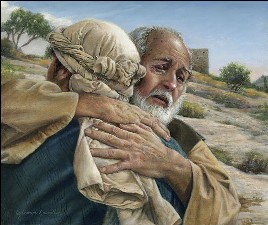
Wayward SonIf we know how to read the Torah and Haftarah properly, they tell us a tale of love that is immense and beyond human comprehension. The Torah is the Law of Love, not condemnation. We shouldn’t forget the timing either. Rabbi Sacks points out that Hosea is the portion from the Prophets always read on the Shabbat directly preceding Shavuot, which is the festival celebrating the giving of the Torah at Sinai.

The fact that tradition chose this of all prophetic passages tells us something deeply moving about how the Jewish people understood this festival, and about the Torah itself as the living connection between a people and G‑d.

I wrote yesterday about the relationship between love and the Bible and it seems like there is no escaping that theme as Shabbat approaches. We see that in spite of all rationality and reason, God loves Israel, and that such love is inescapably linked to Jewish love of God and the Torah. What is it then that God has done by giving us the Bible? What is the message beyond the simple words on the page? How does the very existence of the Bible mean Good News for the Jews, that the love of God can never be lost?

And what is the Good News for the Gentiles?

For God so loved the world, that He gave His only [unique] begotten Son, that whoever believes in Him shall not perish, but have eternal life.

John 3:16 (NASB)

I know that last verse is terribly over-quoted but how else am I to say what needs to be said?

Israel will not be lost! The Jewish people will never be abandoned. To believe otherwise is to completely misunderstand the Scriptures. And if we from among the nations who are called by His Name cling to Messiah and to the promise of his life and resurrection, then by the grace of God, neither will we.

Good Shabbos.

138 days.

John MacArthur and Struggling with Biblical Sufficiency, Part 2

doveThis is a continuation of yesterday’s “meditation” on John MacArthur and “Chapter 1: Embracing the Authority and Sufficiency of Scripture” from his book Think Biblically: Recovering a Christian Worldview. If you haven’t done so already, read Part 1 before continuing here.

In addressing Luke 16:27-31, MacArthur says:

The rich man’s perspective is the same view of many today who always seem to demand some kind of supernatural affirmation of spiritual truth. They imagine that the straightforward statements of Scripture and the power of the Gospel alone are not sufficient. But the Lord, through the words of the parable, argued otherwise and said that even though He Himself would rise from the dead, miracles are not necessary for the Gospel to do its work in changing lives. Why? Because the Word of God through the inspiration and illumination of the Holy Spirit is powerful enough — it is all-sufficient in what it teaches about redemption and sanctification.

-MacArthur, pg 27

To the degree that the Bible records numerous miracles of God (Moses, the Reed Sea, millions of Israelites walk on dry land but the pursuing Egyptians drown under thousands of tons of water…that sort of thing), apparently they have their uses, but I do agree that miracles alone will not insure faith. If they did, then millions of Israelites wouldn’t have struggled in their trust of God and been condemned to die in the desert after a forty year walk.

Setting that aside, I still have a hard time figuring out what MacArthur believes about the Holy Spirit. Most Christians I talk to pray to God that the Spirit will give them wisdom and understanding in their studies of Scripture, but it almost sounds like MacArthur believes that once the Spirit was done inspiring the Bible’s writers, it split the scene, leaving the book behind and saying, “This is all you need…see you in the next life.”

I know that’s a little harsh and MacArthur, as a self-proclaimed Evangelical, probably does believe in a supernatural God and that there are certain supernatural mysteries we don’t understand right now. But in focusing on the sufficiency of the Bible, I kept getting the feeling that MacArthur was leaving the actual influence of God in our lives out of the equation. I got the feeling from MacArthur that the power of God’s Spirit was only found in the pages of the Bible. If that’s so, why pray? Just read.

I personally don’t think that anyone comes to God without His direct intervention in our experiences. I believe this is true of me. I don’t believe that some human being thumping a Bible and quoting its eloquent words convinced me to become a Christian. I know from my own story that a series of extremely unlikely events occurred over six to twelve months that finally convinced me God was involved in my life.

I had resisted the Word and Will of God for forty years and He finally convinced me…but I didn’t start actually reading the Bible until I was already going to church, and I promise you that I had no idea what I was reading for the first several years. In many ways, I’m still wrestling with God and struggling with the Bible. MacArthur makes it seem as if the Bible were as easy to comprehend and absorb as the latest best-selling fiction novel on the market. For me, the Bible is like living within a riddle wrapped in a mystery inside an enigma (to paraphrase Winston Churchill’s famous statement about Russia). It contains many wondrous things of God, but they are only revealed during the journey of a lifetime.

MacArthur spends the second half of his chapter supporting the sufficiency of the Bible from the point of view of the Torah and the Prophets. He presents a pretty good illustration of Jewish devotion to Torah. I was amazed because everything I know about him (which admittedly, isn’t that much) tells me that as a dispensationalist, he believes the Torah “goes away” after Jesus and is no longer “sufficient” for the Jewish believer.

In quoting the Shema (Deut. 6:4-9), MacArthur says:

That was a simple way to summarize the myriad commands God had given Moses. But the law of God — His revealed Word — was and is the one resource for life and godliness. Everywhere they went, the children of God were always to meditate on and apply the words of the living God. Those words were to occupy their attention as a source and centerpiece of everything. For His people, that is still God’s design for life.

ibid, pg 28

simhat-torahMacArthur uses the past and present tense about the sufficiency of Torah twice in the previous paragraph, but I’m not sure he realizes the implications. He’s trying to transfer how he sees the Israelites of the past being devoted to Torah across history to the modern-day Christians and the Bible without explaining that normative Protestant Christianity generally dismisses the vast majority of the Torah.

On page 29, MacArthur says “the law” is the Hebrew word “Torah” (yeah, I know), “which basically means divine teaching (emph. mine). In quoting Psalm 19:7 (“The law of the Lord is perfect”), he says that “perfect” can also mean “whole,” “complete,” or “sufficient.” He actually quotes from Psalm 19:7-9 which is part of the Shabbat liturgy in most synagogues, and those words are amazingly beautiful to me.

For pages and pages and pages, MacArthur cites a stream of examples from Judaism about the perfection of Torah, that it is “reviving,” “restoring,” “transforming,” “converting,” and “refreshing.” He speaks of Torah “making the simple one, wise.” He speaks of David praising the “precepts,” meaning divine principles, statutes, and guidelines.” At one point (Pg 31), he states:

The result of applying Scripture’s principles, obeying its precepts, and walking in its pathways is true joy — “rejoicing the heart.”

I wonder if he realized that from a Jewish point of view, it is the performance of the mitzvot, the commandments such as charity, hospitality, and compassion, that “rejoices the heart?” What MacArthur is praising isn’t just the sufficiency of the Bible, but the Jewish worldview (not Christian worldview) of the sufficiency of the Torah, the mitzvot and, for a Jew, the traditions.

He also said:

If those who claim to follow Christ today were as excited about scriptural precepts as they are about the materialism of this world, the character of the church would be wholly different, and our testimony to the world would be consistent and potent.

Actually, I agree with him, but I’d have changed that sentence to say:

If those who claim to follow Christ today were as excited about scriptural precepts as religious Jews are excited about the Torah and the mitzvot, the character of the church would be wholly different, and our testimony to the world would be consistent and potent.

There were a bunch of other “nitpicky” things I noted about MacArthur’s chapter, but what impressed me the most (as you can probably tell) was how “Jewish” he seems to feel, at least sometimes, about the Bible. I think he’s right that anyone who calls himself or herself a Christian needs to be constantly reading and studying the Bible.

I’ve just started reading John W. Mauck’s book Paul On Trial: The Book Of Acts As A Defense Of Christianity, and Donald A. Hagner in the Foreword says in part:

Just as ministry is the work of the people and not the clergy (who are to equip the saints for ministry according to Eph. 4:11-12), so to the Bible is the book of all the people of God, not the domain of biblical scholars only. Indeed the writings that make up the Bible are meant to be studied by every Christian. The Word of God was written, after all, not to scholars but to the people of God in communities of faith.

I agree and find Professor Hagner’s statement to be wonderfully affirming and empowering. In a number of ways, I agree with MacArthur, but I think he overstates the matter of Biblical sufficiency to the point of being dogmatic and inflexible. It’s as if he leaves no room for discussion and basically says, “It’s my way or the highway.”

I seriously doubt that Moses and Paul had an identical worldview of the Word of God because the world around each of these men was very different. How Torah was understood and applied was based on who each of these men were and what they were trying to accomplish in accordance with their mission from God.

MacArthur, in championing the sufficiency of the Bible, failed to mention needing to understand the original languages of the Bible and especially needing to understand the original contexts, cultures, experiences, and lifetimes of each of the Bible’s authors in order to get a more accurate picture of what they, and God, were trying to say. He failed to mention that how we understand the Bible begins at the level of translation and that the same words and phrases of Scripture can be translated differently, even very differently by different people depending on their biases and worldviews. This is particularly true when comparing Evangelical Christianity and any of the streams of modern, normative Judaism and most pointedly, Messianic Judaism.

bible_read_meI think MacArthur is right though in that many churches have, for the most part, set the Bible aside as irrelevant or archaic and thus unable to reach the people who are trying to reach God in the twenty-first century. Although I seriously doubt MacArthur intended to give this impression, I think that the mass exodus from “the church” isn’t because it thumps too hard on the Bible but because “the church” all but ignores the Bible. I think this is why at least some Gentile Christians have been transitioning into the Hebrew Roots and Messianic Jewish movements, since both of these movements emphasize the study of and devotion to the Bible and specifically Torah.

If the church could learn one thing from the Hebrew Roots and Messianic Jewish movements, it is the continual reading and studying of the Bible, including reading the Bible as part of worship.

I’m not ready to take every book I’ve ever read except for the Bible, and toss them all into a giant campfire. I don’t think other sources of information are useless. If I want to learn something about a web-based technical support product or how online merchants can fight fraud, I’m not going to find the answers just by reading the Bible (OK, those are pretty far out examples and probably MacArthur wouldn’t expect to find them in the Bible, either, but I’m trying to make a point).

The Bible is the single most important and influential document ever written and the world would not know God without it, but we can learn a great deal by reading and studying other material as well. Learning more in the fields of history and archeology relative to Biblical times greatly enhances what we understand about the Bible itself. I disagree that we must throw all this other “stuff” under a bus in order to rightly state that we are seeking an encounter with God and pursuing a life of righteousness.

I also disagree that the Bible is a simple book. I will spend the rest of my life studying the Word of God, and I don’t expect, at the end of my days, to be hardly anymore enlightened about its mysteries than I am right now. May God grant me the wisdom and understanding to see Him and His will for me somewhere in the pages of His Word.

139 days.

Save Me!

falling-save-meA guy is riding his motorcycle down a mountain road when suddenly he loses control and goes hurtling off the cliff. As he’s sailing through the air, he shouts out: “God! Please make a miracle! Save me!”

Within moments his shirt gets caught on a protruding branch – and he is left dangling thousands of feet above the ground.

There’s no way out, so he looks heavenward and shouts: “God! Please save me!”

“Do you trust Me, my beloved son?” calls the voice from heaven.

“Yes, God, I trust you. Just please save me!”

“Okay then,” says God. “Let go of the branch and I’ll catch you.”

The man thinks for a moment, looks around, and calls out: “Is anyone else out there?!”

“Recognizing God”
-from “Ask the Rabbi”
Aish.com

I’ve been writing a lot lately on topics that seem to inspire not only conversation (which is good) but emotional disagreement (which isn’t always good). I thought I’d back off a bit and discuss something that we all have in common: trusting God. I say we all have it in common (assuming you have faith in the living God of Israel), because trusting God isn’t always easy. The little story I quoted above is a joke but jokes are funny because they contain a truth we all understand.

Not only is trusting God difficult but the worse the situation is we find ourselves in, the more difficult of a time we have in trusting. Hence the punchline, “Is anyone else out there?”

Trusting God isn’t a matter of how well our lives are going. If we trust God only when things are doing well with us, it’s not trust. Trusting God is about the relationship we have with Him and to some degree, who we are as an individual personality.

The Aish Rabbi continues:

The key to forging a relationship with God is to trust Him. God is not some vindictive, punishing old man in the sky. God is our loving Creator, who wants only our best. Sometimes that calls for Him to “test” us with difficulties; but the intention is only to bring out our very best.

When we are children, we think we are the center of the universe. Then, through experience and trials, we become increasingly aware of the fact that there are things in life beyond our control. Whether it’s earthquakes, cancer, the rise and fall of fortunes, circumstances of our birth – and even birth itself… this can only be ascribed to a Higher Power.

Maimonides writes that there are two primary ways to attain recognition of God: by observing the wonders of Creation, and by performing mitzvot. Through nature, we see the beauty, splendor, and perfect unity of the world. Through mitzvot, we see how humanity can likewise attain unity and perfection.

trustingIn a way, we learn to trust God by acting the way we want Him to act (speaking of mitzvot). If we live a life that is upright, generous, charitable, merciful, compassionate, and wholesome, we will tend to think of God in that way. If our natures (which are sinful and thus very bad) are stingy, mean-spirited, cruel, hard-hearted, base, and immoral, we tend not to think of God that way, but we think we are going to be struck down any second by God. We expect, when hard times come, that we deserve it and we can’t trust God to help us out.

Trusting God depends on how well we can trust ourselves and how well others trust us.

Rabbi Mordechai Kamenetzky at Torah.org has a commentary based on last week’s Torah reading that also illustrates this point.

My dear friend Rabbi Benyamin Brenig of Golders Green, London recently related this wonderful story to me: Reuvain and Shimon were two men, who lived on opposite ends of town. They each inherited a fortune of gold. Each of them decided to bury their fortunes in their backyards. They wanted to make sure that they would have something to sustain them in their old age. On their respective properties, they each picked a landmark, paced twenty steps due north and dug a large hole.

Reuvain, the more nervous of the two, was careful to make sure that no one was watching. Every other second he glanced furtively over his shoulder to make sure that no one saw him bury the treasure. No one did.

Shimon, by nature, was trusting and carefree and he was not so careful. He was not worried that anyone would steal his fortune. But he was wrong. He was spotted by a nosy neighbor, who was also a thief.

In the middle of the night, the thief dug up the fortune. Out of mercy, he left few coins at the bottom of the pit, and removed the coins. He refilled the hole and packed the ground perfectly as if nothing was disturbed. Then he took off with the fortune.

Reuvain’s fortune, however, remained intact. But he was, by nature, a worrier. And so, the next day he decided to dig up the hole to make sure that the gold was still there. Accidentally, he counted only fifteen paces from his landmark and dug. There was nothing there. Reuvain was frantic. Someone must have seen him dig the pit, he figured. For the rest of his life, he worried. On his property, he had a pit filled with gold coins, but all Reuvain did was worry!

Shimon on the other hand had nothing but the remnants of a few coins. Everything else was stolen. But he never checked the fortune, and was merrily content, assured that when the time would come he could dig up the pit and retrieve his fortune. Reuvain, the millionaire, died heartbroken and frantic. Shimon, the man with but a few coins left for his old-age lived his life content as if he was the wealthiest man in the world.

The Torah tells us about the different types of blessings. For the faithful, Hashem says, “I will command my blessing in the sixth year,” in which Rashi assures us that even a bit will feel like a bounty. But we must acknowledge that despite Heavenly assurances, there are those who always worry. They need to see the money! They ask, “What will we eat in the seventh year? Behold! We will not sow and not gather in our crops!” Hashem must assure them that he will increase their bounty in a way that is visible to them.

Some of us can believe without seeing immediate results. We can sleep well, with full satisfaction on empty stomachs. The greatest expression of faith is when we do not see the blessing, but we feel it in our hearts and even in our stomachs. That blessing transcends tangibility, and the fear of deficiency. I think that is a noble goal.

For the rest of us, those who keep looking over their shoulder and check their fortunes every day, they need a different type of blessing. Sometimes we dig for tangible salvation, even though the treasure is sitting undisturbed in our own backyard.

waiting-for-mannaI know that was a long quote, but I think it’s a good story and it tells us something about God and who we choose to be in God. Once you bury gold in the backyard, you can no longer see if it is there or not unless you dig it up. You can be like Shimon who lost most of his gold but because he trusted in something more precious than gold, lived his life in security and happiness as if he were a wealthy man. Reuvain, by contrast, didn’t lose a dime, but because he thought he had lost everything due to his untrusting nature, he could not trust the One who is worth far more than gold coins, and thus he lived out his life, though wealthy, as if he were a pauper dressed in rags.

We can’t control the circumstances of our lives with any certainty. Yes, we can invest in IRAs, spend cautiously on personal comforts, give generously to the poor, treat the lonely and grieving with kindness and compassion, but like the residents of New York and New Jersey, we cannot anticipate when the next superstorm Sandy will come and wipe all of our material possessions away like a sandcastle on a beach.

Like Job, we can learn to trust in God whether he grants us much or little. And we can strive to learn to trust God as did Paul.

Not that I am speaking of being in need, for I have learned in whatever situation I am to be content. I know how to be brought low, and I know how to abound. In any and every circumstance, I have learned the secret of facing plenty and hunger, abundance and need. I can do all things through him who strengthens me.

Philippians 4:11-13

I’ll freely admit that I sometimes have trouble with matters of trust, but that’s my problem, not God’s. God is not only immensely trustworthy but infinitely so. And even if I were to lose everything, I could only try to aspire to be like Job when he said, “Though he slay me, I will hope in him; yet I will argue my ways to his face” (Job 13:15). The part about “argue my ways” may seem a little off base, but if I trust God, then I can trust Him with my heart, which includes all of my emotions, my disappointments, and my anguish, even my problems of trust in Him.

But in the end, we all will arrive at the same destination. In the end, we must all trust God and cry out to Him, “Save me!” Will we “let go” and let Him catch us?

141 days.

Judging Outside the Box

thinking-inside-the-boxCourage enables a person to say what is on his mind. This is wonderful for someone who has deep respect for other people. He realizes that each person is created in the image of the Creator and therefore he has a basic respect for every person he encounters.

This is wonderful for someone who consistently sees the good in others, and even though he is aware of faults and limitations, he focuses on the good and the potential good. This is wonderful for someone who is on a high level of love for other people and therefore would never want to needlessly cause anyone pain.

For courage to be valuable, the owner of that attribute needs to be sensitive to the feelings of others. While he has the assertiveness to say whatever he feels like saying, he would not feel like saying something that is needlessly painful. He will be careful how he says whatever he says. He pays attention to the outcome of his messages. Since there are always a multitude of ways to word any message, he will choose the most sensitive approach.

-Rabbi Zelig Pliskin
“Courage for Good”
Daily Lift #810
Aish.com

I can see people calling others names on the blogosphere again. Actually, it’s just two bloggers who’ve done this recently and I won’t draw any further attention to them by mentioning their names or the URLs to their blogs.

This is another thing that bugs me about “religious people” (and I’ve mentioned these sorts of problems a time or two before). In the name of being right or telling the truth or whatever we think we’re doing, we behave as if anyone we disagree with is bad or wrong or even evil.

I suppose it’s one thing to have someone criticize us and then to respond with anger. That’s still wrong but it’s understandable and all too human. It’s another thing entirely though, to seek out someone else, compare your position to their’s on some matter, and then go out of your way to write a blog post telling the world how bad that person is in your eyes, specifically calling them denigrating names, and then defending your poor behavior when someone calls you on it.

Although the next example isn’t quite what I’m talking about, in researching an article I recently read that was authored by John F. MacArthur, I read the following on his Wikipedia page:

His writings are critical of other modern Christian movements and ministers such as those who run “seeker-friendly” church services such as Robert Schuller, Bill Hybels, and Rick Warren.

He has criticized popular mega-church pastor Joel Osteen, whom he has spoken of as a quasi-pantheist and proclaimed his teachings to be Satanic…

MacArthur has referred to Catholicism in previous speeches as the “Kingdom of Satan” and holds to the confession that the pope is the antichrist.

We live in a nation where we have free speech rights and so MacArthur has a right to his opinions and to express them in public. No question about that. I’m also not a fan of the whole “megachurch” model and think it’s a bad idea that doesn’t serve the needs of its members as much as it does the needs of its leaders. It’s OK to be critical of this style of offering the Gospel, but calling someone “Satanic” or referring to the Pope as “the antichrist” is not only non-productive, but inflammatory. I suppose you could spin the Bible to justify public name-calling, but there are plenty of scriptures that talk about loving other believers and even praying for your enemies.

Using the above-examples, it might be more “Christian” for MacArthur to pray for those he disagrees with than to call them names.

But I don’t really want to pick on MacArthur much (though Wednesday’s and Thursday’s “morning meditations” will focus my comments on material he’s written), since I’m supposed to be talking about better ways of addressing situations where we disagree with each other in the world of faith. Name calling isn’t on the board nor should it ever be.

Judge NotThere are principles in Judaism that advise we judge people favorably (something I’ve written about before) and see the merit in everyone (see Rabbi Noah Weinberg’s article, Make Others Meritorious). That’s not easy to do. Our entire world is constructed around crushing your enemy and seeing the worst in everyone. From the news media, to politicians, to dealing with your next door neighbor and his noisy dog, we’ve been taught that we must come out on top, we must be a winner therefore others must be losers, and we can only be good when other people who are different are bad.

Is that what the Bible says?

A new commandment I give to you, that you love one another: just as I have loved you, you also are to love one another.

John 13:34

If I speak in the tongues of men and of angels, but have not love, I am a noisy gong or a clanging cymbal. And if I have prophetic powers, and understand all mysteries and all knowledge, and if I have all faith, so as to remove mountains, but have not love, I am nothing. If I give away all I have, and if I deliver up my body to be burned,but have not love, I gain nothing.

Love is patient and kind; love does not envy or boast; it is not arrogant or rude. It does not insist on its own way; it is not irritable or resentful; it does not rejoice at wrongdoing, but rejoices with the truth. Love bears all things, believes all things, hopes all things, endures all things.

Love never ends. As for prophecies, they will pass away; as for tongues, they will cease; as for knowledge, it will pass away. For we know in part and we prophesy in part, but when the perfect comes, the partial will pass away. When I was a child, I spoke like a child, I thought like a child, I reasoned like a child. When I became a man, I gave up childish ways. For now we see in a mirror dimly, but then face to face. Now I know in part; then I shall know fully, even as I have been fully known.

So now faith, hope, and love abide, these three; but the greatest of these is love.

1 Corinthians 13:1-13

Bless those who persecute you; bless and do not curse them. Rejoice with those who rejoice, weep with those who weep. Live in harmony with one another. Do not be haughty, but associate with the lowly. Never be wise in your own sight. Repay no one evil for evil, but give thought to do what is honorable in the sight of all. If possible, so far as it depends on you, live peaceably with all. Beloved, never avenge yourselves, but leave it to the wrath of God, for it is written, “Vengeance is mine, I will repay, says the Lord.” To the contrary, “if your enemy is hungry, feed him; if he is thirsty, give him something to drink; for by so doing you will heap burning coals on his head.” Do not be overcome by evil, but overcome evil with good.

Romans 12:14-21

If you value the Word of God at all, you can’t ignore these teachings. But how do you put them into practice? None of us are spiritual Pollyanna‘s, as much as I suppose we should be. We all have our darker sides, our “sin natures” that stand in-between us and a life of righteousness and holiness.

I’ll put myself on the hot seat. I haven’t publicly offered my criticisms of the chapter MacArthur wrote yet, but I do need to reframe and rethink what I say and think about him. If I disagree with his position on a number of matters (not that he’ll ever know about it or even know that I exist), what should I do? It’s appropriate to write book reviews or “chapter” reviews as long as the disagreement isn’t personalized and I don’t call MacArthur bad names.

I don’t think he’s satanic and he’s probably a nice person. If I met him, I would probably like him. I can see that he values honesty, he certainly values the Word of God, which I admire greatly, and he’s serious about studying the Bible and encouraging others to do so as well. These are all very fine qualities.

HumbleWhat about the parts I don’t agree with? Beyond writing critiques and exercising my free speech rights, I need to pray, not only for him but for me. I’m not a perfect person and I don’t have all the brains in the world, so it’s possible for me to misunderstand something. I must turn to God, who possesses all knowledge and all compassion and ask Him to help me and to help all of us break out of our little boxes and to consider how God thinks about us and how He sees us.

I’m sure if we could see ourselves as God sees us, even for a second or two, it would be a tremendously humbling experience.

Maybe that’s how we do it. Maybe we learn to see the best in others by realizing God’s grace means He’s seeing the best in us. More than that, He’s seeing the best in the human life of Messiah as the best in us, though we hardly deserve it.

In religious Judaism, you sometimes hear that Jews are granted a favor in the merit of the Patriarchs or some similar statement. In Christianity, we tend not to think in those terms. We think instead of Jesus and what he’s done for us. But we also have a place in the world to come in the merit of our Master, the Messiah, Yeshua. It’s the same concept looked at from a slightly different point of view. To see it though, we had to get outside our box for a moment.

Before I’m critical of someone else again, I’ll try to remember that they look differently to God than they do to me, and therefore, I need to see the merit in them and to judge them favorably…even when I disagree with them.

“Never argue with stupid people, they drag you down to their level and then beat you with experience.”

-Mark Twain

142 days.

Squiggle

squiggly-lineAnd the Lord said to Job: “Shall a faultfinder contend with the Almighty? He who argues with God, let him answer it.”

Then Job answered the Lord and said: “Behold, I am of small account; what shall I answer you? I lay my hand on my mouth. I have spoken once, and I will not answer; twice, but I will proceed no further.”

Job 40:1-5

As it is written, “Jacob I loved, but Esau I hated.”

What shall we say then? Is there injustice on God’s part? By no means! For he says to Moses, “I will have mercy on whom I have mercy, and I will have compassion on whom I have compassion.” So then it depends not on human will or exertion, but on God, who has mercy. For the Scripture says to Pharaoh, “For this very purpose I have raised you up, that I might show my power in you, and that my name might be proclaimed in all the earth.” So then he has mercy on whomever he wills, and he hardens whomever he wills.

You will say to me then, “Why does he still find fault? For who can resist his will?” But who are you, O man, to answer back to God? Will what is molded say to its molder, “Why have you made me like this?” Has the potter no right over the clay, to make out of the same lump one vessel for honorable use and another for dishonorable use? What if God, desiring to show his wrath and to make known his power, has endured with much patience vessels of wrath prepared for destruction, in order to make known the riches of his glory for vessels of mercy, which he has prepared beforehand for glory—even us whom he has called, not from the Jews only but also from the Gentiles?

Romans 9:13-24

Pastor Randy is back!

It’s only temporary as he’s leading a group on a two-week trip to Israel in the middle of this month (and alas, I won’t be going with them), but we renewed our conversation last Wednesday evening. We spent very little time in Lancaster’s Galatians book, but we did revisit Calvin and his five points, otherwise known as “TULIP:”

  • Total Depravity (also known as Total Inability and Original Sin)
  • Unconditional Election
  • Limited Atonement (also known as Particular Atonement)
  • Irresistible Grace
  • Perseverance of the Saints (also known as Once Saved Always Saved)

Oy.

I have to admit, Romans 9:13-24 is a devastating argument and one that I can’t ignore. The last time this came up in our conversations, I blogged about it and came to the uneasy peace that God’s mercy outweighs His justice and He desires that none should die, but all live in Christ.

And even Jesus said that “For God so loved the world, that he gave his only Son, that whoever believes in him should not perish but have eternal life” (John 3:16), which does not seem to mean for God so loved the elect… He loved…loves the world.

But what do I do with all this? I happen to agree that “He who makes the universe makes the rules” and that God is sovereign over all, even when we don’t like how He expresses His ultimate sovereignty over our existence.

If God “pre-chose” who would be saved and who wouldn’t be, who am I to argue?

But one of the things I really like about Judaism is that it’s OK to wrestle with God about the “hard stuff” and not be afraid (though I expect to get banged up in the process).

One theory of “election” is that God already knew before He created the universe who would accept Him in faith and who would not, so the “elect” are simply those who would have chosen God anyway and the “non-elect” are those who, no matter what, would never have accepted God.

eph-2-10-potter-clayBut that’s not how Romans 9:13-24 reads. It reads like God made His decision and, as his creations, as clay jars from the potter’s hands, we have nothing to say about how we are formed, if we are formed “saved” or “doomed.”

On the other hand (I actually argued this last Wednesday), we are all formed in God’s image, which means that everyone has something of the Divine in them/us. We are all searching for God, granted some in pretty malformed ways, but that’s why the very concept of “spirituality” exists in our world.

Pastor Randy didn’t buy it.

But I do remember reading a Rabbinic commentary (I can’t remember where anymore) that said part of being made in God’s image has to do with having a built-in desire to do good as God does good, which may account for both religious people and atheists trying to help our fellow human beings. Even the person who denies the existence of God still is made up of the essence of God, the Divine spark within man.

And free will is one of the effects of being made in God’s image according to the Aish.com Rabbis. But if we are “pre-chosen” since before the creation of the universe and we absolutely cannot lose our salvation as a “pre-chosen” group of people, then free will is an illusion.

Or is it?

I won’t give the details, but Pastor Randy did tell me a story that undercut his own argument. Apparently, he knew a man who was an exceptionally fine Pastor and Christian, a man who served God and man unswervingly for decades, a man who no one doubted was is in God’s hand and that doing the will of God was his only waking thought.

Then he suffered a terrible tragedy, but not one any more difficult than many other Christians. The effect through, was astounding. Again, I won’t paint you the full picture, but this man of God, who even Pastor Randy was convinced was a trustworthy servant of the Most High, did a terrible thing and sinned against not just a few, but ultimately against anyone who had ever believed in him.

Most of the time, if we take a Calvinist point of view, we can look at a “Christian” and realize that they are not really committed to Messiah as shown by their behaviors, their “fruits,” so to speak. Yes, even the best of us struggle with sin, but there’s a difference between that, and remaining captured by the ways of the present world and only paying lip service to God.

The falling of Pastor Randy’s friend was almost literally something that came out of left field, a totally unanticipated event. How could it have possibly happened? Even Pastor Randy is baffled. Either this guy was a world-class actor, or there is something wrong with Calvin’s theory. It could mean that God has allowed some small part of us to be completely outside of His control.

Free will.

fallingBut if God’s plan is absolute, cannot be defeated, and if God Himself can’t be surprised, what do we do with free will and what do we do with election?

We talked about another interesting thing that relates to all of the above: sequencing.

As human beings living in linear time, we understand the world in terms of sequencing. That is, something happens first, then second, then third, and so on.

But as far as I’m concerned, God isn’t subject to linear time. He doesn’t “see into the future” or “look into the past.” He exists outside of creation (although He can intersect it) and is not subject to the rules of our reality. For God, there is no before, during, and after…there is just is.

OK, this is all speculation, but what the heck, I can’t lose anything by giving it a shot.

God decides to create the universe but saying that, it really means that God has already created the universe, God is in the process of creating the universe, and God is about to create the universe, all at once. It also means some interesting things. God gives man free will to choose or not to choose Him but that happens at the same time (everything happens at the same time from God’s point of view) as us making all of the decisions we’re ever going to make from birth to death. Literally, the act of God creating the universe means that He is not just starting the universe and then letting it progress, He’s creating the universe from Big Bang to the last gasp of entropy and everything that occurs in-between in a single, unified act.

Try to get the implications of all this.

It doesn’t mean that God created the universe, and then the earth, and then the garden, and then Adam, and then Eve, and then all the animals, and then watched Adam and Eve sin, and then the fall happened, and then sin entered the world, and then….

It means that God created the universe, sun, moon, stars, earth, garden, humans (all of us), and at the same time, all we humans committed every single event every single living being would ever, ever commit from zero to infinity, all as the same creative act.

Yes, I can’t prove any of it so don’t ask me to try. This is just my imagination shooting off sparks and hoping that some illumination will occur.

But what if it’s true? What would it mean? It would mean that at the instant of creation, predetermination and free will, even seemingly minor and random actions (how dust motes float through the air), all happened in a single instant and as a single action.

It’s only from a human being’s point of view from inside the bubble of creation that concepts like election and free will have any “legs” so to speak. It’s not like God decided who was saved and who wasn’t before they were born, exactly. And it’s not like we have free will to defy God and His plan, exactly. Our decisions from birth to death were all part of the creation process. Yes, we will make, are making, and have made those decisions of our own “free will,” but since our entire lifetimes go “squiggling” across the nearly infinite panorama of cosmic history, we’re all part of the single creative act by God wherein He “created” that history.

It’s terrifically metaphysical and impossible to truly communicate in human language, since we (including me) are all designed to communicate accurately only about the environment contained in God’s creation. “Metacommunication” is practically a “mystic art” since it requires describing the indescribable.

creationThat’s the closest thing I can come up with to explain why God isn’t heartless and cruel (though, as Job 40 and Romans 9 seem to say, I don’t have the right to question…but as Genesis 32 seems to say, I do) and at the same time, feebly try to explain the co-existence of man’s free will and God’s total sovereignty. I know my theory’s got more holes than a golf course, but as I said, it’s the best I can do.

I think God created the universe exercising just slightly more mercy than He did justice, so we’d even have a fighting chance, but given that, at the moment of creation, our lives flashed across history like a hyper-energized photon, so even if creation took any time at all from God’s perspective, within that unimaginably fleeting instant, we made all of the free will decisions we would ever make, and when God declared creation a done deal, so were all our decisions…a lifetime’s worth.

It just seems as if we have future decisions to make from inside linear time.

So God has mercy on whomever He wills and hardens whomever He wills. Because His will was, is, and will be the will of Creation and we human beings willed (are willing, are about to will) inside of that creative act.

A lousy theory, I admit. If you’ve got a better one that explains all the facts and still accounts for God’s sovereign will and man’s free will, I’m all ears.

Oh, and if the hard and fast rule of Divine Election turns out to be true, what do we do about Luke 14:15-24?

142 days.

Gathering Jerusalem

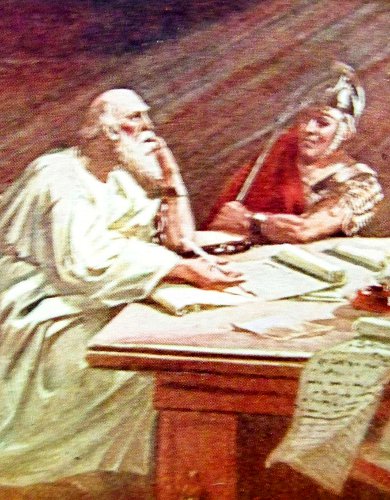
paul-in-romeHe lived there two whole years at his own expense, and welcomed all who came to him, proclaiming the kingdom of God and teaching about the Lord Jesus Christ with all boldness and without hindrance.

Acts 28:30-31

So ends Luke’s chronicle on the acts of the apostles in what we know today as the Book of Acts. Paul is left in Rome as a prisoner of Caesar in a rented abode, still in chains and guarded by a member of the Praetorian guard. We have only bits and pieces from Paul’s letters and other documents to help us understand what happened to him afterward and the fate to which he finally arrived.

The abrupt end of the book leaves the reader wondering why Luke closed the narrative at that point. He does not grant any specific stories about Paul’s activities in those two years, and he does not mention the outcome of his appeal before the emperor. It seems like a strange and unsatisfying place to conclude the story.

-D Thomas Lancaster
Study for “Behar (On the Mountain)”
Commentary on Acts 28:16-31
Chronicles of the Apostles, Volume 6,  pg 837
First Fruits of Zion (FFOZ) Torah Club

This is the conclusion, as far as Luke’s narrative is concerned, of Paul’s long, dangerous, and confusing journey from Jerusalem to Rome, a journey which began under the shadow of grim prophesy.

While we were staying for many days, a prophet named Agabus came down from Judea. And coming to us, he took Paul’s belt and bound his own feet and hands and said, “Thus says the Holy Spirit, ‘This is how the Jews at Jerusalem will bind the man who owns this belt and deliver him into the hands of the Gentiles.’” When we heard this, we and the people there urged him not to go up to Jerusalem. Then Paul answered, “What are you doing, weeping and breaking my heart? For I am ready not only to be imprisoned but even to die in Jerusalem for the name of the Lord Jesus.” And since he would not be persuaded, we ceased and said, “Let the will of the Lord be done.”

After these days we got ready and went up to Jerusalem. And some of the disciples from Caesarea went with us, bringing us to the house of Mnason of Cyprus, an early disciple, with whom we should lodge.

When we had come to Jerusalem, the brothers received us gladly. On the following day Paul went in with us to James, and all the elders were present. After greeting them, he related one by one the things that God had done among the Gentiles through his ministry.

Acts 21:10-19

Even before Paul entered Jerusalem, he knew he might not be leaving the Holy City again, at least not in this life. Yet he did as a result of false accusations against him, having been accused by Jews from Asia of teaching against the Temple, against Jews keeping Torah, and even bringing a Gentile into the Temple past the court of the Gentiles.

As I said, none of it was true, but Paul defended himself as he was taken from one city to the next, from one court venue to the next. And even though he had done no wrong, because of the accusations against him and the threats against his life, Paul finally appealed to Caesar to hear his case, and his assurance of a one-way journey to Rome and the emperor was complete.

But he never saw Jerusalem again. Never saw Peter or James or the elders and apostles again. Never offered sacrifices in the Holy Temple again.

While Paul’s ultimate fate remains a mystery, what about the Council of Apostles in Jerusalem?

Last Sunday, Pastor Randy said a funny thing from the pulpit and he repeated it during last Wednesday night’s conversation with me.

Now those who were scattered because of the persecution that arose over Stephen traveled as far as Phoenicia and Cyprus and Antioch, speaking the word to no one except Jews. But there were some of them, men of Cyprus and Cyrene, who on coming to Antioch spoke to the Hellenists also, preaching the Lord Jesus. And the hand of the Lord was with them, and a great number who believed turned to the Lord.

Acts 11:19-21

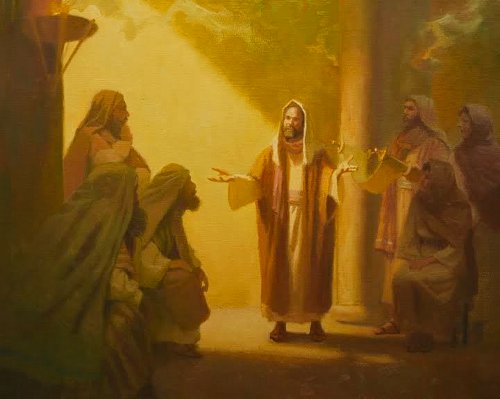
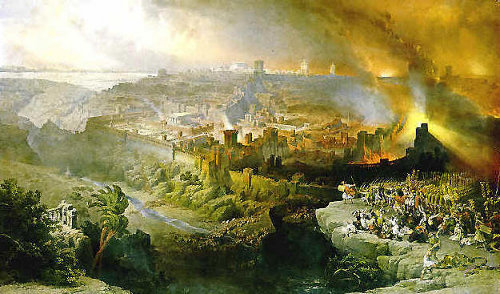
Apostle-Paul-PreachesPastor said this was the beginning of the process of transferring authority from Jerusalem to Syrian Antioch. What? Transferring authority? I’d never heard of such a thing. How could any city but Jerusalem be the geographic and spiritual center of our faith? I had always believed that the ultimate authority over the “church” was always wielded from Jerusalem, that is until 70 CE when the Romans leveled the Temple, razed Jerusalem, and sent the vast majority of the Jewish population into the diaspora. Only then was authority transferred from the Jewish apostolic council to the Gentiles, and this by force.

But according to Pastor Randy, once the original apostles, those who walked with Jesus and who witnessed the resurrection, died…their authority was not automatically passed down to others, either their heirs or any other appointed elders. There is only one record of an apostle being replaced and that was long before the trials of Paul.

So one of the men who have accompanied us during all the time that the Lord Jesus went in and out among us, beginning from the baptism of John until the day when he was taken up from us—one of these men must become with us a witness to his resurrection.” And they put forward two, Joseph called Barsabbas, who was also called Justus, and Matthias. And they prayed and said, “You, Lord, who know the hearts of all, show which one of these two you have chosen to take the place in this ministry and apostleship from which Judas turned aside to go to his own place.” And they cast lots for them, and the lot fell on Matthias, and he was numbered with the eleven apostles.

Acts 1:21-26

Protestantism tends to discourage the idea of a more permanent intent for the Council of Apostles because it smacks of the authority of Rome in Catholicism and other Ecumenical Councils who exercise authority over the faithful, many times to the detriment of the faithful. So Pastor’s thoughts could be a reflection of his perspective and education.

Be that as it may, the Council of Apostles disappears from Jerusalem and from history, certainly by 70 CE if not before.

But what about the centrality of Jerusalem? If you believe there will be a Third Temple (as I do) from where Messiah will reign in Jerusalem, then you cannot dispense with Jerusalem. If you believe that each year the Gentile nations must send representatives to Jerusalem to celebrate Sukkot (Zechariah 14:16-19), then you cannot dispense with Jerusalem. Jerusalem is the focus, the nexus for all of our prophetic hopes in the return of the Messiah. If the apostles and the council vanished from Jerusalem with no successors, did “authority” shift to Antioch?

Now there were in the church at Antioch prophets and teachers, Barnabas, Simeon who was called Niger, Lucius of Cyrene, Manaen a lifelong friend of Herod the tetrarch, and Saul. While they were worshiping the Lord and fasting, the Holy Spirit said, “Set apart for me Barnabas and Saul for the work to which I have called them.” Then after fasting and praying they laid their hands on them and sent them off.

Acts 13:1-3

It certainly seems so, but let’s think about this. The first large group of Gentiles to become disciples of the Master and to receive and extensive education in his teachings and (very likely) in the Torah were the Antioch Gentile God-fearing believers. Antioch also became a good “jumping off place” for Paul and his fellow apostles to go to the Gentiles in the diaspora with the good news of the Messiah (but going to the Jews first, of course). And while Antioch seems to have been a major center of Jewish/Gentile Messianic worship and evangelism, Paul continued to return to Jerusalem (Acts 15 and 21) to receive authoritative rulings on difficult matters and to bring donations for support of the Jewish “saints” in Israel.

fall-of-jerusalemAntioch may have been the center of the Jewish/Gentile interface of the Way, but Jerusalem was the heart, soul, and final authority over the movement.

But when there were no more living apostles in Jerusalem, did God close the door on Jewish authority over the Way, even over the Jewish members?

Lest you be wise in your own sight, I do not want you to be unaware of this mystery, brothers: a partial hardening has come upon Israel, until the fullness of the Gentiles has come in. And in this way all Israel will be saved…

Romans 11:25-26

This and other references of Paul’s, indicate that whatever separation there may be between the Jewish people and King Messiah is only temporary, which includes the separation between the King and Jerusalem. The “authority” left Jerusalem temporarily, but the Throne of the King has always been in the City of David.

The Lord swore to David a sure oath from which he will not turn back: “One of the sons of your body I will set on your throne.

Psalm 132:11

When Jesus returns as Lord of Israel and Lord of all, the authority will return to Jerusalem again. I don’t think even Protestant resistance to “apostolic authority” can deny that we all have one King and he is the authority and author of our lives.

“Jerusalem, Jerusalem, who kills the prophets and stones those who are sent to her! How often I wanted to gather your children together, the way a hen gathers her chicks under her wings, and you were unwilling. Behold, your house is being left to you desolate! For I say to you, from now on you will not see Me until you say, ‘Blessed is He who comes in the name of the Lord!’”

Matthew 23:37-39 (NASB)

Good Shabbos.

145 days.