Tag Archives: Jesus

Tasting Chicken Soup

chicken-soup-with-matzah-ballsPicture the scene: Dead, feathered birds are lying on the kitchen counter; a bag of flour has spilled onto the floor, along with a orange juice—and so, the two-year-old is having a lovely time creating edible mud pies from the mix. From upstairs, a scream shakes the house—it’s the little one furious at the big one for making her bathtub too hot. Meanwhile, the big one is kvetching at the top of her voice because “there’s nothing for me to wear.” The father of the house is hiding somewhere, in full knowledge that if he shows his head, he’ll be sent out again on another urgent, last-minute errand.

At this point, the doorbell rings. It’s the nudnik guest, delivering his gift bottle of wine in advance, certain that the lady of the house has nothing better to do this afternoon than stand at the door and chat. She is careful to open the door only a slight 20 degrees, wedging herself into the space—first, so that the guest won’t see the state of affairs within; but also to prevent the little one who has just escaped from his hot tub from running out naked into the street.

The guest sniffs the air, and sighs, “Ahhh . . . Shabbos!”

Shabbos? Shabbos is a day of rest! Of peace! Of harmony! This is a total disaster zone!

But the guest smells what is coming. And the inhabitants of this house know as well. They know the dead birds will become a sumptuous chicken soup, the remainder of the flour will become fresh-baked challah, the children will be neatly dressed in their finest clothes, the father will turn up again, and they will all sit together at the table, singing in harmony and telling the stories and words of Torah they learned in school that week.

When you know the story, the scene becomes a different scene. The gadget in your pocket, the news on the tab before this one, the financial chaos and the promises of technological breakthrough, the void of leadership and the medical miracles that keep failing to come—think of those as the dead, feathered birds on the kitchen counter, soon to become a sumptuous chicken soup.

Science has opened our eyes to the awesome harmony of our world. The Kabbalah of the Ari, explained in the language of Chabad, can open anyone’s eyes to the G‑dliness behind that harmony. Shortly, we will sit at the Shabbos table with Moshiach, who will show how the earthly wisdom and the heavenly wisdom complement one another. While we are yearning for that knowledge, what is stopping us from tasting a spoonful of the soup right now?

-Rabbi Tzvi Freeman
“The Last Day of History”
Chabad.org

This is the climax to a rather lengthy and challenging article my wife shared with me the other day. I must admit to having skimmed over much of the content, but this portion is not only straightforward but rather the point of it all. I don’t mean that it’s the point of the article, although I suppose it is, I mean that it’s the point of everything.

For we who have believed enter that rest…

Hebrews 4:3 (ESV)

The writer of Hebrews and Rabbi Freeman seem to be drawing their respective audiences to the same point: that we will one day enter into that final rest with the Messiah. What is especially attractive about Rabbi Freeman’s perspective is that a foretaste of that rest exists right now. Jews experience a small sampling from the “menu” of the Messiah’s table every Shabbat. Some Christians who are attached to the traditional Jewish community, Messianic Judaism, or Hebrew Roots, also have the opportunity to experience that “rest” and sample from the “menu” to varying degrees.

As far as I can tell, most Christians don’t.

Shabbat-Made-Easy-paintingI think that “Christ’s rest” is something that is more conceptual within Christianity. Most Christians anticipate being “raptured” and going up to Heaven of course, but there’s no idea that you can get a preview of the event before the event, at least not very frequently. There’s no manner of experiencing such an event in the material world because the “Messiah’s rest” is thought to be wholly spiritual.

More’s the pity.

I miss even the tiniest sliver of Shabbos observance in which my family used to participate. Hopefully, by God’s mercy, my wife will desire to observe the Shabbat again as her life calms down, and our home will be illuminated and warmed by the Shabbos candles once more.

I’m sure what I’m saying seems totally alien to most Christians. How can we experience the return of Jesus Christ before he returns? It must seem ridiculous.

But think about it.

In the U.S., we’ve recently celebrated Thanksgiving and most Christians are anticipating Christmas in just a few weeks. One of my favorite parts of Thanksgiving is the aroma of delicious foods in the kitchen. I traditionally barbecue the turkey in a Weber on the back patio, so in tending to it, I get to enjoy the smells of the slowly roasting bird as the smoke curls into the air. These smells all by themselves are highly pleasurable and also herald the grand feast that is to come.

And that is Shabbat. We know the feast will come but we also have a role in preparing for the feast. How many “feast” metaphors did Jesus use to describe the preparations for his own return and King and Bridegroom? Here’s just one of them.

“Then the kingdom of heaven will be like ten virgins who took their lamps and went to meet the bridegroom. Five of them were foolish, and five were wise. For when the foolish took their lamps, they took no oil with them, but the wise took flasks of oil with their lamps. As the bridegroom was delayed, they all became drowsy and slept. But at midnight there was a cry, ‘Here is the bridegroom! Come out to meet him.’ Then all those virgins rose and trimmed their lamps. And the foolish said to the wise, ‘Give us some of your oil, for our lamps are going out.’ But the wise answered, saying, ‘Since there will not be enough for us and for you, go rather to the dealers and buy for yourselves.’ And while they were going to buy, the bridegroom came, and those who were ready went in with him to the marriage feast, and the door was shut. Afterward the other virgins came also, saying, ‘Lord, lord, open to us.’ But he answered, ‘Truly, I say to you, I do not know you.’ Watch therefore, for you know neither the day nor the hour.

Matthew 25:1-14 (ESV)

There’s preparation. There’s work to be done. There’s waiting. And then finally, sometimes unexpectedly, the Prince arrives and the feast begins.

But in cooking a meal, how many chefs manage to taste a bit here and a bit there, making sure the seasoning is just right, adding a spice or an herb to enhance the flavor?

I suppose that’s what Christmas is to most Christians…celebrating the birth of Jesus and his first entry into the world in anticipation of the second. That’s probably why Easter is also observed with such zeal (and a meal), to rejoice over the risen Jesus and to pray that he returns soon.

But while Judaism also has its great festivals, they also have Shabbos, the weekly reminder. Going to church on Sunday just doesn’t compare.

challahFor a Jew, six days of the week are spent in pursuit of the mundane, taking care of business, and sometimes letting life take over or overwhelm. Shabbos is bringing order to chaos and peace to turmoil. Even the preparations for Shabbos can seem maddening, much like life itself, but the result is wonderful, much like Messiah’s coming.

In God’s wisdom, He gave the Shabbat to the Jewish people as a sign of His covenant with them. Alas, it did not transfer to we Christians when we were brought into the fold. But sometimes you need rest and refreshment in order to summon courage for what is to come and to lay down the burden of what’s already happened. I don’t observe Shabbat these days, but I hope I will again. You may not observe Shabbat either, but it’s something you can access if you choose.

Messiah may come today, tomorrow, next year, or a thousand years hence. But Shabbos comes every week. Why wait? The Challah is rising in the oven and pots are steaming and bubbling on the stove. Have a taste of chicken soup now. It’s delicious.

Giving Compassion to the King

charity-tzedakahI feel the whole thing depends upon humility, grace, and gratitude.

Reasoning:

1. Christians should be humble, gracious and grateful because without Jews we’d have NO knowledge of God, NO bible, and NO HOPE of redemption. They are our spiritual elder brothers, the covenant people of God, and the firstborn son of Adonai.

Does that mean they have it “all” correct, and there is no failings? No.

2. Believing Jews should be humble, gracious and grateful because it’s not their plan, after all, it’s God’s, and He has one for us gentiles too who have kept the Apostolic mission (go tell all nations) knowledge of Messiah alive for these 2k yrs. Additionally, most Jews who have entered into relationship with Messiah did so due to a gentile Christian.

Does that mean they have it “all” correct, and there is no failings? (h, e, double toothpicks, No.)

Therefore, no one is left out of the plan, and there is room for all IF there is first humility. Are there unreasonable Jews who want to act as if they have all truth and there is no room for a gentile?

Yes, of course.

Just like there are (far more) unreasonable gentile Christians who think all Jews need to become Christians and act like a Gentile to believe in their Messiah.

It’s hard for reasonable God loving people to reject others who come in humility and offer love and grace.

Comment of Lrw
on my blog post Divergent Trajectories

I suppose this is a continuation of the “Divergent Trajectories” blog post. I think the concept and the dynamics of Christian/Messianic Jewish relationships bears a great deal more examination than it has been given thus far (and it’s been given plenty). We just can’t seem to figure each other out, or at least, we just can’t seem to figure each other out in the same way.

I want to return to a part of the gospels that caused me some embarrassment in my Sunday school class a couple of weeks ago.

It will be that when the son of man comes in his glory, and all the holy angels with him, he will sit on the throne of his glory. All nations will be gathered before him, and he will separate them like a shepherd separates the sheep and the goats. He will stand the sheep to his right and the goats to his left. Then the king will say to those standing on his right, “Come, those who are blessed by my Father, and possess the kingdom prepared for you from the foundation of the world. For I was hungry, and you fed me. I was thirsty, and you gave me a drink. I was traveling, and you took me in; naked, and you covered me; sick, and you visited me. I was in prison, and you came to me.”

The righteous will answer and say, “Our master, when did we see you hungry and sustain you, or thirsty and give you a drink? When did we see you traveling and take you in, or naked and cover you? When did we see you sick or in prison and come to you?

Then the king will answer and say to them, “Amen, I say to you, what you have done for one of these young brothers of mine, you have done for me.” Then he will also say to those standing to his left, “Go away from me, those who are cursed, to the eternal fire prepared for the satan and his angels. For I was hungry, but you did not feed me. I was thirsty, but you did not give me a drink. I was traveling, but you did not take me in; naked, but you did not cover me; sick and in prison, but you did not visit me.”

These, too, will answer, “Our master, when did we see you hungry or thirsty or traveling or naked or sick or in prison and did not attend to you?” Then he will answer them, saying, “Amen, I say to you, what you did not do for one of these young ones, you also did not do for me.” These will go to an eternal place of torment, but the righteous to eternal life.

Matthew 25:31-46 (DHE Gospels)

I’ve always thought that the sheep were the ones who gave food, gave drink, and visited anyone who was in need but Charlie, the teacher at the Sunday school class I attend, told me that he believes the true meaning has to do with how we Gentile Christians treat the Jewish needy. The sheep specifically are those who provided for the Jews, the “young brothers” of the Jewish Messiah, and the goats were the ones who specifically did not provide for the needy among the Jews.

Frankly, this interpretation reminds me of the following, also taught by the Master:

Not everyone who says to me, “My master! My master!” will enter the kingdom of Heaven, but rather the one who does the will of my Father who is in heaven. It will be that on that day many will say to me, “My master, my master, did we not prophesy in your name and in your name drive out demons and in your name do many wonders?” Then I will answer them, saying, ” I have never known you. Depart from me, workers of evil!”

Matthew 7:21-23 (DHE Gospels)

Of course, I’m forcing a connection between these two portions of scripture and further, forcing a connection to Charlie’s interpretation of Matthew 25:31-46 as meaning how Gentile Christians minister to the Jews, but then, we always have this:

I will bless those who bless you, and him who curses you I will curse; and all the families of the earth shall bless themselves by you.

Genesis 12:3 (Stone Edition Chumash)

tzedakah-taking-rootAgain, I’m creating associations between different parts of the Bible that may not be connected, but I think I can make a credible argument that how we non-Jewish Christians treat the Jewish people directly reflects not only how we obey (or fail to obey) the words of Jesus Christ, but our eternal destiny in the kingdom of Heaven as well (which probably isn’t the same as saying that we’ll go to heaven or hell, but it just might).

But I’ve never heard of Charlie’s interpretation of Matthew 25:31-46 before, and while it nicely fits into my own budding understanding of the relationship between Christians and Jews, where does this interpretation come from (if anywhere)? The Delitzsch Hebrew Gospels, from which I quoted earlier, didn’t have a commentary for those verses, so I turned to my brand new ESV Study Bible to see if there is a common Christian interpretation that matches this teaching. I came up with this notation for Matthew 25:40:

In the context of the parable the least of these refers to those who are most needy among Jesus’ brothers – a reference most likely to Jesus’ disciples and by extension all believers. The “sheep” are commended for their great compassion for those in need – for the hungry, the thirsty, the stranger; for those who are naked, sick, or in prison. The righteous will inherit the kingdom not because of the compassionate works that they have done but because their righteousness comes from their transformed hearts in response to Jesus’ proclamation of the kingdom, as evidenced by their compassion for the “least of these.” In caring for those in need, the righteous discover that their acts of compassion for the needy are the same as if done for Jesus himself (you did it to me).

Not exactly iron-clad support for Charlie’s interpretation, but it does suggest that Jesus probably meant his Jewish disciples when he referred to his “young brothers.” However, the ESV commentary states that “by extension” offering compassion to “all believers” would be the same thing, so the “sheep” would be any believer who gives kindness to any other needy believer, Jew or Gentile.

I would hesitate to say that any Christians who have only ministered to other non-Jewish Christians or even to other people who are not believers have been wasting their time and been doing nothing but “evil.” Much good has been done by the church over the centuries. Many hospitals have been built for the sick in impoverished areas of the world, a great deal of food, medical supplies, and Bibles have been given freely to the sick, the outcast, the desperate, and the dying. Houses have been built, churches have been repaired, roads have been constructed, and many more acts of compassion and kindness have been performed in the name of Jesus Christ where the Jewish people have not been the direct beneficiaries. Is that a bad thing?

The only way I can see that it would be “bad” is if the Christians performing these acts of charity and kindness gave them away freely to everyone except the Jews or deliberately withheld such compassion from Jews or worse, offered food, drink, and shelter to Jews only upon the condition that they hear the Gospel message or be converted to Christianity. I don’t believe that Jesus intended that the sharing of compassion to the Jews (or anyone else) should be conditional upon compelling those being helped to listening to an evangelical message.

But what if…

But what if Charlie is right? I know I’m stretching credibility to its limits and perhaps beyond, but what if part of our mission as Christians is to minister to the Jewish brothers of the Master? What if, as firstborn son of Israel, Messiah’s primary concern was for his own people, the Jewish people, and that we from among the nations, because we are blessed through Abraham and is descendants, have an obligation to respond by offering whatever care and compassion is needed by the Jews? Remember, Jesus didn’t just care for his own Jewish disciples, he said, “I was sent only to the lost (or “perishing”) sheep, who are of the house of Yisra’el.” (Matthew 15:24 DHE Gospels) Jesus was sent to all of Israel; all of the Jews. 

The Master further said, “…for salvation is from the Yehudim.” (John 4:22 DHE Gospels). Of course, according to D. Thomas Lancaster’s commentary on Acts 9 (from Torah Club, Volume 6: Chronicles of the Apostles):

A great multitude of hopeful Samaritan people assembled at the Samaritan village of Tirathaba and prepared to ascend Mount Gerizim together with the prophet. Some came armed. The Samaritan believers, however, were not deceived. By casting their allegiance with Yeshua of Nazareth and the apostles in Jerusalem, they had forsaken their ties to Mount Gerizim. They knew that “salvation is from the Jews” and that the Samaritans worshipped what they did not know. They knew the hour was coming when true worshippers would be unable to worship either on Mount Gerizim or in Jerusalem.

While the words of the Master from John 4:22 were immediately directed to the Samaritans and not to believers in general, like the interpretation from the ESV Study Bible on Matthew 25:31-46 suggests, we may be able to take a specific teaching or command of the Master that is focused on a limited population and extend it to a wider group of people, in this case, all believers in Christ, Gentile and Jewish.

jonathan-pollardI don’t believe that any of this means we Christians shouldn’t minister to the needy in the church. I also don’t think this means that we Christians shouldn’t minister to the needy of the world, regardless of their religious beliefs or lack thereof. I do believe though, that we should give serious consideration to Charlie’s interpretation of Matthew 25:31-46 and when we consider the Jewish people and the nation of Israel, we should look for those who have needs and, in the name of our Master, we should feed the hungry among them, give drink to their thirsty, offer hospitality to Jews who are traveling and in need of shelter. We should visit the sick among Israel and go to those who are in prison (and the plight of Jonathan Pollard who is imprisoned, ill, and who has been denied justice by the United States does not escape me here).

Imagine…

Just imagine that one day you face judgment from our Master and King. You believe you have served him faithfully and consistently throughout your long life. The time of final reward is at hand. Then suddenly, mysteriously, shockingly, you find that he brusquely casts you aside, as if you were among those who have disdained and ridiculed the name of Jesus Christ for their entire lives. How could such a thing be possible? Then you remember that in your long life as a Christian, you had always set aside the Jewish people as “carnal” and “unsaved” and “Christ killers,” and though you had ample opportunity to render aid to the hungry, the naked, and the sick among Israel, you always turned away from them.

And now the Jewish King turns away from you.

I can’t prove to you that any of this will happen as I’ve described it.

But just imagine.

Divergent Trajectories

I have recently been involved in a discussion online with Christian pastors who argue that the “Law” is passed, or fulfilled and therefore they believe Judaism is religion of works righteousness. I told them that is not Judaism, and the Law is not passed, but is part of living a godly life. It highlights for me why Messianic Judaism is not Christianity. We do follow the same Messiah, but the idea of how we are to live is vastly different. Does following Yeshua make one a Christian, or do you think we are something different? Outside of Yeshua, I see nothing in common with them.

-Rabbi Dr Michael Schiffman
from his Facebook comment

Rabbi Dr Schiffman made this comment in a closed Facebook group to which I belong, so I can’t post a link to the entire conversation. I do want to insert a few of the responding comments, but I will disguise the identity of the responders:

RG: we have nothing in common with them…at least I don’t have…G_d’s Covenant with Abraham is an Eternal Covenant for all the ages, as is the Covenant of Circumcision…Forever means ’til revisionists decide to jettison it…?

KS: If I may interject, it’s not that our brethren that don’t see Messianic Judaism as a doctrinally pure way to live feel you can do anything you want. Rather they recoil at the idea that God would expect you to do anything for Him. He is “love” and our greatest and in their mind only commandment is love. But what is the standard. How do I know what love is? Their concept of the Gospel is very subjective. If you engage many christians in dialogue the only firm thing they believe is that you should not follow the “Old Testament” because that is “law”. Unfortunately they then are like the blindfolded men who come across the elephant and one thinks he’s a trunk, another a big foot, a third thinks he is this little tail. We need to walk in the light and then we will see. The light is what David describes in the Psalms: “Torah” is a lamp for my feet and light for my path”. If you reject His written Word how can you hear clearly the Living Word?

YL: So far it seems the conversation is focusing on Christians whose theology is supersessionist, and speaking of those Christians as if they represent the whole. But there are also Christians who have rejected supercessionism and are working to repair its horrible effects on Christian theology and Christian/Jewish relations. If the primary thing that defines Messianic Judaism as a different religion than Christianity is supercessionism and anti-Judaism, then what about those Christians who affirm the Jewish people’s ongoing covenantal relationship with Hashem via the Torah?

Rabbi Dr Schiffman: There is always some overlap among different groups, just as there are differences between Messianics. While there are some post-supersessionist Christians, the majority are supersessionist, and as they find dispensationalism wanting, many have turned toward tradiitional supersessionist theology. Hopefully this will change in the future, but if we are really in a “post-Supersessionist” era, why do we have so many supersessionists around? I guess it hasn’t trickled down yet.

YL: Agreed. So what, if anything, can we do to help make the vision of post-supercessionist Christianity a reality? And are there things we need to avoid as MJs because they subtly undermine that vision?

SB: If a Gentile respected Torah, he (she) would follow the Noakhide instructions. They were given to all mankind. This respect for Torah, I think, is something that should be spread.

I’m sorry for posting such a lengthy transaction but keep in mind this is only a fraction of the responses I’ve reviewed in the conversation as I write this “meditation.” You may be wondering why I’m bothering with all this, but the question of the relationship between Christianity and Messianic Judaism (and I’m deliberately setting aside the Hebrew Roots variants including One Law and Two-House) has been a problem, at least once it came to light that Messianic Judaism must be a Judaism in order to function and be a valid religious and cultural expression of faith in Yeshua for halakhic Jews.

Nearly two months ago, Rabbi Dr. Schiffman wrote a blog post called Messianic Judaism and Christianity: Two Religions With The Same Messiah which more formally presents his ideas on this matter. It is very much in line with what you’ll find in Mark Kinzer’s book, Postmissionary Messianic Judaism: Redefining Christian Engagement with the Jewish People

To distill all of this down into a single sentence, necessarily compressing many complex details, what is being suggested is that Christianity and Messianic Judaism are mutually exclusive religious expressions that, although they share the same God and the same Messiah, otherwise service wholly different populations. Granted, that’s a gross oversimplification, but I believe it captures the essence of what Kinzer and Schiffman are trying to communicate to the rest of us…that is, Christians.

At one point a few years back, this idea bothered me so much that I created an entire blog and series of blog posts, starting with something called Fractured Fellowship.

So where does that leave us. YL provided the most hopeful suggestion in the above-quoted conversation, with the idea that there are “post-supersessionist” Christians who “are working to repair its horrible effects on Christian theology and Christian/Jewish relations” and “who affirm the Jewish people’s ongoing covenantal relationship with Hashem via the Torah.”

I’m not sure YL’s comments were all that well received, especially with the follow-up query about whether or not post-supersessionist Christians should follow the Seven Noahide Laws (and to my understanding, by definition, Christians should already be obeying them).

I must admit to a bit of confusion. I was invited to this Facebook group with the knowledge that I’m not Jewish, so there is some idea that it’s “OK” for Christians and Messianic Jews to occupy the same space, or at least the same virtual space in Facebook. I also have a few Messianic Jews who I feel are my friends and who I have worshipped with fairly recently. Others have invited me to worship and associate with them should we ever overcome the geographic barriers that keep us apart.

This isn’t the only conversation on the web discussing this topic. Both Derek Leman and Gene Shlomovich have written recent blog posts contrasting Christianity and Messianic Judaism. For my own part, I too have have discussed early Christian and Jewish relations as they affect the interaction and fellowship between believing Jews and Christians today.

Yet in reading many of the comments in the Facebook conversation, it is as if fellowship between Messianic Jews and Christians on many levels is undesired and unwelcome.

I wonder if this was built into the original design?

They will fall by the edge of the sword and be led captive among all nations, and Jerusalem will be trampled underfoot by the Gentiles, until the times of the Gentiles are fulfilled.

Luke 21:24 (ESV)

Lest you be wise in your own sight, I do not want you to be unaware of this mystery, brothers: a partial hardening has come upon Israel, until the fullness of the Gentiles has come in.

Romans 11:25 (ESV)

It would seem that not only have (most of) the Jewish people been temporarily blinded to the identity of the Messiah for the sake of the Gentiles, but until the time when Jewish eyes will be reopened, there will be enmity between the Jew and the Gentile (Christian). This somewhat flies in the face of the following:

But now in Christ Jesus you who once were far off have been brought near by the blood of Christ. For he himself is our peace, who has made us both one and has broken down in his flesh the dividing wall of hostility by abolishing the law of commandments expressed in ordinances, that he might create in himself one new man in place of the two, so making peace, and might reconcile us both to God in one body through the cross, thereby killing the hostility.

Ephesians 2:13-16 (ESV)

However, if you add the passages from Luke and Romans to my analysis of Cohen from his book From the Maccabees to the Mishnah, you start seeing a picture of a less than rosy relationship between the first Jewish disciples of the Messiah and the first Gentile disciples right from the start.

Gene Shlomovich confirms this in a comment on his blog:

To begin with, it took nearly 20 years since the all Jewish Messianic community was founded around 30 CE to make first Gentile converts. So, only around year 50 CE we have first Gentile believers coming unto the scene. Even then it wasn’t all flowers between the two groups. I think the example of Peter being afraid to be seen with Gentiles shows that the two groups had an uneasy social relationship from the get go, which hardly meshes with your statement of “unprecedented level of social cohesion” and supposedly fully integrated messianic synagogues. (While you read this, keep in mind that Romans destroyed Jerusalem and led Jews away in chains mere 20 years later, in 70 CE).

Secondly, almost immediately after the first converts among the Gentiles were made, there was a rise in Roman antisemitism. We read that already in Acts 18:2 that Roman Emperor Claudius threw out all Jews from Rome (around 50 CE). This had effectively ended whatever the Jewish presence that existed among the Roman Christians, who were probably the biggest single group of Gentile believers at the time. Secondly and some say as a result of that expulsion, we see an undercurrent of pride and anti-Judaism beginning to appear among Gentile believers – and we have Paul warning (some say around year 56 CE) Gentiles under his care about it. (Romans 11:18) And just 16 years later, Jerusalem and the Temple was destroyed, effectively ending the Messianic Jewish presence in the land, along with whatever communities and synagogues that had existed at the time.

Fortunately, he followed up with another comment:

I have no problem fellowship and worshiping with Gentile believers. In fact, the goal of this blog, as it says in the head, is ” Jewish-Gentile Reconciliation”. What I take issue with is the Supersessionism found within some Hebrew Roots circles, the appropriation of Judaism and misuse of Jewish sancta, anti-Judaism, and misleading Christians (Gentiles) to force them to do things that G-d never intended them to do by making them feel that they are sinning if they do not eat up the One Law agenda.

So what we have, at least from Gene’s perspective, is not a requirement for absolute separation between Messianic Jews and Christians in our individual silos, but a clear definition of relationships and roles within any mutual fellowship context.

Of course, you’ll find variation among believing Jews, with some advocating for total or at least significant inclusion of Gentiles within a Jewish worship and cultural lifestyle, and others advocating for the polar opposite and requiring that non-Jews be excluded from any Messianic Jewish community (which will be pretty tough, since to the best of my awareness, there currently is no Messianic Jewish synagogue, congregation, or community composed of exclusively Jews or even of a majority of Jews).

But then what do we do with the following passages?

Let not the foreigner who has joined himself to the Lord say,
“The Lord will surely separate me from his people”;
and let not the eunuch say,
“Behold, I am a dry tree.”
For thus says the Lord:
“To the eunuchs who keep my Sabbaths,
who choose the things that please me
and hold fast my covenant,
I will give in my house and within my walls
a monument and a name
better than sons and daughters;
I will give them an everlasting name
that shall not be cut off.
“And the foreigners who join themselves to the Lord,
to minister to him, to love the name of the Lord,
and to be his servants,
everyone who keeps the Sabbath and does not profane it,
and holds fast my covenant—
these I will bring to my holy mountain,
and make them joyful in my house of prayer;
their burnt offerings and their sacrifices
will be accepted on my altar;
for my house shall be called a house of prayer
for all peoples.”
The Lord God,
who gathers the outcasts of Israel, declares,
“I will gather yet others to him
besides those already gathered.”

Isaiah 56:3-8 (ESV)

Thus says the LORD of hosts: In those days ten men from the nations of every tongue shall take hold of the robe of a Jew, saying, ‘Let us go with you, for we have heard that God is with you.’”

Zechariah 8:23 (ESV)

While the Matthew 28:18-20 imperative is the command of Jesus to his Jewish disciples to also make disciples of the nations, it doesn’t necessarily pre-suppose a lasting relationship and a fused corporate identity between said-Jewish and Gentile disciples. Certainly there is ample evidence to support how the Jewish and Gentile disciples of the Master almost immediately developed separate communities, probably within a few decades of the first Gentile being brought into worship of the God of Israel through the Jewish Messiah.

And yet Isaiah and Zechariah suggest that we Gentiles (Christians?) may have a closer relationship to the Jews and the Temple than what modern-day Messianics such as Schiffman and Kinzer would necessarily support. It has been suggested that in the future Temple, even Gentiles (Christians?) will be allowed to serve as Priests, but this is disputed by Gene Shlomovich in another of his recent blog posts:

Will the reign of Yeshua as Messiah mean that anyone who truly worships G-d, Jew or Gentile, could finally just waltz into the sanctuary of G-d in the new Temple, have the unfettered access anywhere, even if they are not priests? Does this mean, as some teach, the Gentiles will be selected to work as priests in the new Temple? Not at all!

They [that is “priests, who are Levites and descendants of Zadok” Ezekiel 44:14] alone are to enter my sanctuary; they alone are to come near my table to minister before me and perform my service. (Ezekiel 44:15)

Gene also quotes scripture that supports the idea of Gentiles continuing to be restricted to the outer courts of the future Temple in Messianic times.

Go and measure the Temple of G-d and the altar, with its worshipers. But exclude the outer court; do not measure it, because it has been given to the Gentiles. (Revelation 11:2)

His final comment on the matter is this:

The Temple will be a place where both Jews and Gentiles could worship the G-d of Israel, both together and in unique ways. All nations will come to learn from Israel because they will all know that G-d is with the Jewish people:

This is what the L-rd Almighty says: “In those days ten people from all languages and nations will take firm hold of one Jew by the hem of his robe and say, ‘Let us go with you, because we have heard that G-d is with you.’” (Zechariah 8:23)

The bottom line seems to be that Messianic Jews and Gentile Christians may have started out at a single point in history but once we began to diverge on separate trajectories, those separate and distinct paths forever defined our destiny in terms of a relationship with each other (Jews and Christians) and our separate relationships with God (relative to differences in application of Torah upon Jews and Christians).

Boaz Michael’s new book Tent of David: Healing the Vision of the Messianic Gentile will become available in January 2013 and defines the Gentile mission in the community of the church as one of healing between Christian and Jew. There is also an educational group open to Jews and (Gentile) Christians called MJ Studies that bills itself as “a gateway to post-supersessionist New Testament scholarship”. This group presumably would allow Christians to participate with Jews in mutual study and fellowship (at least virtually) so Jewish/Christian relationships don’t have to be totally severed for the sake of the modern Jewish disciples of Messiah.

There’s a part of me screaming in my ear that the easiest method of satisfying Messianic Jewish requirements is just to let them be. If the integration or even occasional inclusion of the Gentile Christian into a Messianic Jewish context is a great a difficulty, I can solve the problem by having nothing to do with Messianic Judaism. I can exist in a wholly separate and sealed conduit containing only Gentile Christians or, if that’s not to my taste, I can form a “community of one,” but in either case, I can allow Messianic Judaism to develop and grow without injecting my presence into their awareness. Of course, that’s an extremist solution, but it’s the easiest one to implement.

But while some Messianic Jews (and many Jews in general) see Christians as “the enemy,” largely due to the centuries of crime, hostility, rejection, and murder we’ve committed against Jews and Jewish communities, all fueled by our supersessionistic theologies, there are a few voices out there (including a few Jewish voices) that express the hope that some in the church actually support the Jewish right to define Judaism, including the Jewish worship of the Messiah Yeshua. If that is true, there may be hope for future dialog between our two groups. Perhaps that will lead to healing.

I want you to know that I support Jewish uniqueness both generally and as it applies to the Messianic movement. For my part and with that in mind, if someone invites me into their house, I will enter. If they have a “keep out” sign in their yard, I’ll pass by their house and keep on walking.

As for unity in the body of Messiah…as far as I can see, based on everything I’ve just said, that is yet to come.

I know that on Fridays I typically post a commentary on the week’s Torah Portion, (this week it is Vayishlach) but the current topic captured my thoughts and I found I had lost all enthusiasm for that other endeavor. Besides, with images such as “warring” brothers, and man wrestling with God, maybe the theme of Christian vs. Messianic Jew isn’t so off base after all.


36 Days: Backing Away from the High Dive

For the most part they were willing to support the state and to partake of the cultural bounty of the Hellenistic world, but they were unwilling to surrender their identity. They wished to “belong” but at the same time to remain distinct.

Shaye J.D. Cohen
Chapter 2: Jews and Gentiles
Social: Jews and Gentiles, pg 37
from the book
From the Maccabees to the Mishnah, 2nd Ed

This statement of Cohen’s describing the early diaspora Jews who were living in Greek society also reminds me of some halachically, ethnically, and cultural Jews who have come to faith in Yeshua (Jesus) as Messiah and who “belong” to the “body of believers,” “but at the same time (wish) to remain distinct” as Jews. Not an easy task, considering how both mainstream Christianity and the Christian Hebrew Roots offshoot movement want to “equalize” the Jews by making them like the rest of the Gentile community (in the former case, by making all Jews give up their Jewish religious and cultural practices, and in the latter case, by requiring all Gentiles take up Jewish religious and cultural practices).

But that’s not the main thing I want to talk about right now.

I had a most interesting dream last night. It went something like this:

I was sitting in a chair in some sort of waiting area at church with a bunch of other people. I think we were waiting to get into the Sanctuary so services could begin. I was looking through a notebook where I was trying to sort out some sort of theological puzzle. I had lots of notes written in pencil from the day before. I thought I had pretty well figured out what the answer was, but a fellow who knew what I was working on said I got it all wrong. I tried to explain my point of view, but I couldn’t find the right words.

As we were talking, another man approached me. I was still sitting down and had to look up at him. He wanted to invite me to a different Sunday school class than the one I had been attending and asked if I had a “Jesus of Nazareth Bible,” whatever that is. I looked in my right hand and was embarrassed to discover that I was holding the Jewish New Testament Commentary by David H. Stern, which I knew would never be accepted in a traditional Christian Bible study (and I thought I had given up Stern’s works many years ago).

The book was filled with a lot of loose pieces of paper that contained many of my notes. I guess it was good enough for him (though he seemed displeased), because the man told me to stand up and follow him. I looked down and discovered I was barefoot. By my feet were a pair of socks and the sandals I use to put something on my feet when I want to step out on my back patio for a few minutes (not exactly appropriate for church).

That’s when I woke up. My daughter has to be at work at 5 a.m. on Sundays, so I have to get up fairly early to drive her there.

That’s also when I knew I wouldn’t go to church today. It’s been a really active holiday week and weekend and I feel like I need just a little bit of space for a while.

But I can’t go back to sleep and I’m too tired to do much else, so I decided to write. I haven’t actually written anything for days since my family has been visiting, so I feel a little like an animal that has spent too much time in a cramped kennel. The gate has been opened and I’m able to run around in the park again. Feels good, but I wish my brain wasn’t full of cotton candy and iron filings.

In order to maintain their distinctiveness and identity, most Jews of the ancient world sought to separate themselves from their gentile neighbors. In the cities of the East, they formed their own autonomous ethnic communities, each with its own officers, institutions, and regulations. Some cities, notably Alexandria and Rome, had neighborhoods inhabited mostly by Jews. (These were not “ghettos” but “ethnic neighborhoods.”) Following the lead of Ezra, the Jews of the Second Temple period grew more and more intolerant of marriages with foreigners.

-Cohen, “Social: Jews and Gentiles”

I’ve written before that I’ve suspected the schism between Christianity and Judaism occurred fairly early, perhaps within a hundred years or less of the beginning of Paul’s “mission to the Gentiles.” But my opinion has been rudely ridiculed by members of the Hebrew Roots movement who are heavily invested in the notion that early Gentile and Jewish “Christians” were completely equal and uniform members of a single religious movement following Jesus of Nazareth, with the Gentiles adopting all of the Jewish cultural and religious practices.

But according to Cohen, particularly the Jews in the diaspora (where Paul was doing much of his work bringing the good news of the Messiah to the Gentiles) were still strongly driven to maintain their ethnic, cultural, and national identity as Jews. Thus, even the Jews who were involved in that early sect of Judaism called “the Way” were unlikely to surrender their unique identity to a non-Jewish population. In fact, the problem of how to integrate the non-Jewish people groups into a Jewish movement must have seemed an almost insurmountable task, both for the leaders of the Way (the Jerusalem Council) and for the Gentiles who were attracted to this form of Judaism. This is probably why the Acts 15 letter limited the requirements of Gentile disciples to just a few of the mitzvot.

The response of the Gentiles receiving the letter confirms that they neither needed or wanted to actually convert to Judaism (although there was an effort among other Jews to convert Gentiles to Judaism) and were overjoyed to become disciples of “the Christ” without having to be Jewish.

So when they were sent off, they went down to Antioch, and having gathered the congregation together, they delivered the letter. And when they had read it, they rejoiced because of its encouragement. And Judas and Silas, who were themselves prophets, encouraged and strengthened the brothers with many words.

Acts 15:30-32 (ESV)

Cohen comments that Judaism wasn’t something that was thought to be easily accessed, and that even the Gentiles respected its exclusiveness:

Even those Greeks and Romans who despised Judaism respected its exclusiveness as an ancestral usage that the Jews themselves were not free to change.

Immediately following the above-quoted sentence, Cohen makes a statement that seems to also confirm those Christians (non-Jewish followers of the Way) who adopted some of the Jewish practices were treated remarkably different by the Roman authorities than their Jewish counterparts.

The Christians, too, were accused of atheism, and since they could not defend their refusal by appeal to ancestral custom, they were persecuted.

I want to write more about what all this means in terms of Jewish and Christian relationships today, especially relative to Messianic Judaism and Hebrew Roots, but my main emphasis for this “meditation” is my own issues in “integration,” specifically into the church.

While my parents were visiting for Thanksgiving, my mother and I talked about this issue (she’s been trying to encourage me in going to church). She mentioned that she had been born and raised in a Lutheran family and for most of her life, she didn’t really think much about what that meant. She worshiped as a Lutheran because that’s what she had always done. She married and raised two sons as a devout Lutheran, but even after we grew up and left home, and even after she and my Dad retired and relocated to Utah, she still didn’t think much about what being a Lutheran meant.

Then, when my Dad and Mom moved to Kanab and they had to look for a church (not too many Lutherans in that part of Southwestern Utah), she got involved in different groups and started to study the Bible and consider what her faith meant, particularly in the area of religious community. The same thing happened as they got older and moved from Kanab to St. George. Mom and Dad had to visit a number of churches and attend just about every service and activity the church had to begin to discover if they “fit in.” In part, through that process, their faith and understanding grew. To become part of something, you have to dive in all the way and only when you’re drowning in it, do you find out if you are part of it and it is part of you.

Unlike the Jewish people of ancient or modern times, I don’t have a distinct cultural, ethnic, and faith identity that defines who I am in terms of God. But church is a culture and an identity and to belong to church, that’s an identity I have to adopt. To adopt it, I have to be part of it in every sense of the word, not just popping in for a few hours on Sunday morning.

Frankly, I hate the idea, primarily because I hate having to change my behavior patterns that much. Like most people, I’m a creature of habit. I go to work at the same time each morning and I come home at the same time each evening. I have my routine and my comfortable activities. Being part of a community, especially if you’re trying to “break in,” means changing all that; it means change.

I hate change.

But what happens if I don’t change?

Spiritual slumps are a natural part of spiritual growth. There is a cycle that people go through when at times they feel closer to God and at times more distant. In the words of the Kabbalists, it is “two steps forward and one step back.” So although you feel you are slipping, know that this is a natural process. The main thing is to look at your overall progress (over months or years) and be able to see how far you’ve come!

This is actually God’s ingenious way of motivating us further. The sages compare this to teaching a baby how to walk. When the parent is holding on, the baby shrieks with delight and is under the illusion that he knows how to walk. Yet suddenly, when the parent lets go, the child panics, wobbles and may even fall.

At such times when we feel spiritually “down,” that is often because God is letting go, giving us the great gift of independence. In some ways, these are the times when we can actually grow the most. For if we can move ourselves just a little bit forward, we truly acquire a level of sanctity that is ours forever.

Here is a practical tool to help pull you out of the doldrums. The Sefer HaChinuch speaks about a great principle in spiritual growth: “The external awakens the internal.” This means that although we may not experience immediate feelings of closeness to God, eventually, by continuing to conduct ourselves in such a manner, this physical behavior will have an impact on our spiritual selves and will help us succeed. (A similar idea is discussed by psychologists who say: “Smile and you will feel happy.”)

That is the power of Torah commandments. Even if we may not feel like giving charity or praying at this particular moment, by having a “mitzvah” obligation to do so, we are in a framework to become inspired. At that point we can infuse that act of charity or prayer with all the meaning and lift it can provide. But if we’d wait until being inspired, we might be waiting a very long time.

“Spiritual Slump”
Ask the Rabbi
Aish.com

stop-timeThis metaphor doesn’t completely apply to me since I’m not Jewish and don’t have the same spiritual relationship to the Torah as a Jew. One of the things I regret about Christianity is that is eliminated the structure of the mitzvot for the “freedom” of grace. More’s the pity.

Part of me wants the next five weeks or so to zip by so that January 1st will roll around and I can completely and finally spiritually “slump,” thus avoiding change altogether. Then I just pull the plug on most of my Internet presence, step out of the blogosphere, and then what happens to me is between me and God, with no accountability to or commentary by other human beings (and no one in the family is going to care if I go to church or not apart from my Mom).

However, as I’ve been reminded, self-improvement seems to be an expectation of God.

The Chazon Ish (20th century Israel) described the level a person is potentially capable of attaining if he has a long term goal for self-improvement: “If a person constantly strives to improve his character traits, it is possible he will eventually reach a level that he no longer gets angry, will not feel hatred or resentment, will not take revenge nor bear a grudge, will not have ambitions of seeking honor, and will not desire mundane pleasures.”

Today, view every person you find difficult as your partner in character development. View every encounter as an opportunity to develop your positive qualities.

-Rabbi Zelig Pliskin
“Our Potential for Self-Improvement”
Daily Lift #645
Aish.com

I keep wondering if Jewish philosophy can ever be applied to a Christian, but a recent blog post quoting Max Lucado reminded me why I prefer Jewish writings over Christian commentaries:

If God had a refrigerator, your picture would be on it.

If He had a wallet, your photo would be in it.

He sends you flowers every spring.

He sends you a sunrise every morning.

Face it, friend – He is crazy about you!

God didn’t promise days without pain, laughter without sorrow, sun without rain; but He did promise strength for the day, comfort for the tears, and light for the way.

I’m sure Lucado is a wonderful human being, but reading his stuff for more than a few seconds gives me the same type of headache I get between my eyes as the last time I swallowed a mouthful of cotton candy.

I’m taking the day off of church. I think I’ll even take a nap now since the sky is finally getting lighter and I woke up at around 3:30 a.m. (It’s coming up on eight as I write this)

I much prefer Jewish teachings and wisdom, but Judaism isn’t my identity. As a disciple of Jesus, I’m considered a Christian, but so far, the thought of jumping into the deep end of the “church swimming pool” doesn’t seem appealing. I’ll sleep on it, read the church bulletin online later on today, and see if there’s some sort of class or activity I can take a dip into later on in the week.

Maybe.

Mourning on Black Friday

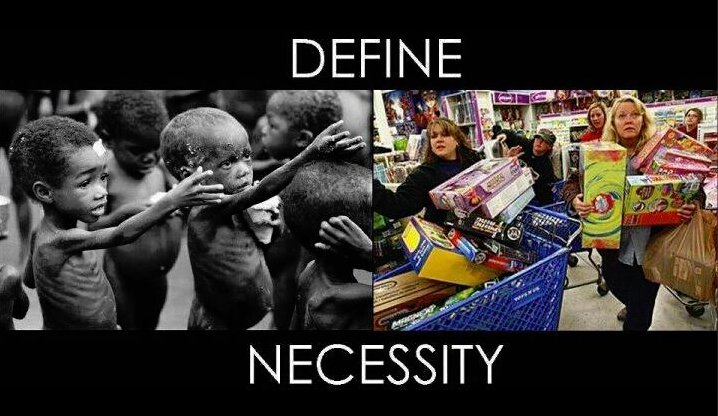
Yesterday in the U.S., we celebrated a day when we are supposed to be reminded of all of our blessings and to give thanks. For most of us, that meant conspicuous consumption of a lot of high calorie foods and if we’re fortunate, spending time in the company of friends and family we truly love, as opposed to those people we only tolerate an association with because we’re related. Today is called “Black Friday” and it is supposed to be the busiest shopping day of the year. It’s called “Black Friday” because it’s the day of the fiscal year for retail outlets that they will sell enough goods and services to put their fiancial books “in the black…” to become profitable. It’s the day untold millions of Americians will spend themselves into mindless debt buying goods that most people don’t really need for people they may not even like. This is all because in a month from now, we’re supposed to celebrate the birthday of the Prince of Peace and Savior of the world.

But as the image above is supposed to remind us, what do we truly need and who is truly in need? For me, today is “Black Friday” because I mourn the loss of sanity, generosity, and compassion, all of which has been replaced by bald greed, consumerism, and the drive to be constantly pursue mind-numbing entertainment in a complete narcissistic orgy of self-obsession.

Good Shabbos and “happy shopping.”

49 Days: Changing into a Stranger

“When he was forty years old, it came into his heart to visit his brothers, the children of Israel. And seeing one of them being wronged, he defended the oppressed man and avenged him by striking down the Egyptian. He supposed that his brothers would understand that God was giving them salvation by his hand, but they did not understand. And on the following day he appeared to them as they were quarreling and tried to reconcile them, saying, ‘Men, you are brothers. Why do you wrong each other?’ But the man who was wronging his neighbor thrust him aside, saying, ‘Who made you a ruler and a judge over us? Do you want to kill me as you killed the Egyptian yesterday?’ At this retort Moses fled and became an exile in the land of Midian, where he became the father of two sons.

“Now when forty years had passed, an angel appeared to him in the wilderness of Mount Sinai, in a flame of fire in a bush. When Moses saw it, he was amazed at the sight, and as he drew near to look, there came the voice of the Lord: ‘I am the God of your fathers, the God of Abraham and of Isaac and of Jacob.’ And Moses trembled and did not dare to look. Then the Lord said to him, ‘Take off the sandals from your feet, for the place where you are standing is holy ground. I have surely seen the affliction of my people who are in Egypt, and have heard their groaning, and I have come down to deliver them. And now come, I will send you to Egypt.’”

Acts 7:23-34 (ESV)

As I write this, it’s early Sunday afternoon and not too long ago, I got home after church services and Sunday school. The Pastor’s sermon was on Acts 7:20-43 and focused on Moses. This is part of Stephen’s defense presented to the Sanhedrin in response to (false) allegations that he spoke against Moses, the Torah, and the Temple. But Pastor Randy didn’t really present it like a legal defense. He was teaching the congregation the story of Moses and he taught it using interesting tools.

OK, for the most part, he told it using Acts and we also read from Hebrews 11:23-27 as well as Joshua 1:5-9. But he also twice referred to the Talmud. Pastor didn’t cite the specific references, but he did point out something about how Jews see Moses and the Exodus, not just how Christians see Moses. I was favorably impressed. How many Baptist Pastors refer to Talmud and the Jewish perspective regarding anything we learn in church?

I was also impressed that he took the time to explain those paintings and statues of Moses that have him wearing horns on his head as the result of a translation error, and he described Moses returning from his encounters with God on Sinai as glowing so brightly that no one could bear to look at the light. He did refer to the giving of the Torah as “delivering the scriptures” but he also called those scriptures “living words.” In referring us to Joshua 1:5-9 he re-enforced (I don’t know how many people picked up on the implications) this high view of Moses and the Torah:

No man shall be able to stand before you all the days of your life. Just as I was with Moses, so I will be with you. I will not leave you or forsake you. Be strong and courageous, for you shall cause this people to inherit the land that I swore to their fathers to give them. Only be strong and very courageous, being careful to do according to all the law that Moses my servant commanded you. Do not turn from it to the right hand or to the left, that you may have good success wherever you go. This Book of the Law shall not depart from your mouth, but you shall meditate on it day and night, so that you may be careful to do according to all that is written in it. For then you will make your way prosperous, and then you will have good success. Have I not commanded you? Be strong and courageous. Do not be frightened, and do not be dismayed, for the LORD your God is with you wherever you go.”

Joshua 1:5-9 (ESV)

Verse 8 says, This Book of the Law shall not depart from your mouth, but you shall meditate on it day and night, so that you may be careful to do according to all that is written in it. For then you will make your way prosperous, and then you will have good success.

A Baptist Pastor is saying that it’s a good thing for God to tell Joshua that he is to meditate on the Torah day and night, to be careful to obey what is written in it, and that doing so will bring success.

Wow.

Both the Pastor’s message and the Sunday school class based on that message focused on how Moses was denied by God entry into Israel because of his disobedience and for that to serve as a warning to us to be careful to obey God’s will for our lives.

If you recall, last Sunday I was more than a little “chatty” in Sunday school class and this past Sunday, I was much more restrained. I did directly answer one of the teacher’s questions, but other than that, I only spoke when engaged in light conversation, fulfilling my desire to listen and learn.

So far, the message I’m getting is one of humility, submissiveness to God, and love for other human beings. This message was consistently presented, even when the Sunday school teacher brought up the recent elections and even when he asked what our proper response should be if two gay people came into the church.

Like I said…wow.

People continue to be friendly. Complete strangers come up to me, introduce themselves (they apparently know who I am somehow) and tell me they’re praying for me. I was asked for my last name in Sunday school this time around (I think for attendance purposes), so now, in theory, I’ve become more “findable” if anyone decides to “Google” me. That means they can potentially find this series of “meditations,” which speaks a lot more about what goes through my head than I’ve exposed in the church community.

I know this is only my second week, but I was very aware of how “disconnected” I felt in church. Like I said, everyone is friendly and all, but I don’t actually know anyone, and they don’t know me. I’m not (yet) a part of the community. They aren’t really “friends” (let alone family) yet. I suppose that comes with time, and I haven’t had to enter into a completely new environment like this in a good, long while. After Sunday school class was over, all I had to do was leave. For me, there was no conversation, no activity, no relationship that was available that would have kept me at church five, ten, or twenty minutes longer.

I’m not sure what to do except keep going every Sunday (or most Sundays) and see what develops. For the first time, someone mentioned the kids rehearsing for the Christmas program, and I realized that a few of the Sundays coming up, I won’t be attending. I guess that’s one of the limits I’m putting on “community.”

Part of what we discussed in Sunday school (well, Charlie, the teacher, did most of the talking) was how Moses’ different experiences, particularly as a shepherd, changed him and prepared him for what he needed to do to lead the Children of Israel. Charlie asked if any of us had any experiences that were as drastic as going from a “prince” in a King’s palace to being a shepherd (I have, but I kept them to myself). He asked how the experiences God put in our lives changed us and prepared us for fulfilling our role in doing God’s will.

In remembering the lesson and looking at myself, I realize that in order to fit in and become a part of this community, I’ll have to change. I’m not sure how or into what or who, but something will need to progress within me that will be for my own good, even if I can’t see what it is right now.

May we have life in which God fulfills our hearts’ desires for good.

-Siddur

The followers of Rabbi Uri of Strelisk were all poor. When another Chassidic master visited him, he asked Rabbi Uri why he did not pray that his congregants become more prosperous.

Rabbi Uri called in a follower whose shabby clothing attested to his poverty. He said to him, “Now is a special moment of grace, and you will be granted anything your heart desires. Ask for whatever you wish.”

Without a moment’s hesitancy, the man said, “I wish to be able to say Baruch She’amar (the opening prayer of the morning service) with the same fervor as the Rabbi does.”

Rabbi Uri turned to his friend. “You see now for yourself!” he said. “They do not want riches. Why should I intercede to get them something they do not want?”

We ask God for many things, but most importantly, we should pray that He enlighten us what it is that we should pray for, lest we waste our prayers by asking for things that are not to our ultimate advantage and fail to ask for what is really essential.

Today I shall…

try to think about what it is that I really need and that is in my best interest, instead of focusing on things that may seem desirable but are really inconsequential.

-Rabbi Abraham J. Twerski
“Growing Each Day, Cheshvan 25”
Aish.com

This is where the “trusting God” part comes in (again). I have to trust that being here, in this church and with these people (who by and large, remain strangers to me) is the right thing to do and is what God wants me to do. I have to trust that whatever way I am to change, that I do so in God’s will and that I will change into more of who I’m supposed to be and not into a stranger to myself.

Moses was a “stranger in a strange land,” and God helped him to become more of who he needed to be, ultimately resulting in Moshe, the most humble man on all the earth, and the greatest prophet in Judaism. I am also a “stranger in a strange land.” Who am I going to be?