Tag Archives: Jesus

Uncomfortably Serving God

No person can know his own inner motives.

He may be kind because kindness brings him pleasure.

He may be wise because wisdom is music to his soul.

He may become a martyr burned in fire because his nature is to defy, his nature is to be fire.

When can you know that your motives are sincere? Only when it is not within your nature to do this thing.

And how do you know that it is not within your nature? Only when you travel two opposite paths at once.

-Rabbi Tzvi Freeman
“Real Motives”
Based on letters and talks of the Rebbe
Rabbi M. M. Schneerson
Chabad.org

This is exactly how I can tell God is working in my life; by how uncomfortable He makes me. I’ve always found it very interesting that some Christians “confirm” the wishes of the Holy Spirit in their decision making process by how much “peace” they feel after praying about a decision. Their peaceful emotional state somehow tells them that they’ve made a decision (regardless of the situation) that is in accordance to the will of God. And yet we see from Rabbi Freeman’s statement above, that people can feel “at peace” with various decisions or actions, not because their motives are pure and perhaps not even because what they are doing lines up with God’s wishes, but just because those decisions and actions are “natural” for that person.

You could argue, probably successfully, that God created us with natures that allow us to serve Him within the activities associated with our natures, but that seems somehow limiting, especially when the needs of the world are so great and so varied.

Here’s an example.

I hate going to hospitals. They kind of creep me out (I think I’ve mentioned this somewhere before). So it’s not easy for me to go to a hospital and visit a sick person. And yet, it’s a commandment of Jesus that we visit the sick. It’s far easier for me to obey the commandment to feed the hungry, because I have no emotional resistance to donating a bunch of canned goods to my local food bank. But would I volunteer to work the kitchen at my local homeless shelter once a week? Gee, I dunno.

And that’s my point. Not that we have to make ourselves serve God only in ways that trigger our discomfort, but we also need to keep in mind that those uncomfortable opportunities God plops directly in our paths to help people, are the very ones we need to do if we want to be called disciples of Jesus (as opposed to “believers” whose only fruit is to “believe”). That makes serving God a lot less approachable for many of us. I’ve heard Christians praying to Jesus to help them be more like him and wondered what would happen if God really gave them the opportunity to do so. I’m sure some people would rise to the occasion, but how many others, when it actually happened to them, would say something like, “Hey wait! This isn’t what I had in mind!”

Sure. We all want to serve God. We just want to serve Him our way and to be really cool and comfortable while doing so.

Uh-huh. Let me know how that works out for you.

Here’s another perspective:

Teshuvas B’tzeil Hachochmah suggests that our Gemara is a proof to Gaon Chida’s position. The Mishnah teaches that one who made an erech vow while wealthy and before fulfilling his vow lost his wealth remains obligated to fulfill his vow as someone who is wealthy and he is not appraised by the kohen as one who vowed when poor whose obligation is discounted in accordance with his means. Tosafos Yom Tov asserts that they will take from the person what he has towards his vow and the remaining amount will remain a debt that he will fulfill when he acquires the necessary funds. The question is how they could collect from him only part of his obligation if it may turn out that he will never have the necessary funds to pay off this debt. If that were to happen he will have never fulfilled his pledge and there was no reason to have taken funds from him in the first place. It must be that even partial fulfillment is considered fulfillment of the mitzvah and that is why they will collect from him what they can even though they may never collect the remainder.

Daf Yomi Digest
Halacha Highlight
“Fulfilling only part of a mitzvah”
Arachin 17

OK, all that might be difficult to understand, so let me boil it down a bit. If you decided to serve God out of your strengths, such as having a lot of money, and something should happen unexpectedly to make that service a lot more difficult, are you still obligated to fulfill your commitment to God? After all, you said you’d do it and presumably, you made a commitment. Are you absolved of your commitment because you misunderstood how God wanted you to satisfy the requirements of the task or because you realized that you didn’t have enough money in your bank account to cover costs?

The Rabbinic sages debate the matter and conclude that you only have to do the best you can. If you promised to donate $1,000 to the food bank but you only have $500, then you pay the $500 and it’s as if you paid the full amount. If you promised to pray for the sick each morning without fail for the next week, but you woke up late for work two days out of seven and had to rush off without praying, then praying for the sick for only five days fulfills your promise.

Gee, you can see why Jesus said this.

“Again you have heard that it was said to those of old, ‘You shall not swear falsely, but shall perform to the Lord what you have sworn.’ But I say to you, Do not take an oath at all, either by heaven, for it is the throne of God, or by the earth, for it is his footstool, or by Jerusalem, for it is the city of the great King. And do not take an oath by your head, for you cannot make one hair white or black. Let what you say be simply ‘Yes’ or ‘No’; anything more than this comes from evil. –Matthew 5:33-37 (ESV)

Of course, that doesn’t cover those unanticipated “requests” from God to serve Him that you never saw coming across the horizon. What about those areas when you want to serve God as a “prayer warrior” for an hour each day just after lunch, but instead, on your commute into work, He wants you to help a mother trying to get her sick baby to the doctor’s office by changing her flat tire? The answer is you do the best you can, and if you can’t change a flat tire, you use your cell to call your brother-in-law who works for a tow truck company to drive over and help out.

You do the best you can, which doesn’t have to be perfect. You do the best you can, even though you are really uncomfortable doing it. You do the best you can, even though sometimes God asks you to do things that make you want to crawl out of your skin.

At least you know that when you’ve served God under those conditions, it wasn’t because you were serving yourself.
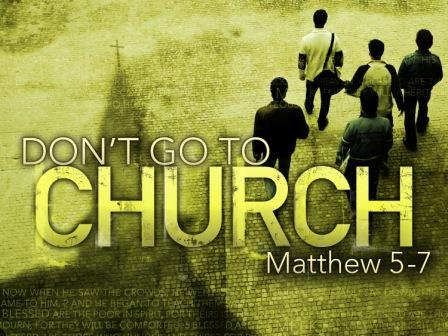

Why I Don’t Go To Church

This dialogue can happen over the Internet. God forbid that I should disparage the Internet as a means of communication; the irony would be a bit sickening. But realistically, all the activity out here is nothing – nothing! – compared to what is going on in real churches, with real people talking face to face. Real, honest dialogue with other people who bear God’s image and are trying just as hard as we are to understand and interpret the Bible.

I have seen so much good come out of the church I am in. Depending on how far you want to stretch the idiom, I have seen “the blind see, the lame walk, the lepers are cured, the deaf hear, the dead are raised to life, and the Good News is being preached to the poor.”

Have people left? Yes. Have people gotten hurt? Yes. Welcome to communal life…

-Jacob Fronczak
“Why I Go to Church”
Hope Abbey blog

For God did not appoint us to suffer wrath but to receive salvation through our Lord Jesus Christ. He died for us so that, whether we are awake or asleep, we may live together with him. Therefore encourage one another and build each other up, just as in fact you are doing.1 Thessalonians 5:9-11 (ESV)

I read Jacob’s latest blog post this morning before I went to work and responded to him that I’d probably have to write a “counter-point” blog from my perspective. I don’t write this to disagree with or to oppose Jacob. In fact, I have the greatest admiration for his writing and the message he has created for today. He’s one of the few people who blog, especially about religion, who consistently presents an attitude that is sane and calm. I always hope that I present myself as sane when I blog, but anyone who has followed my “morning meditations” for any length of time knows that I am not always calm.

Jacob makes some very good points about why a person who is aligned with the “Hebrew Roots” movement can still attend and even thrive in a traditional church setting. I’ve said this in the past and I have also said that a great deal of good is done by the church in pursuing the commandments of Jesus to feed the hungry, visit the sick, and to provide comfort to the widow. In fact, I experience that sort of lovingkindness more from the church and the traditional Jewish synagogue than I do from many of those groups who call themselves “Hebrew Roots” or “Messianic,” usually because those groups are more focused on establishing and maintaining their “rightness” than in actually doing “rightness” to others in the Messiah’s name.

On the other hand, I have reasons for not attending church. None of this is new and I’ve spread “my story” over many different blog posts and various comments in the blagonet, but after reading Jacob’s message this morning, I felt I should collect all of that here today. This also, by coincidence (if I can even believe in coincidence in a created universe), dovetails nicely into today’s morning meditation where I spend several paragraphs summarizing my “witness” or my history in the world of faith.

Up until last May, I was regularly attending and teaching at what you would call a “One Law/Messianic” congregation. I left after much prayer, study, and investigation of the assumptions that had originally attracted me to that movement because of two basic reasons: I no longer felt the One Law proposition, which states that both Jews and non-Jewish Christians are obligated to the full 613 commandment in the Torah (minus Jewish halacha and Talmudic judgments and rulings) was Biblically valid. Also, I didn’t want to worship in a religious venue in which my wife, by her very nature as a (non-Messianic) Jew, would be unable to attend, and which would prevent me, due to my “reputation” as “Messianic,” from fellowship with her communities in Reform and Chabad Judaism.

So for the past nine months, I have been unaffiliated with any specific house of worship or formal denomination or sect, and for nine months, I have not engaged in any form of communal prayer or worship.

I kind of miss it.

The idea was to join with my wife at some point, in her communal religious life, but she doesn’t really have one at this point. She very occasionally attends shul, usually for a bar or bat mitzvah, or to help in some event held at one synagogue or the other, but not for Shabbat services and not to go to any of the classes being offered. I’ve suggested that perhaps we could do something together at one of the synagogues, and after a number of conversations on the matter, she said, “we’ll see.”

So why don’t I attend a church in the meantime? One of the reasons I left “One Law” is that the Rabbis at both synagogues in town are generally “OK” with Christians visiting for worship and classes, but they have an extremely difficult time even tolerating the presence of “Messianics”. Certainly, if I attended a church, even regularly, I would be no more or less offensive to them than any other Christian who walked through their doors, and certainly there are other intermarried couples who attend both synagogues, so how out of place could I be? Church attendance shouldn’t be a barrier to synagogue worship as such.

Traffic ConesThe other reason I left “One Law” was because I didn’t want to worship alone. I don’t mean without fellowship, which I had in abundance, but without my wife. She would no more step one foot inside a church than she would inside a “Messianic” congregation and for pretty much the same reasons. I would be just as “isolated” from my wife in a church service as I ever was in a “Messianic” service. I might eventually gain fellowship with other Christians, but it would still be completely hollow without my wife.

I know what some Christians out there are probably thinking right now.

“Do not think that I have come to bring peace to the earth. I have not come to bring peace, but a sword. For I have come to set a man against his father, and a daughter against her mother, and a daughter-in-law against her mother-in-law. And a person’s enemies will be those of his own household. Whoever loves father or mother more than me is not worthy of me, and whoever loves son or daughter more than me is not worthy of me. And whoever does not take his cross and follow me is not worthy of me. Whoever finds his life will lose it, and whoever loses his life for my sake will find it. –Matthew 10:34-39 (ESV)

You could reduce that down to, “the heck with your family, Jesus is more important” or words to that effect. You could even attach my desire to attend synagogue services with my wife to what the Master said in Matthew 10:33 (ESV): but whoever denies me before men, I also will deny before my Father who is in heaven. So much for loving my wife, eh guys? But what about this?

…and said, ‘Therefore a man shall leave his father and his mother and hold fast to his wife, and the two shall become one flesh’? So they are no longer two but one flesh. What therefore God has joined together, let not man separate.” –Matthew 19:5-6 (ESV)

It’s not so easy now to simply dispense with my “other half,” even for the sake of my faith in Jesus, unless you can come up with some handy way to reconcile the dissonance created by juxtaposing those two teachings of the Master (and I’m aware that theology has come up with some rather creative ways of making discordant verses “fit” for the sake of “smoothing over” theology when rationally, they otherwise shouldn’t reconcile).

And then there’s supersessionism in the church.

I recently wrote an article for Messiah Journal called Origins of Supersessionism in the Church, which is the first of a four-part series on this topic. While I generally oppose this theology, my writing and research has made me particularly sensitive to the extraordinary harm this teaching of the church (not teaching of Jesus and Paul) has done to the Jewish people and to the worship of the Messiah within the framework of Judaism over the past 2,000 years or so. I admit to living with a certain amount of apprehension that if I ever started attending a church again, someone, a Pastor or Bible Teacher or just one of the parishioners, would spout off something about the church replacing Jews. Then I’d feel my blood pressure rise along with my temper, and I’d either just walk out, or I tell that person what I thought of their ill-considered “theology” (and then walk out or be thrown out).

Not that it would really be their fault. After all, the church has been teaching supersessionism as Biblical “fact” ever since the days of the early Gentile “church fathers.” That still doesn’t make it right nor does it mean I have to tolerate a way of understanding the New Testament that requires Judaism and every living, breathing Jew (including my wife and three children) to be deleted from religious, spiritual, and historical significance, not to mention permanently removing them from God’s love and, in at least a historical sense, removing the Jews from their very lives.

I told you I was sensitive to this stuff just now.

So that’s why I don’t go to church.

I understand what Jacob is saying and he’s right. Internet relationships are something of an illusion. I have managed to turn one or two into “real” friendships, but it always involves meeting in real life and doing stuff together. Pretty difficult for most web connections, particularly when those contacts span the globe.

Jacob ended his blog post with an invitation to those of us who are disaffected in relation to the Christian church:

If you believe in Jesus, you’re a Christian. We’re all brothers. We can be distinctive without being destructive. We can worship together. We can live together. We have to.

And maybe, just maybe, you could drop in at church sometime. We’d love to have you.

Thanks, Jacob (where ever you live…which according to his About page, is thousands of miles away from me). I’m not sure how that would ever work out, but I guess we’ll see what God has in mind.

Repairing the Turbulent Suffix

A certain sofer wrote a sefer Torah and was checking it over carefully for any possible errors, when he finally found one…Although with most errors he would only have to erase the problem and rewrite, he was unsure whether he could do so in this case. As is well known, it is forbidden to erase the Name of Hashem. In this case, the problem was not the name per se, but the suffix… Since he did not want to rewrite the entire amud, he wanted to fix the error but only if this was permitted by the halachah.

When this question reached the Taz, he ruled that the sofer could not erase the suffix…It is obvious to me that it is forbidden to erase a suffix to one of the Divine Names. Here is the proof: although we find in Maseches Sofrim that if a drop of ink fell on one of the Divine Names it is permitted to erase the ink in order to correct the blot, the Mordechai explains that this may only be permitted if letter wasn’t yet formed properly. However, if ink fell on a complete Name it would be forbidden to erase the ink. Similarly, if the letter were accidentally connected this would also be forbidden and the same is true regarding a suffix.”

When the Chut Hameshulash saw this response, he presented a different view, however. “In my opinion, although the Beis Yosef brings this Mordechai and it is l’halachah, there is room for leniency regarding a suffix. The proof to this is from Menachos 48. There we find that Rav Yochanan asks if we may do a sin in order to gain something with regard to sacrifices. From the Rambam there it is clear that we hold like the opinion of Rav Yochanan.

He concluded, “Since rectifying the shem Hashem is like saving a sacrifice, it is clear that in this case we may erase to rectify, especially since erasing a suffix is only a rabbinic prohibition.”

Mishna Berura Yomi Digest
Stories to Share
“Erasing to Rectify”
Siman 143 Seif 4(a)

I know that the information imparted in the quote above won’t make a great deal of sense to most Christians and probably even to a good many non-Jews in the “Messianic” movement. However the halacha that relates to the creation of a sefer Torah or Torah scroll is extremely specific if, for no other reason, than to avoid violating the commandment not to take the Name of God lightly or in vain (Exodus 20:7). I’m not going to attempt to provide a commentary on the ruling in this Daf, but I do want to use it as a metaphor.

A few days ago, I created a blog post called Debating Fulfillment Theology for the purpose of inviting polite debate regarding the pros and cons of the Christian theology that states the grace of Christ has wholly replaced the law of Moses. Even under the best of circumstances (and the debate is continuing as I write this “mediation,” so you are free to join it if you haven’t done so already), such dialogues rarely arrive at a unified conclusion. That is, I don’t expect that those who support fulfillment or replacement theology will “repent” and agree that it is a dangerous and unsupportable position, nor to I expect that those who disagree with replacement theology will eventually agree that the Jews must surrender their dedication to Torah and God and submit to the grace of Jesus Christ in a manner that completely denies Jews and Judaism (and I’m sure you can detect my bias based on how I worded that last sentence).

My goal for the debate is to engage in and encourage open, honest discourse with the hope of not resolving this conflict, but presenting alternate points of view. I am disturbed that the church sees replacement theology or supersessionism (though sometimes more politely cloaked as “fulfillment theology”) as concrete fact and the only possible way that the New Testament scriptures can be understood. After all, New Testament scholars have been debating for centuries (and continue to debate today) over the meaning of many portions of Paul’s letters and some of the more “difficult sayings of Jesus.” If a certain amount of scholarly disagreement remains in these interpretations, how can Christianity as a whole believe that replacement theology is such a “done deal?”

In quoting part of the Daf for Siman 143 Seif 4(a), I want to introduce an idea. I’ll use myself as an example (and I’ll try to keep this as short as possible and still form a complete picture). I was an agnostic/atheist until my early 40s as was my Jewish wife. Then I came to faith in Christ in a local Nazarene church (long story). My family and I attended for some time, but we found that many of our questions about God and Jesus weren’t being answered, especially as they related to the Jewish people.

My wife came into contact with a “Messianic/One Law” group in our community and she was immediately “hooked” (it took me a little longer to warm up to this sudden change in perspective). She strongly suggested that I attend with her and eventually, my family and I shifted our worship context from the Nazarene church to the One Law congregation. Years passed and many transitions took place. Eventually, we left the One Law congregation, and then my wife went back while the children and I attended the local Reform synagogue (another long story). Then my wife left One Law and joined the Reform shul, while I eventually went back to One Law and stayed for a number of years, proceeding from attendee to board member and teacher.

I was happy there for a time but my wife continued to explore her Judaism with the Reform synagogue and later with the Chabad and for the first time in almost 20 years of being together, we became a “mixed marriage”. My wife now identifies with the traditional Jewish community and is not “Christian” or “Messianic” in any sense.

As I watched my wife explore what it was and is for her to be a Jew within a cultural, ethnic and religious Jewish context, the basic tenants of the One Law movement seemed so discordant with what I was discovering (through my wife’s eyes) is actually Judaism (most One Law groups refer to themselves corporately as “Messianic Judaism” thus identifying themselves as a “Judaism”, even if the majority of their leaders and members are not Jews). Questions about assumptions I had made years before started coming to me and I entered into a year long investigation of who I was and what I was doing in my walk of faith (if you like reading a lot, that entire year is chronicled on my now defunct blog, Searching for Light on the Path).

Finally, I did what most religious people (or even what most people in general) don’t do. I changed my perspective, my theology, and my approach to being a disciple of the Master. In essence, I repaired what I saw as a damaged “suffix” in my understanding of God. That required great sacrifices on my part and I entered into more than one serious “crisis of faith” which resulted in quite of bit of emotional distress. These crises resolved into a new framework, the one from which I am now operating on this blog. I still take “heck” occasionally from people who don’t agree with my decision, however it’s a decision I found necessary to make for me and my relationship with God.

Why am I telling you all this and why should you care?

People can change. It’s not easy and it’s not common, but it’s possible. People can make significant and even extraordinary shifts in their theological perspectives if presented with enough evidence, but evidence is not enough. It takes the ability to admit that you can be wrong (not that God can be wrong, which would amount to actually erasing the Name of Hashem) and the courage to make changes (fix the suffix) once that admission has occurred.

No one likes change which is why a couple who is planning their wedding is stressed to the max, even though getting married is what they want to do more than anything. Any change creates stress and crisis, especially if it involves making major alterations to fundamental emotional, cognitive, and spiritual structures such as how you comprehend your trust and faith in God.

That means it is possible, however unlikely, that someone might really change as a result of this conversation. OK, I’m not holding my breath, but I am making a suggestion. As we see from the Daf above, change and correction of perceived flaws is not easy and there are times when it is necessary and times when it isn’t. Changes should be made with the utmost care and only after a great deal of deliberation, prayer, and consultation with trusted advisers.

But if change weren’t possible, no one would become a Christian in the first place, since no one is born into that state, not even people who are raised in a Christian family.

Rabbi Dr. Michael Schiffman recently made a comment on the aforementioned blog post that speaks to what I’m trying to express:

Scripture is scripture, but quoting a verse in or out of context says what the scripture says, but doesn’t tell us what you think it means. If you are going to quote scripture you have not achieved your goal until you tell us what YOU think it means. What you think it means is actually what you are basing your argument upon, so just say what you think it means or you have proven nothing.

Scripture is Scripture and the Bible is the Bible. It exists. It says what it says. But what does it mean? That depends on how we interpret it and what that interpretation means in our lives. Not everyone relates to the Bible and to God in the same way based on how we interpret the scriptures and how we interpret who we are. When presented with the challenges and crises in our life of faith and understanding, we need to keep going, no matter what the obstacles and no matter what the cost, even if the cost is that we must change or be forced to admit that we will always live a life at odds with God and in conflict with His Word.

On their exodus from Egypt, towards Mount Sinai, the Jewish people arrived at an obstacle – the Red Sea.

They divided into four parties.

One advocated mass suicide.

One said to surrender and return.

One prepared to fight.

One began to pray.

G-d spoke to Moses and said, “Why are you crying out to Me? I told you to travel straight ahead. Keep going and you will see there is no obstacle!”

The Jewish people kept going
and the obstacle became a miracle.

-Rabbi Tzvi Freeman
“Keep Going”
Based on letters and talks of the Rebbe
Rabbi M. M. Schneerson
Chabad.org

Keep going. Like Nachshon, plunge into the turbulent seas. When you find them, you can fix mistakes. Miracles are possible.

My God, guard my tongue from evil, and my lips from speaking deceitfully. And to those who curse me, let my soul be silent and let my soul be like dust to everyone. Open my heart to Your Torah, then my soul will pursue Your commandments.

-from the Elohai N’tzor

Slandering the Image of God

The Sages tell us, “What is the remedy for one who has spoken leshon hara (slanderous speech)? If he is a Torah scholar, let him engage in Torah study.” (Arachin 15b). Leshon hara defaces man’s “image of God”, and Torah study restores it.

According to the Midrash (Tanchuma, Kedoshim #13, and Nedarim 32a), Avraham was punished for his reaction to God’s promise in the Bris bein Habesarim that He would grant him possession of the land of Canaan. God told him, as it were, “You want to know? Here is something you can know (Bereshis 15:13): ‘Know with certainty that your offspring will be strangers.’”

Daf Yomi Digest
Distinctive Insight
“The power of word”
Arachin 15

There is one who speaks [harshly] like piercings of a sword, but the tongue of the wise heals. True speech is established forever, but a false tongue is only for a moment. –Proverbs 12:18-19 (Stone Edition Tanakh)

I suppose I’ve been on something of a mission lately to try and emphasize that, among people of faith and disciples of the Master, we have an obligation to treat each other with the same love and respect that Jesus has for his people, both the “lost sheep of Israel” and we non-Jews sheep who are “other sheep…not of this fold” (John 10:16). I know I’ve said this before, and blogs and sermons on the topic of “lashon hara” (the evil or slanderous tongue) are plentiful, but it is a lesson that we can’t seem to get enough of. I say this because, if we were taking this teaching to heart and incorporating it into our lives (and our speech), then there wouldn’t be so much harmful speech, insults, and character assassinations in the religious blogosphere.

And I would be writing about something else this morning.

It’s interesting what the Daf has to say about the “cure” for “evil speech”. “What is the remedy for one who has spoken leshon hara (slanderous speech)? If he is a Torah scholar, let him engage in Torah study.” Is the same remedy available for those of us who are not Torah scholars? I hope so (though I can’t speak from Jewish halacha on the matter). Where else can we find a cure for the evil that resides inside us than within the Word of God?

The commentary on the Daf tells us why speech is so important and how it can be so potentially lethal:

Rav Shach once explained that the uniqueness of man in creation — the “image of God” that was bestowed upon him—lies in the fact that he is a “living soul”, which Onkelos renders as “a speaking spirit.” It is the ability to speak that sets man apart from the beasts. The power of speech is indeed a reflection of “God’s image.” Just as God’s very word is capable of accomplishing the same as an actual deed, as it says (Tehillim 33:6): “By the word of God the Heavens were created,” so too is man’s power of speech capable of “establishing the heavens and settling a foundation for the earth” (Yeshaya 51:16). We must therefore ensure that our speech is pure and exact, in order not to corrupt the “image of God” within us.

This is why Avraham was punished for his expression, “How can I know,” although this was seemingly only a minor impropriety of speech. Similarly, Moshe was taken to task for asking God (Shemos 5:22; see Rashi ibid., 6:1), “Why have You treated this people badly?” There are many other examples of improper expressions and harsh penalties for them — all because of the fact that to misuse the gift of speech is to tarnish man’s image of God.

One way I choose to read this is that the “power” of speech comes from our being made in the “image of God” and that it defiles something about our Creator when we misuse this unique gift that he has provided only to humanity. Also, when we use this unique gift to harm another, we are injuring something of that “image” in the other person. Harmful speech damages not only that aspect of God in which we were made, but the same aspect in the other human. It is as if we are using “the power of the word” to damage or destroy “the power of His Word.” So we are hurting ourselves, hurting someone else, and “hurting” God when we commit “lashon hara”. Why is it so easy (I say this, because such speech is exceptionally common in the blog comments I read in the religious blogosphere) for us to spew our insults and harsh words on other brothers and sisters in the faith?

Haven’t we read what the Master said about this?

It is not what enters the mouth that contaminates the person, but what comes out from the mouth – that contaminates the person. –Matthew 15:11 (DHE Gospel)

Even the brother of the Master teaches this lesson.

Not many of you should become teachers, my brothers, for you know that we who teach will be judged with greater strictness. For we all stumble in many ways. And if anyone does not stumble in what he says, he is a perfect man, able also to bridle his whole body. If we put bits into the mouths of horses so that they obey us, we guide their whole bodies as well. Look at the ships also: though they are so large and are driven by strong winds, they are guided by a very small rudder wherever the will of the pilot directs. So also the tongue is a small member, yet it boasts of great things.

How great a forest is set ablaze by such a small fire! And the tongue is a fire, a world of unrighteousness. The tongue is set among our members, staining the whole body, setting on fire the entire course of life, and set on fire by hell. For every kind of beast and bird, of reptile and sea creature, can be tamed and has been tamed by mankind, but no human being can tame the tongue. It is a restless evil, full of deadly poison. With it we bless our Lord and Father, and with it we curse people who are made in the likeness of God. From the same mouth come blessing and cursing. My brothers, these things ought not to be so. Does a spring pour forth from the same opening both fresh and salt water? Can a fig tree, my brothers, bear olives, or a grapevine produce figs? Neither can a salt pond yield fresh water. –James 3:1-12 (ESV)

If you’ve been a Christian for any length of time, you already know these lessons and you know what they mean. If you then continue to deliberately use your speech (or what you write in blog comments or discussion threads on the Internet) to hurt someone else, you must realize that you are also deliberately disobeying the teachings of Jesus and spitting on the will of God. Please keep that in mind.

I am sometimes questioned about how I can use Jewish teachings to help me better focus on the lessons of Jesus (and no, I am not a “mere imitator of Judaism” in my faith or practice), but I find many seemingly associated themes. I don’t know that they are directly connected in any manner, but I find them comforting nonetheless.

Today’s daf discusses the negative consequences of speaking leshon hara.

Once a certain father heard that a child of the rebbe of Toldos Aharon, zt”l, wished to make a match with his daughter. He was overjoyed…until someone told him that the young man was not in his right mind. Obviously, the father was distressed. He was also worried about how to ascertain the truth; surely a maggid shiur or other person within the Toldos Aharon system wouldn’t say anything negative about the rebbe’s grandson.

He finally decided to ask the rebbe himself, since he was certain that the tzaddik would not deceive him. When this question was put to the rebbe he denied the claim against his grandson. “I know that child since he was born. No one has ever thought there was anything wrong with him.”

The father was very glad to hear this, but also furious at the one who had slandered the innocent bochur, and immediately blurted out, “Do you know who told me? It was…”

“Just a moment,” the rebbe firmly interrupted, “It is a question of leshon hara. Perhaps you are forbidden to tell me. Working out whether this is permitted is no simple matter. I am going on a fundraising trip for two weeks in the next few days. When I return you are welcome to come back and I will tell you the halachah.” When the rebbe was away, he learned the entire Sefer Chofetz Chaim through twice with great care. When he returned, the father of the girl—now engaged to the rebbe’s grandson—came to ask whether he was permitted to tell the rebbe who had slandered the bochur.

The Rebbe of Toldos Aharon said, “I learned the sugya very carefully while I was away and I concluded that if you don’t derive any pleasure in the telling, you are permitted to tell me who slandered the young man.”

Before the man could say a word, however, the rebbe stopped him with a motion. He astounded the man with his concluding words, “It may be permitted, but nevertheless, I do not wish to hear about it!”

Daf Yomi Digest
Stories Off the Daf
“A Question of Leshon Hara”
Arachin 15

We may not be able to prevent our brother from using harmful speech or trying to “stir the pot,” but we can certainly control our own tongues (or fingers on the keyboard). And like the Rebbe of Toldos Aharon, when someone is about to speak in such a manner, even if it is “permitted,” we can refuse to listen and refuse to respond.

In Silence Like Sheep

Today’s daf discusses the halachos that apply to a person who has shamed his fellow Jew.

Rav Raphael of Barshad, zt”l, was always careful to see the good in every Jew. Judging others favorably was part of his very nature. Another important characteristic of Rav Raphael was that he was always happy when embarrassed by others. To him, this was the biggest favor that one can receive from anyone. The Ramak, zt”l, writes in Tomer Devorah, that since being shamed is likened to being killed, one who is silent in the face of humiliation has atoned for all of his sins. Like dying, even the worst sins are wiped away if one endures disgrace quietly.

The Ramak adjures people to take this to heart. “Everyone falls short in one way or the other and requires atonement for his failings. What is better? To suffer pain and illness—which cause a person to lose precious time from learning—or to be shamed? Enduring humiliation is a matter of having the right attitude and truly understanding that the humiliation has saved him from much worse. If one achieves this understanding he will not hold it against the person who shamed him. On the contrary, he received a gift from the one who embarrassed him.”

When people would come to Rav Raphael about having endured shame, he would explain the greatness of enduring embarrassment and that this had saved the person much worse troubles. When the person was consoled, he would laugh with pure joy and say, “How wonderful!”

Daf Yomi Digest
Stories Off the Daf
“A Silent Atonement”
Arachin 14

Periodically, I experience some rather impassioned arguments happening in the comments sections of various blog posts. I don’t mind and even encourage spirited debate, but there were moments when that “spirit” crosses the line into insult and harm. We cannot behave like this as disciples of the Master and this is clear disobedience of his commandment for us to love one another (John 13:34). I know what it is to get a “head of steam up” in an argument and to lose sight of what I’m trying to express and why. In that moment, all that really seems to matter is to prove my point and to show “the other guy” that they are in error. Sometimes it may seem really is important to point out an error made in understanding our faith, but at what cost? Is it worth promoting resentment and division in the body of Messiah? Must we always have the loudest voice?

When reading the commentary on the Daf, I was immediately captured by how much this seems to describe Jesus. I doubt the author meant to create such a parallel, but for the Christian, it is unavoidable.

He was oppressed, and he was afflicted,
yet he opened not his mouth;
like a lamb that is led to the slaughter,
and like a sheep that before its shearers is silent,
so he opened not his mouth. –Isaiah 53:7 (ESV)

And the high priest stood up and said, “Have you no answer to make? What is it that these men testify against you?” But Jesus remained silent. –Matthew 26:62-63 (ESV)

How many of us would remain silent in such a situation? How many of us, even knowing what was at stake, would fail to vigorously defend ourselves against these unfair charges and attempt with all our might to avoid a death sentence and execution on the cross? And yet, in a way, we are commanded to do exactly that: to accept even death in silence, enduring everything for our Master’s sake.

But I say to you, Do not resist the one who is evil. But if anyone slaps you on the right cheek, turn to him the other also. –Matthew 5:39 (ESV)

And he said to all, “If anyone would come after me, let him deny himself and take up his cross daily and follow me.” –Luke 9:23 (ESV)

Recall the commentary from today’s Daf which says that insulting someone is the same as murdering them (and I’ve written about this recently), and that enduring an insult in silence is as if you died and have atoned for all of your sins. I realize that Talmudic midrash is not to be taken as literal fact, but Jesus did endure his own murder in silence and in fact, his death did atone for the sins of the world. It’s all right there, if we’ll only pay attention.

We all like to say that we want to “be like Jesus.” For most of us, that doesn’t mean literally dying a horrible and torturous death for the sake of others, but it does mean enduring many insults for the sake of Christ. He even said this would happen to us.

Brother will deliver brother over to death, and the father his child, and children will rise against parents and have them put to death, and you will be hated by all for my name’s sake. But the one who endures to the end will be saved. –Matthew 10:21-22 (ESV)

So did James.

Count it all joy, my brothers, when you meet trials of various kinds, for you know that the testing of your faith produces steadfastness. And let steadfastness have its full effect, that you may be perfect and complete, lacking in nothing. –James 1:2-4 (ESV)

Can you see why the Jewish lens often illuminates the words of the Jewish Messiah, even without apparent intent? And yet there are those who are uncomfortable with the way I choose to view my Master, and some even insist that the Jewish perspective is not only worthless, but has long sense been wiped away and replaced by the singular and wholly “un-Jewish” Christian interpretation. However, I do not want even this point to be the cause of divisiveness between brothers in the Messiah. There is much value in offering consideration for one another for the sake of peace.

“They said of Rabbi Yochanan ben Zakai that no man ever greeted him first, even idol worshippers in the market” [i.e., Rabbi Yochanan ben Zakai was the first to greet every person, even idol worshippers] (Berachot 17). At the same location the sage Abaye advocated soft speech and words of peace to everyone, especially including idol worshippers.

“[it is proper to] support the idol worshippers during the sabbatical year… and to inquire after their welfare [commentators: even on the days of the holidays of their idols, even if they do not keep the seven Noahide commandments] because of the ways of peace.” (Shevi’it 4,3)

The rabbis taught: ‘We support poor Gentiles with the poor people of Israel, and we visit sick Gentiles as well as the sick of Israel and we bury the dead of the Gentiles as well as the dead of Israel, because of the ways of peace.” (Gitin 61a)

the-joy-of-torahAs a Christian, part of how I approach the ways of peace between me and Jewish people is to attempt to understand what Judaism means to a Jew, to the best of my meager ability. Taking joy in the Jewish people and in Judaism may be what the Jewish Messiah himself did as he gazed longingly at Jerusalem, anticipating the final salvation of Israel (Matthew 23:37-38). What he said began in sorrow and dismay, but will one day conclude in great happiness, as we see in the words of Rabbi Tzvi Freeman:

This is the meaning of a Jew and Judaism, the very meaning of the word: To live in a state of sustained wonder. To know that there are things beyond human grasp. That the very existence of anything at all is beyond knowing. And then to strive to know.

Let us endure much in silence and humility for the sake of our brothers and for the Messiah, that we may one day know what is beyond knowing, and shout in brotherly joy at the feast of Abraham, Isaac, and Jacob (Matthew 8:11).

You are the God Who works wonders, You manifested Your might among the nations. With Your powerful arm You redeemed Your nation, the sons of Jacob and Joseph, Selah. –Psalm 77:15-16 (Stone Edition Tanakh)

Debating Fulfillment Theology

This “logic” is plainly presented in Galatians 3. God had a very good reason to institute the Law of Moses and it has nothing to with “bait and switch.” It had to do with point and lead until the fulfillment of its goal. The emphasis of the salvation that was to come for all of mankind goes back to the promise made to Abraham.

-Eugene Adkins
in his January 27 comment on my blog post
The Lord’s Sabbath

This understanding of the function of a paidagogos clears up Galatians 3:23, where Paul says, “Now before faith came, we were held captive under the law, imprisoned until the coming faith would be revealed” (Galatians 3:23). The paidagogos was the child’s guardian, not his jailer. When we understand that the paidagogos was responsible for protecting, supervising, and directing a child, then we have a better understanding of how the Greek text of Galatians 3:23 should be rendered in English. The Greek word which the English Standard Version translates as “held captive” has a different connotation. It can also be rendered as “protected,” “kept safe,” or “guarded.” The word should be understood as speaking about how a pedagogue kept a child safe and out of trouble. Similarly, the Greek word which the ESV translates as “imprisoned” (the same word appears in 3:22) can be rendered as “kept in” or “enclosed” in a positive sense. The word should be understood as speaking about how a pedagogue kept a child inside for his school lessons. He did not allow the child to run off and follow his friends into trouble. He kept him shut up inside for the purpose of education and protection.

-D. Thomas Lancaster
“Sermon Eighteen: The Pedagogue (Galatians 3:19-26), pg 182
The Holy Epistle to the Galatians
First Fruits of Zion
August 2011

Ziesler, “Role of the Tenth Commandment,” p. 50, makes the important observation in Rom. 8:4 of the use of the singular…(“requirement”) in Paul’s conclusion: “having talked in 7.1-6 about dying to the Law, Paul now in a notably bald statement appears to bring us back to life again in relation to the Law, if not under it. We died to the Law in order to keep it better.” He further suggests that this singular reference keeps the singular sin of covetousness in perspective (pp.50-51).

Snodgrass, “Spheres of Influence,” p. 107 states: “If the law is not involved in salvation, then sin is a victor because it defeated God’s law which was for life (7.12.10). But now the law is placed within the sphere of the Spirit (cf. 8.4), where it belongs (7.14). The law in the right sphere frees us from the tyranny of the law in the sphere of sin. I do not think we can ignore a reference to the OT law. It is through the law that Paul died to the law.”

Footnotes 55 and 56
from “Summary and Appendix I,” pp 365-66
in the Mark D. Nanos book
The Mystery of the Romans
Fortress Press (1996)

Important Note! Please read the first comment made by Eugene Adkins below, as he corrects some mistakes I made about his background and role. I apologize to Eugene and to everyone reading this for my errors.

I’ve been debating with Pastor Eugene Adkins in the comments section of my blog post The Lord’s Sabbath regarding what he refers to as “fulfillment theology” and what I consider supersessionism or “replacement theology” (see our series of comments on the aforementioned blog post for full details of this discussion and specifically Pastor Adkins’ comments submitted on Jan 27, 2012 @ 17:31 hours).

In response to some of Pastor Atkins’ points, I’ve quoted from both Lancaster’s recent Galatians book and the classic Nanos tome on Romans (or rather, some footnotes contained within the Nanos book). I’m doing this for several reasons. The first is that, unlike Pastor Adkins, I do not have a post-graduate degree in any form of religious studies (I assume as a Pastor that Adkins is so educated) and thus do not have skill sets equal to his own as far as debating the scriptures. In order to support my arguments, I must rely on the scholarship of external sources, namely the previously mentioned Lancaster and Nanos books.

Secondly, I want to introduce valid and scholarly sources that refute or at least bring into question the traditional Christian view that the Torah was only temporary for the Jewish people (and I have never said that the Law was intended to apply equally to the Jewish and Gentile disciples of Jesus in any equal fashion) and that once Christ lived, died, was resurrected, and ascended, that the Law became null and void (or “fulfilled” in the sense that its temporary purpose as completely satisfied and then ended), and wholly replaced by what Pastor Adkins refers to as Christ’s “international covenant” that applies uniformly to Jewish and non-Jewish disciples of Jesus. I’m trying to point out here that perhaps Pastor Adkins’ interpretation of scripture (which seems to be the interpretation of the church in general) is not the only possible way to understand what Paul was saying to the congregations of Rome and Galatia.

Finally, I want to be fair. There is a tremendous tendency for me to simply dig in my heels, say “you’re wrong,” and base my subsequent responses on my emotional states, particularly those that have to do with Christian supersessionism and its terrible (and often fatal) effect upon the Jewish people across 2,000 years of church history. But that’s not the right thing to do. I want to respond based not only on my spiritual “understanding” of God’s relationship with both Jews and Gentiles (which is completely subjective and therefore, unable to be objectively demonstrated) but on Biblical scholarship as well. The problem here is that I’m like Woody Allen trying to go a few rounds in the ring with Mike Tyson as far as our relative educational backgrounds go (well, probably not that bad).

I have two undergraduate degrees and a post-grad degree, but none of them are in subjects relevant to this conversation. Given my job, my book writing, and my family commitments, I don’t have the time or other resources to go back to school and take another degree, or to perform the necessary research to adequately respond to all of the specific points being brought up in this discussion in order to sufficiently represent my point of view. I believe I’m right based on everything I’ve learned thus far, but belief isn’t enough. I must have proof beyond what I have already demonstrated, both online and in print. Also, assuming that I can be wrong (and I know I can be), I need to either confirm or refute my current belief system using concrete evidence (or as “concrete” as anything gets in theological debates).

That’s where you, dear readers, come in. I’m calling for backup. Or I’m willing to be presented with irrefutable proof that the New Testament writings can be interpreted in one and only one, single manner, and that the one and only interpretation is held under lock and key by the 21st century evangelical Christian church. I personally don’t think it is, but like I said, I want to be fair.

I want to say to you personally Eugene, that I’m not writing this to try and be mean or unfeeling or offensive in any way. I know you are sincere and are representing the truth based on everything you’ve been taught and everything you believe, both intellectually and through your faith. I don’t have a problem with any of that. None of this is motivated by any dislike of or anger toward you. I respect your service to God and thank you for continuing to participate in our dialog rather than summarily “writing me off” as some sort of “religious nut.”

My problem with the traditional Christian position on supersessionism is that, even clothed in a pleasing and benign exterior, this “fulfillment theology” is a nearly 2,000 year old artifact that was first created when the schism between Jewish and non-Jewish believers began to develop and then exploded across the early history of the church, in order to artificially justify the ascension of the Gentiles over the Jews in Messiah, and to literally re-write the nature and character of Christian vs. Jewish “Messianism,” as we see in part here:

The destruction of the Second Temple in 70 CE and the subsequent expulsion of the majority of Jews from what would be called Palestine marked a disastrous shift in the Jewish authority over the Messianic community. Up until that time, the head of the Jerusalem leadership of the Messianic community, otherwise referred to as “the bishop of the church”, had always been Jewish. Once the Jews were expelled from Jerusalem by Hadrian, for the first time a Gentile had to be elected into the role. As events moved forward from that point in time, the Gentile presence in the Messianic community grew dramatically while the Jewish leaders and worshipers of Yeshua struggled under the heartbreak of the loss of the Temple and the ejection from their land. Scant decades later, the failure of the Gentile “church” to support the Jewish revolt of Bar Koshba drove another significant wedge between the Jewish Messianic community and the body of Gentile believers.

With the Jewish population now scattered, humiliated, and fearing destruction at the hands of the Romans, the Gentile Messianics continued to secure their dominance and control of the worship of Yeshua. The self-identity of the Gentile Christians shifted from grafted-in to the root of Judaism through Abrahamic faith to the new inheritors of the Messiah, replacing Israel on a spiritual level. Origin of Alexandria and Justin Martyr were the earliest authors of this tradition and among the first to declare that the church had superseded Israel. Attached to this belief was the rise of Christian blame against the Jews for the murder of Jesus. The Jews became unworthy of their own Messiah and were pushed out of the worship of Yeshua by the Gentile disciples they had once taught and nurtured.

-James Pyles
Excerpt from “Origins of Supersessionism in the Church” (pp. 33-34)
Messiah Journal
Issue 109/Winter 2012

I previously said that I don’t have an advanced degree in religious studies, but as a published author, I do know how to do research, including delving into the history of how “the Way,” which started as a sect of Judaism inclusive of non-Jews but administered and guided by Jewish mentors who understood God and Messiah in a completely Jewish religious framework, into a newly created non-Jewish religion which found it necessary to eliminate any aspects of Judaism from its background.  In my review of the early church, I could see the early “church fathers” virtually reframe the letters of the early Jewish disciples, principally written by Paul, into words that would ultimately be used to discount and eventually all but exterminate the Jewish people.

I’m opening this blog post up for debate on the pros and cons of “fulfillment theology” and asking for those who are far wiser and much better educated and I in religious subjects to enter into the conversation. I do insist however, that this conversation remain polite and respectful. Disagreement is absolutely no excuse for undue emotionalism or any personalizing of conflict. Any apparent “attacks” on someone who differs from your point of view will not be tolerated and I, as the blog owner, reserve the right to edit or delete any offensive comments at my discretion.

This debate is specifically focused on the pros and cons of “supersessionism,” “replacement theology,” “fulfillment theology,” or whatever else you want to call it. It is NOT about One Law or Two House perspectives, so I am not inviting statements on those viewpoints to be presented here. If you find it necessary to disregard my wishes in this, your comments will be removed. Thank you.

With those disclaimers out of the way, please feel free to refer back to the full stream of comments on the “Sabbath” blog post, then return here and discuss how you support or refute my statements and Pastor Adkins’s statements. Please cite specific Biblical or other sources to support your arguments. I am asking for information, not unbridled passion.

One last thing before we begin. Eugene, you previously said:

How is lighting candles a confirmation of Jesus’ grace if that person doesn’t believe in Jesus to begin with?

Shabbat candlesI do have faith in Jesus, as you do Eugene. Watching the lighting the Shabbos candles is a beautiful and unique way of inviting him into my home and to experience something of a preview of his return to us, may it be soon and in our days. If perhaps, your comment were meant as a remark toward my wife who is Jewish but not a believer, I can only ask that you try to consider her with the same compassion and love that God has toward His am segulah; His “wondrous and treasured people” (Exodus 19:5). I can’t tell your attitude toward Jews and thus toward my wife and children through our “text-only” conversation, but if you cannot see them with the same compassion as God does, and believe God has discounted if not completely destroyed them, then I suppose my argument has already been made for me.

With that, I look forward to everyone’s contribution now and in the days ahead. I hope to learn a lot.