Tag Archives: Judaism

Jesus the Traditionalist Jew

However, the Jewish background of the ideas of the Jesus movement is only one piece of the new picture I’m sketching here. Much of the most compelling evidence for the Jewishness of the early Jesus communities comes from the Gospels themselves. The Gospels, of course, are almost always understood as a marker for a very great break from Judaism. Over and over, we find within the interpretations of them (whether pious or scholarly) statements of what a radical break is constituted by Jesus’ teaching with respect to the “Judaism” of his day.

Even among those who recognize that Jesus himself may very well have been a pious Jew – a special teacher, to be sure, but not one instituting a consequential break with Judaism – the Gospels, and especially Mark, are taken as the sign of the rupture of Christianity, of its near-total overturn, of the forms of traditional (Jewish) piety.

-Daniel Boyarin
Chapter 3: “Jesus Kept Kosher”
The Jewish Gospels

I’ve been slowly, very slowly reading Daniel Boyarin’s excellent book The Jewish Gospels and have written regarding my responses to his text in two previous blog posts: The Unmixing Bowl and The Son of Man – The Son of God. Daniel Boyarin is a noteworthy Talmudic scholar and Professor of Talmudic Culture in the Departments of Near Eastern Studies and Rhetoric at the University of California, Berkeley, so I’d have to say that, at least from my point of view, he knows his stuff. The book I’m reading contains an examination of the “stuff” about the ancient perceptions of Jesus and how it may not have been unusual at all for many Jews in the late Second Temple period to see Jesus as Rabbi, Messiah, Prophet, and indeed, Divine Son of God.

In the third chapter of his book, Boyarin examines the “Jewishness of Jesus”.

For anyone involved in the Messianic or Hebrew Roots movements, the fact that Jesus was (and is) Jewish and that he led a completely normative Jewish lifestyle as recorded in the Gospels is no surprise, but it may have been to Boyarin when he first encountered the “good news” of the Master. I still think that Boyarin isn’t personally convinced that Jesus is Messiah King or Son of God, but he does seem to be strongly suggesting that it is no mystery why Jews in the Holy Land 2,000 years ago (and even more recently in many parts of the world?) would believe that he was.

The portion of Boyarin I quoted above aptly defines how most modern Jews and Christians see the role of the Gospels: as defining a sharp break from Jews and Judaism in the teachings of Jesus and the establishment of the very “unJewish” Christian religion. But as we already know, this was hardly the case.

Counter to most views of the matter, according to the Gospel of Mark, Jesus kept kosher, which is to say that he saw himself not as abrogating the Torah but as defining it. There was controversy with some other Jewish leaders as to how best to observe the Law, but none, I will argue, about whether to observe it. According to Mark (and Matthew even more so), far from abandoning the laws and practices of the Torah, Jesus was a staunch defender of the Torah against what he perceived to be threats to it from the Pharisees.

Boyarin characterises the Pharisees as “a kind of reform movement…that was centered on Jerusalem and Judaea (and who) sought to convert other Jews to their way of thinking about God and the Torah.” It’s interesting (since I’ve never heard this interpretation before) that Boyarin characterizes the tension between Jesus and the Pharisees as one of interpretation of halakah. According to Boyarin, the Pharisees may have represented the establishment of religious practices that were formed during the Babylonian exile “while the Jews who remained in the land continued their ancient practices.” Jesus, Boyarin asserts, supported the more ancient Jewish practices and was actually a Torah conservative and traditionalist compared to the “radical innovations in the Law stemming from the Pharisees and Scribes of Jerusalem.”

We usually see Jesus (at least those of us to perceive him as a wholly Jewish man and teacher living a life consistent with the covenant of Sinai) as interpreting the “true” Torah in opposition to the “leaven of the Pharisees” who made up all kinds of stuff and were totally hypocritical. Boyarin suggests that the struggle between the two “Judaisms” may have been one of traditional halakah (Jesus) vs. reform interpretation (Pharisees and Scribes).

Far from being a marginal Jew, Jesus was a leader of one type of Judaism that was being marginalized by another group, the Pharisees, and he was fighting against them as dangerous innovators. This view of Christianity as but a variation within Judaism, and even a highly conservative and traditionalist one, goes to the heart of our description of the relations in the second, third, and fourth centuries between so-called Jewish Christianity and its early rival, the so-called Gentile Christianity that was eventually (after some centuries) to win the day.
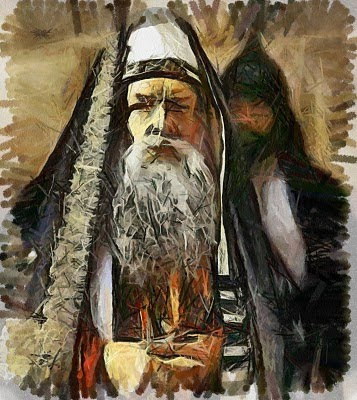
I realize that Boyarin’s opinion is a minority view among both Jews and Christians, but it is compelling to consider that the “original” Jesus Christ was not only a Jew who never broke the Laws of Moses or taught others to break them, but was a teacher who was strongly advocating for a return to a very conservative and traditionalist interpretation of Torah relative to the normative Judaism of those times.

Wow.

Imagine what that might mean to 21st century Christianity and Judaism. Imagine what that might mean to the movement we call “Messianic Judaism,” which is struggling tremendously to establish its own Jewish identity and connection to the other Judaisms of our modern era. Jesus the Jewish traditionalist. Jesus the teacher of conservative halakah.

Like I said. Wow.

Apparently, Boyarin isn’t the only Talmud scholar who holds this opinion of the relationship between Jesus and the Pharisees.

Yair Furstenberg, a young Talmud scholar at the Hebrew University, has recently provided a convincing explanation of the basic controversy between Jesus and those Pharisees. Furstenberg writes that Jesus’ statement (see Mark 7:14-23) needs to be read literally that the body is made impure not through ingesting impure foods but only through various substances that come out of the body…

…This is a debate between Jews about the correct way to keep Torah, not an attack on the Torah. Furstenberg has brilliantly argued that in its original sense, Jesus’ attack on the Pharisees here is literal; they have changed the rules of the Torah…

Really. Consider this. The argument that most Christians interpret about whether or not Jesus made all foods clean had nothing to do with abrogating the kosher laws. It was an argument between different factions of Jews on what made a person impure, which was not eating food but coming into contact with certain objects and substances such as a dead body or certain bodily fluids (you’ll have to read the whole chapter to get the details since Boyarin’s analysis is lengthy). He even presents a different view of Pharisees as “hypocrites” which doesn’t quite fit with what most Christians believe:

We should remember, however, that “in general, in ancient Jewish and Christian contexts a ‘hypocrite’ is a person whose interpretation of the Law differs from one’s own,” as Joel Marcus has so sharply put it.

That statement recasts the Pharisees in the role, not as liars and frauds, but as Jews who had a (sometimes) radically different perspective on halakah from the more conservative interpretation of Jesus.

Of course, the vast, vast majority of people in the church and probably in the Christian colleges and seminaries won’t agree with this. Boyarin suggests a corrective solution, but I don’t know how many believers, scholarly or otherwise, would be willing to try it out:

When put into its historic context, the chapter is perfectly clear. Mark was a Jew and his Jesus kept kosher. At least in its attitude toward the embodied practices of the Torah, Mark’s Gospel does not in any way constitute even a baby step in the direction of the invention of Christianity as a new religion or as a departure from Judaism at all.

Mark is best read as a Jewish text, even in its most radical Christological moments. Nothing that Mark’s Jesus proposes or argues for or enacts would have been inappropriate for a thoroughly Jewish Messiah, the Son of Man, and what would later be called Christianity is a brilliantly successful – the most brilliantly successful – Jewish apocalyptic and messianic movement.

Those of you who have read more than a few of my blog posts know I’m no Biblical scholar. I don’t have the “chops” to adequately evaluate Boyarin’s perspectives relative to other learned texts and teachers and to determine how much evidence there is to support his assertions. However, in general, what he presents to his readers is quite consistent with what is believed by modern “Messianic Jews” and those Gentiles who are called to follow that path of faith.

Jesus was and is a Jew. This “Jewishness” is written all over the Gospels. Jesus never attempted to depart from normative Jewish practice in even the slightest manner and as we see, he may very well have been advocating for a return to the more conservative and traditional understanding and practice of ancient halakah.

Imagine what this will mean for Christians and Jews everywhere when the Son of Man returns in glory. Imagine what it will mean, and what it should mean, to all of us right now.

Worshiping the God of Israel and giving great and very high honor to the Jewish Messiah King within a completely normative Jewish context is not dead. In fact, when he comes back to us and establishes his throne, it’ll all just be getting started.

Love, God, the World, and Everything

“Just as the bride circles around the groom as an expression of yearning and love, so do we circle Jerusalem’s gates as we express our yearning to see it rebuilt, our yearning for the days when we will all be able to go up to the Temple Mount and to the [rebuilt] Temple, and not just walk on the perimeter road that surrounds the walls”, said Nadia Matar.

The18th Annual Walk Around The Walls – Jerusalem
By Yehudit Katsover and Nadia Matar
As quoted from Magic City Morning Star

The Jerusalem Talmud makes an astounding statement: “The generation in which the Beit Hamikdash, the Temple, is not rebuilt is to be regarded as though the Beit Hamikdash was destroyed in that generation.” The explanation is simple. When we mourn for the Beit Hamikdash, we are not mourning for a building that was destroyed 2,000 years ago. Our mourning must be directed to the realization that each generation is obligated to rebuild the Beit Hamikdash and that our failure to do so has little to do with politics, the debate over who has control over the Temple Mount, or the threat of the Arab nations to go to war if we disturb the mosques that sit atop the Temple Mount. The Beit Hamikdash will be rebuilt when a sufficient number of Jews make a commitment to change their lives. When will the Messiah come? As the Torah says, “Today, if you hearken to My voice.”

-Rabbi Pinchas Stolper
“Why Do We Still Mourn”
Excerpted from Living Beyond Time: The Mystery and Meaning of the Jewish Festivals
quoted from Aish.com

I really thought I was done blogging about Tisha B’Av and the Temple and was planning on continuing to write about how we in the community of faith can love, but Rabbi Stolper’s article was recommended to me by a friend on Facebook (one who I’ve met in real life…thanks, Michele), so I thought I should read it.

And I couldn’t stop reading it, and thinking, and then writing.

When writing about Tisha B’Av, I naturally tend to focus on grief and loss. It never occurred to me to see the annual event of marching around Jerusalem as an act of love. In retrospect, it should have been obvious to me. Now it always will be.

But as I mentioned yesterday, how we love and even why we love can be terribly misunderstood. When a Christian says that he or she loves all people made in the image of God, including gay people, the LGBT community and the atheist world tends to doubt that Christian’s sincerity, at least unless the Christian follows up by saying they wholeheartedly support “marriage equality.” I mean, how can you love gay people if you don’t support their desire to marry? But then, how can you love God, love the teachings of Christ, believe his definition that marriage occurs exclusively between a man and a woman (see Matthew 19:4-6 as it references Genesis 1:27 and Genesis 2:24) and still be expected to love a gay person only by supporting “marriage equality?”

The answer is that Christians will express their love in many and varied forms as God defines love, but not as absolute agreement and approval of all progressive social and political expectations.

But when you love Jerusalem:

If I forget you, O Jerusalem,
let my right hand forget its skill!
Let my tongue stick to the roof of my mouth,
if I do not remember you,
if I do not set Jerusalem
above my highest joy! –Psalm 137:5-6 (ESV)

But there’s a problem here:

Palestinians accused U.S. Republican presidential candidate Mitt Romney on Monday of undermining peace prospects by calling Jerusalem “the capital of Israel”, ignoring their own claims to the city and most world opinion.

Romney used the term on Sunday to sustained applause from his Israeli audience in the Holy City, during a trip to present himself as Israel’s closest ally ahead of the November 6 election contest with President Barack Obama.

“We condemn his statements. Those who speak about the two-state solution should know that there can be no Palestinian state without East Jerusalem,” chief Palestinian negotiator Saeb Erekat told Reuters on Monday.

by Jihan Abdalla
for Reuters
as quoted from news.yahoo.com

The Jewish people and Israel aren’t the only ones to have an interest in Jerusalem and the Temple Mount. Does loving Jerusalem, desiring that the Temple be rebuilt, and longing for the coming of the Messiah mean that the Jews fail at loving the Arab people? Do they even have an obligation to love and respect them? For that matter, since we Christians have a vested interest in seeing the Temple rebuilt (since prophecy states the Messiah; Jesus will be the one to rebuild the Temple in Jerusalem), do we have an obligation to love the Arab people who oppose this prophecy?

I can’t speak for the Jewish people, but as I said yesterday, as Christians we are obligated to love, even our “enemy.” Remember though, this isn’t “enemy” as in an enemy in war, but someone we encounter, someone in our environment, someone who needs God’s love as we can express it though acts of compassion and charity. Who’s to say who is our “enemy” or a “neighbor?”

Which doesn’t mean we have to agree with their politics or even their religion.

I can’t answer the question of how the Temple will be rebuilt and what happens to El Aqsa mosque, which is currently located on the Temple Mount. I leave that up to God. However, some Jewish people have a more definite solution as we see in Katsover’s and Matar’s news story:

Later in his (MK Prof. Aryeh Eldad, co-leader of the Erets Israel Knesset Lobby) speech he referred to the future of the El Aqsa mosque, located on the Temple Mount, as he sees it, and said that we can learn one thing from Beit El’s Ulpana Hill deal, and that is the idea of sawing. “There is one thing we can all learn from one of the most questionable deals we have made lately, and that is what happened at the Ulpana Hill, where they decided to dismantle and relocate the houses, rather than destroy them. At least, when the time comes to reconstruct the Temple, and that time is coming, we will dismantle and relocate the “house” that is currently there. We will cut it up and they can relocate it wherever they want, because that’s where the Third Temple belongs”, called out Eldad over the applause of the crowd.

I can’t imagine many Palestinian Arabs “feeling the love” for Prof. Eldad as he compares disassembling and moving the El Aqsa mosque to the way Jewish homes have been taken apart and removed from so-called “occupied” land, and reassembled in those parts of Israel the Palestinians formally recognize as Israel (at least for the time being). I can imagine that they’d experience Prof. Eldad’s words as about as loving as those of Mr. Romney when he declared that all of Jerusalem is the capital of Israel.

In other words, Palestinian Arabs would not hear any love at all.

It seems as if, at least from a Christian point of view, we have a conflict between our religious and theological priorities and the command to love other human beings. If we, for example, insist that “marriage equality” is in direct opposition to the definition of marriage that Jesus gave us, then we are perceived as not loving gay people. Or if we, using another example, believe that Jesus will return and construct a third, physical temple on the Temple Mount in Holy Jerusalem and re-establish Israel as not only a Jewish nation, but the head of all the nations of the earth, the Arab world will certainly not experience us as loving them, either.

So is this an either/or situation? Do we either stick to our theological guns, or toss the Bible, God, and faith out the window in order to blend in and disappear into the progressive social and political masses?

Or is it an either/or situation?

We are often told by atheists, progressives, and politically liberal religious people that Jesus loved unconditionally. But did he?

“Then the King will say to those on his right, ‘Come, you who are blessed by my Father, inherit the kingdom prepared for you from the foundation of the world. For I was hungry and you gave me food, I was thirsty and you gave me drink, I was a stranger and you welcomed me, I was naked and you clothed me, I was sick and you visited me, I was in prison and you came to me.’ Then the righteous will answer him, saying, ‘Lord, when did we see you hungry and feed you, or thirsty and give you drink? And when did we see you a stranger and welcome you, or naked and clothe you? And when did we see you sick or in prison and visit you?’ And the King will answer them, ‘Truly, I say to you, as you did it to one of the least of these my brothers, you did it to me.’

“Then he will say to those on his left, ‘Depart from me, you cursed, into the eternal fire prepared for the devil and his angels. For I was hungry and you gave me no food, I was thirsty and you gave me no drink, I was a stranger and you did not welcome me, naked and you did not clothe me, sick and in prison and you did not visit me.’ Then they also will answer, saying, ‘Lord, when did we see you hungry or thirsty or a stranger or naked or sick or in prison, and did not minister to you?’ Then he will answer them, saying, ‘Truly, I say to you, as you did not do it to one of the least of these, you did not do it to me.’ And these will go away into eternal punishment, but the righteous into eternal life.” – Matthew 25:34-46 (ESV)

I have to believe that Jesus loves unconditionally as God the Father loves humanity unconditionally, but that doesn’t mean we are all free to do as we please with no consequences, just because of that love. Apparently, Jesus has standards and expectations. Not everyone will be acceptable to him in the final judgment. There will be distinctions between people depending on how or if they expressed love in terms of feeding and clothing the needy and visiting the hospitalized and imprisoned, to take the examples presented in the verses above.

Jesus didn’t say that we had to love other people by agreeing with everyone’s social, political, religious, and national priorities. Loving others, as we see here, doesn’t obligate us to adopt everyone else’s behavioral and social desires, just as God’s unconditional love for us doesn’t absolve us from the consequences of our disobedience to Him.

I was recently reminded that the New Testament uses 1 Corinthians 13 as the “crystalization” of Christian love. Love is considered the greatest expression of faith and indeed, is greater than both faith and hope.

But love is not blind and it is not ignorant, nor should it be swayed by whatever issue is considered important or critical in this week’s mainstream news stories. But love is patient and love is kind and love perseveres, so when we struggle with the world around us, when we are condemned and called names because our love does not precisely match up with another person’s wants and desires, our response is not to attack those who are attacking us. To do so, makes our words nothing more than a “noisy gong or a clanging cymbal.”

We must remember that God has been infinitely patient with us. It’s not that he has approved of all of our foolishness, our mistakes, our willful disobedience. But we know that He is slow to anger and abundant in mercy and kindness. If we’ve learned anything at all as disciples of the Master, it’s that we need to be patient, too. We must have patience with our critics and patience with ourselves when we want to respond with anything less than grace.

And we must remember that the source of our love doesn’t flow from today’s headline story on MSNBC, or what happens to be trending on twitter or Facebook. The source of our love surges like waves directly from the heart of God.

Trust is the child of love, for where love showers down, trust will grow.

And since it is a child, the reciprocal is also true: As the child’s call awakens a parent from deep sleep, so trust awakens the love that gave birth to it.

Provide love, trust will be born from it.
Demonstrate your trust, and it will awaken love.

So it is with a child and a parent. So it is with two good friends. So it is with any marriage. Your love may hibernate in deep sleep, but you have trust that the other holds love inside, and in that trust, love awakens once more.

So it is with the love affair between your soul and her Beloved above. Trust that He is in love with you, and your love will awaken.

-Rabbi Tzvi Freeman
“Love and Trust”
Based on letters and talks of the Rebbe
Rabbi M. M. Schneerson
Chabad.org

Tisha B’Av: Longing for Goodness and Righteousness

Jewish in Jerusalemlast night i decided to take a walk around 1am. on my way back a sweet old lady approached me asking if i knew where a certain hotel was. i must note that since leaving my house i was filled with this expansive sense of love and suddenly the situation struck me as very odd that an elderly woman was roaming the streets looking for a place to stay for the night. i told her i did not know where the hotel was but i knew of a hostel nearby. we walked there but there was no room. then we tried another hotel, long story, it turned out the rooms there were $200/night, more than the woman had. at this point the woman began looking at stairwells and considering just sitting somewhere for the remaining night hours. the situation was heartbraking. i even offered to let her stay in my room on a mattress, but she did not want to impose. at this point we were in the ultra-orthodox jewish neighborhood of jerusalem, and i thought, perhaps someone knows of somewhere she could rest for the night, perhaps in a syngagogue or house of study. without really thinking i told her to wait and ran after one of the ultra-orthodox men walking the streets. i explained the situation and asked if he knew of a place she could rest, he said no..no..i began to give up..then he said…

“Tzedakah miracle in Ir HaKodesh, week of Shabbos Chazon 5772”
Rucho Shel Mashiach blog

I actually posted a link to this blog article on Facebook a few days ago, but I really wanted to write about what it means to me (you can click the link above to read the whole story, but I’m going to finish the quote in just a little bit).

I was thinking about Christian perceptions of Jews and Judaism. At its worst, Christianity thinks of Judaism as a dead, works-based religion that has no spirit or soul, no connection to the living God, and that religious Jews only do good deeds because they’re “under the Law” and out of fear of breaking their commandments.

But then I realized that atheists think about Christianity in pretty much the same way.

I’ve been criticized several times over the past week or so by atheists who say that I need to have the “excuse” of God to do anything good for another person. They ask why I can’t just do good deeds because it’s the right thing to do? After all, that’s what (supposedly) all atheists and progressive humanists do.

My, my, my but how we judge each other. Hopefully the “Tzedakah miracle” story will help change some Christian minds about how Jews see helping other people. I’m not sure what to do about helping atheists see that we Christians can actually do good as well, and how we experience Jesus as a powerful motivator and example of what it is to be charitable.

I was also thinking about Tisha B’Av which begins on Saturday at sundown. It’s the solemn commemoration of the destruction of both Solomon’s and Herod’s Temples, as well as many other tragic events that have occurred in Jewish history. Jews typically fast on this occasion, which is the culmination of a three-week period of mourning, and refrain from various pleasurable activities.

Of course, for Christians and everyone else, it’s just another day.

I sometimes wonder why Christians don’t mourn the destruction of the Temple. I know, that probably sounds silly. Most Christians believe that the Temple was destroyed as a natural result of the coming of Jesus and that now, each individual Christian is a “temple” for the Holy Spirit. The physical becomes “spiritualized” a great deal in Christianity.

But among other things, the rebuilding of the Temple in Holy Jerusalem is part of what the Messiah is supposed to do (see Jeremiah 33:18). Here’s a little bit more about what the Messiah will do when he comes.

The mashiach will bring about the political and spiritual redemption of the Jewish people by bringing us back to Israel and restoring Jerusalem (Isaiah 11:11-12; Jeremiah 23:8; 30:3; Hosea 3:4-5). He will establish a government in Israel that will be the center of all world government, both for Jews and gentiles (Isaiah 2:2-4; 11:10; 42:1). He will rebuild the Temple and re-establish its worship (Jeremiah 33:18). He will restore the religious court system of Israel and establish Jewish law as the law of the land (Jeremiah 33:15).

“Mashiach: The Messiah”
Judaism 101

Although plainly depicted in prophecy, almost all of the information in the quote above isn’t generally known and accepted in the church.

But assuming it is true, then perhaps we Christians should mourn the Temple. Perhaps we should long to see it rebuilt because that would mean the Messiah, the Christ has returned.

But what does this have to do with charity? More than you might think.

Jews long for the coming of the Messiah so that their exile will end and that Israel will be restored to great glory and God will be revered by all of the earth (and just because the modern state of Israel exists today, doesn’t mean the exile has ended yet). Christians want Jesus to come back because he will rule and reign over the earth and everyone will honor Christ and Christianity and know God through him.

Similar goals but radically different applications.

Except for a few things like charity.

Both the Jewish and Christian requirements to do charity are rooted in the same source: the Law of Moses. The Torah of Moses and the Gospels of Jesus both go to great efforts to encourage and support a lifestyle of giving and generosity among their devotees. Although in Christianity, there is no direct connection between doing good and bringing back Jesus, in Judaism, every act of tikkun olam or “repairing the world” is thought, at least by some, to hasten the return of Messiah (the mechanics behind this concept are complex, so I won’t delve into them here).

I don’t know if it’s true or not that doing charity brings the Messiah closer to returning, but it couldn’t hurt.

And it couldn’t hurt to help someone out when they’re in need. Does there have to be a reason or does your reason or mine really matter? After all, regardless of motivation (interesting article, by the way), if you give a hungry person some food, they’ll still be fed.

Interestingly enough though, charity doesn’t always have a straightforward result, as we see in the conclusion of the “Tzedakah miracle” story (and as far as I can tell, this isn’t “just a story,” it’s real life):

without really thinking i told her to wait and ran after one of the ultra-orthodox men walking the streets. i explained the situation and asked if he knew of a place she could rest, he said no..no..i began to give up..then he said, that he has money, if that could help. as if to reject it i said no, the only room is $200, but thank you. he preceded as if i had said $5, pulled $150 out of his wallet and handed it to the woman while quoting from the talmud that the temple was destroyed because of a lack of love between people. together we giddily walked to the luxury hotel, only to find out that there were no rooms available! the man then said to the woman that it is not right to ask for charity back after it has been given, so the money is now hers. we considered several other hotels and the man walked off. as soon as he walked off the woman took my hand and we walked into an alleyway. she was beaming with excitement, she said, i will go to the local hospital and sit there for the night, now i have money for the whole week, i can stay somewhere nice while i find an apartment, maybe even save it for shabbos. in other words, hashem orchestrated a miracle..nothing could have turned out better. when i told a friend about this he said i had met the souls of abraham and sarah roaming the streets of jerusalem. now i know why i felt compelled to take a walk, sometimes we are but vehicles for the miracles that are scheduled to take place..

The old woman never found a very comfortable place to spend the night, but instead of spending all of her new-found “wealth” in a single evening, she now had enough money to live on for a week. True, her situation was not permanently solved, but just think of how many people all across our planet live extremely uncertain lives. Even if we give them charity, we can’t solve all of their problems forever. But then, giving them enough to eat even for one more day makes life better for them.

But what about the Temple? Is there a hidden blessing in its destruction and the long, long wait for the coming of the Jewish Messiah King? I don’t know except perhaps that it gives us time and something to shoot for. It reminds us that the Temple is no longer with us because of lack of love between people (at least according to the Talmud). The world needs a lot of fixing. No doubt about that. It’s probably the one thing we can all agree on, regardless of our politics, our religion (or lack thereof), our social standing, or anything else. The world’s a mess.

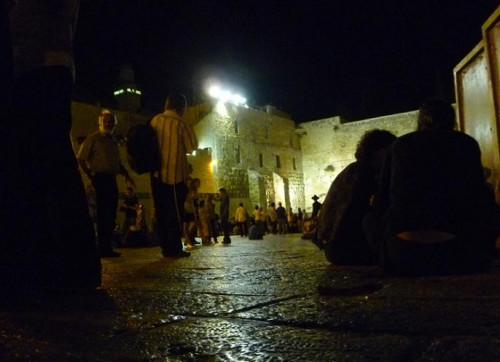
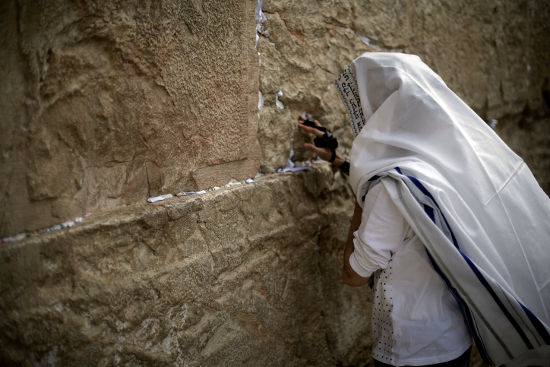
Tisha b'Av at the Kotel 2011There are a lot of missing bits and pieces to the world that need to be replaced and repaired. It’s like our existence is a half-built jigsaw puzzle and we’re the puzzle makers. We have to cooperate to make the picture whole. For those of us who believe, Jesus will come and his job will be to do the final “fixing.” For religious Jews, the Messiah will come and do pretty much the same thing. But you and I are here now. People are still hungry and homeless. We can’t solve their problems, but we can make their lives just a little bit better for an hour, or a day, maybe even for a week if God so wills it.

We can grieve and feel sorrow over our losses. We can complain about what’s wrong with the world and complain about the politics and religions of those people who are different from us. Or we can let events like Tisha B’Av remind us that we have lost but we also have something to look forward to. Tisha B’Av also reminds us that we can get over ourselves, get over being cranky, and try to be part of the solution instead of part of the problem.

I said this ago a few days ago, but it bears repeating. “Do good. Seek peace. Keep swimming.” Give life. I don’t care why you do it. Just do it.

May the inherent righteousness and goodness of all our souls be revealed in full and hasten our full redemption, and may we merit to see the third temple speedily in our days, as one people with one heart.

Rucho Shel Mashiach

Edit: I should note that Tisha B’Av actually starts tonight at sundown, but because it’s also Erev Shabbat, the fast doesn’t begin until after Shabbat has ended. I apologize for the error I made above.

Giving Life

The Jews of Vitebsk, if you want to know the truth, at the time were known not to be generous givers to charity. When money needed to be raised for a worthy cause, it was no simple matter to extract hard currency out of them without applying a good deal of pressure. To their credit, however, it must be said that the Vitebskers could always be counted on to provide food for the hungry; indeed, the Talmud states that giving ready-to-eat food is greater than giving money to charity because it provides immediate relief, while the benefit of money is indirect.

One day a chassid from Vitebsk came to see the Rabbi Menachem Mendel of Lubavitch (the third Chabad Rebbe, 1789-1866). He told the Rebbe that his only son was about to be drafted into the Russian army. Previously, only-sons were exempted automatically, but this year there was a new, tough policy and their precious child was in danger. “Please, Rebbe,” he entreated, “help us, save us.”

Rabbi Menachem Mendel shook his head sadly: “I’m sorry, I cannot help you in this matter.”

-Rabbi Yerachmiel Tilles
“A Plate of Food”
Tales from the Past
Chabad.org

What does stinginess with money, a willingness to feed the hungry, and an only son of a chassid being drafted into the Russian army have in common? On the surface, not very much, but Rabbi Tilles’ commentary tells the whole tale.

But not quite all of it as you’ll see.

The chassid, after much begging and pleading, could not change the Rebbe’s answer, so he turned to another option, the Rebbe’s youngest son, with whom the chassid was good friends. The chassid beseeched the Rebbe’s son (and his eventual successor, Rabbi Shmuel 1834-1882; known as the Maharash), and the young Shmuel promised he would do what he could to change the Rebbe’s response. But when Shmuel approached his father with the matter, he was given the same answer that the Rebbe gave the chassid: “I cannot help him at all.”

Shortly thereafter, the Rabbi Menachem Mendel summoned his son to his study and asked him to bring a Midrash Tanchuma. The Rebbe leafed through it to the week’s reading of Mishpatim, and showed his son section 15 there, concerning the verse, “If money you will lend” (Exodus 22:24):

Says the Holy One, blessed be He: “A poor person was struggling for his life, to escape starvation, and you gave him a coin and saved his life. I promise that I will pay you back ‘a life for a life’: If tomorrow your son or daughter will be seriously ill or in any life-threatening situation, I will remember the good deed that you did… and I will repay you ‘a life for a life.’ “

Rabbi Shmuel was perplexed. What did his father have in mind in showing him this passage?

A few days later, the news reached Lubavitch that the chassid’s son had been released, and for no apparent reason. The Rebbe was visibly delighted by the report.

But there was a reason, at least according to Chassidic midrash (remember, we have no way of telling if this story is even remotely factual…but that’s not the point). There was something important in the lesson the Rebbe taught his son a few days earlier. What had the family of the draftee done to merit that their son be released from service and the restoration of his life? When questioned, neither parent could think of anything special. Then the boy’s mother thought of something.

“That very day, a poor person came to the house and asked us to give him something to eat. At first we told him that we were so worried about our son who was going to be drafted that day that we really couldn’t deal with him. But then he pleaded with us: it had been a long time since he had eaten anything at all and he was starving, and how could it be that a Jew did not have time or food for another Jew who was so hungry! We realized our mistake and served him a huge meal, from what we had prepared to be a special farewell meal for our son. None of us had the appetite to eat anyway, because we were so upset. Then…”

While this is a very inspiring tale, why should we pay any special attention to it? The story is like a thousand other stories of the Chassidim. What can it teach a Christian about kindness, charity, and giving life?

“When the Son of Man comes in his glory, and all the angels with him, then he will sit on his glorious throne. Before him will be gathered all the nations, and he will separate people one from another as a shepherd separates the sheep from the goats. And he will place the sheep on his right, but the goats on the left. Then the King will say to those on his right, ‘Come, you who are blessed by my Father, inherit the kingdom prepared for you from the foundation of the world. For I was hungry and you gave me food, I was thirsty and you gave me drink, I was a stranger and you welcomed me, I was naked and you clothed me, I was sick and you visited me, I was in prison and you came to me.’ Then the righteous will answer him, saying, ‘Lord, when did we see you hungry and feed you, or thirsty and give you drink? And when did we see you a stranger and welcome you, or naked and clothe you? And when did we see you sick or in prison and visit you?’ And the King will answer them, ‘Truly, I say to you, as you did it to one of the least of these my brothers, you did it to me.’” –Matthew 25:31-40 (ESV)

So consider the next time someone needs a helping hand from you, even when you are in distress yourself, even when you are distracted by your own problems, and even if your problems are serious, such as the impending loss of your only son. The gift of one small morsel of food (and if it’s a huge meal, so much the better) to a hungry man may make a tremendous difference, not only for the hungry man, but for you.

Turn away from evil and do good; seek peace and pursue it. –Psalm 34:14 (ESV)

Maybe you’re thinking I’m being unreasonable. Maybe you’re thinking that I can’t be serious. Maybe you’re thinking that it would be too hard for you to help another person while facing a crisis of your own. And yet, God calls us to serve Him under all circumstances. Certainly we expect Him to serve us no matter what we’re going through and no matter what else is happening in the world.

You and I are only flesh and blood and bone. We’re weak. How can we stand up under the pressures of life and still be expected to help someone less fortunate than we are? There are two ways to express the answer:

You have to keep moving forward. As long as you’re holding on to where you were yesterday, you’re standing still.

-Rabbi Tzvi Freeman
“Don’t Just Stand There”
Based on letters and talks of the Rebbe
Rabbi M. M. Schneerson
Chabad.org

Just keep swimming. Just keep swimming. Just keep swimming, swimming, swimming. What do we do? We swim, swim.

Dory

Do good. Seek peace. Keep swimming.

Modesty

Ever wondered why the ark in your synagogue has two coverings – a door and a curtain?

The first mention of the concept of the curtain is found in the Talmud. Today this curtain is called the parochet (Heb. פרוכת).

The ark, known as the aron kodesh (Heb. ארון קודש), is considered one of the holiest components of the synagogue; the actual Torah scrolls which are kept inside the ark are the holiest.

In the Holy Temple in Jerusalem there was a curtain separating the “Holy” chamber and the “Holy of Holies” chamber. “And you shall place the table on the outer side of the dividing curtain…”

The curtain in the Temple was not used to separate the rooms; there was a stone wall for that. The curtain, explains Rabbi Shlomo Yitzchaki, known as Rashi, was a sign of modesty and respect for the Holy Ark which was kept in the Holy of Holies.

The same is true for the ark in the synagogue. The Torahs are wrapped in individual coverings, the ark has a door, and we add an extra curtain as a sign of modesty and respect for the holy scrolls.

-Rabbi Dovid Zaklikowski
“Why is There a Curtain Covering the Ark in my Synagogue?”
Chabad.org

What I quoted above might be just an interesting, educational tidbit except for the following:

And behold, the curtain of the temple was torn in two, from top to bottom. And the earth shook, and the rocks were split. The tombs also were opened. And many bodies of the saints who had fallen asleep were raised, and coming out of the tombs after his resurrection they went into the holy city and appeared to many. When the centurion and those who were with him, keeping watch over Jesus, saw the earthquake and what took place, they were filled with awe and said, “Truly this was the Son of God!” –Matthew 27:51-54 (ESV)

For he himself is our peace, who has made us both one and has broken down in his flesh the dividing wall of hostility by abolishing the law of commandments expressed in ordinances, that he might create in himself one new man in place of the two, so making peace, and might reconcile us both to God in one body through the cross, thereby killing the hostility. –Ephesians 2:14-16 (ESV)

I’m really not bright enough or at least not sufficiently educated in theological issues to really address this issue, but it came up while I was reading so I thought I’d blog about it anyway.

In truth, I doubt there’s a way to connect the small article by Rabbi Zaklikowski to the New Testament verses I’ve referenced, but if nothing else, I guess I can illustrate how differently Judaism and Christianity view the parochet. It’s also important to remember, before I proceed, that Rabbi Zaklikowski’s commentary is midrash rather than established fact, relative to the “modesty” of the Torah scrolls. With all that said, let’s continue.

From Christianity’s point of view, the parochet represents something of a problem. It is both what separates man from God and what separates Jew from Gentile (specifically Gentile Christian). It is commonly believed that when Jesus died, the splitting of the parochet, which separated the Holy place from the Holy of Holies, indicated that through Christ’s blood, there was no longer any separation between man and God. To put it in Christian vernacular, “man could now boldly approach the Throne of God” without the intermediary of the Levitical Priesthood.

The second symbolic representation of the parochet was the separation of Judaism, which for thousands of years was the sole keeper of ethical monotheism, the Torah, the Shabbat, and access to the God of Abraham, from the rest of humanity who were not inheritors of the covenant of Sinai. Through Jesus, the separation was torn down and now all men, not just the Jews, could approach God. There was no need to access God through Judaism and the Jewish priests. The distinctions between Jew and Gentile were torn away and everyone became “one new man” before God.

Well, that’s how the Christians see it.

But looking at the parochet from Rabbi Zaklikowski’s perspective, it isn’t an undesirable barrier at all but rather, a protector and a sign of significance and special Holiness. Putting a veil between man and the most Holy place indicates that it is indeed the most Holy place; something not to be treated casually or as something common or ordinary.

This provides, or rather confirms something for me (and remember, this is all symbolism and parable, not concrete fact or Biblical truth). It has often bothered me how Christianity seems to treat Holy things as common. Jesus is a “good buddy.” God Almighty, Creator of the Universe, vast, infinite, omnipresent, omnipotent God, is actually a cute, cuddly cosmic teddy bear and anyone can just crawl up onto His lap and squeeze Him, and hold onto His furry, little tummy. I’ve even heard some women say that they occasionally imagine falling asleep in bed while being held in Christ’s arms.

Wow, really?

I can understand being hurt and sad and broken and needing access to a comforter beyond what we have access to within humanity; someone who knows us, understands us, sympathizes with us, and yet, has access to the Throne of God and can intercede for us with the Almighty, asking for mercy, comfort, and grace.

Since then we have a great high priest who has passed through the heavens, Jesus, the Son of God, let us hold fast our confession. For we do not have a high priest who is unable to sympathize with our weaknesses, but one who in every respect has been tempted as we are, yet without sin. Let us then with confidence draw near to the throne of grace, that we may receive mercy and find grace to help in time of need. –Hebrews 4:14-16 (ESV)

On the other hand, in order to serve our own wants and needs, we have reduced the Jewish Messiah King and the One God of eternity, the great and awesome Ein Sof, down to mere shadows and objects of personal convenience.

We don’t want Jesus to be separated from us by anything so we make him our neighbor, our buddy, our “lover” (I say that in a non-sexual way), and our BFF.

That isn’t normally how a disciple treats his Master or how a subject considers her King.

Maybe it wouldn’t hurt to put the parochet back up at some point so we can preserve our sense of respect and honor of God as is His due, and to show glory and majesty to the King who came once and who will come again in power.

But what about the separation between Christian and Jew? How will putting parochet back up affect the “one new man?”

I’ve discussed that subject, from one point of view or another, for the past several years. What is the Christian responsibility to the Jew in terms of encouraging Jewish Torah observance, supporting the restoration of national Israel and her redemption, and thus summoning the great and terrible day of the Lord’s return?

In order to have a role in that, there must be some sort of distinction between Christian and Jew, especially if Gentile Torah observance isn’t what’s required to initiate Israel’s national redemption and everything that will follow. To tear down the parochet, removes the mechanism by which the Messiah will return. How can we do that?

Then what am I saying? Am I dismissing scripture? Am I discounting the Gospel of Matthew and the letter of Paul to the Ephesians? Not at all. I am saying that these events may not mean what we’ve been taught they mean. They are two, isolated text strings that have been used as part of a long pattern of the church’s supersessionist theology but which, on an actual lived and spiritual level, may represent something other than what we imagine.

After all, when the parochet in the Temple was torn, do we think that it was never repaired, and remained rent until the final destruction of the Temple and the razing of Jerusalem decades later? And was Paul’s metaphorical language meant to literally mean the Temple’s parochet, or was something else removed, the hostility, which may simply have been the attitudes between Jew and non-Jew which we see Peter overcoming in Acts 10?

I can’t say for sure. Perhaps New Testament scholars have their own theories. All I’m suggesting is that we might want to treat God with a tad bit more awe and reverence than what we are accustomed to, and we might want to consider that the Christian role in redeeming Israel may require removing the barriers of ethnic and religious “hostility,” without removing ethnic and religious distinctions, so that we can work in complementary fashion to perform Tikkun Olam, to repair our broken world, and to make it ready for what God has planned to happen next.

Just a few thoughts to ponder on today’s “morning meditation.”


Take a Deep Breath

I am grateful that the secular spirit of the modern world has made the medieval option of fear of God’s punishment spiritually irrelevant. I felt dignified and challenged as a teacher of Torah in not having the support of God’s punitive powers as a fallback for awakening interest in Torah. In my experiences as a teacher, I never saw Judaism as necessarily weakened by the modern emphasis on the significance to or distaste for the terrifying descriptions of divine retribution awaiting the sinner found in the liturgy and rabbinic midrashim.

-Rabbi David Hartman
from the Postscript of his book
A Living Covenant: The Innovative Spirit in Traditional Judaism

That isn’t exactly a statement that would be palatable to many traditional Jews and particularly fundamentalist Christians, who adhere to the words “the wages of sin is death.” (Romans 6:23) Nevertheless, I don’t think Rabbi Hartman absolutely has to be discussing the absence of divine judgment of humanity, but rather, our human response to God. One of the criticisms leveled against Christianity is our punitive nature, both toward the secular world and within our own. I’ve heard it said more than once that “the church is the only army that shoots its own wounded.” No wonder we don’t have a stellar reputation for love, compassion, and peace within the societies where we live.

Very recently, I’ve been expressing my recurring feelings of diminishment as a believer and frankly, as a human being. It seems that once you become a Christian, as far as other religions and the secular world are concerned, you surrender your passport to travel among your fellow human beings and within your society, and are relegated to a cage assigned to bigots, superstitious louts, and Bible-thumping thugs. If you actually express your faith in terms of compassion, charity, and love toward other people (and not just those who agree with you socially and politically), then repeatedly hearing what a fascist you are can be hard to take.

Time to take a deep breath.

I am deeply frightened by the growth of religious dogmatism and intolerance in many parts of the world, including Israel. I believe that a relationship to God based on fear of punishment, excessive repression, and fear of natural joy and spontaneity contributes to the growth of religious dogmatism and fanaticism.

-Rabbi Hartman

I’m frightened, too.

I’m frightened because one of the results of dogmatism is the destruction of the message of the Bible which promotes love of your fellow human being as the primary expression of love of God. How can the name of God be sanctified if hostility and extremism is overwhelming the voice of Jesus Christ? It’s not like the Messianic lesson doesn’t include moral and ethical components. Far from it. At the heart of the ancient Judaism in which Jesus taught, is the emphasis on the laws of ethical monotheism and the universal benefits that they yield when applied to human society. But as Paul famously said:

If I speak in the tongues of men and of angels, but have not love, I am a noisy gong or a clanging cymbal. And if I have prophetic powers, and understand all mysteries and all knowledge, and if I have all faith, so as to remove mountains, but have not love, I am nothing. If I give away all I have, and if I deliver up my body to be burned, but have not love, I gain nothing. –1 Corinthians 13:1-3 (ESV)

I get tired of fighting but what I’m trying to fight isn’t really all of the times atheists say, “I hate Christians” or all of the times Jewish people say, “Christianity is a pagan religion.” I get tired of fighting how badly Christianity has carried the message of Christ forward into the 21st century. I get tired of supersessionism in the church. I get tired of extremist exclusivism in Christianity which goes to the point of defining itself by what it’s against rather than by the nature and character of God’s grace and love.

I’m not suggesting that Christianity “liberalize” to the point of blending into secular culture, but there’s a difference between standing on a firm moral center and using it as a blunt instrument to commit violence against anyone who steps outside of your interpretation of “Biblical truth.”

I’m tired of being blamed for a system and a history I have no control of and do not participate in. I think it’s possible to do good and be a Christian, a Jew, a Muslim, an atheist, and just about anyone else. My understanding of good is the teachings of the Jewish Jesus. Your mileage may vary.

For myself, belief in the unity of God requires that one learn to appreciate the way every human being reflects the divine image. The unity of God is a challenge to find a shared moral and spiritual language between different faith communities. The declaration of Judaic faith, “Hear, O Israel, the Lord is our God, the Lord is One,” must lead a Jew to relate the profound sense of the particular and intimate relationship of Israel to God (“The Lord is our God”) to an appreciation of the way God is manifested in the variety of spiritual cultures existing throughout the world (“The Lord is One”). Whereas for Maimonides, correct reasoning provides the healing powers that make belief in the unity of God possible, from my perspective the power to appreciate the other, the overcoming of individual or communal narcissism, is essential if we are to act in a way that reflects belief in the unity of God.

-Rabbi Hartman

Obviously, Rabbi Hartman’s views do not represent all of religious Judaism and they certainly don’t represent most of Christianity, since exclusivism is a requirement for access to God on a covenantal level. For Jews, the covenant is Mosaic, although Gentiles may access through the Noahide laws. For Christianity, “No one comes to the Father except through me.” (John 14:6) is an absolutism that locks out anyone who is not a Christian and, in many cases, not a member of a specific congregation or denomination. Even in Judaism, the debate rages on “who is a Jew” which, in its extreme form, is expressed in the contrast between the Haredi Jews and secular Jewish Israel.

Time to take another deep breath.

Let’s try to set all that aside just for a few minutes. I know that most religious people fear the term “unity” because they feel it must also mean “homogeneous,” the idea that in order to have unity, you must surrender all distinctions from the other groups around you, and particularly the dominant group (which, in most cases today, is atheist secular humanism). In other words, the fear is that to have unity, you must either stop being religious, or be religious in name only while really embracing and practicing the entire package of liberal progressive modernism.

But that’s not what I mean.

In Christianity, I understand two things. I understand that God is the God of the universe and not just the God of Christians, Jews, or Muslims. I also understand that every human individual, no matter who you are (yes, even atheists) was made in the image of God. Besides being generically human, we all have those two things in common (whether you choose to recognize that or not). If God is a complete unity of One, then according to Rabbi Hartman, He created humanity to reflect that “oneness,” that particular sort of “unity” whereby we share a common drive to serve Him.

If you’re an atheist, a Christian, a Jew, a Muslim, or anyone else, and you have a need for justice and mercy in the world, we all have that in common because God desires justice and mercy. I don’t care if you recognize God as the source of those two qualities or not, the fact remains, in spite of our differences, that we have a common need to create justice and mercy.

We aren’t going to agree on a good many things. That much is certain. But if we find something we can agree upon, let’s say it’s feeding hungry people, is it only good if you do it but not if I do it? Really, do you have to be an atheist to do good? Do you have to be a Christian to do good? Do you have to be a ...fill in the blank here... to do good?

That’s the sort of crap that’s wearing me down. Well, it’s not all of it, but if I could crawl out from underneath societal condemnation long enough to share something good with you, and affirming that we have that much in common, I’d feel a lot more lively and optimistic.

Christians are accused, and sometimes rightly so (but only sometimes) of being bigots and exclusivists. But many other human groups are guilty of the same thing including (believe it or not) political and social progressives. Inclusiveness is supposed to “include” but it often excludes people like me for no other reason than the label “Christian” I have stamped on my forehead. If you want me to listen to you, get to know you, and not judge you on shallow and superficial appearances, then shouldn’t you practice what you “preach?”

I should, too.

Jesus said, “Blessed are the peacemakers, for they shall be called sons of God.” (Matthew 5:9). Making peace doesn’t require compromising morals or ethics, but it does require doing good and putting aside prejudice and bigotry. If Christians and Jews weren’t capable of doing that, there would have been no civil rights movement in the 1960s. We can do it, we can all do it if we choose to. Or we can choose to continue to wage this senseless social battle of defining ourselves by who we’re against rather than what we can do for good.

That’s your choice and it’s mine.

No, I don’t think this is going to work. I don’t think one small human being writing on one small blog is going to change the world. Heck, I won’t even be able to change predominant social opinion on the Internet. But I can take the moral high road just to see what happens. I can promote good just because it’s the right thing to do. I can love God by loving my fellow human being.

And I can continue to remind myself that even if no one else gives a rip, that each and every step I take, every piece of trash I pick up, every person I smile at today just because I can, is noticed by God. Hopefully, some of it will do other people some good as well.

We live in a broken world. Many of us are broken people. Only by realizing that we are all broken together can we begin to heal. One day we will all realize that our healing comes from Heaven. I know many of you don’t believe me. Let’s try out a little cooperation and see how it works. For the rest of it, just wait and see.