Tag Archives: Judaism

Grandmother of Valor

Rav Moshe Aharon Stern, zt”l, explains that determining who has attained true greatness is no simple matter. “There is no middle way when dealing with the absolute truth. Either something is true or it is false. But how can one tell if someone is truly G-d fearing and whether he is a true scholar? We find an answer in an aggadata brought on today’s daf. In Niddah 33, we learn that when Rav Pappa visited a certain city and wished to determine whether there was a G-d fearing scholar to be found there, he addressed his question to a certain grandmother who resided in that place. He asked, ‘Is there a talmid chacham in this city?’ She immediately replied that there was. ‘There is a talmid chacham called Rav Shmuel. If only I could be like him!’

“Rav Pappa thought to himself, ‘Since she blesses herself to be like him, he obviously has yir’as shamayim.’ One may wonder why he chose to rely on this woman’s reply, of all the people of the town. We can understand this in light of a different statement recorded in the name of the sages. In Berachos we find that women tend to understand the true character of their guests more than men. G-d created women with a special sense to recognize falsehood immediately. This is why Rav Pappa asked a grandmother. He wanted a true answer and figured that, in that town, his best chance of getting one was from a woman!”

Daf Yomi Digest
Stories Off the Daf
“Women’s Intuition”
Niddah 33

While you may assign little reliability to this commentary, I think there may be some truth in it. In this age of “everyone has to be equal,” we tend to interpret that statement as “everyone has to be the same.” Of course, there are obvious physical differences between men and women but even those are coming under scrutiny and being discounted as “not that different.” For instance, this recent article published at The Good Men Project, a website that supposedly gives us a “glimpse of what enlightened masculinity might look like in the 21st century,” (according to their About Us page) seems to say that “masculinity” can only be “enlightened” by “confessing” that men and women are almost completely alike, with only minor differences in mental, emotional, and physical structure and functioning.

Please understand that I’m not promoting sexism or exploitation of women by men in framing my comments this way. Quite the opposite. I’m saying that men and women can and should have equal opportunity to resources and be treated with equal honor and respect, but that doesn’t mean men and women have absolutely no intrinsic differences.

However, in the viewpoint of Christianity, Paul may appear to muddy the waters just a little bit.

There is neither Jew nor Greek, there is neither slave nor free, there is no male and female, for you are all one in Christ Jesus. –Galatians 3:28 (ESV)

In certain areas of Christianity, the phrase “neither Jew nor Greek” (with “Greek” often interpreted to mean “Gentile” or “non-Jewish person”) seems to indicate that whatever roles, functions, and covenant differences that once existed between the Jewish and non-Jewish disciples of the Jewish Messiah were eliminated because of the death and resurrection of Jesus Christ. But did Paul also mean that the roles and functional differences between males and females were also eliminated?

Probably not, since in context we see that Paul is referring to different groups having equal access to being “Abraham’s offsprings” through the promise of Christ. Slaves were still slaves, freemen were still free, men were still men, and women were still women. It is interesting to note that since Paul declared both men and women having equal access to the “resource” of Christ, he may appear to be somewhat “feminist” in his approach to the men and women of his day.

That’s not how the Bible usually depicts him.
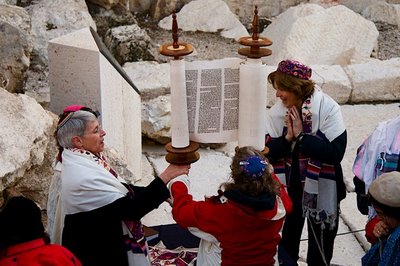
Derek Leman recently posted an article on this blog called, Now a Non-Jewish Messianic Female Rabbi/Pastor. This topic has spawned a lively discussion in the comments section about the nature of the rights of women in the early first century church. The rights and restrictions applied to women in the church today seem to hinge on whether we see the letters of Paul as eternal truths or as contextually limited instructions to specific groups. According to a series of Leman’s comments on his blog, he supports the latter interpretation.

You learned from your background to read the Epistles like unchanging halakhah. Guess what? They’re not. They are specific advice to specific congregations and in particular situations. There … is … no … unchanging … law … against … female … leaders.
…..

(1) Letters from apostles to congregations do not establish new timeless commandments.

(2) Female leadership was accepted in Israel and by the apostles (Priscilla, Phoebe, Junia, Philip’s daughters).

(3) Apostolic instructions for various congregations are not uniform because there is no one model of congregational structure that is a pattern in heaven (an absolute divinely commanded model).
…..

Okay, let’s start with your understanding of the epistles. You think they are new Torah establishing new timeless laws which must be followed for all time, right? I said they are not. I said they are letters about specific congregations in specific places and times.

So, step 1. Is there a law before Paul write 1 Timothy (and/or 1 Corinthians) that women may not have leadership? Please tell me where it is.

Step 2. So I am supposed to believe that God waited until one of Paul’s later writings before revealing a new commandment: woman, thou shalt not teach or have leadership?

Step 3. If you say that the letters of the apostles are timeless commandments, how do you understand numerous scriptures like: 2 Tim 4:13; 2 John 10; 1 Cor 7:8; 1 Cor 7:26-27 (are we still in that “present distress” Paul mentioned?); 1 Cor 11:5 (it means a veil over the face, not a hat); etc.

Step 4. Tell me how the epistles “command” a congregation to be structured. What must the leadership structure be? Are the various letters consistent?

Step 5. Or you could come to realize epistles are not “new Torahs” but advice usually based on Torah and the teaching of Yeshua to specific congregations in particular situations. We no longer live in a world where slavery is widespread (in the West, I mean); so 1 Cor 7:21 makes a little less sense now. There are no bad connotations for women not wearing veils in our society (so no Messianic or Christian burkhas necessary). So we should read epistles differently, as applications of Torah and Messiah to specific situations. We can learn from the way these were applied to specific situations. But, back to 1 Timothy 2, how do we justify the idea that God was laying down a new commandment here? Is this the way God gives commandments? Or is it more reasonable to assume this is something that fit the situation of Paul’s congregations in Paul’s time?
…..

I’m not sure how this debate is going to turn out and my goal for this “meditation” isn’t to “join the fray.” I only want to show how devisive the issue of the role of women in the church and synagogue remains in the arena of religion.

Now let’s move one step backward from this debate and take a look at two related viewpoints of women in Judaism. The first is from Proverbs 31:10-31 which describes “the woman who fears the Lord.” This is the basis for the other related perspective of women in Judaism, referred to as Eishet Chayil or “Woman of Valor,” which is a blessing typically sung in Jewish homes on Erev Shabbat.

The English translation of the first part of the song says:

A Woman of Valor, who can find? She is more precious than corals.
Her husband places his trust in her and profits only thereby.
She brings him good, not harm, all the days of her life.
She seeks out wool and flax and cheerfully does the work of her hands.

This may not fit your picture of a completely liberated, self-actualized, feminist woman of the 21st century, but we do see that Judaism has a history of honoring and valuing women within the community. That “valuation” may have become distorted over time, relative to the history of patriarchal rule we find in both traditional Christianity and Judaism, but I think we should re-examine those assumptions. Regardless of your views about whether a woman should teach men or should lead a congregation, we have ample enough evidence to believe that women tend to be more sensitive to the needs of the family and community, including their spiritual needs.

When I regularly attended a congregation, I couldn’t count the number of women who would come to services bringing their children and, in some cases, grandchildren with them because they wanted the children to honor God, while their “men-folk” remained at home or were off doing some chore or playing some sport. Of course, this isn’t universally true, but the anecdotal evidence is so ubiquitous that it has become cliche. A classic example of this phenomenon on the web is the Spiritually Unequal Marriage blog, which provides a forum for Christian women to interact and share their experiences being married to men who don’t share their faith.

In a way, this seems to lead us back to our “story off the daf” and the grandmother who could immediately identify the most “God-fearing scholar” in her town. Consider that the fellow she identified might not have had the reputation of being the most “God-fearing scholar” in the eyes of the town’s populace, but even someone humble and unassuming in his piety wouldn’t escape the detection of a true “woman of valor,” especially one who has lived many years, raised children and grandchildren, and has the experience and wisdom to see past the surface of a man and into his heart.

The differences between men and women go all the way back to Genesis and reflect the design of God for each of us. While human beings have imposed different roles, responsibilities, and restrictions onto males and females over human societial and cultural history, I believe there is something that God programmed and hardwired into humanity that serves to define us as men and women. Modern secular, progressive thought sees sex differences (as opposed to gender differences, which can become much more complicated) as socially imposed and with those impositions removed, imagines that men and women are not only be equal but hemogenous, and exhibit few if any differences.

While I believe (I state this again for clarity) that men and women should have equal access to resources in society and have been designed under Heaven to have equal access to God, that equality doesn’t presuppose or require homogenization. Replacing “him” and “her” with “it” neither elevates women in a social and cultural context nor reflects the true honor of women as originally established by God.

Differences aren’t bad and being different doesn’t mean you are unequal. It can mean that you are special and have a purpose to fulfill that cannot be accomplished by anyone else.

Sometimes only a grandmother can tell you where to find a talmid chacham in her town.

Korach: Who is Speaking to Your Heart?

In the Torah portion Korach we read how Korach led a band of 250 men in a rebellion against Moshe and Aharon. Underlying their revolt against Aharon’s High Priesthood was the charge: “All the people in the community are holy and G-d is in their midst; why are you setting yourselves above G-d’s congregation?” (Bamidbar 16:3.)

From Moshe’s response, (Ibid. verse 10.) “…and you seek priesthood as well,” we readily perceive that Korach and his band desired to become priests. This being so, their argument that “All the people…are holy,” and nobody can set himself above anybody else seems to contradict their desire to be above others by obtaining priesthood.

“A Lesson in Priesthood”
Based on Likkutei Sichos Vol. VIII, pp. 116-118
Commentary on Torah Portion Korach
The Chassidic Dimension series
Chabad.org

Rav Yisrael of Ruzhin, zt”l, gives a fascinating explanation of a famous statement on today’s daf. “Our sages say that today the yetzer hara says to do one sin, tomorrow another, until one finally falls to idolatry. This statement does not mean that the yetzer hara increases the sins that one indulges in from day to day. It means that the yetzer hara pushes a person who falls to keep falling in the same manner day after day, time after time. Even this is enough to cause one to worship idolatry eventually, God forbid!

“This can be compared to a sick person whose weakened constitution does not improve. If his system does not overcome what ails it, he gets sicker and sicker and eventually he reaches the point where he is dangerously ill.” Rav Shalom Schwadron, zt”l, offers his own insight here. “It is interesting that the yetzer doesn’t demand that one stop fulfilling mitzvos; it merely pushes one to follow his instructions. He wants to bring a person to a place where he will fulfill only that which interests him. A student in yeshiva will learn Torah until very late at night, missing out on a meaningful shachris. Another person will express his zealousness at the expense of fulfilling his obligations to his fellow human beings.

“The yetzer wants to be in the driver’s seat; that one should only do what interests him in the manner that he prefers. He knows that a person who only acts when he is inclined to do so will eventually stop fulfilling the mitzvos. We need to recall that the main thing is to fulfill the mitzvos of the Torah because this is the will of the Creator. We must not be swayed by the compelling-seeming logic of the yetzer hara which causes one to forget God.”

Daf Yomi Digest
Stories Off the Daf
“In the Driver’s Seat”
Niddah 13

Here’s the key portion of the above-quoted lesson:

He wants to bring a person to a place where he will fulfill only that which interests him.

By the time I finished reading this “story off the Daf,” I found that the conclusion didn’t match up with what I thought it would be at the beginning of the story. I thought fulfilling certain of the mitzvot would be contrasted against overt sin, such as a person who fulfills the mitzvah of feeding the hungry and then turns around and cheats his business partner. I didn’t think it would be focusing on fulfilling one mitzvah, the one that fits your personal desires, at the expense of other equally worthy mitzvot.

We’ve seen this sort of thing before:

Then Pharisees and scribes came to Jesus from Jerusalem and said, “Why do your disciples break the tradition of the elders? For they do not wash their hands when they eat.” He answered them, “And why do you break the commandment of God for the sake of your tradition? For God commanded, ‘Honor your father and your mother,’ and, ‘Whoever reviles father or mother must surely die.’ But you say, ‘If anyone tells his father or his mother, “What you would have gained from me is given to God,” he need not honor his father.’ So for the sake of your tradition you have made void the word of God. –Matthew 15:1-6 (ESV)

“Woe to you, scribes and Pharisees, hypocrites! For you tithe mint and dill and cumin, and have neglected the weightier matters of the law: justice and mercy and faithfulness. These you ought to have done, without neglecting the others.” –Matthew 23:23 (ESV)

We see a couple of important points taught by the Master relative to the story off the Daf, and both are related to hypocracy and setting human priorities on what we choose to do for good.

In the example from Matthew 15 (yes, I know this passage is typically used to say Jesus did away with man-made traditions and only endorses obeying pure Torah law, but he was perfectly fine with many other aspects of the normative halachah of the Judaism of his day, so I consider his main “rant” against hypocrisy, not tradition) , Jesus turns on his critics and accuses them of neglecting the commandment to honor parents by committing the money that could have been used to support their parents to the Temple. Outwardly, the Pharisees involved may have appeared holy, but in their neglect of their parents, they were reprehensible.

The short quote from Matthew 23:23 shows us something similar. Certain Pharisees were again, outwardly appearing as holy by their tithes but in the process, they completely ignored what Jesus called, “weightier matters of the law” such as the principles of “justice and mercy and faithfulness.” I should note that Jesus did not say one was really better than the other and told his audience that they should have performed their tithes without neglecting the other mitzvot.

But what does that have to do with us? On the one hand, these arguments could support the classic One Law position in the Hebrew Roots movement which states that non-Jewish people, when we become Christians and are “grafted in” (Romans 11) to the Jewish root, are obligated to the identical set of commandments as the Jews are, and we should not pick and choose which ones to obey. It would appear as if Jesus is telling us to not pick and choose as well, but to obey all of the 613 commandments, or at least as many as can be obeyed without the existence of a Temple, a Levitical priesthood, a Sanhedrin court system, and (for most of us), while living outside the Land of Israel.

On the other hand, we could use the same texts to consider just what our (I’m speaking to Gentile Christians now) true obligations are to God and whether, in our performance of the mitzvot, we are doing what God actually wants us to do, or only obeying what we want, what makes us feel righteous, and what makes us look “cool” in the eyes of our peer group. Are we falling into the same trap as Korach, Heaven forbid?

I know that sounds a little harsh, but I’ve encountered more than one non-Jewish person in the Hebrew Roots movement who seems really pleased with his tzitzit, his Hebrew prayers, and how he laid tefillin. OK, I want to be fair and say that there are many who subscribe to the One Law position who sincerely believe this is the one and only way a Gentile can please the God of Heaven, and these folks feel really picked on when people like me say that obeying many of the Torah commandments is a choice and not an obligation (your behavior doesn’t have to change in any way just because it’s voluntary rather than obligatory). But consider this.

When you say that non-Jewish believers in the Jewish Messiah are obligated to obey the full yoke of Torah, your saying that it is a sin for any Christian to fail to observe the full range of the mitzvot. You are condemning the vast, vast majority of Christians who have lived, loved the Master, observed the “weighter matters of the Torah,” and died, based on your personal interpretation of the Bible. By saying you are obligated to the Torah and that you are fulfilling the Torah, you aren’t equalizing conditions between Christians and Messianic Jews but (whether you mean to or not) elevating yourself above your brothers and sisters in the church.

Let’s continue the Chabad commentary on Korach. I think you’ll see that he and his followers were doing something very similar.

The Kohanim , the priestly class, differed from the rest of the Jewish people in that the Kohanim were wholly dedicated to spiritual matters. This was especially true with regard to the Kohen Gadol , the High Priest, who was commanded “not to leave the Sanctuary.” (Vayikra 21:12.)

Their apartness from the general populace notwithstanding, the Kohanim in general, and the Kohen Gadol in particular, imparted their level of sanctity to all the Jews. Thus we find that Aharon’s service of lighting the Menorah in the Sanctuary imparted sanctity to all Jews, and enabled them to reach Aharon’s level of service and love of G-d. (See Likkutei Torah , beginning of portion Beha’alosecha.)

You may consider this a bit of a stretch, but I think the unique standing and “choseness” of the Jewish people and their obligation Sinai covenant also imparts a “level of sanctity” to we who are grafted in from among the nations. I think there’s a relationship to Israel being a light and to those of us who have seen and been attracted to that light.

I’ve tried talking about this before, especially in blog posts such as Redeeming the Heart of Israel, Part 1 and Part 2, where we see a partnership between the Jewish and Gentile disciples of the Master that is complementary and interwoven, and I’ve tried to show that this partnership does not require a fused or homogenous identity between Christians and Jews in the Messianic realm.

Granted, I believe this manner of thinking is still in its formative stages and requires a great deal more research, especially in Scripture, but we see a classic example in the Korach rebellion of how a group desiring to separate themselves from their fellows and assume an identity not their own results in disaster. In the end, Korach and the rebels didn’t really believe that all of Israel had the right to become priests.

Korach and his band’s complaint that “All the people…are holy,” however, did not contradict their own desire for priesthood, for they desired a manner of priesthood totally removed from the rest of the congregation.

This manner of priesthood would not cause them to feel superior to the rest of the Jewish people, a superiority that resulted from their imparting holiness to them, for in their scheme of things they would not impart holiness to other Jews — they would remain totally separate and apart.

But Korach and his band were badly mistaken: It is true that there are different categories of service — Jews who are solely occupied with spiritual matters, and other Jews whose task it is to purify and elevate the physical world through the service of “All your actions should be for the sake of heaven,” (Avos 2:12.) and “In all your ways you shall know Him.” (Mishlei 3:6.)

Putting all this together, we can paint a picture of those Gentiles who want to assume a full “Jewish” identity without having to convert to Judaism as not demonstrating equality between Jews and Gentiles in the covenant, but perhaps setting themselves above their fellow Christians by taking on Jewish identity markers. I’m sure that many One Law proponents aren’t motivated in this direction, but ask yourself if this could be describing you.

If you, as a Christian (non-Jewish disciple of the Jewish Messiah) in the Hebrew Roots movement, choose to take on additional mitzvot that could be considered specific to Jews, please study up on them first, including the relevant halachah for performing the mitzvot. Shooting from the hip probably isn’t as effective way to perform any of the Torah commandments as using the accepted standards established in normative Judaism.

From my personal perspective, a Gentile publicly appearing as a Jew, even with completely pure motives, is like walking into a room full of trapdoors and tripwires. You might be successful in your efforts, but more than likely, once you step outside your local congregations and into the larger world, you could encounter unanticipated conflicts. Be sure whatever you do is actually what God wants and not just something that makes you feel special.

I’m sure no one wants to make Korach’s mistake. Ask yourself who or what is speaking to your heart?

Addendum: This all gets more complicated when you factor in people who claim a Jewish identity without Jewish parents and exist outside of Messianic Judaism, as we see in this Huffington Post article. One person has blogged about her experiences as a “Jewish” non-Jew, and Derek Leman has offered his own commentary. True, it doesn’t have a direct relationship with this week’s Torah portion or the matter of any Christian’s perceived obligation of Torah, but it is very much relevant to the “identity wars” between Jews and non-Jews, so I include these references here.

Good Shabbos.

Struggling with the World, Part 1

I’m not arguing for either the superiority or the necessity of a covenantal orientation to life for the realization of human responsibility and dignity. In thinking about Judaism, I cannot ignore the fact that atheists act with moral dignity and compassion in the world. I believe, in contrast to many contemporary religious thinkers, that secular humanism is a viable and morally coherent position. What I am claiming is only that neither the critique of halakhic Judaism found in the Christian tradition nor the moral critique found in Spinoza is convincing. There are many different approaches to human life that encourage initiative, intellectual freedom, responsibility, and the sense of personal adequacy and dignity. I am not arguing that faith is necessary in order to have these values, but only that faith in a covenantal God of Judaism does not have to contradict or undermine them.

The God of Sinai does not merely hand over responsibility for the mitzvot to Israel and then take His leave. He also commits Himself to permanent involvement in the history of the community…

-Rabbi David Hartman
Chapter 8: “Rabbinic Responses to Suffering”
A Living Covenant: The Innovative Spirit in Traditional Judaism

I hadn’t intended to turn this into a series, but I find myself continuing to compare the relative merits of the moral and ethical positions of Christianity and, if not atheism as such, progressive secular humanism, which is the predominant philosophy of modern western culture. My previous missives on this topic are Collision, which is my introduction into why atheism holds such animosity toward Christians and Repairing Life which suggests one possible response.

That should have been the end of my reflections on “Religion vs. Atheism,” and it was from a Christian point of view, but I neglected to discuss how Judaism considers this dynamic. As with many things, there’s no single Jewish viewpoint (and I’m probably not qualified to write about this but I will anyway) so I’ll try to offer two: one from Rabbi Hartman’s above-quoted book and the other from Rabbi Tzvi Freeman and Chabad.org.

Whenever someone asks me a question, I first have to think, “What kind of a box has this guy trapped me in?” Then I can deconstruct the box. If the box dissolves, there goes the question. If it doesn’t dissolve, I better listen up. The guy’s got a point.

Here comes one now:
“Rabbi, what was the Rebbe’s response to modernity?”

For at least two hundred years, Jews scrambled to find a response to modernity.

Today, there’s no longer much scrambling. Movements have stopped moving, firmly entrenched. But there was a time when Jewish creative genius generated a cacophony of responses to modernity: Reform, Orthodoxy, Zionism, Religious Zionism, Conservative, Ultra-Orthodoxy, Reconstructionism, Modern Orthodoxy, Renewal and more. Each movement had leaders who spent their years zealously articulating and re-articulating their particular response to the progressive, liberal, enlightened, modern world that came rushing down upon us, particularly after France beheaded its kings and smokestacks started belching into the sky.

Now, in Brooklyn sat a Jewish leader who built up a powerhouse movement that has transformed the face of Jewry worldwide. What was his response to modernity?

Gotcha. Neat little box. But it doesn’t work. What doesn’t work? The box: “Response.”

Again, as I mentioned in my other blog posts on this subject, I’m not trying to “prove” that religion is right and atheism is wrong or even to say that one group possesses an inherently greater moral response to life than the other (although from my point of view, religion should have the greater moral response).

I want to show that the issue can be as simple as how much or how little of themselves people choose to invest in their particular belief systems and and also demonstrate that these matters are far more complex than what we think of as mere “right and wrong.”

Rabbi Hartman’s position might be considered the more progressive of the two based on the quote I used to open this “extra meditation.” Rabbi Freeman represents the more conservative view. He suggests that historically, Judaism has responded to modernity by generating multiple variations of Judaism to adapt to the demands of progressiveness, but currently seems to be digging its heels in, so to speak, as representative of the Orthodox. But as we see from continuing to review Rabbi Freeman’s commentary, even this isn’t as two-dimensional as it appears.

Rabbi Freeman uses the dilemma of Children of Israel trapped between an advancing and vengeful Egyptian army and the uncrossable barrier of the Reed Sea (Exodus 14) as a metaphor for the struggle of Judaism to respond to liberal modernity.

The Children of Israel are stuck at the Sea of Reeds. The Egyptian army is closing in fast. The Jews divide into four parties—four opposing responses to one situation, perfectly summarizing the orthodox responses of the modern era: The Just-Go-Back-to-Egypt response, the I’d-Rather-Drown-Myself response, the Get-Up-And-Fight response and the Get-Down-And-Pray response.

Response Today
Self-Drowning Immerse in a ghetto of Torah, and pretend the world does not exist.
Back to Egypt Give up on the world, on the future, or on trying to change anything. Just do what you have to do because G‑d says so.
Fighting Prove that we are right and they are wrong.
Praying Rely on G‑d to bring Moshiach real soon.

G‑d’s response? You’re all wrong.

“Why are you crying out to me?” G‑d demands of Moses. “Speak to the Children of Israel and tell them to keep going forward!”

No response. No reaction. Proaction. Take charge. You have a purpose, you’re going somewhere. Keep going.

According to Rabbi Freeman, the response of Israel to the demands of progressionism is to progress. Of course, this doesn’t mean abandoning the covenant of Sinai and blending into the general cultural herd, which for a Jew would basically mean assimilation, but it doesn’t mean hiding or freezing in place, either. If the world moves, move with it, but don’t forget to take who you are with you and particularly, don’t forget to take God.

But the world of faith is always vulnerable, not just to tragedy and evil, but to how those elements of life are interpreted, and on some occasions, used against religious people by not only the atheists who blame all the world’s woes on religion (as if humanity weren’t capable of doing harm without a religious belief system to depend upon), but on our own doubts when “bad things happen to good people,” or when God is otherwise incomprehensible.

Rabbi Hartman continues on this point:

From the anthropological perspective on the problem of evil, therefore, the prime concern is not so much to defend the notions of divine justice and power. It is rather, as in other personal relationships, to determine what measure of continuity, stability, and predictability can enable the relationship with God to survive all shocks. It is to identify the cluster of beliefs that supports a person’s will to persist in the face of tragedy and suffering. If the world I live in requires that I become overly vigilant because of the threat of danger striking at any moment, then how can I sustain commitment to a way fo life predicated on God’s covenantal love and justice?

How do we respond to events that can call into question our whole identity as God’s relational partners?

An atheist can dismiss such questions by dismissing God. The presence of tragedy, suffering, and evil can be accepted as conditions of a natural world filled with imperfect human beings. It can also be a world that, while imperfect, is struggling to develop toward a higher moral and ethical reality as indeed, progressivism strongly believes. Human beings then, establish and revise the foundations of our own morality, sometimes radically, as time advances and the concepts of rightness, mercy, and justice continue to evolve in societal consciousness.

But what about the covenantal Jew? How does he resolve or at least address this problem? We’ll pursue the answer to that and other questions in Part 2.

Underlying Reality

At the core of all our thoughts and beliefs lies the conviction that the underlying reality is wholly good. That evil lies only at the surface, a thin film of distortion soon to be washed away by the waves.

-Rabbi Tzvi Freeman
“Essential Good”
Based on letters and talks of the Rebbe
Rabbi M. M. Schneerson
Chabad.org

That hardly seems likely. Given the record of wars, crime, and rampant injustice that is written all over human history, it’s extremely difficult to reconcile all of that with the statement, “reality is wholly good.” For me, it’s as difficult as believing the following to be true:

Despite everything, I believe that people are really good at heart.

-Anne Frank

I still experience astonishment when imagining how a young Jew in the middle of the Holocaust could pen such a statement. Didn’t the Nazis teach her that humanity is essentially evil?

Of course religious Jews and Christians see the nature of humanity as fundamentally different. Jews see our nature as basically good but influenced by an inclination for evil while Christians see that the fall of Adam resulted in the nature of human beings becoming wholly evil and irredeemable without Jesus Christ. Jews believe people have an active part in working toward repairing themselves and their damaged world while Christians believe we are totally helpless and only through Christ is there any hope at all.

I believe Jesus was serious when he said:

Nevertheless, when the Son of Man comes, will he find faith on earth?” –Luke 18:8 (ESV)

Our modern religious world isn’t in any better shape than the secular world surrounding us. We are subject to the same pressures, frailties, passions, temptations, and lusts as the rest of humanity. Christians like to believe we are somehow immune from those forces thanks to the grace of Jesus Christ but scandal upon scandal in the church that has made the headlines over the past several decades shows us otherwise. Dear Christian, if God were to open your heart and show every dirty sin you’ve ever committed in living color on national television, would the reputation of God (already rather shaky in a progressive secular politically correct society) topple completely in the eyes of the common person?

Many religious and inspirational pundits, including Rabbi Freeman have said in one way or another that, “you are what you think,” but what you think won’t affect a morally and ethically corrupt reality.

To know that this world is not some wild jungle where whoever is stronger or richer or smarter can abuse and destroy without regard for those beneath them — this is not a matter of religion or faith, particular to one people or group of believers. This is the underlying reality — that this world has a Master, and it is not any of us.

A peaceful society can only endure when it is built upon that which is real.

-Rabbi Tzvi Freeman
“Getting Real”
Based on letters and talks of the Rebbe
Rabbi M. M. Schneerson
Chabad.org

There are times when I can see the attraction of retreats and monasteries; of withdrawing into a cloistered and sheltered environment isolated from the hideousness of the world around us. In truth though, what I seek most when I have such thoughts, is to be isolated from the corruption within myself. At least if I say or do something that is considered unacceptable to the irreligious and progressive world, in an isolated sanctuary, there are a limited number of people who will be impacted and hopefully, I will be my only victim.

Unfortunately, there’s nowhere to go and no place to hide, even from myself, and between the options of seeking hope and expecting total, catastrophic failure in my life, I can only sit and wait to see which one will endure and which one will perish. Anne Frank had hope and she died anyway. The Nazis were ultimately defeated and the death camps turned into testaments warning the next generation against evil, but antisemitism, Jew hatred, and the desire among almost all the nations of the world (and all the major news agencies) to exterminate every living Israeli (Jewish) man, woman, and infant are still unashamedly rampant.

In spite of all this, Rabbi Freeman still has the nerve (I’m speaking tongue-in-cheek right now) to post a series of articles called meditations on happiness. Even if an individual can somehow achieve a state of happiness or (amazingly) joy, the world should just surround that person with its very nature and crush that spirit to a bloody death, as a serpent might crush the eggs of a swan. But then Rabbi Freeman also said this:

It’s not that Abraham and Moses gave the world the ideas of morality and value of life. These ideas were known to Adam and to Noah — only that with time, humankind had mostly forgotten them.

What these giants brought to the world was a greater idea: That the values essential to humanity’s survival can only endure when they are seen as an outcome of monotheism. They must be tied to an underlying reality, and that reality is the knowledge of a Oneness that brings us into being.

One of my favorite episodes of the TV series M*A*S*H (1972-1983) is called Dear Sigmund. Psychiatrist Sydney Freedman (played by Allan Arbus) is undergoing what you might call a “crisis of faith,” but in his case, it isn’t faith in God but rather, faith in his abilities as a psychiatrist. One of his patients has committed suicide, so he “retreats” to the 4077 and amid the insanity typical among people like Hawkeye, BJ, and Klinger, he starts writing a letter to the founder of modern psychoanalysis Sigmund Freud. This doesn’t go unnoticed:

Capt. B.J. Hunnicut (Mike Farrell): We couldn’t help but notice that you came for the poker game and stayed two weeks.
Maj. Sidney Freedman: Well, I just wanted a little vacation.
Capt. Benjamin Franklin “Hawkeye” Pierce (Alan Alda): Sydney, Venice is a vacation. The Swiss Alps is a vacation. This is a fungus convention in Atlantic City.

At one point in his letter to Freud (who at that point in history, was already deceased), Sydney crystallizes the alternative to rage or despair in the face of hopelessness:

Anger turned inwards is depression. Anger turned sideways… is Hawkeye.

I suppose that was the whole point of the eleven year run of the M*A*S*H series. In the face of something has horrible and crazy as war, it is still possible to survive it and find a third alternative besides depression and anger…controlled insanity.

Well, to be fair, a wacky sense of humor.

I used to believe that the last coping mechanism that would fail me when all others went the way of the Dodo bird would be humor, but that too becomes buried along with everything else when the weight of both the world and my personality descend upon me. But then neither Hawkeye or Sydney relied on anything like faith in God (which was already unpopular in 1976 when the “Dear Sigmund” episode first aired).

At the end of the episode, Sydney’s “vacation” at M*A*S*H enabled him to realize that a small bud of hope had begun to grow within him and he felt the need to nurture it. God doesn’t provide vacations for the “tired soul” so all I have to hope for is that He’ll eventually show a small bit of mercy.

It’s not like life is so bad. Compared to most folks, I’ve got it pretty good. It’s just that I can see past the facade into the inner workings of the machine, and I realize that the spinning of its cogs and sprockets and all the stuff we tend to believe makes life meaningful are just the mechanism operating in futility, like some obscene Rube Goldberg machine that looks wonderful but performs absolutely no useful function.

So I’m sitting at a bus stop at the intersection of Hope and Futility waiting to see which bus will show up first…and which one I’ll take for a ride.

I wonder what would happen if I wrote a letter called, “Dear God?”

Considering Life and Randomness

Despair is a cheap excuse for avoiding one’s purpose in life. And a sense of purpose is the best way to avoid despair.

-Rabbi Tzvi Freeman from his book
Bringing Heaven Down to Earth
quoted from sichosinenglish.org

A rabbi was once called to a hospital to see a Jewish teenager who was suicidal. Feeling that he was a good-for-nothing who could not get anything right, the boy had attempted to take his own life. But even his suicide attempt failed. Seeing that he was Jewish, the hospital staff called the rabbi to come and try to lift the boy’s dejected spirits.

The rabbi arrived at the hospital not knowing what to expect. He found the boy lying in bed watching TV, a picture of utter misery, black clouds of despair hanging over his head. The boy hardly looked up at the rabbi, and before he could even say hello, the boy said, “If you are here to tell me what the priest just told me, you can leave now.”

Slightly taken aback, the rabbi asked, “What did the priest say?”

“He told me that G‑d loves me. That is a load of garbage. Why would G‑d love me?”

It was a good point. This kid could see nothing about himself that was worthy of love. He had achieved nothing in his life; he had no redeeming features, nothing that was beautiful or respectable or lovable. So why would G‑d love him?

The rabbi needed to touch this boy without patronizing him. He had to say something real. But what do you say to someone who sees himself as worthless?

“You may be right,” said the rabbi. “Maybe G‑d doesn’t love you.”

This got the boy’s attention. He wasn’t expecting that from a rabbi.

“Maybe G‑d doesn’t love you. But one thing’s for sure. He needs you.”

This surprised the boy. He hadn’t heard that before.

-Rabbi Aron Moss
“The Rabbi and the Suicidal Teenager”
Chabad.org

I’ve heard this before and on the surface, it sound pretty good. It sounds like you would never have been born and wouldn’t have continued to live if you didn’t have some important part to play in God’s plan. It also sounds like if you took yourself out of God’s plan (by suicide for instance) there would be a big hole punched into the middle of that plan.

Seems like a really fragile and vulnerable plan. Since human beings have free will, we can commit a thousand different actions that would be contrary to God’s master plan for Creation. If one human being were to kill himself before fulfilling his or her part in the plan, what would God do? Is there a “plan B?”

I want to finish with the Rabbi Moss commentary before continuing:

The very fact that you were born means that G‑d needs you. He had plenty of people before you, but He added you to the world’s population because there is something you can do that no one else can. And if you haven’t done it yet, that makes it even more crucial that you continue to live, so that you are able to fulfill your mission and give your unique gift to the world.

If I can look at all my achievements and be proud, I can believe G‑d loves me. But what if I haven’t achieved anything? What if I don’t have any accomplishments under my belt to be proud of?

Well, stop looking at yourself and look around you. Stop thinking about yourself, and start thinking of others. You are here because G‑d needs you — He needs you to do something.

My friend, you and I know that happiness does not come from earning a big salary. Happiness comes from serving others, from living life with meaning. I am convinced that all you need to do is focus outward, not inward. Don’t think about what you need, but what you are needed for. And in finding what you can do for others, you will find yourself.

Let’s get the easy stuff out of the way first. Does fulfilling your part in God’s plan for your life automatically mean you’re going to be happy about it?  Look at the Apostle Paul’s life. After being commissioned by Jesus to be the emissary to the Gentiles and to spread the Good News of Christ to the nations (Acts 9), was his life happy? It may have been fulfilling and rewarding in the sense that Paul knew he was doing what God was asking, but it was hardly happy or even comfortable. Paul was beaten, left for dead, had to run for his life, was shipwrecked, and bitten by a poisonous snake. He was finally executed in Rome after a lengthy stay as a prisoner. That doesn’t sound like “happy” to me.

But Rabbi Moss isn’t talking about happiness, he’s talking about serving others as part of God’s plan and in doing so, finding yourself. If you had a chance to fulfill a great purpose in life and to serve God in bringing many otherwise lost people to Him, wouldn’t you do it, even if it meant personal hardship?

Actually, that’s a tough question, especially for many Christians in western nations who aren’t typically called upon to make such great sacrifices and to suffer such hardships. In theory, our answer should be “yes,” but in practicality, I’m not so sure we’d all jump up and down enthusiastically and yell out, “Pick me!”

Now let’s dig a little deeper. Paul’s purpose in life was unmistakable. Jesus appeared to him in a vision and told him what he wanted. A few days later, he sent a human messenger to him to tell Paul his next steps. We see in other parts of the Bible how Paul seemingly had other supernatural experiences which no doubt re-enforced his life’s purpose.

But all that stuff doesn’t happen to most of us. Even if it did and we saw visions and heard voices telling us to do such and thus, most Christians around us would think we were nuts and recommend us to the nearest psychiatrist.

But as far as I can tell, most of us don’t have supernatural experiences to tell us what our life’s purpose happens to be. Most of us have to figure it out, seemingly on our own.

Rabbi Moss suggests to his (possibly fictional) suicidal teenager that as a young person, he has most likely not yet had the opportunity to fulfill his life’s purpose. God needs him to do that, so he has to stay alive until that purpose if completed. But what is that purpose? How do you know what it is? How do you know when you’ve done it? Do you just wait around and hope you can figure out what it is and then perform it when opportunity strikes?

Tough questions. Here’s another one. If you do figure out what your purpose in life is and you have already completed it, what’s the purpose in continuing to go on?

Running out of timeOK, that’s somewhat unfair, because the question assumes that your purpose in life is to commit one act that is easily defined and can be performed in a relatively quick manner, like changing a tire, or helping an older person across the street. But what if that’s it? You’ve done what God created you to do. You may have years or even decades of life still left in you. What now?

Of course, your purpose might be long-lasting and multi-dimensional. You could have been created to be a parent and a grandparent and to influence and support your family across your entire lifetime. In that case, you can never fulfill your purpose until God dictates that it is time for you to die.

Reflecting back on everything I’ve just written, it would seem that, if we accept the premise Rabbi Moss provides, we know we haven’t fulfilled our purpose in life because we’re alive. We assume that when we die, we’ve completed what we were created to do.

But what about “suicide” and “plan B?” If free will allows a certain number of people to kill themselves, what happens to God’s plan? Is it irreparably thwarted? That hardly seems likely since God is God. Being human, we tend to think of the progression of time, fate, and the universe relative to God’s plan as rather linear. Step 1 leads to step 2 and then to step 3 and so on. But if we accept that, we’re saying that no sort of randomness is possible in a created universe. But if we have free will, that can’t be true.

If God’s plan includes the possibility of randomness and further, the possibility that not all people born will fulfill their plan (so far, I’ve only included the single reason of suicide, but people may fail to fulfill their plan for a variety of other reasons tied in to their free will and the free will of people in their environment), then God must have a “plan B” (and I’m sure it’s much more complicated than this) to compensate. If one person who is to fulfill some aspect of God’s plan dies, then there must be a method (that is totally outside of human awareness) of shifting people and events around to accomplish God’s goals in this instance.

That means in an absolute sense, as individuals, we are not indispensible to God. We can be replaced. God doesn’t have an ultimate need for our individual lives.

Rabbi Moss’ story may seem compelling and we can even see how it might have turned around this depressed and suicidal boy, but it’s also not too hard to work our way around his argument, either. When Rabbi Freeman says, “Despair is a cheap excuse for avoiding one’s purpose in life. And a sense of purpose is the best way to avoid despair,” it sounds like he is being too dismissive of someone else’s despair. If Rabbi Moss (or whoever was the Rabbi in the story of the suicidal teenager) had walked into the room, dropped Rabbi Freeman’s two sentence “bomb,” and walked out, do you think it would have done any good?

People have better days and worse days. Having a purpose in life is usually pretty important, but most of the time, it gets lost in the day-to-day shuffle of going to work, interacting with our families, paying the bills, and whatever other tasks we’re expected to perform just because of the roles we play in the various areas of our lives. Most of the time, we don’t give our overarching purpose much thought. It only comes up when you read blog posts such as this one or encounter a personal life crisis.

The raw fact is that many of us may never become aware of some higher and nobel purpose of our life, let alone one that is assigned to us by Heaven. Most of us, if we have an awareness of God at all, will live our day-to-day existence, try to love, strive not to hate, read our holy book, pray, and by the time we die, we can only hope that we did whatever we were supposed to do.

That’s not a particularly satisfying thought and Rabbi Moss tells a better tale than I do, but who’s to say if life works out this way or that?

I can’t.

God as a Teacher

Talmud StudyThe metaphor of God as teacher and human beings as His pupils, a metaphor that gains prominence in the rabbinic period, is also an apt means of describing the covenantal relationship. God as teacher encourages His pupils to think for themselves and assume intellectual responsibility for the way Torah is to be understood and practiced. The fact that the rabbis not only declared that the age of prophecy had ended, but insisted also that the talmudic sage ranked higher than the prophet, seems to suggest that the community has a higher appreciation of its covenantal relationship to God when it sees Him as its teacher than when it sees Him as an authoritarian voice dictating His will through the prophets.

God as a loving husband and the devoted teacher do not require reward and punishment to play a significant role in the covenantal relationship. They are not frameworks of absolute power of one covenantal partner over the other, but frameworks in which the integrity of both partners is recognized and the human partner is enabled to feel personal dignity and to develop the capabilities of responsibility.

-Rabbi David Hartman
from the Introduction of his book
A Living Covenant: The Innovative Spirit in Traditional Judaism

Are you a God-fearing man, Senator? That is such a strange phrase. I’ve always thought of God as a teacher; a bringer of light, wisdom, and understanding.

-Erik Lehnsheer/Magneto (played by Ian McKellen)
X-Men (2000)

I just did two strange and different things, at least from a Christian point of view. I used Rabbi Hartman’s quote to describe God as primarily a teacher, and I quoted a comic book movie to do the same thing. Strange. Interestingly enough, the character of Eric (Magneto) Lehnsheer is portrayed as a Jewish Holocaust survivor, so his perspectives may have a place in today’s “meditation.”

It’s not as if Judaism doesn’t see God as a Judge, but He is not only a Judge (and I need to be careful here, since I’ve mischaracterized aspects of Judaism before). The Bible is replete with “marriage metaphors” in which God is portrayed as a loving husband to a sometimes faithless Israel. While this metaphor is occasionally used by Christianity to justify the supersessionist view that the church (the loyal wife) has replaced Israel (the faithless wife), in fact, God has also said that He will take back Israel when she turns back to Him and that He will never permanently abandon her.

However, I’m less interested in discussing the topic of supersessionism and more interested in exploring God as our teacher. As Rabbi Hartman seems to say, this casts God in a completely different light than the one by which we are accustomed to viewing Him. It also nicely fits into how Judaism sees the role of human authority within the realm of faith. I continue now with Hartman as he speaks in his book’s Introduction.

When Christian ministers ask me at what age or on what occasion I received my calling as a rabbi, I often find myself hesitating over how to respond. If I answer it began when I entered yeshivah at age five to study Bible and Talmud, they might believe that I am likening myself to Jeremiah, who received his prophetic calling as a child. If I tell them that I never received a calling but was ordained after my teachers concluded that I was intellectually capable of rendering competent decisions regarding what is prohibited and permitted by Jewish law, they might be shocked at meeting a modern version of a Pharisee. They could perhaps find confirmation for the allegation that legalism had replaced the living guidance of God.

…Yet, as a traditional halakhic Jew, I know that a rabbi is a teacher whose spiritual role is premised on possession of an intellectual understanding of the Jewish tradition and commitment to the Jewish people. A direct call from God is not required to legitimize activity as a rabbi in Israel.

I can only imagine that the confusion Rabbi Hartman expects of the Christian ministers he references is reflected in the minds and hearts of any Christians reading this missive. Indeed, Judaism is often seen as a legalistic, works-based, and spiritually “dead” faith for exactly the reasons Rabbi Hartman states. And yet he also says that a “rabbi is a teacher whose spiritual role is premised on possession of an intellect understanding of the Jewish tradition,” presupposing that rabbis actually have spiritual roles in Judaism. So where is the spirituality?

What is spirituality?

According to Wikipedia, spirituality “refers to an ultimate or an alleged immaterial reality; an inner path enabling a person to discover the essence of his/her being; or the “deepest values and meanings by which people live.” That’s probably not a very helpful definition, but spirituality is difficult to define, largely because the spirit cannot be conclusively demonstrated in a material world.

In some branches of Christianity, spirituality is considered synonymous with emotion, or more specifically, an emotional experience that is inspired by a spiritual encounter with God (or one that bypasses God and focuses specifically on Jesus Christ). We tend to think of spirituality as a “feeling.” Most Christians don’t tend to relate to spirituality as a thought or as something that happens when we study and learn from a teacher or rabbi.

And yet, Rabbi Hartman seems to be saying that learning Torah and Talmud is a spiritual experience. I don’t know if that’s what he’s actually saying, but I think I can make a case for it. I think that in Judaism (this is just my opinion, of course), the sense of a Jew’s identity is inexorably tied to Jewish history, traditional Jewish thought, Talmudic study, midrash, halachah, and understanding. You might even think of the passionate debates that occur in yeshivah as a metaphor for a Jew “wrestling with God.” (Genesis 32:22-32)

The concept of wrestling or debating with God may seem alien and even sacrilegious to a Christian, even though we have ample examples from the Bible. Look at Abraham boldly debating with God over the fate of Sodom and Gomorrah (Genesis 18:16-33) and Moses pleading with God to spare the Children of Israel after the sin of the Golden Calf. (Exodus 32:9-14). Can a Christian even understand this the way a Jew can?

That said, Rabbi Hartman doesn’t see a complete dissonance between Jews and Christians.

…those early experiences were given profound intellectual and philosophical support in the years of my graduate study at Fordham University. Living with the Jesuits, sensing the intellectual and spiritual integrity of my teachers, observing how our different faiths were reciprocally enriched through our encounters – these were experiences that I could not ignore in developing my own appreciation of what it is to stand as a covenantal Jew before God.

I can’t say that all Jews will agree with Rabbi Hartman’s statements and I’m sure not all Christians will either. We see, based on everything I’ve written and quoted up to this point, that Christianity and Judaism conceptualize themselves and their relationship with God on a spiritual level in fundamentally different ways. We see God and how we are supposed to connect to Him from two totally different directions. And yet there are the occasional glimmers when, if we try hard enough, we just might be able to understand that we have a few things in common, as Rabbi Hartman pointed out in his description of his time among the Jesuits.

But God is One. He is the God of the Jews and the nations. He makes the rains descend on not only Jews and Christians, but on the righteous and unrighteous alike. He sent His “only begotten son” “not wishing that any should perish, but that all should reach repentance.” (2 Peter 3:0 ESV)

If God is our teacher, is He providing two wholly dissimilar lessons, one for the Jews and the other for everyone else? Christianity doesn’t think so, but their (our) solution is to replace the original lesson God taught at Sinai with the one taught by Jesus at Calvary. Traditional Jews believe that God teaches a larger lesson (the Torah) to the Jews and a subset of that lesson (the Noahide laws) to the nations.

I don’t agree with either viewpoint and believe that it is God’s intention to ultimately reconcile Israel with the nations as co-existing covenant members, Sinai and Messianic, standing side-by-side in front of the throne of God. I don’t know how to completely articulate this relationship yet, especially in terms of our mutually dependent roles being described in scripture, but I believe it is well worth pursuing.

We see that at the end of all things, the ” throne of God and of the Lamb will be in it (the city), and his servants will worship him.” (Revelation 22:3 ESV) I believe those servants are both Israel and we from among the nations who have demonstrated an enduring faith, who have “fought the good fight,” and “have finished the race.” (2 Timothy 4:7)

If God is speaking to both the Jew and the Christian (and indeed, to the entire world), we must discover what the lesson is and what our teacher wants us to learn. Jesus was rightly called “teacher” and “rabbi” and he taught as did the other rabbis during the late Second Temple period in Israel. This was an experience that his disciples found to be completely consistent with how other disciples learned from their rabbis. From what we see in the Bible, it was also consistent with how we Christians experience spirituality, love, compassion, and truth.

Some Jewish thinkers believe that the Second Temple was destroyed, not because of general faithlessness among the Jews, but because of the sin of baseless hatred between one Jew and another. The counterpoint to this sin, and what some believe will aid in the coming of the Messiah, is for Jews to show unrestrained love by…

reaching out to another person – any other person – and showing him care, consideration, and concern. Do a favor for someone else, not because there is a reason to do so, but because you care for him.

“Keeping In Touch: The Three Weeks”
Based on the teachings of the Lubavitcher Rebbe
Rabbi Menachem M. Schneerson
Adapted by Rabbi Eli Touger
Chabad.org

If we are trying to hear the lessons being taught by our rabbi and Master, perhaps reaching out to everyone, Jew and Gentile alike, with care, consideration, and concern, might be a good place to start.

A river of life flows through the inner worlds, emerging from there into your own, carrying with it all your needs.

You need to know about that river, for it carries upstream as well.

When you celebrate that river with a blessing for your food, out loud and with joy, then your voice echoes back with even greater force, replenishing all the higher worlds through which the river passes on its way. The channels of life are widened and their currents grow strong.

Take care of your river. Invest in it and reap the dividends.

-Rabbi Tzvi Freeman
“The Echo Upstream”
Based on letters and talks of the Rebbe
Rabbi M. M. Schneerson
Chabad.org