Tag Archives: Judaism

In Silence Like Sheep

Today’s daf discusses the halachos that apply to a person who has shamed his fellow Jew.

Rav Raphael of Barshad, zt”l, was always careful to see the good in every Jew. Judging others favorably was part of his very nature. Another important characteristic of Rav Raphael was that he was always happy when embarrassed by others. To him, this was the biggest favor that one can receive from anyone. The Ramak, zt”l, writes in Tomer Devorah, that since being shamed is likened to being killed, one who is silent in the face of humiliation has atoned for all of his sins. Like dying, even the worst sins are wiped away if one endures disgrace quietly.

The Ramak adjures people to take this to heart. “Everyone falls short in one way or the other and requires atonement for his failings. What is better? To suffer pain and illness—which cause a person to lose precious time from learning—or to be shamed? Enduring humiliation is a matter of having the right attitude and truly understanding that the humiliation has saved him from much worse. If one achieves this understanding he will not hold it against the person who shamed him. On the contrary, he received a gift from the one who embarrassed him.”

When people would come to Rav Raphael about having endured shame, he would explain the greatness of enduring embarrassment and that this had saved the person much worse troubles. When the person was consoled, he would laugh with pure joy and say, “How wonderful!”

Daf Yomi Digest
Stories Off the Daf
“A Silent Atonement”
Arachin 14

Periodically, I experience some rather impassioned arguments happening in the comments sections of various blog posts. I don’t mind and even encourage spirited debate, but there were moments when that “spirit” crosses the line into insult and harm. We cannot behave like this as disciples of the Master and this is clear disobedience of his commandment for us to love one another (John 13:34). I know what it is to get a “head of steam up” in an argument and to lose sight of what I’m trying to express and why. In that moment, all that really seems to matter is to prove my point and to show “the other guy” that they are in error. Sometimes it may seem really is important to point out an error made in understanding our faith, but at what cost? Is it worth promoting resentment and division in the body of Messiah? Must we always have the loudest voice?

When reading the commentary on the Daf, I was immediately captured by how much this seems to describe Jesus. I doubt the author meant to create such a parallel, but for the Christian, it is unavoidable.

He was oppressed, and he was afflicted,
yet he opened not his mouth;
like a lamb that is led to the slaughter,
and like a sheep that before its shearers is silent,
so he opened not his mouth. –Isaiah 53:7 (ESV)

And the high priest stood up and said, “Have you no answer to make? What is it that these men testify against you?” But Jesus remained silent. –Matthew 26:62-63 (ESV)

How many of us would remain silent in such a situation? How many of us, even knowing what was at stake, would fail to vigorously defend ourselves against these unfair charges and attempt with all our might to avoid a death sentence and execution on the cross? And yet, in a way, we are commanded to do exactly that: to accept even death in silence, enduring everything for our Master’s sake.

But I say to you, Do not resist the one who is evil. But if anyone slaps you on the right cheek, turn to him the other also. –Matthew 5:39 (ESV)

And he said to all, “If anyone would come after me, let him deny himself and take up his cross daily and follow me.” –Luke 9:23 (ESV)

Recall the commentary from today’s Daf which says that insulting someone is the same as murdering them (and I’ve written about this recently), and that enduring an insult in silence is as if you died and have atoned for all of your sins. I realize that Talmudic midrash is not to be taken as literal fact, but Jesus did endure his own murder in silence and in fact, his death did atone for the sins of the world. It’s all right there, if we’ll only pay attention.

We all like to say that we want to “be like Jesus.” For most of us, that doesn’t mean literally dying a horrible and torturous death for the sake of others, but it does mean enduring many insults for the sake of Christ. He even said this would happen to us.

Brother will deliver brother over to death, and the father his child, and children will rise against parents and have them put to death, and you will be hated by all for my name’s sake. But the one who endures to the end will be saved. –Matthew 10:21-22 (ESV)

So did James.

Count it all joy, my brothers, when you meet trials of various kinds, for you know that the testing of your faith produces steadfastness. And let steadfastness have its full effect, that you may be perfect and complete, lacking in nothing. –James 1:2-4 (ESV)

Can you see why the Jewish lens often illuminates the words of the Jewish Messiah, even without apparent intent? And yet there are those who are uncomfortable with the way I choose to view my Master, and some even insist that the Jewish perspective is not only worthless, but has long sense been wiped away and replaced by the singular and wholly “un-Jewish” Christian interpretation. However, I do not want even this point to be the cause of divisiveness between brothers in the Messiah. There is much value in offering consideration for one another for the sake of peace.

“They said of Rabbi Yochanan ben Zakai that no man ever greeted him first, even idol worshippers in the market” [i.e., Rabbi Yochanan ben Zakai was the first to greet every person, even idol worshippers] (Berachot 17). At the same location the sage Abaye advocated soft speech and words of peace to everyone, especially including idol worshippers.

“[it is proper to] support the idol worshippers during the sabbatical year… and to inquire after their welfare [commentators: even on the days of the holidays of their idols, even if they do not keep the seven Noahide commandments] because of the ways of peace.” (Shevi’it 4,3)

The rabbis taught: ‘We support poor Gentiles with the poor people of Israel, and we visit sick Gentiles as well as the sick of Israel and we bury the dead of the Gentiles as well as the dead of Israel, because of the ways of peace.” (Gitin 61a)

the-joy-of-torahAs a Christian, part of how I approach the ways of peace between me and Jewish people is to attempt to understand what Judaism means to a Jew, to the best of my meager ability. Taking joy in the Jewish people and in Judaism may be what the Jewish Messiah himself did as he gazed longingly at Jerusalem, anticipating the final salvation of Israel (Matthew 23:37-38). What he said began in sorrow and dismay, but will one day conclude in great happiness, as we see in the words of Rabbi Tzvi Freeman:

This is the meaning of a Jew and Judaism, the very meaning of the word: To live in a state of sustained wonder. To know that there are things beyond human grasp. That the very existence of anything at all is beyond knowing. And then to strive to know.

Let us endure much in silence and humility for the sake of our brothers and for the Messiah, that we may one day know what is beyond knowing, and shout in brotherly joy at the feast of Abraham, Isaac, and Jacob (Matthew 8:11).

You are the God Who works wonders, You manifested Your might among the nations. With Your powerful arm You redeemed Your nation, the sons of Jacob and Joseph, Selah. –Psalm 77:15-16 (Stone Edition Tanakh)
Debating Fulfillment Theology

This “logic” is plainly presented in Galatians 3. God had a very good reason to institute the Law of Moses and it has nothing to with “bait and switch.” It had to do with point and lead until the fulfillment of its goal. The emphasis of the salvation that was to come for all of mankind goes back to the promise made to Abraham.

-Eugene Adkins
in his January 27 comment on my blog post
The Lord’s Sabbath

This understanding of the function of a paidagogos clears up Galatians 3:23, where Paul says, “Now before faith came, we were held captive under the law, imprisoned until the coming faith would be revealed” (Galatians 3:23). The paidagogos was the child’s guardian, not his jailer. When we understand that the paidagogos was responsible for protecting, supervising, and directing a child, then we have a better understanding of how the Greek text of Galatians 3:23 should be rendered in English. The Greek word which the English Standard Version translates as “held captive” has a different connotation. It can also be rendered as “protected,” “kept safe,” or “guarded.” The word should be understood as speaking about how a pedagogue kept a child safe and out of trouble. Similarly, the Greek word which the ESV translates as “imprisoned” (the same word appears in 3:22) can be rendered as “kept in” or “enclosed” in a positive sense. The word should be understood as speaking about how a pedagogue kept a child inside for his school lessons. He did not allow the child to run off and follow his friends into trouble. He kept him shut up inside for the purpose of education and protection.

-D. Thomas Lancaster
“Sermon Eighteen: The Pedagogue (Galatians 3:19-26), pg 182
The Holy Epistle to the Galatians
First Fruits of Zion
August 2011

Ziesler, “Role of the Tenth Commandment,” p. 50, makes the important observation in Rom. 8:4 of the use of the singular…(“requirement”) in Paul’s conclusion: “having talked in 7.1-6 about dying to the Law, Paul now in a notably bald statement appears to bring us back to life again in relation to the Law, if not under it. We died to the Law in order to keep it better.” He further suggests that this singular reference keeps the singular sin of covetousness in perspective (pp.50-51).

Snodgrass, “Spheres of Influence,” p. 107 states: “If the law is not involved in salvation, then sin is a victor because it defeated God’s law which was for life (7.12.10). But now the law is placed within the sphere of the Spirit (cf. 8.4), where it belongs (7.14). The law in the right sphere frees us from the tyranny of the law in the sphere of sin. I do not think we can ignore a reference to the OT law. It is through the law that Paul died to the law.”

Footnotes 55 and 56
from “Summary and Appendix I,” pp 365-66
in the Mark D. Nanos book
The Mystery of the Romans
Fortress Press (1996)

Important Note! Please read the first comment made by Eugene Adkins below, as he corrects some mistakes I made about his background and role. I apologize to Eugene and to everyone reading this for my errors.

I’ve been debating with Pastor Eugene Adkins in the comments section of my blog post The Lord’s Sabbath regarding what he refers to as “fulfillment theology” and what I consider supersessionism or “replacement theology” (see our series of comments on the aforementioned blog post for full details of this discussion and specifically Pastor Adkins’ comments submitted on Jan 27, 2012 @ 17:31 hours).

In response to some of Pastor Atkins’ points, I’ve quoted from both Lancaster’s recent Galatians book and the classic Nanos tome on Romans (or rather, some footnotes contained within the Nanos book). I’m doing this for several reasons. The first is that, unlike Pastor Adkins, I do not have a post-graduate degree in any form of religious studies (I assume as a Pastor that Adkins is so educated) and thus do not have skill sets equal to his own as far as debating the scriptures. In order to support my arguments, I must rely on the scholarship of external sources, namely the previously mentioned Lancaster and Nanos books.

Secondly, I want to introduce valid and scholarly sources that refute or at least bring into question the traditional Christian view that the Torah was only temporary for the Jewish people (and I have never said that the Law was intended to apply equally to the Jewish and Gentile disciples of Jesus in any equal fashion) and that once Christ lived, died, was resurrected, and ascended, that the Law became null and void (or “fulfilled” in the sense that its temporary purpose as completely satisfied and then ended), and wholly replaced by what Pastor Adkins refers to as Christ’s “international covenant” that applies uniformly to Jewish and non-Jewish disciples of Jesus. I’m trying to point out here that perhaps Pastor Adkins’ interpretation of scripture (which seems to be the interpretation of the church in general) is not the only possible way to understand what Paul was saying to the congregations of Rome and Galatia.

Finally, I want to be fair. There is a tremendous tendency for me to simply dig in my heels, say “you’re wrong,” and base my subsequent responses on my emotional states, particularly those that have to do with Christian supersessionism and its terrible (and often fatal) effect upon the Jewish people across 2,000 years of church history. But that’s not the right thing to do. I want to respond based not only on my spiritual “understanding” of God’s relationship with both Jews and Gentiles (which is completely subjective and therefore, unable to be objectively demonstrated) but on Biblical scholarship as well. The problem here is that I’m like Woody Allen trying to go a few rounds in the ring with Mike Tyson as far as our relative educational backgrounds go (well, probably not that bad).

I have two undergraduate degrees and a post-grad degree, but none of them are in subjects relevant to this conversation. Given my job, my book writing, and my family commitments, I don’t have the time or other resources to go back to school and take another degree, or to perform the necessary research to adequately respond to all of the specific points being brought up in this discussion in order to sufficiently represent my point of view. I believe I’m right based on everything I’ve learned thus far, but belief isn’t enough. I must have proof beyond what I have already demonstrated, both online and in print. Also, assuming that I can be wrong (and I know I can be), I need to either confirm or refute my current belief system using concrete evidence (or as “concrete” as anything gets in theological debates).

That’s where you, dear readers, come in. I’m calling for backup. Or I’m willing to be presented with irrefutable proof that the New Testament writings can be interpreted in one and only one, single manner, and that the one and only interpretation is held under lock and key by the 21st century evangelical Christian church. I personally don’t think it is, but like I said, I want to be fair.

I want to say to you personally Eugene, that I’m not writing this to try and be mean or unfeeling or offensive in any way. I know you are sincere and are representing the truth based on everything you’ve been taught and everything you believe, both intellectually and through your faith. I don’t have a problem with any of that. None of this is motivated by any dislike of or anger toward you. I respect your service to God and thank you for continuing to participate in our dialog rather than summarily “writing me off” as some sort of “religious nut.”

My problem with the traditional Christian position on supersessionism is that, even clothed in a pleasing and benign exterior, this “fulfillment theology” is a nearly 2,000 year old artifact that was first created when the schism between Jewish and non-Jewish believers began to develop and then exploded across the early history of the church, in order to artificially justify the ascension of the Gentiles over the Jews in Messiah, and to literally re-write the nature and character of Christian vs. Jewish “Messianism,” as we see in part here:

The destruction of the Second Temple in 70 CE and the subsequent expulsion of the majority of Jews from what would be called Palestine marked a disastrous shift in the Jewish authority over the Messianic community. Up until that time, the head of the Jerusalem leadership of the Messianic community, otherwise referred to as “the bishop of the church”, had always been Jewish. Once the Jews were expelled from Jerusalem by Hadrian, for the first time a Gentile had to be elected into the role. As events moved forward from that point in time, the Gentile presence in the Messianic community grew dramatically while the Jewish leaders and worshipers of Yeshua struggled under the heartbreak of the loss of the Temple and the ejection from their land. Scant decades later, the failure of the Gentile “church” to support the Jewish revolt of Bar Koshba drove another significant wedge between the Jewish Messianic community and the body of Gentile believers.

With the Jewish population now scattered, humiliated, and fearing destruction at the hands of the Romans, the Gentile Messianics continued to secure their dominance and control of the worship of Yeshua. The self-identity of the Gentile Christians shifted from grafted-in to the root of Judaism through Abrahamic faith to the new inheritors of the Messiah, replacing Israel on a spiritual level. Origin of Alexandria and Justin Martyr were the earliest authors of this tradition and among the first to declare that the church had superseded Israel. Attached to this belief was the rise of Christian blame against the Jews for the murder of Jesus. The Jews became unworthy of their own Messiah and were pushed out of the worship of Yeshua by the Gentile disciples they had once taught and nurtured.

-James Pyles
Excerpt from “Origins of Supersessionism in the Church” (pp. 33-34)
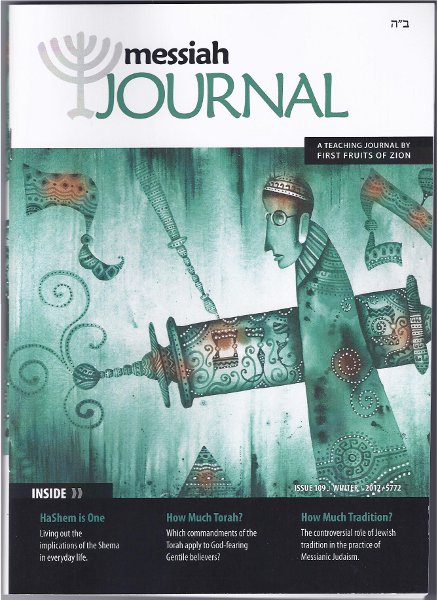
Messiah Journal
Issue 109/Winter 2012

I previously said that I don’t have an advanced degree in religious studies, but as a published author, I do know how to do research, including delving into the history of how “the Way,” which started as a sect of Judaism inclusive of non-Jews but administered and guided by Jewish mentors who understood God and Messiah in a completely Jewish religious framework, into a newly created non-Jewish religion which found it necessary to eliminate any aspects of Judaism from its background.  In my review of the early church, I could see the early “church fathers” virtually reframe the letters of the early Jewish disciples, principally written by Paul, into words that would ultimately be used to discount and eventually all but exterminate the Jewish people.

I’m opening this blog post up for debate on the pros and cons of “fulfillment theology” and asking for those who are far wiser and much better educated and I in religious subjects to enter into the conversation. I do insist however, that this conversation remain polite and respectful. Disagreement is absolutely no excuse for undue emotionalism or any personalizing of conflict. Any apparent “attacks” on someone who differs from your point of view will not be tolerated and I, as the blog owner, reserve the right to edit or delete any offensive comments at my discretion.

This debate is specifically focused on the pros and cons of “supersessionism,” “replacement theology,” “fulfillment theology,” or whatever else you want to call it. It is NOT about One Law or Two House perspectives, so I am not inviting statements on those viewpoints to be presented here. If you find it necessary to disregard my wishes in this, your comments will be removed. Thank you.

With those disclaimers out of the way, please feel free to refer back to the full stream of comments on the “Sabbath” blog post, then return here and discuss how you support or refute my statements and Pastor Adkins’s statements. Please cite specific Biblical or other sources to support your arguments. I am asking for information, not unbridled passion.

One last thing before we begin. Eugene, you previously said:

How is lighting candles a confirmation of Jesus’ grace if that person doesn’t believe in Jesus to begin with?

Shabbat candlesI do have faith in Jesus, as you do Eugene. Watching the lighting the Shabbos candles is a beautiful and unique way of inviting him into my home and to experience something of a preview of his return to us, may it be soon and in our days. If perhaps, your comment were meant as a remark toward my wife who is Jewish but not a believer, I can only ask that you try to consider her with the same compassion and love that God has toward His am segulah; His “wondrous and treasured people” (Exodus 19:5). I can’t tell your attitude toward Jews and thus toward my wife and children through our “text-only” conversation, but if you cannot see them with the same compassion as God does, and believe God has discounted if not completely destroyed them, then I suppose my argument has already been made for me.

With that, I look forward to everyone’s contribution now and in the days ahead. I hope to learn a lot.

Kosher Jesus Salad

The presence of even one whole bug, dead or alive, can render an entire vegetable treif — unkosher. On this matter, Orthodox rabbis are unequivocal.

“From a Torah perspective, eating a Big Mac or eating a salad with insects in it, the salad is worse,” Rabbi Eliezer Eidlitz, who runs the nonprofit Kosher Information Bureau, told me when I met him at his home office in Valley Village.

-Jonah Lowenfeld
“Can we afford kosher lettuce”
January 25, 2012
JewishJournal.com

I actually encountered this article by way of a completely different blog, in a story called How A Rabbinic Ban On Bugs May Have Led To The Creation Of Christianity. As one of the people who commented on the story said, the connection is a pretty big stretch, but the title alone was enough to get my attention.

The Failed Messiah blog is highly critical of Chasidic Judaism and the Chabad movement, which doesn’t exactly make the blog owner Shmarya Rosenberg endearing to many Jews, but he does provide a great deal of information, that would otherwise not be easily accessible, about what goes on in Crown Heights and other Chabad and Haredi communities. I usually take what he writes with a grain of salt, but was captivated with how he could say that a Rabbinic prohibition against eating bugs could possibly have lead to the creation of Christianity.

Let’s cut to the chase.

Din baria probably originated with Beit Shammai, the sometimes violent opponents of Hillel and his school, and whose children and grandchildren heavily populated the rank of the Sicarii and other zealots who spurred the war against Rome that led to the Temple’s destruction.

A student of one of Hillel’s students attacked these rabbis’ extremism: “You blind guides!” he said, “You strain out a gnat and swallow a camel!”

That student, fed up with the growing halakhic extremism that dominated Israel from the last few years of Hillel’s life until the Destruction, did what many other disgruntled Jews did with regard to the rabbis or to the Temple cult – they walked away and formed their own version of Judaism or joined one of the many sects that began at that time.

His sect, known in history as the Jerusalem Church, grew. An offshoot from it – one the student’s brother, who was then the sect’s leader, opposed – is Christianity.

Rosenberg, to the best of my knowledge, has no reason to be sympathetic toward Christianity or to want to create even the slightest link between oto ha’ish (an insulting term some Orthodox Jews use when referring to Jesus) and traditional or historic Judaism. And yet here he is referring to Jesus (though not by name) as a “student of one of Hillel’s students” and directly quoting from the New Testament (Matthew 23:24). Rosenberg even compares the “creation” of Christianity to “(forming) their own version of Judaism or (joining) one of the many sects that began at that time.”

When’s the last time you heard a (non-Messianic) Jewish person refer to Christianity as having begun as a Jewish sect? It makes me wonder just how much of an impact Rabbi Shmuley Boteach’s soon-to-be-published book Kosher Jesus may be having, even if that impact may not be conscious (OK, I’m probably stretching the connection beyond credibility, but let’s roll with it anyway).

Is Jesus starting to be mixed in with today’s kosher tossed salad among some Jews? Just thought I’d ask.

Bo: When We Finally Leave Egypt

The command to confront Pharaoh and negate his influence is given to Moshe, representative of mankind, because the negation of selfishness is a fundamental dimension of man’s service. Man was given the mission of making this world a dwelling for G-d, and this is possible only when selfishness is nullified. Haughty self-interest prevents the Divine Presence from being manifest.

And yet, this nullification of self cannot be accomplished by man alone; it requires G-d’s power. For this reason, Moshe shrank at G-d’s command; he realized that the task was beyond him. That is why G-d instructed him: “Come to Pharaoh,” i.e., come with Me, and not “Go to Pharaoh.” G-d would confront Pharaoh together with Moshe.

-Rabbi Eli Touger
“Confronting Pharaoh”
Commentary on Torah Portion Bo
Adapted from
Likkutei Sichos, Vol. XXI, p. 48-49; Vol. XXXI, p. 32-33;
Sichos Shabbos Parshas Bo, 5733, 5751
Chabad.org

The primary function of the mitzvot is to enable man to permeate the world with goodness and holiness.

“Sanctifying Time”
Commentary on Torah Portion Bo
Adapted from the works of the Lubavitcher Rebbe, Rabbi Menachem M. Schneerson, of righteous memory. (Likkutei Sichos Vol. XXVI, pp. 59-65.)
Chabad.org

And all the Israelites did so; as the Lord had commanded Moses and Aaron, so they did. That very day the Lord freed the Israelites from the land of Egypt, troop by troop.Exodus 12:50-51 (JPS Tanakh)

As I wrote in last week’s Torah commentary Exodus: Challenge in Exile, one of the ways we can think of the exile of the Israelites in Egypt is as an “exile” into their own humanity and as a result, they were distanced from God. Yet, they could not release themselves from their own slavery without God’s intervention, thus God sent Moses as His agent to free the people, to lead them out of slavery, and to redeem them to Himself.

However, what did the Children of Israel have to surrender in order to be free?

I suppose that’s an odd question, since who wants to be a slave? What possible reason would a slave have for not “surrendering” their slavery in order to be free? What about all of the harmful things that enslave us? Pharaoh is a perfect example of this. After the terrible plagues that God had caused upon the land of Egypt, it was in Pharaoh’s best interest to release his slaves and allow them to leave. Even after the plague of the firstborn, when the Israelites finally looted Egypt and left, Pharaoh “strengthened” himself and sent his army to retrieve the Hebrews. As we see, even in the face of overwhelming adversity from God, Pharaoh found it impossible to surrender his “self” in order to protect his nation and his people. He reaped utter destruction as a result.

Is that how we sometimes destroy ourselves, even in the face of the living God who desires to redeem us? The Children of Israel were redeemed when they left Israel and they were saved from themselves. Pharaoh and Egypt could have been redeemed by just letting Israel go at God’s command. Rabbi Touger’s commentary concludes thus:

Penetrating and nullifying self-orientation makes possible the revelation of a positive dimension. And thus the Zohar refers to the House of Pharaoh as: “the place where all lights are revealed in an unrestrained manner.”

Carrying this concept further, the Exodus from Egypt is connected to the ultimate Redemption. Indeed, had the Jews merited, they would have entered Eretz Yisrael immediately after leaving Egypt.

As it is, the entire period from the Exodus until the final Redemption is referred to as “the days of your exodus from Egypt.” For nullifying the selfishness of Pharaoh and breaking through the limitations of Egypt began and begins for each of us as we relive the Exodus a self-reinforcing dynamic destined to take our nation beyond all natural limitations and lead to the Redemption.

And once redeemed, then what? Remember the true purpose of the mitzvot as I mentioned above:

The primary function of the mitzvot is to enable man to permeate the world with goodness and holiness.

The purpose of our redemption, our freedom, and our status as sons and daughters of the Most High is not to exalt ourselves but to “permeate the world with goodness and holiness.” The Master commanded us not to continually resist the insults of “one who is evil” but to turn the other cheek to him (Matthew 5:39). Jesus didn’t teach us to refuse to go a mile with someone by force, but instead, to go with him for two (Matthew 5:41). Yesterday, I tried to say that there are times we must stand resolute before evil as an iron wall against the storm, but there are also times we must bend and be supple like a reed before the wind.

The prophet Isaiah teaches:

a bruised reed he will not break, and a faintly burning wick he will not quench; he will faithfully bring forth justice. –Isaiah 42:3

Yet for all I’ve just said, we cannot free ourselves from ourselves alone. We must rely on God for that strength and that sense of direction which leads us out of our personal Egypt, across the desert, to the redemption promised to all who serve as disciples of the Messiah. If we refuse, even though we claim his name as Master, and continue on our own egotistical and self-destructive course, we’ll find our freedom is an illusion and discover that we never left Egypt at all.

When the time for redemption came, G-d did not keep them for even the blink of an eye

Rashi’s commentary

In the Passover haggadah we say: “Had G-d not taken our forefathers out of Egypt, we, our children, and our children’s children would still be enslaved to Pharaoh.”

After two centuries of exile and subjugation there was little to differentiate the Jewish people from their idol-worshiping masters. So deeply had they sunk into the pagan depravity of Egypt that their redemption came at the very last possible moment, when they were but a hairsbreadth from spiritual annihilation.

Nachmonides

Ironically, we don’t always find redemption when we ask or even beg for it. God waits until we are totally lost within our own worlds of self-indulgence and sin and when we’ve forgotten God completely. Then our redemption comes as Moses came for the unwilling children of Israel.

Said the Zeidehof Shpoli to the Almighty: “Master of the Universe! The sages of the Talmud pleaded before You to bring the Moshiach. You chose not to do so. The holy Ari begged You to bring Moshiach – again You were unwilling. We have reached the point where it is left to someone of my ilk to ask for the redeemer. Still You are holding out.

“Mark my words. There will come a generation who will have no interest in You or Your Moshiach. Then You will have no choice but to bring him.”

-Rabbi Yanki Tauber
“Mark My Words”
Commentary on Torah Portion Bo
Once Upon a Chasid
Chabad.org

This week, there have been many discussions on my “morning meditations” and they do not reflect well on we who claim the cause of Christ. As disciples of Jesus, we have lost our way and are like the Children of Israel in their Egyptian slavery. We say we belong to God but we act like we have completely forgotten Him. We stand up and demand our “rights” for this or that under God, and completely forget that the primary message of Jesus was not one of individual rights but rather, our responsibilities to God and to other people. Christ had the “right” to claim Kingship of the world and its people 2,000 years ago, but instead of standing up for his “rights” (and this is how the adversary tempted him), he submitted to the will of the Father, surrendering even to the horrible death on the cross. If he had “stood up for his rights”, humanity would have no hope. Only by Messiah’s humility and submission have we all been reconciled to God and saved by grace and mercy.

The message has been lost. We must take it back.

Good Shabbos.

The Resolute and Supple Reed

“Who is wise? One who learns from every person.”
-Ben Zoma, Pirkei Avot (Ethics of the Fathers 4:1)

Throughout the existence of the Jewish people, we have long been enamored with intelligence. Just look at the disproportionate amount of Jews who have been awarded the Nobel Prize. However, intelligence by itself is not a supreme value; it can be used for either good or evil. Thus, the Talmud tells us, “The purpose of wisdom is to bring about repentance and good deeds” (Berachot 17a). In other words, if we’re not using our minds to try to become better people, our intelligence really doesn’t amount to much at all. Furthermore, Ben Zoma’s excerpt from Pirkei Avot alludes to the fact that while a person’s intellectual capacity is innately limited, wisdom can be attained by anyone. A wise person is not someone who graduated first in their class, but rather someone who is constantly trying to learn.

-Asher
“Who is Wise”
Lev Echad blog

I didn’t create this “morning meditation” blog to simply spew out answers but rather to ask hard questions. I don’t pretend to have some special insight into God or religion or faith. I only have my experience as I continue and grow in my relationship with God. I chronicle the developments of that relationship here in a variety of forms, including commentary on the Bible and occasionally reviews of related publications. I’m not really here to teach but to learn, and I learn from every person who talks to me in this blog. I think that’s how we all learn…by communicating.

It’s not always easy. As I’m sure you’ve discovered by participating in or just reading the comments on this blog, a lot of disagreement and sometimes heated debate happens. Occasionally, tempers flare, though I do my best to try and contain the “emotionalism” of our debates. The goal, as I see it, is not to try to prove who is right and who is wrong, but to pursue realization and truth. Truth, as I’ve said before, is not the same as fact, and thus truth can take on more than one form.

As Asher said in the quote I posted above, “A wise person is not someone who graduated first in their class, but rather someone who is constantly trying to learn.” He also said this:

Thus, the Talmud tells us, “The purpose of wisdom is to bring about repentance and good deeds” (Berachot 17a). In other words, if we’re not using our minds to try to become better people, our intelligence really doesn’t amount to much at all.

The goal Asher describes is similar to mine. The point of being intelligent isn’t to “be right” but to “bring about repentance and good deeds.” We’re supposed to study and explore and debate and discuss, not to exalt ourselves and to prove we’re the “smarter guy,” but to become better people through a greater understanding of our relationship with God. From a Jewish point of view, that also involves doing and not just thinking or saying, so “good deeds” are a vital part of that process as is repentance of our sins before man and God.

Does that mean a truly wise person is always a doormat who never takes a strong stand on a moral principle? Not at all.

On today’s daf we find that the Beis HaMikdash was purposely destroyed either before or after Shemittah, since bad things happen during times that are already difficult.

Keeping Shemittah in Israel was a big conflict not too long ago. Hardly anyone was doing it—even otherwise religious farmers—and those who were willing were often intimidated by their peers. The Chazon Ish, zt”l, wrote a beautiful letter of encouragement to those farmers who were willing to consider sacrificing what appeared to be their advantage in order to keep the letter of the law.

“I am a farmer who makes his living through the work of my hands. It is now almost Shemittah and a riveting thought has gotten into my head: I want to keep the laws of Shemittah with courage and boldness. I am alone and unaided, a joke to all of my neighbors. ‘How could it be?’ they asked when I began. ‘You won’t plant and you won’t harvest? You can’t fight against reality!’

“But my chutzpah stood me well and despite the indisputable fact that anyone with intelligence knows that it is physically impossible to keep these halachos unless one has a silo filled with grain for three years—since Shemittah is obviously impossible to fulfill in our times without enough grain before the seventh year. Now isn’t like it used to be, they say; you cannot rely on miracles. Yet the year is already halfway over and it looks like one can keep Shemittah after all. I planted everything before Rosh Hashannah, while it was still the sixth year, and during the seventh year I have not worked my field. I am careful to treat the produce which overlaps from the sixth year to the seventh with holiness and I hope to make peace with reality—or that reality should mete out what is good for me.

“My neighbors mock me—yet the weather mocks them. It works out to be good for one who planted early, but not for their crops planted during Shemittah. Only my early-planted crops have survived!”

Daf Yomi Digest
Stories Off the Daf
“A Time of Challenge”
Arachin 12

It seems obvious that if we are in the right in an argument or dispute, we should stand our ground, even against overwhelming odds, including that of “popular public opinion.” The question is, how can you know that you are always right? If you are a reasonable person and honest with yourself, you’ll have to admit that you can never be “always right”. That’s where learning from others comes in. Even a genius cannot know everything if that genius is in isolation. Only by discourse with the rest of the world, including a world that is fundamentally different from you, can real learning ever take place. The trick is to differentiate between being resolute in your principles and being mule-headed stubborn, even in the face of great evidence that discounts the validity of your arguments.

OK, I say that with the understanding that most people don’t change once they’ve made up their minds. But if change were impossible, then no one would come to realize that the God of Abraham is the Maker of the Universe. If we could not humble ourselves and admit that we were wrong, no one would come to faith in the Jewish Messiah, our Lord, Savior, and King.

But our greatest adversary doesn’t exist outside of us in some other group or church or synagogue or even in the supernatural realm. Our greatest enemy is who we are.

There are times you must be like a reed in the wind. And there are times you must face it like an iron wall.

When it comes to matters that lie at the surface, then “I hold like this” and “my opinion is like this” stand in the way of harmony and peace. Every such “I” is the very root and source of evil.

But when it comes to matters that touch your essence and core, the purpose for which you were placed in this world, then you must be an iron wall. Then you must say, “On this, I cannot budge.”

Liberated from its thick shell of ego, empowered and emboldened, the essential self breaks through the concrete, blossoms and flourishes.

-Rabbi Tzvi Freeman
“I Versus I”
Based on letters and talks of the Rebbe
Rabbi M. M. Schneerson
Chabad.org

Although “iron sharpens iron” (Proverbs 27:17), we must not “dull” ourselves by always seeking resistance. To “sharpen” a human being requires debate, disagreement, and discourse, and then an experience of contrition before God to help us understand when it is time to stand our ground like an iron wall, and when it is time to be supple like the reed before the wind.

In the midst of our human storms, we must never forget that what matters most is to seek His Face.

My heart, O God, is steadfast;
I will sing and make music with all my soul.
Awake, harp and lyre!
I will awaken the dawn.
I will praise you, LORD, among the nations;
I will sing of you among the peoples. –Psalm 108:1-3

Review of “Halachic Authority in the Life of the Messianic Community”

This leads me to conclude that the Jewish religion has preserved the Jewish people in their long wanderings in the desert of the Gentiles. Some will say that it is not Judaism which has preserved the Jewish people, but God’s grace. They should rest assured. God has indeed preserved the Jewish people, and he has done so by securing them in this “ark” that is called the Jewish religion. The Jewish religion therefore constitutes a revelation of God’s grace towards the Jewish people. This religion, which arose from the smoky ruins of the Temple and which people so love to hate, is the primary instrument through which God has preserved the Jewish people. Because of it, there are Jews in the world today.

-Tsvi Sadan
“Halachic Authority in the Life of the Messianic Community”
Messiah Journal
Issue 109/Winter 2012, pp 16-17

When I saw the title, I thought the topic would be more related to the specific differences between halacha in traditional, Orthodox Judaism and a halacha that could be applied to Jewish, and perhaps in some sense, to non-Jewish disciples of the Master in a Messianic framework. However, Sadan’s excellent article, which was originally delivered as a lecture in Israel on September 5, 2008, addresses something else almost entirely: the religion of the Jews who follow the Messiah.

Let me explain.

There is an impression that the Jews, and especially the Jews who were born, raised, and educated within a traditional religious and cultural Jewish framework, who are part of Messianic Judaism and who are disciples of Yeshua (Jesus), “the Maggid of Nataret,” belong to a different sort of “Judaism” than their brothers in what we refer to as “Rabbinic Judaism.” In fact, many Jews and non-Jews in other branches of the “Messianic” movement, as well as those attached to Hebrew Roots groups, tend to view Rabbinic Judaism, what we consider the Reform, Conservative, and especially Orthodox branches of Judaism, to be separate, distinct, and “lesser” forms of “true” Judaism. They seem to believe that the only fully realized Judaism is represented by a Messianic Judaism that follows Jesus while removing any aspect of halacha and tradition that exceeds the “written Torah.” This form of Messianic Judaism, actually rejects Rabbinic Judaism in the vast majority of its content (except for using the model of the modern synagogue service and the use of tallitot, siddurim, and so forth) especially and including Mishnah, Talmud, and Gemara: the so called leaven of the Pharisees and the Sadducees” (see Matthew 16:6 and Mark 8:15).

According to Tsvi Sadan, they are dead wrong. Forgive me. What follows is necessarily lengthy.

To understand the meaning of this “leaven,” which scares the daylights out of some people here, I will take just one verse from an abundance of new Testament verses quoted in those inflammatory letters. In Matthew 16 (the word “hypocrites” does not appear in the standard Greek text used today), Yeshua twice calls his disciples to beware of the “leaven of the Pharisees and the Sadducees” (vv. 6, 11). These two admonitions follow the miracles and wonders which he had just performed in the sight of thousands of people. When the Pharisees and the Sadducees approach him to test him (v. 1), Yeshua correctly sees this as impudence of the highest order, and responds accordingly: “[Hypocrites,] do you know how to discern the appearance of the sky but cannot discern the sign of the times?” (v. 3). This means that Yeshua is labeling his opponents hypocrites because of their pretense to see one more sign while in fact all they wanted to do is accuse him.

-Sadan, pg 15

He goes on to say point blank that the “leaven of the Pharisees and the Sadducees” is hypocrisy, not the specifics of Second Temple era halacha and tradition. Sadan confirms that there is no dissonance between Messianic Judaism and Rabbinic Judaism or for that matter, the religious concept of Judaism in any form and Rabbinic Judaism. More plainly put, Rabbinic Judaism is the only Judaism, according to Sadan.

So where does that leave the non-Jews who, in some manner or fashion, are attached to the Messianic and Hebrew Roots worlds? Moreover, where does that leave Christians in relation to their Jewish brothers who also honor Yeshua as Messiah and Lord?

Finally, let me make one point with respect to the Christians living in our midst, because probably there is someone who will distort things and claim that the position I have proposed here leads to hated of the Gentiles. Let me say here that I warmly welcome every Christian – on the condition that he or she does not attempt to impose his or her religion on me. I regard very seriously the behavior of some Christians living in Israel who have the gall to malign the Jews living in the state of Israel merely because they refuse to be evangelicals, Lutherans, or Baptists. God-fearers from all nations are welcome to participate in the Jewish service of God as long as they do not speak against Israel, Torah, and Judaism. I do not agree with the attitude that says that in order to achieve unity with our Gentile brethren, we should remain Jews but reject Judaism. I consider this assertion as nothing less than complete and utter foolishness.

-Sadan pp. 24-25

Laying TefillinSadan continues to strongly make his point for another page and a half, and most assuredly all of it, as I imagine these brief quotes have done, will certainly bring forth the ire of many non-Jews and some Jews in the aforementioned “Messianic” and Hebrew Roots movements, who indeed believe that the Jews who worship the Messiah must abandon Judaism in order to be “completed Jews” (as if a Jew who worships in the manner of his fathers is somehow incomplete).

Sadan’s article does bring up one very interesting point: do Messianic Jews and Gentile Christians belong to two separate and unrelated religions? I have no idea what Sadan thinks, but as far as I can gather from his article, the response seems to be “yes and no.”

It’s “yes” in the sense that everything that Judaism is, including the 613 commandments of the Torah and the entire body of Talmudic judgments, rulings, and traditions, apply only to a Jewish population. Judaism’s ethnic and cultural aspects are completely intertwined with Judaism as a “religion,” so you cannot remove the traditions, without removing what it is that defines a Jew. I’ve said all this before and Sadan’s article does nothing to change my mind.

It’s “no” in the sense that, in spite of the differences in our covenant obligations to God, we share One God and One Messiah, and we are all His creations. We are different branches, but grafted into the same tree. We are Jew and Gentile, but we have equal access to God. We are co-citizens in the Kingdom of Heaven and we all inherit a life in the world to come. And we will all sit at the same table at the feast of Abraham, Isaac, and Jacob (Matthew 8:11).

I do want to take exception to one statement in the article where it appears Sadan refers to we Christians as “God-fearers”.

God-fearers from all nations are welcome to participate in the Jewish service of God as long as they do not speak against Israel, Torah, and Judaism.

I don’t believe that Christians who have accepted the Messianic covenant upon themselves (as it applies to the nations) are equivalent to the ancient God-fearers or the modern Noahides. God-fearers were non-Jews who came out of pagan worship to recognize the God of Abraham, Isaac, and Jacob as the One, true, and unique God of the Universe. They quietly worshiped among the Jews in their synagogues and I imagine the God-fearers humbly populating the Court of the Gentiles in Herod’s Temple, listening with awe to the songs of the Priests, and urgently desiring to bring their own sacrifices before the King.

But they had no covenant relationship with God at all. There was adoration and worship, but no access (unless they chose to convert to Judaism). Jesus, the Messiah, appeared in the world and changed all that. He allowed the nations to come close to God, to be adopted, and to be called sons and daughters of the Most High, through the blood of “the Lamb of God who takes away the sin of the world,” (John 1:29). I certainly hope that Sadan hasn’t chosen to “demote” those of us who come along side him as co-members of the Messianic covenant.

If you’re not familiar with some of the related concepts Mark Kinzer describes in his book Postmissionary Messianic Judaism: Redefining Christian Engagement with the Jewish People, you may find Sadan’s article shocking and even completely alien to how you’ve imagined Jews being attached to Jesus as their own Messiah. If you are familiar with Kinzer’s book, some of you may still be outraged at what Sadan writes and vehemently disagree with his propositions and his ardent passion in defending his own Judaism.

This issue of Messiah Journal couldn’t have come at a better time for me. Last night, I was having a conversation with Judah Gabriel Himango on his Facebook page about the Shabbat and what the coming of Jesus changed in the Jewish and non-Jewish worlds. Judah suggested that because of Jesus, Jews should abandon the traditional Jewish synagogue model of worship and adopt a Shabbat service more along the lines of what’s recorded in 1 Corinthians 14:26-40. Here are some of his comments:

Messiah’s arrival was of such great impact, such that the way we live our lives and the way our congregations are modeled must be in light of his coming. Lives and religious services modeled on the understanding that Messiah hasn’t come would be to live as if he never arrived in the first place. The Messianic movement, including the Messianic Judaism subset, should not merely be emulators of Judaism.

How about the stuff in Corinthians 14 for starters? Shouldn’t those things be in Messianic services?

And how about the Psalms, where music and instruments are used to praise the Lord? Shouldn’t those things be in services, both Jewish and Messianic?

I believe people — Jews and gentiles — should change their lives around to what Messiah commanded and what his disciples taught in the Scriptures.

If our lives and our services look exactly like those before Messiah, it’s as if his arrival never happened.

Needless to say, I disagreed.

The RabbiLet me make clear that I like Judah and I’m not angry or upset with him. I’m not picking on him or singling Judah out, but rather, I’m using his words to illustrate what many other disciples of Jesus believe and want to see actually occur. I must disagree with his desire to replace Jewish worship with how he interprets one small portion of the New Testament, as well as with the general suggestion among Christians, that Messianic Jews should remain (somehow) Jews but flush Judaism down the nearest toilet, tossing Rabbis and Talmud under a speeding bus. While I have questions about how Sadan sees Christians vs. God-fearers, I agree with him in most if not all of the rest of his points. I can’t see the Gentiles in the church and in “Messianism” and Hebrew Roots as having any right whatsoever to re-define Judaism in their own image. Of course, they say that it’s not they who are doing the re-defining, but Jesus instead, but I disagree. We’ve seen that there are an abundant number of paths one can take to interpret the New Testament, including doing away with the Law (and the Jews) and replacing it with the Grace of Christ (and the Gentile Christians), and I disagree with that as well (see my article in MJ 109 “Origins of Supersessionism in the Church” for more).

In previous blog posts and blog comments, I’ve tried to make arguments that present many of the same ideas as expressed in Tsvi Sadan’s “Halachic Authority in the Life of the Messianic Community,” but I lack his insights and perspectives as a Jew and frankly, his wonderful talent in writing. Whether you end up agreeing with him or not, I believe that reading this illuminating work will open your eyes to a new and different way of seeing the Jew in relationship to his Messiah within the time-honored and God-granted context of Judaism.