

First things first. Mark Nanos graciously contacted me to let me know I didn’t quite grasp everything he was saying in his paper ‘Paul’s Non-Jews Do Not Become “Jews,” But Do They Become “Jewish”?: Reading Romans 2:25-29 Within Judaism, Alongside Josephus,’ which I highlighted in Part 1 of this two-part series.
Two clarifications:
- While many do hold that the Jews were expelled from Rome in mass or entirely, in the appendix to The Mystery of Romans Nanos explains why that is almost certainly mistaken historically, and not helpful for explaining Romans.
- More importantly, Nanos does not argue that Paul was actually criticizing Jews in Rome for being hypocritical; rather, he was using the ideal of Jews not being hypocritical as the backdrop for developing a diatribal character, not a real one or even a real accusation as if it is happening, but what it would be like and how obviously hypocritical if so, that one who would call himself a Jew would seek to teach non-Jews Torah if not also committed to keeping Torah, or to get circumcised if not living as one who is circumcised is, dedicated in heart to doing what one separated to God should do regardless of whatever anyone else does or thinks about him and what he does or does not do. That hypothetical character is used to challenge any incipient pride or temptation to judge or behave hypocritically among the non-Jews he addresses directly by way of this diatribal fiction.
I appreciate Dr. Nanos bringing this to my attention and correcting my misreading of his paper where I thought he was saying that Paul was criticizing the Jews in Rome for hypocrisy (and it should be obvious that I’m leveraging Nanos’s words in the numbered list above).
To quote Lt. Cmdr Data, “It is clear that I have much to learn.”
In reporting my impressions on Nanos’ paper last time, I deliberately left out some significant portions for the sake of space. I’m including them here for further discussion.
There are many striking elements in Josephus’s account about Izates, the king of the Parthian client territory of Adiabene, and his mother, Helena, who were not born Jews and ruled a non-Jewish/non-Judean people (Ant. 20.17-96). The events overlap with Paul’s ministry in the 40s and 50s CE (20.15-17), and include interesting parallels to elements of Paul’s approach to and instructions for non-Jews in the Roman Empire. Several scenes warrant discussion.
-Nanos, p. 13
Nanos relates the story of Izates who prior to being crowned King, was sent to Charax Spasini for his own protection. There, Izates encountered the Jewish merchant Ananias. Ananias had been teaching Jewish traditions and customs to several women in the royal family and Izates also became his student.
Or to quote Nanos:
…who taught several women of the royal family with whom Izates was staying to “worship God [the Deity] according to the Jewish ancestral traditions…” (20.34).
-ibid, p. 14
 It is doubtful there was a Jewish community or synagogue present in Adiabene and questionable if Izates and the “women of the royal family” were undergoing this training as part of the proselyte rite (at least at this point in the process), nevertheless, we have several Gentiles being taught to worship the God of Israel “according to the Jewish ancestral traditions.” This at least suggests that said-Gentiles were A) worshiping the God of Israel, and B) doing so “jewishly,” that is, employing Jewish traditions and methods in worshiping Hashem.
While it’s tempting to think that the Ananias in question is the same person who the Master sent to Paul to relieve him of his blindness (Acts 9:9-19) and thus believe that Izates and the “royal women” were being taught Judaism within the Messianic faith, there’s no evidence to support such a theory (see First Fruits of Zion’s Torah Club volume 6: Chronicles of the Apostles for a further discussion of Izates and Ananias in light of Acts 9).
By an amazing “coincidence,” when Izates returned home to assume the throne after the death of his father, he discovered in his absence, his mother had also been studying Judaism.
…he learned his mother had simultaneously begun to observe certain Jewish customs under the direction of a different Jew, who remains unnamed (20.35-38). Izates is described as becoming aware of Helena’s “rejoicing in the Jews’ customs,” (20.38), referred to also as “their laws/conventions” (20.35).
-ibid
It was at this point that Izates decided to extend his Jewish studies and undergo the proselyte rite, converting to Judaism. Here’s where it gets interesting.
It remains unclear whether Izates supposed heretofore that he had become a Jew, or if he was simply unaware of the distinction between adopting (some) Jewish behavior, most likely adding such behavior to the rest of the customs and cult practices of his people as well as those of the people among whom he was residing, and becoming a Jew. Since the matter of circumcision with its signification of identity transformation does not pertain to Helena, it is also unclear if she is still a non-Jew or is recognized to have become a Jew.
-ibid, p. 15
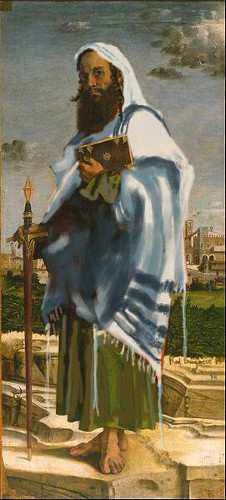 From Paul’s point of view relative to his teaching Jewish practices to Gentiles within the context of Messiah worship, the distinction between Jew and non-Jew in Messiah was clearer, at least to him. But from an outside observer’s perspective, would Paul’s disciples have been seen acting any differently than Izates and Helena? How closely can the two cases be compared, particularly when we realize that nothing called “Christianity” existed in those days as a stand-alone religious entity? Paul’s disciples and Izates and Helena as disciples of other Jewish teachers may have had a great deal in common in acting “jewishly” but not being Jewish (maybe).
Ananias strongly discouraged Izates from converting because of how he thought his non-Jewish royal subjects would react to being ruled by a Jew. But while both Ananias and Helena opposed Izates’ conversion, they “did not, however, oppose him observing certain Jewish beliefs and behavior!”
Tweaking that last statement just slightly, could I call Izates a (somewhat) Torah-observant non-Jew? Nanos asks a similar question:
…it is worth pausing to ask whether Helena and Izates at this point represent jewish non-Jews? They are behaving jewishly, and their jewishness is observably different from that of other nobles and their subjects…
Much of the Apostolic Scriptures record the struggle Paul had in integrating Gentile Jesus-believers into Jewish religious and community space as co-equal participants with the Jewish occupants, particularly in defining how unconverted Gentiles could still receive the covenant blessings that were promised by God to Israel alone. And yet in Paul’s conceptualization, he seemingly had a clear vision of who the Gentiles in Christ were relative to Jews in Messiah (and the wider body of Jewish people).
But in the persons of Helena and particularly Izates, we have a greater degree of ambiguity. Was Izates what we would call a God-fearing Gentile, was he a proselyte, or was he something in-between? He was certainly a Gentile (up to the point when he finally converted) who was practicing at least some aspects of Judaism. How far was he allowed to go?
If Paul’s Gentile disciples had a less ambiguous status in terms of Jewish practices and Judaism than Izates, how do we answer the same questions on their behalf? Can we, as Nanos asks regarding Izates and Helena (p. 17), consider them “jewish” Non-Jews who were gathering in Jewish assemblies or synagogues?
I’ve avoided asking the obvious question so far, but how does any of this apply to Gentile Christianity today, particularly to those of us who call ourselves Messianic Gentiles? Twenty centuries ago or close to it, we have a record of many non-Jewish people co-mingling with Jews within Jewish assemblies and communities and being treated as near-equals or equals in social and even covenant standing. The Gentiles were largely, and some probably fully entrenched in Jewish cultural practices. What does that say about Gentiles interacting and worshiping with Jewish Jesus-believers (Messianic Jews) in Jewish community space today?
Goyish is not bad. Goyish is good. It may not be good for Jews, but if you’re a Gentile—goy is good! It is what God made you. ENJOY!!! And realize that salvation has come to the Gentiles as Gentiles. You don’t have to discover your Jewish roots. You should not abandon or disparage the churches from which you came or where you still live, and move, and have your being. You should enrich them through engagement with the Bible, through discovering and expressing your spiritual gifts, and through your whole-hearted participation, but please please please: Don’t despise your roots or imagine that you have to abandon them to find God. God has come to find you and your people just as you are and where you are.
-Dr. Rabbi Stuart Dauermann
“The Problem With Hebrew Roots, or, It’s Good to be a Goy”
Interfaithfulness.org
 This might almost be seen as the same view from the opposite end of the telescope. It’s an expression (if I’m reading this right) of how the Gentile Jesus-believers do not have to adopt Jewish cultural traits and practices in order to be faithful Jesus-believers and benefit from the Jewish covenant blessings of salvation, justification, and the resurrection to come.
In Paul’s day, there was no template for integrating faith in the Jewish Messiah within the various Gentile cultures, so it was probably easier to bring the Gentiles into Jewish culture. Paul probably wouldn’t have known how to teach about Messiah and the God of Israel in any other way. But two-thousand years later, Christianity has a rich (and sometimes dark) history and culture of its own. Each church could be said to be its own cultural milieu with its traditions and mores and very little if any of it looks at all Jewish.
Some Gentile believers feel kind of ripped off by the Church, especially when they learn to read the Bible, and particularly the Apostolic Scriptures, as God encountering man within Jewish culture and community. It seems inviting to witness the first Gentile believers being taught by Paul and Barnabas at the “Synagogue of the Way” in Syrian Antioch (see Acts 11).
But can or should a Gentile’s faith in the Jewish Messiah be expressed within a Jewish community and cultural context today? From the above-quoted blog post of R. Dauermann, in answer to a comment, he replies:
Yes, right Chris, learning about the Jewish/Hebrew roots of what CHristians believe is instructive and helpful, but not when a Gentile is erroneously steered in the direction of seeking to establish their *own* alleged Jewish roots as a passport to greater spiritual authenticity. As I said above, “It is true that Christianity at its inception had Jewish roots, but this is not Not NOT and never to be understood as recommending that Christians think they have Jewish roots or that they need to find those roots in order to legitimize themselves and their faith.”
From my point of view, I think there are circumstances when Gentile believers can and even should appropriately express their faith within a Jewish cultural context. In fact, at least in the United States, most authentically Messianic Jewish synagogues contain a significant if not majority population of Gentiles in their membership. Like Izates, there will always be Gentiles who are inexorably drawn to Judaism for whatever reason and they will find their way into Jewish community. Further, there are numerous intermarried couples who would benefit from the Jewish spouse participating in Messianic Jewish community along with the Gentile spouse. This is particularly important if they have Jewish children who need to learn and preserve what it is to be Jewish and to be Messianic.
But I was thinking in church last Sunday about Christians (which I suppose isn’t surprising). What do we do about them?
The first thing to consider is that most Christians are more than overjoyed to be in their churches and couldn’t imagine any other venue for their worship of and devotion to Jesus Christ. From their viewpoint, they neither want nor need to engage Jesus within a Jewish cultural context and doing so would just make them feel uncomfortable if not downright alienated.
But that’s not to say that the Church is perfect nor that they cannot learn from what Messianic Jews and Gentiles teach. I was talking to a young fellow after Sunday school class the other day about Jewish traditions and the benefits they possess. We talked about the set times of prayer and the abundance of blessings a Jew recites on various occasions. I also told him that a Christian does not specifically have to adopt Jewish practices in order to gain the benefits of the values that lie behind the traditions.
 On Erev Shabbat for example, it is traditional for Jewish parents to bless their children in a specifically proscribed manner. I told my young friend that he and his wife could also chose to bless their children, but they didn’t have to do it “jewishly”. The values behind Jewish traditions and culture provide context, identity, and meaning to Jewish families, and I think Christians can and sometimes do employ similar practices for the same reasons and can get similar results.
Two-thousand years of history have separated most Christians from even the idea that we could act “jewishly” and for most Christians, it would drive them crazy even to consider the possibility. But if someone like me, who has a few “jewish” ideas to relate to my Christian counterparts, can communicate those concepts in the Church, maybe it will build a bridge between the two worlds.
For those Christians who are drawn to a more “jewish” lifestyle, many of them either come from family and culture that melds into behaving more “jewishly” or they learn to do so through marriage or some other process.
The main takeaway for me is that it’s not a “have to,” that is, I don’t feel compelled by God that I must live “jewishly” and that it’s a sin not to. It may well have been acceptable for Izates and Helena to live “jewishly” and never to convert to Judaism, at least in a formalized manner. Certainly Paul’s Gentile disciples lived “jewishly” probably by default, since there was no other cultural pattern one could employ for a Gentile to live as a disciple of a Jewish teacher.
But that was then, and this is now. While some Gentiles elect to live “jewishly” as an expression of their faith, it doesn’t seem absolutely necessary, at least in the current age. I’ve seen some Christians in the Church observe more of the weightier matters of Torah than I have some Hebrew Roots Gentiles in One Law gatherings.
It isn’t the cultural or religious context that makes the person of faith, it’s the heart. One circumcised heart is worth ten-thousand kippot and tallitot wearing people with uncircumcised hearts (not that you can’t be a kippah and tallit wearing Gentile with a circumcised heart, of course).
To love him with all your heart, with all your understanding and with all your strength, and to love your neighbor as yourself is more important than all burnt offerings and sacrifices.”
–Mark 12:33 (NASB)
A friend of mine said it best: Don’t seek Christianity and don’t seek Judaism. Seek an encounter with God.













 Morning Meditations