Tag Archives: Judaism

Ezekiel and Paul on Messiah and Torah

destruction_of_the_templeFor they have committed adultery and there is blood on their hands and they have committed adultery with their idols; and even their children, whom they had borne for Me, they passed before them to be consumed. Moreover, they have done this to Me: They defiled My Sanctuary on that day, and they desecrated my Sabbaths, when they slaughtered their children for their idols they would come to My Sanctuary on that very day to defile it! Behold, they have done this in My Temple!

Ezekiel 23:37-39 (Stone Edition Tanakh)

Therefore no one is to act as your judge in regard to food or drink or in respect to a festival or a new moon or a Sabbath day—things which are a mere shadow of what is to come; but the substance belongs to Christ.

Colossians 2:16-17 (NASB)

Tales of the Messianic Era series

Sorry. This is a long one. I was dozing in bed this (Sunday) morning when a few thoughts pulled together for me. This “mediation” is the result.

It seems that, according to the prophet Ezekiel (and many other prophets in the Tanakh), God really, really cared about the Israelites keeping His Sabbaths (the weekly Sabbath and the Moedim or Holy, appointed times), but Paul seems to think they don’t matter. Of course, the traditional Christian resolution is that Ezekiel lived on one side of the cross and Paul on the other. Jesus changed everything.

But did he?

I won’t be seeing my Pastor again for one of our conversations for another week or so, but in our review of D. Thomas Lancaster’s book The Holy Epistle to the Galatians, and specifically the chapter covering Galatians 2:15-16, Pastor asked me to read all of Galatians 2 as well as Romans 3 and 4, and Colossians 2 to prepare for our next discussion.

I can see where he’s leading.

Not too long ago, I reviewed an episode of the First Fruits of Zion TV show called The Torah is Not Canceled. The episode is based on a particular interpretation of the following words of the Master:

“Do not think that I came to abolish the Law or the Prophets; I did not come to abolish but to fulfill. For truly I say to you, until heaven and earth pass away, not the smallest letter or stroke shall pass from the Law until all is accomplished. Whoever then annuls one of the least of these commandments, and teaches others to do the same, shall be called least in the kingdom of heaven; but whoever keeps and teaches them, he shall be called great in the kingdom of heaven.

Matthew 5:17-19 (NASB)

crossYou can click the links I provided to get the deeper analysis from my review or by watching the episode, but the basic idea is that Jesus is saying he did not come to neglect the Torah or to teach others to neglect it, but rather to teach it correctly and to obey Torah himself. Of course, this too is on the “wrong side of the cross,” so my Pastor could just say that after his death and resurrection, Jesus changed his teachings. But that would be really confusing for him to teach one way before his death and then completely change things after the resurrection. Christian doctrine demands that he did so, but it defies not only logic, but the overall narrative of the Bible as God’s message to the Jewish people and the rest of the world.

In Ezekiel and many other places in the Old Testament, we see God caring very much about whether or not the ancient Israelites obeyed His commandments. There were dire consequences for them neglecting the mitzvot including exile and death.

Now the Lord was angry with Solomon because his heart was turned away from the Lord, the God of Israel, who had appeared to him twice, and had commanded him concerning this thing, that he should not go after other gods; but he did not observe what the Lord had commanded. So the Lord said to Solomon, “Because you have done this, and you have not kept My covenant and My statutes, which I have commanded you, I will surely tear the kingdom from you, and will give it to your servant.

1 Kings 11:9-11 (NASB)

But the house of Israel rebelled against Me in the wilderness. They did not walk in My statutes and they rejected My ordinances, by which, if a man observes them, he will live; and My sabbaths they greatly profaned. Then I resolved to pour out My wrath on them in the wilderness, to annihilate them. But I acted for the sake of My name, that it should not be profaned in the sight of the nations, before whose sight I had brought them out. Also I swore to them in the wilderness that I would not bring them into the land which I had given them, flowing with milk and honey, which is the glory of all lands, because they rejected My ordinances, and as for My statutes, they did not walk in them; they even profaned My sabbaths, for their heart continually went after their idols.

Ezekiel 20:13-16 (NASB)

God expects obedience to His commands by Israel’s Kings, Prophets, and the nation as a whole. Disobedience carries dire consequences.

Do not imagine that I have come to violate the Torah or the words of the prophets. I have not come to violate but to fulfill. For, amen, I say to you, until heaven and earth pass away, not one yod or one thorn will pass away from the Torah until all has been established.

Matthew 5:17-18 (DHE Gospels)

messiah-prayerJesus tells his disciples and his critics that he has not come to disobey the mitzvot or to teach others to do so but rather, to teach others to obey the mitzvot and to obey them himself. Further, he says that heaven and earth will pass away before even the tiniest detail of the Torah passes away. Since heaven and earth continue to exist, long after the death, resurrection, and ascension of Jesus, logically, I have to conclude that the Torah still applies to the Jewish people as it did the day Jesus uttered those words.

But then, what do I do with the following?

I do not nullify the grace of God, for if righteousness comes through the Law, then Christ died needlessly.”

Galatians 2:21 (NASB)

But now apart from the Law the righteousness of God has been manifested, being witnessed by the Law and the Prophets, even the righteousness of God through faith in Jesus Christ for all those who believe; for there is no distinction; for all have sinned and fall short of the glory of God, being justified as a gift by His grace through the redemption which is in Christ Jesus; whom God displayed publicly as a propitiation in His blood through faith. This was to demonstrate His righteousness, because in the forbearance of God He passed over the sins previously committed; for the demonstration, I say, of His righteousness at the present time, so that He would be just and the justifier of the one who has faith in Jesus.

Where then is boasting? It is excluded. By what kind of law? Of works? No, but by a law of faith. For we maintain that a man is justified by faith apart from works of the Law. Or is God the God of Jews only? Is He not the God of Gentiles also? Yes, of Gentiles also, since indeed God who will justify the circumcised by faith and the uncircumcised through faith is one.

Romans 3:21-30 (NASB)

Of course, Paul immediately says in the next verse, “Do we then nullify the Law through faith? May it never be! On the contrary, we establish the Law.”

From my point of view, Paul isn’t “undoing” the Torah (Law) but rather, he’s saying (and this is how I read his entire message to the churches in Galatia) that Torah obedience doesn’t justify anyone before God.

However…

…that doesn’t mean God disdains the Law that He Himself created or that Jesus unplugged Jewish obedience to God from God’s overall plan. Jesus said that the Torah wouldn’t pass away, not even in the smallest detail, until heaven and earth passed away.

So the “anti-Torah” portions of Paul’s letters either mean Paul was hopelessly conflicted about the Torah or that Christian tradition has erroneously interpreted Paul for a very long time now.

As you probably guessed, I read Ezekiel quite recently and I “discovered” some startling things about the future; about the Messianic Age that is yet to come:

And He said to me, “Son of man, thus says the Lord God, ‘These are the statutes for the altar on the day it is built, to offer burnt offerings on it and to sprinkle blood on it. You shall give to the Levitical priests who are from the offspring of Zadok, who draw near to Me to minister to Me,’ declares the Lord God, ‘a young bull for a sin offering. You shall take some of its blood and put it on its four horns and on the four corners of the ledge and on the border round about; thus you shall cleanse it and make atonement for it. You shall also take the bull for the sin offering, and it shall be burned in the appointed place of the house, outside the sanctuary.

Ezekiel 43:18-21 (NASB)

temple-of-messiahHere we see the future Temple, the one that will exist in the Messianic Era. God is describing the sacrifices that will be offered by the Levitical priests in the future Temple, just as those sacrifices were offered in the Mishkan (Tabernacle) in the desert and in Solomon’s Temple. In Ezekiel 44:15-31, God is describing the ordinances that apply to the Levitical priests, which mirror those originally given in the Torah.

And then we have this:

‘Thus says the Lord God, “The gate of the inner court facing east shall be shut the six working days; but it shall be opened on the sabbath day and opened on the day of the new moon. The prince shall enter by way of the porch of the gate from outside and stand by the post of the gate. Then the priests shall provide his burnt offering and his peace offerings, and he shall worship at the threshold of the gate and then go out; but the gate shall not be shut until the evening. The people of the land shall also worship at the doorway of that gate before the Lord on the sabbaths and on the new moons. The burnt offering which the prince shall offer to the Lord on the sabbath day shall be six lambs without blemish and a ram without blemish; and the grain offering shall be an ephah with the ram, and the grain offering with the lambs as much as he is able to give, and a hin of oil with an ephah. On the day of the new moon he shall offer a young bull without blemish, also six lambs and a ram, which shall be without blemish. And he shall provide a grain offering, an ephah with the bull and an ephah with the ram, and with the lambs as much as he is able, and a hin of oil with an ephah. When the prince enters, he shall go in by way of the porch of the gate and go out by the same way. But when the people of the land come before the Lord at the appointed feasts, he who enters by way of the north gate to worship shall go out by way of the south gate. And he who enters by way of the south gate shall go out by way of the north gate. No one shall return by way of the gate by which he entered but shall go straight out. When they go in, the prince shall go in among them; and when they go out, he shall go out.”

Ezekiel 46:1-10 (NASB)

The Prince, that is, Messiah, will offer the traditional sacrifices in the Temple, and he shall, along with all Israel, observe the New Moons and Sabbaths in accordance with the commands of God in the Torah. This is all supposed to happen in the future Messianic Age, on the “right side of the cross,” and apparently in direct contradiction to what Paul wrote in Colossians 2:16-17.

So we have a few options to consider. If the traditional Christian interpretation of Paul is right, then in spite of all of the evidence in the Old Testament to the contrary, and especially Ezekiel, Jesus “undid” the Torah of Moses for the Jewish people. But that doesn’t make sense. Not only would Paul have to contradict the Old Testament prophets, but he’d have to contradict Jesus and even himself. The scriptures between the Old Testament, the Gospel of Matthew, and the different letters of Paul don’t match up.

If that option doesn’t work, where can we turn?

The only other direction to move in (unless we want to dismantle Christianity) seems to be the fact that the traditions Christianity have been using to understand the New Testament and probably the whole Bible need a bit of reworking. You can’t ignore one part of the Bible in favor of the other. If Paul seems to contradict the Old Testament prophets and Jesus himself, then either Paul is wrong and our New Testament is hopelessly flawed (in which case, we have to dismantle Christianity), or we’re seriously reading things in the wrong way. We don’t understand Paul and we are forcing an interpretation on him that doesn’t fit and that Paul himself would never recognize.

Apostle-PaulWe know from Ezekiel that the Messiah and all Israel will once again offer sacrifices at the Temple, that all of the Sabbaths and New Moons will be observed, that the Levitical priesthood will be restored, and that the Torah mitzvot will be performed correctly by the Jewish people. From Matthew, we know that not one tiny detail of the Torah will pass away until heaven and earth pass away. And from Paul we learn that no matter how important obeying God is by observing the Torah mitzvot, behavioral obedience doesn’t justify anyone, Jew or Gentile, before God. Only faith justifies through God’s grace.

But we still have one little problem. If the Torah is still fully in effect for the Jewish people, what about Jewish disobedience? We have a long record in the Tanakh of the ghastly consequences for such disobedience. While the nation of Israel exists again today, it is still a largely secular nation. Also, many, many Jewish people still choose to live in the diaspora (exile) rather than making Aliyah to Israel and living in the Land, which is also a commandment. Many, many Jews in Israel and all over the world do not observe all or even some of the mitzvot.

What is God’s response to all of this?

Now therefore why do you put God to the test by placing upon the neck of the disciples a yoke which neither our fathers nor we have been able to bear? But we believe that we are saved through the grace of the Lord Jesus, in the same way as they also are.”

Acts 15:10-11 (NASB)

We see a couple of interesting things here. First of all, Peter calls the Torah “a yoke which neither our fathers nor we have been able to bear.” If that’s true, then why do we see so many complementary references to the Torah in both the Old and New Testaments? The answer, I believe, is the long history of Israelite disobedience to the mitzvot which resulted in God’s terrible wrath upon Israel. Faith and obedience to God in the Torah is wonderful, but the consequences of faithlessness and disobedience are disastrous, a yoke that Israel has not been able to bear.

But Peter also said something else. It wasn’t the words he used but the order of them. He said that “But we believe that we (Jews) are saved through the grace of the Lord Jesus, in the same way as they (Gentiles) also are.” As a Jewish person and an apostle, you’d have expected Peter to say that the Gentiles are saved in just the same way as we Jews are. That’s how it was expressed on previous occasions including Acts 10:45.

I think this might be the answer:

For as many as are of the works of the Law are under a curse; for it is written, “Cursed is everyone who does not abide by all things written in the book of the law, to perform them.” Now that no one is justified by the Law before God is evident; for, “The righteous man shall live by faith.” However, the Law is not of faith; on the contrary, “He who practices them shall live by them.” Christ redeemed us from the curse of the Law, having become a curse for us—for it is written, “Cursed is everyone who hangs on a tree” — in order that in Christ Jesus the blessing of Abraham might come to the Gentiles, so that we would receive the promise of the Spirit through faith.

Galatians 3:10-14 (NASB)

clinging_to_torahI believe Paul is saying a couple of things here. First, he is continuing with his central theme in this letter that no one is justified by obedience to Torah in and of itself. If anyone depends on their Torah obedience to justify them before God, then they will be judged by God based on their obedience alone. Since we have a long history of Israel disobeying Torah or not obeying it completely, any disobedience carries with it the curses God proscribed for disobedience, namely things like famine, exile, war, and death.

There is evidence that some first century Jewish people, including some Jewish believers, thought that they could only be justified before God by obedience to the mitzvot (Acts 15:1-2 for example). I think the “light bulb” went off over Peter’s head as he was speaking in front of the Council in Acts 15. I think he understood the Gentiles were saved by faith but it suddenly dawned on him that the same “mechanism” that saves Gentiles also saves Jews…faith, not observance of the mitzvot alone and not being ethnically Jewish.

So what did Jesus “nail to the cross?” Not the Torah. We have too much evidence that says the “curse of the Law” isn’t the Law itself. I believe what he “nailed to the cross” were the curses for Jewish disobedience of Torah. The “yoke” that Israel has never been able to bear. This is the freedom the Jewish people experience in Messiah. And through Messiah, the blessing of Abraham has come to the people of the nations so we too can receive the promise of the Spirit through faith.

I found a rather helpful individual comment on the blogosphere that I think helps illuminate this point:

I would like to add to this that Yeshua removed the curse of the Torah not by making this curse in itself invalid or inapplicable, but by introducing an atonement which exceeds the means of atonement provided by the legal system of the Torah. For in and through his sacrifice we can be justified from all things, from which we couldn’t be justified by the Torah of Moses (cf. Acts 13:39). In becoming a curse for us by being hanged on a tree, Messiah provided a means of atonement which results in eternal and definite forgiveness for those who truly repent, and in this manner he redeemed us from the curse of the Torah (Gal. 3:13).

More: Derek Leman has recently written a blog post on a related topic called Physical and Spiritual Election.

The Messianic Kingdom is not a Democracy

snow-in-jerusalem-bookFor centuries, Jerusalem has been a holy place for Jews, Christians, and Muslims. It has been referred to as both the Center of the Universe and the Eternal City. Jerusalem has also been called the City of Peace despite the fact that it has often been the object of bloody battles over religion and territory.

Today, Jerusalem is a city within a city. Surrounded by Arab East Jerusalem and Jewish West Jerusalem is the ancient Old City, an area of some 220 acres. The Old City is encircled by walls built in the sixteenth century by the Ottoman emperor Suleiman the Magnificent. Visitors may enter the Old City through one of seven large gates.

Inside, the Old City is divided physically and culturally into four sections: the Jewish Quarter, the Muslim (Arab) Quarter, the Armenian Quarter, and the Christian Quarter. These divisions are not totally segregated, however, and include some overlap of cultures. Nevertheless, Jewish and Arab children go to separate schools…

-Deborah da Costa
from the Author’s Note of her book
Snow in Jerusalem

In her affecting but message-driven debut children’s book, da Costa relays the story of two boys who live in Jerusalem’s Old City Avi in the Jewish Quarter and Hamudi in the Muslim Quarter. A fluffy white cat wanders between the homes of the two boys, relishing the scraps each feeds her. Then weeks pass without any sign of the cat, alarming each boy. Looking skinny and dirty, the cat at last visits Avi, who then follows her to Hamudi’s neighborhood, where the youngsters begin to argue, each claiming the cat is his. As a rare snowfall begins, the boys stop bickering and, fearing that the beloved animal will freeze, follow her through Jerusalem to a dark alley where they discover four kittens in a box. As the mother purrs loudly and rubs against the boys, they conclude, “She does not want us to fight…. She wants peace.”

-from the Publisher’s Weekly review of the same book
found at Amazon.com

Tales of the Messianic Era series

My wife checked this book out of our local library (along with a dozen other children’s books) for our four-and-a-half year old grandson, Landon. I took last Friday off of work and spent the day with the little guy. After arts and crafts at the library, lunch of (homemade) macaroni and cheese, two or three episodes of Jonny Quest (1964), Legos and other toys, we got down to the business of reading. Da Costa’s “Snow in Jerusalem” was one of the books he wanted me to read to him while he was enjoying a mid-afternoon snack.

I enjoyed reading the book and especially the feeling of actually walking the streets of the Old City between the Jewish and Arab quarters, but reading the Author’s Note at the very end stopped me cold. I realized that this was a book promoting peace, not just between the characters Avi and Hamudi in the book, but between peoples and cultures. That’s not a bad thing certainly, but there was a further undercurrent suggesting a perpetual sharing of all of Israel, sub-divided between Jewish Israel and Arab Palestine.

That’s a popular solution for the conflict between these two people groups, especially among political and social liberals, but it flies in the face of the Bible and I believe is an affront to God. To be clear, I don’t think peace between all the different people of the world is the affront, but I do believe carving up Israel into different chunks for different people like separating the white and dark meat of a turkey on Thanksgiving is.

The word which Isaiah the son of Amoz saw concerning Judah and Jerusalem.

Now it will come about that
In the last days
The mountain of the house of the Lord
Will be established as the chief of the mountains,
And will be raised above the hills;
And all the nations will stream to it.
And many peoples will come and say,
“Come, let us go up to the mountain of the Lord,
To the house of the God of Jacob;
That He may teach us concerning His ways
And that we may walk in His paths.”
For the law will go forth from Zion
And the word of the Lord from Jerusalem.
And He will judge between the nations,
And will render decisions for many peoples;
And they will hammer their swords into plowshares and their spears into pruning hooks.
Nation will not lift up sword against nation,
And never again will they learn war.

Come, house of Jacob, and let us walk in the light of the Lord.

Isaiah 2:1-5 (NASB)

gateway_jerusalemIn reviewing various scriptures in the Tanakh (Old Testament) about the Messianic Era and the future King of Israel, I don’t see any references to taking the Land of Promise, which God gave to Abraham, and to Isaac, and to Jacob, and all of the physical descendants of that specific line (and notice Ishmael is not included, nor any of Abraham’s other sons) and splitting it up into Jewish and non-Jewish portions. The only “splits” of the Land involved the different areas given to the twelve tribes of Israel.

Messiah will come to return all of the exiled Jewish people to their Land and to rebuild Jerusalem as the Jewish city.

The Lord God, who gathers the dispersed of Israel, declares,
“Yet others I will gather to them, to those already gathered.”

Isaiah 56:8 (NASB)

I will be found by you,’ declares the Lord, ‘and I will restore your fortunes and will gather you from all the nations and from all the places where I have driven you,’ declares the Lord, ‘and I will bring you back to the place from where I sent you into exile.’

Jeremiah 29:14 (NASB)

These are just a few of the examples in scripture declaring that Messiah will gather the exiles of Israel and restore them to their nation.

Peace is a wonderful thing. So is fairness, equity, sharing, friendship, and the like. But how we imagine these general concepts and their application in Messianic Days may not be how they will really play out. Remember, whether you are Jewish or Christian, the Messiah is King, not President or Prime Minister. A Kingdom is not the same as a Democracy. Citizens of a Kingdom ruled by a single Monarch do not get to vote on laws, rules, and ordinances. The King’s Word is Law.

We all assume that everyone will get what they want in the Messianic Kingdom. Perhaps that is true, but I suspect for some people it will not be so. What if you’re a Muslim and the Jewish Messiah comes to rule not only Israel (all of Israel) as a Jewish nation, but the entire planet? For that matter, what if you are a Christian and you suddenly realize just how Jewish your “Jesus” really is? What if the King establishes without any equivocation that the Jewish nation is the head of all the nations (rather than the United States of America), and that the Torah is the Law of the Land for Israel and incumbent upon all of the Jewish people? What if some portions of that Torah go forth from Zion, and apply to all the people of the nations who are called by His Name (Amos 9:11-12)?

Don’t we get a vote on this? Don’t we have a say? How could this possibly be fair? Where is God’s justice?

There will be nothing else but God’s justice on Earth during the Messianic Age. People will get what they need but not always what they want according to the will of God. We will have peace. Our swords will be beaten into plowshares and our spears into pruning hooks, but only after Messiah has led a vast army to defeat all of Israel’s enemies (including, most likely, the United States of America). God Himself will fight for Israel, crush her adversaries, and establish her security.

The Lord will be king over the whole earth. On that day there will be one Lord, and his name the only name.

Zechariah 14:9 (NIV)

Are you getting the picture. The Lord will be one and His Name, One.

In that day the Root of Jesse will stand as a banner for the peoples; the nations will rally to him, and his resting place will be glorious.

He will raise a banner for the nations and gather the exiles of Israel; he will assemble the scattered people of Judah from the four quarters of the earth.

Isaiah 11:10, 12 (NIV)

ffoz-tvNot only will Messiah gather the Jewish exiles and restore them to Israel, but he will act as a banner for the rest of us, drawing us to him.

But remember, we won’t get a vote. This is Law.

The only and last functioning Theocracy (nation directly ruled by God) on Earth was ancient Israel before the people demanded that Samuel anoint Saul as King.

In the Messianic Age, that Kingdom, that Theocracy will be restored. A Davidic King, the last Davidic King will ascend the Throne in Jerusalem again, David’s Throne, which God promised to David and to his descendants forever.

For the sons of Israel will remain for many days without king or prince, without sacrifice or sacred pillar and without ephod or household idols. Afterward the sons of Israel will return and seek the Lord their God and David their king; and they will come trembling to the Lord and to His goodness in the last days.

Hosea 3:4-5 (NASB)

For many, many centuries, Israel has been without a King, but it will not always be so. The King is coming. He will return. He will restore his people, the Jewish people, and all of humanity will go up to Jerusalem, and every knee will bow, to the Ruler, the Prince, the King, Messiah, Son of David, the Righteous Branch.

With respects to Deborah da Costa, while there will be peace within Jerusalem and her walls will forever be secure, it will not be the sort of peace established by a Jewish boy and an Arab boy arguing over possession of a cat and her kittens. It will be a brutally fought and hard-won peace where real adversaries will spill gallons of blood and mountains of dead flesh will decay in the sun and be eaten by carrion birds.

Enemies will be defeated in a war lead by a King whose rule is absolute. Peace will come when all of those enemies are dead, and the survivors of the nations defeated by Israel’s armies and by God must come to Jerusalem once a year to honor the King on Sukkot.

Then it will come about that any who are left of all the nations that went against Jerusalem will go up from year to year to worship the King, the Lord of hosts, and to celebrate the Feast of Booths. And it will be that whichever of the families of the earth does not go up to Jerusalem to worship the King, the Lord of hosts, there will be no rain on them. If the family of Egypt does not go up or enter, then no rain will fall on them; it will be the plague with which the Lord smites the nations who do not go up to celebrate the Feast of Booths. This will be the punishment of Egypt, and the punishment of all the nations who do not go up to celebrate the Feast of Booths.

Zechariah 14:16-19 (NASB)

And then there will be peace.

Everyone will sit under their own vine
and under their own fig tree,
and no one will make them afraid,
for the Lord Almighty has spoken.

Micah 4:4 (NIV)

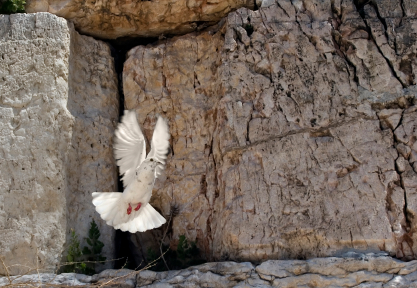
white-pigeon-kotelPeace comes when the Lord Almighty has spoken it, not when we have imagined some man-made utopia and think we can make it real just by publishing enough books, television shows, and movies based on that fantasy.

All that said, we can escape the fantasy and be part of building the way to Messianic peace now, at least a little of it. But we have to grasp onto the “fringes” of the garment of God, so to speak, humble ourselves, and speak the words of the coming Kingdom and the King who is to be. We can choose that path, or deny it and inherit a more terrible end.

“…and you will come up against My people Israel like a cloud to cover the land. It shall come about in the last days that I will bring you against My land, so that the nations may know Me when I am sanctified through you before their eyes, O Gog.”

Ezekiel 38:16 (NASB)

That choice is ours to make. The King has been patient with us, but his patience will end, and we had better be ready when it does. We are either soldiers in his army or on the side that will see defeat. We will see peace in the Kingdom or find the peace of the grave. The Holy One of Jacob neither slumbers or sleeps.

And he is the King. We must bow or be broken.

Jerusalem has been called the Center of the Universe and the Eternal City. But it is also known as the City of David. One day it will truly be the City of Peace.

Imperfect and Perfect

praying_at_masadaGod appeared to Abram and said to him, “I am Almighty God. Walk before Me and be perfect.”

Genesis 17:1

If a human being cannot be perfect, why did God demand perfection of Abraham?

The entire context of the verse indicates both the definition of this perfection and the way in which it can be achieved. It is obvious that no human being can aspire to equal God’s degree of perfection. What man can achieve is to live according to God’s teachings and thereby live up to his own human potential; more than man’s personal maximum is not possible or expected. Thus, God did not say simply, “Be perfect”; He said, “Walk before Me + and thereby you will be perfect.” When a person tries to live according to the Divine teachings, that constitutes human perfection, although one is technically never perfect.

Rabbi Samson Raphael Hirsch notes that the Hebrew word for “walk” in the above verse is not telech but heshalech which implies, “Go your way in spite of opposition, not making your progress dependent on external circumstances, but being led from within yourself: Let your movement proceed from your own free-willed decisions.”

The picture is now complete; human perfection can be achieved by making a free-willed choice to live according to the Divine teaching.

Today I shall…

…try to realize that although I cannot be absolutely without flaw, I can be perfect if I make free-will decisions to obey the Divine will.

-Rabbi Abraham J. Twerski
“Growing Each Day – Cheshvan 6”
Aish.com

This brings to mind something my Pastor and I periodically discuss. Perhaps I’d better preface this with scripture:

For whoever keeps the whole law and yet stumbles in one point, he has become guilty of all.

James 2:10 (NASB)

No one keeps the Law (Torah) perfectly. No one can. So when I insist that Jewish people, including Messianic Jewish people, remain obligated to the mitzvot, he counters with James 2:10. No one can keep the law perfectly, therefore, no one can keep the law. It’s like he’s saying, “if no one can keep the law perfectly, why bother trying to keep it at all?”

Jesus once said that if a man looks at a woman with lust in his heart, it’s as if he had physically committed adultery with her (Matthew 5:28). And yet, probably most men at one time or another in their lives have found themselves looking at a beautiful woman and having lustful thoughts, even momentarily. Does that mean such men, having failed once (or more than once), should throw their marriage vows to the winds and start having physical “relations” with every woman who strikes their fancy?

praying-apostleI should hope not. As people of faith, we should strive to live out our lives in as close an approximation to the perfection of our Master as we can, all the while knowing we will never behave in a perfect manner. We try to better ourselves, we pray for God’s help in bettering us, but even if we come closer to our Master’s example, we’ll never match it.

Remember the word that I said to you, ‘A slave is not greater than his master.’

John 15:20 (NASB)

I don’t think “perfection” is what Jesus had in mind when he made that statement, but it seems to fit today’s example. Just because we can’t be perfect like our Master doesn’t mean we should stop trying.

Putting all this back into the original context, and summoning Rabbi Twerski’s example, just because an observant Jewish person cannot perform all of the mitzvot perfectly (and may not perform some of the mitzvot at all) doesn’t mean that they should abandon their obligation to the Torah of Moses as a way to draw closer to God, or to surrender the lifestyle God gave to the Jewish people which uniquely identifies them as Jewish.

My understanding of one of the purposes of performing the mitzvot is to help a Jewish person continually be reminded that they are Jewish. You wouldn’t think remembering this would be much of a chore, but consider how rampant assimilation of Jews is in our society today. The mainstream culture works very hard at getting everyone to fit in, blend in, assimilate to the will of the world’s “marketing department,” and never, ever to be different or distinct in any way whatsoever.

So being an observant Jew is a lot of work. It would be much easier to assimilate. It would be much easier to be able to go to any restaurant in town and to order anything on the menu. It would be much easier to drive, cook, shop, play golf, and surf the Internet on Shabbat. It would be much easier not to have to study Torah, study Mishnah, study Hebrew (and in some cases Yiddish). It would be much easier to set aside the fixed times of prayer every day, easier to not don tzitzit, easier to not lay tefillin.

But being born into the covenant as all Jewish people are, it is incumbent upon each Jew to live as a Jew. God gave people, including Jewish people, free will, so a Jewish person can choose to observe the mitzvot or not (or choose which of the mitzvot to observe and which ones to ignore), but sooner or later, God will get around to reminding each Jewish person that they are indeed Jewish. The reminders are not always pleasant or easy to endure.

rabbi-prayingI’ve said before that only faith justifies one before God, not observing the mitzvot. It’s not what we do but why we do it and who we do it for that matters. If our thoughts and behavior are not focused on God and responding to God’s will, no matter how well we do something and no matter who we may show kindness to, it begins and ends with us. There is no connection to eternity.

But faith and justification are only the beginning of the journey. Once we have grasped onto “God’s fringes” tightly, we must respond to grace and faith by living life as God wills. For a Jew, that means Torah observance. How to observe the Torah, which of the mitzvot to start with, which tradition to employ in the observance (for instance, there’s more than one way to lay tefillin and to tie tzitzit) is a question and I don’t have the answer. But that doesn’t mean the Jewish person ceases in being obligated to try. Who is to say that the Ashkenazi way to tie tzitzit is any better or worse than the Sephardic tradition? Perhaps both are pleasing to God.

If a Jewish person were to wait around for iron-clad confirmation of exactly which way to do a particular mitzvah, they could wait around until Messiah comes (or returns).

It’s like my current frustration with the politicians in Washington over their lack of action in solving the debt ceiling crisis. I want to scream at them, “Just do something!” The Nike company’s well-known slogan of “Just Do It!” comes to mind.

Rabbi Twerski said that even though he knows he cannot be without flaw, still he does his best to walk in the way of his fathers and of God. He also said something peculiar:

Although I cannot be absolutely without flaw, I can be perfect if I make free-will decisions to obey the Divine will.

How can performing the mitzvot make one perfect simply by exercising free-will in obeying God?

Therefore you are to be perfect, as your heavenly Father is perfect.

Matthew 5:48 (NASB)

Jesus can’t possibly expect literal perfection from his disciples since none of us are perfect. Nothing we can do will ever be perfect. No thought we possess, even our faith is never perfect, so where does this expectation come from?

The road to perfection is infinitely long, and no matter how far we walk down that road, we are always at the starting line. God has to reach out to us to cover the distance we are incapable of traveling. All we can do is to turn to God in teshuvah and to do our best (which will never be good enough) in faith and love, and let God’s grace bridge the gap between lowly man and a Heavenly God.

In the performance of the Torah mitzvot, all a Jewish person can do is that…turn to God in faith and love, imperfectly attempting to do His will by living as a Jew, and letting God’s grace make the imperfect into the perfect.

jews_praying_togetherThe blood of goats and bulls never saved, but faith and grace saved. Davening Shacharit while wearing a tallit katan and laying tefillin doesn’t save, but faith and grace will save. However, in ancient times, God required (not requested, required) the Israelites to sacrifice goats and bulls, and even to this day, God requires (not requests, requires) Jewish people to observe the mitzvot, which includes davening Shacharit while wearing a tallit katan and laying tefillin.

It doesn’t save. It never did. And Jewish people won’t be perfect at all of the mitzvot all of the time. But they are still obeying the will of God in the best way they know how…just like the rest of us, just like Christians in the Church. We’re all doing what we can do. God will take care of what we can’t do. We just need to realize that when we’re tempted to judge others.

People who live in glass houses shouldn’t throw stones.

-Popular idiom

“Do not judge so that you will not be judged. For in the way you judge, you will be judged; and by your standard of measure, it will be measured to you. Why do you look at the speck that is in your brother’s eye, but do not notice the log that is in your own eye? Or how can you say to your brother, ‘Let me take the speck out of your eye,’ and behold, the log is in your own eye? You hypocrite, first take the log out of your own eye, and then you will see clearly to take the speck out of your brother’s eye.

Matthew 7:1-5 (NASB)

It does not become a Christian to criticize a Jew for not being perfect in the performance of the Torah mitzvot when there is no Christian, even under the full grace of Jesus, who lives a perfect life in Christ.

By the way, this is my one thousandth “morning meditation.”

A Quick View of the Coming of Messiah Through a Jewish Lens

cloaked-in-light-tallitBelief in the eventual coming of the mashiach is a basic and fundamental part of traditional Judaism. It is part of Rambam’s 13 Principles of Faith, the minimum requirements of Jewish belief. In the Shemoneh Esrei prayer, recited three times daily, we pray for all of the elements of the coming of the mashiach: ingathering of the exiles; restoration of the religious courts of justice; an end of wickedness, sin and heresy; reward to the righteous; rebuilding of Jerusalem; restoration of the line of King David; and restoration of Temple service.

Modern scholars suggest that the messianic concept was introduced later in the history of Judaism, during the age of the prophets. They note that the messianic concept is not explicitly mentioned anywhere in the Torah (the first five books of the Bible).

However, traditional Judaism maintains that the messianic idea has always been a part of Judaism. The mashiach is not mentioned explicitly in the Torah, because the Torah was written in terms that all people could understand, and the abstract concept of a distant, spiritual, future reward was beyond the comprehension of some people. However, the Torah contains several references to “the End of Days” (acharit ha-yamim), which is the time of the mashiach; thus, the concept of mashiach was known in the most ancient times.

from “Mashiach: The Messiah”
Judaism 101

The Jewish people are compared to the stars twinkling in the high heavens. By their light, even he who walks in the darkness of night shall not blunder. Every Jew, man or woman, possesses enough moral and spiritual strength to influence friends and acquaintances, and bring them into the light.

-from “Today’s Day”
Wednesday – Cheshvan 5 – 5704
Compiled by the Lubavitcher Rebbe; Translated by Yitschak Meir Kagan
Chabad.org

Tales of the Messianic Era series

A few days ago, I wrote a blog post called A Quick View of Revelation Through a Christian Lens, which presented what I thought was a traditional fundamentalist Christian viewpoint of the Book of Revelation and the “end times.” It turned out to be one of my more popular blog posts and I hope laid the groundwork for further investigations into this area of study.

I want to be fair, and since I’m searching for a more Jewish understanding of this topic, I thought the next step should be for me to offer the opposite side of the coin: to show a portrait of a wholly and non-Messianic Jewish perspective on the coming of Moshiach. What would a distillation of the Jewish prophesies about Messiah taken just from the Tanakh (Old Testament) look like? Fortunately a few days ago, one fell quite conveniently in my lap.

The real Jewish messiah appears on the scene. He’s not Jesus, but a virtuous and devout Jewish man who is able to unite all Jews, a scholar and wise military leader. The nations of the world hate and oppose him and work against him, as they’ve done to every Jewish leader in Israel’s history. He’s nothing like what they expected to see – not the glorious all-powerful heavenly Jesus. He regathers the rest of the Jews from all around the world. Many wars against Israel break out, but the Messiah leads Israel in defeating their many enemies and in rebuilding the Third and final Temple.

True prophets once again appear in Israel and they are able to recognize the lineage of all Jews, including of priests, Levites and especially that of the Messiah himself, with many Jews recognizing their leader as the awaited Messiah. Christians, however, almost unanimously speak against him, brand him the “antichrist” of their bible, preaching fiery sermons in their churches against the “antichrist” and against the Jews who fell “under his spell just as Jesus, Paul and John predicted”. No Christian may believe in him, or they risk losing their salvation. Jews are ridiculed and the New Testament is held up as having predicted everything the Jews will do. Muslims, who along with Christians likewise believe that Jesus is the Messiah and that no one else fits the bill, also reject the kingship of the Jewish Messiah and join with the Western world in their opposition to him and the nation of Israel.

Finally, all nations gather against Israel for the ultimate conflagration, attacking Jerusalem and causing much damage. The war against Israel appears to be won and situation is hopeless. However, G-d himself intervenes, and sends his fire on earth and destroys the armies of “G-g and Magog and all the cohorts.” The weakest in Israel chases away thousands. The nations of the world are humbled, they are in awe of what G-d has done for Israel, of His salvation. The idols of the nations which do not save (including Jesus) are destroyed, are put away for good and are remembered no more. All false prophets and idol worshipers will be ashamed, they will realize that they inherited nothing but lies from their forefathers. The earth will be finally at peace. G-d raises all the righteous dead and all peoples of the earth are required to come to Jerusalem to worship Hashem in his Temple. The true Messiah of Israel (which could be the resurrected king David himself) will fear G-d, rule justly and will forever reign as prince/king over the Jewish people.

Jewish in Jerusalem(I just want to mention that although Islam considers Jesus a prophet, they do not see him as their “Messiah.” Rather, the Mahdi is the redeemer of Islam).

Just about all Christians and not a few Hebrew Roots and Messianic Jewish adherents are bound to find the above rendition of the coming of Messiah disturbing. The Jewish Messiah is treated by Christians as the “antichrist” because he’s “too Jewish” and fits the description of Moshiach in Jewish understanding too closely. The Church is waiting for someone who never comes, waiting for a rapture up to Heaven that never occurs. In the end, Christianity becomes just another enemy of Judaism and Israel that God defeats. Humiliated, Christians all over the world discover that they’ve been following a false god all along, and either they surrender their “faith” and pay homage the true King of Israel and worship Israel’s God, or they remain defiant, and continue to pray for a Jesus who never existed and who will never answer.

That’s a horrible thought. Here’s a worse one.

The above summary, at least on the surface, seems to fit quite well with what we understand of the Messianic prophesies in the Tanakh. That is, if we don’t factor in the New Testament, this summary seems to connect almost seamlessly with the words of the ancient Jewish prophets about the coming Moshiach.

You don’t have to worry about the distinctions between the raptured Church and resurrected Israelites because no such dissonance exists. It’s all about Israel. Period.

Interestingly enough, this isn’t tremendously far from what I’ve been trying to find in Messianic Judaism, a completely Jewish Messiah King whose focus is first and foremost on national Israel and the Jewish people. From this focus, the people of the rest of the world receive blessings, but ultimately it’s all about Israel. Period.

If there isn’t a “happy meeting place” between the ancient portrait of the Jewish Messiah King who has yet to come and the promise of a resurrected Yeshua who will come again, then either New Testament Christians must be ready to admit that there is a very fuzzy connection between the Old Testament prophesies of Messiah and how the New Testament describes Jesus, or we have to take a whole new look at the Messianic prophesies in the Tanakh and see who we are really supposed to be waiting for.

This isn’t going to be easy, especially when I’m tossing aside the Church’s assumptions and traditions that make it possible to reconcile what doesn’t seem to fit very well, and re-examine the identity of Messiah and his redemptive mission at its core.

I know in my previous blog post, I received a large number of responses explaining the problems with some of the Christian assumptions about the return of Jesus. I’m hoping a similar reaction will be forthcoming, discussing the Jewish viewpoint of Moshiach and how (or if) a Jewish perspective can factor in and make it understandable that Jesus is the same Messiah we find in the Old and New Testaments.

Now it will come about that
In the last days
The mountain of the house of the Lord
Will be established as the chief of the mountains,
And will be raised above the hills;
And all the nations will stream to it.
And many peoples will come and say,
“Come, let us go up to the mountain of the Lord,
To the house of the God of Jacob;
That He may teach us concerning His ways
And that we may walk in His paths.”
For the law will go forth from Zion
And the word of the Lord from Jerusalem.
And He will judge between the nations,
And will render decisions for many peoples;
And they will hammer their swords into plowshares and their spears into pruning hooks.
Nation will not lift up sword against nation,
never again will they learn war.

Isaiah 2:2-4 (NASB)

tallit-prayerWho is the Messiah who will redeem Israel, gather in her exiles, restore tranquility within her borders, vanquish her enemies, rebuild the Temple, and establish a rule of peace and justice over the entire world? Is it the man we see described by such prophets as Isaiah, Jeremiah, Ezekiel, Hosea, and Micah? Or is it the Son of God who we encounter in Matthew, Mark, Luke, and John, the one spoken of by the apostle Paul as he established the churches of the Gentiles, and the one who we find in all majesty and glory within the pages of Revelation?

Or somehow, is it both?

Lech Lecha: Did You Hear the One About the Jewish Student and the Priest?

strangers-in-israelThe Lord said to Abram, Go forth from your native land and from your father’s house to the land that I will show you.

I will make of you a great nation, And I will bless you; I will make your name great, And you shall be a blessing. I will bless those who bless you And curse him that curses you; And all the families of the earth shall bless themselves by you.”

Abram went forth as the Lord had commanded him, and Lot went with him. Abram was seventy-five years old when he left Haran. Abram took his wife Sarai and his brother’s son Lot, and all the wealth that they had amassed, and the persons that they had acquired in Haran; and they set out for the land of Canaan. When they arrived in the land of Canaan, Abram passed through the land as far as the site of Shechem, at the terebinth of Moreh. The Canaanites were then in the land.

Genesis 12:1-6 (JPS Tanakh)

Thus Abraham took his first steps on a journey that would result in the vast and astonishing progression of the Jewish people across the grand panorama of human history. Abraham the Hebrew “crossed over” not just a geographical boundary, but a spiritual one.

I’ve said on a number of occasions that I thought one of the missions of the Christian church was to provoke zealousness among the Jewish people, to inspire Jews to return to Torah, return to Judaism, return to being who God made them to be.

Although I don’t believe God would allow it, there is a tremendous and ongoing concern, especially in America, that the Jewish population will continually assimilate, and ultimately vanish from our national landscape. And while many Christians believe that the only hope for the Jewish people is to convert to Christianity no matter what, there are some Jewish believers who insist that only when the Jewish people repent and return to Torah that the Messiah will finally return, and all of God’s promises to Israel and the people of the nations who are called by His Name (Amos 9:11-12) will finally come to pass.

In this week’s Torah portion, Avraham (Abraham) makes his way to the land of Israel and begins the journey of the Jewish people through history. Along that path we have seen nations rise and fall and have survived them, even through massive persecution. There were 2 million Jews during the Roman Empire 2,000 years ago. Demographers state that though there are approximately 14 million Jews identified worldwide, there are possibly 400 million halachic Jews (Jews whose mother’s were Jewish or converted according to Jewish law). Many Jews have fallen by the wayside of history. This week I share with you a story of one Jew who made his way back to identifying with the Almighty, the Jewish people and the Torah … albeit in a rather unusual way.

-Rabbi Kalman Packouz
“Shabbat Shalom Weekly”
Commentary on Torah Portion Lech Lecha
Aish.com

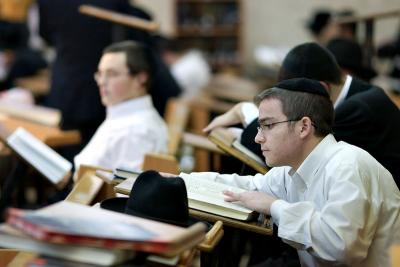
orthodox-talmud-studyRabbi Packouz goes on to tell the story of “Lance,” a young Jewish fellow who came from a family so assimilated that they sent him to a Catholic school to get the “best education.” One of Lance’s instructors, a Priest, found out that Lance was Jewish only by accident. Lance chose to write an essay about Rabbi Akiva for an assignment in the Priest’s class. Curious, the Priest asked Lance why he chose a great Jewish sage as the topic and Lance answered, “Because I’m Jewish.” This simple statement launched another journey into Judaism with some surprising twists:

The priest was surprised that he had a Jewish pupil and asked Lance if he had ever studied the Five Books of Moses with Rashi, the great commentator, or if he had ever learned the Mishna, part of the Talmud. When Lance told him “No,” the priest offered to teach him. For an hour a day after school, they learned together.

One day it occurred to Lance that Judaic studies were not the usual curriculum for the priesthood, so he asked his mentor, “How did you become so knowledgeable in Torah?”

The priest replied, “Before I entered the seminary, I traveled to Israel. While visiting the Western Wall a man asked me if I was Jewish. Curious as to why he asked, I answered ‘Yes.’ The man then asked me if I was interested in learning about my heritage. I figured it would be interesting, so I said, ‘Sure.’ He took me to a yeshiva in the Old City of Jerusalem and I was so impressed that I stayed for close to a year, never revealing that I wasn’t Jewish. I considered converting, but decided that it would be too difficult and too much of a shock to my family, so here I am.”

One Jewish young man who had grown up never knowing what it is to be Jewish and a Catholic priest who nearly converted to Judaism. What strange partners of God. A Priest encouraged his Jewish student, not to convert to Catholicism, but to become knowledgable in Torah and Mishnah. He encouraged “zealousness.”

Protestantism struggles with how to support the Jewish people but gets hung up on Jews who are not in the Church. They can’t always see that we can also “provoke zealousness” and that Messianic Judaism is the most likely vehicle for doing so. If Jesus is Jewish and the Messiah, then his Jewish followers will not abandon being Jewish and will not neglect Torah as his disciples.

Abraham took all that he had and, at the command of God, went to the Land of Promise in obedience. God put Lance and a Priest together and using a highly unlikely set of circumstances, sent one lost Jewish person on the correct path as well. According to Rabbi Packouz, Lance continued pursuing his Jewish studies and presumably became observant.

If you are a Christian, what does this tell you about what God wants you to do? If you are Jewish, where should you be going?

Good Shabbos.

Conversion At Any Cost?

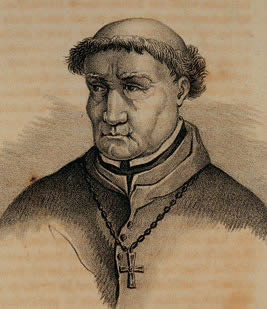
tomas-de-torquemadaIn 1483, Tomas de Torquemada was appointed as “Grand Inquisitor of the Spanish Inquisition.” Jews of Spain had been forced to convert to Christianity, and the Inquisition was designed to uncover those who were continuing to practice their Judaism in secret (called Conversos or Marranos). Those who never confessed were burned at the stake; those who did confess were strangled first. Torquemada believed that as long as the Jews remained in Spain, they might influence the tens of thousands of Jews who had converted to Christianity. It was on his recommendation that the remainder of the Jewish community — 200,000 people — was expelled from Spain in 1492. An estimated 32,000 were burned at the stake, and Torquemada’s name became a byword for cruelty and fanaticism in the service of religion. The order of expulsion was not officially voided by the government of Spain until 1968.

Today in Jewish History
Cheshvan 4
Aish.com

This will be short but not sweet. There are some Christians who say that it was a sin for Jews to refuse to convert to Christianity across the last two-thousand years of history. Yes, these are Christians living today in my little corner of the world. I’ve brought this issue up to them. Is it right for Christians to torture Jews into “conversion?”

They say the torture part was wrong, but that the Jews should have studied scripture and discovered the truth of Jesus for themselves. I’m also told that Christians who resorted to torturing Jews in order to gain their conversions were not “true Christians.”

Unfortunately, as far as I can tell, they represented the normative Church of their day and as far as I can tell, there were no opposing bodies in the Church crying out against the torture and murder of the Jewish people.

I think forcing anyone to convert to Christianity on pain of torture and death is wrong. Period. I don’t think such conversions would be valid in any case. You can torture a person’s body and you can make them speak the words, you can even make someone afraid to think thoughts of refusing Christianity, but you can’t control the spirit, and God knows the truth.

And yet, there are Christians today that say that the Jews under Tomas de Torquemada and those like him should have converted when requested to. I disagree. I think men such as this one are reprehensible villains and should be reviled. The only reason to keep their names in our history books is so that their bad example will never be repeated. I think the Jewish people who resisted this monster are heroes and the ones who “converted” should be pitied.

If any person, Jewish or Gentile, of their own free will, chooses to accept Jesus as the Messiah, that’s between them and God. The minute a so-called “Christian” takes up any manner of coercion against another human being to trick or force them to convert, both that “Christian” and their victim lose.