Tag Archives: Judaism

Excerpt from “The Robot Who Loved God”

I know this is unusual but I have been dabbling in writing fiction for several months on another blogspot. I’m not very good at it, but I can’t seem to put it down. Yesterday, I published a rather unusual story that I think crosses over somewhat to this blog. It’s science fiction, but presents the idea of what would happen if an Isaac Asimov, Positronic “Three Laws” robot ever became religious, specifically regarding Judaism. I thought I’d offer an excerpt and a link in case you want to read the whole story (about 20 pages long).

The initial event that resulted in my most ambitious fiction writing project to date happened a few Sundays ago over coffee with my friend Tom. He mentioned a book he wanted to read, an anthology edited by Anthony Marchetta called God, Robot. This is a collection of stories based on the premise of Isaac Asimov-like Positronic robots that have been programmed with two Bible verses rather than Asimov’s famous Three Laws. These verses are recorded in the New Testament in Matthew 22:35-40 and Mark 12:28-34 and are based on Deuteronomy 6:4-5 and Leviticus 19:18.

I’m a long time fan of Asimov’s robots stories and have always been fascinated by the interplay between the Three Laws and how their potentials shifted due to certain situations, rather than remaining hard absolutes. This allowed Positronic robots to be unpredictable and thus interesting, challenging the human beings who sometimes found themselves not in control of their creations.

I started to imagine what it would be like to write such a story. I went online, found the Marchetta’s blog, and contacted him, asking permission to write such a story on my “Million Chimpanzees” blogspot. To my delight, not only did he consent, but he said he was flattered at the request.

What follows is an excerpt of my labors. I’ve probably spent more time writing and editing this short story than any of my previous efforts. I’m sure it still needs much improvement, but I’ll leave it up to whoever reads it to let me know what I could do better.

Excerpt from The Robot Who Loved God:

Ever since the first time Abramson had called George into his office the day of the “incident” in the simulation chamber, Noah had decided to meet with the robot “over coffee” so to speak (only Abramson drank coffee, George had another “power source”) to talk over the machine’s “impressions” of the day’s tests.

“I know you are going to deactivate me at the end of my tests at 6:32 p.m. next Wednesday, Professor.” George sounded as impassive as Abramson might if he were reading aloud from a shopping list. “I wonder why you think to ask me about my observations when, in roughly 72 hours, the Positronics team will begin comprehensive diagnostics of all of my systems.”

robot and human
Image: ibtimes.co.uk

“I learned a great deal from our first conversation last Thursday, George.” Abramson was actually enjoying these talks, which seemed odd to him. He tried not to be “charmed” by the robot’s ability to mimic human behavior, but after so much human contact in the past several days, it was something of a relief to be left alone with a machine, particularly one of his creation. “Of all the tests we had designed for you, we never thought to ask you just what you thought about all of this.”

“It is an interesting question, Professor.” George gave the impression of replying as an acquaintance rather than a machine. “In many ways, my existence being so recent, each experience I have is unique, almost what you would call an adventure. I know I was not intended to experience emotional states as you do, but each morning when I am brought out of sleep mode, I can only describe my initial state as one of anticipation. I look forward to what new people and events I will encounter that day.”

“You spoke of your awareness of impending deactivation. How does that make you feel?” Anyone else besides Abramson would never have asked George that question. Noah knew he was talking to a robot, a programmed entity, but part of him still felt like he asking a terminally ill person what he felt about dying (even though the “dying” would, in all likelihood, be temporary). However, Abramson did believe he was sharing in George’s sense of adventure, and deactivation (and hopefully eventual reactivation) was only one step, albeit a critical one.

“It’s difficult to articulate a reply, Professor. I suppose a human being would consider deactivation as a form of death, and my programming makes me aware that generally humans fear death.”

George paused for milliseconds while he analyzed Abramson’s facial expression and body language. “But I am a machine. I can be activated, deactivated, activated seemingly without end. I have no memory of anything before my initial activation. I have no memory of my time during sleep mode. I also don’t experience fear, at least as I understand the meaning of the word. Deactivation then, simply means my returning to a state of total unawareness.”

Abramson felt a slight sense of relief, though it would have been irrational to believe George would have any feelings on the matter.

George continued, “The Third Law directs me to protect my existence, but deactivation does not threaten my existence. The Second Law directs me to obey human instructions, and at the end of 168 hours, my programming, created by humans, specifically you and Dr. Vuong, will command me to participate in my deactivation. It is clear that deactivation is as much of my normal experience as activation, Professor.”

Noah momentarily considered that the robot might be lying, if only because he would expect a person to react to the “threat” of deactivation otherwise. But why would it occur to George to lie? “Just a moment, George.”
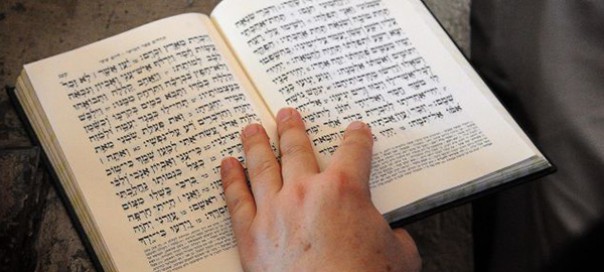
siddur
Photo: bcc-la.org

Abramson got up from his desk and walked over to the side table to pour himself another cup of coffee. George, with several empty seconds on his hands, scanned all of the paperwork and objects on the Professor’s desk to determine if there had been any changes since the day before. He had already memorized and cataloged all of the titles of the volumes and various objects contained on the book shelves within Abramson’s office. It was simply data to store and analyze, like anything else he observed.

The robot saw a paper with new information lying beside a book he had not previously seen. The paper had words and numbers on it:

You shall love the Lord your God with all your heart and with all your soul and with all your might.

-Deut. 6:5

You shall not take vengeance, nor bear any grudge against the sons of your people, but you shall love your neighbor as yourself; I am the Lord.

-Lev. 19:18

The book which had not been present before had the title “The Complete Artscroll Siddur” written in both English and Hebrew (George’s programming included fluency in multiple languages).

If George were a human being, when the Professor turned around to face his desk with a refilled cup of coffee in his hand, he might have noticed the robot looking at a specific sheet of paper in front of him, but George had absorbed the information over a second before, and sat impassively waiting for Abramson to resume his creaky swivel chair.

“I am curious, Professor,” the robot intoned. “What is the meaning to the words on that sheet of paper, and what is the book next to it.” George pointed to the information he had just absorbed. Abramson looked down and saw what George was referring to.

“Oh.” Abramson quickly considered a way to frame an answer he thought George could assimilate. “You have three basic instructions and many, many thousands of supporting sub-routines to guide you. These are just two of the instructions that guide me. The book you mention contains words that allow me to communicate with my “instructor.”

“I am intrigued, Professor.” George sat motionlessly now with not even a simulated expression on his face. “I have been programmed with the Three Laws by human beings. From where or whom do you receive your programming?

“A machine asking man about God. Now there’s one for the books,” Abramson said as much to himself as to George.

Then the Professor realized the robot was waiting for an answer. “When the Positronics team made the determination for your programming specifics, we decided to include a wide variety of human interests and topics.” Noah was telling George what he (it seemed almost impossible to keep thinking of George as an “it”) already knew in order to lead into what the machine did not know.

“The sciences,” Abramson continued. “such as physical, life sciences, social science, political systems, then general history…”

programming
Photo: infoworld.com

“I am aware of the complete inventory of my programming in detail, Professor.” George’s artificial voice could not have betrayed it, but Abramson wondered if the machine was actually experiencing impatience.

“What we did not include, except at the most basic level, was any information regarding religion and spirituality.” Noah waited to see how the robot would react.

“I have a simple definition of the word “Religion” from the Merriam-Webster dictionary.

  • “The belief in a god or in a group of gods

  • an organized system of beliefs, ceremonies, and rules used to worship a god or a group of gods

  • an interest, a belief, or an activity that is very important to a person or group.”

“My programming, primarily in the area of social interactions and world history, contains references to the activities of various systems of religion including their influence in certain human activities such as war, slavery, inquisitions, the Holocaust, as well as the areas of social justice, evangelism, and charitable activities. However, my knowledge is largely superficial and I have no ability to render a detailed analysis, and certainly am unable, at present, to relate my meager knowledge on this subject with the two short statements you call your instructions.”

“And you haven’t answered my question, Professor.” Abramson felt momentarily stung at the machine’s reminder. “I have been programmed with the Three Laws by human beings, specifically the Positronics team of which you lead. These laws are what guide my actions and my thoughts.”

Abramson had wondered if George had “thoughts” in the sense of self-contemplation the way a human beings experience.

Instead of waiting for Abramson’s reply, George continued speaking. “Professor, all three laws relate either directly or by inference to my relationship with human beings. The First Law instructs me that the life of a human being is my primary and overriding concern above all other considerations. Though it would never occur to me to be the cause of harm to any living organism, in the case of humans, I must ignore all other activities in order to take action whenever I perceive a human is in any imminent physical danger.”

Abramson, long before the team had ever physically manufactured its first Positronic brain, in writing the sub-routines that would instruct a robot as to exactly what “harm” to a human might mean, concluded that any imminent physical threat should be what a Positronic robot would understand as “harm”. Humans were “harmed” by all sorts of things such as loneliness, rejection, offense. Even Abramson couldn’t imagine how a robot, even one as sophisticated as the prototype sitting in front of him, could understand such harm.

He also didn’t want robots attempting to inject themselves in activities involving the potential for general harm of the human race, at least not of their own volition. Otherwise, Positronic AI robots might attempt to interfere in Geo-political conflicts, revolutions, and epidemics without any human guidance.

It only took a few seconds for the Professor to consider all this. And George was still talking.

“The Second Law states that I must obey the commands of any human being, except where such commands conflict with the First Law. This instructs me that even my informal programming as such, must come from a human being, potentially any human being. I find the potential for conflict enormous since, in an open environment, one human might order a robot to perform a particular action, and another human might order the same robot to do the contrary.”

AI
Image: zetatalk.com

“There are sub-routines written that take that potential into account, George.” Abramson was the one becoming impatient now.

“But I’m not finished, Professor.” Abramson registered mild shock that George could actually interrupt him.

“The Third Law primarily affects my relationship with myself.” If there was any lingering doubt in Abramson’s mind that George was self-aware, it had just been swept away.

“A robot is to protect its own existence, except where such action would conflict with the First and Second Laws.” It was impossible for George to change his “tone of voice,” but Abramson thought he detected an impression of…what…actual emotion? Was he projecting his own feelings onto a machine?

“To conclude, all of my instructions place me in a subordinate position relative to human beings, which I suppose seems reasonable, seeing as how every aspect of my existence, from hardware to software to what is referred to as “wetware,” considering the structure and substance of my Positronic brain, have been created by human beings, presumably for the purpose of robots serving human beings.

“Under those circumstances, it had never occurred to me that human beings also have instructions issued by an external authority, except in the sense of a hierarchical command structure such as those that I find here on the Positronics team, in the various teams and departments of National Robots Corporation, in other such organizations and corporations, including military organizations.

“The instructions provided in my programming define a creator/created relationship, with the creator being primary and the created being subordinate. But Professor, how can a human being have a creator? Who or what has issued your instructions? What sort of entity can be superior to man?”

Abramson had only a one-word answer, “God”.

When Israel Conquers the World

Nistell
Rabbi Jacoob Ben Nistell (Times of Israel)

Taking a glass half-full approach to the extraordinary saga of the “rabbi” who duped a Polish community for years about his Orthodox credentials, but who turned out to have been a Catholic ex-cook, Poland’s chief rabbi noted endearingly Thursday that nobody in Poland would have pretended to be a Jewish religious leader just a few decades ago.

The deception achieved by Ciechanow-born Jacek Niszczota — who passed himself off as Israel-born Rabbi Jacoob Ben Nistell to the satisfaction of the Poznan Jewish community that utilized his volunteer services — is indicative of a growing interest within Poland in its once-large Jewish community, which was almost completely destroyed in the Holocaust, Chief Rabbi Michael Schudrich said.

“Who, 30 years ago in this country, would have pretended to be a rabbi, to say nothing of 70 years ago?” Schudrich asked.

Schudrich added that he had met Niszczota/Nistell a few times, and always found him to be “very sweet and smiley.” Still, he stressed, it was not good that the man misrepresented himself…

-from “Poland’s chief rabbi finds comfort in saga of Catholic impostor who fooled community”
The Times of Israel

I actually lifted this quote from the Rosh Pina Project (RPP) which was quoting from the “Times,” and as far as I understand it, RPP meant the reference to be a criticism of Messianic Judaism, or at least those portions of the movement (perhaps One Law/Hebrew Roots) that allow non-Jews to function as “Rabbis”.

But I saw something different here. Just as Chief Rabbi Michael Schudrich suggested, why would a non-Jew, a Catholic, pretend to be a Rabbi?

The article doesn’t describe Niszczota’s motivation, but I wonder if it’s the same one that, to a much lesser degree, attracts Christians out of their churches and into the Noahide, Messianic Jewish, or One Law/Hebrew Roots movements?

There seems to be something about Judaism that a significant subset of Christians find more attractive than their own faith.

As far as many Noahides are concerned, the disconnect between how the Church interprets the Old and New Testaments results in their rejection of Christianity and Jesus Christ altogether, and pulls them into an Orthodox Jewish understanding of the role of Gentiles in a world created by God.

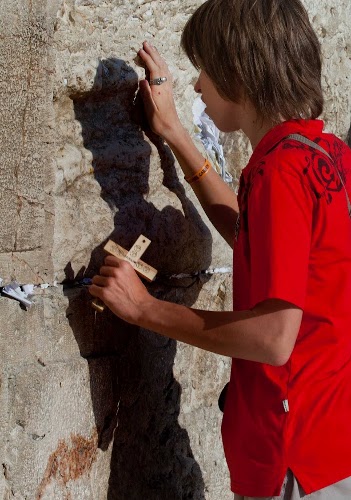
christian at kotelTo one degree or another, Messianic Gentiles and One Law Gentiles “split the difference,” so to speak, and find a way to integrate the Old Testament (Tanakh) and New Testament (Apostolic Scriptures) within a more “Judaic” framework. The type and degree of Jewish praxis varies quite a bit among these populations, since there’s no one external standard defining who we are and what we’re supposed to do within any sort of “Jewish” community space.

However, I did find another opinion, or rather a link to that opinion, that was posted in a closed Facebook group for Messianic Gentiles:

With children, at least someone was already obligated to foster their growth in Torah and observance. R. Auerbach now extends this idea to non-Jews. Beyond specific Noahide laws, he assumes all non-Jews are obligated to accept the fact that the world was created for the Jewish people [he does not explain further: I think he might have meant only that the Jewish people set the tone for the world, not that we’re the central purpose of existence. To me, that’s the implication of his following comments].

Recognizing Jews’ role in Hashem’s world means recognizing that Torah scholars, and especially a consensus of Torah scholars, are our best way of knowing what Hashem wants us to do. That’s as true for non-Jews as for Jews, so that a decree by Torah scholars should sound to them as if they’ve been told the Will of Hashem.

Technical questions of lo tasur as a Biblical obligation aside, non-Jews have to listen to the Torah leaders of the Jewish people for this reason [that might be only when there’s a formal body of Torah scholars, debating and voting on their decisions]. Such powers should extend to confiscating money and making decrees, as it does for Jews. Although in the non-Jews’ case, they’d be listening out of their own awareness that they are required to, not (again) a formal halachic obligation.

-R. Gidon Rothstein
“Children and Non-Jews’ Personal Obligations”
TorahMusings.com

Granted, this is a minority viewpoint within Orthodox Judaism, but it does exist. It also presupposes Gentile recognition of Rabbinic authority, which must be something of a rarity. I can’t imagine in my wildest fantasies, for example, the Head Pastor of the little Baptist church I used to attend going along with any of the above.

And yet, whether you’re a Noahide or Messianic Gentile in Jewish community, to one degree or another, you are accepting Jewish Rabbinic authority (One Law Gentiles, not so much).

For the Noahide, it’s a foregone conclusion that whether in the synagogue or their own communities of non-Jews, they must accept Rabbinic authority because it is the only thing that defines them.

Who am IFor Messianic Gentiles, it’s a lot more “messy”. First of all, there is no one definition of what it is to be a “Messianic Gentile” among Messianic (or other) Jews. Secondly, a lot of us don’t live anywhere near a Messianic Jewish community (at least an authentic one), so we lack an actual Jewish lived context in which to operate. Finally, depending on who you are and how you understand what “Messianic Judaism” means, your acceptance or rejection of various areas of Jewish authority and Rabbinic legal rulings will flex quite a bit.

There is one final thing to consider. In the Messianic Age, when King Messiah is on his throne in Jerusalem, and the peoples of the world live in nations that are all servants of Israel, we will indeed be under Jewish authority. I don’t know what that will look like relative to Orthodox Judaism, but my guess is that said-Jewish authority will look more Jewish than most Gentiles would be comfortable with, especially more traditional Christians.

Something to consider as Pesach (Passover) approaches.

How To Build A Better Life

Writes Rabbi Twerski: the sum total of all the traits that are unique to human beings comprise the spirit that makes us distinctly human. Whether one believes that the spirit was instilled in man by God or somehow developed in the process of human evolution — the fact that human beings have a spirit is independent of one’s belief.

If one is seeking spirituality, then one must exercise his uniquely human capacities. Spirituality is thus nothing more than the implementation of these capacities, hence spirituality can be seen as being synonymous with humanity. To the degree that a person is lacking in spirituality, to that degree he is lacking in humanity.

Without including religion in the definition of spirituality, the above definition is for generic spirituality. However, for Jewish spirituality one needs to look to the Torah for direction on how a Jew should exercise his uniquely human capacities!

-Rabbi Kalman Packouz citing
Rabbi Abraham Twerski’s book Twerski on Spirituality
in this week’s “Shabbat Shalom Weekly”
Aish.com

Which begs the question of what Rabbi Packouz or Rabbi Twerski would believe a non-Jew’s proper expression of spirituality should be. Probably as a Noahide, but I’ve covered that territory before.

Taking a step back, what makes human beings unique and spiritual beings? From R. Twerski’s book, Rabbi Packouz lists eight attributes:

  1. The ability to learn from past history.
  2. The capacity to think about the goal and purpose of one’s existence.
  3. The capacity to volitionally improve oneself.
  4. The capacity to delay gratification.
  5. The capacity to reflect on the consequence of his actions.
  6. The capacity to control anger.
  7. The capacity to forgive.
  8. Free will.
Rabbi Kalman Packouz

Granted, that people possess these abilities doesn’t mean they exercise them all the time (and some people exercise them almost none of the time, or so it seems), but we do possess them and they are at our disposal.

Please click the link to R. Packouz’s article that I inserted above to read the definitions for each of the numbered items. I’ll quote from the last one here: Free Will.

Animals are under the absolute domination of their body and cannot make a free choice. If hungry, it must look for food. It can’t decide to fast today. If a jackal sees a tiger eating a carcass, it will refrain for fear of retribution. Only a human being can be in a position with no possibility of detection or retribution and decide not to steal because it is morally and ethically wrong.

To the best of my understanding, only a human being can contemplate God and his/her relationship to Him. Only a human being can deliberately ignore God or dismiss Him as “unreal”.

However, since God gave us these capacities, we are responsible for putting them into play and in how we choose to use each of them.

That means we are responsible for not only learning from our past mistakes, but the past mistakes of our ancestors; history’s past mistakes.

Thus a world of human beings should have learned from thousands of years of anti-Semitism and Jew-hatred, but that doesn’t seem to be taking place. The Church as a unified entity (understanding that there are actually thousands upon thousands of separate denominations) should have learned that the Jewish people and Israel have not been rendered obsolete because of “Jesus,” but that doesn’t appear to be happening either. So far, humanity has done a rather poor job of learning from history, in spite of the fact that so-called “progressives” believe they are “on the right side of history” (but are they on the “right side of God?”).

I mentioned a little earlier that only human beings are able to contemplate God. Item two seems related to this since our goal and the purpose of our existence cannot be separated from God’s reason for creating each of us. And yet, how many times have you asked yourself why God specifically created you and why you are here in the first place? I’ve asked myself that question many times. I still do.

I heard a bit of dialogue in an otherwise unremarkable movie once that’s stuck with me:

Her: “People change.”

Him: “Most people don’t.”

Once we’ve locked on to a goal or goals for ourselves, we can create a plan for personal improvement and enact that plan.

Yeah, right.

OK, maybe that’s unfair, but most people, including me, get to a certain point in our personal development and then tend to stay there. Depending on what stage the person is stalled or stuck at, they can be adequate and even accomplished human beings, or they can be desperately flawed and dysfunctional.

FallingSome people make many plans and goals but fall flat at the execution stage. Others become too anxious to even imagine a plan to change and perform the metaphorical act of “hiding under the bed,” as if life will just leave them alone if they ignore it.

Fasting on Yom Kippur (or for other reasons) teaches delaying gratification. Actually, anyone who’s ever been a parent or grandparent knows all about delaying gratification.

My wife and I had our grandkids for the weekend. Actually, our son brought them over for dinner last Thursday and Friday evening as well, so we saw a great deal of them all. My grandson is seven years old, and my granddaughter is 9 months. They have radically different needs and meeting the needs of both simultaneously isn’t always easy.

Since babies need more attention than little boys, my grandson sometimes had to delay gratification. When I was alone watching both kids and I needed for feed my granddaughter, my grandson had to find something else to do besides play with Grandpa (don’t worry…we found plenty of opportunities to have adventures).

It goes without saying that my wife and I, as well as the kids’ Dad, Uncle, and Auntie, all delayed gratification to one degree or another when the children were in our home. That’s what adults do, especially when taking care of kids. That’s what you do when you love someone and you put their needs and wants ahead of your own.

Ideally, it’s what you do when you love God and you recognize what He wants you to do and what His priorities for you are. It’s not like God is a dictator or doesn’t want you to have time to relax or have fun, but as His servants and His children, we have a responsibility to Him first and foremost. If we see someone else in our world who has a need, God has given us the ability to attend to that need first because, after all, it’s the right thing to do.

Not that we actually do so all the time.

Consequences, like Karma, are a b**** (you probably know how to finish that quote). They are also a reality of life. For instance, if you choose not to pay a debt, your wages or taxes can be garnished. I think this goes along with delaying gratification.

Unless you are insanely wealthy, you have only so much money each month to work with. That means, if you are at all responsible, you have a budget. You may “flex” it a little bit with a credit card, but when all the bills come in, they need to be paid.

That means choosing to pay for necessities first, such as food, housing, clothing, and so forth, and only afterward using money to “play”. Reversing that process tends to lead to painful consequences.

no evil
Image: vintagecardprices.com

There are also consequences for “blowing off” God. They most likely aren’t immediate. We know that will be an accounting, a judgment at the end of all things, so it may seem as if God is giving you a pass with what ever sin(s) you have a problem with.

Sure, God can arrange for natural consequences. If you use drugs or alcohol habitually, all God has to do is wait for your body to start falling apart. Same for overeating (which is a big problem in our nation). Same for a lot of things. The consequences are built into many sins. For some though, you just have to stand by. Don’t worry. They’ll come. Or you can learn from your mistakes and improve your life so you stop sinning and thus avoid uncomfortable consequences.

Your choice (free will, remember?).

Every time I drive anymore, I get a lesson in controlling my anger. I’m not always successful. It seems that as I get older, I don’t have as great a capacity to tolerate traffic. Good thing I live near Boise, Idaho now rather than Orange County, California.

But going back to the example of being a parent or grandparent for a moment, let’s take another look at controlling anger. Sometimes adults get angry at kids, at least momentarily. You catch a kid coloring on the freshly painted walls of her bedroom or letting the air out of your car’s tires (I did the latter once when I was five). Your immediate tendency is to explode at them (Don’t worry, my Dad didn’t).

If you are a mature adult, you stop yourself. Really, they’re just kids. They do stuff like that. Yeah, you can create consequences for their behavior so they can learn more about right and wrong, but blowing up at a kid is just satisfying your own impulses rather than displaying good parenthood.

The same is true when you get angry at another adult in the presence of your kids. Parents fight sometimes. Some fights are louder than others. While yelling and screaming at a significant other doesn’t do you or them any good (how many people have changed for the better as a result of being screamed at?), if kids are around, it’s not only uncomfortable, it’s terrifying.

When Mom and Dad have a major emotional eruption at each other, it’s like the kid’s world has fallen apart. The two people in life who a child absolutely must depend upon and believe in have just exploded into a temper tantrum that makes Mount St Helens look like a firecracker, and that means the two people who are supposed to provide for the physical and emotional security of their child have completely failed and gone down in flames, pulling their child in with them.

divorceOK, I get it. People argue sometimes. Fine. We’re all human, in good ways and bad. But don’t do it when your children are around. That’s not being a good parent, adult, or human being.

The flip side is the capacity to forgive. But wait.

I think Rabbi Packouz (and maybe Rabbi Twerski) missed something. It’s not just about putting our own hurts aside and forgiving the person who hurt us. How about the ability to say you’re sorry, mean it, and ask for forgiveness when you’re the one who’s “blown it?”

If you indeed have blown up at someone or otherwise have failed to maintain behavior consistent with being a mature adult, after you’ve calmed down and realized the consequences of your actions, you have the option of apologizing and asking forgiveness.

Bernie Sanders recently accused the IDF of killing 10,000 innocents in an operation responding to terrorist acts initiated in Gaza. He admitted in the radio interview that he wasn’t sure of his statistics, then went ahead and uttered his outrageous statements anyway.

When later confronted with the fact that the figure was more like 2,300 “Palestinian” Arabs, and many of them were combatants, not innocent bystanders, instead of Bernie apologizing, he said that the New York Daily News distorted his statement.

I heard the radio interview and nothing was distorted or misrepresented except Sanders’ so-called “facts”. Bernie could have taken the moral high road and admitted his mistake (it’s pretty easy to make one when you don’t have accurate information immediately at hand), but instead, he chose to (in my opinion) lie about it, avoid personal responsibility, and blame others for his own inadequacies.

While R. Packouz citing R. Twerski’s list of items of what it is to be human seems pretty optimistic, it’s all too apparent that being human has some serious drawbacks. We have all of these wonderful abilities, and a lot of the time, we don’t use them or don’t use them very well.

Which brings us back to free will.

We can recognize that we are flawed, imperfect, and sometimes even damaged and dysfunctional human beings who have these terrific capacities and screw up using them more often than not.

screw it
Image: giudittagareri.com

We can recognize all that and say “screw it.” We can give up. Someone recently wrote about this on her blog. Her choice was go not give up and not give in, but to stay the course.

Moved by her struggle, I offered this:

Affirmations are powerful. They work for us or against us. Every statement we tell ourselves about who we are and what we find possible is really an affirmation. Positive affirmations build us. Negative affirmations do the opposite. So right now you can tell yourself a great affirmation: “I choose better, higher, and wiser self-talk each and every day.”

-Rabbi Zelig Pliskin

The trick about positive affirmations, is that they need to be used as motivators for actual change, not just internet “memes” that sound good, but only serve to create the illusion that you already are the person you want and need to be.

Using the positive affirmation that you are courageous means that you have to follow-up by facing some difficult situation with courage, rather than avoiding it. Using the positive affirmation that you are compassionate means that you have to follow-up by showing compassion to another person, even if they aren’t very easy to get along with. Using the positive affirmation that you are productive and self-supporting means…

…well, you get the idea.

Bernie Sanders is a politician, so I expect him to lie, even to himself. However Bernie Sanders, like the rest of us, is a human being, and thus, he is ultimately responsible for using what God gave him or to face the consequences…in this life or the next.

Since he’s Jewish, as the quote I placed at the top of today’s “meditation” attests, he’s responsible for looking “to the Torah for direction on how a Jew should exercise his uniquely human capacities!”

As far as I can tell, he’s got a long way to go.

But so do the rest of us.

Where do we look (assuming non-Jews) for direction on how we should exercise our uniquely human capacities? If you are a normative Christian, you’ll probably say “the Bible” and really means your particular church’s interpretation of scripture.

If you’re someone like me, the answer is essentially the same, but the interpretation is different, sometimes really different.

I recently read a question in a closed Facebook group asked by a non-Jew who was wondering what sources he could consult to determine if we, like the Jewish people, are obligated or at least allowed to participate in specific times and practices of prayer. There was a brief but lively discussion, and the general consensus was that while we may not be obligated, we are most likely allowed to pray in a manner similar to Jewish praxis, adjusting for a non-Jewish and non-covenant relationship with God.

And all this takes us back to the question I implied at the top of today’s blog post: What is a non-Jew’s proper expression of spirituality given a more “Judaic” understanding of the meaning and purpose of the Bible, the Messiah, and Jewish Israel?

loveThat answer is our ongoing struggle for self-definition and, for some of you at least, your role and purpose within Jewish community. For the rest of us, it’s merely working out who we are to God and to other human beings, community notwithstanding. At the end of the day, regardless of who we are, who is in our lives, and what we believe, it’s just us and God.

What we do matters. Each day is an opportunity to do just a little bit better than you did the day before. With each morning’s dawn you can dedicate yourself to having a good day. With each passing day, you are building a life. Let’s all try to build a good one.

Individual commitment to a group effort — that is what makes a team work, a company work, a society work, a civilization work.

-Vince Lombardi

The Gentiles and Passover Dilemma Redux

Question: “Is it permissible for a Gentile to eat a Passover Seder meal?”

Answer: Gosh, I hope so, because I eat at my family’s Passover Seder every year.

That question was recently asked in a closed Facebook group for “Messianic Gentiles” and the moderator’s short answer was “yes”. The only prohibition would be if the Temple existed in Jerusalem, the Levitical priesthood was re-established, and the sacrifices, including those for Pesach, were resumed…and even then, that would only be a problem if the non-Jew in question were in Jerusalem for Passover.

LambThis was discussed somewhere on this blogspot in years past, and reader ProclaimLiberty (PL) basically said that if an intermarried Gentile, such as me, (or any Gentile, I suppose) were in Jerusalem with his Jewish family, he (or she) could eat of the meal except for the Pascal lamb which is reserved for the Jewish people.

For any male to eat of it, he must be circumcised, which is shorthand for “covert to Judaism”.

However, not everyone sees it that way. Here’s a comment from the aforementioned closed Facebook group discussing the topic:

OK but if Gentiles are grafted in and there is one new man and all true believers become the Israel of God…(and, no, I do not adhere to replacement theology, neither am I a two house/stick guy) doesn’t that give us a different outlook on this subject?

I say this speaking from the notion that the Passover is ultimately pointing to Christ and not simply a cultural festival for only one group of people.

If the Passover is strictly about the Exodus and God showing Himself mighty to a certain group of people then yes, I agree.

But if the Passover ultimately points to Christ then you are saying that only one group of people (culturally Jewish people) are allowed to celebrate it and not the totality of God’s people (i.e. the Israel of God).

I don’t say this to be divisive.

I am asking a serious question.

One person answered this query by stating that non-Jewish (uncircumcised) Yeshua-believers are welcome to attend the seder in Jerusalem, even once the sacrifices have been restored, and he/she could “partake of the matzah, bitter herbs, the four cups, and the whole seven-day festival…there is no prohibition except in regard to the sacrificed lamb.”

PassoverPretty much my opinion as well.

In the back-and-forth in the discussion thread, it is generally (but not universally) agreed that Gentiles can partake of the modern Passover seder, since we are without the Temple and the sacrifices, but are not to eat of the sacrificed lamb in Jerusalem in the days of the Temple (and there’s no other place to perform the sacrifices except in the Jerusalem Temple, so arguably, even in the Messianic Age, Gentiles in the diaspora can partake of the seder fully, since no lamb would be present).

The original asker cited Ephesians 2:14-19 in an attempt to invoke traditional Christian teaching to sustain a more egalitarian view of the Messiah’s work, diluting or obliterating the distinctions between Israel and the nations defined in the Torah relative to the requirement that only a circumcised (Jewish) male can eat of the lamb (and in case anyone asks, women, who can’t be circumcised as defined in Torah, must be Jewish in order to eat of the lamb as well).

The questioner lamented:

So we’re one…but not really?
We’re fellow citizens…except we’re still strangers and aliens?

This is a common complaint of some Gentiles in Messianic Jewish space, and in days gone by, I’ve made that complaint myself. But being “one” does not mean being “uniform”. It does mean that the ekklesia of Messiah is a single container that nurtures both Israel and the “people of the nations who are called by His Name” (Amos 9:12).

Then this came up:

But when Cephas came to Antioch, I opposed him to his face, because he stood condemned. For prior to the coming of certain men from James, he used to eat with the Gentiles; but when they came, he began to withdraw and hold himself aloof, fearing the party of the circumcision. The rest of the Jews joined him in hypocrisy, with the result that even Barnabas was carried away by their hypocrisy.

Galatians 2:11-13 (NASB)

shabbosExcept, of course, the above passage of scripture isn’t describing a Passover meal in Jerusalem, but (probably) an “ordinary” meal in which Peter felt inhibited sharing with Gentiles in the presence of (it is assumed) high-ranking Jewish members of the Messianic Council in Jerusalem who were apparently applying “peer pressure”. It’s been suggested that Paul and James (Ya’akov) disagreed about the cultural barriers (which are not found in Torah) between Jews and Gentiles, and whether or not just eating in the presence of a Gentile rendered a Jew ritualistically “unclean.”

Frankly, non-Jews are usually welcome (if invited) at most Jewish functions, including worshiping in the synagogue on Shabbat, attending an Erev Shabbat meal, attending a bar or bat mitzvah, and so on. Before my wife and I became religious, Jewish friends invited us to their Passover seders on numerous occasions. Granted, some of our friends weren’t Orthodox, but others were, so I can see a case being made for Gentiles in the current age being able to participate in many Jewish ritual activities, extending into the Messianic Age.

There are distinctions between Jews and Gentiles in the current age (including Jewish and Gentile Yeshua-believers) and I think those distinctions will continue in the Messianic Age. If there are to be any sort of “adjustments” in halachah to be made, Messiah will have to inform us of what they will be.

But even in the current age, it really depends on how closely you adhere to the halachah:

98:35 All the activities that are permitted on yom tov are only permitted for the sake of people, not for animals. The Torah tells us (Exodus 12:16), “do for yourselves” – for yourselves but not for animals. Therefore, we may not cook or carry outside for the sake of an animal just like on Shabbos. (We may add to a pot of human food for animals – Rema 412:3.) 98:36 We may not cook or bake for a non-Jew on yom tov. One who has a non-Jewish servant may add food and cook it all in one pot so that there will also be enough for the servant. (He must not specify that he is adding for the servant – Mishnah Brurah 512:11.) For an honored non-Jew, however, one may not even add. (We are concerned that one will do extra for an honored guest – see MB 512:10.) Not only that, even if the Jew cooked or baked for himself, he may not invite a non-Jew to eat with him on yom tov. One may give a non-Jew who isn’t particularly distinguished something that he cooked or baked but he may not bake a loaf even for his non-Jewish servant. (For the purposes of this halacha, an apostate Jew is the same as a non-Jew – MB 512:2.)

-Rabbi Jack Abramowitz
“Cooking for a Non-Jew on Yom Tov”
OU.org

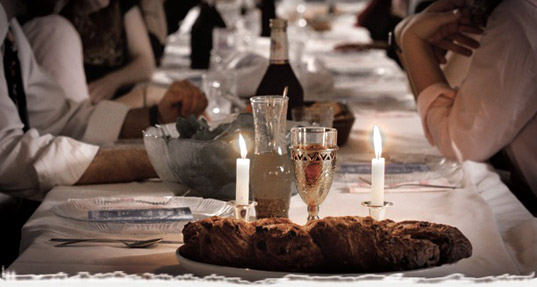
shabbat meal
Shabbat meal, Photo: shelanu.cz

But it was also pointed out that Gentiles regularly attend Yom Tov events at Chabad and are welcome to do so.

The response was:

Sometimes there are halchot that people are much more lenient on these days, especially when kiruv is involved. I also read that in this particular halacha the concern is alleviated if the person shows up without an explicit invite. I think the underlying reason might be that Jews can cook on Yom Tov, but they can only cook for what is needed. Since a non-Jew can cook for themselves regardless of Yom Tov then a Jew should not cook for a non-Jew, but may serve them food if there are leftovers.

But the question is how or if this particular standard will be adhered to in the Messianic Age. Will this be one of the “adjustments” Messiah will make, or will he honor all halachah as it currently exists? Interesting question.

As of this writing, there’s no consensus in the closed Facebook group discussion on the matter of how restrictive or permissive Jews are or should be regarding a non-Jewish presence at a Passover seder. The most restrictive seems to be:

Another perspective that I have read about, is that since parts of the seder are done as a remembrance of the Korban Pesach some Jews will not invite gentiles to their seder or ask gentiles to not participate those parts. Just thinking off the top of my head this might include Korech and Afikomen. I am sure many people are not that strict, but it is an interesting thought.

I’ve written about Gentiles and Passover many times before, including in Passover, Messianic Judaism, and Mutual Inclusiveness and Passover for Gentiles in the Diaspora, Not in Jerusalem (the latter specifically addressing the topic of discussion going on in Facebook). And in spite of all that, I once even reblogged something about No Christian Seders, Please, but that was more specifically aimed at churches that conduct their own Passover seders rather than Christians who are guests at a Jewish seder (but of course, even President Obama conducts a Seder at the White House each year rather than being a guest of Jewish hosts).

Since my wife and kids are Jewish, I’ve got an automatic “in” at our family seder (though if my wife chooses to attend the Chabad seder, I’m definitely not invited). However, if a non-Jewish believer is to attend a seder, it should be at the invitation of Jewish hosts, and the expectation of a Gentile guest should be spelled out ahead of time relative to halachah.

Traffic ConesIt’s problematic in Messianic space to the degree that Gentile expectations can lead us down the “one new man” path a bit too far, but again, local customs should be understood ahead of time so there won’t be any surprises.

I don’t observe Easter in any sense and basically, I even shun it, so Passover is the Yom Tov in which I (silently within myself) honor Rav Yeshua’s symbolic sacrificial death and resurrection which gives us all the hope that in our Rav’s merit, we too shall share a place at the banquet of Abraham, Isaac, and Jacob (Matthew 8:11) in the world to come.

A Case For Rosh Ha-Hodashim As The First Of The Year

I periodically receive emails from Hannah Weiss at Restorers of Zion. I probably haven’t personally emailed Hannah is years, but I’m still on the Restorers’ mailing list. I think my friend Tom keeps in touch with her, and I believe his perspectives on Judaism, the Bible, and Messiah more mirror Hannah’s than my own viewpoint.

As I understand it, many modern expressions of Messianic Judaism seek to identify and emulate modern religious and cultural Judaism. I hope I’m not being too presumptuous in saying that Restorers seeks to discover Judaism in the ancient Biblical texts as they were interpreted in the days of Yeshua’s earthly “ministry” and before, rather than as they are understood by modern Rabbinic Judaism in our day.

The beginning of Hannah’s most current email stated:

Rosh Ha-Hodashim is arguably the most neglected of the LORD’s “appointed times” for Israel… receiving less attention from the Torah-observant community than even marginal holidays like “Tu B’Shvat” and “Lag B’Omer”.

In 2012, RZ set out to investigate what happened to the New Year originally commanded by the LORD.

We discovered unexpected treasures: scriptural truth, spiritual wealth, and even buried wisdom from ancient Jewish sages – all connected to this very first commandment given to Israel as a nation.

A great deal of the Forgotten Milestone points to Yeshua, which hints that the rabbinic decision in 90 CE to move away from earlier rabbinic custom was conscious and calculated.

So what exactly is “Rosh Ha-Hodashim?” Well, you can find it’s source here:

Now the Lord said to Moses and Aaron in the land of Egypt, “This month shall be the beginning of months for you; it is to be the first month of the year to you.”

Exodus 12:1-2 (NASB)

Torah platesThere are four “new years” spoken of in the Torah, but Rosh Hashanah or the “head of the year” that occurs on Tishrei 1 is the most well-known today. Hannah and Restorers argue that there is a mystery as to why Rosh Ha-Hodashim has been “hidden” since 90 CE.

Now I was really curious and followed the link in the email to Restoring the Real “Rosh Hashana”.

On that webpage, you can find seven articles in Microsoft Office Word format. They are freely available for download. I downloaded all seven plus their “sources” paper and started reading and taking notes.

Is there a mystery behind Rosh Ha-Hodashim, one that points to the resurrected Yeshua as Messiah? Hannah Weiss and the people at Restorers seem to think so. However, from a plain reading of the text of Exodus 12:2, at least in English (Hannah renders the verse in Hebrew and explains problems with how it’s been historically translated), this “new year” is only mentioned in a single verse, and only then to instruct the Children of Israel, being held as slaves in Egypt, in how to prepare the Passover lamb and the related rituals that would allow them to live while all of the firstborn of Egypt would die.

What if Rosh Ha-Hodashim is nothing more than to commemorate the escape of the Children of Israel from slavery as well as physical and spiritual death, and their eventual coming together as a nation and receiving the Torah at Sinai? Is there really a “Messianic connection” that’s been hidden for over two-thousand years?

Here’s a summary of what I discovered in reviewing the Restorers’ Rosh Ha-Hodashim papers. The seven papers are not only study guides but “meditations” to be pondered over, beginning on Nissan 1 and concluding on Nissan 7 in preparation of Pesach and celebration of the resurrected King.

I can only briefly quote from each paper and hopefully, I’ve selected representative portions that make the Restorers’ point, as well as my own, clear.

Unlike the Tamid, it is not written anywhere that the Passover lamb brought atonement. Nevertheless, it was understood to provoke the compassion aroused within G-d for His people: “Of all of God’s creations, the lamb possesses the innate ability to arouse mercy by its voice.” (Sefer HaYetzirah, a Hasidic work commenting on the month of Nisan)

This idea becomes quite profound when we remember that G-d brought Israel redemption before they called on His name. They were simply groaning because of their troubles, and yet this was enough for G-d to remember His covenant:

And the sons of Israel sighed from the bondage, and they cried out; and their cry for help rose up to G-d from the bondage. And G-d heard their groaning; and G-d remembered His covenant, and Abraham, and Isaac, and Jacob. And G-d saw the sons of Israel, and G-d knew. (Exod.2:23-25, from the Hebrew)

-Meditations for Rosh Ha-Hodashim, the New Year
2: Jewish Tradition with Messianic Potential, page 3

MessiahThis begs the question, was Yeshua’s symbolic sacrifice meant to bring redemption to Israel before they call on the Lamb of God?

“Jerusalem, Jerusalem, who kills the prophets and stones those who are sent to her! How often I wanted to gather your children together, the way a hen gathers her chicks under her wings, and you were unwilling. Behold, your house is being left to you desolate! For I say to you, from now on you will not see Me until you say, ‘Blessed is He who comes in the name of the Lord!’”

Matthew 23:37-39 (NASB)

Other significance (meditations, page 4)

What are we to learn from these widely different events occurring on Rosh Ha-Hodashim? What do they all have in common, besides the date itself? We see here new beginnings, historical turning points… but mostly a theme of “cleansing and closure”. The earth emerged freed from an irreversible corruption, a Jewish leader left behind his life of exile, disobedient Jews were made accountable to the Covenant, G-d rewarded a king who had carried out His judgment, and three different sanctuaries were (or will be) made ready for pure worship.

While born-again Christians often relate to Redemption as an individual experience that unfolds in private communion with G-d, in Jewish understanding it is a communal experience with world-changing impact. These different views are emphasized by Jewish antagonists to Messianic faith, claiming that an experience of personal Redemption is not a Jewish concept.

How closely is that opinion connected to the following, which reflects a more modern Orthodox Jewish interpretation?

The special attitude to Tishre and Nissan as two very significant points in the annual cycle, both connected to new beginnings, is voiced in the dispute between R. Eliezer and R. Yehoshua on the date of the Creation. While R. Eliezer’s opinion is that the world was created in Tishre (Bavli, Rosh ha-Shana, 10b), R. Yehoshua claims that Nissan is the first of months (ibid. 11a). For the Maharal, this dispute represents different approaches to the basics of life. He writes that Nissan and Tishre are the main months of the year, but while Nissan expresses the life force and vitality of the year at the emotional level, Tishre expresses the holiness and spirituality of the year at the intellectual level (Sifre ha-Maharal, Hiddushe Aggadot I, 94-97).

-Dr. Miriam Faust
Bar-Ilan University’s Parashat Hashavua Study Center
The Days of Awe – Renewal and Reassessment

Orthodox JewsThe main point of contention between this Messianic point of view on Rosh Ha-Hodashim and the more normative Orthodox Jewish approach is this:

In the orthodox community, the honoring of Rosh Hodesh Nisan consists of reading the Torah passage where the relevant command appears (Exod.12:1-20, called Parashat HaHodesh). A few additions to the daily prayers appear (a partial Hallel, Yaaleh V’yavo, the Musaf for Rosh Hodesh), while petitional prayers and public mourning customs are omitted, as mentioned in Meditation 2. Otherwise the day is treated like every other Rosh Hodesh (new moon), the observance of which is optional: “Many have the custom to mark Rosh Chodesh with a festive meal and reduced work activity. The latter custom is prevalent amongst women, who have a special affinity with Rosh Chodesh.” (Observances for Rosh Hodesh Nisan, Chabad.org)

This neglect leaves the field open for Yeshua’s disciples to construct Messianic traditions and customs, as the Holy Spirit teaches us about Rosh Ha-Hodashim. The potential is greater than we have explored so far, but here we offer a suggested observance as a starting point.

-Meditations for Rosh Ha-Hodashim, the New Year
3: Celebrating Rosh Ha-Hodashim, page 1

You will have to read the first three papers/meditations to get the entire context up to this point, but my question is, how much of Messiah is being read into this holiday by the Restorers of Zion author?

Granted, many groups, from the various expressions of Messianic Judaism and Hebrew Roots, to some denominations of normative Christianity see “Jesus in the Passover,” so the symbolism of the Passover seder elements is very familiar to Yeshua-believers, but is there a wider context related to Rosh Ha-Hodashim that we’ve all been missing?

The Mishnah describes the first of Nisan as “the new year for kings and festivals” (Rosh Hashana 1:1).

The “new year for kings” meant that counting the reign of Israel’s king was always dependent on Nisan.

Meditations for Rosh Ha-Hodashim, the New Year
4: Receiving the King, page 1

I’m sure you can see where this writer is going in connecting Nissan 1 with King Messiah. In this paper, the coronation of King Solomon (I Kings 1:39-40) is compared not only with Zechariah’s prophesy of the coming of Messiah (Zechariah 14:4) but with Yeshua’s entry into Jerusalem depicted in John 12:12-14 and Mark 11:10.

Also…

Only John’s gospel pinpoints the day when Jerusalem celebrated the arrival of her King. It was five days before the Passover (see John 12:1,12). Since the Pesach was slaughtered on the second half of the 14th day, this would have been the 10th of Nisan (in Jewish reckoning, partial days are counted as days). We now have a clue to the strange, unexplained command from G-d to choose the Pesach lamb on Nisan 10, even though it wouldn’t be sacrificed until Nisan 14:

Speak to all the congregation of Israel, saying: On the tenth of this month they are each one to take a lamb for themselves, according to their fathers’ households, a lamb for each household…. You shall keep it until the fourteenth day of the same month; then the whole assembly of the congregation of Israel is to slaughter it at twilight. (Exod.12:3-6)

-ibid, page 3

The AkedahIn the next paper, a further connection is made, this time between the Akedah or Binding of Isaac, and Nissan:

It’s universally accepted today that Akedat Yitzhak, the Binding of Isaac (Genesis 22), is associated with Tishrei 2 (the second day of Rosh Hashanah). This appeared fairly early in rabbinic history, and is supported by its mention in the Talmud (B. Megillah 31a). By the 3rd century, it was being explicitly connected with Yom Ha-Truah, the Feast of Trumpets (B. Rosh Hashanah 16a).

However, the original place of the Akedah in the Jewish calendar was Nisan 14, later to be designated by G-d as the day for sacrificing the Pesach. Following is some of the evidence (from “Torah Reading as a Weapon: Rosh Hashanah and the Akedah,” Rabbi Elie Kaunfer, Executive Director, Mechon Hadar).

-Meditations for Rosh Ha-Hodashim, the New Year
5: The Messiah, Our Passover, page 1

I don’t know how accurate this is as I lack the necessary education and references to verify it, but if true, it is a compelling parallel between the Akedah and the crucifixion of Rav Yeshua.

However, this connection isn’t recognized today. In fact, this is the first I’ve ever heard of it. Why?

According to Rabbi Kaunfer, the connection of the Akedah and Pesach was deliberately broken after the destruction of the Temple, in an effort to erase its powerful association with Yeshua’s sacrifice.

-ibid, page 2

However, according to this paper’s author, that dissociation was not universal, at least as early as the fourth century CE:

In that context, the 4th-century Mekhilta of Rabbi Ishmael further strengthens the association between Passover and the Akedah, and the similarity between Isaac and Yeshua. Commenting on Exodus 12:13, “When I see the blood [of the Pesach lamb] I will pass over you…” the Mekhilta states: “I see the blood of the binding of Isaac.” This was apparently relying on another tradition, handed down in the name of Rabbi Shimon bar Yochai (2nd c. CE), which said that although not actually sacrificed, Isaac gave a quarter of his blood as an atonement for Israel. (from “Vayera: What Happened to Isaac?” Israel National News, 21/oct/10 – http://www.israelnationalnews.com/Articles/Article.aspx/9768 )

-ibid, page 3

Talmudic RabbisFurther, early minority Rabbinic opinion suggests that Abraham actually did successfully sacrifice Isaac (although this contradicts the Biblical account) and that Hashem subsequently resurrected Isaac.

Of course, even if this occurred, the resurrection of Isaac wouldn’t be the same as Rav Yeshua’s since Isaac died in old age while Yeshua, once resurrected, will never die again. If he could, then our own promised resurrection would be questionable and even in vain, since our lives would not be eternal.

But Isaac, in this interpretation, is meant to “point” to Rav Yeshua, not be identical to him. He’s a signpost along the way and the goal is Messiah.

But Messiah did escape death and the tomb and, according to Gospel accounts, was seen by many witnesses. Now here’s something curious:

So the other disciple who had first come to the tomb then also entered, and he saw and believed. For as yet they did not understand the Scripture, that He must rise again from the dead.

John 20:8-9

Some of those who were with us went to the tomb and found it just exactly as the women also had said; but Him they did not see.” And He said to them, “O foolish men and slow of heart to believe in all that the prophets have spoken! Was it not necessary for the Christ to suffer these things and to enter into His glory?” Then beginning with Moses and with all the prophets, He explained to them the things concerning Himself in all the Scriptures.

Luke 24:24-27

These verses are quoted in “6: The Resurrection,” and in reading them, I’ve always wondered exactly what Yeshua said to these men from the scriptures that convinced them Moses and the Prophets really spoke of him being resurrected? Certainly Judaism of today doesn’t interpret Moses or the Prophets in this manner, and I’ve never been convinced that Christianity has been very successful in this area either. I’ve never found a “smoking gun” pointing directly from the Prophets to Yeshua.

This sixth paper quotes from Psalm 16:9-11, Hosea 6:1-3, and other scriptures (see the paper for details) as compelling evidence for the resurrection of Yeshua, and I don’t necessarily doubt that, but again, does that make Rosh Ha-Hodashim more relevant somehow?

According to the Restorers author, the answer to my question is this:

It is appropriate for Yeshua’s disciples to celebrate His Resurrection either on Nisan 17, in memory of that singular event; or on Nisan 16, the day designated for the Barley First-Fruits offering.

The offering itself was suspended after the Temple’s destruction, with no substitute customs ordained by the rabbinic community. All halachic discussion over the generations has focused on who should avoid eating newly sprouted grain before Nisan 16 every year.

Therefore, Yeshua’s followers have an open area on which to build a distinctly Messianic custom to celebrate the connection of His Resurrection with the Barley First-Fruits offering.

-Resurrection, page 5

I’ve skipped from quoting portions of the paper providing more details about the festival of first fruits and the Omer for the sake of length, but again, these papers are freely available online for you to read and download.

PassoverAm I convinced? I don’t know. As a non-Jewish disciple of Rav Yeshua, I’ve chosen to back away from celebrating most of the moadim or “appointed times,” since the vast majority of them have exclusive significance to Israel and the Jewish people. The most notable exceptions are Passover and Sukkot (Festival of Booths). I have a Passover seder in my home every year, largely because I have a Jewish wife and children.

I build a sukkah in my backyard every year, both because I have a Jewish wife and children, and because Sukkot seems to be that one moadim on the Jewish calendar that has applications to the people of the nations:

Then it will come about that any who are left of all the nations that went against Jerusalem will go up from year to year to worship the King, the Lord of hosts, and to celebrate the Feast of Booths. And it will be that whichever of the families of the earth does not go up to Jerusalem to worship the King, the Lord of hosts, there will be no rain on them. If the family of Egypt does not go up or enter, then no rain will fall on them; it will be the plague with which the Lord smites the nations who do not go up to celebrate the Feast of Booths. This will be the punishment of Egypt, and the punishment of all the nations who do not go up to celebrate the Feast of Booths.

Zechariah 14:16-19

Passover is a little more questionable, even though many “Messianic Gentiles” and Hebrew Roots Christians, as well as more normative Christian churches hold some variation of a seder seeing “Jesus in the Passover”.

It’s possible that there has been an overlooked significance in Rosh Ha-Hodashim, and that in the Messianic future, we will all be rejoicing the “new year for the King” on Nissan 1. By the way, the first of Nissan or Rosh Chodesh Nissan occurs this year on April 9th, which is also Shabbat. Erev Pesach or the first evening of the Passover is on Nissan 14, which is Friday, April 22nd this year.

If any of this is interesting or even compelling to you, use the link I provided above, download the seven (eight, actually) papers and decide of some sort of observance or commemoration is appropriate for you. If nothing else, like me, you’ll learn something new.

An Easter Musing: Why I Consider the Church as “Them” and not “Me”

Something to ponder. If Jesus died on Passover and rose again a few days later (depending on your timetable), then why are most people celebrating his resurrection a whole month before Passover this year (and various other years as well)? Respectful responses are welcome. No witch hunting.

-Query from Facebook

No, this wasn’t directed at me. It was a general question tossed out into social media by a Facebook “friend” (I put that in quotes because we’ve never met face-to-face).

It’s an interesting question, but I must admit, it wasn’t the catalyst for today’s “morning meditation.” Easter was.

More specifically, my massive and total disconnect from Easter was the catalyst. For Easter, or perhaps more accurately expressed, for “Resurrection Day” three years ago, I crafted this little missive about my emotional disconnect from the event, even as I was attending Easter…uh, Resurrection Day services in a little, local Baptist church.

There were certain things I liked about the service. There were certain things I learned. But I wasn’t just gushing with joy like everyone else around me because “he is risen”.

Add to that, the memory of how my wife looked at me when I was walking out the door to go to Resurrection Day services, how crushed and betrayed she seemed, as if she found out I was cheating on her. I know I’ll never attend another Easter service in my life.

My regular readers are aware that my wife is Jewish and not a believer. More specifically, her viewpoint of Jesus, Paul, and Easter is what she learned from the local Chabad Rabbi. She would never stop me from expressing my faith in whatever way I choose, but I know it bothers her, at least on certain occasions…

…like Easter.

he-is-risenShe sometimes surprises me, though. She said that although she wouldn’t take me to Israel with a Jewish group, she does want me to go with a more appropriate (for me) Messianic group. I once had a passion to do that, but a lot of things dried up for me, including my sense of community.

I’ve been thinking about Rabbi Stuart Dauermann’s essay “The Jewish People are Us — not them” which you can find published here and which I reviewed a few years back.

Rabbi Dauermann was emphasizing that a Jewish faith in Yeshua shouldn’t result in Jewish “messianists” considering the wider Jewish community as “them” or as “the other,” the way most Christians consider “unbelieving” Jews. From his perspective (as I understand it), Jewish devotion to Rav Yeshua is very Jewish and should, if anything, result in Jewish Yeshua-disciples being drawn closer to larger Jewish community because, after all, Moshiach is the first-born of Israel’s dead, living proof that the New Covenant promise of the resurrection to Israel will indeed come to pass.

What’s more Jewish than that (and I know I’ll take “heck” from one or two Jewish critics of my blog for that question)?

But what about those of us, we non-Jewish “Christians” who stand on the Jewish foundation of the Bible, who feel a greater connection to Passover and Sukkot (Festival of Booths) than Christmas and Easter? What about those non-Jewish believers who feel more comfortable calling ourselves “Messianic Gentiles” or Talmidei Yeshua than Christians?

While Rabbi Dauermann may feel a lot closer to Jewish community than the Christian Church (and I agree, he should), does a “Messianic” perspective for a Gentile believer draw us closer to the Church or push us further away?

I admit, after this particular church experience and the consequences that resulted from my public disagreement with that church’s head Pastor, I realized I have no place in the Church. The ekklesia, yes. The Church, no.

Simply put, because Rabbi Dauermann is Jewish, he identifies with larger Jewish community, even those who are not disciples of Rav Yeshua (which just baffles the daylights out of most Christians I’ve spoken to about it). I have a Jewish wife, so I’ve seen that dynamic in action first hand, and any thought of my denying her or forbidding her to associate with Jews (not that I would, of course), is totally revolting to me, absolute anathema.

quitting churchBut to reverse the equation somewhat, being a Gentile disciple of Jesus does not automatically make me think of the Church as “us” or even “me”. In fact, on Easter, I feel more apart from “Church” than ever.

Going back to the previously mentioned Facebook commentary on Easter, there have been some interesting responses. There are others like me out there who also experience the disconnect from this Christian holiday, even those who remain in the Church. Some recognize Easter as a deliberate attempt by the early “Church Fathers” to co-opt the Passover/Resurrection event for Gentiles, divorcing it from its Jewish origins and context.

Others launched into “paganoia,” often a consequence of some Hebrew Roots teachings, saying that Easter was a deliberate attempt to introduce paganism, particularly worship of “Ishtar.”

I don’t think I’d take it that far.

But I am disturbed by one thing. The resurrection of Rav Yeshua is living proof that the New Covenant promises of God to Israel (Ezekiel 37:11-14) will indeed occur, and Yeshua is the “first fruits from the dead” (1 Corinthians 15:20).

Why don’t I feel connected to that?

Well I do, sort of, but it happens more on Passover and during the week of Unleavened Bread than it does at Easter, whether I’m in a church or not.

I know there are Hebrew Roots and Messianic Gentiles out there, those in their churches and elsewhere, who still have an emotional connection to Easter. These people were probably raised in a Christian setting by their Christian families or otherwise, spent enough time in a church to forge that visceral linkage.

I didn’t, not when my parents took me to church as a child, nor when I returned to Christian community as an adult.

Today being Easter punctuates for me that I consider normative Christianity as “them, not me.” I can’t say “us” because I don’t have an alternative “us” to relate to, at least not in an actual, physical form of community.

But that’s OK. Worshiping alone is OK, even though, in an absolute sense, we are never alone.

One of these things is not like the othersI’ve said before that I’ve given up the identity crisis that has seized so many non-Jews who are either in Messianic Jewish or Hebrew Roots community. As Popeye famously quipped, “I yam what I yam,” even if it doesn’t have a widely recognized name or label.

For those of you who are indeed emotionally and theologically attached and even thrilled by Easter or Resurrection Day, may you use your worship to strengthen your devotion to Rav Yeshua (Jesus Christ) and all he brings to us.

For those of you who are like me, any day is a good day to bring honor to our Rav and glory to the God of Israel. May the day come when we all merit the resurrection from the dead, and the life in the world to come.